1. Introduction
Emulsions with enhanced stability against environmental stresses and release properties can be obtained by applying an interfacial engineering technique
layer by layer (LBL) based on the electrostatic deposition of charged biopolymers onto droplet surfaces with opposite charge. These systems result in oil droplets being stabilized by multiple interfacial layers constituted by an emulsifier layer and one or more biopolymer ones. Different emulsion characteristics such as charge, thickness, and composition, as well as bulk physicochemical properties, can be affected by this interfacial technology. Thus, the LBL technique could be used for the food industry to develop functional food with improved stability during manufacture, storage, transport, and utilization [
1]. Because of the high omega-3 content of chia oil and its susceptibility to lipid oxidation, its inclusion into multilayer systems using a natural emulsifier such as sunflower lecithin—a by-product of the oil-degumming process—and chitosan—a waste product of the marine food processing industry—is of interest.
The aim of this research work was to develop chia O/W mono- and bilayer emulsions, whilst evaluating their physicochemical characteristics as a function of refrigerated storage to obtain interesting information about their potential application as omega-3 delivery systems.
2. Materials and Methods
2.1. Materials
Chia oil was provided by Nutraceutica Sturla SRL (Buenos Aires, Argentina). Fatty acid composition was determined by GC according to IUPAC, 1992 [
2], resulting in 10.5, 2.5, 6.1, 19.5 and 61.3% for C16:0, C18:0, C18:1, C18:2, C18:3, respectively. Chitosan (Ch) of medium MW∼250 kDa and deacetylation of 75–85% was purchased from Sigma Chemical Company (St. Louis, MO, USA) and sunflower lecithin was provided by Vicentin SAIC (Santa Fe, Argentina). All reagents were analytical grade.
2.2. Methods
2.2.1. Sunflower Lecithin Modification
The deoiling process of native sunflower lecithin was carried out according to American Oil Chemists’ Society Official Method Ja 4–46 [
3].
2.2.2. Preparation of Emulsions
A primary emulsion (L) with 5% (wt/wt) of chia seed oil and deoiled sunflower lecithin (DSL) was obtained in two homogenization steps using an Ultraturrax T-25 (Janke and Kunkel GmbH, Staufen, Germany) (9500 rpm, 1 min) and a high-pressure valve homogenizer (Niro Soavi, Parma, Italy) (600 bar, 4 passes) at pH 3. From the monolayer system, a secondary emulsion (LCh) was obtained through the addition of 0.2% chitosan. In order to prevent microbial growth both nisine 0.0012% (wt/wt) and potassium sorbate 0.1% (wt/wt) were added. Mono- and bilayer systems were stored 30 days at 4 °C.
2.2.3. Droplet Size
The droplet size distribution curves (DSD) and the D[3, 2] mean diameter were determined using a particle size analyzer Malvern Mastersizer 2000E (Malvern Instruments Ltd., Worcestershire, UK).
2.2.4. ζ-Potential
The ζ-potential measurements were performed with a Zeta Potential Analyzer Brookhaven 90 Plus/Bi-MAS (Brookhaven Instruments Corporation, Holtsville, NY, USA) in a range −100 to 50 mV according to Julio et al. [
4].
2.2.5. Rheological Properties
Rheological measurements were carried out at 25 ± 1 °C using a rheometer Haake RS600 (Haake, Germany) with a coarse plate–plate sensor system according to Julio et al. [
4].
2.2.6. Emulsion Stability
Emulsions’ global stability was monitored by the evolution of their backscatter profiles using a Vertical Scan Analyzer Quick Scan (Coulter Corp., Miami, FL, USA) according to Pan et al. [
5]. Samples were transferred to cylindrical glass tubes and measured periodically for 30 days.
2.2.7. Peroxide Value (PV)
The primary products of lipid oxidation were determined according to Shantha and Decker [
6] as a function of refrigerated storage.
3. Results and Discussion
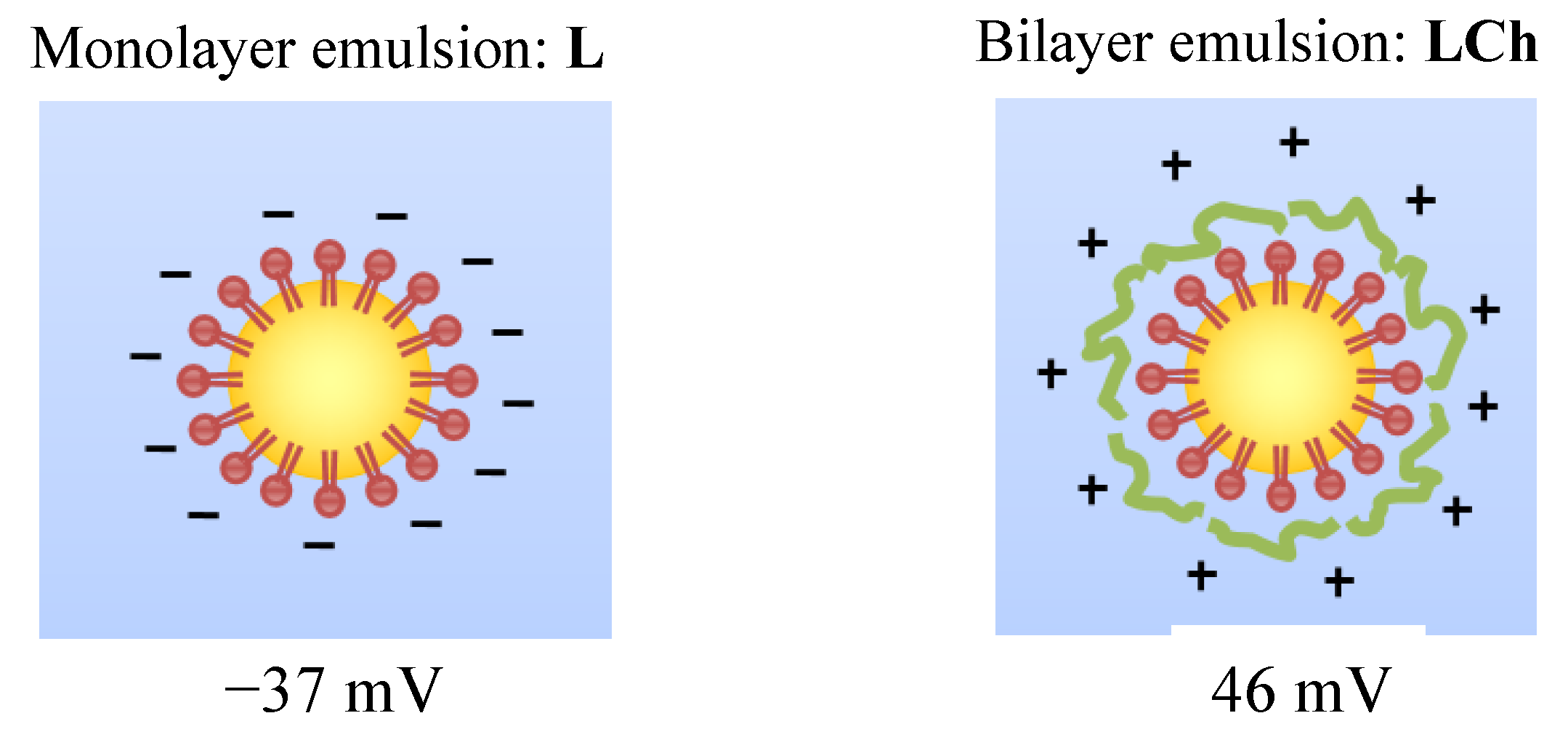
Figure 1 shows the schemes of the monolayer (L) and bilayer (LCh) systems with their respective ζ– potential values at pH 3. The electrostatic deposition of cationic chitosan onto the DSL-stabilized oil droplets was evidenced thought the inversion charge. In this sense, the droplet surface charge of monolayer emulsions of −37 mV turned to +46 mV for bilayer emulsions because of chitosan deposition. These results could be due to the opposite charges between DSL and chitosan molecules at this pH level, both being compounds mutually attracted.
Bilayer emulsions presented a monomodal DSD curve while a shoulder corresponding to a second population of larger droplet sizes was observed in DSD from monolayer systems (data not shown); D[2, 3] values for L and LCh emulsions were 0.32 and 0.26 µm, respectively. No significant (p > 0.05) changes in particle size were recorded during refrigerated storage.
The flow curves of the different systems were obtained from the rheological data fitting to the Power Law model equation (R
2 > 0.99). The apparent viscosity values of emulsions at 100 s − 1 (η100)—typical shear rate for food processes, such as stirring or mastication, flow through a pipe—were also calculated [
7]. According to
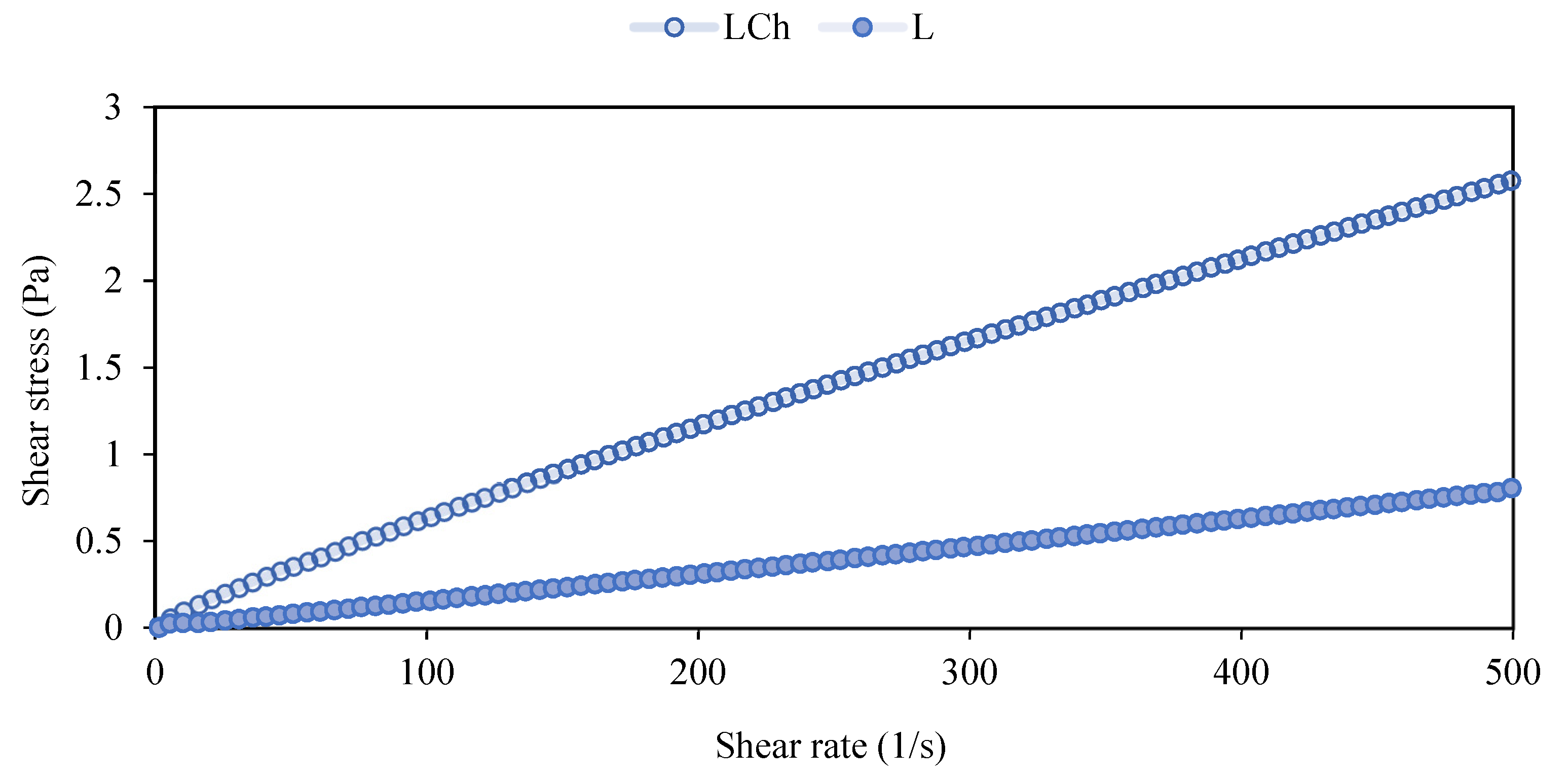
Figure 2, monolayer systems behaved as Newtonian fluids (
n~1), while the chitosan deposition into bilayer emulsions led to shear-thinning behavior (
n < 1). Additionally, a significant increase (
p < 0.05) in η
100 was recorded, resulting in 1.54 and 9.97 × 10
−3 Pa.s
n for L and LQ systems, respectively.
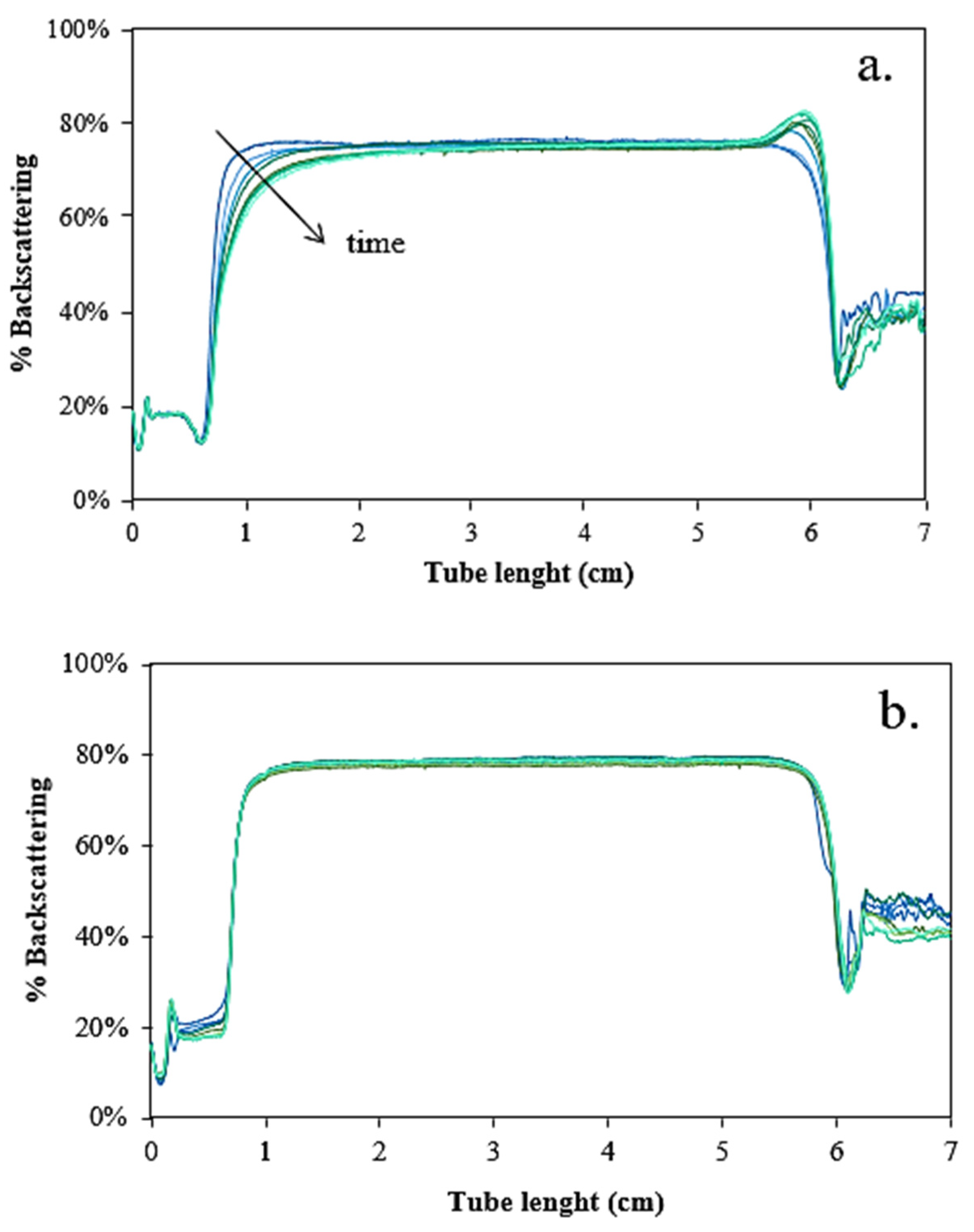
Regarding global stability, primary emulsions experienced creaming destabilization, which can be seen from their BS profiles. In contrast, secondary systems were more stable, with their BS profiles remaining unchanged over the storage period. This fact could be associated with the higher aqueous phase viscosity of bilayer emulsions, which would reduce the oil droplets’ movement (
Figure 3).
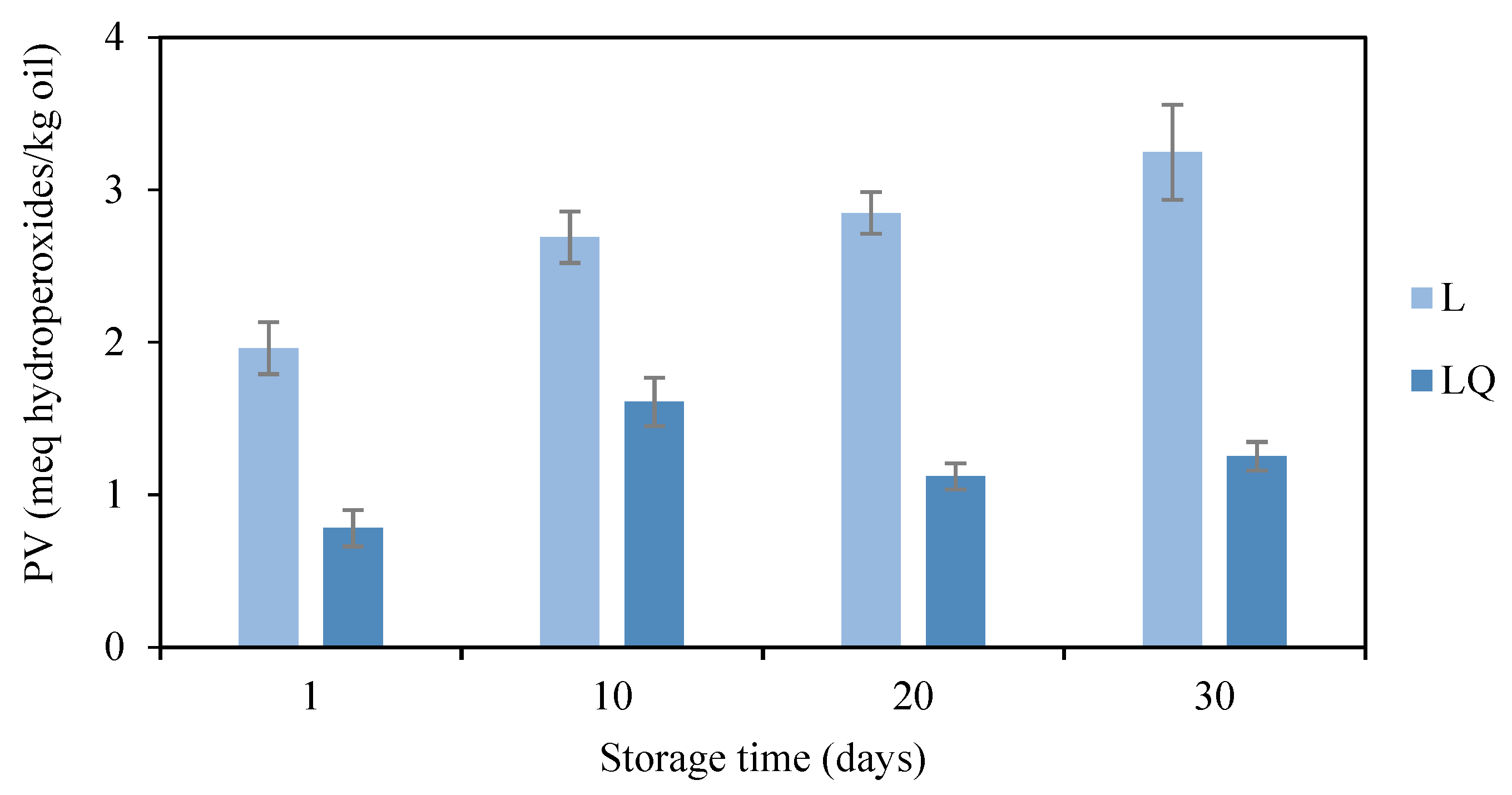
Bilayer emulsions with DSL and chitosan presented a lower PV and, therefore, higher oxidative stability than bulk oil and monolayer systems after 30 days of refrigerated storage (
Figure 4). This fact indicates the positive effect of the bilayer formed around the oil droplets to improve the protection against lipid oxidation. Some authors suggest that chitosan could act as a free radical scavenger, while others indicate that positively charged droplets could repel Fe
+ ions, reducing lipid oxidation [
8].
4. Conclusions
Mono- and bilayer emulsions containing chia oil were developed by applying the layer-by-layer technique. The electrostatic deposition of chitosan onto a DSL interfacial membrane to form a bilayer around the chia oil droplets was evidenced through the inversion charge at pH 3.
Bilayer emulsions presented smaller and monodisperse oil droplets and a better long-term stability than conventional systems. Additionally, bilayer emulsions provided higher protection against chia oil oxidation, recording lower PV values over the storage period. From these results, the bilayer emulsion proved to be an effective system to protect and deliver of omega-3 fatty acids from chia oil into functional foods.
Funding
This research received no external funding.
Institutional Review Board Statement
Not applicable.
Informed Consent Statement
Not applicable.
Data Availability Statement
Not applicable.
Acknowledgments
This work was supported by grant Ia ValSe-Food-CYTED (119RT0567) Spain, Universidad Nacional de La Plata (UNLP) (11/X907), and the ANPCyT (PICT 2016-0323), Argentina.
Conflicts of Interest
The authors declare no conflict of interest.
References
- Klinkesorn, U.; Sophanodora, P.; Chinachoti, P.; McClements, D.J.; Decker, E.A. Stability of Spray-Dried Tuna Oil Emulsions Encapsulated with Two-Layered Interfacial Membranes. J. Agric. Food Chem. 2005, 53, 8365–8371. [Google Scholar] [CrossRef] [Scilit] [PubMed]
- IUPAC. Standard methods for the analysis of oils, fats and derivates. In International Union of Pure and Applied Chemistry, Oxford, 7th ed.; Paquot, C., Hautfenne, A., Eds.; Blackwell Scientific Publications Inc.: Oxford, UK, 1992. [Google Scholar]
- AOCS. Official Methods and Recommended Practices of the American Oil Chemists' Society, 4th ed.; AOCS Press: Champaign. IL, USA, 1994. [Google Scholar]
- Julio, L.M.; Copado, C.N.; Diehl, B.W.; Ixtaina, V.Y.; Tomás, M.C. Chia bilayer emulsions with modified sunflower lecithins and chitosan as delivery systems of omega-3 fatty acids. LWT 2018, 89, 581–590. [Google Scholar] [CrossRef] [Scilit]
- Pan, L.G.; Tomás, M.; Añon, M.C. Effect of sunflower lecithins on the stability of water-in-oil and oil-in-water emulsions. J. Surfactants Deterg. 2002, 5, 135–143. [Google Scholar] [CrossRef] [Scilit]
- Shantha, N.C.; Decker, E. Rapid, Sensitive, Iron-Based Spectrophotometric Methods for Determination of Peroxide Values of Food Lipids. J. AOAC Int. 1994, 77, 421–424. [Google Scholar] [CrossRef] [Scilit] [PubMed]
- McClements, D.J. Food Emulsions: Principles, Practices, and Techniques; CRC Press: Boca Raton, FL, USA, 2004. [Google Scholar]
- Klinkesorn, U.; Sophanodora, P.; Chinachoti, P.; McClements, D.J.; Decker, E.A. Increasing the Oxidative Stability of Liquid and Dried Tuna Oil-in-Water Emulsions with Electrostatic Layer-by-Layer Deposition Technology. J. Agric. Food Chem. 2005, 53, 4561–4566. [Google Scholar] [CrossRef] [Scilit] [PubMed]
| Publisher’s Note: MDPI stays neutral with regard to jurisdictional claims in published maps and institutional affiliations. |
© 2022 by the authors. Licensee MDPI, Basel, Switzerland. This article is an open access article distributed under the terms and conditions of the Creative Commons Attribution (CC BY) license (https://creativecommons.org/licenses/by/4.0/).