


Abstract
Animal abuse, encompassing active cruelty and neglect, is an underreported animal welfare and public safety concern. In Hungary, the parallel administrative and criminal law definitions of animal cruelty create additional uncertainty for citizens, professionals, and authorities, particularly regarding which institution should receive and evaluate a report. Existing reporting pathways are unstructured, and rarely produce documentation that is directly usable in subsequent administrative or criminal proceedings. This study presents the concept design of a structured online citizen-reporting interface developed for the Hungarian regulatory context. The interface functions as a structured intake tool: it guides non-expert reporters through standardised, category-based data entry; supports the submission of contextual evidence, including photographs, videos and location data; and prepares structured case files for transmission to the competent authority. The concept was shaped by a preliminary stakeholder needs assessment, in which people knowledgeable in animal welfare issues and members of the general public participated. The system does not perform legal or veterinary welfare assessment; instead, it standardises the information available to the responsible administrative, investigative or expert veterinary actor. Anticipated benefits include improved completeness of initial reports, clearer routing between administrative and criminal pathways, support for reporting, and a documentation format compatible with downstream expert evaluation.
1. Introduction
Animal abuse, encompassing active cruelty and passive neglect, remains a multi-faceted animal welfare and public safety issue. It ranges from direct physical violence to deprivation of basic needs, and its broader relevance is supported by evidence linking animal abuse with interpersonal violence and other antisocial behaviours [1,2,3,4,5]. In Hungary, animal cruelty has been a criminal offence since 2004. A national police-based study covering 99 police stations reported 1169 animal-cruelty-related cases between July 2013 and December 2021, with proceedings initiated in 77.7% of reports [6]. This case volume, together with the documented association between animal abuse and interpersonal violence, highlights the need for earlier recognition, more accurate documentation, and more efficient routing of reports to competent authorities [5,6].
At the same time, Hungarian animal protection law and criminal law define and handle animal cruelty through partially overlapping but procedurally different frameworks [7,8]. This distinction is often unclear to laypersons and may delay the routing of reports to the competent authority. Despite increasing societal awareness, the detection and reporting of animal abuse cases remain significantly limited. Besides the lack of accessible, structured, and user-friendly reporting systems, underreporting may also result from uncertainty in recognising abuse, fear of retaliation or neighbourhood conflict, unclear division of responsibilities between authorities, limited feedback after reporting, and difficulties in collecting legally usable evidence [9,10,11]. Members of the public often encounter situations that may indicate animal welfare concerns but lack the necessary expertise or tools to interpret these observations accurately [9,10].
The proliferation of digital technologies and social media platforms has transformed how animal welfare issues are communicated and perceived. While these platforms have enhanced awareness and visibility, they have simultaneously contributed to the spread of misinformation and emotionally driven interpretations [11,12]. Visual content often lacks contextual information, leading to misinterpretation of animal conditions by non-expert observers. Anthropomorphic interpretations and emotional bias further exacerbate this issue, potentially resulting in both false-positive and false-negative assessments [9,12,13].
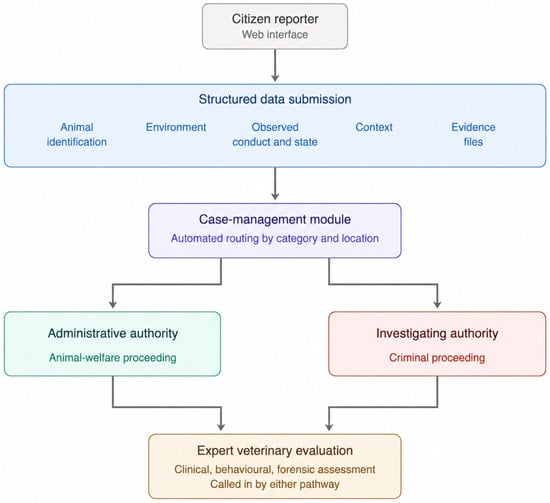
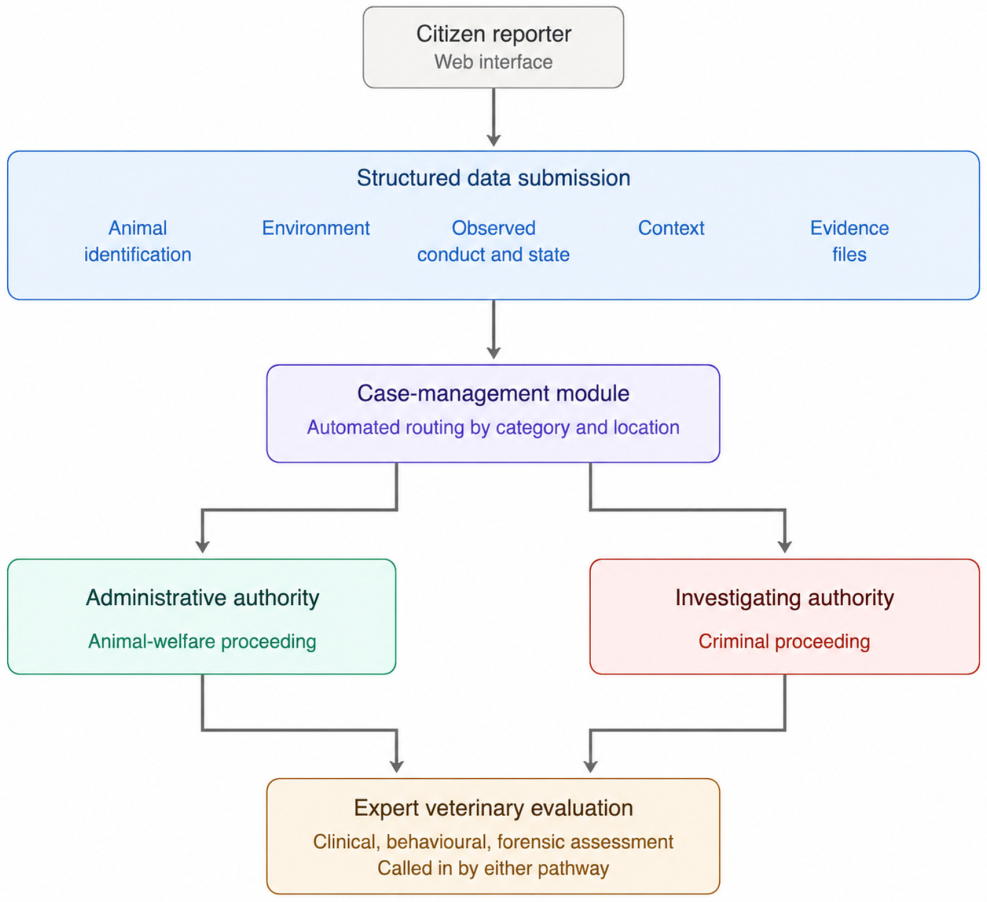
The gap between expert knowledge and public perception highlights the need for structured digital tools capable of guiding users through the reporting process (Figure 1) [9,10]. The aim of this study is to present the concept design of a structured online citizen-reporting interface developed for the Hungarian regulatory context.
Figure 1.
Conceptual workflow of the reporting interface. The citizen reporter submits a structured set of factual observations and evidentiary materials through the web interface. The case-management module routes the file to the competent administrative animal welfare authority, the investigating authority, or both, depending on the category and location of the case. Expert veterinary evaluation may be requested in either pathway. (Figure created by the authors).
2. Materials and Methods
2.1. Study Design
The present study is a concept design report. Its objective was to specify a structured online citizen-reporting interface capable of supporting the administrative and criminal evaluation of suspected animal abuse cases in Hungary. The development process consisted of three steps: mapping the legal and procedural requirements of animal abuse reporting in Hungary; conducting a preliminary stakeholder needs assessment among professionals dealing with animal protection cases and members of the public; and translating these findings into a structured web-based reporting workflow [7,8].
The system was not subjected to empirical validation in the present study. Therefore, the manuscript does not claim that the interface has already reduced the number of animal abuse cases or improved reporting accuracy in practice. These outcomes require subsequent usability testing and field validation.
2.2. Preliminary Stakeholder Needs Assessment
The conceptual plan was informed by a preliminary assessment of the needs of stakeholders, which included two groups: professionals experienced in animal protection procedures and members of the general public. Semi-structured interviews were conducted with five individuals involved in animal protection matters (police officer, notary, judge, forensic veterinarian, head of an animal protection organisation). The interviews focused on current reporting practices, recurring deficiencies in citizen reports, evidentiary limitations, and the type of information considered necessary for subsequent professional or legal evaluation.
A self-administered questionnaire was distributed among members of the general public. A total of 238 respondents completed the questionnaire. The survey explored previous experiences with observing suspected animal abuse, willingness to report, perceived barriers to reporting, uncertainty regarding competent authorities, and attitudes toward a structured online reporting platform.
The interview and questionnaire data were used as a needs assessment tool rather than as a standalone empirical outcome. Their function was to inform the design of the interface, including the wording of guided prompts, the distinction between mandatory and optional fields, the possibility of anonymous reporting, and the structure of evidence submission.
2.3. System Design Principles
The interface was designed according to the following key principles:
- Accessibility: The system must be usable by non-expert individuals without prior training.
- Standardisation: Structured input fields reduce ambiguity and improve consistency.
- Evidence-Based Input: Integration of multimedia uploads supports objective evaluation.
- Guided Assessment: Welfare-based prompts assist users in interpreting observed conditions [9,10,14].
2.4. Reporting Workflow Structure
The reporting process is organised into predefined categories, including animal identification, environmental conditions, and welfare indicators (Table 1). Users are required to provide information related to animal identification, including species, breed, and approximate age. This is followed by the description of environmental conditions, such as housing, hygiene, and the availability of space. The interface then collects data on observable welfare indicators, including the animal’s physical condition and behaviour. In addition, users must provide contextual information, such as the location of the observation. Finally, the system allows the submission of supporting evidence in the form of images and videos. Each section is supported by guided prompts and examples designed to minimise subjective interpretation.
Table 1.
Structure of the reporting system, including main data categories, their descriptions, and functional roles in the reporting process.
3. Results
3.1. Architecture and Operation of the Reporting Interface
The reporting interface was designed as a website accessible without prior registration. The reporter is guided through a sequential workflow in which each step contains short, neutral prompts. The wording is observation-focused and avoids accusatory or diagnostic terminology, so that the submitted information consists of factual descriptions rather than lay legal or veterinary conclusions.
Mandatory fields ensure a minimum dataset for procedural triage, while optional fields allow additional contextual detail. The system does not determine whether animal abuse has occurred. Instead, it prepares a structured case file for downstream evaluation by the competent authority.
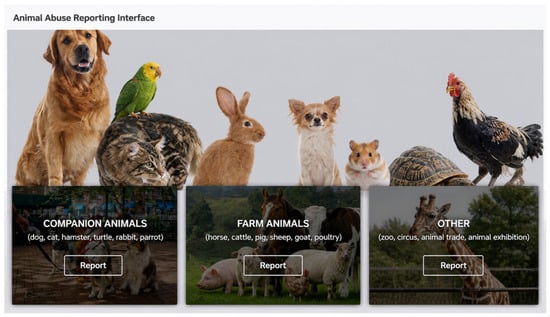
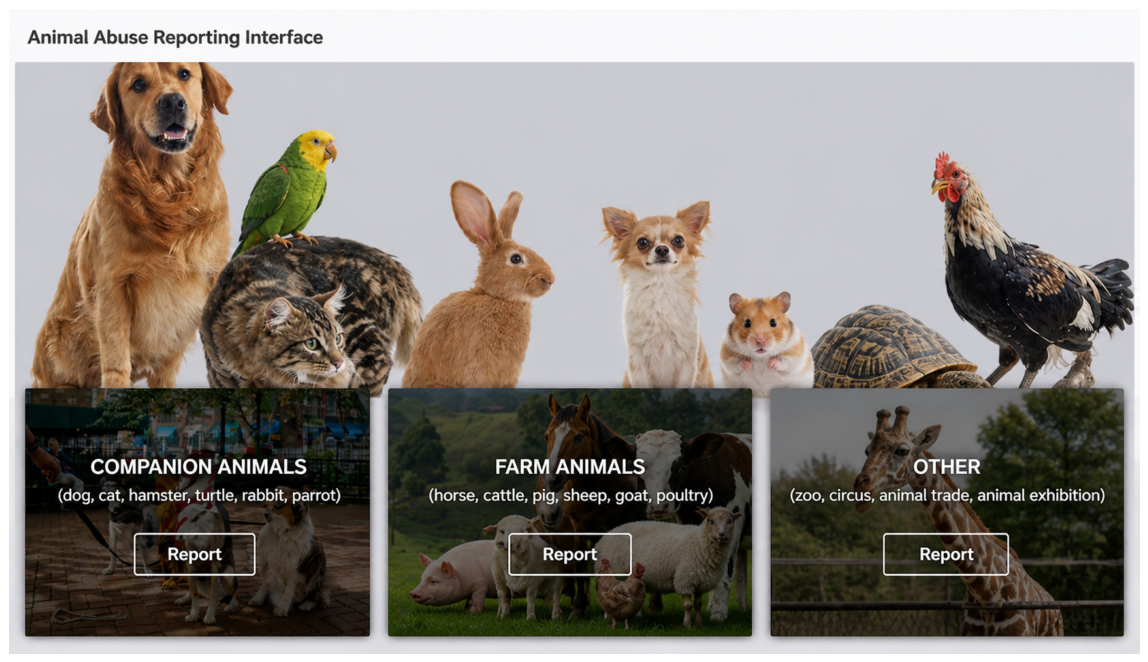
The developed reporting interface provides a structured and user-friendly environment for submitting animal abuse reports. The homepage of the system is organised into clearly defined categories based on the type and use of animals, thereby facilitating intuitive navigation for users with varying levels of experience. In addition to structured textual data entry, the interface allows users to upload photographic evidence directly at the time of reporting, thereby supporting real-time visual documentation and facilitating more objective case evaluation by professionals [12,13]. As shown in Figure 2, the interface distinguishes between companion animals, farm animals, and other categories, such as animals involved in entertainment or trade. This categorisation allows users to select the most relevant reporting pathway. The design of the interface prioritises accessibility and simplicity, ensuring that non-expert users can easily initiate reports without requiring prior knowledge of legal or animal welfare frameworks. At the same time, the structured layout supports the collection of standardised information, which is essential for subsequent evaluation by professionals. The interface was developed in Hungarian; however, its structure is language-independent and can be adapted to other linguistic and regulatory contexts.
Figure 2.
Homepage of the developed animal abuse reporting interface, illustrating the three principal entry categories: companion animals, farm animals and other contexts, including animals involved in entertainment, exhibition or trade. The operational interface was developed in Hungarian; the visible labels in the figure were translated into English for presentation and manuscript purposes. (Screenshot from the authors’ reporting interface).
3.2. Identified and Anonymous Reporting
The interface supports both identified and anonymous reporting. Anonymous reports are routed in the same manner as identified reports; however, the receiving authority is informed of the anonymous status, because the evidentiary weight and follow-up possibilities differ from those of an identified submission.
To reduce the risk of misuse, the interface requires factual, verifiable information. This structure discourages purely accusatory or emotionally framed submissions and facilitates initial credibility assessment by the receiving authority.
3.3. Improvement in Reporting Accuracy
The implementation of structured categories and guided prompts is expected to reduce common reporting errors, including:
- incomplete or inconsistent descriptions;
- misinterpretation of normal behaviour;
- lack of contextual information.
The use of predefined categories enhances data comparability and usability.
3.4. Stakeholder Needs Identified During Preliminary Assessment
The preliminary stakeholder assessment indicated that the two groups involved in or affected by animal abuse reporting emphasised different aspects of the reporting process. Animal protection experts emphasised procedural uncertainty and the frequent lack of actionable data in citizen reports. Their concerns were related mainly to unclear territorial competence and the difficulty of deciding whether a case should be handled through an administrative animal welfare pathway, a criminal pathway, or both.
Members of the general public reported different barriers. Their concerns focused on uncertainty in recognising abuse, not knowing which authority to contact, fear of retaliation or neighbourhood conflict, and lack of confidence that a report would lead to action. These findings supported the use of simple prompts, clearly separated reporting categories, mobile-compatible access, and the possibility of anonymous reporting.
Across the two groups, one common theme emerged: open-text reporting alone is insufficient. Professionals require structured and legally relevant data, while laypersons require guidance that helps them distinguish observable facts from emotional interpretation. The interface therefore functions as a translation layer between citizen observation and professional case evaluation.
4. Discussion
The present study describes the concept design of a structured online citizen-reporting interface for suspected animal abuse cases in Hungary. Its central contribution is the standardisation of the initial information submitted by non-expert reporters. This distinction is important because the first submission may determine whether the competent authority can act efficiently [6,9,13].
The Hungarian regulatory context makes structured reporting particularly relevant. The administrative and criminal definitions of animal cruelty overlap but are not identical, and the same lay observation may require different procedural responses [7,8]. A structured interface can reduce this uncertainty by collecting the factual elements needed for preliminary routing.
The need for such a system is also supported by previous Hungarian police-based research indicating that animal-cruelty-related reports may lead to official proceedings in a substantial proportion of cases [6]. However, official action depends on whether the report contains information that is sufficiently complete, locatable and interpretable. The proposed interface addresses this gap by requiring the reporter to provide core factual data.
The legal and forensic value of the interface lies in its capacity to preserve the structure of the first observation [9,13]. In administrative animal welfare proceedings, the structured report may accelerate initial fact-finding by providing the competent authority with a classified minimum dataset. In criminal proceedings, the report cannot replace expert evidence, but it may provide a factual basis for further investigation [8,13].
For this reason, the interface deliberately avoids assigning severity scores, welfare ratings or diagnostic labels. Such interpretation would exceed the competence of most lay reporters and could introduce bias into later proceedings. Instead, the system records observable facts, links evidence files to the corresponding data fields, and preserves metadata relevant to the evidentiary value of photographs and videos where legally and ethically permissible [13].
The possibility of anonymous reporting is a necessary but sensitive element of the system [11]. In many animal abuse cases, the reporter may be a neighbour, employee, family member or otherwise dependent person who fears retaliation or social conflict. At the same time, anonymous reporting carries a higher risk of misuse, including malicious, retaliatory or commercially motivated reports [9,11]. The interface addresses this risk through structure rather than exclusion. Anonymous reports are accepted, but they must contain verifiable factual information such as location, animal category, observed conduct and contextual evidence. The receiving authority is informed that the report was submitted anonymously, allowing it to assess the evidentiary weight accordingly. This approach balances the need to lower reporting barriers with the need to protect authorities and animal keepers from unfounded allegations.
Several limitations must be acknowledged. First, the present study reports the concept design of the interface and does not provide empirical validation of its performance. Therefore, claims regarding improved reporting accuracy, reduced administrative burden or faster intervention remain anticipated benefits that require future testing. Second, the effectiveness of the system depends on user compliance; incomplete, inaccurate or intentionally misleading input may still occur. However, these limitations are not specific to the proposed online interface, as incomplete, inaccurate or intentionally misleading reports may also occur in traditional reporting channels. Third, anonymous reporting may reduce the evidentiary weight of the report in subsequent proceedings. Fourth, the interface addresses the citizen-to-authority transmission stage only; it cannot resolve institutional capacity constraints, lack of field resources or delays within the receiving authorities. Finally, the system is designed for the Hungarian legal context, and adaptation to other jurisdictions would require modification of the routing logic and legal data fields.
Future work should focus on empirical validation of the interface under real or simulated reporting conditions. Further development may include interoperability with official databases, automated territorial routing, and carefully validated artificial intelligence-based image support tools [10].
5. Conclusions
The present study has presented the concept design of a structured online citizen-reporting interface for suspected animal abuse cases in Hungary. The principal design choice is the direct translation of lay observations into structured factual data that can support administrative or criminal routing. The system reduces the risk of subjective, emotionally framed or incomplete reports while preserving the role of competent authorities and experts.
The interface supports both identified and anonymous reporting, incorporates guided prompts and enables multimedia evidence submission. The preliminary stakeholder needs assessment indicated that animal protection experts and members of the public have different expectations of a reporting system: professionals require complete and interpretable data, while laypersons require accessible guidance, confidentiality options and clear reporting pathways.
No empirical performance claims are made at this stage. Future research should validate the system’s usability, the quality of generated case files, and its practical contribution to administrative and criminal animal welfare procedures. Within these limits, the proposed interface represents a feasible step toward more standardised, transparent and professionally usable citizen reporting of suspected animal abuse.
Author Contributions
Conceptualisation, K.F. and A.K.; Methodology, A.K.; Software, A.K.; Validation, G.L., K.F. and A.K.; Formal Analysis, A.K.; Investigation, G.L., K.F. and A.K.; Resources, A.K.; Data Curation, A.K.; Writing—Original Draft Preparation, A.K.; Writing—Review and Editing, K.F. and G.L.; Visualisation, A.K.; Supervision, K.F.; Project Administration, A.K.; Funding Acquisition, K.F. All authors have read and agreed to the published version of the manuscript.
Funding
This research received no external funding.
Institutional Review Board Statement
Ethical review and approval were waived for this study due to the preliminary stakeholder needs assessment involved adult, voluntary participants. The study did not involve the processing of personal data.
Informed Consent Statement
Informed consent was obtained from all participants involved in the preliminary stakeholder needs assessment. Questionnaire submission was considered consent to participate.
Data Availability Statement
The data presented in this study are available on request from the corresponding author due to ethical and privacy restrictions concerning interview notes/transcripts and questionnaire responses. The website of the reporting interface can be found here: Főoldal-Állatbántalmazás Bejelentő, https://www.moonshot-test.com/allattudomanyi-concept/ (accessed on 9 June 2026).
Conflicts of Interest
The authors declare no conflicts of interest.
References
- Kiss, A.; Lorászkó, G.; Fodor, K. Az állatvédelem társadalmi, jogi és közegészségügyi vonatkozásai. Magy. Állatorvosok Lapja 2020, 142, 619–624. [Google Scholar]
- Gullone, E. Conceptualising Animal Abuse with an Antisocial Behaviour Framework. Animals 2011, 1, 144–160. [Google Scholar] [CrossRef] [Scilit] [PubMed]
- Gullone, E. Risk Factors for the Development of Animal Cruelty. J. Anim. Ethics 2014, 4, 60–79. [Google Scholar] [CrossRef] [Scilit]
- Newberry, M. Associations between different motivations for animal cruelty, methods of animal cruelty and facets of impulsivity. Psychol. Crime Law 2018, 24, 500–526. [Google Scholar] [CrossRef] [Scilit]
- Monsalve, S.; Ferreira, F.; Garcia, R. The connection between animal abuse and interpersonal violence: A review from the veterinary perspective. Res. Vet. Sci. 2017, 114, 18–26. [Google Scholar] [CrossRef] [Scilit] [PubMed]
- Lorászkó, G.; Vetter, S.; Rácz, B.; Sótonyi, P.; Ózsvári, L. Comparison of Police Data on Animal Cruelty and the Perception of Animal Welfare NGOs in Hungary. Animals 2023, 13, 1224. [Google Scholar] [CrossRef] [Scilit] [PubMed]
- Nemzeti Jogszabálytár. Act XXVIII of 1998 on the Protection and Welfare of Animals; Nemzeti Jogszabálytár: Budapest, Hungary, 1999.
- Nemzeti Jogszabálytár. Act C of 2012 on the Criminal Code, Section 244; Nemzeti Jogszabálytár: Budapest, Hungary, 2012.
- Niemiec, R.; Kogan, L.R. Animal Abuse Investigations: Challenges and Recommendations to Improve Animal and Human Welfare. Animals 2024, 14, 3602. [Google Scholar] [CrossRef] [Scilit] [PubMed]
- Sivadasan, S.; Mohamed Jisar, C.; Rasmina; Murshida Farsana, V.; Shijaz, K. Abuse Reporting System. In Proceedings of the 2024 IEEE Recent Advances in Intelligent Computational Systems (RAICS), Kothamangalam, India, 16–18 May 2024; pp. 1–6. [Google Scholar] [CrossRef] [Scilit]
- Cover, R.; Beckett, J.; Brevini, B.; Lumby, C.; Simcock, R.; Thompson, J.D. Reporting online abuse to platforms: Factors, interfaces and the potential for care. Convergence 2026, 32, 142–158. [Google Scholar] [CrossRef] [Scilit]
- Pettina-Rodriguez, C.; Chávez-Chuquimango, M. The use of Photography as a Prevention Tool Against Animal Abuse Through Instagram. In Proceedings of the International Conference on Communication and Applied Technologies; Atlantis Press: Dordrecht, The Netherlands, 2024; pp. 105–117. [Google Scholar]
- Touroo, R.; Baucom, K.; Kessler, M.; Smith-Blackmore, M. Minimum standards and best practices for the clinical veterinary forensic examination of the suspected abused animal. Forensic Sci. Int. Rep. 2020, 2, 100150. [Google Scholar] [CrossRef] [Scilit]
- Mellor, D.J.; Beausoleil, N.J.; Littlewood, K.E.; McLean, A.N.; McGreevy, P.D.; Jones, B.; Wilkins, C. The 2020 Five Domains Model: Including Human–Animal Interactions in Assessments of Animal Welfare. Animals 2020, 10, 1870. [Google Scholar] [CrossRef] [Scilit] [PubMed]

Disclaimer/Publisher’s Note: The statements, opinions and data contained in all publications are solely those of the individual author(s) and contributor(s) and not of MDPI and/or the editor(s). MDPI and/or the editor(s) disclaim responsibility for any injury to people or property resulting from any ideas, methods, instructions or products referred to in the content. |
© 2026 by the authors. Licensee MDPI, Basel, Switzerland. This article is an open access article distributed under the terms and conditions of the Creative Commons Attribution (CC BY) license.