1. Introduction
The Great-tailed Grackle,
Quiscalus mexicanus, originally had a distribution restricted to the Gulf of Mexico coast. In pre-Columbian times, the Aztec Emperor Ahuízotl promoted its introduction to the central region of the country, favoring its dispersal in environments with abundant water. This species was valued for its varied vocalizations, large body size, iridescent blue-to-black plumage, long tail, and bright yellow eyes [
1]. The capture, release, and protection policies established by this ruler facilitated its adaptation to human populations [
2]. Indigenous peoples referred to it as “Teozanatl” (divine bird), from which the current name “Zanate” is derived [
1].
Currently,
Q. mexicanus is considered an exploratory species, present in urbanized environments. It is observed in wetlands, parks, gardens, and beaches, feeding on food waste, insects, and fruits, as well as utilizing garbage containers and taking refuge in dense vegetation for nesting [
1,
3,
4]. Its abundance decreases in the presence of noise and pedestrian activity but increases with greater food availability and plant diversity, which are key factors in its adaptive success in urban environments [
4].
Global urban expansion represents a risk to wetlands and the birds that inhabit them, as it destroys the natural vegetation used for perching, resting, nesting, and feeding. Species with higher adaptive capacity ensure their persistence over less tolerant ones. Birds are environmental indicators sensitive to changes in the structure and composition of urban areas, and their abundance enables the evaluation of urban ecosystem health [
5]. In this context, the present study aimed to document habitat conditions, behavior, and abundance of
Q. mexicanus in two wetlands in Mazatlán, Sinaloa (Mexico), to determine whether significant differences exist.
2. Materials and Methods
2.1. Study Area
The El Yugo wetland is located between the coordinates −106.4798° W, 23.30604° N, and −106.48583° W, 23.29888° N, with an approximate surface area of 10.18 ha. The Parque Central wetland is located between −106.444° W, 23.23953° N and −106.43833° W, 23.23619° N, with an approximate surface area of 7.66 ha. Both are situated on the northern Pacific coast of Mexico, in the city of Mazatlán, Sinaloa [
6].
2.2. Methods
The degree of urbanization and land use was determined through maps developed from data provided by CONABIO [
7] and CONAGUA [
8], processed using the open-source software QGIS 3.34.6 Prizren. The percentage of urban surface and natural vegetation cover was estimated for each wetland. Behavioral patterns, habitat conditions, and the abundance of
Q. mexicanus were recorded on five fixed dates (2 January, 23 March, 29 April, 22 July, and 14 August 2025) in two wetlands, with three sampling points per wetland. Abundance was assessed using the point count method [
9], conducted between 6:00 and 10:00 a.m. for 30 min per point. An observation radius of ≈6 m, defined by the 6.9° field of view of Nikon 10 × 42 M7 binoculars, encompassed a circular area of ≈113 m
2 where individuals of the target species were systematically recorded. Surveys were performed by the same observer to ensure consistency, and the 100 m spacing between points guaranteed spatial independence. Equipment included Nikon 10 × 42 M7 binoculars (Nikon, Tokyo, Japan), a Canon ELPH 190 IS PowerShot digital camera (Canon, Tokyo, Japan) (10× optical zoom), field data sheets, and bird identification guides [
10,
11].
Abundance data were processed using the opensource software PAST 5.1 [
12], generating basic statistics and applying analysis of variance (ANOVA) and complementary statistical tests to evaluate whether significant differences exist between wetlands with different degrees of urbanization and habitat conditions; with the hypothesis that differences in these conditions determine the behavior and abundance of the species.
3. Results
3.1. Habitat Conditions and Behavior
3.1.1. Behavior
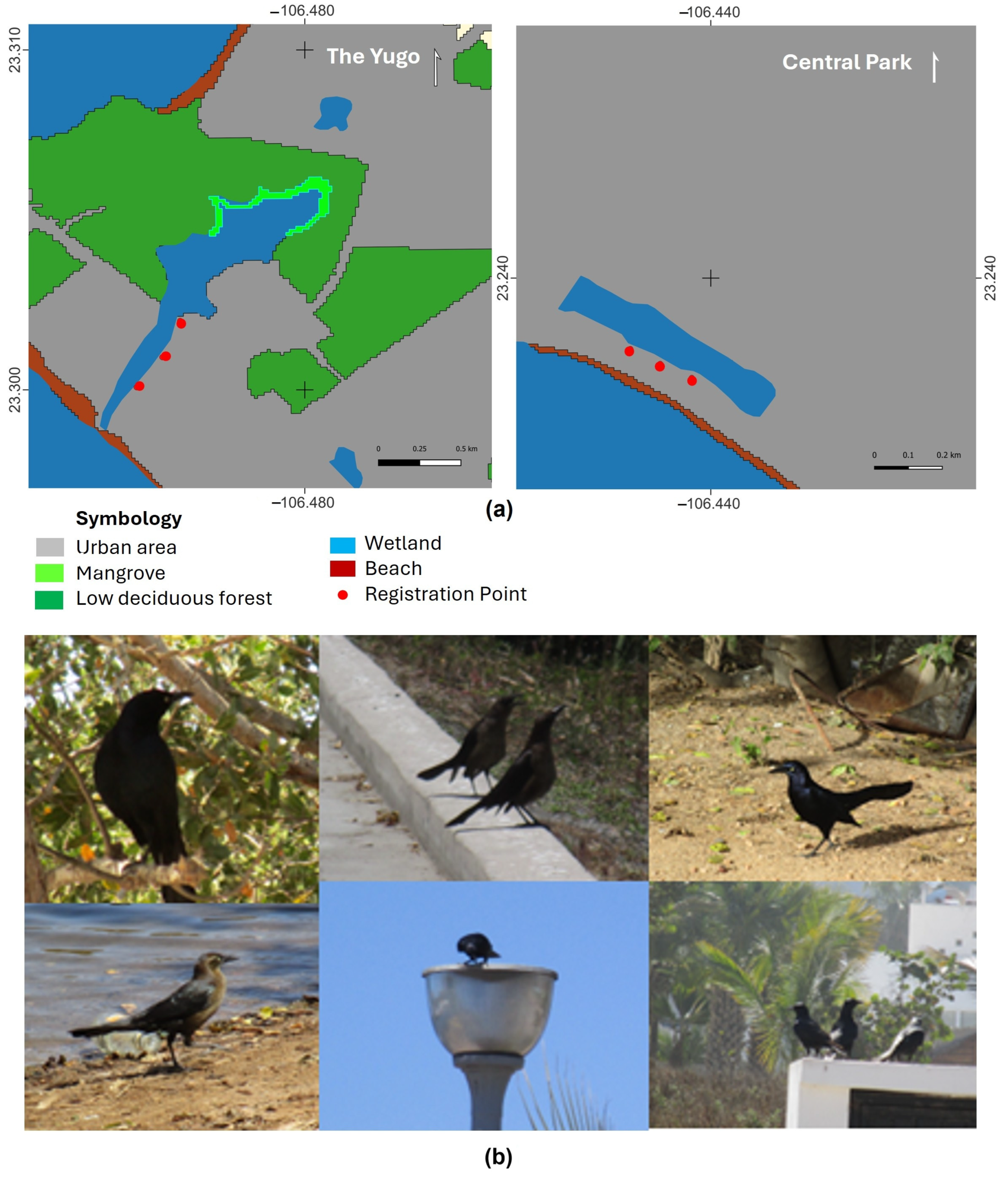
In El Yugo, birds use both natural resources (wetland, soil) and anthropogenic resources (garbage containers), as well as engaging in nesting and resting. In Parque Central, feeding occurs in more urban spaces (sidewalks), with less evidence of nesting, which reflects a less suitable habitat for reproduction (
Figure 1).
3.1.2. Vegetation
El Yugo presents the natural vegetation with species of mangrove
Conocarpus erectus L.,
Laguncularia racemosa (L.) C.F. Gaertn and other species:
Gossypium hirsutum L.,
Pithecellobium dulce (
Roxb.),
Hippomane mancinella L.,
Prosopis juliflora (
Sw.)
DC.,
Crateva tapia L.,
Guazuma ulmifolia Lam.,
Vallesia glabra (
Cav.) Link,
Hippomane mancinella L. and
Ehretia tinifolia L., which provide shelter and food. In contrast, Parque Central has a mixture of introduced species (
Eucalyptus,
Casuarina,
Tamarix), but with lower natural vegetation cover, thereby limiting habitat quality (
Figure 1).
3.1.3. Human Activities
In El Yugo, tourism and recreational activities predominate; although they generate pressure, they are less intensive than the urban recreational activities in Parque Central, where the constant presence of people and infrastructure reduces the availability of undisturbed spaces.
3.1.4. Urban Infrastructure and Degree of Urbanization
El Yugo maintains moderate infrastructure (utility poles, avenues, hotels), whereas Parque Central is surrounded by buildings and roads, increasing habitat fragmentation. Parque Central, with a 100% urbanized environment and vegetation dominated by exotic species, provides limited conditions for reproduction and shelter of
Q. mexicanus. The species showed a preference for resting on light poles and sidewalks, as well as feeding along edges with accumulated water and moist soil covered with dry leaves, which reflects adaptation to available urban resources (
Figure 1).
In contrast, The Yugo wetland, with 52% natural vegetation cover (tropical dry forest and mangrove) and 48% urban area, designated under the Ramsar Convention, provided more favorable habitats. There, the species preferred wooded mangrove areas and tropical dry forest, which coincides with the higher abundance and population stability recorded (
Figure 1).
3.2. Abundance
El Yugo wetland showed a cumulative abundance of 530 individuals during the sampling period, whereas the Parque Central wetland recorded 150 individuals, additional results are provided in the
Supplementary Material, where
Figure S1 illustrates (a) the plot of
Q. mexicanus abundance and (b) the comparative boxplot of its abundance. In addition,
Table S1 summarizes the abundance of
Q. mexicanus recorded for each month and wetland, offering complementary information for the interpretation of the observed patterns.
3.2.1. Descriptive Statistics
Descriptive statistical analysis showed clear differences in the abundance of
Q. mexicanus between the two wetlands. In El Yugo, with lower urbanization and greater natural vegetation cover, the mean was 106 individuals, with a median of 132 and a range of 54–138. In contrast, in Parque Central, a fully urbanized site with scarce vegetation, the mean was 30, with a median of 31 and a range of 14–51 (
Table 1).
The coefficient of variation was higher in Parque Central (51.6%) than in El Yugo (37.6%) (see
Table 1), indicating greater population instability in more urbanized environments. Negative skewness at El Yugo suggests that abundance values tend toward higher levels, whereas the slight positive skewness observed in Parque Central reflects a predominance of lower values. Negative kurtosis at both sites indicates flatter-than-normal distributions, with greater dispersion at El Yugo (
Table 1).
3.2.2. Anova
The analysis of variance (ANOVA) (see
Table 2) showed highly significant differences in the abundance of
Q. mexicanus between El Yugo and Parque Central (F = 15.82,
p = 0.0041). The effect size (ω
2 = 0.5971) indicates that nearly 60% of the variation in abundance is explained by the degree of urbanization and vegetation of the wetlands that was observed.
The ICC (0.7477) indicated that variability between wetlands was greater than within-wetland variability. Levene’s test based on means indicated heterogeneity of variances (p = 0.0046), although the median-based test was not significant. Welch’s test confirmed differences between groups even under unequal variances (p = 0.0098). The Bayes factor (13.25) provided strong evidence in favor of the unequal means hypothesis.
4. Discussion
The differences observed in the abundance of Q. mexicanus between El Yugo and Parque Central can be explained by the combined influence of vegetation cover, food availability, human disturbance, and urban infrastructure. Although El Yugo (8 ha) and Camarón Parque-Central (3.03 ha) differ in size, this variation did not affect the abundance statistics, since point counts were used with a fixed radius and the same sampling effort at each site (three points spaced 100 m apart, with 30 min of observation at each). Thus, the difference in area does not directly affect the estimation of abundance, because the effort was standardized.
In El Yugo, the presence of native vegetation such as mangroves (Conocarpus erectus, Laguncularia racemosa) and tropical dry forest species provides shelter, nesting sites, and natural food sources. These conditions favor population stability and higher abundance, in contrast to Parque Central, where exotic species dominate and habitat fragmentation reduces reproductive and persistence opportunities.
Food availability is also a key factor. In El Yugo, birds exploit both natural resources (wetland soil, mangrove areas) and anthropogenic sources (garbage containers), broadening feeding opportunities while maintaining access to natural habitats. In Parque Central, feeding is concentrated in urbanized areas such as sidewalks and edges with accumulated water, reflecting adaptation to urban resources but reduced suitability for reproduction.
Human disturbance further differentiates the sites. Although tourism and recreational activities occur in El Yugo, they are less intensive than the constant human presence in Parque Central, where urban infrastructure limits undisturbed spaces. This contributes to greater population instability. Urban infrastructure amplifies this effect: while El Yugo maintains moderate development, Parque Central is fully urbanized, increasing fragmentation and reducing ecological functions.
Overall, the findings highlight that the abundance and stability of Q. mexicanus populations are strongly influenced by the interaction of native vegetation, food resource diversity, human activity intensity, and degree of urbanization. Conserving natural vegetation in urban wetlands is essential to sustain bird populations and mitigate the impacts of urbanization.
The magnitude of the effect confirms that the degree of urbanization is a determining factor in species abundance in wetlands The heterogeneity of variances reflects that populations in fully urbanized environments are more unstable, whereas those in environments with natural vegetation remain more consistent.
5. Conclusions
The abundance of Q. mexicanus is significantly higher and more stable in El Yugo wetland, which has lower urbanization and greater vegetation cover, whereas in Parque Central, a highly urbanized environment, the population is reduced and more variable. This supports the hypothesis that natural vegetation cover, lower urbanization, and conservation policies are key factors in sustaining healthy populations in wetlands within urban areas.
From an ecological perspective, it can be concluded that urbanization reduces the abundance and stability of wetland-associated bird populations. Natural vegetation in El Yugo appears to provide adequate shelter and resources, favoring the persistence of Q. mexicanus, whereas intense urbanization in Parque Central limits its presence and generates more unstable populations. Relative variability was higher in Parque Central, reflecting more unstable populations in hostile urban environments. The data distribution suggests that high abundances predominate in El Yugo, whereas low values prevail in Parque Central.
Statistical and ecological results converge in indicating that urbanization is a key factor in the decline of wetland bird populations. The contrast between wetlands demonstrates that Parque Central, with a fully urbanized environment and vegetation dominated by exotic species, offers limited habitats that force Q. mexicanus to use light poles, sidewalks, and water-filled margins for resting and feeding, reflecting adaptation to urban resources. On the other hand, El Yugo, with more than half of its surface covered by natural vegetation and protected under the Ramsar Convention, provides higher-quality habitats, where the species showed preference for wooded mangrove areas and tropical dry forest areas. These results confirm that natural vegetation and conservation policies are decisive in maintaining more abundant and stable populations in urban environments.