Proceeding Paper

Antimicrobial Properties of Lactic Acid Bacteria Isolated from Moroccan Camel Meat for Natural Food Preservation †

1
Bioprocess & Environment Team, LASIME Research Laboratory, Agadir Superior School of Technology, Ibn Zohr University, Agadir CP 80150, Morocco
2
Future Ready Food Safety Hub (FRESH) (A Joint Alliance by A*STAR, SFA and NTU), Nanyang Technological University, 50 Nanyang Avenue, N1, B3C-41, Singapore 639798, Singapore
*
Author to whom correspondence should be addressed.
Presented at the 6th International Electronic Conference on Foods, 28–30 October 2025; Available online: https://sciforum.net/event/foods2025.
Biol. Life Sci. Forum 2026, 56(1), 29; https://doi.org/10.3390/blsf2026056029
Published: 27 April 2026
(This article belongs to the Proceedings of The 6th International Electronic Conference on Foods)

Abstract

Lactic acid bacteria (LAB) are valuable natural bio-preservatives due to their ability to produce antimicrobial compounds such as organic acids, hydrogen peroxide, and bacteriocins. This study aimed to isolate and characterize LAB from Moroccan camel meat and evaluate their antimicrobial potential against major foodborne pathogens. From 2304 isolates obtained from fresh, fermented, and dried camel meat, 115 exhibited antimicrobial activity against Listeria monocytogenes, Salmonella enterica Enteritidis, and Staphylococcus aureus. Seven isolates demonstrated broad-spectrum activity with inhibition zones ranging from 15 to 30 mm. Physiological and biochemical tests, combined with API 20 Strep identification, revealed that most isolates belonged to Enterococcus faecium. These isolates are promising candidates for natural preservation of camel meat, offering a sustainable alternative to synthetic preservatives. These findings highlight the potential of camel-meat-associated lactic acid bacteria as natural, clean-label bio-preservatives, particularly in arid regions where camel meat serves as a vital protein source and limited cold-chain infrastructure increases the risk of spoilage.

1. Introduction

Meat and meat products are essential components of the human diet, providing high-quality protein, amino acids, and micronutrients such as vitamin B12. However, their high moisture and nutrient content make them susceptible to spoilage and foodborne pathogenic bacteria. There is a growing interest in natural preservation methods that ensure food safety while reducing chemical additives [1,2]. Recent reviews highlight a marked global shift toward natural/clean-label preservation strategies in meat processing, driven by consumer expectations, regulatory constraints on certain additives, and the need to maintain safety and quality while reducing synthetic preservatives [3,4,5,6]. In developing and resource-limited settings, meat preservation is further challenged by cold-chain interruptions and variable storage/transport conditions, which can accelerate spoilage and contamination risks and thereby increase interest in robust, low-infrastructure preservation hurdles [5,6].
Lactic acid bacteria (LAB) are Gram-positive, non-spore-forming microorganisms recognized for their Generally Recognized as Safe status. LAB are known to inhibit spoilage and pathogenic microorganisms through acidification and the production of antimicrobial compounds, including organic acids, hydrogen peroxide, and bacteriocins [3,4]. Bacteriocin-producing LAB have been used in fermented meat products to enhance safety and shelf life [5,6,7]. However, their effectiveness depends on strain and product conditions, necessitating the search for new strains adapted to specific meat types [8,9,10]. Researchers using traditional culture methods have recovered LAB with antimicrobial activity from fermented goat-meat sucuk, naturally fermented beef jerky, and fermented mutton sausages. These findings suggest that these meats can serve as useful sources of Weissella and Lactiplantibacillus strains for bioprotective starter cultures [11,12].
Camel meat is an underutilized protein source in arid regions. While camel milk has been extensively studied for its diverse LAB flora [13], camel meat remains poorly explored in Morocco and similar environments. Preservation is constrained by difficulties in maintaining safe conditions along the supply chain, increasing spoilage and contamination risks [14]. Traditional products such as Khlii (drying, salting, and cooking in fat) remain widely used to extend shelf life at room temperature in low-infrastructure settings [15]. Accordingly, this study isolates and characterizes LAB from Moroccan camel meat and evaluates their antimicrobial activity against foodborne pathogens.

2. Materials and Methods

2.1. Sample Collection

Forty-eight camel meat samples (16 each of fresh, fermented, and dried–fermented) were collected from various locations in the Souss Massa region, Morocco. Samples were transported under refrigeration and analyzed within 12 h. Despite the fact that the isolation period for LAB extends over 18 months, the effect of seasonality is included in the LAB isolation process. But the sample size was chosen to enable an exploratory comparison across three commonly consumed product types rather than to capture seasonal variation; therefore, seasonal effects remain a limitation to be addressed in future work.

2.2. Isolation of Lactic Acid Bacteria

Twenty-five grams of ground meat were homogenized in 225 mL of buffered peptone water and serially diluted. Dilutions were plated on de Man, Rogosa, and Sharpe (MRS) agar and GM17 agar (Biokar Diagnostics, Beauvais, France) and incubated anaerobically at 37 °C for 48 h. Colonies were purified and identified microscopically and biochemically according to Kowsalya et al. [9].

2.3. Preparation of Cell-Free Supernatant

LAB cultures were grown in MRS broth (Biokar Diagnostics) at 30 °C for 48 h, centrifuged at 13,000× g for 15 min at 4 °C, and filtered (0.2 µm) to obtain cell-free supernatants (CFS) [1].

2.4. Antimicrobial Activity Assay

Indicator strains were grown in Tryptic Soy Broth (Biokar Diagnostics) at 37 °C for 18 h. These included Listeria monocytogenes CECT935, Salmonella enterica Enteritidis CECT4396, from the Spanish Type Culture Collection (CECT), and Staphylococcus aureus ArFMSA019 from our laboratory collection. The antimicrobial activity of CFS was tested using the agar well diffusion method [2]. Indicator strain suspensions were adjusted to approximately 0.5 McFarland standard (≈1.5 × 10⁸ CFU/mL) and further diluted as required to reach approximately 1 × 10⁸ CFU/mL. Standardization of inoculum density was performed by turbidity measurement at 600 nm (OD600). Agar wells (8 mm diameter) were then aseptically prepared and loaded with 100 µL CFS. After incubation, inhibition zones were measured in millimeters.

2.5. Physiological and Biochemical Tests

Selected isolates were subjected to preliminary phenotypic identification. Gram staining, catalase and oxidase activities, CO2 production, tolerance to 6.5% NaCl, and growth at different temperatures (10–45 °C) were evaluated using standard microbiological procedures. Biochemical identification was performed using the API 20 Strep system (bioMérieux, Beauvais, France), following the manufacturer’s instructions. Profiles were interpreted using the API database to obtain preliminary species-level identification.

2.6. Molecular Identification by 16S rRNA Gene Sequencing

Isolates were cultured on YPG medium and incubated at 30 °C for 72 h. Genomic DNA was extracted from bacterial pellets following procedures compliant with ISO 22174:2024 standards [16]. DNA concentration and purity were assessed using a NanoDrop spectrophotometer (Berthold Technologies GmbH & Co. KG, Bad Wildbad, Germany). The nearly full-length 16S rRNA gene (~1500 bp) was amplified using universal primers:
  • pA (5′-AGAGTTTGATCCTGGCTCAG-3′)
  • pH (5′-AAGGAGGTGATCCAGCCGCA-3′)
PCR reactions were carried out using Green-Taq DNA polymerase (Canvax, Reagents, S.L.U., Boecillo, Valladolid, Spain). Cycling conditions included an initial denaturation at 94 °C for 5 min, followed by 35 cycles of 94 °C for 30 s, 56 °C for 30 s, and 72 °C for 30 s, with a final extension at 72 °C for 5 min.
PCR products were purified using the ExoSAP-IT™ PCR Product Clean-Up kit (Affymetrix Inc., Santa Clara, CA, USA; supplied by Thermo Fisher Scientific). Sequencing was performed using the Sanger method with BigDye™ Terminator v3.1 Cycle Sequencing Kit and analyzed on an Applied Biosystems SeqStudio Genetic Analyzer (Applied Biosystems, Thermo Fisher Scientific, Waltham, MA, USA). Obtained sequences were compared against the NCBI GenBank database using BLASTn (Basic Local Alignment Search Tool for nucleotides) through the NCBI web server (National Center for Biotechnology Information, Bethesda, MD, USA).to determine phylogenetic affiliation. Species identification was assigned based on the highest similarity percentage, query coverage, and E-value.

3. Results

3.1. Isolation and Selection of Antagonistic LAB

Presumptive LAB were initially selected based on their growth on selective media (MRS/GM17), Gram-positive reaction, catalase-negative and oxidase-negative characteristics, and antimicrobial activity. Non-duplicate isolates exhibiting notable antagonistic activity together with relevant phenotypic traits were then shortlisted for further characterization. Among the 2304 isolates recovered, 115 showed antimicrobial activity. The highest number of active isolates was obtained from fermented and dried meat samples, suggesting that traditional processing conditions may favor the occurrence of antimicrobial LAB (Table 1).

3.2. Phenotypic and Physiological Characteristics

All seven selected isolates were Gram-positive, catalase- and oxidase-negative cocci capable of growth at 10–45 °C and in 6.5% NaCl (Table 2). These features indicate salt tolerance and adaptability to varying storage conditions.

3.3. Antimicrobial Activity

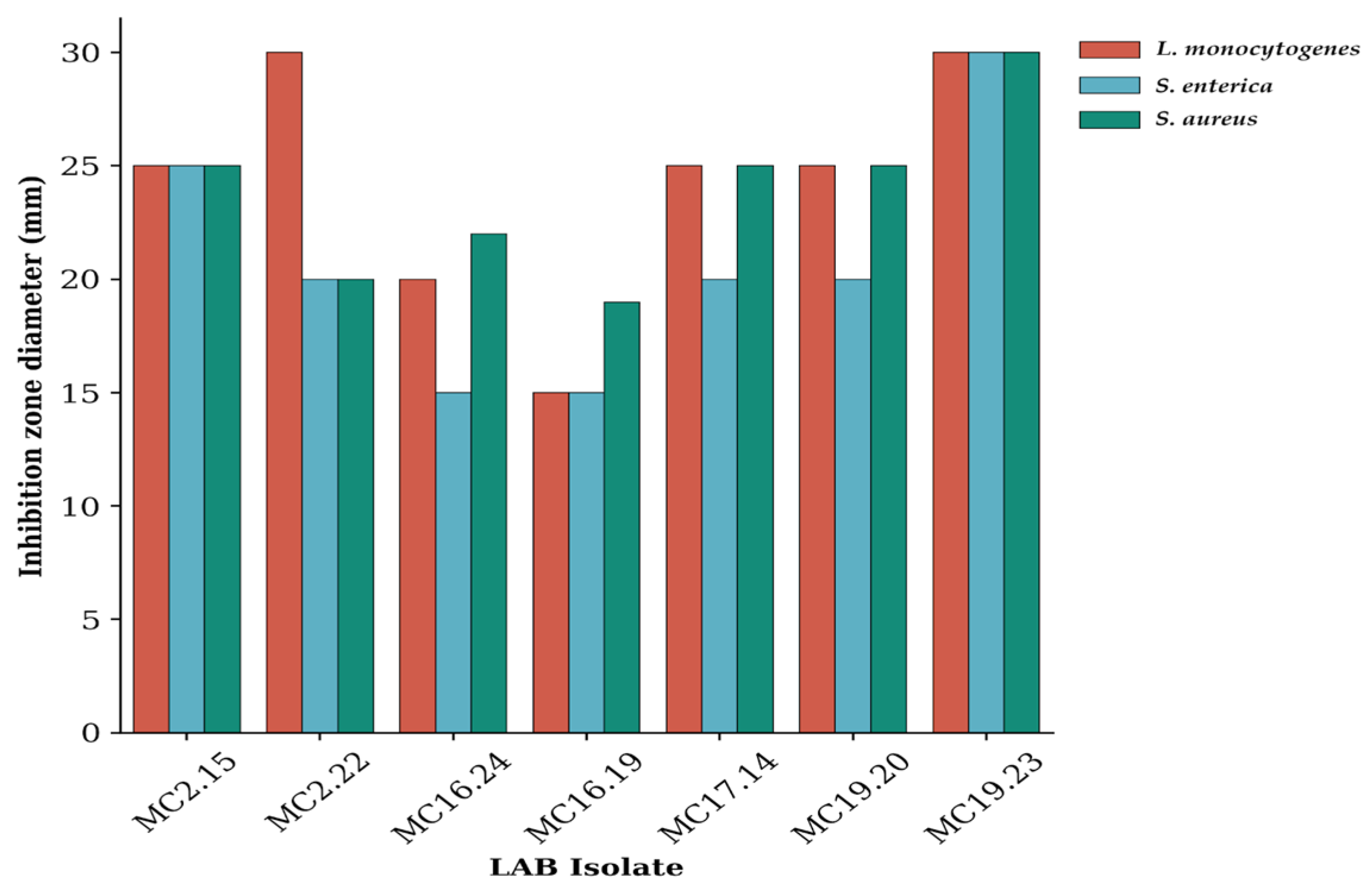
All isolates exhibited inhibition against the three pathogens, with inhibition zones between 15 and 30 mm (Figure 1). The strongest activity was recorded for isolates MC2.22 and MC19.23 (30 mm). Neutralized CFS retained antimicrobial activity, suggesting that the inhibitory effect may not be solely due to organic acids and could involve bacteriocin-like substances.

3.4. Proteolytic and Lipolytic Activity

None of the isolates showed proteolytic, lipolytic, or gelatinase activity. This confirms their potential suitability for food preservation without causing undesirable degradation of meat proteins or fats.

3.5. Antibiotic Resistance

Antibiotic sensitivity testing revealed that most isolates were resistant to ampicillin, amoxicillin, and kanamycin but variably sensitive to spectinomycin, flumequine, and lincomycin (Table 3). This pattern aligns with known intrinsic resistances of LAB [8,9].

3.6. Biochemical and Molecular Identification of Selected Isolates

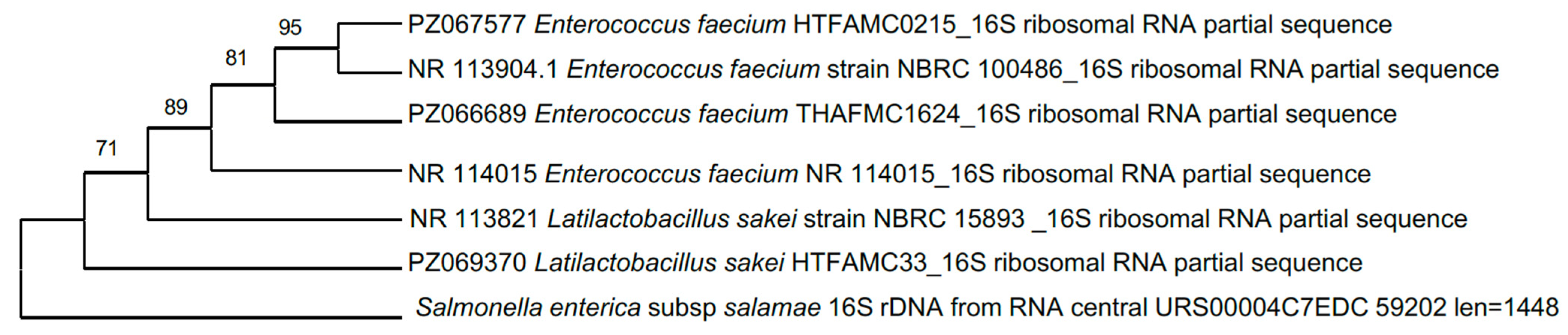
Phenotypic and biochemical characterization showed that all isolates were Gram-positive, catalase-negative, and oxidase-negative, consistent with lactic acid bacteria. They tolerated 6.5% NaCl and grew within the temperature range of 10–45 °C. API 20 Strep profiling preliminarily identified the majority of isolates as Enterococcus faecium. To confirm taxonomic affiliation, 16S rRNA gene sequencing was performed. PCR amplification generated ~1500 bp fragments for all isolates, and sequence comparison using BLASTn against the NCBI database provided precise identification. Molecular analysis confirmed several isolates as Enterococcus faecium, one as Enterococcus faecalis, and revealed that a distinct group belonged to Latilactobacillus sakei, with similarity values ranging from 86.82% to 99.44% and high query coverage. Phylogenetic analysis further supported these assignments, clustering the isolates into two well-defined clades corresponding to the genera Enterococcus and Latilactobacillus. An external sequence (Salmonella enterica subsp. salamae) was used as an outgroup, allowing clear rooting of the tree and confirming the phylogenetic separation between enterococci and lactobacilli (Figure 2).

4. Discussion

The dominance of LAB in fermented and dried camel meat demonstrates that traditional processing environments create selective niches favoring the growth of beneficial, antimicrobial strains. These findings are consistent with previous studies reporting that fermentation conditions, particularly salt concentration, pH reduction, and limited oxygen, promote the proliferation of stress-tolerant LAB species capable of producing bioactive compounds [6,7,8,9]. The physiological resilience of these isolates, especially their ability to thrive in high-salt and broad temperature ranges, indicates strong ecological adaptation to arid and semi-arid environments typical of North Africa. This adaptability is advantageous for their potential application in camel meat preservation under variable storage conditions.
The antimicrobial activity observed in this study, with inhibition zones reaching up to 30 mm, underscores the potency of the isolated E. faecium strains. This activity compares favorably with previously characterized bacteriocinogenic LAB from other meat matrices such as sausages, poultry, and fish [2,4,5,17]. The persistence of inhibitory activity after pH neutralization indicates that factors other than organic acids may contribute to the antimicrobial effect, including possible bacteriocin-like peptides. Such proteinaceous compounds have been recognized for their stability, broad-spectrum antimicrobial properties, and potential for industrial application as natural food preservatives [5,6]. This finding aligns with recent evidence showing that Enterococcus-derived bacteriocins, including enterocin A and B, exhibit strong activity against Listeria monocytogenes and Staphylococcus aureus without adversely affecting sensory properties of meat products [7,8].
The higher abundance of antimicrobial LAB in dried fermented products likely results from the combined effects of low water activity, increased salt levels, and fluctuating temperatures. Together, these conditions tend to select for stress-tolerant enterococci that can continue to grow and inhibit competing microorganisms during processing and storage. The absence of proteolytic and lipolytic activities among the isolates further strengthens their suitability for food applications, as these enzymatic functions can lead to off-flavors and textural degradation in meat systems. From a technological standpoint, the non-proteolytic nature of the isolates ensures that the integrity of meat proteins and lipids is preserved during storage and processing. Therefore, these LAB strains combine antimicrobial potential with technological safety, key criteria for selecting protective cultures in the meat industry.
However, despite these advantages, the detection of antibiotic resistance in E. faecium strains raises concerns regarding their safety for direct food use. Although intrinsic resistance to some antibiotics (e.g., aminoglycosides and β-lactams) is well-documented in enterococci, horizontal gene transfer poses a potential risk if resistance determinants are located on mobile genetic elements [8,9]. According to the European Food Safety Authority (EFSA), only strains free from transferable resistance genes can be approved as safe for use in food production [18]. Thus, comprehensive genomic screening, including whole-genome sequencing, is necessary to confirm the absence of virulence and antibiotic resistance genes.
Moreover, the application of these isolates as bioprotective cultures should be validated in situ within camel meat matrices. Real-world trials assessing microbial stability, sensory attributes, and shelf-life extension under commercial storage conditions will be essential [19]. Combining these LAB with mild processing techniques, such as modified atmosphere packaging, low-temperature storage, or natural plant antimicrobials, could further enhance their efficacy while maintaining product quality.
Overall, this study highlights the promising potential of camel-meat-derived E. faecium as a natural biopreservative, given the robust antimicrobial activity, environmental adaptability, and desirable technological properties exhibited by the selected strains. Nevertheless, the role of Enterococcus spp. in foods remains highly controversial. Although some strains are recognized for their technological relevance and for producing antimicrobial substances with potential value in biopreservation, enterococci are also considered important hygienic indicators, since their presence in food may reflect fecal contamination and, consequently, suggest a higher risk of concomitant contamination by enteric pathogens such as Salmonella spp. and Listeria monocytogenes [4,5]. Furthermore, the documented occurrence in this genus of mobile genetic elements carrying antibiotic resistance determinants and virulence-associated factors raises important safety concerns and may limit their application in the food industry. Therefore, despite the encouraging in vitro results obtained in the present study, the effectiveness of these strains has not yet been confirmed in real meat systems. Future work should thus evaluate their performance directly in meat matrices, identify the active antimicrobial compounds involved, and compare their efficacy with recent biopreservation strategies [20]. In parallel, comprehensive safety validation, including genomic and toxicological assessments, remains essential before any industrial application can be considered. Integrating such findings with modern food preservation approaches could ultimately support the development of sustainable and clean-label preservation strategies, particularly for arid and resource-limited regions where camel meat constitutes an important protein source.

5. Conclusions

This exploratory investigation suggests that traditional camel-meat processing practices in Morocco’s Souss–Massa region particularly fermentation and drying promote the enrichment of LAB with antimicrobial potential. Antimicrobial LAB were recovered much more frequently from fermented and dried fermented products than from fresh meat (2, 5, and 8 positive samples, respectively), and dried fermented meat produced the greatest number of active isolates (48 strains retained). Collectively, these findings indicate that the physicochemical conditions associated with drying and fermentation impose a strong selective pressure favoring inhibitory LAB.
Among the recovered isolates, seven coccoid LAB strains exhibited broad-spectrum antagonistic activity against Listeria monocytogenes, Salmonella enterica serovar Enteritidis, and Staphylococcus aureus. The pH-neutralized cell-free supernatants generated inhibition zones of 15–30 mm, implying that the observed antimicrobial activity of inhibition after pH neutralization indicates that antagonism is not solely attributable to organic-acid-mediated pH reduction, and is consistent with bacteriocin-like substances and/or other pH-independent metabolites produced by the isolates. Phenotypic/API profiling combined with partial 16S rRNA gene sequencing indicates that these strains predominantly belong to the genus Enterococcus, closely related to E. faecium. Moreover, the lack of detectable proteolytic, gelatinase, and lipolytic activities supports their potential technological suitability for food applications. Nevertheless, the occurrence of resistance to clinically relevant antibiotics in several isolates highlights important safety concerns that must be addressed prior to use.
Overall, camel-meat-associated LAB particularly those isolated from dried–fermented products appear to be promising candidates for clean-label biopreservation. However, practical deployment should be contingent upon (i) elucidating the inhibitory mechanism(s) through characterization of bacteriocins and/or other antimicrobial compounds, (ii) conducting comprehensive safety assessments, including evaluation of transferable antimicrobial resistance and virulence determinants, and (iii) validating efficacy in relevant meat matrices using challenge testing alongside shelf-life and sensory analyses. Camel-meat LAB revealed encouraging pathogen inhibition in our lab tests, but we still need to confirm their usefulness for real biopreservation. Our next step is to test them directly in meat products and identify the compounds responsible for the antimicrobial effect, using recently validated approaches.

Author Contributions

Conceptualization, H.T. and F.A.; methodology, H.T. and Y.E.; validation, Y.E. and M.Z.; formal analysis, M.Z.; investigation, H.T. and M.A.; resources, F.A.; data curation, M.A.; writing—original draft preparation, H.T.; writing—review and editing, Y.E., M.Z. and F.A.; supervision, F.A. All authors have read and agreed to the published version of the manuscript.

Funding

The authors would like to express their gratitude to the EU PRIMA program and the Moroccan Ministry of Higher Education, Scientific Research and Innovation (MESRSI) for their support of the Pas-Agro-Pas project [Grant number PRIMA/0016/2022].

Data Availability Statement

Data is contained within the article.

Conflicts of Interest

The authors declare no conflicts of interest.

References

  1. Kasimin, M.E.; Shamsuddin, S.; Molujin, A.M.; Sabullah, M.K.; Gansau, J.A.; Jawan, R. Enterocin: Promising Biopreservative Produced by Enterococcus sp. Microorganisms 2022, 10, 684. [Google Scholar] [CrossRef] [Scilit]
  2. Elidrissi, A.; Ezzaky, Y.; Boussif, K.; Achemchem, F. Isolation and characterization of bioprotective lactic acid bacteria from Moroccan fish and seafood. Braz. J. Microbiol. 2023, 54, 2117–2127. [Google Scholar] [CrossRef] [Scilit] [PubMed]
  3. Inguglia, E.S.; Song, Z.; Kerry, J.P.; O’Sullivan, M.G.; Hamill, R.M. Addressing Clean Label Trends in Commercial Meat Processing: Strategies, Challenges and Insights from Consumer Perspectives. Foods 2023, 12, 2062. [Google Scholar] [CrossRef] [Scilit] [PubMed]
  4. Chauhan, K.; Rao, A. Clean-Label Alternatives for Food Preservation: An Emerging Trend. Heliyon 2024, 10, e35815. [Google Scholar] [CrossRef] [Scilit] [PubMed]
  5. Barcenilla, C.; Ducic, M.; López, M.; Prieto, M.; Álvarez-Ordóñez, A. Application of Lactic Acid Bacteria for the Biopreservation of Meat Products: A Systematic Review. Meat Sci. 2022, 183, 108661. [Google Scholar] [CrossRef] [Scilit] [PubMed]
  6. Amani, M.A.; Sarkodie, S.A. Mitigating Spread of Contamination in Meat Supply Chain Management Using Deep Learning. Sci. Rep. 2022, 12, 5037. [Google Scholar] [CrossRef] [Scilit] [PubMed]
  7. Bhattacharya, D.; Nanda, P.K.; Pateiro, M.; Lorenzo, J.M.; Dhar, P.; Das, A.K. Lactic Acid Bacteria and Bacteriocins: Novel Biotechnological Approach for Biopreservation of Meat and Meat Products. Microorganisms 2022, 10, 2058. [Google Scholar] [CrossRef] [Scilit] [PubMed]
  8. Barcenilla, C.; Puente, A.; Cobo-Díaz, J.F.; Alexa, E.-A.; Garcia-Gutierrez, E.; O’Connor, P.M.; Cotter, P.D.; González-Raurich, M.; López, M.; Prieto, M.; et al. Selection of Lactic Acid Bacteria as Biopreservation Agents and Optimization of Their Mode of Application for the Control of Listeria monocytogenes in Ready-to-Eat Cooked Meat Products. Int. J. Food Microbiol. 2023, 403, 110341. [Google Scholar] [CrossRef] [Scilit] [PubMed]
  9. Fernandes, N.; Achemchem, F.; Gonzales-Barron, U.; Cadavez, V. Biopreservation Strategies Using Bacteriocins to Control Meat Spoilage and Foodborne Outbreaks. Ital. J. Food Saf. 2024, 13, 12558. [Google Scholar] [CrossRef] [Scilit] [PubMed]
  10. Promrug, D.; Wittayacom, K.; Nathapanan, N.; Dong, H.T.; Thongyoo, P.; Unajak, S.; Reamtong, O.; Boonyuen, U.; Aroonnual, A.; Shioda, T.; et al. Cocultures of Enterococcus faecium and Aeromonas veronii Induce the Secretion of Bacteriocin-like Substances against Aeromonas. J. Agric. Food Chem. 2023, 71, 16194–16203. [Google Scholar] [CrossRef] [Scilit] [PubMed]
  11. Quintela-Baluja, M.; Jobling, K.; Graham, D.W.; Tabraiz, S.; Shamurad, B.; Alnakip, M.; Böhme, K.; Barros-Velázquez, J.; Carrera, M.; Calo-Mata, P. Rapid Proteomic Characterization of Bacteriocin-Producing Enterococcus faecium Strains from Foodstuffs. Int. J. Mol. Sci. 2022, 23, 13830. [Google Scholar] [CrossRef] [Scilit] [PubMed]
  12. Rahman, M.S.; Soltani, S.; LaPointe, G.; Karboune, S.; Fliss, I. Lactic Acid Bacteria: Beyond Fermentation to Bio-Protection against Fungal Spoilage and Mycotoxins in Food Systems. Front. Microbiol. 2025, 16, 1580670. [Google Scholar] [CrossRef] [Scilit] [PubMed]
  13. Cheriet, S.; Lengliz, S.; Romdhani, A.; Hynds, P.; Abbassi, M.S.; Ghrairi, T. Selection and Characterization of Bacteriocinogenic Lactic Acid Bacteria from the Intestine of Gilthead Seabream (Sparus aurata) and Whiting Fish (Merlangius merlangus): Promising Strains for Aquaculture Probiotic and Food Bio-Preservation. Life 2023, 13, 1833. [Google Scholar] [CrossRef] [Scilit] [PubMed]
  14. Montanari, C.; Barbieri, F.; Lorenzini, S.; Gottardi, D.; Šimat, V.; Özogul, F.; Gardini, F.; Tabanelli, G. Survival, Growth, and Biogenic Amine Production of Enterococcus faecium FC12 in Response to Extracts and Essential Oils of Rubus fruticosus and Juniperus oxycedrus. Front. Nutr. 2023, 9, 1092172. [Google Scholar] [CrossRef] [Scilit] [PubMed]
  15. Merzoug, M.; Bendida, K.; Aireche, M.; Zater, Z.Y.; Brakna, C.N.; Hammadi, A.I.; Saidi, Y.; Todorov, S.D.; Saidi, D. Isolation and Characterization of Enterocin-Producing Enterococcus faecium Strains from Algerian Traditional Food “Dried Figs Marinated in Olive Oil”: Functional and Safety Evaluations. Foods 2025, 14, 766. [Google Scholar] [CrossRef] [Scilit] [PubMed]
  16. ISO 22174:2024; Microbiology of the Food Chain—Polymerase Chain Reaction (PCR) for the Detection and Quantification of Microorganisms—General Requirements and Definitions. International Organization for Standardization: Geneva, Switzerland, 2024.
  17. Fernandes, N.; Faria, A.S.; Carvalho, L.; Choupina, A.; Rodrigues, C.; Gonzales-Barron, U.; Cadavez, V. Genetic Identification and Technological Potential of Indigenous Lactic Acid Bacteria Isolated from Alheira, a Traditional Portuguese Sausage. Foods 2024, 13, 598. [Google Scholar] [CrossRef] [Scilit] [PubMed]
  18. EFSA Panel on Additives and Products or Substances used in Animal Feed (FEEDAP); Villa, R.E.; Azimonti, G.; Bonos, E.; Christensen, H.; Durjava, M.; Dusemund, B.; Gehring, R.; Glandorf, B.; Kouba, M.; et al. Safety and Efficacy of a Feed Additive Consisting of L-arginine Produced with Escherichia Coli CGMCC 7.401 for All Animal Species (Eppen Europe SAS). EFSA J. 2024, 22, e9028. [Google Scholar] [CrossRef] [Scilit] [PubMed]
  19. Bilecen Şen, D.; Ertürkmen, P.; Alp Baltakesmez, D. Microbiota and Quality Profiling of Fermented Goat Meat Sausages (Sucuk) under Nitrite-Reduced and Mixed-Culture Strategies. World J. Microbiol. Biotechnol. 2026, 42, 64. [Google Scholar] [CrossRef] [Scilit] [PubMed]
  20. Han, J.; Wang, Y.; Xu, Y.; Gu, Y.; Zhang, K.; Tian, J.; Jin, Y. Effects of Compound Fermentation of Lactic Acid Bacteria IMAUJBP3 and IMAUJBR3 on the Characteristic Flavors and Metabolites of Mutton Fermented Sausages. LWT 2024, 212, 116995. [Google Scholar] [CrossRef] [Scilit]
Figure 1. Antimicrobial profiles of LAB isolates. Inhibition zone diameters (mm) demonstrating the antagonistic activity of seven selected isolates against Gram-positive (L. monocytogenes, S. aureus) and Gram-negative (S. enterica) bacteria.
Blsf 56 00029 g001
Figure 2. Phylogenetic tree of selected Lactic Acid Bacteria.
Blsf 56 00029 g002
Table 1. Distribution of antimicrobial LAB isolates from camel meat.
Sample TypePositive SamplesActive IsolatesSelected Isolates
Number of Samples161616
Fresh Meat232
Fermented Meat51919
Dried–Fermented Meat85048
Table 2. Phenotypic and physiological characteristics of selected LAB isolates.
IsolateCatalaseOxidaseNaCl (6.5%)Temp Range (°C)MorphologyPresumptive ID
MC2.15--+10–45CocciE. faecium
MC2.22--+10–45CocciE. faecium
MC16.24--+10–45CocciE. faecium
MC16.19--+10–45CocciE. faecium
MC17.14--+10–45CocciE. faecium
MC19.20--+10–45CocciE. faecium
MC19.23--+10–45CocciE. faecium
Table 3. Antibiotic resistance patterns of LAB isolates.
AntibioticConcentration of the DiskResistant IsolatesSensitive Isolates
Ampicillin10 µgAll0
Penicillin10 U63
Kanamycin30 µg72
Spectinomycin100 µg63
Lincomycin15 µg72
Amoxicillin25 µgAll0
Flumequine30 µg54
Disclaimer/Publisher’s Note: The statements, opinions and data contained in all publications are solely those of the individual author(s) and contributor(s) and not of MDPI and/or the editor(s). MDPI and/or the editor(s) disclaim responsibility for any injury to people or property resulting from any ideas, methods, instructions or products referred to in the content.