
Proceeding Paper

Evaluating the Aqueous Extraction of Phenolic Compounds from Olive Tree Pruning †
by
Luis Carlos Morán-Alarcón
1,2,
María del Mar Contreras
1,2,*,
Alfonso M. Vidal
1,2,
Cristina Marzo-Gago
1,2,
Irene Gómez-Cruz
1,2,
Juan Miguel Romero-García
1,2 and
Eulogio Castro
1,2
1
Department of Chemical, Environmental and Materials Engineering, Universidad de Jaén, Campus Las Lagunillas, 23071 Jaén, Spain
2
Institute of Biorefineries Research (I3B), Universidad de Jaén, Campus Las Lagunillas, 23071 Jaén, Spain
*
Author to whom correspondence should be addressed.
Presented at the 6th International Electronic Conference on Foods, 28–30 October 2025; Available online: https://sciforum.net/event/foods2025.
Biol. Life Sci. Forum 2026, 56(1), 18; https://doi.org/10.3390/blsf2026056018
Published: 12 February 2026
(This article belongs to the Proceedings of The 6th International Electronic Conference on Foods)

Abstract

This study aimed to evaluate the aqueous extraction of phenolic compounds from olive tree pruning. Soxhlet extraction and aqueous extraction at 120 °C were performed in two types of pressurized reactors and different scales. The highest total phenolic content was obtained using Soxhlet (3809.8 mg/100 g biomass), followed by the other extraction strategies (up to 1500 mg/100 g). The content of 3,4-dihydroxyphenylglycol, hydroxytyrosol, and oleuropein also varied depending on the extraction conditions. Overall, aqueous extraction at 120 °C can be used to partially recover phenolic compounds, albeit in a shorter time compared to Soxhlet extraction and using higher solid loads to facilitate scaling up. This type of extraction can be applied in the future to recover these high-value compounds from olive tree pruning, a common agricultural byproduct of the Mediterranean region.

1. Introduction

The integral valorization of agroindustrial waste through biorefinery platforms represents a key strategy to move towards more sustainable and circular production models. In this context, residual olive biomass is widely available in the Mediterranean Basin, primarily derived from the pruning of olive trees and from the fruit during oil extraction (olive pomace). It has aroused growing interest due to its richness in bioactive phytochemicals, like phenolic compounds with high functional and bioactive value [1]. These metabolites, among which 3,4-dihydroxyphenylglycol (3,4-DHPG), hydroxytyrosol, and oleuropein stand out, have been associated with antioxidant, anti-inflammatory, and cardioprotective properties [2,3,4]. This makes them promising candidates for applications in the food, cosmetic, and pharmaceutical sectors.
In particular, olive tree pruning (OTP) is generated in the agricultural stage of industrial production of olive oil and table olives. Currently, this biomass is either cut and left scattered on the soil for fertilization or burned, with neither practice generating any economic return, or the economic revenue being low for the farmers. OTP also contains phenolic compounds, like oleuropein and hydroxytyrosol [5], but the extraction strategies generally focus on the leaves fraction [6].
The efficiency in obtaining these compounds is conditioned by the extraction technology and conditions applied to the biomass, which not only influence the quantity of the extracts obtained and their phenolic profile, but also determine their technical feasibility on an industrial scale. Thermal-assisted extraction, such as Soxhlet extraction, autoclaving, microwave, and pressurized reactors, is a widely used technique due to its ability to disrupt the lignocellulosic matrix, like that in olive tree pruning and olive leaves, and facilitate the release of intracellular metabolites [7,8,9]. However, the choice of the method involves trade-offs between yield, the thermal stability of the compounds, safety, and process technology readiness levels [6,8]. For example, although the yield of certain phenolic compounds is lower, hydrothermal treatments have been used due to safety, scalability, and cost considerations for food, pharmaceutical, and cosmetic uses of the extract [8]. Furthermore, adopting a more circular-thinking approach, hydrothermal treatments can be used as the initial step before biorefining, offering a dual benefit: extracting desirable bioactive compounds and enhancing subsequent processes like enzymatic hydrolysis to recover glucose from cellulose [7].
The objective of this research is to compare the effect of three extraction strategies (Soxhlet, autoclave, and 20 L pressurized reactor) using water on the recovery and composition of phenolic compounds from OTP. By utilizing water as the primary solvent instead of organic chemicals, this research highlights a more sustainable strategy for obtaining olive phenolic compounds.

2. Materials and Methods

2.1. Raw Material

OTP was obtained in Jaén (Spain). It was reduced in size to 1 cm in a hammer mill (Retsch GmbH, Haan, Germany), and had a moisture content of 5.8%. The OTP was stored in a dry, controlled location for later use. For Soxhlet extraction, the 1 cm sample was ground to 1 mm using a Retsch GmbH Ultra Centrifugal Mill ZM 200.

2.2. Aqueous Extraction

For Soxhlet extraction, 7.5 g of the dry sample was extracted in a 0.1 L Soxhlet extractor with 180 mL of distilled water heated on a hot plate at the boiling point. In the set of experiments, the volume recovered was quantified, and the extract was stored at −20 °C for later analysis.
An aqueous autoclave extraction (Raypa, Barcelona, Spain) was also performed. A solid–liquid ratio of 15% w/v was used, and the temperature was maintained at 120 °C for 60 min in a 1 L-ISO-bottle. The liquid was then vacuum-filtered and separated from the solid and stored for subsequent analysis. Moreover, another experiment was carried out in a 20 L kiloclave® reactor (Büchiglasuster, Meierseggstrasse, Switzerland). The extraction conditions were as follows: a solid–liquid ratio of 20% m/v and a temperature of 120 °C for 60 min. The extract was recovered and stored as before. All extractions were performed at least in triplicate.

2.3. Analysis of the Extracts

The total phenolic content (TPC) was determined using the Folin–Ciocalteu colorimetric method in a microplate, based on a previous study [10]. Gallic acid (Sigma-Aldrich, St. Louis, MO, USA) was used as a standard, with a calibration curve in the range of 0.03 to 0.25 g/L, along with 80 µL of 0.7 M calcium carbonate (Honeywell Fluka, Seelze, Germany) and 100 µL of 0.2 M Folin–Ciocalteu reagent (Sigma-Aldrich, St. Louis, MO, USA) in a microplate for reading at 655 nm using a Bio-Rad iMark reader (Hercules, CA, USA). The analysis was performed in triplicate, and the results were expressed in mg gallic acid equivalents (GAE) per 100 g of biomass.
The determination of the phenolic compounds profile was carried out using the methodology adapted from a previous study [7]. This method uses a Shimadzu Prominence UFLC chromatograph (Kyoto, Japan) equipped with an SPD-M20A diode array detector and a C18 reversed-phase column (250 mm × 4.6 mm), type BDS HYPERSIL 5 µm (Thermo Fisher Scientific Inc., Waltham, MA, USA). The chromatographic conditions were: elution flow rate of 1 mL/min; ternary gradient composed of 0.2% v/v orthophosphoric acid–water, methanol, and acetonitrile; oven temperature set at 30 °C; and a sample volume of 20 μL. The chromatographic separation was done using a multi-step linear gradient: 96% A with 2% B/C to 50% A with 25% B/C over 40 min, 40%A with 30% B/C over 5 min, 50% B/C for 15 min, followed by a 10 min isocratic hold and a 12 min re-equilibration period with 96%A and 2%B/C. The absorbance was recorded at a wavelength of 280 nm. Calibration curves were obtained with standards of 3,4-DHPG, hydroxytyrosol, and oleuropein, which were purchased from Sigma-Aldrich.

3. Results and Discussion

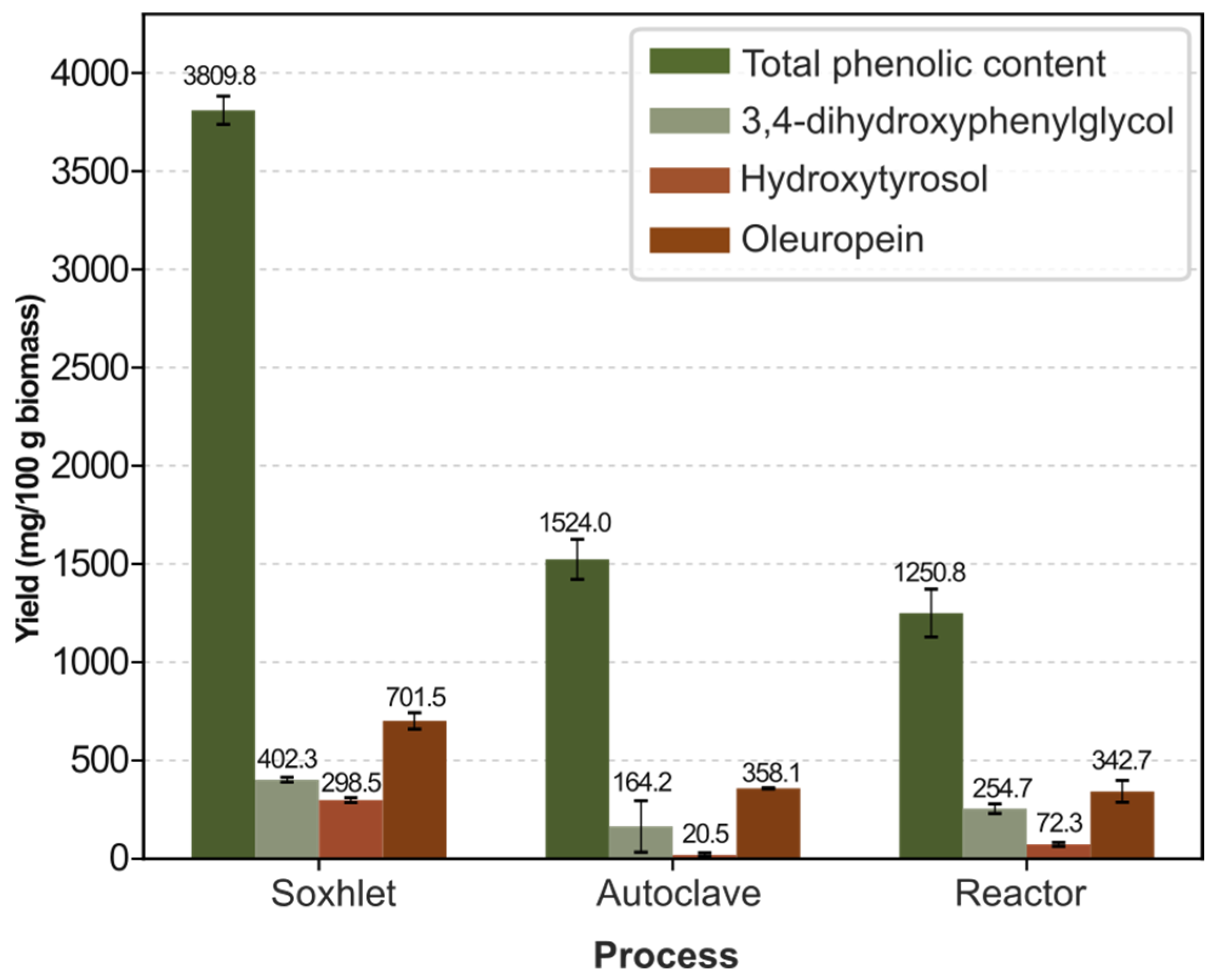
In this study, three extraction strategies were applied to recover phenolic compounds from OTP using water as the extractive agent: Soxhlet extraction and aqueous extraction at an autoclave, and a 20 L-reactor. Figure 1 shows the TPC along with the content of individual characteristic olive phenolic compounds that were quantified, i.e., 3,4-DHPG, hydroxytyrosol, and oleuropein.
The Soxhlet extraction showed the highest TPC yield (~3800 mg GAE/100 g biomass), followed by the aqueous extraction in the autoclave (~1500 mg/100 g biomass) and in the reactor (~1251 mg/100 g biomass). This higher efficiency could be associated with the lower solid-to-liquid ratio (~4.5:100) and particle size used to favor Soxhlet application (~1 mm) at laboratory scale, along with the longer extraction time applied. The results suggest that aqueous extraction in pressurized reactors can be used to partially recover phenolic compounds from OTP, albeit in a shorter time compared to Soxhlet extraction and using higher solid loads and particle size (~1 cm) to facilitate scaling up. The synergistic effect of elevated temperature and pressure can favor the dissolution and transfer of phenolic compounds from the plant matrix [9].
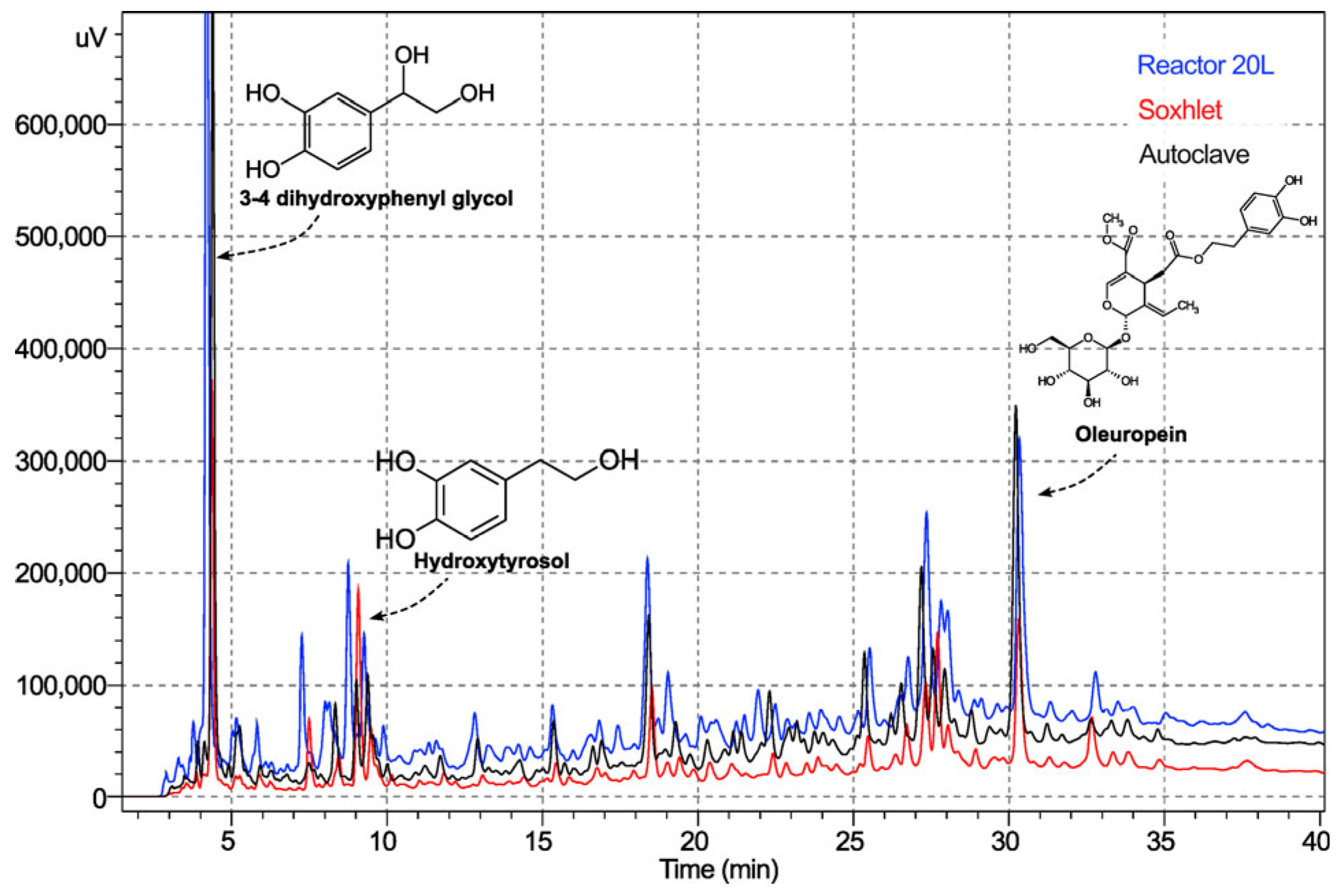
When analyzing the phenolic compound profiles, the profiles were similar, but quantitative differences were also observed (Figure 2). Soxhlet treatment was more effective in preserving or favoring the extraction of phenolic compounds, such as 3,4-DHPG and hydroxytyrosol, reaching concentrations of 402.3 mg/100 g and 298.5 mg/100 g, respectively. The data for oleuropein in the aqueous extracts obtained from the autoclave and the 20 L-reactor were similar, but the reactor conditions allowed for obtaining higher levels of hydroxytyrosol and 3,4-DHPG. The results obtained by the aqueous extraction agreed with previous studies on OTP, which found about 649 and 1998 mg/100 g of TPC, 190 mg/100 g of hydroxytyrosol, and 537 mg/100 g of oleuropein [7,11]. Notably, 3,4-DHPG has not been studied in OTP, but olive pomace may contain up to 44 mg/100 g [12].
This result suggests that the Soxhlet method offers a higher performance towards certain phenolic compounds, but it presents a disadvantage when the process needs to be scaled up. In this regard, the potential scalability of the process represents a determining criterion. For example, Soxhlet is generally considered to require longer treatment time or prolonged reflux cycles, higher solvent, and more energy than other technologies [13], but it can serve as a control technology for the extraction performance at the laboratory scale. The Soxhlet extraction, although effective for recovery, presents important limitations in terms of processing volume and operational control, which restrict its application at pilot or industrial scale. In contrast, aqueous extraction at 120 °C offers greater flexibility and adaptability to intensified process conditions, which is advantageous in the design of integrated biorefinery platforms to obtain bioactive compounds like the studied phenolic compounds, along with bioethanol from the recovered solid, as in the previous work by Romero-García et al. [7], or other platform chemicals, such as xylitol, from the lignocellulosic components [14]. In these studies, OTP fractionation was achieved through aqueous extraction to recover antioxidant phenolic compounds, followed by hydrothermal treatments (using steam explosion and liquid hot water), using minimal chemicals. Other potential hydrothermal treatments, which can be combined with aqueous extraction, are sub-supercritical water at higher temperatures and pressures, applied in a sequential scheme to modify water properties and enhance biomass deconstruction for subsequent conversion into platform compounds. Although this pretreatment combination can be more environmentally friendly, as water is the main solvent, most research remains at bench scale [15].

4. Conclusions

The results suggest that aqueous extraction at 120 °C can be used to partially recover phenolic compounds from OTP, albeit in a shorter time compared to Soxhlet extraction and using higher solid loads to facilitate scaling up. This operation can be integrated into the biorefining of OTP to obtain valuable phenolic compounds like 3,4-DHPG, hydroxytyrosol, and oleuropein, along with other bioproducts.

Author Contributions

Conceptualization, M.d.M.C., J.M.R.-G. and E.C.; methodology, formal analysis, and investigation, L.C.M.-A., M.d.M.C., A.M.V., C.M.-G. and I.G.-C.; software, L.C.M.-A.; validation and data curation, L.C.M.-A., M.d.M.C. and J.M.R.-G.; resources, M.d.M.C. and E.C.; writing—original draft preparation, L.C.M.-A. and M.d.M.C.; writing—review and editing, L.C.M.-A., M.d.M.C., J.M.R.-G., I.G.-C. and E.C.; visualization, L.C.M.-A.; supervision, M.d.M.C., J.M.R.-G. and E.C.; project administration, M.d.M.C., J.M.R.-G. and E.C.; funding acquisition, M.d.M.C., J.M.R.-G. and E.C. All authors have read and agreed to the published version of the manuscript.

Funding

L.C.M.-A. is grateful for pre-doctoral grants for the training of research personnel under Action 8.a) of the Operational Plan to Support Research at the University of Jaén (UJA) (2021–2022), J.M.R.-G. thanks UJA (action 7, Postdoctoral grant), and I.G.-C. thanks the grant DGP_POST_2024_00733 from the Andalusian Government. The authors thank the project PID2023-149614OB-C21, funded by the “Ministerio de Ciencia, Innovación y Universidades” MICIN/AEI/10.13039/501100011033 and by FEDER, UE, and the grant “Juan de la Cierva” JDC2022-049264-I. The project from the “Instituto de Estudios Giennenses” (research projects in the area of knowledge of Natural Sciences and Technology in accordance with the provisions of the Call Bases BOP No. 42, dated 29 February 2024) is also appreciated.

Institutional Review Board Statement

Not applicable.

Informed Consent Statement

Not applicable.

Data Availability Statement

The data are contained within the article.

Acknowledgments

The technical and human support provided by CICT of the Universidad de Jaén is gratefully acknowledged.

Conflicts of Interest

The authors declare no conflicts of interest.

Abbreviations

The following abbreviations are used in this manuscript:
3,4-DHPG 3,4-dihydroxyphenylglycol
HPLCHigh-performance liquid chromatography
OTPOlive tree pruning
TPCTotal phenolic content

References

  1. Melo Ferreira, D.; Oliveira, M.B.P.; Alves, R.C. A Comprehensive Review of the Antitumor Activity of Olive Compounds: The Case of Olive Oil, Pomace, and Leaf extracts, Phenolic Alcohols, Secoiridoids, and Triterpenes. Antioxidants 2025, 14, 237. [Google Scholar] [CrossRef] [PubMed]
  2. Bermúdez-Oria, A.; Rodríguez-Gutiérrez, G.; Rodríguez-Juan, E.; González-Benjumea, A.; Fernández-Bolaños, J. Molecular Interactions between 3,4-Dihydroxyphenylglycol and Pectin and Antioxidant Capacity of This Complex in Vitro. Carbohydr. Polym. 2018, 197, 260–268. [Google Scholar] [CrossRef] [PubMed]
  3. Monteiro, M.; Silva, A.F.R.; Resende, D.; Braga, S.S.; Coimbra, M.A.; Silva, A.M.S.; Cardoso, S.M. Strategies to Broaden the applications of olive biophenols oleuropein and hydroxytyrosol in food products. Antioxidants 2021, 10, 444. [Google Scholar] [CrossRef] [PubMed]
  4. Fernández-Prior, Á.; Bermúdez-Oria, A.; Millán-Linares, M.D.C.; Fernández-Bolaños, J.; Espejo-Calvo, J.A.; Rodríguez-Gutiérrez, G. Anti-Inflammatory and Antioxidant Activity of Hydroxytyrosol and 3,4-Dihydroxyphenyglycol Purified from Table Olive Effluents. Foods 2021, 10, 227. [Google Scholar] [CrossRef] [PubMed]
  5. Servian-Rivas, L.D.; Pachon, E.R.; Rodriguez, M.; Gonzalez-Miquel, M.; Gonzalez, E.J.; Diaz, I. Techno-economic and Environmental Impact Assessment of an Olive Tree Pruning Waste Multiproduct Biorefinery. Food Bioprod. Process. 2022, 134, 95–108. [Google Scholar] [CrossRef]
  6. Contreras, M.d.M.; Gómez-Cruz, I.; Galán-Martín, Á.; Romero, I.; Castro, E. Green Extraction Techniques Applied to Recover Chemical Compounds from Olive-Derived Biomasses. In Agricultural Waste: Environmental Impact, Useful Metabolites and Energy Production; Ramawat, K.G., Mérillon, J.-M., Arora, J., Eds.; Springer Nature Singapore: Singapore, 2023; Volume 31, pp. 415–452. ISBN 978-981-19-8773-1. [Google Scholar]
  7. Romero-García, J.M.; López-Linares, J.C.; Contreras, M.d.M.; Romero, I.; Castro, E. Exploitation of Olive Tree Pruning Biomass through Hydrothermal Pretreatments. Ind. Crops Prod. 2022, 176, 114425. [Google Scholar] [CrossRef]
  8. Monteleone, J.I.; Sperlinga, E.; Siracusa, L.; Spagna, G.; Parafati, L.; Todaro, A.; Palmeri, R. Water as a Solvent of Election for Obtaining Oleuropein-Rich Extracts from Olive (Olea Europaea) Leaves. Agronomy 2021, 11, 465. [Google Scholar] [CrossRef]
  9. Faraone, I.; Russo, D.; Bruno, M.R.; Todaro, L.; D’Auria, M.; Milella, L. Focus on Olea Europaea L. Pruning by-Products: Extraction Techniques, Biological Activity, and Phytochemical Profile. Biofuels Bioprod. Biorefin. 2021, 15, 1835–1849. [Google Scholar] [CrossRef]
  10. García-Vargas, M.C.; Contreras, M.D.M.; Gómez-Cruz, I.; Romero-García, J.M.; Castro, E. Avocado-Derived Biomass: Chemical Composition and Antioxidant Potential. Proceedings 2021, 70, 100. [Google Scholar] [CrossRef]
  11. Sezer Okur, P.; Okur, I. Recent Advances in the Extraction of Phenolic Compounds from Food Wastes by Emerging Technologies. Food Bioproc. Tech. 2024, 17, 4383–4404. [Google Scholar] [CrossRef]
  12. Doménech, P.; Duque, A.; Higueras, I.; Luis Fernández, J.; Manzanares, P. Analytical Characterization of Water-Soluble Constituents in Olive-Derived By-Products. Foods 2021, 10, 1299. [Google Scholar] [CrossRef] [PubMed]
  13. Lama-Muñoz, A.; Rubio-Senent, F.; Bermúdez-Oria, A.; Fernández-Bolaños, J.; Prior, Á.F.; Rodríguez-Gutiérrez, G. The Use of Industrial Thermal Techniques to Improve the Bioactive Compounds Extraction and the Olive Oil Solid Waste Utilization. Innov. Food Sci. Emerg. Technol. 2019, 55, 11–17. [Google Scholar] [CrossRef]
  14. Oliva, J.M.; Negro, M.J.; Álvarez, C.; Manzanares, P.; Moreno, A.D. Fermentation Strategies for the Efficient Use of Olive Tree Pruning Biomass from a Flexible Biorefinery Approach. Fuel 2020, 277, 118171. [Google Scholar] [CrossRef]
  15. Martins-Vieira, J.C.; Torres-Mayanga, P.C.; Lachos-Perez, D. Hydrothermal Processing of Lignocellulosic Biomass: An Overview of Subcritical and Supercritical Water Hydrolysis. BioEnergy Res. 2023, 16, 1296–1317. [Google Scholar] [CrossRef]
Figure 1. Concentration of phenolic compounds extracted after aqueous extraction of olive tree pruning by Soxhlet, in an autoclave, and in a 20 L reactor.
Blsf 56 00018 g001
Figure 2. Representative chromatograms of the phenolic extracts obtained from the aqueous extraction of olive tree pruning. Color code: garnet, Soxhlet extraction; blue, extraction with autoclave; black, extraction with 20 L-reactor.
Blsf 56 00018 g002
Disclaimer/Publisher’s Note: The statements, opinions and data contained in all publications are solely those of the individual author(s) and contributor(s) and not of MDPI and/or the editor(s). MDPI and/or the editor(s) disclaim responsibility for any injury to people or property resulting from any ideas, methods, instructions or products referred to in the content.