Proceeding Paper

Color Stability and Bioactive Compound Retention in Patagonian Berry Pulps: Comparative Study of Pasteurization and Freezing Treatments †

by
Carolina Antonella Paulino
*,
Candela Shaiel Mendinueta Morales
,
María Laura Coppo
and
Facundo Carlos Namor
Facultad de Ciencias y Tecnología de los Alimentos, Universidad Nacional del Comahue, Villa Regina 8336, Argentina
*
Author to whom correspondence should be addressed.
Presented at the 6th International Electronic Conference on Foods, 28–30 October 2025; Available online: https://sciforum.net/event/Foods2025.
Biol. Life Sci. Forum 2026, 56(1), 17; https://doi.org/10.3390/blsf2026056017
Published: 11 February 2026
(This article belongs to the Proceedings of The 6th International Electronic Conference on Foods)

Abstract

Berry pulps are valued for their intense color and bioactive compounds, which are susceptible to degradation during processing and storage. This study provides a comparative analysis of the effects of pasteurization (85 °C, 15 min) and frozen storage (−18 °C) on the physicochemical stability of four Patagonian berry pulps, including blackberry, raspberry, sour cherry, and blueberry, over a 12-month storage period. Color changes were evaluated using the CIELab system. Pasteurization caused significant increases in ΔE and L*, and reductions in a* and Chroma (p < 0.05), whereas frozen pulps showed minor changes and null ΔE at time zero. Hue angle shifts were mainly driven by storage time (p < 0.05). Overall, freezing better preserved color stability and bioactive quality.

1. Introduction

Berries are widely recognized for their intense pigmentation and high concentrations of bioactive compounds such as anthocyanins, flavonoids, and other phenolics, which contribute both to their visual appeal and to their antioxidant and potential health-promoting properties. These compounds are chemically labile and prone to degradation during processing and storage, mainly due to exposure to heat, oxygen, light, and pH changes [1,2]. In thermally processed berry products, several studies have reported losses of total phenolics, anthocyanins, and antioxidant capacity over time, highlighting the need to optimize preservation strategies that limit such degradation [2,3,4].
Anthocyanins are particularly sensitive among berry phenolics. Their stability is strongly affected by temperature, pH, oxygen, light, and interactions with other matrix constituents, leading to structural transformations, color fading, and browning reactions during processing and storage [1]. Kinetic studies in thermally processed berry matrices have shown that anthocyanins and ascorbic acid often follow first-order degradation, with reaction rates increasing sharply with temperature [2,5]. Conversely, low-temperature preservation, such as freezing, can better retain pigments and antioxidant compounds by slowing chemical and enzymatic reactions, although ice-crystal damage and long-term frozen storage may still promote gradual changes in phenolic profiles depending on fruit structure and formulation [5,6].
Freezing is widely used for berries and berry-derived products, and numerous reports indicate that frozen storage generally preserves polyphenols and antioxidant activity more effectively than conventional thermal treatments, especially over extended periods [5]. For example, in aronia berries, refrigerated storage leads to marked reductions in anthocyanins and total phenolics, whereas frozen storage maintains extractable polyphenols for several months, with more modest losses at longer times [6]. Nonetheless, the magnitude and direction of these changes depend on the cultivar, maturity stage, and product type (whole fruit, juices, pulps, or purees), as well as on specific processing and storage conditions [5,6].
Patagonian berries constitute a particularly interesting group within this context. Species such as blackberry (Rubus fruticosus), raspberry (Rubus idaeus), sour cherry (Prunus cerasus), and blueberry (Vaccinium corymbosum), together with native Patagonian berries, are characterized by high levels of anthocyanins and other phenolics and have been proposed as promising raw materials for functional foods and value-added products [7]. However, despite the growing interest in Patagonian berry pulps for industrial use, there is still limited comparative information on how pasteurization and frozen storage affect their long-term color stability and the retention of key bioactive compounds.
Therefore, the aim of this study was to compare color changes and the retention of total phenolics, flavonoids, anthocyanins, ascorbic acid, and antioxidant activity in Patagonian blackberry, raspberry, sour cherry, and blueberry pulps subjected to pasteurization or freezing over 12 months of storage. By contrasting these two preservation strategies under controlled conditions, this work seeks to provide practical criteria for selecting processing and storage conditions that better maintain the visual quality and functional properties of berry-based products. Although the general superiority of freezing over thermal processing is well recognized, comparative long-term data for Patagonian berry pulps (same matrix, same storage window, and identical analytical endpoints) remain scarce. Therefore, the present work provides a standardized comparison across four regional cultivars, supporting practical selection criteria for pulp processing and shelf-life management.

2. Materials and Methods

2.1. Raw Materials

Fresh fruits of blackberry (Rubus fruticosus cv. Thornfree), raspberry (Rubus idaeus cv. Tulameen), sour cherry (Prunus cerasus cv. Montmorency), and blueberry (Vaccinium corymbosum cv. Elliot) were harvested by local producers from the Comarca Andina del Paralelo 42 region at optimal commercial maturity and immediately transported to Villa Regina. Upon arrival, fruits were stored under refrigerated conditions at 5 °C until processing. A simple random sampling was performed, and fruits showing signs of advanced ripeness and/or decay were discarded prior to pulp preparation. Fruits were manually sorted to remove damaged or overripe material, washed, drained, and pulped using an immersion blender. The pulps were kept at 5 °C for no longer than 24 h before processing. Time zero (T0) corresponded to the composition of the pulp immediately after each preservation treatment (post-pasteurization or post-freezing).

2.2. Pasteurization Treatment

Fresh pulps were placed into glass containers, hermetically sealed, and pasteurized in a thermostatic water bath at 85 °C for 15 min. After heating, samples were rapidly cooled in an ice–water bath (ice and water mixture, approximately 0 °C) and then stored at 25 °C, protected from light, for up to 12 months. Storage at 25 °C was selected due to the natural acidity of the pulps (pH < 3.5), which ensures microbiological stability under shelf-stable conditions.

2.3. Freezing Treatment

Aliquots of fresh pulps were vacuum-packed in multilayer polyethylene–polyamide pouches and frozen at −18 °C. Samples remained frozen throughout the 12-month storage period. Frozen samples were thawed at 4 °C for 12 h prior to analysis.

2.4. Storage and Sampling

Both pasteurized and frozen pulps were analyzed at 0, 3, 6, 9, and 12 months. Frozen samples were thawed at 4 °C for 12 h before analysis. Three independent biological replicates were prepared for each sample, and each extract was analyzed in triplicate (technical replicates). Statistical analyses were performed on biological replicates (n = 3).

2.5. Extraction of Bioactive Compounds

Portions weighing between 2 and 5 g of pulp were mixed with 20 mL of ethanol acidified with 1% HCl (v/v). Samples were incubated at 37 °C for 30 min in a shaking water bath, filtered under vacuum, and re-extracted twice under identical conditions. Combined extracts were brought to a final volume of 100 mL with distilled water. Acidified ethanol was selected to stabilize anthocyanins during extraction.

2.6. Analytical Determinations

All spectrophotometric determinations were performed using a SHIMADZU (Kyoto, Japan).

2.6.1. Total Phenolics (TP)

Total phenolics were quantified using the Fast Blue BB (FBBB) colorimetric method, selected to avoid positive interference from high ascorbic acid levels typical of berry pulps. Two milliliters of extract was mixed with 200 µL of 1% FBBB and 200 µL of 5% NaOH and incubated in the dark for 60 min, and absorbance was measured at 420 nm. Results are expressed as mg gallic acid equivalents (GAE)/100 g of sample [8,9].

2.6.2. Total Flavonoids (TF)

Flavonoids were quantified by the aluminum chloride complexation method. One milliliter of extract was mixed sequentially with 300 µL of NaNO2 (5%), 300 µL of AlCl3 (10%), and after 6 min, 2 mL of NaOH (1 N). The final volume was adjusted to 10 mL with distilled water. Absorbance was recorded at 510 nm, and results are expressed as mg catechin equivalents (CE)/100 g of sample [10].

2.6.3. Total Monomeric Anthocyanins (ACY)

Anthocyanins were determined by the pH differential method. Absorbance was measured at 520 and 700 nm in buffers at pH 1.0 and pH 4.5. Results are expressed as mg cyanidin-3-glucoside equivalents (C3G)/100 g of sample [11].

2.6.4. Ascorbic Acid (AA)

Ascorbic acid was quantified using the AOAC-validated 2,6-dichlorophenolindophenol titration method, selected for its compatibility with highly pigmented matrices. Results are expressed as mg ascorbic acid/100 g of sample [12].

2.6.5. Antioxidant Activity (DPPH Assay)

Antioxidant activity was determined using the DPPH method adapted from Brand-Williams [13]. A 40 ppm methanolic DPPH solution was mixed with diluted extracts to obtain 30–70% radical consumption. After 90 min of incubation in the dark, absorbance was measured at 515 nm. The antioxidant capacity was expressed as the EC50, defined as the amount of sample pulp (mg) required to reduce the initial DPPH concentration by 50%:
E C 50 = m g   f r e s h   p u l p   r e q u i r e d   t o   r e d u c e   D P P H   b y   50 %
To compare samples, the antiradical power (AR) was calculated as the inverse of EC50:
A R = 1 E C 50
Higher AR values indicate stronger antioxidant capacity.

2.6.6. Color Measurements

Color parameters (L*, a*, b*, chroma, and hue angle) were measured using a tristimulus colorimeter (D65 illuminant, 10° observer). For each sample, ten measurements were taken at different surface points to account for heterogeneity, and the mean value was used for analysis. Total color difference (ΔE) relative to time zero was calculated using the standard CIE formula:
Δ E = ( Δ L * ) 2 + ( Δ a * ) 2 + ( Δ b * ) 2
Bioactive compound retention was operationally assessed as the change in total phenolics, total flavonoids, monomeric anthocyanins, ascorbic acid, and antiradical activity over storage time relative to time zero of each preservation method (post-pasteurization or post-freezing). Fresh pulp values were included only as a descriptive reference.

2.7. Statistical Analysis

To evaluate the effect of processing on the bioactive and color parameters, data were analyzed using analysis of variance (ANOVA) at a significance level of α = 0.05. For bioactive compounds, a factorial design (4 × 5 × 2) was applied, considering fruit type (blackberry, raspberry, blueberry, and sour cherry), storage time (0, 3, 6, 9, and 12 months), and preservation method (pasteurization or freezing) as fixed factors. Color parameters were analyzed separately using factorial ANOVA with the same factors, due to the different number of measurements per sample. When appropriate, mean comparisons were performed using the DGC test (Di Rienzo, Guzmán, Casanoves). Statistical analyses were carried out using Infostat v. 2020 [14].

3. Results and Discussion

3.1. Color Parameters

Color evolution is a key indicator of quality degradation in berry-derived products, as it reflects pigment breakdown, oxidation, and browning reactions that directly affect visual appeal. Changes in total color difference (ΔE) of berry pulps subjected to pasteurization or freezing during storage are shown in Table 1. ΔE values were calculated relative to the fresh pulp, which was used as the reference state.
At time zero, frozen pulps exhibited null ΔE values, as the pulps were frozen immediately after preparation and therefore retained the color characteristics of the fresh material without undergoing additional processing steps. In contrast, pasteurized pulps showed non-zero ΔE values at time zero, ranging from 0.7 to 1.2 depending on the fruit, clearly reflecting the immediate impact of the thermal treatment on color attributes. During storage, ΔE increased progressively in all fruits (Table 1), particularly in pasteurized samples, indicating cumulative and perceptible color deterioration over time. Raspberry and sour cherry exhibited the highest ΔE values after 12 months of storage, whereas blueberry and blackberry showed lower overall color changes.
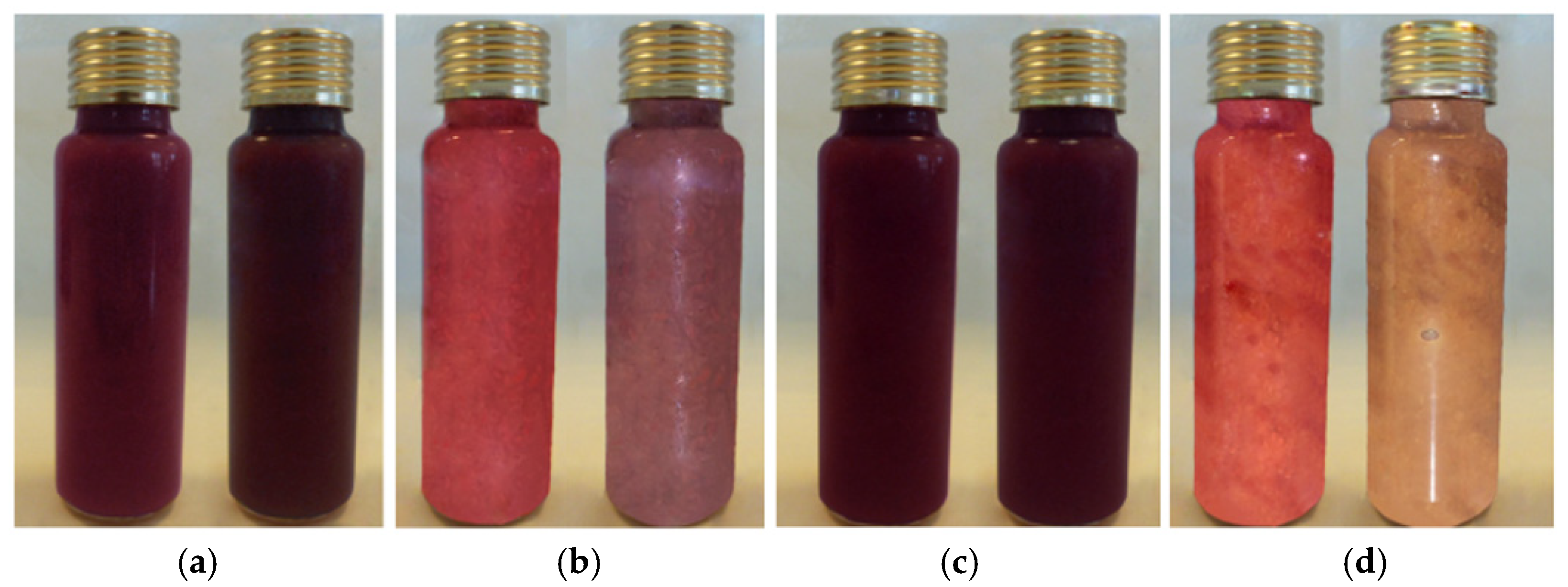
These instrumental results were consistent with the visual appearance of the pulps. Figure 1 shows the marked color fading observed in pasteurized samples between time 0 and 12 months, especially in raspberry and sour cherry, where loss of redness and the development of duller tones were evident. Conversely, Figure 2 illustrates that frozen pulps retained a visual appearance much closer to that of the initial state after 12 months, with better preservation of color saturation across all fruits. Together, Figure 1 and Figure 2 demonstrate that freezing more effectively preserves the visual quality of berry pulps during long-term storage.
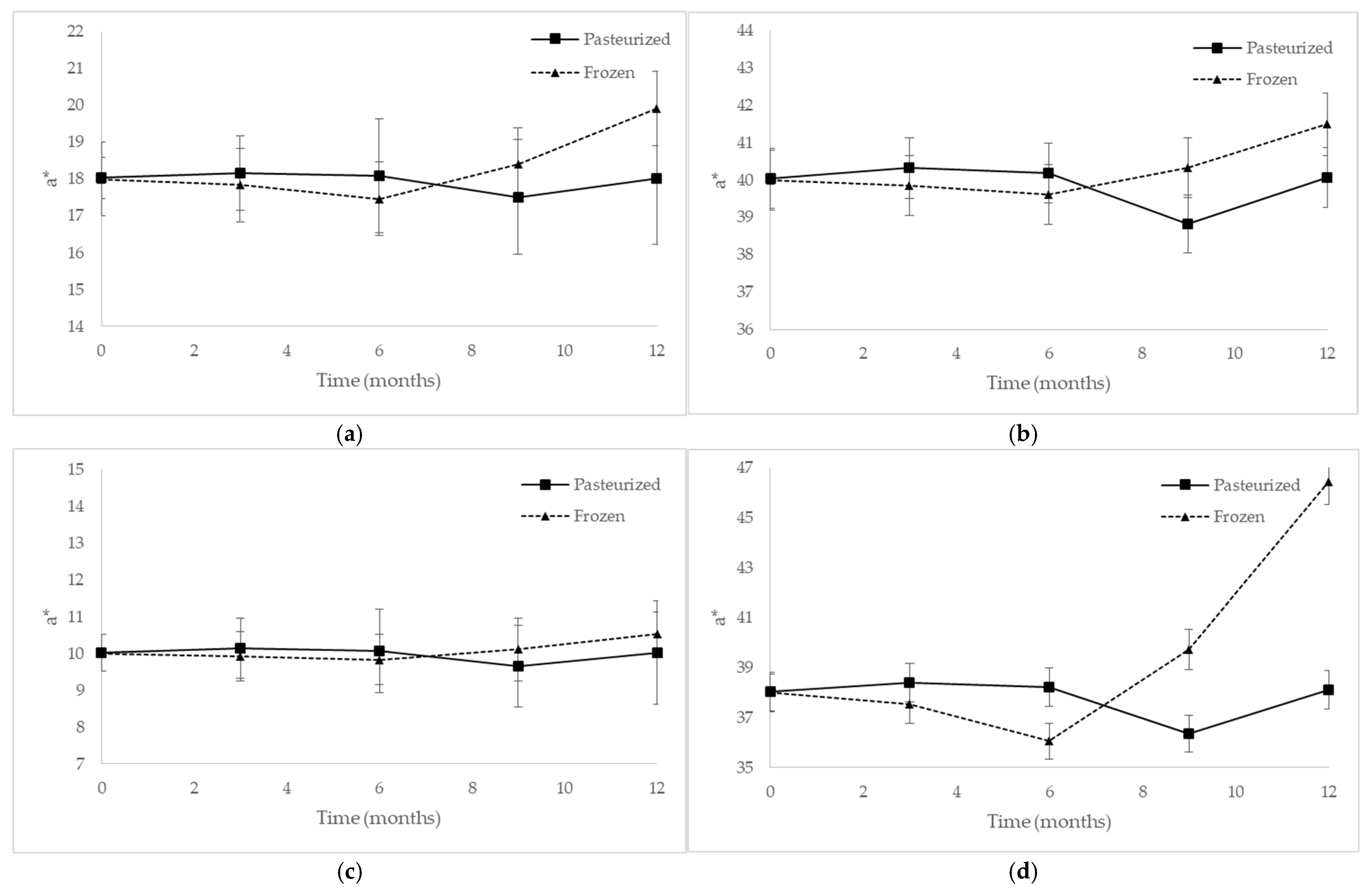
To further describe the chromatic changes associated with these perceptible differences, the evolution of the a* parameter (red–green coordinate), which is directly associated with red color intensity and anthocyanin content, is presented in Figure 3. In all fruits, pasteurized pulps exhibited a pronounced decrease in a* values during storage, indicating a significant loss of redness consistent with the visual fading observed in Figure 1. In contrast, frozen pulps showed a slower decline in a*, maintaining higher redness values throughout storage, in agreement with the visual stability shown in Figure 2. These trends are consistent with the well-documented thermal instability of anthocyanins, as heat accelerates pigment degradation, oxidation reactions, and the formation of brown polymeric compounds [15,16].
Additional CIELab parameters further supported these observations. Statistically significant changes (p ≤ 0.05), determined by analysis of variance and mean comparison tests, were observed for lightness (L*), a*, b*, chroma, and hue angle during storage. In pasteurized pulps, L* tended to increase over time, particularly in raspberry and sour cherry, indicating progressive lightening associated with pigment loss and browning reactions. Redness (a*) and chroma decreased significantly during storage, reflecting reduced color saturation, while hue angle shifted toward higher values, consistent with a transition from red hues toward more brownish tones. The b* coordinate also contributed to these changes by reflecting shifts in the balance between red/yellow and darker color components. Frozen pulps generally exhibited smaller changes in all CIELab parameters, confirming the protective effect of frozen storage against color degradation [17,18].
In berry matrices, the magnitude of color change is also strongly species-dependent, reflecting differences in anthocyanin profiles and pigment acylation, which influence stability during processing and storage [19]. In the present study, blueberry and blackberry showed the highest overall color stability, whereas raspberry and sour cherry were the most susceptible to perceptible discoloration.
Overall, color susceptibility during storage followed the trend raspberry > sour cherry > blackberry > blueberry. The combined evaluation of ΔE (Table 1), visual appearance (Figure 1 and Figure 2), and the evolution of a* (Figure 3), together with complementary CIELab parameters, demonstrates that pasteurization accelerates color degradation, whereas freezing effectively preserves the chromatic attributes of Patagonian berry pulps during long-term storage.

3.2. Bioactive Parameters

The evolution of total phenolics (TP), total flavonoids (TF), monomeric anthocyanins (ACY), antioxidant activity (AR), and ascorbic acid (AA) during storage is shown in Table 2. Fresh pulp values are included as a descriptive reference, whereas the effects of fruit type, storage time, and preservation method on treated samples (0–12 months) were assessed using a full factorial ANOVA (4 × 5 × 2); the corresponding p-values for main effects and interactions are summarized in Table 3. Overall, frozen pulps exhibited higher preservation of bioactive compounds than pasteurized samples, and factorial analysis confirmed that changes during storage depended on fruit type, time, preservation method, and (for most variables) their interactions.

3.2.1. Total Phenolics (TP)

Pasteurized pulps showed an immediate reduction in TP at time zero, confirming the impact of thermal exposure on phenolic stability. After the initial loss, TP decreased progressively throughout storage, with 12-month retentions of 83% in blackberry, 91% in raspberry, 80% in blueberry, and 81% in sour cherry (Table 2). This pattern reflects the well-known susceptibility of phenolic acids and polymeric phenols to heat-induced oxidation, followed by gradual degradation during storage as polymerization and browning reactions continue to develop [4]. Factorial ANOVA confirmed significant main effects of fruit type, storage time, and preservation method on TP (Table 3), together with significant fruit × time and time × treatment interactions, indicating that TP changes during storage depended on both berry species and the preservation strategy.
Frozen pulps showed higher TP preservation, with final retentions of 79% (blackberry), 85% (raspberry), 82% (blueberry), and 87% (sour cherry) (Table 2). The significant time × treatment interaction (Table 3) supports that TP evolution differed between frozen and pasteurized pulps. These results are consistent with earlier observations of improved phenolic preservation in frozen berry matrices [20,21].

3.2.2. Total Flavonoids (TF)

TF in pasteurized pulps also exhibited thermal sensitivity, with losses already evident at time zero, especially in raspberry and sour cherry (Table 2). After 12 months, TF retention reached 95% in blackberry, 56% in raspberry, 94% in blueberry, and 88% in sour cherry. Factorial ANOVA indicated significant effects of fruit type, storage time, and preservation method on TF, as well as significant interaction terms (Table 3), supporting that the magnitude of TF changes differed among berries and depended on the preservation method. The early and pronounced decrease in raspberry suggests that specific flavonols and flavan-3-ols present in this fruit are more vulnerable to heat, a trend previously linked to the structural fragility of glycosylated flavonoids under thermal processing [22].
Frozen pulps retained higher TF levels at the end of storage: 87% (blackberry), 108% (raspberry), 95% (blueberry), and 100% (sour cherry) (Table 2). The fruit × treatment and time × treatment interactions detected for TF (Table 3) indicate that treatment-related differences varied across berries and storage times. The >100% retention observed in raspberry likely reflects increased extractability of flavonoids due to ice-crystal damage to cellular structures, a phenomenon frequently reported in frozen fruit systems [21].

3.2.3. Monomeric Anthocyanins (ACY)

ACY was the most sensitive compound to both pasteurization and storage. In pasteurized pulps, large reductions were apparent immediately after processing, consistent with the known instability of anthocyanins under heat, which accelerates cleavage, chalcone formation, polymerization, and browning. As storage progressed, degradation continued, resulting in 12-month retentions of 16% (blackberry), 25% (raspberry), 17% (blueberry), and only 3% in sour cherry (Table 2). Factorial ANOVA showed highly significant effects of fruit type, storage time, and preservation method on ACY, together with strongly significant interaction terms (Table 3), indicating that anthocyanin degradation patterns depended on berry species and differed markedly between pasteurization and freezing across storage time.
Frozen pulps showed substantially better pigment preservation and did not experience the large initial loss seen in pasteurized samples. After 12 months, ACY retentions were 90% (blackberry), 41% (raspberry), 89% (blueberry), and 70% (sour cherry) (Table 2). The significant fruit × time, fruit × treatment, and time × treatment interactions (Table 3) provide evidence that the protective effect of freezing varied among species and along storage time. Similar protective effects of frozen storage have been widely documented for berry pigments [21,23].

3.2.4. Antiradical Activity (AR)

AR exhibited fruit-dependent responses under pasteurization, with marked declines in raspberry (56%) and sour cherry (80%), while blackberry and blueberry remained essentially unchanged (102% and 100% after 12 months) (Table 2). Factorial ANOVA confirmed significant main effects of fruit type, storage time, and preservation method on AR, as well as significant interaction terms (Table 3), indicating that antioxidant capacity changes during storage depended on berry species and on the preservation strategy. The sharp reductions observed in raspberry and sour cherry parallel the strong decline in ACY and AA, confirming the major contribution of anthocyanins and vitamin C to the antioxidant capacity of these matrices [22,24]. The close correspondence between AR and pigment loss has been previously highlighted in studies evaluating thermal impacts on berry antioxidants [22].
In frozen pulps, AR remained comparatively more stable, with 12-month retentions of 98% (blackberry), 53% (raspberry), 96% (blueberry), and 73% (sour cherry) (Table 2). The significant interaction terms observed for AR (Table 3) indicate that stability during frozen storage differed among berries and across time. This trend agrees with reports demonstrating a strong relationship between phenolic retention and antioxidant activity during frozen storage [21,22].

3.2.5. Ascorbic Acid (AA)

AA experienced the largest thermal losses, decreasing immediately after pasteurization and continuing to decline throughout storage. After 12 months, retentions were 53% (blackberry), 52% (raspberry), 67% (blueberry), and 52% (sour cherry) (Table 2). Factorial ANOVA confirmed significant main effects of fruit type, storage time, and preservation method on AA (Table 3). In contrast to the other bioactive parameters, the fruit × time interaction was not significant for AA (Table 3), suggesting a more uniform time-related decline pattern across berries when averaged across preservation methods. The steep early decline reflects the high sensitivity of vitamin C to heat-induced oxidation and its rapid conversion to dehydroascorbic acid, followed by degradation through non-enzymatic browning mechanisms. This behaviour is consistent with the well-established kinetics of AA degradation in thermally processed fruit matrices.
Frozen pulps exhibited higher AA stability, with retentions at month 12 of 82% (blackberry), 74% (raspberry), 81% (blueberry), and 80% (sour cherry) (Table 2). The significant time × treatment effect (Table 3) supports the better preservation achieved under frozen storage. Recent research has likewise demonstrated that AA remains substantially more stable in frozen fruits than in thermally treated products [25].
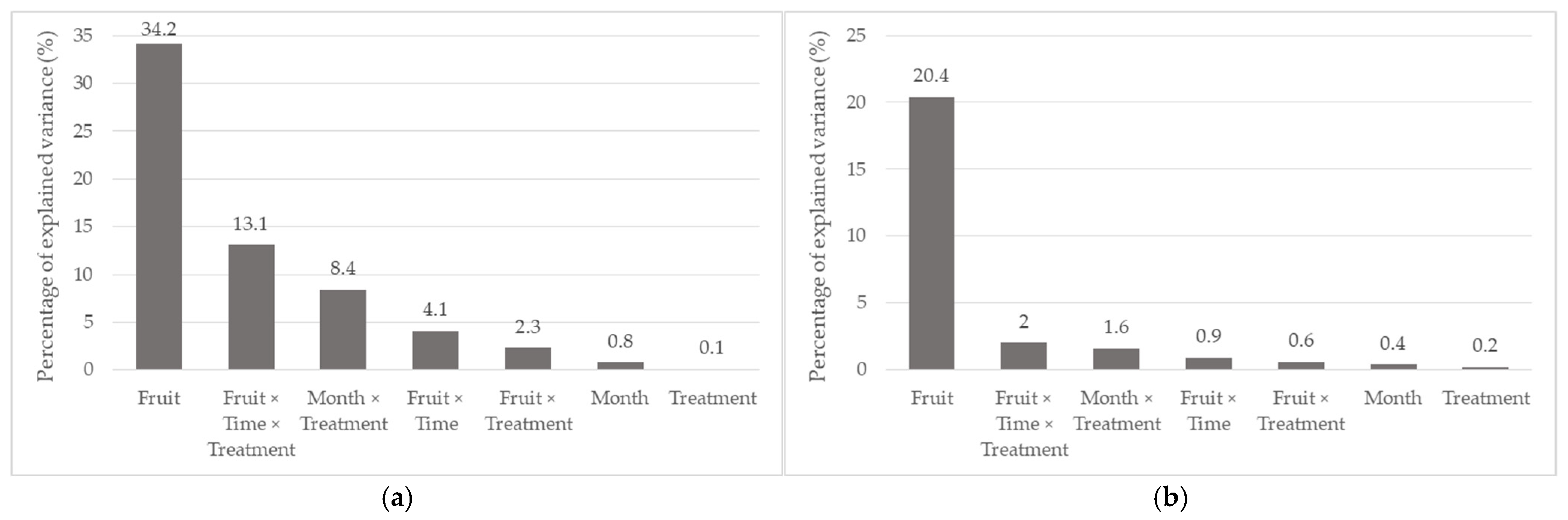
To further elucidate the relative importance of the experimental factors, a Pareto analysis based on the factorial ANOVA was performed for selected bioactive parameters (Figure 4). For monomeric anthocyanins, fruit type accounted for the largest proportion of the explained variability, followed by interaction effects involving storage time and preservation method, whereas the main effect of treatment alone contributed marginally. A similar pattern was observed for ascorbic acid, for which fruit type and time × treatment interactions dominated the response. These results indicate that bioactive compound degradation during storage is strongly fruit-dependent and modulated by interaction effects rather than by the preservation method alone.

4. Conclusions

This study evaluated the effects of pasteurization and frozen storage on color stability and bioactive compound retention in Patagonian berry pulps during 12 months of storage. The results demonstrate that preservation method and storage time strongly influence both chromatic attributes and functional quality, with responses varying according to fruit species and pigment composition.
Pasteurization caused immediate and progressive alterations in color and bioactive compounds, as evidenced by increases in total color difference (ΔE), reductions in a* values, and losses in anthocyanins, vitamin C, and antioxidant activity. In contrast, frozen storage effectively preserved color attributes and bioactive compounds, showing minimal perceptible color changes and greater stability of functional parameters throughout storage.
Overall, blueberry and blackberry pulps exhibited higher stability, whereas raspberry and sour cherry were more susceptible to processing and storage stresses. From a practical perspective, frozen storage emerges as the most suitable strategy for maintaining both visual quality and nutritional value in berry pulps intended for long-term use. A limitation of this study is that sensory attributes were not directly assessed; therefore, the present conclusions are restricted to instrumental color parameters and the measured bioactive/functional indicators. In addition, only one pasteurization condition (85 °C, 15 min) was evaluated, and bioactive compounds were quantified using spectrophotometric/standard assays; future work could assess optimized thermal profiles and compound-specific analyses.
These findings provide useful guidance for selecting preservation technologies that balance product quality and shelf-life in berry-based products.

Author Contributions

Conceptualization, C.A.P. and F.C.N.; methodology, C.A.P.; software, C.A.P.; validation, C.A.P. and F.C.N.; formal analysis, C.A.P., C.S.M.M. and M.L.C.; investigation, C.A.P., C.S.M.M., M.L.C. and F.C.N., resources, C.A.P. and F.C.N.; data curation, C.A.P.; writing—original draft preparation, C.A.P.; writing—review and editing, C.A.P. and F.C.N.; visualization, C.A.P.; supervision, F.C.N.; project administration, C.A.P. and F.C.N.; funding acquisition, C.A.P. and F.C.N. All authors have read and agreed to the published version of the manuscript.

Funding

This research received no external funding.

Institutional Review Board Statement

Not applicable.

Informed Consent Statement

Not applicable.

Data Availability Statement

The original contributions presented in the study are included in the article; further inquiries can be directed to the corresponding author.

Conflicts of Interest

The authors declare no conflicts of interest.

Abbreviations

The following abbreviations are used in this manuscript:
TPTotal Phenolics
TFTotal Flavonoids
ACYTotal Monomeric Anthocyanins
AAAscorbic Acid
ARAntiradical Power (DPPH assay)
ΔETotal Color Difference
CIECommission Internationale de l’Éclairage
GAEGallic Acid Equivalents
CECatechin Equivalents
C3GCyanidin-3-Glucoside

References

  1. Enaru, B.; Drețcanu, G.; Pop, T.D.; Stǎnilă, A.; Diaconeasa, Z. Anthocyanins: Factors Affecting Their Stability and Degradation. Antioxidants 2021, 10, 1967. [Google Scholar] [CrossRef]
  2. Diaconeasa, Z. Time-Dependent Degradation of Polyphenols from Thermally-Processed Berries and Their In Vitro Antiproliferative Effects against Melanoma. Molecules 2018, 23, 2534. [Google Scholar] [CrossRef]
  3. Badin, E.E.; Rossi, Y.E.; Montenegro, M.A.; Ibarz, A.; Ribotta, P.D.; Lespinard, A.R. Thermal Processing of Raspberry Pulp: Effect on the Color and Bioactive Compounds. Food Bioprod. Process. 2020, 124, 469–477. [Google Scholar] [CrossRef]
  4. Skrede, G.; Wrolstad, R.E.; Durst, R.W. Changes in Anthocyanins and Polyphenolics During Juice Processing of Highbush Blueberries (Vaccinium corymbosum L.). J. Food Sci. 2000, 65, 357–364. [Google Scholar] [CrossRef]
  5. Neri, L.; Faieta, M.; Di Mattia, C.; Sacchetti, G.; Mastrocola, D.; Pittia, P. Antioxidant Activity in Frozen Plant Foods: Effect of Cryoprotectants, Freezing Process and Frozen Storage. Foods 2020, 9, 1886. [Google Scholar] [CrossRef]
  6. King, E.S.; Noll, A.; Glenn, S.; Bolling, B.W. Refrigerated and Frozen Storage Impact Aronia Berry Quality. Food Prod. Process. Nutr. 2022, 4, 3. [Google Scholar] [CrossRef]
  7. Fuentes, L.; Figueroa, C.R.; Valdenegro, M.; Vinet, R. Patagonian Berries: Healthy Potential and the Path to Becoming Functional Foods. Foods 2019, 8, 289. [Google Scholar] [CrossRef] [PubMed]
  8. Medina, M.B. Simple and Rapid Method for the Analysis of Phenolic Compounds in Beverages and Grains. J. Agric. Food Chem. 2011, 59, 1565–1571. [Google Scholar] [CrossRef] [PubMed]
  9. Lester, G.E.; Lewers, K.S.; Medina, M.B.; Saftner, R.A. Comparative Analysis of Strawberry Total Phenolics via Fast Blue BB vs. Folin–Ciocalteu. J. Food Compos. Anal. 2012, 27, 102–107. [Google Scholar] [CrossRef]
  10. Zhishen, J.; Mengcheng, T.; Jianming, W. The Determination of Flavonoid Contents in Mulberry and Their Scavenging Effects on Superoxide Radicals. Food Chem. 1999, 64, 555–559. [Google Scholar] [CrossRef]
  11. Giusti, M.M.; Wrolstad, R.E. Anthocyanin Characterization by UV–Vis Spectroscopy. In Handbook of Food Analytical Chemistry; Wiley: New York, NY, USA, 2001. [Google Scholar]
  12. AOAC International. Official Method 967.21: Ascorbic Acid in Fruits and Vegetables; AOAC International: Gaithersburg, MD, USA, 2000. [Google Scholar]
  13. Brand-Williams, W.; Cuvelier, M.E.; Berset, C. Use of a Free Radical Method to Evaluate Antioxidant Activity. LWT–Food Sci. Technol. 1995, 28, 25–30. [Google Scholar] [CrossRef]
  14. Di Rienzo, J.; Casanoves, F.; Balzarini, M.; González, L.; Tablada, M.; Robledo, C. InfoStat Software, Version 2020; Universidad Nacional de Córdoba: Córdoba, Argentina, 2020. [Google Scholar]
  15. Oancea, S. A Review of the Current Knowledge of Thermal Stability of Anthocyanins and Approaches to Their Stabilization to Heat. Antioxidants 2021, 10, 1337. [Google Scholar] [CrossRef]
  16. Lin, Y.; Li, C.; Shi, L.; Wang, L. Anthocyanins: Modified New Technologies and Challenges. Foods 2023, 12, 1368. [Google Scholar] [CrossRef]
  17. Xue, H.; Zhao, J.; Wang, Y.; Shi, Z.; Xie, K.; Liao, X.; Tan, J. Factors Affecting the Stability of Anthocyanins and Strategies for Their Stabilization: A Review. Curr. Opin. Food Sci. 2024, 59, 102225. [Google Scholar] [CrossRef]
  18. Žlabur, J.Š.; Mikulec, N.; Doždor, L.; Duralija, B.; Galić, A.; Voća, S. Preservation of Biologically Active Compounds and Physicochemical Properties in Quick-Frozen Soft Fruits. Processes 2021, 9, 1940. [Google Scholar] [CrossRef]
  19. Aguilera, J.M. Berries as Foods: Processing, Products, and Health Implications. Annu. Rev. Food Sci. Technol. 2024, 15, 1–26. [Google Scholar] [CrossRef]
  20. Tobar-Bolaños, G.; Casas-Forero, N.; Orellana-Palma, P.; Petzold, G. Blueberry juice: Bioactive compounds, health impact, and concentration technologies—A review. J. Food Sci. 2021, 86, 5062–5077. [Google Scholar] [CrossRef]
  21. Veberic, R.; Stampar, F.; Schmitzer, V.; Cunja, V.; Zupan, A.; Koron, D.; Mikulic-Petkovsek, M. Changes in the Contents of Anthocyanins and Other Compounds in Blackberry Fruits Due to Freezing and Long-Term Frozen Storage. J. Agric. Food Chem. 2014, 62, 6926–6935. [Google Scholar] [CrossRef] [PubMed]
  22. Ahmed, M.; Eun, J.B. Flavonoids in fruits and vegetables after thermal and nonthermal processing: A review. Crit. Rev. Food Sci. Nutr. 2018, 58, 3159–3188. [Google Scholar] [CrossRef]
  23. Ancos, B.; Ibáñez, E.; Reglero, G.; Cano, M.P. Frozen storage effects on anthocyanins and volatile compounds of raspberry fruit. J. Agric. Food Chem. 2000, 48, 873–879. [Google Scholar] [CrossRef]
  24. Dini, C.; Zaro, M.J.; Viña, S.Z. Bioactivity and functionality of anthocyanins: A review. Curr. Bioact. Compd. 2019, 15, 507–523. [Google Scholar] [CrossRef]
  25. Phillips, K.M.; Tarragó-Trani, M.T.; Gebhardt, S.E.; Exler, J.; Patterson, K.Y.; Haytowitz, D.B.; Pehrsson, P.R.; Holden, J.M. Stability of vitamin C in frozen raw fruit and vegetable homogenates. J. Food Compos. Anal. 2010, 23, 253–259. [Google Scholar] [CrossRef]
Figure 1. Visual appearance of berry pulps at time 0 (left) and after 12 months of pasteurized storage (right): (a) blackberry; (b) raspberry; (c) blueberry; (d) sour cherry.
Blsf 56 00017 g001
Figure 2. Visual appearance of berry pulps at time 0 (left) and after 12 months of frozen storage (right): (a) blackberry; (b) raspberry; (c) blueberry; (d) sour cherry.
Blsf 56 00017 g002
Figure 3. Evolution of the a* parameter during storage of berry pulps subjected to pasteurization or freezing: (a) blackberry, (b) raspberry, (c) blueberry, and (d) sour cherry. Values represent mean ± SD (n = 10).
Blsf 56 00017 g003
Figure 4. Pareto analysis showing the relative contribution of experimental factors to the variability of (a) monomeric anthocyanins (ACY) and (b) ascorbic acid (AA) in berry pulps subjected to pasteurization or freezing during storage. Note: Bars represent the percentage contribution of each main effect and interaction term to the total explained variance (sum of squares, type III). Fresh samples were excluded from the factorial analysis.
Blsf 56 00017 g004
Table 1. Total color difference (ΔE) of berry pulps subjected to pasteurization or freezing during 12 months of storage.
FruitMonthPasteurizedFrozen
Blackberry00.8 ± 0.1 Aa0.0 ± 0.0 Aa
31.5 ± 0.1 Ab2.0 ± 0.2 Ab
62.3 ± 0.2 Ab3.5 ± 0.3 Ab
92.8 ± 0.2 Ac4.8 ± 0.4 Ac
123.2 ± 0.3 Ac5.3 ± 0.4 Ac
Raspberry00.9 ± 0.1 Aa0.0 ± 0.0 Aa
33.4 ± 0.2 Ab1.8 ± 0.1 Ab
64.8 ± 0.2 Ab2.5 ± 0.2 Ab
96.7 ± 0.3 Ac3.6 ± 0.2 Ac
127.4 ± 0.3 Ac4.1 ± 0.2 Ac
Blueberry00.7 ± 0.1 Aa0.0 ± 0.0 Aa
31.2 ± 0.1 Ab0.9 ± 0.1 Ab
61.7 ± 0.1 Ab1.1 ± 0.1 Ab
92.0 ± 0.2 Ac1.3 ± 0.1 Ac
122.5 ± 0.2 Ac1.5 ± 0.1 Ac
Sour cherry01.2 ± 0.2 Aa0.0 ± 0.0 Aa
31.2 ± 0.1 Ab0.9 ± 0.1 Ab
66.2 ± 0.3 Ab12.0 ± 0.4 Ab
99.4 ± 0.3 Ac17.5 ± 0.5 Ac
1211.0 ± 0.4 Ac23.0 ± 0.6 Ac
Values represent mean (n = 10) ± SD. Total color difference (ΔE) was calculated relative to the fresh pulp (reference state). Lowercase letters indicate significant differences among storage times within the same fruit and preservation method, while uppercase letters indicate comparisons between preservation methods at the same storage time. Different letters denote statistically significant differences according to the DGC test (p ≤ 0.05).
Table 2. Bioactive parameters of berry pulps subjected to pasteurization or freezing during storage.
FruitMonthTPTFACYARAA
PFPFPFPFPF
BlackberryFresh420 ± 15 62 ± 3 175 ± 8 0.65 ± 0.03 28 ± 2.0
0380 ± 12 420 ± 15 58 ± 2 62 ± 3 120 ± 4 175 ± 8 0.63 ± 0.01 0.65 ± 0.03 22 ± 1.0 28 ± 2.0
3350 ± 15 407 ± 16 53 ± 3 61 ± 3 90 ± 5 168 ± 7 0.63 ± 0.04 0.63 ± 0.04 24 ± 2.0 27 ± 2.0
6335 ± 15 391 ± 16 52 ± 3 55 ± 3 60 ± 4 164 ± 7 0.64 ± 0.04 0.64 ± 0.04 20 ± 2.0 26 ± 2.0
9320 ± 12 334 ± 14 54 ± 3 54 ± 3 35 ± 3165 ± 7 0.64 ± 0.03 0.62 ± 0.04 17 ± 1.5 24 ± 2.0
12315 ± 15 331 ± 15 55 ± 4 58 ± 4 19 ± 1157 ± 6 0.64 ± 0.03 0.64 ± 0.04 15 ± 1.5 23 ± 2.0
RaspberryFresh220 ± 10 38 ± 2 110 ± 6 0.60 ± 0.03 23 ± 2.0
0190 ± 9 220 ± 10 32 ± 3 38 ± 2 75 ± 5 110 ± 6 0.48 ± 0.02 0.60 ± 0.03 18 ± 2.0 23 ± 2.0
3170 ± 7 215 ± 9 28 ± 2 36 ± 2 90 ± 5 47 ± 3 0.42 ± 0.03 0.59 ± 0.04 19 ± 1.5 21 ± 1.5
6172 ± 7 201 ± 8 23 ± 2 33 ± 2 60 ± 4 43 ± 3 0.34 ± 0.03 0.57 ± 0.04 16 ± 1.5 20 ± 1.5
9173 ± 6 192 ± 8 20 ± 2 37 ± 2 35 ± 3 47 ± 3 0.30 ± 0.02 0.52 ± 0.03 13 ± 1.0 18 ± 1.5
12173 ± 4 187 ± 7 18 ± 1 41 ± 3 19 ± 145 ± 3 0.27 ± 0.01 0.32 ± 0.03 12 ± 1.0 17 ± 1.5
BlueberryFresh480 ± 15 155 ± 5 255 ± 10 0.81 ± 0.03 42 ± 3.0
0440 ± 10 480 ± 15 150 ± 3 155 ± 5 180 ± 12 255 ± 10 0.78 ± 0.01 0.81 ± 0.03 36 ± 1.0 42 ± 3.0
3420 ± 15 461 ± 15 147 ± 4 122 ± 5 118 ± 5 214 ± 8 0.79 ± 0.04 0.78 ± 0.04 38 ± 3.0 40 ± 3.0
6395 ± 15 425 ± 15 149 ± 4 118 ± 5 83 ± 4 203 ± 8 0.76 ± 0.04 0.77 ± 0.04 34 ± 2.5 38 ± 3.0
9370 ± 12 402 ± 13 148 ± 4 145 ± 5 54 ± 3 226 ± 9 0.79 ± 0.04 0.79 ± 0.04 30 ± 2.0 36 ± 3.0
12350 ± 10 392 ± 12 141 ± 2 157 ± 5 30 ± 1 228 ± 9 0.78 ± 0.04 0.78 ± 0.04 28 ± 2.0 34 ± 3.0
Sour cherryFresh560 ± 20 290 ± 12 40 ± 4 0.82 ± 0.03 35 ± 2.0 A
0520 ± 10 560 ± 20 265 ± 8 290 ± 12 22 ± 5 C40 ± 4 0.75 ± 0.02 0.82 ± 0.03 25 ± 1.0 C35 ± 2.0
3500 ± 25 544 ± 22 278 ± 12 278 ± 11 13 ± 2 D38 ± 3 0.79 ± 0.04 0.78 ± 0.05 29 ± 2.0 B33 ± 2.5
6455 ± 23 505 ± 20 260 ± 12 260 ± 11 7 ± 1 E33 ± 3 0.68 ± 0.03 0.69 ± 0.04 25 ± 2.0 C32 ± 2.5
9435 ± 20 490 ± 20 244 ± 11 244 ± 10 3 ± 1 F29 ± 2 0.63 ± 0.03 0.61 ± 0.04 21 ± 1.5 D30 ± 2.0
12422 ± 6 485 ± 19 232 ± 10 267 ± 11 0.60 ± 0.1 F28 ± 2 0.60 ± 0.02 0.60 ± 0.04 18 ± 1.5 D28 ± 2.0
Values represent mean (n = 3) ± SD. P = pasteurized, F = frozen; TP = total phenolics (mg GAE/100 g), TF = total flavonoids (mg CE/100 g), ACY = total monomeric anthocyanins (mg C3G/100 g), AR = antiradical power (1/EC50), AA = ascorbic acid (mg/100 g). Fresh samples are reported as a descriptive reference and were not included in the factorial ANOVA. Uppercase letters indicate comparisons between preservation methods at the same storage time.
Table 3. Summary of factorial ANOVA (4 × 5 × 2) p-values for bioactive parameters of berry pulps subjected to pasteurization or freezing during storage.
VariableFruitTimeTreatmentFruit × TimeFruit × TreatmentTime × TreatmentFruit × Time × Treatment
TP2.90 × 10−772.49 × 10−353.95 × 10−183.56 × 10−075.57 × 10−024.39 × 10−062.60 × 10−01
TF1.41 × 10−993.14 × 10−167.08 × 10−031.17 × 10−142.11 × 10−072.31 × 10−083.04 × 10−05
ACY2.70 × 10−881.83 × 10−645.68 × 10−671.45 × 10−356.42 × 10−612.73 × 10−484.75 × 10−37
AR4.15 × 10−515.64 × 10−235.12 × 10−062.58 × 10−171.58 × 10−122.15 × 10−024.85 × 10−04
AA4.76 × 10−481.55 × 10−281.81 × 10−188.75 × 10−015.16 × 10−027.93 × 10−089.94 × 10−01
Fruit type (blackberry, raspberry, blueberry, and sour cherry), storage time (0, 3, 6, 9, and 12 months), and preservation method (pasteurization or freezing) were considered fixed factors. Data were analyzed using analysis of variance (ANOVA) under a full factorial design (4 × 5 × 2). Reported values correspond to p-values for main effects and interaction terms. Statistical significance was established at p ≤ 0.05. Fresh samples were included only as a descriptive reference in Table 2 and were not included in the factorial ANOVA.
Disclaimer/Publisher’s Note: The statements, opinions and data contained in all publications are solely those of the individual author(s) and contributor(s) and not of MDPI and/or the editor(s). MDPI and/or the editor(s) disclaim responsibility for any injury to people or property resulting from any ideas, methods, instructions or products referred to in the content.