Proceeding Paper

Baseline Susceptibility of Eldana saccharina to Coragen® SC: Implications for Resistance Monitoring and Management in Sugarcane †

by
Kwanele Phiwinhlanhla Msele
1,2,*,
Caswell Munyai
2,
Ewald Hendrik Albertse
1 and
Lawrence Nkosikhona Malinga
1,2
1
South African Sugarcane Research Institute, Private Bag X02, Mount Edgecombe 4300, South Africa
2
School of Agriculture and Science, University of KwaZulu-Natal, Private Bag X01, Scottsville 3209, South Africa
*
Author to whom correspondence should be addressed.
Presented at the 3rd International Online Conference on Agriculture (IOCAG 2025), 22–24 October 2025; Available online: https://sciforum.net/event/IOCAG2025.
Biol. Life Sci. Forum 2025, 54(1), 8; https://doi.org/10.3390/blsf2025054008
Published: 16 January 2026
(This article belongs to the Proceedings of The 3rd International Online Conference on Agriculture)

Abstract

Eldana saccharina Walker is a major sugarcane pest in South Africa, primarily controlled with chemical insecticides, though resistance threatens their effectiveness. Laboratory bioassays at the South African Sugarcane Research Institute evaluated the baseline susceptibility of E. saccharina to six concentrations of Coragen® (chlorantraniliprole). Mortality and larval weight data were analysed using probit analysis to determine LC50 and LC95 values and assess growth inhibition. Mortality and weight reduction increased with concentration, with the highest concentration causing 79% mortality.

1. Introduction

Sugarcane (Saccharum officinarum L.) is a globally important agricultural crop and a key pillar of the South African agricultural economy, contributing substantially to rural livelihoods, the national gross domestic product (GDP), and employment [1]. Despite its economic significance, sugarcane production faces persistent challenges from biotic stresses, particularly insect pests. In South Africa, the indigenous stalk borer Eldana saccharina Walker (Lepidoptera: Pyralidae) is widely regarded as one of the most economically damaging in sugarcane production systems [2,3].
Eldana saccharina causes severe internal damage by boring into the sugarcane stalks, leading to reduced sucrose content, stalk lodging, and substantial yield losses. The management of this pest has historically relied heavily on chemical insecticides as the primary control strategy [4]. However, the prolonged and often indiscriminate use of chemical control agents has increased selection pressure on pest populations [3]. This evolution of insecticide resistance threatens the long-term sustainability of sugarcane pest management programmes and highlights the need for proactive, evidence-based integrated pest management (IPM) strategies.
Chlorantraniliprole, the active ingredient in Coragen® SC, belongs to the anthranilic diamide class of insecticides and is characterised by a novel and highly specific mode of action. It targets the ryanodine receptors in insect muscle cells, causing uncontrolled calcium release, muscle paralysis, and eventual death [5]. Due to its specificity towards lepidopteran pests and its relatively favourable environmental and non-target profile, chlorantraniliprole has become an important component of modern IPM programmes [6]. Nevertheless, resistance to chlorantraniliprole has already been reported in several major lepidopteran pests, including Plutella xylostella and Spodoptera frugiperda, across various regions worldwide [7,8]. In the case of E. saccharina, previous studies have emphasised the species’ capacity to develop resistance to traditional chemistries such as pyrethroids and organophosphates [9].
Establishing baseline susceptibility is a fundamental prerequisite for effective insecticide resistance monitoring programmes. Baseline susceptibility data provide a reference point against which future changes in insecticide sensitivity can be detected, allowing early detection of resistance development and timely management interventions before resistance becomes widespread and operationally unmanageable [10,11,12]. Coragen® SC was selected for baseline susceptibility testing because it is a chlorantraniliprole-based insecticide (IRAC Group 28) registered for sugarcane borer control in South Africa, widely adopted in commercial sugarcane production, and therefore represents a relevant chemistry for resistance monitoring in E. saccharina populations. Despite the increasing adoption of chlorantraniliprole-based products in South African sugarcane production, published data on the baseline susceptibility of E. saccharina to Coragen® SC remains limited. While the efficacy of chlorantraniliprole has been demonstrated under field conditions [10], laboratory-based, standardised assessments are essential for generating reproducible diagnostic concentrations and for establishing resistance-monitoring protocols aligned with the guidelines of the Insecticide Resistance Action Committee (IRAC) [11].
Therefore, the objective of the present study was to determine the baseline susceptibility of two-day-old E. saccharina larvae to Coragen® SC under controlled laboratory conditions. Specifically, the study quantified larval mortality, determined lethal concentration parameters (LC50 and LC95), and evaluated sublethal effects. It was hypothesised that increasing concentrations would result in a corresponding increase in larval mortality and growth inhibition.

2. Materials and Methods

2.1. Insect Rearing

The laboratory bioassays were conducted in the Insect Rearing Unit (IRU) at the South African Sugarcane Research Institute (SASRI) (29°42′22.2″ S, 31°02′43.4″ E) in Mount Edgecombe, Durban, KwaZulu-Natal, South Africa. Rearing procedures for E. saccharina followed those described by Ngomane et al. [12]. Adult moths were allowed to mate in ventilated plastic containers (27 cm × 14 cm × 29 cm) lined with moist paper towels to facilitate oviposition. The containers were maintained at 27 °C and 75% relative humidity (RH) under a 16:8 h (L:D) photoperiod. Paper towels containing eggs were collected daily, placed into polytubing bags (Hasmart (pty) ltd, Durban, South Africa) and incubated at 21 °C and 70% RH until hatching. Environmental parameters were continuously monitored using an iButton data logger (Natsep, Durban, South Africa) to ensure that short-term micro-fluctuations remained within acceptable tolerance limits (±2 °C and ±5% RH) and did not confound treatment effects.

2.2. Bioassays Preparation

Six concentrations of Coragen® SC (Chlorantraniliprole), 0.005, 0.014, 0.024, 0.033, 0.041, and 0.049 µg/mL, were achieved after thoroughly mixing 6.25 mL of each solution into 250 mL of artificial diet. The concentration range was established following preliminary range-finding assays conducted to identify a biologically informative response window spanning low (<20%) to high (>70%) mortality, consistent with IRAC recommendations for baseline susceptibility and probit-based lethal concentration estimation [13]. These concentrations were selected following preliminary range-finding to identify a dose interval yielding partial to high mortality responses suitable for probit analysis. The diet was mixed for two minutes using a baking palette knife to ensure homogeneity. Standardised mixing time and volume were applied across all treatments to minimise within-treatment variability and ensure uniform exposure of larvae to the active ingredient. The treated diet mixture was poured into trays (170 mm × 100 mm) to form a 15 mm thick layer, which was allowed to air-dry and solidify for one hour. Drying time was standardised across treatments to reduce moisture-driven variability in larval feeding and insecticide intake. Control diets were prepared similarly but without insecticide.
Approximately 15 mm of diet was placed into 25 mL polypropylene vials (23 mm diameter × 80 mm depth). Holes were created in the diet to promote ventilation and enhance larval access to the treated substrate. Moisture was maintained by adding 1 mg of pre-weighed sago (The Spice Emporium) to each vial. Two-day-old larvae were individually transferred onto the treated diet surface in each vial using fine brushes to avoid handling stress. Individual handling procedures were standardised to minimise mechanical stress and cross-contamination between treatments. Vials were sealed with ventilated lids fitted with stainless steel mesh (80# 0.20 ap × 0.12 th) to allow airflow and prevent condensation. Each treatment group consisted of 20 vials per replicate, and treatments were replicated four times (n = 480). All vials were incubated at 27 ± 5 °C, 70 ± 5% RH, under a 16:8 h (L:D) photoperiod. Larvae were monitored daily for seven days for signs of feeding, growth, and mortality. Vials were placed randomly across shelves to minimise positional effects.

2.3. Data Collection

Larval feeding behaviour and larval growth were observed daily for seven days after inoculation. Larval mortality was recorded daily, and larvae were classified as dead if they exhibited no movement upon stimulation or had a body weight of ≤0.1 mg, indicating severe growth inhibition as described by MarÇon et al. (2000) [14]. This mortality threshold is commonly applied in resistance and baseline susceptibility studies, where larvae exhibiting severe growth inhibition are considered functionally non-viable and unlikely to recover or contribute to subsequent life stages [15]. Surviving larvae were weighed individually at the end of the seven days using a calibrated precision balance (Ohaus), and measurements were conducted at a fixed time point to minimise temporal and handling-related variability.
Larval mortality (LM) was calculated using the following formula:
L M = 100 ( N o . o f   l a r v a e   k i l l e d + N o . o f   s u r v i v n g   l a r v a e   w i t h   b o d y   w e i g h t < 0.1   m g T o t a l   N o . o f   l a r v a e   a s s a y e d )
Growth inhibition (GI) was calculated using the following formula:
G I x = 100 ( W x × 100 W o )
where
Wx = mean weight of larvae at concentration x;
W0 = mean weight of larvae in the control group.
Corrected mortality in relation to the control was calculated with Abbott’s correction formula [16].
C M ( % ) = ( M o r t a l i t y   i n   T r e a t m e n t M o r t a l i t y   o n   C o n t r o l ) ( 100 M o r t a l i t y   i n   C o n t r o l ) × 100

2.4. Statistical Analysis

Larval mortality was calculated as the proportion of dead larvae relative to the total assayed. Growth inhibition relative to the control was calculated for each concentration. Differences in mortality and larval weight across different concentrations were assessed using a one-way ANOVA in IBM SPSS. Tukey’s multiple-comparison test was used to assess differences in larval mortality and weight across concentration groups. Probit analysis [17] was performed using IBM SPSS version 27 (2020) to determine the LC50 and LC95 values, along with their 95% confidence intervals (95% CI). Model suitability was assessed based on the presence of a monotonic dose–response relationship and biologically plausible confidence intervals, consistent with established guidelines for probit analysis. Replication was incorporated at the experimental unit level to account for between-replicate variability and improve the robustness of parameter estimation.

3. Results

3.1. Larval Mortality

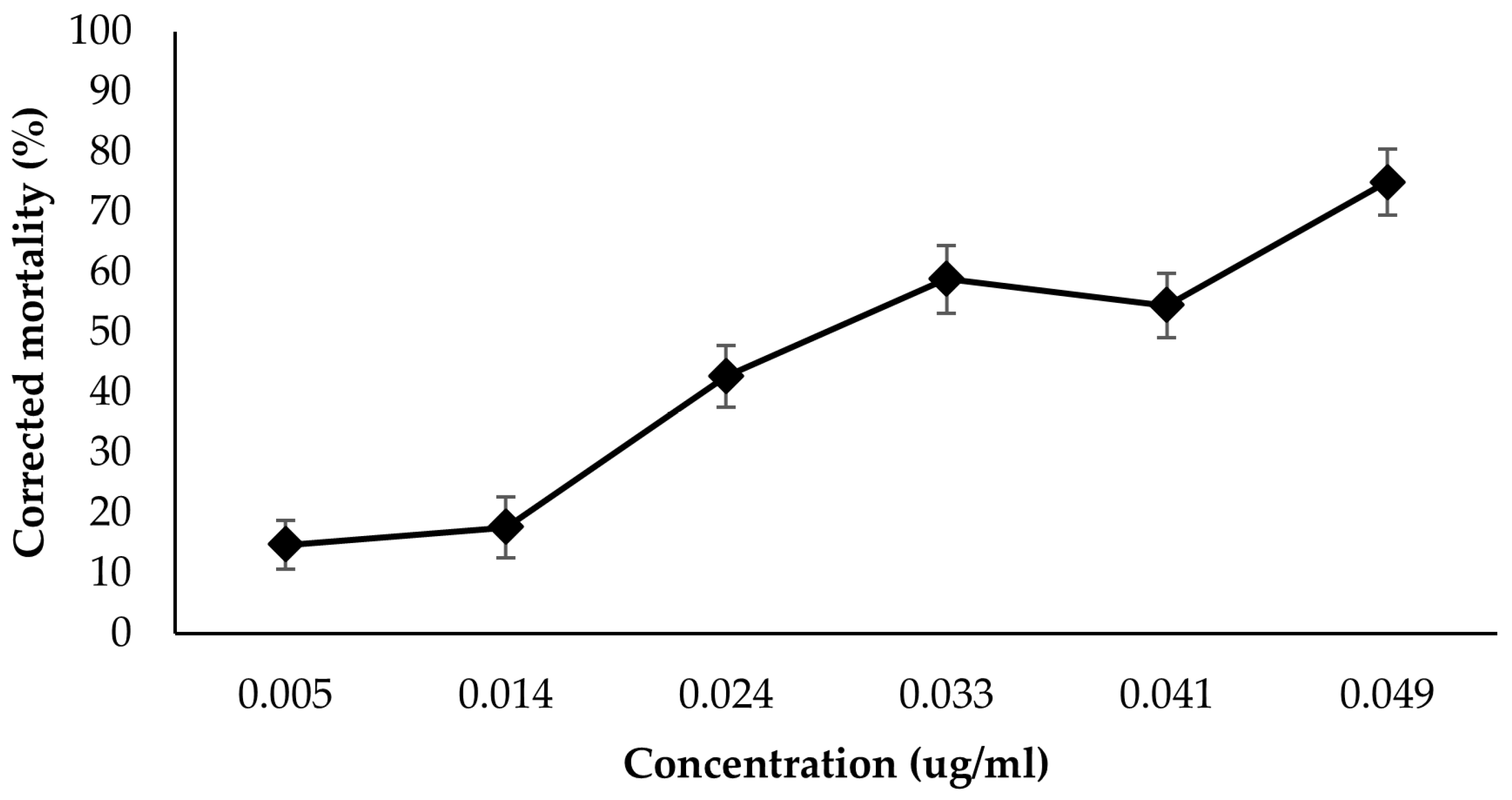
A clear dose-dependent increase in mortality was observed across the tested concentrations of Coragen® SC (Figure 1). The corrected mortality rate of 0.005 µg/mL was 15%, while the highest tested concentration (0.049 µg/mL) resulted in 79% mortality. Intermediate concentrations (0.033 and 0.041 µg/mL) showed 50% and 65% mortality, respectively. Mortality rates significantly differed across concentrations (F = 8.413, df = 6, p < 0.001). Multiple comparisons revealed a significant difference in larval mortality between concentrations (p < 0.001). The continuous increase in mortality supports a stable dose–response relationship suitable for probit-based LC estimation. The calculated LC50 value for Coragen® SC based on practical mortality was 0.0298 μg/mL with a 95% CI of 0.0252–0.0353 μg/mL, while the LC95 was 0.292 with a 95% CI of 0.161–0.530 μg/mL (Table 1). The absence of complete mortality at the highest tested concentration further supports the suitability of the selected dose range for baseline susceptibility determination.

3.2. Growth Inhibition

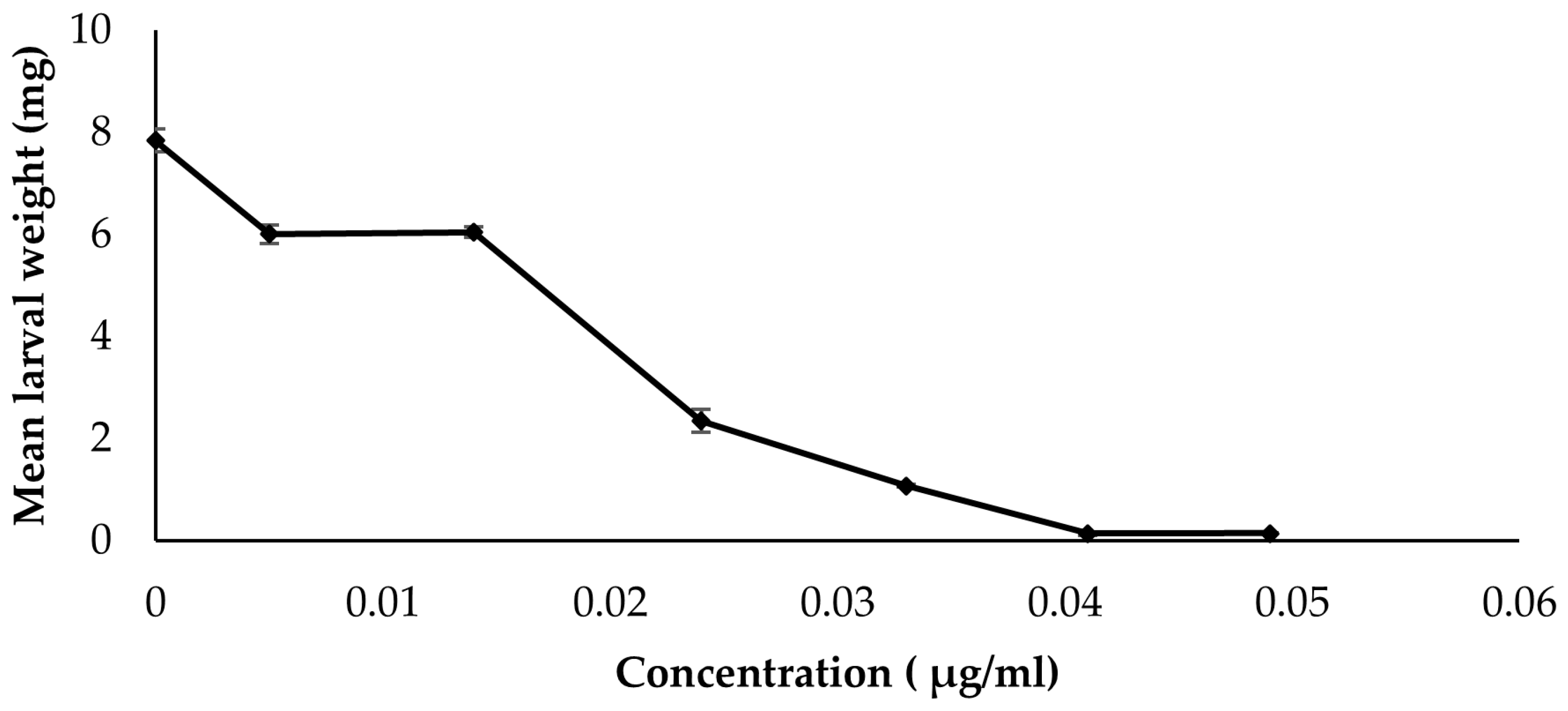
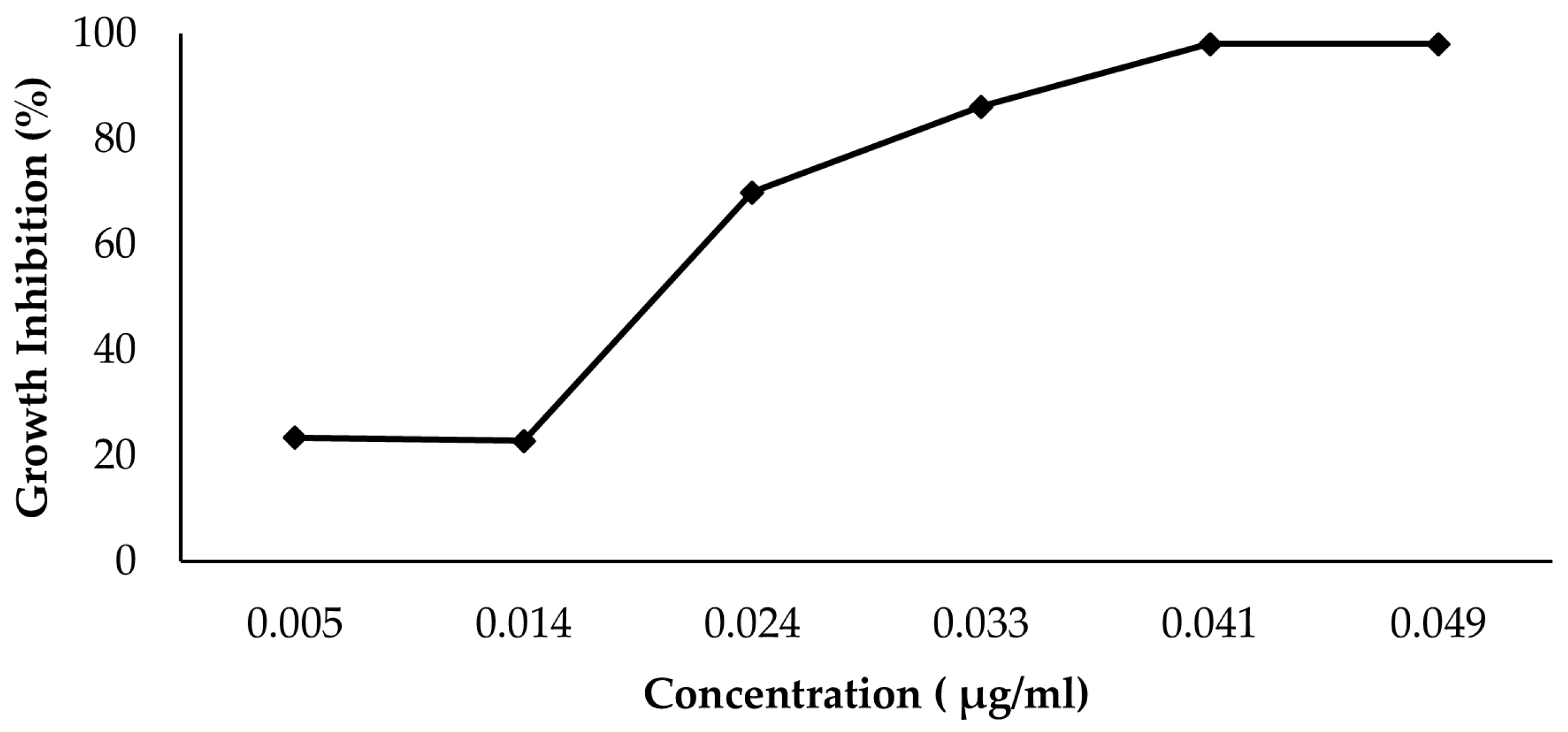
Increasing the dosage decreased larval weight across concentrations (Figure 2). Control larvae had the highest mean weight (8.0 ± 0.2 mg), while larvae exposed to 0.041 µg/mL and 0.049 µg/mL had dramatically reduced weights, averaging 0.2 ± 0.1 mg. Differences in larval weight across concentrations were statistically significant (F = 1976.15, df = 6, p < 0.001). Multiple comparisons revealed a significant difference in larval weight among concentrations (p < 0.001). Growth inhibition remained relatively stable (23%) at lower concentrations (0.005 to 0.014 μg/mL) but increased sharply to 70% at 0.024 μg/mL before plateauing at higher concentrations (Figure 3). The alignment between mortality and inhibition confirms the physiological impact of the compound on muscle regulation pathways targeted by chlorantraniliprole.

4. Discussion

The results of the current study indicated that Coragen® SC is effective against two-day-old E. saccharina larvae. The increase in concentration induced higher mortality and notable reductions in larval weight, with an LC50 of 0.0298 μg/mL, therefore establishing a crucial baseline for future resistance monitoring efforts. The validated mortality range (15–79%) across the selected concentrations confirms that the chosen doses were appropriate for resistance-monitoring applications. A similar pattern was observed in other studies on lepidopteran pests treated with insecticides containing the identical active ingredient, chlorantraniliprole. For example, the high toxicity of chlorantraniliprole to S. frugiperda, characterised by significant reductions in larval feeding and weight gain at sublethal concentrations, has been reported [8,18,19]. Lutz et al. [20] also found a similar observation in Spodoptera cosmioides, as pupal weight was decreased, and fecundity was reduced in adult female moths. Similarly, Wang and Wu [21] found a notable weight reduction and feeding inhibition in P. xylostella exposed to chlorantraniliprole. Lahm et al. [5] found that this compound disrupts calcium ion regulation, impairing muscle function and feeding behaviour in targeted insect species. The observed mortality range across concentrations is consistent with expectations for baseline susceptibility assays, indicating that the experimental design provided sufficient biological resolution for resistance monitoring.
In South Africa, chlorantraniliprole as an active ingredient has already been identified as a valuable alternative to traditional chemistries, such as pyrethroids and organophosphates, to which E. saccharina populations have shown increasing resistance [22]. These results are comparable to those reported by Leslie and Moodley [23], who achieved effective control of E. saccharina in a cage setup using a chlorantraniliprole-based product. The findings of this study, therefore, support the inclusion of Coragen ® SC with the integrated IPM strategies for sugarcane.
Sublethal endpoints, including growth inhibition, provide complementary sensitivity to mortality-based metrics and may enhance early detection of shifts in susceptibility prior to operational control failure [24]. Sublethal effects, such as reduced larval weight and feeding inhibition, have an important impact on IPM [25]. Although immediate mortality is not achieved, impaired development can delay pest life cycles and reduce reproductive success, ultimately reducing pest pressure in subsequent generations. In resistance monitoring, the use of sublethal impacts can also assist in detecting early physiological adaptations that precede full mortality-based resistance. Similar resistance monitoring protocols have been successfully implemented for Spodoptera littoralis in Egypt [26] and Helicoverpa armigera in India [27]. Nonetheless, overreliance on any single mode of action can quickly accelerate resistance development, as witnessed in several agroecosystems worldwide [11].
The use of Coragen® SC in isolation may accelerate selection pressure if not integrated with non-chemical approaches such as biological control or habitat manipulation, as promoted in IPM frameworks [3]. While laboratory conditions cannot fully replicate field exposure dynamics, the standardised design and controlled environment strengthen the internal validity and reproducibility of the findings. The dose-dependent mortality and growth inhibition observed under laboratory conditions are consistent with the known IRAC Group 28 mode of action of chlorantraniliprole, which causes rapid feeding cessation and muscle paralysis, supporting the relevance of the baseline values generated here for field-based resistance monitoring and management programmes in sugarcane. Routine periodic assays using the baseline values established here will support the early detection of changes in susceptibility. Additionally, the monitoring protocol developed here will be used to evaluate the baseline susceptibility of Bacillus thuringiensis insecticidal crystal proteins against E. saccharina. As such, resistance to chlorantraniliprole-based insecticides has already been documented in pests such as P. xylostella in Asia and S. frugiperda in South America.

5. Conclusions

The current study established the baseline susceptibility of E. saccharina larvae to Coragen® SC insecticide, indicating a dose-dependent increase in larval mortality and a significant reduction in larval weight at higher concentrations. The estimated LC50 and LC95 values of 0.0298 μg/mL provided a considerable reference point that can be integrated into an IRAC-aligned resistance monitoring programme for SASRI. These findings represent the first laboratory-based susceptibility for this pest–insecticide combination and support future comparisons against field populations to detect resistance. This study also highlights sublethal growth inhibition as an additional tool for resistance monitoring. Lastly, it could further serve as a foundation for developing an IRAC laboratory-based resistance monitoring protocol. The methodological framework described here provides a reproducible reference for future laboratory-based resistance surveillance and comparative susceptibility assessments in E. saccharina.

Author Contributions

Conceptualisation, L.N.M. and C.M.; methodology, E.H.A. and K.P.M.; investigation, K.P.M.; data curation, K.P.M.; writing—original draft presentation, K.P.M.; writing—review and editing, L.N.M., C.M. and E.H.A.; supervision, L.N.M. and C.M. All authors have read and agreed to the published version of the manuscript.

Funding

This research received no external funding.

Institutional Review Board Statement

Not applicable.

Informed Consent Statement

Not applicable.

Data Availability Statement

The original contributions submitted are included in the article. Further questions can be directed to the corresponding author.

Acknowledgments

The author would like to thank the whole insect rearing team for their assistance and patience.

Conflicts of Interest

The authors declare no conflicts of interest.

References

  1. Ndaba, N. Assessment of the Effects of Climate Change, Renewable Energy Consumption, Economic and Population Growth on Sugarcane Productivity in South Africa from 1972–2021. Master’s Thesis, University of South Africa, Pretoria, South Africa, 2024. [Google Scholar]
  2. Way, M.J. Developmental biology of the immature stages of Eldana saccharina Walker (Lepidoptera: Pyralidae). Proc. S. Afr. Sug. Technol. Assoc. 1995, 69, 83–86. Available online: https://www.cabidigitallibrary.org/doi/full/10.5555/19961104577 (accessed on 13 January 2026).
  3. Barker, A. Habitat Management Using Stimulo-Deterrent Diversion Techniques to Decrease Infestation of Sugarcane by Eldana saccharina Walker (Lepidoptera: Pyralidae). Master’s Thesis, University of the Witwatersrand, Johannesburg, South Africa, 2008. [Google Scholar]
  4. Barathi, S.; Sabapathi, N.; Kandasamy, S.; Lee, J. Present status of insecticide impacts and eco-friendly approaches for remediation—A review. Environ. Res. 2024, 240, 117432. [Google Scholar] [CrossRef] [PubMed]
  5. Lahm, G.P.; Selby, T.P.; Freudenberger, J.H.; Stevenson, T.M.; Myers, B.J.; Seburyamo, G.; Smith, B.K.; Flexner, L.; Clark, C.E.; Cordova, D. Insecticidal anthranilic diamides: A new class of potent ryanodine receptor activators. Bioorg. Med. Chem. Lett. 2005, 15, 4898–4906. [Google Scholar] [CrossRef] [PubMed]
  6. Caballero, R.; Cyman, S.; Schuster, D.J. Baseline susceptibility of Bemisia tabaci, biotype B (Hemiptera: Aleyrodidae) to chlorantraniliprole in southern Florida. Fla. Entomol. 2013, 96, 1002–1008. [Google Scholar] [CrossRef]
  7. Nauen, R.; Steinbach, D. Resistance to diamide insecticides in lepidopteran pests. In Advances in Insect Control and Resistance Management; Horowitz, A., Ishaaya, I., Eds.; Springer: Berlin/Heidelberg, Germany, 2016; pp. 219–240. [Google Scholar] [CrossRef]
  8. Wu, H.M.; Feng, H.L.; Wang, G.D.; Zhang, L.L.; Zulu, L.; Liu, Y.H.; Zheng, Y.L.; Rao, Q. Sublethal effects of three insecticides on development and reproduction of Spodoptera frugiperda (Lepidoptera: Noctuidae). J. Agron. 2022, 12, 1334. [Google Scholar] [CrossRef]
  9. Mulcahy, M.M.; Conlong, D.E.; Hill, M.P. Determining the efficacy of push-pull for management of Eldana saccharina (Walker) (Lepidoptera: Pyralidae) in sugarcane through on-farm field trials. Afr. Entomol. 2023, 31, 1–2. [Google Scholar] [CrossRef]
  10. Rutherford, R.S. An Integrated Pest Management (IPM) Approach for the Control of the Stalk Borer Eldana saccharina Walker (Lepidoptera: Pyralidae); The South African Sugarcane Research Institute: Mount Edgecombe, South Africa, 2015; ISBN 1-874903-41-7. [Google Scholar]
  11. IRAC (Insecticide Resistance Action Committee). IRAC Mode of Action Classification Scheme. Available online: https://irac-online.org/documents/moa-classification (accessed on 14 May 2025).
  12. Ngomane, N.C.; Gillespie, D.Y.; Conlong, D.E. The effect of an improved artificial diet formulation on Eldana saccharina Walker rearing, growth and development. Proc. S. Afr. Sug. Technol. Assoc. 2017, 90, 66–77. [Google Scholar]
  13. Insecticide Resistance Action Committee (IRAC). IRAC Susceptibility Test Methods Series–Biotech Method No. 1, Version 3. 2 September 2008. Available online: https://irac-online.org/methods/biotech-method-no-1-v3-2-sept-08/ (accessed on 30 November 2025).
  14. MarÇon, P.C.R.G.; Siegfried, B.D.; Spencer, T.; Hutchison, W.D. Development of diagnostic concentrations for monitoring Bacillus thuringiensis resistance in European corn borer (Lepidoptera: Crambidae). J. Econ. Entomol. 2000, 93, 925–930. [Google Scholar] [CrossRef] [PubMed]
  15. Li, H.; Wang, W.; Yang, X.; Kang, G.; Zhang, Z.; Wu, K. Toxic effects of Bt-(Cry1Ab+Vip3Aa) maize (DBN3601T event) on the Asian corn borer Ostrinia furnacalis (Guenée) in southwestern China. Agronomy 2024, 14, 1906. [Google Scholar] [CrossRef]
  16. Abbott, W.S. A method of computing the effectiveness of an insecticide. J. Econ. Entomol. 1925, 18, 265–267. [Google Scholar] [CrossRef]
  17. Finney, D.J. Probit Analysis: A Statistical Treatment of the Sigmoid Response Curve, 2nd ed.; Cambridge University Press: Cambridge, UK, 1952. [Google Scholar]
  18. Akhtar, Z.R.; Afzal, A.; Idrees, A.; Zia, K.; Qadir, Z.A.; Ali, S.; Haq, I.U.; Ghramh, H.A.; Niaz, Y.; Tahir, M.B.; et al. Lethal, sub-lethal and trans-generational effects of chlorantraniliprole on biological parameters, demographic traits, and fitness costs of Spodoptera frugiperda (Lepidoptera: Noctuidae). J. Insects 2022, 13, 881. [Google Scholar] [CrossRef] [PubMed]
  19. Yang, J.; Guan, D.; Wei, J.; Ge, H.; Cao, X.; Lv, S.; Zhou, X.; Zheng, Y.; Meng, X.; Wang, J.; et al. Mechanisms underlying the effects of low concentrations of chlorantraniliprole on development and reproduction of the fall armyworm, Spodoptera frugiperda. Pestic. Biochem. Physiol. 2023, 191, 105362. [Google Scholar] [CrossRef] [PubMed]
  20. Lutz, A.L.; Bertolaccini, I.; Scotta, R.R.; Curis, M.C.; Favaro, M.A.; Fernandez, L.N.; Sánchez, D.E. Lethal and sublethal effects of chlorantraniliprole on Spodoptera cosmioides (Lepidoptera: Noctuidae). Pest Manag. Sci. 2018, 74, 2817–2821. [Google Scholar] [CrossRef] [PubMed]
  21. Wang, X.; Wu, Y. High levels of resistance to chlorantraniliprole evolved in field populations of Plutella xylostella. J. Econ. Entomol. 2012, 105, 1019–1023. [Google Scholar] [CrossRef] [PubMed]
  22. U.S. Environmental Protection Agency. Pesticides Fact Sheet for Chlorantraniliprole. Office of Pesticide Programs, 2008. Available online: https://nepis.epa.gov/Exe/ZyPURL.cgi?Dockey=P100C269.TXT (accessed on 19 March 2025).
  23. Leslie, G.W.; Moodley, S. A preliminary assessment of new insecticides for the control of the sugarcane borer Eldana saccharina Walker (Lepidoptera: Pyralidae). Proc. S. Afr. Sug. Technol. Assoc. 2014, 87, 455–458. [Google Scholar]
  24. Bartling, M.-T.; Brandt, A.; Hollert, H.; Vilcinskas, A. Current insights into sublethal effects of pesticides on insects. Int. J. Mol. Sci. 2024, 25, 6007. [Google Scholar] [CrossRef] [PubMed]
  25. Nauen, R.; Bretschneider, T. New modes of action of insecticides. Pestic. Outlook 2002, 13, 241–245. [Google Scholar] [CrossRef]
  26. Moustafa, M.A.M.; Moteleb, R.I.A.; Ghoneim, Y.F.; Hafez, S.S.; Ali, R.E.; Eweis, E.E.A.; Hassan, N.N. Monitoring resistance and biochemical studies of three Egyptian field strains of Spodoptera littoralis (Lepidoptera: Noctuidae) to six insecticides. Toxics 2023, 11, 211. [Google Scholar] [CrossRef] [PubMed]
  27. Kranthi, K.R.; Jadhav, D.R.; Wanjari, R.R.; Kranthi, S.; Russell, D.A. Pyrethroid resistance and mechanisms of resistance in Helicoverpa armigera (Lepidoptera: Noctuidae) in India. J. Econ. Entomol. 2001, 95, 1345–1353. [Google Scholar] [CrossRef]
Figure 1. Percentage of corrected mortality of two-day-old E. saccharina larvae across increasing concentrations of Coragen® SC insecticide.
Blsf 54 00008 g001
Figure 2. Mean larval weight of two-day-old E. saccharina across increasing concentrations of Coragen® SC insecticide.
Blsf 54 00008 g002
Figure 3. Growth inhibition (GI) of two-day-old E. saccharina larvae inoculated with Coragen® SC insecticide. GI is the percentage growth inhibition in terms of larval weight relative to the control.
Blsf 54 00008 g003
Table 1. Lethal concentrations and 95% confidence intervals on larval mortality against Coragen® SC insecticide.
ToxinnLC50 (95% CI) (μg/mL)LC95 (95% CI) (μg/mL)
Coragen® SC4800.0298 (0.0252–0.0353)0.292 (0.161–0.530)
Disclaimer/Publisher’s Note: The statements, opinions and data contained in all publications are solely those of the individual author(s) and contributor(s) and not of MDPI and/or the editor(s). MDPI and/or the editor(s) disclaim responsibility for any injury to people or property resulting from any ideas, methods, instructions or products referred to in the content.