Proceeding Paper

Yield Stability of Selected Potato Cultivars Under Mulch and Fungicide Applications Across Different Environments †

by
Nosipho Precious Minenhle Phungula
1,2,*,
Sandile Thamsanqa Hadebe
3,
Lucky Sithole
4,
Morgan Nadioo
4 and
Nomali Ziphorah Ngobese
2
1
Department of Science, Botany and Plant Biotechnology, University of Johannesburg, P.O. Box 524, Auckland Park, Johannesburg 2006, South Africa
2
Unit for Environmental Sciences and Management, Faculty of Natural and Agricultural Sciences, North-West University, Private Bag X6001, Potchefstroom 2520, South Africa
3
Department of Plant Production, Soil Science and Agricultural Engineering, University of Limpopo, Private Bag X1106, Sovenga, Polokwane 0727, South Africa
4
Department of Agriculture and Rural Development, Private Bag X9059, Pietermaritzburg 3245, South Africa
*
Author to whom correspondence should be addressed.
Presented at the 3rd International Online Conference on Agriculture (IOCAG 2025), 22–24 October 2025; Available online: https://sciforum.net/event/IOCAG2025.
Biol. Life Sci. Forum 2025, 54(1), 6; https://doi.org/10.3390/blsf2025054006
Published: 31 December 2025
(This article belongs to the Proceedings of The 3rd International Online Conference on Agriculture)

Abstract

Smallholder farmers’ yields fluctuate yearly due to the variability of climate, resources, and diseases. The study aimed to assess genotypes-by-environment interactions under different management practices using additive main effects and multiplicative interaction models. Potato cultivars (Mondial, Electra, Sababa, and Panamera) were grown in five environments (Mbalenhle, Hlathikhulu, Mbhava, Stezi, and Gobizembe) for three seasons (2021–2023). Potatoes were planted under mulch (non-mulched and mulched) and fungicide (sprayed and unsprayed) management practices. The results revealed that the genotype–environment effect had a minimal contribution to tuber yield, ranging from 8.42% to 11.01% across management practices. For instance, in the absence of fungicide application with mulch and non-mulched practices, resulted in genotype effects of 69.92% and 60.62% and environments effects of 20.52% and 30.95%, respectively.

1. Introduction

Potato yields in rainfed smallholder settings are highly unstable due to the crop’s high sensitivity to moisture fluctuations and temperature extremes, which are exacerbated by climate variability [1,2,3]. Furthermore, yield instability is often driven by erratic rainfall, poor soil management, and limited access to critical resources for disease and pest management [4,5]. These challenges have broad economic, social, and environmental implications affecting the overall stability of food systems [6,7]. Negative impacts of the food system are exacerbated by consistently low yields in smallholder settings, often associated with resource-constrained farming scenarios [4].
A genotype achieves its optimal yield potential when it is adapted to the local climate and environmental conditions. Additionally, genotypes that consistently produce high yields are typically preferred for cultivation, as they perform with less fluctuation across environments and even different growing seasons at the same location [8]. To enhance food security and increase farmer profitability, it is vital to cultivate stable and high-yielding genotypes. The primary cause of low stability is the wide occurrence of genotype–environment interaction (GEI) [9]. Environmental conditions can significantly impact genotypes such that the responses of certain genotypes may vary based on different genotype-by-environment interactions [8]. Some phenotypic expressions of various genotypes may remain consistent across different environments, while others show variability [8]. Various statistical methods have been established to assess stability and support the recommendation of potato genotypes [10]. These include techniques such as additive main effects and multiplicative interaction (AMMI) analysis, and genotype main effect plus genotype-by-environment interaction (GGE) analysis [10]. The stability of a specific potato genotype reflects its ability to produce consistent yields across various geographic and environmental contexts.
Many smallholder farmers in sub-Saharan Africa continue to cultivate low-yielding genotypes that were introduced many years ago due to limited access to well-suited, high-yielding, improved genotypes in remote areas, which are significantly less productive and vulnerable to diseases and climate variability, resulting in inconsistent yields [11]. As a result, in the study area, many smallholder farmers plant potatoes using their locally available seed sources with unidentified cultivar names, which are frequently affected by disease and yield poorly. At the same time, some farmers have planted improved cultivars, but these have not been adapted to their specific environment, leading to low and unstable yields. Thus, it is vital to test newly introduced cultivars across growing environments to identify or select suitable cultivars for farmers to make informed decisions when choosing a cultivar. Moreover, this is important for narrowing the gap between current yields and their potential and for gaining insight into the selection and recommendation of cultivars, ultimately improving productivity and crop production for smallholder farmers. This study aimed to assess cultivar–environment interactions on potato yield stability exposed to different management and to identify adapted high-yielding cultivars for production in the study environments.

2. Methods and Materials

The field trials were implemented under rainfed conditions in smallholder settings from 2021 to 2023 (31 August to 18 January) in the KwaZulu-Natal province, South Africa, at two different agroecological zones, namely Appelsbosch and Swayimane, as shown in Table 1. Appelsbosch experiences a cooler, very humid, but relatively dry climate overall, and its soils have lower clay content, typically falling within the sandy loam range. In contrast, Swayimane is characterized by a warmer, moderately humid, and wetter environment, with soil that contains a higher proportion of clay and is classified as sandy clay in texture. The tested factors consisted of four potato genotypes (Mondial, Panamera, Electra, and Sababa) and five different environments (Mbalenhle and Hlathikhulu under Appelsbosch, whereas Gobizembe, Mbhava, and Stezi are from Swayimane), as reported by [1]. The cultivars were grown under two different levels of mulch application (mulched and non-mulched), and fungicide application (sprayed and unsprayed) using a randomized complete block design replicated three times under rainfed conditions. The plot size was 18 m2 (5 m × 3.6 m), consisting of four rows, and the sprayed block and unsprayed block were separated by 5 m. The spacing of 30 cm and 90 cm was used for intra- and inter-row, respectively. Fungicide spraying consisted of chloroyhalonil (1 L/ha), mefenoxam (2.5 L/ha), and mancozeb (3 kg/ha). Insects were controlled using Cypermethrin and Decis at a rate of 0.150 L ha−1. Dry grass was used as a mulch, applied at a rate of 1.9 kg per m2, completely covering the surface during the establishment stage. Overall, cultivars were planted under four different management practices, namely, mulched × sprayed, non-mulched × sprayed, mulched × unsprayed, and non-mulched × unsprayed. Potatoes were harvested according to maturity period; only the two center rows were harvested to quantify yield.

Statistical Analysis

The additive main effects and multiplicative interaction (AMMI) model was used to determine the G × E interaction effect and assess the adaptability and stability of the potato cultivars across five environments under four different management practices. The AMMI stability value (ASV) was calculated as described in [11] to measure and rank potato cultivars on their stability. The AMMI and genotype-by-environment interaction (GGE) biplot analyses were performed using GenStat software, 24th edition (VSN International, Hemel, Hempstead, UK).

3. Results and Discussion

3.1. AMMI Analysis of Variance for Tuber Yield

The mean square of variation among genotypes and environment was significant (p < 0.05), and the G × E interaction mean square showed no significant differences (p > 0.05) across management practices. The sum of squares factors explained (Table 2) that the main contributor to potato tuber yield variation was the genotype effect, followed by the environment effect across management practices. Notably, the genotype-environment effect had a minimal contribution to tuber yield, ranging from 8.42% to 11.01% across management practices. For instance, in the absence of fungicide application, the genotype effect for mulched and non-mulched practices was 69.92% and 60.62%, respectively, with the environment effects at 20.52% and 30.95%, respectively. On the other hand, the mulched × sprayed, and non-mulched × sprayed genotype effect was 56.55% and 55.63% and the environment effects at 32.44% and 34.88%, respectively. The significance of the environmental effect revealed that environments differ but did not vary, while the observed non-significance of genotype by environment interaction showed that yield did not diverge from one environment to another. The insignificant GEI for tuber yield could be explained by the homogeneity of the nature of the multi-environments tested, with different genetic makeup of the genotypes planted. Additionally, all the management practices revealed similar results across environments; hence, management practices made a minimal contribution to the variation in yield.

3.2. Genotype Tuber Yield Stability and Adaptive Analysis Using AMMI Biplot

Genotypes with lower AMMI Stability Values (ASVs) are considered more stable, while those with higher ASVs are deemed unstable [9]. The results revealed that each cultivar was stable for a specific treatment, as shown in Table 3. For instance, under treatment non-mulched × sprayed, Mondial (0.75) was found to be stable, followed by Panamera (2.02). Furthermore, Panamera (3.43), followed by Mondial (4.81), were stable under non-mulched × unsprayed. Sababa (2.2), followed by Mondial (2.26), were stable under mulched × sprayed. Lastly, Electra (1.56), followed by Mondial (1.78), were found to be stable under mulched × unsprayed. Overall, Mondial appeared to be stable across environments and treatments, although it had the lowest mean yield compared to other cultivars. On the other hand, Electra was identified as having a high tuber yield; this cultivar appears to be specifically adapted to the first treatment. In contrast, cultivars with IPC1 scores near zero exhibited minimal interaction effects, indicating that they are adaptable to the environment [12]. Even though a cultivar such as Mondial may exhibit stability across environments, the results revealed that this old-released cultivar is well adapted to a wide range of environments, compared to the newly introduced ones. Its overall performance in terms of yield or other desired traits is equally crucial, not just stability alone [13]. In other words, stability becomes meaningful only when it is associated with satisfactory average performance. Previous studies [8,14] provided crucial insights into the GEI using a similar approach to the current study, revealing that genotypes or environments with large absolute values of the IPCA score exhibit high interaction, indicating that their performance is highly variable and strongly influenced by environmental factors. The opposite is true for IPCA scores with small absolute values.
Under the management practices non-mulched × sprayed, mulch × sprayed, and non-mulch unsprayed, Mondial was found close to the origin, indicating minimal interaction effects (Figure 1), insensitive to the environmental change. Meanwhile, Panamera was found to be adapted to Hlathikhulu for all the management practices. Furthermore, Sababa was found to be adapted to Stezi for all the treatments except for mulched × sprayed. Electra was found to be adapted to Mbhava and Mbalenhle under treatment, non-mulched × sprayed, and it was also found to be adapted to Gobizembe and Stezi for the mulch–sprayed treatment, and to Mbalenhle only for the mulch–unsprayed treatment. Environments with short vectors did not exert strong interaction effects, while those environments that have long vectors farther from the origin exert strong interaction effects. Mean tuber yields for treatment non-mulch × unsprayed were Mbalenhle (36.91 t ha−1), Stezi (39.96 t ha−1), and Gobizembe (34.37 t ha−1). For mulched × sprayed treatment, Stezi (46.46 t ha−1), Mbalenhle (47.30 t ha−1), and Gobizembe (41.84 t ha−1). For mulched × unsprayed Gobizembe (33.040, Mbalenhle (37.34 t ha−1), and Stezi (40.11 t ha−1). Panamera, Sababa, and Electra were located farthest from the origin, which indicated the most responsive (interactive) cultivar contributed the highest interaction effects, and even had high mean tuber yield performance (Figure 1). Cultivars occurring close together will tend to have similar yield responses. For example, under non-mulched × unsprayed, Mondial and Sababa are close to each other; however, under mulched × sprayed, Mondial is close to Electra. Therefore, when disease control measures are applied, Mondial tends to have a yield similar to Electra, which was a high-yielding cultivar for this study.

3.3. GGE Analyses

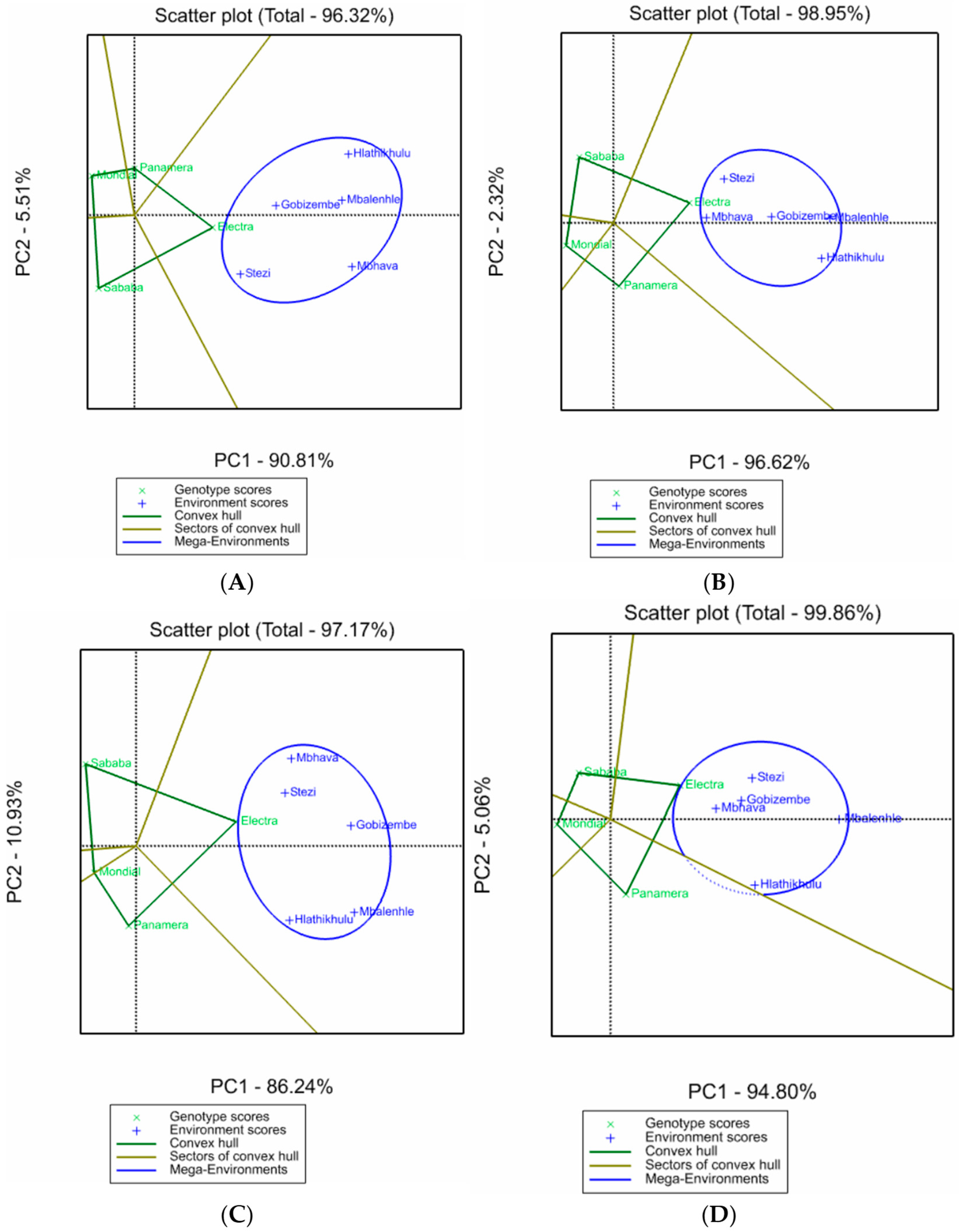
The analysis of the GGE biplot results revealed that among the vertex cultivars, Electra was identified within a sector encompassing several environments (Mbalenhle, Mbhava, Gobizembe, Hlathikhulu, and Stezi) across treatments (Figure 2). This indicates that Electra exhibited the highest level of adaptation, showcasing good performance in these environments. Additionally, the environments were grouped into one sector, creating a mega-environment, indicating that the genotype-by-environment interaction had a minimal impact on the total tuber yield variation. Genotypes that are not close to the origin are considered winning genotypes in the environments that fall within that sector. Hence, they are more sensitive to the GEI and are therefore specifically adapted to the environment. The findings align with previous research conducted by [8,15,16]. These studies used GGE biplot analyses to identify a superior genotype for a specific environment.

4. Conclusions

The results of the AMMI analysis revealed that genotype influenced the stability of yield; the genotype-by-environment interaction had minimal impact on potato tuber yield under different management practices. Mondial produced a low but stable tuber yield compared to Electra and Panamera. Meanwhile, Electra was the superior cultivar with consistent performance over the period of three years across environments. It may be recommended that farmers apply mulch and spray with fungicide for crop management and use Electra to obtain high yields, considering that Electra was able to attain the highest yield of 52.29 t ha−1 across environments.

Author Contributions

Conceptualization, N.P.M.P. and S.T.H.; methodology, N.P.M.P., M.N. and L.S.; validation and formal analysis, N.P.M.P.; resources and software, N.Z.N.; writing—original draft preparation, N.P.M.P. and S.T.H.; writing—review and editing, N.P.M.P., S.T.H., M.N., L.S. and N.Z.N.; supervision, S.T.H. and N.Z.N.; project administration and funding acquisition N.Z.N. All authors have read and agreed to the published version of the manuscript.

Funding

This project was funded by the National Research Foundation (NRF) grant No. 134115 and the European Union’s Horizon 2020 research and innovation program to cover running costs under grant agreement No. 862555. Potatoes South Africa provided a scholarship for N.P.M.P.

Institutional Review Board Statement

Not applicable.

Informed Consent Statement

Not applicable.

Data Availability Statement

The raw data supporting the conclusions of this article will be made available by the authors on request.

Acknowledgments

We would like to thank Wesgrow (Pty) Ltd. for assisting with potato seeds; the Department of Agriculture and Rural Development and extension officers from the Allerton office, Pietermaritzburg; and farmers from Swayimane and Appelsbosch.

Conflicts of Interest

The authors declare no conflicts of interest.

References

  1. Phungula, N.P.M.; Hadebe, S.T.; Schilte-Geldermann, E.; Sithole, L.; Ngobese, N.Z. Yield and growth response of selected potato cultivars to different mulch and fungicide applications, and various localities under rainfed conditions. Potato Res. 2024, 68, 2261–2283. [Google Scholar] [CrossRef]
  2. Puma-Cahua, J.; Belizario, G.; Laqui, W.; Alfaro, R.; Huaquisto, E.; Calizaya, E. Evaluating the yields of rainfed potato crop under climate change scenarios using the AquaCrop model in the Peruvian Altiplano. Sustainability 2024, 16, 71. [Google Scholar] [CrossRef]
  3. Zhao, F.; Zhang, Q.; Lei, J.; Wang, H.; Zhang, K.; Qi, Y. Environmental factors influence the responsiveness of potato tuber yield to growing season precipitation. Crop Environ. 2024, 3, 112–122. [Google Scholar] [CrossRef]
  4. Phungula, N.P.M.; Hadebe, S.T.; Schilte-Geldermann, E.; Sithole, L.; Ngobese, N.Z. The response of potato late blight to the integration of selected potato cultivars, fungicides and mulch at different levels, and localities. Eur. J. Plant Pathol. 2025, 172, 631–645. [Google Scholar] [CrossRef]
  5. Karina, T.; Supit, I.; Groot, A.; Ludwig, F.; Demissie, T. Projected climate change impacts on potato yield in East Africa. Eur. J. Agron. 2025, 166, 127560. [Google Scholar] [CrossRef]
  6. Martinez-Feria, R.A.; Basso, B. Unstable crop yields reveal opportunities for site-specific adaptations to climate variability. Sci. Rep. 2020, 10, 2885. [Google Scholar] [CrossRef] [PubMed]
  7. Liu, W.; Zhou, J.; Luo, Y.; Chen, S.; Ma, Y. Reduced crop yield stability is more likely to be associated with heat than with moisture extremes in the US Midwest. Earth’s Future 2025, 13, e2024EF005172. [Google Scholar] [CrossRef]
  8. Scavo, A.; Mauromicale, G.; Lerna, A. Dissecting the genotype x environment interaction for potato tuber yield and components. Agronomy 2022, 13, 101. [Google Scholar] [CrossRef]
  9. Enyew, M.; Feyissa, T.; Geleta, M.; Tesfaye, K.; Hammenhag, C.; Carlsson, A.S. Genotype by environment interaction, correlation, AMMI, GGE biplot and cluster analysis for grain yield and other agronomic traits in sorghum (Sorghum bicolor L. Moench). Plus One 2021, 16, e0258211. [Google Scholar] [CrossRef] [PubMed]
  10. Hassanpanah, D.; Azimi, J. Yield stability analysis of potato cultivars in spring cultivation and after barley harvest cultivation. Am.-Eurasian J. Agric. Environ. Sci 2010, 9, 140–144. [Google Scholar]
  11. Daemo, B.B.; Ashango, Z. Application of AMMI and GGE biplot for genotype by environment interaction and yield stability analysis in potato genotypes grown in Dawuro zone, Ethiopia. J. Agric. Food Res. 2024, 18, 101287. [Google Scholar] [CrossRef]
  12. Mekonnen, A.; Mekbib, F.; Gashaw, A. AMMI and GGE biplot analysis of grain yield of bread wheat (Triticum aestivum L.) genotypes at moisture deficit environment of Wollo, Ethiopia. J. Agric. Sci. Pract. 2019, 4, 9–19. [Google Scholar] [CrossRef]
  13. Bilate, D.B.; Belew, Y.D.; Mulualem, B.T.; Gebreselassie, A.W. AMMI and GGE biplot analyses for mega environment identification and selection of some high-yielding cassava genotypes for multiple environments. Int. J. Agron. 2023, 1, 6759698. [Google Scholar] [CrossRef]
  14. Cadersa, Y.; Santchurn, D.; Soulange, J.G.; Saumtally, S.; Parmessur, Y. Genotype by environment interaction for marketable tuber yield in advanced potato clones using AMMI and GGE methods. Afr. Crop Sci. J. 2022, 30, 332–346. [Google Scholar] [CrossRef]
  15. Sood, S.; Bhardwaj, V.; Kumar, V.; Gupta, V.K. BLUP and stability analysis of multi-environment trials of potato varieties in sub-tropical Indian conditions. Heliyon 2020, 6, e05525. [Google Scholar] [CrossRef] [PubMed]
  16. Gemechu, G.E.; Mulualem, T.; Semman, N. Genotype by environment interaction effect on some selected traits of orange-fleshed sweet potato (Ipomoea batatas L.). Heliyon 2022, 8, e12395. [Google Scholar] [CrossRef] [PubMed]
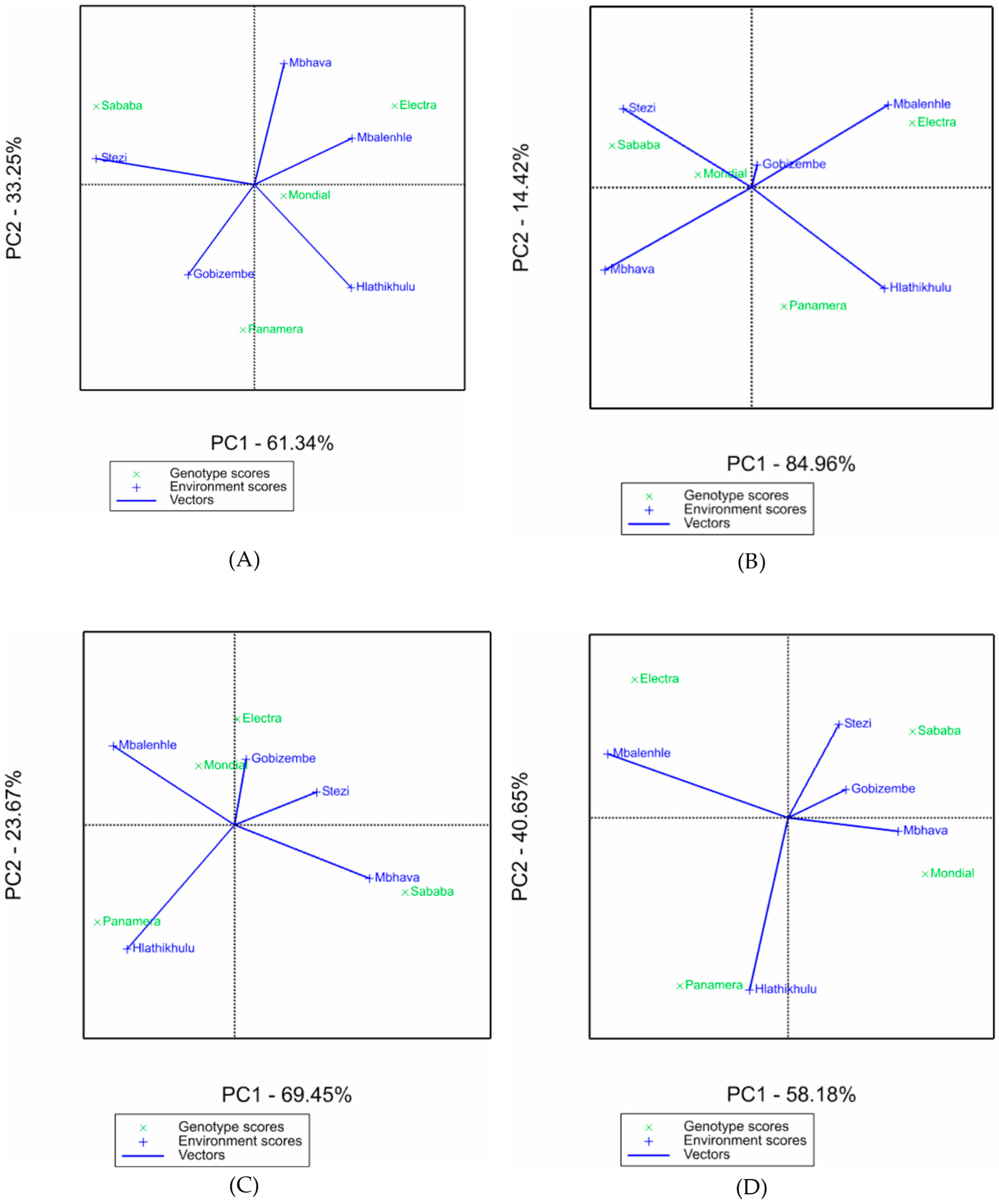
Figure 1. AMMI biplot of the four cultivars and five environments under different management practices, (A) non-mulched × sprayed, (B) non-mulched × unsprayed, (C) mulched × sprayed, (D) mulched × unsprayed.
Blsf 54 00006 g001
Figure 2. Which-Won-Where polygon view of GGE biplot of the four cultivars, showing cultivars with best performances in each environment and the mega environment under different management practices (A) non-mulched × sprayed, (B) non-mulched × unsprayed, (C) mulched × sprayed, (D) mulched × unsprayed.
Blsf 54 00006 g002
Table 1. Description of the Appelsbosch and Swayimane trial environments.
DescriptionAppelsboschSwayimane
MbalenhleHlathikhuluGobizembeMbhavaStezi
Altitude (m.a.s.l)1003922940750874
Latitude30°52′4.84″ E30°52′14.62″ E30°37′55.25″ E30°39′44.64″ E30°35′24.42″ E
Longitude29°22′33.88″ S29°23′53.58″ S29°29′22.98″ S29°33′54.98″ S29°31′51.10″ S
Annual rainfall (mm)540.3–774.0540.3–778616–690.8602.7–623.4629.3–663.7
Day air temperature (min–max) (°C)5.8–38.74.6–36.44.9–37.75.6–37.44.5–36.6
Soil typeUmbrisolsUmbrisolsFerralsolsFerralsolsUmbrisols
Key: m.a.s.l = meters above sea level.
Table 2. Additive main effects and multiplicative interaction (AMMI) analysis of variance for tuber yield (t ha−1) of four genotypes evaluated in five environments under different management.
Source of VariationDFSSMS% SS Explained
Non-mulched sprayed
Total17926,972150.7
Treatments1911,447602,5
Genotype36368.132122.7 *55.63
Environment43992.78998.2 *34.88
Block1028028
Interactions12108690.5 ns9.487
Residuals25929.4
Errors15015,245101.6
Mulched unsprayed
Total17927,701154.8
Treatments1911,915627.1
Genotype372232407.8 *60.62
Environment43688922.1 *30.95
Block1041441.4
Interactions12100383.6 ns8.42
Residuals2157.3
Errors15015,372102.5
Mulched sprayed
Total17928,572159.6
Treatments1913,181693.7
Genotype374542484.6 *56.55
Environment442761069.1 *32.44
Block1091891.8
Interactions121451120.9 ns11.01
Residuals210049.9
Errors15014,47496.5
Non-mulched unsprayed
Total17931,444175.7
Treatments1914,490762.6
Genotype310,1323377.2 *69.924
Environment42974743.4 *20.52
Block1043243.2
Interactions121385115.4 ns9.56
Residuals294.3
Errors15016,522110.1
Key: * = significant at p < 0.05, ns = insignificant at p > 0.05, DF = degree of freedom, SS = sum squares of variables, MS = mean squares of variables, and IPCA = interaction principal component analysis.
Table 3. The mean tuber yield (t ha−1), AMMI stability value, IPCA1, and IPCA2 of four selected cultivars across five environments.
CultivarTuber Yield (t ha−1)RankASVIPCA1IPCA2
Non-mulched × sprayed
Electra51.1333.711.921.08
Mondial35.8410.750.4−0.16
Panamera41.7122.02−0.16−1.99
Sababa37.4144.15−2.171.07
Non-mulched × unsprayed
Electra46.01414.472.450.98
Mondial26.3924.81−0.820.19
Panamera34.8913.430.49−1.82
Sababa29.27312.55−2.130.64
Mulched × sprayed
Electra52.2911.56−0.041.55
Mondial36.7921.76−0.530.87
Panamera40.6436.07−2.01−1.42
Sababa36.3747.412.500.99
Mulched × unsprayed
Electra43.0942.78−1.651.48
Mondial26.4522.191.47−0.61
Panamera35.6732.45−1.16−1.81
Sababa29.4212.121.340.93
Disclaimer/Publisher’s Note: The statements, opinions and data contained in all publications are solely those of the individual author(s) and contributor(s) and not of MDPI and/or the editor(s). MDPI and/or the editor(s) disclaim responsibility for any injury to people or property resulting from any ideas, methods, instructions or products referred to in the content.