1. Introduction
Unmanned aerial vehicles (UAVs) are rapidly transforming agricultural practices by enabling precision operations such as site-specific spraying, monitoring, and disease control. Their use is particularly valuable in labor-scarce or topographically challenging regions, where conventional spraying machinery is inefficient or infeasible. In India, the integration of UAV-based technologies is aligned with the push toward climate-smart agriculture and sustainable crop production systems [
1,
2].
UAV-based spraying allows for uniform agrochemical application, reduced operator exposure, and efficient resource use. However, the effectiveness of UAV spraying depends on several factors, including nozzle type, operational height, droplet characteristics, and local meteorological conditions [
3,
4]. Among these, nozzle design and flight altitude are especially critical as they influence droplet distribution, swath width, canopy penetration, and drift [
5,
6,
7]. The selection of nozzle type—whether flat-fan or air-induction anti-drift—affects droplet size and pattern, which in turn determine spray retention and effectiveness in different canopy layers [
8,
9].
Despite growing interest, comprehensive field-based studies examining the interaction between nozzle type and UAV flight height remain limited, particularly under Indian agronomic conditions. Most existing studies have been conducted in orchard systems or high-input mechanized farms, leaving a gap in evidence for smallholder rice systems [
10,
11]. Moreover, studies have emphasized the need to validate nozzle performance not only through field trials but also through controlled lab-based characterization, including parameters like volume median diameter (VMD), spray angle, and flow rate [
12].
This study addresses this gap by evaluating four nozzle types at three UAV flight heights in a field trial conducted during the Kharif 2022 season in Saharanpur, Uttar Pradesh. The objective is to assess their influence on critical spray parameters—crop canopy coverage area (CA%), droplet density (DD), volume median diameter (VMD), and swath width (SW)—across different canopy zones. Statistical validation using Analysis of Variance (ANOVA) and Tukey’s post hoc tests is employed to identify the optimal configuration for maximizing spray efficiency and minimizing agrochemical loss.
The specific objectives were to:
To characterize selected flat-fan and air-induction nozzles under laboratory conditions in terms of spray angle, volume median diameter (VMD), and flow rate across varying pressures;
To evaluate the effects of nozzle type and UAV flight height on spray performance parameters—crop canopy coverage area (CA%), droplet density (DD), VMD, and swath width (SW)—across different canopy layers of the rice crop;
To perform statistical analyses using ANOVA and Tukey’s HSD tests in order to determine significant differences and identify optimal nozzle–height configurations;
To derive practical recommendations for UAV spraying calibration that would be suitable for smallholder rice farming systems under Indian agronomic conditions.
2. Materials and Methods
2.1. UAV Sprayer Platform and Nozzle Types
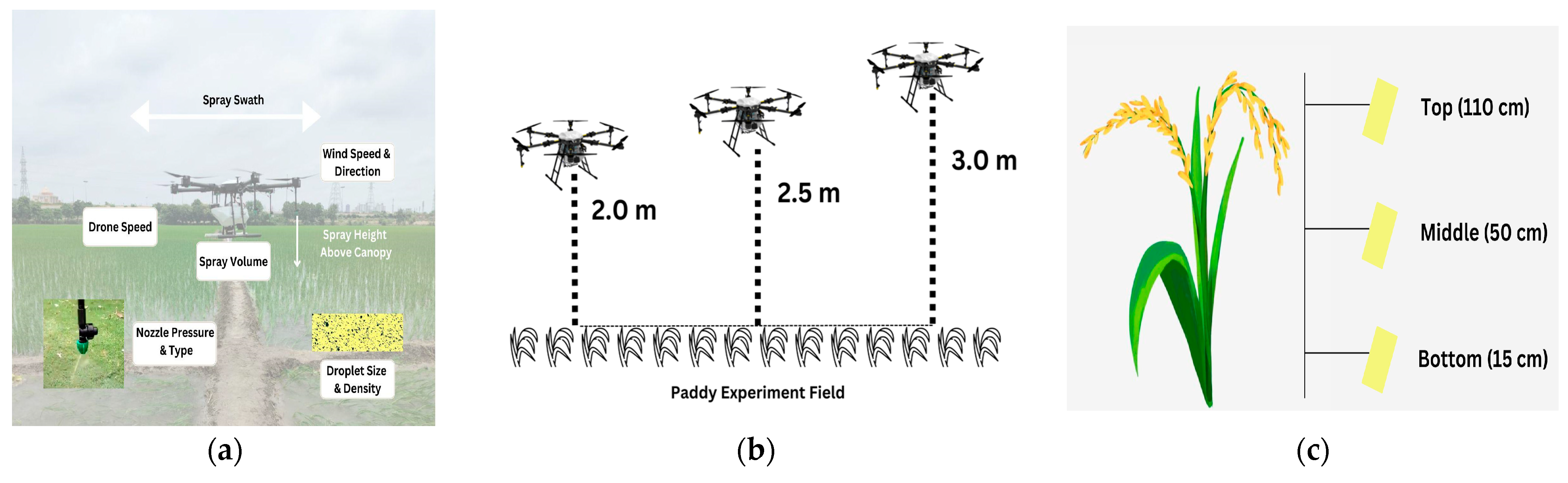
A hexacopter UAV (DEEP 1.0 v616, CHIRAG Technologies, Greater Noida, Uttar Pradesh, India) was used for field trials (
Figure 1a). The UAV featured a 16 L spraying tank and was operated at a constant flight speed of 5 m/s. The UAV operated as a hexacopter equipped with six brushless motors paired with 33-inch rotor blades. The rotor system generated a stable downwash flow that assisted droplet transport into the canopy, consistent with previously reported plant-protection UAV airflow characteristics. The platform was controlled using a GPS-assisted flight controller operating in altitude-hold and velocity-hold modes, which ensured constant flight height (±0.1 m) and speed (5 m/s) during all spray passes. These settings minimized height drift and variability in downwash strength across treatments. Four hydraulic nozzles were tested: LU 120-02 and LU 90-02 (flat-fan), and IDK 120-02 and IDK 90-02 (air-induction) (Lechler GmbH, Metzingen, Germany). These nozzles varied in spray angle (90° to 120°) and pressure compatibility (10–65 psi), enabling comparative assessment under operational constraints [
13,
14].
2.2. Laboratory Nozzle Characterization
All nozzles were characterized in a laboratory spray bench setup to assess spray angle, volume median diameter (VMD), and flow rate. Spray angles were measured manually with a protractor, and droplet spectra were evaluated per ASABE S572.3 FEB2020 standard for spray nozzle droplet spectra classification [
15]. Each measurement was repeated in triplicate across pressures (10, 30, 65 psi).
2.3. Field Site and Experimental Layout
Field experiments were conducted during the Kharif 2022 season in Saharanpur, Uttar Pradesh, using rice variety PB 1121 (ICAR–Indian Agricultural Research Institute (ICAR-IARI), New Delhi, India). A factorial randomized block design (4 nozzle types × 3 UAV heights) was implemented across 150 m
2 plots. The UAV was flown at 2.0 m, 2.5 m, and 3.0 m above canopy level (
Figure 1b), and environmental conditions were recorded during each sortie [
16,
17].
Water-sensitive papers (WSPs; TeeJet
®, Spraying Systems Co., Wheaton, IL, USA) were clipped at three canopy levels (top, middle, bottom) to measure spray deposition (
Figure 1c). This allowed for vertical profiling of droplet density and canopy coverage under different treatments [
18]. For each nozzle–height combination, three replicate WSPs were used at each canopy layer, resulting in a total of nine WSPs per treatment. This replication ensured adequate sampling depth and statistical reliability across canopy strata.
2.4. Droplet Data Extraction and Statistical Analysis
All WSPs were scanned (600 dpi) and analyzed using DepositScan software (USDA-ARS, Wooster, OH, USA) for droplet size, density, and coverage area. Coefficient of variation (CV) was calculated to assess spray uniformity. Statistical comparisons were conducted using one-way and two-way ANOVA, followed by Tukey’s HSD for pairwise analysis. Python (v3.10; Python Software Foundation, Wilmington, DE, USA) together with the
statsmodels (v0.14) and
SciPy (v1.11) libraries were used for all computations [
19]. All statistical procedures were implemented to ensure complete reproducibility of the analyses, and the selection of ANOVA and Tukey’s HSD was based on their suitability for multi-factor agricultural spray deposition studies.
For all graphical representations, error bars were computed using nonparametric bootstrapped 95% confidence intervals (2000 resamples) based on three replicate observations per treatment. This approach provides robust interval estimates for small sample sizes and has been widely recommended for spray-deposition and UAV spraying studies. All summary statistics plotted in
Figure 2,
Figure 3,
Figure 4 and
Figure 5 therefore represent mean values accompanied by their corresponding 95% confidence intervals.
3. Results and Discussion
3.1. Laboratory Characterization of Nozzles
The laboratory results demonstrated consistent trends across the four nozzle types. The flow rate increased with pressure for all nozzles, with the air-induction nozzle N-3 showing the highest value of 2.4 L/min at 65 psi. Spray pattern widths also expanded with increasing pressure, with N-3 producing the widest and most stable patterns (CV < 1.1%), suggesting its suitability for large-area coverage.
Droplet size analysis revealed that N-3 produced the largest volume median diameter (VMD) across all pressures, reaching 512.7 µm, and was classified as Very Coarse under the ASABE S572.3 standards. Flat-fan nozzles (N-1 and N-2) demonstrated finer spray spectra, whereas air-induction nozzles (N-3 and N-4) produced more uniform and coarser droplets. Spray angle measurements confirmed that nozzle types N-1 and N-3 retained consistent 120° patterns, while N-2 and N-4 remained stable around 90°, validating their operational reliability under field conditions.
3.2. Crop Canopy Coverage Area (CA%)
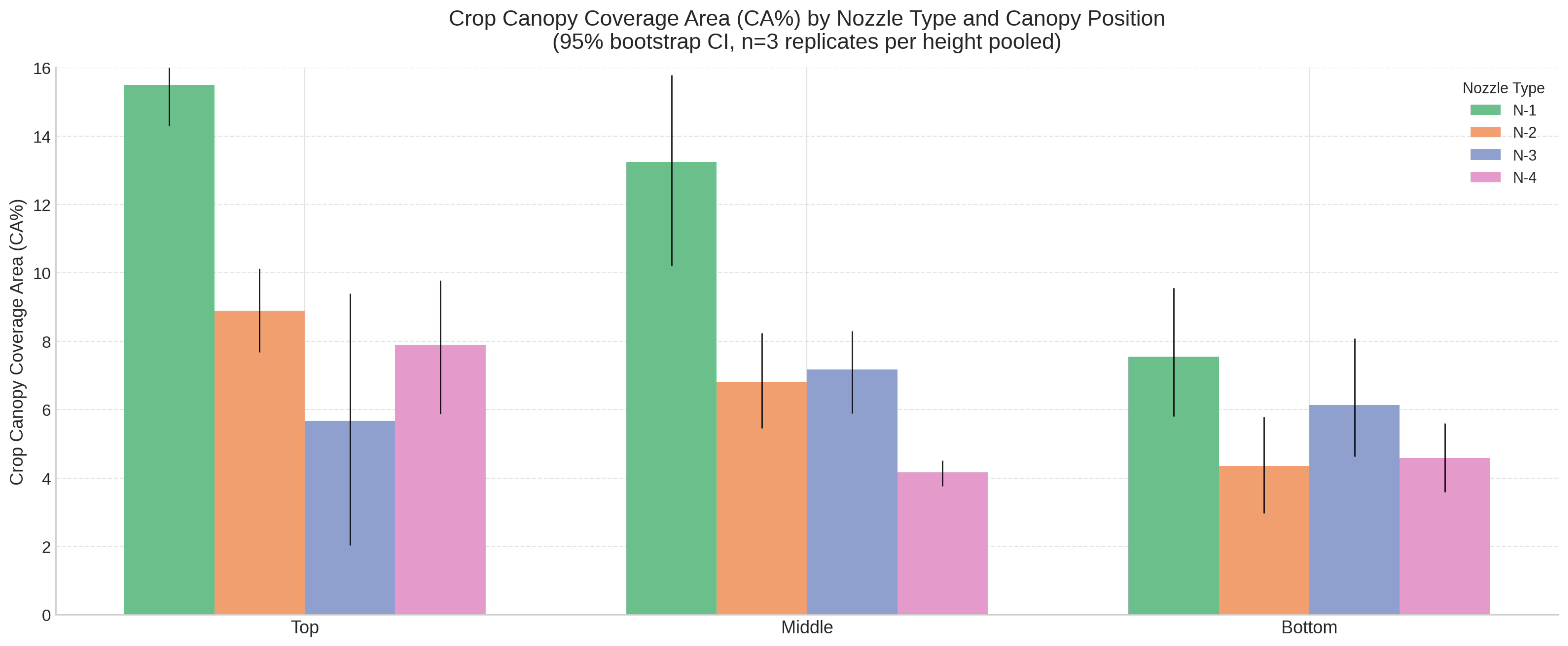
Field trials revealed that both UAV height and nozzle type had a significant effect on crop canopy coverage (p < 0.05). Nozzle N-1 operating at 3.0 m yielded the highest CA% of 15.6% at the top canopy layer, while N-4 exhibited the lowest coverage across most treatments. The top canopy generally received better coverage than the middle and bottom layers. These findings are consistent with previous work on vertical canopy stratification in aerial spraying.
The comparative results are illustrated in
Figure 2, which shows grouped bar plots by canopy position and nozzle type. Post hoc Tukey’s analysis further confirmed that N-1 significantly outperformed N-2, N-3, and N-4 (
p < 0.05), while height-based differences were marginally non-significant in pairwise comparisons.
3.3. Droplet Density (DD)
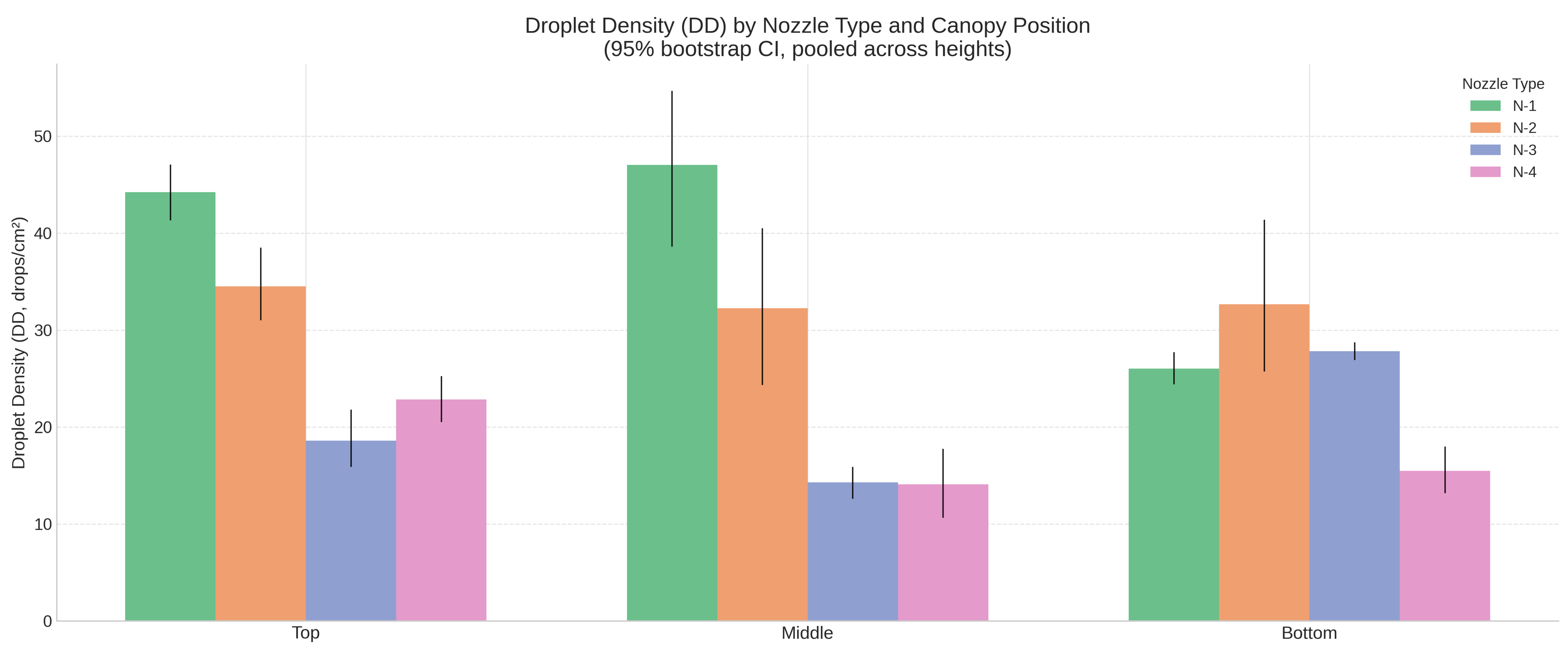
The droplet density followed a pattern similar to CA%. The highest droplet count (605.5 drops/cm2) was recorded at the middle canopy for N-2 at 2.0 m. In general, nozzles N-1 and N-2 achieved denser deposition profiles, while N-3 and N-4 had more variability, particularly at lower canopies. UAV height also had a significant effect, with the 2.5 m configuration delivering the most balanced deposition across layers.
These results are presented in
Figure 3, which illustrates droplet density variations across nozzle-height combinations using grouped bar charts with bootstrapped confidence intervals. Tukey’s test revealed statistically significant differences across all nozzle pairings, except between N-3 and N-4.
3.4. Volume Median Diameter (VMD)
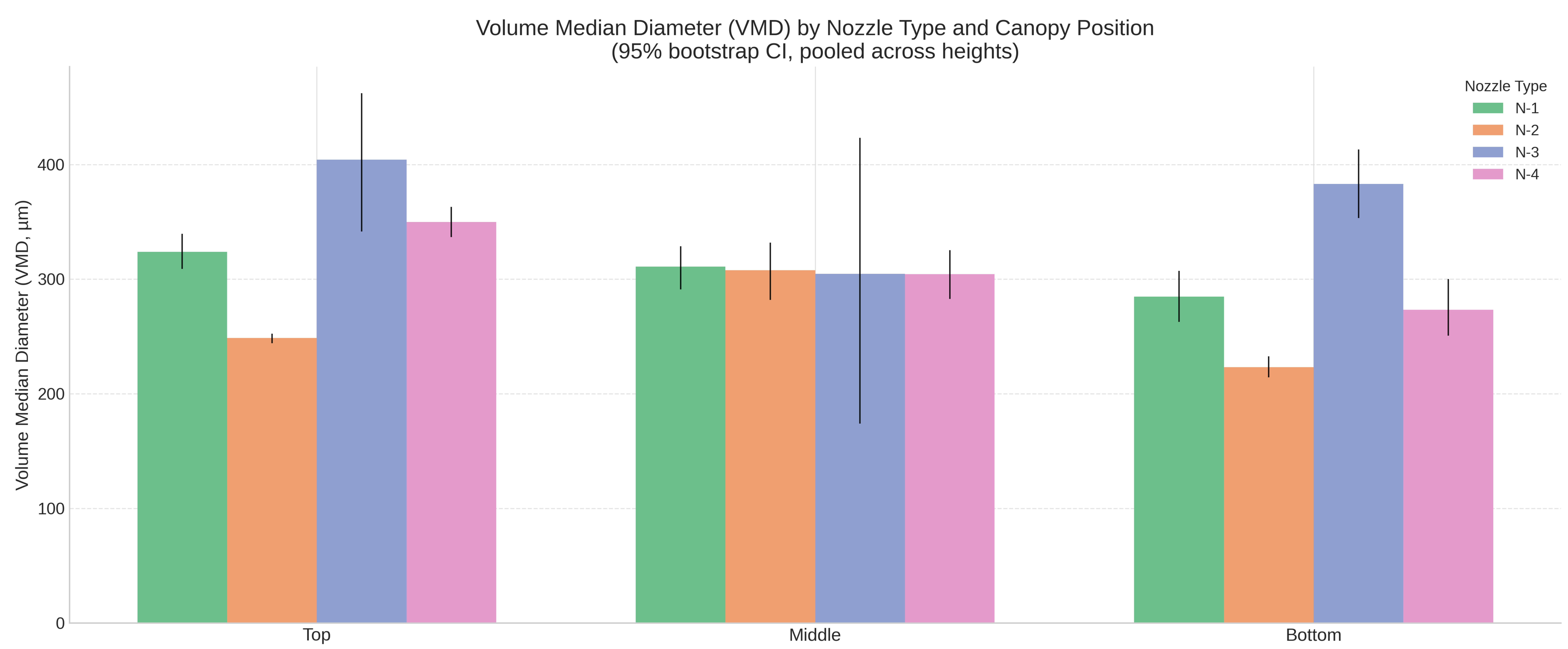
VMD analysis demonstrated the highest droplet size (487.7 µm) for N-3 at 2.5 m, particularly effective at penetrating the middle canopy. Droplets from N-3 were consistently classified as Very Coarse (VC), while those from N-2 were in the Medium (M) category. The interaction between UAV height and nozzle type was not statistically significant, although both main effects were individually significant (p < 0.05).
Outliers were observed—for instance, a 39 µm reading for N-3 at 3 m (middle canopy), likely due to rotor-induced turbulence. The grouped bar chart in
Figure 4 visualizes the VMD trends for each configuration.
3.5. Swath Width (SW)
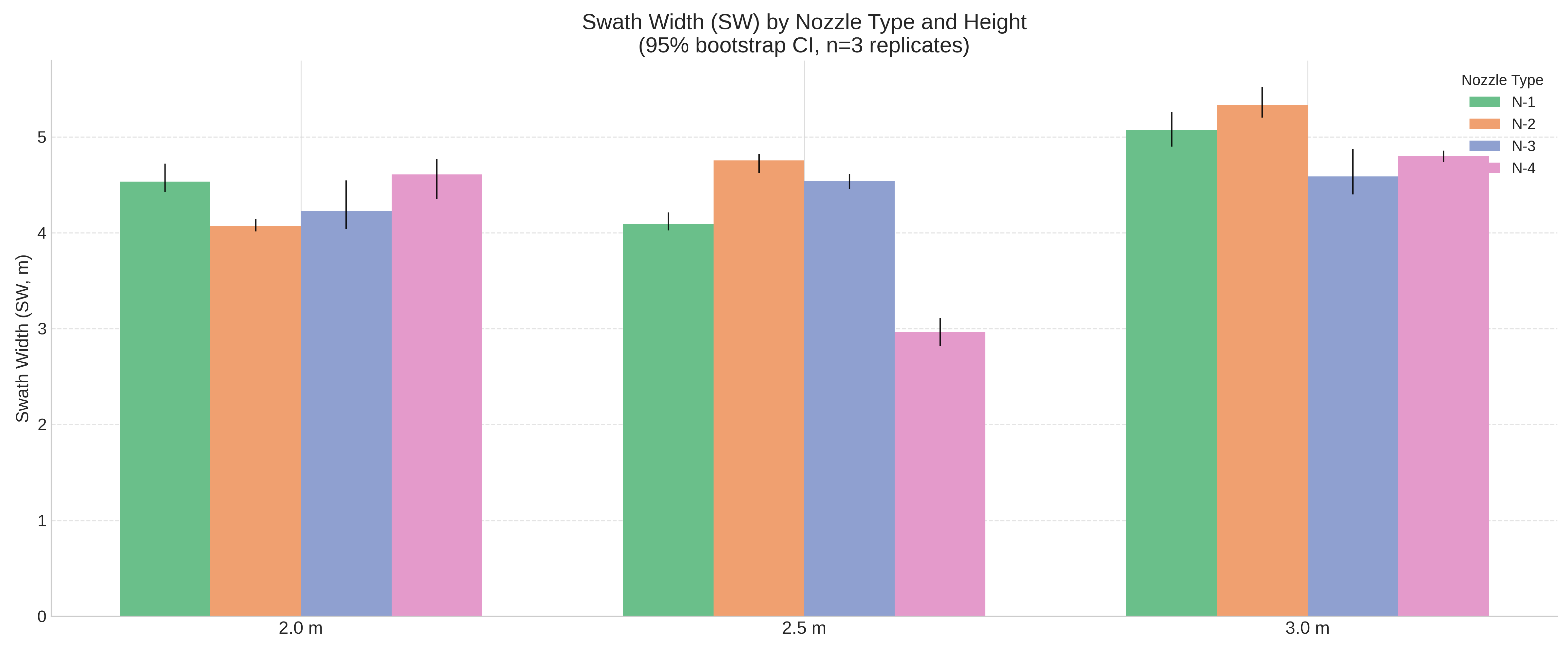
Swath width was highest for N-2 at 3.0 m (5.3 m) and lowest for N-4 at 2.5 m (2.9 m). Both nozzle type and UAV height were statistically significant (
p < 0.01) in influencing SW, with height exerting a more pronounced effect. Nozzle N-2, with its narrower spray angle and strong lateral projection, was optimal for wide swath coverage, as shown in
Figure 5.
3.6. Statistical Synthesis and Interpretation
A comprehensive statistical analysis using two-way ANOVA revealed that both nozzle type and UAV height significantly influenced all key spray deposition metrics—CA%, DD, VMD, and SW—with p-values < 0.05 in most cases. Importantly, the interaction term (nozzle × height) was not significant across metrics, suggesting that these two variables can be optimized independently. This is particularly relevant for field practitioners, as it simplifies calibration protocols for UAV spraying platforms. Effect sizes and interaction magnitudes were examined to confirm that nozzle and height acted as independent determinants of spray performance, reinforcing the appropriateness of the two-way ANOVA framework.
Tukey’s HSD post hoc tests validated the superiority of nozzle N-1 in maximizing canopy coverage and droplet density, and nozzle N-3 in optimizing droplet size for penetration. Furthermore, UAV heights of 2.5 m and 3.0 m consistently outperformed lower altitudes across parameters, indicating that slight elevation may reduce drift while maintaining effective deposition.
Overall, these results emphasize that spray performance is highly sensitive to nozzle design and height configurations, and that air-induction and flat-fan nozzles serve complementary purposes—the former for coarse, drift-resistant applications and the latter for finer, uniform coverage. These findings provide actionable insights for tailoring UAV spraying strategies to specific crop canopy structures and environmental conditions.
These findings are consistent with earlier UAV spraying studies that reported substantial sensitivity of droplet behavior to nozzle design and canopy turbulence [
5,
9,
20]. The superior performance of flat-fan nozzles for canopy coverage and the enhanced penetration achieved by air-induction nozzles mirror trends observed in other rice and orchard systems, confirming that nozzle hydraulics and droplet spectra remain primary drivers of aerial spray deposition outcomes.
4. Conclusions
This study investigated the influence of UAV height and nozzle type on critical agrochemical spray parameters—canopy coverage (CA%), droplet density (DD), volume median diameter (VMD), and swath width (SW)—in a rice cultivation setting in Northern India. Laboratory nozzle characterization confirmed that air-induction nozzles (particularly N-3) delivered the coarsest and most uniform droplet sizes, while flat-fan nozzles (notably N-1) provided superior coverage and deposition density under operational pressures.
Field trials validated these insights, showing that the UAV height of 2.5 m achieved a balanced deposition profile, with statistically significant improvements in droplet density and volume median diameter. Nozzle N-1 yielded the highest canopy coverage and droplet density, while N-3 achieved optimal droplet size for canopy penetration. In contrast, N-4 consistently underperformed across multiple metrics.
Two-way ANOVA revealed significant main effects of nozzle and height on all spray parameters (p < 0.05), with no significant interaction, thus allowing for independent calibration of these variables. Tukey’s HSD tests further confirmed that nozzle type had a dominant role in optimizing spray efficiency.
Overall, the configurations of N-1 at 3.0 m and N-3 at 2.5 m emerged as optimal strategies for balancing drift control and canopy penetration. These insights are expected to support the development of standardized UAV spraying protocols tailored for smallholder rice farmers under Indian agronomic conditions.
Future work may explore additional variables such as UAV speed, wind drift modeling, and real-time sensor feedback systems to further refine precision spraying. Integration with AI-based prescription maps and crop health monitoring tools also holds promise for next-generation UAV spraying solutions [
21].
Author Contributions
Conceptualization, S.V.R.; Methodology, S.V.R.; Software, S.V.R.; Validation, S.V.R.; Data curation, S.V.R.; Writing—original draft, S.V.R.; Writing—review and editing, P.K.V. and V.T.; Visualization, P.K.V.; Supervision, P.K.V. and V.T. All authors have read and agreed to the published version of the manuscript.
Funding
This research received no external funding.
Institutional Review Board Statement
Not applicable.
Informed Consent Statement
Not applicable.
Data Availability Statement
The datasets generated and analyzed in this study are not publicly available due to ongoing research and commercial confidentiality agreements with CHIRAG TECHNOLOGIES. The data form part of a continuing development program and contain proprietary information.
Conflicts of Interest
The authors declare no conflicts of interest.
References
- Huang, Y.B.; Thomson, S.J.; Hoffmann, W.C.; Lan, Y.B.; Fritz, B.K. Development and prospect of unmanned aerial vehicle technologies for agricultural production management. Int. J. Agric. Biol. Eng. 2013, 6, 1–10. [Google Scholar]
- Li, X.; Andaloro, J.T.; Lang, E.B.; Pan, Y. Best Management Practices for Unmanned Aerial Vehicles (UAVs) Application of Insecticide Products on Rice. In Proceedings of the 2019 ASABE Annual International Meeting, Boston, MA, USA, 7–10 July 2019. [Google Scholar]
- Chen, S.; Lan, Y.; Li, J.; Zhou, Z.; Liu, A.; Mao, Y. Effect of wind field below unmanned helicopter on droplet deposition distribution of aerial spraying. Int. J. Agric. Biol. Eng. 2017, 10, 67–77. [Google Scholar]
- Ahmad, F.; Qiu, B.; Dong, X.; Ma, J.; Huang, X.; Ahmed, S.; Chandio, F.A. Effect of operational parameters of UAV sprayer on spray deposition pattern in target and off-target zones. Comput. Electron. Agric. 2020, 172, 105350. [Google Scholar] [CrossRef]
- Lan, Y.; Qian, S.; Chen, S.; Zhao, Y.; Deng, X.; Wang, G.; Zang, Y.; Wang, J.; Qiu, X. Influence of the Downwash Wind Field of Plant Protection UAV on Droplet Deposition at Different Heights. Agronomy 2021, 11, 2399. [Google Scholar] [CrossRef]
- Martin, D.E.; Singh, V.P.; Latheef, M.A.; Bagavathiannan, M.V. Spray deposition on weeds from remotely piloted aerial systems and backpack sprayers. Drones 2020, 4, 59. [Google Scholar] [CrossRef]
- Qin, W.; Qiu, B.; Xue, X.; Chen, C.; Xu, Z.; Zhou, Q. Droplet deposition and control effect of insecticides sprayed with a UAV against planthoppers. Crop Prot. 2016, 85, 79–88. [Google Scholar] [CrossRef]
- Wang, S.; Li, X.; Nuyttens, D.; Zhang, L.; Liu, Y.; Li, X. Evaluation of Compact Air-Induction Flat-Fan Nozzles for Herbicide Applications: Spray Drift and Biological Efficacy. Front. Plant Sci. 2023, 14, 1018626. [Google Scholar]
- Hunter, J.E.; Gannon, T.W.; Richardson, R.J.; Yelverton, F.H.; Leon, R.G. Coverage and drift potential associated with nozzle and speed selection in UAV spraying. Weed Technol. 2020, 34, 235–240. [Google Scholar] [CrossRef]
- Shamshiri, R.R.; Hameed, I.A.; Balasundaram, S.K.; Weltzien, C.; Yamin, M. Fundamental research on UAVs to support precision agriculture in oil palm plantations. In Agricultural Robots: Fundamentals and Applications; IntechOpen: London, UK, 2018. [Google Scholar]
- Baio, F.H.R.; Antuniassi, U.R.; Castilho, B.R.; Teodoro, P.E.; da Silva, E.E. Factors affecting aerial spray drift in the Brazilian Cerrado. PLoS ONE 2019, 14, e0212289. [Google Scholar] [CrossRef] [PubMed]
- Escolà, A.; Camp, F.; Solanelles, F.; Planas, S.; Gràcia, F.; Rosell, J.R.; Gil, E.; Val, L. Spray application volume test in apple and pear orchards in Catalonia. In Proceedings of the 2006 ASAE Annual Meeting, Portland, OR, USA, 9–12 July 2006. Paper No. 061120. [Google Scholar]
- Wenneker, M.; Heijne, B.; van de Zande, J.C. Effect of Air-Induction Nozzles, Air Assistance, and One-Sided Spraying of the Outer Tree Row on Spray Drift in Orchard Spraying. Annu. Rev. Agric. Eng. 2005, 4, 116–128. [Google Scholar]
- Nuyttens, D.; Baetens, K.; De Schampheleire, M.; Sonck, B. Effect of Nozzle Type, Size and Pressure on Spray Droplet Characteristics. Biosyst. Eng. 2007, 97, 333–345. [Google Scholar] [CrossRef]
- ANSI/ASAE S572.3 FEB2020; Spray Nozzle Classification by Droplet Spectra. American Society of Agricultural and Biological Engineers: St. Joseph, MI, USA, 2020; Volume 15.
- Li, H.; Li, Y.; Zeeshan, M.; Yang, L.; Gao, Z.; Yang, Y.; Han, X. The Influence of Unmanned Aerial Vehicle Wind Field on the Pesticide Droplet Deposition and Control Effect in Cotton Fields. Agronomy 2025, 15, 1221. [Google Scholar] [CrossRef]
- Martin, D.E.; Woldt, W.E.; Latheef, M.A. Effect of application height and ground speed on droplet spectra from UAVs. Drones 2019, 3, 83. [Google Scholar]
- Zhu, H.; Salyani, M.; Fox, R.D. A portable scanning system for spray deposit evaluation. Comput. Electron. Agric. 2011, 76, 38–43. [Google Scholar] [CrossRef]
- Virtanen, P.; Gommers, R.; Oliphant, T.E.; Haberland, M.; Reddy, T.; Cournapeau, D.; Burovski, E.; Peterson, P.; Weckesser, W.; Bright, J.; et al. SciPy 1.0 Contributors. SciPy 1.0: Fundamental Algorithms for Scientific Computing in Python. Nat. Methods 2020, 17, 261–272. [Google Scholar] [CrossRef] [PubMed]
- Chen, S.; Lan, Y.; Zhou, Z.; Ouyang, F.; Wang, G.; Huang, X.; Cheng, S. Effect of Droplet Size Parameters on Droplet Deposition and Drift of Aerial Spraying by Using Plant Protection UAV. Agronomy 2020, 10, 195. [Google Scholar] [CrossRef]
- Faiçal, B.S.; Costa, F.G.; Pessin, G.; Ueyama, J.; Freitas, H.; Colombo, A.; Fini, P.H.; Villas, L.; Osório, F.S.; Vargas, P.A.; et al. The Use of Unmanned Aerial Vehicles and Wireless Sensor Networks for Spraying Pesticides. J. Syst. Archit. 2014, 60, 393–404. [Google Scholar] [CrossRef]
| Disclaimer/Publisher’s Note: The statements, opinions and data contained in all publications are solely those of the individual author(s) and contributor(s) and not of MDPI and/or the editor(s). MDPI and/or the editor(s) disclaim responsibility for any injury to people or property resulting from any ideas, methods, instructions or products referred to in the content. |
© 2025 by the authors. Licensee MDPI, Basel, Switzerland. This article is an open access article distributed under the terms and conditions of the Creative Commons Attribution (CC BY) license (https://creativecommons.org/licenses/by/4.0/).