Proceeding Paper

A Hybrid Machine Learning Approach for Monitoring Wheat Crop Traits Using Proximal Hyperspectral Remote Sensing †

Division of Agricultural Physics, Indian Council of Agricultural Research (ICAR)–Indian Agricultural Research Institute (IARI), New Delhi 110012, India
*
Author to whom correspondence should be addressed.
Presented at the 3rd International Online Conference on Agriculture (IOCAG 2025), 22–24 October 2025; Available online: https://sciforum.net/event/IOCAG2025.
Biol. Life Sci. Forum 2025, 54(1), 33; https://doi.org/10.3390/blsf2025054033
Published: 23 March 2026
(This article belongs to the Proceedings of The 3rd International Online Conference on Agriculture)

Abstract

This study employs a hybrid methodology that integrates a physical process-based radiative transfer (RT) model and machine learning regression to assess three key wheat crop traits: leaf area index (LAI), leaf chlorophyll content (LCC), and canopy chlorophyll content (CCC). The non-imaging hyperspectral data collected proximally using the ASD FieldSpec Spectroradiometer were spectrally resampled to 269 spectral bands ranging from 400 to 1000 nm for the retrieval of these crop traits. Upon validating against in situ measurements, good accuracies in terms of NRMSE values, 10.65%, 11.63%, and 13.85%, were achieved for LAI, LCC, and CCC, respectively.

1. Introduction

The ability of hyperspectral sensors to capture precise spectral measurements, which signify the inherent properties of the target material, presents a strong potential for accurately estimating key crop health indicators in precision agriculture. The timely management of these crop health traits, such as leaf area index (LAI), leaf chlorophyll content (LCC), and canopy chlorophyll content (CCC), allows farmers to make accurate decisions for fertilizer applications, irrigation scheduling, and yield management [1]. Traditional approaches are destructive in nature and require more labour and time, especially when dealing with larger fields. So there exists a growing demand for developing novel sensor-based approaches for accurate and rapid estimation of crop traits [2]. Large datasets of spectral simulations from PROSAIL radiative transfer models can be effectively used for developing accurate machine learning prediction models, called “hybrid models,” which have been proven to be powerful in retrieving important crop traits from high-resolution remote sensing datasets acquired at different platforms. In our earlier studies, we successfully optimized hybrid Gaussian process regression (GPR) models for retrieving LAI, LCC, and CCC for wheat from unmanned aerial vehicle (UAV) hyperspectral data in the spectral range of 400–1000 nm [3,4]. Here, we explore the potential of this hybrid method to retrieve these traits in the same wheat experiments using proximal non-imaging hyperspectral sensors at ground level. Even though the visual interpretation of spatial variability in these traits is missing at the pixel level, this approach facilitates the retrieval of important crop traits from high-precision point measurements. Proximal sensors offering real-time spectral measurements can be used for fast and accurate estimation of crop traits at the operational level in combination with these sophisticated hybrid models. So in the absence of these powerful imaging sensors, the proximal sensors act as a potential alternative for accurately estimating the important crop traits. We have successfully evaluated hybrid models from multiple hyperspectral sensing platforms (imaging and non-imaging) for predicting mustard leaf chlorophyll content, but not attempted to do so for wheat crop. Overall, the major objective of this study is to optimize a hybrid retrieval workflow for retrieving LAI, LCC, and CCC for wheat using proximal hyperspectral data. A spectral resampling was carried out on the proximal data to compare with UAV sensors. This facilitates comparing the results with UAV-acquired predictions through hybrid modelling. The key innovation exists in the consistency, transferability, and scalability of hybrid models for retrieving these key parameters from UAV imaging data to non-imaging data at ground level. The Gaussian process regression algorithm, an active learning method for reducing sample size, principal component analysis for spectral dimensionality reduction, and training with spectral simulations from the PROSAIL RT model were the main components.

2. Materials and Methods

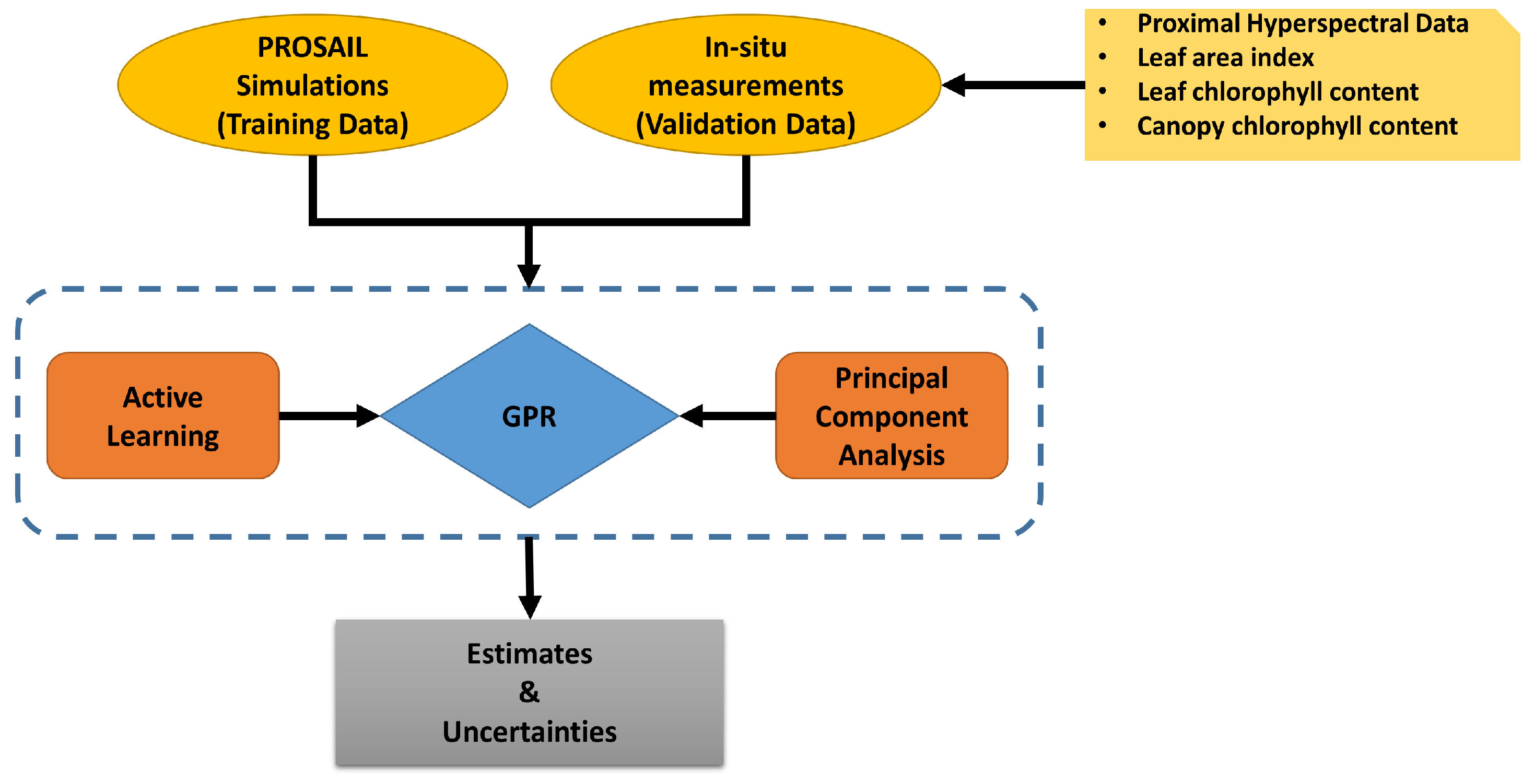
The flowchart showing the methodology adopted for the present study is shown in Figure 1. The methodology involves the following steps: (i) study area and field experimentation, (ii) data collection, and (iii) hybrid machine learning approach. Each step is detailed below.

2.1. Study Area and Field Experimentation

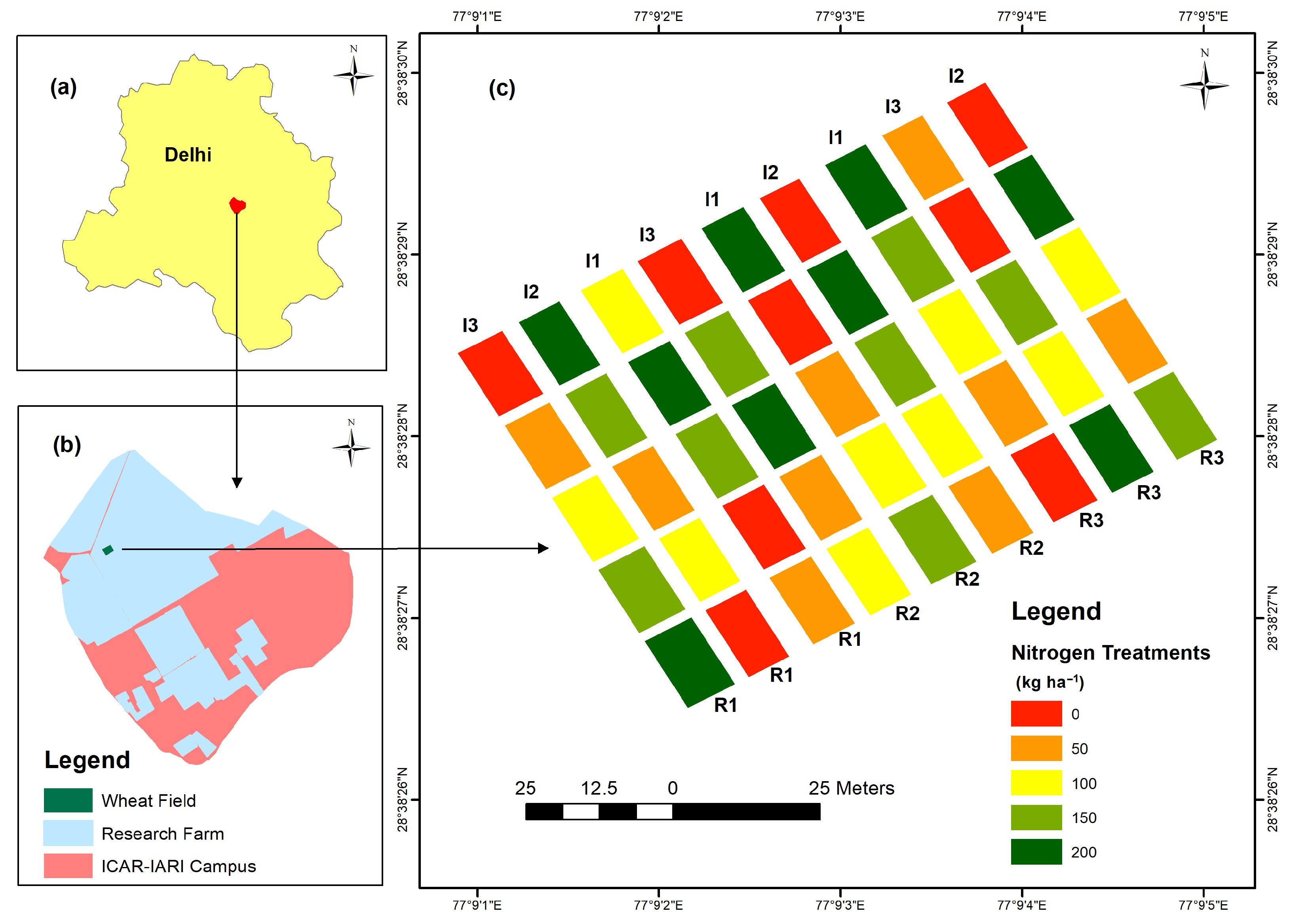
The study was conducted on the wheat experiments carried out during the rabi season of 2021–2022 in the research farm of ICAR–Indian Agricultural Research Institute (IARI), New Delhi, India. The field was geographically located at 28°38′28.314″ N and 77°9′3.106″ E. A split-plot design (SPD) was used for the field. There were three replications (R1–R3) of five graded N levels (N0–N4) maintained at three irrigation treatments (I1–I3). So altogether they were 45 plots with each having an area of 93.6 m2 (7.2 m × 13 m). The five N levels were 0, 50, 100, 150, and 200 kg ha−1, respectively. The three irrigation treatments were I1: irrigation based on soil moisture sensors; I2: crop water stress index (CWSI); and I3: conventional methods. The study area, showing the location of the experimental fields and the details of the treatments, is shown in Figure 2.

2.2. Data Collection

The proximal hyperspectral data from each experimental plot were collected using a portable ASD FieldSpec® 4 Standard-Res Portable Spectroradiometer (Analytical Spectral Devices Inc., Boulder, CO, USA) equipped with a gun probe in the spectral range of 350–2500 nm at a spectral interval of 1 nm. The data collection was carried out on 17 March 2022. Before data collection, the instrument was optimized using the reflectance data from the Spectralon white panel. The pre-processing of the spectral data, including the splice correction, reflectance conversion, and exporting to ASCII format, was carried out using ASD View Spec Pro software 6.20 [5]. Three spectral measurements were taken from each plot by placing the gun probe at a distance of 1 m above the canopy with a field of view (FOV) of 25°.
The spectral data was resampled to 2.2 nm and FWHM of 6 nm by taking only the range of 400–1000 nm to spectrally match with UAV-borne data [6]. This will facilitate the comparison of crop trait prediction results from the proximal sensor to previously published results from UAV data [4]. On the same day of spectral data collection, the LAI was measured in-situ using the LI-COR LAI-2000 Plant Canopy Analyzer (LI-COR, Inc., Lincoln, NE, USA) [6]. Leaf samples were collected from each plot, and their LCC was analyzed in the laboratory using the dimethyl sulfoxide (DMSO) method [7]. The CCC was calculated by multiplying LAI and LCC [8].

2.3. Hybrid Machine Learning Approach

The radiative transfer model PROSAIL-4 is a combination of the PROSPECT-4 leaf reflectance model and the 4-SAIL canopy reflectance model. The input variables and their corresponding values are shown in Table 1 [9,10,11]. The simulated directional reflectance in the spectral range of 400–1000 nm and spectral interval of 2.2 nm from PROSPECT-4 was used as the input for 4-SAIL. The bi-directional top-of-canopy (TOC) reflectance from 4-SAIL will be used for training the machine learning model. About 1000 spectral simulations were generated using Latin hypercube sampling (LHS) [12,13]. After a comprehensive comparison of multiple machine learning models, it was found that Gaussian process regression with a squared exponential kernel function shows superior accuracy for predicting wheat crop traits [14]. The MATLAB R2018A implementation of GPR with a squared exponential kernel function available in the ARTMO (automated radiative transfer models operator) software package was selected for developing the hybrid model. The principal component analysis (PCA) with 20 components was selected for dimensionality reduction [4,5,14]. In order to avoid the redundancy in using large spectral simulations as training datasets, suitable active learning (AL) techniques were chosen for reducing the sample size without compromising the prediction accuracy. Four AL techniques, such as pool active learning (PAL), residual active learning (RSAL), Euclidean distance-based diversity (EBD), angle-based diversity (ABD), and clustering-based diversity (CBD), were evaluated, and the best one was selected for developing the hybrid model. The prediction performance of the optimized hybrid models was assessed using the commonly used goodness-of-fit statistics, such as coefficient of determination (R2), mean absolute error (MAE), root mean square error (RMSE), and normalized RMSE (NRMSE). The insitu collected data from 45 plots and 5 non-vegetation spectra were used for the model validation. The non-vegetation spectra, here the soil spectral with corresponding trait values of zero, improve the model prediction accuracy and applicability to heterogeneous classes [15].

3. Results

3.1. Performance of AL Techniques

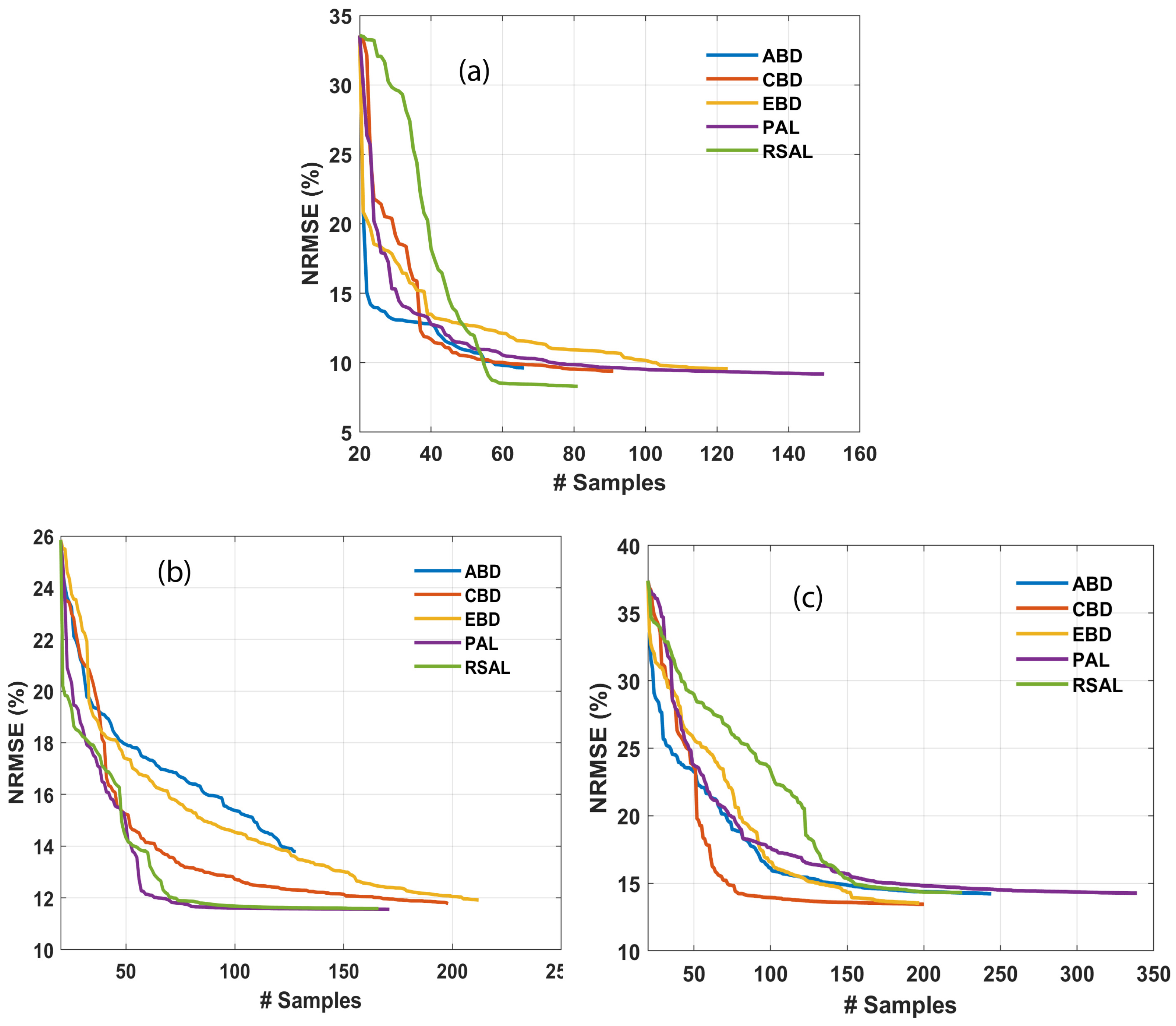
A comparative evaluation of different AL methods for LAI, LCC, and CCC estimations using NRMSE is shown in Figure 3. A stable decrease in the NRMSE was obtained on the addition of new samples at each iteration. Optimal GPR performance was obtained at a few samples, as indicated by the X-axis of the graphs in Figure 3. The RSAL shows the superior performance for LAI, while the PAL and CBD outperform in the case of LCC and CCC. In the case of LAI, the RSAL shows a steady decrease in NRMSE from 33.56% to 8.30% at a sample size of 81. In the case of LCC, PAL shows a steady decrease in NRMSE from 25.8% to 11.56% at a sample size of 171. In the case of CCC, CBD shows a steady decrease in NRMSE from 37.4% to 13.46% at a sample size of 200. These reduced datasets were used for optimizing the hybrid GPR model for retrieving crop traits.

3.2. Retrieval and Accuracy Assessment

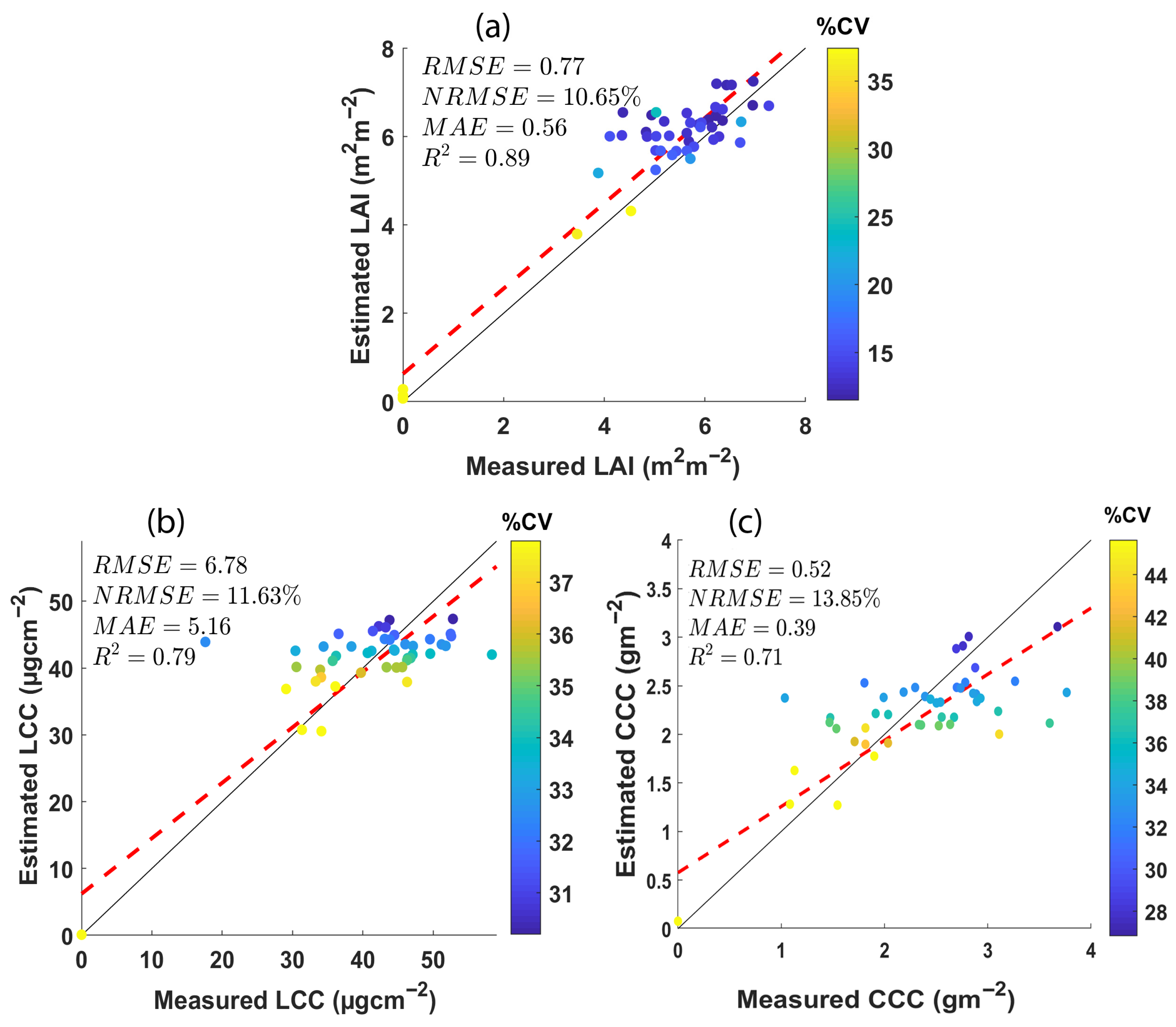
Figure 4 shows the scatterplots of the predicted LAI, LCC, and CCC values against insitu measurements, along with accurate goodness-of-fit results (RMSE, MAE, NRMSE, and R2). A colour chart showing the relative uncertainties expressed in coefficient of variation (CV)% obtained from GP regression was also provided on the right side of each image. Low NRMSE values of 10.65%, 11.63%, and 13.85% and higher R2 values of 0.89, 0.79, and 0.71, respectively, for LAI, LCC, and CCC suggest good agreement between measured and estimated values.
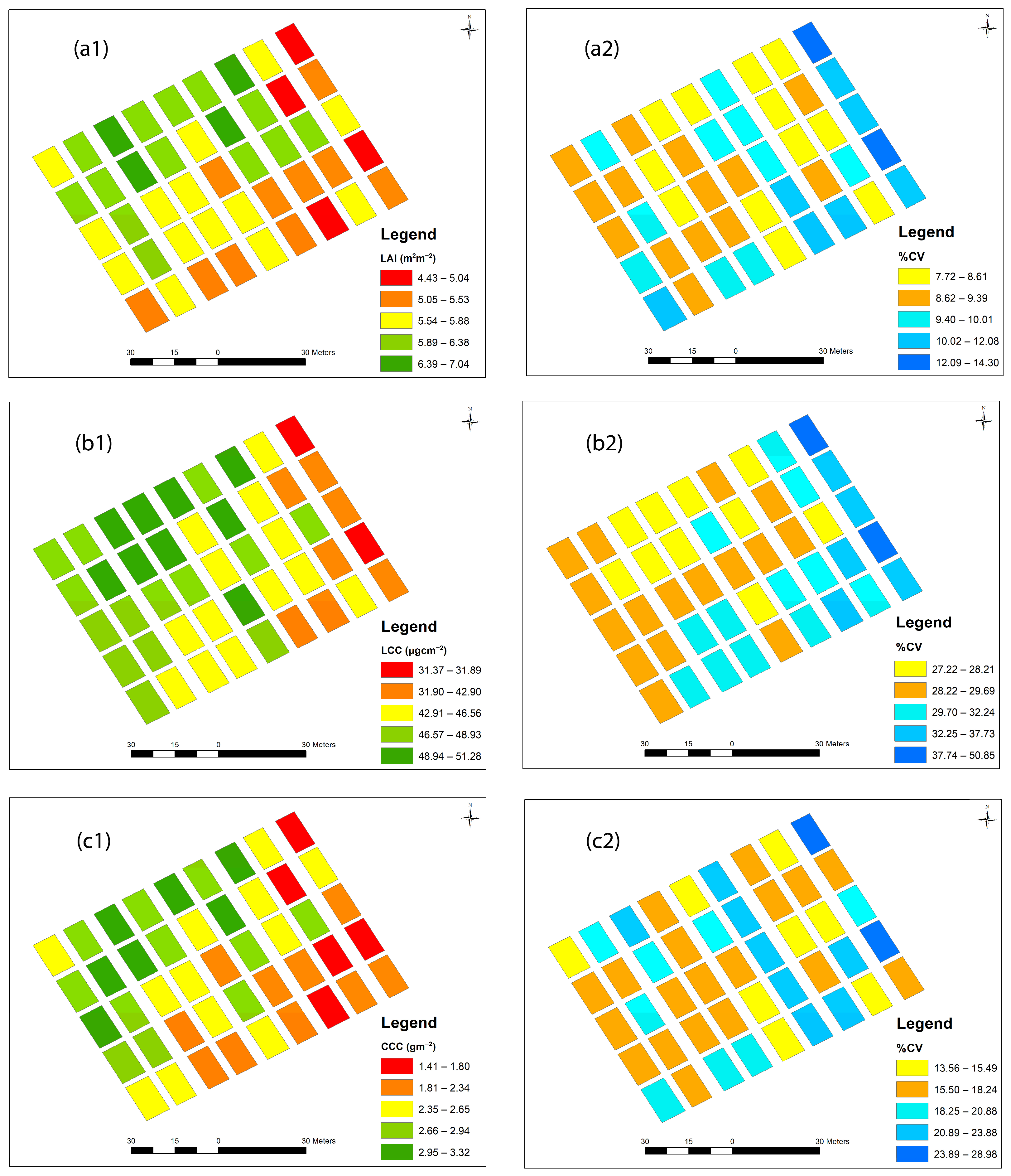
Figure 5 shows the trait maps and their associated uncertainty maps from proximal data. Each plot indicates a unique value of the estimate and its relative uncertainty, expressed as the CV%. An increasing trend in the estimates was observed with respect to measured values and applied N treatments. Compared to LAI and CCC, a high CV% was observed for LCC. Within the plots, high CV% may be attributed to sparse or less healthy vegetation.

4. Discussion

A GPR hybrid retrieval workflow was developed for proximal hyperspectral remote sensing data to estimate important crop traits of the wheat crop. The selection of a suitable AL strategy facilitates the reduction in sample size with improved NRMSE. The smooth convergence of NRMSE from higher values indicates the improvement in model performance on adding new samples. This strongly supports the usage of NRMSE over any other statistical parameter for selecting the best performing AL technique [16]. The NRMSE stabilizes at a particular sample size with no improvement on further addition. This intelligent sampling allows developing lighter GPR models that can be considered in future for integration with cloud platforms for operational delivery [17]. The use of PCA in optimizing hybrid models made a significant achievement in fast processing without compromising the prediction accuracy. The use of 20 PCA components has proved to be sufficient for generating accurate results from various hyperspectral data streams [15]. In the case of proximal sensors, the outperformance of full range over resampled data with best goodness-of-fit validation results was previously identified for hybrid modelling [12]. When the band settings of UAV sensors were applied to the proximal data, comparable results with an acceptable range of uncertainties were obtained. The retrieval accuracies reported for the UAV hyperspectral sensor in terms of R2 and NRMSE were 0.89 and 8.58% for LAI, 0.76 and 12.15% for LCC, and 0.66 and 14.84% for CCC, respectively [4]. This highlights the importance of proximal sensors as a potential alternative for accurate retrieval of crop biophysical parameters.
Follow-up research is needed to improve the accuracy of retrieval by considering multi-growth-stage data or single-stage temporal data of wheat crops to achieve a generalized retrieval model. To broaden further applicability, advanced RTMs like PROSAIL-PRO may also be considered for retrieving canopy nitrogen content (CNC), above-ground biomass (AGB), etc., from proximal hyperspectral sensors [18,19].

5. Conclusions

A Bayesian hybrid machine learning approach was selected for the accurate estimation of important crop traits of wheat. High prediction accuracies (R2 ranges 0.71 to 0.89) confirm the potential of proximal hyperspectral technology for accurate estimation of key traits. Plot-wise maps showing the spatial variability of LAI, LCC, and CCC, along with their uncertainties, were also generated to visualize the prediction results. These optimized retrieval models facilitate operational delivery of critical variables for monitoring crop dynamics and nutrient management practices.

Author Contributions

Conceptualization, R.G.R. and R.N.S.; methodology, R.G.R. and R.N.S.; software, R.G.R.; validation, R.G.R.; formal analysis, R.G.R. and T.K.; investigation, R.G.R. and R.R.; resources, T.K., A.B. and R.R.; data curation, R.G.R. and R.R.; writing—original draft preparation, R.G.R.; writing—review and editing, R.G.R. and R.N.S.; visualization, T.K., A.B. and R.R.; supervision, R.N.S.; project administration, R.N.S.; funding acquisition, R.N.S. All authors have read and agreed to the published version of the manuscript.

Funding

The results summarized in the manuscript were achieved as part of the research project “Network Program on Precision Agriculture (NePPA)”, which is funded by the Indian Council of Agricultural Research (ICAR), India.

Institutional Review Board Statement

Not applicable.

Informed Consent Statement

Not applicable.

Data Availability Statement

Data can be made available upon request.

Conflicts of Interest

The authors declare no conflicts of interest.

References

  1. Leng, M.; Liu, Y.; Li, B.; Che, Y.; Feng, H.; Shu, M.; Xu, X.; Qiao, H.; Yue, J. Analysis of Crop Leaf Area Index, Leaf Chlorophyll Content, and Canopy Chlorophyll Content Based on Deep Learning and Hyperspectral Remote Sensing. Int. J. Remote Sens. 2025, 46, 6937–6955. [Google Scholar] [CrossRef]
  2. Sahoo, R.N.; Rejith, R.G.; Gakhar, S.; Ranjan, R.; Meena, M.C.; Dey, A.; Mukherjee, J.; Dhakar, R.; Meena, A.; Daas, A.; et al. Drone Remote Sensing of Wheat N Using Hyperspectral Sensor and Machine Learning. Precis. Agric. 2023, 25, 704–728. [Google Scholar] [CrossRef]
  3. Sahoo, R.N.; Rejith, R.G.; Gakhar, S.; Verrelst, J.; Ranjan, R.; Kondraju, T.; Meena, M.C.; Mukherjee, J.; Dass, A.; Kumar, S.; et al. Estimation of Wheat Biophysical Variables through UAV Hyperspectral Remote Sensing Using Machine Learning and Radiative Transfer Models. Comput. Electron. Agric. 2024, 221, 108942. [Google Scholar] [CrossRef]
  4. Sahoo, R.N.; Gakhar, S.; Rejith, R.G.; Verrelst, J.; Ranjan, R.; Kondraju, T.; Meena, M.C.; Mukherjee, J.; Daas, A.; Kumar, S.; et al. Optimizing the Retrieval of Wheat Crop Traits from UAV-Borne Hyperspectral Image with Radiative Transfer Modelling Using Gaussian Process Regression. Remote Sens. 2023, 15, 5496. [Google Scholar] [CrossRef]
  5. Rejith, R.G.; Sahoo, R.N.; Kondraju, T.; Bhandari, A.; Ranjan, R.; Moursy, A. Generation of Synthetic Hyperspectral Image Cube for Mapping Soil Organic Carbon Using Proximal Remote Sensing. Environ. Earth Sci. Proc. 2025, 36, 3. [Google Scholar] [CrossRef]
  6. Lama, G.F.C.; Errico, A.; Pasquino, V.; Mirzaei, S.; Preti, F.; Chirico, G.B. Velocity Uncertainty Quantification Based on Riparian Vegetation Indices in Open Channels Colonized by Phragmites Australis. J. Ecohydraulics 2022, 7, 71–76. [Google Scholar] [CrossRef]
  7. Arnon, D.I. Copper enzymes in isolated chloroplasts. Polyphenoloxidase in Beta vulgaris. Plant Physiol. 1949, 24, 1–15. [Google Scholar] [CrossRef] [PubMed]
  8. Gitelson, A.A.; Viña, A.; Ciganda, V.; Rundquist, D.C.; Arkebauer, T.J. Remote Estimation of Canopy Chlorophyll Content in Crops. Geophys. Res. Lett. 2005, 32, L08403. [Google Scholar] [CrossRef]
  9. Tripathi, R.; Sahoo, R.N.; Sehgal, V.K.; Gupta, V.K.; Bhattacharya, B.B.K.; Gupta, K.; Bhattacharya, B.B.K. Remote Sensing Derived Composite Vegetation Health Index Through Inversion of Prosail for Monitoring of Wheat Growth in Trans Gangetic Plains of India. In ISPRS Archives XXXVIII-8/W3 Workshop Proceedings: Impact of Climate Change on Agriculture; ISPRS: Hanover, Germany, 2009. [Google Scholar]
  10. Chakraborty, D.; Sehgal, V.K.; Sahoo, R.N.; Pradhan, S.; Gupta, V.K. Study of the Anisotropic Reflectance Behaviour of Wheat Canopy to Evaluate the Performance of Radiative Transfer Model PROSAIL5B. J. Indian Soc. Remote Sens. 2015, 43, 297–310. [Google Scholar] [CrossRef]
  11. Mridha, N. Assessing Crop Biophysical Parameters from Hyper-Spectral and Multispectral Remote Sensing and Multispectral Remote Sensing Data Through Radiative Transfer Modeling; Indian Agricultural Research Institute: New Delhi, India, 2014. [Google Scholar]
  12. Sahoo, R.N.; Rejith, R.G.; Kondraju, T.; Ranjan, R.; Bhandari, A.; Gakhar, S.; Asim, M.; Verrelst, J.; Kaur, R.; Singh, T.; et al. Scaling-up Plant Chlorophyll Retrieval from Proximal to UAV-Borne Hyperspectral Data Using a Gaussian Process Hybrid Model. Int. J. Remote Sens. 2025, 46, 8990–9014. [Google Scholar] [CrossRef]
  13. Estévez, J.; Berger, K.; Vicent, J.; Rivera-Caicedo, J.P.; Wocher, M.; Verrelst, J. Top-of-Atmosphere Retrieval of Multiple Crop Traits Using Variational Heteroscedastic Gaussian Processes within a Hybrid Workflow. Remote Sens. 2021, 13, 1589. [Google Scholar] [CrossRef] [PubMed]
  14. Rejith, R.G.; Sahoo, R.N.; Verrelst, J.; Ranjan, R.; Gakhar, S.; Anand, A.; Kondraju, T.; Kumar, S.; Kumar, M.; Dhandapani, R. UAV-Based Retrieval Of Wheat Canopy Chlorophyll Content Using A Hybrid Machine Learning Approach. In Proceedings of the 2023 IEEE India Geoscience and Remote Sensing Symposium (InGARSS); IEEE: New York, NY, USA, 2023; pp. 1–4. [Google Scholar]
  15. Pascual-Venteo, A.B.; Portalés, E.; Berger, K.; Tagliabue, G.; Garcia, J.L.; Pérez-Suay, A.; Rivera-Caicedo, J.P.; Verrelst, J. Prototyping Crop Traits Retrieval Models for CHIME: Dimensionality Reduction Strategies Applied to PRISMA Data. Remote Sens. 2022, 14, 2448. [Google Scholar] [CrossRef] [PubMed]
  16. Berger, K.; Rivera Caicedo, J.P.; Martino, L.; Wocher, M.; Hank, T.; Verrelst, J. A Survey of Active Learning for Quantifying Vegetation Traits from Terrestrial Earth Observation Data. Remote Sens. 2021, 13, 287. [Google Scholar] [CrossRef] [PubMed]
  17. Sahoo, R.N.; Kondraju, T.; Rejith, R.G.; Verrelst, J.; Ranjan, R.; Gakhar, S.; Bhandari, A.; Chinnusamy, V. Monitoring Cropland LAI Using Gaussian Process Regression and Sentinel—2 Surface Reflectance Data in Google Earth Engine. Int. J. Remote Sens. 2024, 45, 5008–5027. [Google Scholar] [CrossRef]
  18. Berger, K.; Hank, T.; Halabuk, A.; Rivera-Caicedo, J.P.; Wocher, M.; Mojses, M.; Gerhátová, K.; Tagliabue, G.; Dolz, M.M.; Venteo, A.B.P.; et al. Assessing Non-Photosynthetic Cropland Biomass from Spaceborne Hyperspectral Imagery. Remote Sens. 2021, 13, 4711. [Google Scholar] [CrossRef] [PubMed]
  19. Wocher, M.; Berger, K.; Verrelst, J.; Hank, T. Retrieval of Carbon Content and Biomass from Hyperspectral Imagery over Cultivated Areas. ISPRS J. Photogramm. Remote Sens. 2022, 193, 104–114. [Google Scholar] [CrossRef] [PubMed]
Figure 1. Flowchart showing the methodology adopted for the present study.
Blsf 54 00033 g001
Figure 2. Study area map. (a,b) Location of wheat fields in the research farm of ICAR-IARI, New Delhi; (c) experimental plots with details of nitrogen and irrigation treatments.
Blsf 54 00033 g002
Figure 3. Evaluation of different AL methods. (a) LAI, (b) LCC, and (c) CCC. # samples indicate the number of samples.
Blsf 54 00033 g003
Figure 4. Scatter plots between estimated and insitu measured crop traits along with 1:1 line. (a) LAI; (b) LCC; and (c) CCC.
Blsf 54 00033 g004
Figure 5. Wheat trait maps and their associated uncertainty maps for (a1,a2) LAI, (b1,b2) LCC, and (c1,c2) CCC. Each plot indicates a unique value.
Blsf 54 00033 g005
Table 1. PROSAIL-4 parameters and values [9,10,11].
ParameterValues
Leaf Model: PROSPECT-4
Leaf structure coefficient (N)1
Leaf chlorophyll content (LCC)0–80 µgcm−2 (0.2 interval)
Equivalent water thickness (Cw) 0.01–0.045 cm (0.001 interval)
Dry Matter (Cm) 0.0046 gcm−2
Canopy Model: 4-SAIL
Leaf area index (LAI)0.1–7 m2m−2 (0.01 interval)
Average leaf inclination angle (ALIA) 70, 57, 45 Degree
Fraction of diffuse incoming solar radiation (skyl)0.1
Soil brightness coefficient (αsoil) 0.1
Hot-spot size parameter (hspot) 0.78, 0.40, 0.32 mm−1
Solar zenith angle (tts) 51, 45, 33 Degree
Sensor zenith angle (tto)0 Degree
Relative azimuth (psi)0 Degree
Disclaimer/Publisher’s Note: The statements, opinions and data contained in all publications are solely those of the individual author(s) and contributor(s) and not of MDPI and/or the editor(s). MDPI and/or the editor(s) disclaim responsibility for any injury to people or property resulting from any ideas, methods, instructions or products referred to in the content.