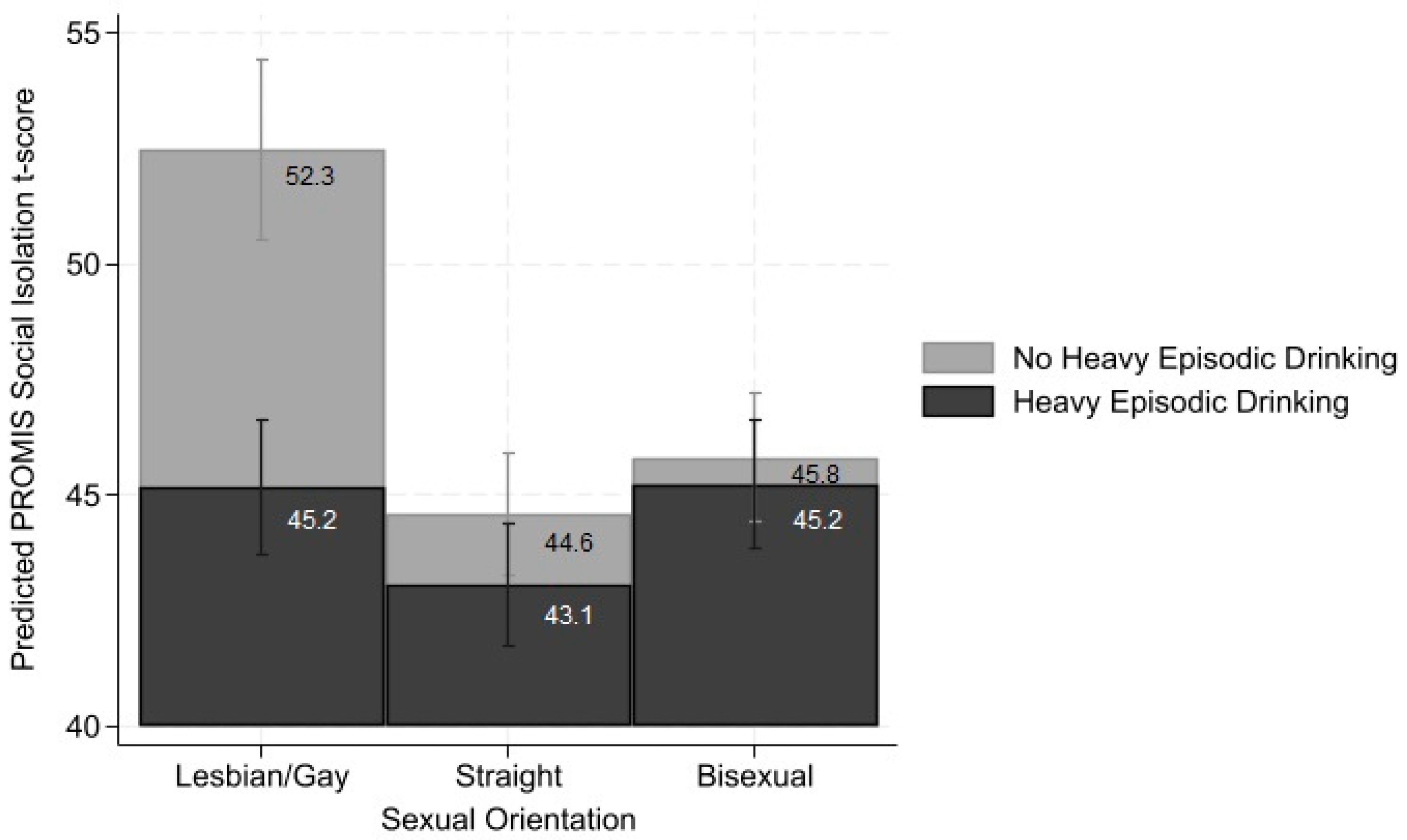

Associations Between Heavy Episodic Drinking and Perceived Social Isolation in U.S. Young Adults by Sexual Orientation


Abstract
1. Introduction
2. Methods
2.1. Study Design and Data
2.2. Measures
2.2.1. Sociodemographic Measures
2.2.2. Psychological Distress
2.2.3. Perceived Social Isolation
2.2.4. Heavy Episodic Drinking
2.3. Statistical Analysis
3. Results
3.1. Sample Distribution and Bivariate Comparisons
3.2. Weighted Linear Regressions
3.3. Sensitivity Analyses
4. Discussion
4.1. Limitations and Strengths
4.2. Intervention and Practice Implications
4.3. Conclusions
Funding
Institutional Review Board Statement
Informed Consent Statement
Data Availability Statement
Conflicts of Interest
Appendix A

| Model 1 | Model 2 | |||||||
|---|---|---|---|---|---|---|---|---|
| 95% CI | 95% CI | |||||||
| B | SE | LL | UL | B | SE | LL | UL | |
| Intercept | 54.85 *** | 1.16 | 52.56 | 57.15 | 45.44 *** | 1.01 | 43.43 | 47.45 |
| Age | −0.11 *** | 0.03 | −0.16 | −0.06 | −0.11 *** | 0.03 | −0.16 | −0.06 |
| Sex (ref. = Male) | ||||||||
| Female | 1.44 *** | 0.22 | 1.01 | 1.88 | 1.44 *** | 0.22 | 1.01 | 1.88 |
| Sexual identity | ||||||||
| Lesbian/Gay | Ref. | −6.74 *** | 1.14 | −9.01 | −4.47 | |||
| Straight | −7.88 *** | 0.78 | −9.44 | −6.33 | −0.97 | 0.55 | −2.06 | 0.12 |
| Bisexual | −6.68 *** | 0.88 | −8.43 | −4.93 | Ref. | |||
| Race/ethnicity (ref. = NH White) | ||||||||
| Non-Hispanic Black | −3.54 *** | 0.63 | −4.79 | −2.29 | −3.54 *** | 0.63 | −4.79 | −2.29 |
| Hispanic | −1.78 *** | 0.24 | −2.25 | −1.30 | −1.78 *** | 0.24 | −2.25 | −1.30 |
| Non-Hispanic Asian | 1.55 *** | 0.49 | 0.58 | 2.52 | 1.55 *** | 0.49 | 0.58 | 2.52 |
| Non-Hispanic Other | 4.81 *** | 0.52 | 3.77 | 5.84 | 4.81 *** | 0.52 | 3.77 | 5.84 |
| Education level (ref. = college graduate or more) | ||||||||
| Less than high school | −1.70 ** | 0.60 | −2.89 | −0.51 | −1.70 ** | 0.60 | −2.89 | −0.51 |
| High school graduate | 0.34 | 0.30 | −0.26 | 0.94 | 0.34 | 0.30 | −0.26 | 0.94 |
| Some college | −0.12 | 0.27 | −0.65 | 0.42 | −0.12 | 0.27 | −0.65 | 0.42 |
| Household income (ref. = $100,000+) | ||||||||
| <$20,000 | 2.11 *** | 0.52 | 1.09 | 3.13 | 2.11 *** | 0.52 | 1.09 | 3.13 |
| $20,000–<$35,000 | −1.75 *** | 0.49 | −2.71 | −0.78 | −1.75 *** | 0.49 | −2.71 | −0.78 |
| $35,000–<$50,000 | 1.00 | 0.52 | −0.02 | 2.03 | 1.00 | 0.52 | −0.02 | 2.03 |
| $50,000–<$75,000 | −0.76 | 0.51 | −1.76 | 0.25 | −0.76 | 0.51 | −1.76 | 0.25 |
| $75,000–<$100,000 | −0.21 | 0.48 | −1.16 | 0.74 | −0.21 | 0.48 | −1.16 | 0.74 |
| Adults in household (ref. = 2+) | ||||||||
| 1 | 0.42 | 0.26 | −0.09 | 0.94 | 0.42 | 0.26 | −0.09 | 0.94 |
| HINTS Cycle (ref. = 7[2024]) | ||||||||
| 6 (2022) | 0.79 * | 0.30 | 0.19 | 1.39 | 0.79 * | 0.30 | 0.19 | 1.39 |
| Smoking Status (ref. = never) | ||||||||
| Current | 2.73 *** | 0.31 | 2.11 | 3.35 | 2.73 *** | 0.31 | 2.11 | 3.35 |
| Former | −1.02 ** | 0.38 | −1.78 | −0.27 | −1.02 ** | 0.38 | −1.78 | −0.27 |
| Personal Health Questionnaire (PHQ)−4 score | 2.11 *** | 0.05 | 2.00 | 2.22 | 2.11 *** | 0.05 | 2.00 | 2.22 |
| Heavy episodic drinking (HED) occasions (ref. = 0) | ||||||||
| 1+ | −7.31 *** | 0.95 | −9.19 | −5.42 | −0.57 | 0.53 | −1.62 | 0.49 |
| Interaction (HED = 1+ × sexual orientation) | ||||||||
| HED = 1+ × lesbian/gay | Ref. | −6.74 *** | 1.14 | −9.01 | −4.47 | |||
| HED = 1+ × straight | 5.77 *** | 0.98 | 3.84 | 7.71 | −0.97 | 0.55 | −2.06 | 0.12 |
| HED = 1+ × bisexual | 6.74 *** | 1.14 | 4.47 | 9.01 | Ref. | |||
| Model 1 | Model 2 | |||||||
|---|---|---|---|---|---|---|---|---|
| 95% CI | 95% CI | |||||||
| B | SE | LL | UL | B | SE | LL | UL | |
| Intercept | 43.99 *** | 2.77 | 38.56 | 49.43 | 43.78 *** | 2.77 | 38.33 | 49.22 |
| Age | −0.09 | 0.10 | −0.29 | 0.10 | −0.09 | 0.10 | −0.29 | 0.10 |
| Sex (ref. = Male) | ||||||||
| Female | 1.08 | 0.63 | −0.16 | 2.32 | 1.09 | 0.63 | −0.14 | 2.33 |
| Sexual identity (ref. = straight) | ||||||||
| Lesbian/Gay | 2.97 * | 1.30 | 0.41 | 5.53 | 4.59 * | 1.84 | 0.99 | 8.19 |
| Bisexual | 2.23 * | 0.86 | 0.54 | 3.92 | 2.41 * | 1.21 | 0.05 | 4.78 |
| Race/ethnicity (ref. = NH White) | ||||||||
| Non-Hispanic Black | 0.53 | 0.93 | −1.30 | 2.36 | 0.59 | 0.93 | −1.24 | 2.42 |
| Hispanic | −0.06 | 0.72 | −1.47 | 1.36 | −0.06 | 0.72 | −1.48 | 1.36 |
| Non-Hispanic Asian | 2.37 * | 1.10 | 0.21 | 4.54 | 2.50 * | 1.11 | 0.32 | 4.67 |
| Non-Hispanic Other | 3.64 * | 1.47 | 0.74 | 6.53 | 3.61 * | 1.47 | 0.72 | 6.51 |
| Education level (ref. = college graduate or more) | ||||||||
| Less than high school | −0.39 | 1.85 | −4.03 | 3.24 | −0.34 | 1.85 | −3.98 | 3.30 |
| High school graduate | −0.63 | 0.97 | −2.54 | 1.28 | −0.55 | 0.98 | −2.47 | 1.37 |
| Some college | −0.72 | 0.75 | −2.20 | 0.76 | −0.67 | 0.76 | −2.15 | 0.82 |
| Household income (ref. = $100,000+) | ||||||||
| <$20,000 | 0.88 | 1.33 | −1.74 | 3.50 | 0.80 | 1.34 | −1.82 | 3.43 |
| $20,000–<$35,000 | −0.94 | 1.42 | −3.72 | 1.85 | −1.00 | 1.42 | −3.79 | 1.79 |
| $35,000–<$50,000 | 0.68 | 1.29 | −1.86 | 3.21 | 0.59 | 1.29 | −1.95 | 3.13 |
| $50,000–<$75,000 | 0.73 | 1.20 | −1.64 | 3.09 | 0.66 | 1.21 | −1.71 | 3.03 |
| $75,000–<$100,000 | −0.49 | 1.21 | −2.87 | 1.88 | −0.50 | 1.21 | −2.88 | 1.87 |
| Adults in household (ref. = 2+) | ||||||||
| 1 | 0.63 | 0.74 | −0.82 | 2.09 | 0.67 | 0.74 | −0.79 | 2.13 |
| HINTS Cycle (ref. = 7[2024]) | ||||||||
| 6 (2022) | 0.50 | 0.68 | −0.83 | 1.82 | 0.55 | 0.68 | −0.78 | 1.88 |
| Smoking Status (ref. = never) | ||||||||
| Current | 1.55 | 1.11 | −0.63 | 3.72 | 1.60 | 1.11 | −0.58 | 3.77 |
| Former | 0.82 | 1.15 | −1.45 | 3.09 | 0.81 | 1.16 | −1.46 | 3.08 |
| Personal Health Questionnaire (PHQ)−4 score | 1.97 *** | 0.10 | 1.78 | 2.16 | 1.97 *** | 0.10 | 1.77 | 2.16 |
| Heavy episodic drinking (HED) occasions (ref. = 0) | ||||||||
| 1+ | −1.39 * | 0.62 | −2.60 | −0.18 | −1.15 | 0.69 | −2.50 | 0.21 |
| Interaction (ref. = HED = 1+ × straight) | ||||||||
| HED = 1+ × lesbian/gay | −3.19 | 2.58 | −8.25 | 1.88 | ||||
| HED = 1+ × bisexual | −0.37 | 1.65 | −3.61 | 2.87 | ||||
References
- Alessi, E. J. (2014). A framework for incorporating minority stress theory into treatment with sexual minority clients. Journal of Gay & Lesbian Mental Health, 18(1), 47–66. [Google Scholar] [CrossRef] [Scilit]
- Argyriou, A., Goldsmith, K. A., & Rimes, K. A. (2021). Mediators of the disparities in depression between sexual minority and heterosexual individuals: A systematic review. Archives of Sexual Behavior, 50(3), 925–959. [Google Scholar] [CrossRef] [Scilit]
- Beemyn, B. (2013). Creating a place for ourselves: Lesbian, gay, and bisexual community histories. Routledge. [Google Scholar]
- Brook, C. A., & Willoughby, T. (2016). Social anxiety and alcohol use across the university years: Adaptive and maladaptive groups. Developmental Psychology, 52(5), 835. [Google Scholar] [CrossRef] [Scilit]
- Brown, S. A., McGue, M., Maggs, J., Schulenberg, J., Hingson, R., Swartzwelder, S., Martin, C., Chung, T., Tapert, S. F., & Sher, K. (2008). A developmental perspective on alcohol and youths 16 to 20 years of age. Pediatrics, 121, S290–S310. [Google Scholar] [CrossRef] [Scilit]
- Brown, S. A., McGue, M., Maggs, J., Schulenberg, J., Hingson, R., Swartzwelder, S., Martin, C., Chung, T., Tapert, S. F., & Sher, K. (2009). Underage alcohol use: Summary of developmental processes and mechanisms: Ages 16–20. Alcohol Research & Health, 32(1), 41. [Google Scholar]
- Cacioppo, J. T., & Hawkley, L. C. (2009). Perceived social isolation and cognition. Trends in Cognitive Sciences, 13(10), 447–454. [Google Scholar] [CrossRef] [Scilit] [PubMed]
- Cadigan, J. M., Calhoun, B. H., Rhew, I. C., & Lee, C. M. (2023). Trajectories of loneliness during COVID-19 pandemic and associations with mental health and substance use. Journal of Research on Adolescence, 33(3), 816–827. [Google Scholar]
- Campagne, D. M. (2019). Stress and perceived social isolation (loneliness). Archives of Gerontology and Geriatrics, 82, 192–199. [Google Scholar] [CrossRef] [Scilit]
- Caro-Fuentes, S., & Sanabria-Mazo, J. P. (2024). A systematic review of the psychometric properties of the Patient Health Questionnaire-4 in clinical and nonclinical populations. Journal of the Academy of Consultation-Liaison Psychiatry, 65(2), 178–194. [Google Scholar] [CrossRef] [Scilit]
- Cerezo, A., Williams, C., Cummings, M., Ching, D., & Holmes, M. (2020). Minority stress and drinking: Connecting race, gender identity and sexual orientation. The Counseling Psychologist, 48(2), 277–303. [Google Scholar] [CrossRef] [Scilit]
- Cogger, A., Conover, K. J., & Israel, T. (2012). Factors influencing alcohol use among sexual minority women in a non-urban community: A mixed methods study. Journal of LGBT Issues in Counseling, 6(4), 293–309. [Google Scholar] [CrossRef] [Scilit]
- Croff, J. M., Hubach, R. D., Currin, J. M., & Frederick, A. F. (2017). Hidden rainbows: Gay bars as safe havens in a socially conservative area since the pulse nightclub massacre. Sexuality Research and Social Policy, 14(2), 233–240. [Google Scholar] [CrossRef] [Scilit]
- Dyar, C., & Kaysen, D. (2022). Multiple diverse drinking trajectories among sexual minority women: Unique and joint prediction by minority stress and social influence risk factors. Addictive Behaviors, 129, 107273. [Google Scholar] [CrossRef] [Scilit] [PubMed]
- Fairlie, A. M., Feinstein, B. A., Lee, C. M., & Kaysen, D. (2018). Subgroups of young sexual minority women based on drinking locations and companions and links with alcohol consequences, drinking motives, and LGBTQ-related constructs. Journal of Studies on Alcohol and Drugs, 79(5), 741–750. [Google Scholar] [CrossRef] [Scilit] [PubMed]
- Falk, D. S., Vazquez, C. E., & Handique, S. (2026). Psychological distress mediates the relationship between perceived social isolation and medical vs. recreational marijuana use among adults in the United States. Psychiatry International, 7(2), 55. [Google Scholar] [CrossRef] [Scilit]
- Feinstein, B. A., & Dyar, C. (2023). Bisexuality and health: New directions in research on identity, stress, and health disparities. Current Sexual Health Reports, 15(2), 65–73. [Google Scholar] [CrossRef] [Scilit]
- Feinstein, B. A., Dyar, C., & London, B. (2017). Are outness and community involvement risk or protective factors for alcohol and drug abuse among sexual minority women? Archives of Sexual Behavior, 46(5), 1411–1423. [Google Scholar]
- Garcia, J., Vargas, N., Clark, J. L., Magaña Álvarez, M., Nelons, D. A., & Parker, R. G. (2020). Social isolation and connectedness as determinants of well-being: Global evidence mapping focused on LGBTQ youth. Glob Public Health, 15(4), 497–519. [Google Scholar] [CrossRef] [Scilit]
- García-Pérez, J. N., Cañas-Ruano, E., Navarro, J., Raventós, B., López, L., Broto, C., Arando, M., Barberá, M. J., Descalzo, V., & Suanzes, P. (2022). Sexual behavior and drug use impact in gay, bisexual, and other men who have sex with men. Medicina Clínica (English Edition), 159(12), 563–568. [Google Scholar] [CrossRef] [Scilit]
- Gates, J. R., Corbin, W. R., & Fromme, K. (2016). Emerging adult identity development, alcohol use, and alcohol-related problems during the transition out of college. Psychology of Addictive Behaviors, 30(3), 345. [Google Scholar] [CrossRef] [Scilit]
- Ghaziani, A. (2022). Belonging in gay neighborhoods and queer nightlife. In Introducing the new sexuality studies (pp. 540–550). Routledge. [Google Scholar]
- Ghaziani, A. (2025). The sociology of queer nightlife (Vol. 66, pp. 661–674). Taylor & Francis. [Google Scholar]
- Hahn, E. A., DeVellis, R. F., Bode, R. K., Garcia, S. F., Castel, L. D., Eisen, S. V., Bosworth, H. B., Heinemann, A. W., Rothrock, N., & Cella, D. (2010). Measuring social health in the patient-reported outcomes measurement information system (PROMIS): Item bank development and testing. Quality of Life Research, 19(7), 1035–1044. [Google Scholar] [CrossRef] [Scilit]
- Hilderbrand, L., Adeyemi, K., Cartier, M., Garcia-Mispireta, L. M., Ghaziani, A., Gieseking, J. J., Greene, T., Khubchandani, K., Mattson, G., & Rivera-Servera, R. H. (2025). The night is still young: A cross-disciplinary forum on Queer nightlife studies. The Sociological Quarterly, 66(4), 887–909. [Google Scholar] [CrossRef] [Scilit]
- Hoy-Ellis, C. P. (2023). Minority stress and mental health: A review of the literature. Journal of Homosexuality, 70(5), 806–830. [Google Scholar] [CrossRef] [Scilit] [PubMed]
- Hunt, G., Antin, T., Sanders, E., & Sisneros, M. (2019). Queer youth, intoxication and queer drinking spaces. Journal of Youth Studies, 22(3), 380–400. [Google Scholar] [CrossRef] [Scilit] [PubMed]
- Jaspal, R. (2022). Chemsex, identity and sexual health among gay and bisexual men. International Journal of Environmental Research and Public Health, 19(19), 12124. [Google Scholar] [CrossRef] [Scilit]
- Jowaheer, Y. K. P. (2023). The association between victimization, resilience, loneliness, and substance use among sexual and gender minority young adults of color. American University. [Google Scholar]
- Kalb, N., Roy Gillis, J., & Goldstein, A. L. (2018). Drinking to cope with sexual minority stressors: Understanding alcohol use and consequences among LGBQ emerging adults. Journal of Gay & Lesbian Mental Health, 22(4), 310–326. [Google Scholar] [CrossRef] [Scilit]
- Kroenke, K., Spitzer, R. L., Williams, J. B., & Löwe, B. (2009). An ultra-brief screening scale for anxiety and depression: The PHQ-4. Psychosomatics, 50(6), 613–621. [Google Scholar]
- Lehavot, K., Johnson, K. E., Simpson, T. L., & Kaysen, D. (2017). Alcohol screening and brief interventions among U.S. veterans who identify as lesbian, gay, or bisexual. Drug and Alcohol Dependence, 173, 102–108. [Google Scholar] [CrossRef] [Scilit]
- Löwe, B., Wahl, I., Rose, M., Spitzer, C., Glaesmer, H., Wingenfeld, K., Schneider, A., & Brähler, E. (2010). A 4-item measure of depression and anxiety: Validation and standardization of the Patient Health Questionnaire-4 (PHQ-4) in the general population. Journal of Affective Disorders, 122(1–2), 86–95. [Google Scholar] [CrossRef] [Scilit]
- Lutete, P., Matthews, D. W., Sabounchi, N. S., Paige, M. Q., Lounsbury, D. W., Rodriguez, N., Echevarria, N., Usher, D., Walker, J. J., Dickerson, A., Hillesheim, J., & Frye, V. (2022). Intersectional stigma and prevention among gay, bisexual, and same gender-loving men in New York City, 2020: System dynamics models. American Journal of Public Health, 112(S4), S444–S451. [Google Scholar] [CrossRef] [Scilit] [PubMed Central]
- Marks, A. K., Woolverton, G. A., & García Coll, C. (2020). Risk and resilience in minority youth populations. Annual Review of Clinical Psychology, 16(1), 151–163. [Google Scholar] [CrossRef] [Scilit]
- Mata, D., Korpak, A. K., Macaulay, T., Dodge, B., Mustanski, B., & Feinstein, B. A. (2023). Substance use experiences among bisexual, pansexual, and queer (bi+) male youth: A qualitative study of motivations, consequences, and decision making. Archives of Sexual Behavior, 52(3), 1169–1181. [Google Scholar] [CrossRef] [Scilit] [PubMed] [PubMed Central]
- Mathes Winnicki, B. M., Hinds, Z., Newberger, N. G., & Livingston, N. A. (2023). Prospective associations between perceived social connection and alcohol use: A scoping review. Addiction Research & Theory, 31(4), 250–259. [Google Scholar]
- McCormack, M. (2023). Issues in Bisexual men’s lives: Identity, health and relationships. Current Opinion in Psychology, 49, 101501. [Google Scholar] [CrossRef] [Scilit]
- McGarrity, L. A. (2014). Socioeconomic status as context for minority stress and health disparities among lesbian, gay, and bisexual individuals. Psychology of Sexual Orientation and Gender Diversity, 1(4), 383. [Google Scholar] [CrossRef] [Scilit]
- Miller, L. A., Åkerlund, A., & Fischer, S. (2026). The role of community connectedness in understanding the connection between LGBTQ+ minority stress and problem drinking. Substance Use & Misuse, 61, 420–430. [Google Scholar]
- Mundy, E., Carter, A., Nadarzynski, T., Whiteley, C., De Visser, R. O., & Llewellyn, C. D. (2025). The complex social, cultural and psychological drivers of the ‘chemsex’ experiences of men who have sex with men: A systematic review and conceptual thematic synthesis of qualitative studies. Front Public Health, 13, 1422775. [Google Scholar] [CrossRef] [Scilit]
- National Cancer Institute. (2025). Health information national trends survey. Available online: https://hints.cancer.gov/ (accessed on 4 October 2025).
- Nápoles, A. M., Stewart, A. L., Strassle, P. D., Alhomsi, A., Quintero, S., Ponce, S., Wilkerson, M., & Bonilla, J. (2023). Depression symptoms, perceived stress, and loneliness during the COVID-19 pandemic among diverse US racial-ethnic groups. Health Equity, 7(1), 364–376. [Google Scholar] [CrossRef] [Scilit]
- Pachankis, J. E., Mahon, C. P., Jackson, S. D., Fetzner, B. K., & Bränström, R. (2020). Sexual orientation concealment and mental health: A conceptual and meta-analytic review. Psychological Bulletin, 146(10), 831. [Google Scholar] [CrossRef] [Scilit]
- Parks, C. A., & Heller, N. R. (2013). The influence of early drinking contexts on current drinking among adult lesbian and bisexual women. Journal of the American Psychiatric Nurses Association, 19(5), 241–254. [Google Scholar] [CrossRef] [Scilit]
- Pitoňák, M. (2017). Mental health in non-heterosexuals: Minority stress theory and related explanation frameworks review. Mental Health & Prevention, 5, 63–73. [Google Scholar] [CrossRef] [Scilit]
- Primack, B. A., Shensa, A., Sidani, J. E., Whaite, E. O., yi Lin, L., Rosen, D., Colditz, J. B., Radovic, A., & Miller, E. (2017). Social media use and perceived social isolation among young adults in the US. American Journal of Preventive Medicine, 53(1), 1–8. [Google Scholar] [CrossRef] [Scilit]
- Quigley, L. A., & Marlatt, G. A. (1996). Drinking among young adults: Prevalence, patterns, and consequences. Alcohol Health and Research World, 20(3), 185. [Google Scholar]
- Rapier, R., McKernan, S., & Stauffer, C. S. (2019). An inverse relationship between perceived social support and substance use frequency in socially stigmatized populations. Addictive Behaviors Reports, 10, 100188. [Google Scholar] [CrossRef] [Scilit]
- Rivas-Drake, D., Pinetta, B. J., Juang, L. P., & Agi, A. (2022). Ethnic-racial identity as a source of resilience and resistance in the context of racism and xenophobia. Review of General Psychology, 26(3), 317–326. [Google Scholar] [CrossRef] [Scilit]
- Schulenberg, J. E., & Maggs, J. L. (2002). A developmental perspective on alcohol use and heavy drinking during adolescence and the transition to young adulthood. Journal of Studies on Alcohol, 14, 54–70. [Google Scholar]
- Singh, G. K., Lee, H., & Daus, G. P. (2022). Prevalence and sociodemographic and behavioral correlates of psychological distress among lesbian, gay, and bisexual adults in the United States, 2013–2018. International Journal of Translational Medical Research and Public Health, 6(1), 1–18. [Google Scholar] [CrossRef] [Scilit]
- Substance Abuse and Mental Health Services Administration. (2025). 2024 Companion infographic report: Results from the 2021 to 2024 national surveys on drug use and health (SAMHSA Publication No. PEP25-07-006). Available online: https://www.samhsa.gov/data/report/2022-nsduh-annual-national-report (accessed on 1 October 2025).
- Talley, A. E., Gilbert, P. A., Mitchell, J., Goldbach, J., Marshall, B. D., & Kaysen, D. (2016). Addressing gaps on risk and resilience factors for alcohol use outcomes in sexual and gender minority populations. Drug and Alcohol Review, 35(4), 484–493. [Google Scholar] [CrossRef] [Scilit]
- Thakur, M., Mathiason, M. A., Kim, C., Pieczkiewicz, D., Austin, R., & Rajamani, S. (2025). Social isolation, social media use, quality of health care, and trust in health care system: Findings from a national health information survey. CIN: Computers, Informatics, Nursing, 44, e01370. [Google Scholar] [CrossRef] [Scilit]
- Vance, S. R., Jr., Boyer, C. B., Glidden, D. V., & Sevelius, J. (2021). Mental health and psychosocial risk and protective factors among Black and Latinx transgender youth compared with peers. JAMA Network Open, 4(3), e213256. [Google Scholar] [CrossRef] [Scilit]
- Villar, E., Martínez-López, Z., Mayo, M. E., Braña, T., Rodríguez, M., & Tinajero, C. (2022). A systematic review and narrative synthesis of the relationship between social support and binge drinking among adolescents and emerging adults. Youth, 2(4), 570–586. [Google Scholar] [CrossRef] [Scilit]
- Whaite, E. O., Shensa, A., Sidani, J. E., Colditz, J. B., & Primack, B. A. (2018). Social media use, personality characteristics, and social isolation among young adults in the United States. Personality and Individual Differences, 124, 45–50. [Google Scholar] [CrossRef] [Scilit]
- White, H. R., & Jackson, K. (2004). Social and psychological influences on emerging adult drinking behavior. Alcohol Research & Health, 28(4), 182. [Google Scholar]
- Wolfe, M. (1992). Invisible women in invisible places: Lesbians, lesbian bars, and the social production of people/environment relationships. Architecture and Behavior, 8(2), 137–158. [Google Scholar]
- World Health Organization. (2024). Global status report on alcohol and health and treatment of substance use disorders. World Health Organization. [Google Scholar]
- Xie, Z., Zhong, G., Xu, C., Chen, T., Du, Z., Wei, Y., Zhao, M., & Du, J. (2025). Trends and cross-country inequalities of alcohol use disorders: Findings from the global burden of disease study 2021. Global Health, 21(1), 30. [Google Scholar] [CrossRef] [Scilit]

| Full Sample | HED Occasions * | p-Value † | ||
|---|---|---|---|---|
| None (n = 394) | 1+ (n = 329) | |||
| M (SE) or n (%) | M (SE) or % | M (SE) or % | ||
| Age | 23.6 (0.05) | 23.3 (0.06) | 24.0 (0.06) | <0.001 |
| Sex | <0.001 | |||
| Female | 460 (47.9) | 50.3 | 49.7 | |
| Male | 263 (52.1) | 59.8 | 40.2 | |
| Sexual orientation | 0.012 | |||
| Lesbian/gay | 39 (4.5) | 61.8 | 38.2 | |
| Straight | 576 (84.7) | 55.1 | 44.9 | |
| Bisexual | 108 (10.8) | 53.8 | 46.2 | |
| Race/ethnicity | <0.001 | |||
| Non-Hispanic White | 336 (53.3) | 50.6 | 49.4 | |
| Non-Hispanic Black | 94 (8.6) | 72.6 | 27.4 | |
| Hispanic | 202 (22.3) | 48.7 | 51.3 | |
| Non-Hispanic Asian | 60 (11.0) | 71.9 | 28.1 | |
| Non-Hispanic Other | 31 (5.0) | 68.6 | 31.4 | |
| Education level | <0.001 | |||
| Less than high school | 21 (6.1) | 37.0 | 63.0 | |
| High school graduate | 100 (18.4) | 64.7 | 35.3 | |
| Some college | 202 (41.4) | 59.3 | 40.7 | |
| College graduate or more | 400 (34.1) | 48.5 | 51.5 | |
| Household income | <0.001 | |||
| <$20,000 | 112 (18.3) | 47.7 | 52.3 | |
| $20,000–<$35,000 | 75 (9.9) | 54.0 | 46.0 | |
| $35,000–<$50,000 | 114 (14.6) | 60.3 | 39.7 | |
| $50,000–<$75,000 | 153 (19.4) | 64.7 | 35.3 | |
| $75,000–<$100,000 | 188 (27.1) | 59.4 | 40.6 | |
| $100,000+ | 81 (10.8) | 35.0 | 65.0 | |
| Adults in household | 0.170 | |||
| 1 | 157 (11.6) | 57.1 | 42.9 | |
| 2+ | 566 (88.4) | 55.0 | 45.0 | |
| HINTS Cycle | <0.001 | |||
| 6 (2022) | 432 (66.8) | 63.7 | 36.3 | |
| 7 (2024) | 291 (33.2) | 38.3 | 61.7 | |
| Smoking Status | <0.001 | |||
| Current | 62 (9.5) | 9.8 | 90.2 | |
| Former | 52 (7.1) | 42.1 | 57.9 | |
| Never | 606 (83.5) | 61.7 | 38.3 | |
| Personal Health Questionnaire (PHQ)-4 score | 3.3 (0.04) | 3.12 (0.05) | 3.5 (0.06) | <0.001 |
| Model 1 | Model 2 | |||||||
|---|---|---|---|---|---|---|---|---|
| 95% CI | 95% CI | |||||||
| B | SE | LL | UL | B | SE | LL | UL | |
| Intercept | 44.68 *** | 0.78 | 43.14 | 46.22 | 44.24 *** | 0.79 | 42.66 | 45.81 |
| Age | −0.12 *** | 0.03 | −0.18 | −0.07 | −0.11 *** | 0.03 | −0.16 | −0.06 |
| Sex (ref. = Male) | ||||||||
| Female | 1.42 *** | 0.22 | 0.99 | 1.85 | 1.44 *** | 0.22 | 1.01 | 1.88 |
| Sexual identity (ref. = straight) | ||||||||
| Lesbian/Gay | 5.62 *** | 0.58 | 4.47 | 6.77 | 7.88 *** | 0.78 | 6.33 | 9.44 |
| Bisexual | 1.66 *** | 0.34 | 0.99 | 2.33 | 1.21 * | 0.48 | 0.26 | 2.15 |
| Race/ethnicity (ref. = NH White) | ||||||||
| Non-Hispanic Black | −3.64 *** | 0.63 | −4.90 | −2.38 | −3.54 *** | 0.63 | −4.79 | −2.29 |
| Hispanic | −1.76 *** | 0.24 | −2.23 | −1.29 | −1.78 *** | 0.24 | −2.25 | −1.30 |
| Non-Hispanic Asian | 1.37 * | 0.48 | 0.41 | 2.32 | 1.55 *** | 0.49 | 0.58 | 2.52 |
| Non-Hispanic Other | 4.87 *** | 0.52 | 3.84 | 5.90 | 4.81 *** | 0.52 | 3.77 | 5.84 |
| Education level (ref. = college graduate or more) | ||||||||
| Less than high school | −1.61 * | 0.59 | −2.78 | −0.44 | −1.70 * | 0.60 | −2.89 | −0.51 |
| High school graduate | 0.16 | 0.29 | −0.43 | 0.74 | 0.34 | 0.30 | −0.26 | 0.94 |
| Some college | −0.19 | 0.27 | −0.72 | 0.34 | −0.12 | 0.27 | −0.65 | 0.42 |
| Household income (ref. = $100,000+) | ||||||||
| <$20,000 | 2.12 *** | 0.51 | 1.10 | 3.14 | 2.11 *** | 0.52 | 1.09 | 3.13 |
| $20,000–<$35,000 | −1.67 *** | 0.48 | −2.63 | −0.71 | −1.75 *** | 0.49 | −2.71 | −0.78 |
| $35,000–<$50,000 | 1.18 * | 0.52 | 0.15 | 2.21 | 1.00 | 0.52 | −0.02 | 2.03 |
| $50,000–<$75,000 | −0.58 | 0.52 | −1.61 | 0.45 | −0.76 | 0.51 | −1.76 | 0.25 |
| $75,000–<$100,000 | −0.18 | 0.48 | −1.13 | 0.77 | −0.21 | 0.48 | −1.16 | 0.74 |
| Adults in household (ref. = 2+) | ||||||||
| 1 | 0.42 | 0.25 | −0.08 | 0.92 | 0.42 | 0.26 | −0.09 | 0.94 |
| HINTS Cycle (ref. = 7[2024]) | ||||||||
| 6 (2022) | 0.73 * | 0.30 | 0.14 | 1.33 | 0.79 * | 0.30 | 0.19 | 1.39 |
| Smoking Status (ref. = never) | ||||||||
| Current | 2.78 *** | 0.31 | 2.16 | 3.40 | 2.73 *** | 0.31 | 2.11 | 3.35 |
| Former | −0.99 * | 0.38 | −1.73 | −0.24 | −1.02 * | 0.38 | −1.78 | −0.27 |
| Personal Health Questionnaire (PHQ)−4 score | 2.11 *** | 0.06 | 2.00 | 2.21 | 2.11 *** | 0.05 | 2.00 | 2.22 |
| Heavy episodic drinking (HED) occasions (ref. = 0) | ||||||||
| 1+ | −1.71 *** | 0.20 | −2.10 | −1.32 | −1.54 *** | 0.21 | −1.96 | −1.11 |
| Interaction (ref. = HED = 1+ × straight) | ||||||||
| HED = 1+ × lesbian/gay | −5.77 *** | 0.98 | −7.71 | −3.84 | ||||
| HED = 1+ × bisexual | 0.97 | 0.55 | −0.12 | 2.06 | ||||
Disclaimer/Publisher’s Note: The statements, opinions and data contained in all publications are solely those of the individual author(s) and contributor(s) and not of MDPI and/or the editor(s). MDPI and/or the editor(s) disclaim responsibility for any injury to people or property resulting from any ideas, methods, instructions or products referred to in the content. |
© 2026 by the author. Licensee MDPI, Basel, Switzerland. This article is an open access article distributed under the terms and conditions of the Creative Commons Attribution (CC BY) license.
Share and Cite
Falk, D.S. Associations Between Heavy Episodic Drinking and Perceived Social Isolation in U.S. Young Adults by Sexual Orientation. Youth 2026, 6, 43. https://doi.org/10.3390/youth6020043
Falk DS. Associations Between Heavy Episodic Drinking and Perceived Social Isolation in U.S. Young Adults by Sexual Orientation. Youth. 2026; 6(2):43. https://doi.org/10.3390/youth6020043
Chicago/Turabian StyleFalk, Derek Sean. 2026. "Associations Between Heavy Episodic Drinking and Perceived Social Isolation in U.S. Young Adults by Sexual Orientation" Youth 6, no. 2: 43. https://doi.org/10.3390/youth6020043
APA StyleFalk, D. S. (2026). Associations Between Heavy Episodic Drinking and Perceived Social Isolation in U.S. Young Adults by Sexual Orientation. Youth, 6(2), 43. https://doi.org/10.3390/youth6020043