Article

Body Weight Perceptions as a Determinant of Obesity and Emerging Eating Disorders Among Young Cameroonian Migrants


by
Emmanuel Cohen
1,2,*,
Philippe Gradidge
3,
Amandine Ponty
1,
François Etotogo
4,5,
Alain Martial Wassu Fokam
6,
Wakenge Wakilongo
1,
Norbert Amougou
1 and
Patrick Pasquet
1
1
Unité Mixte de Recherche 7206, Eco-Anthropologie (EA), Musée de l’homme, 75016 Paris, France
2
International Research Laboratory 3189 “Environnement, Santé, Sociétés”, Faculté de Médecine (FMPOS), Université Cheikh Anta Diop (UCAD), Dakar 5005, BP, Senegal
3
Department of Exercise Science and Sports Medicine, Faculty of Health Sciences, University of the Witwatersrand, Johannesburg 2193, South Africa
4
Process Engineering Laboratory, University of Douala, Douala 1872, Cameroon
5
Department of Social and Family Economics, University of Douala, Douala 1872, Cameroon
6
Laboratoire des Sciences et Techniques des Activités Physiques et du Sport—Jeunesse et Loisirs (STAPS-JL), Institut National Supérieur de l’Education Populaire et du Sport (INSEPS), Université Cheikh Anta Diop (UCAD), Dakar 5005, BP, Senegal
*
Author to whom correspondence should be addressed.
Youth 2026, 6(2), 40; https://doi.org/10.3390/youth6020040
Submission received: 11 July 2025 / Revised: 28 January 2026 / Accepted: 6 March 2026 / Published: 1 April 2026

Abstract

African migrants living in High-Income Countries are more vulnerable to socio-economic insecurity, as well as higher morbidity and mortality. In their cultural background, these populations, especially the Bamiléké ethnic group from Cameroon, tend to socially value stoutness as a symbol of health and prosperity, potentially obesogenic in urban areas. However, recent studies showed that urbanisation has led to an acculturation process toward the promotion of thinness in young African adults, exposing them to emerging eating disorders. From this perspective, we conducted an original mixed-methods anthropological study, through a repeated qualitative cross-sectional study (two time points in 2011 and 2021) and a quantitative survey (in 2012), in young Cameroonian Bamiléké [18–39 y] migrating to urban Cameroon and France to innovatively explore obesity- and eating disorder-related body weight perceptions. We observed that the qualitative rural–urban tendencies were similar between 2011 and 2021. While rural people tended to value stoutness as a symbol of prosperity, wellbeing and peacefulness, urban people, especially in Paris, tended to value thinness, even extreme thinness, as a symbol of beauty and health and reported a pronounced weight stigma. Quantitatively, we found that Parisian Bamiléké had a desired and ideal body size (DBS and IBS) in the normal-weight category with standard deviations reaching or close to the underweight category, whereas the rural and urban ones had DBS and IBS means between normal-weight and overweight categories. Moreover, we observed a high prevalence of overweight and obesity in both urban groups while the Parisian one tended to underestimate one’s weight and expected to lose it. Public health policies should consider body image as a persisting risk factor for obesity and also a risk factor for emerging eating disorders in young Cameroonian migrants experiencing this dual burden within the urban transition.

1. Introduction

Sub-Saharan African (SSA) migrants living in High-Income Countries (HICs) are more vulnerable to socio-economic insecurity, and to higher morbidity and mortality (Agyemang et al., 2009b, 2016). Added to this vulnerability, these populations tend in their cultural background to value stoutness (a large body size) as a symbol of health and prosperity, potentially viewed as obesogenic in urban areas (Cohen et al., 2013). Indeed, during internal migration in SSA countries, new migrants from rural areas perceive the modern African city as a resource-rich environment, an “Eldorado”. Hence, they tend to view stoutness as a symbol of their successful integration into a plethoric urban lifestyle. Thus, this sociocultural phenomenon becomes pronounced in African urban areas as well as obesogenic, where new migrants persist in the belief that fat storage is advantageous for survival, as in rural areas (de Garine, 1990). Consequently, this ill-adapted valorisation of stoutness may persist in poor SSA migrant populations living in HICs (Agyemang et al., 2009a) that exacerbates the global burden they suffer from (Addo et al., 2021; Hurston et al., 2024).
Thus, in France where ethnic minorities are globally more vulnerable in terms of public health compared to the total population (Khlat & Guillot, 2017), few preliminary case studies in the 2000s have suggested that obesity is ultimately a burden for the life expectancy of first-generation SSA immigrants (De Capèle et al., 2004; Wluczka & Debska, 2006). And the explanation highlighting this trend in these works was the social valorisation of high-calorie food. As observed in the USA (Lofton et al., 2023), the systemic social disadvantage experienced by SSA minorities living in France makes this group overexposed to obesity (Martin-Fernandez et al., 2012; Cohen et al., 2017; Khlat et al., 2020), whose dietary practices and related body weight perceptions could be a potential determinant (Osei-Kwasi et al., 2016).
In addition, other studies have also identified a relationship between eating disorders and body weight perception in urban-dwelling African and African-descendant young people living in both African and Western cities (Jones & Cook-Cottone, 2013; Fadipe et al., 2017). Indeed, the lifestyle transition has led to an acculturation process toward the adoption of modern values promoting thinner body sizes in these populations, as observed in Ghana and South Africa (Benkeser et al., 2012; Cohen et al., 2019), as well as in Europe and Australia (Renzaho et al., 2012; Toselli et al., 2016). This rapid sociocultural change is considered by experts in mental health as a key determinant of a probable emerging eating disorder epidemic in these populations living in urbanised areas worldwide (Toselli et al., 2016; Van Den Heuvel et al., 2023).
Cameroon actually illustrates this lifestyle transition around body image. This is particularly true in a major ethnic group of the country, the Bamiléké, who presents on one hand a strong historical valorisation of stoutness and plethoric diet as a major risk factor for obesity, especially in urban areas (Cohen et al., 2013), and on the other hand urbanised adolescents/young adults more valuing thinness with a potential risk of eating disorder for this age group (Dapi et al., 2007; Mbassa Menick & Moukouta, 2016; Lo-oh & Bambo, 2023). In this context, studying how both ‘obesogenic’ and ‘obesophobic’ aspects of urbanisation can impact the global health of young Cameroonian migrants is absolutely relevant, especially because little is known about this complex public health concern in young SSA migrants in HICs. From this perspective, we conducted an original anthropological investigation, based on a mixed-methods study, in young Bamiléké Cameroonian migrants situated between these two body image models, to innovatively explore how body image qualitatively and quantitatively affects the global health of this population migrating to urban Cameroon and France, especially through exposure to the dual burden of obesity and eating disorders.

2. Methods

2.1. Study Design

We conducted a mixed-methods anthropological study in young adult Bamiléké (having at least one Bamiléké parent and self-declared as Bamiléké) from rural Cameroon (West region), urban Cameroon (Yaoundé) and France (Paris region). Bamiléké in Yaoundé and Paris were first- or second-generation immigrants. The protocol was composed of a repeated qualitative cross-sectional study (twice: in 2011 and 2021) and a quantitative survey (in 2012) to identify and measure body weight perceptions in young Cameroonian migrants [18–39 y] within the process of both internal (West rural Cameroon to urban Yaoundé) and external (Cameroon to Paris) migrations (Table 1).

2.2. Qualitative Study

2.2.1. Study Protocol

This study qualitatively investigated, within a ten-year interval, the body weight perceptions by: (i) describing the different vernacular perceptions associated with the body weight, i.e., fertility, power, wellbeing, good health and beauty (Mvo et al., 1999) and (ii) exploring whether a modern lifestyle through acculturation is linked to an emerging thinness valorisation (Berry, 1997). According to the standard procedure for qualitative studies, based on a great freedom of expression to interviewees and an interview guide with a malleable frame (Copans, 2008), we conducted semi-structured interviews. We also measured the weight and height of participants to calculate their Body Mass Index (BMI) and compare an objective index of their corpulence with their body size perceptions. We used the qualitative study’s findings to: (i) identify the Bamiléké body weight norms with a greater in-depth approach than in a quantitative study and (ii) interpret the outcomes of the quantitative study on body weight perceptions.

2.2.2. Sampling

At both time points (2011 and 2021), we recruited a sample of 12 young adults [sex ratio = 1] from various neighbourhoods in each of the three investigation areas (Table 1). Both samples covered a large age, educational level and occupation variability to facilitate the comparison with each other and obtain a representativeness of this study population. From a local interviewer with experience of conducting local anthropological studies in Cameroon, we selected participants inside a network of relationships. In the region of Paris, France, we investigated a large network of Bamiléké through associations of migrants. The vast majority of migrants are aware of the existence of these associations. We used information from these Bamiléké community associations to expand our sampling frame and to meet other Bamiléké outside the associations’ networks; for example, in typical Bamiléké restaurants.

2.2.3. Study Process

Individual interviews were performed at home or inside Associations’ centres (in France), so to allow each participant to express themselves in a familiar context without exterior pressure, and were recorded with a handheld recorder. Anthropological studies commonly base their prospective tools on vernacular language to precisely understand local cultural norms. Nevertheless, Bamiléké come from different subgroups and speak different dialects; even if they traditionally share many cultural similarities (e.g., funeral traditions and food habits), they do not fully understand each other’s language. Therefore, the study was mostly conducted in French, their vehicular language spoken in the whole population, and directly transcribed in French. The verbatim cited in this article were directly selected from the original transcription of interviews, and their French–English translation were double-checked by a team’s member.

2.3. Quantitative Survey

2.3.1. Study Process

From an original Cameroonian dataset on adult body image developed in the ANTRAC project (Nutritional Anthropology in Cameroonians migrating to urban areas and France) (Cohen et al., 2017), this study quantitatively investigated the Bamiléké body weight norms in young adult migrants, presenting variable socio-demographic profiles in terms of educational level and occupations for comparison with participants from the qualitative study. Quantitative analyses allowed us to assess at a larger scale the qualitative findings’ strength.

2.3.2. Sampling

In the three settings, we used a two-stage sampling strategy. First, we selected potential sites where young adult Bamiléké lived or gathered by randomly choosing an exhaustive list of Bamiléké villages for rural participants, neighbourhoods for urban participants in Yaoundé, and associations and restaurants for urban participants in the Paris region (Table 1). We recruited study participants in: one village in a rural area, three urban neighbourhoods in Yaoundé, three migrant associations, and three restaurants in the Paris region (1st degree). Second, inside these respective clusters, we randomly selected one person every three persons for inclusion (2nd degree). For representativeness, our sampling covered, in each study site, a large gradient of educational levels and occupations, with a sex ratio close to 1. We excluded pregnant women and infirm elderly to collect reliable biological and cultural data.

2.3.3. Body Mass Index

The BMI of participants was measured to compare an objective index of their corpulence with their body size perceptions. Hence, height was measured to the nearest mm using a portable stadiometer (Siber Hegner, Zurich, Switzerland). Weight was measured with participants in light clothing, to the nearest 100 g, using a digital beam scale (Tanita, Tokyo, Japan). BMI was calculated by dividing weight (in kilograms) by the square of height (in metres). According to WHO recommendations, BMI (kg/m2) was categorised as underweight (<18.5); normal weight (18.5–24.9); overweight (25–29.9); and obesity (>30) (WHO, 2000).

2.3.4. Body Size Perceptions

Following the standard procedure (Cohen et al., 2015), we used the validated and anthropologically relevant Body Size Scale (BSS) to visually assess the current, desired and ideal body size (CBS, DBS and IBS) of participants, the last dimensions for oneself as well as one’s partner (Williamson et al., 1993), and compare lay Bamiléké norms with scientific norms of body weight. From these dimensions, we assessed the stoutness valorisation index (DBS ≥ 5), the body self-assessment index (BMI-CBS both categorised into six categories from underweight to obesity) and the body self-satisfaction index (CBS-DBS) (Cohen et al., 2019).

2.4. Data Analysis

2.4.1. Qualitative Study

Following the recommendation on the methodologies of investigation in anthropological studies, we adopted an inductive approach without a pre-identification of sociocultural determinants related to obesity in order to understand the local perceptions of this population towards obesity development. Two researchers using a thematic grouping approach, based on an exhaustive reading of all transcripts, performed transcript analyses independently to identify emerging themes around body weight perceptions. The main emerging themes were identified from the comparison of each researcher’s thematic grouping to avoid, as much as possible, the individual subjectivity of each researcher (Mason, 2002). The themes were derived only from participants’ point of view on body weight perceptions. We retained the main common themes identified by both researchers, considered as the central topics developed by participants. After identification of the main themes organised as a codebook, we used the constant comparative method (Corbin & Strauss, 1990) to categorise the main information within each theme. All results were presented by the most relevant quotes illustrating the participants’ discourse. We used NVivo 7 software (QSR International, Melbourne, Australia) to summarise the main outcomes of the interviews.

2.4.2. Quantitative Study

BSS was treated as a numerical variable, from 1 to 9 according to increasing silhouettes’ BMI categories. Stata 14 (StataCorp, College Station, TX, USA) was used to run simple linear regressions adjusted by age and calculate the potential significant relationships between migrant status and body image dimensions explored. Means and standard deviations of body image dimensions were derived from the linear regression models displayed in Table S1 (as Supplementary Material).

2.4.3. Ethics

This study was conducted according to the guidelines laid down in the Declaration of Helsinki. Permission to conduct the study and ethical clearance were obtained from the ethical committee of the Ministry of Public Health of Cameroon (N2017/09/940/CE/CNERSH/SP). After being informed about the study objectives, oral approval and, when possible, written consent were obtained from participants before starting the study.

3. Results

3.1. Qualitative Study

The rural–urban perceptions described were similar between 2011 and 2021.

3.1.1. Traditional Perceptions and Practices Around Stoutness

Bamiléké from West Cameroon has experienced a strong agricultural success due to the great richness of their lands, the Grassfields, so that they live in a relative food abundance compared to the other Cameroonian ethnic groups. This success is a symbol of the Bamiléké sociocultural identity. This abundance is socially valued, as much for the food consumption as for the body image. Thus, the prevalence of overweight people in West Cameroon is high, as explained below.
  • Woman, rural area, merchant, thirties (2021):
In our village, I can say that the majority of Bamiléké are stout. It is rare to see thin people.
The concept of abundance within the Bamiléké imagination means to eat large meals and have a large body for adults as well as children.
  • Woman, rural area, employee, thirties (2011):
In West Cameroon, we eat in abundance. Our parents are used to feed the children every times. This is our habit, they like this. When I was pregnant, they forced me to drink per day half litre of milk to make my breastfeeding good. The milk must come out, the infant must be in shape [she made a circle with her hands to describe the infant’s physic].
  • Woman, rural area, student (in medicine), twenties (2021):
When the brain is at rest, everything increases, it is natural. 1m65 for a women, she can weight 65–67 kilos before marriage. And afterwards, it can go up to–70–75 kilos, but if it reaches 80, it is dangerous”.

3.1.2. Sociocultural Norms Promoting Stoutness

In Cameroon, as in many African societies, the weight gain during marriage is perceived as a symbol of peace, prosperity and health at home. The masculine weight means that the wife is able to care and feed her husband abundantly.
  • Man, rural area, merchant, thirties (2021):
Rich people, those who eat what is very well prepared by their wife, they gain weight, a good weight; this is the ‘administrative belly’. Whoever has a good life, who lives well, if he’s 1m80, he can reach up to 90 kilos, but if he reaches 100 kilos, that means he is overweight.
Conversely, the feminine weight gain means that the husband is able to financially support his household and protect his family. For women, the weight is also strongly associated with fertility and fecundity.
  • Woman, rural area, student, twenties (2011):
In our culture, a married woman who loses weight is not in a good home, it is our view. It implies that she suffers in this home. When she is fine, she gains weight, which means that the home is doing perfectly.
  • Woman, urban area, student, twenties (2021):
For a woman, weight means that the husband care her well, and also that she is sufficiently strong to carry and deliver a baby.
Indeed, the weight for both sexes is globally perceived as a symbol of global wellbeing, physically, mentally and socioeconomically. Thus, thinness is perceived as a disease, a suffering, and often at an extreme point of a curse, a malediction.
  • Man, urban area, sport teacher, thirties (2021):
When you are stout, we think that you have a good life and money. The skinny person suffers, we think that she is miserable.
With the HIV pandemic in Africa during the last decades, thinness is often associated with a positive HIV status because one of the first symptoms of the infection is rapid weight loss.
  • Woman, urban area, student, twenties (2011):
It’s worse to be skinny than being stout. The thinness is a disease, the HIV.
Weight is also perceived as a symbol of maturity and responsibility. The more you are aged, the more you should take up space with your body as a symbol of authority and wisdom. Indeed, the society imagines that a person who is getting old with wellbeing and social success will gain weight because they understood and overtook life challenges to access to inner peace and prosperity.
  • Woman, urban area, nurse, thirties (2021):
When you are older, your weight must fit with your age status. It is like that, otherwise, it means that in your mind did not evolve with your age.

3.1.3. Social Pressure to Be Stout

Stoutness is strongly valued as a symbol of wellbeing, but the weight is also a sign of beauty. Therefore, it is necessary to be stout to manifest serenity and desirability.
  • Woman, urban area, pupil, twenties (2011):
When I wanted to lose weight (she is overweight, BMI: 27.0 kg/m2), my mother was not happy. When I gain weight, she says: “It’s good my daughter”, whereas I don’t want to gain it.
  • Woman, urban area, pupil, twenties (2021):
I am really appreciated by men. How I am, it’s attractive (she is overweight, 27.2 kg/m2).
  • Man, urban area, merchant, twenties (2021):
I like stout women, with shapes, but not fat. The good big women, with a certain weight: 1m65 for 80 kilos it is good [around obesity]. Because when she walks with me, she is stout, influent, she walks as the elephant.
The social pressure to be stout is so strong that some people feel stigmatised and excluded since they do not match to these aesthetic criteria valued by the society.
  • Woman, urban area, merchant, twenties (2011):
I am treated as a skinny person, an Ethiopian (she is normal weight, BMI: 22.1 kg/m2).
  • Woman, urban area, pupil, twenties (2011):
They call me a broom twig, they say they’ll break me, they call me: malnourished. It’s mean (she is normal weight, BMI: IMC 20.2 kg/m2).
  • Man, urban area, official, twenties (2011):
I look handsome, comfortable with my weight. But, I lost a bit weight compared to before. I want to have a bigger belly. When I dress, I want that my belly comes out. I will feel more comfortable like this, more respected. I must dress with clothes for responsible person (he is overweight, IMC: 25.5 kg/m2).
  • Man, urban area, merchant, thirties (2021):
There are those who are rich but with no weight. One wonders why. We wonder and ask them if they live really well.

3.1.4. Acculturation Towards the Social Valorisation of Thinness

However, the social pressure to be thin is emerging in Cameroon, particularly in urban areas, with the influence of the Western media. This acculturation process towards the thinness valorisation particularly affects young urban people who are more receptive to the modern lifestyle due to consumption society and individualism.
  • Woman, urban area, student, thirties (2011):
In your country, people don’t like stout people. In fact, based on what we see on TV, really, you don’t like it. Us, for you, we are big and ugly (she is obese, BMI: 38.0 kg/m2). Here, there are not discriminations, but it’s starting, people begin to stigmatise them. It’s a new phenomenon, people start to say: ‘Oh, this one is big’.
  • Man, urban area, merchant, twenties (2011):
Too big, it’s ugly. She can’t dress properly, only with Kaba [large traditional clothes] and loincloths. You can see that Bamiléké are only dressed with Kaba and loincloths. Now, it does not work anymore, you must be fashionable. In modelling agencies, most women are only Bassa or Boulou [other ethnic groups].
  • Woman, rural area, merchant, thirties (2021):
In village, we don’t have any problem with weight but in cities, it is like this. People can say: « Ah, you are too big, deformed… ». In cities, we make fun of big persons but in village, we think that it represents the good life”.
With external migration to France, the acculturation process is exacerbated around body weight perceptions. BMI preferences are more assimilated into local Western norms, whereas traditional Cameroonian norms are strongly questioned. The strategy now is to minimise the weight gain.
  • Man, Paris area, factory worker, thirties (2011):
We tend now to prefer thinner women, and muscular men with no belly. We are influenced by the modern society, but it is not our traditional culture, as Bamiléké”.
  • Man, Paris area, manager, thirties (2021):
In the West, the thin girl will be courted and the plump one will be less so, but she will develop more complexes, to live that in a more oppressive way than the thin girl in Africa. The question of the body is taboo in Blacks here, but in Cameroon, it is not a problem to talk about it. We don’t make a whole story. We don’t care, we are more tolerant. There are all tastes, people just want you to be healthy.
  • Woman, Paris area, employee, thirties (2021):
I don’t necessarily find myself big, but others will find me big. A plump girl, she faces a pressure in France, not in Cameroon. There are a lot of plump women in Cameroon. Here, if a plump woman dresses a little sexy, she will be criticised: “She is not ashamed to dress like this whereas she’s fat?

3.2. Quantitative Survey

3.2.1. Nutritional Status of Participants

We observed a significant difference (F-test, p < 0.001) between the BMI means of our study groups, as follows: rural Bamiléké (25.4 ± 4.3), urban Bamiléké (26.5 ± 4.2) and Parisan Bamiléké (26.4 ± 4.2). The prevalence of overweight status and obesity were, respectively, 27.6%, 34.6%, and 48.8% and 9.4%, 21.8%, and 20.9% in rural, urban, and Parisan Bamiléké (Chi2 test, p < 0.001).

3.2.2. Current, Desired and Ideal Body Size

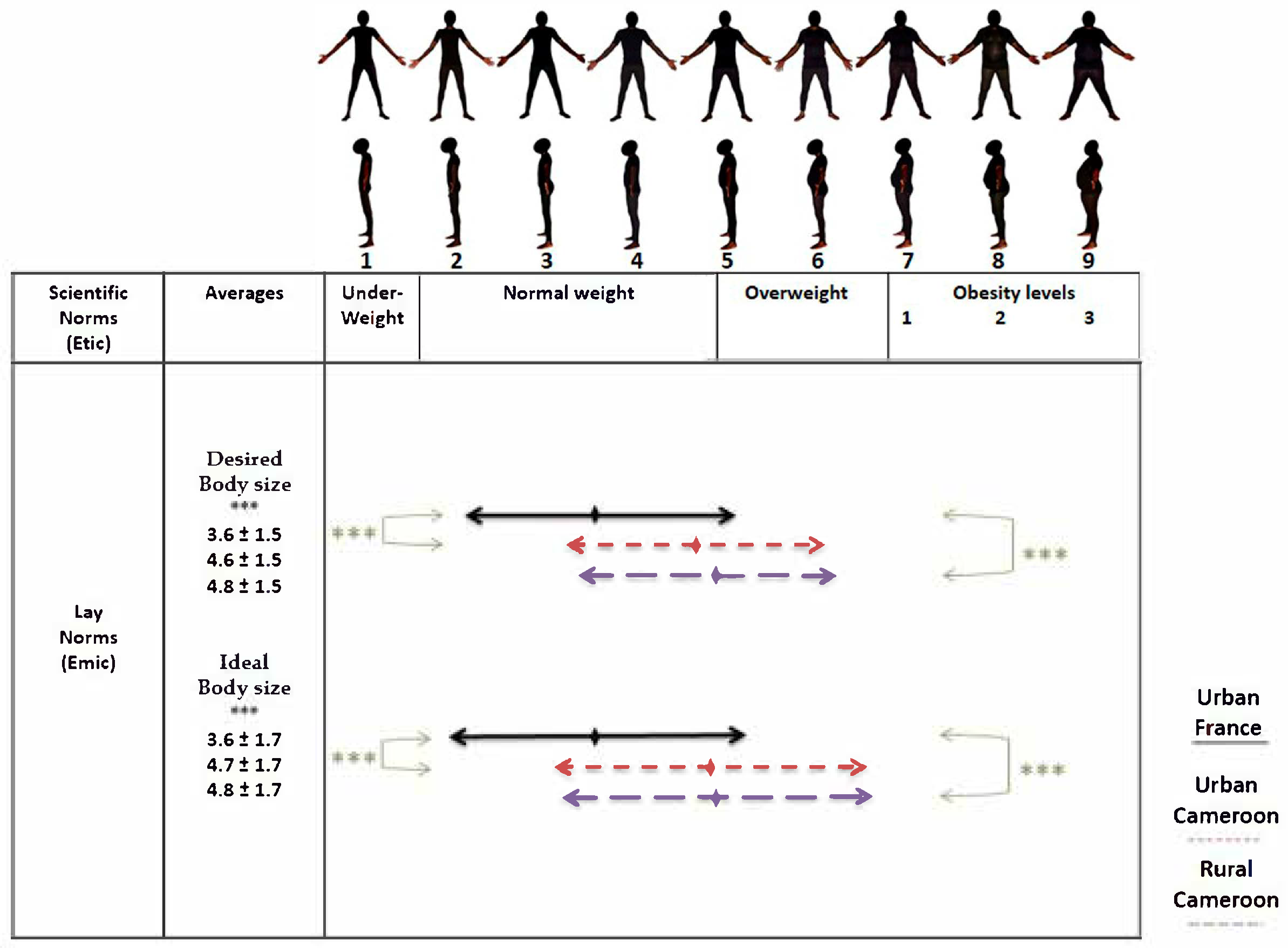
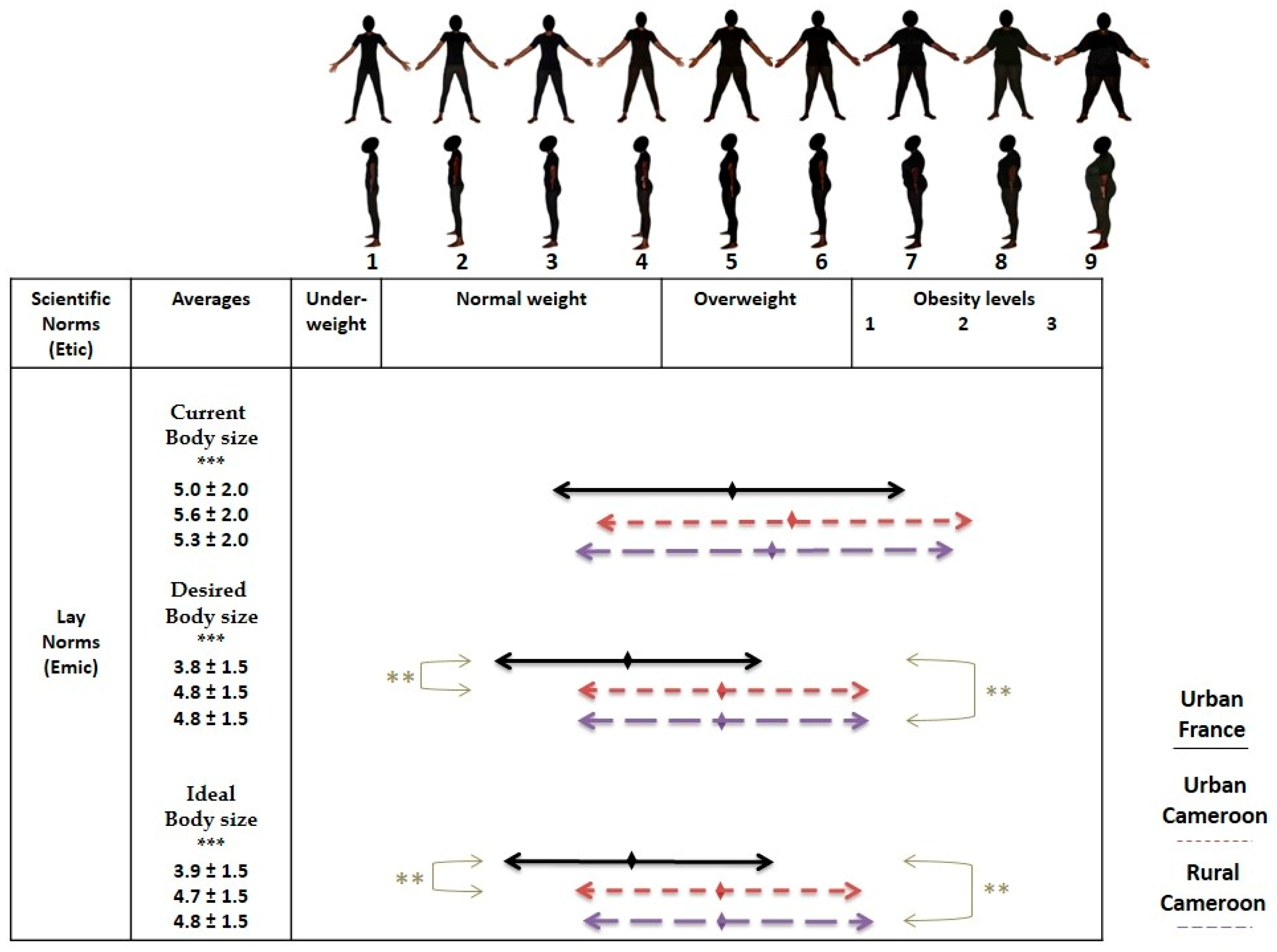
CBS means were situated within the normal-weight category in men and the overweight category in women. We also observed that for both masculine and feminine scales, DBS and IBS means were significantly lower in the Parisian Bamiléké than in the rural and urban ones, but no difference was found between rural and urban Bamiléké (Figure 1 and Figure 2). On both scales, Parisian Bamiléké had DBS and IBS means in the normal-weight category with standard deviations reaching or close to the underweight category, whereas rural and urban Bamiléké had DBS and IBS means between normal-weight and overweight categories.

3.2.3. Frequencies on Major Body Image Indexes

Table 2 shows that Parisan Bamiléké tended to devalue stoutness and underestimate their weight, and expected to lose weight compared to the two other groups. Both the last groups presented similar tendencies for these three body image dimensions.

3.2.4. Predictors of the Stoutness Valorisation Index

Independently to the effects of the other predictors, the external migration to Paris was negatively associated with the stoutness valorisation while being a women and having a higher BMI were positively associated with this outcome (Table 3). Unvaried analyses showed that being older was positively associated with the stoutness valorisation while having a higher educational level was negatively associated with the outcome.

3.2.5. Predictors of Body Self-Assessment and Self-Satistaction Indexes

Table 4 showed that living in Paris was independently and positively associated with the body weight underestimation, while being older and having a higher BMI were positively associated with this outcome. Then, being a woman was independently and positively associated with the body weight overerestimation, while having both higher BMI and educational level were associated with this outcome, the first one postively and the second one negatively. Concerning the body self-satisfaction, living in Paris and having a higher BMI were independently and positively associated with being willing to lose weight, while being a women was independently and negatively associated with this outcome. In addition, being older and having a higher educational level were associated with being willing to lose weight. Being a women was independently and negatively associated with being willing to gain weight, while living in urban Cameroon and having a higher BMI were both negatively associated with this outcome.

4. Discussion

This study investigated innovatively the relationships between body weight perceptions, obesity and eating disorders of young Bamiléké Cameroonian migrants along the migration process from rural Cameroon to both Cameroonian (Yaoundé) and French (Paris) urban environments. We observed that the body weight norms of this migrant population are influenced by the acculturation process related to both internal and external migration to urban Cameroon and France. However, even though eating disorders could stem from this shift in body image standards, both the valorisation of stoutness in some urban participants maintaining historical conceptions of body size and the underestimation of one’s weight can expose one to obesity risk.
The qualitative study, within a 10-year interval, showed that Bamiléké from the villages in West Cameroon over-valued stoutness as a symbol of wellbeing, prosperity and responsibility, as observed in other Cameroonian ethnic groups (De Garine & Pollock, 1995). Many studies in Africa attested that stoutness is a symbol of peace and economic success in the household while thinness is perceived as disease and, in an extreme case, a curse (Calame-Griaule, 1996). Our qualitative results showed that only one term expresses overweight status in the Bamiléké culture. The signifier is ovou but its signified is associated with wellbeing and economic success. Only one expression associated with this term could be negative: ovou nocho. It refers to people with obesity as slow and heavy, but, even still, this signifier is not associated with a real body weight-related disease, at worst it is associated with greed.
In Bamiléké traditions, different initiation rituals concretise the prestigious masculine status of both notables (wealthy/high ranking people) and kings, especially by their increasing corpulence. Socially, these men of power also need to gain weight with age “to fill” their large traditional clothes, called in the vernacular languages njocho. The same phenomenon is observed in women, they have to gain a considerable weight to be considered as fertile, beautiful, and comforting in the home, and therefore ready for marriage (Cohen et al., 2017). This valorisation of stoutness from the rural lifestyle seems to persist in Yaoundé according to both our qualitative and quantitative analyses: the symbol of the “administrative belly” in the household head man acquires a high professional status (Kiawi et al., 2006); the symbol of the obese housewife expressing the economic success of her husband through a large corpulence (Neveu Kringelbach, 2007; Cohen, 2020).
Nevertheless, according to our qualitative analyses, this social valorisation of stoutness seems to fall progressively in Yaoundé, and strongly with the external migration to Paris, illustrated also quantitatively through a minor valorisation of underweight status. Parisian Bamiléké seem to adapt their body size norms to those of the host population, like many other migrant populations living in HICs (Cachelin et al., 2002; Nicolaou et al., 2008). Indeed, several studies showed that while the French BMI mean is one of the lowest in Europe (Troy, 2024), within normal-weight ranges in both sexes, French men and women value very thin bodies (close to underweight in women) and most are dissatisfied with their body size (De Saint Pol, 2009; Robineau & de Saint Pol, 2013), as observed in Parisian Bamiléké.
In this specific French context of influential body weight norms promoting extreme thinness, the food was perceived in most urban interviewees from France as a potential danger while beauty should not express any expression of fatness, as observed in different Western populations (Le Barzic, 2007; De Saint Pol, 2009). Whether Bamiléké traditions value high-calorie food as a major strategy to give the body vitality, strength and beauty (Cohen et al., 2013), as also observed in black South African people (Puoane et al., 2005; Okop et al., 2016), both countries through the global influence of the urban lifestyle worldwide present younger generations, as observed in urban interviewees from Cameroon and France, contradicting these ‘vitalistic’ conceptions of the body leading to a strong depreciation of stoutness (Cohen et al., 2017, 2019), potentially associated with the so-called ‘Western’ eating disorders (Mbassa Menick & Moukouta, 2016; Toselli et al., 2016). In our qualitative findings, this emerging valorisation of thinness is also associated with a social stigmatisation of people with overweight status and obesity in Cameroon and France, and in a near future could globally conduct to an explosion of weight stigma (obesophobia) in young Cameroonian people with poor consequences on mental health, as observed in Western populations (Emmer et al., 2020).
However, in the meanwhile, the persisting valorisation of stoutness in Cameroon can be a risk factor for overweight status and obesity in urbanised obesogenic areas, as identified in this study and other African countries (Cohen et al., 2013; Appiah et al., 2016). Although the literature showed that elders are generally the main at-risk subgroup concerned by the obesogenic promotion of stoutness (Cohen et al., 2022), our study demonstrated that this valorisation of stoutness is independently and positively associated with BMI. This attests that African populations are transitional, so that contradictory social trends can coexist in specific populations, as an ‘obesogenic’ valorisation of stoutness and an ‘obesophobic’ valorisation of thinness in young migrants (Cohen, 2020). In addition, a high frequency of body weight underestimation was observed in Parisian Bamiléké, independently to other predictors of this body image dimension, whereas the prevalence of overweight status and obesity was high in this subgroup, especially when compared with the French national prevalence (Troy, 2024). This is in line with the literature attesting that African migrants living in Europe are overexposed to obesity and insufficiently targeted by policies in public health nutrition for managing excessive body weight (Khlat & Guillot, 2017; Toselli et al., 2019).
Despite young African migrant people tending to be receptive to etic standards (scientific norms) of corpulence from Western countries and questioning the emic (lay norms) valorisation of stoutness (Morris et al., 1999), this social change does not mean a better health for this population. Indeed, though this psychocultural emic trait valuing stoutness is relatively adapted to the rural less-obesogenic lifestyle (Fezeu et al., 2008; Cohen et al., 2013), and the obesogenic promotion of stoutness may lead to a decrease in the near future with urbanisation (Hay & Mitchison, 2021), the weight stigma caused by Western media in Cameroon and elsewhere is incompatible with expanding obesogenic urban areas in Africa, France, and the rest of the world (Brewis et al., 2018). Such a shift in body weight conceptions with a direct expression in the Bamiléké language—the term stout (“costaud” in French) meaning body strength and vitality is progressively replaced by big (“gros” in French) meaning excess of fat—puts them under pressure and simultaneously exposed to the dual burden of both obesity and weight stigma.
This study, based on a mixed-methods anthropological approach, has the merit of exploring innovatively and rigorously the evolution of body weight perceptions regarding the BMI status in a young Cameroonian population, the Bamiléké, experiencing through both internal and external migrations the influence of the globalised urban environment. The strength of this work is to illustrate through a case study the body weight norm transition, with its plural effects on both mental and physical health, at a one generation-interval. Such work will help to formulate public health recommendations about global health-related body image—i.e., the dual burden of both obesity and eating disorders—in these young African populations adopting dynamic body image constructs within the urbanisation process worldwide and at the crossroad between lay and modern body weight norms.
A noteworthy point is that the sub-study conducted in France is preliminary. Qualitative findings were absolutely informative and illustrative while quantitative findings were reliable, interpretable and in line with the existing literature, even if a stronger statistical power would help to distinguish differences between men and women. Although this first step was necessary to envision the public health context of SSA migrants in France toward body image and obesity relationships, further works based on larger study samples will allow extending the study population to other migrant networks (students, workers, etc.) to cover exhaustively the acculturation process and explore more accurately quantitative tendencies. Even if our repeated qualitative study at a ten-year interval shows that the quantitative trends found on body image are still ongoing, further quantitative studies including mental health dimensions of body image disturbance, eating disorders and poor self-esteem should be implemented to identify eventual psychological comorbidities associated with the emerging weight stigma in such populations overexposed to obesity.
To conclude, within a ten-year interval, young urban Bamiléké in Cameroon and France tend to progressively abandon a historical sociocultural trait which exposes them to obesity within the urbanisation context to adopt a new emerging sociocultural trait which increasingly exposes them to eating disorders and mental health issues associated with weight stigma. Future larger studies as well as public health policies should focus on the impact of the rapid urbanisation process on the global health of such African transitional and disadvantaged populations exposed to a dual burden relative to an obesogenic’ as well as ‘obesophobic’ urban environment.

Supplementary Materials

The following supporting information can be downloaded at: https://www.mdpi.com/article/10.3390/youth6020040/s1, Table S1: Regressions for CBS, DBS and IBS according to the residence area.

Author Contributions

Conceptualization, E.C., N.A. and P.P.; methodology, E.C. and P.P.; formal analysis, E.C.; investigation, A.P., A.M.W.F. and W.W.; writing—original draft, E.C.; writing—review and editing, E.C., P.G., F.E., W.W., N.A. and P.P.; supervision, E.C. and P.P.; project administration, E.C. and P.P.; funding acquisition, E.C. and P.P. All authors have read and agreed to the published version of the manuscript.

Funding

This research was funded by Agence Nationale de la Recherche in France, grant number ANR-08-BLAN-0004.

Institutional Review Board Statement

The study was conducted in accordance with the Declaration of Helsinki and approved by the National Ethics Committee for Health Research of Cameroon (2017/09/940/CE/CNERSH//SP, 12 September 2017).

Informed Consent Statement

Verbal informed consent was always obtained from the participants. Verbal consent was obtained and, in some cases, also the written one. Indeed, many participants in Cameroon, especially in rural area, considered that authorisations from national (ethics committee) and local (chief of villages/districts) institutions were sufficient, and felt quite uncomfortable to leave their signature in a document belonging to unknown persons.

Data Availability Statement

The raw data supporting the conclusions of this article will be made available by the authors on request.

Acknowledgments

Particular thanks to investigators in the field, especially Léolain Harris-Edoubé, Gerard Donfack and Jules Bertin Djifack.

Conflicts of Interest

The authors declare no conflicts of interest.

References

  1. Addo, I. Y., Brener, L., Asante, A. D., & De Wit, J. (2021). Socio-cultural beliefs about an ideal body size and implications for risk of excess weight gain after immigration: A study of Australian residents of sub-Saharan African ancestry. Ethnicity & Health, 26(8), 1209–1224. [Google Scholar] [CrossRef]
  2. Agyemang, C., Addo, J., Bhopal, R., Ade, G. A., & Stronks, K. (2009a). Cardiovascular disease, diabetes and established risk factors among populations of sub-Saharan African descent in Europe: A literature review. Global Health, 5(7), 7. [Google Scholar] [CrossRef]
  3. Agyemang, C., Meeks, K., Beune, E., Owusu-Dabo, E., Mockenhaupt, F. P., Addo, J., de Graft Aikins, A., Bahendeka, S., Danquah, I., Schulze, M. B., Spranger, J., Burr, T., Agyei-Baffour, P., Amoah, S. K., Galbete, C., Henneman, P., Klipstein-Grobusch, K., Nicolaou, M., Adeyemo, A., … Stronks, K. (2016). Obesity and type 2 diabetes in sub-Saharan Africans—Is the burden in today’s Africa similar to African migrants in Europe? The RODAM study. BMC Medicine, 14(1), 166. [Google Scholar] [CrossRef]
  4. Agyemang, C., Owusu-Dabo, E., de Jonge, A., Martins, D., Ogedegbe, G., & Stronks, K. (2009b). Overweight and obesity among Ghanaian residents in The Netherlands: How do they weigh against their urban and rural counterparts in Ghana? Public Health Nutrition, 12(7), 909–916. [Google Scholar] [CrossRef]
  5. Appiah, C. A., Otoo, G. E., & Steiner-Asiedu, M. (2016). Preferred body size in urban Ghanaian women: Implication on the overweight/obesity problem. Pan African Medical Journal, 23, 239. [Google Scholar] [CrossRef]
  6. Benkeser, R. M., Biritwum, R., & Hill, A. G. (2012). Prevalence of overweight and obesity and perception of healthy and desirable body size in urban, Ghanaian women. Ghana Medical Journal, 46(2), 66–75. [Google Scholar]
  7. Berry, J. W. (1997). Immigration, acculturation, and adaptation. Applied Psychology, 46(1), 5–34. [Google Scholar] [CrossRef]
  8. Brewis, A., SturtzSreetharan, C., & Wutich, A. (2018). Obesity stigma as a globalizing health challenge. Globalization and Health, 14(1), 20. [Google Scholar] [CrossRef] [PubMed]
  9. Cachelin, F. M., Rebeck, R. M., Chung, G. H., & Pelayo, E. (2002). Does ethnicity influence body-size preference? A comparison of body image and body size. Obesity Research, 10(3), 158–166. [Google Scholar] [PubMed]
  10. Calame-Griaule, G. (1996). Valeurs symboliques de l’alimentation chez les Dogon. Journal Des Africanistes, 66(1), 81–104. [Google Scholar] [CrossRef]
  11. Cohen, E. (2020). Des corps pour paraître. La corpulence et ses perceptions au Sénégal. Présence Africaine. [Google Scholar]
  12. Cohen, E., Amougou, N., Ponty, A., Guerrien, M., Wakenge, W., Chidumwa, G., Said-Mohamed, R., Fezeu, L. K., & Pasquet, P. (2022). Direct and indirect determinants of body mass index in both major ethnic groups experiencing the nutritional transition in Cameroon. International Journal of Environmental Research and Public Health, 19(10), 6108. [Google Scholar] [CrossRef] [PubMed]
  13. Cohen, E., Amougou, N., Ponty, A., Loinger-Beck, J., Nkuintchua, T., Monteillet, N., Bernard, J. Y., Saïd-Mohamed, R., Holdsworth, M., & Pasquet, P. (2017). Nutrition transition and biocultural determinants of obesity among Cameroonian migrants in urban Cameroon and France. International Journal of Environmental Research and Public Health, 14(7), 696. [Google Scholar] [CrossRef]
  14. Cohen, E., Bernard, J. Y., Ponty, A., Ndao, A., Amougou, N., Said-Mohamed, R., & Pasquet, P. (2015). Development and validation of the body size scale for assessing body weight perception in African populations. PLoS ONE, 10(11), 0138983. [Google Scholar]
  15. Cohen, E., Boëtsch, G., Palstra, F. P., & Pasquet, P. (2013). Social valorisation of stoutness as a determinant of obesity in the context of nutritional transition in Cameroon: The Bamileke case. Social Science & Medicine, 96, 24–32. [Google Scholar] [CrossRef]
  16. Cohen, E., Gradidge, P. J.-L., Micklesfield, L. K., & Norris, S. A. (2019). Relationship between body mass index and body image disturbances among South African mothers and their daughters living in Soweto, Johannesburg. Family & Community Health, 42(2), 140–149. [Google Scholar] [CrossRef] [PubMed]
  17. Copans, J. (2008). L’enquête et ses méthodes: L’enquête ethnologique de terrain. Armand Colin. [Google Scholar]
  18. Corbin, J. M., & Strauss, A. (1990). Grounded theory research: Procedures, canons, and evaluative criteria. Qualitative Sociology, 13(1), 3–21. [Google Scholar] [CrossRef]
  19. Dapi, L. N., Omoloko, C., Janlert, U., Dahlgren, L., & Håglin, L. (2007). “I eat to be happy, to be strong, and to live.” Perceptions of rural and urban adolescents in Cameroon, Africa. Journal of Nutrition Education and Behavior, 39(6), 320–326. [Google Scholar] [CrossRef]
  20. De Capèle, B., Delourme, V., & Fabbro, S. (2004). L’alimentation des Africains vivant en France. Alimentation et Précarité (CERIN), 24, 1–20. [Google Scholar]
  21. de Garine, I. (1990). Adaptation biologique et bien-être psycho-culturel. Bulletins et Mémoires de la Société d’anthropologie de Paris, 2(2), 151–173. [Google Scholar]
  22. De Garine, I., & Pollock, N. J. (1995). Social aspects of obesity. Gordon and Breach Publishers. [Google Scholar]
  23. De Saint Pol, T. (2009). Surpoids, normes et jugements en matière de poids: Comparaisons européennes. Populations et Sociétés, 455, 1–4. [Google Scholar] [CrossRef]
  24. Emmer, C., Bosnjak, M., & Mata, J. (2020). The association between weight stigma and mental health: A meta-analysis. Obesity Reviews, 21(1), e12935. [Google Scholar] [CrossRef]
  25. Fadipe, B., Oyelohunnu, M. A., Olagunju, A. T., Aina, O. F., Akinbode, A. A., & Suleiman, T. F. (2017). Disordered eating attitudes: Demographic and clinico-anthropometric correlates among a sample of Nigerian students. African Health Sciences, 17(2), 513–523. [Google Scholar] [CrossRef]
  26. Fezeu, L. K., Assah, F. K., Balkau, B., Mbanya, D. S., Kengne, A. P., Awah, P. K., & Mbanya, J. C. N. (2008). Ten-year changes in central obesity and BMI in rural and urban Cameroon. Obesity, 16(5), 1144–1147. [Google Scholar] [PubMed]
  27. Hay, P., & Mitchison, D. (2021). Urbanization and eating disorders: A scoping review of studies from 2019 to 2020. Current Opinion in Psychiatry, 34(3), 287–292. [Google Scholar] [CrossRef] [PubMed]
  28. Hurston, J., Worthy, C., Huefner, E., Sayed, M., Dubose, C., Mabundo, L., Horlyck-Romanovsky, M., Younger-Coleman, N., & Sumner, A. (2024). An overview of body size preference, perception and dissatisfaction in sub-Saharan Africans living in the United States. Diabetes, Metabolic Syndrome and Obesity, 17, 3279–3293. [Google Scholar] [CrossRef] [PubMed]
  29. Jones, L. A., & Cook-Cottone, C. (2013). Media and cultural influences in African-American girls’ eating disorder risk. ISRN Preventive Medicine, 2013, 319701. [Google Scholar] [CrossRef][Green Version]
  30. Khlat, M., & Guillot, M. (2017). Health and mortality patterns among migrants in France. In Migration, health and survival (pp. 193–213). Edward Elgar Publishing. Available online: https://www.elgaronline.com/edcollchap/edcoll/9781785365966/9781785365966.00016.xml (accessed on 24 November 2017).
  31. Khlat, M., Legleye, S., & Bricard, D. (2020). Gender patterns in immigrants’ health profiles in France: Tobacco, alcohol, obesity and self-reported health. International Journal of Environmental Research and Public Health, 17(23), 8759. [Google Scholar] [CrossRef]
  32. Kiawi, E., Edwards, R., Shu, J., Unwin, N., Kamadjeu, R., & Mbanya, J. C. (2006). Knowledge, attitudes, and behavior relating to diabetes and its main risk factors among urban residents in Cameroon: A qualitative survey. Ethnicity & Disease, 16(2), 503–509. [Google Scholar]
  33. Le Barzic, M. (2007). Le point de vue de la psychanalyse: Le plaisir oral est-il nutritionnellement correct? Oléagineux, Corps Gras, Lipides, 14(5), 241–246. [Google Scholar]
  34. Lofton, H., Ard, J. D., Hunt, R. R., & Knight, M. G. (2023). Obesity among African American people in the United States: A review. Obesity, 31(2), 306–315. [Google Scholar] [CrossRef]
  35. Lo-oh, J. L., & Bambo, E. C. (2023). Body image perception and psychological distress among students in the University of Buea in Cameroon. Journal of Education and Human Development, 12(2), 64–78. [Google Scholar] [CrossRef]
  36. Martin-Fernandez, J., Grillo, F., Tichit, C., Parizot, I., & Chauvin, P. (2012). Overweight according to geographical origin and time spent in France: A cross sectional study in the Paris metropolitan area. BMC Public Health, 12(1), 937. [Google Scholar] [CrossRef]
  37. Mason, J. (2002). Qualitative researching. Sage. [Google Scholar]
  38. Mbassa Menick, D., & Moukouta, C. S. (2016). Quand manger n’est plus manger. Une clinique émergente en Afrique ? Neuropsychiatrie de l’enfance et de l’adolescence, 64, 22–30. [Google Scholar] [CrossRef]
  39. Morris, M. W., Leung, K., Ames, D., & Lickel, B. (1999). Views from inside and outside: Integrating emic and etic insights about culture and justice judgment. Academy of Management Review, 24(4), 781–796. [Google Scholar] [CrossRef]
  40. Mvo, Z., Dick, J., & Steyn, K. (1999). Perceptions of overweight African women about acceptable body size of women and children. Curationis, 22(2), 27–31. [Google Scholar] [CrossRef]
  41. Neveu Kringelbach, H. (2007). «Le poids du succès»: Construction du corps, danse et carrière à Dakar. Politique Africaine, 107, 81–101. [Google Scholar] [CrossRef]
  42. Nicolaou, M., Doak, C., Dam, R. V., Hosper, K., Seidell, J., & Stronks, K. (2008). Body size preference and body weight perception among two migrant groups of non-Western origin. Public Health Nutrition, 11(12), 1332–1341. [Google Scholar] [CrossRef] [PubMed]
  43. Okop, K. J., Mukumbang, F. C., Mathole, T., Levitt, N., & Puoane, T. (2016). Perceptions of body size, obesity threat and the willingness to lose weight among black South African adults: A qualitative study. BMC Public Health, 16(1), 365. [Google Scholar] [CrossRef] [PubMed]
  44. Osei-Kwasi, H. A., Nicolaou, M., Powell, K., Terragni, L., Maes, L., Stronks, K., Lien, N., & Holdsworth, M. (2016). Systematic mapping review of the factors influencing dietary behaviour in ethnic minority groups living in Europe: A DEDIPAC study. International Journal of Behavioral Nutrition and Physical Activity, 13(1), 85. [Google Scholar] [CrossRef]
  45. Puoane, T., Fourie, J. M., Shapiro, M., Rosling, L., Tshaka, N. C., & Oelefse, A. (2005). ‘Big is beautiful’—An exploration with urban black community health workers in a South African township. South African Journal of Clinical Nutrition, 18(1), 6–15. [Google Scholar] [CrossRef]
  46. Renzaho, A. M., McCabe, M., & Swinburn, B. (2012). Intergenerational differences in food, physical activity, and body size perceptions among African migrants. Qualitative Health Research, 22(6), 740–754. [Google Scholar] [CrossRef]
  47. Robineau, D., & de Saint Pol, T. (2013). Les normes de minceur: Une comparaison internationale. Population & Sociétés, 504(9), 1–4. [Google Scholar] [CrossRef]
  48. Toselli, S., Gualdi-Russo, E., & Campa, F. (2019). Ethnic differences in body image perception in patients with type 2 diabetes. Journal of Human Nutrition and Dietetics, 32(3), 356–371. [Google Scholar] [CrossRef] [PubMed]
  49. Toselli, S., Rinaldo, N., & Gualdi-Russo, E. (2016). Body image perception of African immigrants in Europe. Globalization and Health, 12(1), 48. [Google Scholar] [CrossRef] [PubMed]
  50. Troy, L. (2024). Surpoids et obésité: Facteurs de risques et politiques de prévention. Panorama Des Politiques Publiques de Prévention et de Leurs Effets, En Europe et Dans Le Monde. Les Dossiers de la DREES, 118, 1–74. [Google Scholar]
  51. Van Den Heuvel, L. L., Van Der Merwe, C. A., Jordaan, G. P., & Szabo, C. P. (2023). Eating Disorders in Africa. In P. Robinson, T. Wade, B. Herpertz-Dahlmann, F. Fernandez-Aranda, J. Treasure, & S. Wonderlich (Eds.), Eating Disorders (pp. 1–22). Springer International Publishing. Available online: https://link.springer.com/10.1007/978-3-030-97416-9_17-1 (accessed on 3 March 2023).
  52. WHO. (2000). Obesity: Preventing and managing the global epidemic. WHO. [Google Scholar]
  53. Williamson, D. A., Gleaves, D. H., Watkins, P. C., & Schlundt, D. G. (1993). Validation of self-ideal body size discrepancy as a measure of body dissatisfaction. Journal of Psychopathology and Behavioral Assessment, 15(1), 57–68. [Google Scholar] [CrossRef]
  54. Wluczka, M., & Debska, E. (2006). La santé des primo-migrants en 2006. ANAEM. [Google Scholar]
Figure 1. Perceptions of current, desired and ideal body sizes on masculine BSS. ***: p < 0.001. F-tests were used for global mean comparisons and Tukey post hoc analyses were used for two-by-two mean comparisons.
Youth 06 00040 g001
Figure 2. Perceptions of current, desired and ideal body sizes on feminine BSS. **, ***: p < 0.01 and p < 0.001, respectively. F-tests were used for global mean comparisons and Tukey post hoc analyses were used for two-by-two mean comparisons.
Youth 06 00040 g002
Table 1. Descriptive characteristics of the study samples.
Rural CameroonUrban CameroonUrban France
Qualitative study
in 2011 and 2021
Each sample size, n121212
Sex, % men505050
LocationVillage of DiambouBamiléké neighbourhoods of the capitalBamiléké migrant associations
Quantitative survey
in 2012
Sample size, n12718843
Sex, % men48.845.760.5
Age, Mean26.4 ± 6.928.9 ± 6.130.6 ± 5.6
LocationVillage of DiambouBamiléké neighbourhoods of the capitalBamiléké migrant associations
Cultural events: weddings, baptisms, community celebrations.
Cameroonian restaurants and at home
Table 2. Frequencies on body image indexes according to the residence area.
(%/N)Rural BamilékéUrban BamilékéParisian Bamiléké
Stoutness valorisation p
No44.4 (56)41.2 (77)81.4 (35)***
Yes55.6 (70)58.8 (110)18.6 (8)
Body self-assessment
Correct estimation59.5 (75)58.8 (110)46.5 (20)**
Underestimation11.9 (15)12.8 (24)37.2 (16)
Overestimation28.6 (36)28.3 (53)16.3 (7)
Body self-satisfaction
Satisfied82.5 (104)85.0 (159)48.8 (21)***
Want to lose weight4.8 (6)10.2 (19)41.9 (18)
Want to gain weight12.7 (16)4.8 (9)9.3 (4)
Pearson’s Chi2 or Fisher’s exact tests. **, ***: p < 0.01 and p < 0.001, respectively.
Table 3. Odds ratio and 95% confidence intervals (CI) for subjects who value stoutness, using a binomial logistic regression analysis, and compared to subjects who do not value stoutness in the total sample.
PredictorsCategoriesStoutness Valorisation
Areas Odds ratio95% CIp
Rural Cameroon †
Urban Cameroon0.70.41.2
Urban France ***0.10.00.2c
Age **
1.01.01.1
Sex ***
Men †
Women1.91.13.1a
Educational level ***
Others †
High school/University0.80.41.4
BMI ***
1.41.31.5c
n = 355
Unadjusted significant estimates (**, ***): p < 0.01 and p < 0.001, respectively. In bold, binomial logit analysis significant effects (a, c): p < 0.05, p < 0.001, respectively. † Category taken as reference.
Table 4. Odds ratio and 95% confidence intervals (CI) for subjects who underestimate/overestimate their body size and who want to lose/gain weight, using a multinomial logistic regression analysis and compared to subjects who do not do so in the total sample.
PredictorsCategoriesBody Self-Assessment (Underestimation) Body Self-Assessment (Overestimation) Body Self-Satisfaction (Losing Weight) Body Self-Satisfaction (Gaining Weight)
Areas Odds ratio95% CIpCrude effectsOdds ratio95% CIpCrude effectsOdds ratio95% CIpCrude effectsOdds ratio95% CIpCrude effects
Rural Cameroon †
Urban Cameroon0.8−0.40.6 0.90.51.6 1.40.54.0 0.50.21.2 *
Urban France3.81.311.0a**1.10.43.4 11.42.944.4c***2.20.510.7
Age
1.00.91.1 *1.01.01.1 1.01.01.1 **1.00.91.1
Sex
Men †
Women0.70.31.3 2.71.64.6c***0.10.00.1c***0.10.00.2c***
Educational level
Others †
High school/University0.70.31.7 0.50.31.0 *1.40.53.5 **0.80.32.2
BMI
1.21.11.2 ***1.01.01.1 *1.21.11.4c**0.90.71.0 **
n = 355
In bold, multinomial logit analysis significant effects (a, c): p < 0.05, p < 0.001, respectively. Crude or unadjusted significant estimates (*, **, ***): p < 0.05; p < 0.01 and p < 0.001, respectively. The correct estimation and the satisfaction of one’s body weight are the baseline of body self-assessment and body self-satisfaction, respectively. †: category taken as reference.
Disclaimer/Publisher’s Note: The statements, opinions and data contained in all publications are solely those of the individual author(s) and contributor(s) and not of MDPI and/or the editor(s). MDPI and/or the editor(s) disclaim responsibility for any injury to people or property resulting from any ideas, methods, instructions or products referred to in the content.