Review

Developing Innovations to Enable Care-Experienced Parents’ Successing: A Narrative Review

Warwick Business School, University of Warwick, Coventry CV4 7AL, UK
*
Author to whom correspondence should be addressed.
Submission received: 30 July 2025 / Revised: 25 November 2025 / Accepted: 19 December 2025 / Published: 6 January 2026
(This article belongs to the Special Issue Youth Transitions from Care: Towards Improved Care-Leaving Outcomes)

Abstract

Whilst there has been substantial attention to care-experienced parents’ needs and experiences in the academic literature internationally, understandings of nascent services, their characteristics and implementation processes are more limited. With an overarching socioecological resilience systems framing and drawing on an innovation perspective, we aim to develop understanding of how to design and develop innovations to enable care-experienced parents’ successing. We conducted a narrative literature review that included 33 sources published internationally between 2017 and 2025. We conducted thematic analysis to identify adversities experienced by and innovations developed for care-experienced parents. We authenticated the themes in a workshop with members of the practice community and developed frameworks to represent the themes. Findings are represented in three sections. First, we consider parental needs, with an overview of adversities experienced by care-experienced parents together with individual protective factors and required service responses, framed by psychological, social and structural domains. Second, drawing upon such understanding, we consider intervention design, with a focus on exemplar innovations and the characteristics that are represented by five service delivery models: therapeutic; social; partnership; advocacy; and co-production. Third, with a need to ensure that service intervention is effective, we examine the process of developing service innovations and consider five dynamic ingredients that enable implementation success: shared leadership; receptivity of context; co-production; learning and adaption; and outcome measurement. Our review contributes new understanding to inform processes of designing and implementing innovations to enable care-experienced parents’ successing. We offer a framework that represents a starting point towards enabling care-experienced parents’ successing that can be applied in policy and practice, although more research is needed.

1. Introduction

Recent research suggests that becoming a parent is a source of joy and meaning but also of heightened needs for individuals, and emotional, social and practical support is often required to protect and enhance parental capacity (Samani & Psouni, 2024). The heightened needs associated with the transition to parenthood and becoming a parent are of particular significance for care-experienced parents, parents or parents to be who are or have experience of being in any form of statutory care, including kinship care, foster care, residential care or adoption (Barnardo’s, 2022). Heightened needs are associated with age, since for care-experienced parents across the globe, there is a higher prevalence of parenthood at a relatively young age (Roberts et al., 2019; Strahl et al., 2021; Taussig & Roberts, 2022), and, specifically, in relation to their experiences within the care system. Childhood experiences for those growing up in the care system, which may include unstable living arrangements, poor access to education and difficult relationships and loss of contact with first families, can mean that care-experienced young people face additional challenges when becoming parents (Dworsky et al., 2021; Purtell et al., 2022; Roberts, 2021; Samani & Psouni, 2024) that can extend into later parenthood (Refaeli et al., 2022). Whilst much of the understandings of care-experienced parents’ needs and experiences, as well as the services developed, relate to mothers, we use the collective term ‘parent’ in this paper (with an exception in relation to services with specific referral criteria), in line with the emergent focus on the need to promote focus and inclusion in relation to fathers (Crowley, 2022; Dworsky et al., 2021).
A recent study of outcomes of children of care-experienced parents has indicated that there is an ‘out-of-home care penalty’ that leads to inter-generational cycles of disadvantage (Parsons et al., 2023), with high proportions of children of care-experienced parents being involved in child protection cases and removed from the care of their parents (Doebler et al., 2024; Dworsky et al., 2021; Fitzsimons et al., 2025; Krutzinna, 2021; Roberts, 2021). At the same time, it is evident that at an individual level, some care-experienced parents can overcome adversities, following which there is a call to focus on and support the development of protective factors (Gill et al., 2023; Purtell & Morris, 2025; Samani & Psouni, 2024). Reinforcing this, at a system level, there is a growing call for enhanced enactment of statutory corporate parenting responsibilities and service provision to enable care leavers who are parents to be the parents they want to be (Barnardo’s, 2022; Roberts, 2021).
Whilst this growing body of academic knowledge has offered valuable insights into care-experienced parents’ needs and experiences and what is required from service provision, understandings of the characteristics of nascent services and how these have been implemented are more limited (Dworsky et al., 2021). This restricts opportunities for those who are designing, developing and implementing new services to apply and build on learning and prevents the diffusion and scaling of successful services (Currie et al., 2025; Dworsky et al., 2021). Furthermore, whilst there is growing comparative understanding of the diverse between-country differences relating to care leaving more generally (Strahl et al., 2021), a deeper focus specific to care-experienced parents is yet to be developed. Our narrative literature review seeks to address these gaps in understanding by contributing insights to inform design and implementation processes. We aim to contribute to developing understanding of service interventions to enable care-experienced parents’ ‘successing’ (Van Breda et al., 2012).
Drawing on applications of theory in care-leaving studies in social care more generally, we frame our study with a socioecological resilience systems perspective (Mupaku et al., 2021; Van Breda & Reuben, 2025). This framing emphasises how care-experienced parents’ experiences of parenting are situated and interactive within a wider system, with a focus on enabling processes. This aligns with the theme of care leavers’ ‘successing’ (Van Breda et al., 2012) in the Special Issue in which this article is located: understanding becoming a parent as an ongoing lifelong process in which care-experienced parents journey towards success. We attend to personal, social and structural factors to identify enabling and protective processes that contribute to care-experienced parents’ successing.
Furthermore, we apply an additional ‘innovation’ lens (Van de Ven et al., 2008) to address the relative lack of insight into the design elements and dynamic ingredients underpinning successful implementation of new services. We build upon an emergent understanding of innovation in the broader context of children’s social care (Brown, 2021; Lefevre et al., 2023), in particular a recent study focused on innovations for young people transitioning from care (Currie et al., 2025; Lynch et al., 2024). In line with this, we frame innovation as a non-linear and complex ‘journey’ involving diverse stakeholders (Van de Ven et al., 2008). To aid the synthesis of literature towards actionable insight, we first draw on an innovation framework developed by Lefevre et al. (2023) in relation to the broader context of children’s social care. This trajectory model, comprising earlier (mobilising and designing), middle (developing and integrating) and latter (growing and system change) phases, framed how we characterised the phases of the identified innovations for care-experienced parents (Lefevre et al., 2023, pp. 2489–2490). Second, we adapt a framework that we developed inductively in a UK study that explored innovations for care leavers’ transitions more generally. The framework was developed by identifying factors that underpinned the success of innovations that had sustained beyond a pilot phase (Currie et al., 2025). The framework features five enabling factors that were identified across cases to differing degrees that together constituted sustaining ingredients: shared leadership; outcome measurement; learning and adaption; co-production; and receptivity of context (Currie et al., 2025; Lynch et al., 2024). Table 1 outlines descriptions of each ingredient, with slight adaptions to nuance the framework to the specific context of innovation for care-experienced parents.

2. Materials and Methods

The review formed an initial phase of a research study that aimed to develop our understanding of innovation for care-experienced parents. It followed our early engagement with leaders of a local project in England, as they embarked on a journey of developing a new service for care-experienced parents living in their area.
Constrained by funding and temporal factors, a full-scale systematic or scoping review was not achievable. A small-scale narrative review (Greenhalgh et al., 2018) was conducted over a three-month period (February to April 2025) by one researcher (AL). The limited scope and scale of the review are recognised as limitations.
The research questions guiding the review were as follows: (i) What are the current understandings of the adversities that care-experienced parents face that act as barriers to their successing? (ii) How might services be developed to enable care-experienced parents’ successing?
The search methods involved two stages. Stage 1 involved a search for academic journal articles, focused on the needs of and services for care-experienced parents using the Scopus database. The search terms applied were ‘need OR innovation OR service AND care-experienced parent OR mother OR father’. No disciplinary, journal, date or geographical restrictions were applied. This initial search was extended through citation following and citation harvesting. Stage 2 focused on practice-focused sources (so-called ‘grey’ literature). Internet desktop searches were conducted using the same prompts as in Stage 1, supplemented with sources shared by a project lead at a national voluntary care leaver organisation in England, following discussion at a conference.
Following an initial review of abstracts, executive summaries and introductory information, sources were sifted and prioritised for inclusion in the review. Inclusion criteria were applied as follows: ‘source focused on care-experienced parents as a specific group’. Exclusion criteria were applied as ‘source focused on universal parenting services, including for young parents or recurrent care proceeding services’. An inclusive approach was applied in relation to the source type and quality, with descriptive as well as evaluative sources included from the practice literature. The limited scale of the review determined the number of sources that could be included. To limit the review sources to a pragmatic number and to enhance relevance for our study context, grey literature sources were restricted to the UK.
Thirty-three sources were included: twenty academic journal articles, one book, one book chapter and eleven practice-focused reports and online resources. These sources represent empirical exploratory and evaluative research studies and descriptive service information. They were published between 2017 and 2025, including in Australia, Canada, England, Israel, Italy, Norway, Scotland, Sweden, USA and Wales. The representation of studies from the Global North and the absence of studies from countries in the Global South are recognised as limitations of the review.
The 33 sources were reviewed in full, and visual mind-mapping methods (Buzan, 2010) were used in an iterative, inductive process to map the findings thematically according to our theoretical frameworks. Inductive themes were developed within the broader categories of individual, social and system-level factors; identified innovations; innovation characteristics; enablers and barriers; innovation phases (Lefevre et al., 2023); and innovation ingredients (Currie et al., 2025; Table 1). The emerging themes were discussed by all members of the research team. To increase trustworthiness and authenticity, we shared the key themes and convened a practice workshop with seven practitioners, managers and leaders from health, social care and voluntary and community organisations who were developing the new service. Within the workshop, open discussion was encouraged. The attendees posed questions and offered reflections on the themes, indicating which had resonated with them as implications for their particular innovation. These discussions highlighted that there was a need for assimilation of current understandings of adversities that act as barriers and how services might respond to enable care-experienced parents’ successing. Reflections on the discussions led us to include all themes in the article and to develop tabular formats as accessible descriptive representations to enhance accessibility to practice-sector readers. The findings from the review are presented below.

3. Results

We first present an overview of parental needs, with a focus on the adversities experienced by care-experienced parents together with individual protective factors and required service responses to enable care-experienced parents’ successing. Second, we present exemplar innovations that have been developed to enable care-experienced parents’ successing with their constituent design dimensions. Finally, with a focus on implementation, we reflect on the innovation phase (Lefevre et al., 2023) and provide analyses of the five ingredients that underpin innovation success (Table 1; Currie et al., 2025; Lynch et al., 2024).

3.1. Parental Needs: Care-Experienced Parents’ Experiences of Adversities, Individual Protective Factors and Required Service Responses

In this section, we outline the three domains (psychological, social and structural) we identified that related to care-experienced parents’ experience of adversities, together with the individual protective factors and desired service and system responses identified to enable care-experienced parents’ successing.

3.1.1. Psychological Domain

Within the psychological domain, care-experienced parents faced adversities that included low confidence and anxiety relating to parenting capacity (Roberts, 2021; Samani & Psouni, 2024); emotional experiences related to complex trauma (Prévost-Lemire et al., 2024); ambiguous loss and an ‘emotional void’ relating to lost contact and disrupted relationships with first families (Purtell et al., 2020; Purtell & Morris, 2025); models of insecure attachment (Bowlby, 1969/1982; Purtell et al., 2021; Samani & Psouni, 2024); mental health difficulties and distress (Roberts et al., 2019; Parsons & Schoon, 2022; Refaeli et al., 2022); and fear and mistrust of disclosing needs to professional services (Barnardo’s, 2022; Purtell et al., 2021; Samani & Psouni, 2024).
Alongside these difficult psychological and emotional experiences, becoming a parent also elicited positive experiences. Positive psychological and emotional experiences that might be seen to act as protective factors encompassed developing a new identity, accompanied by hope, aspiration and determination to create a loving a stable family (Barnardo’s, 2022; Cresswell, 2019; Dandy et al., 2020; Ethier, 2022; Roberts, 2021; Samani & Psouni, 2024).
Required service and system responses that related to the emotional domain included the development of trauma-informed services (Barnardo’s, 2022; Gill et al., 2023; Prévost-Lemire et al., 2024; Purtell et al., 2022), emotional support offered by practitioners, providing opportunities for ‘emotional attunement’ and a ‘secure base’ (Purtell et al., 2021, p. 361) and mental health support (Barnardo’s, 2022). Attachment theory (Bowlby, 1969/1982) provided a lens for understanding the psychological domain in relation to care-experienced parents’ early relational disruptions, their impact and how services might respond. Furthermore, the concept of parallel process (Bernstein & Edwards, 2012; Ethier, 2022) provided a lens for understanding the need to support practitioners’ emotional wellbeing so that they have the capacity to offer emotional support to parents. The application of a parallel process, as multilevel modelling of nurturing, suggests that for parents to provide supportive, nurturing relationships to their children, they need to experience this with practitioners, and, in turn, practitioners need to experience this within their organisation and the child welfare system more generally (Ethier, 2022).

3.1.2. Social Domain

Within the social domain, care-experienced parents faced adversities that include a start point of the ‘zero family’ (Mauri, 2024), lower likelihood of being in contact with their first family (Parsons & Schoon, 2022), a lack of informal support (Roberts et al., 2019) and social isolation (Barnardo’s, 2022).
Informal support networks (Barnardo’s, 2022), described as care-experienced parents’ ‘chosen family’ (Gill et al., 2023) were identified as protective factors and an important area to be facilitated within service delivery. Gill and colleagues called for services to ‘encourage and empower parents to develop communities of support by identifying, forming and maintaining relationships which are meaningful’ (Gill et al., 2023, p. 1779).
Professional support networks included services delivered by professionals who provided a ‘maternal figure’ and role model to care-experienced parents. These roles were underpinned by the development of trusting relationships between professionals and care-experienced parents and included offering parenting support, akin to what might be offered by a parent or grandparent (Barnardo’s, 2022; Roberts, 2021).
Social support theory (Taylor, 2011; Ditzen & Heinrichs, 2014; Gill et al., 2023) specifying four elements of support—informational (advice and guidance); instrumental (practical help and provision of resources); emotional (empathy and love); and companionship (feeling cared for and supported)—provided a lens for how services might frame enabling elements of social support across informal and professional networks.

3.1.3. Structural Domain

Within the structural domain, care-experienced parents faced adversities including provision of insufficient and unstable housing (Barnardo’s, 2022; Roberts et al., 2019); poor access to education and employment and low levels of educational attainment (Parsons et al., 2023; Roberts, 2021); experience of poverty, including food poverty (Purtell et al., 2021; Roberts et al., 2019); lack of availability of mental health services (Barnardo’s, 2022); stigma and judgement within health and social care services (Barnardo’s, 2022; Purtell et al., 2021; Roberts, 2021); and experience of the criminal justice system (Fitzpatrick et al., 2024).
Care-experienced parents’ success in relation to educational attainment and employment were identified as protective factors (Parsons et al., 2023; Roberts, 2021).
Required service and system responses that related to the structural domain included providing suitable housing (Parsons et al., 2023; Roberts, 2021); increasing access to health and mental health services (Barnardo’s, 2022; Roberts, 2021); and addressing judgement and discrimination (Barnardo’s, 2022; Roberts, 2021). Purtell and Morris (2025, p. 8) introduce the concepts of ‘surveillance’ and the ‘paradox of surveillant care’ at the system level. They describe ‘surveillance’ as ‘assessing parenting capacity without providing supports’ that ‘enable care leaver parents to attain their basic needs’ or to access education and employment that ‘will allow them to earn adequate incomes’. They reflect on the ‘paradox of surveillant care’ as ‘that it perpetuates exactly the cycle it purports to break’ (Purtell & Morris, 2025, p. 8).

3.1.4. Interactions Across the Domains

Whilst we present the three domains of adversity as distinct, we also highlight how the domains interact. With an initial focus on the psychological domain, care leavers’ experiences of ambiguous loss and an emotional void (Boss, 2010; Knight & Gitterman, 2019; Purtell et al., 2020), heightened when becoming parents, relate to the social domain: first, related to the simultaneous presence (psychologically) and absence (physically) of family members, friends and community networks who become lost due to relational disruptions but who still exist in the world (Purtell et al., 2020); and second, in relation to the emotional support provided by informal networks, ‘a chosen family’ (Gill et al., 2023) and by practitioners (Purtell et al., 2021). In turn, the emotional impact of experiences of early disruption and trauma relate to structural issues within the wider system. Care-experienced parents’ experiences of and responses to unresolved trauma and grief as complex mental health concerns have been recognised as a sensitive area where there is a lack of capacity and confidence amongst professionals and a dearth of availability of services (Purtell et al., 2020). Consideration of care-experienced parents’ needs and experiences of adversities indicates that these cross-domain features need to be reflected in effective service intervention.

3.2. Innovation Design: Exemplar Innovations and Delivery Models

In this section, we outline exemplary innovations that have been developed to enable care-experienced parents’ successing. With a focus on design features, we then present a framework of five constituent models of delivery and consider how these reflect responses to the cross-domain characteristics of care-experienced parents’ needs described above.

3.2.1. Exemplar Innovations

Table 2 outlines eight exemplar innovations for care-experienced parents with accompanying descriptions. Despite the international breadth of studies focused on care-experienced parents’ needs and adversities, these were all located in UK and USA, countries with relatively well-developed, yet fragmented, general leaving care legislation and frameworks (Strahl et al., 2021). Seven of the innovations were located in the UK and were represented in the practice literature, with only the one USA innovation represented in the academic literature. The UK innovations were developed across three of the four devolved UK nations: England, Scotland and Wales. In England, five innovations were located in three regions/five local areas (West Midlands: Birmingham; Solihull; Warwickshire; South: East Sussex; Southeast: Hertfordshire). The innovations in both Scotland and Wales were at a national level (Scotland: The Village; Wales: Project Unity). The USA innovation was located in the state of Illinois. Analysis of the innovations by organisation type identified that two were developed in health organisations (Birmingham and Solihull Integrated Care System, n.d.; East Sussex Safeguarding Children Partnership, 2024); two in social care services within statutory organisations (LGA, 2023; WCC, 2020, 2024); and four in voluntary and community organisations (Crowley, 2022; Dworsky et al., 2021; Rees Foundation, n.d.; Why Not Trust, 2023, 2024).

3.2.2. Models of Delivery

Table 3 represents the constituent models of delivery that we identified across the exemplar innovations: therapeutic; social; partnership; advocacy; and co-production, with their defining characteristics. The therapeutic and social models can be regarded as direct responses to meet care-experienced parents’ needs in the psychological and social domains. Furthermore, the partnership, advocacy and co-production models can be regarded as responses to needs in the structural domain, to mobilise and integrate services within systems and involve and empower care-experienced parents in their development.
Table 4 outlines the constituent models identified within five of the exemplar innovations and illustrates that each innovation incorporates two to four of the five delivery models. Four of the five innovations include either the therapeutic or the social model, aligning predominantly with parents’ psychological or social needs, and one or more of the partnership, advocacy and co-production models, aligning with parental needs in the structural domain.
The value of service responses characterised by therapeutic, social and advocacy models was evident in how delivery met parents’ cross-domain needs at psychological, social and structural levels. The value of the therapeutic model to meet parents’ psychological needs was indicated in the evaluation of HFA. A positive impact on maternal emotional wellbeing, related to home visitors sharing self-regulation strategies and resources with mothers, such as bringing lavender oils, stress balls and headphones to listen to music, included mothers feeling relaxed and overcoming feelings of stress, depression and low mood (Dworsky et al., 2021). The value of a social model to meet parents’ social-domain needs was strongly evidenced within Project Unity, where parents perceived practitioners who ‘held my hand’ to be ‘on my side’ and as ‘my guardian angel’ (Crowley, 2022, p. 22). This was echoed in the HFA evaluation, where, in the absence of mothers’ ‘natural social support system’, home visitors became a ‘mother figure’, the person their pilot project clients would turn to whenever they needed to talk (Dworsky et al., 2021, p. 140). The value of a social model was further emphasised by parents’ expressed desires for more informal and facilitated meet-ups and peer support with other parents, such as in a cafe or park (Crowley, 2022; Why Not Trust, 2024). The value of the advocacy model to address needs in the structural domain was highlighted in Project Unity, where advocacy support was provided by project workers to mothers related to improvements in accessing education, training and employment, accessing more suitable housing and accessing financial support (Crowley, 2022). The inter-relatedness of outcomes related to the integration of delivery models to meet cross-domain needs was also evident. Parental outcomes related to Project Unity’s social advocacy model were evident in relation to each of the psychological, social and structural domains and were described in relation to three inter-related areas: first, an increase in mothers’ knowledge of rights and entitlements and an increase in confidence and empowerment, relating to speaking up and engaging with professionals and peers, including around accessing housing services, service development and system change (Crowley, 2022); second, improvements in emotional and mental health and wellbeing through increasing social networks and reducing isolation (Crowley, 2022); and third, the identified improvements in the structural domain described above, which were identified as ‘inextricably linked’ to parents’ emotional and mental health and wellbeing (Crowley, 2022, p. 32).
Consideration of how the innovations, integrating delivery models, have achieved three inter-related outcome areas reflective of the psychological, social and structural areas of parental need suggests that a combination of models is required in order to achieve this cross-domain impact. However, to ensure the new service intervention is effective and contributes to enabling care-experienced parents’ successing, an additional focus on how innovations are implemented across the innovation journey is required.

3.3. Implementation of Innovations: Innovation Phases and Ingredients

In this section, we move on from what is required in service design to focus on implementation processes and consider how innovations can be delivered effectively to meet care-experienced parents’ cross-domain needs and enable their successing. We highlight enablers and barriers identified in the review; consider the phases of the innovations’ journeys according to the trajectory framework (Lefevre et al., 2023); and apply the framework of implementation ingredients (Table 1; Currie et al., 2025).

3.3.1. Enablers and Barriers in Implementing Innovations

We identified enablers and barriers in the process of implementing innovations in relation to three areas: promotion and referral processes, parental engagement and service delivery.
In relation to promotion and referral processes, identified enablers included face-to-face meetings with health and social care professionals and swift contact with a parent following referral (Crowley, 2022). Areas for development included more promotional activity focused on parents in online communities and community-based venues such as GP surgeries, clinics, cafes, libraries, early educational settings; a central access point; and enhanced clarity of the service offer (Crowley, 2022).
A further area for consideration that extended to parental engagement focused on parental demographics and extending referral criteria and enhancing engagement with fathers, parents who have experienced stillbirth or whose children have been removed from their care (Crowley, 2022; Dworsky et al., 2021). Crowley (2022) further called for consideration of the timing of the referral in relation to parents who were experiencing care proceedings, with the need to avoid referrals being made too late in the process.
Additional factors related to parental engagement focused on parental context and the psychological factors of trust and confidence. The importance of considering parental context was highlighted; parents experienced barriers to engagement if they had competing commitments, were experiencing personal crises or moving home or living in residential homes or detention centres where access was restricted (Dworsky et al., 2021). Three enablers of engagement relating to parental trust in the service were identified: innovation identity as separate to children’s social care; the voluntary nature of the service, characterised by parental choice; and assurance of confidentiality (Crowley, 2022). Conversely, prior experience of care proceedings was associated with distrust of professionals and acted as a barrier to engagement, and there was a need for services to develop clear policies regarding information sharing and parental permissions (Dworsky et al., 2021). Factors relating to parental confidence to engage in the service were related to individual preferences for specific modes of delivery. While an online format was identified as an enabler for parents who experienced low confidence regarding travel and accessing face-to-face services, it could also be daunting for parents if they had not accessed the service previously (Crowley, 2022; Why Not Trust, 2024). Online formats also acted as a barrier to deeper engagement between practitioners and parents, such as in creating difficulties with co-creating parental plans online, and acted as a barrier to effective service delivery (Crowley, 2022).
Further factors that impacted effective service delivery were related to practitioner emotional wellbeing, training and partnerships. Whilst weekly staff meetings, reflective supervision and support from managers were identified as enablers of practitioner emotional wellbeing, the impact of high caseloads overwhelmed practitioners, and there was a need to consider and support practitioners’ emotional capacity by restricting the number of cases held (Crowley, 2022; Dworsky et al., 2021). Training and developing partnerships were identified as areas for development. Identified training needs focused on trauma-informed approaches; understanding of child welfare system; needs of care-experienced parents; and how to support the development of healthy relationships (Dworsky et al., 2021). Developing partnerships included a focus on enhancing communication with children’s social care services; local service mapping and developing access for care-experienced parents to domestic abuse services, mental health services and community parent and child groups; and developing national-level partnerships (Crowley, 2022; Why Not Trust, 2024).

3.3.2. Phases of Innovation

Application of the trajectory framework (Lefevre et al., 2023) offered a valuable resource to consider the dynamic journey of innovations for care-experienced parents. Descriptive analysis of the phases of innovation according to the trajectory framework indicated that whilst all innovations were temporally nascent, they could be situated across the three phases (earlier–middle–latter) (Lefevre et al., 2023). The nascent nature of innovations’ journeys was indicated by analysis and interpretation of inception and delivery dates, suggesting that all innovations were within ten years of inception at the time of the literature review. Application of the trajectory framework (Lefevre et al., 2023) revealed its relevance. Whilst the earlier and middle phases of mobilising–designing–developing were more evident, some innovation journeys were characterised by the latter phases of growing and system change, albeit not necessarily having ‘left behind’ the previous phases. HFA was mobilised as a pilot project in 2017, and following a developing pilot project phase with accompanying evaluation, by 2021, HFA was approaching a growing phase with plans to extend the offer beyond the pilot areas (Dworsky et al., 2021). The mid-term evaluation of Project Unity indicated its position in the growing phase in relation to national expansion across Wales, and the innovation had also reached the latter phase of system change in respect to achieving reductions in children in care (see also Outcome Measures below Crowley, 2022). The Village’s first Annual Report (Why Not Trust, 2023) indicated that whilst the innovation was in an early-mid-developing phase, it was also characterised by the latter stage of system change in respect to the development of charters across local authorities. This analysis reflected Lefevre and colleagues’ framing of the innovation process as ‘recursive’ (Lefevre et al., 2023, p. 2493), indicating that innovations could be positioned across multiple phases simultaneously and suggested that all exemplar innovations could be characterised in relation to the ‘developing’ phase.
Whilst the trajectory framework (Lefevre et al., 2023) offers value in helping to frame an innovation’s journey as dynamic and position it according to a specific phase or phases, further focus on specific ingredients that enable an innovation to move through the phases of its journey is required.

3.3.3. Implementation Processes: Five Ingredients

Finally, we present applications of the framework of five innovation ingredients (Table 1; Currie et al., 2025; Lynch et al., 2024) that might enable an innovation to progress from a mobilising phase through to growing and system change (Lefevre et al., 2023). For each ingredient (shared leadership; co-production; adaption and learning; receptivity of context; and outcome measurement) we outline the characteristics of the process and identified areas for development,
Shared leadership—Aligned with the partnership model of delivery, shared leadership at a strategic level, involving leaders from across local, regional and national organisations, was identified in relation to two innovations: the peri-natal pathway in the Birmingham and Solihull Integrated Care System (n.d.) and The Village (Why Not Trust, 2024). Furthermore, the importance of political leadership in the form of the commitment of a councillor was identified in Ohana (LGA, 2023). The need to develop the project board and system-wide leadership were identified as areas of development for Project Unity (Crowley, 2022). At an operational level, the energy of an individual manager was identified as a strength in relation to forging relationships with partners (Crowley, 2022).
Co-production—Aligned with the co-production model of delivery, the participation of parents in the development of the service was identified in respect of Ohana (LGA, 2023) and The Village (Why Not Trust, 2024). Ohana was described as a service built in partnership with care-experienced parents, and opportunities for parents to participate in recruitment of volunteers and share perspectives on how to develop social work practices were outlined (LGA, 2023). Similarly, The Village was developed in response to parental feedback, and the Steering Group included two-thirds representation from care-experienced parents (Why Not Trust, 2024). An area of learning was identified to include learning from parents to inform ongoing delivery in Ohana (LGA, 2023).
Learning and adaption—A commitment to learning and adaption was identified in three of the innovations, characterised by external or internal evaluations. External evaluations of pilot phases included data analysis and interviews with parents, professionals and partners, with a focus on enablers and barriers to implementation (Crowley, 2022; Dworsky et al., 2021). Similarly, The Village’s Annual Reports included a focus on analysis of data, parent feedback generated through surveys and interviews and professionals’ perspectives (Why Not Trust, 2023, 2024). Identified enablers of the implementation process included regular operational and strategic meetings that were held across the pilot phases to share and reflect on learning, including a focus on outcomes, enablers and barriers (Crowley, 2022; Dworsky et al., 2021). Developing the process for recording and responding to learning generated in operational meetings was identified as an area for development (Dworsky et al., 2021). HFA was itself an adaption of a more universal home-visiting service, and ongoing practice adaptions were identified (Dworsky et al., 2021). Furthermore, The Village developed activities to share learning within and beyond the local system (Why Not Trust, 2024).
Receptivity of Context—Whilst there was quite limited focus on the receptivity of context across the exemplar innovations, enablers and barriers were evident that related to the receptivity of the global and national context of COVID-19. Whilst COVID-19 prompted the design and the development of Ohana and Baby Box (LGA, 2023; WCC, 2020), it acted as a barrier to the rollout and implementation of Project Unity (Crowley, 2022). Further national contextual factors were identified as enablers: first, the provision of government funding and the mandated rollout of Project Unity across all regions of Wales (Crowley, 2022), and second, the alignment of the aims of The Village with the national government initiative of ‘The Promise’ in Scotland (Why Not Trust, 2024). Whilst Dworsky et al. (2021) identified state-wide policy development in Illinois as a potential enabler, it was too soon to prove this at the time of the publication of their article.
Outcome measures—A focus on outcome measures was identified within the evaluations of Project Unity and The Village, pertaining to four levels:
  • Service outputs: Project Unity included service output outcome measures related to analysis of individual case records focused on engagement and reach that included data on parental attendance/visits and demographics, with linkage to child welfare databases via unique identifiers (Crowley, 2022). However, ethical concerns were identified that related to the sharing of confidential child welfare data (Crowley, 2022) that, perhaps, related to The Village, recording no parental service use data (Why Not Trust, 2024).
  • Service quality: Project Unity and The Village collected feedback from parents, practitioners and wider stakeholders in meetings, interviews and surveys to review and assess service quality (Crowley, 2022; Why Not Trust, 2024). An opportunity to develop the process for formally capturing service quality outcomes discussed in meetings was identified (Crowley, 2022).
  • Parental impact: Parental impact at the individual level was measured through analysis of case records; parental feedback forms; creation of case studies; interviews with parents; and reflections and observations by practitioners, managers and referrers (Crowley, 2022; Why Not Trust, 2024). Parental interviews with external evaluators captured the impact in relation to five areas: development of trusting relationships with home visitors that enabled them to ask for help; increased understanding of child development; enhanced capability to care for their children; awareness of the need for self-regulation; and the development of healthy relationships with partners (Dworsky et al., 2021). Although distance-travelled tools were also used to capture parental impact, difficulties were reported in relation to completion at mid- and end- points, which limited their efficacy (Crowley, 2022).
  • System impact: Project Unity included a focus on a reduction in children in care and related cost savings, with an area of development identified as including the status and any change in status relating to child safeguarding and care episodes in case records to enable impact analysis (Crowley, 2022).
Whilst we have presented the ingredients as discrete, we have further reflected on the dynamic and inter-related nature of the ingredients as highlighted in our broader care-leaving study (Currie et al., 2025; Lynch et al., 2024). For example, adaptation can involve development of shared leadership; co-production practices often facilitate learning and may lead to adaptations to better meet parental needs and the development of new outcome measures. Given the dynamic nature of an innovation’s journey, it is also likely that some ingredients are more or less important at different phases. For example, a focus on outcome measures and strategic shared leadership in the earlier mobilising phases might be necessary to engage partners in conversations around shared aims and how the intended impact will be articulated and captured, as well as contribute to achieving progress in terms of system change.

4. Discussion

4.1. Developing Innovations to Meet Care-Experienced Parents’ Needs

Through our narrative review, we have contributed to the growing understanding of how to enable care-experienced parents to overcome adversities, become the parents they want to be and avoid inter-generational cycles of disadvantage for their children (Barnardo’s, 2022; Roberts, 2021; Parsons et al., 2023). The review represents a starting point of bringing together nascent understandings of innovations for care-experienced parents, in relation to parental needs; what is required in terms of service response and innovation design; and how services can be implemented effectively across the innovation journey to enable care-experienced parents’ successing.

4.1.1. Parental Need

We have articulated how care-experienced parents face complex intertwining of psychological, social and structural adversities that have been recognised in relation to young people leaving care more generally (Campie et al., 2015; Sebba et al., 2015; Stein, 2006). We have highlighted the relevant and required application of a socioecological resilience systems perspective (Mupaku et al., 2021; Van Breda & Reuben, 2025) that emphasises how care-experienced parents’ experiences of parenting are situated within a wider system and require considered innovative service responses to enable their successing in becoming parents.

4.1.2. Service Responses and Innovation Design

We have identified service responses, developed specifically to enable care-experienced parents’ successing, in eight exemplar innovations situated in the UK and USA (Table 2). The services represented diversity in relation to target population, including national services available to all care-experienced parents regardless of gender or age and services with restrictions relating to geography (local area), age (up to 25 years) and gender (mothers). Consideration should be given to enhancing inclusion and reflecting on criteria for service use whilst recognising the need to develop differentiated service responses. Identified specific groups of care-experienced parents requiring tailored service responses were parents to be who have experienced stillbirth, parents with experiences of care proceedings and fathers.
We identified five models of delivery (therapeutic; social; partnership; advocacy; co-production); (Table 3 and Table 4) reflecting the required service and systems-level response to meet care-experienced parents’ psychological, social and structural needs. The therapeutic model highlighted the value of underpinning psychological theory to frame support for parents, focus on practitioner wellbeing and guide the development of a trauma-informed practice approach more broadly. This is aligned with a growing recognition of the need for organisations to provide emotionally attuned, reflective and clinical supervision, including for child and family social workers (e.g., Ravalier et al., 2023) and midwives (e.g., Edgar et al., 2024), with a trauma-informed approach aligning with an emergent focus on implementation in services that support care leavers’ transitions from care, in health, including mental health, and social work more broadly (Emsley et al., 2022; Huo et al., 2023; Levenson, 2017; Matte-Landry et al., 2025). Furthermore, the ‘parallel process’ (Bernstein & Edwards, 2012; Ethier, 2022) was recognised as a valuable concept to enhance our understanding of the need to support practitioners’ emotional wellbeing so that they have the capacity to offer emotional support to parents. The social model highlighted the importance of practitioners and volunteers in providing parenting role models and support as well as facilitating the development of informal networks between parents, such as in developing peer support groups. This directly aligns with the recognised importance of building social capital to help care-experienced young people overcome adversities; care leavers having an authentic trusted professional within services; and supporting care leavers to develop positive and enduring friendships (Martikke et al., 2019; Prendergast et al., 2024; Roesch-Marsh & Edmond, 2021). Furthermore, ‘social support theory’ (Taylor, 2011; Ditzen & Heinrichs, 2014; Gill et al., 2023) was recognised as a valuable framework to develop our understanding of enabling parents’ access to informational; instrumental; emotional; and companionship elements of support. The partnership model highlighted the importance of multi-agency work in developing services, from referral to delivery and enhancing access to broader services, reflecting the integrated delivery response required to meet the complex, cross-cutting needs of care leavers and people working with health and social care organisations more broadly (Glasby, 2017; Prendergast et al., 2024). The advocacy model highlighted the importance of individual and system-level representation and challenge to influence structural change for care-experienced parents. This reflected a service outcome of increasing awareness of entitlements and rights to support across housing, employment, education and financial domains for care leavers more broadly (Prendergast et al., 2024). The co-production model, centring care-experienced parents in shaping and leading services, is aligned with the enhanced participation of care leavers, and young people more generally in the development of health and care services (Armitt et al., 2024; Dixon et al., 2019; McGovern et al., 2024).
The diversity and inclusion of multiplicity of the five models within innovations indicated the complexity of designing services to meet care-experienced parents’ cross-domain needs and emphasised the insufficiency of a single model.

4.1.3. Innovation Journey and Implementation Processes

Aligned with our initial framing, the exemplar innovations could be characterised as complex journeys towards enabling care-experienced parents’ successing, involving a broad range of stakeholders (Currie et al., 2025; Lynch et al., 2024; Van de Ven et al., 2008). Identified stakeholders included care-experienced parents and diverse groups of professionals, including project leads, project sponsors and referral and delivery partners in operational and strategic roles across local and national health, care, education, community, private sector, voluntary and community and statutory organisations.
Within the studies, a focus on process evaluation highlighted enablers, barriers and areas for development in relation to promotion and referral processes, parental engagement and service delivery. Further application of Lefevre et al.’s (2023) innovation process framework highlighted how the exemplar innovations could be characterised as nascent and at ‘developing’ phases, with non-linear, recursive trajectories.
Application of the adapted framework from our broader care-leaving innovation study highlighted the importance of the five ingredients (shared leadership; learning and adaption; outcome measures; co-production; receptivity of context; Currie et al., 2025; Lynch et al., 2024) in enabling care-experienced parents’ successing.
A focus on shared leadership highlighted the importance of a project lead role as externally as well as internally facing to enable the development of partnerships and a project sponsor role as being fulfilled by someone in a position of formal power, such as an elected member with a local authority system. Furthermore, inclusion of partners as steering group members indicated a sharing of responsibility and holding of accountability that extended beyond the locus of the delivery organisation and might be considered as necessary to achieving impact at the system level. A focus on learning and adaption processes identified the important processes of gathering and acting on the perspectives on stakeholders, including parents, practitioners and partners to inform ongoing innovation developments. Learning processes extended to focusing on practitioner training needs and sharing new understandings and impacts with potential partners at local and national levels. A focus on outcome measurement revealed four areas—service output; service quality; parental impact; and system impact—involving the collection and analysis of quantitative and qualitative data within the innovation and by external evaluators relating to children, parents, practitioners, managers and referral partners’ experiences. A focus on co-production as an innovation process ingredient aligns with its position as a model of delivery, indicating the value of developing services with care-experienced parents. The extension of parents’ involvement across design, governance, recruitment, training and evaluative processes reflected the opportunities for co-production across the phases and structures within the innovation journey. A focus on receptivity of context highlighted government funding and policy development within regional and national contexts as potential enablers and indicated a growing receptivity to recognising the need to develop a focus on improving systems for care-experienced parents globally.

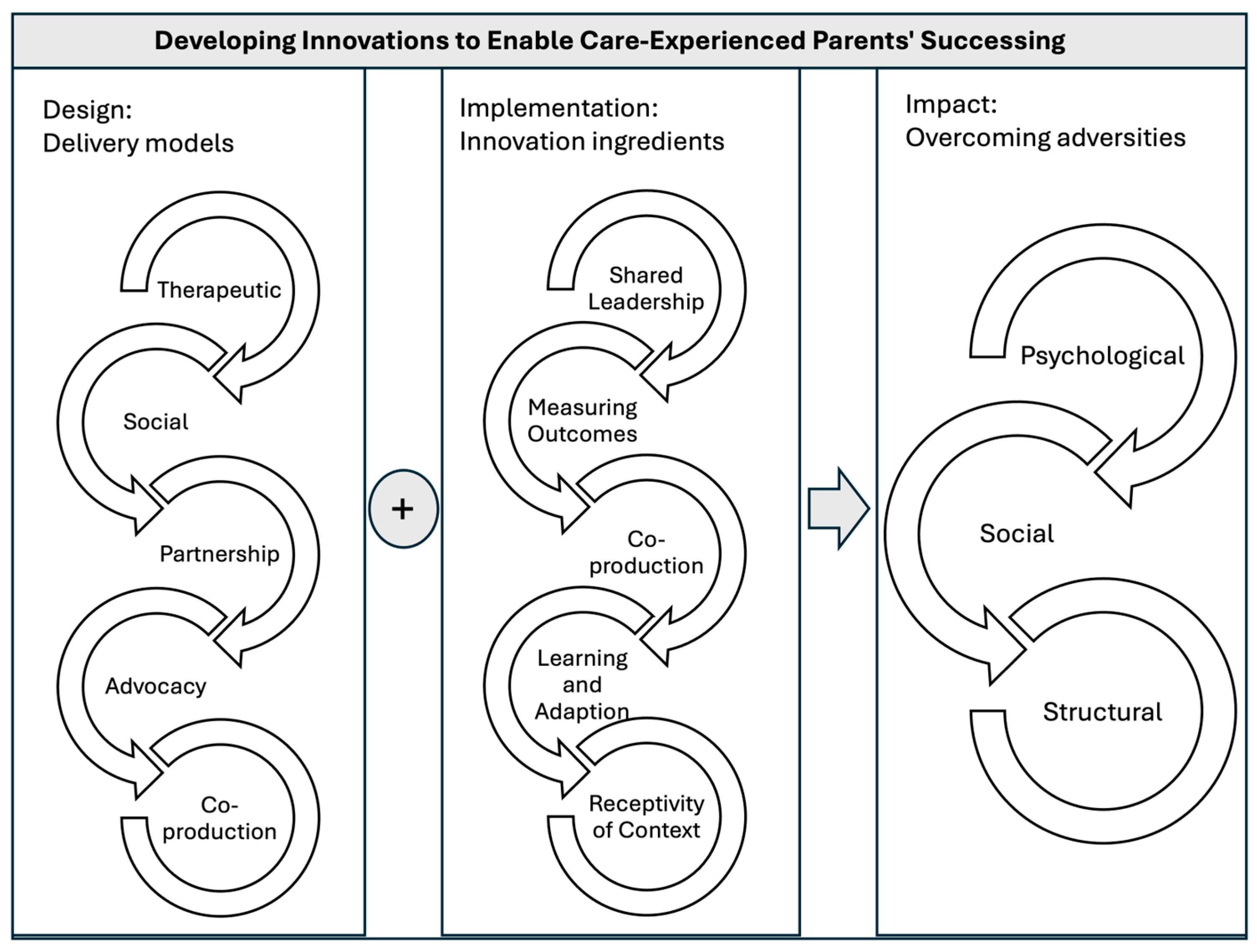
4.2. A Framework to Guide the Development of Innovations for Care-Experienced Parents

Our review has contributed understanding to enable care-experienced parents’ successing. We have shown how care-experienced parents face multiple challenges that require innovative system-level solutions, with designs that attend to psychological/therapeutic, social and structural/advocacy elements, underpinned by a collaborative approach involving parents in co-production and professionals in partnership. Although attending to these design characteristics is necessary, this focus is not sufficient; a focus on the innovation journey and enabling ingredients across developing phases is needed to ensure effective implementation and thereby achieve impact for and with care-experienced parents.
To prompt reflection on what is required in the dynamic journeys of developing innovations to enable care-experienced parents’ successing, we have developed a process model. Figure 1 outlines the required focus on design characteristics, in relation to therapeutic, social, partnership, advocacy and co-production models of delivery and implementation processes, in relation to the ingredients of shared leadership, measuring outcomes, co-production, learning and adaption and receptivity of context (Currie et al., 2025; Lynch et al., 2024), to achieve the necessary positive system-level impact for care-experienced parents across psychological, social and structural domains.

4.3. Implications and Further Research

Our review builds on a focus on ‘organisation, implementation and delivery’ (Crowley, 2022, p. 8) and related advocacy to ‘improve implementation by providing actionable data and can assist others in planning to implement similar programs in the future’ (Dworsky et al., 2021, p. 153). Designed to be used to inform practice, we hope the review will be of value for members of research, policy and practice communities who are striving to create services and system change to address the inequalities experienced by care-experienced parents and their children and enable care-experienced parents’ successing.
The review highlighted the relative absence of academic research focused on service innovation for care-experienced parents, with just one investigation identified globally in one state of the USA (Dworsky et al., 2021). Further reviews should seek to identify additional studies globally, including comparative reviews with a specific focus on the Global South and national policy contexts. More empirical research is needed as services are developed in practice and sustained into later phases, with a focus on implementation and the broader innovation journey to develop understandings of how to design, develop, implement and sustain effective innovations to enable care-experienced parents’ successing.
As suggested by Dworsky et al. (2021), more detailed consideration of implementation challenges and solutions is valuable in research evaluations of service interventions for care-experienced parents. Implementation frameworks developed for child welfare and suggested by Dworsky et al. (2021) include focus on core implementation, organisation and systems-level factors (Fixsen et al., 2005); the interactive systems framework for dissemination and implementation (Wandersman et al., 2008); and a formative evaluation approach to identify factors that influence the progress and effectiveness of implementation efforts (Stetler et al., 2006).
More research is needed to explore, apply and evaluate the frameworks we have presented across diverse local and national contexts. This might include theoretical development of delivery models; investigation of outcomes and impact; exploring how delivery models can be most effectively integrated; and establishing which ingredients are more or less important at different stages of innovation maturity.
Specific lines of enquiry might look across the framework (Figure 1), such as to focus on outcome measurement in relation to (i) service output and quality in relation to the constituent delivery models and (ii) individual and system-level impacts in relation to the psychological, social and structural domains of adversities to leverage the system change required to enable parents’ successing more broadly and in the longer term.

4.4. Limitations

This was a small-scale narrative review, and further sources that had relevance could not be included within the project’s limited resource capacity. Of note, we recognise the absence of studies from the Global South as a key limitation; this restricts the generalisation of our review.

5. Conclusions and Recommendations

In this paper, we have reviewed the extant literature focused on the adversities experienced by care-experienced parents and required service responses that enable care-experienced parents’ successing, with a resilience systems and innovation perspective. We have outlined the potential value of applying a framework of service delivery comprising therapeutic, social, partnership, advocacy and co-production models and the broader framework of innovation ingredients comprising shared leadership, co-production, learning and adaption, outcome measurement and receptivity of context (Currie et al., 2025; Lynch et al., 2024, Table 1) to achieve positive systems-level impact. We recommend further research to extend the review, including empirical studies to pilot and develop the frameworks to enable care-experienced parents’ successing, across broader geographic and practice contexts.

Author Contributions

Conceptualisation, A.L. and G.C.; methodology, A.L. and R.O.; formal analysis, A.L.; writing—original draft preparation, A.L.; writing—review and editing, A.L., R.O. and G.C.; visualisation, A.L.; supervision, G.C.; funding acquisition, G.C. All authors have read and agreed to the published version of the manuscript.

Funding

This research was funded by the National Institute for Health and Care Research (NIHR) Applied Research Collaboration (ARC) West Midlands, grant number NIHR200165.

Institutional Review Board Statement

Not applicable.

Informed Consent Statement

Not applicable.

Data Availability Statement

Data sharing is not applicable. No new data were created or analyzed in this study.

Acknowledgments

The contributions of the seven professionals who participated in the literature review workshop are gratefully acknowledged.

Conflicts of Interest

The authors declare no conflicts of interest. The funders had no role in the design of the study; in the collection, analyses or interpretation of data; in the writing of the manuscript; or in the decision to publish the results.

References

  1. Armitt, H. A., Attwell, L., Kingsley, E. N., White, P. C. L., Woolley, K., Garside, M., Green, N., & Coventry, P. A. (2024). Reflections and practical tips from co-producing an intervention with neurodiverse children, their families, and professional stakeholders. Humanities and Social Sciences Communications, 11, 813. [Google Scholar] [CrossRef]
  2. Barnardo’s. (2022). Care-experienced parents unite for change peer researchers’ project exploring the experience of becoming a parent. Available online: https://www.barnardos.org.uk/sites/default/files/uploads/Care%20Experienced%20Parenthood%20Report.pdf (accessed on 1 July 2025).
  3. Bernstein, V. J., & Edwards, R. C. (2012). Supporting early childhood practitioners through relationship-based, reflective supervision. NHSA Dialog, 15(3), 286–301. [Google Scholar] [CrossRef]
  4. Birmingham and Solihull Integrated Care System. (n.d.). Support for care experienced parents. Available online: https://www.birminghamsolihullics.org.uk/our-initiatives/local-maternity-and-neonatal-system/support-care-experienced-parents (accessed on 1 July 2025).
  5. Boss, P. (2010). The trauma and complicated grief of ambiguous loss. Pastoral Psychology, 59(2), 137–145. [Google Scholar] [CrossRef]
  6. Bowlby, J. (1982). Attachment and loss: Vol. 1. attachment. Basic. (Original work published 1969). [Google Scholar]
  7. Brown, L. (2021). Managing evidence and cultural adaptation in the international transfer of innovative social work models. International Social Work, 64(2), 175–186. [Google Scholar] [CrossRef]
  8. Buzan, T. (2010). The mind map book. BBC. [Google Scholar]
  9. Campie, P. E., Pakstis, A., Flynn, K., & McDermott, K. (2015). Developing a coherent approach to youth well-being in the fields of child welfare, juvenile justice, education, and health: A systematic literature review. Family in Society: The Journal of Contemporary Social Services, 96(3), 175–184. [Google Scholar] [CrossRef]
  10. Cresswell, C. (2019). (Re)Displaying family: Relational agency of care-experienced young people embarking on parenthood. In L. Murray, L. McDonnell, T. Hinton-Smith, N. Ferreira, & K. Walsh (Eds.), Families in motion: Ebbing and flowing through space and time (pp. 233–248). Emerald Publishing Limited. [Google Scholar] [CrossRef]
  11. Crowley, A. (2022). Project unity mid-term review. Available online: https://nyas.s3.eu-west-1.amazonaws.com/GetSupport/SupportInWales/Documents/NYAS-Project-Unity-MidTerm-Review-Jan-2022_Caitlin%20Evans%20(2)%20(1).pdf (accessed on 1 July 2025).
  12. Currie, G., Lynch, A., Swan, J., Alderson, H., Friel, S., Harrop, C., Johnson, R., Kerridge, G., Smart, D., McGovern, R., & Munro, E. (2025). How to extend pilot innovation in public services: A case of children’s social care innovation. Public Administration, 103(2), 357–375. [Google Scholar] [CrossRef]
  13. Dandy, E., Knibbs, J., & Gilbey, F. (2020). ‘Mad, sad and bad’ to ‘Dad’: Care-experienced men’s experiences of fatherhood. Adoption & Fostering, 44(3), 285–300. [Google Scholar] [CrossRef]
  14. Ditzen, B., & Heinrichs, M. (2014). Psychobiology of social support: The social dimension of stress buffering. Restorative Neurology and Neuroscience, 32(1), 149–162. [Google Scholar] [CrossRef]
  15. Dixon, J., Ward, J., & Blower, S. (2019). “They sat and actually listened to what we think about the care system”: The use of participation, consultation, peer research and co-production to raise the voices of young people in and leaving care in England. Child Care in Practice, 25(1), 6–21. [Google Scholar] [CrossRef]
  16. Doebler, S., Bailey, G., Broadhurst, K., Roberts, L., Wood, S., Cowley, L., North, L., & Griffiths, L. (2024). Care experienced mothers and their children in care in Wales. Centre for Child and Family Justice Research (CfJ), Lancaster University. Available online: https://eprints.lancs.ac.uk/id/eprint/214578/12/CFJ-Care_experienced_mothers_and_their_children_in_care_in_Wales_report_-FINAL_13_Feb_2024_.pdf (accessed on 1 July 2025).
  17. Dworsky, A., Gitlow, E. R., & Ethier, K. (2021). Bridging the divide between child welfare and home visiting systems to address the needs of pregnant and parenting youth in care. Social Service Review, 95(1), 110–164. [Google Scholar] [CrossRef]
  18. East Sussex Safeguarding Children Partnership. (2024). New care leavers maternity pathway. Available online: https://www.esscp.org.uk/new-care-leavers-maternity-pathway/ (accessed on 1 July 2025).
  19. Edgar, D., Moroney, T., Middleton, R., & Wilson, V. (2024). Clinical supervision, a reflective intervention to support new graduate nurses and midwives enhance their person-centredness: Qualitative evaluation. Contemporary Nurse, 60(6), 645–658. [Google Scholar] [CrossRef]
  20. Emsley, E., Smith, J., Martin, D., & Lewis, N. V. (2022). Trauma-informed care in the UK: Where are we? A qualitative study of health policies and professional perspectives. BMC Health Services Research, 22, 1164. [Google Scholar] [CrossRef]
  21. Ethier, K. (2022). Relationships to self, baby, others, and system: A narrative analysis of the transition to parenthood for young mothers in foster care. Child and Adolescent Social Work Journal, 39, 711–734. [Google Scholar] [CrossRef]
  22. Fitzpatrick, C., Hunter, K., Shaw, J., & Staines, J. (2024). Confronting intergenerational harm: Care experience, motherhood and criminal justice involvement. The British Journal of Criminology, 64(2), 257–274. [Google Scholar] [CrossRef]
  23. Fitzsimons, E., Parsons, S., & Schoon, I. (2025). The OHC penalty in the UK: Maternal experience and child development. Longitudinal and Life Course Studies, 16(1), 45–74. [Google Scholar] [CrossRef]
  24. Fixsen, D., Naoom, S., Blase, K., Friedman, R., & Wallace, F. (2005). Implementation research: A synthesis of the literature. Louis de la Parte Florida Mental Health Institute, University of Sout Florida. Available online: https://fpg.unc.edu/sites/fpg.unc.edu/files/resource-files/NIRN-MonographFull-01-2005.pdf (accessed on 1 July 2025).
  25. Gilkerson, L., Hofherr, J., Heffron, M. C., Murphy Sims, J., Jalowiec, B., Bromberg, S. R., & Paul, J. J. (2012). Implementing the fussy baby network [R] approach. Zero to Three, 33(2), 59–65. [Google Scholar]
  26. Gill, A., Page, S., & Hairston, M. (2023). Communities of support for care-experienced mothers. British Journal of Social Work, 53, 1775–1783. [Google Scholar] [CrossRef]
  27. Glasby, J. (2017). Partnership working in health and social care. In Understanding health and social care. Policy Press. [Google Scholar] [CrossRef]
  28. Greenhalgh, T., Thorne, S., & Malterud, K. (2018). Time to challenge the spurious hierarchy of systematic over narrative reviews? European Journal of Clinical Investigation, 48(6), e12931. [Google Scholar] [CrossRef]
  29. Holmes, L., Neagu, M., Sanders-Ellis, D., & Harrison, N. (2020). Lifelong Links Evaluation report. Department for Education. Available online: https://assets.publishing.service.gov.uk/media/60104f74d3bf7f05c3182253/Lifelong_Links_evaluation_report.pdf (accessed on 1 July 2025).
  30. Huo, Y., Couzner, L., Windsor, T., Laver, K., Dissanayaka, N. N., & Cations, M. (2023). Barriers and enablers for the implementation of trauma-informed care in healthcare settings: A systematic review. Implement Science Communications, 4, 49. [Google Scholar] [CrossRef]
  31. Knight, C., & Gitterman, A. (2019). Ambiguous loss and its disenfranchisement: The need for social work intervention. Families in Society: The Journal of Contemporary Social Services, 100(2), 164–173. [Google Scholar] [CrossRef]
  32. Krutzinna, J. (2021). Breaking the Cycle: Solidarity with care-leaver mothers. Journal of Diversity and Gender Studies, 7(2), 82–92. [Google Scholar] [CrossRef]
  33. Lefevre, M., Hampson, M., & Goldsmith, C. (2023). Towards a synthesised directional map of the stages of innovation in children’s social care. The British Journal of Social Work, 53(5), 2478–2498. [Google Scholar] [CrossRef]
  34. Levenson, J. (2017). Trauma-informed social work practice. Social Work, 62(2), 105–113. [Google Scholar] [CrossRef]
  35. Local Government Association. (2023). Ohana: Building a new community for care experienced young parents. Available online: https://www.local.gov.uk/case-studies/ohana-building-new-community-care-experienced-young-parents (accessed on 1 July 2025).
  36. Lynch, A., Mohamoud, J., Munro, E. M., & Currie, C. (2024). Exploring innovation in transitions national house project case study final report. Available online: https://thehouseproject.org/Media/Reports/EXITNHPFINALREPORTJune24.pdf (accessed on 1 July 2025).
  37. Martikke, S., Cumbers, H., Cox, N., Webb, L., Gedzielewski, E., & Duale, M. (2019). Building bridges into the community: Social capital in a volunteering project for care leavers. Children & Society, 33(2), 111–125. [Google Scholar] [CrossRef]
  38. Matte-Landry, A., Lemire-Harvey, A., de Serres-Lafontaine, A., & Fournier, V. (2025). Trauma-informed care as a promising avenue for supporting the transition to adulthood among trauma-exposed youth: A scoping review. Trauma Care, 5(2), 7. [Google Scholar] [CrossRef]
  39. Mauri, D. (2024). Constructing the ‘zero family’: Breaking the intergenerational transmission of maltreatment from the perspective of care-experienced parents. Child Abuse & Neglect, 153, 106855. [Google Scholar] [CrossRef]
  40. McGovern, R., Balogun-Katung, A., Artis, B., Alderson, H., Brown, E., Diggle, T., Lingam, R., McArdle, P., Rankin, J., Thomason, P., & Kaner, E. (2024). Co-producing an intervention to prevent mental health problems in children and young people in contact with child welfare services. BMC Public Health, 24, 2276. [Google Scholar] [CrossRef]
  41. Mupaku, W. M., van Breda, A. D., & Kelly, B. (2021). Transitioning to adulthood from residential childcare during COVID-19: Experiences of young people with intellectual disabilities and/or autism spectrum disorder in South Africa. British Journal of Learning Disabilities, 49(3), 341–351. [Google Scholar] [CrossRef]
  42. Parsons, S., Fitzsimons, E., & Schoon, I. (2023). Intergenerational transmission of educational disadvantage: Education progression of children of care leavers compared to a general population sample. British Educational Research Journal, 49, 875–899. [Google Scholar] [CrossRef]
  43. Parsons, S., & Schoon, I. (2022). Does the trauma associated with out-of-home care transmit across generations? Evidence from the 1970 British Cohort Study during a major health pandemic. BMJ Open, 12(4), e056736. [Google Scholar] [CrossRef] [PubMed] [PubMed Central]
  44. Prendergast, L., Davies, C., Seddon, D., Hartfiel, N., & Edwards, R. T. (2024). Barriers and enablers to care-leavers engagement with multi-agency support: A scoping review. Children and Youth Services Review, 159, 107501. [Google Scholar] [CrossRef]
  45. Prévost-Lemire, M., Paquette, G., & Tougas, A.-M. (2024). Navigating uncharted waters: Complex trauma-related relational disruptions among young mothers formerly in residential care. Traumatology. [Google Scholar] [CrossRef]
  46. Purtell, J., Mendes, P., & Saunders, B. J. (2020). Care leavers, ambiguous loss and early parenting: Explaining high rates of pregnancy and parenting amongst young people transitioning from out-of-home care. Children Australia, 45(4), 2251. [Google Scholar] [CrossRef]
  47. Purtell, J., Mendes, P., & Saunders, B. J. (2021). Where is the village? Care leaver early parenting, social isolation and surveillance bias. International Journal of Child Maltreat, 4(3), 349–371. [Google Scholar] [CrossRef] [PubMed] [PubMed Central]
  48. Purtell, J., Mendes, P., Saunders, B. J., & Baidawi, S. (2022). Healing trauma and loss and increasing social connections: Transitions from care and early parenting. Child and Adolescent Social Work Journal, 39, 735–747. [Google Scholar] [CrossRef]
  49. Purtell, J., & Morris, S. (2025). Care leavers into parenthood: Support needs and effective practice approaches through transitions from care. Australian Journal of Social Issues, 60, 747–756. [Google Scholar] [CrossRef]
  50. Ravalier, J. M., Wegrzynek, P., Mitchell, A., McGowan, J., Mcfadden, P., & Bald, C. (2023). A rapid review of reflective supervision in social work. The British Journal of Social Work, 53(I4), 1945–1962. [Google Scholar] [CrossRef]
  51. Rees Foundation. (n.d.). Start for life. Available online: https://www.reesfoundation.org/startforlife.html (accessed on 1 July 2025).
  52. Refaeli, T., Zeira, A., & Benbenishty, R. (2022). Ten years later: Satisfaction with intimate relationships and parenthood of young people aging out of residential care. Child Abuse and Neglect, 129, 105635. [Google Scholar] [CrossRef]
  53. Roberts, L. (2021). The children of looked after children: Outcomes, experiences and ensuring meaningful support to young parents in and leaving care. Bristol University Press. [Google Scholar] [CrossRef]
  54. Roberts, L., Maxwell, N., & Elliott, M. (2019). When young people in and leaving state care become parents: What happens and why? Children and Youth Services Review, 104, 104387. [Google Scholar] [CrossRef]
  55. Roesch-Marsh, A., & Edmond, R. (2021). Care experience and friendship: Theory and international evidence to improve practice and future research. The British Journal of Social Work, 51(1), 132–149. [Google Scholar] [CrossRef]
  56. Samani, A., & Psouni, E. (2024). Playing with the child within: Early parenthood experiences of parents who were out-of-home placed during childhood. Children and Youth Services Review, 160, 107573. [Google Scholar] [CrossRef]
  57. Sebba, J., Berridge, D., Luke, N., Fletcher, J., Bell, K., Strand, S., Thomas, S., Sinclair, I., & O’Higgins, A. (2015). The educational progress of looked after children in England: Linking care and educational data. Nuffield Foundation. [Google Scholar]
  58. Stein, M. (2006). Research review: Young people leaving care. Child & Family Social Work, 11(3), 273–279. [Google Scholar] [CrossRef]
  59. Stetler, C., Legro, M., Rycroft-Malone, J., Wallace, C., Bowman, C., Guihan, M., Hagedorn, H., Kimmel, B., Sharp, N., & Smith, J. (2006). Role of formative evaluation in implementation of research and the QUERI experience. Journal of General Internal Medicine, 21(Suppl. S2), S1–S8. [Google Scholar] [CrossRef]
  60. Strahl, B., van Breda, A. D. P., Mann-Feder, V., & Schröer, W. (2021). A multinational comparison of care-leaving policy and legislation. Journal of International and Comparative Social Policy, 37(1), 34–49. [Google Scholar] [CrossRef]
  61. Taussig, H., & Roberts, L. (2022). Early parenthood for males and females with foster care experience: An exploratory study of predictive factors at entry to care during preadolescence. Child and Adolescent Social Work Journal, 39, 657–668. [Google Scholar] [CrossRef] [PubMed]
  62. Taylor, S. E. (2011). Social support: A review. In H. S. Friedman (Ed.), The Oxford handbook of health psychology (pp. 189–214). Oxford University Press. [Google Scholar] [CrossRef]
  63. Van Breda, A. D., Marx, P., & Kader, K. (2012). Journey into independent living: A grounded theory. University of Johannesburg and Girls & Boys Town South Africa. Available online: https://www.girlsandboystown.org.za/wp-content/uploads/2017/08/GBT-UJ-2012-Journey-Towards-Independent-Living.pdf (accessed on 1 July 2025).
  64. Van Breda, A. D., & Reuben, S. (2025). Theories used to explain care-leavers’ journey out of care: A scoping review. PLoS ONE, 20(6), E0325776. [Google Scholar] [CrossRef]
  65. Van de Ven, A., Douglas, P., & Raghu, G. (2008). The innovation journey. Oxford University Press. [Google Scholar]
  66. Wandersman, A., Duffy, J., Flaspohler, P., Noonan, R., Lubell, K., Stillman, L., Blachman, M., Dunville, R., & Saul, J. (2008). Bridging the Gap between Prevention Research and Practice: The Interactive Systems Framework for Dissemination and Implementation. American Journal of Community Psychology, 41, 171–181. [Google Scholar] [CrossRef]
  67. Warwickshire County Council. (2020). Warwickshire County Council win award for support provided to young people leaving care. Available online: https://www.warwickshire.gov.uk/news/article/1474/warwickshire-county-council-win-award-for-support-provided-to-young-people-leaving-care (accessed on 1 July 2025).
  68. Warwickshire County Council. (2024). A Warwickshire project to support care experienced parents goes from strength to strength. Available online: https://www.warwickshire.gov.uk/news/article/5608/a-warwickshire-project-to-support-care-experienced-parents-goes-from-strength-to-strength (accessed on 1 July 2025).
  69. Why Not Trust. (2023). The village: A year of listening, learning and creating. Available online: https://whynot-trust.uksouth01.umbraco.io/media/50rj3igm/the-village-annual-review.pdf (accessed on 1 July 2025).
  70. Why Not Trust. (2024). The village annual report 2023/24. Available online: https://whynottrust.org/media/scufumlc/the-village-annual-report-2024_160824.pdf (accessed on 1 July 2025).
Figure 1. Developing innovations to enable care-experienced parents’ successing: a framework to guide design, implementation and impact.
Youth 06 00004 g001
Table 1. Ingredients that support successful innovation (Currie et al., 2025) adapted for care-experienced parents.
IngredientDescription
Shared leadershipExtent to which accountability is appropriately located and responsibilities shared amongst stakeholders across roles and sector
Receptivity of context Extent to which the national and local context is receptive to the innovation, including alignment with priorities, approach to risk and value alignment
Co-production Extent to which care-experienced parents’ perspectives are included in shaping the innovation and how diverse and representative these views are
Learning and adaption Extent to which there is a focus on learning that informs development and adaption of the innovation
Outcome measurementExtent to which outcomes are defined, measured, monitored and reported, including in relation to business case, e.g., funder KPIs, cohort level outcomes, e.g., % engaged in education, employment or training and individual experiences and outcomes.
Table 2. Innovations for care-experienced parents delivered by health, social care and voluntary and community organisations.
Innovation TypeInnovation ExemplarDescription
Health (2)Locally developed midwifery peri-natal services in two regions of England, UK (Birmingham and Solihull Integrated Care System, n.d.; East Sussex Safeguarding Children Partnership, 2024)Trauma-informed service pathway to enhance engagement with, support to and experience of care-experienced mothers in the peri-natal and early post-natal periods
Social Care (2)Ohana, Hertfordshire, England, UK (LGA, 2023)Service to help parents build new and supportive relationships; offer ongoing practical and emotional support to parents and children, which aims to be akin to family support
Baby Box, Warwickshire, England, UK (WCC, 2020, 2024)Service to provide practical support to new care-experienced parents, including baby essentials and equipment
Voluntary and Community (4)Healthy Families America (HFA), Illinois, USA (Dworsky et al., 2021)Evidence-based home-visiting programme implemented specifically for care-experienced parents in 10 pilot programmes
Project Unity, Wales, UK (Crowley, 2022)Nationally available, locally based service across Wales, aiming to empower and improve the wellbeing of care-experienced mothers; address inequalities and provide cost saving to local authorities by reducing demand on services and preventing escalation of child protection proceedings
The Village, Scotland, UK (Why Not Trust, 2023, 2024)Nationally developed, largely online service (Phase 1), with locally based in-person provision (Phase 2) aiming to provide a village of social support to care-experienced parents across Scotland
Start for Life, Birmingham, England UK (Rees Foundation, n.d.)Service aiming to provide social and psychological support to care-experienced parents through delivery of specific groups and activities, including parents, whole family and fathers
Table 3. Delivery models: therapeutic; social; partnership; advocacy; co-production.
ModelCharacteristics
Therapeutic model (Birmingham and Solihull Integrated Care System, n.d.; Dworsky et al., 2021; East Sussex Safeguarding Children Partnership, 2024; Rees Foundation, n.d.)
  • Underpinned by psychological theories, including attachment and developmental trauma
  • Health, mental health and social work professionals (social workers, midwives and clinical psychologists) support parents to develop secure attachments and positive interactions with their child and to access support relating to experiences of anxiety and stress relating to parenting, such as difficult childhood experiences, fear and experiences relating to children being removed from their care
  • Service includes provision of reflective supervision and training for professionals to protect their emotional wellbeing and enhance their understanding of trauma-informed approaches
Social model (Crowley, 2022; Dworsky et al., 2021; LGA, 2023; Rees Foundation, n.d.; Why Not Trust, 2023, 2024)
  • Team members (practitioners, home visitors and volunteer champions) as ‘grandmothers’ and role models engage parents with a genuine, consistent, committed, tenacious, caring and compassionate approach
  • Offer information, advice and support relating to:
    Parenting, including child development and health and safety
    Finance, including managing entitlements and budgets
    Healthy relationships
    Wellbeing, including a focus on managing anxiety, understanding feelings, decreasing stress and recovering from experiences of trauma
  • Service supports parents to create peer and family networks through integration with existing community activities and services such as LifeLong Links (Holmes et al., 2020) and creating new groups for care-experienced parents to develop friendships such as peer cafes, peer support groups, coffee mornings, walks and talks, dads’ groups and online forums and specific baby groups such as baby yoga and baby massage
Partnership model
(Birmingham and Solihull Integrated Care System, n.d.; Crowley, 2022; East Sussex Safeguarding Children Partnership, 2024; Why Not Trust, 2023, 2024; WCC, 2024)
  • Leaders and managers develop partnerships to enhance access to services for care-experienced parents
  • Mapping services, delivering training and developing links for increasing referrals, delivering services and enhancing access to partner services
  • Partners include health (family nurses; midwives; health visitors), mental health (clinical psychologists) housing and homelessness services, children’s social care, education (early years and further education college), community centres and voluntary and community organisations
Advocacy model (Birmingham and Solihull Integrated Care System, n.d.; Crowley, 2022; East Sussex Safeguarding Children Partnership, 2024; Why Not Trust, 2023, 2024)
  • Project workers provide individual advocacy support and representation to develop parents’ social capital and help them navigate and access services related to financial entitlements; housing; education, training and employment, including development as peer mentors; domestic abuse services; and wellbeing and mental health services
  • Leaders engage in system advocacy at a national and local levels to enhance services for care-experienced parents by connecting with national organisations to influence and champion challenging and changing local pathways and policies, e.g., removing automatic referral to children’s services at peri-natal phase
Co-production model (Crowley, 2022; LGA, 2023; Why Not Trust, 2023, 2024; WCC, 2024)Opportunities are created for care-experienced parents to co-design and participate at:
  • Individual level: co-create individual support plans with project workers
  • Service level: co-develop service design; involved in recruitment of volunteers
  • System level: contribute to training to develop professional practice with care-experienced parents in the wider system
Table 4. Innovations by their constituent delivery models.
InnovationConstituent Delivery Models
The Village (Why Not Trust, 2023, 2024)Social: Evidence-informed social support (Barnardo’s, 2022; Ethier, 2022; Parsons et al., 2023 Roberts et al., 2019) through creating a supported community of care-experienced parents to provide informal and non-judgmental practical and emotional support with option for one-to-one support from project workers
Partnership: Developing local partnerships with health (family nurses and health visitors), housing and homelessness services, children’s social care; education (early years and further education college); community centres; and voluntary and community organisations (Home-Start; Women’s Aid; Your Voice)
Advocacy: Focus on development of social capital as a resilience factor to overcome structural disadvantage
HFA (Dworsky et al., 2021)Therapeutic: Reflective supervision and training in the attachment-informed approach of Facilitated Attuned Interactions (Gilkerson et al., 2012)
Social: Evidence-informed home-visiting programme by para-professional home visitors and doulas; aim to provide practical, emotional and social support, with a focus on the parent–child relationship and promoting parental integration with community groups
Project Unity (Crowley, 2022)Social: Practitioners provide support to mothers relating to advocacy and practical and emotional needs
Partnership: Local partnership with children’s social care, midwives and health visitors to identify potential parents to refer to the service
Advocacy: Focus on challenging and changing systemic disadvantage and discrimination through supporting mothers to access entitlements and navigate the system
Co-production: Mothers co-create individualised support plans
Ohana (LGA, 2023)Social: Parents access family-like support through a volunteer and peer approach delivery, e.g., facilitated peer cafes
Co-production: Parents co-designed the service, with opportunities to be involved in recruitment of volunteers
Peri-natal health innovations (Birmingham and Solihull Integrated Care System, n.d.; East Sussex Safeguarding Children Partnership, 2024)Therapeutic: Provision of training and supervision to enhance practitioners’ understandings of care-experienced parents’ needs; develop trauma-informed communication; and enhance parental engagement and provision of support
Partnership: Developed through partnerships within the Integrated Care System and NHS between midwives, clinical psychologists and children’s social care to develop a new pathway
Advocacy: Creating a new peri-natal pathway and removing automatic midwifery referral to children’s services to challenge and change parents’ experiences within the health and care system
Disclaimer/Publisher’s Note: The statements, opinions and data contained in all publications are solely those of the individual author(s) and contributor(s) and not of MDPI and/or the editor(s). MDPI and/or the editor(s) disclaim responsibility for any injury to people or property resulting from any ideas, methods, instructions or products referred to in the content.