


Abstract
Restorative Practices (RP) are increasingly adopted in U.S. pre-K-12 schools as an alternative to punishment, yet research less frequently examines student perspectives on this transition. This qualitative study centers alumni student voices in the implementation of RP at Riverdale High School (RHS), an urban-emergent high school, through semi-structured interviews with 13 alumni who attended before, during, and after RHS’s shift from punishment to RP. Using the Social Discipline Window (SDW) as a conceptual framework, the study explores students’ perceptions of their relationships with teachers and administrators. Findings indicate four distinct experiences in both disciplinary practices and relational dynamics: (1) punitive “To” experiences, where adults exerted expectations without support, (2) neglectful “Not” experiences, where students experienced neither expectations nor support, (3) permissive “For” experiences, where adults offered support without expectations, and (4) restorative “With” experiences, where students experienced high expectations and high support from adults. Some students, however, described harmful experiences unrepresented by the SDW, leading to the proposal of an Emergent Social Discipline Window, which includes “Against” experiences, representing situations where students experienced harm from adults. Findings underscore the need to prioritize student voices in RP implementation, ensuring students are centered in decision-making processes.
1. Introduction
Increasingly, pre-K-12 schools in the United States (U.S.) have begun implementing Restorative Practices (B. Morrison & Vaandering, 2012; Osher et al., 2023). Restorative Practices (RPs) represent a set of philosophies and practices that focus on preventing and repairing harm through centering people and relationships, rather than rules and punishment (Milner, 2020b; Winn, 2018; Zehr, 2002). Although the foundational principles of RP are rooted in global indigenous practices, in the U.S., organizations like the International Institute of Restorative Practices (IIRP) have popularized training programs and curricula aimed at facilitating schools’ transition from conventional punishment practices to RP (Eagle, 2001; Gregory & Evans, 2020).
Concurrently, scholarly research on the conceptualization, implementation, and evaluation of RP in U.S. schools is expanding (Anwar & Furey, 2020; Gregory & Kuan, 2015; Halman et al., 2022; McCluskey et al., 2008; B. Morrison & Vaandering, 2012). Much of this emerging research has focused on quantitative analyses of disciplinary data and qualitative studies exploring the perspectives of adults, such as school administrators, RP coordinators, and, to a lesser extent, teachers. While many studies have investigated RP in U.S. schools through the lens of disciplinary data and adult perceptions, fewer have examined students’ explanations and voices about their experiences in schools, making the shift from punitive measures to RP.
In this study, I center alumni student1 voices in a Restorative Practices implementation. Specifically, I highlight perspectives of 13 alumni students who attended Riverdale High School (RHS),2 a mid-size, urban-emergent high school,3 as it transitioned from punitive to Restorative practices (Milner, 2012). Using the Social Discipline Window (McCold & Wachtel, 2003) as a framework, which illustrates how authority figures interact with their constituents, I analyze alumni students’ perspectives on their relationships with teachers and administrators at RHS. Specifically, I ask: What do students say about relationships with adults in a school, Riverdale High School, transitioning from punitive to Restorative Practices? I found that the ways in which alumni described their interactions with adults at RHS revealed important insights into both traditional punishment and Restorative discipline.
Although this study is situated in a U.S. context, restorative practices in schools have developed and been evaluated across multiple countries. Research in Scotland and the wider UK documents school-level culture change and implementation challenges (e.g., McCluskey et al., 2008; Short et al., 2018). In England, the INCLUSIVE trial incorporated participatory action groups to support whole-school approaches (Warren et al., 2019). Work in Canada and Australia highlights tensions between policy uptake and relational enactment in classrooms (B. E. Morrison, 2007; B. Morrison & Vaandering, 2012; Vaandering, 2013). Together, this international scholarship underscores that the questions raised here—about relationships, accountability, and student voice—resonate beyond the U.S. and may inform comparative understandings of RP implementation.
2. Literature Review
A growing number of pre-K-12 schools in the U.S. and abroad have started to implement Restorative Practices (B. Morrison & Vaandering, 2012; Osher et al., 2023). Some of these schools have utilized teachings and trainings of IIRP (and their counterparts, Safer Saner Schools and the Community Service Foundation) as they endeavor to transition from punishment to discipline (B. E. Morrison, 2007; B. Morrison & Vaandering, 2012). IIRP, founded by Ted Wachtel, focuses on the philosophies and practices that help school communities enact restorative discipline. Before discussing Restorative Discipline in U.S. schools and current research on RP, I foreground conventional punishment practices in schools. Specifically, I discuss the emergence and impact of (1) Zero Tolerance Policies, (2) trends of Racially Disproportionate Punishment, and (3) the phenomena of the School-to-Prison Pipeline. I focus on these areas because, according to the literature, these are some of the important areas that are situated as problems Restorative Practices is poised to address (Halman et al., 2022; Stutzman & Mullet, 2014; Wachtel, 2013a).
2.1. Restorative Practices in Schools: A Global View
Beyond the U.S., schools in the UK and elsewhere have adopted restorative approaches with varied aims—from reducing exclusions to strengthening community and engagement. Studies in Scotland and the broader UK report perceived improvements in relationships alongside implementation constraints (McCluskey et al., 2008; Short et al., 2018; Standing et al., 2012). In England, participatory action groups within a whole-school change model show promise for embedding student and staff voice (Warren et al., 2019). Canadian and Australian scholarship emphasizes the centrality of values, culture, and relational practice in translating policy to classroom-level work (Cavanagh et al., 2014; B. Morrison & Vaandering, 2012; Vaandering, 2013). Importantly, this literature distinguishes discipline as a relational, educative process aimed at accountability and growth, versus punishment as a retributive, exclusionary reaction to rule violations (B. Morrison & Vaandering, 2012). This global evidence base provides a comparative backdrop for the present analysis, which focuses on how students themselves describe relationships and discipline during RP implementation.
2.2. Punishment Practices in Schools
Historically, U.S. schools have relied on punishment practices to maintain order (Osher et al., 2023). Punishment practices are based on exclusion, marginalization, and retribution (Milner, 2020b). Although schools frequently refer to these approaches as disciplinary practices, such terminology obscures a critical distinction between discipline as an educative, relational process and punishment as a reaction focused on compliance and exclusion. Punishment practices such as suspension and expulsion have disproportionately impacted racially minoritized students, who receive harsher and more frequent punishment than their white peers, contributing to what is widely known as the School-to-Prison Pipeline (Fabelo et al., 2011; Skiba & Losen, 2016).
These punishment practices are increasingly formalized through Zero Tolerance Policies, which typically mandate predetermined and exclusionary punishments for student behavior, limiting educator discretion. Emerging from federal and state policy contexts, including the Gun-Free Schools Act of 1994, Zero Tolerance Policies have become a dominant framework for school punishments in the United States (Kafka, 2011; Skiba & Knesting, 2014), and are examined in greater detail in the following section.
2.3. Zero Tolerance Policies
Zero Tolerance Policies mandate automatic suspension or expulsion for specific infractions (Wilf, 2012). These policies do not allow for a nuanced examination of the situation or the individual circumstances surrounding the incident, nor do they offer students the chance to stay in school and address the behavior constructively. Rather than considering the context of a student’s actions, the individuals involved, or the broader impact on the school environment, Zero Tolerance Policies remove discretion from school administrators and typically involve law enforcement (Hines-Datiri & Carter Andrews, 2020; Kang-Brown et al., 2013; Milner et al., 2019). This one-size-fits-all approach reinforces historically marginalizing practices by disproportionately punishing students of color, who face suspension and expulsion rates far higher than their white peers (Darling-Hammond & Ho, 2024), contributing to racially disproportionate punishment.
2.4. Racially Disproportionate Punishment
Racially disproportionate punishment occurs in U.S. schools as students of color, particularly Black, Latine, and Native American students, are far more likely to face suspension and expulsion than their white classmates (Gregory et al., 2010; Kupchik & Henry, 2022; Skiba & Losen, 2016). This punishment gap is stark: for example, in the 2015–2016 school year, Black students lost 103 school days per 100 students due to out-of-school suspensions, which is 82 more days than the 21 days lost by their white peers (Darling-Hammond & Ho, 2024). Furthermore, Black students often face more severe punishments than white students for similar infractions, highlighting persistent racial disparities in school punishment practices that shape the educational experiences of students of color (Gregory et al., 2010; Skiba & Losen, 2016) and contribute to phenomena such as the School-to-Prison Pipeline.
2.5. School-to-Prison Pipeline
The School-to-Prison Pipeline describes the link between punitive school practices and an increased likelihood of students becoming involved in the criminal system (Kim et al., 2010; Wald & Losen, 2003). Scholars have documented how punishment practices in K-12 schools—such as suspension and expulsion—often lead to greater interactions with law enforcement and a higher risk of future incarceration (Fine & Ruglis, 2009; Kim et al., 2010; Milner et al., 2019; Muñiz, 2021; Skiba & Losen, 2016).
Punitive measures like suspension and expulsion are often justified as necessary for maintaining order and preventing classroom disruptions. These practices, rooted in the idea of deterring misbehavior through exclusion, have become the primary method of discipline in many schools (Milner, 2020a; Kang-Brown et al., 2013). Despite the widespread use of such policies, there is no evidence supporting the idea that Zero Tolerance policies—often at the heart of these disciplinary practices—improve school behavior or outcomes. In fact, studies have found no connection between increased suspension and expulsion rates and reduced classroom disruptions (Skiba & Knesting, 2014).
Rather than improving school climates or learning conditions, Zero Tolerance policies are often ineffective and can be harmful (American Psychological Association Zero Tolerance Task Force, 2006; Noguera, 2003). In addition, research consistently shows that these exclusionary practices disproportionately negatively affect students of color (Arcia, 2006; Gregory et al., 2010) and contribute to a cycle that increases the likelihood of future involvement with the legal system (Muñiz, 2021; Skiba & Losen, 2016). Importantly, schools with higher suspension and expulsion rates do not demonstrate better academic outcomes compared to similar schools with more Restorative or inclusive approaches (Kang-Brown et al., 2013).
2.6. Restorative Discipline in Schools
Restorative Discipline in U.S. schools offers an alternative to conventional punishment practices. While punishment practices attempt to prevent rule-breaking through exclusion and marginalization, RP focuses on building community and repairing harm. According to Zehr (2002), Restorative Practices focus on the power of relationships, the centrality of community, and an imperative to repair harm. Below, I review these three interrelated aspects of RP: (1) Repairing harm, (2) Building community, and (3) Relationships. Then, I provide an overview of current research on RP, and I argue that student perspectives on RP have been notably sidelined in current research.
2.6.1. Repairing Harm
RP is an approach to repairing harm that prioritizes people and relationships rather than focusing on order and preventing rule-breaking (B. Morrison & Vaandering, 2012). Unlike traditional methods that aim to maintain order by punishing misconduct, RP views wrongdoing as a violation of individuals and their relationships. As such, it sees violations as creating obligations, particularly the obligation to repair the harm caused (Zehr, 2002). RP uses practices like formal conferences in schools to facilitate this repair. These conferences are structured meetings, led by a trained RP facilitator, where all parties involved in the harm come together to share their experiences, express how they were affected, and discuss what is needed to make amends and prevent future harm (Wachtel, 2013b). Unlike typical discipline policies, in which the victim, student, teacher, and parent have little involvement or input, RP is designed for students, teachers, and families to work with each other to build trust and to repair harm.
2.6.2. Building Community
Central to RP is a focus on the power of community. Specifically, RP maintains that every person in the community is important: each individual makes the community what it is (Zehr, 2002). Therefore, each individual has great power to both grow the community and to be involved in repairing harm when it occurs within the community (Wachtel, 2013a). In schools, RP often involves building and maintaining community through the practices of participating in circles. Community-building circles occur when participants—such as students and teachers—sit in a circle and use a “talking piece,” an object that signals whose turn it is to speak. These circles can involve activities like introductions, ice-breaker questions, games, brainstorming, or event planning (Lustick, 2021). While the specific format can vary, the core focus of community-building circles is ensuring that every voice is heard, reinforcing the idea that all participants contribute to shaping the community. The practice emphasizes equal opportunity for everyone to speak, fostering a sense of shared responsibility and belonging.
2.6.3. Relationships
Relationships are central to RP. In particular, RP contends that importance of people in positions of authority working with their constituents: The fundamental premise of Restorative Practices is that “human beings are happier, more cooperative and productive, and more likely to make positive changes in their behavior when those in positions of authority do things with them, rather than to them or for them” (Wachtel, 2005).
While typical punishment practices in U.S. schools involve adults acting in “to” relationships (wielding power over students), RP argues for the power of “with” relationships—where adults and students work together. This conception of relationships is central to the conceptual framework in this study; thus, I will elaborate on the importance of relationships and a framework to interpret them later in this piece.
2.6.4. Current Research
Restorative Practices (RP) are not a new concept; they are based on ancient and indigenous traditions from cultures around the world (Eagle, 2001). However, their implementation in schools and the research examining their effectiveness is a relatively recent and growing area of study (Gregory & Evans, 2020). Some early findings suggest that both students and teachers report positive experiences with RP (Garnett et al., 2022; Gregory et al., 2021; Lodi et al., 2021). In certain settings, the use of RP has been associated with a reduction in out-of-school suspensions (Goldys, 2016; Gregory & Evans, 2020; Rainbolt et al., 2019). However, in other contexts, the implementation of RP did not improve, and in some cases, actually worsened racially disproportionate discipline (Davison et al., 2021).
Research on the effectiveness of Restorative Practices (RP) has primarily focused on exclusionary discipline data (Mirsky, 2007, 2011) and the experiences of school administrators (Gregory et al., 2010; Lustick, 2017; Weaver & Swank, 2020; Vaandering, 2013), RP coordinators (Gregory et al., 2010), and teachers (Acosta et al., 2016; Bruhn, 2020; Lash, 2019; Lustick, 2017; Reimer, 2019; Short et al., 2018; Vaandering, 2013; Weaver & Swank, 2020; Warren et al., 2019). Additionally, research has included more peripheral perspectives from families (Cavanagh et al., 2014; McCluskey, 2010) and current students (Acosta et al., 2016; Lange, 2008; Lustick, 2017; McCluskey, 2010; Schumacher, 2014; Standing et al., 2012; Weaver & Swank, 2020). While many studies have studied the efficacy of Restorative Practices in U.S. schools through the perspectives of disciplinary data and the perceptions of adults, fewer have centered on student voices in RP. There are, however, some notable exceptions. For example, Winn (2011, 2018) has documented how student voices illuminate the role of restorative justice practices in classrooms and schools, highlighting how literacy, justice, and healing intersect. These studies show that youth perspectives are essential in understanding both the possibilities and limits of RP. My study builds on and extends this work by focusing specifically on alumni voices in the implementation of RP at a large urban high school.
3. Purposes and Significance of Study
The purposes of this study are twofold: first, to practice the foundational principles of restorative practices (RP) by prioritizing the voices of students, particularly those from racially marginalized groups in schools and society; and second, to contribute to the field of educational research methodology by recognizing students as critical, first-hand sources for understanding the implementation of RP. Centering student voices is essential, as they are the individuals most directly engaged in the school experience, yet often hold the least power and are paradoxically underrepresented in contemporary research. Additionally, the 13 alumni participants in this study identify as members of racial groups typically marginalized in school and society, suggesting that their perspectives are even less likely to be included in existing research compared to their white peers.
4. Conceptual Framework
The conceptual framework for this study draws on the Social Discipline Window, a tool ascribed to be foundational to Restorative Practices (McCold & Wachtel, 2003). Below, I detail the emergence of the Social Discipline Window before discussing how I operationalize this conceptual framework throughout the study.
4.1. Emergence of the Social Discipline Window
The Social Discipline Window, developed by McCold and Wachtel (2003), is based on the proposition of Australian criminologist John Braithwaite. Braithwaite argued that relying on punishment for social regulation is problematic because it focuses on shame, stigmatizes wrongdoers, and fails to change behavior (Braithwaite, 1989; D. Glaser, 1964). Braithwaite argues that community, rather than state systems, holds the power to establish social norms and enforce them through disapproval when a member violates these norms (1989). Braithwaite suggests that, just as crime is socially constructed, society also defines what constitutes positive and harmful behavior and therefore has the capacity to hold its members accountable through reintegrative shame. Unlike disintegrative shame, which can be counterproductive by stigmatizing offenders and isolating them from the community, Braithwaite’s concept of reintegrative shame involves community disapproval for unacceptable actions and the community seeking to reintegrate the offender back into the community of responsible citizens. Instead of labeling individuals through punitive measures, Braithwaite emphasizes community accountability through discipline, which is central to maintaining social order and preventing harm. His focus on community-based accountability, as opposed to rigid rules and punishment, forms a key foundation for Restorative Practices and is reflected in the Social Discipline Window.
The Social Discipline Window (SDW: Figure 1 below) is a window into relationships. The SDW visually depicts how people in positions of authority interact with others: either in a neglectful, punitive, permissive, or restorative way. The SDW is organized by a “Y axis” that represents “control” or high expectations. The “X axis” represents “support” or encouragement. If a person in a position of authority is not holding high expectations or supporting their constituents in achieving them, this relationship can be understood as “neglectful” (or by the preposition “not”). If a person in authority is holding high expectations but not supporting constituents in achieving them, this relationship can be understood as “punitive” (doing things “to” others). If a person in authority does not have high expectations but is very supportive, this relationship can be understood as “permissive” (doing things “for” others). To engage in a Restorative (doing things “with” others) relationship, a person in a position of authority holds high expectations and supports their constituents in achieving those high expectations.
Figure 1.
The Social Discipline Window (McCold & Wachtel, 2003).
In schools, punishment and discipline tend to be controlled by adults, whether they be teachers, deans, or principals. The SDW (McCold & Wachtel, 2003) provides a visual and analytic tool to understand adult-student relationships in schools as they pertain to social discipline. Specifically, the SDW provides a useful analytic tool for understanding adult-student relationships as punitive, neglectful, permissive, or Restorative.
4.2. Affordances and Limitations of the Social Discipline Window
Prior applications of the SDW to schooling point to both its communicative clarity and its analytic boundary conditions. In classroom and school studies, the window has helped educators reflect on how authority is exercised and experienced (e.g., McCluskey et al., 2008; B. Morrison & Vaandering, 2012), yet student accounts also show that quadrant boundaries can blur in practice (Reimer, 2019). Moreover, when relational dynamics include explicit adult-caused harm or intimidation, the SDW’s two-axis formulation (expectations × support) may be insufficient to represent those experiences.
There are both affordances and limitations to the SDW as a framework for analyzing adult-student relationships. One affordance of the SDW is that it provides a clear framework for analysis: the SDW provides a straightforward, visual way to categorize and analyze authority styles, making it easier for educators and practitioners to understand their approach to discipline. Specifically, the SDW may encourage educators to reflect on their discipline strategies and the balance of expectations and support they offer their students. This self-reflection can lead to more intentional, thoughtful approaches to discipline that promote student growth and development. Additionally, the SDW aligns with restorative practices principles by advocating for community-based accountability and reintegration.
While there are many affordances of the SDW, there are also limitations. While the SDW is a useful tool for categorizing approaches to adult-student relationships, it may oversimplify the complexities of discipline in real-world situations. Human behavior, especially in diverse school environments, may not always neatly fit into one of the four quadrants, making it difficult to apply the framework rigidly. Further, the SDW assumes the possibility of a significant change in mindset. Shifting from punitive or permissive approaches to a restorative one requires significant mindset shifts, both within schools and broader societal structures. This transformation can be challenging and time-consuming, particularly in environments that are entrenched in traditional punishment methods.
The SDW offers a useful conceptual tool for understanding the dynamics of adult-student relationships, encouraging a more restorative approach. While it has significant benefits, especially in providing a clear visual and promoting adult reflection and accountability, its limitations include the potential for oversimplification and challenges for implementation, particularly due to structural barriers in schools and society.
To be clear, while RP encompasses both disciplinary practices and relational approaches, I understand these as conceptually distinct but interrelated. Restorative discipline practices refer to responses to incidents aimed at repairing harm. Whereas restorative discipline refers to a mindset about discipline and provides guidance for responding to incidents, restorative relationships describe the ongoing, everyday climate of with interactions—high expectations paired with high support—that cultivate belonging, trust, and shared power both within and outside of disciplinary incidents (Wachtel, 2005, 2013a; Zehr, 2002). In this study, I analyze both restorative disciplinary practices and restorative relationships using the SDW, but I explicitly note whether student narratives reflect disciplinary practices or broader relational dynamics. This distinction avoids conflating the two while recognizing that restorative relationships provide the necessary trust for restorative discipline.
After sharing my positionality—how my identities impact my research—and my research methods, I will present findings from semi-structured interviews with thirteen alumni students. Then, using a conceptual framework of the SDW, I will discuss how students experienced their relationships with adults during the transition from punitive to RP at their school.
5. Positionality
I understand my positionality as not just a statement, but rather as something to be considered throughout every aspect of my research (Milner, 2007; Milner et al., 2024). I am a former teacher and RP coordinator at the school where I am studying. I have both an emic (insider) and an etic (outsider) perspective in this study (Given, 2008). This emic (I taught in the school for eight years and am aware of many of the experiences RHS staff may reference in their interviews) and etic (At the time of the study, I was a Ph.D. student and not officially employed in the school, although I was still connected to the school through providing professional development to RHS’s teachers) perspective affords me a unique lens to understand staff experiences at RHS.
Based on Milner’s (2007) Researcher Positionality framework, I understand a “seen” danger as a harmful outcome that arises directly from the choices made by the researcher. A “seen” danger in this study is my positive bias toward RP and RP implementation at RHS, since I am a proponent of RP and I was the RP coordinator at RHS during the time of the study. Furthermore, an “unseen” danger refers to a hidden or implicit harm that the researcher may not be aware of. An “unseen” danger in this study is the possibility for me to superimpose my own experience and perspectives over those of the alumni whom I interview.
Since my focus in this study is centering the experiences of RHS alumni students, I worked to mitigate these “seen” and “unseen” dangers by engaging in a grounded approach (B. Glaser & Strauss, 1967) to this study, engaging in open and axial coding (Strauss & Corbin, 2015) of interview data, and participating in member checks with RHS alumni (Erlandson et al., 1993) in order to get as close to representing alumni perspectives as possible.
An “unforeseen” danger, dangers that may arise in the future, could be that, during the semi-structured interviews, my commentary (in)validated student experiences—positively and/or negatively. While I wanted to be sure to position alumni as the experts in our interviews and validate their experiences (“mmhmm”), I utilized the Zoom tool of muting myself so that I could not verbally respond to alumni while they were sharing their stories. In addition, I focused on listening to understand—rather than to respond—to alumni by asking questions and listening, rather than reacting or responding to what alumni told me about their experiences with punishment and discipline at RHS.
6. Methodology
This study began with broad interviews of thirteen RHS alumni. During these semi-structured interviews, alumni students told me powerful stories about moments they experienced both discipline and punishment at RHS. While they told me these stories, I kept visualizing the SDW to make sense of how students were experiencing interactions with people in positions of authority at RHS. Since many of the students were already familiar with the SDW from their experiences with RP at RHS, I began asking questions about how they would map their experiences and stories onto the SDW. A majority (11 out of 13) of student stories mapped onto the SDW. Others (2 out of 13), however, did not “fit.” Sparked by this curiosity, I began exploring how to best represent student experiences with RP at RHS.
6.1. Research Question
Based on this curiosity, in this study, I explore the following research question: What do students say about relationships with adults in a school, Riverdale High School, transitioning from punitive to Restorative Practices?
6.2. Research Experience
Riverdale High School (pseudonym) is a large urban high school in the southeastern United States. RHS serves approximately 1200 students in grades 9–12. According to 2017–2018 data from the National Center for Education Statistics, nearly 80% of students identified as part of a minority group: 50% Hispanic, 20% Black, 20% white (this includes the school’s large population of students from northern Africa and Middle Eastern countries), and 5% Asian. Additionally, 85% of students qualify for free or reduced lunch (National Center for Education Statistics, 2021).4
6.3. Participants
6.3.1. Sampling
After securing IRB approval, I utilized purposive sampling (Guest et al., 2013) to recruit alumni student participants for this study. Purposive sampling involves intentionally choosing individuals who are considered to provide rich, relevant, and detailed information that contributes to a deeper understanding of the research topic (Patton, 2002). I sent emails and text messages with an overview of the study and invitation to participate to every alumni for whom I had contact information (approximately 100 people). Of those that responded to this communication, 13 RHS alumni consented and participated in an interview. I conducted one semi-structured Zoom interview (~45 min) with each of 13 RHS alumni, yielding 5.8 h of audio/video and 161 transcript pages. Interviews followed a phenomenological orientation to elicit lived experiences (Creswell, 2013; Lincoln & Guba, 1985; Rinaldo & Guhin, 2022). An IRB-approved guide ensured comparability while allowing conversational flow. Transcripts (Otter.ai, manually cleaned) and analytic memos were managed in NVivo.
After the interview, I wrote methodological, theoretical, and personal notes. For instance, during the first few interviews, I noted the recurrence of participants using language (“with,” “to,” “for,” “not”) that reflected the Social Discipline Window. I used Otter.ai for transcription. Otter.ai is a cloud-based transcription and collaboration tool that uses artificial intelligence (AI) to convert spoken language into text. I then sent the participant a thank-you note. After Otter.ai finished transcribing, I briefly edited the transcript. I frequently listened and read through the transcripts in the month between beginning and ending data collection in order to get “close” to the data.
6.3.2. Participant Demographics
I interviewed thirteen alumni who attended RHS between 2013 and 2020. Participants reported their self-identified ethnoracial identities and gender identities. To be consistent and person-centered, I use participants’ own terms (e.g., Black, Latine, Asian, Biracial, Kurdish) and report them as such. I use “Latine” as a gender-inclusive umbrella term. These identities matter because disproportionality in punishment is well-documented across U.S. systems and is differentially experienced by minoritized groups.
While the participants in the study were disproportionately female, these thirteen alumni are a racially representative sample of the greater population of RHS students. I include this demographic data because several participants refer to their racial and/or gender identities when discussing their experiences with adults at RHS. Additionally, while participants identified themselves in other ways (e.g., sexuality; immigration status), I choose to highlight their race and gender here because these are metrics by which research has demonstrated disproportionate punishment.
Recent national data shows that students in U.S. public schools lost over a million days of school in 2015–2016 due to out-of-school suspensions. Per 100 students enrolled, Black students lost 103 days of school—82 more days than the 21 days lost by their white peers. Based on these data, Black students were four times more likely to be suspended or expelled than their white classmates (Losen & Martinez, 2020). Additionally, Black students often receive harsher punishments than their white peers for similar offenses (Gregory et al., 2010; Skiba & Losen, 2016). Less research has been conducted to explore the punishment experiences of youth of other races. For example, research on Latin* (I use Latin* here as a gender-neutral term that signals a person who racially identifies as being of Latin descent) students has been less conclusive: Latin* students are overrepresented in school suspensions in some contexts (Skiba et al., 2011) and underrepresented in others (Anderson & Ritter, 2017). The stories of the alumni interviewed in this study are crucial for researchers and practitioners to understand how racially marginalized students—including Black, Latinx, Asian, and other students with minoritized racial identities—experience the implementation of RP.
Table 1 (below) shares the alumni youth with whom I talked in a semi-structured interview, along with their self-identified racial identities, gender identities, and any other identities they wished for me to include. Out of an abundance of caution and respect for the participants, I do not include any participant identifiers surrounding their sexuality or immigration status, as participants did not indicate that this identity impacted their experiences in the stories that I analyze in this study. Importantly, I note below which of the participants in this study also participated in the Restorative Student Leaders team that I facilitated when I taught at the school.
Table 1.
Study Participants.
6.4. Data Sources
The data source for this study is 13 semi-structured interviews with RHS alumni students. Semi-structured interviews are a type of qualitative research method where the interviewer follows a set of predetermined questions or topics but allows for flexibility in how these are asked and explored (Kvale & Brinkmann, 2015). I asked questions through a phenomenological approach to explore the “life worlds” of my participants as they related to their experiences at RHS (Rinaldo & Guhin, 2022). A phenomenological approach is a qualitative research methodology that focuses on understanding and describing the lived experiences of individuals from their own perspective (Creswell, 2013). Semi-structured interviews allow the researcher to “maintain some consistency over the concepts that are covered in each interview” while allowing for the timing and order of the questions to be more fluid and conversational (Strauss & Corbin, 2015; Kvale & Brinkmann, 2015). These semi-structured interviews were conducted on Zoom due to COVID quarantine restrictions in place in the spring of 2021. I conducted one, approximately 45-minute semi-structured interview with each participant. These interviews yielded 5.8 h of interview video data and 161 pages of transcript.
6.5. Data Analysis
I used constructivist grounded analytic techniques (line-by-line coding, constant comparison) in a reflexive thematic analysis (Charmaz, 2014), treating the Social Discipline Window as a sensitizing concept rather than a fixed coding frame. Phase 1 open coding produced 42 inductive codes derived from student talk. In Phase 2, I conducted axial/thematic clustering; here, the SDW informed category naming (“To/For/Not/With”) without dictating inclusion. Member checks occurred after interviews to test the validity of mappings to the SDW. Member checks refer to a process in which the researcher shares their findings, interpretations, or raw data (such as interview transcripts or field notes) with participants to ensure that the researcher’s understanding of the participants’ experiences is accurate and reflective of their perspectives. In this study, I engaged in post-analysis member checks with participants (Erlandson et al., 1993). Finally, I utilized open and axial coding (Strauss & Corbin, 2015) on NVivo. Open coding refers to the process of reading through data line-by-line to assign labels or “codes” to information that appeared significant (Charmaz, 2014). Axial coding refers to the process of identifying patterns and building a deeper understanding of the central themes emerging from the data (Strauss & Corbin, 2015; Charmaz, 2014).
6.5.1. Phase One
After uploading interview transcripts in NVivo, I engaged in two phases of coding. In order to do this research with participants as much as possible, I first utilized line-by-line thematic analysis in open coding through a constant-comparative method (Strauss & Corbin, 2015). A constant-comparative method involves continuously comparing data (e.g., as interview transcripts) to identify patterns, themes, or categories. Using a constant-comparative method helped me stay close to the data and follow the narratives presented to me by my participants, rather than superimpose my understanding of themes or a storyline on them (although, to some extent, researcher biases always impact data interpretation). Open coding led to 42 thematic categories.
6.5.2. Phase Two
In phase two, I engaged in axial coding to understand the relationship between thematic categories. For instance, initial codes such as ‘not being heard,’ ‘admin making decisions,’ and ‘student-led but controlled’ were later collapsed into the broader axial code of ‘For experiences.’ In this way, the 42 codes were distilled into four analytic categories aligned with the SDW. Through axial coding, I distilled the 42 original categories into 4: “with” experiences, “to” experiences, “not” experiences, and “for” experiences.
7. Findings: Alumni Describe Relationships with Adults as RHS
Using a conceptual framework of the SDW, I utilized open and axial coding to understand experiences where alumni students experienced people in positions of authority performing things to, for, not, and with them. Axial coding led to an understanding of nine out of the thirteen alumni experiencing “to” experiences, “for” experiences, “not” experiences, or “with” experiences with adults at RHS, but two students’ stories (Jake and Louie) did not map onto the SDW, and two students (Consuelo and Marley) did not describe relationships with adults at RHS. I use the term ‘experiences’ not to indicate separate school locations, but rather to describe distinct relational contexts or interactional experiences between students and adults (e.g., ‘To’ experiences, ‘With’ experiences). Below, I expand on four themes: (1) “To” experiences, (2) “Not” experiences, (3) “For” experiences, and (4) “With” experiences that emerged from interviews with nine out of the thirteen students. Then, I share the two stories that did not map onto the SDW.
7.1. “To” Experiences: Alumni Stories of Punitive Disciplinary Incidents at RHS
Three alumni students, Oli, Irene, and Lilly, told me stories about times people in positions of authority did things to them at RHS. Alumni students described “To” experiences as experiences when they did not feel listened to by those in authority and/or received exclusionary punishment.
Oli attended RHS during its first year of RP implementation with the Freshman Academy. Oli described an experience where she received a three-day Out-of-School Suspension for smelling like marijuana. Oli indicated that she had not smoked herself, but a friend she had driven to school had insisted upon smoking in the car. She describes how the principal suspended her for three days for smelling like marijuana—even though a finger swab (to verify exposure to marijuana) or other verification measures were never used.
Oli: The principal got me. He said “yeah, I’m gonna suspend you for two days. This and that. You can’t be doing this.” Did they try to do the finger swab thing for the? No, they didn’t even… they didn’t even do that to me. They didn’t even do that to me. They did not do the finger swab did not check me, they did not do anything. Literally. They just sent me home. They didn’t even try to… like to figure out what was the cause. I just smelled like it and I had to go home. That was a… they didn’t try to take me and search me… they didn’t bring no dogs. I would be fine if they brought the dog because I didn’t have anything on me. I did not touch the blood at all. So my fingers were straight. My eyes were clear as day like I was perfectly fine. I just smelled like it: “no, go home for three days.” I went home for three days.
Oli: Okay, so whenever I say that they did something to the kids, it would be that, that weed scenario that I smell like shade dank, and, you know, he just, like, sent me off.
Oli found the experience of being suspended for smelling like marijuana to be a “To” experience because she was “sent off” without going through any verification measures for actually being under the influence of marijuana, and “They didn’t even try to… like to figure out what was the cause.” Oli experienced exclusionary discipline for smelling like marijuana, even though she maintained that she herself had not smoked. She was not given a chance to explain or to prove that she was not high. This can be understood as a “To” experience because she experienced the administration holding high expectations (students should not come to school high), but she did not experience any support (a chance to explain, prove she was not high, and so forth).
Irene attended RHS from 2013–2017. During her sophomore year (2015), Irene was told by a dean that she could not wear a shirt because it was “too low-cut.” Irene told me that she tried to explain to the administrator that she was wearing the required uniform for her school’s Mariachi performance, but that the administrator would not listen. Irene told me, “I had a voice and I was trying to use it, but she wasn’t interested in it.” Irene and I, collaborating during the interview, decided that this experience was represented by “to” because the dean had high expectations for Irene’s dress code, but had low support in understanding the situation or helping Irene find a way to comply with the dress code while also wearing her required mariachi uniform.
Lilly, who also attended RHS from 2013–2017, including during RHS’s first year of RP implementation, told me about a time that principals cancelled all senior activities (typically including a cookout, games, a senior breakfast, and a senior walk with cap and gown) because of fighting. Lilly found this experience to be a “to” experience because the principals were punishing students by keeping the entire senior class from participating in traditional graduation activities. Lilly told me, “If they had allowed that one student to calm down first, then this wouldn’t have happened.” Notably, this experience occurred in 2017, the first year RHS implemented RP as a whole school and funded a Restorative Room with a full-time RP specialist—whose job it was to help students de-escalate and resolve conflict restoratively.
7.2. “Not” Experiences: Alumni Stories of Neglectful Disciplinary Responses at RHS
One alumni student told a story of a time that people in positions of authority were neglectful to her, represented by “not” experiences. Ase attended RHS from 2016–2020. Ase told me about a time during her senior year (2020) when she shared concerns about how other students were treating her in preparation for International Day with three adults. Ase told me that, while the adults listened to her concerns, “no one did anything.” Ase and I found this to map onto neglectful (or “not”), because Ase did not experience expectations that she could be involved in remedying this conflict, or support to help her do so.
7.3. “For” Experiences: Alumni Stories of Relational Practices at RHS
Two alumni students, Francisca and Alethea, talked about times people in positions of authority did things for them at RHS. These alumni students describe “For” experiences as times administration and/or teachers did things without involving students, even when they ostensibly were attempting to be helpful.
Francisca, who attended RHS from 2013–2017, talked about how administration and teachers might listen to her ideas, but they would not involve her in the process of carrying them out:
Francisca: And, you know, being class president, I was trying to do all these things for my class and allow my class to have fun and let their voice be heard. But at the same time, you know, working with the principal at the time… well, he’s still the same one… I just felt like a lot of the time, I didn’t have the freedom to make decisions: I would come up with proposals and they just be like, “no,” or they’d be like, “Oh, we can look into it.” Yes, you know, it was a lot of the times when the admin had a lot of control and made decisions for students that I felt like, you should allow your students to make them and those are things you know, kind of like events that we were coordinating our pep rallies or you know, little things, fundraisers here and there that we wanted to do, or International Day, you know, like all these things that Riverdale is known for, I felt like a lot of the times, they were student-led, but a lot of the decisions that were made on the backside of it were from admin and teachers.
And, you know, I have such a great relationship with Mrs. Bud because she kind of inspired and allowed her students involved in SGA and International Day to be led by students and [she] gave us that feeling of this is yours, you handle it, you control it, you do it yourself.
And that’s why I think that International Day was such a big thing at Riverdale because students felt like that was their time to shine, as opposed to, you know, any other time where students kind of felt neglected or unheard or ignored. Because they didn’t feel like those things were happening for them, or they didn’t have authority over it.
Francisca described her experiences as class president where she would “try to do all these things for her class and allow my class to have fun and let their voice be heard,” but that she felt that she “didn’t have the freedom to make decisions” because even though activities appeared to be “student-led,” a “lot of the decisions that were made on the backside of it were from admin and teachers.” This experience can be understood as a “For” experience because, even though administration and teachers were ostensibly trying to help students (high support), they were taking student input and making decisions without involving students in the process (low expectations). For students like Francisca, these experiences were particularly frustrating because they were performed under the facade of “student voice” or “student leadership,” but administration and teachers were really the ones with the power to make decisions.
Similarly, Alethea told me of a time during her junior year (2015) when she walked out of a class because a long-term substitute teacher was using a whistle. Alethea told her counselor about the problem, and the counselor told Alethea that she would “take care of it,” but Alethea was not included in the process or any communication about a resolution. Alethea told me, “[the counselor] was very good at listening to my concerns, but she wasn’t very good at telling me what the next steps were, or telling me how this fits into the process of fixing this. It was more of like an empty void to communicate to and there wasn’t really a ‘okay now that we know the problem, how can we fix it?’ type dialogue. And I think I would have liked more of that.” Alethea found this “empty void of communication” frustrating, and we discussed how this experience was represented by a “for” experience because, while the counselor ostensibly had intentions of supporting Alethea by resolving the problem, she did not have expectations that Alethea could be involved with the problem-solving process or communication about the outcome.
7.4. “With” Experiences: Alumni Stories of Restorative Discipline and Restorative Relationships at RHS
Six alumni students, Oli, Veronica, Irene, Eustace, Francisca, and Kevin, talked positively about experiences when people in positions of authority did things with them at RHS. These alumni students describe “With” experiences as moments when they felt like administration, teachers, and/or students were able to work together and share power.
For example, Oli told me about a time during her freshman year when she was kicked out of class and sent to the dean’s office. When reflecting on this experience, Oli said, “[the dean] listened to me. He connected with me.” Oli related how the dean listened to her “side of the story” and helped her “think of ways to resolve it.” Later, she added, “I could tell he cared about me.” Oli and I found that this experience mapped onto a “with” experience because the dean held high expectations that Oli could participate in class, and he supported her in doing so.
Veronica, Irene, and Eustace each told me about being part of a student-led protest where RHS students walked out of school, held up signs, and chanted against school shootings. When reflecting on this moment in his semi-structured interview, Eustace said, “We had one thing in common… and it was powerful.” Veronica, Eustace, and I found this experience to map onto “with” because they experienced high expectations that they could engage in a student-led walkout protesting school shootings and support from administration and teachers that not only gave permission for students to walk out, but also worked with students to ensure the protest would happen smoothly and safely.
In contrast to her “For” experience experience as class president, Francisca appreciated opportunities like International Day, an event where students prepare food, dances, and posters from their home countries to share with the rest of the school because they “didn’t feel like things were happening for them” or that they “didn’t have authority over it.” This relational practice fostered a restorative climate as Francisca described feeling like the teacher in charge of International Day communicated to students, “this is yours, you handle it, you control it, you do it yourself.” This can be understood as a “With” experience because the teacher held high expectations for students and supported them in achieving them. In contrast to her experience with administrators who held all the power and made decisions without consulting students, Francisca felt like International Day was something students were in control of. It is important to note that while most alumni remembered International Day as empowering and student-led, Ase’s experience shows that not all interactions around the event were supportive. This contrast suggests that even celebrated school traditions can be experienced differently depending on how adults respond to individual student concerns.
Eight of the thirteen alumni interviewed in this study participated in a class called Restorative Student Leaders (RSL) during their time at RHS. RSL is a class that I developed and facilitated, organized around principles of student leadership and RP. Specifically, RSL members served as leaders of RP at RHS, and they worked to identify areas of injustice at RHS and propose equitable solutions.
Francisca, Irene, Kevin, and Oli all described their experiences on the Restorative Student Leaders (RSL) team as a “With” experience. For example, Francisca highlighted the change that happened at RHS when the RSL team started:
Francisca: And then once we introduce the Restorative team, it kind of gave students the opportunity to where if they had some kind of disagreement with a teacher or an encounter with a student that, you know, they had, that would usually be taken care of by admin, that was kind of the moment where we were able to jump in and try the different restorative practice techniques. But I think that with my time at Riverdale there was a lot of, of change my senior year, but in the time, like, my ninth and 11th, grade year, there was still a lot of just, you didn’t feel like you were in control.
And, you know, hopefully, this has changed with the Restorative team being a part of it, and students kind of being becoming leaders and taking over their school. Because at the end of the day, it’s their school.
And with today’s world and so many things happening, there’s just you know, Black Lives Matter movement, you know, you want your LGBTQ community to feel safe and you want immigrants to feel safe and you know, with Riverdale being the diverse school that they are, I think that you want your community that you are serving to feel comfortable in your building. You want them to feel heard, and you want them to feel equally treated by every single person. And I think that, you know, like I said, I haven’t gone to one class, I don’t know if this has changed. But at the time that I was there, I think that we were on the road to making these changes to where students felt heard and felt like, they could be a part of a lot of the changes in school.
As a member of the inaugural Restorative Student Leaders team (which began the same year RHS began implementing RP with just Freshman teachers and students), Francisca described the change she felt at RHS as a result of RP implementation and her experience on the RSL team. She saw subtle shifts where the RSL team would try “different restorative practice techniques” to solve disagreements that “would usually be taken care of by admin[istration].” Francisca saw RHS as being “on the road to making these changes to where students felt heard and felt like, they could be a part of a lot of the changes in school.” Francisca saw the beginnings of “With” experiences at RHS and hoped future students would feel “comfortable,” “heard,” and a “part of changes in the school.”
Kevin, who attended RHS from 2013–2017, reflected that being part of RSL felt like a “with” experience because he was “on the ‘same level’ with other students and teachers.” Kevin also told me how he felt like “Being on [RSL] actually mattered” and told me that he was talking with a friend (in 2021) about something he had done in RSL (in 2016).
Oli also described her experiences with the Restorative Student Leaders team as a “With” experience:
Oli: But with the kids, Restorative team! Come on now. The Restorative team! Now that was crazy now that I felt like I was somebody. I felt like, bro, I felt like I was the queen of the world, the king of the world, like I really felt like I could really do anything. And that was cool. That was cool. I will forever hold on to that precious memory. Because you know that, that, to this day… it’s been like two years I’ve been out of there, and dude, that is still implemented in my brain so hard that I can talk to anybody, anybody! And not feel like I’m being a burden. You know… it just feels great. Now that’s with-what’s with the kids. Feels delicious. Talking to senators, talking to the Board of Education, you know having things really like dramatically change where you see it, you feel it, you know, that’s cool. With the kids is nice.
For Oli, being part of the Restorative Student Leaders team was a clear “With” experience that she described as a source of joy and pride. Oli described feeling like “queen of the world” and that she could “talk to anybody… and not feel like I’m a burden” as part of the RSL team. She referenced experiences “talking to senators, talking to the Board of Education”, and how “having things really like dramatically change where you see it, you feel it” is “really cool.” As a person who indicated in her interview that she had experienced juvenile detention and exclusionary punishment herself, Oli described feeling proud of her experience advocating for an end to elementary school suspensions and arrests in front of the district’s Board of Education.
Francisca, Irene, Kevin, and Oli talked about their experiences on the Restorative Student Leaders team as being a “With” experience because they got to solve problems with other students, teachers, and administrators. They were held to high expectations and were supported in achieving them. Franciscia, Irene, Kevin, and Oli indicated that their experiences with RSL as “With” experiences were not only externally powerful (making change in the school and district), but also internally powerful, as these “with” experiences contributed to feelings of pride and joy.
7.5. From “To” to “With”: A Relationship That Transformed from Punitive to Restorative
Some alumni shared experiences of “to” experiences, “not” experiences, and “for” experiences that paralleled similar, later “with” experiences as RHS implemented RP. For instance, Irene shared how her earlier “to” experience with being “out of dress code” paralleled a later “With” experience when the Restorative Student Leaders team designed and facilitated a circle with administration regarding student frustration with several school policies:
Irene: To me. I definitely feel like to me because it wasn’t with me: because she wasn’t trying to work with me to figure out the problem. It wasn’t for me, because she wasn’t like, “Hey, you know, you should change your shirt, because this is showing and you know, I want you to be safe” or whatever; it was to me because she was talking to me, not listening to me and just trying to get me to conform to everybody else. And that’s not me. Like I’m, I don’t conform, I’m different. […]
But the second incident with the circle, I definitely felt like I was being worked with because they were trying for their own views. And we were trying for our own views. But we were working together to figure out what we could do and how we could do it and why we could do it. And everything else, all the other Ws. And that wasn’t for me that definitely was a with moment because they were listening to us and we were listening to them and were trying our best to figure out the middle line.
Here, Irene explains how, in the first scenario, an administrator did something to her by publicly admonishing her for being out of dress code when she was wearing a required uniform for her mariachi performance. Irene reflects how this moment “definitely wasn’t with me” because the administrator “wasn’t trying to work with me to solve the problem.” Instead, this experience felt like a “To” experience because “she was talking to me, not listening to me, and just trying to get me to conform.” Irene understood this moment as a “To” experience because an administrator was exerting power over her, not listening to her, and attempting to get her to conform to the rules.
Irene describes how this initial “To” experience was transformed into a “With” experience during the second scenario when the RSL team helped design and facilitate a circle with students and administration—including the administrator from the “to” experience—to discuss school policies that students found frustrating. Irene recalls, “I definitely felt like I was being worked with because they were trying for their own views. And we were trying for our own views. But we were working together to figure out what we could do…” In the second scenario, Irene experienced a “With” experience because students and teachers were working together to solve problems, and because she felt like the administration and students were listening to each other.
7.6. Stories That Did Not Fit onto the Social Discipline Window
Two students’ stories were not represented in McCold and Wachtel’s (2003) SDW. For example, Jake told me of a time when he asked a teacher to go to the restroom, but she refused and blocked the door. When the teacher moved, Jake went to the bathroom. When he returned, the principal and a School Resource Officer (SRO; an armed police officer; often stationed in many U.S. public schools) were there. The teacher told the SRO that Jake “pushed” her. Jake told me that, if there hadn’t been a room full of students vouching that he had never touched the teacher, he would have been led out of RHS in handcuffs that day.
Louie attended RHS from 2013 to 2017. In our interview, Louie told me that he brings a different perspective than most U.S. students. Louie, who identifies as a Latino, bilingual, and first-generation college graduate, arrived in the U.S. when he was 18 and was placed in freshman classes due to his language. After attending RHS from 2013–2017, Louie graduated when he was 21. Louie told me about a time in 2014 when a teacher told him, “I would knock you out and send you to the hospital”, when the teacher perceived Louie as being disruptive when he asked peers in Spanish to clarify instructions. Louie, who told me that he often had a hard time fitting in because of the language/age difference, said that he would get in trouble for asking peers in Spanish about the instructions in class. When talking with Louie about this experience, we did not find that this experience mapped onto the SDW because Louie indicated he felt harmed by this experience, and the SDW does not include harm as a metric. In my interviews with Jake and Louie, we found that neither of the above stories seemed to map onto the existing SDW because the existing window did not account for negative expectations or support, or for harm.
8. Discussion
This study sought to explore the relationships and disciplinary practices that alumni from Riverdale High School (RHS) experienced with adults in positions of authority, framed through the lens of the Social Discipline Window (SDW) and Restorative Practices (RP) at the school. Four themes—‘To,’ ‘Not,’ ‘For,’ and ‘With’—were identified through open and axial coding and are analytically aligned with the Social Discipline Window framework. While guided by the SDW, these themes were grounded in student narratives. These themes represented various modes of interaction between students and adults, ranging from punitive, neglectful, or permissive to restorative. Additionally, two cases emerged that were not represented by the SDW, highlighting areas for potential refinement in the framework. Below, I discuss these findings, particularly focusing on the (1) transitions from punitive to restorative relationships, (2) limitations of the SDW in representing the full range of student experiences at RHS and an Emergent Social Discipline Window, and (3) implications of this study for future research. These findings also build on existing RJ scholarship that incorporates student perspectives (e.g., Winn, 2011, 2018), extending this literature by showing how alumni voices illuminate both restorative and harmful experiences, as well as gaps in frameworks like the SDW.
Situating these findings within international work, prior studies similarly underscore that RP is experienced through relationships first (McCluskey et al., 2008; B. Morrison & Vaandering, 2012). In the UK, teachers report culture-level shifts but also uneven enactment across classrooms (Short et al., 2018), while participatory change structures can bolster student/staff ownership (Warren et al., 2019). Participant-experience accounts—students feeling listened to, supported, and expected to contribute—align with this study’s “with” narratives, whereas frustrations with performative “voice” or top-down decisions echo “for” accounts (Vaandering, 2013; Cavanagh et al., 2014; Standing et al., 2012).
8.1. Transitions from Punitive to Restorative Relationships
Before RP was implemented at RHS in 2016, RHS alumni described punishment as “to,” “not,” “for,” and “against” experiences. At the beginning of RP, 2016, RHS alumni described punishment experiences as “to” experiences and restorative discipline as “with” experiences. After school-wide RP, 2017–2020: RHS alumni overwhelmingly described restorative discipline as “with” experiences, but still experienced a “to” experience and a “not” experience. This shows that, although there was overall positive progression, there is still room for future growth. A student in 2020 still felt like adults were “not” solving problems, and another experienced principals enacting punishment “to” the senior class, indicating a need for ongoing training and support at RHS.
The findings from this study suggest that RHS’s transition to RP was instrumental in creating “With” experiences, where students felt both supported and challenged in ways that honored their voices. A central element of RP is the emphasis on building relationships. Many alumni spoke of feeling more connected to their teachers and administrators both during and after RP was implemented at RHS. For example, Oli related that a conversation with her dean after she had been kicked out of class was a “With” experience because the dean “listened to [her],” listened to “[her] side of the story,” and “helped [her] think of ways to resolve it.” Oli found this to be a “With” experience because the dean had high expectations that Oli could participate in class, and he supported her in doing so. This interaction during Oli’s freshman year occurred when RP was first introduced to just the Freshman class at RHS.
Francisca, Irene, Kevin, and Oli described their time on the Restorative Student Leaders (RSL) team as a “With” experience because it allowed them to collaboratively address issues alongside students, teachers, and administrators. In these experiences, they were held to high expectations and given the support necessary to meet them. For these alumni, the RSL experience was powerful not only in terms of making tangible changes within the school and district, but also in fostering a deep sense of personal pride and joy. These “With” experiences, therefore, had a significant internal impact, strengthening their confidence and connection to the school community.
In contrast, the earlier “For” experiences—like those described by Francisca—highlighted the limitations of authority figures doing things for students without expectations for their active involvement. While the intent behind “For” experiences is ostensibly to provide support (as in providing resources or attempting to meet student needs), this approach often led to frustration among students who felt that their input was sidelined. Francisca’s frustration with administrative decisions being made “behind the scenes” without student involvement suggests that even when support is given, it may feel disempowering if students are not included in decision-making processes. The contrast between these “For” and “With” experiences illustrates the importance of involving students in their own educational journey.
8.2. Unaddressed Gaps: Alumni Stories That the SDW Did Not Represent
While the SDW framework was useful for categorizing many alumni stories, two out of the thirteen stories were not represented in the established categories of the SDW, revealing gaps in the SDW’s ability to fully capture the range of student experiences. In particular, stories of harm—such as Louie’s experience of a teacher threatening him with violence, or Jake’s account of being falsely accused and nearly handcuffed—suggest that the SDW, as currently conceptualized, does not adequately address the harm students may experience. These examples suggest that the SDW may need to be expanded to account for forms of neglect or harm that are not explicitly addressed in its current design.
Therefore, while many alumni students (9 out of 13) and I found that their stories did map onto the SDW, and two alumni did not discuss relationships with adults in their interviews, two alumni stories did not map onto the SDW because it does not account for harm or negative experiences of [lack of] expectations and/or [lack of] support. Based on my collaborative analysis with students during our interviews, I created an Emergent Social Discipline Window (Figure 2; below) that more accurately represented student experiences with punishment and Restorative Practices. An Emergent Social Discipline Window uses Cartesian coordinates with both positive and negative expectations and support (Figure 2; below).
Figure 2.
An Emergent Social Discipline Window.
This emergent model accounts for experiences of people in positions of authority harming their constituents by doing things “against” them (negative expectations; harm). Jake’s experience of his teacher accusing him of “pushing her” mapped onto an “against” experience because his teacher harmed Jake by having negative expectations that he could not use the bathroom appropriately and by negatively supporting him [indeed, preventing him from] doing so. Similarly, Louie’s experience of a teacher saying he was going to “knock [Louie] out and send [Louie] to the hospital” mapped onto an “Against” experience because the teacher had negative expectations for Louie to participate in class while learning English, and negative support by threatening Louie when Louie was talking in class. While McCold and Wachtel’s (2003) SDW provided a helpful analytic tool to understand many alumni experiences at RHS, the SDW did not represent experiences of students being harmed by adults. Jake and Louie’s experiences of a teacher doing things “against” them may indicate the need for an Emergent Social Discipline Window.
Additionally, an Emergent Social Discipline Window places “For” experiences in a quadrant that mathematically signals both positive (support) and negative (expectations). “For” experiences can be seen as both positive and negative due to the dynamics of authority and student involvement. On the positive side, when teachers and administrators do things “for” students, they may be acting with high support, trying to help students. For example, Alethea’s counselor took on the responsibility of resolving an issue without Alethea, which could be interpreted as the counselor trying to act in her best interest.
Despite positive intentions, however, the impact of “For” experiences can be negative. Even when adults may think that they are being supportive, students may experience feeling excluded from the decision-making process or that their voices are not truly heard. Alethea’s experience with the counselor, where the problem with the sub using a whistle was acknowledged, but the next steps or resolution were not communicated, left her feeling disconnected. The lack of follow-up or clear communication about next steps created an “empty void,” making her feel like her concerns were not being actively addressed or that she was not part of the solution.
Francisca indicated that, even though teachers and administrators were helping to organize events and activities that seemed “student-led,” the “admin had a lot of control and made decisions for the students.” Francisca’s insight that “on the backside, a lot of the decisions that were made on the backside of it were from admin and teachers” reveals that even though RHS was “known for” student voice, the actual decision-making power rested with the adults. Francisca’s insight reveals that “student voice” could be seen as merely a façade, and the true authority remained with the administration and teachers, limiting her autonomy and sense of ownership. Thus, “For” experiences can be perceived as negative when students do not experience autonomy or involvement in the decision-making process.
9. Limitations, Implications, and Conclusions
While I believe this study provides an important contribution to the SDW by understanding that an Emergent Social Discipline Window is needed to represent the harm (“against”) adults can cause students in schools, a major limitation of this analysis is that it does not contend with structural harm. Specifically, an Emergent Social Discipline Window does not account for structural inequities that contribute to SROs policing classrooms, potentially racist/classist school rules, administrators inequitably enforcing those rules, or the myriad of inequalities we know plague U.S. schools and society. Future iterations of an Emergent Social Discipline Window need to take a critical approach to represent not just interpersonal harm, but also structural harm and inequity. Further, this study does not account for why two alumni (Consuelo and Marley) did not describe relationships with adults in their interviews.
9.1. Implications for School Policies
The findings from this study have important implications for the implementation of RP in school policies. This study underscores the value of moving beyond traditional punishment policies that focus on exclusion toward practices that emphasize relationship-building and collaborative problem-solving. These findings support the growing body of research advocating for RP as a potential method for building a more supportive, equitable, and inclusive school culture. In addition, findings revealed that while there was a general shift to RP at RHS, there were still instances where punitive practices persisted (“To” and “Not” experiences). School policies should include clear guidelines on how to transition from traditional punitive measures (e.g., suspensions or expulsions) to restorative interventions, with a focus on repairing harm and rebuilding relationships. Finally, centering student voice must itself be treated as a policy priority. In top-down school systems, neglect of student perspectives often begins at the district or state level. Policies that require and resource structures for meaningful student participation in decision-making—such as student advisory boards, participatory curriculum design, or restorative student leadership teams—are necessary to ensure that student voice is not lost, even when educators and administrators are committed to responsiveness. Comparative evaluations outside the U.S. likewise point to the value of formal structures for shared decision-making (e.g., action groups, student leadership), strengthening the case for policy that requires student expertise (Warren et al., 2019; McCluskey et al., 2008).
9.2. Implications for Teachers and Administrators
Implications of this study for teachers and administrators include the importance of ensuring that students are not only supported but also given high expectations to be included in the decision-making processes that affect them. Francisca’s experience with “For” experiences exemplifies how well-intentioned actions that exclude students can create frustration and feelings of disempowerment. As schools continue to adopt RP, it is crucial that administrators, teachers, and staff not only provide support but also have high expectations for students and create opportunities for students to actively participate in shaping the policies and practices that influence their school experience.
Teachers can work toward fostering more “With” experiences by actively including students in classroom decisions and encouraging their participation in problem-solving discussions. In order to foster more “with” experiences, teachers may benefit from ongoing training and reflection on RP, particularly in supporting students while maintaining high expectations. Specifically, administrators should prioritize providing teachers and staff with the resources and support they need for the consistent application of RP. This includes offering time for collaborative planning, mentorship, and professional development, which could also focus on how to shift punitive responses to restorative ones.
9.3. Implications for Researchers
This study contributes to research around RP in schools by highlighting the importance of listening to the experiences of students. Students are the ones closest to the implementation of RP. Centering student voices in studies exploring RP implementation in schools is essential to both embody the Restorative philosophy and to understand areas of strength and areas for growth.
In addition, this study contributes to the understanding of student-adult relationships in schools, particularly through the lens of the Social Discipline Window. By analyzing alumni experiences at RHS, it becomes clear that moving from punitive to restorative practices has the potential to foster more positive, supportive, and empowering relationships. However, the SDW’s limitations—particularly in accounting for harm and neglect—suggest that further refinement of the framework, potentially through an Emergent Social Discipline Window, is needed to fully represent the diverse range of student experiences.
Researchers may find it useful to continue refining the Social Discipline Window to better account for the range of student experiences, particularly in relation to harm and neglect. The creation of an Emergent Social Discipline Window provides a foundation for future studies that explore how students interact with authority figures in ways not captured by the current SDW framework. Future studies should aim to further validate and refine this emergent model.
9.4. Conclusions
The findings of this study provide valuable insights for policymakers, educators, administrators, and researchers aiming to foster more restorative and inclusive school environments. Emphasis should be placed on continuously strengthening the relationships between students and adults, amplifying students’ voices, and refining frameworks like the SDW to fully reflect the diversity of student experiences. By focusing on these areas, schools can cultivate environments where students feel valued, supported, and empowered to engage meaningfully in their educational journeys.
Funding
This research received no external funding.
Institutional Review Board Statement
This study was approved by the Institutional Review Board of Vanderbilt University (protocol code #210337 and date of approval 3 August 2021).” for studies involving humans.
Informed Consent Statement
Informed consent was obtained from all subjects involved in the study.
Data Availability Statement
Data is unavailable due to privacy restrictions.
Acknowledgments
I would like to thank my spouse, Ellen Parks, for her consistent inspiration, collaboration, and encouragement. I also thank my advisor, Rich Milner, and dissertation committee members Chris da Silva Iddings, Heidi Carlone, and Ben Kirshner for their support during the planning, process, and writing about this study.
Conflicts of Interest
The author declares no conflicts of interest.
Abbreviations
The following abbreviations are used in this manuscript:
| SDW | Social Discipline Window |
| RP | Restorative Practices |
| RHS | Riverdale High School |
Notes
| 1 | In this paper, I use “student” and “alumni student” interchangeably to acknowledge that participants reflected on their experiences as RHS students while also noting that, at the time of data collection, they were alumni of RHS for between one and six years. |
| 2 | Pseudonym. |
| 3 | Milner (2012) defines urban-emergent school districts as those located in cities with populations under one million that, while not as large as urban-intensive cities, still face challenges related to diversity and resource allocation. |
| 4 | (School demographics have been rounded to the nearest multiple of 5 to prevent reverse lookup of experiences). |
References
- Acosta, J. D., Chinman, M., Ebener, P., Phillips, A., Xenakis, L., & Malone, P. S. (2016). A cluster-randomized trial of restorative practices: An illustration to spur high-quality research and evaluation. Journal of Educational & Psychological Consultation, 26(4), 413–430. [Google Scholar] [CrossRef] [Scilit]
- American Psychological Association Zero Tolerance Task Force. (2006). Are zero tolerance policies effective in the schools? An evidentiary review and recommendations. American Psychological Association. Available online: https://www.apa.org/pubs/info/reports/zero-tolerance.pdf (accessed on 13 November 2025).
- Anderson, K. P., & Ritter, G. W. (2017). Disparate use of exclusionary discipline: Evidence on inequities in school discipline from a U.S. state. Education Policy Analysis Archives, 25, 49. [Google Scholar] [CrossRef] [Scilit]
- Anwar, S., & Furey, D. (2020). Evaluating restorative justice programs in U.S. high schools: Outcomes and lessons learned. Journal of School Health, 90(7), 507–515. [Google Scholar]
- Arcia, E. (2006). Achievement and enrollment status of suspended students: Outcomes in a large, multicultural school district. Education and Urban Society, 38(3), 359–369. [Google Scholar] [CrossRef] [Scilit]
- Braithwaite, J. (1989). Crime, shame and re-integration. Cambridge University Press. [Google Scholar]
- Bruhn, S. (2020). “The child is not broken”: Leadership and restorative justice at an urban charter high school. Teachers College Record, 122(8), 1–34. [Google Scholar] [CrossRef] [Scilit]
- Cavanagh, T., Vigil, P., & Garcia, E. (2014). A story legitimating the voices of Latino/Hispanic students and their parents: Creating a restorative justice response to wrongdoing and conflict in schools. Equity & Excellence in Education, 47(4), 565–579. [Google Scholar] [CrossRef] [Scilit]
- Charmaz, K. (2014). Constructing grounded theory (2nd ed.). Sage Publications. [Google Scholar]
- Creswell, J. W. (2013). Qualitative inquiry and research design: Choosing among five approaches (3rd ed.). Sage Publications. [Google Scholar]
- Darling-Hammond, S., & Ho, E. (2024). No matter how you slice it, Black students are punished more: The persistence and pervasiveness of discipline disparities. AERA Open, 10(1), 1–21. [Google Scholar] [CrossRef] [Scilit]
- Davison, M., Penner, A. M., & Penner, E. K. (2021). Restorative for all? Racial disproportionality and school discipline under restorative justice. American Educational Research Journal, 59(4), 687–718. [Google Scholar] [CrossRef] [Scilit] [PubMed]
- Eagle, H. (2001). Restorative justice in native cultures. State of Justice 3. A periodic publication of Friends Committee on Restorative Justice. Available online: https://restorativejustice.org/rj-archive/restorative-justice-in-native-cultures/ (accessed on 8 September 2021).
- Erlandson, D., Harris, E., Skipper, B., & Allen, S. (1993). Doing naturalistic inquiry. Sage. [Google Scholar]
- Fabelo, T., Thompson, M. D., Murrin, M., & Combs, M. (2011). Breaking schools’ rules: A statewide study of how school discipline relates to students’ success and juvenile justice involvement. Council of State Governments Justice Center. [Google Scholar]
- Fine, M., & Ruglis, J. (2009). Circuits and consequences of dispossession: The racialized realignment of the public sphere for U.S. youth. Transforming Anthropology, 17(1), 20–33. [Google Scholar] [CrossRef] [Scilit]
- Garnett, B. R., Kervick, C. T., Moore, M., & Turner, T. Á. (2022). School staff and youth perspectives of tier-1 restorative practices classroom circles. Journal of Applied School Psychology, 38(1), 4–23. [Google Scholar] [CrossRef] [Scilit]
- Given, L. (2008). The sage encyclopedia of qualitative research methods. Sage Publications. [Google Scholar] [CrossRef] [Scilit]
- Glaser, B., & Strauss, A. (1967). The discovery of grounded theory; strategies for qualitative research. Aldine Pub. Co. [Google Scholar]
- Glaser, D. (1964). The effectiveness of a prison and parole system. Bobbs-Merrill. [Google Scholar]
- Goldys, P. H. (2016). Restorative practices: From candy and punishment to celebrations and problem-solving circles. Journal of Character Education, 12(1), 75–80. [Google Scholar]
- Gregory, A., & Evans, K. (2020). The starts and stumbles of restorative justice in education: Where do we go from here? National Education Policy Center. [Google Scholar]
- Gregory, A., Huang, F. L., & Ward-Seidel, A. R. (2021). Evaluation of the whole school restorative practices project: One-year implementation and impact on discipline incidents. Technical report. Rutgers University. Available online: https://files.eric.ed.gov/fulltext/ED614590.pdf (accessed on 13 November 2025).
- Gregory, A., & Kuan, L. (2015). Restorative justice in U.S. schools: An overview of research and policy. Journal of School Violence, 14(3), 281–301. [Google Scholar]
- Gregory, A., Skiba, R. J., & Noguera, P. A. (2010). The achievement gap and the discipline gap: Two sides of the same coin? Educational Researcher, 39(1), 59–68. [Google Scholar] [CrossRef] [Scilit]
- Guest, G., Namey, E., & Mitchell, M. (2013). Collecting qualitative data: A manual for applied research. Sage Publications. [Google Scholar]
- Halman, L., Howell, C., Rossier, E., & Verley, J. (2022). Transforming school culture through restorative practices. Dispute Resolution Magazine, 28(3), 17–22. [Google Scholar]
- Hines-Datiri, D., & Carter Andrews, D. J. (2020). The effects of zero tolerance policies on Black girls: Using critical race feminism and figured worlds to examine school discipline. Urban Education, 55(10), 1419–1440. [Google Scholar] [CrossRef] [Scilit]
- Kafka, J. (2011). The history of “zero tolerance” in American public schooling. Palgrave Macmillan. [Google Scholar] [CrossRef] [Scilit]
- Kang-Brown, J., Trone, J., Fratello, J., & Daftary-Kapur, T. (2013). A generation later: What we’ve learned about zero tolerance in schools. United States of America, Vera Institute of Justice, Center on Youth Justice. Available online: https://www.vera.org/publications/a-generation-later-what-weve-learned-about-zero-tolerance-in-schools (accessed on 28 April 2016).
- Kim, C. Y., Losen, D. J., & Hewitt, D. T. (2010). The school-to-prison pipeline: Structuring legal reform. New York University Press. [Google Scholar]
- Kupchik, A., & Henry, F. A. (2022). Generations of criminalization: Resistance to desegregation and school punishment. Journal of Research in Crime and Delinquency, 60(1), 43–78. [Google Scholar] [CrossRef] [Scilit]
- Kvale, S., & Brinkmann, S. (2015). InterViews: Learning the craft of qualitative research interviewing (3rd ed.). Sage Publications. [Google Scholar]
- Lange, B. (2008). The power of community. Reclaiming Children and Youth, 17(3), 27–29. Available online: https://search-proquest-com.proxy.library.vanderbilt.edu/scholarly-journals/power-community/docview/61807191/se-2?accountid=14816 (accessed on 27 September 2021).
- Lash, W. L. (2019). Factors that influence the implementation of restorative practices in an urban district: The role of forgiveness and endorsement [Ph.D. dissertation, Cleveland State University]. [Google Scholar]
- Lincoln, Y. S., & Guba, E. G. (1985). Naturalistic inquiry. Sage Publications. [Google Scholar]
- Lodi, E., Perrella, L., Lepri, G. L., Scarpa, M. L., & Patrizi, P. (2021). Use of restorative justice and restorative practices at school: A systematic literature review. International Journal of Environmental Research and Public Health, 19(1), 96. [Google Scholar] [CrossRef] [Scilit]
- Losen, D. J., & Martinez, P. (2020). Lost opportunities: How disparate school discipline continues to drive differences in the opportunity to learn (Executive Summary). Civil Rights Project/Proyecto Derechos Civiles, UCLA. Available online: https://files.eric.ed.gov/fulltext/ED608537.pdf (accessed on 13 November 2025).
- Lustick, H. (2017). Restorative small schools in locked-down buildings: The impact of zero-tolerance district-wide discipline on small school culture AERA online paper repository, available from: American Educational Research Association. 1430 K Street NW Suite 1200, Washington, DC 20005. Available online: https://search-proquest-com.proxy.library.vanderbilt.edu/speeches-presentations/restorative-small-schools-locked-down-buildings/docview/2459003748/se-2?accountid=14816 (accessed on 15 September 2021).
- Lustick, H. (2021). “Restorative justice” or restoring order? Restorative school discipline practices in urban public schools. Urban Education, 56(8), 1269–1296. [Google Scholar] [CrossRef] [Scilit]
- McCluskey, G. (2010). Restoring the possibility of change? A restorative approach with troubled and troublesome young people. International Journal on School Disaffection, 7(1), 19–25. Available online: https://search-proquest-com.proxy.library.vanderbilt.edu/scholarly-journals/restoring-possibility-change-restorative-approach/docview/1031155067/se-2?accountid=14816 (accessed on 3 September 2021). [CrossRef] [Scilit]
- McCluskey, G., Lloyd, G., Kane, J., Riddell, S., Stead, J., & Weedon, E. (2008). Can restorative practices in schools make a difference? Educational Review, 60(4), 405–417. [Google Scholar] [CrossRef] [Scilit]
- McCold, P., & Wachtel, T. (2003). In pursuit of paradigm: A theory of restorative justice. International Institute of Restorative Practices. [Google Scholar]
- Milner, H. R. (2007). Race, culture, and researcher positionality: Working through dangers seen, unseen, and unforeseen. Educational Researcher, 36(7), 388–400. [Google Scholar] [CrossRef] [Scilit]
- Milner, H. R. (2012). But what is urban education? Urban Education, 47(3), 556–561. [Google Scholar] [CrossRef] [Scilit]
- Milner, H. R. (2020a). Fifteenth annual AERA brown lecture in education research: Disrupting punitive practices and policies: Rac(e)ing back to teaching, teacher preparation, and brown. Educational Researcher, 49(3), 147–160. [Google Scholar] [CrossRef] [Scilit]
- Milner, H. R. (2020b). Start where you are, but don’t stay there: Understanding diversity, opportunity gaps, and teaching in today’s classrooms (2nd ed.). Harvard Education Press. [Google Scholar]
- Milner, H. R., Cunningham, H. B., Delale-O’Connor, L., & Kestenberg, E. G. (2019). These kids are out of control: Why we must reimagine “classroom management” for equity. Corwin Press. [Google Scholar]
- Milner, H. R., Singer, J. N., Parks, L., Murray, I., & Lane-Bonds, D. (2024). Positionality as a data point in race research. Qualitative Inquiry, 31, 659–670. [Google Scholar] [CrossRef] [Scilit]
- Mirsky, L. (2007). SaferSanerSchools: Transforming school cultures with restorative practices. Reclaiming Children and Youth: The Journal of Strength-Based Interventions, 16(2), 5–12. Available online: https://search-proquest-com.proxy.library.vanderbilt.edu/scholarly-journals/safersanerschools-transforming-school-cultures/docview/62063464/se-2?accountid=14816 (accessed on 13 November 2025).
- Mirsky, L. (2011). Restorative practices: Giving everyone a voice to create safer saner school communities. Prevention Researcher, 18(5), 3–6. Available online: https://search-proquest-com.proxy.library.vanderbilt.edu/scholarly-journals/restorative-practices-giving-everyone-voice/docview/1011399685/se-2?accountid=14816 (accessed on 1 August 2021).
- Morrison, B., & Vaandering, D. (2012). Restorative justice: Pedagogy, praxis, and discipline. Journal of School Violence, 11(2), 138–155. [Google Scholar] [CrossRef] [Scilit]
- Morrison, B. E. (2007). Schools and restorative justice. In G. Johnstone, & D. W. Van Ness (Eds.), Handbook of restorative justice (pp. 325–350). Willan Publishing. [Google Scholar]
- Muñiz, J. O. (2021). Exclusionary discipline policies, school-police partnerships, surveillance technologies and disproportionality: A review of the school-to-prison pipeline literature. The Urban Review, 53(5), 735–760. [Google Scholar] [CrossRef] [Scilit]
- National Center for Education Statistics. (2021). Racial/ethnic enrollment in public schools: 2017–18 (Indicator CGE-1). In The condition of education 2021. U.S. Department of Education. Available online: https://nces.ed.gov/programs/coe/pdf/2021/cge_508c.pdf (accessed on 13 November 2025).
- Noguera, P. (2003). Schools, prisons, and social implications of punishment: Rethinking disciplinary practices. Theory into Practice, 42, 341–350. [Google Scholar] [CrossRef]
- Osher, D., Plank, S., Hester, C., & Houghton, S. (2023). The contribution of school and classroom disciplinary practices to the school-to-prison pipeline. In D. L. Espelage, & E. J. Sabornie (Eds.), Handbook of classroom management (3rd ed., Vol. 1, pp. 288–318). Routledge. [Google Scholar] [CrossRef] [Scilit]
- Patton, M. Q. (2002). Qualitative research & evaluation methods (3rd ed.). Sage Publications. [Google Scholar]
- Rainbolt, S., Fowler, E. S., & Mansfield, K. C. (2019). High school teachers’ perceptions of restorative discipline practices. NASSP Bulletin, 103(2), 158–182. [Google Scholar] [CrossRef] [Scilit]
- Reimer, K. E. (2019). Relationships of control and relationships of engagement: How educator intentions intersect with student experiences of restorative justice. Journal of Peace Education, 16(1), 49–77. [Google Scholar] [CrossRef] [Scilit]
- Rinaldo, R., & Guhin, J. (2022). How and why interviews work: Ethnographic interviews and meso-level public culture. Sociological Methods & Research, 51(1), 34–67. [Google Scholar] [CrossRef] [Scilit]
- Schumacher, A. (2014). Talking circles for adolescent girls in an urban high school: A restorative practices program for building friendships and developing emotional literacy skills. SAGE Open, 4(4), 1–13. Available online: https://search-proquest-com.proxy.library.vanderbilt.edu/scholarly-journals/talking-circles-adolescent-girls-urban-high/docview/2488229797/se-2?accountid=14816 (accessed on 3 September 2021). [CrossRef] [Scilit]
- Short, R., Case, G., & McKenzie, K. (2018). The long-term impact of a whole school approach of restorative practice: The views of secondary school teachers. Pastoral Care in Education, 36(4), 313–324. [Google Scholar] [CrossRef] [Scilit]
- Skiba, R. J., Horner, R. H., Chung, C.-G., Rausch, M. K., May, S. L., & Tobin, T. (2011). Race is not neutral: A national investigation of African American and Latino disproportionality in school discipline. School Psychology Review, 40(1), 85–107. [Google Scholar] [CrossRef] [Scilit]
- Skiba, R. J., & Knesting, K. (2014). Zero tolerance, zero evidence: An analysis of school disciplinary practice. New Directions for Youth Development, 2001(92), 17–43. [Google Scholar] [CrossRef] [Scilit]
- Skiba, R. J., & Losen, D. J. (2016). From reaction to prevention: Turning the page on school discipline. American Educator, 39(4), 4. [Google Scholar]
- Standing, V., Fearon, C., & Dee, T. (2012). Investigating the value of restorative practice: An action research study of one boy in a mixed secondary school. International Journal of Educational Management, 26(4), 354–369. [Google Scholar] [CrossRef] [Scilit]
- Strauss, A., & Corbin, J. (2015). Basics of qualitative research: Techniques and procedures for developing grounded theory. SAGE. [Google Scholar]
- Stutzman, L., & Mullet, J. (2014). The little book of restorative discipline for schools. Good Books. [Google Scholar]
- Vaandering, D. D. (2013). Student, teacher, and administrator perspectives on harm: Implications for implementing safe and caring school initiatives. Review of Education, Pedagogy & Cultural Studies, 35(4), 298–318. [Google Scholar] [CrossRef] [Scilit]
- Wachtel, T. (2005, November 9–11). The next step: Developing restorative communities. Seventh International Conference on Conferencing, Circles and Other Restorative Practices, Manchester, UK. [Google Scholar]
- Wachtel, T. (2013a). Defining restorative. International Institute for Restorative Practices. [Google Scholar]
- Wachtel, T. (2013b). Dreaming of a new reality: How restorative practices reduce crime and violence, improve relationships and strengthen civil society. The Piper’s Press. [Google Scholar]
- Wald, J., & Losen, D. J. (2003). Defining and redirecting a school-to-prison pipeline. New Directions for Youth Development, 2003(99), 9–15. [Google Scholar] [CrossRef] [Scilit]
- Warren, E., Bevilacqua, L., Opondo, C., Allen, E., Mathiot, A., West, G., & Bonell, C. (2019). Action groups as a participative strategy for leading whole-school health promotion: Results on implementation from the INCLUSIVE trial in English secondary schools. British Educational Research Journal, 45(5), 979–1000. [Google Scholar] [CrossRef] [Scilit]
- Weaver, J. L., & Swank, J. M. (2020). A case study of the implementation of restorative justice in a middle school. RMLE Online: Research in Middle Level Education, 43(4), 1–9. [Google Scholar] [CrossRef] [Scilit]
- Wilf, R. (2012, March 13). Disparities in school discipline move students of color toward prison: New data show youth of color disproportionately suspended and expelled from school (Issue brief). Center for American Progress. Available online: https://www.americanprogress.org/issues/race/news/2012/03/13/11350/disparities-in-school-discipline-move-students-of-color-toward-prison/ (accessed on 28 April 2016).
- Winn, M. T. (2011). Girl time: Literacy, justice, and the school-to-prison pipeline. Teachers College Press. [Google Scholar]
- Winn, M. T. (2018). Justice on both sides: Transforming education through restorative justice. Harvard Education Press. [Google Scholar]
- Zehr, H. (2002). The little book of restorative justice. Good Books. [Google Scholar]
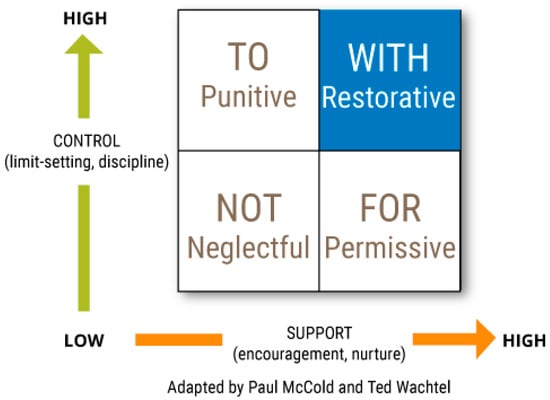
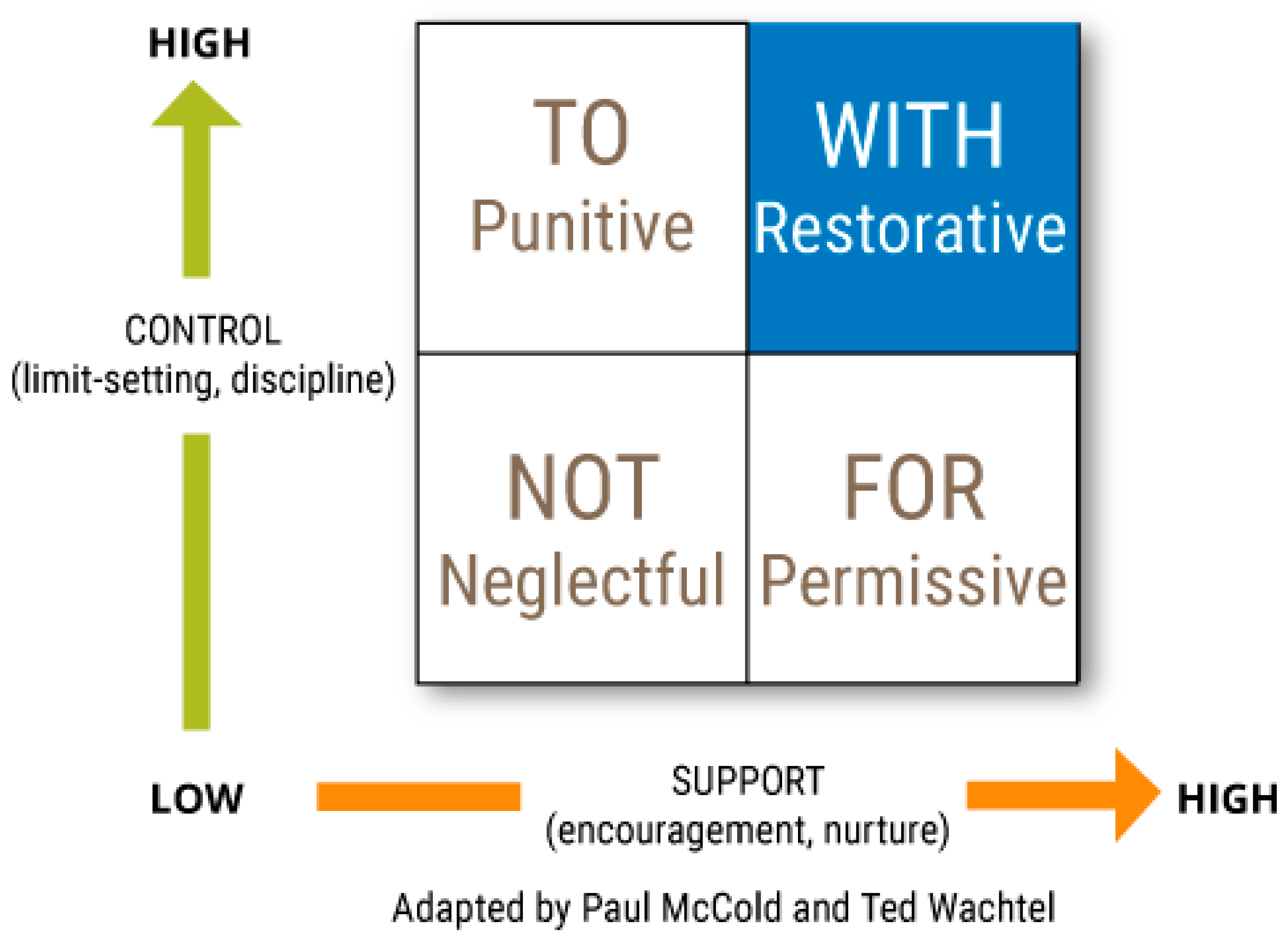
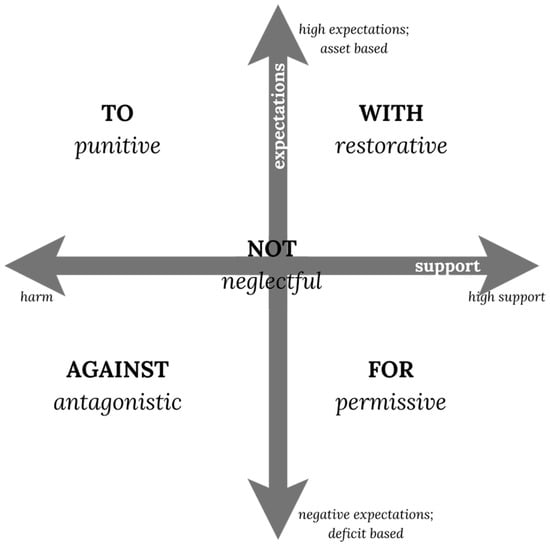
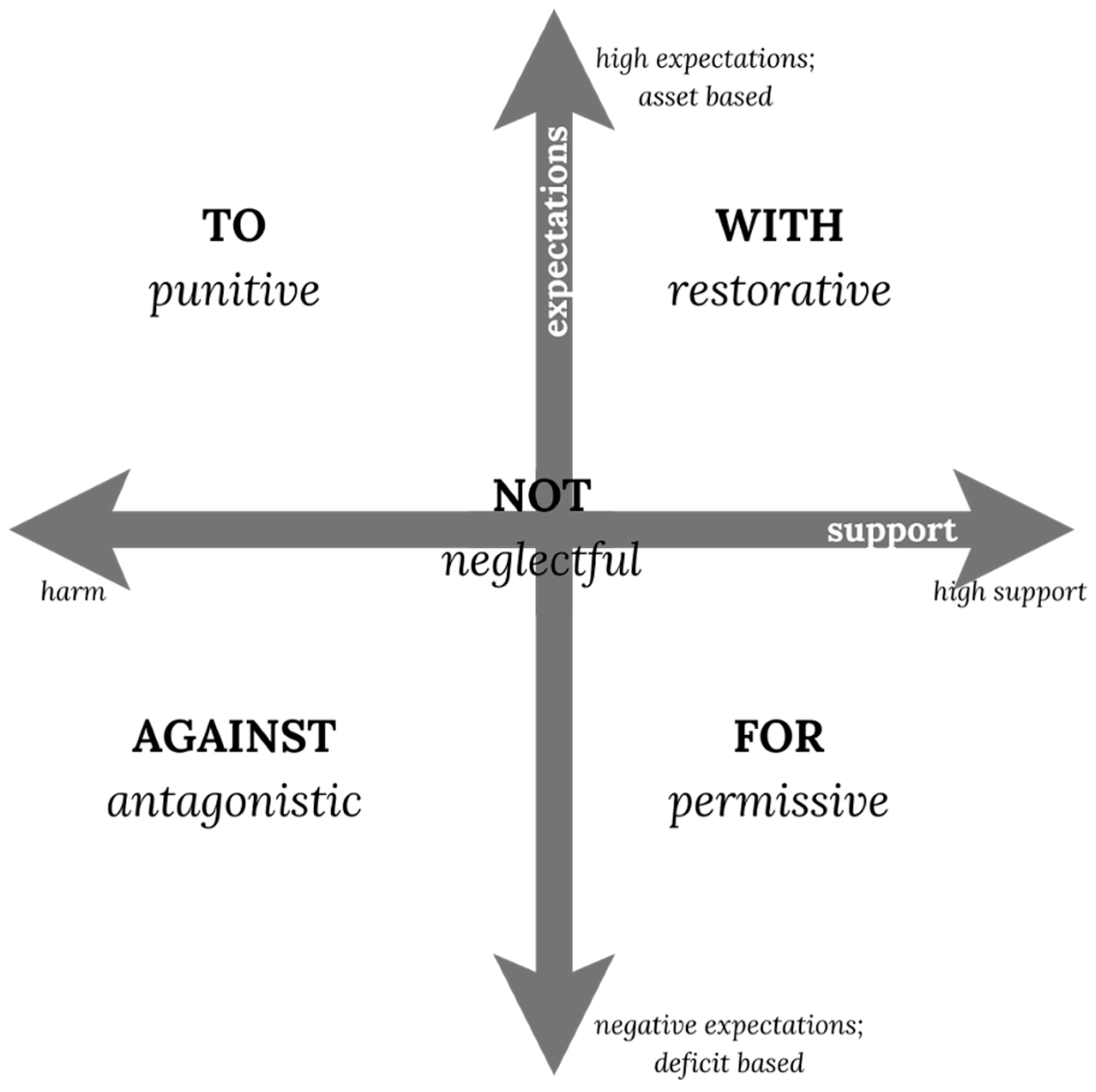

Disclaimer/Publisher’s Note: The statements, opinions and data contained in all publications are solely those of the individual author(s) and contributor(s) and not of MDPI and/or the editor(s). MDPI and/or the editor(s) disclaim responsibility for any injury to people or property resulting from any ideas, methods, instructions or products referred to in the content. |
© 2025 by the author. Licensee MDPI, Basel, Switzerland. This article is an open access article distributed under the terms and conditions of the Creative Commons Attribution (CC BY) license.