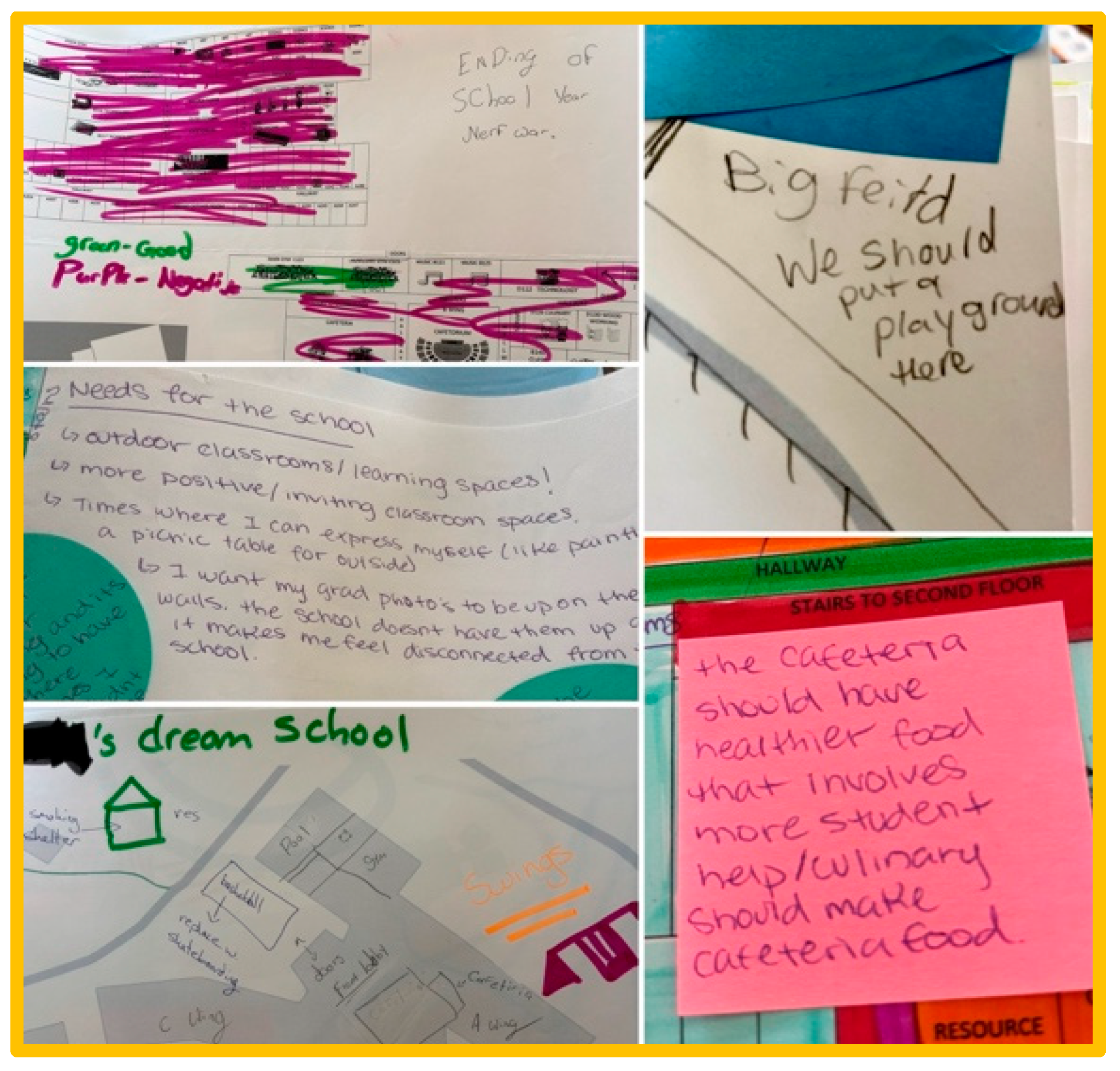

Counter-Mapping School Wellbeing with Youth in Alternative Education

Abstract
1. Introduction
- How is student wellbeing in alternative programming affected by exclusionary discipline?
- What spatial practices in schools might be rewritten to advance an equity-orientation?
- What spatialized aspects of just educational futures do students in alternative education envision for themselves?
1.1. Alternative Education and School Wellbeing
1.2. Critical Spatial Theory, Counter-Mapping, and Moving-Together
2. Methods
2.1. Participatory Action Research
2.2. Considerations of Youth and Power in Research
2.3. Participants
2.4. Activities
- Activity 1: Understanding and Defining Wellbeing
- Activity 2: Defining What Matters
- Activity 3: Mapping the School
- Activity 4: Mapping Relationships
- Activity 5: Mapping Experiences
- Activity 6: Maps to the Future
- Activity 7: Creating Directions
2.5. Data Analysis
3. Results and Discussion
3.1. The Negative Wellbeing Outcomes of Exclusionary Discipline Are Magnified for Youth in Alternative Programming
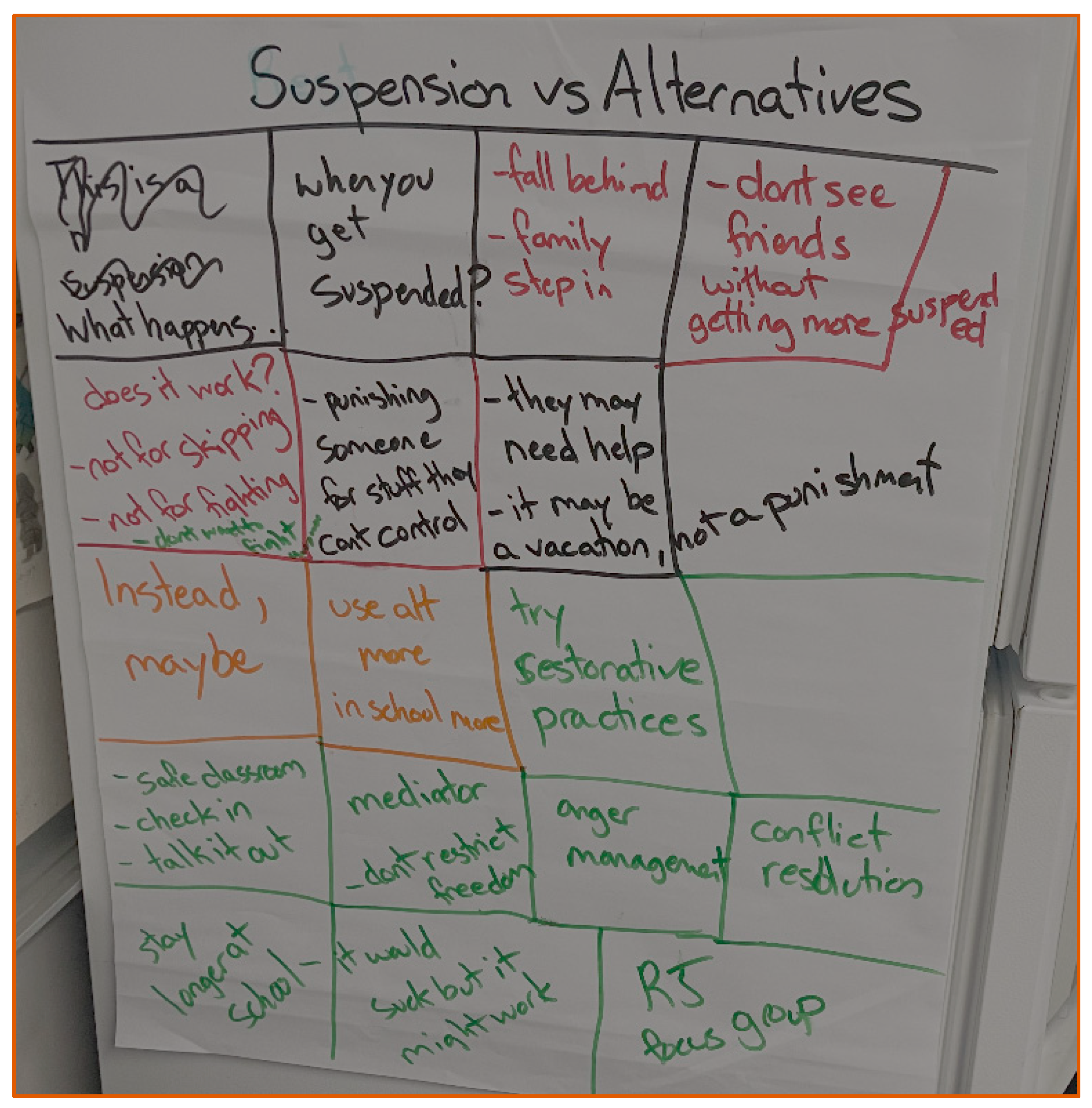
“I think finding out which person that the people who thought would be comfortable talking with because that’s a big thing. Not just throwing them into somebody they’re not comfortable with or don’t know and putting ‘em in the same room… The order would be kind of sitting them down maybe a day or two after the fight and just getting how they feel, cut the whole thing out if they’re willing to talk about it. And then once the whole kind of animosity is settled down a bit, then get the two people to talk to each other about it. The hate between each other is only going to grow if you don’t talk about what happened. Give them a little bit time to cool off before they talk about it.”(Blake)
Participants’ reflections indicated a nuanced understanding of the tensions of school fights, and a recognition that there was a difference between exclusionary discipline and respectful space being taken or given to calm down or resolve an issue.“After a fight your mind may not be in the right, it may not be in the right state of mind to be able to do that work as much as someone else expects you to do that. And I think that’s why they should talk to their people afterwards just so they can have a say in what they need. Because some people would just want to be in, have their normal life in school and out of school after that whole thing. Some people want a special area for them. You got to talk to them instead of making the decisions for them because not everything’s going to work for someone.”(Cara)
3.2. Schools Can Advance an Equity-Orientation Through Explicit Discussion and Reformation of Community Spatial Politicies and Practices
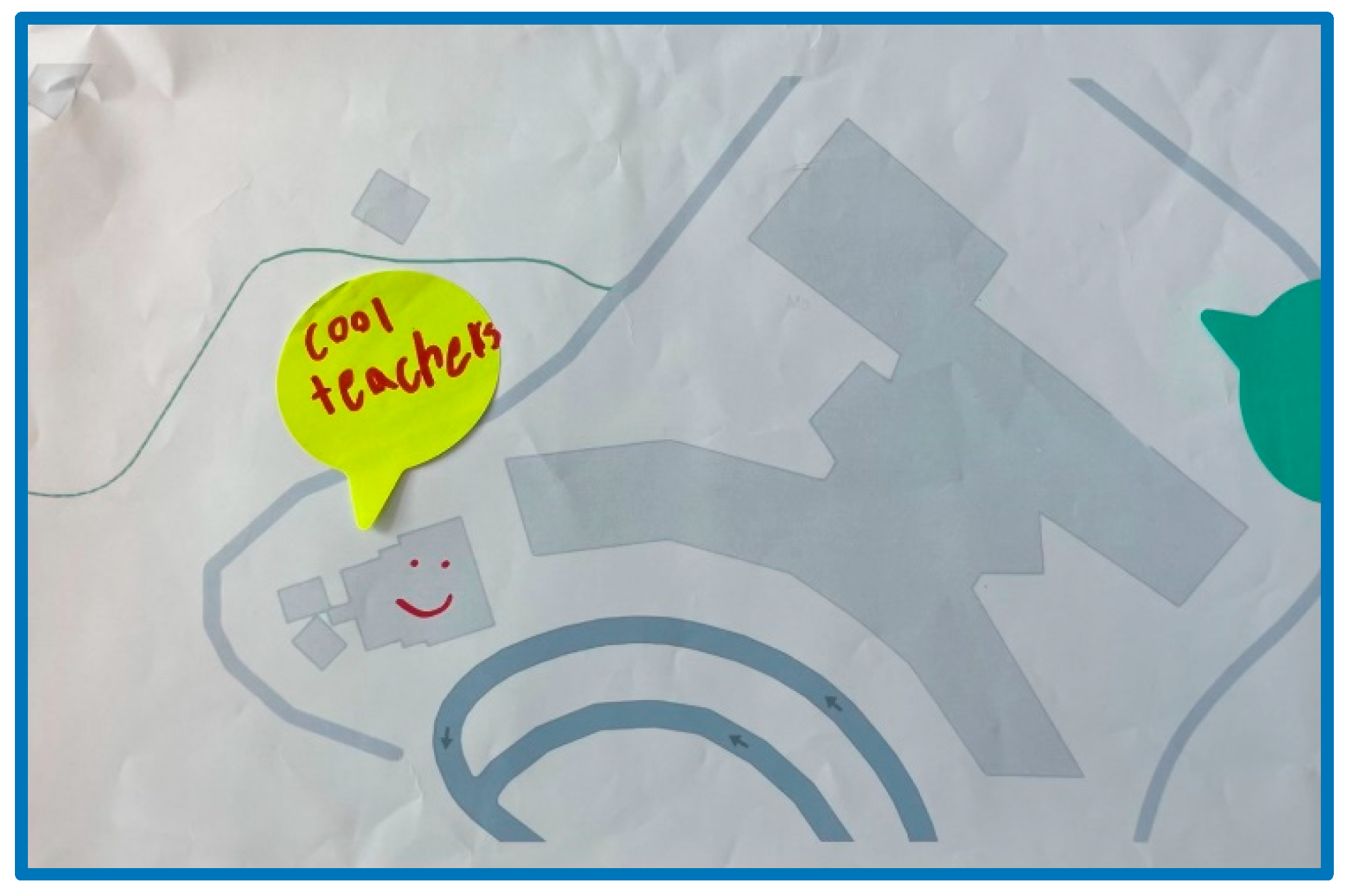
Interactions between students and main-school staff were mediated at various points by the director of alt ed, who issued large-scale wooden hall passes to flag his students for other teachers, asking them to leave his students alone or call him if there was a problem. This did not mediate staff encounters in the intended way, as evidenced by students’ observations:Al: I feel like it kind of depends on the setting or something. If you’re in their classroom, they’ll respect you because I dunno they’re teaching you or something, but in the hallway or whatever, when you’re walking they’re like, where are you going?Cole: Like that. Teachers in halls versus classrooms, they’re just so much more cruel and demanding almost. And they follow you around, even if you look suspicious or don’t look suspicious, they just find someone to target and it’s like they’ll stay behind you and check what you’re doing. I’m going to my class.Al: It depends who you are, right?Desi: I don’t want to be mean or anything, but appearance does kind of matter.Cole: Oh yeah. I don’t know if you dress a certain way, I feel like, I don’t know what I’m saying.Desi: Okay, so I know what you mean though. For me 100% the way that we’re dressed, the beanie, the hat.
In all cases, staff from the alt ed program were supportive of the research and asserted their professional purview in deciding who participated and where the group was permitted to go. These decisions were contested by other staff in part through hostile hallway encounters. From data, students’ affective educational wellbeing reflected complexity in how teachers chose to engage with them. Interactions that were characterized by curiosity and mentorship supported students in feeling as though they belonged and were respected. In absence of being able to confidently solve for staff variables, exploring these issues with students became about how best to co-create and manage protocols of engagement for areas under pressure.Joel: I feel like we should start probably bring out hall passes again. If it would stop people from asking me questions all the time… You remember when Mr. Z had those really big ones. Well usually when I bring it they’re like, you’re supposed to be downstairs. You can’t be upstairs. Because they’ll see it and they’ll know it’s from the alt wing.Pete: “It’s like a big wooden board so they leave you alone.”Joel: “Yeah, but they still bug you anyway, they always bug me whenever I carry it, so I just stopped bringing it.”
3.3. Students’ Visions of Just Educational Futures Include Movement, Creativity, Autonomy, Trust, and Outdoor Spaces
3.4. Study Limitations
4. Conclusions
Funding
Institutional Review Board Statement
Informed Consent Statement
Data Availability Statement
Conflicts of Interest
Abbreviations
| Alt ed | Alternative education program |
Appendix A. Sample Activity Prompts
- Activity 1
- What does wellbeing look, feel, and sound like here in this school?
- How do you know when someone is okay or when they are well?
- How was this wellbeing information about the school created? Did you participate in this process? How would you collect information on wellbeing?
- Do you see your understandings of wellbeing reflected in this data? What could be added or removed from the survey design to better address what wellbeing means to you?
- To what extent are your experiences with wellbeing visible in this data? What is missing?
- Activity 2
- Activity 3
- Activity 4
- Activity 5
- Activity 6
- Activity 7
References
- Akbari, E. (2019). Spatiality of engagement. In Mobile media in and outside of the art classroom: Attending to identity, spatiality, and materiality (pp. 103–126). Springer International Publishing. [Google Scholar]
- Aldridge, J. M., & McChesney, K. (2018). The relationships between school climate and adolescent mental health and wellbeing: A systematic literature review. International Journal of Educational Research, 88, 121–145. [Google Scholar] [CrossRef]
- Annamma, S. A., Connor, D., & Ferri, B. (2013). Dis/ability critical race studies (DisCrit): Theorizing at the intersections of race and dis/ability. Race Ethnicity and Education, 16(1), 1–31. [Google Scholar] [CrossRef]
- Asakura, K., Lundy, J., Black, D., & Tierney, C. (2020). Art as a transformative practice: A participatory action research project with trans* youth. Qualitative Social Work, 19(5–6), 1061–1077. [Google Scholar] [CrossRef]
- Barad, K. (2001). Re (con) figuring space, time, and matter. In Feminist locations: Global and local, theory and practice. Rutgers University Press. [Google Scholar]
- Bascia, N., & Maton, R. (2017). Curriculum development in alternative schools: What goes on in alternative schools stays in alternative schools. In N. Bascia, E. S. Fine, & M. Levin (Eds.), Alternative schooling and student engagement (pp. 3–10). Springer International Publishing. [Google Scholar]
- Beneke, M. R., Machado, E., & Taitingfong, J. (2022). DisCrit literacies: Early childhood teachers critically reading school as text and imagining an otherwise. Reading Research Quarterly, 57(4), 1237–1257. [Google Scholar] [CrossRef]
- Berkeley YPAR Hub. (2025). Why YPAR? Available online: https://yparhub.berkeley.edu/why-ypar (accessed on 30 January 2025).
- Braun, V., & Clarke, V. (2021). Thematic analysis: A practical guide. Sage. [Google Scholar]
- Breakspear, S. (2012). An exploration of the normative effects of international benchmarking in school system performance. In OECD working papers No 71. OECD. [Google Scholar]
- Brooke, A. (2026, April 8–12). Finding the edges of participation: A case for multi-modality as equity in research design. American Educational Research Association Annual Conference, Los Angeles, CA, USA. [Google Scholar]
- Bryan, J., & Wood, D. (2015). Weaponizing maps: Indigenous peoples and counterinsurgency in the Americas. Guilford Publications. [Google Scholar]
- Bunting, M., & Jota, K. (2021). The importance of the student-teacher relationship. In D. T. Gravesen, K. Stuart, M. Bunting, S. H. Mikkelsen, & P. H. Frostholm (Eds.), Combatting marginalisation by co-creating education: Methods, theories and practices from the perspectives of young people. Emerald Publishing Limited. [Google Scholar]
- CAST. (2024). Universal design for learning guidelines version 3.0. Available online: https://udlguidelines.cast.org (accessed on 30 January 2024).
- Chandler, E., Johnson, M., Gold, B., Rice, C., & Bulmer, A. (2019). Cripistemologies in the city: ‘Walking-together’ as sense-making. Journal of Public Pedagogies, (4). [Google Scholar] [CrossRef]
- Clark, A. (2011). Breaking methodological boundaries? Exploring visual, participatory methods with adults and young children. European Early Childhood Education Research Journal, 19(3), 321–330. [Google Scholar] [CrossRef]
- Conrad, D. (2020). Youth participatory action research and applied theatre engagement: Supporting indigenous youth survivance and resurgence. Theatre Research in Canada, 41(2), 258–277. [Google Scholar] [CrossRef]
- Cooke, B., & Kothari, U. (2001). The case for participation as tyranny. In B. Cooke, & U. Kothari (Eds.), Participation: The new tyranny? Zed books. [Google Scholar]
- Cornish, F., Breton, N., Moreno-Tabarez, U., Delgado, J., Rua, M., de-Graft Aikins, A., & Hodgetts, D. (2023). Participatory action research. Nature Reviews Methods Primers, 3(1), 1. [Google Scholar] [CrossRef]
- Crain, R., & Hanson, B. (2014). New Brunswick schools alternative education review. Department of Education and Early Childhood Development. [Google Scholar]
- Creswell, J. W., & Creswell, J. D. (2017). Research design: Qualitative, quantitative, and mixed methods approaches. Sage Publications. [Google Scholar]
- D’Angelo, F., & Zemanick, R. (2009). The twilight academy: An alternative education program that works. Preventing School Failure: Alternative Education for Children and Youth, 53(4), 211–218. [Google Scholar] [CrossRef]
- Darling-Hammond, L., Flook, L., Cook-Harvey, C., Barron, B., & Osher, D. (2020). Implications for educational practice of the science of learning and development. Applied Developmental Science, 24(2), 97–140. [Google Scholar] [CrossRef]
- Diaz-Diaz, C., Semenec, P., & Moss, P. (2019). Opening for debate and contestation: OECD’s international early learning and child wellbeing study and the testing of children’s learning outcomes. In Policy futures in education (Vol. 17, Issue 1, pp. 1–10). SAGE Publications Sage UK. [Google Scholar]
- Drew, S., & Guillemin, M. (2014). From photographs to findings: Visual meaning-making and interpretive engagement in the analysis of participant-generated images. Visual Studies, 29(1), 54–67. [Google Scholar] [CrossRef]
- Engel, L. C., & Rutkowski, D. (2020). Pay to play: What does PISA participation cost in the US? Discourse: Studies in the Cultural Politics of Education, 41(3), 484–496. [Google Scholar] [CrossRef]
- Falkenberg, T. (2014). Making sense of western approaches to wellbeing for an educational context. In F. Deer, T. Falkenberg, B. McMillan, & L. Sims (Eds.), Sustainable wellbeing: Concepts, issues, and educational practices (pp. 77–94). ESWB Press. [Google Scholar]
- Falkenberg, T., & Krepski, H. (2020). On conceptualizing child wellbeing. Canadian Journal of Education/Revue Canadienne de l’éducation, 43(4), 891–917. [Google Scholar]
- Ferrare, J. J., & Apple, M. W. (2010). Spatializing critical education: Progress and cautions. Critical Studies in Education, 51(2), 209–221. [Google Scholar] [CrossRef]
- Fine, M., & Rosenberg, P. (1983). Dropping out of high school: The ideology of school and work. Journal of Education, 165(3), 257–272. [Google Scholar] [CrossRef]
- Fraser, N. (2009). Scales of justice: Reimagining political space in a globalizing world (Vol. 31). Columbia University Press. [Google Scholar]
- Gairola, R. K. (2021). Finding our way home: A theory and pedagogy of anti-colonial Q-mapping. Digital Scholarship in the Humanities, 37(4), 997–1001. [Google Scholar] [CrossRef]
- Gerlinger, J., Viano, S., Gardella, J. H., Fisher, B. W., Chris Curran, F., & Higgins, E. M. (2021). Exclusionary school discipline and delinquent outcomes: A meta-analysis. Journal of Youth and Adolescence, 50(8), 1493–1509. [Google Scholar] [CrossRef]
- Goeman, M. (2013). Mark my words: Native women mapping our nations. U of Minnesota Press. [Google Scholar]
- Goldman, M. (2023). There’s always a way out: Spatial domination, disappearance, and free movement in the carceral-educational landscape. Berkeley Review of Education, 13(1), 32–60. [Google Scholar] [CrossRef]
- Gordon, E., Elwood, S., & Mitchell, K. (2016). Critical spatial learning: Participatory mapping, spatial histories, and youth civic engagement. Children’s Geographies, 14, 1–15. [Google Scholar] [CrossRef]
- Gubrium, A., & Harper, K. (2013). Participatory visual and digital methods. Alberta Journal of Educational Research, 60(4), 748–750. [Google Scholar]
- Gutiérrez, K. D. (2020). When learning as movement meets learning on the move. Cognition and Instruction, 38(3), 427–433. [Google Scholar] [CrossRef]
- Hall, B. L., & Tandon, R. (2017). ‘Participatory research: Where have we been, where are we going?—A dialogue’. Research for All, 1(2), 365–374. [Google Scholar] [CrossRef]
- Haraway, D. (1997). The deployment of information technology in the field of education and the augmentation of the child. In Foucault’s challenge: Discourse, knowledge, and power in education. Teachers College Press. [Google Scholar]
- Horgan, D. (2017). Child participatory research methods: Attempts to go ‘deeper’. Childhood, 24(2), 245–259. [Google Scholar] [CrossRef]
- Immordino-Yang, M. H. (2015). Emotions, learning, and the brain: Exploring the educational implications of affective neuroscience (the Norton series on the social neuroscience of education). WW Norton & Company. [Google Scholar]
- İnce, F. (2025). Youth addiction and wellbeing: Analysis of social, behavioral, and economic factors. Youth, 5(4), 115. [Google Scholar] [CrossRef]
- Kelly, D. M. (1993). Last chance high: How girls and boys drop in and out of alternative schools. Yale University Press. [Google Scholar]
- Kwan, M. P. (2002). Feminist visualization: Re-envisioning GIS as a method in feminist geographic research. Annals of the Association of American Geographers, 92(4), 645–661. [Google Scholar] [CrossRef]
- Leavy, P. (Ed.). (2017). Handbook of arts-based research. Guilford Publications. [Google Scholar]
- Lee, S., & Roth, W. M. (2003). Becoming and belonging: Learning qualitative research through legitimate peripheral participation. Forum: Qualitative Social Research, 4(2). Available online: https://doaj.org/article/c7479a7b83f14c63977c67749320926f (accessed on 30 January 2026).
- Lehr, C. A., Tan, C. S., & Ysseldyke, J. (2009). Alternative schools: A synthesis of state-level policy and research. Remedial and Special Education, 30(1), 19–32. [Google Scholar] [CrossRef]
- Literat, I. (2013). Participatory mapping with urban youth: The visual elicitation of socio-spatial research data. Learning, Media and Technology, 38(2), 198–216. [Google Scholar] [CrossRef]
- Marin, A. M. (2020). Ambulatory sequences: Ecologies of learning by attending and observing on the move. Cognition and Instruction, 38(3), 281–317. [Google Scholar] [CrossRef]
- Massey, D. (2005). For space. Sage. [Google Scholar]
- Massey, D. (2011). A counterhegemonic relationality of place. In E. McCann, & K. Ward (Eds.), Mobile urbanism: Cities and policymaking in the global age (pp. 1–14). University of Minnesota Press. [Google Scholar]
- McCreary Centre Society. (2019). Balance and connection in BC: The health and wellbeing of our youth. McCreary Centre Society. [Google Scholar]
- McNeill, K. F., Friedman, B. D., & Chavez, C. (2016). Keep them so you can teach them: Alternatives to exclusionary discipline. International Public Health Journal, 8(2), 169–181. [Google Scholar]
- Meiners, E. R. (2017). The problem child: Provocations toward dismantling the carceral state. Harvard Educational Review, 87(1), 122–146. [Google Scholar] [CrossRef]
- Miller, A. L., & Kurth, J. A. (2022). Photovoice research with disabled girls of color: Exposing how schools (re) produce inequities through school geographies and learning tools. Disability & Society, 37(8), 1362–1390. [Google Scholar]
- Mills, M., & McGregor, G. (2013). Re-engaging young people in education: Learning from alternative schools. Routledge. [Google Scholar]
- Mitchell, C. (2011). What’s participation got to do with it? Visual methodologies in ‘girl-method’ to address gender-based violence in the time of AIDS. Global Studies of Childhood, 1(1), 51–59. [Google Scholar] [CrossRef]
- Monreal, T., Deroo, M. R., & Pitts, B. (2024). Where we are: Reflecting on our use of critical mapping practices for spatial justice in teacher education. Social Studies Research and Practice, 19(2), 157–170. [Google Scholar] [CrossRef]
- New Brunswick Health Council. (2023). New Brunswick student wellness survey. Available online: www.nbhc.ca (accessed on 30 January 2026).
- Noltemeyer, A. L., & Mcloughlin, C. S. (2010). Changes in exclusionary discipline rates and disciplinary disproportionality over time. International Journal of Special Education, 25(1), 59–70. [Google Scholar]
- Pain, R., & Francis, P. (2003). Reflections on participatory research. Area, 35(1), 46–54. [Google Scholar] [CrossRef]
- Panina-Beard, N., & Vadeboncoeur, J. A. (2022). Learning from youth in alternative programs: Transforming schooled histories into a reimagined school for education. Journal of Education for Students Placed at Risk (JESPAR), 27(3), 239–269. [Google Scholar] [CrossRef]
- Parent, L. (2016). The wheeling interview: Mobile methods and disability. Mobilities, 11(4), 521–532. [Google Scholar] [CrossRef]
- Rose, G. (2014). On the relation between ‘visual research methods’ and contemporary visual culture. The Sociological Review, 62(1), 24–46. [Google Scholar] [CrossRef]
- Rose, M., Heddon, D., Qualmann, C., Wilson, H., & O’Neill, M. (2026). Cripping desire lines: Disabled people, creative walking and the right to walk the city. Urban Studies. [Google Scholar] [CrossRef]
- Rubel, L., Lim, V., Hall-Wieckert, M., & Katz, S. (2016). Cash across the city: Participatory mapping & teaching for spatial justice. Journal of Urban Learning, Teaching, and Research, 12, 4–14. [Google Scholar]
- Ryan, T. G., & Goodram, B. (2013). The impact of exclusionary discipline on students. International Journal of Progressive Education, 9(3), 169–177. [Google Scholar]
- Said, E. W. (1993). An interview with Edward W. Said. Boundary 2, 20(1), 1–25. [Google Scholar] [CrossRef]
- Schoone, A., Bruce, J., Piggot-Irvine, E., & Turner-Adams, H. (2022). How alternative education teachers embarked on getting to the heart of young people’s schooling stories. International Journal of Inclusive Education, 28(11), 2590–2606. [Google Scholar] [CrossRef]
- Selman, K. J. (2018). Punishment as pedagogy: An exploration of the disciplinary alternative school [Doctoral dissertation, Old Dominion University]. Available online: https://digitalcommons.odu.edu/sociology_criminaljustice_etds/17 (accessed on 30 January 2026).
- Soja, E. W. (2013). Seeking spatial justice. University of Minnesota Press. [Google Scholar]
- Springgay, S., & Truman, S. E. (2022). Critical walking methodologies and oblique agitations of place. Qualitative Inquiry, 28(2), 171–176. [Google Scholar] [CrossRef]
- Stokes, H., & Aaltonen, S. (2021). Time–space paths and the experiences of vulnerable young people in alternative educational settings. International Journal of Inclusive Education, 28(8), 1488–1502. [Google Scholar] [CrossRef]
- Switzer, S. (2019). Working with photo installation and metaphor: Re-Visioning photovoice research. International Journal of Qualitative Methods, 18, 1609406919872395. [Google Scholar] [CrossRef]
- Sykes, B. L., Piquero, A. R., Gioviano, J. P., & Pittman, N. (2015). The school-to-prison pipeline in America, 1972–2012. In Oxford handbooks online scholarly research reviews. Oxford Academic. [Google Scholar]
- Te Riele, K. (2010). Philosophy of hope: Concepts and applications for working with marginalized youth. Journal of Youth Studies, 13(1), 35–46. [Google Scholar] [CrossRef]
- Tierney, G. (2020). Ideational resources and alternative definitions of success: Reorienting to education and developing identities in an alternative high school. The High School Journal, 103(4), 241–261. [Google Scholar] [CrossRef]
- Tilley, S. (2019). Doing respectful research: Power, privilege and passion. Fernwood Publishing. [Google Scholar]
- Tuck, E., & Habtom, S. (2019). Unforgetting place in urban education through creative participatory visual methods. Educational Theory, 69(2), 241–256. [Google Scholar] [CrossRef]
- Tuck, E., & McKenzie, M. (2015). Relational validity and the “where” of inquiry: Place and land in qualitative research. Qualitative inquiry, 21(7), 633–638. [Google Scholar] [CrossRef]
- Tuhiwai-Smith, L. (2005). On tricky ground. In The Sage handbook of qualitative research (Vol. 3, pp. 85–107). Sage. [Google Scholar]
- Vadeboncoeur, J. A. (2009). Spaces of difference: The contradictions of alternative educational programs. Educational Studies, 45(3), 280–299. [Google Scholar] [CrossRef]
- Vadeboncoeur, J. A. (2025). Spaces of difference: The contradictions of alternative educational programs. In Critical geographies in/of education (pp. 64–83). Routledge. [Google Scholar]
- Warf, B., & Arias, S. (Eds.). (2008). The Spatial Turn: Interdisciplinary Perspectives (1st ed.). Routledge. [Google Scholar] [CrossRef]
- Whitty, P. (2010). Responsibility with and to others: Deconstructing and reconceptualizing children, childhoods, and early childhood literacy curricula. Journal of Curriculum Studies, 42(2), 279–292. [Google Scholar] [CrossRef]
- Wlasichuk, L., Wilson, T., Rempel, K., Bear, C., & Cidro, J. (2022). Winnipeg’s north end wellbeing measure: Using social innovation to drive community measurements. Progress in Community Health Partnerships: Research, Education, and Action, 16(3), 385–392. [Google Scholar] [CrossRef] [PubMed]
- Zembylas, M. (2018). Reinventing critical pedagogy as decolonizing pedagogy: The education of empathy. Review of Education, Pedagogy, and Cultural Studies, 40(5), 404–421. [Google Scholar] [CrossRef]


Disclaimer/Publisher’s Note: The statements, opinions and data contained in all publications are solely those of the individual author(s) and contributor(s) and not of MDPI and/or the editor(s). MDPI and/or the editor(s) disclaim responsibility for any injury to people or property resulting from any ideas, methods, instructions or products referred to in the content. |
© 2026 by the author. Licensee MDPI, Basel, Switzerland. This article is an open access article distributed under the terms and conditions of the Creative Commons Attribution (CC BY) license.
Share and Cite
Brooke, A. Counter-Mapping School Wellbeing with Youth in Alternative Education. Youth 2026, 6, 34. https://doi.org/10.3390/youth6010034
Brooke A. Counter-Mapping School Wellbeing with Youth in Alternative Education. Youth. 2026; 6(1):34. https://doi.org/10.3390/youth6010034
Chicago/Turabian StyleBrooke, Auralia. 2026. "Counter-Mapping School Wellbeing with Youth in Alternative Education" Youth 6, no. 1: 34. https://doi.org/10.3390/youth6010034
APA StyleBrooke, A. (2026). Counter-Mapping School Wellbeing with Youth in Alternative Education. Youth, 6(1), 34. https://doi.org/10.3390/youth6010034