


Abstract
The main goal of this study is to explain the idea of generalized interval-valued () convexity on a fractal set. We first define the basic operations for a generalized interval of with . Then, we expand the idea of () Riemann integration to () local fractal integration, which sets the stage for further research. This is followed by the proof of new Jensen, Hermite, Hadamard, Pachpatte, and Fejer inequalities that are () and have to do with the generalized class of () convexity defined over the fractal domain. We furnish validation through visual and comparative approaches. Our outcomes are the refinement of many existing results, indicating that they are fruitful. In fractal settings, this is the first paper to work on () convexity and some set-valued versions of Hermite–Hadamard-type containments.
1. Introduction and Preliminaries
The theory of convexity has made significant contributions in several fields of mathematical and applied sciences. Researchers have frequently used innovative and novel concepts to investigate and refine convexity and its related terms in recent years. It has appeared as an important subject of analysis due to its geometrical and analytical aspects. The study of convexity has progressed in many areas, but the theory of convex mappings is one of the most studied sub-domain because it has so many precise and unique uses. These kinds of mappings provide us unique minima and enjoy similar properties even though the dimension of space is not finite. Over the years, a wide range of generalizations of convexity have been used to refine the various existing inequalities.
The theory of inequalities has flourished exponentially due to its potential applications through the applications of convexity. The ongoing research and applicability of this theory motivated the researchers to work further on inequalities and convex mappings. The idea of convex maps and their generalizations can be used to produce the various fundamental inequalities.
Let be a convex mapping. Then the Hadmard inequality is given as
This result is considered as a necessary and sufficient condition for a convex mapping. Also, it provides the error estimation of mid-point and trapezium-type quadrature rules. The literature is evident that Moore’s work [1] started the use of () calculus in numerical analysis, especially in automated error analysis. This work has remained a useful resource for researchers studying () techniques, which replace single-valued mappings, as well as for those dealing with uncertainty issues. On the other side, interval analysis has also gained the researcher’s attention because of its applications in error analysis.
In 2012, Chalco-Cano et al. [2] opened a new venue to conduct more research in mathematical inequalities via () mappings, especially utilizing the generalized Hukuhara differences. In 2017, Costa et al. [3] used the fuzzy valued mappings to construct novel forms of classical inequalities. While [4] introduces and studies coordinated log-h h-convexity for interval-valued functions, to make fractional inclusion relations, the authors of [5] used the idea of () p-convex mapping. After these changes, Budak et al. [6] were able to successfully explore the idea of fractional () variations oin the Hermite–Hadamard type inequality. In [7], authors developed a fresh generic class of convexity using the quasi-weighted mean and containment ordering relation. They have derived some unified () inequalities utilizing the notion of generalized convexity. In 2021, Kara et al. [8] developed some two-dimensional containments utilizing coordinated () convex mappings. Khan et al. [9] used generalized () fuzzy convex mappings to come up with some fuzzy fractional versions of Jensen [10] and Hermite-Hadamard [11,12] inequalities. The authors of [13] talked about the concept of left-right () fuzzy bi-convex mapping and looked at some fractional integral containments that are connected to the Atangana-Baleanu fractional operator. For more detail, see [14,15,16].
Many significant refinements of calculus have emerged in recent eras to overcome the limitations of classical relations and to visualize real-world problems. Fractional calculus addresses the problem of fractional order derivatives and antiderivatives and generalizes the already known concepts. In 2012, Yang [17] initiated the idea of local fractional calculus based on a fractal set to seek out the problems concerned with Riemann and Caputo fractional calculus. From these operators, one can recover the classical results. The concept of fractal sets was presented and elaborated by Mandelbrot [18] (pp. 25–74). Fractals have utility in photography creation, soil mechanic, and scattering theory, etc. These days, fractal calculus is very useful and complete for studying math problems with mappings that are not differentiable and appearing in nature sciences. Inspired by the properties above, Mo et al. [19] set up the idea of extended convexity over and examined specific algebraic characteristics associated with that novel class. Additionally, she created the new fractal counterparts of inequalities.
In [20], Sarikaya and Budak created the Ostrowski type of integral inequalities in 2017. They did this by using the idea of extended convexity and a local fractional procedure. The idea of generalized harmonic convex mappings to formulate Hermite-Hadamard and Hermite-Hadamard Fejer inequalities was proved by Noor et al. [21] in 2018. They also examined various specific situations to supplement their findings with existing research. Sun et al. [22] used general harmonic convex mapping to prove new trapezium-type inequalities with local fractional identity in 2020. Also, the Hermite-Hadamard type inequality for general harmonic convex mappings over fractal sets employing local fractional calculus was discussed in [23]. For comprehensive investigation, see [24,25,26,27,28,29].
2. Preliminaries
To further explore the Yang [17] calculus, we recollect some well-known s-sets.
- 1.
- 2.
- 3.
- 4.
- .
The operations addition ′ + ′, and multiplication ′ * ′ over s-like subsets are defined as follows:
and both .
Observe that is a commutative group. Let be arbitrary, and then,
- 1.
- 2.
- 3.
- is the additive identity of such that ,
- 4.
- For any then there exists such that .
Also is a commutative group. For any be arbitrary, and then:
- 1.
- 2.
- 3.
- then for each we have
- 4.
- For each there exists such that .
Remark 1.
- is a field.
- The order relation ≤ on is defined as follows ⇔ in . Then, is an ordered field.
Definition 1.
A mapping is called local fractional continuous at , if for all there exists such that
If is local fractional continuous at , then we can write .
Now, we deliver the local differentiability.
Definition 2.
The local fractional derivative of Θ defined over s-type sets is defined as
provided that limit exists and using the notation .
Moreover, we iterate the above definition and write for any ; when the corresponding iterated limit exists we call this expression the k-th order derivative of s-type. If exists at each , then we write , where the space of k-order local differentiable mappings is represented by and .
Analogously, the integral operators is defined as
Definition 3.
Let , , be a division of such that . Then, the fractal integral of Θ on is defined as follows:
where and for . If the limit exists, then we say that Θ is local fractional integrable.
Lemma 1.
The following equalities hold:
- 1.
- If , then
- 2.
- If , then
- 3.
- If , then
In 2014, Mo et al. [19] studied the concept of fractal convexity in the context of local calculus.
Definition 4.
A function is called generalized convex if
and
Additionally, Mo and Sui [19] formulated the Jensen inequality via generalized convexity.
Theorem 1.
Let be a generalized convex mapping, then
In the next section, we provide our main outcomes.
3. Main Results
Here, denote the space of all intervals of the space with . If , then
If , then the interval is said to be degenerate. If is positive, then and similarly is negative if . From now on, let denote the set of positive and the set of negative fractals intervals of , respectively.
Now, we define the scalar multiplication of any fractal interval in the following way:
The inclusion between two fractal intervals and is defined as follows:
The operations of Minkowski addition and difference for fractal intervals are given as follows: Let and ; then,
It is worth noting that the previous differences only hold when , where l denotes the length of an interval which is defined as .
Now, we define the notion of the Hausdorff-Pompeiu distance between two fractal intervals and as follows:
In the following sequel, we define the product of and as follows:
Now, we present some algebraic properties of fractal intervals of .
- 1.
- Commutativity under addition and multiplications:
- 2.
- Associativity under addition and multiplications:
- 3.
- Existence of both identities:
- 4.
- Associativity:
- 5.
- First distributive law:
- 6.
- Second distributive law:
- 7.
- In general, distributive law does not hold. One can easily check that for , and , distributive property does not hold.
- 8.
- Inverse does not exist. One can verify that for , the inverse does not exist.
Local Integration
Let be a generalized mapping. Let be a partition of , where is a general subinterval of . Let be the set of all partitions of and be the collection of all points such that the mesh of any partition is . Moreover, the norm or mesh is the length of the longest generalized interval. Let , then the local sum is defined as
Any is called local fractional integrable on ; if there exists , the following holds: For each there exists , such that
for every local sum S of related to each . Here, is called the () local fractional integral of on and is given as follows:
If , then . Also, its end point representation is given as
Theorem 2.
Let be an () mapping, such that with . Then, Θ is () local fractional integrable if and only if and are local fractional integrable on .
Proof.
Let be a partition and let Θ be a () local fractional integrable mapping. Then, for each , there exists such that
This can be transformed as
and
From (3) and (4), it is clear that both and are local integrable mappings. To prove the converse, we assume that and are local integrable mappings and . Then, it can be written as and for some . Then for each there exist and such that
and
By selecting and combining (5) and (6), we obtain the desired definition and this concludes the proof. □
4. Interval-Valued Generalized Convex Functions
Now, we introduce the concept of () convex mappings over fractal sets, which is defined as follows.
Definition 5.
Suppose is an () mapping such that with , then Θ is called a generalized () convex mapping if
where .
If the inclusion holds in opposite direction, then Θ is said to be a generalized concave mapping.
For the convenience the collection of generalized () convex mappings, generalized () concave mappings, generalized convex mappings and generalized concave mappings are denoted by , , and , respectively.
Theorem 3.
Suppose is an () mapping, such that with . Then, & .
Proof.
Assume that and and ; then,
This suggests that
From (2), we have
and
Equations (7) and (8) indicate that and .
- Conversely, suppose that and ; then,
□
Theorem 4.
Suppose is an () mapping such that with . Then .
Proof.
The proof is similar to Theorem 3. □
Example 1.
Let be an mapping and .
With the help of Theorem 3, one can clearly visualize that .
Now we establish the Jensen’s inequality for () generalized convex mappings.
Theorem 5.
Let , then we have
where and , .
If , then (11) holds in reverse direction.
Proof.
Since , for by choosing & and by using the notion of () generalized convexity, the result holds.
Assume that the result holds true for ; then, for any for and , we have
If , , and , then set , i = 1, 2, 3…1 and so .
Thus,
□
Our next result is Hermite–Hadamard inclusion.
Theorem 6.
Let be a local () mapping, such that and ; then,
where .
If , then the following inequality holds:
Proof.
Now, we provide the general Hermite–Hadamard–Fejer inequality by the means of symmetric mappings.
Theorem 7.
[Right-sided Fejer Inequality]
Let be a local () mapping such that . If and g is a symmetric mapping with respect to , then
If and g is a symmetric mapping with respect to , then
Proof.
Now, take the local fractional integration of (23) with respect to ′ ϰ
′ over , then
where
Similarly,
and
By combining (23)–(26), we obtain
We multiply (18) by and (19) by , and so we obtain
Adding (21) and (22) and using the symmetry of g gives
- , then
□
Theorem 8
(Left sided Fejer Inequality). Let be a local () mapping such that . If and g is a symmetric mapping with respect to ; then,
If and g is a symmetric mapping with respect to , then
Proof.
Since , then
Multiplying both sides of (27) by and taking the integration with respect to ′ ϰ ′ over , then
Now, utilizing the symmetry of g such that , we obtain
Simply by using the substitution principle, and adding the similar integrals, we obtain the intended inequality. □
Now, we give some product trapezium-like inequalities, which are known as Pachpatte-type inequalities.
Theorem 9.
Let be two mappings, such that and . If , then
where
If , then
Proof.
Since , then
When multiplying (28) and (29), then
Now taking the local fractional integration with respect to ′ ϰ ′ over ,
□
Theorem 10.
Let be two mappings such that and . If , then
where and are already defined in Theorem 9. The above inclusion holds in the reverse direction for interval-valued generalized concave mappings.
Proof.
Since , then
Applying local fractional integration on (30) with respect to ′ ϰ′ over , then
After performing simple integrations by using power formula and substitution techniques, we obtain
It ends the proof. □
5. Visual Analysis
In this section, we present numerical and graphical validation of our main results.
Example 2.
We consider that . If , and , then we have
In addition, the middle part of Theorem 6 becomes (see Figure 1)
The right-hand side of Theorem 6 becomes (see Figure 1)
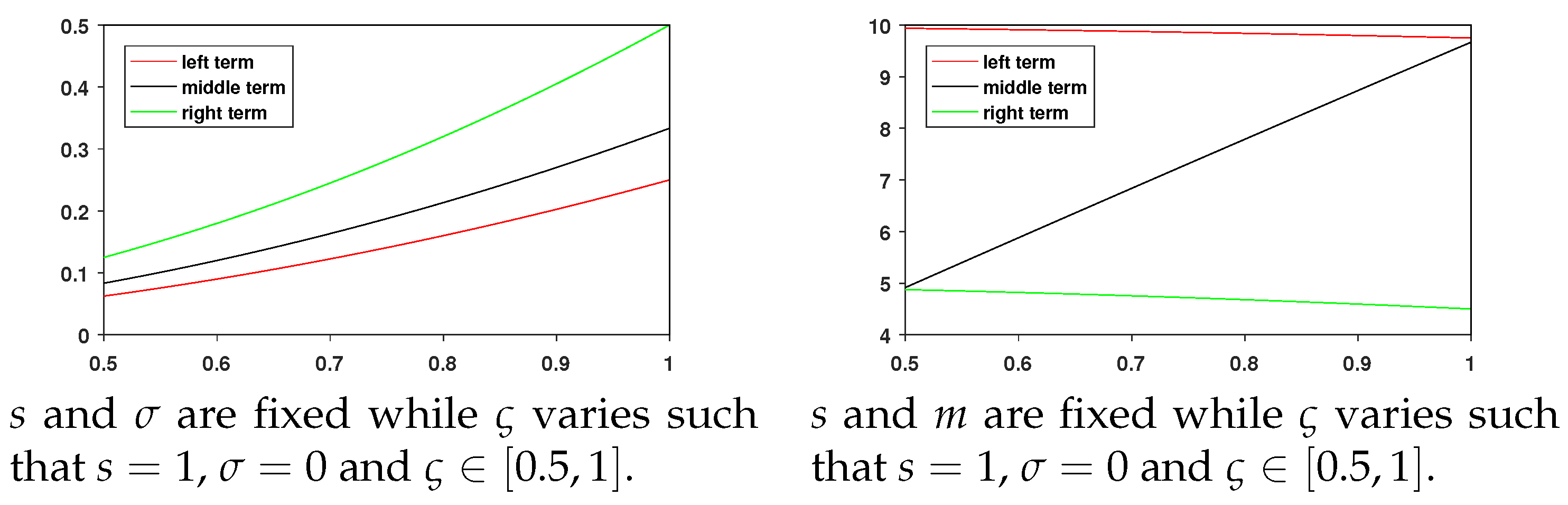
Table 1.
Numerical validation of Example 2 for based on Theorem 6 for .
Table 2.
Numerical validation of Example 2 for based on Theorem 6 for .
Example 3.
We consider that , . If , and , then the left side of Theorem 7 can be written as (see Figure 2)
In addition, the right-hand side of Theorem 7 becomes (see Figure 2)
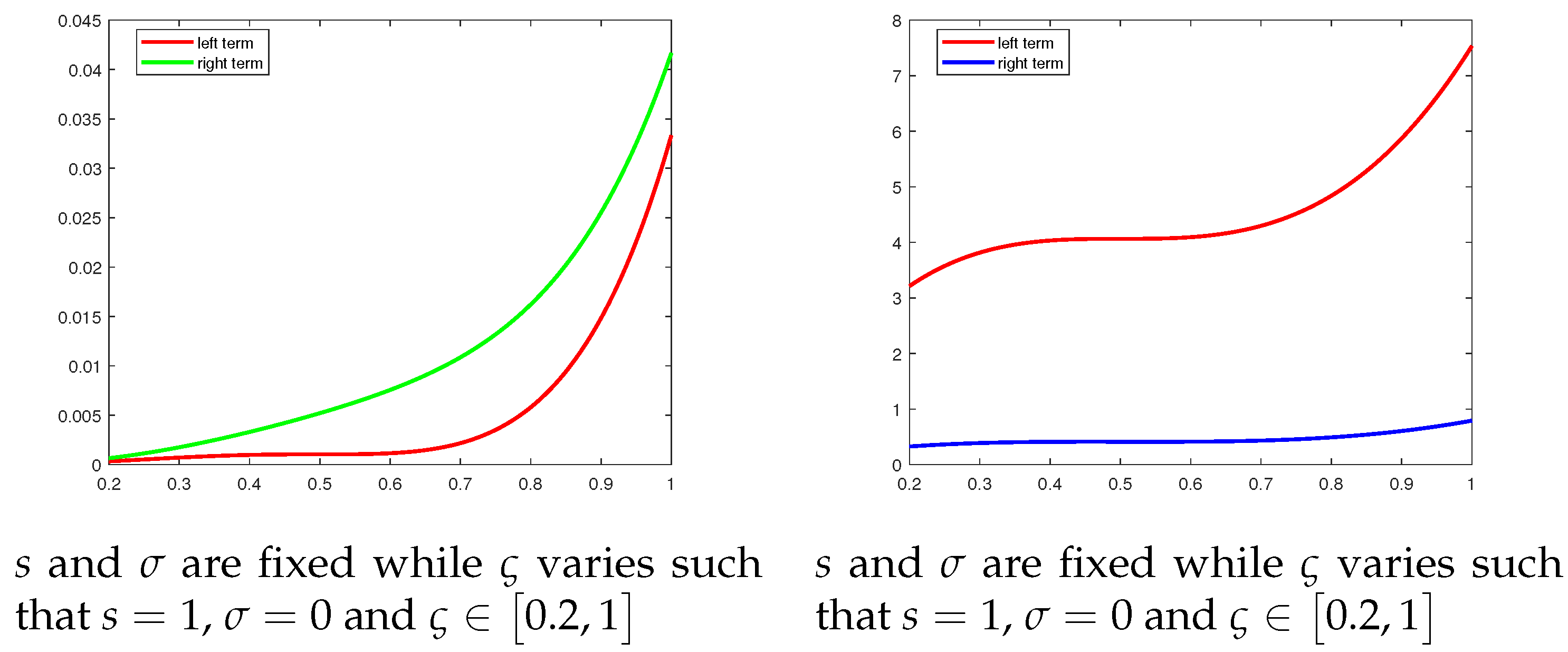
Table 3.
Numerical validation of Example 3 for based on Theorem 7 for .
Table 4.
Numerical validation of Example 3 for based on Theorem 7 for .
6. Conclusions
In recent years, fractional calculus approaches have often been utilized to analyze many scientific models. It has been modified and refined by various techniques. Yang [17] has successfully introduced local fractal calculus to tackle non-differentiable scientific problems. Due to the effective range of applications, researchers have tried formulating the fractal version of classical inequalities. The subject of fractal inequalities is a widely explored site of research. We have defined some operations on fractal intervals, such as local fractional integration of fractal intervals and order relations to compare the fractal intervals. These were influenced by research that is still going on. With the help of these developments, we have constructed some well-known integral inequalities. The idea and technique of the paper will create more opportunities to derive new results in various domains of mathematics.
Author Contributions
Conceptualization, M.Z.J. and M.U.A.; methodology, D.Z. and A.G.K.; software, L.J.; validation, M.Z.J., M.U.A. and A.G.K.; formal analysis, D.Z.; investigation, M.Z.J.; resources, M.U.A.; data curation, D.Z.; writing—original draft preparation, M.Z.J.; writing—review and editing, M.Z.J. and L.J.; visualization, A.G.K.; supervision, L.J.; project administration, D.Z. All authors have read and agreed to the published version of the manuscript.
Funding
This research received no external funding.
Data Availability Statement
All generated data is within the manuscript.
Conflicts of Interest
The authors declare no conflicts of interest.
References
- Moore, R.E. Interval Analysis; Prentice-Hall: Englewood Cliffs, NJ, USA, 1966; Volume 4. [Google Scholar]
- Chalco-Cano, Y.; Flores-Franulič, A.; Román-Flores, H. Ostrowski type inequalities for interval-valued functions using generalized Hukuhara derivative. Comput. Appl. Math. 2012, 31, 457–472. [Google Scholar]
- Costa, T.M.; Román-Flores, H. Some integral inequalities for fuzzy-interval-valued functions. Inf. Sci. 2017, 420, 110–125. [Google Scholar] [CrossRef] [Scilit]
- Guo, Y.; Ye, G.; Zhao, D.; Liu, W. Some integral inequalities for log-h-convex interval-valued functions. IEEE Access 2019, 7, 86739–86745. [Google Scholar] [CrossRef] [Scilit]
- Abdeljawad, T.; Rashid, S.; Khan, H.; Chu, Y.M. On new fractional integral inequalities for p-convexity within interval-valued functions. Adv. Differ. Equ. 2020, 2020, 330. [Google Scholar] [CrossRef] [Scilit]
- Budak, H.; Tunç, T.; Sarikaya, M.Z. Fractional Hermite-Hadamard-type inequalities for interval-valued functions. Proc. Am. Math. Soc. 2020, 148, 705–718. [Google Scholar] [CrossRef] [Scilit]
- Bin-Mohsin, B.; Javed, M.Z.; Awan, M.U.; Kashuri, A. On Some New AB-Fractional Inclusion Relations. Fractal Fract. 2023, 7, 725. [Google Scholar] [CrossRef] [Scilit]
- Kara, H.; Ali, M.A.; Budak, H. Hermite-Hadamard-type inequalities for interval-valued coordinated convex functions involving generalized fractional integrals. Math. Methods Appl. Sci. 2021, 44, 104–123. [Google Scholar] [CrossRef] [Scilit]
- Khan, M.B.; Noor, M.A.; Mohammed, P.O.; Guirao, J.L.G.; Noor, K.I. Some integral inequalities for generalized convex fuzzy-interval-valued functions via fuzzy Riemann integrals. Int. J. Comput. Intell. Syst. 2021, 14, 158. [Google Scholar] [CrossRef] [Scilit]
- Jensen, J.L.W.V. Sur les fonctions convexes et les inégalités entre les valeurs moyennes. Acta Math. 1906, 30, 175–193. [Google Scholar] [CrossRef] [Scilit]
- Hadamard, J. Étude sur les propriétés des fonctions entières et en particulier d’une fonction considérée par Riemann. J. Math. Pures Appl. 1893, 9, 171–215. [Google Scholar]
- Hermite, C. Cours d’Analyse de l’École Polytechnique. Première Partie; Gauthier-Villars: Paris, France, 1873; p. 478. [Google Scholar]
- Bin-Mohsin, B.; Rafique, S.; Cesarano, C.; Javed, M.Z.; Awan, M.U.; Kashuri, A.; Noor, M.A. Some General Fractional Integral Inequalities Involving LR-Bi-Convex Fuzzy Interval-Valued Functions. Fractal Fract. 2022, 6, 565. [Google Scholar] [CrossRef] [Scilit]
- Fahad, A.; Wang, Y.; Ali, Z.; Hussain, R.; Furuichi, S. Exploring properties and inequalities for geometrically arithmetically-Cr-convex functions with Cr-order relative entropy. Inf. Sci. 2024, 662, 120219. [Google Scholar] [CrossRef] [Scilit]
- Afzal, W.; Breaz, D.; Abbas, M.; Cotîrlă, L.-I.; Khan, Z.A.; Rapeanu, E. Hyers-Ulam Stability of 2D-Convex Mappings and Some Related New Hermite-Hadamard, Pachpatte, and Fejér Type Integral Inequalities Using Novel Fractional Integral Operators via Totally Interval-Order Relations with Open Problem. Mathematics 2024, 12, 1238. [Google Scholar] [CrossRef] [Scilit]
- Saeed, T.; Nwaeze, E.R.; Khan, M.B.; Hakami, K.H. New Version of Fractional Pachpatte-Type Integral Inequalities via Coordinated ℏ-Convexity via Left and Right Order Relation. Fractal Fract. 2024, 8, 125. [Google Scholar] [CrossRef] [Scilit]
- Yang, X.-J. Advanced Local Fractional Calculus and Its Applications; World Science Publisher: New York, NY, USA, 2012. [Google Scholar]
- Mandelbrot, B.B. The Fractal Geometry of Nature; WH Freeman: New York, NY, USA, 1982; Volume 1. [Google Scholar]
- Mo, H.; Sui, X. Generalized s-convex functions on fractal sets. Abstr. Appl. Anal. 2014, 2014, 254737. [Google Scholar] [CrossRef] [Scilit]
- Sarikaya, M.Z.; Budak, H. Generalized Ostrowski type inequalities for local fractional integrals. Proc. Am. Math. Soc. 2017, 145, 1527–1538. [Google Scholar] [CrossRef] [Scilit]
- Noor, M.A.; Noor, K.I.; Iftikhar, S.; Awan, M.U. Fractal integral inequalities for harmonic convex functions. Appl. Math. Inf. Sci. 2018, 12, 831–839. [Google Scholar] [CrossRef] [Scilit]
- Sun, W.; Liu, Q. Hadamard type local fractional integral inequalities for generalized harmonically convex functions and applications. Math. Methods Appl. Sci. 2020, 43, 5776–5787. [Google Scholar] [CrossRef] [Scilit]
- Sun, W.; Xu, R. Some new Hermite-Hadamard type inequalities for generalized harmonically convex functions involving local fractional integrals. AIMS Math. 2021, 6, 10679–10695. [Google Scholar] [CrossRef] [Scilit]
- Razzaq, A.; Rasheed, T.; Shaokat, S. Generalized Hermite-Hadamard type inequalities for generalized F-convex function via local fractional integrals. Chaos Solitons Fractals 2023, 168, 113172. [Google Scholar] [CrossRef] [Scilit]
- Sánchez, R.V.; Sanabria, J.E. Strongly convexity on fractal sets and some inequalities. Proyecciones 2020, 39, 1–13. [Google Scholar] [CrossRef] [Scilit]
- Luo, C.; Wang, H.; Du, T. Fejér-Hermite-Hadamard type inequalities involving generalized h-convexity on fractal sets and their applications. Chaos Solitons Fractals 2020, 131, 109547. [Google Scholar] [CrossRef] [Scilit]
- Ayman-Mursaleen, M.; Nasiruzzaman, M.; Rao, N. On the approximation of Szasz-Jakimovski-Leviatan beta type integral operators enhanced by Appell polynomials. Iran. J. Sci. 2025, 49, 1013–1022. [Google Scholar] [CrossRef] [Scilit]
- Rao, N.; Farid, M.; Raiz, M. On the approximations and symmetric properties of Frobenius–Euler–Simşek polynomials connecting Szasz operators. Symmetry 2025, 17, 648. [Google Scholar] [CrossRef] [Scilit]
- Rashid, S.; Khalid, A.; Karaca, Y.; Chu, Y.M. Revisiting Fejer-Hermite-Hadamard type inequalities in fractal domain and applications. Fractals 2022, 30, 2240133. [Google Scholar] [CrossRef] [Scilit]
Disclaimer/Publisher’s Note: The statements, opinions and data contained in all publications are solely those of the individual author(s) and contributor(s) and not of MDPI and/or the editor(s). MDPI and/or the editor(s) disclaim responsibility for any injury to people or property resulting from any ideas, methods, instructions or products referred to in the content. |
© 2026 by the authors. Licensee MDPI, Basel, Switzerland. This article is an open access article distributed under the terms and conditions of the Creative Commons Attribution (CC BY) license.