1. Introduction
Rabies is a fatal viral zoonosis primarily affecting mammals, including humans. It is responsible for nearly 59,000 human deaths per year worldwide, with the majority occurring in Africa and Asia, with dogs accounting for over 99% of human transmissions [
1,
2]. Prevention mainly relies on vaccination of reservoir animals, particularly dogs, and post-exposure prophylaxis in humans. Numerous studies have confirmed that mass dog vaccination is the most effective tool for interrupting transmission, often more cost-effective than solely strengthening post-exposure prophylaxis [
3,
4].
However, cross-border dog mobility complicates control strategies, especially in border regions where inter-state coordination is often weak. For example, studies conducted at the border between Chad and Cameroon have shown the importance of considering canine migratory flows to understand the spatial dynamics of rabies [
3,
5]. In the Serengeti region, analyses have highlighted that regular reintroductions of the disease from neighboring areas can compromise local efforts, making large-scale vaccination necessary [
6].
In several regions of the world, particularly in Africa and Asia, vaccination efforts are fragmented. Models applied to African urban contexts [
7] or to China [
8,
9] have shown that vaccination coverage must exceed a critical threshold (often ≥70 %) to guarantee elimination, and that high turnover in the dog population leads to a rapid decline in coverage if campaigns are not repeated annually [
10].
Mathematical models have improved our understanding of rabies transmission, particularly compartmental models of SIR [
11] or SEIR type adapted to animal and human contexts [
12]. These works also highlight the importance of integrating the dynamics of canine and human populations in a realistic spatial framework. However, few studies have explored the impact of cross-border dog exchanges in a multi-country framework, even though this approach is crucial for achieving the WHO’s “Zero human dog-mediated rabies deaths by 2030” strategy [
1].
The aim of this study is to propose a multi-country mathematical model for canine rabies, taking into account dog movements between two neighboring countries to better understand the impact of cross-border mobility on disease dynamics and to evaluate the effectiveness of different control strategies.
Our specific objectives include:
Developing a country-structured compartmental model, integrating bidirectional dog movements between the two countries;
Calculating and analyzing the basic reproduction number for this multi- country system;
Studying the stability of the rabies-free equilibrium and the conditions for endemic persistence in each country;
Performing sensitivity analysis to identify the most influential parameters on rabies spread;
Simulating the effect of different targeted vaccination and movement control strategies.
2. Model Formulation
To describe rabies dynamics in two interconnected countries, we construct a compartmental model structured into two subpopulations (human and canine) for each country denoted
(country of origin) and
(neighboring country) [
13]. The model is inspired by previous work on canine rabies dynamics and interspecies transmission between dogs and humans [
3,
14,
15], incorporating migration [
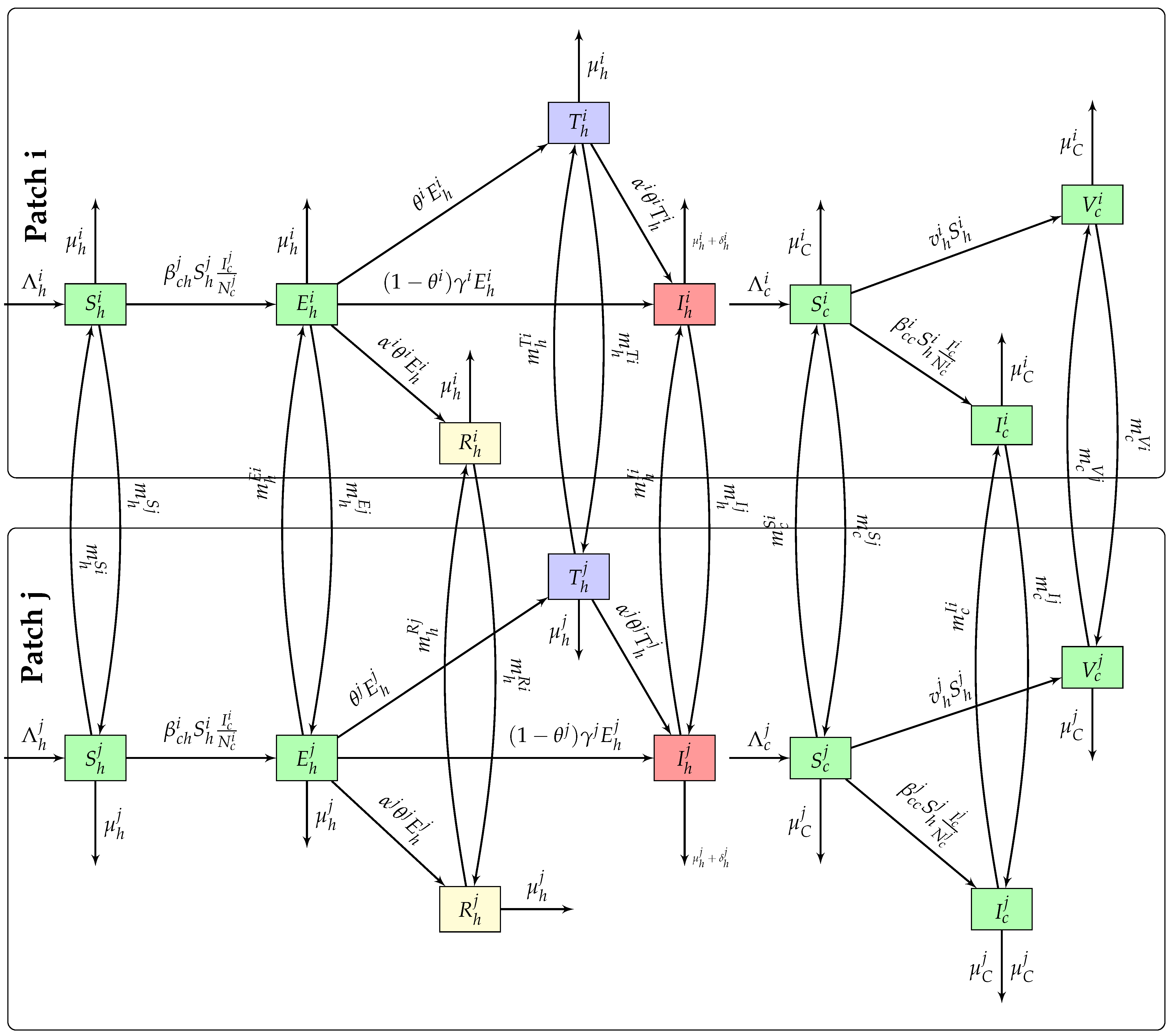
16] as illustrated in
Figure 1.
For each country i,
The canine population is divided into compartments: susceptible (), exposed (), infectious (), and vaccinated ().
The human population is divided into susceptible (), exposed (), and infected ().
Vaccination is applied only to dogs.
The model is formulated for two interconnected countries .
Human movements and dog movements are considered equal.
The parameters and are central to modeling post-exposure prophylaxis (PEP) in humans:
represents the proportion of exposed humans who receive post-exposure prophylaxis after potential rabies exposure. This parameter captures the coverage and accessibility of healthcare services in country i.
represents the efficacy of post-exposure prophylaxis in preventing rabies development among treated individuals. This parameter accounts for the combined effectiveness of wound care, rabies vaccination, and rabies immunoglobulin administration.
In the model structure:
The term in Equation (1g) represents exposed individuals initiating PEP treatment
The term in Equation (1h) represents successfully treated individuals who recover and gain immunity
The term in Equation (1i) represents exposed individuals who don’t receive treatment and progress to infectious rabies
Flow Diagram
The description of variables and parameters is given in
Table 1 and
Table 2 respectively.
The system of equations is given by:
3. Model Analysis
3.1. Vector Form
Before proceeding further, let us specify some vector and matrix notations that will be used later.
Vectors are assumed to be column vectors but are written without particular orientation unless otherwise indicated [
13]. If
, then
means that
,
means that
and there exists at least one
i such that
; finally,
means that
for all
. For
, we have
,
and
if, respectively,
,
and
. This same notation applies to matrices.
Writing system (1) in vector form is particularly useful for the subsequent work. We therefore introduce some notations here.
For any variable
, we denote
, and define:
as the state variable vector of dimension
.
Then the vector form of (1) is
where
represents the local infection and transition terms, and
is the global movement matrix defined by:
The local terms are given by:
The diagonal matrices are defined by:
For each compartment
, the associated movement matrix is given by:
where ∘ denotes the Hadamard product (element-wise product).
Movement matrices of the form (
3) possess many useful properties for the analysis of metapopulation systems [
13,
17], which we will use later in the analysis.
3.2. Positivity
Theorem 1. The components are positive at all times t.
Proof. Equation (
1e) implies
. Its vector form gives
, where
denotes the movement matrix of susceptible canines. The solution of this differential equation is
with
Similarly, the solution of Equation (
1a) is given by
with
. □
Theorem 2. The total human and canine populations are bounded at all positive times t.
Proof. Define the total human population of country i: .
Summing Equation (1e–i), we obtain:
This differential inequality is linear, and its solution is
Thus:
− If , then .
− If , then .
We therefore obtain:
The same reasoning applies to the total canine population:
Thus, all human and canine populations are not only positive but also uniformly bounded in time. □
3.3. Isolated Case
In this section, we consider the initial model without movement.
3.3.1. Rabies-Free Equilibrium
The analysis of equilibrium points of a dynamical system allows identifying stationary states in which populations no longer vary over time.
Thus, by setting the differential equations to zero and assuming the absence of infected or exposed individuals
, we obtain:
We thus have two rabies-free equilibrium points:
3.3.2. Basic Reproduction Number in an Isolated Location
To calculate the basic reproduction number,
We use the
Next-Generation Matrix method of van den Driessche and Watmough [
18].
We consider the following infectious variables for country i, .
The dynamics of these variables is decomposed into two functions:
: rate of appearance of new infections in each compartment and
: rate of transition between compartments (exits and entries due to progression or recovery),
which are given by:
We compute the Jacobian of
F and
V at the disease-free equilibrium (DFE), i.e., when
.
The Jacobian of
and
at DFE are:
We define the next-generation matrix
:
The basic reproduction number
is the
spectral radius (dominant eigenvalue) of
. Here, we have:
Remark 1. This model assumes that humans do not retransmit rabies, which is biologically correct (rabies is not transmissible between humans). This is why is not a source of new infections, and humans do not fuel the epidemic reproduction dynamics.
3.3.3. Local Stability Analysis
Theorem 3. The disease-free equilibrium point is locally asymptotically stable when and unstable otherwise.
Proof. The Jacobian matrix evaluated around the DFE is given by
The stability of the DFE depends on the sign of the eigenvalues of this matrix. We can see:
The 2 × 2 submatrix at the top left is triangular, so its eigenvalues are:
The last eigenvalue (related to
) is:
Then, if
,
. So all eigenvalues have negative real parts. Therefore, the disease-free equilibrium
is locally asymptotically stable.
But, if , . And since one of the eigenvalues is positive, then the disease-free equilibrium is unstable. □
3.3.4. Global Stability of the Disease-Free Equilibrium
Theorem 4. The disease-free equilibrium is globally asymptotically stable if .
Proof. Let us verify the conditions of the Castillo-Chavez theorem.
Let be the class of uninfected individuals, and the class of infected individuals.
For
, the system becomes:
Solving these equations:
i.e.,
and
Taking the limit as
, we obtain:
So is globally stable when .
Now consider the system for infected individuals:
Let
, we have:
Then
since from (
13) and (
9)
Thus, is globally asymptotically stable when . □
Theorem 5. is globally asymptotically stable when .
Proof. Consider the Lyapunov function candidate:
Its time derivative is expressed as:
where
is the basic reproduction number.
The first two terms are always negative or zero
The third term satisfies:
Therefore if , then
The equality is only achieved at the disease-free equilibrium
Conclusion: Under the condition , the derivative is negative semi-definite, guaranteeing the global asymptotic stability of the disease-free equilibrium . □
3.4. Analytical Calculation of the Critical Vaccination Threshold
If
the condition
implies:
If , then : no vaccination effort required to ensure (theoretical viewpoint).
If , then gives the minimum vaccination rate to achieve in steady state to obtain .
Practical remark: this threshold is a theoretical guide; in reality, one must account for actual coverage, vaccine efficacies, parameter uncertainties, and logistics.
Corollary 1 (Critical canine vaccination threshold)
. From the expressionthe condition provides a minimum threshold for the vaccination rate , denoted , such that if then . Proof. Condition on
for
. We start from
- –
Multiply by
:
Divide by
:
- –
Negative case: if , the right-hand side is , so a rate satisfies . Otherwise, a positive minimum vaccination effort is required.
- –
□
3.4.1. Equivalent Expression of Vaccination Coverage p
We express
p as the proportion of vaccinated dogs at equilibrium:
Solving for
:
Substitute into
:
The condition
becomes:
Critical coverage:
We verify that this corresponds to
:
3.4.2. Generalization: Imperfect Vaccine
If the vaccine has an efficacy , the protected fraction is and the remaining fraction is .
3.5. Disease-Free Equilibrium
Then, by setting the differential equations of system (
2) to zero and assuming the absence of infected or exposed individuals
, and noting that the matrix
is non-singular and therefore invertible, we obtain:
We thus have two rabies-free equilibrium points:
3.6. Derivation of the Global Basic Reproduction Number
Considering the vector of infectious variables
, the vectorial transmission and transition functions are:
The Jacobian matrices at the disease-free equilibrium
are:
with
Using the approximations
and
, and considering migration terms as second-order perturbations, we obtain:
The next-generation matrix for the canine subsystem is therefore:
Taking into account the influence of susceptible migration on the equilibrium distribution, we obtain the final form:
The global basic reproduction number is the spectral radius of this matrix:
This expression generalizes the isolated case result and captures the effect of migration between patches on the global epidemic dynamics.
3.7. Local Stability
First, from [
18] (Theorem 2), we have the following result.
Theorem 6. is locally asymptotically stable if and unstable if .
Proof. We need to verify that assumptions A1–A5 of [
18] (Theorem 2) are satisfied. Assumptions A1–A4 follow from the procedure used above to derive
F and
V in the calculation of
. Therefore, all we need to verify is that the disease-free system at DFE is locally asymptotically stable. In the absence of disease, (
2) is a linear system
This is exactly
Section 3.5, so we know it has a unique equilibrium, the disease-free equilibrium (
22). The Jacobian matrix of the system at any point takes the form
We saw in
Section 3.1 that this matrix is invertible. From [
17] (Lemma 2 and Proposition 3), the spectral abscissa of this matrix is negative, so the disease-free equilibrium is always (locally) asymptotically stable. The result then follows. □
4. Sensitivity Analysis
We use the data from
Table 3 for our numerical simulations. In this table, the parameter values are real data but are not yet available online. They are available from IRED (Institute of Livestock Research for Development) in Chad.
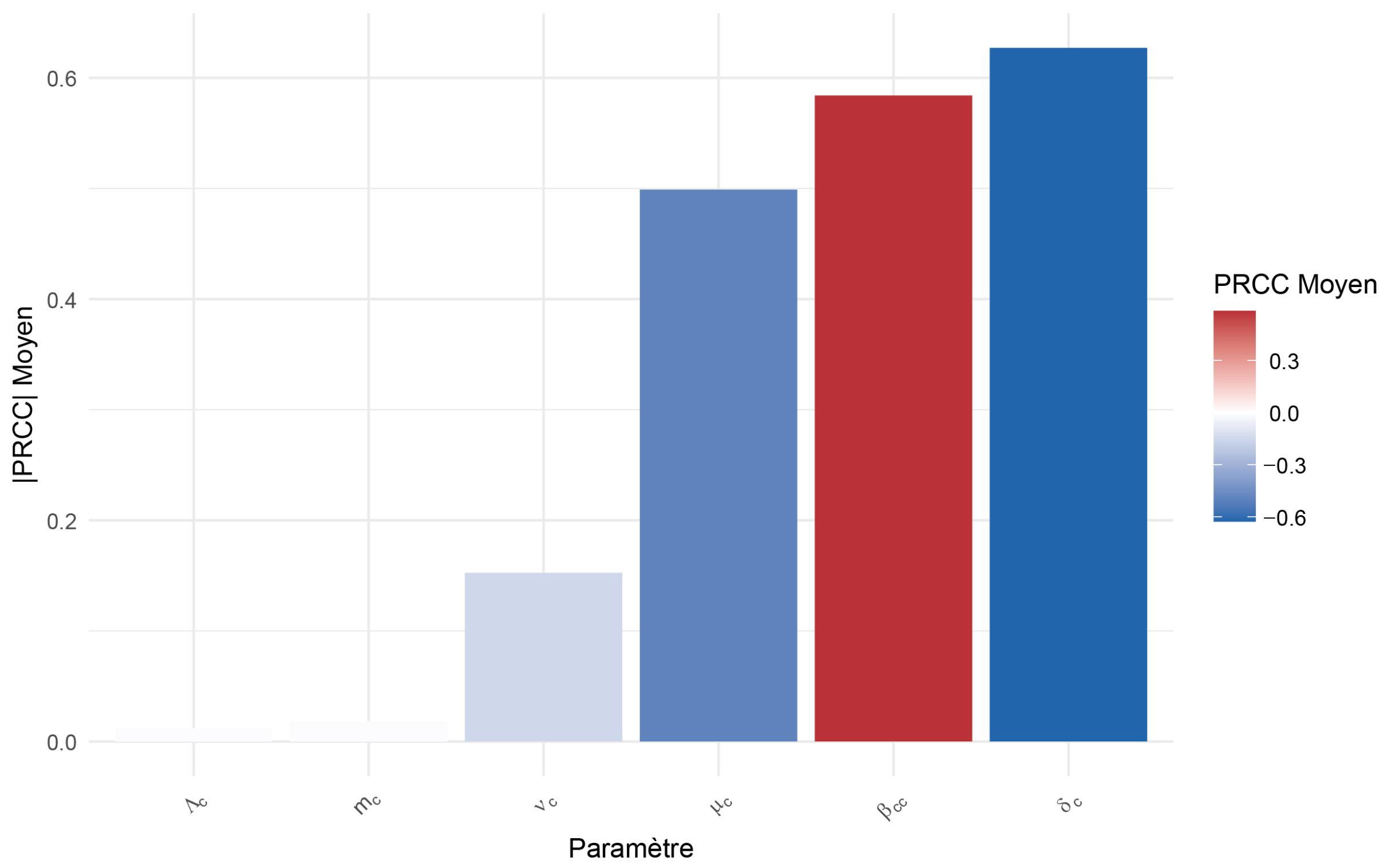
Interpretation: This analysis reveals which parameters to target for effective interventions:
Parameters with high positive PRCC (See
Figure 2) represent priority targets for reduction measures (e.g., decreasing transmission rates). Parameters with high negative PRCC represent intervention opportunities (e.g., increasing vaccination or treatment rates).
5. Numerical Simulations
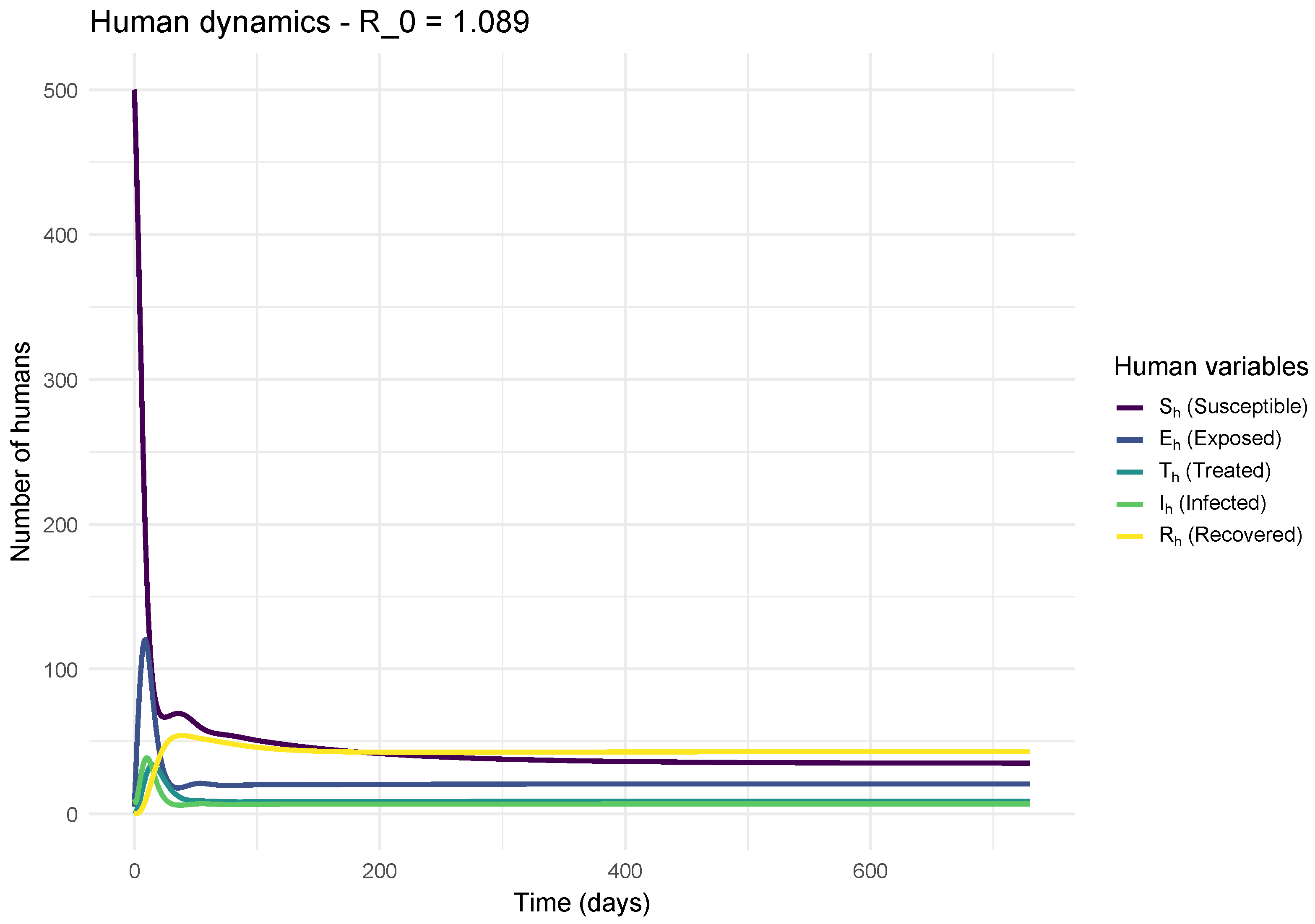
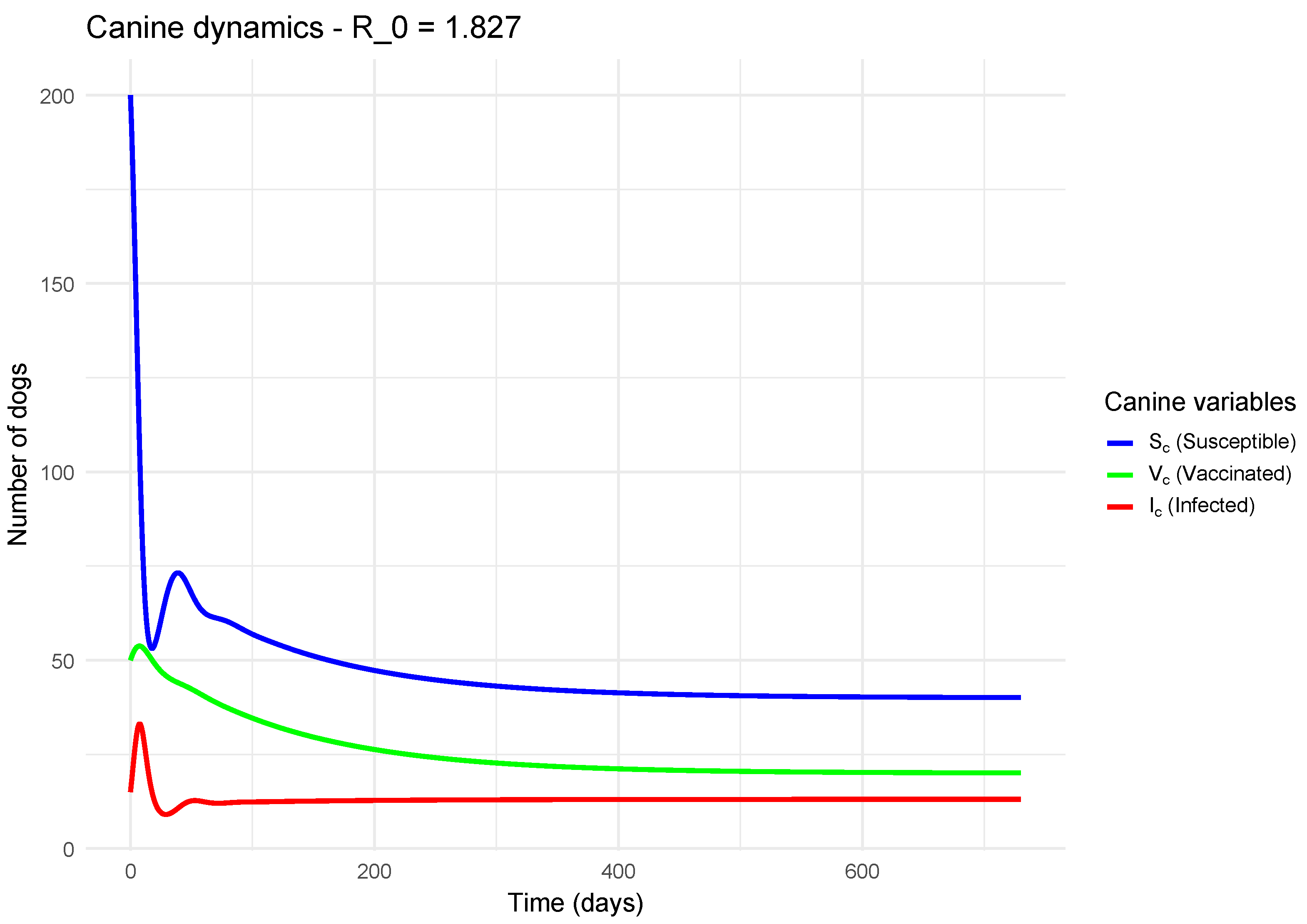
To visualize the temporal dynamics of the model and understand the impact of the basic reproduction number (), we performed numerical simulations for canine and human populations. Two contrasting scenarios were studied: one where , indicating that the epidemic is theoretically controlled, and another where , a scenario in which the disease can spread within the population while accounting for canine mobility.
6. Discussion
Figure 3 shows the dynamics for
. A fulminant epidemic is observed: the infected compartment (
) experiences rapid exponential growth, peaking at a high level where a large portion of the population is simultaneously infected; this is due to the high mobility of dogs between Patches. Subsequently, the number of infected decreases as the susceptible pool (
) is depleted, either by infection, vaccination, or the limited number of dog movements. This curve is characteristic of an uncontrolled epidemic.
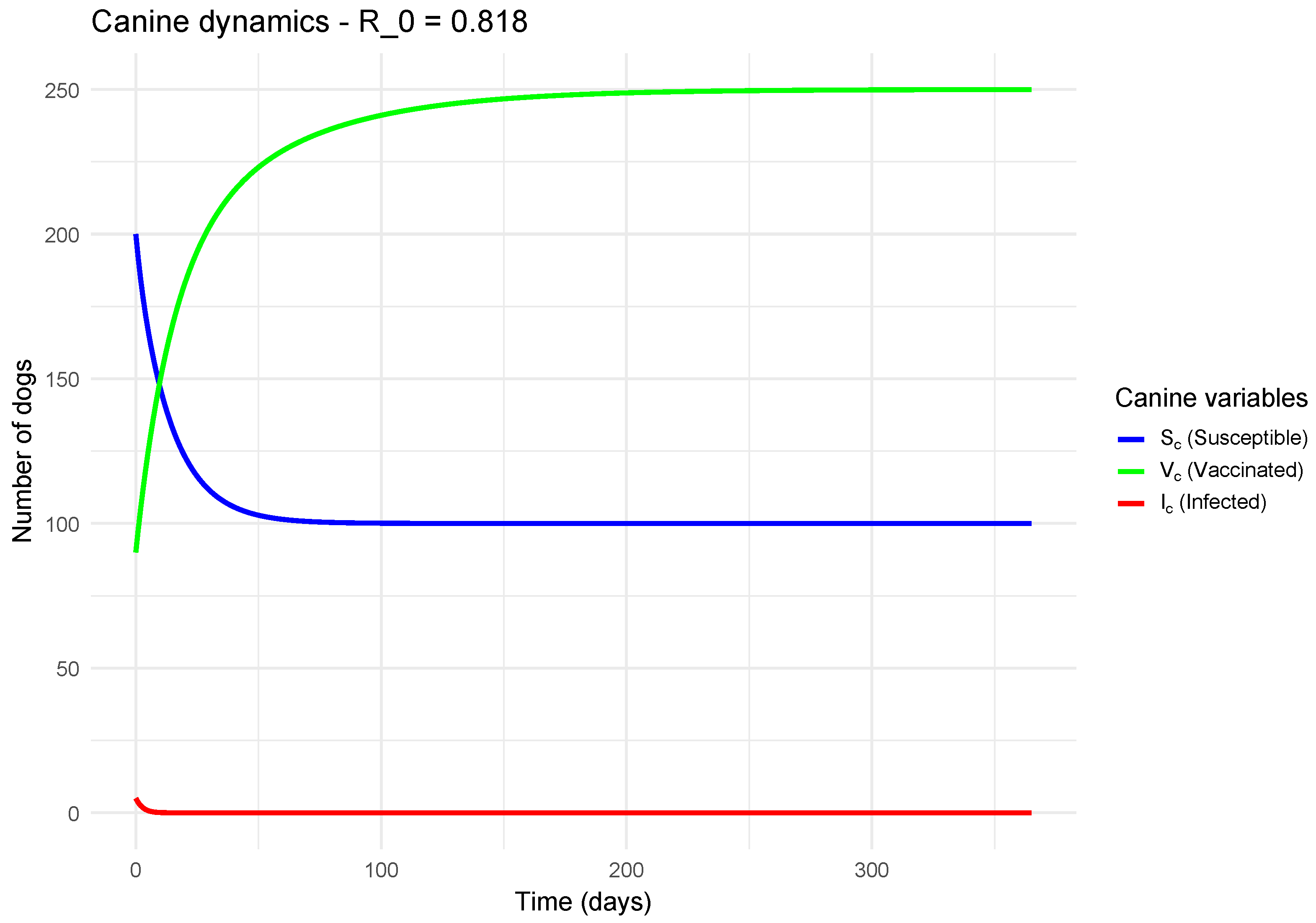
In contrast,
Figure 4 illustrates the scenario where
. Here, the number of infected decreases monotonically from the start, without an epidemic peak. Each infected individual generates on average less than one new infection, leading to the natural and rapid extinction of the disease. The vaccinated population (
) remains significant, contributing to herd protection. This result validates the theoretical threshold: if
, the disease cannot be maintained in the population.
The impact of the two canine scenarios on public health is striking.
Figure 5 shows that an uncontrolled canine epidemic (
) leads to a significant risk for humans (
), resulting in an increase in exposed (
), infected (
), and treated (
) cases.
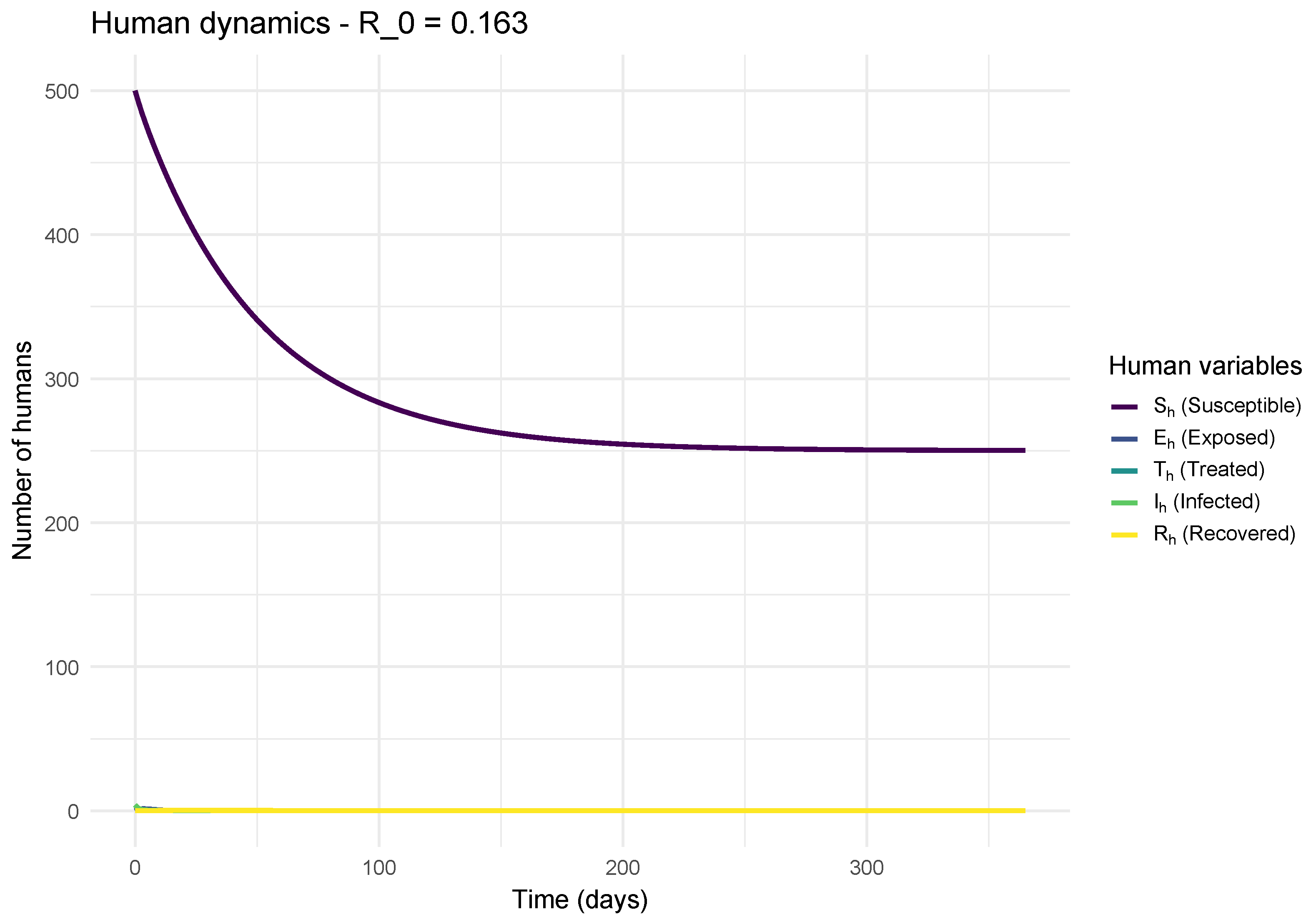
Conversely,
Figure 6 demonstrates the beneficial effect of controlling rabies at its animal source. When
, transmission from dog to human is interrupted, as evidenced by the value
. The curves of the exposed, infected, and treated compartments remain consistently at negligible, if not zero, levels. The human population remains mostly, if not entirely, in the susceptible (
) or immune (
) compartment, confirming that the best strategy to protect humans is to massively vaccinate dogs and reduce their mobility.
These results highlight the critical relationship between disease control in the animal reservoir (the dog) and the risk to human health. They emphasize the importance of maintaining sufficient canine vaccination coverage to ensure that remains sustainably below 1, in order to prevent both canine epidemics and human rabies cases.
7. Conclusions
This study developed and analyzed a metapopulation-type mathematical model for canine and human rabies dynamics in a cross-border context. The theoretical analysis allowed determination of the basic reproduction number, , whose threshold value of 1 governs the stability of the disease-free equilibrium. The results rigorously demonstrate that this equilibrium is locally and globally asymptotically stable when , guaranteeing epidemic extinction, and unstable otherwise, leading to persistent endemicity. Sensitivity analysis identified the parameters most influential on , such as the inter-canine transmission rate () and the vaccination rate (), thus providing priority targets for intervention strategies.
Numerical simulations concretely illustrated the crucial impact of canine vaccination and canine mobility. Insufficient vaccination coverage, leading to , results in an explosive epidemic in the canine population, which immediately translates into an increased risk of transmission to humans. Conversely, vaccination coverage exceeding the critical threshold, ensuring , effectively extinguishes transmission in both dogs and humans. Our results emphasize that without coordinated management of canine mobility, even the highest local vaccination coverages cannot guarantee elimination. Mobility is not an accessory factor but the cornerstone of any sustainable eradication strategy to achieve the global goal of “Zero human dog-mediated rabies deaths by 2030”.
Author Contributions
Conceptualization, A.A.S. and M.S.D.H.; methodology, A.A.S.; validation, M.S.D.H.; formal analysis, A.A.S.; investigation, M.S.D.H.; resources, M.S.D.H.; writing—original draft preparation, M.S.D.H.; writing—review and editing, A.A.S.; visualization, A.A.S.; supervision, M.S.D.H.; project administration, A.A.S.; funding acquisition, M.S.D.H. All authors have read and agreed to the published version of the manuscript.
Funding
This research received no external funding.
Data Availability Statement
The datasets presented in this article are not readily available because no permission for public data has been obtained. Requests to access the datasets should be directed to IRED.
Conflicts of Interest
The authors declare no conflicts of interest.
References
- World Health Organization. Zero by 30: The Global Strategic Plan to End Human Deaths from Dog-Mediated Rabies by 2030; World Health Organization: Geneva, Switzerland, 2018. [Google Scholar]
- Hampson, K.; Coudeville, L.; Lembo, T.; Sambo, M.; Kieffer, A.; Attlan, M.; Barrat, J.; Blanton, J.D.; Briggs, D.J.; Cleaveland, S.; et al. Estimating the global burden of endemic canine rabies. PLoS Neglected Trop. Dis. 2015, 9, e0003709. [Google Scholar]
- Zinsstag, J.; Durr, S.; Penny, M.A.; Mindekem, R.; Roth, F.; Gonzalez, S.M.; Naissengar, S.; Hattendorf, J. Transmission dynamics and economics of rabies control in dogs and humans in an african city. Proc. Natl. Acad. Sci. USA 2009, 106, 14996–15001. [Google Scholar] [CrossRef] [Scilit] [PubMed]
- Beyer, H.L.; Hampson, K.; Lembo, T.; Undurraga, E.A.; Blanton, J.D.; Kahn, E.B.; Dyer, J.L.; Rupprecht, C.E.; Meltzer, M.I. Cost-effectiveness of dog rabies vaccination programs in east africa. PLoS Neglected Trop. Dis. 2018, 12, e0006490. [Google Scholar]
- Lechenne, M.; Mindekem, R.; Madjadinan, S.; Oussiguéré, A.; Moto, D.D.; Naissengar, K.; Zinsstag, J. The importance of a participatory and integrated one health approach for rabies control: The case of N’djamena, Chad. Trop. Med. Infect. Dis. 2017, 2, 43. [Google Scholar] [CrossRef] [Scilit] [PubMed]
- Mancy, R.; Rajeev, M.; Lugelo, A.; Brunker, K.; Cleaveland, S.; Ferguson, E.A.; Hotopp, K.; Kazwala, R.; Magoto, M.; Rysava, K.; et al. Rabies shows how scale of transmission can enable acute infections to persist at low prevalence. Science 2020, 6592, 512–516. [Google Scholar] [CrossRef] [Scilit] [PubMed]
- Zinsstag, J.; Lechenne, M.; Laager, M.; Mindekem, R.; Naïssengar, S.; Oussiguéré, A.; Bidjeh, K.; Rives, G.; Tessier, J.; Madjaninan, S.; et al. Vaccination of dogs in an african city interrupts rabies transmission and reduces human exposure. Sci. Transl. Med. 2017, 9, eaaf6984. [Google Scholar] [CrossRef] [Scilit]
- Ruan, S. Modeling the transmission dynamics and control of rabies in china. Math. Biosci. 2017, 286, 65–93. [Google Scholar] [CrossRef] [Scilit] [PubMed]
- Lv, M.M.; Sun, X.D.; Jin, Z.; Wu, H.R.; Li, M.T.; Sun, G.Q.; Pei, X.; Wu, Y.T.; Liu, P.; Li, L.; et al. Dynamic analysis of rabies transmission and elimination in mainland China. Infect. Dis. Model. 2023, 8, 34–47. [Google Scholar] [CrossRef] [Scilit] [PubMed]
- Chidumayo, N.N. System dynamics modelling approach to explore the effect of dog demography on rabies vaccination coverage decline. PLoS ONE 2018, 13, e0205884. [Google Scholar] [CrossRef] [Scilit] [PubMed]
- Abdramane, A.S.; Djimramadji, H.; Haggar, M.S.D. Study of the dynamics of hiv-cholera co-infection in a mathematical model. Electron. J. Math. Anal. Appl. 2025, 13, 1–11. [Google Scholar] [CrossRef] [Scilit]
- Bourhy, H.; Reynes, J.M.; Dunham, E.J.; Dacheux, L.; Larrous, F.; Huong, V.T.Q.; Xu, G.; Yan, J.; Miranda, M.E.G.; Holmes, E.C. The origin and phylogeography of dog rabies virus. J. Gen. Virol. 2008, 89 Pt 11, 2673–2681. [Google Scholar] [CrossRef] [Scilit] [PubMed] [PubMed Central]
- Saad, A.A.; Arino, J.; Djomegni, P.M.T.; Haggar, M.S.D. A metapopulation model for the spread of cholera. arXiv 2025, arXiv:2505.17269. [Google Scholar] [CrossRef] [Scilit]
- Hossain, M. Rabies Elimination Program of Bangladesh. Bangladesh J. Infect. Dis. 2021, 7, 34–35. [Google Scholar] [CrossRef] [Scilit]
- Lembo, T.; Hampson, K.; Kaare, M.T.; Ernest, E.; Knobel, D.; Kazwala, R.R.; Haydon, D.T.; Cleavel, S. The feasibility of canine rabies elimination in Africa: Dispelling doubts with data. PLoS Neglected Trop. Dis. 2010, 4, e626. [Google Scholar] [CrossRef] [Scilit] [PubMed]
- Mokni, K.; Mouhsine, H.; Ch-Chaoui, M. Multi-parameter bifurcations in a discrete ricker-type predator–prey model with prey immigration. Math. Comput. Simul. 2025, 233, 39–59. [Google Scholar] [CrossRef] [Scilit]
- Arino, J.; Bajeux, N.; Kirkland, S. Number of source patches required for population persistence in a source–sink metapopulation with explicit movement. Bull. Math. Biol. 2019, 81, 1916–1942. [Google Scholar] [CrossRef] [Scilit] [PubMed]
- van den Driessche, P.; Watmough, J. Reproduction numbers and sub-threshold endemic equilibria for compartmental models of disease transmission. Math. Biosci. 2002, 180, 29–48. [Google Scholar] [CrossRef] [Scilit] [PubMed]
- Kebkiba, B.; Ouagal, M.; Kourdina, M.M.; Kemdongarti, N.; Mindekem, R.; Assandi, O. Situation of Rabies in the Republic of Chad. Anim. Vet. Sci. 2017, 5, 52–56. [Google Scholar] [CrossRef] [Scilit]
- Mbaipago, N.; Mindekem, R.; Oussiguere, A.; Moyengar, R.; Naïssengar, K.; Madjadinan, A.; Zinsstag, J.; Léchenne, M. Rabies knowledge and practices among human and veterinary health workers in Chad. Acta Trop. 2020, 202, 105180. [Google Scholar] [CrossRef] [Scilit] [PubMed]
- Kayali, U.; Mindekem, R.; Yémadji, N.; Vounatsou, P.; Kaninga, Y.; Ndoutamia, A.G.; Zinsstag, J. Coverage of pilot parenteral vaccination campaign against canine rabies in N’Djaména, Chad. Bull. World Health Organ. 2003, 81, 739–744. [Google Scholar] [PubMed]
- WHO. Rabies Country Profile: Chad; Technical report; World Health Organization: Geneva, Switzerland, 2021. [Google Scholar]
| Disclaimer/Publisher’s Note: The statements, opinions and data contained in all publications are solely those of the individual author(s) and contributor(s) and not of MDPI and/or the editor(s). MDPI and/or the editor(s) disclaim responsibility for any injury to people or property resulting from any ideas, methods, instructions or products referred to in the content. |
© 2025 by the authors. Licensee MDPI, Basel, Switzerland. This article is an open access article distributed under the terms and conditions of the Creative Commons Attribution (CC BY) license (https://creativecommons.org/licenses/by/4.0/).