


Abstract
Inventory models have evolved to incorporate a wide range of realistic factors, including growing items, imperfect quality, deterioration, and sustainability concerns. While these areas have received significant individual attention, no model has yet integrated the complexities of growing items, imperfect quality, deterioration, and carbon emissions. This study addresses this gap by introducing an economic order quantity (EOQ) model for growing items that simultaneously accounts for imperfect quality, deterioration, carbon emissions, and a demand rate that is influenced by both stock levels and the freshness condition. The goal is to determine the replenishment cycle and the optimal order quantity that will maximise profit. A numerical example is presented to illustrate the model’s feasibility. A sensitivity analysis on key parameters is also conducted to provide critical managerial insights. The results reveal that the shelf life of items and the scaling parameter of demand are among the most influential factors of profit, causing up to 150% and 112% increase in profit, respectively. The findings also indicate that deterioration significantly impacts system profitability by up to −45%. Another critical insight is that profit decreases by up to 80% when the weight of the growing items increases. Furthermore, emissions can be most effectively reduced by focusing on the feeding process, which represents the most impactful factor for improving sustainability, whereas emissions from the screening process, purchasing, deterioration, and storage hold minimal financial consequence.
1. Introduction
Inventory management encompasses all activities involved in planning and controlling inventory levels of raw materials, work-in-progress items, and finished goods, ensuring a sufficient amount of inventory is available [1]. An effective inventory management has a significant impact on company performance in real-world systems, as key decisions are often made around order/batch quantities and timing. Poor inventory control can lead to costly outcomes, while appropriate management helps meet customer demand. It enables companies to maintain optimal inventory levels, preventing shortages or excessive stock while minimising operating costs.
Numerous inventory models have been developed in the literature, with Harris [2]’s economic order quantity model being the foundational framework. The traditional EOQ assumes deterministic, constant demand over the planning horizon and instantaneous order receipt, aiming to determine the optimal order quantity that minimises total costs, primarily holding and ordering costs. However, real-world inventory systems often require relaxing these basic assumptions to address more complex scenarios. In practical situations, many products exhibit characteristics that deviate significantly from traditional EOQ assumptions. For instance, growing items, particularly in agricultural sectors, experience weight increases during the inventory cycle [3]. Additionally, inventory models have been developed for scenarios where demand is influenced by price [4], time [5], and shelf life [6]. Other models consider multi-item systems [7]. Furthermore, products often require inspection before release to consumers due to quality concerns. Many items also experience deterioration over time, with freshness declining as they approach expiration dates. The demand for such products is often influenced by the stock levels, which adds further complexity to inventory management [8]. Adding to these challenges, environmental sustainability concerns have made carbon emissions a critical factor in modern inventory systems. Governments worldwide are implementing carbon emissions regulations, increasing operational costs to compel firms to adapt their business practices. As a result, many companies are increasingly adopting inventory models that prioritise carbon footprint reduction while maintaining economic viability. This paper develops an integrated inventory model that addresses these real-life challenges simultaneously to determine optimal ordering policies that balance economic objectives for growing items. The remainder of the paper is structured as follows: Section 2 reviews the related literature; Section 3 defines the key terms and then outlines the underlying assumptions; in Section 4, an inventory model is developed for growing items with imperfect quality, deteriorating items, and carbon emissions, where demand is considered to be dependent on the freshness condition and stock level; Section 5 presents a numerical example and sensitivity analysis; a conclusion is presented in Section 6.
2. Literature Review
Many products, unlike those assumed to be of perfect quality, require inspection before they can be released and sold to consumers to separate products of good quality from poor quality. Those that fail to meet the standards are classified as imperfect-quality items, and the model of Salameh and Jaber [9] may be considered as the classic model for such problems. They formulated an inventory management model to account for the presence of a certain proportion of lower-quality items within each production lot. Chang [10] developed an inventory model for items with fuzzy imperfect-quality rate and demand to identify the optimal order quantity that maximises the overall profit. Wee et al. [11] developed an optimal inventory model that accounts for the presence of imperfect-quality items with full backordering. Konstantaras et al. [12] developed inventory models for imperfect-quality items with shortages, where the fraction of imperfect quality in each shipment was reduced because of learning in inspection. Cárdenas-Barrón [13] derived closed-form expressions to determine the optimal solution to an inventory model considering items with imperfect quality. Hsu and Hsu [14] proposed an inventory model with imperfect-quality products, inspection errors, shortages with backordering, and sales returns. Zhou et al. [15] introduced an integrated economic order quantity model that simultaneously accounts for trade credit, shortages, imperfect quality, and inspection errors and derived the closed-form optimal solution to the model. Taleizadeh et al. [16] presented an extension of the traditional economic order quantity inventory model to address the challenges associated with imperfect products in supply chains with long distances between the buyer and supplier. The proposed model incorporates partial backordering and considers imperfect products that are repairable. These imperfect items are withdrawn from an inventory, sent in a single lot to a local repair shop, and then returned as a repaired batch to the buyer’s store. Jaggi et al. [17] introduced a two-warehouse inventory model that accounts for deteriorating, imperfect-quality items and delayed payments. The model’s key features include an immediate screening of incoming inventory, with the screening rate exceeding the demand rate to enable concurrent fulfilment of demand and identification of quality items.
Certain products, unlike traditional or conventional products, require feeding until they reach a specific weight before they can be slaughtered and sold to consumers. These are named growing items, and the model of Rezaei [18] may be considered as the classic model for such problems. Additionally, the preparation of these items for sale typically involves some level of quality inspection to separate products of good quality from poor quality. A key distinction between these growing items and more conventional products, like phones or books, is that the total weight of the growing items increases over the course of an inventory cycle. Various researchers have begun to build upon Rezaei’s work for growing items, expanding it for diverse applications. For instance, Malekitabar et al. [19] presented an inventory model for the production of items that undergo a growth process to analyse a two-echelon supply chain consisting of a supplier and a farmer. Khalilpourazari et al. [20] studied a multi-item inventory control system for growing items, considering budget and warehouse capacity constraints. Sebatjane and Adetunji [21] developed a coordinated inventory management model for a supply chain involving growing items, focusing specifically on item mortality and quality control protocols. Pourmohammad-Zia and Karimi [22] developed an inventory model for a rearing farm that considered factors such as quality degradation from overbreeding, age-dependent breeding, and holding costs. Sebatjane and Adetunji [23] formulated a model for growing inventory in a three-stage supply chain, including farming, processing, and retail echelons and investigated the effectiveness of a profit enhancement mechanism under stock-dependent demand. Biswas et al. [24] presented a model for inventory control of growing items, considering the post-pandemic scenario to examine how poultry farmers can manage their farms to mitigate the impact of viral diseases and maximise profitability by determining the optimal order quantity. Mokhtari et al. [25] expanded the traditional inventory model to incorporate growing items, where livestock grows during a specific period. It is assumed that the slaughtered livestock deteriorates during the sales period. Furthermore, a weight reduction factor is introduced to account for the waste generated when livestock are slaughtered. Nobil et al. [26] considered a generalised inventory model for growing items under shortages and penalties. Their objective was to minimise total costs, including setup, purchasing, holding, feeding, and shortage costs, while accounting for permissible shortages. Sebatjane et al. [27] extended Sebatjane and Adetunji [3]’s model to integrate three different carbon emissions regulations, namely, carbon cap, carbon cap-and-trade, and carbon tax regulations, with demand dependent on the selling price and the environmental impact.
The management of deteriorating items represents another crucial component of inventory systems. Such goods, which are susceptible to degradation or obsolescence over time, are prevalent across various real-world inventory contexts, including the handling of perishable commodities, pharmaceutical products, and electronic components. Deterioration is an important factor to consider in inventory management, as it affects the quality and usability of inventory items over time. The first model on deteriorating items was introduced by Ghare [28], in which the deteriorating rate was assumed to be constant and the purchasing cost was paid at the time of delivery. Chang [29] proposes a model with deteriorating items under inflation, with supplier credits linked to the order quantity. The work by Khanra et al. [30] proposed an economic order quantity model for a deteriorating product with a time-dependent demand and delayed payments. The deterioration rate was assumed to be constant, and the time-varying demand was modelled as a quadratic function. Widyadana and Wee [31] discussed an optimal production inventory model for deteriorating items with random machine breakdowns and stochastic repair time. Thangam [32] formulated an inventory problem for perishable products under two-echelon trade credits in a single-supply chain. Sanni and Chukwu [33] proposed an economic order quantity inventory model for deteriorating items with a three-parameter Weibull distribution for deterioration and a ramp-type demand function. Taleizadeh [34] developed inventory models for a deteriorating product with and without shortage under consecutive prepayments. Viji and Karthikeyan [35] introduced a three-level economic production inventory model for deteriorating items, with the deterioration rate following a two-parameter Weibull distribution. The model allows for switching between production rates over time. Rahman et al. [36] looked at a model for deteriorating products where there were both shortages and no shortages, and factored in discounts. The rate at which items deteriorated was described using interval-based parameters. Mallick et al. [37] considered a stock-dependent demand inventory model for deteriorating items, where the demand increases with the stock level. The effects of lead time, inflation, and a finite time horizon are also incorporated. Rabiu and Ali [38] proposed an innovative modification to the EPQ model that integrates Weibull-distributed gradual deterioration, holding costs, variable demands, and effective strategies for managing shortages and backlogs. Arunadevi and Umamaheswari [39] proposed an inventory model aiming to address and meet consumers’ needs and preferences. The model combines time and pricing considerations to minimise deterioration during the amelioration of items.
Some products, such as fruits, milk, meat, and vegetables, have a limited shelf life and eventually deteriorate or spoil over time. As these products approach their expiration date, their freshness and quality gradually diminish until complete depletion is reached at the point of expiration. Sarker et al. [40] examined the negative effect of ageing stocks on the demand rate for deteriorating items. Bai and Kendall [41] presented a model for optimising shelf-space allocation and inventory management for a perishable product with a fixed lifetime and a stock- and age-dependent demand function. Wu et al. [42] presented an inventory model that addresses non-ending scenarios, relaxing the banal zero-ending assumption to a non-ending situation, with demand dependent on both the stock and the freshness condition of the items. Chen et al. [43] conducted a study on the published work of Wu et al. [42], taking into account shelf space and non-ending situations. Janssen et al. [44] studied an inventory model that takes into account both age and closing days constraints. The proposed stochastic multi-items inventory model considers various factors such as total stock capacity limits, positive lead time, periodic inventory control, target customer service level, and mixed FIFO and LIFO. Khan et al. [45] suggested a model for deteriorating products, where the consumer’s demand is influenced by the sale prices of the products and their expiry dates. Sebatjane and Adetunji [46] used the selling price and the age of items to investigate an inventory model for perishable items that have little brand identification within the supply chain that starts with farming operations and ends with consumption. The study conducted by Khan et al. [47] explored two inventory models for perishable products under shortages. To better model the demand for these perishable items, Khan et al. [47] used a price- and freshness-dependent demand function.
Global warming poses a significant threat to the world, with carbon emissions being a primary driver of this concerning issue. Consequently, sustainability has become an essential concern for all individuals seeking to preserve the health of the planet. It is widely acknowledged that industrial activities generate substantial carbon emissions [48]. These activities ultimately contribute to the deterioration of the environment and the ongoing challenge of global warming. In an effort to promote environmental sustainability and mitigate pollution, governments often impose policies that restrict carbon emissions. These regulations have inevitably increased operational costs for firms, thereby incentivising them to adapt their business practices and comply with the government’s requirements. In response to these regulatory and economic pressures, numerous companies have adopted inventory management models designed to prioritise the reduction in carbon footprint. By optimising their supply chains, implementing green technologies, and adopting sustainable inventory strategies, these firms have been able to navigate this challenging regulatory landscape while also contributing to the broader goal of environmental protection.
This corporate shift has motivated a significant body of academic research aimed at developing quantitative models for sustainable inventory management. Many models have been developed, including the work by De-la-Cruz-Márquez et al. [48] which proposed an inventory model for growing items with imperfect-quality and price-sensitive demand, considering carbon emissions and shortages to determine the optimal selling price, order quantity, and backordering quantity that maximise expected total profit. Hua et al. [49] investigated how companies manage carbon emissions in inventory management. Bouchery et al. [50] added sustainability criteria into a warehouse–retailer supply chain. Pan et al. [51] examined the environmental impact of pooling supply chains, and they found that supply network pooling is an efficient approach to reducing emissions. Zanoni et al. [52] developed a joint economic lot-sizing model to optimise coordinated inventory replenishment decisions in a vendor-managed inventory system with consignment stock and an emissions trading scheme. They considered a single product flowing along a two-stage supply chain with a single vendor and a single buyer. The total cost of the system in their analysis included setup and ordering costs, inventory holding costs, as well as costs associated with greenhouse gas emissions in the form of taxes and penalties. He et al. [53] incorporated carbon emissions costs into the objective function of the economic order quantity model under carbon cap-and-trade and carbon cap regulations, respectively, and then determined the optimal order quantity while minimising inventory and carbon emissions costs. Tiwari et al. [54] investigated an integrated single-vendor–single-buyer inventory model for deteriorating items with imperfect quality, considering the environmental implications of carbon emissions. Carbon emissions result from transporting, warehousing, and management of deteriorating items. Transportation emissions depend on factors like vehicle fuel consumption, fuel emissions, and travel distance. Warehouse emissions are influenced by the total inventory and the energy consumption per unit item. Emissions are also associated with the disposal of deteriorating items. Li and Hai [55] examined inventory management for a one-warehouse, multi-retailer system that incorporates carbon emissions considerations to determine the optimal reorder intervals for the warehouse and retailers while minimising both inventory-related costs and carbon emissions costs. Medina-Santana and Cárdenas-Barrón [56] formulated a sustainable inventory model that incorporates a discontinuous transportation cost function and a new carbon emissions function. The model considers various pollution sources in the decision-making process, which are not accounted for in traditional inventory management approaches. Modak and Kelle [57] proposed applying corporate social responsibility investments into a closed-loop supply chain while considering carbon emissions tax. The integrated closed-loop supply chain framework incorporates stochastic demand that is influenced by both the sales price and social work donation. Zhang et al. [58] analysed an inventory management model for growing items to discuss the impact of carbon constraints on overall costs, carbon emissions, optimal order quantities, and slaughter times. Their findings also suggest that a modest penalty can motivate retailers to lower their carbon emissions. Yadav et al. [59] introduced a sustainable inventory model for deteriorating products to address changes in the quality of products under demand volatility and stockouts over a specific planning horizon. The authors considered demand as a trapezoidal demand function and incorporated Weibull distributions for both amelioration and deterioration processes, as well as a carbon cap-and-tax policy to optimise replenishment decisions while promoting environmental sustainability. Saurav et al. [60] proposed a dual-objective strategy for sustainable supply chain management aimed at minimising operational costs and improving environmental responsibilities under a two-level trade credit policy for a supplier–manufacturer–customer supply chain across multiple scenarios based on credit periods. Sebatjane [61] developed four sustainable inventory models for perishable products with imperfect quality to study the effects of inspection errors, advertising frequency, expiration date, selling price, as well as carbon tax and carbon cap policies.
Stock level is another stream of studies that has been included in the literature. It is commonly observed that many organisations display large quantities of items to drive the sales of specific products [62]. Baker and Urban [63] developed a scenario of a continuous, deterministic inventory system in which the demand rate follows a polynomial function that varies with the stock level. Alfares [64] presented an inventory policy for products with a stock-level-dependent demand rate and a storage-time-dependent holding cost. Goyal and Chang [65]’s study investigated an inventory model that determined the optimal order quantity for the retailer and the optimal replenishment rate from the warehouse to the retailer. The model incorporated a stock-dependent demand function as well as a constraint on the displayed space. Sarkar [66] developed a model that accounts for a finite replenishment rate where demand is influenced by the stock level. Chakraborty et al. [67] examined multi-item integrated production inventory models involving collaboration between suppliers and retailers for products with a constant deterioration rate and stock-dependent demand functions. Pando et al. [68] explored an inventory model for perishable goods with a fixed deterioration rate and stock-dependent demand. The cumulative holding cost used for the items in stock is defined by a nonlinear function that depends on both time and inventory level. Building on prior research, Chen et al. [69] proposed an inventory model for short-life cycle products that experience deterioration over time. The model considers a finite-horizon, multi-period setting, wherein the deterministic demand is influenced by stock levels, time, and pricing.
An examination of the existing literature indicates a lack of research on inventory models that account for growing, imperfect-quality items, deterioration, the effect of stock levels on demand, the effect of freshness, and the effect of carbon emissions. A comparison of the suggested inventory system and previously published relevant models is provided in Table 1, which highlights the contributions of various research papers and the novel insights introduced by this study regarding the inventory theory for growing items.
Table 1.
Gap analysis of related works in the literature.
The primary aim of this study is to develop an inventory model that accounts simultaneously for growing items, imperfect quality, deterioration, freshness effects, stock-dependent demand, and carbon emissions to determine the optimal cycle time and order quantity that will maximise total profit. By integrating these factors, the proposed model provides a more realistic and comprehensive framework than the classical economic order quantity model and extends the works of Salameh and Jaber [9], Rezaei [18], and Sebatjane and Adetunji [3]. This study bridges the gap in the literature by integrating, for the first time, an EOQ model that integrates growing items, imperfect quality, deterioration, stock-level- and freshness-dependent demand, and carbon emissions all at once. The model serves as a practical decision-support tool for managers in sectors such as poultry and perishable goods, as it offers optimal policies that balance profit with environmental sustainability, along with other constraints.
3. Notations, Assumptions and Model Development
3.1. Notations
Table 2.
Notations used in the formulation of the mathematical model.
Table 3.
Notations used in the formulation of the mathematical model.
3.2. Assumptions
The model is based on the following assumptions:
- The inventory system starts with a quantity y of a growing item, and the replenishment cycle occurs at fixed time intervals T.
- The slaughtered items are immediately inspected and prepared for sale to consumers.
- The slaughtered items have a maximum shelf life of L time units, which constrains the inventory replenishment cycle duration to be less than this lifetime (i.e., ).
- A 100% inspection is performed on the entire batch at a screening rate x to separate the products based on their quality into ’good’ and ’bad’ products.
- A percentage of the slaughtered items are of imperfect quality.
- Good quality products are sold at a price .
- All imperfect-quality products are collected and sold together as a single batch at the end of the inspection procedure at a price .
- The freshness function for the product is deterministic and is dependent on the shelf life L of the slaughtered items as follows:
- The inventory is at its peak freshness immediately after slaughter and delivery to the customer, with at . The product then deteriorates over time, reaching its expiration date at when . To maintain product quality, the retailer’s inventory cycle time T must be less than the expiration date L.
- The demand for the product is deterministic and is dependent on the level of the current inventory and its freshness as follows:where and .
- The inventory is subject to a physical deterioration, , and it is a time-dependent function represented by the following exponential function:
- Deteriorated items are not repairable and, therefore, are discarded to reflect the impact of cost and emissions processing these items.
- The shortages are not permitted.
- The inventory purchasing, holding, and ordering activities result in the release of carbon emissions.
- Carbon tax policies are implemented as a regulatory measure to reduce emissions.
4. Mathematical Model
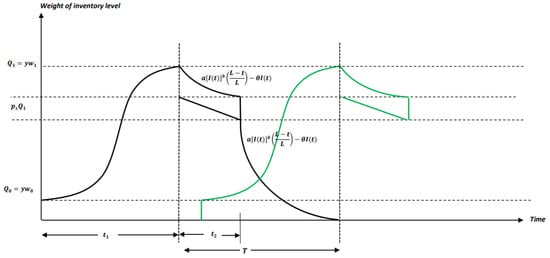
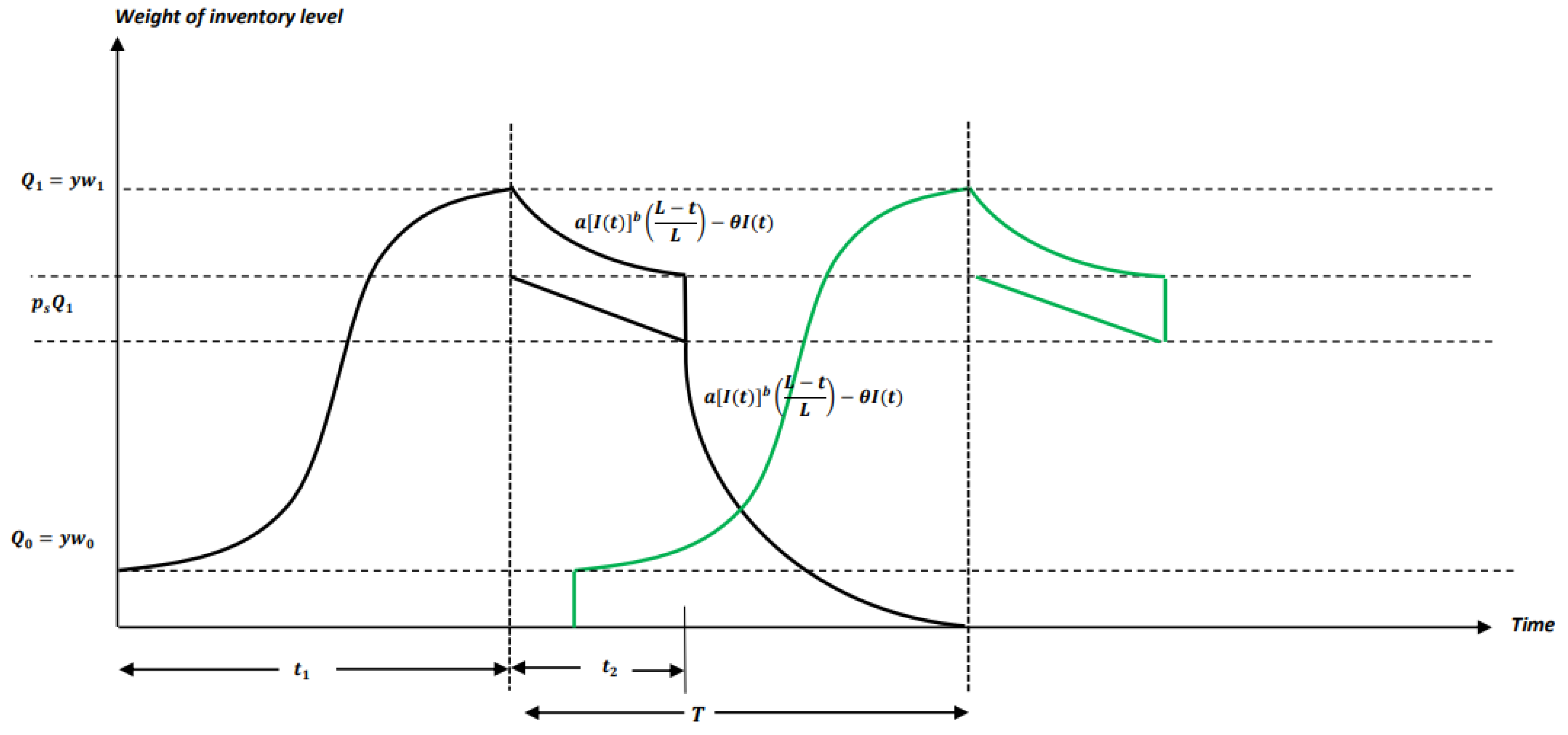
At the beginning of each cycle, a company procures y newborn items. When these are first acquired, each one weighs . The total weight of the inventory at the time the newborn items were purchased, , is calculated by multiplying the weight of each newborn item by the total number, y, bought. These items are then fed and grow until they reach a certain weight , at time . These items are then processed once the company reaches its target weight, . The total inventory weight at time is . Afterwards, the processed items are then screened over a period at a rate of x. After the screening, a portion of these screened items is considered to be of poor quality. At the end of the screening period, these poor-quality items are sold as a single batch at a discounted price. Figure 1 shows the inventory level corresponding to growing items with imperfect quality, deterioration, freshness- and inventory level-dependent demand as well as carbon emissions. At every inventory cycle , the stored inventory is consumed at a demand rate of D until it reaches zero at time T. The aim is to find the cycle time T and the order size y, so that total profit is maximised.
Figure 1.
Inventory profile for growing items with imperfect quality, showing the growth phase and the consumption phase.
Using the assumptions in Assumptions, the inventory level is governed by the following differential equation:
Integrating both sides of Equation (5) yields
From Equation (6), under the boundary condition , we get
Thus, the total weight, using the boundary condition at , can be expressed as
The proposed inventory model aims to optimise the company’s overall profit by subtracting the total cost function from the total revenue . These costs encompass purchasing , ordering , screening , feeding , deteriorating , holding ( and ), and carbon emissions expenses. The company’s total profit function is given by
Since all the slaughtered inventory must be inspected before being sold, the duration of the inspection period is computed as
4.1. Total Cost Function (TCF)
The total cost function includes the feeding cost, the holding cost of the perfect products, the holding cost of the imperfect products, the deterioration cost, the screening cost, the purchasing cost of the newborn items, the ordering cost, and the carbon tax emissions cost.
4.1.1. Feeding Cost per Cycle
The feeding cost per cycle can be calculated as the product of the feeding cost rate and the quantity of food consumed by the total number of growing items during the growth period. This can be expressed as
Specific mathematical model: Case of items with a linear growth function
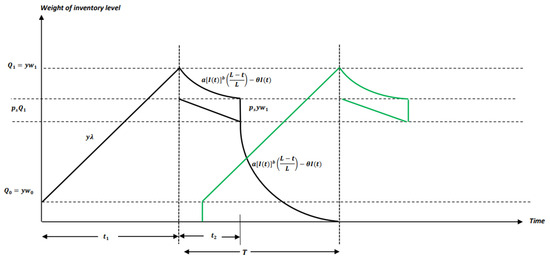
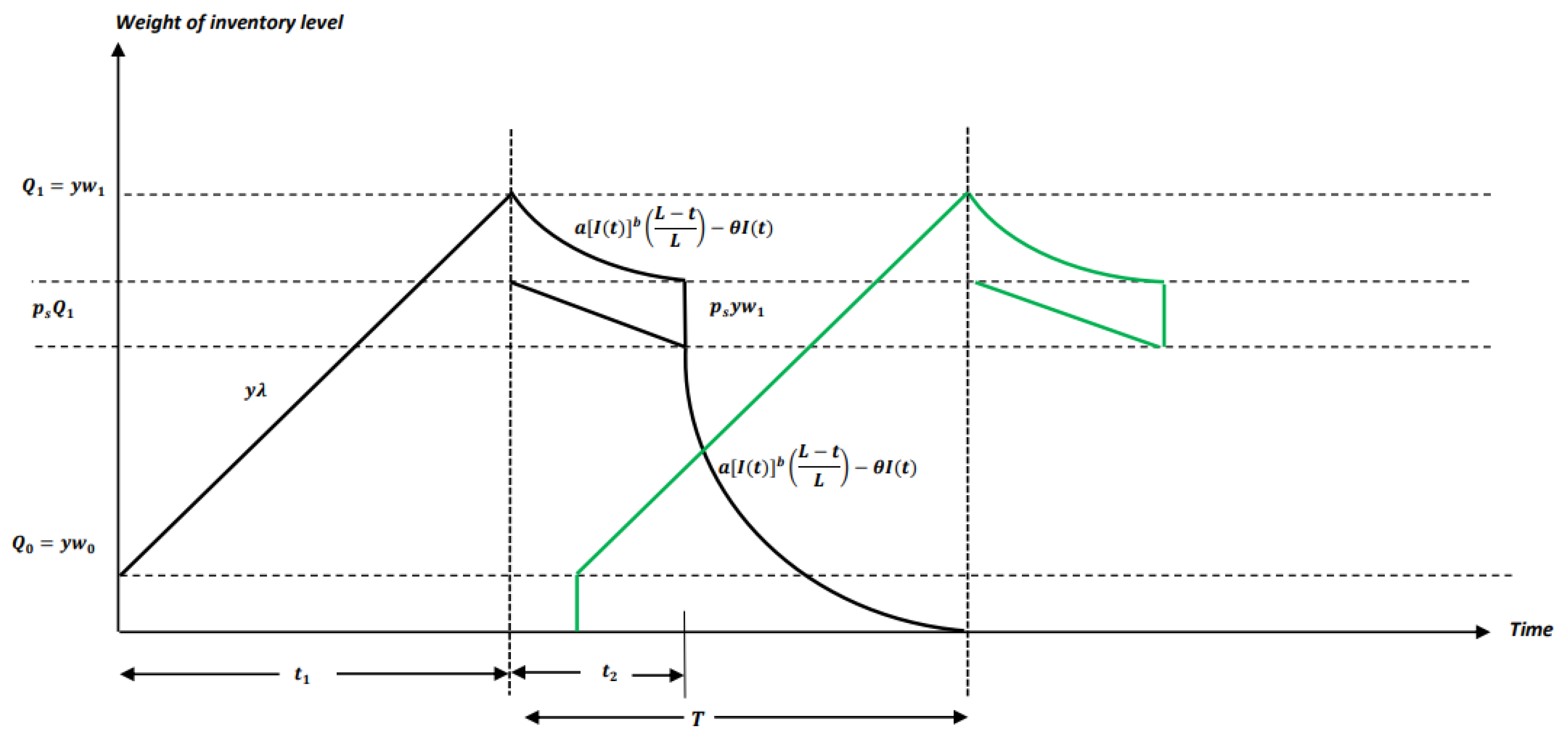
Consider a situation where each item’s growth, , follows a linear growth. Their weight goes up at a steady rate, b, units per unit of time, for a period as shown in Figure 2. If is the weight of each newborn at the start and is the weight of each grown item at time , then can be represented as a linear function, with a slope of and a y-intercept of as expressed in Equation (13)
Figure 2.
Inventory system behaviour for growing items with imperfect quality under the assumption of linear growth function.
Multiplying each term by the batch size y gives the growth function for all the ordered items.
From Figure 2, the growth period can be expressed as
Feeding Cost per Cycle
To determine the feeding cost, the following factors are considered: the feeding cost rate, the duration of the feeding period, the difference in the weight of the items from the start to the end of the feeding period, and the number of ordered items that need to be fed. The feeding cost per cycle is expressed as
4.1.2. Holding Cost of the Good Product
The organisation incurs a holding cost associated with keeping items throughout the cycle period T. This is represented mathematically by Equation (18).
To simplify the model, the exponential functions in both Equations (8) and (9) are expanded using Maclaurin’s series.
Maclaurin expansion of
For small values of (neglecting higher powers of ) and , we get
can be approximated using the Maclaurin series expansion. For small values and , the exponential function is approximated as
4.1.3. Holding Cost of the Imperfect Product
The holding cost of the imperfect product is determined by multiplying area (2) in Figure 2 by the holding cost rate of the imperfect product.
4.1.4. Deterioration Cost
This is a cost that is attributed to the products that deteriorate. This is calculated as
4.1.5. Screening Cost
A inspection is carried out at a rate x to separate the good quality items from imperfect ones. The organisation incurs a cost to inspect the batch size. The total cost of inspecting in each replenishment cycle is
4.1.6. Purchasing Cost of the Product
At the start of each cycle, the organisation procures y newborn items, each weighing , at a unit price of per unit of weight. Thus, the purchasing cost of all the items at the beginning of the cycle is
4.1.7. Ordering Cost
At the start of the cycle, an ordering cost is incurred. this is expressed by
4.1.8. Carbon Emissions Costs
Carbon Emissions caused by the purchasing action
Carbon emissions caused by the purchasing action refer to the greenhouse gases released during the procurement process. In the context of growing items, the carbon emissions caused by the purchasing action can be expressed as the product of the amount of carbon emissions generated by the quantity . This can be expressed by
Carbon emissions generated during the feeding process
The carbon emissions generated during the feeding of growing items can be modelled as the product of the unit of carbon emissions per unit time and the integral of the feeding function over the growth cycle . For the linear growth, this can be calculated using area (3) depicted in Figure 2.
Carbon emissions created in holding inventory’s operations
In addition to the financial holding costs, the organisation also incurs carbon emissions costs due to the storage of inventory throughout the cycle period T. The carbon emissions associated with holding inventory is calculated as
Carbon emissions made by deteriorating products
The carbon emissions due to deterioration can be represented as
Carbon emissions made by the screening process
The carbon emissions generated by the screening process is given by
Governments often employ carbon taxation as a regulatory mechanism to penalise carbon emissions. This means that companies are required to pay a fee, which is referred to as carbon , on the amount of carbon they emit. As a consequence, the company incurs a per-period cost associated with its carbon emissions, and this can be expressed as
The total cost function is simplified and obtained in Equation (11) by substituting the relevant cost components, such as the holding cost of perfect and imperfect products, deterioration cost, screening cost, purchasing cost, ordering cost, and carbon tax emissions cost, from their respective equations. Thus,
4.2. Total Revenue Function (TRF)
The total revenue , as depicted in Equation (40), is composed of two components: the revenue , generated from the sales of perfect products, and the revenue obtained from the sales of imperfect/deteriorated products.
The revenue from the sales of perfect items is calculated by multiplying the selling price, , per perfect product by the number of perfect items sold. The quantity of perfect items is determined by subtracting the quantity of imperfect/deteriorated items from the total quantity slaughtered/produced. This revenue represents the income from the sales of perfect products. The revenue from imperfect/deteriorated items is calculated by multiplying the discounted selling price, , of the imperfect/deteriorated items by the quantity of imperfect/deteriorated items. Hence,
4.3. Total Profit per Unit of Time (TPU)
The total profit, TRF, is calculated by subtracting the total cost, TCF, incurred from the total revenue, TCF, generated. Hence,
Equation (42).
The expression for the total profit per cycle is obtained by substituting the values , , , and into Equation (43), then dividing the entire expression by the cycle T. Hence, the total profit, TPU, per cycle is
One key assumption is that the total inventory of slaughtered items is equal to the quantity, , consumed. The number of newly ordered items per cycle is calculated by dividing by the weight of each fully grown item at the time of slaughtering . Thus,
4.3.1. Model Constraint
To ensure that the processed items are available for consumption within the specified timeframe, the growth duration and the screening time must not exceed the consumption period. Hence, a constraint is imposed on T, and it is formulated as
4.3.2. Mathematical Formulation of the EOQ Model for Growing Items with Imperfect Quality and Carbon Emissions
Using the objective function in Equation (46) and the constraints, the mathematical formulation for the proposed system is given by
To demonstrate the existence of a unique solution for the equation and confirm that the value at the given point maximises the objective function, it is sufficient to calculate the second derivative with respect to T in Equation (A1) in the Appendix A to establish that it is negative definite. However, due to the complex nature of Equation (A1), it is very difficult from a practical perspective to prove the concavity of the function analytically. A graphical method has been applied to determine the concavity of TPU in Equation (54).
4.3.3. Computational Algorithm
The following optimisation Algorithm 1 is proposed for determining the solution to the EOQ model for growing items with imperfect quality:
| Algorithm 1: Proposed step-by-step algorithm |
5. Numerical Example and Sensitivity Analysis
5.1. Numerical Example
To illustrate the practical application of the proposed model, consider the operations of a medium-scale broiler chicken farming company. The company’s operational parameters, summarised in Table 4, are as follows: The demand has a scaling parameter a of 40 g/day and elasticity b of 0.63. Chicks have an initial weight of 53 g, a growth rate of 42 g/chick/day, and a target slaughter weight of 1,267 g. The feeding cost is Rand/g/day. Once slaughtered, the meat is screened at a rate g/day. The slaughtered meat has a shelf life L of 130 days and deteriorates at a rate . The screening process identifies imperfect meat at a rate x, and it costs Rand per gram to screen. Holding cost rates are Rand/g/day for perfect and Rand/g/day for imperfect meat, respectively. The purchasing cost is Rand/g. The ordering cost is Rand/order. Selling prices are Rand/g for good quality meat and Rand/g for imperfect ones. The deterioration cost is Rand/g/day. A carbon tax Rand/g of is applied to emissions generated from purchasing ( g of /g/day), feeding ( g of /g/day), screening ( g of /g/day), holding ( g of /g/day, g of /g/day), and deterioration ( g of /g/day).
Table 4.
Numerical input parameters.
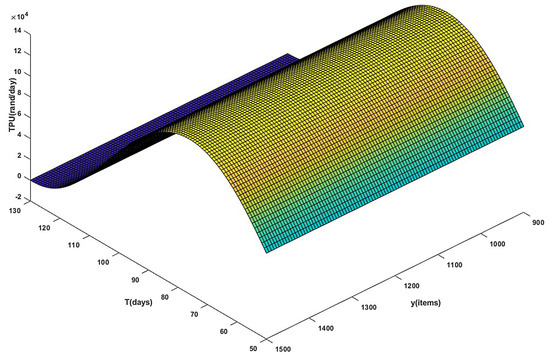
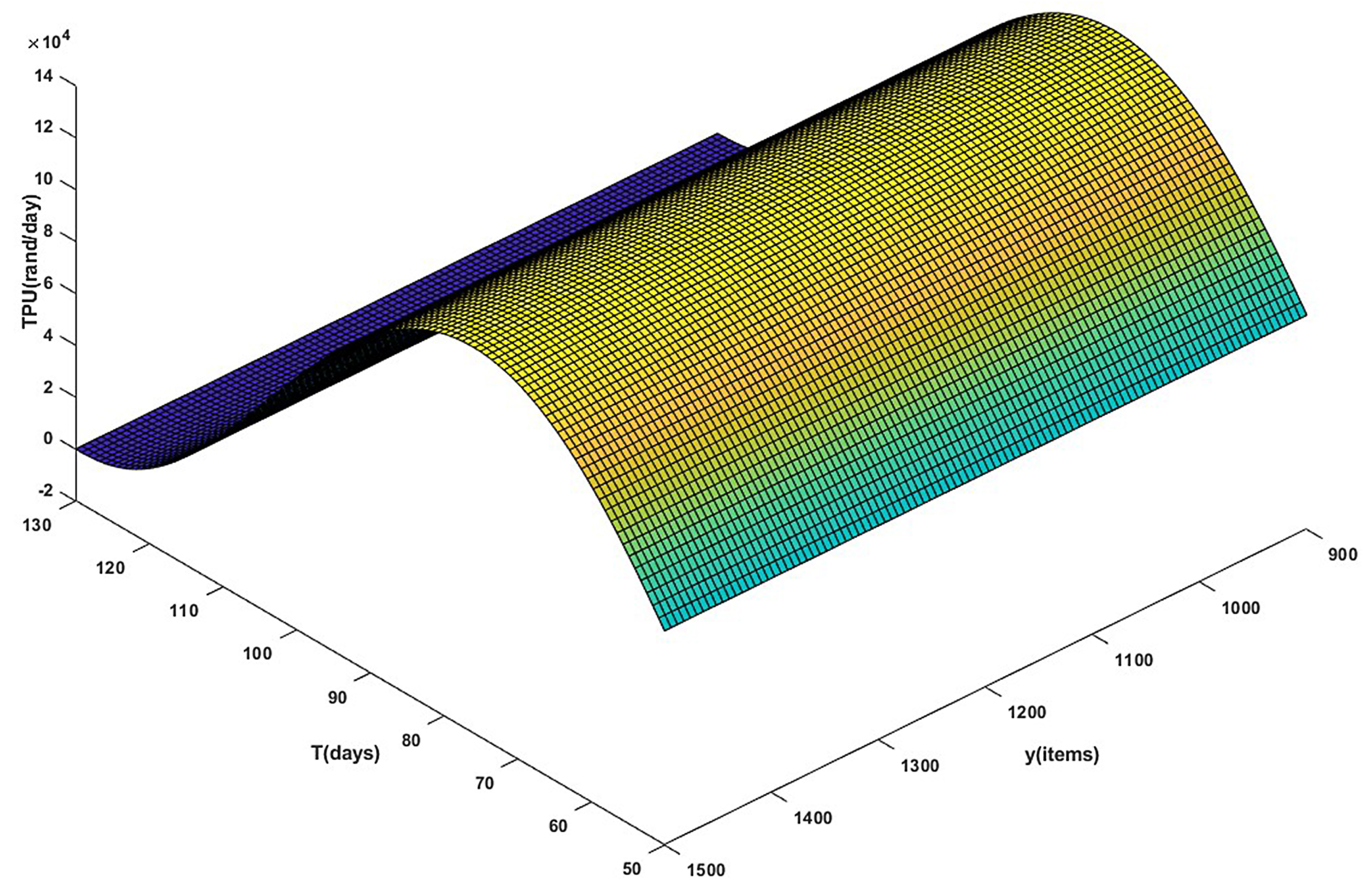
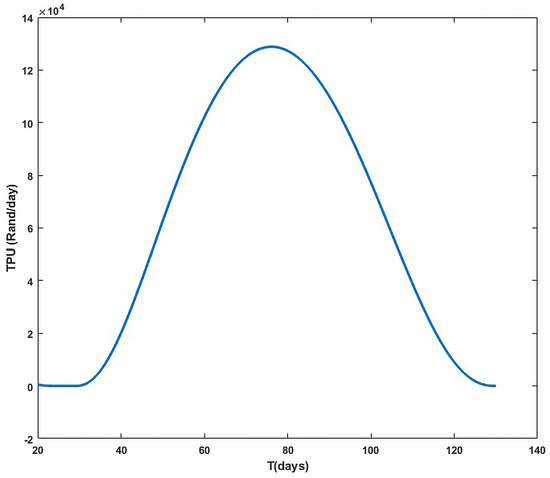
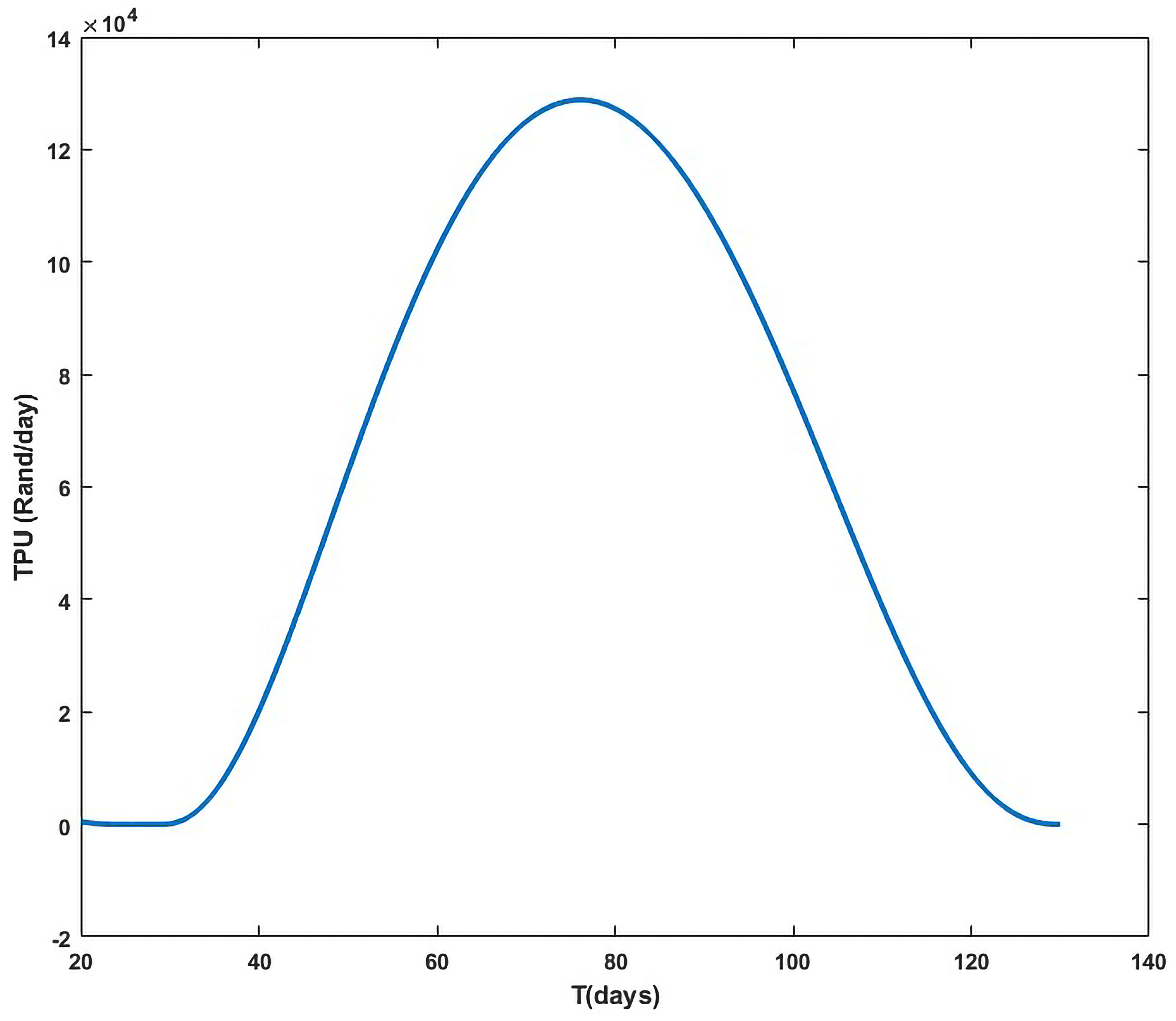
Using the values of the parameters captured in Numerical Values, we obtain the following optimal values for the inventory cycle, the number of chicks, and the corresponding optimal profit, respectively: , and . The behaviour of the profit function is visualised graphically to confirm the optimality of this solution. The three-dimensional graph shown in Figure 3 represents the behaviour of TPU as a function of both the cycle time T and the order quantity y. The graph clearly displays a concave shape. To further validate this, Figure 4 provides a two-dimensional cross-section by fixing the order quantity at and plotting TPU with respect to the cycle time T. The resulting graph displays a concave shape. Initially, the profit increases with time, reaches a maximum at , and then decreases at time T greater than 77.
Figure 3.
Three-dimensional surface plot showing the concavity of TPU as a function of both T and y.
Figure 4.
Two-dimensional plot of TPU with respect to the cycle time T.
5.2. Sensitivity Analysis
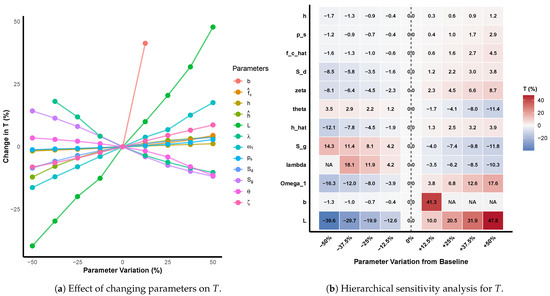
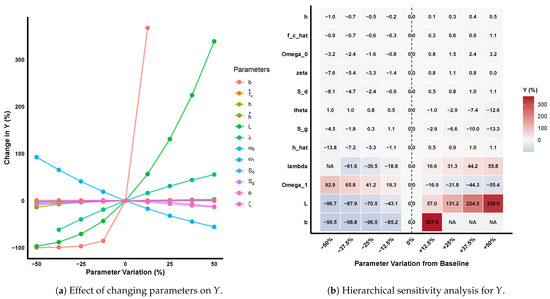
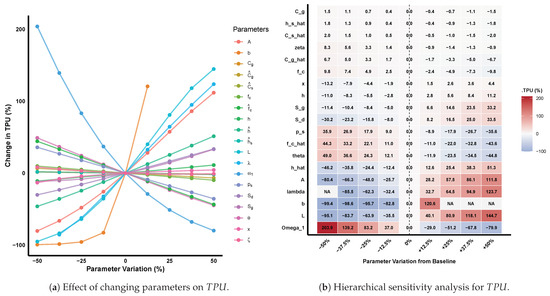
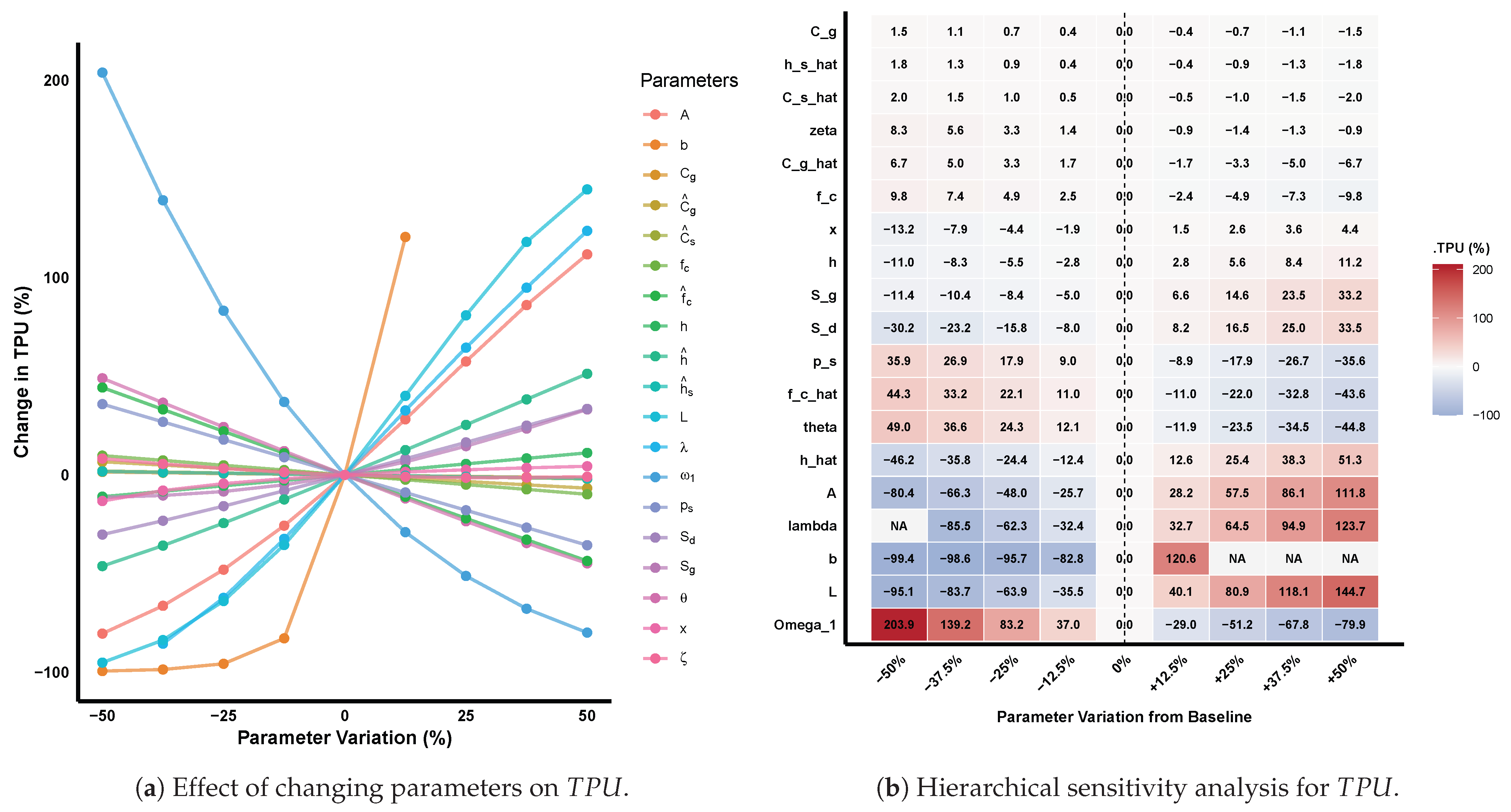
To conduct a sensitivity analysis, we solve the model using a range of different values (−50% to + 50%) for each parameter while keeping the other parameters constant to investigate the effects of changing each input parameter on the cycle time , order quantity , and total profit per unit of time . Table A1 in the Appendix A presents the results of the sensitivity analysis. These results, illustrated in Figure 5, Figure 6 and Figure 7, reveal the following insights:
Figure 5.
Sensitivity analysis of T.
Figure 6.
Sensitivity analysis Y.
Figure 7.
Sensitivity analysis of .
- As shown in Figure 5, the optimal cycle length is
- –
- Highly sensitive to parameters b, L, , , , , , and ;
- –
- Moderately sensitive to changes in , h, , and ;
- –
- Insensitive to variations in a, , , x, and K.
- Figure 6 shows that the optimal lot size is
- –
- Highly sensitive to parameters b, , L, and ;
- –
- Moderately sensitive to changes in , , , , and ;
- –
- Insensitive to other parameters including , h, a, , , , , , , x, , , and K.
- The behaviour of the total profit per unit time , detailed in Figure 7, indicates
- –
- High sensitivity to parameters , L, , b, A, , , , , , and ;
- –
- Moderate sensitivity to changes in x, h, , , , , , and ;
- –
- Insensitivity to , , , , , , and K.
5.3. Managerial Insights
- 1.
- Parameter L has the most significant impact on T performance, with L showing substantial positive influence when it increases and notable negative effects when it decreases. Managers should opt for longer expiration dates (shelf lives).
- 2.
- Parameter b demonstrates strong asymmetric sensitivity, with a positive influence when it increases and minimal negative impact when it decreases. This suggests that increasing b within controlled limits can significantly enhance T performance without substantial downside risk. Production managers should optimise this parameter to maximise the system output while maintaining operational stability.
- 3.
- Parameters b and L have the most critical impact on performance, with b showing both positive and negative effects. Managers should optimise this parameter and use real-time monitoring to ensure optimal batch size y performance. L also shows similar behaviour. This suggests that the shelf life, L, is also a fundamental driver of the batch size, y.
- 4.
- The weight, , of each grown item at the time of slaughtering shows significant impacts on y. When , the optimal order quantity, increases, y decreases significantly. This is because a higher implies a longer growth cycle; to meet a fixed total weight target for the market, fewer items are required. Managers should, therefore, reduce their initial order quantity (y) when aiming to raise them to a higher slaughter weight.
- 5.
- The total profit per time decreases significantly as increases. This is because the operational costs of sustaining inventory, including feeding cost consumption, carbon emissions costs, and inventory holding costs over the growth period, increase at a rate that surpasses the revenue from the increase in weight . To optimise financial performance, managers should identify a weight that prioritises a fast turnover rate. Slaughtering items at this weight minimises the period during which they incur high costs, thus prioritising efficiency.
- 6.
- Managers should also aim for a longer shelf life L as well as a faster growth rate , as longer shelf life allows more time for management to optimise sales, thereby protecting profit margins. A longer shelf life reduces the risk of spoilage within a cycle, allowing managers to capitalise on economies of scale by placing larger, less frequent orders. With a product that remains fresh for longer, the retailer can safely lengthen the replenishment cycle without compromising quality. This reduces ordering costs. A faster growth rate acts as a force multiplier, significantly increasing the system throughput and revenue without requiring capital expansion.
- 7.
- The analysis of Table A1 reveals that strategically differentiating emissions sources offers a clear path to enhance sustainability and boost profitability. The most impactful opportunity lies within the feeding period, where reducing emissions offers substantial improvements, creating an increase in profit. In contrast, emissions associated with inventory inspection, storage, or spoilage hold surprisingly minimal financial or operational implications. Therefore, to master the profit sustainability dynamic, organisations should strategically prioritise investments into innovating the feeding process and optimising purchasing strategies, as these are the cornerstones for a more profitable and sustainable operation.
6. Conclusions and Future Work
This paper proposed an inventory model for growing items with imperfect quality and carbon emissions in which the demand rate is freshness- and inventory-level-dependent. Furthermore, deterioration is considered as items deteriorate over time, affecting both the quality and availability of the slaughtered products. The goal of the proposed model is to find the optimal cycle time that optimises the total profit per cycle. A numerical example along with a sensitivity analysis is used to demonstrate the feasibility and robustness of this model.
The model presented in this paper can be extended by incorporating some of the popular extensions of the classic EOQ model, such as time inflation and time discounting, trade credits, and partial backordering of shortages and quantity discounts, among others. Future studies should address the proposed inventory system’s assumption that the screening process is effective at separating good and poor-quality items, and the inclusion of learning effects in the screening process is another possible area for further development. The model could also be expanded to investigate the impact of reworking a percentage of defective items while eliminating the rest. Other research studies can be conducted to include new aspects such as nonlinear holding cost, vendor-managed inventory (VMI) with consignment stock (CS), inflation, volume discounts, deterioration, trade credit, supply chain environment, and a vendor–buyer inventory model with multiple shipments, advertising, and multiple products subject to constraints such as space, budget, and time.
Author Contributions
Conceptualisation, K.T., O.A., and S.Y.; methodology, K.T.; software, K.T.; validation, K.T., O.A., and S.Y.; formal analysis, K.T.; investigation, K.T.; writing—original draft preparation, K.T.; writing—review and editing, K.T., O.A., and S.Y.; visualisation, K.T.; supervision, O.A. and S.Y. All authors have read and agreed to the published version of the manuscript.
Funding
This research received no external funding.
Data Availability Statement
The original contributions presented in this study are included in the article. Further inquiries can be directed to the corresponding authors.
Conflicts of Interest
The authors declare no conflicts of interest.
Appendix A
Table A1.
Sensitivity analysis.
References
- Mokhtari, H. Economic order quantity for joint complementary and substitutable items. Math. Comput. Simul. 2018, 154, 34–47. [Google Scholar] [CrossRef] [Scilit]
- Harris, F.W. How many parts to make at once. Mag. Manag. 1913, 10, 135–136. [Google Scholar] [CrossRef] [Scilit]
- Sebatjane, M.; Adetunji, O. Economic order quantity model for growing items with imperfect quality. Oper. Res. Perspect. 2019, 6, 100088. [Google Scholar] [CrossRef] [Scilit]
- Agrawal, A.K.; Yadav, S. Price and profit structuring for single manufacturer multi-buyer integrated inventory supply chain under price-sensitive demand condition. Comput. Ind. Eng. 2020, 139, 106208. [Google Scholar] [CrossRef] [Scilit]
- Khan, M.A.; Halim, M.A.; AlArjani, A.; Shaikh, A.A.; Uddin, M.S. Inventory management with hybrid cash-advance payment for time-dependent demand, time-varying holding cost and non-instantaneous deterioration under backordering and non-terminating situations. Alex. Eng. J. 2022, 61, 8469–8486. [Google Scholar] [CrossRef] [Scilit]
- Agi, M.A.N.; Soni, H.N. Joint pricing and inventory decisions for perishable products with age-, stock-, and price-dependent demand rate. J. Oper. Res. Soc. 2020, 71, 85–99. [Google Scholar] [CrossRef] [Scilit]
- Sebatjane, M. Three-echelon circular economic production–inventory model for deteriorating items with imperfect quality and carbon emissions considerations under various emissions policies. Expert Syst. Appl. 2024, 252, 124162. [Google Scholar] [CrossRef] [Scilit]
- Hou, K.L. An inventory model for deteriorating items with stock-dependent consumption rate and shortages under inflation and time discounting. Eur. J. Oper. Res. 2006, 168, 463–474. [Google Scholar] [CrossRef] [Scilit]
- Salameh, M.K.; Jaber, M.Y. Economic production quantity model for items with imperfect quality. Int. J. Prod. Econ. 2000, 64, 59–64. [Google Scholar] [CrossRef] [Scilit]
- Chang, H.C. An application of fuzzy sets theory to the EOQ model with imperfect quality items. Comput. Oper. Res. 2004, 31, 2079–2092. [Google Scholar] [CrossRef] [Scilit]
- Wee, H.M.; Yu, J.; Chen, M.C. Optimal inventory model for items with imperfect quality and shortage backordering. Omega 2007, 35, 7–11. [Google Scholar] [CrossRef] [Scilit]
- Konstantaras, I.; Skouri, K.; Jaber, M.Y. Inventory models for imperfect quality items with shortages and learning in inspection. Appl. Math. Model. 2012, 36, 5334–5343. [Google Scholar] [CrossRef] [Scilit]
- Cárdenas-Barrón, L.E. A complement to “A comprehensive note on: An economic order quantity with imperfect quality and quantity discounts”. Appl. Math. Model. 2012, 36, 6338–6340. [Google Scholar] [CrossRef] [Scilit]
- Hsu, J.T.; Hsu, L.F. An EOQ model with imperfect quality items, inspection errors, shortage backordering, and sales returns. Int. J. Prod. Econ. 2013, 143, 162–170. [Google Scholar] [CrossRef] [Scilit]
- Zhou, Y.; Chen, C.; Li, C.; Zhong, Y. A synergic economic order quantity model with trade credit, shortages, imperfect quality and inspection errors. Appl. Math. Model. 2016, 40, 1012–1028. [Google Scholar] [CrossRef] [Scilit]
- Taleizadeh, A.A.; Khanbaglo, M.P.S.; Cárdenas-Barrón, L.E. An EOQ inventory model with partial backordering and reparation of imperfect products. Int. J. Prod. Econ. 2016, 182, 418–434. [Google Scholar] [CrossRef] [Scilit]
- Jaggi, C.K.; Cárdenas-Barrón, L.E.; Tiwari, S.; Shafi, A. Two-warehouse inventory model for deteriorating items with imperfect quality under the conditions of permissible delay in payments. Sci. Iran. 2017, 24, 390–412. [Google Scholar] [CrossRef] [Scilit]
- Rezaei, J. Economic order quantity for growing items. Int. J. Prod. Econ. 2014, 155, 109–113. [Google Scholar] [CrossRef] [Scilit]
- Malekitabar, M.; Yaghoubi, S.; Gholamian, M.R. A novel mathematical inventory model for growing-mortal items (case study: Rainbow trout). Appl. Math. Model. 2019, 71, 96–117. [Google Scholar] [CrossRef] [Scilit]
- Khalilpourazari, S.; Pasandideh, S.H.R.; Niaki, S.T.A. Optimizing a multi-item economic order quantity problem with imperfect items, inspection errors, and backorders. Soft Comput. 2019, 23, 11671–11698. [Google Scholar] [CrossRef] [Scilit]
- Sebatjane, M.; Adetunji, O. Optimal inventory replenishment and shipment policies in a four-echelon supply chain for growing items with imperfect quality. Prod. Manuf. Res. 2020, 8, 130–157. [Google Scholar] [CrossRef] [Scilit]
- Pourmohammad-Zia, N.; Karimi, B. Optimal replenishment and breeding policies for growing items. Arab. J. Sci. Eng. 2020, 45, 7005–7015. [Google Scholar] [CrossRef] [Scilit]
- Sebatjane, M.; Adetunji, O. Optimal lot-sizing and shipment decisions in a three-echelon supply chain for growing items with inventory level-and expiration date-dependent demand. Appl. Math. Model. 2021, 90, 1204–1225. [Google Scholar] [CrossRef] [Scilit]
- Biswas, J.; Duari, N.K.; Chakrabarti, T. Inventory Model for Growing Items and Its Waste Management. In Data Analytics and Artificial Intelligence for Inventory and Supply Chain Management; Springer: Berlin/Heidelberg, Germany, 2022; pp. 113–132. [Google Scholar]
- Mokhtari, H.; Salmasnia, A.; Fallahi, A. Economic production quantity under possible substitution: A scenario analysis approach. Int. J. Ind. Eng. 2022, 33, 1–17. [Google Scholar]
- Nobil, A.H.; Sedigh, A.H.A.; Cardenas-Barron, L.E. A generalized economic order quantity inventory model with shortage: Case study of a poultry farmer. Arab. J. Sci. Eng. 2018, 44, 2653–2663. [Google Scholar] [CrossRef] [Scilit]
- Sebatjane, M.; Cárdenas-Barrón, L.E.; Nobil, A.H. Sustainable inventory models for a three-echelon food supply chain with growing items and price-and carbon emissions-dependent demand under different emissions regulations. Clean. Logist. Supply Chain 2024, 13, 100192. [Google Scholar] [CrossRef] [Scilit]
- Ghare, P.M. A model for an exponentially decaying inventory. J. Ind. Eng. 1963, 14, 238–243. [Google Scholar]
- Chang, C.T. Inventory models with stock-dependent demand and nonlinear holding costs for deteriorating items. Asia-Pac. J. Oper. Res. 2004, 21, 435–446. [Google Scholar] [CrossRef] [Scilit]
- Khanra, S.; Ghosh, S.K.; Chaudhuri, K.S. An EOQ model for a deteriorating item with time dependent quadratic demand under permissible delay in payment. Appl. Math. Comput. 2011, 218, 1–9. [Google Scholar] [CrossRef] [Scilit]
- Widyadana, G.A.; Wee, H.M. An economic production quantity model for deteriorating items with preventive maintenance policy and random machine breakdown. Int. J. Syst. Sci. 2012, 43, 1870–1882. [Google Scholar] [CrossRef] [Scilit]
- Thangam, A. Optimal price discounting and lot-sizing policies for perishable items in a supply chain under advance payment scheme and two-echelon trade credits. Int. J. Prod. Econ. 2012, 139, 459–472. [Google Scholar] [CrossRef] [Scilit]
- Sanni, S.S.; Chukwu, W.I.E. An Economic order quantity model for Items with Three-parameter Weibull distribution Deterioration, Ramp-type Demand and Shortages. Appl. Math. Model. 2013, 37, 9698–9706. [Google Scholar] [CrossRef] [Scilit]
- Taleizadeh, A.A. An economic order quantity model for deteriorating item in a purchasing system with multiple prepayments. Appl. Math. Model. 2014, 38, 5357–5366. [Google Scholar] [CrossRef] [Scilit]
- Viji, G.; Karthikeyan, K. An economic production quantity model for three levels of production with Weibull distribution deterioration and shortage. Ain Shams Eng. J. 2018, 9, 1481–1487. [Google Scholar] [CrossRef] [Scilit]
- Rahman, M.S.; Duary, A.; Khan, M.; Shaikh, A.A.; Bhunia, A.K. Interval valued demand related inventory model under all units discount facility and deterioration via parametric approach. Artif. Intell. Rev. 2022, 55, 2455–2494. [Google Scholar] [CrossRef] [Scilit]
- Mallick, R.K.; Patra, K.; Mondal, S.K. A new economic order quantity model for deteriorated items under the joint effects of stock dependent demand and inflation. Decis. Anal. J. 2023, 8, 100288. [Google Scholar] [CrossRef] [Scilit]
- Rabiu, S.; Ali, M.K.M. An enhanced EPQ model: Incorporating Weibull distribution deterioration, defective items, and dynamic demands for sustainable production optimization. Ain Shams Eng. J. 2024, 15, 102824. [Google Scholar] [CrossRef] [Scilit]
- Arunadevi, E.; Umamaheswari, S. Enhancing ameliorating items with sustainable inventory management strategies: A Weibull approach for time and price-dependent demand trends. Ain Shams Eng. J. 2024, 15, 103065. [Google Scholar] [CrossRef] [Scilit]
- Sarker, B.R.; Mukherjee, S.; Balan, C.V. An order-level lot size inventory model with inventory-level dependent demand and deterioration. Int. J. Prod. Econ. 1997, 48, 227–236. [Google Scholar] [CrossRef] [Scilit]
- Bai, R.; Kendall, G. A model for fresh produce shelf-space allocation and inventory management with freshness-condition-dependent demand. INFORMS J. Comput. 2008, 20, 78–85. [Google Scholar] [CrossRef] [Scilit]
- Wu, J.; Chang, C.T.; Cheng, M.C.; Teng, J.T.; Al-Khateeb, F.B. Inventory management for fresh produce when the time-varying demand depends on product freshness, stock level and expiration date. Int. J. Syst. Sci. Oper. Logist. 2016, 3, 138–147. [Google Scholar]
- Chen, S.C.; Min, J.; Teng, J.T.; Li, F. Inventory and shelf-space optimization for fresh produce with expiration date under freshness-and-stock-dependent demand rate. J. Oper. Res. Soc. 2016, 67, 884–896. [Google Scholar] [CrossRef] [Scilit]
- Janssen, L.; Sauer, J.; Claus, T.; Nehls, U. Development and simulation analysis of a new perishable inventory model with a closing days constraint under non-stationary stochastic demand. Comput. Ind. Eng. 2018, 118, 9–22. [Google Scholar] [CrossRef] [Scilit]
- Khan, M.A.; Shaikh, A.A.; Panda, G.C.; Konstantaras, I.; Taleizadeh, A.A. Inventory system with expiration date: Pricing and replenishment decisions. Comput. Ind. Eng. 2019, 132, 232–247. [Google Scholar] [CrossRef] [Scilit]
- Sebatjane, M.; Adetunji, O. A three-echelon supply chain for economic growing quantity model with price-and freshness-dependent demand: Pricing, ordering and shipment decisions. Oper. Res. Perspect. 2020, 7, 100153. [Google Scholar] [CrossRef] [Scilit]
- Khan, M.A.; Shaikh, A.A.; Khan, A.R.; Alrasheedi, A.F. Advertising and pricing strategies of an inventory model with product freshness-related demand and expiration date-related deterioration. Alex. Eng. J. 2023, 73, 353–375. [Google Scholar] [CrossRef] [Scilit]
- De-la-Cruz-Márquez, C.G.; Cárdenas-Barrón, L.E.; Mandal, B. An inventory model for growing items with imperfect quality when the demand is price sensitive under carbon emissions and shortages. Math. Probl. Eng. 2021, 2021, 6649048. [Google Scholar] [CrossRef] [Scilit]
- Hua, G.; Cheng, T.C.E.; Wang, S. Managing carbon footprints in inventory management. Int. J. Prod. Econ. 2011, 132, 178–185. [Google Scholar] [CrossRef] [Scilit]
- Bouchery, Y.; Ghaffari, A.; Jemai, Z.; Dallery, Y. Including sustainability criteria into inventory models. Eur. J. Oper. Res. 2012, 222, 229–240. [Google Scholar] [CrossRef] [Scilit]
- Pan, S.; Ballot, E.; Fontane, F. The reduction of greenhouse gas emissions from freight transport by pooling supply chains. Int. J. Prod. Econ. 2013, 143, 86–94. [Google Scholar] [CrossRef] [Scilit]
- Zanoni, S.; Mazzoldi, L.; Jaber, M.Y. Vendor-managed inventory with consignment stock agreement for single vendor–single buyer under the emission-trading scheme. Int. J. Prod. Res. 2014, 52, 20–31. [Google Scholar] [CrossRef] [Scilit]
- He, P.; Zhang, W.; Xu, X.; Bian, Y. Production lot-sizing and carbon emissions under cap-and-trade and carbon tax regulations. J. Clean. Prod. 2015, 103, 241–248. [Google Scholar] [CrossRef] [Scilit]
- Tiwari, S.; Daryanto, Y.; Wee, H.M. Sustainable inventory management with deteriorating and imperfect quality items considering carbon emission. J. Clean. Prod. 2018, 192, 281–292. [Google Scholar] [CrossRef] [Scilit]
- Li, Z.; Hai, J. Inventory management for one warehouse multi-retailer systems with carbon emission costs. Comput. Ind. Eng. 2019, 130, 565–574. [Google Scholar] [CrossRef] [Scilit]
- Medina-Santana, A.A.; Cárdenas-Barrón, L.E. A sustainable inventory model considering a discontinuous transportation cost function and different sources of pollution. arXiv 2020, arXiv:2005.03781. [Google Scholar] [CrossRef] [Scilit]
- Modak, N.M.; Kelle, P. Using social work donation as a tool of corporate social responsibility in a closed-loop supply chain considering carbon emissions tax and demand uncertainty. J. Oper. Res. Soc. 2021, 72, 61–77. [Google Scholar] [CrossRef] [Scilit]
- Zhang, Y.; Li, L.; Tian, X.; Feng, C. Inventory management research for growing items with carbon-constrained. In Proceedings of the 2016 35th Chinese Control Conference (CCC), Chengdu, China, 27–29 July 2016; pp. 9588–9593. [Google Scholar]
- Yadav, V.; Shekhar, C.; Saurav, A.; Kumar, A. Sustainable inventory management with trapezoidal demand and amelioration under carbon regulations. Inf. Sci. 2025, 730, 122883. [Google Scholar] [CrossRef] [Scilit]
- Saurav, A.; Yadav, V.; Shekhar, C. An inventory optimization model for reliable and sustainable supply chains under trade credit and carbon constraints. Supply Chain Anal. 2025, 11, 100132. [Google Scholar] [CrossRef] [Scilit]
- Sebatjane, M. Sustainable inventory, pricing, and marketing strategies for imperfect quality perishable items with inspection errors and advertisement-, expiration date-and price-dependent demand under carbon emissions policies. Sustain. Oper. Comput. 2024, 5, 239–256. [Google Scholar] [CrossRef] [Scilit]
- Larson, P.D.; DeMarais, R.A. Psychic stock: An independent variable category of inventory. Int. J. Phys. Distrib. Logist. Manag. 1990, 20, 28–34. [Google Scholar] [CrossRef] [Scilit]
- Baker, R.C.; Urban, T.L. A deterministic inventory system with an inventory-level-dependent demand rate. J. Oper. Res. Soc. 1988, 39, 823–831. [Google Scholar] [CrossRef]
- Alfares, H.K. Inventory model with stock-level dependent demand rate and variable holding cost. Int. J. Prod. Econ. 2007, 108, 259–265. [Google Scholar] [CrossRef] [Scilit]
- Goyal, S.K.; Chang, C.T. Optimal ordering and transfer policy for an inventory with stock dependent demand. Eur. J. Oper. Res. 2009, 196, 177–185. [Google Scholar] [CrossRef] [Scilit]
- Sarkar, B. An EOQ model with delay in payments and stock dependent demand in the presence of imperfect production. Appl. Math. Comput. 2012, 218, 8295–8308. [Google Scholar] [CrossRef] [Scilit]
- Chakraborty, D.; Jana, D.K.; Roy, T.K. Multi-item integrated supply chain model for deteriorating items with stock dependent demand under fuzzy random and bifuzzy environments. Comput. Ind. Eng. 2015, 88, 166–180. [Google Scholar] [CrossRef] [Scilit]
- Pando, V.; San-José, L.A.; García-Laguna, J.; Sicilia, J. Optimal lot-size policy for deteriorating items with stock-dependent demand considering profit maximization. Comput. Ind. Eng. 2018, 117, 81–93. [Google Scholar] [CrossRef] [Scilit]
- Chen, L.; Chen, X.; Keblis, M.F.; Li, G. Optimal pricing and replenishment policy for deteriorating inventory under stock-level-dependent, time-varying and price-dependent demand. Comput. Ind. Eng. 2019, 135, 1294–1299. [Google Scholar] [CrossRef] [Scilit]

Disclaimer/Publisher’s Note: The statements, opinions and data contained in all publications are solely those of the individual author(s) and contributor(s) and not of MDPI and/or the editor(s). MDPI and/or the editor(s) disclaim responsibility for any injury to people or property resulting from any ideas, methods, instructions or products referred to in the content. |
© 2025 by the authors. Licensee MDPI, Basel, Switzerland. This article is an open access article distributed under the terms and conditions of the Creative Commons Attribution (CC BY) license (https://creativecommons.org/licenses/by/4.0/).