Modeling Ranking Concordance, Dispersion, and Tail Extremes with a Joint Copula Framework


Abstract
1. Introduction
1.1. The Problem of Ranking Analysis
1.2. Limitations of Current Approaches
1.3. The Copula Perspective
1.4. Research Contribution and Novelty
- Regime and dispersion analysis. The CDEF first classifies the ranking regime as forced or non-forced, then selects an appropriate dispersion mechanism. For forced permutations with dependence, it fits a Mallows structure; for forced independence, it compares against the uniform permutation baseline. For non-forced rankings, a test distinguishes between independence (modeled using a multinomial allocation) and dependence, aligning inference with the data-generating structure.
- Screening and reporting. Global concordance (W), mutual information across representative pairs, and likelihood summaries provide complementary views of dependence. Decision rules then diagnose Genuine versus Phantom concordance—Phantom when high apparent concordance is primarily driven by tail dependence and shared dispersion patterns rather than stable consensus across raters.
2. Background and Related Work
2.1. Ranking Analysis Fundamentals
2.2. Traditional Ranking Evaluation Methods
2.2.1. Concordance Measures
2.2.2. Dispersion Analysis
2.2.3. Extremeness Detection
2.3. Copula Theory in Dependence Modeling
2.3.1. Theoretical Foundations
2.3.2. Copula Families for Ranking Applications
- is the copula cumulative distribution function evaluated at the point .
- is the pseudo-observation corresponding to the i-th rater’s rank for a given item (obtained via the mid-rank transformation defined above).
- d is the number of raters.
- ln denotes the natural logarithm.
- is the Gumbel dependence parameter controlling the strength of upper-tail dependence, with corresponding to independence and to perfect upper-tail dependence.
2.3.3. Recent Advances in Copula Applications
2.4. Comparison with Recent Multivariate Ranking and Copula-Based Methods
2.5. Gaps in the Current Literature and the CDEF’s Unique Contribution
3. The Concordance–Dispersion–Extremeness Framework (CDEF)
3.1. Conceptual Foundation
3.2. Operational Formulation
3.2.1. Data Layout and Regime Detection
3.2.2. Concordance
3.2.3. Concurrence Diagnostics: Mutual Information and
3.2.4. Extremeness via Copulas (Upper-Tail Co-Movement)
3.2.5. Dispersion Baselines and Model Selection
3.2.6. Copula Selection and Tail Dependence
3.2.7. Reporting: Normalized Contributions
3.3. Estimation, Algorithms, and Numerical Safeguards
Regime Detection and Dispersion Model Selection
- : Average pairwise Gumbel copula log-likelihood, centered relative to the independence copula (baseline ).
- : Scaled upper-tail dependence parameter from fitted pairwise Gumbel copulas, summarizing the strength of joint extreme behavior.
- W: Rank concordance statistic (e.g., Kendall-type) capturing the degree of ordering agreement across variables.
- : Pairwise mutual information, capturing nonlinear dependence between variables.
- : p-value from a chi-squared test on the joint contingency table.
- : Upper-tail dependence threshold, set as the qth percentile (e.g., ) of under the null of independence.
- : Concordance threshold, defined analogously for W under the null.
- : Mutual information threshold, defined as the qth percentile under permuted samples.
- : Significance level for rejecting independence in the test, typically .
3.4. Model Validation and Extensions
4. Materials and Methods: Empirical Application
4.1. Data, Structure, and Preprocessing
4.1.1. Data Scope and Layout
4.1.2. Forced vs. Non-Forced Detection
4.2. Reproducibility
4.2.1. Data Schema and Ingestion
4.2.2. End-to-End Analysis Pipeline
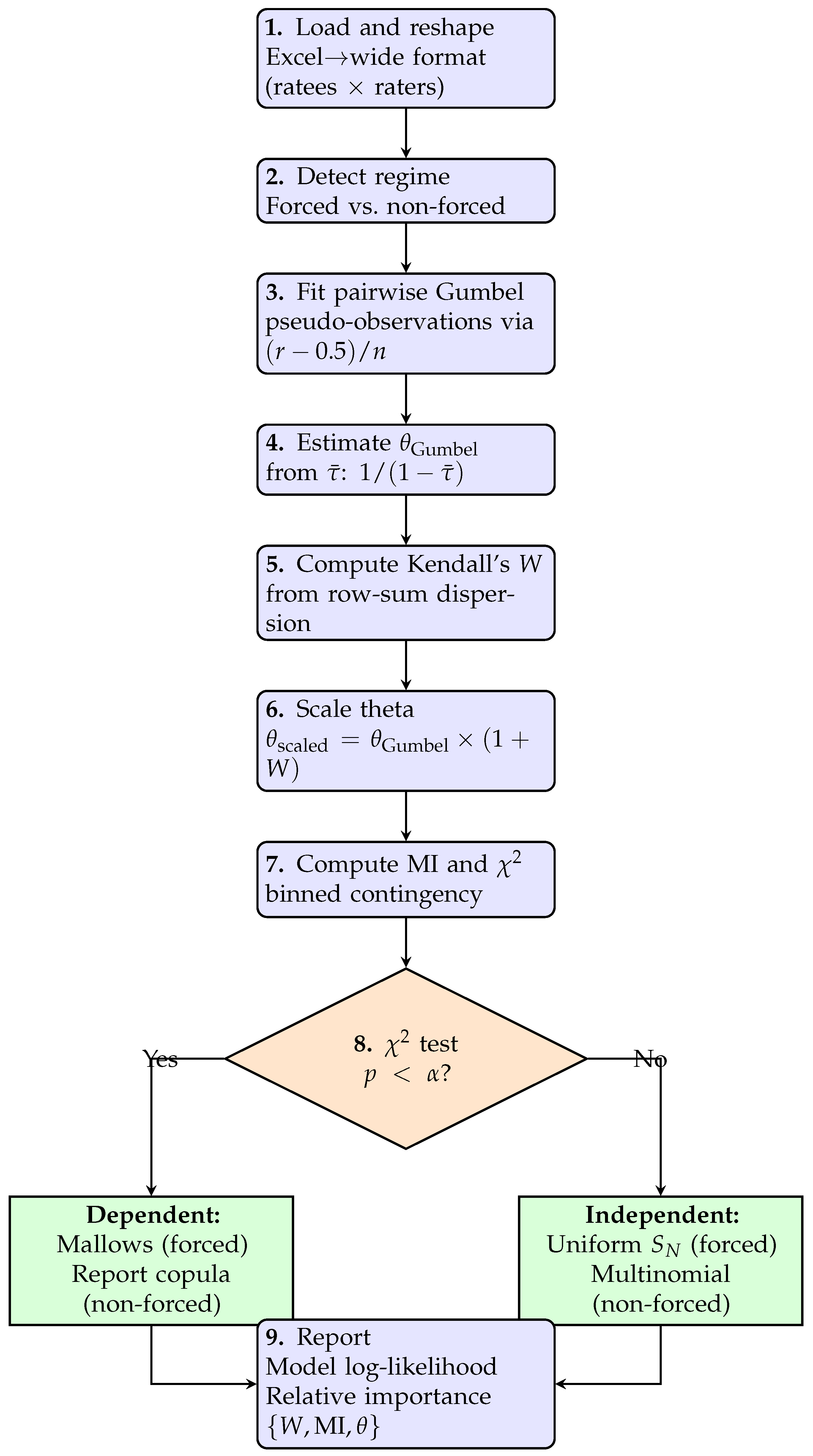
- Load and reshape. Excel→DataFrame; pivot to wide (ratees × raters).
- Ranking-type detection. Forced (strict permutations) vs. non-forced (ties allowed).
- Core concordance. Compute Kendall’s W from row-sum dispersion (closed form).
- Pairwise association. Compute pairwise Kendall’s and the full matrix.
- Global tail parameter. Map and scale by for a concordance-aware extremeness index.
- Model selection summary. Report the selected distributional family and its (approximate) log-likelihood, alongside the copula average log-likelihood baseline.
- Relative importance decomposition. Report normalized weights over {Concordance W, Concurrence (MI), Extremeness }; these are interpretable as contribution weights, not probabilities.
4.2.3. Model Components and Estimation
4.2.4. Simulation Scenarios (Exemplar Study)
4.2.5. Software, Determinism, and Environment
Code and Data Availability
Software Usage
- Programmatic: RankDependencyAnalyzer.analyze_from_excel("data.xlsx").
- Command-line: cdef_analyzer –input rankings.xlsx –output report.json.
- Interactive: Jupyter notebooks for parameter exploration and visualization customization.
- Interpreter and OS. Experiments were run with Python 3.12 (package supports Python ≥ 3.12). The pipeline is OS-agnostic; example paths use Windows Subsystem for Linux (WSL) mounts for convenience (e.g., /mnt/c/Users/…). Docker containerization is available for isolated execution environments.
- Random seeds. All exemplars fix the numpy RNG seed prior to any random draws. The analyzer optionally accepts random_seed at initialization to enforce determinism end-to-end.
- Key libraries. Core dependencies are numpy, pandas, and scipy (Kendall’s , , entropy/MI), plus copulas for Gumbel fits; openpyxl/xlsxwriter are used for Excel I/O; matplotlib supports visualization. Full, pinned versions are listed in requirements.txt at the repository root.
- Artifacts and logs. Each scenario is exported as a long-format Excel file, analyzed once, and summarized; the script writes a CSV comparison table. Console output records: ranking type, selected distribution, W, , , , MI, copula average log-likelihood, independence baseline, relative importance weights, pairwise range, and the interpretation label. The results can be exported to JSON, CSV, or formatted text reports.
- Environment capture. For exact replication, a fresh virtual environment is created and installed from the repository’s requirements.txt.
- python -m venv .venv
- source .venv/bin/activate # Windows: .venv\Scripts\activate
- pip install -r requirements.txt
4.2.6. Diagnostics and Validation
4.2.7. From Paper to Code
4.3. CDEF Components and Estimation
4.3.1. Concordance (Global Agreement)
4.3.2. Concurrence (Information-Sharing)
4.3.3. Extremeness (Upper-Tail Co-Movement)
4.4. Model Selection for the Ranking Regime
4.4.1. Forced Rankings
4.4.2. Non-Forced Rankings
4.5. Composite Reporting: Indices, Not Conditional Probabilities
4.6. Exemplar Outputs and Diagnostics
5. Results
5.1. NCAA Analysis Results
5.1.1. CDEF Analysis Results
5.1.2. Comparative Interpretation: Revealing Phantom Concordance
5.1.3. Quantifying the Cost of Ignoring Dependencies
5.2. Simulation Study
5.2.1. Analysis Pipeline
5.2.2. Results by Scenario
- Phantom. Forced rankings with overwhelming tail-driven agreement yielded , , , and . The average copula log-likelihood was (independence baseline ). Pairwise Gumbel ranged from to . CDEF classification: Phantom (). Normalized indices: concordance , concurrence , extremeness .
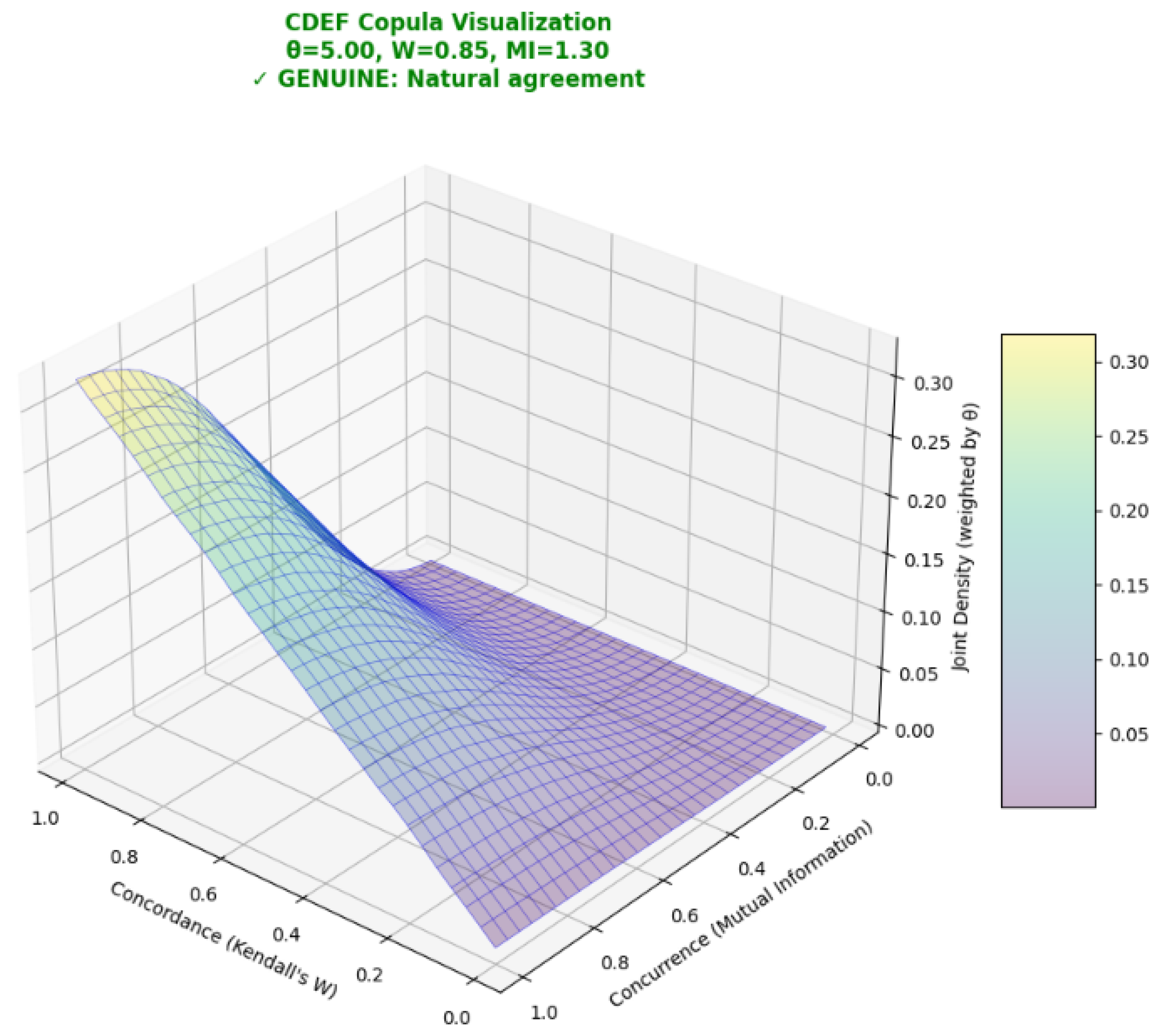
- Genuine (Natural Agreement). High agreement without engineered extremes yielded , , , and . The average copula log-likelihood was (independence ). Pairwise Gumbel fell in a narrow band: –. CDEF label: Genuine (). Normalized indices: concordance , concurrence , extremeness .
- Random (No Agreement). In the Random scenario, near-independence is obtained by construction. Under these conditions, the run aborted with a numerical error during log-density evaluation, reflecting the inherent instability of copula likelihood estimation when dependence approaches zero. This is expected: as the system nears independence, the log-likelihood surface flattens and provides little information for parameter identification, particularly for tail-dependent families such as Gumbel. In such cases, the intended baseline interpretation is , , and , with pairwise centering near 0. We treat this as the independence reference, not as a model failure but as a signal that the CDEF has correctly encountered the lower bound of interpretable dependence.
- Clustered (Outlier). The three-rater cluster with one divergent rater produced , , , and . The average copula log-likelihood was (independence ). Pairwise Gumbel range: – (stronger within-cluster, weaker with the outlier). CDEF classification: Genuine (). Normalized indices: concordance , concurrence , extremeness .
5.2.3. Takeaways
6. Discussion
6.1. Theoretical Contributions
6.2. Methodological Advances
6.3. Practical Applications
6.4. Limitations and Future Research
7. Conclusions
7.1. Key Contributions
7.2. Implications for Practice
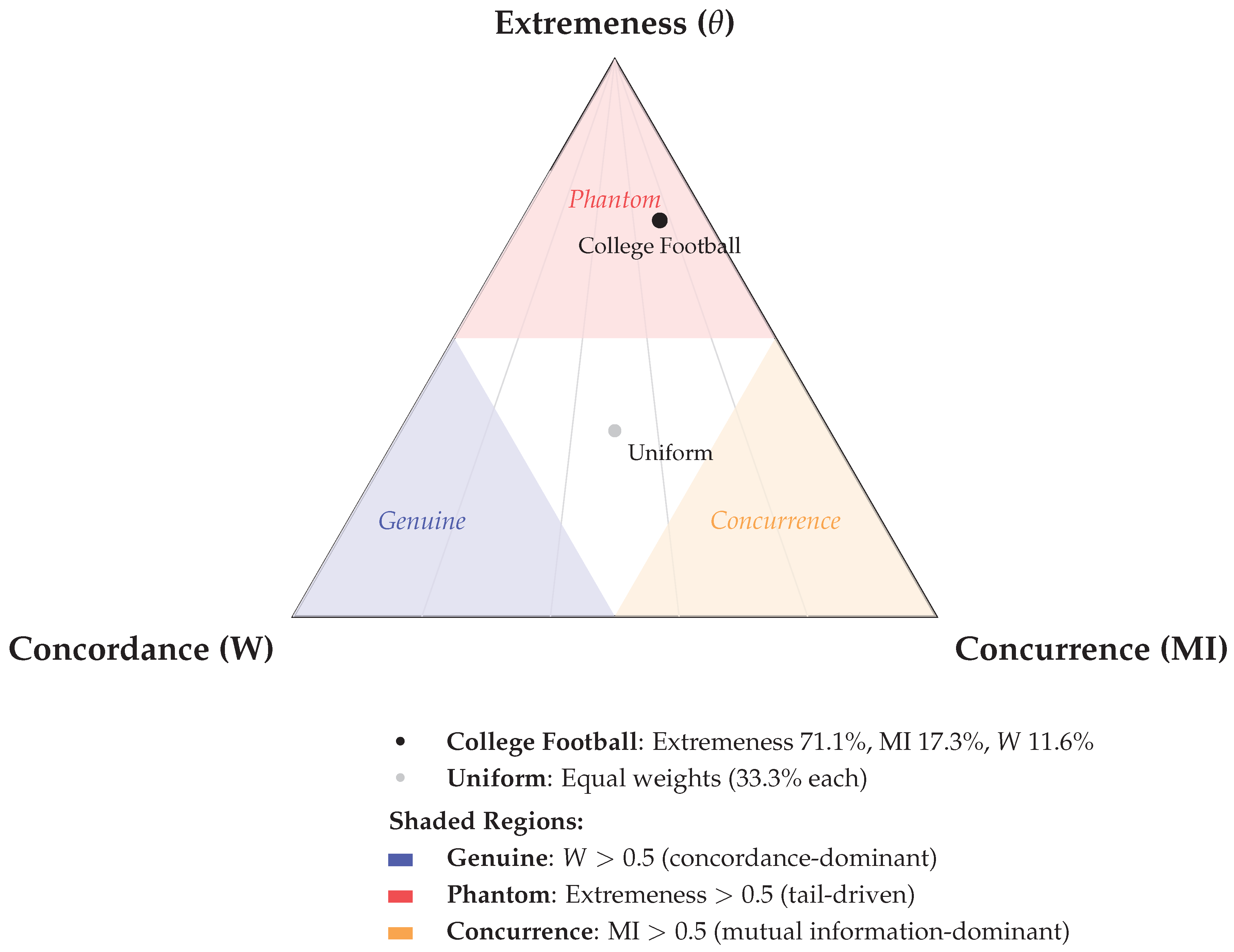
- Flag for Phantom concordance when extremeness exceeds of the normalized triad, even if W appears high. In the college football application, extremeness accounted for despite , revealing tail-driven rather than uniform consensus. The simulation’s Phantom scenario showed extremeness at with = 30.7, whereas Genuine consensus exhibited only extremeness with = 4.2.
- Examine pairwise heterogeneity when Gumbel varies substantially across rater pairs. In our empirical case, the CBS/CFN/NYT cluster showed 3.6–5.6, while Congrove’s alignment was weaker ( 1.85–2.12), indicating a subgroup structure that global W obscures.
- Compare copula log-likelihood gains against independence. Small gains (<0.5 per observation) suggest weak dependence structure; large gains (>2.0) coupled with high extremeness indicate coordinated tail behavior requiring scrutiny.
7.3. Future Research Directions
7.4. Final Remarks
7.5. Generative Artificial Intelligence Disclosure
Author Contributions
Funding
Data Availability Statement
Conflicts of Interest
References
- Arrow, K.J. Social Choice and Individual Values, 2nd ed.; Yale University Press: New Haven, CT, USA, 1963; ISBN 978-0-300-01364-0. [Google Scholar]
- Sen, A. Collective Choice and Social Welfare; Holden-Day: San Francisco, CA, USA, 1970; ISBN 978-0-8162-2158-8. [Google Scholar]
- Bornmann, L. Scientific peer review. Annu. Rev. Inform. Sci. Technol. 2011, 45, 197–245. [Google Scholar] [CrossRef]
- Lamont, M. How Professors Think: Inside the Curious World of Academic Judgment; Harvard University Press: Cambridge, MA, USA, 2009. [Google Scholar] [CrossRef]
- Engist, O.; Merkus, E.; Schafmeister, F. The effect of seeding on tournament outcomes. J. Sports Econ. 2021, 22, 115–144. [Google Scholar] [CrossRef]
- Csató, L. Tournament design: A review. Eur. J. Oper. Res. 2024, 318, 800–828. [Google Scholar] [CrossRef]
- Sutton, R.T.; Pincock, D.; Baumgart, D.C.; Sadowski, D.C.; Fedorak, R.N.; Kroeker, K.I. An overview of clinical decision support systems. Npj Digit. Med. 2020, 3, 17. [Google Scholar] [CrossRef]
- Kawazoe, Y.; Ohe, K. A clinical decision support system. BMC Med. Inform. Decis. Mak. 2023, 23, 47. [Google Scholar] [CrossRef]
- Brown, T.C.; O’Kane, P.; Mazumdar, B.; McCracken, M. Performance management: A scoping review. Hum. Resour. Dev. Rev. 2019, 18, 47–82. [Google Scholar] [CrossRef]
- Scullen, S.E.; Bergey, P.K.; Aiman-Smith, L. Forced distribution rating systems and the improvement of workforce potential: A baseline simulation. Pers. Psychol. 2005, 58, 1–32. [Google Scholar] [CrossRef]
- Zhang, Y.; Wang, M.; Saberi, M.; Chang, E. Analysing academic paper ranking algorithms using test data and benchmarks: An investigation. Scientometrics 2022, 127, 4045–4074. [Google Scholar] [CrossRef]
- Adler, N.; Friedman, L.; Sinuany-Stern, Z. Review of ranking methods in the data envelopment analysis context. Eur. J. Oper. Res. 2002, 140, 249–265. [Google Scholar] [CrossRef]
- Kendall, M.G. A new measure of rank correlation. Biometrika 1938, 30, 81–93. [Google Scholar] [CrossRef]
- Spearman, C. The proof and measurement of association between two things. Am. J. Psychol. 1904, 15, 72–101. [Google Scholar] [CrossRef]
- Hochberg, Y.; Tamhane, A.C. Multiple Comparison Procedures; Wiley: New York, NY, USA, 1987; ISBN 978-0-471-82222-6. [Google Scholar] [CrossRef]
- Westfall, P.H.; Young, S.S. Resampling-Based Multiple Testing: Examples and Methods for p-Value Adjustment; Wiley: New York, NY, USA, 1993; ISBN 978-0-471-55761-6. [Google Scholar]
- Sklar, A. Fonctions de répartition à n dimensions et leurs marges. Publ. Inst. Stat. Univ. Paris 1959, 8, 229–231. [Google Scholar]
- Joe, H. Dependence Modeling with Copulas; Chapman and Hall/CRC: Boca Raton, FL, USA, 2014; ISBN 978-1-4665-8322-1. [Google Scholar] [CrossRef]
- Nelsen, R.B. An Introduction to Copulas, 2nd ed.; Springer: New York, NY, USA, 2006; ISBN 978-0-387-28678-5. [Google Scholar] [CrossRef]
- Cherubini, U.; Luciano, E.; Vecchiato, W. Copula Methods in Finance; Wiley: Chichester, UK, 2004; ISBN 978-0-470-86344-2. [Google Scholar] [CrossRef]
- Patton, A.J. A review of copula models for economic time series. J. Multivar. Anal. 2012, 110, 4–18. [Google Scholar] [CrossRef]
- Salvadori, G.; De Michele, C.; Kottegoda, N.T.; Rosso, R. Extremes in Nature: An Approach Using Copulas; Springer: Dordrecht, The Netherlands, 2007; ISBN 978-1-4020-4415-1. [Google Scholar] [CrossRef]
- AghaKouchak, A.; Bárdossy, A.; Habib, E. Conditional simulation of remotely sensed rainfall data using a non-Gaussian v-transformed copula. Adv. Water Resour. 2010, 33, 624–634. [Google Scholar] [CrossRef]
- Embrechts, P.; McNeil, A.; Straumann, D. Correlation and dependence in risk management: Properties and pitfalls. In Risk Management: Value at Risk and Beyond; Dempster, M.A.H., Ed.; Cambridge University Press: Cambridge, UK, 2002; pp. 176–223. [Google Scholar] [CrossRef]
- McNeil, A.J.; Frey, R.; Embrechts, P. Quantitative Risk Management: Concepts, Techniques and Tools, 2nd ed.; Princeton University Press: Princeton, NJ, USA, 2015; ISBN 978-0-691-16627-8. [Google Scholar]
- Marden, J.I. Analyzing and Modeling Rank Data; Chapman & Hall: London, UK, 1995; ISBN 978-0-412-99521-2. [Google Scholar]
- Critchlow, D.E. Metric Methods for Analyzing Partially Ranked Data; Springer: Berlin, Germany, 1985; ISBN 978-0-387-96137-9. [Google Scholar] [CrossRef]
- Tastle, W.J.; Wierman, M.J. Consensus and dissention: A measure of ordinal dispersion. Int. J. Approx. Reason. 2007, 45, 531–545. [Google Scholar] [CrossRef]
- Johnson, N.L.; Kotz, S.; Balakrishnan, N. Discrete Multivariate Distributions; Wiley: New York, NY, USA, 1997; ISBN 978-0-471-12844-1. [Google Scholar]
- Mallows, C.L. Non-null ranking models. I. Biometrika 1957, 44, 114–130. [Google Scholar] [CrossRef]
- Greenleaf, E.A. Measuring extreme response style. Public Opin. Q. 1992, 56, 328–351. [Google Scholar] [CrossRef]
- Coles, S. An Introduction to Statistical Modeling of Extreme Values; Springer: London, UK, 2001; ISBN 978-1-85233-459-8. [Google Scholar] [CrossRef]
- de Haan, L.; Ferreira, A. Extreme Value Theory: An Introduction; Springer: New York, NY, USA, 2006; ISBN 978-0-387-23946-0. [Google Scholar] [CrossRef]
- Fisher, R.A.; Tippett, L.H.C. Limiting forms of the frequency distribution of the largest or smallest member of a sample. Math. Proc. Camb. Philos. Soc. 1928, 24, 180–190. [Google Scholar] [CrossRef]
- Reiss, R.D.; Thomas, M. Statistical Analysis of Extreme Values: With Applications to Insurance, Finance, Hydrology and Other Fields, 3rd ed.; Birkhäuser: Basel, Switzerland, 2007; ISBN 978-3-7643-7230-9. [Google Scholar] [CrossRef]
- Beirlant, J.; Goegebeur, Y.; Segers, J.; Teugels, J. Statistics of Extremes: Theory and Applications; Wiley: Chichester, UK, 2004; ISBN 978-0-471-97647-9. [Google Scholar] [CrossRef]
- Fleiss, J.L. Measuring nominal scale agreement among many raters. Psychol. Bull. 1971, 76, 378–382. [Google Scholar] [CrossRef]
- Krippendorff, K. Reliability in content analysis: Some common misconceptions and recommendations. Hum. Commun. Res. 2004, 30, 411–433. [Google Scholar] [CrossRef]
- Gwet, K.L. Computing inter-rater reliability and its variance in the presence of high agreement. Br. J. Math. Stat. Psychol. 2008, 61, 29–48. [Google Scholar] [CrossRef] [PubMed]
- Critchlow, D.E.; Fligner, M.A.; Verducci, J.S. Probability models on rankings. J. Math. Psychol. 1991, 35, 294–318. [Google Scholar] [CrossRef]
- Genest, C.; MacKay, J. The joy of copulas: Bivariate distributions with uniform marginals. Am. Stat. 1986, 40, 280–283. [Google Scholar] [CrossRef]
- Durante, F.; Sempi, C. Principles of Copula Theory; Chapman and Hall/CRC: Boca Raton, FL, USA, 2015; ISBN 978-1-4398-8444-1. [Google Scholar] [CrossRef]
- Genest, C.; Ghoudi, K.; Rivest, L.P. A semiparametric estimation procedure of dependence parameters in multivariate families of distributions. Biometrika 1995, 82, 543–552. [Google Scholar] [CrossRef]
- Segers, J. Asymptotics of empirical copula processes under non-restrictive smoothness assumptions. Bernoulli 2012, 18, 764–782. [Google Scholar] [CrossRef]
- Arnold, B.C.; Balakrishnan, N.; Nagaraja, H.N. A First Course in Order Statistics; Wiley: New York, NY, USA, 1992; ISBN 978-0-471-57321-3. [Google Scholar]
- Demarta, S.; McNeil, A.J. The t copula and related copulas. Int. Stat. Rev. 2005, 73, 111–129. [Google Scholar] [CrossRef]
- Emura, T.; Chen, Y.H. Gene selection for survival data under dependent censoring: A copula-based approach. Stat. Methods Med. Res. 2016, 25, 2840–2857. [Google Scholar] [CrossRef]
- Emura, T.; Sofeu, C.L.; Rondeau, V. Conditional copula models for correlated survival endpoints: Individual patient data meta-analysis of randomized controlled trials. Stat. Methods Med. Res. 2021, 30, 2634–2650. [Google Scholar] [CrossRef]
- Aas, K.; Czado, C.; Frigessi, A.; Bakken, H. Pair-copula constructions of multiple dependence. Insur. Math. Econ. 2009, 44, 182–198. [Google Scholar] [CrossRef]
- Czado, C. Analyzing Dependent Data with Vine Copulas: A Practical Guide with R; Springer: Cham, Switzerland, 2019; ISBN 978-3-030-13784-2. [Google Scholar] [CrossRef]
- Oh, D.H.; Patton, A.J. Modeling dependence in high dimensions with factor copulas. J. Bus. Econ. Stat. 2017, 35, 139–154. [Google Scholar] [CrossRef]
- Fermanian, J.D. Goodness-of-fit tests for copulas. J. Multivar. Anal. 2005, 95, 119–152. [Google Scholar] [CrossRef]
- Genest, C.; Rémillard, B.; Beaudoin, D. Goodness-of-fit tests for copulas: A review and a power study. Insur. Math. Econ. 2009, 44, 199–213. [Google Scholar] [CrossRef]
- Kojadinovic, I.; Yan, J. Goodness-of-fit test for multiparameter copulas based on multiplier central limit theorems. Stat. Comput. 2011, 21, 17–30. [Google Scholar] [CrossRef]
- Grübel, R. Ranks, copulas, and permutons: Three equivalent ways to look at random permutations. Metrika 2024, 87, 155–182. [Google Scholar] [CrossRef]
- St-Pierre, J.; Oualkacha, K. A copula-based set-variant association test for bivariate continuous, binary or mixed phenotypes. Int. J. Biostat. 2023, 19, 369–387. [Google Scholar] [CrossRef]
- Petti, D.; Gardini, A.; Belloni, P. Variable selection in bivariate survival models through copulas. In Book of Short Papers CLADAG 2023; Visentin, F., Simonacci, V., Eds.; Pearson: Milano, Italy, 2023; pp. 481–484. Available online: https://repository.essex.ac.uk/36703/ (accessed on 15 October 2025).
- Akpo, T.G.; Rivest, L.P. Hierarchical copula models with D-vines: Selecting and aggregating predictive cluster-specific cumulative distribution functions for multivariate mixed outcomes. Can. J. Stat. 2025, 53, e11830. [Google Scholar] [CrossRef]
- Eckert, C.; Hohberger, J. Addressing endogeneity without instrumental variables: An evaluation of the Gaussian copula approach for management research. J. Manag. 2023, 49, 1460–1495. [Google Scholar] [CrossRef]
- Kojadinovic, I.; Yan, J. Modeling multivariate distributions with continuous margins using the copula R package. J. Stat. Softw. 2010, 34, 1–20. [Google Scholar] [CrossRef]
- Hofert, M.; Kojadinovic, I.; Mächler, M.; Yan, J. Elements of Copula Modeling with R; Springer: Cham, Switzerland, 2018; ISBN 978-3-319-89635-9. [Google Scholar] [CrossRef]
- Mai, J.F.; Scherer, M. Simulating Copulas: Stochastic Models, Sampling Algorithms, and Applications; World Scientific: Singapore, 2012; ISBN 978-1-84816-874-9. [Google Scholar] [CrossRef]
- Marshall, A.W.; Olkin, I. Inequalities: Theory of Majorization and Its Applications; Academic Press: New York, NY, USA, 1979; ISBN 978-0-12-473750-1. [Google Scholar]
- Kurowicka, D.; Cooke, R.M. Uncertainty Analysis with High Dimensional Dependence Modelling; Wiley: Chichester, UK, 2006; ISBN 978-0-470-86306-0. [Google Scholar]
- Acar, E.F.; Genest, C.; Nešlehová, J. Beyond simplified pair-copula constructions. J. Multivar. Anal. 2012, 110, 74–90. [Google Scholar] [CrossRef]
- Patton, A.J. Modelling asymmetric exchange rate dependence. Int. Econ. Rev. 2006, 47, 527–556. [Google Scholar] [CrossRef]
- AP News. NCAA College Football Rankings. Available online: https://apnews.com/hub/ap-top-25-college-football-poll (accessed on 15 October 2025).
- CFB-HQ On SI. Coaches Poll Top 25: College Football Rankings 2024 Preseason. Available online: https://www.si.com/fannation/college/cfb-hq/rankings/coaches-poll-top-25-college-football-rankings-2024-preseason (accessed on 15 October 2025).
- College Football Poll. Congrove Computer Rankings. Available online: https://www.collegefootballpoll.com/ (accessed on 15 October 2025).
- ESPN. College Football Preseason Power Rankings 2024. Available online: https://www.espn.com/college-football (accessed on 15 October 2025).



| Method | Year | Primary Focus | What It Does | CDEF’s Unique Addition |
|---|---|---|---|---|
| Copula-Based Set Variant Association Test [56] | 2023 | Genetic association testing | Uses copulas to test association between genetic variants and bivariate phenotypes; handles mixed continuous/binary data | Joint ranking system evaluation: CDEF specifically models concordance, dispersion, and extremeness as interdependent ranking characteristics rather than testing genetic associations |
| Variable Ranking in Bivariate Copula Survival Models [57] | 2023 | Survival analysis variable selection | Applies copula-based variable ranking for bivariate time-to-event data with censoring | System-level analysis: CDEF evaluates ranking system integrity rather than selecting variables; models Phantom concordance not visible in survival contexts |
| Hierarchical Copula Models for Clustered Data [58] | 2025 | Hierarchical data modeling | Uses vine copulas for hierarchical data with cluster-specific predictions | Ranking-specific framework: CDEF addresses ranking evaluation challenges (concordance artifacts, extremeness bias) not present in general hierarchical modeling |
| Copula Correction Methods [59] | 2023 | Endogeneity correction | Addresses regressor–error correlation using Gaussian copulas in econometric models | Dependence revelation: CDEF reveals hidden dependencies creating Phantom properties rather than correcting for known endogeneity |
| Ranks, Copulas, and Permutons [55] | 2024 | Mathematical rank theory | Studies asymptotic properties of random permutations using copula connections | Applied evaluation: CDEF provides practical ranking system diagnostics rather than theoretical permutation analysis |
| Simulation Concept in Paper | Description (Statistic Profile) | Code Entry Point/Outputs |
|---|---|---|
| Phantom (Extreme Bias) | High W, very high (shared extreme pattern; tiny swaps) | create_phantom_scenario()→ DataFrame; persisted as scenario_phantom_extreme_bias.xlsx; analyzed by RankDependencyAnalyzer [18,19] |
| Genuine (Natural Agreement) | High W, moderate (moderate perturbations) | create_genuine_scenario()→ DataFrame; file scenario_genuine_natural_agreement.xlsx; same pipeline |
| Random (No Agreement) | Low W, low (independent permutations) | create_random_scenario()→ DataFrame; file scenario_random_no_agreement.xlsx; same pipeline |
| Clustered (Outlier) | High W among three raters, one divergent (heterogeneous ) | create_clustered_scenario()→ DataFrame; file scenario_clustered_outlier.xlsx; same pipeline |
| Scenario persistence | Long-format export matching empirical input schema | save_scenario_to_excel(rankings_df, filename, scenario_name) (Rater, Ratee, Ranking) |
| One-pass analysis runner | Runs all scenarios with fixed seed; prints/returns summary | run_cdef_demonstration()→DataFrame summary and console report; saves cdef_summary_fixed.csv |
| Interpretation rule (CDEF) | Maps to narrative class and | cdef_interpretation(results)→; thresholds guided by tail dependence [18,25] |
| CFN | Congrove | NYT | CBS | |
|---|---|---|---|---|
| CBS | 5.350 | 2.094 | 5.564 | – |
| CFN | 1.852 | 3.628 | 5.350 | |
| Congrove | 2.124 | 2.094 | ||
| NYT | 5.564 |
| CBS | CFN | Congrove | NYT | |
|---|---|---|---|---|
| CBS | 1.000 | 0.813 | 0.522 | 0.820 |
| CFN | 1.000 | 0.460 | 0.724 | |
| Congrove | 1.000 | 0.529 | ||
| NYT | 1.000 |
| Component | Raw Metric | Normalized Index |
|---|---|---|
| Concordance (W) | — | 0.116 |
| Concurrence (MI, nats) | 1.266 | 0.173 |
| Extremeness () | — | 0.711 |
| Scenario | W | MI | Avg LL | Indices (Conc/Concur/Extreme) | Range | Model | ||
|---|---|---|---|---|---|---|---|---|
| Phantom (Extreme Bias) | 0.964 | 30.733 | 15.648 | 2.358 | 2.047 | 0.028/0.069/0.902 | 9.850–35.308 | Mallows (forced, dep.) |
| Genuine (Natural Agreement) | 0.748 | 4.232 | 2.421 | 1.611 | 0.412 | 0.113/0.244/0.642 | 2.171–2.830 | Mallows (forced, dep.) |
| Clustered (Outlier) | 0.718 | 3.805 | 2.215 | 1.811 | 0.452 | 0.113/0.286/0.601 | 1.542–3.877 | Mallows (forced, dep.) |
| Random (No Agreement) † | ≈0 | ≈1 | ≈1 | ≈0 | ≈0 | ≈1/3/1/3/1/3 | n/a | Baseline (indep.) |
Disclaimer/Publisher’s Note: The statements, opinions and data contained in all publications are solely those of the individual author(s) and contributor(s) and not of MDPI and/or the editor(s). MDPI and/or the editor(s) disclaim responsibility for any injury to people or property resulting from any ideas, methods, instructions or products referred to in the content. |
© 2025 by the authors. Licensee MDPI, Basel, Switzerland. This article is an open access article distributed under the terms and conditions of the Creative Commons Attribution (CC BY) license (https://creativecommons.org/licenses/by/4.0/).
Share and Cite
Fulton, L.; Sharma, A.; Tomic, A.; Shanmugam, R. Modeling Ranking Concordance, Dispersion, and Tail Extremes with a Joint Copula Framework. AppliedMath 2025, 5, 155. https://doi.org/10.3390/appliedmath5040155
Fulton L, Sharma A, Tomic A, Shanmugam R. Modeling Ranking Concordance, Dispersion, and Tail Extremes with a Joint Copula Framework. AppliedMath. 2025; 5(4):155. https://doi.org/10.3390/appliedmath5040155
Chicago/Turabian StyleFulton, Lawrence, Arvind Sharma, Aleksandar Tomic, and Ramalingam Shanmugam. 2025. "Modeling Ranking Concordance, Dispersion, and Tail Extremes with a Joint Copula Framework" AppliedMath 5, no. 4: 155. https://doi.org/10.3390/appliedmath5040155
APA StyleFulton, L., Sharma, A., Tomic, A., & Shanmugam, R. (2025). Modeling Ranking Concordance, Dispersion, and Tail Extremes with a Joint Copula Framework. AppliedMath, 5(4), 155. https://doi.org/10.3390/appliedmath5040155