


Clinical Efficacy of Continuously Diffused Oxygen (CDO) Therapy and Cohort Comparison to Negative Pressure Wound Therapy (NPWT)


Abstract
1. Introduction and Background
2. Materials and Methods
2.1. Research Design and Methods
2.2. Data Sources
2.3. Comparative Effectiveness Research
2.4. The Use of Stata Statistical Analysis Software
2.5. Statistical Analysis of the PPD—Clinical Outcomes and Robustness
3. Results
3.1. Efficacy of CDO Therapy from PPD
3.2. Robustness of the Data in the CDO PPD
3.3. Clinical Effectiveness Comparison Between NPWT and Real-World CDO
3.4. Clinical Effectiveness Comparison Between CDO and NPWT Clinical Trials
4. Discussion
4.1. CDO Real-World Clinical Outcomes
4.2. Confirmation of Data Robustness in the CDO PPD
4.3. Comparison of CDO to NPWT
4.4. Limitations and Advantages of Study Design and Analysis
5. Conclusions
Author Contributions
Funding
Institutional Review Board Statement
Informed Consent Statement
Data Availability Statement
Conflicts of Interest
Abbreviations
| CDO | Continuous Diffusion of Oxygen |
| CER | Comparative effectiveness research |
| DFU | Diabetic foot ulcer |
| MWT | Moist wound therapy |
| NPWT | Negative pressure wound therapy |
| PEM | Proton exchange membrane |
| PPD | Prospective Patient Database |
| QALYs | Quality-Adjusted Life Years |
| VLU | Venous leg ulcer |
References
- Grand View Research. U.S. Wound Care Centers Market Size, Share & Trends Analysis Report By Procedure (Debridement, HBOT, Compression Therapy, Specialized Dressing, Infection Control), And Segment Forecasts, 2023–2030; Grand View Research: San Francisco, CA, USA, 2022; Report ID: GVR-4-68039-125-9; Available online: https://www.grandviewresearch.com/industry-analysis/us-wound-care-centers-market (accessed on 15 July 2025).
- Snyder, R.J.; Ead, K. A Comparative Analysis of the Cost Effectiveness of Five Advanced Skin Substitutes in the Treatment of Foot Ulcers in Patients with Diabetes. Ann. Rev. Resear. 2020, 6, 555678. [Google Scholar] [CrossRef]
- Chan, B.C.; Campbell, K.E. An economic evaluation examining the cost-effectiveness of continuous diffusion of oxygen therapy for individuals with diabetic foot ulcers. Int. Wound J. 2020, 17, 1791–1808. [Google Scholar] [CrossRef]
- Continuous Diffused Oxygen Therapy for Wound Healing. Can. J. Health Technol. 2024, 4. [CrossRef]
- Putri, I.L.; Alyssa, A.; Aisyah, I.F.; Permatasari, A.A.I.Y.; Pramanasari, R.; Wungu, C.D.K. The efficacy of topical oxygen therapy for wound healing: A meta-analysis of randomized controlled trials and observational studies. Int. Wound J. 2024, 21, e14960. [Google Scholar] [CrossRef]
- Carter, M.J.; Frykberg, R.G.; Oropallo, A.; Sen, C.K.; Armstrong, D.G.; Nair, H.K.R.; Serena, T.A. Efficacy of Topical Wound Oxygen Therapy in Healing Chronic Diabetic Foot Ulcers: Systematic Review and Meta-Analysis. Adv. Wound Care 2023, 12, 177–186. [Google Scholar] [CrossRef] [PubMed]
- Lavery, L.A.; Davis, K.E.; Berriman, S.J.; Braun, L.; Nichols, A.; Kim, P.J.; Margolis, D.; Peters, E.J.; Attinger, C. WHS guidelines update: Diabetic foot ulcer treatment guidelines. Wound Repair Regen. 2016, 24, 112–126. [Google Scholar] [CrossRef]
- Frykberg, R.; Andersen, C.; Chadwick, P.; Haser, P.; Janssen, S.; Lee, A.; Niezgoda, J.; Serena, T.; Stang, D.; Agarwal, A.; et al. Use of Topical Oxygen Therapy in Wound Healing—International Consensus Document. J. Wound Care 2023, 32 (Suppl. 8b), S1–S32. [Google Scholar] [CrossRef] [PubMed]
- Chen, P.; Vilorio, N.C.; Dhatariya, K.; Jeffcoate, W.; Lobmann, R.; McIntosh, C.; Piaggesi, A.; Steinberg, J.; Vas, P.; Viswanathan, V.; et al. Guidelines on interventions to enhance healing of foot ulcers in people with diabetes (IWGDF 2023 update). Diabetes Metab. Res. Rev. 2024, 40, e3644. [Google Scholar] [CrossRef]
- ElSayed, N.A.; Aleppo, G.; Aroda, V.R.; Bannuru, R.R.; Brown, F.M.; Bruemmer, D.; Collins, B.S.; Gibbons, C.H.; Giurini, J.M.; Hilliard, M.E.; et al. Retinopathy, Neuropathy, and Foot Care: Standards of Care in Diabetes—2023. Diabetes Care 2023, 46 (Suppl. 1), S203–S215. [Google Scholar] [CrossRef]
- Serena, T.; Andersen, C.; Cole, W.; Garoufalis, M.; Frykberg, R.; Simman, R. Guidelines for the use of topical oxygen therapy in the treatment of hard-to-heal wounds based on a Delphi consensus. J. Wound Care 2022, 31, S20–S24. [Google Scholar] [CrossRef]
- Pastar, I.; Stojadinovic, O.; Yin, N.C.; Ramirez, H.; Nusbaum, A.G.; Sawaya, A.; Patel, S.B.; Khalid, L.; Isseroff, R.R.; Tomic-Canic, M. Epithelialization in Wound Healing: A Comprehensive Review. Adv. Wound Care 2014, 3, 445–464. [Google Scholar] [CrossRef] [PubMed]
- von Elm, E.; Altman, D.G.; Egger, M.; Pocock, S.J.; Gøtzsche, P.C.; Vandenbroucke, J.P.; STROBE Initiative. The Strengthening the Reporting of Observational Studies in Epidemiology (STROBE)statement: Guidelines for reporting observational studies. J. Clin. Epidemiol. 2008, 61, 344–349. [Google Scholar] [CrossRef]
- Amat, M.; Duralde, E.; Masutani, R.; Glassman, R.; Shen, C.; Graham, K.L. “Patient Lost to Follow-up”: Opportunities and Challenges in Delivering Primary Care in Academic Medical Centers. J. Gen. Intern. Med. 2022, 37, 2678–2683. [Google Scholar] [CrossRef]
- Niederauer, M.Q.; Michalek, J.E.; Liu, Q.; Papas, K.K.; Lavery, L.A.; Armstrong, D.G. Continuous diffusion of oxygen improves diabetic foot ulcer healing when compared with a placebo control: A randomised, double-blind, multicentre study. J. Wound Care 2018, 27, s30–s45. [Google Scholar] [CrossRef] [PubMed]
- Blume, P.A.; Walters, J.; Payne, W.; Ayala, J.; Lantis, J. Comparison of Negative Pressure Wound Therapy Using Vacuum-Assisted Closure with Advanced Moist Wound Therapy in the Treatment of Diabetic Foot Ulcers. Diabetes Care 2008, 31, 631–636. [Google Scholar] [CrossRef]
- Berger, M.L.; Dreyer, N.; Anderson, F.; Towse, A.; Sedrakyan, A.; Normand, S.L. Prospective Observational Studies to Assess Comparative Effectiveness: The ISPOR Good Research Practices Task Force Report. Value Health 2012, 15, 217–230. [Google Scholar] [CrossRef]
- Anisuzzaman, D.M.; Patel, Y.; Rostami, B.; Niezgoda, J.; Gopalakrishnan, S.; Yu, Z. Multi-modal wound classification using wound image and location by deep neural network. Sci. Rep. 2021, 12, 20057. [Google Scholar] [CrossRef]
- Colosimo, E.A.; Ferreira, F.C.; Oliveira, M.R.; Sousa, C. Empirical comparisons between Kaplan-Meier and Nelson-Aalen survival function estimators. J. Stat. Comput. Simul. 2002, 72, 299–308. [Google Scholar] [CrossRef]
- Box-Steffensmeier, J.M.; Jones, B.S. Event History Modeling; Cambridge University Press: Cambridge, UK, 2004. [Google Scholar] [CrossRef]
- Grambsch, P.M.; Thernau, T.M. Proportional hazards tests and diagnostics based on weighted residuals. Biometrika 1994, 81, 515–526. [Google Scholar] [CrossRef]
- Zulbaran-Rojas, A.; Mishra, R.; Pham, A.; Suliburk, J.; Najafi, B. Continuous Diffusion of Oxygen Adjunct Therapy to Improve Scar Reduction after Cervicotomy—A Proof of Concept Randomized Controlled Trial. J. Surg. Res. 2021, 268, 585–594. [Google Scholar] [CrossRef] [PubMed]
- Lavery, L.A.; Killeen, A.L.; Farrar, D.; Akgul, Y.; Crisologo, P.; Malone, M.; Davis, K.E. The effect of continuous diffusion of oxygen treatment on cytokines, perfusion, bacterial load, and healing in patients with diabetic foot ulcers. Int. Wound J. 2020, 17, 1986–1995. [Google Scholar] [CrossRef] [PubMed]
- Lavery, L.A.; Niederauer, M.Q.; Papas, K.K.; Armstrong, D.G. Does Debridement Improve Clinical Outcomes in People with DFU Ulcers Treated with CDO? Wounds 2019, 31, 246–251. Available online: https://pubmed.ncbi.nlm.nih.gov/31461400/ (accessed on 15 July 2025).
- Bowen, J.; Ingersoll, M.S.; Carlson, R. Effect of CDO on Pain in Treatment of Chronic Wounds. Wound Cent. 2018, 2, 186–195. [Google Scholar]
- Ligthelm, R.J.; Borzì, V.; Gumprecht, J.; Kawamori, R.; Wenying, Y.; Valensi, P. Importance of observational studies in clinical practice. Clin. Ther. 2007, 29, 1284–1292. [Google Scholar] [CrossRef]
- Song, J.W.; Chung, K.C. Observational studies: Cohort and Case-Control studies. Plast. Reconstr. Surg. 2010, 126, 2234–2242. [Google Scholar] [CrossRef]


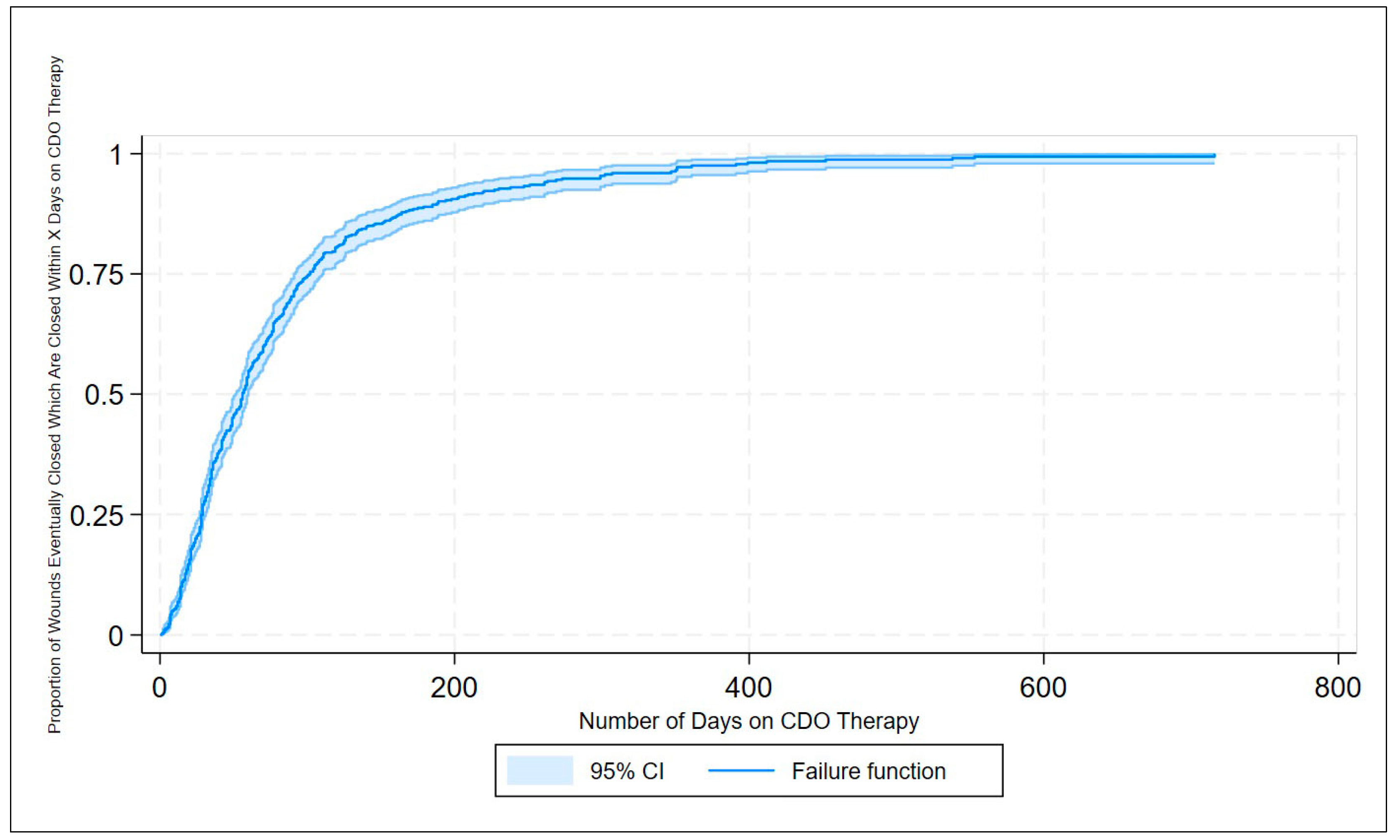
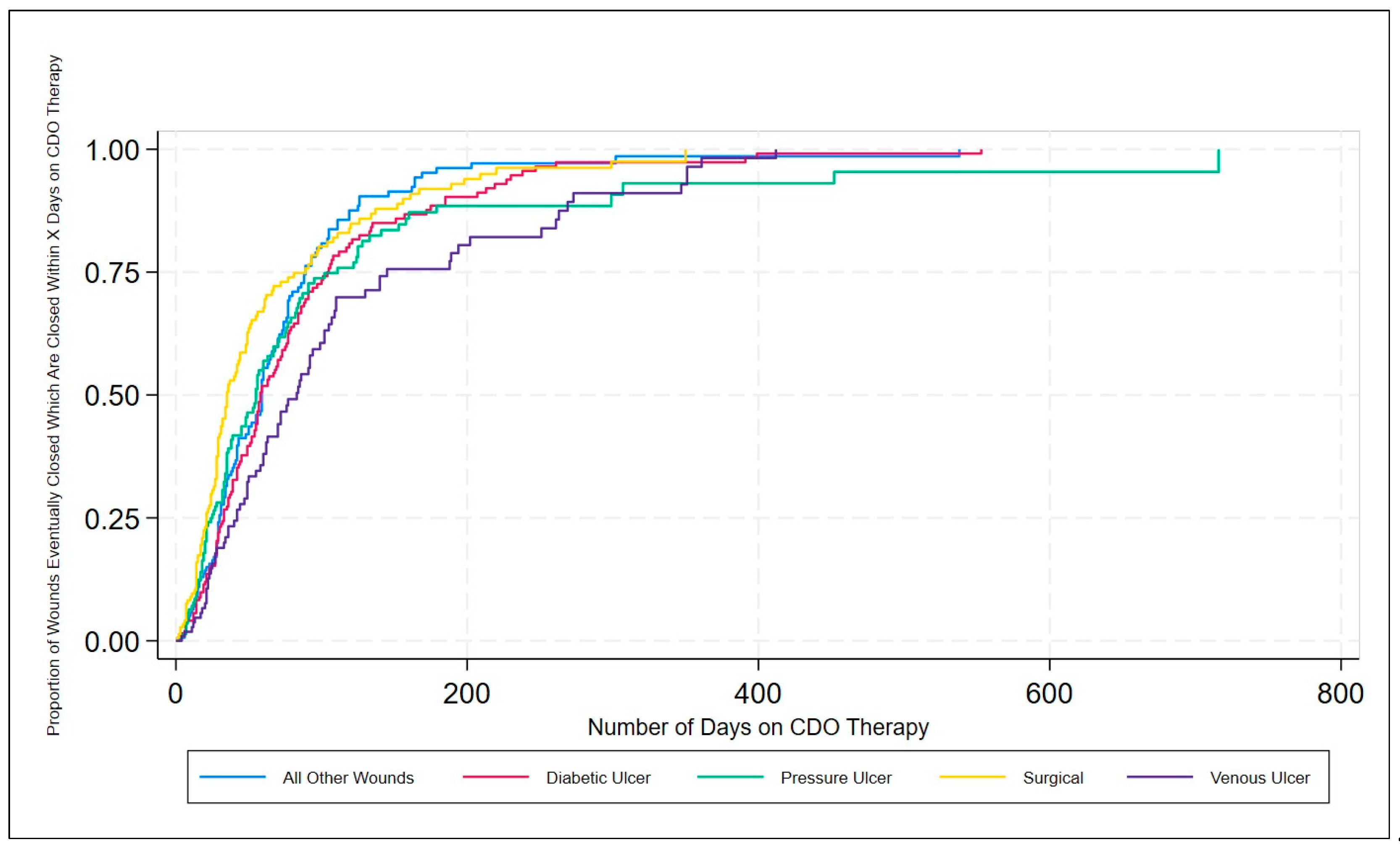



| Wound Location | Frequency | Wound Location | Frequency |
|---|---|---|---|
| Pedal (Foot) | 391 | Abdominal | 11 |
| Lower Limb | 164 | Back (Dorsal) | 10 |
| Unknown | 98 | Head/Neck | 7 |
| Sacrum | 37 | Upper Limb | 3 |
| Pelvic/Pubic | 27 | Buttocks Right | 1 |
| Thoracic | 15 | Total | 764 |
| Parameters * | Total, All Wounds | Diabetic Ulcers | Venous Ulcers | Pressure Ulcers | Surgical Wounds | All Other |
|---|---|---|---|---|---|---|
| Number of Patients Treated (N) | 764 | 200 | 111 | 145 | 145 | 163 |
| Success Rate, Overall (%) | 76.3% | 75.5% | 71.2% | 71.7% | 84.1% | 77.9% |
| Success Rate, Medicare Age (%) | 72.7% | 73.2% | 67.0% | 73.4% | 77.1% | 73.3% |
| Patient Age, Years (avg ± SD) | 66.1 ± 14.7 | 65.5 ± 13.2 | 70.8 ± 14.9 | 68.8 ± 16.5 | 61.2 ± 14.6 | 65.3 ± 13.1 |
| Medicare Age (65+), % | 49.1% | 50.5% | 65.7% | 54.5% | 38.6% | 38.8% |
| Medicare Age, Years (avg ± SD) | 78.0 ± 8.8 | 75.8 ± 8.4 | 79.8 ± 8.5 | 81.1 ± 8.4 | 75.0 ± 8.7 | 78.4 ± 8.7 |
| Wound Age, Days (avg) | 298.3 | 292.4 | 440.3 | 332.4 | 164.2 | 292.0 |
| Wound Size, cm2 (avg ± SD) | 11.7 ± 28.6 | 6.1 ± 9.0 | 20.5 ± 34.4 | 10.5 ± 20.4 | 7.1 ± 14.6 | 17.5 ± 43.9 |
| Max. Patient Age Healed, Years | 101 | 97 | 101 | 100 | 100 | 93 |
| Max. Wound Size Healed, cm2 | 283 | 56 | 224 | 85 | 122 | 283 |
| CDO Therapy Days, avg | 65.0 | 66.0 | 85.7 | 67.6 | 52.8 | 58.2 |
| Analysis Time _t | Hazard Ratio | Standard Error | X-Value | p-Value | Lower 95% Confidence Bound | Upper 95% Confidence Bound |
|---|---|---|---|---|---|---|
| Patient Age at Onset of Therapy | 1.001 | 0.003 | 0.250 | 0.800 | 0.995 | 1.007 |
| Sex–Female | 0.845 | 0.082 | −1.740 | 0.082 | 0.698 | 1.022 |
| Wound Location | ||||||
| Back (Dorsal) | 0.511 | 0.263 | −1.300 | 0.192 | 0.187 | 1.400 |
| Buttocks Right | 2.186 | 2.330 | 0.730 | 0.463 | 0.271 | 17.653 |
| Head/Neck | 1.413 | 0.752 | 0.650 | 0.516 | 0.498 | 4.009 |
| Lower Limb | 0.695 | 0.251 | −1.010 | 0.313 | 0.343 | 1.409 |
| Pedal (Foot) | 0.764 | 0.258 | −0.800 | 0.426 | 0.394 | 1.481 |
| Pelvic/Pubic | 0.271 | 0.125 | −2.830 | 0.005 | 0.110 | 0.669 |
| Sacrum | 0.536 | 0.221 | −1.510 | 0.131 | 0.239 | 1.203 |
| Thoracic | 1.086 | 0.518 | 0.170 | 0.863 | 0.426 | 2.765 |
| Unknown | 0.735 | 0.265 | −0.850 | 0.393 | 0.362 | 1.491 |
| Upper Limb | 0.701 | 0.469 | −0.530 | 0.595 | 0.189 | 2.599 |
| Wound Type | ||||||
| Diabetic Ulcer | 0.822 | 0.125 | −1.290 | 0.198 | 0.609 | 1.108 |
| Pressure Ulcer | 1.025 | 0.188 | 0.140 | 0.892 | 0.715 | 1.469 |
| Surgical | 1.082 | 0.171 | 0.500 | 0.618 | 0.794 | 1.475 |
| Venous Ulcer | 0.654 | 0.129 | −2.150 | 0.032 | 0.443 | 0.964 |
| Outcome | CDO (Real-World) (PPD) | NPWT (Blume Study) |
|---|---|---|
| Closure at 112 Days, % | 79.2% | 43.2% |
| Kaplan–Meier Estimate to Full Closure, days | 58 days | 96 days |
| Average Baseline Wound Size, cm2 (SD) | 11.7 (27.7) | 13.5 (18.2) |
Disclaimer/Publisher’s Note: The statements, opinions and data contained in all publications are solely those of the individual author(s) and contributor(s) and not of MDPI and/or the editor(s). MDPI and/or the editor(s) disclaim responsibility for any injury to people or property resulting from any ideas, methods, instructions or products referred to in the content. |
© 2025 by the authors. Licensee MDPI, Basel, Switzerland. This article is an open access article distributed under the terms and conditions of the Creative Commons Attribution (CC BY) license (https://creativecommons.org/licenses/by/4.0/).
Share and Cite
Mercurio, M.G.; Lavery, L.A.; Agarwal, A.; Oropallo, A. Clinical Efficacy of Continuously Diffused Oxygen (CDO) Therapy and Cohort Comparison to Negative Pressure Wound Therapy (NPWT). Oxygen 2025, 5, 26. https://doi.org/10.3390/oxygen5040026
Mercurio MG, Lavery LA, Agarwal A, Oropallo A. Clinical Efficacy of Continuously Diffused Oxygen (CDO) Therapy and Cohort Comparison to Negative Pressure Wound Therapy (NPWT). Oxygen. 2025; 5(4):26. https://doi.org/10.3390/oxygen5040026
Chicago/Turabian StyleMercurio, Matthew G., Lawrence A. Lavery, Animesh Agarwal, and Alisha Oropallo. 2025. "Clinical Efficacy of Continuously Diffused Oxygen (CDO) Therapy and Cohort Comparison to Negative Pressure Wound Therapy (NPWT)" Oxygen 5, no. 4: 26. https://doi.org/10.3390/oxygen5040026
APA StyleMercurio, M. G., Lavery, L. A., Agarwal, A., & Oropallo, A. (2025). Clinical Efficacy of Continuously Diffused Oxygen (CDO) Therapy and Cohort Comparison to Negative Pressure Wound Therapy (NPWT). Oxygen, 5(4), 26. https://doi.org/10.3390/oxygen5040026



