
Positive Influence of Mussel Aquaculture on Epibenthic Macrofauna: An Example of Restorative Aquaculture in Coastal Ecosystems
 , ,
, ,
Abstract
1. Introduction
2. Materials and Methods
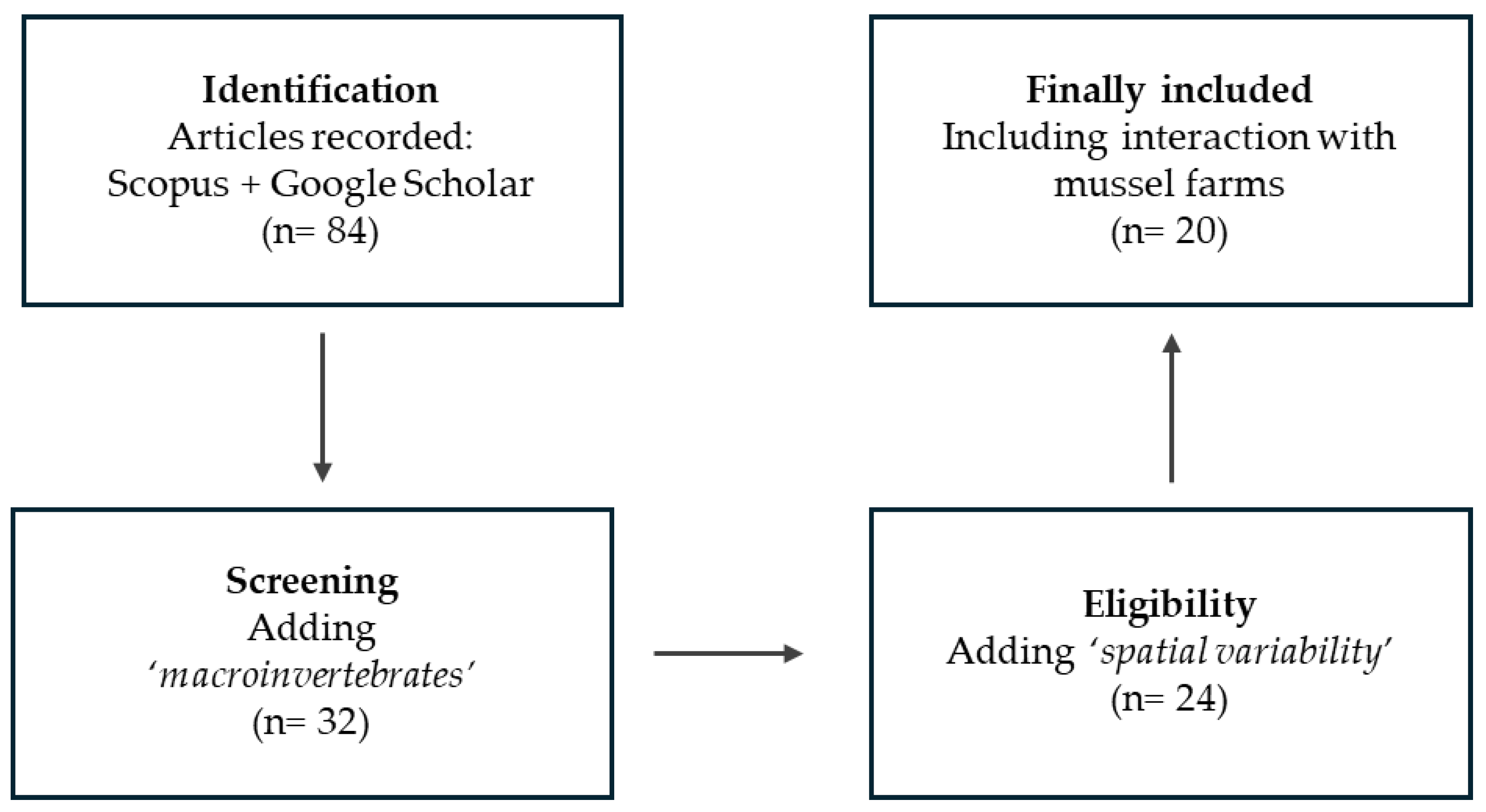
Literature Review
3. Results
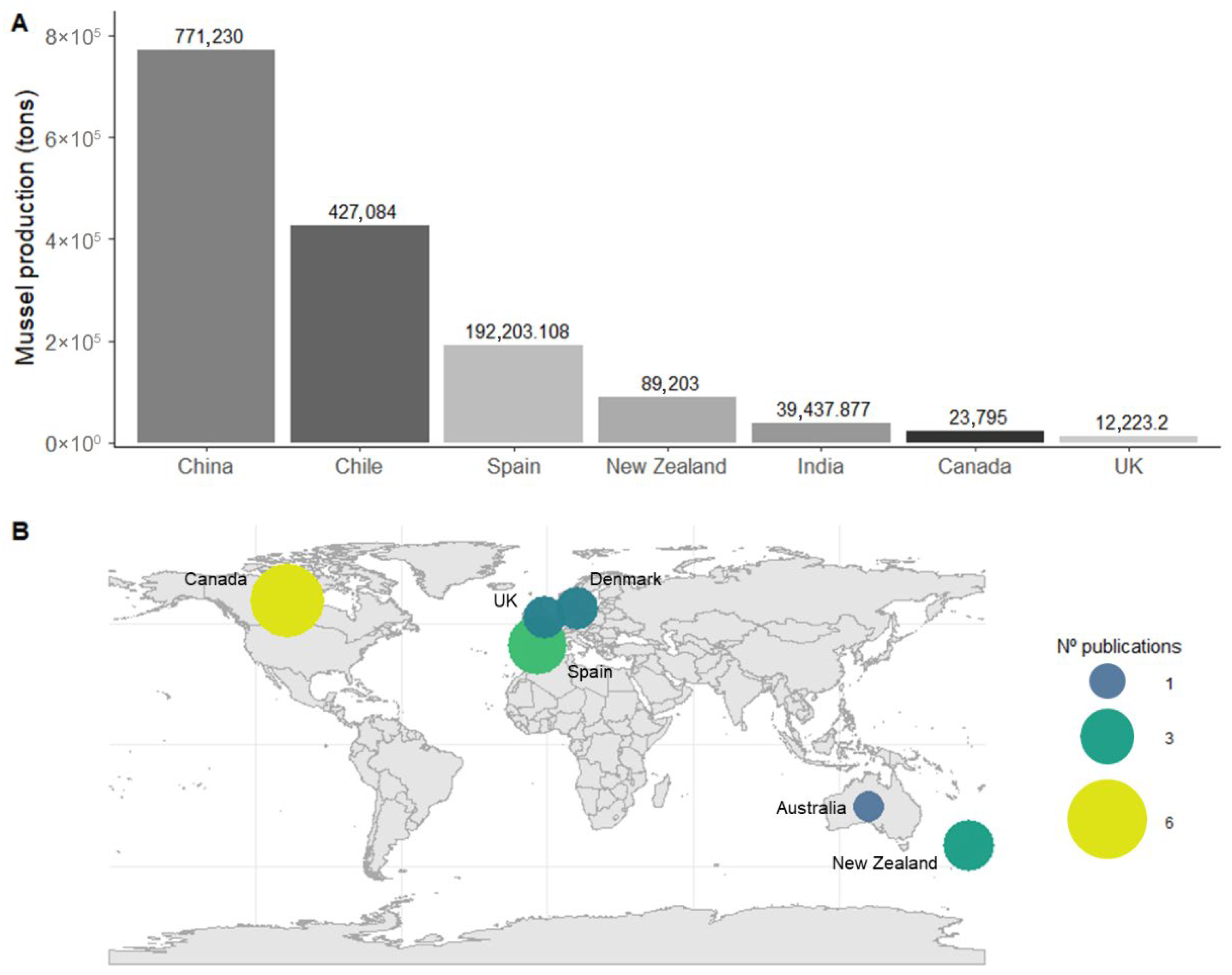
3.1. Annual Production Rates and Scientific Effort

3.2. Ecological Benefits
3.3. Effects on Epibenthic Macroinvertebrates

| Group/Specie | Response to Mussel Farm | Ecological Role/Implication | References |
|---|---|---|---|
| Cancer pagurus, C. irroratus (rock crabs) | Attraction to mussel fall-off; abundance up to 6 times within farm; diet shift toward mussel | Predator of mussels; important prey of lobsters; enhances trophic links | [12,35,37] |
| Homarus americanus (American lobster) | Mixed results: limited association in sandy offshore farms; sometimes higher abundances near structures; inter-stage competition | High-value commercial species; uses anchor blocks and fall-off as habitat; diverse diet due to higher prey availability | [45,49] |
| Homarus gammarus (European lobster) | Strong association with offshore farm structures; sheltering in anchor blocks and mussel fall-off | Key commercial species; higher shelter fidelity and behavioural shifts | [24] |
| Asterias spp. (sea star) | Major predator of mussels; classified as “pests” by producers | Keystone predator; causes economic losses in aquaculture; higher reproductive success and rapid growth | [13,42] |
| Coscinasterias muricata (eleven-armed star) | Abundance 25× higher within farms; enhanced growth and gonad production; interspecies competition | Predator; reproductive success boosted by mussel deposits | [22,41] |
| Holothuroidea (sea cucumber) | Attracted to organic deposits beneath farms | Detritivores; recycling organic matter | [51] |
| Echinoidea (sea urchin) | Recruitment on culture structures; individuals often fall to seabed | Grazers; influence benthic community composition | [51] |
| Ophiocomia nigra (brittle star) | Dense beds under longlines due to pseudofaeces enrichment | Suspension feeder; increases local biodiversity | [44] |
4. Discussion
4.1. Balancing Ecological and Socio-Economic Benefits
4.2. Challenges and Spatial Planning Considerations
Supplementary Materials
Author Contributions
Funding
Data Availability Statement
Conflicts of Interest
Abbreviations
| EU | European Union |
References
- Rogers, A.D.; Aburto-Oropeza, O.; Appeltans, W.; Assis, J.; Ballance, L.T.; Cury, P.; Duarte, C.; Favoretto, F.; Kumagai, J.; Lovelock, C.; et al. Critical Habitats and Biodiversity: Inventory, Thresholds and Governance. In The Blue Compendium; Lubchenco, J., Haugan, P.M., Eds.; World Resources Institute: Washington, DC, USA; Springer International Publishing: Cham, Switzerland, 2023; pp. 333–392. [Google Scholar] [CrossRef]
- Overton, K.; Dempster, T.; Swearer, S.E.; Morris, R.L.; Barrett, L.T. Achieving conservation and restoration outcomes through ecologically beneficial aquaculture. Conserv. Biol. 2024, 38, e14065. [Google Scholar] [CrossRef] [PubMed]
- Theuerkauf, S.J.; Barrett, L.T.; Alleway, H.K.; Costa-Pierce, B.A.; St Gelais, A.; Jones, R.C. Habitat value of bivalve shellfish and seaweed aquaculture for fish and invertebrates: Pathways, synthesis and next steps. Rev. Aquac. 2022, 14, 54–72. [Google Scholar] [CrossRef]
- Hassan, R.; Scholes, R.; Ash, N.; Condition, M.; Group, T. Ecosystems and Human Well-Being: Current State and Trends: Findings of the Condition and Trends Working Group (Millennium Ecosystem Assessment Series); Island Press: Washington, DC, USA, 2005. [Google Scholar]
- FAO. The State of World Fisheries and Aquaculture 2024; FAO: Rome, Italy, 2024. [Google Scholar] [CrossRef]
- Wilding, T.; Nickell, T. Changes in Benthos Associated with Mussel (Mytilus edulis L.) Farms on the West-Coast of Scotland. PLoS ONE 2013, 8, e68313. [Google Scholar] [CrossRef]
- Grant, C.; Archambault, P.; Olivier, F.; McKindsey, C. Influence of ‘bouchot’ mussel culture on the benthic environment in a dynamic intertidal system. Aquac. Environ. Interact. 2012, 2, 117–131. [Google Scholar] [CrossRef][Green Version]
- Chamberlain, J. Impacts of biodeposits from suspended mussel (Mytilus edulis L.) culture on the surrounding surficial sediments. ICES J. Mar. Sci. 2001, 58, 411–416. [Google Scholar] [CrossRef]
- Hartstein, N.D.; Rowden, A.A. Effect of biodeposits from mussel culture on macroinvertebrate assemblages at sites of different hydrodynamic regime. Mar. Environ. Res. 2004, 57, 339–357. [Google Scholar] [CrossRef]
- Mascorda-Cabre, L.; Hosegood, P.; Attrill, M.J.; Bridger, D.; Sheehan, E.V. Detecting sediment recovery below an offshore longline mussel farm: A macrobenthic Biological Trait Analysis (BTA). Mar. Pollut. Bull. 2023, 195, 115556. [Google Scholar] [CrossRef]
- Drouin, A.; Archambault, P.; Clynick, B.; Richer, K.; McKindsey, C.W. Influence of mussel aquaculture on the distribution of vagile benthic macrofauna in îles de la Madeleine, eastern Canada. Aquac. Environ. Interact. 2015, 6, 175–183. [Google Scholar] [CrossRef][Green Version]
- Sean, A.-S.; Drouin, A.; Archambault, P.; McKindsey, C.W. Influence of an Offshore Mussel Aquaculture Site on the Distribution of Epibenthic Macrofauna in Îles de la Madeleine, Eastern Canada. Front. Mar. Sci. 2022, 9, 859816. [Google Scholar] [CrossRef]
- D’Amours, O.; Archambault, P.; McKindsey, C.; Johnson, L. Local enhancement of epibenthic macrofauna by aquaculture activities. Mar. Ecol. Prog. Ser. 2008, 371, 73–84. [Google Scholar] [CrossRef]
- Bridger, D.; Attrill, M.J.; Davies, B.F.R.; Holmes, L.A.; Cartwright, A.; Rees, S.E.; Cabre, L.M.; Sheehan, E.V. The restoration potential of offshore mussel farming on degraded seabed habitat. Aquac. Fish Fish. 2022, 2, 437–449. [Google Scholar] [CrossRef]
- Alleway, H.K.; Waters, T.J.; Brummett, R.; Cai, J.; Cao, L.; Cayten, M.R.; Costa-Pierce, B.A.; Dong, Y.-W.; Hansen, S.C.B.; Liu, S.; et al. Global principles for restorative aquaculture to foster aquaculture practices that benefit the environment. Conserv. Sci. Pract. 2023, 5, e12982. [Google Scholar] [CrossRef]
- Wickham, H. ggplot2: Elegant Graphics for Data Analysis; Springer: New York, NY, USA, 2016; Available online: https://ggplot2.tidyverse.org (accessed on 1 February 2025).
- R Core Team. R: A Language and Environment for Statistical Computing; R Foundation for Statistical Computing: Vienna, Austria, 2025; Available online: https://www.r-project.org/ (accessed on 1 February 2025).
- Kaspar, H.F.; Gillespie, P.A.; Boyer, I.C.; MacKenzie, A.L. Effects of mussel aquaculture on the nitrogen cycle and benthic communities in Kenepuru Sound, Marlborough Sounds, New Zealand. Mar. Biol. 1985, 85, 127–136. [Google Scholar] [CrossRef]
- Shumway, S.; Davis, C.; Downey, R.; Karney, R.; Kraeuter, J.; Parsons, J.; Rheault, R.; Wikfors, G. Shellfish aquaculture—In praise of sustainable economies and environments. World Aquac. 2003, 34, 8–10. [Google Scholar]
- Rose, J.M.; Bricker, S.B.; Tedesco, M.A.; Wikfors, G.H. A Role for Shellfish Aquaculture in Coastal Nitrogen Management. Environ. Sci. Technol. Am. Chem. Soc. 2014, 48, 2519–2525. [Google Scholar] [CrossRef]
- Davidson, R.J.; Scrimgeour, G.J.; Richards, L.A.; Locky, D. Multi-Spatial and Temporal Assessments of Impacts and Recovery of Epibenthic Species and Habitats Under Mussel Farms in the Marlborough Sounds, New Zealand. J. Shellfish Res. 2024, 43, 15–28. [Google Scholar] [CrossRef]
- Inglis, G.J.; Gust, N. Potential indirect effects of shellfish culture on the reproductive success of benthic predators. J. Appl. Ecol. 2003, 40, 1077–1089. [Google Scholar] [CrossRef]
- Mascorda Cabre, L.; Hosegood, P.; Attrill, M.J.; Bridger, D.; Sheehan, E.V. Offshore longline mussel farms: A review of oceanographic and ecological interactions to inform future research needs, policy and management. Rev. Aquac. 2021, 13, 1864–1887. [Google Scholar] [CrossRef]
- Stamp, T.; Pittman, S.; Holme, L.; Rees, A.; Ciotti, B.; Thatcher, H.; Davies, P.; Hall, A.; Wells, G.; Olczak, A.; et al. Restorative function of offshore longline mussel farms with ecological benefits for commercial crustacean species. Sci. Total Environ. 2024, 951, 174987. [Google Scholar] [CrossRef]
- McKindsey, C.W.; Anderson, M.R.; Courtenay, S.; Landry, T.; Skinner, M. Effects off Shellfish Aquaculture on Fish Habitat; Canadian Science Advisory Secretariat: Ottawa, ON, Canada, 2006. [Google Scholar]
- Powers, M.; Peterson, C.; Summerson, H.; Powers, S. Macroalgal growth on bivalve aquaculture netting enhances nursery habitat for mobile invertebrates and juvenile fishes. Mar. Ecol. Prog. Ser. 2007, 339, 109–122. [Google Scholar] [CrossRef]
- Costa-Pierce, B.; Bridger, C.J. The role of marine aquaculture facilities as habitats and ecosystems. In Responsible Marine Aquaculture; CABI Publishing: Wallingford, UK, 2002; pp. 105–144. [Google Scholar]
- MCS. Good Fish Guide: Best Choice Seafood; Marine Conservation Society: Herefordshire, UK, 2018; Available online: https://www.mcsuk.org/news/why-you-should-be-eating-more-uk-shellfish (accessed on 1 February 2025).
- FAO. The State of World Fisheries and Aquaculture 2020: Sustainability in Action; Food and Agriculture Organization of the United Nations: Rome, Italy, 2020. [Google Scholar]
- Callier, M.D.; McKindsey, C.W.; Desrosiers, G. Evaluation of indicators used to detect mussel farm influence on the benthos: Two case studies in the Magdalen Islands, Eastern Canada. Aquaculture 2008, 278, 77–88. [Google Scholar] [CrossRef]
- Clynick, B.; McKindsey, C.; Archambault, P. Distribution and productivity of fish and macroinvertebrates in mussel aquaculture sites in the Magdalen Islands (Quebec, Canada). Aquaculture 2013, 283, 203–210. [Google Scholar] [CrossRef]
- Romero, P.; Gonzfilez-Gurriarfin, E.; Penas, E. Influence of Mussel Rafts on Spatial and Seasonal Abundance of Crabs in the Ria de Arousa, North-West Spain. Mar. Biol. 1982, 72, 201–210. [Google Scholar] [CrossRef]
- Drummond-Davis, N.C.; Mann, K.H.; Pottle, R.A. Some Estimates of Population Density and Feeding Habits of the Rock Crab, Cancer irroratus, in a Kelp Bed in Nova Scotia. Can. J. Fish. Aquat. Sci. 1982, 39, 636–639. [Google Scholar] [CrossRef]
- Dolmer, P. The interactions between bed structure of Mytilus edulis L. and the predator Asterias rubens L. J. Exp. Mar. Biol. Ecol. 1998, 228, 137–150. [Google Scholar] [CrossRef]
- Lees, K.; Lavoie, M.-F.; Macgregor, K.; Simard, É.; Drouin, A.; Comeau, L.; McKindsey, C.W. Movement of American lobster Homarus americanus and rock crabs Cancer irroratus around mussel farms in Malpeque Bay, Prince Edward Island, Canada. Aquac. Environ. Interact. 2023, 15, 179–193. [Google Scholar] [CrossRef]
- Wong, M.C.; Barbeau, M.A. Prey selection and the functional response of sea stars (Asterias vulgaris Verrill) and rock crabs (Cancer irroratus Say) preying on juvenile sea scallops (Placopecten magellanicus (Gmelin)) and blue mussels (Mytilus edulis Linnaeus). J. Exp. Mar. Biol. Ecol. 2005, 327, 1–21. [Google Scholar] [CrossRef]
- Freire, J.; González-Gurriarán, E. Feeding ecology of the velvet swimming crab Necora puber in mussel raft areas of the Ría de Arousa (Galicia, NW Spain). Mar. Ecol. Prog. Ser. 1995, 119, 139–154. [Google Scholar] [CrossRef][Green Version]
- Gaymer, C.F.; Himmelman, J.H.; Johnson, L.E. Use of prey resources by the seastars Leptasterias polaris and Asterias vulgaris: A comparison between field observations and laboratory experiments. J. Exp. Mar. Biol. Ecol. 2001, 262, 13–30. [Google Scholar] [CrossRef]
- Agüera, A. The Role of Starfish (Asterias rubens L.) Predation in Blue Mussel (Mytilus edulis L.) Seedbed Stability. Ph.D. Thesis, Wageningen University, Wageningen, The Netherlands, 2015. [Google Scholar] [CrossRef]
- Pryor, M.L. Temporal and Spatial Distribution of Larval and Post-Larval Blue Mussels (Mytilus edulis/Mytilus trossulus) and Starfish (Asterias vulgaris) Within Four Newfoundland Mussel Culture sites. Master’s Thesis, Memorial University of Newfoundland, St. John’s, NL, Canada, 2004. Available online: https://hdl.handle.net/20.500.14783/14408 (accessed on 21 August 2025).
- Barrett, L.T.; Swearer, S.E.; Dempster, T. Native predator limits the capacity of an invasive seastar to exploit a food-rich habitat. Mar. Environ. Res. 2020, 162, 105152. [Google Scholar] [CrossRef]
- Barrett, L.T.; Swearer, S.E.; Dempster, T. Impacts of marine and freshwater aquaculture on wildlife: A global meta-analysis. Rev. Aquac. 2019, 11, 1022–1044. [Google Scholar] [CrossRef]
- McKindsey, C.; Landry, T.; O’Beirn, F.; Davies Ian, M. Bivalve aquaculture and exotic species: A review of ecological considerations and management issues. J. Shellfish Res. 2007, 26, 281–294. [Google Scholar] [CrossRef]
- Olaso Toca, I. Biología de los Equinodermos de la ría de Arosa: N.o 270; Instituto Español de Oceanografía: Madrid, Spain, 1979; Volume 5, pp. 81–128. Available online: https://dialnet.unirioja.es/servlet/articulo?codigo=9216248 (accessed on 21 August 2025).
- Sardenne, F.; Forget, N.; McKindsey, C. Contribution of mussel fall-off from aquaculture to wild lobster Homarus americanus diets. Mar. Environ. Res. 2019, 149, 126–136. [Google Scholar] [CrossRef] [PubMed]
- Zanotto, F.P.; Wheatly, M.G. Calcium balance in crustaceans: Nutritional aspects of physiological regulation. Comp. Biochem. Physiol. Part A Mol. Integr. Physiol. 2002, 133, 645–660. [Google Scholar] [CrossRef] [PubMed]
- Hudon, C.; Lamarche, G. Niche segregation between American lobster Homarus americanus and rock crab Cancer irroratus. Mar. Ecol. Prog. Ser. 1989, 52, 155–168. [Google Scholar] [CrossRef]
- Gendron, L.; Fradette, P.; Godbout, G. The importance of rock crab (Cancer irroratus) for growth, condition and ovary development of adult American lobster (Homarus americanus). J. Exp. Mar. Biol. Ecol. 2001, 262, 221–241. [Google Scholar] [CrossRef]
- Agüera, A.; Saurel, C.; Møller, L.; Fitridge, I.; Petersen, J. Bioenergetics of the common seastar Asterias rubens: A keystone predator and pest for European bivalve culture. Mar. Biol. 2021, 168, 48. [Google Scholar] [CrossRef]
- Wahle, R.A.; Steneck, R.S. Habitat restrictions in early benthic life: Experiments on habitat selection and in situ predation with the American lobster. J. Exp. Mar. Biol. Ecol. 1992, 157, 91–114. [Google Scholar] [CrossRef]
- Cobb, J.S. The Shelter-Related Behavior of the Losbter, Homarus Americanus. Ecology 1971, 52, 108–115. [Google Scholar] [CrossRef]
- Karnofsky, E.B.; Atema, J.; Elgin, R.H. Field Observations of Social Behavior, Shelter Use, and Foraging in the Lobster, Homarus americanus. In The Biological Bulletin; The University of Chicago Press: Chicago, IL, USA, 1989; Volume 176, pp. 239–246. [Google Scholar] [CrossRef]
- Lavoie, M.-F.; Simard, É.; Drouin, A.; Archambault, P.; Comeau, L.; McKindsey, C. Movement of American lobster Homarus americanus associated with offshore mussel Mytilus edulis aquaculture. Aquac. Environ. Interact. 2022, 14, 189–204. [Google Scholar] [CrossRef]
- Olaso Toca, I. Ecología de los Equinodermos de la Ría de Arosa: N.o334; Instituto Español de Oceanografía: Madrid, Spain, 1982; Volume 7, pp. 3–30. Available online: https://dialnet.unirioja.es/servlet/articulo?codigo=9188696 (accessed on 21 August 2025).
- Lacoste, É.; Drouin, A.; Weise, A.; Archambault, P.; McKindsey, C. Low benthic impact of an offshore mussel farm in Îles-de-la-Madeleine, eastern Canada. Aquac. Environ. Interact. 2018, 10, 473–485. [Google Scholar] [CrossRef]
- McKindsey, C.; Archambault, P.; Callier, M.; Olivier, F. Influence of suspended and off-bottom mussel culture on the sea bottom and benthic habitats: A review. Can. J. Zool. 2013, 89, 622–646. [Google Scholar] [CrossRef]
- EU. Quality Status Report (QRS) 2010; European Comission: Brussels, Belgium, 2012; Available online: https://oap.ospar.org/en/ospar-assessments/quality-status-reports/qsr-2023/other-assessments/aquaculture/ (accessed on 21 August 2025).
- Sala, E.; Lubchenco, J.; Grorud-Colvert, K.; Novelli, C.; Roberts, C.; Sumaila, R. Assessing real progress towards effective ocean protection. Mar. Policy 2018, 91, 11–13. [Google Scholar] [CrossRef]
- Zupan, M.; Fragkopoulou, E.; Claudet, J.; Erzini, K.; Horta e Costa, B.; Gonçalves, E.J. Marine partially protected areas: Drivers of ecological effectiveness. Front. Ecol. Environ. 2018, 16, 381–387. [Google Scholar] [CrossRef]
- e Costa, B.H.; Claudet, J.; Franco, G.; Erzini, K.; Caro, A.; Gonçalves, E.J. A regulation-based classification system for marine protected areas: A response to Dudley et al. Mar. Policy 2017, 77, 193–195. [Google Scholar] [CrossRef]
- Fernandez-Jover, D.; Sanchez-Jerez, P.; Bayle-Sempere, J.; Valle, C.; Dempster, T. Seasonal patterns and diets of wild fish assemblages associated to Mediterranean coastal fish farms. ICES J. Mar. Sci. 2008, 65, 1153–1160. [Google Scholar] [CrossRef]
- Dempster, T.; Uglem, I.; Sanchez-Jerez, P.; Fernandez-Jover, D.; Bayle-Sempere, J.; Nilsen, R.; Bjørn, P.A. Coastal salmon farms attract large and persistent aggregations of wild fish: An ecosystem effect. Mar. Ecol. Prog. Ser. 2009, 385, 1–14. [Google Scholar] [CrossRef]
- Weitzman, J. Applying the ecosystem services concept to aquaculture: A review of approaches, definitions, and uses. Ecosyst. Serv. 2019, 35, 194–206. [Google Scholar] [CrossRef]
- Lavoie, M.-F.; Lacoste, É.; Weise, A.M.; McKindsey, C.W. Benthic responses to organic enrichment under a mussel (Mytilus edulis) farm. Front. Mar. Sci. 2024, 11, 1433365. [Google Scholar] [CrossRef]
- Ysebaert, T.; Hart, M.; Herman, P. Impacts of bottom and suspended cultures of mussels Mytilus spp. on the surrounding sedimentary environment and macrobenthic biodiversity. Helgol. Mar. Res. 2010, 63, 59–74. [Google Scholar] [CrossRef]
- Mizita, D.D.; Froehlich, H.E.; Wilson, J. The changing role and definitions of aquaculture for environmental purposes. Rev. Aquac. 2023, 15, 130–141. [Google Scholar]
- van den Burg, S.W.K.; Termeer, E.E.W.; Skirtun, M.; Poelman, M.; Veraart, J.A.; Selnes, T. Exploring mechanisms to pay for ecosystem services provided by mussels, oysters and seaweeds. Ecosyst. Serv. 2022, 54, 101407. [Google Scholar] [CrossRef]
- Willot, P.-A.; Aubin, J.; Salles, J.-M.; Wilfart, A. Ecosystem service framework and typology for an ecosystem approach to aquaculture. Aquaculture 2019, 512, 734260. [Google Scholar] [CrossRef]
- Vivier, B.; Dauvin, J.-C.; Navon, M.; Rusig, A.-M.; Mussio, I.; Orvain, F.; Boutouil, M.; Claquin, P. Marine artificial reefs, a meta-analysis of their design, objectives and effectiveness. Glob. Ecol. Conserv. 2021, 27, e01538. [Google Scholar] [CrossRef]
- Perkol-Finkel, S.; Hadary, T.; Rella, A.; Shirazi, R.; Sella, I. Seascape architecture—Incorporating ecological considerations in design of coastal and marine infrastructure. Ecol. Eng. 2018, 120, 645–654. [Google Scholar] [CrossRef]
- Langhamer, O. Artificial Reef Effect in relation to Offshore Renewable Energy Conversion: State of the Art. Sci. World J. 2012, 2012, 386713. [Google Scholar] [CrossRef]
- Norrie, C.; Dunphy, B.; Roughan, M.; Weppe, S.; Lundquist, C. Spill-over from aquaculture may provide a larval subsidy for the restoration of mussel reefs. Aquac. Environ. Interact. 2020, 12, 231–249. [Google Scholar] [CrossRef]
- Wu, W.; Lundquist, C.; Jeffs, A. Determining the significance of pelagic versus juvenile dispersal of larvae in a coastal mussel. Sci. Total Environ. 2025, 969, 178940. [Google Scholar] [CrossRef]
- Wu, W.; Chaput, R.; Lundquist, C.; Orozco, M.; Jeffs, A. Tracking the source of wild mussel spat for aquaculture using shell microchemistry and biophysical models. Aquaculture 2023, 578, 740025. [Google Scholar] [CrossRef]
- Zhao, F.; Wu, J. The Role of Shellfish Aquaculture in Coastal Habitat Restoration. Int. J. Mar. Sci. 2024, 14, 275–284. [Google Scholar] [CrossRef]
- Pacifico, A.M.; Brigolin, D.; Mulazzani, L.; Semeraro, M.; Malorgio, G. Managing marine aquaculture by assessing its contribution to ecosystem services provision: The case of Mediterranean mussel, Mytilus galloprovincialis. Ocean. Coast. Manag. 2024, 259, 107456. [Google Scholar] [CrossRef]
- Gimpel, A.; Stelzenmüller, V.; Töpsch, S.; Galparsoro, I.; Gubbins, M.; Miller, D.; Murillas, A.; Murray, A.G.; Pınarbaşı, K.; Roca, G.; et al. A GIS-based tool for an integrated assessment of spatial planning trade-offs with aquaculture. Sci. Total Environ. 2018, 627, 1644–1655. [Google Scholar] [CrossRef]
- Thatcher, H.; Stamp, T.; Wilcockson, D.; Moore, P. Residency and habitat use of European lobster (Homarus gammarus) within an offshore wind farm. ICES J. Mar. Sci. 2023, 80, 1410–1421. [Google Scholar] [CrossRef]
- FLUC. Growing Better: Ten Critical Transitions to Transform Food and Land Use; Food and Land Use Coalition: London, UK, 2019. [Google Scholar]
- Soto, D.; Aguilar-Manjarrez, J.; Hishamunda, N. Building an Ecosystem Approach to Aquaculture. FAO/Universitat de les Illes Balears Expert Workshop; FAO: Rome, Italy, 2008. [Google Scholar]
- Brugère, C.; Aguilar-Manjarrez, J.; Beveridge, M.C.M.; Soto, D. The ecosystem approach to aquaculture 10 years on—A critical review and consideration of its future role in blue growth. Rev. Aquac. 2019, 11, 493–514. [Google Scholar] [CrossRef]
- Basconi, L. First Evidence of Spatial Relationships between Ecosystem Functioning and Services in the marine environment. J. Ecol. Nat. Resour. 2023, 7, 000321. [Google Scholar] [CrossRef]

Disclaimer/Publisher’s Note: The statements, opinions and data contained in all publications are solely those of the individual author(s) and contributor(s) and not of MDPI and/or the editor(s). MDPI and/or the editor(s) disclaim responsibility for any injury to people or property resulting from any ideas, methods, instructions or products referred to in the content. |
© 2026 by the authors. Licensee MDPI, Basel, Switzerland. This article is an open access article distributed under the terms and conditions of the Creative Commons Attribution (CC BY) license.
Share and Cite
Carbonell-Garzon, E.; Mateo, A.; Leyva, L.; Daban, P.; Troncoso, J.; Sanchez-Jerez, P. Positive Influence of Mussel Aquaculture on Epibenthic Macrofauna: An Example of Restorative Aquaculture in Coastal Ecosystems. Coasts 2026, 6, 12. https://doi.org/10.3390/coasts6010012
Carbonell-Garzon E, Mateo A, Leyva L, Daban P, Troncoso J, Sanchez-Jerez P. Positive Influence of Mussel Aquaculture on Epibenthic Macrofauna: An Example of Restorative Aquaculture in Coastal Ecosystems. Coasts. 2026; 6(1):12. https://doi.org/10.3390/coasts6010012
Chicago/Turabian StyleCarbonell-Garzon, Estela, Angela Mateo, Laura Leyva, Paula Daban, Jesus Troncoso, and Pablo Sanchez-Jerez. 2026. "Positive Influence of Mussel Aquaculture on Epibenthic Macrofauna: An Example of Restorative Aquaculture in Coastal Ecosystems" Coasts 6, no. 1: 12. https://doi.org/10.3390/coasts6010012
APA StyleCarbonell-Garzon, E., Mateo, A., Leyva, L., Daban, P., Troncoso, J., & Sanchez-Jerez, P. (2026). Positive Influence of Mussel Aquaculture on Epibenthic Macrofauna: An Example of Restorative Aquaculture in Coastal Ecosystems. Coasts, 6(1), 12. https://doi.org/10.3390/coasts6010012