


Community–Academic Collaboration for Sargassum Clean-Up and Coastal Monitoring in Xcalak, Southern Mexican Caribbean
 , , , and
Abstract
1. Introduction
2. Materials and Methods
2.1. Study Area
2.2. Community–Academic Collaboration and Perception
- (i)
- Baseline beach characterization using field observations, photographic records and community descriptions to assess natural conditions and past changes.
- (ii)
- Critical zone identification for developing sargassum clean-up treatments based on sargassum accumulation and impacts on primary community-use beaches.
- (iii)
- Mitigation of management impacts, addressing prior clean-up practices that caused sand loss, improper storage, unpleasant odors, leachates, disruptions to coastal activities, and the spread of harmful fauna.
2.3. Clean-Up Efforts: Monitoring of Sargassum Influxes and Shoreline Changes
3. Results
3.1. The Sargassum Clean-Up Treatments
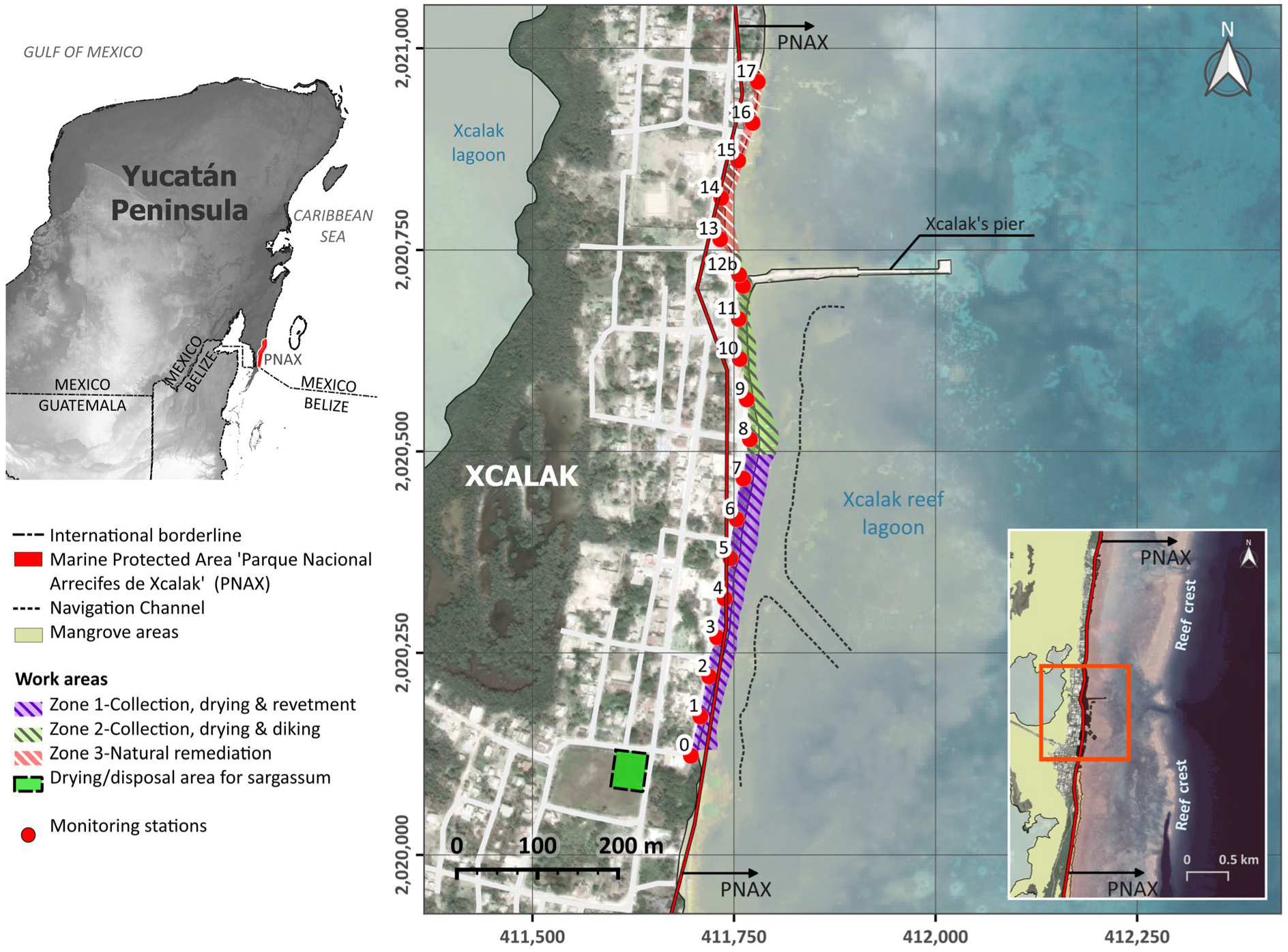
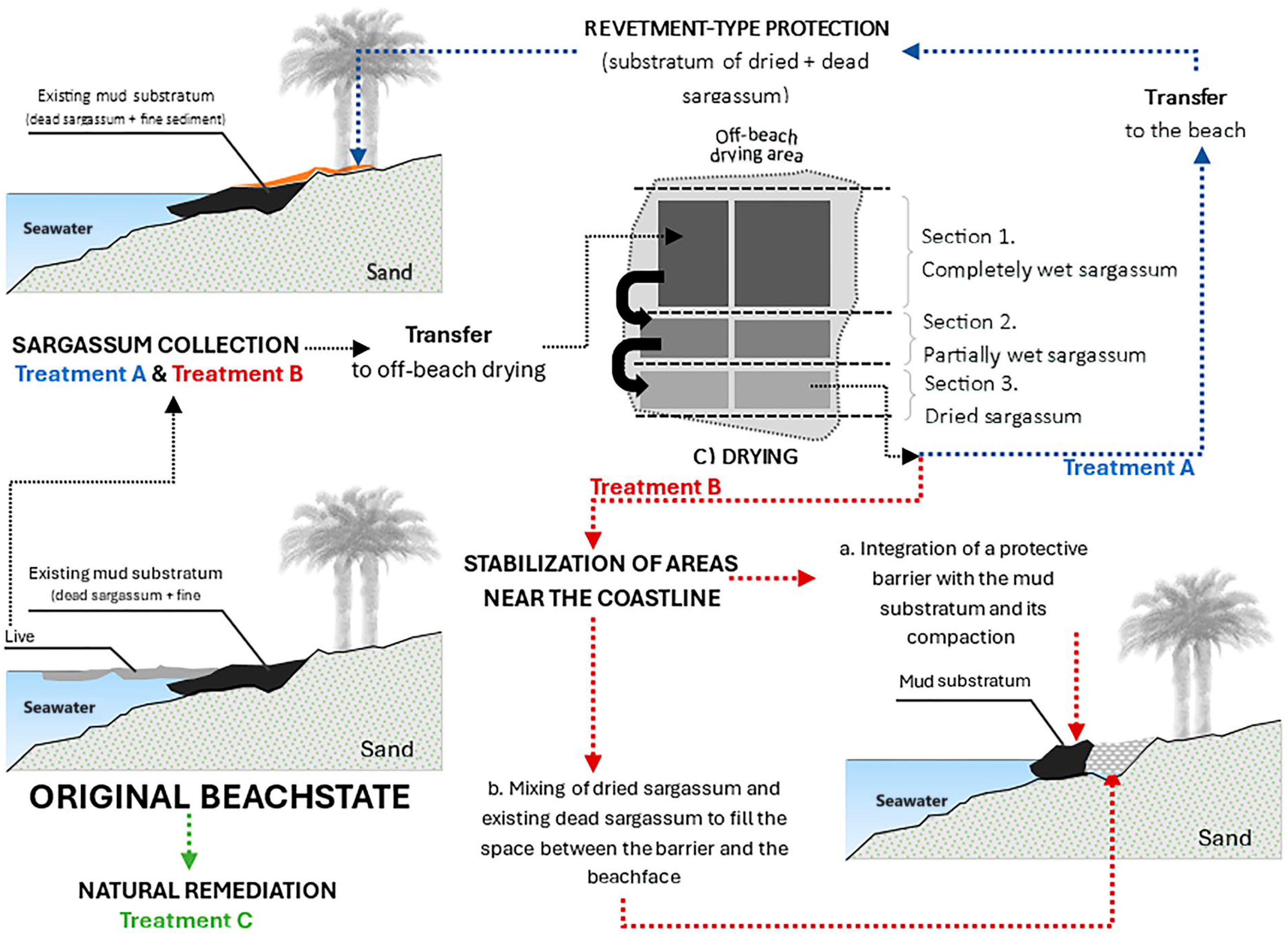
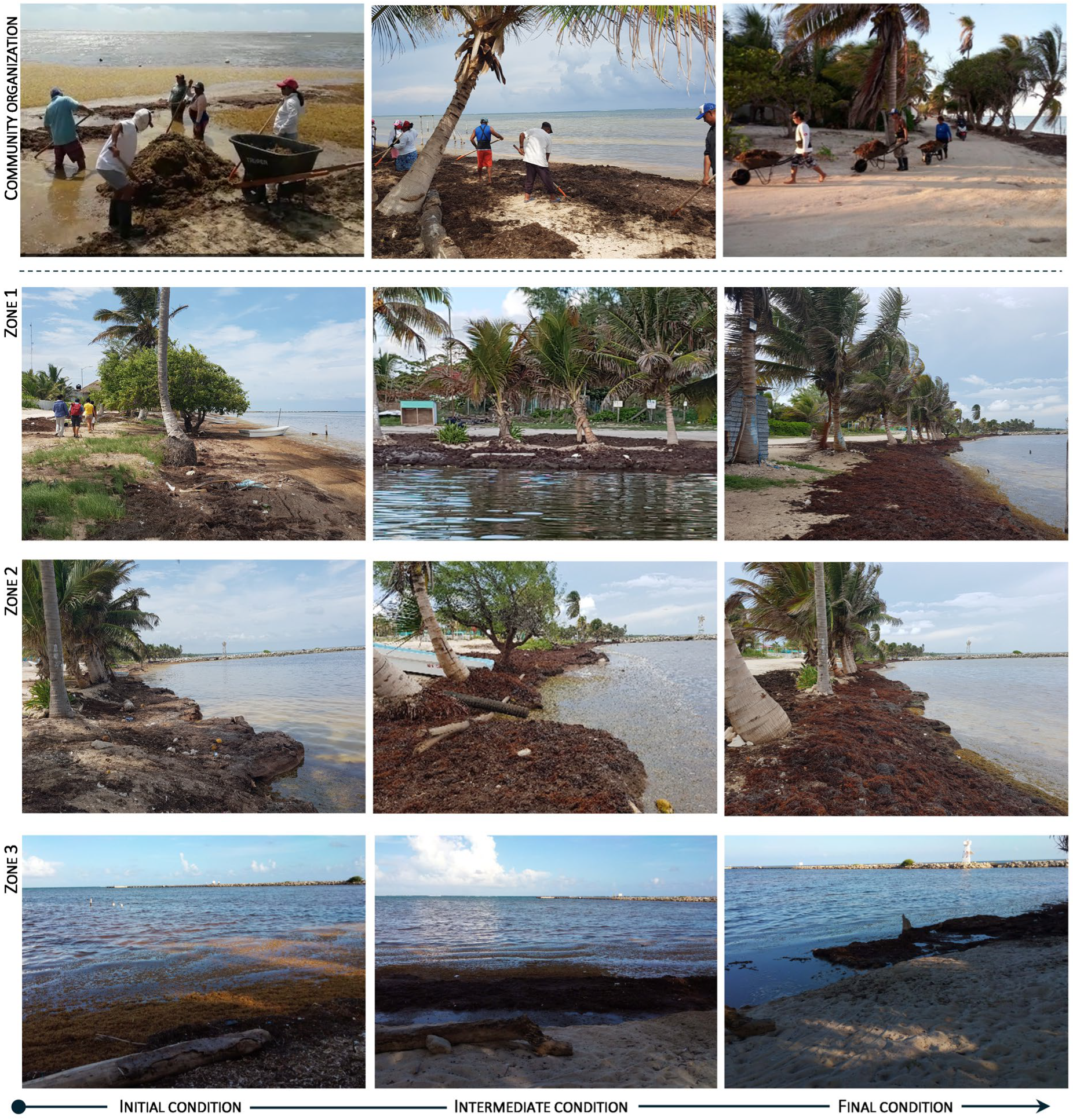
- Treatment A. Sargassum spreading, collection, drying, and revetment-type beach protection. This treatment received the highest level of community approval due to its “natural cycle” approach for sargassum management. It consisted of collecting sargassum, transporting it to designated areas for drying and natural aeration, and later reintegrating it into the beachfront as a protective revetment layer (Figure 2). Zone 1 was chosen for implementing this treatment, as it was expected to experience limited shoreline displacements due to reef protection. It also met community preferences for short transport distances between work and drying sites (i.e., <500 m) (Figure 1). The collection process primarily focused on live sargassum floating nearshore, minimizing sand adhesion and reducing potential beach erosion. Unlike the common practice prior to 2019 that involved piling sargassum into mounds (Figure 3), this method emphasized spreading sargassum in thin layers (<0.10 m thick) across designated drying/disposal areas (Figure 1).This treatment qualitatively succeeded in reducing unpleasant odors, harmful fauna, and heat associated with decomposition while facilitating aeration and sun drying (Figure 2). Once dried, the sargassum was reincorporated into the beach face to serve as a protective revetment layer. Using the beach face as a drying site also minimized transportation needs, improving overall efficiency.
- Treatment B. Sargassum collection, drying, and stabilization of areas near the shoreline. The activities under this treatment aimed to mitigate coastal erosion caused by wind-driven waves in Zone 2 (Figure 1), where no reef protection exists. A secondary goal was to preserve the integrity of existing plant root systems. The sargassum collection and drying methods employed followed the same principles as Treatment A but focused on using dried sargassum to create a protective barrier (Figure 2). The strategy combined decomposing sargassum—which normally forms a muddy substrate along the shoreline and is left in place due to its sand and fine material content—with freshly dried sargassum. This mixture produced a workable substratum to build a barrier ~1 m parallel to the shoreline and 0.20 m above the water level. The space between the barrier and the beach was filled with layers composed of a combination of dry sargassum and the existing sargassum–sand mixture. Regular maintenance was necessary to prevent the barrier from being washed away by wave action.
- Treatment C. Natural clean-up and observation. The treatment was implemented in Zone 3, an area without settlements or beaches but containing sparse mangrove patches. This approach involved the passive observation of the natural clean-up and sargassum influx process without human intervention.
3.2. Sargassum Collection and Shoreline Displacements
3.3. Community Group Perception
4. Discussion
5. Conclusions
- Promoting the role of community groups and scaling participatory frameworks for sargassum management and monitoring in similar protected and rural areas, especially where institutional response is limited.
- Supporting community–academic collaborations that integrate scientific guidance with local knowledge to co-design context-specific management strategies and adaptive coastal governance.
- Prioritizing nature-based, low-cost solutions to enhance coastal resilience and community livelihoods in natural protected areas.
- Aligning funding mechanisms with ecological and social outcomes, reorienting national public programs considering community and academic initiatives. This could incentivize long-term restoration, social acceptance, transparency, and responsibility.
Author Contributions
Funding
Data Availability Statement
Acknowledgments
Conflicts of Interest
References
- García-Sánchez, M.; Graham, C.; Vera, E.; Escalante-Mancera, E.; Álvarez-Filip, L.; van Tussenbroek, B.I. Temporal Changes in the Composition and Biomass of Beached Pelagic Sargassum Species in the Mexican Caribbean. Aquat. Bot. 2020, 167, 103275. [Google Scholar] [CrossRef]
- Louime, C.; Fortune, J.; Gervais, G. Sargassum Invasion of Coastal Environments: A Growing Concern. Am. J. Environ. Sci. 2017, 13, 58–64. [Google Scholar] [CrossRef]
- Martin, L.M.; Taylor, M.; Huston, G.; Goodwin, D.S.; Schell, J.M.; Siuda, A.N.S. Pelagic Sargassum Morphotypes Support Different Rafting Motile Epifauna Communities. Mar. Biol. 2021, 168, 115. [Google Scholar] [CrossRef]
- Uribe-Martínez, A.; Berriel-Bueno, D.; Chávez, V.; Cuevas, E.; Almeida, K.L.; Fontes, J.V.H.; van Tussenbroek, B.I.; Mariño-Tapia, I.; Liceaga-Correa, M.d.l.Á.; Ojeda, E.; et al. Multiscale Distribution Patterns of Pelagic Rafts of Sargasso (Sargassum spp.) in the Mexican Caribbean (2014–2020). Front. Mar. Sci. 2022, 9, 920339. [Google Scholar] [CrossRef]
- Wang, M.; Hu, C.; Barnes, B.B.; Mitchum, G.; Lapointe, B.; Montoya, J.P. The Great Atlantic Sargassum Belt. Science 2019, 365, 83–87. [Google Scholar] [CrossRef]
- Wang, M.; Hu, C. Mapping and Quantifying Sargassum Distribution and Coverage in the Central West Atlantic Using MODIS Observations. Remote Sens. Environ. 2016, 183, 350–367. [Google Scholar] [CrossRef]
- Rodríguez-Martínez, R.E.; Medina-Valmaseda, A.E.; Blanchon, P.; Monroy-Velázquez, L.V.; Almazán-Becerril, A.; Delgado-Pech, B.; Vásquez-Yeomans, L.; Francisco, V.; García-Rivas, M.C. Faunal Mortality Associated with Massive Beaching and Decomposition of Pelagic Sargassum. Mar. Pollut. Bull. 2019, 146, 201–205. [Google Scholar] [CrossRef] [PubMed]
- Rodríguez-Martínez, R.E.; Roy, P.D.; Torrescano-Valle, N.; Cabanillas-Terán, N.; Carrillo-Domínguez, S.; Collado-Vides, L.; García-Sánchez, M.; van Tussenbroek, B.I. Element Concentrations in Pelagic Sargassum along the Mexican Caribbean Coast in 2018–2019. PeerJ 2020, 8, e8667. [Google Scholar] [CrossRef]
- Hamel, K.; Garcia-Quijano, C.; Jin, D.; Dalton, T. Perceived Sargassum Event Incidence, Impacts, and Management Response in the Caribbean Basin. Mar. Policy 2024, 165, 106214. [Google Scholar] [CrossRef]
- Chávez, V.; Uribe-Martínez, A.; Cuevas, E.; Rodríguez-Martínez, R.E.; van Tussenbroek, B.I.; Francisco, V.; Estévez, M.; Celis, L.B.; Monroy-Velázquez, L.V.; Leal-Bautista, R.; et al. Massive Influx of Pelagic Sargassum spp. on the Coasts of the Mexican Caribbean 2014–2020: Challenges and Opportunities. Water 2020, 12, 2908. [Google Scholar] [CrossRef]
- Espinosa, L.A.; Li Ng, J.J. El Riesgo Del Sargazo Para La Economía y Turismo de Quintana Roo y México. BBVA Res. 2020, 20, 1–35. [Google Scholar]
- Gray, L.A.; Bisonó León, A.G.; Rojas, F.E.; Veroneau, S.S.; Slocum, A.H. Caribbean-Wide, Negative Emissions Solution to Sargassum spp. Low-Cost Collection Device and Sustainable Disposal Method. Phycology 2021, 1, 49–75. [Google Scholar] [CrossRef]
- Rodríguez-Martínez, R.E.; Jordán-Dahlgren, E.; Hu, C. Spatio-Temporal Variability of Pelagic Sargassum Landings on the Northern Mexican Caribbean. Remote Sens. Appl. 2022, 27, 100767. [Google Scholar] [CrossRef]
- Rodríguez-Martínez, R.E.; van Tussenbroek, B.I.; Jordán-Dahlgren, E. Afluencia Masiva de Sargazo Pelágico a La Costa Del Caribe Mexicano (2014–2015). In Florecimientos Algales Nocivos en México; Mendoza, E., Quijano-Scheggia, S.I., Olivos-Ortiz, A., Núñez-Vázquez, E.J., Eds.; CICESE: Ensenada, México, 2016; pp. 352–365. [Google Scholar]
- Arellano-Verdejo, J.; Lazcano-Hernandez, H.E.; Cabanillas-Terán, N. ERISNet: Deep Neural Network for Sargassum Detection along the Coastline of the Mexican Caribbean. PeerJ 2019, 7, e6842. [Google Scholar] [CrossRef] [PubMed]
- van Tussenbroek, B.I.; Hernández Arana, H.A.; Rodríguez-Martínez, R.E.; Espinoza-Avalos, J.; Canizales-Flores, H.M.; González-Godoy, C.E.; Barba-Santos, M.G.; Vega-Zepeda, A.; Collado-Vides, L. Severe Impacts of Brown Tides Caused by Sargassum spp. on near-Shore Caribbean Seagrass Communities. Mar. Pollut. Bull. 2017, 122, 272–281. [Google Scholar] [CrossRef]
- Cabanillas-Terán, N.; Hernández-Arana, H.A.; Ruiz-Zárate, M.-Á.; Vega-Zepeda, A.; Sanchez-Gonzalez, A. Sargassum Blooms in the Caribbean Alter the Trophic Structure of the Sea Urchin Diadema antillarum. PeerJ 2019, 7, e7589. [Google Scholar] [CrossRef]
- Powers, L.C.; Hertkorn, N.; McDonald, N.; Schmitt-Kopplin, P.; Del Vecchio, R.; Blough, N.V.; Gonsior, M. Sargassum sp. Act as a Large Regional Source of Marine Dissolved Organic Carbon and Polyphenols. Glob. Biogeochem Cycles 2019, 33, 1423–1439. [Google Scholar] [CrossRef]
- Rodríguez-Martínez, R.E.; Quintana-Pali, G.; Trujano-Rivera, K.I.; Herrera, R.; García-Rivas, M.d.C.; Ortíz, A.; Castañeda, G.; Maldonado, G.; Jordán-Dahlgren, E. Sargassum Landings Have Not Compromised Nesting of Loggerhead and Green Sea Turtles in the Mexican Caribbean. J. Environ. Manag. 2021, 299, 113614. [Google Scholar] [CrossRef]
- SEMARNAT-INECC. Lineamientos Técnicos y de Gestión Para La Atención de La Contingencia Ocasionada Por Sargazo En El Caribe Mexicano y El Golfo de México; SEMARNAT-INECC: Mexico City, Mexico, 2021; p. 50. [Google Scholar]
- Desrochers, A.; Cox, S.A.L.; Oxenford, H.A.; van Tussenbroek, B. Pelagic Sargassum—A Guide to Current and Potential Uses in the Caribbean; FAO Fisheries and Aquaculture: Rome, Italy, 2022; ISBN 978-92-5-137320-0. [Google Scholar]
- Hinds, C.; Oxenford, H.; Cumberbatch, J.; Fardin, F.; Doyle, E.; Cashman, A. Golden Tides: Management Best Practices for Influxes of Sargassum in the Caribbean with a Focus on Clean-Up; Centre for Resource Management and Environmental Studies (CERMES)-The University of the West Indies: Cave Hill Campus, Barbados, 2016. [Google Scholar]
- Innocenti, R.A.; Feagin, R.A.; Huff, T.P. The Role of Sargassum Macroalgal Wrack in Reducing Coastal Erosion. Estuar. Coast. Shelf Sci. 2018, 214, 82–88. [Google Scholar] [CrossRef]
- van der Plank, S.; Cox, S.-A.; Cumberbatch, J.; Mahon, R.; Thomas, B.; Tompkins, E.L.; Corbett, J. Polycentric Governance, Coordination and Capacity: The Case of Sargassum Influxes in the Caribbean. Coast. Manag. 2022, 50, 285–305. [Google Scholar] [CrossRef]
- Lara-Hernández, J.A.; Enriquez, C.; Zavala-Hidalgo, J.; Cuevas, E.; van Tussenbroek, B.; Uribe-Martínez, A. Sargassum Transport towards Mexican Caribbean Shores: Numerical Modeling for Research and Forecasting. J. Mar. Syst. 2024, 241, 103923. [Google Scholar] [CrossRef]
- Celliers, L.; Mañez Costa, M.; Rölfer, L.; Aswani, S.; Ferse, S. Social Innovation That Connects People to Coasts in the Anthropocene. Camb. Prism. Coast. Futures 2023, 1, e24. [Google Scholar] [CrossRef]
- Kittinger, J.N.; Bambico, T.M.; Minton, D.; Miller, A.; Mejia, M.; Kalei, N.; Wong, B.; Glazier, E.W. Restoring Ecosystems, Restoring Community: Socioeconomic and Cultural Dimensions of a Community-Based Coral Reef Restoration Project. Reg. Environ. Change 2016, 16, 301–313. [Google Scholar] [CrossRef]
- Cumming, G.; Campbell, L.; Norwood, C.; Ranger, S.; Richardson, P.; Sanghera, A. Putting Stakeholder Engagement in Its Place: How Situating Public Participation in Community Improves Natural Resource Management Outcomes. GeoJournal 2022, 87, 209–221. [Google Scholar] [CrossRef]
- MacPhail, V.J.; Colla, S.R. Power of the People: A Review of Citizen Science Programs for Conservation. Biol. Conserv. 2020, 249, 108739. [Google Scholar] [CrossRef]
- Schnurr, R.E.J.; Alboiu, V.; Chaudhary, M.; Corbett, R.A.; Quanz, M.E.; Sankar, K.; Srain, H.S.; Thavarajah, V.; Xanthos, D.; Walker, T.R. Reducing Marine Pollution from Single-Use Plastics (SUPs): A Review. Mar. Pollut. Bull. 2018, 137, 157–171. [Google Scholar] [CrossRef]
- DOF. Decreto Por El Que Se Declara Área Natural Protegida Con El Carácter de Parque Nacional, La Región Conocida Como Arrecifes de Xcalak, Que Se Encuentra Localizada En La Costa Caribe Del Municipio de Othón P. Blanco, En El Estado de Quintana Roo; Secretaría de Gobernación: Mexico City, Mexico, 2020. [Google Scholar]
- CONANP-SEMARNAT. Programa de Manejo Parque Nacional Arrecifes de Xcalak; CONANP-SEMARNAT: Mexico City, Mexico, 2004; p. 162. [Google Scholar]
- RAMSAR. Servicio de Información Sobre Sitios Ramsar. Parque Nacional Arrecifes de Xcalak. Available online: https://rsis.ramsar.org/es/ris/1320 (accessed on 1 January 2024).
- López Jiménez, L.N. Conservación En El Parque Nacional Arrecifes de Xcalak. Teoría Y Prax. 2017, 13, 9–30. [Google Scholar] [CrossRef]
- INEGI. Principales Resultados Del Censo de Población y Vivienda 2020-Quintana Roo; Instituto Nacional de Estadística y Geografía: Aguascalientes, Mexico, 2023. [Google Scholar]
- CONANP. Programa Para La Protección y Restauración de Ecosistemas y Especies Prioritarias (PROREST). Available online: https://www.gob.mx/conanp/acciones-y-programas/programa-para-la-proteccion-y-restauracion-de-ecosistemas-y-especies-prioritarias-prorest (accessed on 3 July 2025).
- Brown, T.; Wyatt, J. Design Thinking for Social Innovation. Stanf. Soc. Innov. Rev. 2009, 8, 31–35. [Google Scholar] [CrossRef]
- Diefenderfer, H.L.; Thom, R.M.; Adkins, J.E. Systematic Approach to Coastal Ecosystem Restoration; NOAA Coastal Services Centre: Charleston, SC, USA, 2003. [Google Scholar]
- Berkes, F.; Arce-Ibarra, M.; Armitage, D.; Charles, A.; Loucks, L.; Makino, M.; Satria, A.; Seixas, C.; Abraham, J.; Berdej, S. Analysis of Social-Ecological Systems for Community Conservation; Community Conservation Research Network: Halifax, NS, Canada, 2016. [Google Scholar]
- Charles, A. Sustainable Fishery Systems; Wiley-Blackwell: Oxford, UK, 2001. [Google Scholar]
- Bruun, P. Beach Scraping—Is It Damaging to Beach Stability? Coast. Eng. 1983, 7, 167–173. [Google Scholar] [CrossRef]
- Schoonees, T.; Gijón Mancheño, A.; Scheres, B.; Bouma, T.J.; Silva, R.; Schlurmann, T.; Schüttrumpf, H. Hard Structures for Coastal Protection, Towards Greener Designs. Estuaries Coasts 2019, 42, 1709–1729. [Google Scholar] [CrossRef]
- Zebrowitz, L.A. Social Perception; Brooks/Cole Pub. Co.: Pacific Grove, CA, USA, 1990. [Google Scholar]
- Mendoza-González, G.; Paredes-Chi, A.; Méndez-Funes, D.; Giraldo, M.; Torres-Irineo, E.; Arancibia, E.; Rioja-Nieto, R. Perceptions and Social Values Regarding the Ecosystem Services of Beaches and Coastal Dunes in Yucatán, Mexico. Sustainability 2021, 13, 3592. [Google Scholar] [CrossRef]
- Likert, R. A Technique for the Measurement of Attitudes. Arch. Psychol. 1932, 22, 55. [Google Scholar]
- Rosellón-Druker, J.; Calixto-Pérez, E.; Escobar-Briones, E.; González-Cano, J.; Masiá-Nebot, L.; Córdova-Tapia, F. A Review of a Decade of Local Projects, Studies and Initiatives of Atypical Influxes of Pelagic Sargassum on Mexican Caribbean Coasts. Phycology 2022, 2, 254–279. [Google Scholar] [CrossRef]
- Higgins, E.T.; Bargh, J.A. Social Cognition and Social Perception. Annu. Rev. Psychol. 1987, 38, 369–425. [Google Scholar] [CrossRef]
- Buzard, R.M.; Overbeck, J.R.; Maio, C.V. Community-Based Methods for Monitoring Coastal Erosion; Alaska Division of Geological & Geophysical Surveys: Fairbanks, AK, USA, 2019. [Google Scholar]
- Rodríguez-Martínez, R.E.; Torres-Conde, E.G.; Jordán-Dahlgren, E. Pelagic Sargassum Cleanup Cost in Mexico. Ocean Coast. Manag. 2023, 237, 106542. [Google Scholar] [CrossRef]
- Martínez-Garza, C.; Ceccon, E.; Méndez-Toribio, M. Ecological and Social Limitations for Mexican Dry Forest Restoration: A Systematic Review. Sustainability 2022, 14, 3793. [Google Scholar] [CrossRef]
- Seidel, V.P.; Fixson, S.K. Adopting Design Thinking in Novice Multidisciplinary Teams: The Application and Limits of Design Methods and Reflexive Practices. J. Prod. Innov. Manag. 2013, 30, 19–33. [Google Scholar] [CrossRef]
- Verganti, R.; Dell’Era, C.; Swan, K.S. Design Thinking: Critical Analysis and Future Evolution. J. Prod. Innov. Manag. 2021, 38, 603–622. [Google Scholar] [CrossRef]
- Hoffman, D. Institutional Legitimacy and Co-Management of a Marine Protected Area: Implementation Lessons from the Case of Xcalak Reefs National Park, Mexico. Hum. Organ. 2009, 68, 39–54. [Google Scholar] [CrossRef]
- Arce-Ibarra, A.M.; Seijo, J.C.; Headley, M.; Infante-Ramírez, K.; Villanueva-Poot, R. Rights-Based Coastal Ecosystem Use and Management. In Governing the Coastal Commons: Communities, Resilience and Transformation; Armitage, D., Charles, A., Berkes, F., Eds.; Taylor & Francis Group: London, UK, 2017; p. 271. ISBN 1138918431. [Google Scholar]
- Masselink, G.; Lazarus, E. Defining Coastal Resilience. Water 2019, 11, 2587. [Google Scholar] [CrossRef]
- Abdul Talib, C.; Aliyu, F.; Aabdul Malik, A.M.; Kang, H.S.; Chin, C.K.; Ismail, M.E.; Samsudin, M.A. Effect of Design-Thinking to Develop Marine and Coastal Environmental Attitudes. J. Sustain. Sci. Manag. 2023, 18, 14–28. [Google Scholar] [CrossRef]
- Rutten, J.; Arriaga, J.; Montoya, L.D.; Mariño-Tapia, I.J.; Escalante-Mancera, E.; Mendoza, E.T.; van Tussenbroek, B.I.; Appendini, C.M. Beaching and Natural Removal Dynamics of Pelagic Sargassum in a Fringing-Reef Lagoon. J. Geophys. Res. Oceans 2021, 126, e2021JC017636. [Google Scholar] [CrossRef]
- Jacobson, C.; Carter, R.W.; Thomsen, D.C.; Smith, T.F. Monitoring and Evaluation for Adaptive Coastal Management. Ocean Coast. Manag. 2014, 89, 51–57. [Google Scholar] [CrossRef]
- Voyer, M.; Gollan, N.; Barclay, K.; Gladstone, W. ‘It’s Part of Me’; Understanding the Values, Images and Principles of Coastal Users and Their Influence on the Social Acceptability of MPAs. Mar. Policy 2015, 52, 93–102. [Google Scholar] [CrossRef]
- Mishra, K. Viability of Community Participation in Coastal Conservation: A Critical Analysis. IOP Conf. Ser. Earth Environ. Sci. 2022, 1095, 012009. [Google Scholar] [CrossRef]
- Mumuni, E.; Kaliannan, M.; O’Reilly, P. Approaches for Scientific Collaboration and Interactions in Complex Research Projects under Disciplinary Influence. J. Dev. Areas 2016, 50, 383–391. [Google Scholar] [CrossRef]
- DCNA. Prevention and Clean-Up of Sargassum in the Dutch Caribbean; Dutch Caribbean Nature Alliance: Bonaire, The Netherlands, 2019. [Google Scholar]
- Devault, D.A.; Pierre, R.; Marfaing, H.; Dolique, F.; Lopez, P.-J. Sargassum Contamination and Consequences for Downstream Uses: A Review. J. Appl. Phycol. 2021, 33, 567–602. [Google Scholar] [CrossRef]
- Gómez-Pujol, L.; Orfila, A.; Álvarez-Ellacuría, A.; Terrados, J.; Tintoré, J. Posidonia Oceanica Beach-Cast Litter in Mediterranean Beaches: A Coastal Videomonitoring Study. J. Coast. Res. 2013, 165, 1768–1773. [Google Scholar] [CrossRef]
- De Falco, G.; Simeone, S.; Baroli, M. Management of Beach-Cast Posidonia Oceanica Seagrass on the Island of Sardinia (Italy, Western Mediterranean). J. Coast. Res. 2008, 4, 69–75. [Google Scholar] [CrossRef]
- Purba, N.P.; Pasaribu, B.; Faizal, I.; Martasuganda, M.K.; Ilmi, M.H.; Febriani, C.; Alfarez, R.R. Coastal Clean-up in Southeast Asia: Lessons Learned, Challenges, and Future Strategies. Front. Mar. Sci. 2023, 10, 1250736. [Google Scholar] [CrossRef]
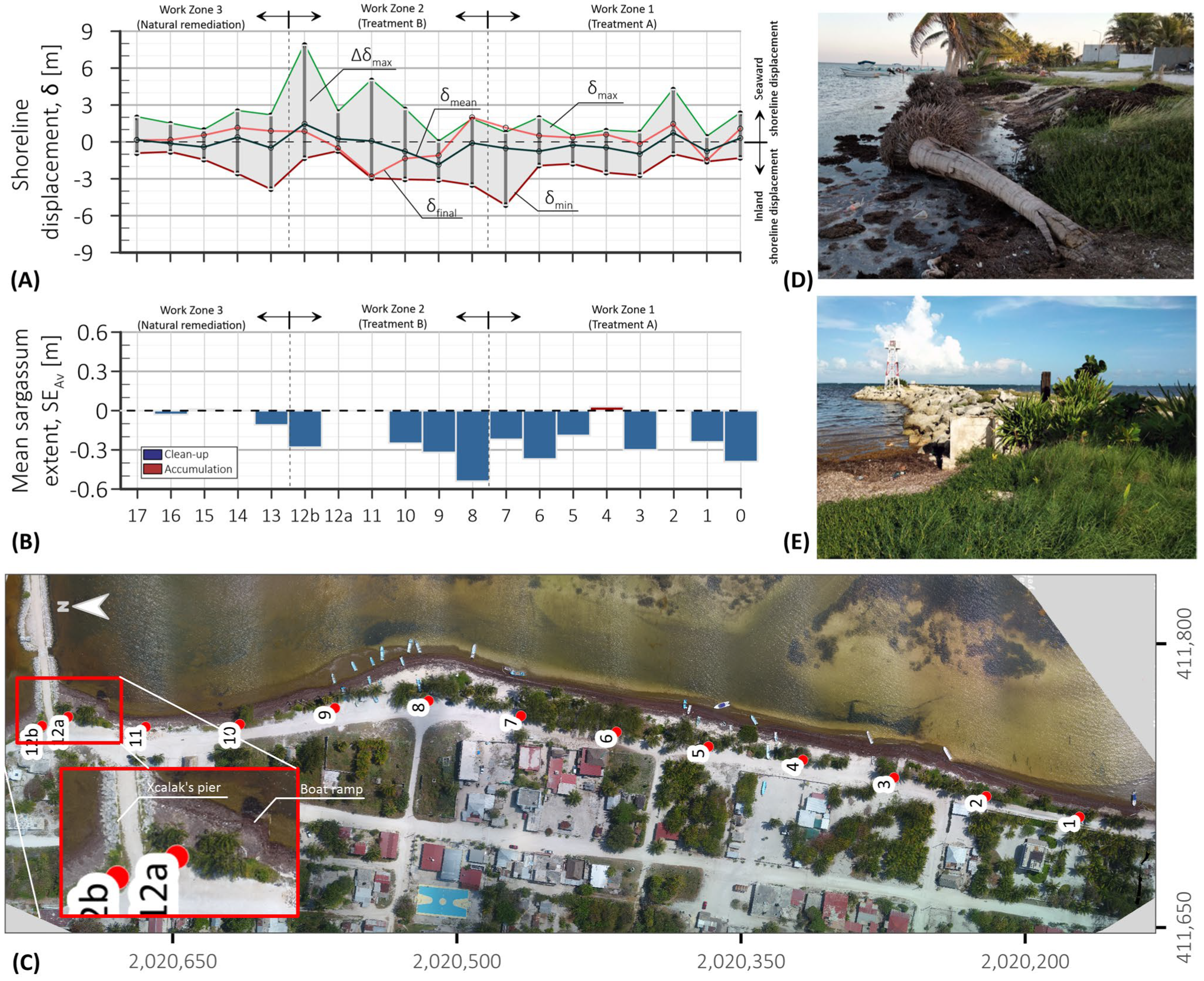

| ID | Coordinates | a Sargassum | b Shoreline Displacements | |||||||
|---|---|---|---|---|---|---|---|---|---|---|
| Easting (X_UTM) | Northing (Y_UTM) | [m] | [m] | [m2] | [m3] | δmean [m] | δfinal [m] | Δδmax [m] | ||
| Treatment A—zone 1 | 0 | 411,696.6 | 2,020,123.0 | −0.39 | −9.7 | −485.0 | −24.3 | 0.30 | 1.07 | 3.63 |
| 1 | 411,708.4 | 2,020,171.3 | −0.24 | −6.11 | −305.5 | −15.3 | −0.76 | −1.50 | 2.00 | |
| 2 | 411,719.3 | 2,020,220.6 | 0.00 | 0.06 | 3.0 | 0.2 | 0.74 | 1.45 | 5.24 | |
| 3 | 411,729.2 | 2,020,269.2 | −0.30 | −7.42 | −371.0 | −18.6 | −0.98 | −0.16 | 3.48 | |
| 4 | 411,738.5 | 2,020,317.4 | 0.03 | 0.76 | 38.0 | 1.9 | −0.47 | 0.60 | 3.40 | |
| 5 | 411,745.6 | 2,020,367.3 | −0.19 | −3.88 | −194.0 | −9.7 | −0.26 | 0.35 | 2.22 | |
| 6 | 411,753.3 | 2,020,415.9 | −0.37 | −9.32 | −466.0 | −23.3 | −0.76 | 0.50 | 3.88 | |
| 7 | 411,761.8 | 2,020,466.3 | −0.22 | −5.62 | −281.0 | −14.1 | −0.52 | 1.16 | 5.88 | |
| Average | −0.21 | −5.15 | −257.7 | −12.9 | −0.34 | 0.43 | 3.72 | |||
| Standard deviation | 0.16 | 3.93 | 196.5 | 9.9 | 0.58 | 0.93 | 1.33 | |||
| Treatment B—zone 2 | 8 | 411,769.8 | 2,020,515.1 | −0.54 | −13.39 | −669.5 | −33.5 | −0.09 | 1.99 | 5.33 |
| 9 | 411,765.9 | 2,020,564.6 | −0.32 | −8.10 | −405.0 | −20.3 | −1.84 | −1.10 | 3.10 | |
| 10 | 411,757.3 | 2,020,614.8 | −0.25 | −6.15 | −307.5 | −15.4 | −0.78 | −1.35 | 5.70 | |
| 11 | 411,756.0 | 2,020,664.5 | 0.00 | −0.08 | −4.0 | −0.2 | 0.07 | −2.80 | 7.95 | |
| 12a | 411,761.3 | 2,020,705.5 | 0.00 | 0.03 | 1.5 | 0.1 | 0.25 | −0.50 | 3.16 | |
| 12b | 411,756.5 | 2,020,719.3 | −0.28 | −6.93 | −346.5 | −17.3 | 1.46 | 0.85 | 9.19 | |
| Average | −0.23 | −5.77 | −288.5 | −14.4 | −0.16 | −0.49 | 5.74 | |||
| Standard deviation | 0.21 | 5.12 | 255.9 | 12.8 | 1.10 | 1.70 | 2.47 | |||
| Treatment C—zone 3 | 13 | 411,733.0 | 2,020,763.4 | −0.11 | −2.77 | −138.5 | −6.9 | −0.49 | 0.89 | 6.00 |
| 14 | 411,734.2 | 2,020,814.2 | 0.00 | 0.00 | 0.0 | 0.0 | 0.37 | 1.15 | 5.07 | |
| 15 | 411,755.2 | 2,020,860.6 | 0.01 | 0.24 | 12.0 | 0.6 | −0.42 | 0.55 | 2.39 | |
| 16 | 411,773.1 | 2,020,907.4 | −0.03 | −0.77 | −38.5 | −1.9 | −0.13 | 0.17 | 2.28 | |
| 17 | 411,779.6 | 2,020,958.4 | 0.00 | 0.07 | 3.5 | 0.2 | 0.17 | 0.15 | 2.91 | |
| Average | −0.03 | −0.65 | −32.3 | −1.6 | −0.10 | 0.58 | 3.73 | |||
| Standard deviation | 0.05 | 1.25 | 62.5 | 3.1 | 0.37 | 0.44 | 1.70 | |||
| * Parameters | ASaExt | Sto | MinOd | Disr | Lch | Beach | Income | SocAc | Cont | Total | |
|---|---|---|---|---|---|---|---|---|---|---|---|
| Treatment A | strongly agree | 8.6 | 91.4 | 100.0 | 0.0 | 0.0 | 97.1 | 0.0 | 0.0 | 100.0 | 44.1 |
| agree | 91.4 | 5.7 | 0.0 | 5.7 | 88.6 | 0.0 | 100.0 | 85.7 | 0.0 | 41.9 | |
| neutral | 0.0 | 2.9 | 0.0 | 85.7 | 5.7 | 2.9 | 0.0 | 5.7 | 0.0 | 11.4 | |
| disagree | 0.0 | 0.0 | 0.0 | 8.6 | 5.7 | 0.0 | 0.0 | 8.6 | 0.0 | 2.5 | |
| strongly disagree | 0.0 | 0.0 | 0.0 | 0.0 | 0.0 | 0.0 | 0.0 | 0.0 | 0.0 | 0.0 | |
| Treatment B | strongly agree | 0.0 | 0.0 | 0.0 | 0.0 | 0.0 | 0.0 | 0.0 | 0.0 | 0.0 | 0.0 |
| agree | 17.1 | 0.0 | 0.0 | 0.0 | 0.0 | 0.0 | 100.0 | 85.7 | 0.0 | 22.5 | |
| neutral | 14.3 | 8.6 | 0.0 | 2.9 | 2.9 | 0.0 | 0.0 | 2.9 | 0.0 | 3.5 | |
| disagree | 62.9 | 17.1 | 85.7 | 77.1 | 2.9 | 0.0 | 0.0 | 11.4 | 71.4 | 36.5 | |
| strongly disagree | 5.7 | 74.3 | 14.3 | 20.0 | 94.3 | 100.0 | 0.0 | 0.0 | 28.6 | 37.5 | |
| Treatment C | strongly agree | 100.0 | 0.0 | 0.0 | 0.0 | 0.0 | 0.0 | 0.0 | 0.0 | 0.0 | 11.1 |
| agree | 0.0 | 28.6 | 0.0 | 0.0 | 14.3 | 91.4 | 0.0 | 0.0 | 0.0 | 14.9 | |
| neutral | 0.0 | 5.7 | 0.0 | 100.0 | 14.3 | 8.6 | 0.0 | 0.0 | 100.0 | 25.4 | |
| disagree | 0.0 | 65.7 | 0.0 | 0.0 | 65.7 | 0.0 | 100.0 | 100.0 | 0.0 | 36.8 | |
| strongly disagree | 0.0 | 0.0 | 100.0 | 0.0 | 5.7 | 0.0 | 0.0 | 0.0 | 0.0 | 11.7 | |
Disclaimer/Publisher’s Note: The statements, opinions and data contained in all publications are solely those of the individual author(s) and contributor(s) and not of MDPI and/or the editor(s). MDPI and/or the editor(s) disclaim responsibility for any injury to people or property resulting from any ideas, methods, instructions or products referred to in the content. |
© 2025 by the authors. Licensee MDPI, Basel, Switzerland. This article is an open access article distributed under the terms and conditions of the Creative Commons Attribution (CC BY) license (https://creativecommons.org/licenses/by/4.0/).
Share and Cite
Alcérreca-Huerta, J.C.; Reyes-Mendoza, O.F.; Carrillo, L.; Callejas-Jiménez, M.E.; González-Garduño, V. Community–Academic Collaboration for Sargassum Clean-Up and Coastal Monitoring in Xcalak, Southern Mexican Caribbean. Coasts 2025, 5, 48. https://doi.org/10.3390/coasts5040048
Alcérreca-Huerta JC, Reyes-Mendoza OF, Carrillo L, Callejas-Jiménez ME, González-Garduño V. Community–Academic Collaboration for Sargassum Clean-Up and Coastal Monitoring in Xcalak, Southern Mexican Caribbean. Coasts. 2025; 5(4):48. https://doi.org/10.3390/coasts5040048
Chicago/Turabian StyleAlcérreca-Huerta, Juan Carlos, Oscar F. Reyes-Mendoza, Laura Carrillo, Mariana E. Callejas-Jiménez, and Viridiana González-Garduño. 2025. "Community–Academic Collaboration for Sargassum Clean-Up and Coastal Monitoring in Xcalak, Southern Mexican Caribbean" Coasts 5, no. 4: 48. https://doi.org/10.3390/coasts5040048
APA StyleAlcérreca-Huerta, J. C., Reyes-Mendoza, O. F., Carrillo, L., Callejas-Jiménez, M. E., & González-Garduño, V. (2025). Community–Academic Collaboration for Sargassum Clean-Up and Coastal Monitoring in Xcalak, Southern Mexican Caribbean. Coasts, 5(4), 48. https://doi.org/10.3390/coasts5040048

