
Systematic Review

Intestinal Microbiota Response to Dietary Hermetia illucens Meal in Cultured Finfish: A Systematic Review

by
Cynthia Jo-Rivero
1,*,
Anthony Gutierrez-Severino
2,
Manuel Feria-Zevallos
3,
Victor Jesús Vergara-Rubín
1,
Akram Hernández-Vásquez
4 and
Ignacio Jauralde
5
1
Programa Doctoral en Nutrición, Universidad Nacional Agraria La Molina, Lima 15024, Peru
2
Ingeniería Acuícola, Facultad de Ciencias Ambientales, Universidad Científica del Sur, Lima 15067, Peru
3
Laboratorio de Microbiología Molecular y Biotecnología, Facultad de Ciencias Biológicas, Universidad Nacional Mayor de San Marcos, Lima 15001, Peru
4
Centro de Excelencia en Investigaciones Económicas y Sociales en Salud, Vicerrectorado de Investigación, Universidad San Ignacio de Loyola, Lima 15024, Peru
5
Aquaculture and Biodiversity Research Group, Institute of Science and Animal Technology (ICTA), Universitat Politècnica de València, 46022 Valencia, Spain
*
Author to whom correspondence should be addressed.
Aquac. J. 2026, 6(3), 43; https://doi.org/10.3390/aquacj6030043
Submission received: 6 July 2026 / Revised: 5 September 2026 / Accepted: 8 September 2026 / Published: 21 September 2026

Abstract

This review synthesizes the available evidence on the effects of Hermetia illucens meal inclusion on the intestinal microbiota of fish. A literature search was conducted in Scopus, Web of Science, PubMed, and Embase from inception to 23 April 2025, including in vivo experimental studies reporting changes in fish intestinal microbiota. Of 2525 records identified, 39 studies met the predefined PICOS-based eligibility criteria and were included in a PRISMA 2020-guided synthesis; risk of bias was assessed using the SYRCLE tool. Given the substantial methodological heterogeneity among studies (fish species, dietary formulations, sequencing platforms, and analytical pipelines), no quantitative meta-analysis was performed, and results were synthesized semi-quantitatively based on the direction of reported effects. At the phylum level, most studies reported significant increases in Bacillota (41% vs. 16% decreases; n = 32) and Actinomycetota (65% increases; n = 26), while Pseudomonadota showed a recurrent, though not universal, reduction (50%; n = 28), with enrichment of genera such as Bacillus (70%; n = 20), Enterococcus (81%; n = 16), and Oceanobacillus (93%; n = 15). These changes have been hypothesized to involve prebiotic, metabolic, and antimicrobial mechanisms related to chitin, lauric acid, and antimicrobial peptides. Overall, H. illucens meal inclusion (~10–30%) appears to be associated with a predominant, though not universal, modulation of the fish intestinal microbiota toward profiles with greater fermentative and chitinolytic potential; an inference based on the ecological attributes of the enriched taxa rather than on functional measurements. The magnitude and consistency of this modulation depend on dose, species, habitat, and meal processing type.

1. Introduction

The search for sustainable and economically viable aquafeeds has become a key research priority in recent years [1,2], driven by the unprecedented global expansion and intensification of aquaculture [3,4], a sector that reached a record production of 103 million tonnes of aquatic animals in 2024, accounting for 53% of total global aquatic animal production [5]. This need has spurred research into alternative sources of proteins, carbohydrates, and lipids to replace conventional feed ingredients [6], which have historically underpinned the sector’s productive growth [7,8].
Among the available alternatives, meal derived from the black soldier fly (Hermetia illucens L.), in both full-fat and defatted forms, has emerged as an option for the partial or total replacement of fishmeal or soybean meal in aquafeeds [9,10]. H. illucens larvae meal exhibits variable nutritional composition, with crude protein ranging from 14.6% to 62.7% and lipid content between 2.8% and 38.6% depending on the processing method and larval substrate [11,12]. A recent meta-analysis reports pooled estimates of 42.7% (95% CI: 40.1–45.3%) for crude protein and 31.2% (95% CI: 28.5–33.9%) for lipid, with substantial heterogeneity across studies (I2 = 91% and 94%, respectively), and reports that lauric acid reported 38.5% (95% CI: 34.2–42.8%) of the total fatty acid profile [13]. This wide compositional range means that studies using nominally similar inclusion levels may in fact expose fish to substantially different chitin, lipid, and bioactive-peptide loads, which is a plausible source of the inconsistent microbiota responses reported across the primary literature and a key motivation for the species and processing-type-stratified synthesis performed in this review. Its amino acid profile is generally compatible with the nutritional requirements of multiple commercially important fish species [14,15], although its composition varies depending on the developmental stage of H. illucens [16]. Experimental studies have reported favorable digestibility [17] and positive nutritional outcomes [18,19] across freshwater and marine species of commercial relevance, including salmonids [20], cyprinids [15], gilthead seabream [4], European seabass [8], and sturgeons [21]. However, digestibility outcomes are not uniformly positive. The chitin present in the insect exoskeleton, an indigestible N-acetylglucosamine polymer, can act as dietary fiber and impair the apparent digestibility of dry matter, protein, and lipids, particularly at high inclusion levels or in species with limited chitinolytic capacity [11]. This effect has been documented in rainbow trout (Oncorhynchus mykiss) [22] and golden pompano (Trachinotus ovatus) [23], where elevated chitin content reduced nutrient digestibility and, in some cases, negatively affected growth performance.
A critical yet underexplored dimension of H. illucens meal inclusion in aquafeeds is its potential to modulate the intestinal microbiota [16,24]. The introduction of a novel protein source can significantly alter the structure, composition, and functional dynamics of the microbial community [25], with direct implications for fish health, given the well-established roles of the intestinal microbiota in nutrient metabolism, immune modulation [26,27], disease resistance, intestinal barrier integrity, stress response, and overall host health [18,25]. The fish intestinal microbiota is typically dominated by the phyla Bacillota (formerly Firmicutes), Pseudomonadota (formerly Proteobacteria), and Actinomycetota (formerly Actinobacteria) [6,28,29], with specific taxa such as Actinomycetaceae recognized as particularly beneficial for fish health [30].
While early research focused predominantly on zootechnical performance [21,24] and molecular markers of metabolic response [12], advances in high-throughput sequencing technologies have enabled systematic characterization of diet-induced microbiota shifts in aquaculture species [31]. However, the evidence on how H. illucens meal specifically modulates intestinal microbial communities remains scattered across studies differing in species, inclusion levels, and processing methods, limiting the ability to draw generalizable conclusions. A critical and often overlooked complication is that observed microbiota changes may not be exclusively attributable to the dietary ingredient itself. Variability in microbial taxa between studies and individuals can relate to factors such as feeding rates, host maturation, rearing system, and environmental conditions [32]. Additionally, a significant proportion of diet studies in fish fail to meet minimum sample size thresholds, generating highly variable and indeterminate microbiota profiles [33]. Taken together, these sources of uncontrolled variability underscore the need for systematic reviews capable of identifying robust and reproducible patterns across the existing literature.
Among the insect species approved for aquafeed production, H. illucens is uniquely positioned as an intestinal microbiota modulator due to its distinctive biochemical composition. H. illucens larvae are characterized by: (i) chitin content of 5.0–6.9% on a dry matter basis [34], which acts as a selective prebiotic substrate promoting the proliferation of chitinolytic bacterial consortia including Bacillus, Paenibacillus, as well as members of the phylum Actinomycetota; (ii) a high proportion of lauric acid (C12:0) in the lipid fraction, with documented antimicrobial activity against Gram-positive pathogens [35,36]; and (iii) the presence of antimicrobial peptides (AMPs), including cecropin-like and other antibacterial peptides isolated from larval tissues [37,38]. Although AMPs and chitin are common to insects in general, the particularly high proportion of lauric acid is a distinctive feature of H. illucens lipids, and the combined occurrence of these bioactive components at nutritionally relevant levels distinguishes this species among commercially available insect meals.
Previous syntheses in this field have addressed either different outcomes or a narrower evidence base. The meta-analyses of Hua [39] and Weththasinghe et al. [40] examined growth performance and nutrient utilization, in the latter case restricted to salmonids, without addressing the intestinal microbiota. Priyadarshana et al. [41] reviewed histomorphology, intestinal microbiota and blood chemistry narratively, without a systematic search protocol or a formal appraisal of study quality. The closest antecedent is the meta-analysis of Foysal and Gupta [42] which reported enrichment of Actinomycetota and Bacillota in the fish intestinal microbiota, but drew on four trials in a single species, rainbow trout, and confined its synthesis to the phylum level.
The present review extends this evidence base in four respects. First, in scope: an updated search to April 2025 yielded 39 in vivo studies across 17 finfish species, spanning freshwater and marine environments. Second, in taxonomic resolution: the synthesis extends beyond phyla to family and genus level, allowing functional taxa such as Bacillus, Enterococcus and Oceanobacillus to be identified. Third, in stratification: directional patterns are analyzed separately by habitat and by meal processing type (full-fat versus partially defatted), two sources of heterogeneity not previously disentangled. Fourth, in methodological rigor: reporting follows the PRISMA 2020 statement [43], and the internal validity of every included study was appraised with the SYRCLE risk-of-bias tool, which to our knowledge has not previously been applied to this literature.

2. Materials and Methods

2.1. Protocol Registration and Reporting Guidelines

The protocol for this systematic review was prospectively registered on the Open Science Framework (OSF) platform (https://doi.org/10.17605/OSF.IO/PHMSR), with the aim of ensuring the transparency and reproducibility of the study. The report was prepared following the guidelines of the PRISMA 2020 statement (Preferred Reporting Items for Systematic Reviews and Meta-Analyses) [43] (see Supplementary Material) and the Synthesis Without Meta-analysis (SWiM) [44]. Two deviations from the registered protocol were introduced during screening. First, whereas the protocol specified the replacement of fishmeal, the eligibility criteria were extended to include studies replacing soybean meal, since several trials evaluated H. illucens meal against plant-protein-based control diets and excluding them would have omitted relevant evidence on the same intervention. Second, a minimum inclusion level of 10% of the diet was adopted, a threshold not specified in the registered protocol, to restrict the synthesis to replacement-level feeding scenarios and to avoid pooling these with functional-supplementation doses, which represent a mechanistically distinct intervention. All other criteria, including the search period and the language restriction, were applied as registered.

2.2. Eligibility Criteria

Original studies published in peer-reviewed scientific journals and written in English that evaluated the total or partial substitution of fishmeal or soybean meal with H. illucens meal in diets for farmed fish were included. To be eligible, studies had to: (i) be in vivo; (ii) be conducted under controlled experimental conditions or in commercial production systems; (iii) report outcomes related to intestinal microbiota composition and diversity; and (iv) characterize microbiota using next-generation sequencing (NGS) techniques, such as 16S rRNA gene amplicon sequencing, employing either short-read (Illumina) or long-read (Nanopore) technologies.
Studies were excluded if they (i) used insect species other than H. illucens as the main ingredient; (ii) evaluated aquatic organisms other than fish, such as crustaceans or mollusks; (iii) fell outside the established temporal range; (iv) were not published in English; (v) corresponded to reviews (narrative or systematic), conference abstracts, short communications, academic theses, or technical reports; (vi) employed inclusion levels of H. illucens meal below 10% of the experimental diet as the only level tested, because this range is generally considered additive/functional supplementation rather than meaningful protein replacement; or (vii) did not use molecular techniques for the assessment of intestinal microbiota (Table 1).

2.3. Information Sources

The literature search was conducted in the following electronic databases: Web of Science, Scopus, PubMed, and Embase. These were selected for their broad coverage in the fields of aquafeed nutrition, veterinary sciences, and microbiology. The literature search was from inception to 23 April 2025.

2.4. Search Strategy

The search strategies were specifically designed for each database, based on the strategy developed in PubMed, which was subsequently adapted to the remaining electronic databases. Controlled terms and keywords related to Hermetia illucens, fish, and aquaculture were combined using Boolean operators (AND, OR). Truncations and spelling variants were also used to maximize search sensitivity. The complete search strategies used in each database are detailed in Supplementary Table S2.

2.5. Study Selection Process

All records identified in the electronic databases were imported into the EndNote reference manager (version X9, Clarivate, Philadelphia, PA, USA) and subjected to a deduplication process following the method proposed by Bramer et al. [45]. Subsequently, the titles and abstracts of the records were independently screened by two reviewers (C.J-R. and A.G-S.) according to the pre-defined eligibility criteria, using the Rayyan web platform (free access version, available at http://rayyan.qcri.org) [46]. The pre-selected records were then independently assessed in full text by the same reviewers (C.J-R. and A.G-S.) to determine their final inclusion. Any disagreements arising during the different phases of the selection process were resolved through discussion and consensus between the reviewers. In the event of disagreement, a third reviewer (M.F-Z.) acted as an arbiter and made the final decision.
Inter-reviewer agreement, calculated from the independent pre-consensus decisions recorded in Rayyan, was 93.8% for title/abstract screening (Cohen’s κ = 0.53; prevalence-adjusted, bias-adjusted kappa [PABAK] = 0.88; n = 1231) and 79.3% for full-text assessment (κ = 0.46; PABAK = 0.59; n = 58) [47,48].

2.6. Data Extraction Process

Data extraction was performed independently by two reviewers (C.J-R. and A.G-S.) using a previously standardized template designed in Microsoft Excel. Prior to use, the template was piloted on a subset of three studies to ensure variable clarity, standardize recording criteria, and reduce potential interpretation errors between reviewers. In the event of discrepancies, these were resolved through discussion and joint revision of the articles until consensus was reached, with the participation of a third reviewer (M.F-Z.). No automated tools were employed.

2.7. Variables and Definitions

The primary outcome of this review was the characterization of the intestinal microbiota, including alpha diversity, beta diversity, and taxonomic composition (relative abundance at the phylum, family, and genus levels). Additionally, the following variables were collected:
  • Population characteristics: fish species, family, habitat (marine or freshwater), developmental stage (larva, fingerling, juvenile), and total number of fish.
  • Intervention characteristics: percentage of Hermetia illucens meal inclusion, meal type, and trial duration (days).

2.8. Data Synthesis

A quantitative meta-analysis was not performed for three reasons. First, the included studies were highly heterogeneous in fish species, developmental stage, habitat, experimental design, dietary formulation, and H. illucens meal processing, as well as in microbiota methodology: sequencing platforms (short-read Illumina vs. long-read Nanopore), 16S rRNA hypervariable regions, bioinformatic pipelines and reference databases, taxonomic resolution, and the alpha- and beta-diversity metrics reported, without a common normalization approach. Second, a large proportion of studies did not report the means, measures of dispersion, or exact sample sizes required to compute standardized effect sizes or log response ratios, with abundance data frequently presented only graphically. Third, relative abundances are compositional data, so response ratios computed on them are not independent across taxa and can generate spurious effects. Under these conditions, pooled estimates would appear precise but be statistically invalid.
Throughout this review, a study refers to a primary publication, and an observation to a single experimental condition within a study for which directional outcomes were extracted, corresponding to one comparison between a diet containing H. illucens meal and its control within a defined combination of fish species and meal processing type. When a single study evaluated different types of insect meal (full-fat vs. defatted) or multiple fish species, each condition was considered as an independent observation, which minimized potential confounding and improved the precision of microbiota assessment. Four of the 39 included studies contributed two observations each on this basis, yielding 43 observations in total. The study of origin of each observation, together with the fish species, meal processing type and inclusion level and meal characterization, is provided in Supplementary Table S8, where the four studies contributing two observations each are explicitly flagged.
A semi-quantitative synthesis based on the direction of effect was adopted, coding each response as an increase (1), no statistically significant difference reported (0), or a decrease (−1). Directions were taken as reported by the original authors (p < 0.05 or the criterion defined by each author); no statistical values were recalculated, and no cross-study standardization was applied. All percentages reported in this review represent the proportion of independent observations showing each direction of effect. They quantify the consistency of the reported responses across studies and must not be interpreted as effect sizes, as magnitudes of biological change, or as pooled estimates of the extent to which a taxon changes in abundance. Alpha- and beta-diversity outcomes reported by the primary studies are described narratively in the Results; they were not coded directionally, as the indices, distance metrics and statistical approaches used were not comparable across studies.
This review addressed H. illucens as a fishmeal replacement strategy, and the 10–30% range was prioritized as the most studied and nutritionally relevant dietary inclusion range in aquafeeds. Studies using inclusion levels below 10% were not prioritized, as these are generally considered additive or functional supplementation rather than as a major dietary component. Studies testing levels above 30% were included in the review and in the semi-quantitative synthesis, and their results were considered separately in the discussion. Accordingly, the findings of this review apply only to dietary inclusion levels of ≥10% and should not be extrapolated to lower, functional-supplementation doses. In studies evaluating multiple inclusion levels, only observations corresponding to levels of 10% or above contributed to the directional counts.
In the overall analysis, microbial taxa were included only when reported in at least 12 independent observations, a value corresponding to approximately one quarter of the 43 observations available, applied uniformly to every taxon before the directional counts were examined. However, taxa with lower reporting frequency were also considered if they simultaneously met two criteria: (i) having at least 6 independent observations and (ii) showing a consistent trend, defined as ≥70% concordance in the direction of the effect (relative increase or decrease) across studies.
For stacked bar charts, data were filtered by environment type (marine and freshwater species) based on 39 articles. In this specific analysis, and due to the lower availability of studies within each category, a less restrictive threshold was applied, including taxa reported in at least four independent observations, without modifying the other methodological criteria. The ≥70% concordance criterion is more stringent than a simple majority, and no principal finding of the review depends on it, as all main conclusions derive from taxa with ≥12 independent observations. The number of independent observations (n) and the full directional counts for every taxon are reported in Supplementary Tables S5–S7 so that readers may apply alternative evidentiary standards. These criteria, defined by consensus among the reviewers (C.J-R. and A.G-S.) prior to analysis, served solely as reporting rules to avoid presenting directional proportions based on sparse and inconsistent data; they were not validated statistically and should therefore be read as descriptive filters rather than as inferential criteria.

2.9. Risk of Bias Assessment

The risk of bias of the included studies was assessed using the SYRCLE’s Risk of Bias Tool (Systematic Review Centre for Laboratory Animal Experimentation), specifically designed for animal experimental studies [49], evaluating the following domains: random sequence generation (selection bias), baseline characteristics (selection bias), allocation concealment (selection bias), random housing (performance bias), blinding (performance bias), random outcome assessment (detection bias), blinding of outcome assessment (detection bias), incomplete outcome data (attrition bias), selective reporting (reporting bias), and other bias (i.e., whether there are any other study design characteristics that might influence the results). SYRCLE does not include a domain addressing the unit of analysis, an issue of relevance in aquaculture nutrition trials, where the tank rather than the individual fish constitutes the experimental unit and pseudoreplication may arise when fish sampled from a shared tank are treated as independent replicates. Therefore, this concern was assessed within the “other sources of bias” domain. Each domain was judged as having a low, high, or unclear risk of bias according to the criteria established by the SYRCLE tool. The assessment was performed independently by two reviewers (C.J-R. and A.G-S.), and discrepancies were resolved through discussion and consensus (M.F-Z.) when necessary.

2.10. Ethical Aspects

Since this systematic review is based exclusively on data from previously published studies and does not involve the collection of primary information from human participants or animals, approval from an institutional ethics committee was not required.

3. Results

3.1. Study Selection

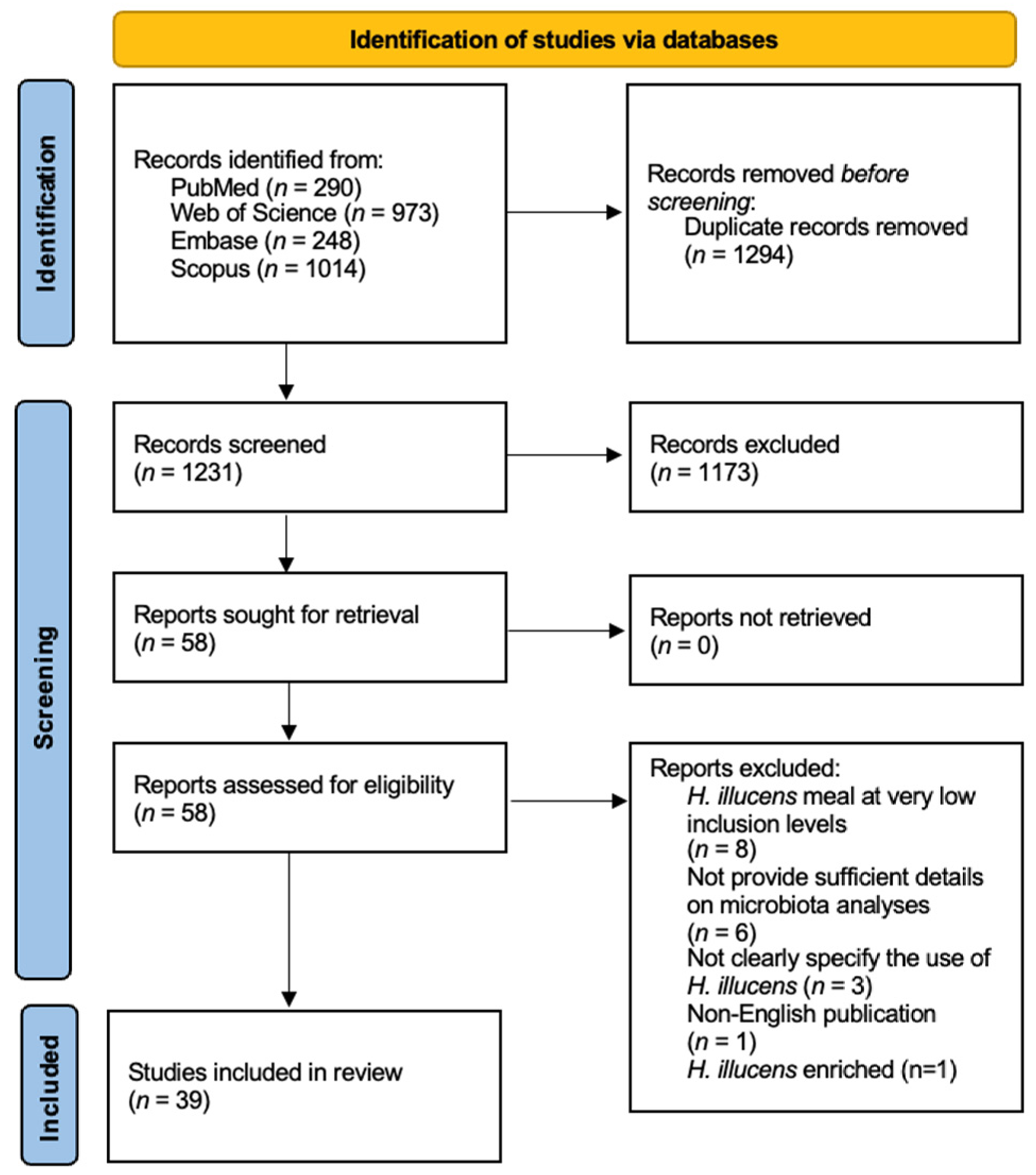
The systematic search across four scientific databases (Web of Science, Scopus, Embase, and PubMed) identified a total of 2525 records. After duplicate removal (n = 1294), 1231 records were screened by title and abstract, of which 1173 were excluded. A total of 58 full-text articles were assessed for eligibility. Of these, 19 were excluded for the following reasons: eight included H. illucens meal at very low inclusion levels, six did not provide sufficient details on microbiota analyses, three did not clearly specify the use of H. illucens, one was published using H. illucens enriched, and another was in a language other than English (Supplementary Table S3) [50,51,52,53,54,55,56,57,58,59,60,61,62,63,64,65,66,67]. Finally, 39 original studies met the inclusion criteria and were incorporated into the qualitative synthesis (Figure 1) [1,3,4,6,8,9,10,12,14,15,16,17,18,19,20,21,23,24,25,26,27,28,30,31,68,69,70,71,72,73,74,75,76,77,78,79,80,81,82].

3.2. Study Characteristics

A total of 39 studies were included in this systematic review (Table S1). Most of the research was conducted in Europe, accounting for 71.8% of the total (28/39 studies). Italy recorded the highest number of publications (n = 14; 35.9%), followed by China (n = 8; 20.5%). Norway and Portugal each contributed 7.7% of the studies (n = 3 each). The remaining studies were distributed among Croatia, Poland, Greece, Spain, Sweden, the Czech Republic, Turkey, Iceland, Canada, the United States, and Japan, with a contribution of one study per country (11 studies in total) [6,8,17,24,26,28,30,70,71,75,77]. The country of origin was reported solely for descriptive purposes to show the geographic distribution and potential regional research gaps.
The target species covered both freshwater and marine environments, including carnivorous and omnivorous fish, with a total of 17 species represented. The most frequently investigated species were Oncorhynchus mykiss (n = 10; 25.6%), Sparus aurata (n = 6; 15.4%), and Salmo salar (n = 5; 12.8%). Dicentrarchus labrax and Danio rerio were evaluated in three studies each (7.7%). Danio rerio was included as an established experimental model for aquaculture nutrition research rather than as a commercially cultured food species; findings from these three studies are therefore interpreted as mechanistic evidence rather than as production-oriented outcomes.
Epinephelus fuscoguttatus, including one study on a hybrid grouper, was reported in two studies (5.1%). The remaining eleven species were represented in only one study each (2.6%): Argyrosomus regius, Pagrus major, Ctenopharyngodon idellus, Sciaenops ocellatus, Trachinotus ovatus, Scophthalmus maximus, Acanthopagrus schlegelii, Sander lucioperca, Oreochromis niloticus, Micropterus salmoides, and Acipenser baerii. Regarding developmental stage, most trials were conducted on juvenile fish (n = 34; 87.2%). Larval stages were evaluated in three studies (7.7%), and the fingerling stage in two studies (5.1%).
Considerable variability was observed in the type of H. illucens meal used. Partially defatted meal was the most frequently applied form, reported in 20 studies (51.3%), followed by full-fat meal (n = 16; 41.0%), while three studies (7.7%) evaluated both types. Most studies used fishmeal-based control diets (n = 32; 82.1%), while other studies combined fishmeal with plant protein sources, mainly soybean protein concentrate (n = 5; 12.8%). Only two studies employed control diets composed exclusively of plant sources (5.1%). Experimental designs varied from two to eight dietary treatments, with two to four replicates per treatment.
The most frequently reported culture systems were flow-through systems (n = 16; 41.0%) and recirculating aquaculture systems (RAS) (n = 9; 23.1%). Other systems included tanks without detailed specification (n = 8; 20.5%), marine cages or floating net pens (n = 4; 10.3%), as well as open recirculating systems and aquaponic systems (n = 1; 2.6% each). Regarding feeding trial duration, it ranged from 21 to 180 days. Most studies (n = 27; 69.2%) were conducted over a period of 56 to 98 days. Short-term trials (<56 days) accounted for 10.3% (n = 4), while long-term trials (>100 days) accounted for the remaining 20.5% (n = 8).

3.3. Global Microbiota Patterns

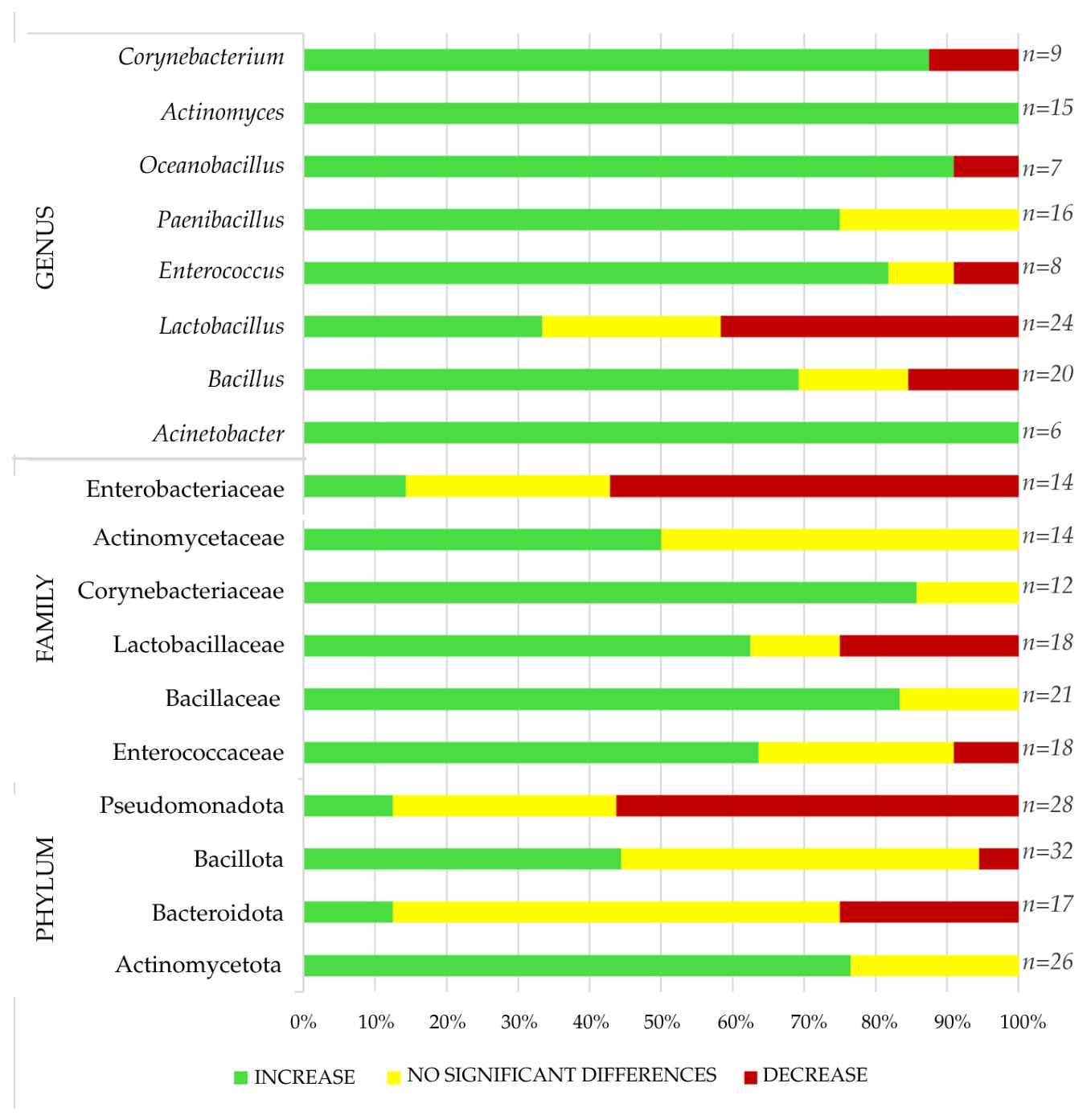
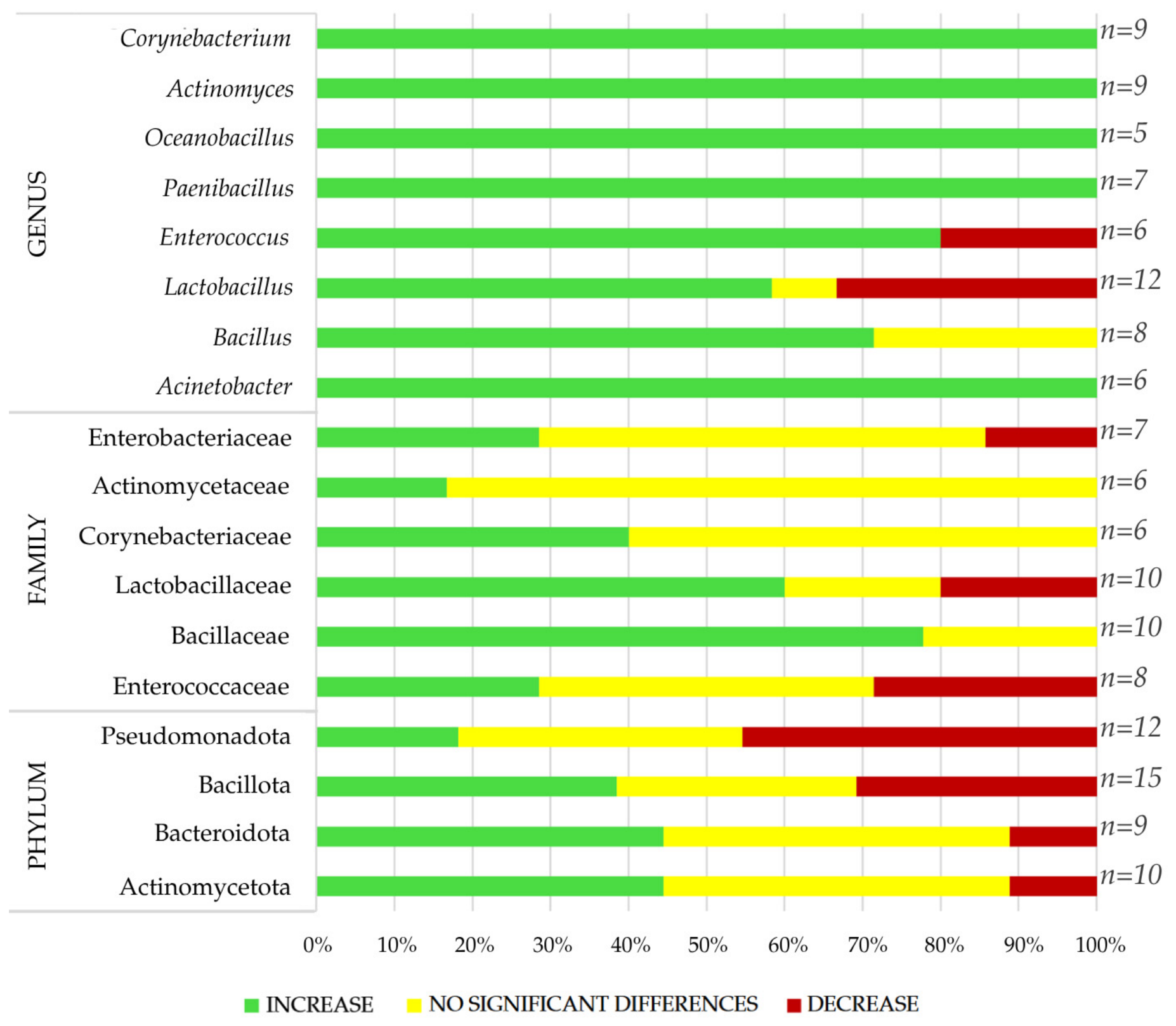
Figure 2 synthesizes the variations in relative abundance induced by the inclusion of H. illucens meal at the phylum, family, and genus levels across the various species included in this review. Studies reporting significant increases are represented in green, decreases in red, and absence of significant changes in yellow, compared to the control group. Percentages in this section refer to independent observations, not to studies; the number of observations available for each taxon is given as n.
The inclusion of H. illucens at levels between 10 and 30% induced consistent changes in the intestinal microbiota of fish, with responses dependent on the taxonomic level (phylum, family, and genus). To standardize the presentation of these results, proportions are expressed in the format (% increase; % no statistically significant difference reported; % decrease), corresponding to the fraction of studies reporting increase, no statistically significant difference reported, or decrease for each taxon. These proportions represent a semi-quantitative, vote-counting synthesis of directionally consistent findings across independent observations, rather than pooled statistical effect sizes; formal dose–response modelling was not performed due to the heterogeneity of reporting metrics across studies (see Section 2.8). The number of independent observations (n) is reported for each taxon in Tables S5–S7 so that the robustness of each estimate can be assessed.
At the phylum level, Bacillota showed a predominance of statistically significant increases in its abundance (41%; 44%; 16%). In contrast, Pseudomonadota exhibited an opposite trend, with a recurrent reduction (14%; 36%; 50%). Actinomycetota also showed a predominantly positive response (65%; 31%; 4%), while Bacteroidota (formerly Bacteroidetes) did not show a clear directional pattern, with a predominance of studies without changes (29%; 53%; 18%). At lower taxonomic levels, the family Bacillaceae was characterized by a consistently positive response (81%; 19%; 0%), consistent with the genus Bacillus, which followed a similar pattern, showing a frequency of increases (70%; 20%; 10%). Also, the genera Oceanobacillus (93%; 0%; 7%) and Paenibacillus (86%; 14%; 0%) showed a markedly positive response in the studies in which they were reported.
In contrast, the family Enterococcaceae did not show a defined trend (50%; 33%; 17%). However, at the genus level, the genus Enterococcus showed a predominance of increases (81%; 6%; 13%), indicating a more consistent response at a lower taxonomic level. On the other hand, the family Lactobacillaceae showed a mostly positive, although variable, trend (61%; 17%; 22%), while the genus Lactobacillus showed a heterogeneous response (45%; 17%; 38%). Habitat-stratified analysis clarified this pattern: the dominant direction was an increase in marine species (58.3%, 7/12) but a decrease in freshwater species (41.7%, 5/12), indicating that habitat is a plausible source of the observed variability for this taxon.
The family Corynebacteriaceae showed a positive trend, with no reports of decrease (67%; 33%; 0%), a pattern that was maintained for its only genus, Corynebacterium, consistently showing increases (89%; 0%; 11%). In contrast, the family Actinomycetaceae did not show a clear pattern, with a predominance of studies without changes (36%; 64%; 0%). However, the genus Actinomyces, although based on a limited number of observations (n = 9), showed increases in all studies in which it was reported (100%; 0%; 0%).
The family Enterobacteriaceae showed a variable response, with no dominant direction (21%; 43%; 36%). Within the family Pseudomonadaceae, the genus Pseudomonas showed a predominantly negative trend (12%; 25%; 63%).
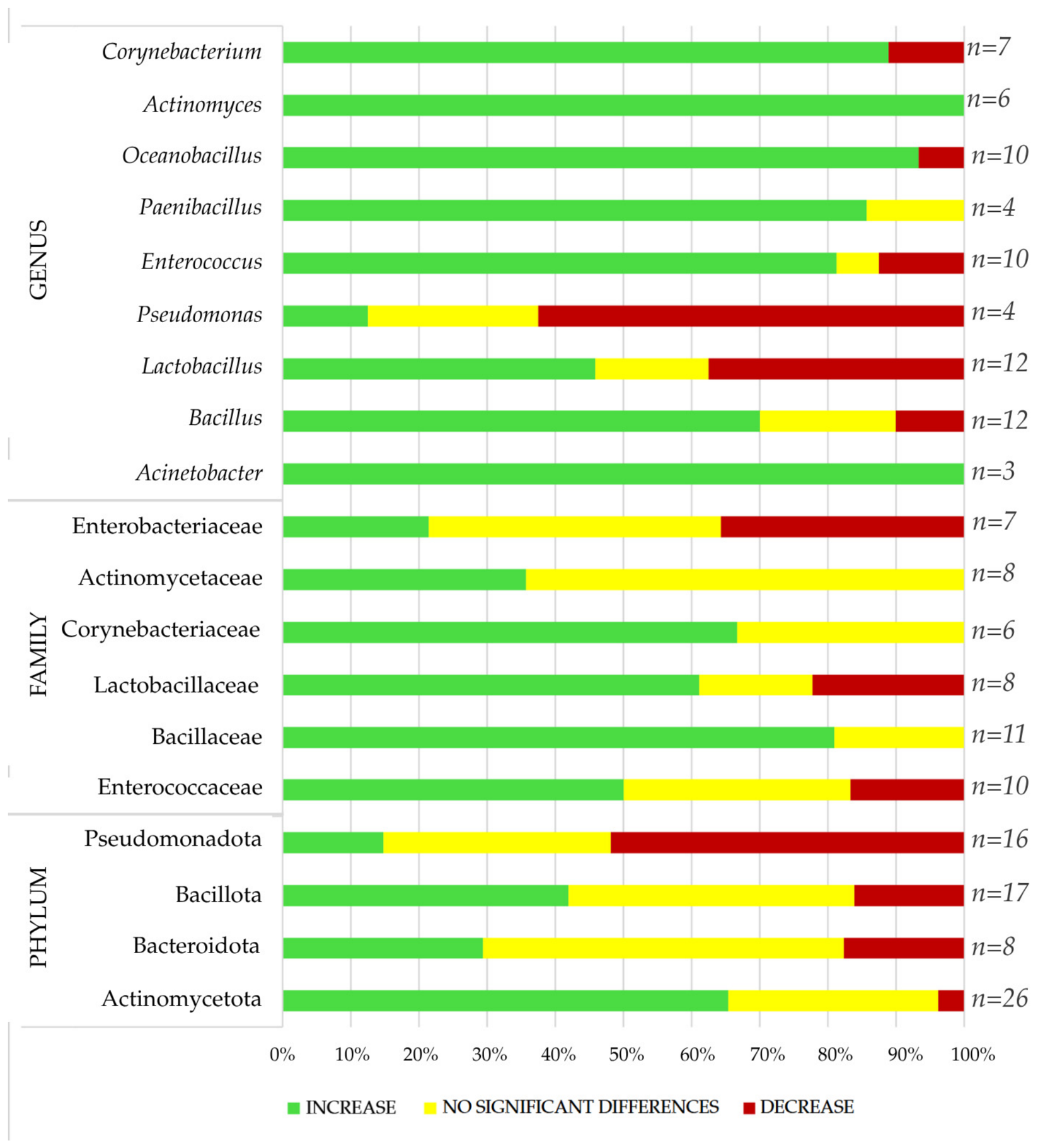
When comparing freshwater and marine species, the direction and consistency of microbiota modulation appeared to differ (Figure 3 and Figure 4). In freshwater species, Bacillota (41%; 53%; 6%) and Actinomycetota (75%; 25%; 0%) showed more frequent increases, whereas Pseudomonadota showed a more consistent decrease (13%; 31%; 56%). In marine fish, the responses were more variable: Bacillota (40%; 33%; 27%) and Actinomycetota (50%; 40%; 10%) and Pseudomonadota (16%; 42%; 42%) showed a less marked trend toward decrease. However, these comparisons should be interpreted with caution, as habitat is confounded with species, diet, culture conditions, and rearing system. Therefore, the observed patterns should be viewed as exploratory observations requiring confirmation in controlled experiments.
Fusobacteriaceae was reported in 8 independent observations, of which 1 indicated an increase, 5 no statistically significant difference reported, and 2 a decrease. This taxon did not meet the thresholds for graphical presentation defined in Section 2.8 and is therefore not displayed in Figure 2, Figure 3 and Figure 4. At the genus level, in both groups a frequent increase in Bacillus was observed, as well as Paenibacillus and Oceanobacillus, which showed consistent increases (>70%). Similarly, Corynebacterium presented a high frequency of increase (85.7%). Together, these results show more consistent modulation in freshwater fish, while in marine species the patterns were more variable.

3.4. Bias Analysis

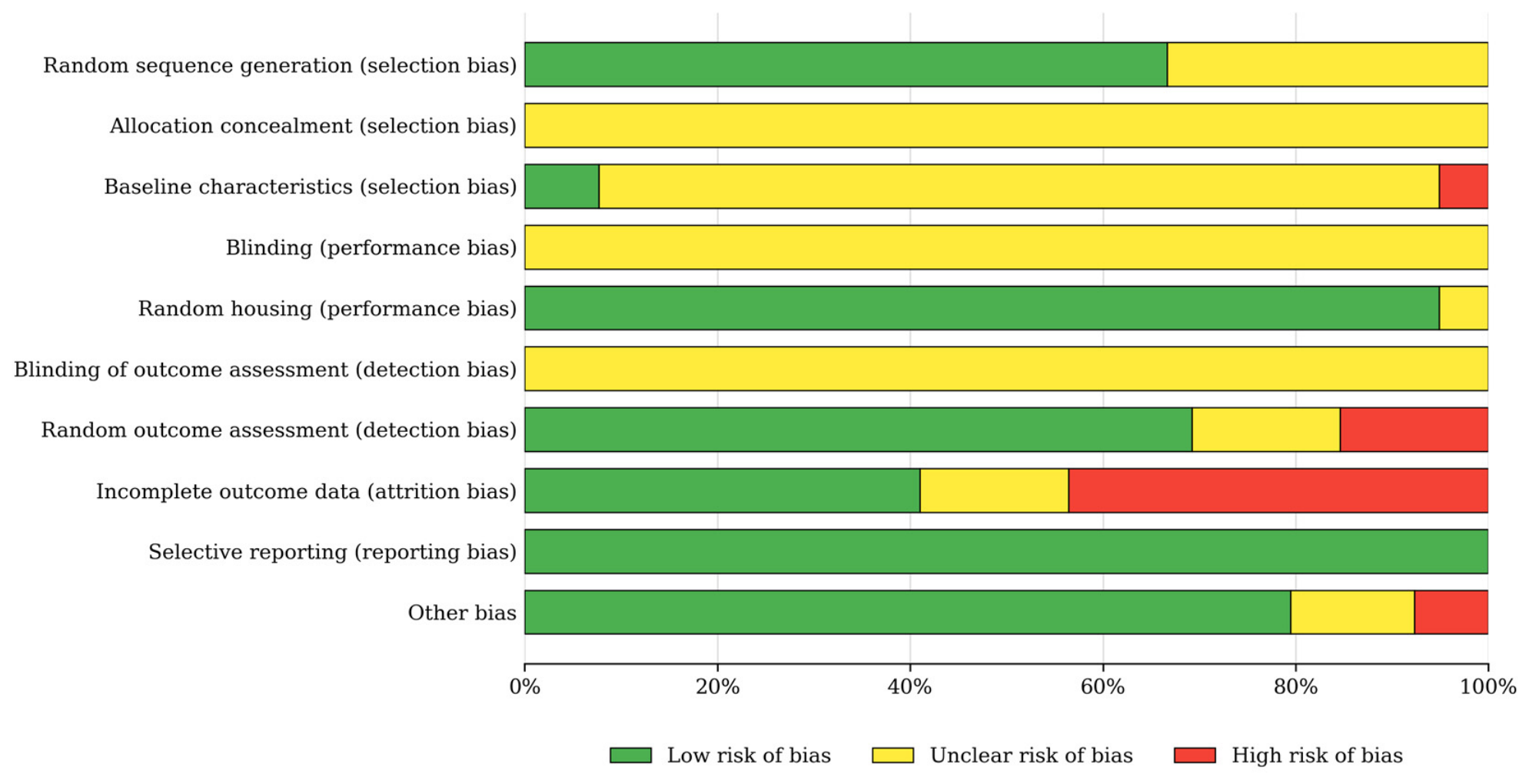
The risk of bias and the distribution of judgments for each domain are presented in Figure 5. Regarding selection bias, random sequence generation showed a predominance of low risk (67%), while the remaining 33% was classified as unclear risk; no studies were rated as high risk. Allocation concealment was consistently rated as unclear risk in all studies (100%). Regarding baseline characteristics, 87% of studies presented were rated unclear risk, followed by low risk (8%) and high risk (5%).
Concerning domains associated with performance bias, random housing showed a predominance of low risk (95%), with 5% unclear risk. In contrast, blinding of personnel responsible for fish handling and feeding was classified as unclear risk in 100% of studies. Regarding detection bias, blinding of outcome assessment was classified as unclear risk in 100% of studies, whereas random outcome assessment showed a predominance of low risk (69%), with 15% unclear risk and 15% high risk.
Attrition bias (incomplete outcome data) showed a heterogeneous distribution: 41% of studies had low risk, 15% unclear risk, and 44% high risk. Selective reporting bias was low in all studies (100%). Finally, other potential biases showed a predominance of low risk (80%), while 13% were classified as unclear risk and 8% as high risk.
In Supplementary Figure S1, each row represents an independent study and each column a bias domain; the risk level is color-coded: green (low risk), yellow (unclear risk), and red (high risk).

4. Discussion

The present systematic review shows that the inclusion of H. illucens meal in fish diets consistently modulates the intestinal microbiota, manifesting as changes in its taxonomic composition. An increase in bacterial richness has been observed, evidenced by Chao1 index and OTUs, particularly in rainbow trout, Oncorhynchus mykiss [31,69]. This pattern suggests a diversification of the intestinal ecosystem, which could be related to greater functional stability of the microbiota. However, this effect is not universal; in species such as hybrid grouper, Epinephelus fuscoguttatus × Epinephelus lanceolatus, and gilthead seabream, Sparus aurata, high inclusion levels (>60%) caused a reduction in alpha diversity, suggesting a host-specific tolerance threshold [4,9,10]. Likewise, beta diversity analyses show that H. illucens diets generate microbial communities significantly different from the control, forming independent clusters based on diet [27,30,71].
In accordance with these structural changes, modifications in microbial composition at the phylum level were observed. Bacillota and Actinomycetota showed a predominance of statistically significant increases (41% and 65%, respectively), with infrequent reductions (16% and 4%). In contrast, Pseudomonadota presented a consistent trend toward decrease (50%), while Bacteroidota showed no defined directional pattern. These results point to a restructuring of the intestinal microbiota toward compositional states associated with greater fermentative and chitinolytic potential. These findings should be interpreted as qualitative patterns based on the frequency and direction of statistically significant responses, rather than as quantitative estimates of the magnitude of microbiota changes. Moreover, taxonomic shifts at the phylum level do not necessarily indicate improved or impaired gut health, given potential functional redundancy and complex ecological interactions within the microbial community.
Taxonomic analysis of the intestinal microbiota consistently identifies the phylum Fusobacteriota as one of the predominant components of the core bacterial communities in various teleost species [83,84,85]. This phylum is represented almost exclusively by the genus Cetobacterium, which is a common member of the core microbiome in salmonids and perciform fish [26,75]. In the present dataset, this lineage was recorded at family level as Fusobacteriaceae and was reported in 8 observations. Previous studies have indicated that dietary inclusion of H. illucens meal induces a reduction in the relative abundance of this taxon [24,81]. For instance, in gilthead seabream, Sparus aurata, the control group exhibited a higher prevalence of the family Fusobacteriaceae, which decreased markedly when fishmeal was replaced with H. illucens [19]. However, notable exceptions exist in zebrafish, Danio rerio, a compensatory enrichment of Cetobacterium was observed, proportional to the H. illucens inclusion level, reaching up to 50% of the microbial community at certain substitution rates [27].
The mechanisms discussed in this section are proposed explanations rather than demonstrated ones. All included studies characterized the intestinal microbiota by 16S rRNA gene amplicon sequencing, an approach that resolves community composition but not gene expression or metabolite production. The roles attributed here to chitin, lauric acid, antimicrobial peptides and short-chain fatty acids, and the proposed involvement of gut–brain, immune and oxidative pathways, are therefore inferred from the compositional properties of H. illucens meal and from the ecological attributes of the enriched taxa, together with evidence from other experimental systems. They should be read as hypotheses generated by this synthesis and requiring direct experimental validation, not as mechanisms established by the evidence reviewed.
In this context, one of the main mechanisms associated with these changes is the presence of chitin in insect meal. Chitin, an N-acetylglucosamine polymer present in the insect exoskeleton [86], can act as a selective prebiotic substrate [24,87], promoting the formation of chitinolytic consortia with genera such as Bacillus, Paenibacillus, and Oceanobacillus; however, this mechanism is inferred from compositional co-occurrence rather than demonstrated through direct chitinase-activity or isotope-tracing evidence in most of the included studies [19]. This process would favor the proliferation of bacteria capable of degrading complex structural compounds, thereby increasing the functional diversity of the microbiota. In this context, an increase in the abundance of chitinolytic genes (such as chiA) has been reported in European seabass, Dicentrarchus labrax, fed diets including 25% H. illucens, suggesting a functional adaptation of the intestinal microbiome [16].
At the genus level, a selective enrichment of functional taxa is observed. Bacillus showed an increase in 70% of the included studies, being proposed as a biomarker of insect intake in various species [14,76,77,79]. This effect could be attributed to its chitinolytic capacity [88] and its resistance to feed extrusion processes through spore formation [89]. Likewise, Bacillus has been widely associated with improved immune response and resistance against pathogens [9]. Similarly, Oceanobacillus and Paenibacillus showed consistent increases (93% and 86%, respectively), associated with the production of digestive enzymes and the degradation of complex polysaccharides [62,72,90]. The selective enrichment of these functional genera following H. illucens inclusion suggests an adaptive response of the microbiota oriented toward greater specialized metabolic potential [19,30,80]. These functional attributions should be treated with caution. The properties invoked here are strain-dependent rather than genus-level characteristics, and 16S rRNA gene amplicon sequencing does not resolve taxa below genus level with confidence [30]. Genera reported as enriched therefore encompass strains of divergent ecological behavior: Enterococcus, for example, includes strains used as probiotics in aquaculture alongside opportunistic pathogens such as E. faecalis, and Bacillus comprises both well-characterized probiotic species and environmental strains of undetermined function [62]. An increase in the relative abundance of a genus consequently indicates a compositional shift, not an improvement in intestinal health, particularly since relative abundances are compositional data in which an apparent increase may reflect the decline of other taxa rather than absolute growth.
Likewise, several studies have documented an increase in lactic acid bacteria (LAB) in various aquaculture species [8,20,78]. This microbial group, affiliated with the phylum Bacillota and comprising genera such as Lactobacillus and Enterococcus, has been proposed as an indicator of intestinal health [3] due to its ability to produce bacteriocins and other antimicrobial metabolites that inhibit the growth of opportunistic pathogens such as Aeromonas and Vibrio [68,78]. This protective effect could be mediated by the antimicrobial activity of lauric acid (C12:0) and antimicrobial peptides present in the larva [36,91], although direct evidence of this mechanism (e.g., in vitro antimicrobial assays using intestinal isolates) was not reported in most of the included studies.
Meanwhile, members of the phylum Actinomycetota also contribute to the degradation of chitin and chitosan through hydrolases and lytic polysaccharide monooxygenases [92,93], and their increase in the intestine of fish fed H. illucens meal has been previously reported [8,26]. At the genus level, taxa such as Corynebacterium and Actinomyces may contribute to the degradation of lipids and chitin, reinforcing the metabolic potential of the intestinal microbiota [18,69,79]. Additionally, it has been proposed that these genera could constitute part of the transient microbiota originating from H. illucens, as they have been identified in the digestive tract of its larvae [18,94]. In agreement, studies focusing on the intestinal microbiota of H. illucens show that the composition of these genera depends on the diet, the intestinal segment analyzed, the host fish species and the rearing system, supporting the idea of a significant fraction of transient microbiota in addition to possible more stable microbial cores [95,96,97]. These taxonomic changes have relevant functional implications. In particular, Bacillota is associated with fermentative processes and the production of short-chain fatty acids (SCFAs), including acetate, propionate, and butyrate [31,98,99]. These metabolites are known to contribute, in other systems, to intestinal homeostasis through multiple mechanisms, including energy supply to enterocytes, maintenance of epithelial barrier integrity, direct antibacterial activity via luminal pH reduction, and anti-inflammatory regulation of the fish immune system [19,25,75,100,101].
Fishmeal-based diets are often associated with high dominance of Pseudomonadota [102], while the inclusion of H. illucens has been linked to a reduction in this phylum and an increase in Bacillota [8,14]. This reduction should not be equated with a beneficial response. Pseudomonadota is functionally heterogeneous: comprises opportunistic genera such as Aeromonas, Pseudomonas, and Vibrio; whose decrease has been associated with more favorable intestinal profiles [15,78,103], but also taxa with commensal and nutritionally relevant functions, and shifts at phylum level therefore conflate ecologically distinct groups. Consistent with this, our synthesis recorded a decrease in Pseudomonas in 63% of the observations reporting it, indicating that the phylum-level pattern is driven in part by genera of recognized opportunistic character. However, none of the included studies assessed disease resistance, pathogen challenge or health outcomes alongside the microbiota data, so the biological consequences of these compositional shifts remain undemonstrated in this evidence base.
These results are consistent with a modulation integrating prebiotic, metabolic and antimicrobial effects [104], although this pattern may not be exclusive to insect meal, since probiotic supplementation has also been shown to reduce Pseudomonadota and promoting beneficial bacteria, suggesting a common mechanism of intestinal modulation [105]. Changes should accordingly be interpreted in terms of specific taxa and their ecological context rather than in a generalized manner at the phylum level [106].
Exceptionally, Siberian sturgeon, Acipenser baerii, showed a remarkably stable core microbiota, dominated by Mycoplasma (>58%) and Clostridium (22–28%), with no significant shifts following the inclusion of 50% H. illucens in the feed [21]. This pattern may have been due to low palatability, which would have induced physiological fasting and reduced intestinal microbiota plasticity [107]. Likewise, the observed microbial resilience is possibly associated with the dominance of Mycoplasma, whose ability to produce antimicrobial compounds, such as organic acids, would limit the colonization of new taxa [12].
Despite this exception, the overall evidence suggests that dietary inclusion level is an important factor shaping the intestinal microbiota. Across the studies included in this review, H. illucens meal was incorporated at levels ranging from approximately 10% to 60%, with most experiments evaluating multiple dietary inclusion levels. Although the heterogeneity among fish species, insect meal type, and experimental protocols precluded a formal dose–response analysis, several studies reported progressive microbial changes with increasing inclusion. For example, Atlantic salmon fed 10–20% H. illucens meal exhibited gradual increases in Actinomycetota and reductions in Fusobacteriota and Lactobacillus [24]. Likewise, in gilthead seabream, reductions in alpha diversity became evident only at higher inclusion levels (35–46%) [3], whereas in red seabream, taxa such as Photobacterium and members of Vibrionales increased only at the highest inclusion level (45%) [17].
Moderate inclusion levels (approximately 10–30%) were more frequently associated with stable microbial communities while maintaining or improving growth performance [1,8,68,70]. In contrast, higher inclusion levels (>30%) were associated with more variable, species-dependent responses. These included hepatic steatosis, alterations in fatty acid profiles, and decreased growth [17,18,21,27]. Furthermore, in O. mykiss, digestibility was impaired without significant changes in the intestinal microbiota [22], whereas in golden pompano, Trachinotus ovatus, high dietary chitin levels were associated with reduced digestibility and growth [23]. Overall, these findings suggest that moderate dietary inclusion of H. illucens meal may provide a favorable balance between microbiota modulation and productive performance. However, these observations should be interpreted as descriptive trends across heterogeneous studies rather than evidence of a universal optimal inclusion level.
The transition between freshwater and saltwater, or the type of system (aquaponic, RAS, sea cages, or flow-through system), alters the basal community and consequently the ability of H. illucens to colonize the intestine [19]. However, the magnitude and direction of these effects are not uniform and depend on multiple factors. Differences were observed between freshwater and marine species, with modulation being more consistent in species produced in freshwater systems such as O. mykiss [28] and S. salar [79], while in marine species the responses were more variable [3,6,17]. These differences could be associated with intrinsic host factors, such as digestive physiology and basal microbiota composition, as well as with environmental conditions. The observed differences therefore describe two distinct groups of studies rather than an effect attributable to habitat itself, and the possible contributions of salinity and substrate availability [69,108] remain hypotheses requiring direct experimental testing.
The type of meal used appears to play a relevant role in microbial modulation [26]. In S. salar, full-fat meal enriched mucin degradation pathways due to the adherence of lactic acid bacteria to the mucosa and reduced lipopolysaccharide biosynthesis [79]. On the other hand, the use of full-fat H. illucens meal has been associated with an increase in genera such as Chryseobacterium, suggesting possible dysbiosis states at high inclusion levels in Scophthalmus maximus [72]. These seemingly contradictory effects suggest that the response depends on the inclusion level and the host species. Partially defatted meal is nutritionally more stable and tends to configure a more balanced microbial profile, closer to that of control diets, selectively promoting chitinolytic probiotic genera such as Bacillus [72]. This defatting process allows the microbiota to specialize in functional pathways related to carbohydrate metabolism, reducing the metabolic pressure derived from the excess of saturated fatty acids from the insect [4]. Although it has been suggested that the increased abundance of the genus Corynebacterium in fish microbiota could be associated with the lipid fraction of H. illucens meal [30,79], the results of this review do not show an exclusive pattern, since its increase (89%) is observed both in diets with full-fat meal [28,69,74] and partially defatted meal [4,18,68,79,80]. This would indicate that its abundance could be modulated by multiple dietary factors, beyond lipid content.
In general terms, in salmonids, full-fat meal may be functional due to its higher energy contribution, provided that the balance of fatty acids and taurine is controlled [79]. For marine species highly sensitive to fat and SFAs (e.g., S. maximus or S. aurata), defatted meal is the recommended option [71,72]. Another relevant aspect is the spatial heterogeneity of the intestinal microbiota; the variability between studies may be explained by differences in the intestinal compartment analyzed, since the microbiota can vary significantly along the gastrointestinal tract [109]. Furthermore, it has been observed that digesta exhibits greater sensitivity to diet, with more pronounced changes in diversity and composition, while the mucosa-associated microbiota is more resilient [16,68]. The observed variations in the intestinal microbiota response suggest that the effect of H. illucens inclusion is influenced by multiple factors, including fish species, habitat, and ingredient processing type [6,12,72].
Beyond SCFA-mediated effects, the available evidence in fish suggests that the inclusion of Hermetia illucens may influence the host through additional mechanisms related to the intestinal microbiota. In teleosts, the microbiota participates in the regulation of the gut–brain axis through the production of metabolites and neuroactive compounds that can modulate enteroendocrine signalling, feeding behavior, and the stress response [110,111,112]. In this context, several feeding trials with H. illucens have reported changes in the abundance of metabolically active bacterial taxa, such as Clostridium, Bacteroides, and Faecalibacterium, suggesting a possible functional role of the microbiota in these processes; however, none simultaneously assessed microbial changes together with the production of neuroactive metabolites or behavioral responses, so this hypothesis remains experimentally unconfirmed [25,75]. Likewise, the inclusion of H. illucens meal has been associated with changes in mucosal immunity parameters, including modifications in mucin composition, lysozyme and alkaline phosphatase activity, and the expression of genes related to Toll-like immune pathways, suggesting a possible interaction between the intestinal microbiota and the innate immune response [25,113,114]. Complementarily, several studies have described that microbiota changes induced by H. illucens diets are accompanied by modifications in antioxidant and oxidative stress biomarkers, indicating a close relationship between microbial composition, redox homeostasis, and the host inflammatory response [25,76,113,114]. Nevertheless, most of these studies assessed microbiota, immunity, and oxidative status independently, without integrating functional analyses that would allow causal relationships to be established. Consequently, although current evidence suggests that H. illucens may exert its effects through multiple complementary mechanisms in addition to SCFA production, studies combining microbiome analysis with metabolomic, transcriptomic, and immunological approaches are still needed to elucidate the mechanisms responsible for the physiological responses observed in fish. However, functional prediction approaches such as PICRUSt or KEGG pathway analysis were not consistently reported across the included studies and therefore could not be reliably synthesized.
Our findings align with the meta-analysis of Foysal and Gupta [42], which reported enrichment of Actinomycetota and Bacillota, including the genera Bacillus, Lactobacillus and Enterococcus in fish fed H. illucens diets relative to fishmeal controls. The present review extends that observation in two respects. First, our habitat stratified synthesis indicates that this enrichment is more consistent in freshwater than in marine species (Bacillota 41%; 53%; 6% and Actinomycetota 75%; 25%; 0% in freshwater, versus 40%; 33%; 27% and 50%; 40%; 10% in marine species), a stratification not addressed in previous meta-analytic work on fish. Second, whereas Weththasinghe et al. [40] focused on zootechnical and digestibility outcomes in salmonids and reported that protein digestibility penalties become more frequent above approximately 25–30% inclusion, our synthesis indicates that microbiota modulation is already apparent within the 10–30% range. Together, these observations suggest that microbial and nutritional optima do not necessarily coincide, and that inclusion levels selected on growth performance alone may not capture the full functional impact of H. illucens meal.

Limitations and Implications

Most mechanistic interpretations offered in this Discussion, particularly those relating to chitin- and lauric-acid-mediated effects are indirect, derived from compositional association across studies rather than from mechanistic assays (e.g., chitinase activity, isotope tracing, in vitro antimicrobial testing) performed within the primary studies themselves, and should be read as hypothesis-generating rather than confirmatory. Methodological limitations must be considered when interpreting the results of this review. First, eligibility was restricted to peer-reviewed articles published in English, and grey literature was not sought, which may have introduced language and publication bias: studies reporting no significant microbiota changes may be underrepresented. The search covered four databases (Web of Science, Scopus, Embase and PubMed) and did not include regional or aquaculture-specific repositories, introducing a potential database-selection bias. Formal testing for publication bias was not possible, as funnel plot asymmetry and Egger’s test require effect-size estimates and their standard errors, which a semi-quantitative directional synthesis does not generate; its presence and magnitude therefore remain undetermined. Likewise, the inclusion threshold pre-specified in this review (≥10%), selected to reflect replacement-level rather than additive use of H. illucens meal, restricts the conclusions to replacement-level feeding scenarios and precludes the evaluation of potential microbiota effects at lower, functional-supplementation doses, where bioactive compounds such as chitin and lauric acid could still exert measurable effects; a synthesis incorporating lower inclusion levels is recommended as future work.
Additionally, substantial heterogeneity was identified among the included studies. Biologically, the trials span 17 finfish species differing in feeding habit, digestive physiology, developmental stage and habitat; comparator diets were not uniform, with control formulations based on fishmeal in some trials and on plant protein, principally soybean meal, in others; and H. illucens meal differed in processing (full-fat versus partially defatted) and rearing substrate, both of which modify the chitin and lauric acid delivered by the diet. Therefore, the observed shifts cannot be attributed solely to the inclusion of H. illucens meal, as they reflect differences between the two complete diets.
The extent of this variation could not be characterized in detail, because the relevant information is unevenly reported. The characteristics of the H. illucens meal administered were extracted for every observation and are reported in Supplementary Table S8. Defatting status was reported for all 43 observations and was therefore used as a stratification variable. Beyond this, the commercial origin of the meal was specified in 28 observations (65%), proximate composition in 24 (56%), and rearing substrate in only 15 (35%); drying method and processing conditions were not reported in any study. Most notably, chitin content was quantified in 12 observations (28%) and lauric acid concentration in 2 (5%). Stratification by these characteristics was therefore not feasible, as it would rest on a small and non-random subset of the evidence base. This also bears directly on the mechanistic interpretation offered in this review: the roles attributed to chitin and lauric acid are inferred from the general compositional properties of H. illucens rather than from the composition of the specific meals administered, which in most cases was not measured. These sources of variation would be expected to attenuate rather than to generate the directional concordance reported here.
Methodologically, studies differed in sequencing platform, 16S rRNA hypervariable region, bioinformatic pipeline, reference database and normalization procedure, and in the intestinal compartment sampled (whole versus distal intestine, digesta versus mucosa-associated communities) [78,80]. Whereas research on gilthead seabream, Sparus aurata [3,9,19], zebrafish, Danio rerio [27,74,82], and European seabass, Dicentrarchus labrax [6,8] has primarily targeted the V3–V4 or V4 regions, studies on Atlantic salmon, Salmo salar have frequently resorted to V1–V2 amplification [18,68]. These differential primer choices are not inconsequential; each primer set possesses distinct thermodynamic properties and hybridization preferences, which may bias the inferred relative abundances [68].
A comparable source of variation concerns the intestinal compartment sampled. Digesta-associated communities represent the transient luminal fraction, whereas mucosa-associated communities represent the resident fraction, and the two differ substantially in composition; mucosal samples additionally present very low bacterial biomass relative to host DNA, which increases their vulnerability to reagent-derived contamination [68,69]. Sampling location was not among the variables extracted under our registered protocol and is not reported consistently across the included studies, so stratification by compartment was not feasible. This constitutes a further reason to interpret the directional patterns reported here as trends across a heterogeneous evidence base rather than as estimates of a single common effect.
Furthermore, the semi-quantitative synthesis approach used, based on classifying changes as increase, decrease, or no statistically significant difference reported, does not capture the magnitude of the reported changes, does not weight studies by sample size or precision, and treats non-significant results as absence of effect, although statistical significance is influenced by sample size and study design; consequently, it does not allow robust quantitative comparisons between studies. For the same reason, no validated dose–response analysis could be performed: inclusion level was recorded for every observation, but the absence of comparable effect-size estimates precludes formal modelling, so the dose-related trends described here are descriptive.
A further limitation concerns the independent treatment of multiple conditions from the same primary study. When a single study evaluated more than one experimental condition, whether different fish species or different meal processing types, each condition was treated as an independent observation. Although this approach was adopted to capture condition-specific microbial responses, observations originating from the same study are not strictly independent, which could in principle inflate the apparent consistency of the reported patterns. Given that this review adopts a semi-quantitative rather than meta-analytic approach, a formal sensitivity analysis recalculating pooled effect sizes under alternative unit of analysis decisions is not applicable. These four studies account for only 8 of the 43 observations (18.6%), and Supplementary Table S8 reports the origin of every observation, so that readers may reconstruct the counts under a one-observation-per-study rule. The reported directional patterns should nonetheless be interpreted with this limitation in mind, particularly for taxa reported in a limited number of observations.
The high frequency of ‘unclear risk’ ratings was concentrated in domains requiring explicit procedural statements that are seldom reported in aquaculture nutrition trials, and in which blinding is often not feasible; these ratings therefore reflect incomplete reporting rather than confirmed methodological flaws, whereas domains assessable from routinely reported information were predominantly rated as low risk. This distinction, however, is not grounds for confidence: incomplete reporting precludes any judgement on whether these procedures were adequately implemented, and unclear ratings cannot be treated as evidence of low risk. The internal validity of the underlying evidence base is therefore undetermined rather than confirmed.
Pseudoreplication arising from tank-level replication, assessed within the “other sources of bias” domain, was rated at high risk in only three studies. Because our synthesis records the direction of effects reported as significant by the original authors, residual pseudoreplication would tend to increase the overall proportion of observations classified as significant in either direction rather than to favor a particular direction and is therefore unlikely to have generated the directional concordance reported here. Nonetheless, because three domains could not be judged in any study and given that incomplete outcome data showed the greatest variability, the observed patterns should be interpreted as suggestive rather than conclusive. Notably, only four of the 39 included studies (10.3%) were rated at high risk of bias in two or more SYRCLE domains, indicating that the directional patterns described here are unlikely to be dominated by the studies with the greatest methodological concerns. This does not establish the robustness of the evidence base, since for most studies the risk of bias could not be determined in four of the ten SYRCLE domains, three of which were unclear in every included study.
From a practical perspective, these findings imply that H. illucens meal, especially in its partially defatted form and at moderate levels, may constitute a viable functional ingredient for environmentally sustainable aquafeed formulation. However, it is recommended that future studies (i) standardize microbiota sampling and analysis protocols (including intestinal compartment and sequencing technology); (ii) explicitly evaluate the dose–response relationship for different species and culture conditions; and (iii) explore the molecular mechanisms underlying the interaction between chitin, larval antimicrobial compounds, and specific microbial populations.

5. Conclusions

Based on a semi-quantitative synthesis of 39 in vivo studies, dietary inclusion of Hermetia illucens meal modulates the fish intestinal microbiota in a prevalent, though not universal, manner characterized by increasing Bacillota and Actinomycetota while reducing Pseudomonadota. At the genus level, Bacillus, Oceanobacillus and Enterococcus were the most consistently enriched, whereas Lactobacillus responded heterogeneously depending on species, habitat, and H. illucens meal processing type. These directional patterns are the findings directly supported by the evidence. However, the mechanistic interpretations of these shifts remain hypothetical: the roles attributed to chitin as a prebiotic substrate, lauric acid and larval antimicrobial peptides are inferred from meal composition and the ecological traits of the enriched taxa rather than from functional assays conducted within the reviewed studies. Although not statistically validated as a dose–response relationship, moderate inclusion levels (10–30%) were more frequently associated with stable responses than higher levels (>30%); this is a descriptive observation from the primary literature and requires species-specific validation. Changes should therefore be interpreted in terms of specific taxa and their ecological context rather than as generalized phylum-level transitions.
From an applied perspective, defatted meal was more frequently associated with stable microbial profiles in marine species at 10–20% inclusion, consistent with their lower tolerance to the saturated fatty acid load of H. illucens. In freshwater species, both processing forms yielded comparable profiles, and full-fat meal remained compatible with stable profiles up to 20–30% when lipid balance was controlled. These observations reflect patterns in the primary literature rather than modelled dose–response relationships; any aquafeed application would require species-specific trials in which inclusion level is tested as an experimental variable.

Supplementary Materials

The following supporting information can be downloaded at https://www.mdpi.com/article/10.3390/aquacj6030043/s1: Figure S1: Risk of Bias Assessment Using the SYRCLE Tool; Table S1: Characterization of included studies evaluating the effect of H. illucens on the intestinal microbiota of fish; Table S2: Search strategies; Table S3: List of full texts excluded and reasons for exclusion; Table S4: Reporting Checklist According to the PRISMA Statement; Table S5: Directional effects of H. illucens meal on intestinal microbiota taxa—all species; Table S6: Directional effects of H. illucens meal on intestinal microbiota taxa—marine species; Table S7: Directional effects of H. illucens meal on intestinal microbiota taxa—freshwater species. Table S8: Unit-of-analysis map of the 43 independent observations, showing the study of origin of each observation and identifying those derived from the same primary study.

Author Contributions

Conceptualization, C.J.-R., A.H.-V. and M.F.-Z.; methodology, C.J.-R. and A.H.-V.; validation, C.J.-R. and A.H.-V.; formal analysis, C.J.-R. and A.H.-V.; investigation, C.J.-R., A.H.-V., A.G.-S., M.F.-Z. and I.J.; data curation, C.J.-R., A.H.-V. and I.J.; supervision, C.J.-R., A.H.-V., M.F.-Z., V.J.V.-R. and I.J.; writing—original draft preparation, C.J.-R., A.H.-V., A.G.-S., M.F.-Z. and I.J.; writing—review and editing, C.J.-R., A.H.-V., A.G.-S., V.J.V.-R. and I.J. All authors have read and agreed to the published version of the manuscript.

Funding

This work was part of a PhD program funded by the National Program for Scientific Research and Advanced Studies (PROCIENCIA, by its Spanish acronym), as part of the project Interinstitutional Alliances for Doctoral Programs—Phase II: Nutrition, Contract No. PE501084302-2023-PROCIENCIA-BM.

Institutional Review Board Statement

As this manuscript is a review and does not involve any research on animals or human subjects, ethical approval from an Institutional Review Board was not required.

Informed Consent Statement

Not applicable.

Data Availability Statement

The original contributions presented in this study are included in the article and Supplementary Materials. The study-level extraction dataset and the directional coding for every taxon and observation are provided in Supplementary Tables S5–S8. Further inquiries can be directed to the corresponding author.

Acknowledgments

DeepSeek (DeepSeek-V3-0324; September 2026) was utilized during the preparation of this manuscript to assist with grammar and spelling corrections during the final editing of the manuscript. After using this tool, the authors reviewed and edited the content as necessary and take full responsibility for the integrity and accuracy of the manuscript’s content.

Conflicts of Interest

The authors declare no conflicts of interest.

Abbreviations

The following abbreviations are used in this manuscript:
OSFOpen Science Framework
PRISMAPreferred Reporting Items for Systematic Reviews and Meta-Analyses
NGSNext-generation sequencing
SYRCLESystematic Review Centre for Laboratory animal Experimentation
RASRecirculating aquaculture systems

References

  1. Bruni, L.; Pastorelli, R.; Viti, C.; Gasco, L.; Parisi, G. Characterisation of the Intestinal Microbial Communities of Rainbow Trout (Oncorhynchus mykiss) Fed with Hermetia Illucens (Black Soldier Fly) Partially Defatted Larva Meal as Partial Dietary Protein Source. Aquaculture 2018, 487, 56–63. [Google Scholar] [CrossRef] [Scilit]
  2. Gasco, L.; Acuti, G.; Bani, P.; Dalle Zotte, A.; Danieli, P.P.; De Angelis, A.; Fortina, R.; Marino, R.; Parisi, G.; Piccolo, G.; et al. Insect and Fish By-Products as Sustainable Alternatives to Conventional Animal Proteins in Animal Nutrition. Ital. J. Anim. Sci. 2020, 19, 360–372. [Google Scholar] [CrossRef] [Scilit]
  3. Basili, M.; Randazzo, B.; Caccamo, L.; Guicciardi, O.; Guizzardi, S.; Meola, M.; Perdichizzi, A.; Quero, G.M.; Maricchiolo, G. Effect of Graded Inclusion of Black Soldier Fly (Hermetia illucens, Linnaeus, 1758) Pre-Pupae Meal in Diets for Gilthead Seabream (Sparus aurata, Linnaeus, 1758) on Gut Microbiome and Liver Morphology. Fish Physiol. Biochem. 2025, 51, 85. [Google Scholar] [CrossRef] [Scilit] [PubMed]
  4. Moutinho, S.; Peres, H.; Martins, N.; Serra, C.; Santos, R.A.; Monroig, Ó.; Oliva-Teles, A. Use of Black Soldier Fly (Hermetia illucens) Larvae Meal in Diets for Gilthead Seabream Juveniles: Effects on Growth-Related Gene Expression, Intermediary Metabolism, Digestive Enzymes, and Gut Microbiota Modulation. Aquaculture 2024, 580, 740357. [Google Scholar] [CrossRef] [Scilit]
  5. FAO. The State of World Fisheries and Aquaculture 2026; FAO: Rome, Italy, 2026; ISBN 978-92-5-140453-9. [Google Scholar]
  6. Panteli, N.; Mastoraki, M.; Lazarina, M.; Chatzifotis, S.; Mente, E.; Kormas, K.A.; Antonopoulou, E. Configuration of Gut Microbiota Structure and Potential Functionality in Two Teleosts under the Influence of Dietary Insect Meals. Microorganisms 2021, 9, 699. [Google Scholar] [CrossRef] [Scilit] [PubMed]
  7. FAO. Fishery and Aquaculture Statistics—Yearbook 2023; FAO: Rome, Italy, 2025; ISBN 978-92-5-140095-1. [Google Scholar]
  8. Lepen Pleić, I.; Bušelić, I.; Messina, M.; Hrabar, J.; Žuvić, L.; Talijančić, I.; Žužul, I.; Pavelin, T.; Anđelić, I.; Pleadin, J.; et al. A Plant-Based Diet Supplemented with Hermetia illucens Alone or in Combination with Poultry by-Product Meal: One Step Closer to Sustainable Aquafeeds for European Seabass. J. Anim. Sci. Biotechnol. 2022, 13, 77. [Google Scholar] [CrossRef] [Scilit] [PubMed]
  9. Busti, S.; Bonaldo, A.; Candela, M.; Scicchitano, D.; Trapella, G.; Brambilla, F.; Guidou, C.; Trespeuch, C.; Sirri, F.; Dondi, F.; et al. Hermetia Illucens Larvae Meal as an Alternative Protein Source in Practical Diets for Gilthead Sea Bream (Sparus aurata): A Study on Growth, Plasma Biochemistry and Gut Microbiota. Aquaculture 2024, 578, 740093. [Google Scholar] [CrossRef] [Scilit]
  10. Huang, B.; Zhang, S.; Dong, X.; Chi, S.; Yang, Q.; Liu, H.; Tan, B.; Xie, S. Effects of Fishmeal Replacement by Black Soldier Fly on Growth Performance, Digestive Enzyme Activity, Intestine Morphology, Intestinal Flora and Immune Response of Pearl Gentian Grouper (Epinephelus fuscoguttatus ♀ × Epinephelus lanceolatus ♂). Fish Shellfish Immunol. 2022, 120, 497–506. [Google Scholar] [CrossRef] [Scilit] [PubMed]
  11. Mohan, K.; Rajan, D.K.; Muralisankar, T.; Ganesan, A.R.; Sathishkumar, P.; Revathi, N. Use of Black Soldier Fly (Hermetia illucens L.) Larvae Meal in Aquafeeds for a Sustainable Aquaculture Industry: A Review of Past and Future Needs. Aquaculture 2022, 553, 738095. [Google Scholar] [CrossRef] [Scilit]
  12. Rimoldi, S.; Gini, E.; Iannini, F.; Gasco, L.; Terova, G. The Effects of Dietary Insect Meal from Hermetia Illucens Prepupae on Autochthonous Gut Microbiota of Rainbow Trout (Oncorhynchus mykiss). Animals 2019, 9, 143. [Google Scholar] [CrossRef] [Scilit] [PubMed]
  13. Ogabidu, O.A.; Abdulkadir, J.; Bernard, M.; Malami, N.U.; Haruna, G.A.; John, C.A.; Muhammad, T.Z.; Mohammed, A.; Bature, S.Q.; Abdullahi, A.S.; et al. Nutritional Composition of Black Soldier Fly (Hermetia illucens) Larvae for Animal Feed and Food Security: A Systematic Review and Meta-Analysis. UMYU J. Microbiol. Res. 2025, 10, 231–247. [Google Scholar] [CrossRef] [Scilit]
  14. Couto, A.; Serra, C.R.; Guerreiro, I.; Coutinho, F.; Castro, C.; Rangel, F.; Lavrador, A.S.; Monteiro, M.; Santos, R.; Peres, H.; et al. Black Soldier Fly Meal Effects on Meagre Health Condition: Gut Morphology, Gut Microbiota and Humoral Immune Response. J. Insects Food Feed. 2022, 8, 1281–1295. [Google Scholar] [CrossRef] [Scilit]
  15. Lu, R.; Chen, Y.; Yu, W.; Lin, M.; Yang, G.; Qin, C.; Meng, X.; Zhang, Y.; Ji, H.; Nie, G. Defatted Black Soldier Fly (Hermetia illucens) Larvae Meal Can Replace Soybean Meal in Juvenile Grass Carp (Ctenopharyngodon idellus) Diets. Aquac. Rep. 2020, 18, 100520. [Google Scholar] [CrossRef] [Scilit]
  16. Rangel, F.; Enes, P.; Gasco, L.; Gai, F.; Hausmann, B.; Berry, D.; Oliva-Teles, A.; Serra, C.R.; Pereira, F.C. Differential Modulation of the European Sea Bass Gut Microbiota by Distinct Insect Meals. Front. Microbiol. 2022, 13, 831034. [Google Scholar] [CrossRef] [Scilit] [PubMed]
  17. Oktay, O.; Seong, T.; Kabeya, N.; Morioka, S.; Liu, C.-M.; Kobayashi, T.; Shimoda, M.; Satoh, S.; Haga, Y. Can Black Soldier Fly Meal in Diets Improve Gut Microbiota Diversity, Nutrient Digestibility, and Growth Response of Marine Fish? A Study on Red Sea Bream Pagrus Major. Fish. Sci. 2024, 90, 773–786. [Google Scholar] [CrossRef] [Scilit]
  18. Li, Y.; Gajardo, K.; Jaramillo-Torres, A.; Kortner, T.M.; Krogdahl, Å. Consistent Changes in the Intestinal Microbiota of Atlantic Salmon Fed Insect Meal Diets. Anim. Microbiome 2022, 4, 8. [Google Scholar] [CrossRef] [Scilit] [PubMed]
  19. Rimoldi, S.; Di Rosa, A.R.; Oteri, M.; Chiofalo, B.; Hasan, I.; Saroglia, M.; Terova, G. The Impact of Diets Containing Hermetia Illucens Meal on the Growth, Intestinal Health, and Microbiota of Gilthead Seabream (Sparus aurata). Fish Physiol. Biochem. 2024, 50, 1003–1024. [Google Scholar] [CrossRef] [Scilit] [PubMed]
  20. Biasato, I.; Chemello, G.; Oddon, S.B.; Ferrocino, I.; Corvaglia, M.R.; Caimi, C.; Resconi, A.; Paul, A.; Van Spankeren, M.; Capucchio, M.T.; et al. Hermetia illucens Meal Inclusion in Low-Fishmeal Diets for Rainbow Trout (Oncorhynchus mykiss): Effects on the Growth Performance, Nutrient Digestibility Coefficients, Selected Gut Health Traits, and Health Status Indices. Anim. Feed Sci. Technol. 2022, 290, 115341. [Google Scholar] [CrossRef] [Scilit]
  21. Zarantoniello, M.; Randazzo, B.; Nozzi, V.; Truzzi, C.; Giorgini, E.; Cardinaletti, G.; Freddi, L.; Ratti, S.; Girolametti, F.; Osimani, A.; et al. Physiological Responses of Siberian Sturgeon (Acipenser baerii) Juveniles Fed on Full-Fat Insect-Based Diet in an Aquaponic System. Sci. Rep. 2021, 11, 1057. [Google Scholar] [CrossRef] [Scilit] [PubMed]
  22. Tefal, E.; Peñaranda, D.S.; Martínez-Llorens, S.; Tomás-Vidal, A.; Jauralde, I.; Lagos, L.; Moyano, F.J.; Jover-Cerdá, M. Feeding of Rainbow Trout (Oncorhynchus mykiss) with Organic Ingredients Replacing Fish Meal. Aquaculture 2024, 592, 741257. [Google Scholar] [CrossRef] [Scilit]
  23. Yu, Z.; Sun, Z.; Ou, B.; Zhou, M.; Huang, Y.; Tan, X. Effects of Partial Replacement of Fish Meal with Black Soldier Fly (Hermetia illucens) Larvae Meal on Growth Performance, Lipid Metabolism and Hepatointestinal Health of Juvenile Golden Pompano (Trachinotus ovatus). Aquac. Rep. 2023, 33, 101824. [Google Scholar] [CrossRef] [Scilit]
  24. Rawski, M.; Mazurkiewicz, J.; Mikołajczak, Z.; Kierończyk, B.; Skrzypczak, P.; Szymkowiak, P.; Józefiak, D. Black Soldier Fly Meal as a Gastrointestinal Tract Microbiota Remodelling Factor: A New Natural and Sustainable Source of Prebiotic Substances for Fish? Aquac. Res. 2025, 2025, 8852384. [Google Scholar] [CrossRef] [Scilit]
  25. Wang, T.; Bao, M.-Y.; Xiao, G.-X.; Wang, Z.; Zhou, N.; Wei, H.; Qiao, F.; Du, Z.-Y.; Zhang, M.-L. The Defatted Black Soldier Fly Meal (Hermetia illucens) Improved the Pathogen Resistance and Gut Health of Nile Tilapia (Oreochromis Niloticus). Fish Shellfish Immunol. 2025, 161, 110242. [Google Scholar] [CrossRef] [Scilit] [PubMed]
  26. Sayramoğlu, H.; Öztürk, R.Ç.; Ustaoglu, D.; Terzi, Y.; Yandi, I.; Kayis, S.; Capkin, E.; Altinok, I. Effects of Black Soldier Fly Meal Feeding on Rainbow Trout Gut Microbiota, Immune-Related Gene Expression, and Lactococcus petauri Resistance. J. Insects Food Feed 2023, 10, 141–157. [Google Scholar] [CrossRef] [Scilit]
  27. Zarantoniello, M.; Zimbelli, A.; Randazzo, B.; Compagni, M.D.; Truzzi, C.; Antonucci, M.; Riolo, P.; Loreto, N.; Osimani, A.; Milanović, V.; et al. Black Soldier Fly (Hermetia illucens) Reared on Roasted Coffee by-Product and Schizochytrium sp. as a Sustainable Terrestrial Ingredient for Aquafeeds Production. Aquaculture 2020, 518, 734659. [Google Scholar] [CrossRef] [Scilit]
  28. Huyben, D.; Vidaković, A.; Werner Hallgren, S.; Langeland, M. High-Throughput Sequencing of Gut Microbiota in Rainbow Trout (Oncorhynchus mykiss) Fed Larval and Pre-Pupae Stages of Black Soldier Fly (Hermetia illucens). Aquaculture 2019, 500, 485–491. [Google Scholar] [CrossRef] [Scilit]
  29. Oren, A.; Garrity, G.M. Valid Publication of the Names of Forty-Two Phyla of Prokaryotes. Int. J. Syst. Evol. Microbiol. 2021, 71, 005056. [Google Scholar] [CrossRef] [Scilit] [PubMed]
  30. Yamamoto, F.Y.; Suehs, B.A.; Ellis, M.; Bowles, P.R.; Older, C.E.; Hume, M.E.; Bake, G.G.; Cammack, J.A.; Tomberlin, J.K.; Gatlin, D.M. Dietary Fishmeal Replacement by Black Soldier Fly Larvae Meals Affected Red Drum (Sciaenops ocellatus) Production Performance and Intestinal Microbiota Depending on What Feed Substrate the Insect Larvae Were Offered. Anim. Feed Sci. Technol. 2022, 283, 115179. [Google Scholar] [CrossRef] [Scilit]
  31. Gaudioso, G.; Marzorati, G.; Faccenda, F.; Weil, T.; Lunelli, F.; Cardinaletti, G.; Marino, G.; Olivotto, I.; Parisi, G.; Tibaldi, E.; et al. Processed Animal Proteins from Insect and Poultry By-Products in a Fish Meal-Free Diet for Rainbow Trout: Impact on Intestinal Microbiota and Inflammatory Markers. Int. J. Mol. Sci. 2021, 22, 5454. [Google Scholar] [CrossRef] [Scilit] [PubMed]
  32. Karlsen, C.; Tzimorotas, D.; Robertsen, E.M.; Kirste, K.H.; Bogevik, A.S.; Rud, I. Feed Microbiome: Confounding Factor Affecting Fish Gut Microbiome Studies. ISME Commun. 2022, 2, 14. [Google Scholar] [CrossRef] [Scilit] [PubMed]
  33. Zhang, Z.; Yang, Q.; Liu, H.; Jin, J.; Yang, Y.; Zhu, X.; Han, D.; Zhou, Z.; Xie, S. Potential Functions of the Gut Microbiome and Modulation Strategies for Improving Aquatic Animal Growth. Rev. Aquac. 2025, 17, e12959. [Google Scholar] [CrossRef] [Scilit]
  34. Schiavone, A.; De Marco, M.; Martínez, S.; Dabbou, S.; Renna, M.; Madrid, J.; Hernandez, F.; Rotolo, L.; Costa, P.; Gai, F.; et al. Nutritional Value of a Partially Defatted and a Highly Defatted Black Soldier Fly Larvae (Hermetia illucens L.) Meal for Broiler Chickens: Apparent Nutrient Digestibility, Apparent Metabolizable Energy and Apparent Ileal Amino Acid Digestibility. J. Anim. Sci. Biotechnol. 2017, 8, 51. [Google Scholar] [CrossRef] [Scilit] [PubMed]
  35. Mohamed, H.; Marusich, E.; Pustovalova, M.; Leonov, S. Mechanism of Bactericidal Efficacy against Nosocomial Pathogenic Staphylococcus aureus Strain Caused by Fatty Acids from Hermetia illucens Larvae Fat. Sci. Rep. 2025, 15, 30305. [Google Scholar] [CrossRef] [Scilit] [PubMed]
  36. Suryati, T.; Julaeha, E.; Farabi, K.; Ambarsari, H.; Hidayat, A.T. Lauric Acid from the Black Soldier Fly (Hermetia illucens) and Its Potential Applications. Sustainability 2023, 15, 10383. [Google Scholar] [CrossRef] [Scilit]
  37. Park, S.; Yoe, S.M. A Novel Cecropin-like Peptide from Black Soldier Fly, Hermetia illucens: Isolation, Structural and Functional Characterization. Entomol. Res. 2017, 47, 115–124. [Google Scholar] [CrossRef] [Scilit]
  38. Park, S.-I.; Kim, J.-W.; Yoe, S.M. Purification and Characterization of a Novel Antibacterial Peptide from Black Soldier Fly (Hermetia illucens) Larvae. Dev. Comp. Immunol. 2015, 52, 98–106. [Google Scholar] [CrossRef] [Scilit] [PubMed]
  39. Hua, K. A Meta-Analysis of the Effects of Replacing Fish Meals with Insect Meals on Growth Performance of Fish. Aquaculture 2021, 530, 735732. [Google Scholar] [CrossRef] [Scilit]
  40. Weththasinghe, P.; Hansen, J.Ø.; Mydland, L.T.; Øverland, M. A Systematic Meta-analysis Based Review on Black Soldier Fly (Hermetia illucens) as a Novel Protein Source for Salmonids. Rev. Aquac. 2022, 14, 938–956. [Google Scholar] [CrossRef] [Scilit]
  41. Priyadarshana, M.K.C.; Walpita, C.N.; Ruwandeepika, H.A.D.; Magamage, M.P.S. Effects of Black Soldier Fly, Hermetia illucens (Linnaeus, 1758), Larvae Incorporated Feed on Histomorphology, Gut Microbiota and Blood Chemistry of Cultured Fishes: A Review. Asian Fish. Sci. 2022, 35, 269–281. [Google Scholar] [CrossRef] [Scilit]
  42. Foysal, M.J.; Gupta, S.K. A Systematic Meta-Analysis Reveals Enrichment of Actinobacteria and Firmicutes in the Fish Gut in Response to Black Soldier Fly (Hermetia illucens) Meal-Based Diets. Aquaculture 2022, 549, 737760. [Google Scholar] [CrossRef] [Scilit]
  43. Page, M.J.; McKenzie, J.E.; Bossuyt, P.M.; Boutron, I.; Hoffmann, T.C.; Mulrow, C.D.; Shamseer, L.; Tetzlaff, J.M.; Akl, E.A.; Brennan, S.E.; et al. The PRISMA 2020 Statement: An Updated Guideline for Reporting Systematic Reviews. BMJ 2021, 372, n71. [Google Scholar] [CrossRef] [Scilit] [PubMed]
  44. Campbell, M.; McKenzie, J.E.; Sowden, A.; Katikireddi, S.V.; Brennan, S.E.; Ellis, S.; Hartmann-Boyce, J.; Ryan, R.; Shepperd, S.; Thomas, J.; et al. Synthesis without Meta-Analysis (SWiM) in Systematic Reviews: Reporting Guideline. BMJ 2020, 368, l6890. [Google Scholar] [CrossRef] [Scilit] [PubMed]
  45. Bramer, W.M.; Giustini, D.; De Jonge, G.B.; Holland, L.; Bekhuis, T. De-Duplication of Database Search Results for Systematic Reviews in EndNote. J. Med. Libr. Assoc. 2016, 104, 240–243. [Google Scholar] [CrossRef]
  46. Ouzzani, M.; Hammady, H.; Fedorowicz, Z.; Elmagarmid, A. Rayyan-a Web and Mobile App for Systematic Reviews. Syst. Rev. 2016, 5, 210. [Google Scholar] [CrossRef] [Scilit] [PubMed]
  47. Feinstein, A.R.; Cicchetti, D.V. High Agreement but Low Kappa: I. The Problems of Two Paradoxes. J. Clin. Epidemiol. 1990, 43, 543–549. [Google Scholar] [CrossRef] [Scilit] [PubMed]
  48. Landis, J.R.; Koch, G.G. The Measurement of Observer Agreement for Categorical Data. Biometrics 1977, 33, 159. [Google Scholar] [CrossRef] [Scilit]
  49. Hooijmans, C.R.; Rovers, M.M.; De Vries, R.B.; Leenaars, M.; Ritskes-Hoitinga, M.; Langendam, M.W. SYRCLE’s Risk of Bias Tool for Animal Studies. BMC Med. Res. Methodol. 2014, 14, 43. [Google Scholar] [CrossRef] [Scilit] [PubMed]
  50. Agbohessou, P.S.; Mandiki, R.; Mes, W.; Blanquer, A.; Gérardy, M.; Garigliany, M.-M.; Lambert, J.; Cambier, P.; Tokpon, N.; Lalèyè, P.A.; et al. Effect of Fatty Acid-Enriched Black Soldier Fly Larvae Meal Combined with Chitinase on the Metabolic Processes of Nile Tilapia. Br. J. Nutr. 2024, 131, 1326–1341. [Google Scholar] [CrossRef] [Scilit] [PubMed]
  51. Banavar, A.; Amirkolaei, S.K.; Duscher, L.; Khairunisa, B.H.; Mukhopadhyay, B.; Schwarz, M.; Urick, S.; Ovissipour, R. Nutritional Evaluation of Black Soldier Fly Frass as an Ingredient in Florida Pompano (Trachinotus carolinus L.) Diets. Animals 2022, 12, 2407. [Google Scholar] [CrossRef] [Scilit] [PubMed]
  52. Chaklader, M.R.; Howieson, J.; Foysal, M.J.; Fotedar, R. Transformation of Fish Waste Protein to Hermetia illucens Protein Improves the Efficacy of Poultry By-Products in the Culture of Juvenile Barramundi, Lates calcarifer. Sci. Total Environ. 2021, 796, 149045. [Google Scholar] [CrossRef] [Scilit] [PubMed]
  53. Chaklader, M.R.; Howieson, J.; Siddik, M.A.B.; Foysal, M.J.; Fotedar, R. Supplementation of Tuna Hydrolysate and Insect Larvae Improves Fishmeal Replacement Efficacy of Poultry By-Product in Lates calcarifer (Bloch, 1790) Juveniles. Sci. Rep. 2021, 11, 4997. [Google Scholar] [CrossRef] [Scilit] [PubMed]
  54. Eide, L.H.; Rocha, S.D.C.; Morales-Lange, B.; Kuiper, R.V.; Dale, O.B.; Djordjevic, B.; Hooft, J.M.; Øverland, M. Black Soldier Fly Larvae (Hermetia illucens) Meal Is a Viable Protein Source for Atlantic Salmon (Salmo salar) during a Large-Scale Controlled Field Trial under Commercial-like Conditions. Aquaculture 2024, 579, 740194. [Google Scholar] [CrossRef] [Scilit]
  55. Lawson, R.; Chen, Y.; Zhang, J.; Chiasson, M.A.; Ellis, J.; Bureau, D.; Moccia, R.D.; Huyben, D. Effects of Dietary Protein to Lipid Ratio and Insect Meal on Growth Performance, Feed Utilization, and the Gut Microbiome of Lake Whitefish (Coregonus clupeaformis). Aquac. Nutr. 2025, 2025, 5511161. [Google Scholar] [CrossRef] [Scilit] [PubMed]
  56. Li, Z.; Han, C.; Wang, Z.; Li, Z.; Ruan, L.; Lin, H.; Zhou, C. Black Soldier Fly Pulp in the Diet of Golden Pompano: Effect on Growth Performance, Liver Antioxidant and Intestinal Health. Fish Shellfish Immunol. 2023, 142, 109156. [Google Scholar] [CrossRef] [Scilit] [PubMed]
  57. Mikołajczak, Z.; Rawski, M.; Mazurkiewicz, J.; Kierończyk, B.; Kołodziejski, P.; Pruszyńska-Oszmałek, E.; Józefiak, D. The First Insight into Black Soldier Fly Meal in Brown Trout Nutrition as an Environmentally Sustainable Fish Meal Replacement. Animal 2022, 16, 100516. [Google Scholar] [CrossRef] [Scilit] [PubMed]
  58. Mikołajczak, Z.; Rawski, M.; Mazurkiewicz, J.; Kierończyk, B.; Józefiak, D. The Effect of Hydrolyzed Insect Meals in Sea Trout Fingerling (Salmo trutta m. trutta) Diets on Growth Performance, Microbiota and Biochemical Blood Parameters. Animals 2020, 10, 1031. [Google Scholar] [CrossRef] [Scilit] [PubMed]
  59. Naya-Català, F.; Do Vale Pereira, G.; Piazzon, M.C.; Fernandes, A.M.; Calduch-Giner, J.A.; Sitjà-Bobadilla, A.; Conceição, L.E.C.; Pérez-Sánchez, J. Cross-Talk Between Intestinal Microbiota and Host Gene Expression in Gilthead Sea Bream (Sparus aurata) Juveniles: Insights in Fish Feeds for Increased Circularity and Resource Utilization. Front. Physiol. 2021, 12, 748265. [Google Scholar] [CrossRef] [Scilit] [PubMed]
  60. Ntakirutimana, R.; Rahiman, K.M.; Lovejan, M. Baker’s Yeast-Supplemented Black Soldier Fly Larvae as a Sustainable Fishmeal Alternative in Nile Tilapia Diets: Impacts on Growth, Health and Gut Microbiota. Adv. Anim. Vet. Sci. 2025, 13, 584–595. [Google Scholar] [CrossRef] [Scilit]
  61. Piazzon, M.C.; Naya-Català, F.; Pereira, G.V.; Estensoro, I.; Del Pozo, R.; Calduch-Giner, J.A.; Nuez-Ortín, W.G.; Palenzuela, O.; Sitjà-Bobadilla, A.; Dias, J.; et al. A Novel Fish Meal-Free Diet Formulation Supports Proper Growth and Does Not Impair Intestinal Parasite Susceptibility in Gilthead Sea Bream (Sparus aurata) with a Reshape of Gut Microbiota and Tissue-Specific Gene Expression Patterns. Aquaculture 2022, 558, 738362. [Google Scholar] [CrossRef] [Scilit]
  62. Rangel, F.; Santos, R.A.; Monteiro, M.; Lavrador, A.S.; Gasco, L.; Gai, F.; Oliva-Teles, A.; Enes, P.; Serra, C.R. Isolation of Chitinolytic Bacteria from European Sea Bass Gut Microbiota Fed Diets with Distinct Insect Meals. Biology 2022, 11, 964. [Google Scholar] [CrossRef] [Scilit] [PubMed]
  63. Rimoldi, S.; Di Rosa, A.R.; Armone, R.; Chiofalo, B.; Hasan, I.; Saroglia, M.; Kalemi, V.; Terova, G. The Replacement of Fish Meal with Poultry By-Product Meal and Insect Exuviae: Effects on Growth Performance, Gut Health and Microbiota of the European Seabass, Dicentrarchus labrax. Microorganisms 2024, 12, 744, Correction in Microorganisms 2024, 12, 1524. [Google Scholar] [CrossRef] [Scilit] [PubMed]
  64. Seo, B.-S.; Park, S.-J.; Hwang, S.-Y.; Lee, Y.-I.; Lee, S.-H.; Hur, S.-W.; Lee, K.-J.; Nam, T.-J.; Song, J.-W.; Kim, J.-S.; et al. Effects of Decreasing Fishmeal as Main Source of Protein on Growth, Digestive Physiology, and Gut Microbiota of Olive Flounder (Paralichthys olivaceus). Animals 2022, 12, 2043. [Google Scholar] [CrossRef] [Scilit] [PubMed]
  65. Xie, Y.; Huang, W.; Li, S.; Huang, Y.; Liu, C.; Xu, F.; Wang, G. Effects of replacing fish meal with black soldier fly larvae meal on serum immune antioxidant indices, intestinal function and disease resistance of hybrid snakehead (Channa maculata ♀ × Channa argus ♂). J. Fish. China 2024, 48, 119615. [Google Scholar] [CrossRef]
  66. Zarantoniello, M.; Bruni, L.; Randazzo, B.; Vargas, A.; Gioacchini, G.; Truzzi, C.; Annibaldi, A.; Riolo, P.; Parisi, G.; Cardinaletti, G.; et al. Partial Dietary Inclusion of Hermetia illucens (Black Soldier Fly) Full-Fat Prepupae in Zebrafish Feed: Biometric, Histological, Biochemical, and Molecular Implications. Zebrafish 2018, 15, 519–532. [Google Scholar] [CrossRef] [Scilit] [PubMed]
  67. Zarantoniello, M.; De Oliveira, A.A.; Sahin, T.; Freddi, L.; Torregiani, M.; Tucciarone, I.; Chemello, G.; Cardinaletti, G.; Gatto, E.; Parisi, G.; et al. Enhancing Rearing of European Seabass (Dicentrarchus labrax) in Aquaponic Systems: Investigating the Effects of Enriched Black Soldier Fly (Hermetia illucens) Prepupae Meal on Fish Welfare and Quality Traits. Animals 2023, 13, 1921. [Google Scholar] [CrossRef] [Scilit] [PubMed]
  68. Li, Y.; Bruni, L.; Jaramillo-Torres, A.; Gajardo, K.; Kortner, T.M.; Krogdahl, Å. Differential Response of Digesta- and Mucosa-Associated Intestinal Microbiota to Dietary Insect Meal during the Seawater Phase of Atlantic Salmon. Anim. Microbiome 2021, 3, 8. [Google Scholar] [CrossRef] [Scilit] [PubMed]
  69. Bruni, L.; Milanović, V.; Tulli, F.; Aquilanti, L.; Parisi, G. Effect of Diets Containing Full-Fat Hermetia illucens on Rainbow Trout Microbiota: A Dual Cultivation-Independent Approach with DGGE and NGS. Aquaculture 2022, 553, 738109. [Google Scholar] [CrossRef] [Scilit]
  70. Fabrikov, D.; Vargas-García, M.D.C.; Barroso, F.G.; Sánchez-Muros, M.J.; Cacua Ortíz, S.M.; Morales, A.E.; Cardenete, G.; Tomás-Almenar, C.; Melenchón, F. Effect on Intermediary Metabolism and Digestive Parameters of the High Substitution of Fishmeal with Insect Meal in Sparus aurata Feed. Insects 2021, 12, 965. [Google Scholar] [CrossRef] [Scilit] [PubMed]
  71. Leeper, A.; Benhaïm, D.; Smárason, B.Ö.; Knobloch, S.; Òmarsson, K.L.; Bonnafoux, T.; Pipan, M.; Koppe, W.; Björnsdóttir, R.; Øverland, M. Feeding Black Soldier Fly Larvae (Hermetia illucens) Reared on Organic Rest Streams Alters Gut Characteristics of Atlantic Salmon (Salmo Salar). J. Insects Food Feed. 2022, 8, 1355–1372. [Google Scholar] [CrossRef] [Scilit]
  72. Zhao, J.; Pan, J.; Zhang, Z.; Chen, Z.; Mai, K.; Zhang, Y. Fishmeal Protein Replacement by Defatted and Full-Fat Black Soldier Fly Larvae Meal in Juvenile Turbot Diet: Effects on the Growth Performance and Intestinal Microbiota. Aquac. Nutr. 2023, 2023, 8128141. [Google Scholar] [CrossRef] [Scilit] [PubMed]
  73. Ren, X.; Tan, Y.; Weng, X.; He, J.; Wu, Y. Gamma Ray Irradiation Enhances Defatted Black Soldier Fly Larvae Meal’s Efficacy as a Fishmeal Alternative in the Diet of Black Sea Bream Acanthopagrus achlegel; Elsevier: Amsterdam, The Netherlands, 2024. [Google Scholar]
  74. Osimani, A.; Milanović, V.; Roncolini, A.; Riolo, P.; Ruschioni, S.; Isidoro, N.; Loreto, N.; Franciosi, E.; Tuohy, K.; Olivotto, I.; et al. Hermetia illucens in Diets for Zebrafish (Danio rerio): A Study of Bacterial Diversity by Using PCR-DGGE and Metagenomic Sequencing. PLoS ONE 2019, 14, e0225956. [Google Scholar] [CrossRef] [Scilit] [PubMed]
  75. Tran, H.Q.; Prokešová, M.; Zare, M.; Gebauer, T.; Elia, A.C.; Colombino, E.; Ferrocino, I.; Caimi, C.; Gai, F.; Gasco, L.; et al. How Does Pikeperch Sander lucioperca Respond to Dietary Insect Meal Hermetia illucens? Investigation on Gut Microbiota, Histomorphology, and Antioxidant Biomarkers. Front. Mar. Sci. 2021, 8, 680942. [Google Scholar] [CrossRef] [Scilit]
  76. Chen, Y.; Ma, J.; Yong, Y.-S.; Chen, Y.; Chen, B.; Cao, J.; Peng, K.; Wang, G.; Huang, H.; Loh, J.-Y. Impacts of Black Soldier Fly (Hermetia illucens) Larval Meal on Intestinal Histopathology and Microbiome Responses in Hybrid Grouper (Epinephelus fuscoguttatus ♀ × E. lanceolatus ♂): A Comprehensive Analysis. Animals 2024, 14, 3596. [Google Scholar] [CrossRef] [Scilit] [PubMed]
  77. Drosdowech, S.; Bezner, S.; Daisley, B.; Chiasson, M.; Easton, A.; Rooney, N.; Huyben, D. Influence of Feeding Black Soldier Fly (Hermetia illucens), Cricket (Gryllodes sigillatus), and Superworm (Zophobas morio) on the Gut Microbiota of Rainbow Trout (Oncorhynchus mykiss). J. Appl. Microbiol. 2024, 135, lxae295. [Google Scholar] [CrossRef] [Scilit] [PubMed]
  78. Rimoldi, S.; Antonini, M.; Gasco, L.; Moroni, F.; Terova, G. Intestinal Microbial Communities of Rainbow Trout (Oncorhynchus mykiss) May Be Improved by Feeding a Hermetia Illucens Meal/Low-Fishmeal Diet. Fish Physiol. Biochem. 2021, 47, 365–380. [Google Scholar] [CrossRef] [Scilit] [PubMed]
  79. Weththasinghe, P.; Rocha, S.D.C.; Øyås, O.; Lagos, L.; Hansen, J.Ø.; Mydland, L.T.; Øverland, M. Modulation of Atlantic Salmon (Salmo salar) Gut Microbiota Composition and Predicted Metabolic Capacity by Feeding Diets with Processed Black Soldier Fly (Hermetia illucens) Larvae Meals and Fractions. Anim. Microbiome 2022, 4, 9. [Google Scholar] [CrossRef] [Scilit] [PubMed]
  80. Terova, G.; Rimoldi, S.; Ascione, C.; Gini, E.; Ceccotti, C.; Gasco, L. Rainbow Trout (Oncorhynchus mykiss) Gut Microbiota Is Modulated by Insect Meal from Hermetia illucens Prepupae in the Diet. Rev. Fish Biol. Fish. 2019, 29, 465–486. [Google Scholar] [CrossRef] [Scilit]
  81. Dong, W.; Ran, X.; He, G.; Hu, W.; Chen, Y.; He, Y.; Lin, S. The Effect of Dietary Full-Fat Hermetia Illucens Larvae Meal on Growth Performance and Intestine Physiology in Largemouth Bass (Micropterus salmoides). Anim. Feed. Sci. Technol. 2024, 317, 116089. [Google Scholar] [CrossRef] [Scilit]
  82. Zarantoniello, M.; Randazzo, B.; Gioacchini, G.; Truzzi, C.; Giorgini, E.; Riolo, P.; Gioia, G.; Bertolucci, C.; Osimani, A.; Cardinaletti, G.; et al. Zebrafish (Danio rerio) Physiological and Behavioural Responses to Insect-Based Diets: A Multidisciplinary Approach. Sci. Rep. 2020, 10, 10648. [Google Scholar] [CrossRef] [Scilit] [PubMed]
  83. Etyemez, M.; Balcázar, J.L. Bacterial Community Structure in the Intestinal Ecosystem of Rainbow Trout (Oncorhynchus mykiss) as Revealed by Pyrosequencing-Based Analysis of 16S rRNA Genes. Res. Vet. Sci. 2015, 100, 8–11. [Google Scholar] [CrossRef] [Scilit] [PubMed]
  84. Ramírez, C.; Coronado, J.; Silva, A.; Romero, J. Cetobacterium Is a Major Component of the Microbiome of Giant Amazonian Fish (Arapaima gigas) in Ecuador. Animals 2018, 8, 189. [Google Scholar] [CrossRef] [Scilit] [PubMed]
  85. Earley, A.M.; Graves, C.L.; Shiau, C.E. Critical Role for a Subset of Intestinal Macrophages in Shaping Gut Microbiota in Adult Zebrafish. Cell Rep. 2018, 25, 424–436. [Google Scholar] [CrossRef] [Scilit] [PubMed]
  86. Tan, Y.N.; Chin, Y.L.; Chen, W.N. Comparison of Sustainable Lipid and Protein Removal Methods for the Isolation of Insect Chitin from Black Soldier Fly Exoskeleton. ACS Food Sci. Technol. 2021, 1, 698–706. [Google Scholar] [CrossRef] [Scilit]
  87. Rimoldi, S.; Ceccotti, C.; Brambilla, F.; Faccenda, F.; Antonini, M.; Terova, G. Potential of Shrimp Waste Meal and Insect Exuviae as Sustainable Sources of Chitin for Fish Feeds. Aquaculture 2023, 567, 739256. [Google Scholar] [CrossRef] [Scilit]
  88. Cody, R.M. Distribution of Chitinase and Chitobiase in Bacillus. Curr. Microbiol. 1989, 19, 201–205. [Google Scholar] [CrossRef] [Scilit]
  89. Niu, K.; Khosravi, S.; Kothari, D.; Lee, W.; Lee, B.; Lim, S.; Hur, S.; Lee, S.; Kim, S. Potential of Indigenous Bacillus Spp. as Probiotic Feed Supplements in an Extruded Low-fish-meal Diet for Juvenile Olive Flounder, Paralichthys olivaceus. J. World Aquac. Soc. 2021, 52, 244–261. [Google Scholar] [CrossRef] [Scilit]
  90. Kalemi, V.; Rimoldi, S.; Costa, R.S.; Basto, A.; Monteiro, M.; Terova, G.; Valente, L.M.P. Replacing Fishmeal with an Insect Meal Blend: Implications for Intestinal Microbiota in European Seabass. Aquac. Rep. 2025, 43, 102939. [Google Scholar] [CrossRef] [Scilit]
  91. Randazzo, B.; Di Marco, P.; Zarantoniello, M.; Daniso, E.; Cerri, R.; Finoia, M.G.; Capoccioni, F.; Tibaldi, E.; Olivotto, I.; Cardinaletti, G. Effects of Supplementing a Plant Protein-Rich Diet with Insect, Crayfish or Microalgae Meals on Gilthead Sea Bream (Sparus aurata) and European Seabass (Dicentrarchus labrax) Growth, Physiological Status and Gut Health. Aquaculture 2023, 575, 739811. [Google Scholar] [CrossRef] [Scilit]
  92. Beier, S.; Bertilsson, S. Bacterial Chitin Degradation—Mechanisms and Ecophysiological Strategies. Front. Microbiol. 2013, 4, 149. [Google Scholar] [CrossRef] [Scilit] [PubMed]
  93. Lacombe-Harvey, M.-È.; Brzezinski, R.; Beaulieu, C. Chitinolytic Functions in Actinobacteria: Ecology, Enzymes, and Evolution. Appl. Microbiol. Biotechnol. 2018, 102, 7219–7230. [Google Scholar] [CrossRef] [Scilit] [PubMed]
  94. Silvaraju, S.; Zhang, Q.; Kittelmann, S.; Puniamoorthy, N. Genetics, Age, and Diet Influence Gut Bacterial Communities and Performance of Black Soldier Fly Larvae (Hermetia illucens). Anim. Microbiome 2024, 6, 56. [Google Scholar] [CrossRef] [Scilit] [PubMed]
  95. Bruno, D.; Bonelli, M.; De Filippis, F.; Di Lelio, I.; Tettamanti, G.; Casartelli, M.; Ercolini, D.; Caccia, S. The Intestinal Microbiota of Hermetia illucens Larvae Is Affected by Diet and Shows a Diverse Composition in the Different Midgut Regions. Appl. Environ. Microbiol. 2019, 85, e01864-18. [Google Scholar] [CrossRef] [Scilit] [PubMed]
  96. Gorrens, E.; Van Moll, L.; Frooninckx, L.; De Smet, J.; Van Campenhout, L. Isolation and Identification of Dominant Bacteria From Black Soldier Fly Larvae (Hermetia illucens) Envisaging Practical Applications. Front. Microbiol. 2021, 12, 665546. [Google Scholar] [CrossRef] [Scilit] [PubMed]
  97. Klüber, P.; Müller, S.; Schmidt, J.; Zorn, H.; Rühl, M. Isolation of Bacterial and Fungal Microbiota Associated with Hermetia illucens Larvae Reveals Novel Insights into Entomopathogenicity. Microorganisms 2022, 10, 319. [Google Scholar] [CrossRef] [Scilit] [PubMed]
  98. He, J.; Zhang, P.; Shen, L.; Niu, L.; Tan, Y.; Chen, L.; Zhao, Y.; Bai, L.; Hao, X.; Li, X.; et al. Short-Chain Fatty Acids and Their Association with Signalling Pathways in Inflammation, Glucose and Lipid Metabolism. Int. J. Mol. Sci. 2020, 21, 6356. [Google Scholar] [CrossRef] [Scilit] [PubMed]
  99. Pardesi, B.; Roberton, A.M.; Lee, K.C.; Angert, E.R.; Rosendale, D.I.; Boycheva, S.; White, W.L.; Clements, K.D. Distinct Microbiota Composition and Fermentation Products Indicate Functional Compartmentalization in the Hindgut of a Marine Herbivorous Fish. Mol. Ecol. 2022, 31, 2494–2509. [Google Scholar] [CrossRef] [Scilit] [PubMed]
  100. Fontinha, F.; Martins, N.; Campos, G.; Peres, H.; Oliva-Teles, A. The Effects of Short-Chain Fatty Acids in Gut Immune and Oxidative Responses of European Sea Bass (Dicentrarchus labrax): An Ex Vivo Approach. Animals 2024, 14, 1360. [Google Scholar] [CrossRef] [Scilit] [PubMed]
  101. Kalaiselvan, P.; Malarvizhi, K.; Ranjan, A. Probing into the Impacts of Endogenous and Exogenous Short-Chain Fatty Acids (SCFAS) in Fish Health and Growth—A Review. Ann. Anim. Sci. 2025, 25, 119–137. [Google Scholar] [CrossRef] [Scilit]
  102. Hasan, I.; Rimoldi, S.; Saroglia, G.; Terova, G. Sustainable Fish Feeds with Insects and Probiotics Positively Affect Freshwater and Marine Fish Gut Microbiota. Animals 2023, 13, 1633. [Google Scholar] [CrossRef] [Scilit] [PubMed]
  103. Manchanayake, T.; Salleh, A.; Amal, M.N.A.; Yasin, I.S.M.; Zamri-Saad, M. Pathology and Pathogenesis of Vibrio Infection in Fish: A Review. Aquac. Rep. 2023, 28, 101459. [Google Scholar] [CrossRef] [Scilit]
  104. Hasan, I.; Gai, F.; Cirrincione, S.; Rimoldi, S.; Saroglia, G.; Terova, G. Chitinase and Insect Meal in Aquaculture Nutrition: A Comprehensive Overview of the Latest Achievements. Fishes 2023, 8, 607. [Google Scholar] [CrossRef] [Scilit]
  105. Calcagnile, M.; Quarta, E.; Sicuro, A.; Pecoraro, L.; Schiavone, R.; Tredici, S.M.; Talà, A.; Corallo, A.; Verri, T.; Stabili, L.; et al. Effect of Bacillus Velezensis MT9 on Nile Tilapia (Oreochromis niloticus) Intestinal Microbiota. Microb. Ecol. 2025, 88, 37. [Google Scholar] [CrossRef] [Scilit] [PubMed]
  106. Ma, C.; Chen, C.; Jia, L.; He, X.; Zhang, B. Comparison of the Intestinal Microbiota Composition and Function in Healthy and Diseased Yunlong Grouper. AMB Expr. 2019, 9, 187. [Google Scholar] [CrossRef] [Scilit] [PubMed]
  107. Mekuchi, M.; Asakura, T.; Sakata, K.; Yamaguchi, T.; Teruya, K.; Kikuchi, J. Intestinal Microbiota Composition Is Altered According to Nutritional Biorhythms in the Leopard Coral Grouper (Plectropomus leopardus). PLoS ONE 2018, 13, e0197256. [Google Scholar] [CrossRef] [Scilit] [PubMed]
  108. Soh, M.; Tay, Y.C.; Lee, C.S.; Low, A.; Orban, L.; Jaafar, Z.; Seedorf, H. The Intestinal Digesta Microbiota of Tropical Marine Fish Is Largely Uncultured and Distinct from Surrounding Water Microbiota. npj Biofilms Microbiomes 2024, 10, 11. [Google Scholar] [CrossRef] [Scilit] [PubMed]
  109. Kokou, F.; Sasson, G.; Friedman, J.; Eyal, S.; Ovadia, O.; Harpaz, S.; Cnaani, A.; Mizrahi, I. Core Gut Microbial Communities Are Maintained by Beneficial Interactions and Strain Variability in Fish. Nat. Microbiol. 2019, 4, 2456–2465. [Google Scholar] [CrossRef] [Scilit] [PubMed]
  110. Butt, R.L.; Volkoff, H. Gut Microbiota and Energy Homeostasis in Fish. Front. Endocrinol. 2019, 10, 9. [Google Scholar] [CrossRef] [Scilit] [PubMed]
  111. Churilov, M.N.; Prazdnova, E.V.; Rudoy, D.V. Psychobiotics in Aquaculture: Harnessing the Microbiome–Gut–Brain Axis for Stress Management and Production Enhancement in Fish. Animals 2025, 15, 2726. [Google Scholar] [CrossRef] [Scilit] [PubMed]
  112. Tolas, I.; Zhou, Z.; Zhang, Z.; Teame, T.; Olsen, R.E.; Ringø, E.; Rønnestad, I. A Fishy Gut Feeling—Current Knowledge on Gut Microbiota in Teleosts. Front. Mar. Sci. 2025, 11, 1495373. [Google Scholar] [CrossRef] [Scilit]
  113. Elia, A.C.; Capucchio, M.T.; Caldaroni, B.; Magara, G.; Dörr, A.J.M.; Biasato, I.; Biasibetti, E.; Righetti, M.; Pastorino, P.; Prearo, M.; et al. Influence of Hermetia Illucens Meal Dietary Inclusion on the Histological Traits, Gut Mucin Composition and the Oxidative Stress Biomarkers in Rainbow Trout (Oncorhynchus mykiss). Aquaculture 2018, 496, 50–57. [Google Scholar] [CrossRef] [Scilit]
  114. Hidalgo, M.C.; Morales, A.E.; Pula, H.J.; Tomás-Almenar, C.; Sánchez-Muros, M.J.; Melenchón, F.; Fabrikov, D.; Cardenete, G. Oxidative Metabolism of Gut and Innate Immune Status in Skin and Blood of Tench (Tinca tinca) Fed with Different Insect Meals (Hermetia illucens and Tenebrio molitor). Aquaculture 2022, 558, 738384. [Google Scholar] [CrossRef] [Scilit]
Figure 1. Flow diagram of study identification and selection.
Aquacj 06 00043 g001
Figure 2. Relative proportions of taxonomic changes in the intestinal microbiota of marine and freshwater fish following dietary inclusion of Hermetia illucens; percentages indicate observations reporting a significant increase, no statistically significant difference reported, or a significant decrease vs. control, n = number of independent observations reporting that taxon.
Aquacj 06 00043 g002
Figure 3. Relative proportions of taxonomic changes in the intestinal microbiota of freshwater fish following dietary inclusion of Hermetia illucens; percentages indicate observations reporting a significant increase, no statistically significant difference reported, or a significant decrease vs. control, n = number of independent observations reporting that taxon.
Aquacj 06 00043 g003
Figure 4. Relative proportions of taxonomic changes in the intestinal microbiota of marine fish following dietary inclusion of Hermetia illucens; percentages indicate observations reporting a significant increase, no statistically significant difference reported, or a significant decrease vs. control, n = number of independent observations reporting that taxon.
Aquacj 06 00043 g004
Figure 5. Assessment of risk of bias. Aggregated risk of bias (RoB) for each SYRCLE tool domain across all included studies.
Aquacj 06 00043 g005
Table 1. PICOS framework defining the eligibility criteria of the review.
ComponentInclusion CriteriaExclusion Criteria
PopulationFarmed finfish of any species and developmental stage, reared under controlled experimental conditions or in commercial production systemsAquatic organisms other than fish (crustaceans, molluscs)
InterventionDietary inclusion of Hermetia illucens meal (full-fat or partially defatted) at ≥10% of the dietInclusion levels <10%; other insect species as the main ingredient; H. illucens not clearly specified or H. illucens enriched
ComparatorControl diet without H. illucens meal, based on conventional fishmeal or soybean meal protein sourcesStudies without a control diet free of H. illucens
OutcomeChanges in intestinal microbiota composition and diversity, characterized by next-generation sequencing.Microbiota not assessed by molecular techniques; outcomes reported without sufficient taxonomic or directional detail.
Study designOriginal in vivo research articles published in peer-reviewed journals, in EnglishReviews (narrative or systematic), meta-analyses, conference abstracts, short communications, theses, technical reports; publications in other languages
Disclaimer/Publisher’s Note: The statements, opinions and data contained in all publications are solely those of the individual author(s) and contributor(s) and not of MDPI and/or the editor(s). MDPI and/or the editor(s) disclaim responsibility for any injury to people or property resulting from any ideas, methods, instructions or products referred to in the content.