
Article

Synergistic Bioremediation Potential of a Multi-Strain Bacillus Probiotic in Tilapia Cultures Under Biofloc Conditions


by
Maria Vitoria Santos de Almeida
1,
Marco Shizuo Owatari
2,*,
Gabriel Fernandes Alves Jesus
3 and
Adolfo Jatobá
1
1
Aquaculture Laboratory, Postgraduate Program in Animal Production and Health, Araquari Campus, Federal Institute of Santa Catarina—IFC, BR 280, km 27, Araquari 89245-000, SC, Brazil
2
AQUOS—Aquatic Organisms Health Laboratory, Aquaculture Department, Federal University of Santa Catarina (CCA, UFSC), Rodovia Admar Gonzaga 1346, Florianópolis 88040-900, SC, Brazil
3
Gabbia Biotecnologia e Desenvolvimento Ltda., Rua Nabor Pires 100, Barra Velha 88390-000, SC, Brazil
*
Author to whom correspondence should be addressed.
Aquac. J. 2026, 6(3), 33; https://doi.org/10.3390/aquacj6030033
Submission received: 24 June 2026 / Revised: 3 August 2026 / Accepted: 7 August 2026 / Published: 9 August 2026

Abstract

The study evaluated the bioremediation potential of a commercial probiotic composed of multi-strain Bacillus (B. subtilis CCT 0089, B. amyloliquefaciens ATCC 31592, B. licheniformis CCT 7836 and B. megaterium CCT 7935) in biofloc technology (BFT). In vitro, the ideal dosage was identified between concentrations [0.01], [0.10], [1.00], and [10.00] g m−3. Additionally, the growth of probiotic species was characterised in different temperature and oxygen conditions, resistance in 3.0% sodium chloride culture medium, enzyme production (protease, amylase, and lipase) and antibacterial activity. The in vivo experiment evaluated the bioremediation potential of the probiotic and its impact on the growth performance of Nile tilapia Oreochromis niloticus raised in BFT conditions. The group that received the multi-strain Bacillus probiotic at a dosage of 0.10 g m−3 experienced a decrease in floc volume, toxic ammonia, and nitrate levels, leading to environmental enhancements and improved well-being for the cultured organisms. It is advisable to use the multi-strain probiotic at a dosage of 0.10 g m−3 in BFT conditions.

1. Introduction

Aquaculture, like any other anthropogenic activity, generates environmental impacts on ecosystems [1]. Effluents from aquaculture may have significant consequences, including increased concentrations of nitrogen and phosphate compounds in water bodies, as well as the accumulation of organic matter in sediments [2]. In recent decades, intensive production systems have become increasingly prominent in aquaculture, particularly those with minimal water exchange, known as closed systems [3]. However, limited water renewal, combined with high stocking densities and increased feed inputs, leads to the accumulation of nutrients in these systems, which must be removed or reduced to minimise risks to cultured organisms and potential impacts on the surrounding environment [4,5].
In response to this challenge, biofloc technology (BFT) has emerged as a sustainable alternative to address such production constraints [6,7]. The establishment of BFT is based on nutrient recycling through the maintenance of a high carbon-to-nitrogen (C:N) ratio in the water, in order to stimulate the growth of heterotrophic bacteria that convert ammonia into microbial biomass, which may supplement the nutrition of cultured organisms [8].
In order to optimise nutrient cycling processes or restore equilibrium conditions in BFT systems, microorganisms with bioremediation potential, such as those belonging to the Bacillus genus, are being intentionally introduced [9], as they enable bioflocs to exert multiple beneficial effects on water quality, as well as on animal growth and health [10,11]. In bioremediation processes, several microorganisms have proven effective in reducing and/or eliminating toxic pollutants generated in aquaculture systems [12,13]. However, bacteria of the Bacillus genus are widely recognised for their capacity to remove organic residues, heavy metals, and other polluting compounds [14,15,16,17,18,19,20].
The Bacillus genus comprises Gram-positive, rod-shaped bacteria that are aerobic or facultatively anaerobic [21]. These microorganisms are widely distributed across diverse environments, including soil, extreme habitats, and the gastrointestinal tract of mammals and aquatic organisms [22,23,24]. Bacillus species are commonly used in aquaculture for probiotic [25], bioremediation, and biocontrol purposes [26]. They produce essential biomolecules, such as amino acids, fatty acids, and vitamins, as well as digestive enzymes, including cellulase, phytase, tannase, protease, lipase, and amylase. These enzymes enhance nutrient absorption and contribute to the degradation of compounds within BFT systems [23,27,28]. Furthermore, several Bacillus species are capable of producing antimicrobial compounds, including peptides, lipopeptides, and bacteriocins [24,29,30]. They may also produce antimicrobial substances known as BLIS (bacteriocin-like inhibitory substances), which inhibit pathogenic microorganisms and thereby enhance probiotic efficacy in controlling harmful bacteria [29].
Although numerous studies have evaluated probiotics as dietary supplements in aquaculture, comparatively fewer investigations have combined in vitro characterization of water probiotics with in vivo validation under biofloc technology (BFT) conditions. Moreover, dose optimization of commercially available multi-strain Bacillus probiotics applied directly to culture water remains poorly documented. These knowledge gaps limit the establishment of evidence-based recommendations for probiotic application in BFT systems.
Therefore, this study aimed to evaluate, both in vitro and in vivo, the bioremediation capacity of a multi-strain probiotic product (Bacillus subtilis CCT 0089, B. amyloliquefaciens ATCC 31592, B. licheniformis CCT 7836, and B. megaterium CCT 7935) in the intensive cultivation of Nile tilapia under BFT conditions. Specifically, the study characterised the resistance and growth of Bacillus strains under different oxygen conditions, temperatures, and salinity levels, as well as assessing enzyme production and antibacterial activity of the probiotic strains, in addition to the growth performance of the animals.

2. Materials and Methods

The present study was approved on 18 August 2021, by the National Council for Animal Experimentation Control (CONCEA) under protocol number 373/2021, and it was performed in the Aquaculture Laboratory (LAq) of IFc-Araquari (IFCA) following guidelines of the Ethics Committee on Animal Use (CEUA) and aiming at the principles of “reduction, replacement and refinement” in the use of animals in scientific and academic centers.

2.1. Dose–Response Assay

The 72-h in vitro experiment was conducted in the Aquaculture Laboratory (LAQ) of the Instituto Federal Catarinense (IFC), Araquari campus, located in the state of Santa Catarina, Brazil. To evaluate bioremediation efficiency and determine the optimal dose of the multi-strain probiotic Arkhon Aqua (Bacillus subtilis 2.5 × 10¹⁰ colony-forming units (CFU) g−1, B. amyloliquefaciens 2.5 × 10¹⁰ CFU g−1, B. licheniformis 2.5 × 10¹⁰ CFU g−1, and B. megaterium 2.5 × 10¹⁰ CFU g−1, and sodium chloride as a carrier material), a dose–response assay was performed in triplicate using the following concentrations: 0.00 g m−3 (control), 0.01 g m−3, 0.10 g m−3, 1.00 g m−3, and 10.00 g m−3. The required amount for each treatment was weighed and directly added to the experimental units without prior rehydration, activation, or pre-incubation. Because no significant differences were detected among probiotic doses, the concentration showing the most favorable overall numerical performance across the evaluated parameters (removal efficiency of nitrogenous compounds and total suspended solids, as well as floc volume) was selected for the subsequent in vivo trial. The removal efficiency (%) of ammonia, nitrite, nitrate, and orthophosphate was calculated as:
R e m o v a l   e f f i c i e n c y   ( % ) = C i C f C i × 100
where Ci is the initial concentration and Cf is the final concentration of each water quality parameter.
To conduct the experiment, 15 experimental units made of polyethylene terephthalate with a capacity of 1500 mL were used. The units were supplied with constant aeration and placed on a wooden grid, which was positioned in a water bath inside a polyethylene tank, maintained at an average temperature of 26.89 ± 0.39 °C. All experimental units were filled with 1000 mL of water from a maturation tank containing established BFT. The water quality parameters at the time of experimental setup were as follows: dissolved oxygen (DO) 7.38 mg L−1, temperature 28.10 °C, floc volume (FV) 43.00 mL L−1, total ammonia nitrogen (TAN-N) 14.00 mg L−1, unionised ammonia (NH3–N) 0.0322 mg L−1, nitrite (NO2–N) 0.5472 mg L−1, nitrate (NO3–N) 315.56 mg L−1, alkalinity (as CaCO3) 130.00 mg L−1, and total suspended solids (TSS) 642.00 mg L−1.
The probiotic was applied twice, the first application at the beginning of the test, and the second after 24 h. Water quality parameters were monitored after 24 h to verify the progression of the experiment. After 72 h, the water quality variables for DO (mg L−1), pH, temperature (°C) (YSI® ProQuatro multiparameter probe, Yellow Springs, OH, USA), FV (mL L−1) (Imhoff cone), TAN-N (mg L−1), NH3-N (mg L−1), NO2-N (mg L−1), NO3-N (mg L−1), CaCO3 (mg L−1), orthophosphate (mg L−1), conductivity (µS cm−1), pH, and TSS (mg L−1) were measured according to APHA [31], and were therefore used for all statistical analyses and treatment comparisons.

2.2. Characterisation of Bacillus Strains

The commercial probiotic consisted of a multi-strain formulation containing four Bacillus species. For the dose–response and in vivo assays, the commercial formulation was used as supplied. For the physiological and functional characterization, however, each constituent strain was provided separately by the manufacturer as an individual pure culture and was evaluated independently.
To assess the strains and confirm microbial survival following exposure to environmental conditions commonly encountered in aquaculture systems, samples of B. subtilis (CCT 0089), B. amyloliquefaciens (ATCC 31592), B. licheniformis (CCT 7836), and B. megaterium (CCT 7935) were subjected to a 24-h challenge under aerobic conditions (control), microaerophilic conditions (reduced oxygen levels generated using a microaerophilic system), and anaerobic conditions (oxygen-free environment generated using an anaerobic system) in nutrient broth. In addition, the plates were incubated at three different temperatures: 37.00 °C, fluctuating between 19.00~23.00 °C, and 4.00 °C.
Following this 24-h challenge period, the samples were serially diluted (1:10) and plated onto nutrient agar, then incubated in a bacteriological incubator (ProLab®) at 37.00 ± 1.00 °C for a further 24 h. After the incubation period, colony counts were performed and the concentration of bacterial species was determined. In addition, the same assay was conducted using culture medium supplemented with 3.0% sodium chloride (NaCl) and incubated at 37.00 ± 1.00 °C for 24 h to evaluate strain resistance under saline conditions.

2.3. Enzyme Production

Protease activity was assessed using milk agar plates, where the formation of a clear halo around the colony indicated enzymatic activity. For the amylase assay, starch agar plates were prepared using brain heart infusion (BHI) medium supplemented with 1.0% soluble starch and incubated at 37.00 °C for 48 h. Gram’s iodine was applied to stain the agar. A clear zone surrounding the colonies indicated amylase production. Finally, lipase activity was evaluated using tributyrin agar and BHI medium plates supplemented with 1.0% Tween 20 and 0.5% tributyrin. Indicators of lipase production included microbial growth and the precipitation of calcium salts.

2.4. Microbial Antagonism

Gabbia Biotecnologia e Desenvolvimento Ltda., Itajaí, Brazil has isolated pathogenic microorganisms from field samples and incorporated them into its collection of characterised pathogenic strains. The antimicrobial antagonism of B. subtilis, B. amyloliquefaciens, B. licheniformis, and B. megaterium against the pathogenic bacteria Salmonella enterica serovars Typhimurium, Enteritidis, Minnesota, and Heidelberg, as well as Escherichia coli, was evaluated.
To this end, Petri dishes containing brain heart infusion (BHI) agar were inoculated with the probiotic strains, while the pathogenic bacteria—after growth in a standardised 0.5 McFarland suspension—were inoculated onto fresh Petri dishes containing Mueller–Hinton agar. Subsequently, agar discs impregnated with the respective Bacillus strains were placed onto the freshly inoculated pathogen plates and incubated in a bacteriological incubator at 35.00 °C for 12–18 h. Pathogen growth inhibition was assessed by measuring the diameter of the inhibition halo formed around the agar discs [18]. All assays were performed in duplicate.

2.5. In Vivo Assay

The in vivo assay was conducted over four weeks at the Aquaculture Laboratory (LAQ) of the Instituto Federal Catarinense (IFC), Araquari campus, located in the state of Santa Catarina, Brazil. The in vivo assay was conducted in a closed BFT system, in which no intentional water exchange was performed throughout the experimental period, as is inherent to BFT management. Only water lost through evaporation was replaced twice weekly with freshwater to restore the original culture volume. The BFT system was prepared 10 days prior to fish stocking, during which the tank water was fertilised with a carbon source (sugar) and a nitrogen source (ground feed) to maintain a C:N ratio of 10:1 [32,33]. After stocking, this fertilisation ratio was maintained for one week. During the second week, the tanks were fertilised three times, whereas in the third and fourth weeks fertilisation was reduced to twice per week. To maintain alkalinity, sodium bicarbonate (NaHCO3) was applied twice weekly throughout the experimental period. The amount of NaHCO3 added at each application was determined according to the measured alkalinity of the culture water and adjusted whenever alkalinity declined below the target range (100–150 mg CaCO3 L−1), following standard BFT management practices.
To conduct the study, 400 Nile tilapia (O. niloticus) fingerlings with an initial average weight of 3.50 ± 0.09 g, obtained from LAQ, were randomly distributed into eight 250 L experimental units equipped with constant aeration and divided into two groups with four replicates each. One group received the probiotic at 0.10 g m−3, applied directly to the culture water at the dosage established in the in vitro stage, while the other group, without probiotic supplementation, served as the control. The multi-strain probiotic was applied twice weekly (Mondays and Thursdays) in the late afternoon throughout the experimental period. Fish were fed four times daily (08:00, 11:00, 14:00, and 17:00 h) at 5.0% of body weight using a commercial feed (45% crude protein, 8.0% crude fat, 1.0 mm pellet size; Guabi Group, Campinas, Brazil) formulated to meet the nutritional requirements of tilapia. Biometrics were performed weekly to adjust feeding rates and collect data for growth performance evaluation. Additionally, evaporative water losses were compensated twice per week.
To evaluate BFT, DO (mg L−1), temperature (°C), and FV (mL L−1) were measured daily (Imhoff cone). Weekly, were checked TAN-N (mg L−1), NH3-N (mg L−1), NO2-N (mg L−1), NO3-N (mg L−1), CaCO3 (mg L−1), orthophosphate (mg L−1), conductivity (µS cm−1), pH, and TSS (mg L−1) according to APHA [31]. It should be noted that TAN-N, NH3-N, and pH were checked twice weekly.
To establish O. niloticus growth performance, survival (%), final average weight (g), weekly gain (g week−1), apparent feed conversion, specific growth rate (% day−1), and productivity (kg m−3), were checked following the formulas below:
S u r v i v a l   ( % ) = [ f i n a l   n u m b e r   o f   f i s h i n i t i a l   n u m b e r   o f   f i s h ] × 100
W e e k l y   g r o w t h   ( g   w e e k 1 ) = a v e r a g e   f i n a l   w e i g h t a v e r a g e   i n i t i a l   w e i g h t c u l t i v a t i o n   w e e k s
A p p a r e n t   f e e d   c o n v e r s i o n = c o n s u m e d   f e e d ( f i n a l   b i o m a s s i n i t i a l   b i o m a s s )
S p e c i f i c   G r o w t h   R a t e   ( %   d a y 1 ) = L n f i n a l   w e i g h t L n i n i t i a l   w e i g h t c u l t i v a t i o n   d a y s
P r o d u c t i v i t y   k g   m 3 = f i n a l   b i o m a s s i n i t i a l   b i o m a s s e x p e r i m e n t a l   u n i t   v o l u m e

2.6. Statistical Analysis

The data were subjected to the Kolmogorov–Smirnov test to assess normality and Levene’s test to verify homoscedasticity. For the in vitro dose–response assay, second-order polynomial regression analyses were performed to describe dose-dependent trends, and the goodness-of-fit of the fitted models was assessed using the coefficient of determination (R2). For the subsequent in vivo experiment, after confirming the assumptions of normality and homogeneity of variance, the data were analysed using one-way analysis of variance (ANOVA), followed by the Student–Newman–Keuls (SNK) multiple comparison test when significant differences were detected. All analyses were performed at a 5% significance level [34].

3. Results

3.1. Pilot Dose–Response Trial

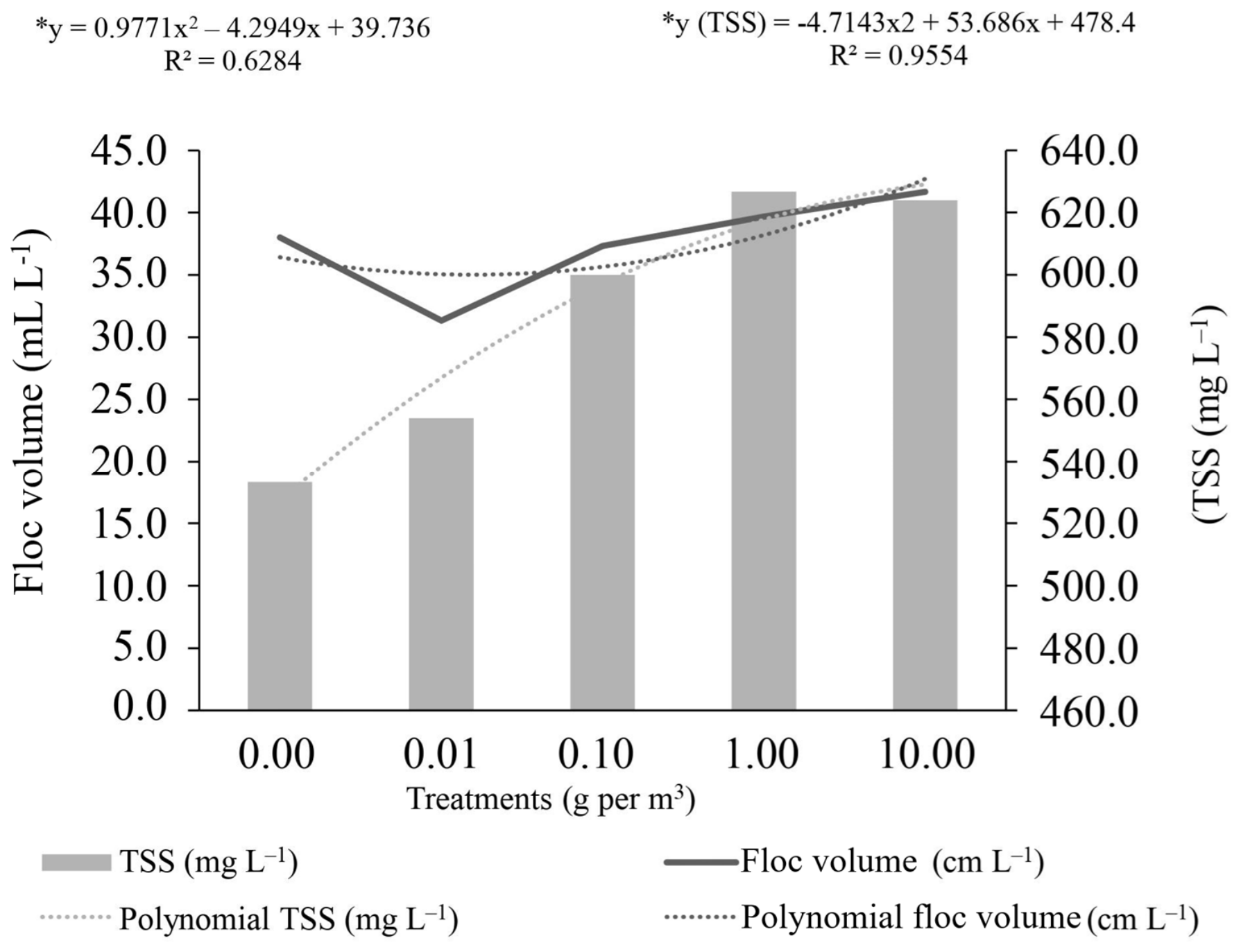
The results presented refer to the 72-h treatment period. No statistically significant differences were observed among the various probiotic doses (p > 0.05). To determine the appropriate dose, treatment efficacy (%) was calculated. In the experimental units, mean dissolved oxygen (6.72 ± 0.26 mg L−1) and temperature (26.89 ± 0.39 °C) remained stable throughout the experiment. The lowest concentrations of the multi-strain probiotic resulted in reduced floc volume (FV). The control group exhibited an FV of 38.00 ± 1.50 mL L−1, whereas the treatments at 0.01, 0.10, 1.0, and 10.0 g m−3 showed values of 31.33 ± 1.00, 37.33 ± 1.25, 39.67 ± 2.50, and 41.67 ± 1.75 mL L−1, respectively (Figure 1).
Moreover, the dosages (0.01, 0.10, 1.0, and 10.0 g m−3) resulted in floc volume (FV) reduction efficiencies of 17.54 ± 2.50%, 1.75 ± 1.50%, −4.39 ± 0.84%, and −9.65 ± 1.36%, respectively. These findings were crucial for determining the dosage used in the in vivo trial, taking into account both the amount of product applied and the observed effects on FV and overall efficiency (%).
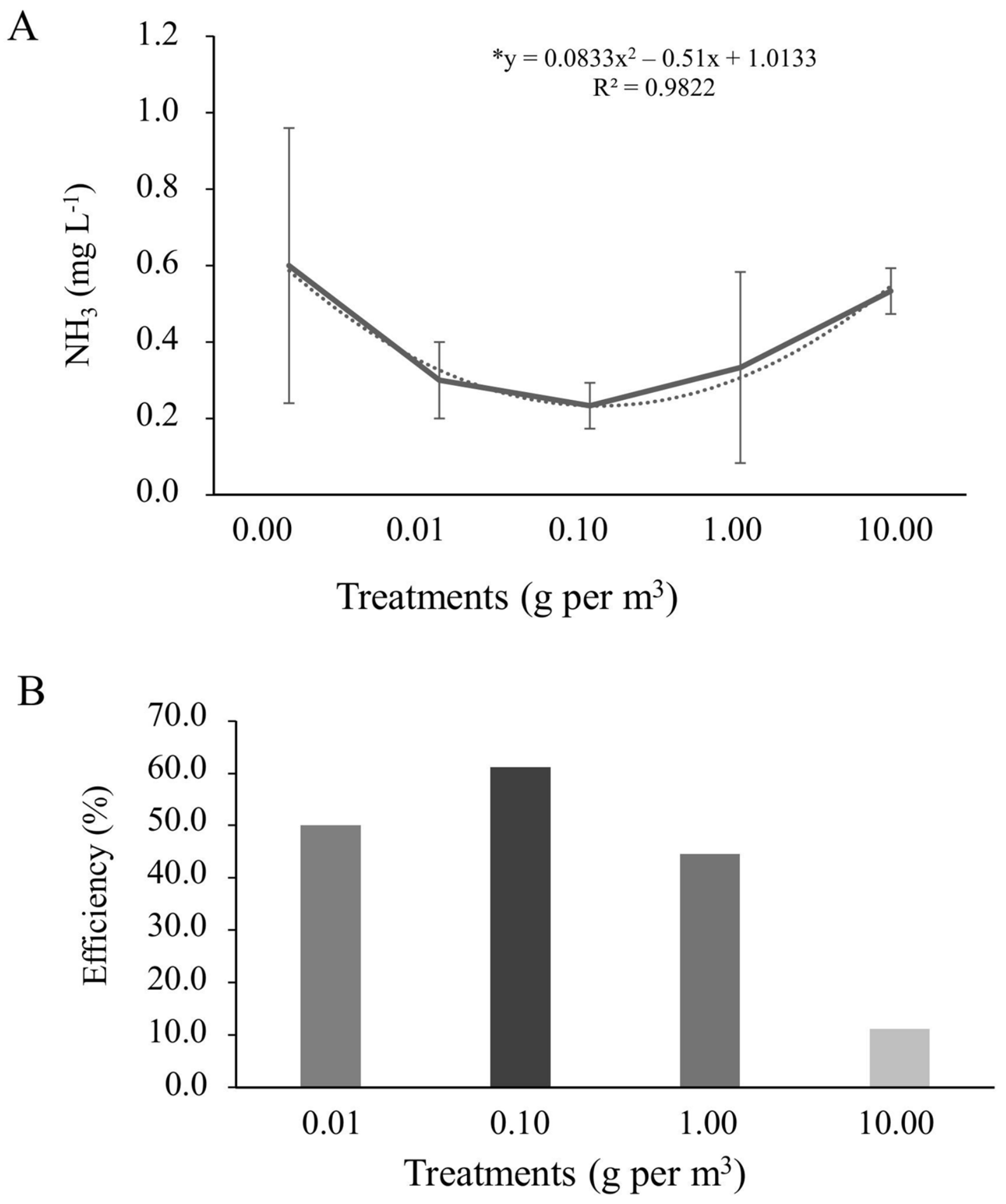
Regarding total suspended solids (TSS), the 0.01 g m−3 and 0.10 g m−3 treatments exhibited lower concentrations (554.00 ± 51.10 mg L−1 and 600.00 ± 67.30 mg L−1, respectively) compared with the 1.0 g m−3 and 10.0 g m−3 treatments (626.7 ± 35.78 mg L−1 and 624.00 ± 54.65 mg L−1, respectively) (Figure 1). Concerning NH3–N, the 0.01 g m−3 (0.30 ± 0.05 mg L−1) and 0.10 g m−3 (0.23 ± 0.03 mg L−1) treatments showed lower concentrations compared with the control (0.60 ± 0.20 mg L−1), 1.0 g m−3 (0.33 ± 0.23 mg L−1), and 10.0 g m−3 (0.53 ± 0.08 mg L−1) treatments (Figure 2A). Consequently, the 0.01 g m−3 and 0.10 g m−3 treatments showed greater efficacy in reducing this nitrogenous compound (50.00 ± 0.0% and 61.10 ± 0.5%, respectively) (Figure 2B).
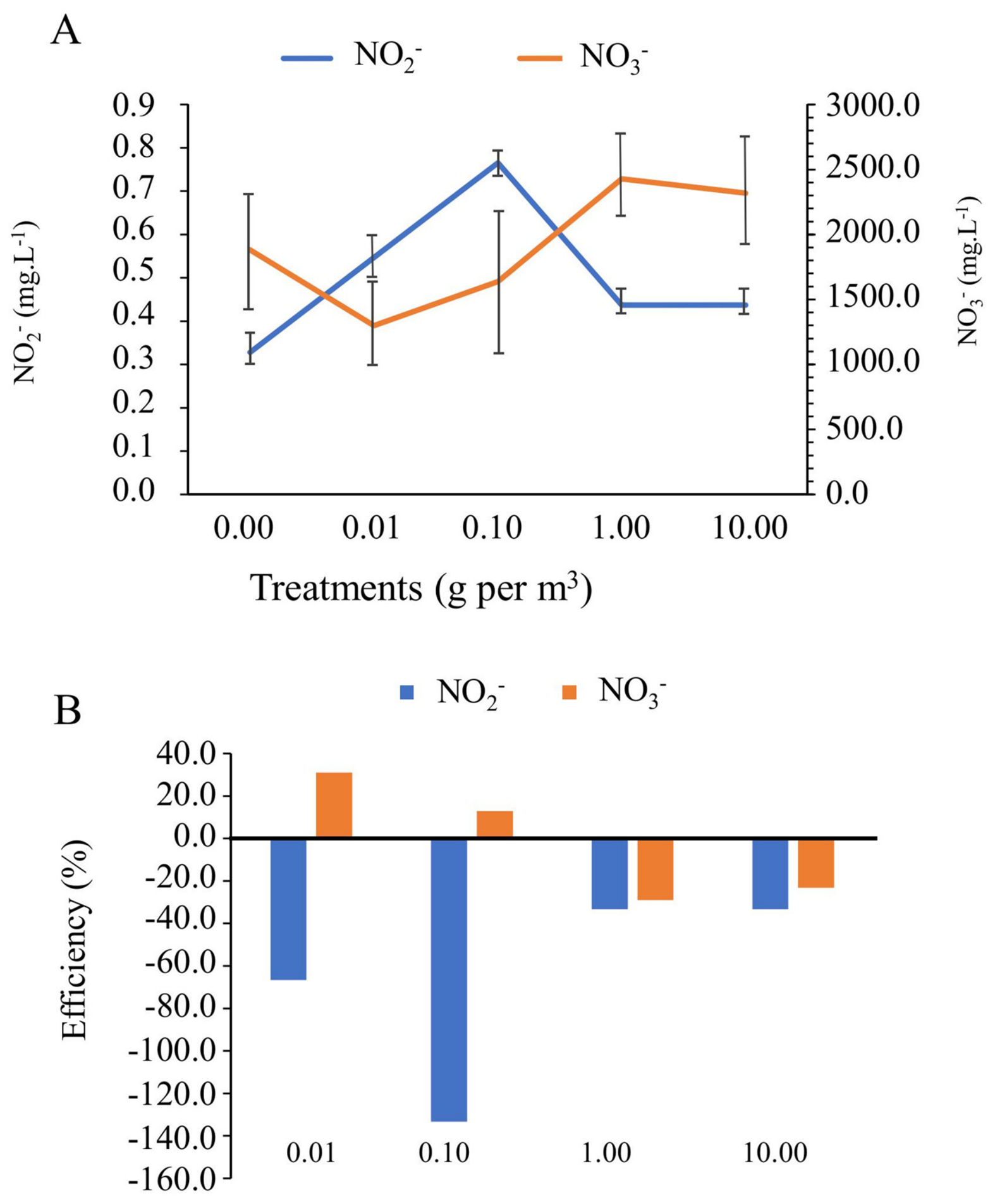
Furthermore, the 0.01 g m−3 and 0.10 g m−3 treatments also presented lower NO3–N concentrations compared with the other doses (Figure 3A). In addition, the reduction efficiency for nitrate in these treatments was higher, with values of 31.0 ± 1.0% and 12.9 ± 1.5%, respectively (Figure 3B). On the other hand, the 1.0 g m−3 and 10.0 g m−3 treatments showed lower NO2–N concentrations (0.44 ± 0.20 mg L−1) compared with the other probiotic treatments (Figure 3A).

3.2. Characterisation of Bacillus Strains (Oxygen, Temperature, and Salinity)

After the challenge, at 37.00 °C and 19.00~23.00 °C, under aerobic, microaerophilic, and anaerobic conditions, the microorganisms exhibited growth exceeding 1011 CFU mL−1, demonstrating the versatility of Bacillus in thriving across diverse environmental conditions. Lower growth was observed at 4.00 °C, and the different oxygen conditions influenced strain-specific growth responses. In the presence of 3% NaCl at 37 °C, growth was similar across all species (Table 1).

3.3. Enzyme Production and Microbial Antagonism

All species were able to produce digestive enzymes, including amylase, lipase, and protease. However, high lipase production was observed in B. licheniformis. B. megaterium also exhibited notable enzymatic activity. Regarding microbial antagonism, only B. subtilis and B. megaterium showed strong antibacterial activity against E. coli. Furthermore, B. subtilis also exhibited weak inhibitory activity against Salmonella enterica serovar Typhimurium (Table 2).

3.4. In Vivo Assay

The average values obtained for water quality parameters over the weeks of experimentation differed significantly (p < 0.05) for alkalinity, TAN-N, NO2-N e NO3-N. The results showed lower concentrations of nitrogen compounds in treatment using probiotics. Furthermore, in this same group, higher alkalinity can be found (Table 3). For the other parameters, there were no significant differences (p > 0.05) between treatments.
In the in vivo test, there was a decrease in total ammonia concentration (0.23 ± 0.01 mg L−1) compared to the control group (0.30 ± 0.03 mg L−1). Similarly, in the in vivo assay, the probiotic group showed a significant reduction in nitrite concentration (6.26 ± 2.06 mg L−1) compared to the control group (12.79 ± 1.09 mg L−1). Additionally, nitrate levels were lower (23.88 ± 2.03 mg L−1) in the probiotic group compared to the control group (66.04 ± 22.79 mg L−1). Regarding the growth performance of O. niloticus, it was not possible to verify significant differences between the treatments (Table 4).

4. Discussion

The results of this study demonstrate that B. subtilis and B. megaterium effectively inhibited Escherichia coli, whilst B. licheniformis exhibited notable lipase production. Overall, the multi-strain Bacillus probiotic reduced nitrogenous compounds in BFT without affecting the growth performance of O. niloticus within the system. The effects of B. subtilis in wastewater treatment are attributed to its ability to secrete extracellular polymeric substances (EPS) and its strong flocculation activity [35]. EPS can facilitate bioflocculation and influence the physicochemical properties of particles, as well as modify their structure and surface charge, thereby increasing the sedimentation capacity of flocculated aggregates [36]. Furthermore, it has been reported that EPS content enhances bioflocculation, as extracellular polysaccharides can disrupt the cellular electrical potential [37]. In these processes, the hydrophobic components of EPS, such as proteins and lipids, render the floc surface more hydrophobic [4]. Additionally, the anionic groups of EPS may interact with divalent ions, promoting their binding to biofloc particles and thereby enhancing bioflocculation [38].
Lu et al. [39] also reported a lower floc volume when using Bacillus spp. In addition, they observed higher protein and polysaccharide contents in extracellular polymeric substances (EPS) extracted from a reactor containing these bacteria, indicating enhanced EPS production and, consequently, increased floc sedimentation capacity. Thus, these findings suggest that Bacillus species can significantly contribute to reducing floc volume in BFT systems, which helps explain the results of the present in vitro study.
Although TSS values were numerically higher in the probiotic treatment, this increase likely reflects greater microbial biomass production rather than deterioration of water quality. Similar observations have been reported in BFT systems, where increased suspended solids are associated with enhanced biofloc development rather than accumulation of undesirable particulate matter. Dash et al. [40] observed an increase in total suspended solids during the first week following the addition of probiotics to the culture water of common carp (Cyprinus carpio) under BFT conditions. This indicates that the introduction of probiotic bacteria into the culture environment promotes the development of suspended biomass.
Undoubtedly, aquaculture is frequently associated with the accumulation of nitrogenous compounds such as ammonia and nitrite, as well as high loads of organic matter [11]. The accumulation of these compounds is known to be toxic to cultured organisms, causing stress and, in severe cases, mortality [41]. Total ammonia nitrogen (TAN-N), NO2–N, NO3–N, and total Kjeldahl nitrogen (TKN) are utilised by various microorganisms, including probiotics, as part of their metabolism [42]. Ammonification, nitrification, and denitrification are key processes involved in the nitrogen cycle [43]. In the present study, the higher probiotic doses, nitrite concentrations decreased whereas nitrate concentrations increased. This pattern is consistent with enhanced nitrification, in which nitrite is further oxidised to nitrate [43]. Although autotrophic nitrifying bacteria such as Nitrobacter and Nitrospira are traditionally responsible for this conversion, several Bacillus species have been reported to perform heterotrophic nitrification coupled with aerobic denitrification [44]. Bacillus spp. have been reported to contribute to nitrogen cycling through complementary mechanisms, including ammonification, heterotrophic nitrification, aerobic denitrification, assimilation of inorganic nitrogen into microbial biomass, and degradation of organic matter [45,46,47,48]. These activities complement, rather than replace, the ecological functions of indigenous autotrophic nitrifying bacteria (AOB and NOB) [49] naturally established in biofloc systems. Consequently, the reductions in nitrogenous compounds observed in the present study likely resulted from the combined activity of the native microbial community and the probiotic Bacillus strains.
Orthophosphate and electrical conductivity were monitored as complementary indicators of nutrient dynamics and the overall physicochemical stability of the BFT system. Orthophosphate plays an important role in microbial growth and phosphorus cycling, whereas electrical conductivity reflects the concentration of dissolved ions associated with feeding inputs, organic matter mineralization, and microbial metabolism [7,12,18,22]. Although neither parameter differed significantly between treatments, these findings indicate that the multi-strain Bacillus probiotic improved nitrogen-related water quality without causing measurable changes in phosphorus availability or in the overall ionic balance of the culture water.
The effectiveness of Bacillus in bioremediation is influenced by factors such as dissolved oxygen, metal ions, pH, temperature, salinity, application mode, and nutrient source. The control of these parameters at optimal levels is essential to achieve efficient bioremediation performance using Bacillus. Different Bacillus strains may have specific optimal conditions for water quality regulation; therefore, defining a suitable range of operational conditions is crucial for improving efficiency in water quality management [22]. Hong et al. [50] demonstrated that B. subtilis strains can reach >1011 CFU mL−1 within 24 h under standard laboratory conditions. Klausmann et al. [51] reported high cell densities of B. subtilis (strain JABs32) in pre-cultures grown in flasks at 37 °C and 120 rpm prior to bioreactor cultivation. These findings indicate that rapid growth can be achieved under well-prepared batch fermentation conditions, even in the absence of controlled bioreactors. In the present study, the high CFU levels observed after 24 h of exposure at lower temperatures (19–23 °C and even 4 °C) are likely attributable to the spore-forming capacity and stress resistance of Bacillus species. Nicholson et al. [52] highlighted the persistence of spores under harsh conditions, which may explain both survival and subsequent recovery of viable cells following incubation under favourable conditions.
Temperature fluctuations play a crucial role in influencing the growth and survival of these microorganisms [53,54]. Under laboratory conditions, B. subtilis demonstrates the ability to grow across a broad temperature range, from 11 °C to 52 °C [55,56]. However, abrupt temperature decreases can challenge bacterial cells by disrupting protein synthesis and ribosomal activity, ultimately reducing protein functionality. In addition, such temperature shifts may affect cytoplasmic membrane fluidity and impair cellular transport mechanisms [54,57]. These factors likely contributed to the observed reduction in bacterial growth in the present experiment.
The Bacillus genus exhibits important beneficial properties, including the microbial synthesis of essential biomolecules such as amino acids, fatty acids, and vitamins, as well as the production of digestive exoenzymes including cellulase, phytase, tannase, protease, lipase, and amylase [23,27,28]. These microbial products enhance nutrient bioavailability to the host, highlighting the relevance of the enzymatic activity observed in the bacterial species evaluated in the present study.
Additionally, it should be noted that the Bacillus genus exhibits another important characteristic, namely the ability of several species to produce antimicrobial substances, including bacterial peptides and lipopeptides, bacteriocins, and bacteriocin-like inhibitory substances [24,29,30], as well as BLIS (bacteriocin-like inhibitory substances) [29]. These compounds inhibit a wide range of pathogens, boosting probiotic activity and aiding in the management of harmful bacteria in the environment. Although the present study included an in vitro antagonism assay demonstrating antibacterial activity of selected Bacillus strains against E. coli and S. enterica, no in vivo pathogen challenge was performed. This is because the primary objective of this study was to evaluate the probiotic as a bioremediation agent under BFT conditions rather than its ability to enhance disease resistance. Nevertheless, future studies incorporating pathogen challenge assays will be valuable to further elucidate the relationship between the observed antimicrobial activity and disease protection under commercial aquaculture conditions.
The alkalinity level was higher in the probiotic group (144.25 ± 2.33 mg L−1) compared with the control group (122.83 ± 10.22 mg L−1). Bacillus species contribute to the modulation of alkalinity and pH by facilitating the mineralisation of organic matter, which supports photosynthetic activity [22]. During the mineralisation process, oxygen is consumed, resulting in the production of CO2, H2O, and nutrients [58]. CO2 and nutrients derived from mineralisation promote phytoplankton photosynthesis, which in turn releases O2. Furthermore, photosynthetic activity utilises free CO2 and bicarbonates, leading to an increase in carbonate concentrations and dissolved oxygen, thereby influencing water pH, as carbonates increase pH through hydrolysis reactions [59].
Regarding the growth performance of O. niloticus, no significant differences were observed among treatments. Biotic factors, particularly the presence of other microorganisms, may also affect bacterial growth and consequently influence the efficacy of probiotics. Antagonistic interactions, such as competition for energy sources, nutrients, and adhesion sites, as well as the production of bacteriocins, antibiotics, and lytic enzymes with antibacterial and antifungal activity (e.g., chitinases, proteases, cellulases, and β-1,3-glucanases), and disruption of quorum sensing [60], may interfere with the growth of Bacillus species. For example, probiotics and other microbial groups often utilise similar nutrients and energy sources and therefore compete for the same available organic substrates, such as carbon [61]. Thus, the activity of other microorganisms can influence the efficiency of Bacillus species in the system.
Aquaculture has progressively advanced its understanding of probiotics, employing microorganisms that have been selected or optimised under laboratory conditions to perform effectively across a range of environments [18,19,22]. It is important to note that certain Bacillus species, such as B. cereus, may be pathogenic [62]. Nevertheless, Bacillus spp., including those evaluated in this study, are routinely assessed in aquaculture and are generally regarded as safe for use as probiotics and potential bioremediation agents [63].
The present study demonstrated the bioremediation potential of a multi-strain Bacillus probiotic. The strains B. subtilis (CCT 0089), B. amyloliquefaciens (ATCC 31592), B. licheniformis (CCT 7836), and B. megaterium (CCT 7935) exhibited adaptability under varying environmental conditions, including temperatures ranging from 19 to 23 °C and different oxygen regimes. Moreover, strain CCT 7836 showed significant lipase activity, while strain CCT 7935 exhibited moderate protease activity, suggesting their capacity to enhance nutrient bioavailability and contribute to the degradation of compounds in BFT systems. Additionally, strains CCT 0089 and CCT 7935 demonstrated strong antibacterial activity against E. coli, thereby enhancing their probiotic potential and supporting the control of pathogenic bacteria in aquaculture. However, the present study focused on the functional performance of the probiotic and did not quantify the persistence or abundance of the introduced strains within the biofloc microbial community. Future studies integrating microbiological enumeration or molecular monitoring with water quality assessments will help clarify the colonization dynamics and long-term persistence of probiotic strains under BFT conditions.

5. Conclusions

The study demonstrated that different Bacillus species have bioremediation potential under fluctuating temperature and oxygen conditions. Certain strains exhibited high enzymatic activity and antibacterial effects against E. coli. Lower concentrations of the multi-strain probiotic were effective in reducing waste parameters in aquaculture systems. Under the experimental conditions evaluated in this study, the recommended application rate for the multi-strain Bacillus probiotic was 0.10 g m−3 applied twice weekly, which effectively reduced nitrogenous compounds and improved water quality in Nile tilapia cultured under biofloc technology. Further studies should evaluate whether alternative application frequencies, including strategic applications during biofloc maturation or periods of elevated TAN and nitrite, provide comparable performance under commercial farming conditions.

Author Contributions

M.V.S.d.A. Experimental execution, Writing—original draft, Methodology, M.S.O. Experimental execution, Data curation, Writing—original draft, final writing. G.F.A.J. Methodology, Experimental execution, Project administration, Resources. A.J. Conceptualization, Methodology, Experimental execution, Project administration, Resources and Supervision. All authors have read and agreed to the published version of the manuscript.

Funding

National Council for Scientific and Technological Development (CNPq, 404382/2023-1 and 308661/2023-0) and IFC—Instituto Federal Catarinense for the scholarship granted to Maria Vitoria Santos de Almeida, grant code IFC APL 60/2020.

Institutional Review Board Statement

This research was approved 18 August 2021, by the National Council for the Control of Animal Experimentation (CONCEA) under protocol number 373/2021, and it was performed in the Aquaculture Laboratory (LAq) of IFc-Araquari (IFCA) following guidelines of the Ethics Committee on Animal Use (CEUA) and aiming at the principles of “reduction, replacement and refinement” in the use of animals in scientific and academic centers.

Informed Consent Statement

Not applicable.

Data Availability Statement

The original contributions presented in the study are included in the article, further inquiries can be directed to the corresponding author.

Acknowledgments

The authors acknowledge the company Nutricol—Brazil for providing diets used in this research, BioHall and Biosyn for financial support, “National Council for Scientific and Technological Development (CNPq, 404382/2023-1 and 308661/2023-0) and IFC—Instituto Federal Catarinense for the scholarship granted to Maria Vitória grant code IFC APL 60/2020. Declaration of Generative AI: During the preparation of this manuscript, the authors used Grammar Labs for language editing to ensure the readability of the work.

Conflicts of Interest

Author Gabriel Fernandes Alves Jesus was employed by the company for Gabbia Biotecnologia e Desenvolvimento Ltda. The remaining authors declare that the research was conducted in the absence of any commercial or financial relationships that could be construed as a potential conflict of interest.

References

  1. Ahmad, A.L.; Chin, J.Y.; Harun, M.H.Z.M.; Low, S.C. Environmental impacts and imperative technologies towards sustainable treatment of aquaculture wastewater: A review. J. Water Process Eng. 2022, 46, 102553. [Google Scholar] [CrossRef] [Scilit]
  2. Jiang, Q.; Bhattarai, N.; Pahlow, M.; Xu, Z. Environmental sustainability and footprints of global aquaculture. Resour. Conserv. Recycl. 2022, 180, 106183. [Google Scholar] [CrossRef] [Scilit]
  3. Zhao, Y.; Xue, B.; Bi, C.; Ren, X.; Liu, Y. Influence mechanisms of macro-infrastructure on micro-environments in the recirculating aquaculture system and biofloc technology system. Rev. Aquac. 2023, 15, 991–1009. [Google Scholar] [CrossRef] [Scilit]
  4. Duan, S.; Vasconcelos, R.O.; Wu, L.; Li, X.; Sun, W.; Li, X. Managing Aquaculture Noise: Impacts on Fish Hearing, Welfare, and Mitigation Strategies. Rev. Aquac. 2025, 17, e70013. [Google Scholar] [CrossRef] [Scilit]
  5. Jatobá, A.; Borges, Y.V.; Silva, F.A. BIOFLOC: Sustainable alternative for water use in fish culture. Arq. Bras. Med. Vet. Zootec. 2019, 71, 1076–1080. [Google Scholar] [CrossRef] [Scilit]
  6. Khanjani, M.H.; da Silva, L.O.B.; Fóes, G.K.; do Vieira, F.N.; Poli, M.A.; Santos, M.; Emerenciano, M.G.C. Synbiotics and aquamimicry as alternative microbial-based approaches in intensive shrimp farming and biofloc: Novel disruptive techniques or complementary management tools? A scientific-based overview. Aquaculture 2023, 567, 739273. [Google Scholar] [CrossRef] [Scilit]
  7. Maia, W.P.; Owatari, M.S.; Fernandes, N.I.; Del Guerra, L.O.M.; Soligo, T.; Mouriño, J.L.P.; Martins, M.L. Effects of a commercial multi-strain bioremediator on the growth and microbial community of Nile tilapia (Oreochromis niloticus) under biofloc conditions: A field study. Aquac. Sci. Manag. 2025, 2, 3. [Google Scholar] [CrossRef] [Scilit]
  8. Avnimelech, Y. Bio-filters: The need for an new comprehensive approach. Aquac. Eng. 2006, 34, 172–178. [Google Scholar] [CrossRef] [Scilit]
  9. Khanjani, M.H.; Sharifinia, M.; Akhavan-Bahabadi, M.; Emerenciano, M.G.C. Probiotics and Phytobiotics as Dietary and Water Supplements in Biofloc Aquaculture Systems. Aquac. Nutr. 2024, 2024, 3089887. [Google Scholar] [CrossRef] [Scilit] [PubMed]
  10. He, X.; Abakari, G.; Tan, H.; Liu, W.; Luo, G. Effects of different probiotics (Bacillus subtilis) addition strategies on a culture of Litopenaeus vannamei in biofloc technology (BFT) aquaculture system. Aquaculture 2023, 566, 739216. [Google Scholar] [CrossRef] [Scilit]
  11. Khanjani, M.H.; Mohammadi, A.; Emerenciano, M.G.C. Microorganisms in biofloc aquaculture system. Aquac. Rep. 2022, 26, 101300. [Google Scholar] [CrossRef] [Scilit]
  12. Martinez-Porchas, M.; Martínez-Córdova, L.R.; Lopez-Elias, J.A.; Porchas-Cornejo, M.A. Bioremediation of aquaculture effluents. In Microbial Biodegradation and Bioremediation; Elsevier: Amsterdam, The Netherlands, 2014; pp. 539–553. [Google Scholar] [CrossRef] [Scilit]
  13. Wen, Y.; Wang, M.; Wang, H.; Liu, S.; Xing, R.; Zhang, H.; Chen, L.; Li, R.; Yu, Z. Promoting aquatic animal health and water quality: A systematic review on probiotics, prebiotics and synbiotics in aquaculture. Fishes 2026, 11, 174. [Google Scholar] [CrossRef] [Scilit]
  14. Wang, Y.B.; Han, J.Z. The role of probiotic cell wall hydrophobicity in bioremediation of aquaculture. Aquaculture 2007, 269, 349–354. [Google Scholar] [CrossRef] [Scilit]
  15. Wu, Y.; Li, T.; Yang, L. Mechanisms of removing pollutants from aqueous solutions by microorganisms and their aggregates: A review. Bioresour. Technol. 2021, 107, 10–18. [Google Scholar] [CrossRef] [Scilit] [PubMed]
  16. Huang, T.Y.; Ju, H.J.; Huang, M.Y.; Kuo, Q.M.; Su, W.T. Optimal nitrite degradation by isolated Bacillus subtilis sp. N4 and applied for intensive aquaculture water quality management with immobilized strains. J. Environ. Manag. 2025, 374, 123896. [Google Scholar] [CrossRef] [Scilit] [PubMed]
  17. Tao, L.T.; Wei, D.M.; Niu, B.; Lu, H.; Xiong, J.; Sun, W.W.; Shan, X.F. Bacillus subtilis probiotic enhances ornamental fish survival through ammonia detoxification. Aquac. Int. 2025, 33, 153. [Google Scholar] [CrossRef] [Scilit]
  18. Ghosh, T. Recent advances in the probiotic application of the Bacillus as a potential candidate in the sustainable development of aquaculture. Aquaculture 2025, 594, 741432. [Google Scholar] [CrossRef] [Scilit]
  19. Thurlow, C.M.; Williams, M.A.; Carrias, A.; Ran, C.; Newman, M.; Tweedie, J.; Allison, E.; Jescovitch, L.N.; Wilson, A.E.; Terhune, L.S.; et al. Bacillus velezensis AP193 exerts probiotic effects in channel catfish (Ictalurus punctatus) and reduces aquaculture pond eutrophication. Aquaculture 2019, 503, 347–356. [Google Scholar] [CrossRef] [Scilit]
  20. Zheng, Y.; Wu, Y.; Tang, S.; Li, J.; Fan, L.; He, W. Effects of Bacillus licheniformis on the water quality, growth performance and bacterial community in Penaeus vannamei aquaculture system. Front. Microbiol. 2025, 16, 1595680. [Google Scholar] [CrossRef] [Scilit] [PubMed]
  21. Lu, Y.; Bambridge, N.B.; Chen, X.; Feng, Y. Bacillus spp. in Fish Farming: Enhancing Fish Performance, Health and Farming Practices. Aquac. Nutr. 2026, 2026, 3323307. [Google Scholar] [CrossRef] [Scilit] [PubMed]
  22. Hlordzi, V.; Kuebutornye, F.K.; Afriyie, G.; Abarike, E.D.; Lu, Y.; Chi, S.; Anokyewaa, M.A. The use of Bacillus species in maintenance of water quality in aquaculture: A review. Aquac. Rep. 2020, 18, 100503. [Google Scholar] [CrossRef] [Scilit]
  23. Ray, A.K.; Ghosh, K.; Ringø, E. Enzyme-producing bacteria isolated from fish gut: A review. Aquac. Nutr. 2012, 18, 465–492. [Google Scholar] [CrossRef] [Scilit]
  24. Sumi, C.D.; Yang, B.W.; Yeo, I.C.; Hahm, Y.T. Antimicrobial peptides of the genus Bacillus: A new era for antibiotics. Can. J. Microbiol. 2015, 61, 93–103. [Google Scholar] [CrossRef] [Scilit] [PubMed]
  25. Veiga, P.T.N.; Owatari, M.S.; Nunes, A.L.; Rodrigues, R.A.; Kasai, R.Y.; Fernandes, C.E.; Campos, C.M. Bacillus subtilis C-3102 improves biomass gain, innate defense, and intestinal absorption surface of native Brazilian hybrid Surubim (Pseudoplatystoma corruscans x P. reticulatum). Aquac. Int. 2020, 28, 1183–1193. [Google Scholar] [CrossRef] [Scilit]
  26. Oliveira, H.M.; Owatari, M.S.; Martins, M.A.; Lopes, G.R.; Ferreira, M.B.; Jesus, G.F.A.; Godoi, L.A.; Shapira, B.; Martins, M.L.; Mouriño, J.L.P. Probiotic BioPlus® PS modulate shrimp-tilapia polyculture pond soil microbiome and exhibit bioremediation potential. J. Appl. Aquac. 2023, 36, 252–269. [Google Scholar] [CrossRef] [Scilit]
  27. Ghosh, K.; Ray, A.K.; Ringø, E. Applications of plant ingredients for tropical and subtropical freshwater finfish: Possibilities and challenges. Rev. Aquac. 2019, 11, 793–815. [Google Scholar] [CrossRef] [Scilit]
  28. Ghosh, K.; Sen, K.; Ray, A.K. Characterization of Bacilli isolated from the gut of rohu, Labeo rohita, fingerlings and its significance in digestion. J. Appl. Aquac. 2002, 12, 33–42. [Google Scholar] [CrossRef] [Scilit]
  29. Abriouel, H.; Franz, C.M.; Omar, N.B.; Gálvez, A. Diversity and applications of Bacillus bacteriocins. FEMS Microbiol. Rev. 2011, 35, 201–232. [Google Scholar] [CrossRef] [Scilit] [PubMed]
  30. Stein, T. Bacillus subtilis antibiotics: Structures, syntheses and specific functions. Mol. Microbiol. 2005, 56, 845–857. [Google Scholar] [CrossRef] [Scilit] [PubMed]
  31. APHA—American Public Health Association. Standard Methods for the Examination of Water and Wastewater, 21st ed.; American Water Works Association: Denver, CO, USA; Water Environment Federation: Alexandria, VA, USA; American Public Health Association (APHA): Washington, DC, USA, 2005. [Google Scholar]
  32. Avnimelech, Y. Carbon/nitrogen ratio as a control element in aquaculture systems. Aquaculture 1999, 176, 227–235. [Google Scholar] [CrossRef] [Scilit]
  33. Ebeling, J.M.; Timmons, M.B.; Bisogni, J.J. Engineering analysis of the stoichiometry of photoautotrophic, autotrophic, and heterotrophic removal of ammonia–nitrogen in aquaculture systems. Aquaculture 2006, 257, 346–358. [Google Scholar] [CrossRef] [Scilit]
  34. Zar, J.H. Biostatistical Analysis, 5th ed.; Pearson Education India: Noida, India; Prentice Hall: Hoboken, NJ, USA, 2013; p. 760. [Google Scholar]
  35. Shih, L.; Wu, P.J.; Shieh, C.J. Microbial production of a poly (γ-glutamic acid) derivative by Bacillus subtilis. Process Biochem. 2005, 40, 2827–2832. [Google Scholar] [CrossRef] [Scilit]
  36. Adav, S.S.; Lee, D.J. Extraction of extracellular polymeric substances from aerobic granule with compact interior structure. J. Hazard. Mater. 2008, 154, 1120–1126. [Google Scholar] [CrossRef] [Scilit] [PubMed]
  37. Salehizadeh, H.; Shojaosadati, S.A. Extracellular biopolymeric flocculants: Recent trends and biotechnological importance. Biotechnol. Adv. 2001, 19, 371–385. [Google Scholar] [CrossRef] [Scilit] [PubMed]
  38. Forster, C.F. Factors involved in the settlement of activated sludge—I: Nutrients and surface polymers. Water Res. 1985, 19, 1259–1264. [Google Scholar] [CrossRef] [Scilit]
  39. Lu, L.; Tan, H.; Luo, G.; Liang, W. The effects of Bacillus subtilis on nitrogen recycling from aquaculture solid waste using heterotrophic nitrogen assimilation in sequencing batch reactors. Bioresour. Technol. 2012, 124, 180–185. [Google Scholar] [CrossRef] [Scilit] [PubMed]
  40. Dash, P.; Tandel, R.S.; Bhat, R.A.H.; Mallik, S.; Pandey, N.N.; Singh, A.K.; Sarma, D. The addition of probiotic bacteria to microbial floc: Water quality, growth, non-specific immune response and disease resistance of Cyprinus carpio in mid-Himalayan altitude. Aquaculture 2018, 495, 961–969. [Google Scholar] [CrossRef] [Scilit]
  41. Ciji, A.; Akhtar, M.S. Nitrite implications and its management strategies in aquaculture: A review. Rev. Aquac. 2020, 12, 878–908. [Google Scholar] [CrossRef] [Scilit]
  42. Martínez-Córdova, L.R.; Emerenciano, M.; Miranda-Baeza, A.; Martínez-Porchas, M. Microbial-based systems for aquaculture of fish and shrimp: An updated review. Rev. Aquac. 2015, 7, 131–148. [Google Scholar] [CrossRef] [Scilit]
  43. Liu, C.H.; Chiu, C.S.; Ho, P.L.; Wang, S.W. Improvement in the growth performance of white shrimp, Litopenaeus vannamei, by a protease-producing probiotic, Bacillus subtilis E20, from natto. J. Appl. Microbiol. 2009, 107, 1031–1041. [Google Scholar] [CrossRef] [Scilit] [PubMed]
  44. Zhai, J.; Jiumu, L.; Cong, L.; Wu, Y.; Dai, L.; Zhang, Z.; Zhang, M. Reed decomposition under Bacillus subtilis addition conditions and the influence on water quality. Ecohydrol. Hydrobiol. 2020, 20, 504–512. [Google Scholar] [CrossRef] [Scilit]
  45. Hui, C.; Wei, R.; Jiang, H.; Zhao, Y.; Xu, L. Characterization of the ammonification, the relevant protease production and activity in a high-efficiency ammonifier Bacillus amyloliquefaciens DT. Int. Biodeterior. Biodegrad. 2019, 142, 11–17. [Google Scholar] [CrossRef] [Scilit]
  46. Rout, P.R.; Bhunia, P.; Dash, R.R. Simultaneous removal of nitrogen and phosphorous from domestic wastewater using Bacillus cereus GS-5 strain exhibiting heterotrophic nitrification, aerobic denitrification and denitrifying phosphorous removal. Bioresour. Technol. 2017, 244, 484–495. [Google Scholar] [CrossRef] [Scilit] [PubMed]
  47. Verbaendert, I.; Boon, N.; De Vos, P.; Heylen, K. Denitrification is a common feature among members of the genus Bacillus. Syst. Appl. Microbiol. 2011, 34, 385–391. [Google Scholar] [CrossRef] [Scilit] [PubMed]
  48. Yousuf, J.; Thajudeen, J.; Rahiman, M.; Krishnankutty, S.; Alikunj, A.P.; Abdulla, M.H.A. Nitrogen fixing potential of various heterotrophic Bacillus strains from a tropical estuary and adjacent coastal regions. J. Basic Microbiol. 2017, 57, 922–932. [Google Scholar] [CrossRef] [Scilit] [PubMed]
  49. Liu, T.; He, X.; Jia, G.; Xu, J.; Quan, X.; You, S. Simultaneous nitrification and denitrification process using novel surface-modified suspended carriers for the treatment of real domestic wastewater. Chemosphere 2020, 247, 125831. [Google Scholar] [CrossRef] [Scilit] [PubMed]
  50. Hong, H.A.; Duc, L.H.; Cutting, S.M. The use of bacterial spore formers as probiotics. FEMS Microbiol. Rev. 2005, 29, 813–835. [Google Scholar] [CrossRef] [Scilit] [PubMed]
  51. Klausmann, P.; Hennemann, K.; Hoffmann, M.; Treinen, C.; Aschern, M.; Lilge, L.; Heravi, K.M.; Henkel, M.; Hausmann, R. Bacillus subtilis high cell density fermentation using a sporulation-deficient strain for the production of surfactin. Appl. Microbiol. Biotechnol. 2021, 105, 4141–4151. [Google Scholar] [CrossRef] [Scilit] [PubMed]
  52. Nicholson, W.L.; Munakata, N.; Horneck, G.; Melosh, H.J.; Setlow, P. Resistance of Bacillus endospores to extreme terrestrial and extraterrestrial environments. Microbiol. Mol. Biol. Rev. 2000, 64, 548–572. [Google Scholar] [CrossRef] [Scilit] [PubMed]
  53. Graumann, P.; Marahiel, M.A. Some like it cold: Response of microorganisms to cold shock. Arch. Microbiol. 1996, 166, 293–300. [Google Scholar] [CrossRef] [Scilit] [PubMed]
  54. Weber, M.H.; Marahiel, M.A. Coping with the cold: The cold shock response in the Gram-positive soil bacterium Bacillus subtilis. Philos. Trans. R. Soc. Lond. Ser. B Biol. Sci. 2002, 357, 895–907. [Google Scholar] [CrossRef] [Scilit] [PubMed]
  55. Budde, I.; Steil, L.; Scharf, C.; Volker, U.; Bremer, E. Adaptation of Bacillus subtilis to growth at low temperature: A combined transcriptomic and proteomic appraisal. Microbiology 2006, 152, 831–853. [Google Scholar] [CrossRef] [Scilit] [PubMed]
  56. Holtmann, G.; Bremer, E. Thermoprotection of Bacillus subtilis by exogenously provided glycine betaine and structurally related compatible solutes: Involvement of Opu transporters. J. Bacteriol. 2004, 186, 1683–1693. [Google Scholar] [CrossRef] [Scilit] [PubMed]
  57. Mansilla, M.C.; Cybulski, L.E.; Albanesi, D.; de Mendoza, D. Control of membrane lipid fluidity by molecular thermosensors. J. Bacteriol. 2004, 186, 6681–6688. [Google Scholar] [CrossRef] [Scilit] [PubMed]
  58. Bokossa, H.K.J.; Saïdou, A.; Sossoukpe, E.; Fiogbé, D.E.; Kossou, D. Decomposition and mineralization effect of various sources of Pig manure on water quality and nutrients availability for agro-Fish System in Benin. Agric. Sci. 2014, 5, 1194. [Google Scholar] [CrossRef]
  59. Sunitha, K.; Padmavathi, P. Influence of Probiotics on Water Quality and Fish Yield in Fish Ponds. Int. J. Pure Appl. Sci. Technol. 2013, 19, 48–60. Available online: https://www.proquest.com/scholarly-journals/influence-probiotics-on-water-quality-fish-yield/docview/1500359544/se-2 (accessed on 18 January 2024).
  60. Kuebutornye, F.K.; Abarike, E.D.; Lu, Y.; Hlordzi, V.; Sakyi, M.E.; Afriyie, G.; Wang, Z.; Li, Y.; Xie, C.X. Mechanisms and the role of probiotic Bacillus in mitigating fish pathogens in aquaculture. Fish Physiol. Biochem. 2020, 46, 819–841. [Google Scholar] [CrossRef] [Scilit] [PubMed]
  61. Amenyogbe, E. Application of probiotics for sustainable and environment-friendly aquaculture management-A review. Cogent Food Agric. 2023, 9, 2226425. [Google Scholar] [CrossRef] [Scilit]
  62. Carlin, F.; Nguyen-The, C. Pathogen update: Bacillus species. In Advances in Microbial Food Safety; Woodhead Publishing Series in Food Science, Technology and Nutrition; Woodhead Publishing: Cambridge, UK, 2013; pp. 70–96. [Google Scholar] [CrossRef] [Scilit]
  63. Soltani, M.; Ghosh, K.; Hoseinifar, S.H.; Kumar, V.; Lymbery, A.J.; Roy, S.; Ringø, E. Genus Bacillus, promising probiotics in aquaculture: Aquatic animal origin, bio-active components, bioremediation and efficacy in fish and shellfish. Rev. Fish. Sci. Aquac. 2019, 27, 331–337. [Google Scholar] [CrossRef] [Scilit]
Figure 1. Pilot 72-h dose–response trial assessing the bioremediation capabilities of a commercial probiotic containing multi-strains of Bacillus. Floc volume (FV, mL L−1) and total suspended solids (TSS, mg L−1) under biofloc technology (BFT) conditions. Mean values ± SD are presented. (*) Second-order polynomial regressions. One-way ANOVA indicated no significant differences among probiotic doses for FV (F(4,10) = 1.28, p = 0.3404) or TSS (F(4,10) = 0.91, p = 0.3685).
Aquacj 06 00033 g001
Figure 2. Pilot 72-h dose–response trial evaluating the bioremediation potential of a commercial multi-strain Bacillus probiotic under biofloc technology (BFT) conditions. (A) Toxic ammonia (NH3–N, mg L−1) concentration after 72 h of treatment. Mean values ± SD are presented. (*) The curve represents a second-order polynomial regression fitted to describe the dose–response trend. One-way ANOVA indicated no significant differences among probiotic doses (F(4,10) = 1.47, p = 0.0814). (B) Bioremediation efficiency (%) of the multi-strain Bacillus probiotic treatments, calculated from the reduction in NH3–N concentration relative to the control.
Aquacj 06 00033 g002
Figure 3. Pilot 72-h dose–response trial evaluating the bioremediation potential of a commercial multi-strain Bacillus probiotic under biofloc technology (BFT) conditions. (A) Nitrite (NO2–N, mg L−1) and nitrate (NO3–N, mg L−1) concentrations after 72 h of treatment. Mean values ± SD are presented. Second-order polynomial regressions were fitted to describe dose-dependent trends. One-way ANOVA indicated no significant differences among probiotic doses for NO2–N (F(4,10) = 1.12, p = 0.3986) or NO3–N (F(4,10) = 1.56, p = 0.2598). (B) Bioremediation efficiency (%) of the multi-strain Bacillus probiotic treatments, calculated from the reduction in nitrate (NO3–N) concentration relative to the control.
Aquacj 06 00033 g003
Table 1. In vitro characterisation of multi-strain Bacillus probiotic subjected to different environmental challenges.
Challenge Bacillus ProbioticStrains
TemperatureOxygenB. subtilisB. amyloliquefaciensB. megateriumB. licheniformis
Aerobiosis>1011>10111.8 × 1011>1011
37.00 °CMicroaerophilia>1011>1011>1011>1011
Anaerobiosis>1011>1011>1011>1011
19.00~23.00 °CAerobiosis>1011>1011>1011>1011
atMicroaerophilia>1011>1011>1011>1011
room temperatureAnaerobiosis>1011>1011>1011>1011
Aerobiosis1.52 × 10101.34 × 10101.90 × 1081.14 × 1010
4.00 °CMicroaerophilia3.00 × 1093.20 × 1092.00 × 1084.00 × 108
Anaerobiosis4.80 × 1088.80 × 1081.44 × 10101.59 × 1010
NaCl (3.0%)Aerobiosis>1010>1010>1010>1010
atMicroaerophilia>1010>1010>1010>1010
37.00 °CAnaerobiosis>1010>1010>1010>1010
Note: The strains were challenged for 24 h under aerobic (control), microaerophilic, and anaerobic conditions in nutrient broth. The same assay was conducted in culture medium supplemented with 3.0% sodium chloride (NaCl) to evaluate strain resistance under saline conditions. The results refer to microbial growth (CFU mL−1) observed after 24 h of exposure to the different environmental conditions.
Table 2. In vitro characterisation of the enzymatic and antibacterial activity of a multi-strain Bacillus probiotic. The results refer to the enzymatic and antibacterial activities of the different probiotic strains. (-) indicates no reaction. (+) indicates low activity, corresponding to an inhibition halo of 0–4 mm. (++) indicates moderate activity, corresponding to a halo of 5–9 mm. (+++) indicates high activity, corresponding to a halo of ≥10 mm. The qualitative scores are based on measured inhibition (or hydrolysis) halo diameters and are presented as activity classes to facilitate comparison among strains.
B. subtilisB. amyloliquefaciensB. megateriumB. licheniformis
Enzymatic
activity
Amylases++++
Lipases+++++++++
Proteases+++++
Antibacterial
activity
S. Typhimurium+---
S. Enteritidis----
S. Minnesota----
S. Heidelberg----
Escherichia coli+++-+++-
Table 3. Water quality in the rearing of Oreochromis niloticus under BFT conditions, evaluating the bioremediation potential of a commercial multi-strain Bacillus probiotic (B. subtilis CCT 0089, B. amyloliquefaciens ATCC 31592, B. licheniformis CCT 7836, and B. megaterium CCT 7935). Data are presented as means (±SD) over 4 weeks. (*) indicates a significant difference according to the Student–Newman–Keuls (SNK) test at a 5.0% significance level.
Water Quality ParametersControlBioremediatorp-Value
Temperature (°C)29.40 ± 0.4329.05 ± 0.300.2616
Dissolved oxygen (mg L−1)6.86 ± 0.087.06 ± 0.180.1503
Floc volume (mL L−1)13.18 ± 0.683.93 ± 1.090.4249
Alkalinity (mg L−1) *122.83 ± 10.22144.25 ± 2.330.0413
pH7.08 ± 0.097.10 ± 0.050.3167
TAN (mg L−1) *0.30 ± 0.030.23 ± 0.010.0288
NO2 (mg L−1) *12.79 ± 1.096.26 ± 2.060.0212
NO3 (mg L−1) *66.04 ± 22.7923.88 ± 2.030.0200
PO43− (mg L−1)2.69 ± 0.332.22 ± 0.390.1841
TSS (mg L−1)100.29 ± 11.05116.04 ± 25.540.0959
Conductivity (µS cm−1)2159.25 ± 88.331957.48 ± 71.860.1651
Table 4. Growth performance of Oreochromis niloticus reared under BFT conditions, evaluating the bioremediation potential of a commercial multi-strain Bacillus probiotic (B. subtilis CCT 0089, B. amyloliquefaciens ATCC 31592, B. licheniformis CCT 7836, and B. megaterium CCT 7935). Data are presented as means (±SD) over 4 weeks. Means were compared using the Student–Newman–Keuls (SNK) test at a 5% significance level.
Growth Performance IndexesControlProbioticp-Value
Initial weight (g)3.50 ± 0.09 3.50 ± 0.09 -
Final weight (g)20.43 ± 1.4021.16 ± 1.120.2241
Weekly growth (g week−1)5.27 ± 0.485.48 ± 0.370.2496
Feed conversion1.35 ± 0.071.29 ± 0.070.1480
Specific Growth Rate (% day−1)3.07 ± 0.153.11 ± 0.110.3449
Productivity (kg m−3)4.09 ± 0.284.23 ± 0.220.2241
Survival (%)99.00 ± 1.00100.0 ± 0.00 0.0669
Disclaimer/Publisher’s Note: The statements, opinions and data contained in all publications are solely those of the individual author(s) and contributor(s) and not of MDPI and/or the editor(s). MDPI and/or the editor(s) disclaim responsibility for any injury to people or property resulting from any ideas, methods, instructions or products referred to in the content.