
Article

Ammonia Excretion Dynamics in Juvenile and Adult Freshwater Prawn Macrobrachium caementarius Reared Under Recirculating Aquaculture Conditions

by
Carlos A. Mendez
1,2,3,*,
María Cristina Morales
2,3 and
German E. Merino
2
1
Programa Doctorado en Acuicultura, Facultad de Ciencias del Mar, Universidad Católica del Norte, Coquimbo 1781421, Chile
2
Departamento de Acuicultura, Facultad de Ciencias del Mar, Universidad Católica del Norte, Larrondo 1281, Coquimbo 1781421, Chile
3
Núcleo FIGEMA-Tec, Universidad Católica del Norte, Larrondo 1281, Coquimbo 1780000, Chile
*
Author to whom correspondence should be addressed.
Aquac. J. 2026, 6(3), 23; https://doi.org/10.3390/aquacj6030023
Submission received: 25 April 2026 / Revised: 23 June 2026 / Accepted: 25 June 2026 / Published: 28 June 2026

Abstract

In this study, total ammonia nitrogen (TAN) excretion rates were quantified in juvenile (mean weight: 1.79 ± 0.17 g) and adult (mean weight: 15.91 ± 0.63 g) prawns (Macrobrachium caementarius) reared under recirculating aquaculture system (RAS) conditions representative of small-scale farming operations. Prawns were fed a commercial dry pelleted diet (48.5% crude protein) at a daily ration equivalent to 5% of total biomass. Water quality parameters were maintained within species-specific tolerance ranges to ensure normal physiological and metabolic function. TAN excretion rates were estimated using a mass balance approach under closed-flow batch conditions. A significant difference in TAN excretion was observed between life stages (p = 0.008): juveniles excreted 0.009 ± 0.006 mg TAN g−1 h−1 (0.22 ± 0.18 mg TAN g−1 day−1), whereas adults excreted 0.03 ± 0.01 mg TAN g−1 h−1 (0.73 ± 0.06 mg TAN g−1 day−1). Distinct diel postprandial patterns were evident in both life stages, with peak TAN release occurring 1–2 h after each feeding event, followed by a gradual decline. These life-stage differences have direct implications for RAS design and biofilter management and should be interpreted in the context of the dietary conditions used. The quantified excretion rates provide baseline bioengineering parameters for sizing biofilters, estimating nitrogen loading, and optimizing water quality management for this emerging aquaculture species.

1. Introduction

Ensuring optimal water quality is essential for the success of any aquaculture farm, as it profoundly impacts the growth, reproduction, and survival of aquatic organisms [1,2]. In closed systems, the primary water quality variable that limits production is dissolved oxygen [3,4]. However, once aeration and oxygenation devices effectively meet oxygen demands, the next significant concern often becomes nitrogenous metabolic byproducts excreted by aquatic organisms, particularly ammonia [5,6,7]. Addressing these issues is significant for enhancing prawn farm productivity and operations.
Ammonia is the main end-product of protein catabolism in crustaceans, and the gill epithelium generally releases most of the excreted nitrogen, which accounts for 60 to 100% of total nitrogenous waste [8]. Ammonia, as nitrogen, can be found in water in two different forms: ionized NH4+-N and non-ionized NH3-N. Total ammonia nitrogen (TAN) is the sum of these two forms [9]. The ratio of these two types of nitrogen forms is mostly determined by pH and, to a lesser extent, by temperature and salinity [10]. Because NH3-N readily diffuses through cell membranes and into hemolymph, it is regarded as the more toxic of the two chemical species of TAN [11]. Ammonia negatively affects aquatic organisms by disrupting enzyme activity, compromising cell membrane stability and water permeability, impairing the molting process, hindering oxygen transport, and damaging tissue integrity. It also suppresses growth and survival, interferes with osmoregulation, induces dysbiosis of the intestinal microbiota, and impairs immune function—thereby increasing susceptibility to pathogens, triggering apoptosis, and potentially leading to mortality [5,11,12,13,14,15,16,17,18]. Additionally, ammonia induces oxidative stress by elevating intracellular levels of reactive oxygen species (ROS) [19].
In crustaceans, most of the excreted ammonia is a result of the breakdown of amino acids from their diet [20]. However, various external and internal factors can influence its excretion, including temperature, salinity, pH, oxygen concentration levels [21,22,23,24,25,26,27], diet and nutritional status [28,29,30,31], molting cycle [32,33], body weight [34,35], daily rhythm [36], ontogenetic development [37,38,39,40], environmental ammonia concentration levels [41,42], and hormonal influences [43,44].
Among the native species with potential to diversify aquaculture in northern Chile is the northern river prawn Macrobrachium caementarius, the only representative of the family Palaemonidae currently recorded in the country [45]. This species, formerly known as Cryphiops caementarius, has been recently reassigned to the genus Macrobrachium following updated systematic revisions [46]. It is considered a hydrobiological resource with high aquaculture potential, as culture technology has been validated, enabling the control of reproduction in captivity and the year-round production of juveniles [47]. The cultivation of M. caementarius in Chile therefore represents a promising opportunity for the development of new aquaculture activities, supported by strong domestic demand, high market value, and the capacity for continuous juvenile production [48].
Despite the recognized aquaculture potential of M. caementarius, no quantitative data exist on total ammonia nitrogen (TAN) excretion rates under production-relevant conditions, representing a critical knowledge gap that prevents the rational design and sizing of biological filtration units in RAS-based culture systems for this species. Unlike the well-studied tropical congeners M. rosenbergii and M. amazonicum, which have been characterized under individual respirometry [23,39], no study has quantified the diel dynamics of TAN excretion in M. caementarius under group-feeding, farm-like conditions. This information is essential for determining appropriate biofilter volumes, water flow rates, and system carrying capacity in intensive culture. Therefore, the aim of this study was to quantify daily TAN excretion rates and their diel postprandial dynamics in juvenile and adult M. caementarius reared under recirculating aquaculture system (RAS) conditions and to provide baseline bioengineering parameters for the design and management of RAS-based production systems for this species.

2. Materials and Methods

2.1. Experimental Design

The study was conducted in the crustacean culture laboratory of the Universidad Católica del Norte (UCN), in Coquimbo, Chile (29°57′ S–71°21′ W). To determine the ammonia excretion rate, six rectangular fiberglass tanks with a surface area of 1.46 m2 and a useful water volume of 0.5 m3 were utilized. These tanks were connected to a rectangular fiberglass tank of 0.25 m3 containing 2 kg of a moving biofilter bed of KaldnesTM medium (AnoxKaldnes, Lund, Sweden). The system was connected to a centrifugal pump (ESPATM, model Silen 150, 1.0 Hp, ESPA; Girona, Spain) that pumped water to a heat pump (Hot Water Heat Pumps Ltd., Henderson, Auckland, New Zealand) Performance Plus model HW-225, 2.0 kW) to maintain a constant temperature of 23 °C. The inlet flow rate into each culture tank was 12 L min−1. Make-up water accounted for approximately 2% of the total system volume per day. The water was obtained from the municipal supply system and subjected to 24 h of continuous aeration to ensure complete dechlorination. Aeration was provided using diffuser stones connected to a 2.5 Hp Sweetwater blower (Sweetwater, Pentair, Golden Valley, MN, USA). The experiments were conducted between October and November (spring in the southern hemisphere) in outdoor tanks under natural photoperiod and rearing conditions similar to those in culture.

2.2. Organisms

Two groups of M. caementarius prawns were used: juveniles with a mean body weight of 1.79 ± 0.17 g stocked at a density of 46 individuals m−2, and adults with a mean body weight of 15.91 ± 0.63 g stocked at a density of 19 individuals m−2. These stocking densities were selected to maintain comparable total biomass loading per tank across both life stages, following standard culture practices established for M. caementarius at UCN [48,49]. The higher individual density for juveniles reflects their smaller body size while maintaining a similar volumetric nitrogen loading per tank, which is the operationally relevant parameter for water quality management in RAS. Potential behavioral effects of the density differential on TAN excretion are acknowledged as a limitation of this study (see Section 4.6).
All prawns were obtained from the Crustacean Culture Laboratory of the Universidad Católica del Norte (UCN) and acclimated to the experimental culture conditions for 15 days prior to the start of the experiment, a period considered sufficient for metabolic stabilization following transfer [49]. Prawns were fed daily with a commercial formulated trout diet at 5% of their total biomass. This feeding rate was selected in accordance with standard practices established for M. caementarius culture at UCN [48,49] and is consistent with feeding recommendations used in culture trials for Macrobrachium species [50]. Although the optimal protein requirement likely differs between life stages—juveniles generally require higher dietary protein for growth, while adults may direct a greater proportion of nutrients toward reproductive processes—no species-specific feeding rate data exist for M. caementarius at either stage. The proximate composition of the diet was 48.5% crude protein, 18.5% lipids, 1.9% crude fiber, 12% ash, and 10% moisture. The use of a commercial salmonid diet reflects the current absence of a species-specific formulated feed for M. caementarius [51].
Exuviae (molted exoskeletons) were monitored and removed daily throughout the experimental period. No molting events were recorded during any 24 h batch measurement period, minimizing potential confounding effects of the molting cycle on measured TAN excretion rates. Individual sex and reproductive status were not determined, as the group-culture design did not allow for non-disruptive individual identification. Both juvenile and adult groups were derived from mixed-sex cohorts maintained at the UCN Crustacean Culture Laboratory. The experiments were conducted during October–November (austral spring), which corresponds to an active reproductive season for M. caementarius in northern Chile [47]. Potential effects of sex ratio and reproductive status on the observed excretion variance are discussed in Section 4.6. Each tank was provided with 12 shelters consisting of polyvinyl chloride (PVC) tubes measuring 10 cm in length and 32 mm in diameter.

2.3. Ammonia Excretion Determination

The experimental design consisted of three replicate rearing tanks per life stage (n = 3 tanks per stage). In each tank, three independent 24 h batch experiments were conducted sequentially, separated by a minimum of 48 h of standard recirculating operation between trials. During each 24 h batch period, water samples were collected in triplicate at each 2 h time point from each tank. Accordingly, mean values per time point per life stage are based on nine independent trial-tank observations (3 tanks × 3 trials). The tank was used as the statistical experimental unit for all inferential analyses. Experiments were performed for two life stages (juveniles and adults). The ammonia excretion rate was determined by mass balance analysis under closed-flow (batch-type) conditions, following Merino et al. [6]. During each batch period, the connection between the culture tanks and the biofilter chamber was closed using a manual isolation valve, ensuring that nitrification did not remove TAN from the water during the excretion measurements. Water was circulated within each culture tank using a submersible pump (Atman AT-105; Qmax: 3000 L h−1, Guangzhou Ample Technology Co., Ltd., Zhongshan, China) to maintain homogeneous conditions throughout the batch period. In addition, two 300 W heaters (SeraTM, Heinsberg, Germany) were installed in each rearing tank to maintain a constant water temperature. Water samples (10 mL) were collected in triplicate from each tank at 0 h and subsequently at 2 h intervals throughout the 24 h batch period. At the end of the experimental period, the system was returned to standard recirculating conditions.
To account for background TAN contributions from uneaten feed and microbial activity, blank control tanks (without prawns) were run separately for each life stage: three juvenile blank tanks received the juvenile daily ration (equivalent feed amount per tank as the corresponding experimental tanks), and three adult blank tanks received the adult daily ration. This life-stage-specific blank correction was necessary because feed amounts differed substantially between treatments. TAN concentrations in blank tanks were measured at the same time points as experimental tanks. The mean TAN increase recorded in each set of blank tanks at each time interval was subtracted from the corresponding experimental tank values prior to calculating excretion rates. Blank-derived TAN contributions represented less than 8% of total TAN measured in the corresponding experimental tanks, indicating minimal interference from feed-derived nitrogen. TAN concentrations were quantified colorimetrically using the salicylate method (Hach Method 8155, low-range: 0.01–0.50 mg TAN L−1), employing ammonium salicylate and ammonium cyanurate reagents, following the manufacturer’s protocol for the Hach DR3900 spectrophotometer. Instrument verification was performed using certified reference standards (Hach AccuVac® ampules, Hach Company; Loveland, CO, USA). All samples were analyzed in triplicate; samples with a coefficient of variation (CV) exceeding 5% were re-analyzed. The specific TAN excretion rate (mg TAN g−1 h−1) was calculated using the following equation:
TAN   excretion   rate   ( mg   TAN   g 1   prawn   h 1 ) = ( C t 1 C t 0 t 1 t 0 V ) / B
where Ct1 is the concentration of TAN at time t1; Ct0 is the concentration at time t0; V is the volume of the tank in liters (L); B is the total prawn biomass.
To quantify the proportion of ingested nitrogen recovered as excreted TAN, the dietary nitrogen input was calculated for each life stage as:
  Feed   N   input   ( mg   N   day 1 ) = ( f e e d   a m o u n t   ( g   day 1 )   ×   c r u d e   p r o t e i n   c o n t e n t   ( % )   6.25 × 1000 )
where feed amount was determined as the product of total tank biomass (g) and the feeding rate (5% body weight day−1), and 6.25 is the nitrogen-to-protein conversion factor. The percentage of dietary nitrogen recovered as TAN (TAN recovery, %) was then calculated as:
  TAN   recovery   ( % ) = ( d a i l y   T A N   e x c r e t e d   ( mg   TAN   day 1 )     F e e d   N   i n p u t   ( mg   N   day 1 ) ) ×   100
where daily TAN excreted per tank was obtained by multiplying the specific daily excretion rate (mg TAN g prawn−1 day−1) by the total tank biomass (g).

2.4. Experimental Water Quality Conditions

During the experimental period, dissolved oxygen and temperature were measured using a multiparameter meter (Hach HQ40d, Hach Company; Loveland, CO, USA), while pH was determined with a pH meter (Ezodo PP-203, GOnDO Electronic Co., Ltd.; Taipei, Taiwan). Total alkalinity was measured by titration using the bromophenol blue method with an HI3811 alkalinity test kit (Hanna Instruments, Inc., Woonsocket, RI, USA). Water hardness was determined by EDTA titration using the Hach 5B hardness kit. Un-ionized ammonia (NH3-N, mg N L−1) was calculated from TAN using the corresponding pH and temperature values, according to the formula proposed by Bower and Bidwell [9]. Nitrate-nitrogen concentrations were measured weekly using Hach Method 8039 (cadmium reduction method; range 0–30.0 mg L−1 NO3-N), and nitrite-nitrogen concentrations were determined using Hach Method 8507 (diazotization method; range 0–0.300 mg L−1 NO2-N) [52]. Total suspended solids (TSS) were quantified following the American Public Health Association method 2540D [53].

2.5. Statistical Analysis

All data are presented as mean ± standard deviation (SD). Differences between juvenile and adult prawns were evaluated using Student’s t-test. Temporal variations in TAN excretion were analyzed using a repeated-measures ANOVA, with time (h) as the within-subject factor and tank as the experimental unit. When sphericity was violated, Greenhouse–Geisser corrections were applied. Post hoc pairwise comparisons were performed using Tukey’s HSD test. Prior to analyses, normality was assessed using Shapiro–Wilk test and homogeneity of variances using Levene’s test. Statistical significance was set at p < 0.05 [54]. All analyses were performed using R software version 3.5.3 [55].

3. Results

3.1. Water Quality

In general, the physicochemical parameters of the water in the culture tanks were very similar across all treatments, indicating no interference with the ammonia excretion data in the experiment. Water conditions such as temperature, dissolved oxygen, pH, TAN, and NO2-N were consistent among treatments during the experimental period, with no significant differences (p > 0.05). However, NH3-N, NO3-N, alkalinity, hardness, and TSS showed significant variations between treatments (p < 0.05). The average values of the water quality parameters are presented in Table 1.
The mechanistic basis for these between-treatment differences and their potential influence on TAN measurements are discussed in Section 4.1.

3.2. Ammonia Excretion Rate

During all experimental periods, no mortality occurred. Feeding activity was visually confirmed at each feeding event, with all animals observed actively foraging within 15 min of feed addition. No abnormal behavioral signs (surfacing, aggregation at water inlets, or erratic swimming) were recorded during any batch period. Exuviae monitoring confirmed that no molting events occurred during the 24 h batch measurement windows. Significant differences in TAN excretion were observed between juvenile and adult life stages (p = 0.008). Juveniles exhibited lower TAN excretion than adults. The cumulative daily excretion rate was 0.22 ± 0.18 mg TAN g−1 day−1 for juveniles and 0.73 ± 0.06 mg TAN g−1 day−1 for adults. The corresponding mean hourly excretion rates were 0.009 ± 0.006 mg TAN g−1 h−1 for juveniles and 0.03 ± 0.01 mg TAN g−1 h−1 for adults (Table 2).
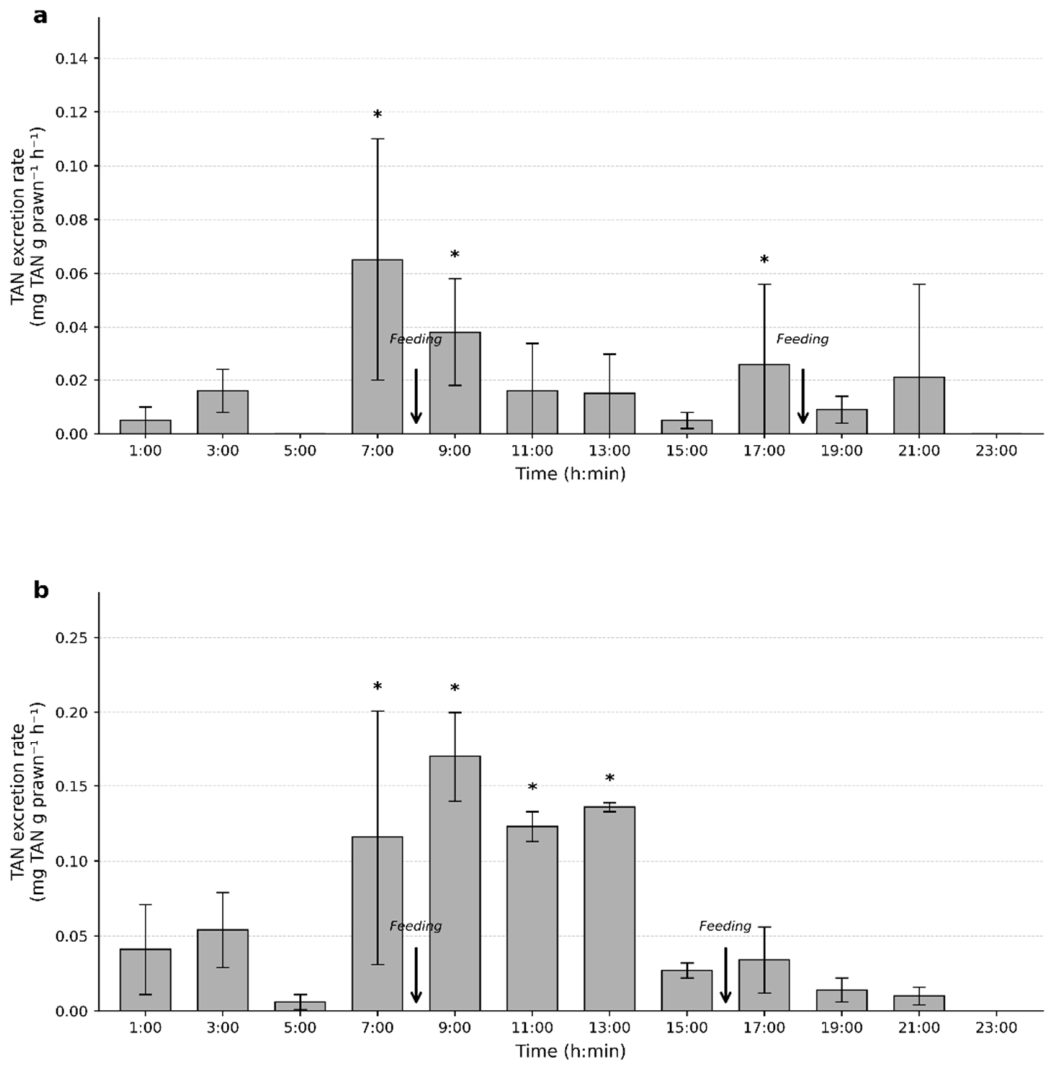
A clear diel postprandial pattern in TAN excretion was observed for both life stages (Figure 1). Peak excretion occurred for juveniles between 7:00 and 9:00 h and again at 17:00 h, and for adults between 9:00 and 13:00 h and at 17:00 h, generally 1–2 h following each feeding event.
The dietary nitrogen input was 3.88 mg N g prawn−1 day−1 for both life stages, based on a feeding rate of 5% body weight day−1 and a diet containing 48.5% crude protein. The percentage of dietary nitrogen recovered as TAN differed significantly between life stages (p < 0.05): juveniles recovered 5.7 ± 4.6% of dietary N as TAN, while adults recovered 18.8 ± 1.5% (Table 2). These values indicate that adults catabolized a substantially greater proportion of dietary protein compared to juveniles, consistent with the higher absolute TAN excretion rates observed in the adult group. The complete nitrogen budget, including feed N input, TAN excreted, and TAN recovery efficiency for each life stage, is summarized in Table 2.
For RAS bioengineering applications, we recommend using the upper 95% confidence bound of the juvenile daily excretion rate as a conservative design parameter for biofilter sizing, rather than the mean alone. This value is calculated as: mean + 1.96 × SD = 0.22 + (1.96 × 0.18) = 0.57 mg TAN g−1 day−1, and is hereafter referred to as the conservative upper-bound rate for juvenile M. caementarius.

4. Discussion

4.1. Water Quality Suitability and Absence of Ammonia Toxicity

The water quality parameters remained stable and within optimal values for the development of M. caementarius under culture conditions [49,51,56,57]. Dissolved oxygen remained above 5 mg L−1, which is recommended for freshwater prawn culture and necessary for nitrifying bacteria [50,58]. pH ranged between 8.37 and 8.49, within the suitable range of 7.0–9.0 for nitrifying bacteria, and did not fall below 7.0 or exceed 8.8, avoiding negative effects on zootechnical performance and water quality [59,60,61]. Alkalinity remained above 100 mg CaCO3 L−1, within the recommended range of 100–150 mg CaCO3 L−1 for stable nitrification [62,63]. Water hardness did not exceed 1000 mg CaCO3 L−1, a threshold associated with reduced performance in M. rosenbergii [64]; values above 500 mg CaCO3 L−1 have been reported in natural habitats of M. caementarius [65]. Nevertheless, optimal alkalinity and hardness ranges for M. caementarius remain poorly defined, and specific recommendations for this species are still lacking [51]. Nitrogenous compounds can negatively affect the growth and survival of decapod crustaceans [66,67]. In this study, ammonia, nitrite, and nitrate concentrations remained within safe ranges reported for decapod crustaceans [68,69,70]. Nitrite–nitrogen levels were below 0.5 mg L−1, considered safe [71,72,73], although metabolic effects have been reported at 2 mg L−1 in M. nipponense [74]. Nitrate–nitrogen concentrations remained well below 80 mg NO3-N L−1 in both treatments (Table 1), within the safe range of 80–145 mg NO3-N L−1 reported for decapod crustaceans [75,76,77]. TAN concentrations in the culture tanks remained low throughout the experimental period (juveniles: 0.04 ± 0.01 mg TAN L−1; adults: 0.07 ± 0.01 mg TAN L−1), with corresponding un-ionized ammonia (NH3-N) values of 3.90 ± 0.18 µg L−1 and 8.70 ± 1.21 µg L−1, respectively (Table 1). These concentrations are well below the safe thresholds reported for Macrobrachium species: 75 µg NH3-N L−1 for juvenile M. amazonicum and 108 µg NH3-N L−1 for adults [78], and 300 µg NH3-N L−1 for both juvenile and adult M. acanthurus [79]. In M. rosenbergii, TAN concentrations as low as 0.5 mg L−1 have been reported to reduce feed intake and impair growth [80], a threshold also not approached in the present study. Although toxic thresholds for NH3-N vary among decapod species, it is generally recommended to maintain concentrations below 1.5 mg NH3 L−1 to avoid adverse effects [81,82,83]. The NH3-N values recorded in this study confirm that no ammonia toxicity occurred during the experimental period and that the measured TAN excretion rates reflect normal physiological conditions.
The between-treatment differences observed in Table 1 for NH3-N, NO3-N, alkalinity, hardness, and TSS are mechanistically coherent consequences of the higher TAN excretion and feed intake in adult tanks, rather than independent confounding variables. The higher NO3-N in adult tanks (30.72 ± 1.79 vs. 15.41 ± 1.12 mg L−1) is a direct result of greater TAN input to the biofilter, producing proportionally greater nitrification activity and nitrate accumulation over time. The lower alkalinity in adult tanks (135 ± 11 vs. 192 ± 19 mg CaCO3 L−1) reflects greater carbonate consumption during nitrification, which consumes approximately 7.1 g CaCO3 per gram of TAN oxidized [62]. The higher NH3-N in adult tanks (8.70 ± 1.21 vs. 3.90 ± 0.18 µg L−1) is a joint consequence of higher TAN concentrations and slightly higher pH (8.49 vs. 8.37); both values remain well below thresholds at which physiological effects have been reported for congeners [78,79], and are therefore unlikely to have affected the measured TAN excretion rates or animal physiology. The higher TSS in adult tanks (20.92 ± 4.56 vs. 5.12 ± 2.91 mg L−1) reflects greater fecal and exoskeletal material production at larger body size and higher feed intake. Although blank corrections with life-stage-specific rations were applied (Section 2.3), we acknowledge that particle-associated nitrogen could contribute a small additional TAN fraction; however, given that water samples were collected as clear supernatant and the Hach salicylate method measures dissolved TAN only, this contribution is expected to be negligible. The differences in hardness (589 ± 30 vs. 478 ± 12 mg CaCO3 L−1) likely reflect natural variability of the source water supply across sampling periods; both values fall within the range reported for natural habitats of M. caementarius [65] and are not expected to influence TAN excretion physiology.

4.2. Diel Postprandial TAN Dynamics and Comparison with Other Crustaceans

Our results indicate that M. caementarius exhibits an increase in TAN excretion following food ingestion. This postprandial response has been widely reported in several decapod crustaceans, including freshwater prawns and penaeid species such as Litopenaeus stylirostris, L. vannamei, M. rosenbergii, Marsupenaeus japonicus, Penaeus esculentus, P. setiferus, and P. paulensis. Similar patterns have also been documented in crabs, such as Carcinus maenas, as well as in spiny lobsters, including Jasus lalandii, Panulirus homarus rubellus, and Sagmariasus verreauxi [28,41,42,84,85,86,87,88,89,90,91,92]. A comparable postprandial increase in ammonia excretion has also been observed in several fish species following feeding [6,7,93,94]. This physiological response is primarily driven by protein-rich diets, which result in elevated nitrogen loads in metabolic waste [95]. Moreover, a direct relationship has been consistently reported between dietary protein intake, feeding rate, and ammonia excretion [96,97,98]. Postprandial responses can lead to higher peaks and/or longer periods of ammonia production, depending on the protein nitrogen intake and metabolic pathways used [99,100]. In our study, an increase in TAN excretion was observed 2 h after food consumption in both juveniles and adults. This behavior has also been observed in other crustaceans, where a peak occurs between 1 and 3 h after feeding, followed by a gradual decline in ammonia excretion [101]. In fish, the postprandial response is typically delayed, occurring 4–8 h after feeding in eels [102,103], 4–6 h in sea bass [104], and up to 8 h in turbot, trout, and carp [94,105,106]. The response in crustaceans is shorter than in fish, primarily due to their relatively higher digestive efficiency [107]. The ammonia excretion response in marine and freshwater crustaceans is not constant and shows a diel pattern, increasing with feeding and decreasing over time [8].

4.3. Comparison with Published Excretion Rates Across Species

Our data obtained under farm-like conditions differ from those described for crustaceans tested in closed respirometers. Most metabolic studies are conducted in closed systems with fasted individual organisms, and the resulting data may differ from actual farm-like conditions due to factors such as handling stress, social interactions, feeding schedule, and water quality management [39,108]. Furthermore, it has been reported that metabolic rate and the weight ratio can be altered in response to diet [109]. An important aspect to consider is dietary protein supply. If the amount of protein ingested exceeds the body’s requirements, or if the amino acids are poorly balanced, deamination increases, leading to greater ammonia excretion [110,111]. Additionally, insufficient energy from lipids and carbohydrates can hinder metabolic processes [40]. M. caementarius juveniles and adults were fed the same diet with 48.5% crude protein. The protein requirement for adults may be lower than for juveniles, as decapod crustaceans generally have higher protein requirements during early growth stages compared to later ontogenetic phases [112]. In juveniles, lower protein catabolism leads to greater nitrogen accumulation, indicating that dietary protein is primarily utilized for growth rather than as an energy source [89,113]. At present, no species-specific commercial diets are formulated for M. caementarius; consequently, feeds developed for salmonids during their freshwater phase are commonly used [51]. Comparisons with other studies are challenging due to the wide range of water temperatures, dietary compositions, and measurement protocols employed, and particularly due to the scarcity of daily ammonia excretion data for freshwater prawns under culture conditions. TAN excretion rates of M. caementarius in the present study tend to fall within relatively low ranges compared to other species. It has been reported that endogenous nitrogen excretion in marine species is generally lower than in freshwater species of comparable body weight [114], possibly because tissue protein hydrolysis proceeds at a faster rate in freshwater environments to maintain internal homeostasis, suggesting that higher dietary protein inputs may be required for freshwater prawns [115]. In a study on juvenile M. caementarius (0.038–0.146 g) fed fresh fish, ammonia excretion was extremely low and could not be reliably quantified [116]. In contrast, studies on penaeid species have shown that the proportion of ammonia excreted relative to food intake typically ranges from 0.1 to 4.0%, depending on species, diet composition, and experimental conditions [31,117,118,119,120]. Nitrogenous waste excretion rates are frequently neglected in energy balance calculations, despite their relevance for accurately assessing the energetic costs associated with digestion and nutrient utilization [121].
Critically, because both life stages were fed the same diet at the same ration rate, the observed difference in TAN excretion between juveniles and adults integrates both life-stage physiological differences and potential differences in protein utilization efficiency. Juveniles likely have a higher protein requirement for somatic growth relative to their body mass, meaning the 48.5% crude protein diet may be closer to their physiological optimum. Adults, whose protein requirements for growth are lower but whose reproductive protein catabolism is higher, may receive excess dietary protein that is subsequently deaminated and excreted as TAN rather than retained. Isolating the physiological component from the dietary component of the life-stage difference in TAN excretion would require testing each life stage at its optimal dietary protein level—a critical direction for future research.

4.4. Bioengineering Implications for RAS Design and Biofilter Sizing

Ammonia excretion rates can serve as indicators of the efficiency of dietary protein utilization by aquatic organisms [27,101]. The selection of dietary protein levels should therefore be carefully optimized considering not only growth performance and feed conversion efficiency, but also the release of nitrogenous compounds into the culture water and the associated oxygen consumption of the cultured animals [31]. The TAN excretion rates obtained in this study provide direct input parameters for the design and operational management of biological filtration units in M. caementarius RAS. As a practical example, consider a production unit stocked with 100 kg of adult M. caementarius. Using the measured daily excretion rate (0.73 mg TAN g−1 day−1), the expected daily TAN production would be 73 g TAN day−1. Assuming a KaldnesTM moving bed biofilm reactor (MBBR) with a surface-area-specific nitrification rate of 0.6 g TAN m−2 day−1 [122], the required protected specific surface area would be approximately 122 m2, corresponding to approximately 0.24 m3 of KaldnesTM medium (specific surface area: 500 m2 m−3). For juvenile M. caementarius, using the conservative upper-bound rate of 0.57 mg TAN g−1 day−1 (see Section 3.2), the required media volume is approximately 0.19 m3 per 100 kg biomass. These estimates should be validated in pilot-scale systems and adjusted with appropriate safety factors (typically 1.5–2.0×) to account for peak excretion events and seasonal temperature variation [123]. In decapod crustaceans, the primary metabolic energy substrate can be species-specific and may vary within a species depending on ontogenetic stage and the quantity and quality of dietary protein supplied [40]. Oxygen consumption may vary according to diet composition and metabolic demand, thereby directly influencing the carrying capacity of the production system [31]. Another key metabolic parameter that warrants further investigation in M. caementarius is oxygen consumption, as it provides insight into metabolic changes across developmental stages and allows determination of species-specific oxygen requirements—information essential for the bioengineering design, optimization, and management of aquaculture production systems [124].

4.5. Life-Stage Differences: Departures from Allometric Expectation

In terms of body mass, it has been reported that size significantly influences the metabolic processes of organisms [38,125,126]. In crustaceans, the relationship between body weight and ammonia excretion generally decreases with increasing body mass [41,42,43,125,126,127,128,129]. Experiments conducted on penaeid species have shown that smaller organisms excrete greater amounts of ammonia per unit body weight than larger ones [128]. This same pattern has been observed in fish, where ammonia excretion rates decrease with increasing body weight [6,94,108,130], illustrating a universal principle that the metabolic rate per unit weight generally decreases as body size increases [131]. The observed pattern in the present study—in which adults showed higher weight-specific TAN excretion than juveniles (0.73 vs. 0.22 mg TAN g−1 day−1)—is apparently at odds with this general allometric expectation. However, this relationship is typically established under fasting or routine metabolic conditions. Under active feeding at a uniform ration rate (5% body weight day−1) with a high-protein diet (48.5% crude protein), the allometric scaling of mass-specific excretion can be overridden by the relative dietary protein-N load. Furthermore, adult animals may exhibit higher catabolism of proteins and amino acids, using them as an energy source while utilizing dietary lipids as reserves for the maturation process [123,132]. Supporting this interpretation, the calculation of feed nitrogen input and TAN recovery efficiency (Table 2) showed that juveniles excreted only 5.7 ± 4.7% of the ingested nitrogen as TAN, whereas adults excreted 18.8 ± 1.9%. The low recovery in juveniles indicates that most dietary nitrogen is retained for somatic growth, a typical pattern for early life stages. In contrast, the nearly fourfold higher nitrogen recovery observed in adults reflects increased amino acid catabolism; this response is likely driven by the elevated dietary protein level (48.5% crude protein), which exceeds the nutritional requirements of adults, and by the increased metabolic demands associated with reproductive maturation [133]. These values are within the range reported for other decapod crustaceans (0.1–4.0% under various dietary conditions [31,117,118,119,120]), although direct comparisons are limited by differences in diet composition, feeding rate, and experimental protocols. Lipids serve as an important energy storage source during the reproductive phase and are a significant component of M. caementarius eggs, suggesting high lipid requirements, particularly in reproductive females during the mating season [133]. This life-stage departure from allometric expectation has direct implications for RAS management: as M. caementarius transitions from the juvenile to the adult stage, TAN excretion per unit biomass increases, requiring progressive adjustment of biofilter capacity throughout the production cycle.
The density differential between life stages (46 ind m−2 for juveniles vs. 19 ind m−2 for adults) represents a potential confounding factor that deserves explicit consideration. M. caementarius is a territorial species in which agonistic interactions increase with density, potentially elevating basal metabolic rate through activity-related energy expenditure [49]. Higher individual density in juvenile tanks could, therefore, have contributed to elevated metabolic activity and, consequently, higher ammonia excretion per unit body mass, partially counteracting the allometric expectation that smaller individuals excrete less per gram. However, the observed pattern was the opposite: juveniles showed lower weight-specific TAN excretion than adults despite being held at higher density. This suggests that any density-related metabolic elevation in juveniles was insufficient to override the differences in dietary protein catabolism between life stages. Nevertheless, we acknowledge that isolating the effect of stocking density from that of life stage would require a crossed experimental design in which each life stage is tested at multiple densities—an important direction for future research. Until such data are available, the excretion rates reported here should be interpreted as integrating both life-stage physiology and the specific density conditions used in this study.

4.6. Study Limitations and Future Research Directions

The present study was conducted at a single temperature (23 °C), a single feeding rate (5% body weight day−1), and using a single commercial salmonid diet (48.5% crude protein), which constrains the direct extrapolation of the reported TAN excretion rates to broader production scenarios. Temperature is a primary driver of metabolic rate and ammonia excretion in ectotherms; correction factors will therefore be required when applying these values to M. caementarius culture operations at temperatures outside this range, particularly given the thermal variability of northern Chilean aquaculture facilities (18–26 °C across seasons). Similarly, dietary protein content directly influences the magnitude of postprandial TAN excretion; the values reported here may change substantially if species-specific optimized diets become available for M. caementarius. The study compared only two life stages, which does not allow for the establishment of a continuous allometric relationship between body mass and TAN excretion. Future studies should characterize TAN excretion across multiple intermediate body-mass classes to derive the allometric scaling exponent (b), a standard bioengineering parameter that enables dynamic nitrogen loading predictions as animals grow throughout the production cycle. Additional priorities include (i) characterization across the full thermal range relevant to northern Chilean aquaculture; (ii) evaluation of species-specific diets once available; and (iii) simultaneous measurement of oxygen consumption to determine the O:N ratio and metabolic substrate use across ontogenetic stages. The values reported in this study should be interpreted as baseline bioengineering estimates representative of the specific conditions tested and validated in pilot-scale production systems before use as definitive engineering constants.

5. Conclusions

This study provides the first quantitative data on daily total ammonia nitrogen (TAN) excretion rates in juvenile and adult M. caementarius reared under intensive, farm-like recirculating aquaculture system (RAS) conditions. Cumulative daily TAN excretion was 0.22 ± 0.18 mg TAN g−1 day−1 for juveniles and 0.73 ± 0.06 mg TAN g−1 day−1 for adults, with corresponding mean hourly rates of 0.009 ± 0.006 and 0.03 ± 0.01 mg TAN g−1 h−1, respectively. A significant difference was observed between life stages (p < 0.05), with adults exhibiting higher weight-specific TAN excretion than juveniles—a pattern that departs from the general allometric expectation and is discussed in relation to reproductive metabolism and dietary protein load. M. caementarius exhibited a clear diel postprandial pattern in TAN excretion, with peak rates occurring 1–2 h following each feeding event. It should be noted that these excretion values are specifically tied to the dietary condition used (commercial salmonid diet, 48.5% crude protein; 5% body weight day−1 ration) and may shift considerably when species-specific optimized diets become available for M. caementarius.
These baseline bioengineering parameters are directly applicable to the design and sizing of biofiltration units and for estimating nitrogen loading in RAS for M. caementarius. The results should be interpreted within the context of the study conditions (temperature: 23 °C; commercial salmonid diet: 48.5% crude protein; two life stages only) and validated in pilot-scale production systems before use as definitive engineering constants. Future research should characterize TAN excretion across the full thermal range relevant to northern Chilean aquaculture, additional life stages, and species-specific diets to expand the applicability of these baseline parameters.

Author Contributions

C.A.M.: Conceptualization, Data curation, Formal analysis, Investigation, Methodology, Writing—original draft, Writing—review and editing. M.C.M.: Funding acquisition, Project administration, Writing—review and editing. G.E.M.: Conceptualization, Formal analysis, Investigation, Methodology, Writing—review and editing. All authors have read and agreed to the published version of the manuscript.

Funding

This research was funded by FONDEF (Fondo de Fomento al Desarrollo Científico y Tecnológico, Chile), grant number ID15I10353 and ID15I20353.

Institutional Review Board Statement

The authors followed all applicable international, national, and institutional guidelines for the care and use of animals. Studies on animals were reviewed and approved by the ethics and biotechnology committee of the Universidad Católica del Norte (UCN), Coquimbo, Chile, (CEC UCN No. 45; Approval Date: 16 November 2021).

Informed Consent Statement

Not Applicable.

Data Availability Statement

Data will be made available on request.

Acknowledgments

This research work and manuscript were developed with the support of the grant FONDEF ID15I10353 Producción de Biofloc estable y su aplicabilidad en la acuicultura a pequeña escala en zonas áridas, grant IT20I0066 Sistemas Biointegrados AgroAcuícolas Sustentables y Sostenibles para Promover Desarrollo y Emprendimiento a Micro, Mediana y Pequeña Escala, grant FOVI210068 Sistemas biointegrados: Red Latinoamericana Agro-Acuícola (SIBIOLAT), and grant CYTED 423RT0144 Red Latinoamericana de Biointegración Agro-Acuícola para una Economía Circular Sostenible (SIBIOLAT Plus). We express our sincere gratitude to the research staff of the Laboratory of Crustaceans of the Universidad Católica del Norte.

Conflicts of Interest

The authors declare no conflicts of interest.

References

  1. Carbajal-Hernández, J.J.; Sánchez-Fernández, L.P.; Villa-Vargas, L.A.; Carrasco-Ochoa, J.A.; Martínez-Trinidad, J.F. Water quality assessment in shrimp culture using an analytical hierarchical process. Ecol. Indic. 2013, 29, 148–158. [Google Scholar] [CrossRef] [Scilit]
  2. Hridoy, A.A.M.; Neogi, S.; Ujjaman, R.; Hasan, M. Water quality interactions and their synergistic effects on aquaculture performance in Bangladesh: A critical review. Results Chem. 2025, 16, 102306. [Google Scholar] [CrossRef] [Scilit]
  3. Wheaton, F.W. Acuacultura: Diseño y Construcción de Sistemas; AGT, Ed.; AGT: México City, Mexico, 1982. [Google Scholar]
  4. Khater, E.S.; Bahnasawy, A.; El-Ghobashy, H.; Shaban, Y.; Elsheikh, F.; El-Reheem, S.A.; Aboegela, M. Mathematical model for predicting oxygen concentration in tilapia fish farms. Sci. Rep. 2021, 11, 24130. [Google Scholar] [CrossRef] [Scilit] [PubMed]
  5. Colt, J.E.; Armstrong, D.A. Nitrogen toxicity to crustaceans, fish, and molluscs. In Proceedings of the Bio-Engineering Symposium for Fish Culture; Allen, L.J., Kinney, E.C., Eds.; American Fisheries Society: Bethesda, MD, USA, 1981; pp. 34–47. [Google Scholar]
  6. Merino, G.; Piedrahita, R.; Conklin, D. Ammonia and urea excretion rates of California halibut (Paralichthys californicus) under farm-like conditions. Aquaculture 2007, 271, 227–243. [Google Scholar] [CrossRef] [Scilit]
  7. Nerici, C.; Silva, A.; Merino, G. Effect of temperature on ammonia excretion of Seriolella violacea. Aquacult. Eng. 2012, 46, 47–52. [Google Scholar] [CrossRef] [Scilit]
  8. Regnault, M. Nitrogen excretion in marine and freshwater crustacea. Biol. Rev. 1987, 62, 1–24. [Google Scholar] [CrossRef] [Scilit]
  9. Bower, C.E.; Bidwell, J.P. Ionization of ammonia in seawater: Effects of temperature, pH, and salinity. J. Fish. Res. Board Can. 1978, 35, 1012–1016. [Google Scholar] [CrossRef] [Scilit]
  10. Boyd, C.E. Water Quality Management for Pond Fish Culture; Elsevier: Amsterdam, The Netherlands, 1982. [Google Scholar]
  11. Lu, X.; Kong, J.; Luan, S.; Dai, P.; Meng, X.; Cao, B. Transcriptome analysis of the hepatopancreas in Pacific white shrimp (Litopenaeus vannamei) under acute ammonia stress. PLoS ONE 2016, 11, e0164396. [Google Scholar] [CrossRef] [Scilit] [PubMed]
  12. Boyd, C.E. Water Quality in Ponds for Aquaculture; Alabama Agricultural Experiment Station: Auburn, AL, USA, 1990. [Google Scholar]
  13. Chen, J.C.; Lai, S.H. Oxygen consumption and ammonia-N excretion of Penaeus japonicus adolescents exposed to ambient ammonia. Comp. Biochem. Physiol. C 1992, 102, 129–133. [Google Scholar] [CrossRef] [Scilit]
  14. Racotta, I.S.; Hernández-Herrera, R. Metabolic responses of the white shrimp Penaeus vannamei to ambient ammonia. Comp. Biochem. Physiol. A 2000, 125, 437–443. [Google Scholar] [CrossRef] [Scilit] [PubMed]
  15. Brazão, C.C.; Kracizy, R.O.; Dutra, F.M.; de Oliveira, A.P.; da Silva, R.I.; Ballester, E.L.C. Combined and isolated effects of ammonia and nitrite on Amazon River prawn Macrobrachium amazonicum juveniles. Aquaculture 2021, 533, 736204. [Google Scholar] [CrossRef] [Scilit]
  16. Li, H.; Li, Q.; Wang, S.; He, J.; Li, C. Ammonia nitrogen stress increases susceptibility to bacterial infection via blocking IL-1R–Relish axis-mediated antimicrobial peptide expression in shrimp. Aquaculture 2023, 563, 738934. [Google Scholar] [CrossRef] [Scilit]
  17. Hou, D.; Li, H.; Wang, S.; Weng, S.; He, J. Ammonia nitrogen stress induces dysbiosis of the intestinal bacterial community and facilitates enrichment of pathogenic bacteria in shrimp intestines. Aquaculture 2025, 595, 741510. [Google Scholar] [CrossRef] [Scilit]
  18. Emadi, C.M.; Dos Santos Neto, F.; Bohenek, J.R.; Smithers, B.; Acevedo, M.F.; Mager, E.M. Acute toxicity assessment and real-time metabolic rate responses of early life stages of Macrobrachium rosenbergii to ammonia exposure at different salinities. Comp. Biochem. Physiol. C Toxicol. Pharmacol. 2026, 300, 110401. [Google Scholar] [CrossRef] [Scilit] [PubMed]
  19. Liang, Q.; Dong, W.; Wang, F.; Wang, W.; Zhang, J.; Liu, X. Ficus hirta Vahl promotes antioxidant enzyme activity under ammonia stress by inhibiting miR-2765 expression in Penaeus vannamei. Ecotoxicol. Environ. Saf. 2021, 228, 112989. [Google Scholar] [CrossRef] [Scilit] [PubMed]
  20. Claybrook, D.L. Nitrogen metabolism. In The Biology of Crustacea, Volume 5: Internal Anatomy and Physiological Regulation; Mantel, L.H., Ed.; Academic Press: London, UK, 1983; pp. 163–213. [Google Scholar]
  21. Chen, J.C.; Lai, S.H. Effects of temperature and salinity on oxygen consumption and ammonia-N excretion of juvenile Penaeus japonicus Bate. J. Exp. Mar. Biol. Ecol. 1993, 165, 161–170. [Google Scholar] [CrossRef] [Scilit]
  22. Chen, J.C.; Lin, C.Y. Responses of oxygen consumption, ammonia-N excretion and urea-N excretion of Penaeus chinensis exposed to ambient ammonia at different salinity and pH levels. Aquaculture 1995, 136, 243–255. [Google Scholar] [CrossRef] [Scilit]
  23. Chen, J.C.; Kou, T.T. Effects of temperature on oxygen consumption and nitrogenous excretion of juvenile Macrobrachium rosenbergii. Aquaculture 1996, 145, 295–303. [Google Scholar] [CrossRef] [Scilit]
  24. Schmitt, A.S.C.; Uglow, R.F. Effects of temperature change rate on nitrogen effluxes of Macrobrachium rosenbergii. Aquaculture 1996, 140, 373–381. [Google Scholar] [CrossRef] [Scilit]
  25. O’Donnell, M.J. Mechanisms of excretion and ion transport in invertebrates. In Comparative Physiology; Dantzler, W.H., Ed.; Oxford University Press: New York, NY, USA, 1997; pp. 1207–1289. [Google Scholar] [CrossRef] [Scilit]
  26. Comoglio, L.I.; Smolko, L.; Amin, O. Effects of starvation on oxygen consumption, ammonia excretion and biochemical composition of the hepatopancreas of adult males of the false southern king crab Paralomis granulosa (Crustacea, Decapoda). Comp. Biochem. Physiol. B 2005, 140, 411–416. [Google Scholar] [CrossRef] [Scilit] [PubMed]
  27. Zhang, P.; Zhang, X.; Li, J.; Gao, T. Effect of salinity on survival, growth, oxygen consumption and ammonia-N excretion of juvenile Litopenaeus vannamei. Aquacult. Res. 2009, 40, 1419–1427. [Google Scholar] [CrossRef] [Scilit]
  28. Hewitt, D.R.; Irving, M.G. Oxygen consumption and ammonia excretion of the brown tiger prawn Penaeus esculentus fed diets of varying protein content. Comp. Biochem. Physiol. A Physiol. 1990, 96, 373–378. [Google Scholar] [CrossRef] [Scilit]
  29. Schmitt, A.S.C.; Santos, E.A. Ammonia-N efflux rate and nutritional state of juvenile pink shrimp, Penaeus paulensis (Perez-Farfante), in relation to food type. Aquacult. Res. 1998, 29, 495–502. [Google Scholar] [CrossRef] [Scilit]
  30. Perera, E.; Fraga, I.; Carrillo, O.; Díaz-Iglesias, E.; Cruz, R.; Báez, M.; Galich, G.S. Evaluation of practical diets for the Caribbean spiny lobster Panulirus argus (Latreille, 1804): Effects of protein sources on substrate metabolism and digestive proteases. Aquaculture 2005, 244, 251–262. [Google Scholar] [CrossRef] [Scilit]
  31. Mantoan, P.; Ballester, E.L.C.; Ramaglia, A.C.; Augusto, A. Diet containing 35% crude protein improves energy balance, growth and feed conversion in the Amazon river prawn Macrobrachium amazonicum. Aquac. Rep. 2021, 21, 100962. [Google Scholar] [CrossRef] [Scilit]
  32. Regnault, M. Ammonia excretion of the sand shrimp Crangon crangon (L.) during the moult cycle. J. Comp. Physiol. B 1979, 133, 199–204. [Google Scholar] [CrossRef] [Scilit]
  33. Stern, S.; Cohen, D. Oxygen consumption and ammonia excretion during the molt cycle of the freshwater prawn Macrobrachium rosenbergii. Comp. Biochem. Physiol. A 1982, 73, 417–419. [Google Scholar] [CrossRef] [Scilit]
  34. Carvalho, P.S.M.; Phan, V.N. Oxygen consumption and ammonia excretion of Xiphopenaeus kroyeri Heller (Penaeidae) in relation to mass temperature and experimental procedures. J. Exp. Mar. Biol. Ecol. 1997, 209, 143–156. [Google Scholar] [CrossRef] [Scilit]
  35. Crear, B.J.; Forteath, G.N.R. Feeding has the largest effect on the ammonia excretion rate of the southern rock lobster Jasus edwardsii and the western rock lobster Panulirus cygnus. Aquacult. Eng. 2002, 26, 239–250. [Google Scholar] [CrossRef] [Scilit]
  36. Dall, W.; Smith, D.M. Oxygen consumption and ammonia-N excretion in fed and starved tiger prawns Penaeus esculentus Haswell. Aquaculture 1986, 55, 23–33. [Google Scholar] [CrossRef] [Scilit]
  37. Agard, J.B.R. A four-dimensional response surface analysis of the ontogeny of physiological adaptation to salinity and temperature in larvae of the palaemonid shrimp Macrobrachium rosenbergii (de Man). J. Exp. Mar. Biol. Ecol. 1999, 236, 209–233. [Google Scholar] [CrossRef] [Scilit]
  38. Perera, E.; Díaz-Iglesias, E.; Fraga, I.; Carrillo, O.; Galich, G.S. Effect of body weight, temperature and feeding on the metabolic rate in the spiny lobster Panulirus argus (Latreille, 1804). Aquaculture 2007, 265, 261–270. [Google Scholar] [CrossRef] [Scilit]
  39. Hayd, L.A.; Lemos, D.; Valenti, W.C. Ontogenetic variation in ammonia excretion during early life stages of the Amazon River prawn Macrobrachium amazonicum. J. World Aquacult. Soc. 2010, 41, 107–115. [Google Scholar] [CrossRef] [Scilit]
  40. Augusto, A.; New, M.B.; Santos, M.R.; Amorim, R.V.; Valenti, W.C. Energy budget and physiology in early ontogenetic stages of the Amazon River prawn. Aquac. Rep. 2020, 18, 100446. [Google Scholar] [CrossRef] [Scilit]
  41. Schmitt, A.S.C.; Santos, E.A. Haemolymph nitrogenous constituents and nitrogen efflux rates of juvenile shrimp Penaeus paulensis exposed to ambient ammonia-N. Aquacult. Res. 1999, 30, 1–11. [Google Scholar] [CrossRef] [Scilit]
  42. Kemp, J.O.G.; Britz, P.J.; Cockcroft, A.C. Ammonia excretion dynamics in the east coast rock lobster Panulirus homarus rubellus. Aquaculture 2009, 286, 296–300. [Google Scholar] [CrossRef] [Scilit]
  43. Nelson, S.G.; Kropp, R.Y. Ammonia excretion and nitrogen assimilation by Macrobrachium lar. Comp. Biochem. Physiol. A 1985, 81, 699–704. [Google Scholar] [CrossRef] [Scilit]
  44. Zhang, X.; Pan, L.; Wei, C.; Tong, R.; Li, Y.; Ding, M.; Wang, H. CHH regulates ammonia excretion and metabolism in Litopenaeus vannamei under ammonia-N stress. Sci. Total Environ. 2020, 723, 138128. [Google Scholar] [CrossRef] [Scilit] [PubMed]
  45. Meruane, J.A.; Morales, M.C.; Galleguillos, C.A.; Rivera, M.A.; Hosokawa, H. Experiencias y resultados de investigaciones sobre el camarón de río del norte Cryphiops caementarius (Molina, 1782): Historia natural y cultivo. Gayana 2006, 70, 280–292. [Google Scholar] [CrossRef] [Scilit]
  46. DecaNet. Macrobrachium caementarius (Molina, 1782). World Register of Marine Species. Available online: https://decanet.info/aphia.php?p=taxdetails&id=1774141 (accessed on 26 June 2025).
  47. Moreno-Reyes, J.E.; Morales, M.C.; Meruane, J. Effects of temperature and photoperiod on ovarian maturity of Cryphiops caementarius. Aquacult. Rep. 2021, 21, 100809. [Google Scholar] [CrossRef] [Scilit]
  48. Mendez, C.A.; Morales, M.C.; Merino, G.E. Settling velocity distribution of bioflocules generated with different carbon sources during the rearing of the river shrimp Cryphiops caementarius with biofloc technology. Aquacult. Eng. 2021, 93, 102157. [Google Scholar] [CrossRef] [Scilit]
  49. Mendez, C.A.; Morales, M.C.; Brokordt, K. Effects of stocking density of the river shrimp Cryphiops caementarius on physiological and performance responses in a biofloc system. Fishes 2024, 9, 377. [Google Scholar] [CrossRef] [Scilit]
  50. New, M.B.; Valenti, W.C.; Tidwell, J.H.; D’Abramo, L.R.; Kutty, M.N. (Eds.) Freshwater Prawns: Biology and Farming; Wiley-Blackwell: Hoboken, NJ, USA, 2010. [Google Scholar]
  51. Mendez, C.A.; Morales, M.C.; Merino, G.E. Effect of different carbon sources on biofloc particle size and settling velocity distribution in biofloc technology aquaculture systems for northern river shrimp (Cryphiops caementarius) farming. Aquacult. Int. 2025, 33, 380. [Google Scholar] [CrossRef] [Scilit]
  52. Hach Company. HACH Water Analysis Handbook: Procedures; Hach Company: Loveland, CO, USA, 2003. [Google Scholar]
  53. APHA. Standard Methods for the Examination of Water and Wastewater, 19th ed.; American Public Health Association: Washington, DC, USA, 1995. [Google Scholar]
  54. Sokal, R.R.; Rohlf, F.J. Biometry: The Principles and Practice of Statistics in Biological Research; W.H. Freeman: New York, NY, USA, 1969. [Google Scholar]
  55. R Core Team. R: A Language and Environment for Statistical Computing; R Foundation for Statistical Computing: Vienna, Austria, 2020; Available online: https://www.R-project.org/ (accessed on 25 May 2025).
  56. Reyes-Avalos, W. Efecto del recipiente de cultivo sobre la supervivencia y el crecimiento de machos de Cryphiops caementarius en sistemas individualizados. Rev. Bio Cienc. 2016, 3, 311–325. [Google Scholar] [CrossRef]
  57. Terrones, S.; Reyes, W. Effect of diets with biological silage of mollusk residues on the growth of shrimp Cryphiops caementarius and tilapia Oreochromis niloticus in intensive co-culture. Sci. Agropecu. 2018, 9, 167–176. [Google Scholar] [CrossRef] [Scilit]
  58. Cheng, W.; Liu, C.H.; Kuo, C.M. Effects of dissolved oxygen on hemolymph parameters of freshwater giant prawn Macrobrachium rosenbergii (De Man). Aquaculture 2003, 220, 843–856. [Google Scholar] [CrossRef] [Scilit]
  59. Cheng, W.; Chen, J.C. Effects of pH, temperature and salinity on immune parameters of the freshwater prawn Macrobrachium rosenbergii. Fish Shellfish Immunol. 2000, 10, 387–391. [Google Scholar] [CrossRef] [Scilit] [PubMed]
  60. Chen, S.; Ling, J.; Blancheton, J.P. Nitrification kinetics of biofilm as affected by water quality factors. Aquacult. Eng. 2006, 34, 179–197. [Google Scholar] [CrossRef] [Scilit]
  61. Furtado, P.S.; Poersch, L.H.; Wasielesky, W. Effect of calcium hydroxide, carbonate and sodium bicarbonate on water quality and zootechnical performance of shrimp Litopenaeus vannamei reared in biofloc technology (BFT) systems. Aquaculture 2011, 321, 130–135. [Google Scholar] [CrossRef] [Scilit]
  62. Ebeling, J.M.; Timmons, M.B.; Bisogni, J.J. Engineering analysis of the stoichiometry of photoautotrophic, autotrophic, and heterotrophic removal of ammonia–nitrogen in aquaculture systems. Aquaculture 2006, 257, 346–358. [Google Scholar] [CrossRef] [Scilit]
  63. Furtado, P.S.; Poersch, L.H.; Wasielesky, W. The effect of different alkalinity levels on Litopenaeus vannamei reared with biofloc technology (BFT). Aquacult. Int. 2014, 23, 345–358. [Google Scholar] [CrossRef] [Scilit]
  64. González-Vera, C.; Brown, J.H. Effects of alkalinity and total hardness on growth and survival of freshwater prawn postlarvae Macrobrachium rosenbergii (De Man, 1879). Aquaculture 2017, 473, 521–527. [Google Scholar] [CrossRef] [Scilit]
  65. Zacarías, S.; Yépez, V. Cryphiops caementarius en la costa centro-sur del Perú. Inf. Inst. Mar. Perú 2015, 42, 398–415. Available online: https://hdl.handle.net/20.500.12958/2989 (accessed on 25 May 2025).
  66. Lin, Y.C.; Chen, J.C. Acute toxicity of nitrite on Litopenaeus vannamei juveniles at different salinity levels. Aquaculture 2003, 224, 193–201. [Google Scholar] [CrossRef] [Scilit]
  67. Valencia-Castañeda, G.; Frías-Espericueta, M.G.; Vanegas-Pérez, R.C.; Páez-Osuna, F. Acute toxicity of ammonia, nitrite and nitrate to shrimp Litopenaeus stylirostris postlarvae in low-salinity water. Environ. Toxicol. Pharmacol. 2019, 65, 51–55. [Google Scholar] [CrossRef] [Scilit] [PubMed]
  68. Lin, Y.C.; Chen, J.C. Acute toxicity of ammonia on Litopenaeus vannamei juveniles at different salinity levels. J. Exp. Mar. Biol. Ecol. 2001, 259, 109–119. [Google Scholar] [CrossRef] [Scilit] [PubMed]
  69. Romano, N.; Zeng, C. Toxic effects of ammonia, nitrite and nitrate to decapod crustaceans: A review on factors influencing their toxicity, physiological consequences and coping mechanisms. Rev. Fish. Sci. 2013, 21, 1–21. [Google Scholar] [CrossRef] [Scilit]
  70. Furtado, P.S.; Campos, B.; Serra, F.; Klosterhoff, M.; Romano, L.; Wasielesky, W. Effects of nitrate toxicity in the Pacific white shrimp Litopenaeus vannamei reared with biofloc technology (BFT). Aquacult. Int. 2015, 23, 315–327. [Google Scholar] [CrossRef] [Scilit]
  71. Gross, A.; Abutbul, S.; Zilberg, D. Acute and chronic effects of nitrite on white shrimp Litopenaeus vannamei cultured in low-salinity brackish water. J. World Aquacult. Soc. 2004, 35, 315–321. [Google Scholar] [CrossRef] [Scilit]
  72. Tomasso, J.R. Environmental nitrite and aquaculture: A perspective. Aquacult. Int. 2012, 20, 1107–1116. [Google Scholar] [CrossRef] [Scilit]
  73. Satanwat, P.; Nagai, N.; Boonprasertsakul, T.; Nagano, A.; Okubo, T.; Adlin, N.; Watari, T.; Hatamoto, M.; Yamaguchi, T.; Sitthi, S.; et al. Effect of hydraulic retention time of sponge-based trickling filter for shrimp culture recirculating tank. Process Saf. Environ. Prot. 2025, 198, 107154. [Google Scholar] [CrossRef] [Scilit]
  74. Jiang, Q.; Dilixiati, A.; Zhang, W.; Li, W.; Wang, Q.; Zhao, Y.; Yang, J.; Li, Z. Effect of nitrite exposure on metabolic response in the freshwater prawn Macrobrachium nipponense. Open Life Sci. 2014, 9, 86–91. [Google Scholar] [CrossRef] [Scilit]
  75. de Farias Lima, J.; Lobo, E.T.; Bastos, A.M.; Silva, S. Nitrate level safety to Amazon River shrimp juveniles. Environ. Sci. Pollut. Res. 2020, 27, 4546–4550. [Google Scholar] [CrossRef] [Scilit] [PubMed]
  76. Kuhn, D.; Smith, S.A.; Boardman, G.D.; Angier, M.W.; Marsh, L.; Flick, G.J., Jr. Chronic toxicity of nitrate to Pacific white shrimp Litopenaeus vannamei: Impacts on survival, growth, antennae length and pathology. Aquaculture 2010, 309, 109–114. [Google Scholar] [CrossRef] [Scilit]
  77. Moraes-Valenti, P.; Valenti, W.C. Culture of the Amazon River prawn Macrobrachium amazonicum. In Freshwater Prawns: Biology and Farming; New, M.B., Valenti, W.C., Tidwell, J.H., D’Abramo, L.R., Kutty, M.N., Eds.; Wiley-Blackwell: Oxford, UK, 2010; pp. 485–501. [Google Scholar] [CrossRef] [Scilit]
  78. Dutra, F.M.; Forneck, S.C.; Brazão, C.C.; Freire, C.A.; Ballester, E.L.C. Acute toxicity of ammonia to various life stages of the Amazon River prawn Macrobrachium amazonicum (Heller, 1862). Aquaculture 2016, 453, 104–109. [Google Scholar] [CrossRef] [Scilit]
  79. Miranda, E.K.S.; Garçon, D.P.; Brazão, C.C.; Ferreira de Almeida, L.C.; Bertini, G. Effects of ammonia on the survival and physiology of juveniles and adults of Macrobrachium acanthurus. Aquat. Toxicol. 2025, 280, 107261. [Google Scholar] [CrossRef] [Scilit] [PubMed]
  80. Cavalli, R.O.; Vanden Berghe, E.; Lavens, P.; Thuy, N.T.T.; Wille, M.; Sorgeloos, P. Ammonia toxicity as a criterion for the evaluation of larval quality in the prawn Macrobrachium rosenbergii. Comp. Biochem. Physiol. C 2000, 125, 333–343. [Google Scholar] [CrossRef] [Scilit] [PubMed]
  81. Crab, R.; Avnimelech, Y.; Defoirdt, T.; Bossier, P.; Verstraete, W. Nitrogen removal techniques in aquaculture for a sustainable production. Aquaculture 2007, 270, 1–14. [Google Scholar] [CrossRef] [Scilit]
  82. Brazão, C.C.; Kracizy, R.O.; Dutra, F.M.; Rodrigues, M.C.G.; Ballester, E.L.C. Combined effect of ammonia and nitrite for Macrobrachium amazonicum and Macrobrachium rosenbergii postlarvae. Aquaculture 2022, 551, 737880. [Google Scholar] [CrossRef] [Scilit]
  83. Naqvi, A.A.; Adhikari, S.; Pillai, B.R.; Sarangi, N. Effect of ammonia-N on growth and feeding of juvenile Macrobrachium rosenbergii (De-Man). Aquac. Res. 2007, 38, 1178–1228. [Google Scholar] [CrossRef] [Scilit]
  84. Zoutendyk, P. Nitrogen excretion by the Cape rock lobster Jasus lalandii. S. Afr. J. Mar. Sci. 1987, 5, 565–574. [Google Scholar] [CrossRef] [Scilit]
  85. Bautista, M.N. The response of Penaeus monodon juveniles to varying protein/energy ratios in test diets. Aquaculture 1986, 53, 229–242. [Google Scholar] [CrossRef] [Scilit]
  86. Koshio, S.; Teshima, S.; Kanazawa, A.; Watase, T. The effect of dietary protein content on growth, digestion efficiency and nitrogen excretion of juvenile kuruma prawns Penaeus japonicus. Aquaculture 1993, 113, 101–114. [Google Scholar] [CrossRef] [Scilit]
  87. Taboada, G.; Gaxiola, G.; Garcia, T.; Pedroza, R.; Sanchez, A.; Soto, L.A.; Rosas, C. Oxygen consumption and ammonia-N excretion related to protein requirements for growth of white shrimp Penaeus setiferus juveniles. Aquacult. Res. 1998, 29, 822–833. [Google Scholar] [CrossRef] [Scilit]
  88. Rosas, C.; Cuzon, G.; Taboada, G.; Pascual, C.; Gaxiola, G.; van Wormhoudt, A. Effect of dietary protein and energy levels on growth, oxygen consumption, haemolymph and digestive gland carbohydrates, nitrogen excretion and osmotic pressure of Litopenaeus vannamei (Boone) and L. setiferus (Linne) juveniles (Crustacea, Decapoda; Penaeidae). Aquacult. Res. 2001, 32, 531–547. [Google Scholar] [CrossRef] [Scilit]
  89. González-Peña, M.C.; Moreira, M.G.B.S. Effect of dietary cellulose level on specific dynamic action and ammonia excretion of the prawn Macrobrachium rosenbergii (De Man, 1879). Aquacult. Res. 2003, 34, 915–921. [Google Scholar] [CrossRef] [Scilit]
  90. Gauquelin, F.; Cuzon, G.; Gaxiola, G.; Rosas, C.; Arena, L.; Bureau, D.P.; Cochard, J.C. Effect of dietary protein level on growth and energy utilization by Litopenaeus stylirostris under laboratory conditions. Aquaculture 2007, 271, 439–448. [Google Scholar] [CrossRef] [Scilit]
  91. Wang, S.; Carter, C.G.; Fitzgibbon, Q.P.; Smith, G.G. Stoichiometric bioenergetics elucidates metabolic energy substrate use in juvenile spiny lobsters. Aquaculture 2021, 532, 736021. [Google Scholar] [CrossRef] [Scilit]
  92. Quijada-Rodriguez, A.R.; Allen, G.J.P.; Nash, M.T.; Weihrauch, D. Postprandial nitrogen and acid–base regulation in the seawater-acclimated green crab Carcinus maenas. Comp. Biochem. Physiol. A 2022, 267, 111171. [Google Scholar] [CrossRef] [Scilit] [PubMed]
  93. Dosdat, A.; Servais, F.; Métailler, R.; Huelvan, C.; Desbruyères, E. Comparison of nitrogenous losses in five teleost fish species. Aquaculture 1996, 141, 107–127. [Google Scholar] [CrossRef] [Scilit]
  94. Engin, K.; Tufan-Eroldoğan, O.; Özşahinoğlu, I.; Asuman, H.; Mumogullarinda, P. Diurnal ammonia and urea excretion rates in European sea bass (Dicentrarchus labrax) fed diets containing mixtures of canola and cottonseed oil at two ambient temperatures. J. Therm. Biol. 2013, 38, 588–596. [Google Scholar] [CrossRef] [Scilit]
  95. Rosas, C.; Sanchez, A.; Diaz, E.; Soto, L.A.; Gaxiola, G.; Brito, R. Effect of dietary protein level on apparent heat increment and postprandial nitrogen excretion of Penaeus spp. postlarvae. J. World Aquacult. Soc. 1996, 27, 92–102. [Google Scholar] [CrossRef] [Scilit]
  96. Ballestrazzi, R.; Lanari, D.; D’Agaro, E. Performance, nutrient retention efficiency, total ammonia and reactive phosphorus excretion of growing European sea bass (Dicentrarchus labrax L.) as affected by diet processing and feeding level. Aquaculture 1998, 161, 55–65. [Google Scholar] [CrossRef] [Scilit]
  97. McIntosh, D.; Samocha, T.M.; Jones, E.R.; Lawrence, A.L.; Horowitz, S.; Horowitz, A. Effects of two commercially available low-protein diets on water and sediment quality and production of Litopenaeus vannamei in outdoor tank systems with limited water discharge. Aquacult. Eng. 2001, 25, 69–82. [Google Scholar] [CrossRef] [Scilit]
  98. Frisk, M.; Steffensen, J.F.; Skov, P.V. The effects of temperature on specific dynamic action and ammonia excretion in pikeperch (Sander lucioperca). Aquaculture 2013, 404–405, 65–70. [Google Scholar] [CrossRef] [Scilit]
  99. Chakraborty, S.C.; Chakraborty, S. Effect of dietary protein level on excretion of ammonia in Indian major carp, Labeo rohita, fingerlings. Aquacult. Nutr. 1998, 4, 47–51. [Google Scholar] [CrossRef] [Scilit]
  100. Bucking, C.; Wood, C.M. The alkaline tide and ammonia excretion after voluntary feeding in freshwater rainbow trout. J. Exp. Biol. 2008, 211, 2533–2541. [Google Scholar] [CrossRef] [Scilit] [PubMed]
  101. Rajaram, V.; Jannathulla, R.; Ambasankar, K.; Dayal, J.S. Oxygen consumption in relation to nitrogen metabolism in black tiger shrimp Penaeus monodon (Fabricius, 1798) fed fresh food and formulated feed. Aquacult. Res. 2022, 53, 2237–2248. [Google Scholar] [CrossRef] [Scilit]
  102. Gallagher, M.L.; Matthews, A.M. Oxygen consumption and ammonia excretion of the American eel Anguilla rostrata fed diets with varying protein–energy ratios and protein levels. J. World Aquacult. Soc. 1987, 18, 107–112. [Google Scholar] [CrossRef] [Scilit]
  103. Heinsbroek, L.T.N.; Tijssen, P.A.T.; Flach, R.B.; de Jong, G.D.C. Energy and nitrogen balance studies in fish. In Fish Nutrition in Practice; Kaushik, S.J., Luquet, P., Eds.; INRA: Paris, France, 1993; pp. 375–389. [Google Scholar]
  104. Ballestrazzi, R.; Lanari, D.; D’Agaro, E.; Mion, A. The effect of dietary protein level and source on growth, body composition, total ammonia and reactive phosphate excretion of growing sea bass (Dicentrarchus labrax). Aquaculture 1994, 127, 197–206. [Google Scholar] [CrossRef] [Scilit]
  105. Rychly, J.; Marina, B.A. The ammonia excretion of trout during a 24-hour period. Aquaculture 1977, 11, 173–178. [Google Scholar] [CrossRef] [Scilit]
  106. Chakraborty, S.C.; Ross, L.G.; Ross, B. The effect of dietary protein level and ration level on excretion of ammonia in common carp, Cyprinus carpio. Comp. Biochem. Physiol. A 1992, 103, 801–808. [Google Scholar] [CrossRef] [Scilit]
  107. McGaw, I.J.; Curtis, D.L. A review of gastric processing in decapod crustaceans. J. Comp. Physiol. B 2013, 183, 443–465. [Google Scholar] [CrossRef] [Scilit] [PubMed]
  108. Stejskal, V.; Kouril, J.; Valentova, O.; Hamackova, J.; Policar, T. Size-related oxygen consumption and ammonia excretion of Eurasian perch Perca fluviatilis reared in a recirculating system. Aquacult. Res. 2009, 41, 135–142. [Google Scholar] [CrossRef] [Scilit]
  109. Nelson, S.G.; Simmons, M.A.; Knight, A.W. Ammonia excretion by Crangon franciscorum in relation to diet. Mar. Biol. 1979, 54, 25–31. [Google Scholar] [CrossRef] [Scilit]
  110. Porter, C.B.; Krom, M.D.; Robbins, M.G.; Brickell, L.; Davidson, A. Ammonia excretion and total nitrogen budget for gilthead seabream (Sparus aurata) and its effect on water quality conditions. Aquaculture 1987, 66, 287–297. [Google Scholar] [CrossRef] [Scilit]
  111. Jobling, M. Fish Bioenergetics; Chapman and Hall: London, UK, 1994. [Google Scholar]
  112. Correia, E.S.; Wilkenfeld, J.S.; Morris, T.C.; Wei, L.; Prangnell, D.I.; Samocha, T.M. Intensive nursery production of the Pacific white shrimp Litopenaeus vannamei using two commercial feeds with high and low protein content in a biofloc-dominated system. Aquacult. Eng. 2014, 59, 48–54. [Google Scholar] [CrossRef] [Scilit]
  113. Fang, L.; Bai, X.L.; Liang, X.F.; He, S.; Guo, X.Z.; Li, L.; Li, B.; Shen, D.; Tao, Y.X. Ammonia nitrogen excretion in mandarin fish (Siniperca chuatsi) and grass carp (Ctenopharyngodon idellus) fed practical diets: Effects of water temperature. Aquacult. Res. 2017, 48, 836–843. [Google Scholar] [CrossRef] [Scilit]
  114. Li, Q.S.; Lin, X.T.; Li, J.Z.; Xu, Z.N. Effects of feeding on metabolism of Pacific white shrimp (Litopenaeus vannamei). J. Trop. Oceanogr. 2006, 25, 44–48. [Google Scholar]
  115. Ding, S.; Wang, F.; Dong, S.; Li, Y. Comparison of the respiratory metabolism of juvenile Litopenaeus vannamei cultured in seawater and freshwater. J. Ocean Univ. China 2014, 13, 331–337. [Google Scholar] [CrossRef] [Scilit]
  116. Zúñiga, O.; Ramos, R. Balance energético en juveniles de Cryphiops caementarius. Biota 1987, 3, 33–43. [Google Scholar]
  117. Yan, B.; Wang, X.; Cao, M. Effects of salinity and temperature on survival, growth and energy budget of juvenile Litopenaeus vannamei. J. Shellfish Res. 2007, 26, 141–146. [Google Scholar] [CrossRef] [Scilit]
  118. Su, Y.; Ma, S.; Feng, C. Effects of salinity fluctuation on growth and energy budget of juvenile Litopenaeus vannamei at different temperatures. J. Crustac. Biol. 2010, 30, 430–434. [Google Scholar] [CrossRef] [Scilit]
  119. Augusto, A.; Masui, D.C. Comparison of growth, metabolism, feed intake, fecal production, excretion and energy budget in males and females of the Amazon River prawn Macrobrachium amazonicum. Mar. Freshw. Behav. Physiol. 2014, 47, 373–388. [Google Scholar] [CrossRef] [Scilit]
  120. Coelho, R.T.; Yasumaru, F.A.; Passos, M.J.; Gomes, V.; Lemos, D. Energy budgets for juvenile Pacific whiteleg shrimp Litopenaeus vannamei fed different diets. Braz. J. Oceanogr. 2019, 67, e19243. [Google Scholar] [CrossRef] [Scilit]
  121. Nelson, S.G.; Knight, A.W.; Li, W. Metabolic cost of food utilization and ammonia production by juvenile Macrobrachium rosenbergii. Comp. Biochem. Physiol. A 1977, 57, 67–72. [Google Scholar] [CrossRef] [Scilit]
  122. Timmons, M.B.; Ebeling, J.M. Recirculating Aquaculture, 5th ed.; Ithaca Publishing Company: Ithaca, NY, USA, 2023. [Google Scholar]
  123. Sacristán, H.J.; Mufari, J.R.; Lorenzo, R.A.; Boy, C.C.; Lovrich, G.A. Ontogenetic changes in energetic reserves, digestive enzymes, amino acid and energy content of Lithodes santolla. PLoS ONE 2020, 15, e0232880. [Google Scholar] [CrossRef] [Scilit] [PubMed]
  124. Merino, G.; Conklin, D.; Piedrahita, R. Diel rhythms of oxygen consumption rates of California halibut (Paralichthys californicus) under culture in a recirculating system. Aquacult. Eng. 2011, 45, 28–34. [Google Scholar] [CrossRef] [Scilit]
  125. McGaw, I.J.; Curtis, D.L. Effect of meal size and body size on specific dynamic action and gastric processing in decapod crustaceans. Comp. Biochem. Physiol. A 2013, 166, 414–425. [Google Scholar] [CrossRef] [Scilit] [PubMed]
  126. Jensen, M.A.; Fitzgibbon, Q.P.; Carter, C.G.; Adams, L.R. The effect of stocking density on growth, metabolism and ammonia-N excretion during larval ontogeny of the spiny lobster Sagmariasus verreauxi. Aquaculture 2013, 376–379, 45–53. [Google Scholar] [CrossRef] [Scilit]
  127. Jensen, M.A.; Fitzgibbon, Q.P.; Carter, C.G.; Adams, L.R. Effect of body mass and activity on metabolic rate and ammonia-N excretion of the spiny lobster Sagmariasus verreauxi during ontogeny. Comp. Biochem. Physiol. A 2013, 1661, 191–198. [Google Scholar] [CrossRef] [Scilit] [PubMed]
  128. Venkitraman, P.R.; Jayalakshmy, K.V. Effect of eyestalk ablation on the metabolic activities of two penaeid prawns. Ital. J. Zool. 2008, 75, 345–360. [Google Scholar] [CrossRef] [Scilit]
  129. Melo Filho, M.E.S.; Owatari, M.S.; Mouriño, J.L.P.; Carciofi, B.A.M.; Soares, H.M. Empirical modeling of feed conversion in Pacific white shrimp (Litopenaeus vannamei) growth. Ecol. Model. 2020, 437, 109291. [Google Scholar] [CrossRef] [Scilit]
  130. Jatteau, P. Daily patterns of ammonia nitrogen output of Siberian sturgeon Acipenser baerii (Brandt) of different body weights. Aquacult. Res. 1997, 28, 551–557. [Google Scholar] [CrossRef] [Scilit]
  131. Gillooly, J.F.; Brown, J.H.; West, G.B.; Savage, V.M.; Charnov, E.L. Effects of size and temperature on metabolic rate. Science 2001, 293, 2248–2251. [Google Scholar] [CrossRef] [Scilit] [PubMed]
  132. Li, W.F.; Li, S.; Liu, J.; Wang, X.F.; Chen, H.Y.; Hao, H.; Wang, K.J. Vital carbohydrate and lipid metabolites involved in energy metabolism during pubertal molt of mud crab (Scylla paramamosain). Metabolites 2021, 11, 651. [Google Scholar] [CrossRef] [Scilit] [PubMed]
  133. Moreno-Reyes, J.E.; Méndez-Ruiz, C.A.; Díaz, G.X.; Meruane, J.A.; Toledo, P.H. Chemical composition of the freshwater prawn Cryphiops caementarius in two populations in northern Chile. Lat. Am. J. Aquat. Res. 2015, 43, 745–754. [Google Scholar] [CrossRef] [Scilit]
Figure 1. Diel postprandial pattern of Total Ammonia Nitrogen (TAN) excretion rate (mg TAN g−1 h−1) in M. caementarius reared under RAS conditions. (a) Juveniles (mean weight 1.79 ± 0.17 g); (b) Adults (mean weight 15.91 ± 0.63 g). Values are mean ± SD (n = 9; 3 tanks × 3 trials). Vertical arrows indicate feeding times. * p < 0.05 (Tukey’s HSD).
Aquacj 06 00023 g001
Table 1. Water quality parameters of northern freshwater prawn (M. caementarius).
ParametersJuveniles (1.79 ± 0.17 g)Adults (15.91 ± 0.63 g)
Temperature °C22.32 ± 0.2222.81 ± 0.88
Dissolved oxygen (mg L−1)7.77 ± 0.447.75 ± 0.54
pH8.37 ± 0.088.49 ± 0.02
TAN (mg L−1)0.04 ± 0.010.07 ± 0.01
Un-ionized ammonia (µg L−1)3.90 ± 0.18 b8.70 ± 1.21 a
Nitrite (mg L−1)0.02 ± 0.010.03 ± 0.01
Nitrate (mg L−1)15.41 ± 1.12 b30.72 ± 1.79 a
Alkalinity (CaCO3 mg L−1)192 ± 19 a135 ± 11 b
Hardness (CaCO3 mg L−1)589 ± 30 a478 ± 12 b
TSS (mg L−1)5.12 ± 2.91 b20.92 ± 4.56 a
The values are shown as means ± standard deviation (SD) (n = 3 replicate tanks). Different superscript letters within a row indicate significant differences (p < 0.05; Student’s t-test). TSS: total suspended solids.
Table 2. Dietary nitrogen input, TAN excretion, and nitrogen recovery efficiency in juvenile and adult M. caementarius reared under RAS conditions.
ParametersJuveniles
(1.79 ± 0.17 g)
Adults
(15.91 ± 0.63 g)
Dietary N input (mg N g prawn−1 day−1) 13.883.88
Daily feed intake (g tank−1 day−1)6.0 ± 0.5722.25 ± 0.88
Cumulative daily TAN excretion (mg TAN g prawn−1 day−1)0.22 ± 0.18 b0.73 ± 0.06 a
Mean hourly TAN excretion rate (mg TAN g prawn−1 h−1)0.009 ± 0.006 b0.030 ± 0.010 a
TAN recovery (% of dietary N) 25.7 ± 4.6 b18.8 ± 1.5 a
TAN excreted (mg N tank−1 day−1)26.4 ± 21.76 b324.9 ± 29.68 a
Values are mean ± SD. Different superscript letters indicate significant differences between life stages (p < 0.05). 1 Feed N input (mg N g prawn−1 day−1) = feeding rate (50 mg feed g prawn−1 day−1) × crude protein (48.5%)/6.25. 2 TAN recovery (%) = (daily TAN excreted/dietary N input) × 100. TAN: total ammonia nitrogen; SD: standard deviation; RAS: recirculating aquaculture system.
Disclaimer/Publisher’s Note: The statements, opinions and data contained in all publications are solely those of the individual author(s) and contributor(s) and not of MDPI and/or the editor(s). MDPI and/or the editor(s) disclaim responsibility for any injury to people or property resulting from any ideas, methods, instructions or products referred to in the content.