
Article

Antimicrobial and Antibiofilm Activities of Pseudoalteromonas Bacterial Strains Isolated from Marine Environment Against Potential Fish Pathogen Tenacibaculum discolor Strain FMCC B487

by
Eirini Schoina
1,
Christine Delbarre-Ladrat
2,
Laetitia Kolypczuk
2,
Françoise Leroi
2,
Delphine Passerini
2 and
George-John Nychas
3,4,*
1
Laboratory of Microbiology and Biotechnology of Foods, Department of Food Science and Human Nutrition, School of Food and Nutritional Sciences, Agricultural University of Athens, 11855 Athens, Greece
2
Ifremer, MASAE—Microbiologie Aliment Santé Environment, F-44000 Nantes, France
3
Department of Food Science and Human Nutrition, Agricultural University of Athens, Iera Odos 75, 11855 Athens, Greece
4
International Joint Research Lab (China and Greece) of Digital Transformation as an Enabler for Food Safety and Sustainability, Tai’an 271018, China
*
Author to whom correspondence should be addressed.
Aquac. J. 2026, 6(1), 5; https://doi.org/10.3390/aquacj6010005
Submission received: 29 December 2025 / Revised: 28 January 2026 / Accepted: 3 February 2026 / Published: 5 February 2026

Abstract

Tenacibaculosis is a major bacterial disease in aquaculture, with Tenacibaculum discolor being characterized as one of the causative agents. This study evaluated the antimicrobial and antibiofilm potential of three isolated Pseudoalteromonas strains—Pseudoalteromonas sp. GY795-2 (deep-sea), Pseudoalteromonas spongiae MB2 (aquaculture installation), and Pseudoalteromonas tetraodonis SAE 20 (kelps)—against T. discolor strain FMCC B487. Cell-free supernatants (SNs) from each Pseudoalteromonas culture were tested in microtiter assays, assessing planktonic growth measured by OD600 and biofilm biomass quantified by crystal violet (CV) staining. The addition of the Pseudoalteromonas SNs affected both growth and biofilm development of T. discolor strain FMCC B487. A significant decrease in T. discolor strain FMCC B487 growth and biofilm was observed in the presence of P. spongiae MB2 SN, whereas the SN of Pseudoalteromonas sp. GY795-2 promoted both growth and biofilm development of T. discolor strain FMCC B487. To assess whole-cell activity, dual-species biofilms were formed on plastic surfaces. After 24 h, all three Pseudoalteromonas strains reduced the viable T. discolor strain FMCC B487 population while maintaining their own cell numbers comparable to single-culture controls, suggesting an inhibitory interaction. These results demonstrate that these Pseudoalteromonas strains’ metabolites and cells can modulate T. discolor growth and biofilm development, highlighting their potential as biocontrol agents in aquaculture.

1. Introduction

The abuse of antibiotics has led to the emergence of a global health threat resulting from the spread of antimicrobial resistance [1,2]. This threat is not limited to human health but also affects livestock industries. Aquaculture is one of those industries where the use of antibiotics is frequent as a means of treatment and control of bacterial diseases. Also, due to the nature of the culture conditions (especially in the marine cages), antibiotic agents are in immediate contact with the environment, affecting microbial populations. Thus, bacterial multidrug resistance poses a great danger to the aquaculture sector. In order to tackle this problem, a multisectoral approach is demanded [3]. The need for alternative strategies is rising, such as the use of natural antimicrobial compounds and the application of probiotics [1,2]. Suitable candidates would be marine microorganisms that have already been characterized as a promising and sustainable source of novel bioactive compounds [4].
Tenacibaculosis is considered one of the major bacterial diseases occurring in marine aquaculture [5]. Tenacibaculum maritimum is the most important pathogen, followed by other species such as T. discolor [6]. Treatment of tenacibaculosis involves antibiotic administration [7]. Instead of using antibiotics to control tenacibaculosis disease, biological alternatives have also been investigated, such as the use of probiotics [8].
Marine bacterial strains of the Pseudoalteromonas genus have drawn the attention of researchers as they have displayed a wide spectrum of biological effects, such as antimicrobial, antibiofilm, and antitumoral activities [9,10]. They also produce exopolysaccharides that affect marine invertebrate maturation and exhibit properties for skin care in the cosmetic field, cryoprotectants, and extracellular enzymes with polymer hydrolytic activities [10]. Pseudoalteromonas strains are found exclusively in the marine environment and are known for their association with fouling marine organisms [9,11,12].
Pseudoalteromonas genus belongs to the Gammaproteobacteria class, Enterobacterales order, and Alteromonadaceae family. To date, 124 species have one or more genomes sequenced (https://gtdb.ecogenomic.org/, accessed on 17 December 2025). These Gram-negative heterotrophic bacteria are non-spore-forming, aerobic, and moderately halotolerant; they have a polar flagellum and their GC content ranges between 38 and 50% [10,13]. Pseudoalteromonas spp. can be divided phenotypically into two categories depending on the production of pigments, as confirmed genomically by recent sequence analyses [12]. Due to their antimicrobial potential and richness in secondary metabolites, Pseudoalteromonas strains were investigated as probiotics in marine aquaculture [10].
Pseudoalteromonas spp. are known to produce metabolites with various biological effects [10,12,14], such as antimicrobial [15], antibiofilm [16], and antifouling activities [17]. Given this fact, strains of this genus are already proposed for use in aquaculture, especially for anti-fouling technologies and the control of toxic algal blooms [9]. In particular, Pseudoalteromonas associated with corals (holobionts) have been reported for their antimicrobial activity against Gram-positive bacteria [15]. Strains of Pseudoalteromonas tunicata have served as models for studying the mechanisms and ecology of naturally produced antibiotics as well as the antifouling activity and biofilm formation [12]. Methylamine produced from Pseudoalteromonas haloplanktis has shown an inhibitory effect against Burkholderia cepacia complex strains [1]. Also, strains of Pseudoalteromonas piscicida, with characterized cell-associated proteolytic enzymes, have been shown to exhibit bacteriocidal activities against Vibrio parahaemolyticus by transferring lytic vesicles [18].
With all the above-mentioned, the objective of the present study was to investigate the ability of three Pseudoalteromonas strains to inhibit the growth and biofilm development of the fish pathogen T. discolor strain FMCC B487, in the search for an alternative strategy to control tenacibaculosis. In vitro assays were employed to assess the antimicrobial and antibiofilm activity of the three Pseudoalteromonas strains derived from different environments. Both supernatant activities and behavior, along with the development of dual-species biofilms, were evaluated.

2. Materials and Methods

2.1. Bacterial Strains

Fish pathogen T. discolor strain FMCC B487 was isolated in a marine recirculated aquaculture system (RAS) [19]. Three Pseudoalteromonas strains isolated from marine samples were selected for the experiment: Pseudoalteromonas sp. strain GY795-2 was isolated from a sample collected during the Guaynaut cruise in 1991 in the East Pacific Ridge at the level of the Guaymas basin in the Gulf of California [20], Pseudoalteromonas spongiae strain MB2 isolated from the same marine RAS as T. discolor strain FMCC B487 [19], and Pseudoalteromonas tetraodonis strain SAE 20 isolated from brown algae [21]. Both Pseudoalteromonas sp. strain GY795-2 and P. tetraodonis strain SAE are non-pigmented, while the strain MB2 produces an orange pigment. All strains were conserved in glycerol at −80 °C, thawed, inoculated in 10 mL of Zobell broth medium (4 g/L Tryptone, 1 g/L yeast extract, and 33.3 g/L aquarium salts), and incubated statically at 25 °C unless otherwise stated.
The three Pseudoalteromonas strains were selected after a screening of marine-derived strains for antibacterial effect with simple spot-on-lawn assays. Briefly, an inoculum of one ml of T. discolor strain FMCC B487 of 24 h culture was spread on the surface of Zobell medium supplemented with 1% agar in a 90 mm Petri dish. After the absorption of the inoculum in the medium gel, the excess was removed, and the plate was left to dry aseptically. Five microliters of each bacterial strain culture were spotted on the surface of the agar and plates (in triplicate). Plates were incubated for 48 h at 25 °C. A clear halo around the spot indicated an inhibition effect against T. discolor strain FMCC B487.

2.2. Identification of Pseudoalteromonas sp. GY795-2

The 16S rRNA gene of the strain GY795-2 was amplified by PCR with universal primers (8F: 5′-AGAGTTTGATCATGGCTCAG-3′; 1489R: 5′-GTTACCTTGTTACGACTTCAC-3′), resulting in a fragment of 1500 pb, and sequenced by Eurofins, GATC (Köln, Germany). The sequence was aligned with BLAST against the RefSeq RNA database (https://blast.ncbi.nlm.nih.gov/, accessed on 12 December 2024). A phylogenetic tree was built with reference 16S-rRNA gene sequences of type strains for each species using the MEGA 11 software [22]. The 16S-rRNA gene sequence of Pseudoalteromonas sp. GY795-2 can be found in Supplementary Materials.

2.3. Antimicrobial and Antibiofilm Effects of Pseudoalteromonas Supernatants on T. discolor Strain FMCC B487

Supernatants (SNs) of all strains were collected from bacterial cultures prepared in 10 mL of Zobell broth and incubated for 24 h under moderate agitation (240 rpm/min) at 25 °C. The SNs were obtained after double centrifugation for 20 min at 6000 g. SNs were filtered with a 0.2 μm syringe filter; the absence of living cells in SNs was verified by spreading 10 μL of sterile SNs on Zobell agar plates.
The antimicrobial and antibiofilm activities of Pseudoalteromonas SNs against T. discolor strain FMCC B487 were evaluated using microtiter assays as described below. Microtiter wells were inoculated with 200 μL of a T. discolor strain FMCC B487 24 h culture, diluted 10,000× in Zobell medium. Cells were allowed to form a biofilm for 24 h (static incubation at 25 °C) in four different 96-well microplates, one of which served as the control microtiter. Initial cell growth was assessed by measuring the optical density at 600 nm (OD600) with either the 96-microplate reader VarioskanLUX (Thermo Fisher Scientific, Illkirch, France) or the Synergy HT multi-mode microplate reader (BioTek, Winooski, VT, USA). Then, planktonic and loosely attached cells were removed by aspiration, and sessile cells were double-washed with phosphate-buffered saline solution (PBS, Oxoid Limited, Basingstoke, Hampshire, UK). Crystal violet assay (CV assay) was performed to measure the initial biofilm formed as previously described [23] in the control microtiter. Then, 200 μL of fresh Zobell broth along with 10 μL of the SN of the appropriate Pseudoalteromonas strain were added to the other three microtiter plates; for comparisons, SN of T. discolor strain FMCC B487 was used as a control in every microtiter. Then, microplates were incubated for another 24 h period at 25 °C. At the end of the incubation, growth was monitored by measuring OD600, and a CV assay was performed to evaluate the biofilm development compared to the initial control microtiter.
The impact on T. discolor strain FMCC B487 growth was expressed as a percentage and calculated as follows:
Δ OD 600 = O D   600 O D   600   o f   c o n t r o l O D   600   o f   c o n t r o l × 100
The antibiofilm activities of the SNs were calculated as a percentage with the following formula:
Δ b i o f i l m = t r e a t m e n t   C V   O D   590   n m c o n t r o l   C V   O D c o n t r o l   C V   O D × 100
All assays were performed in three biological replicates with 16 technical replicates (48 replicates in total for each treatment) to validate results. Statistical analyses were performed using the Stata 18 software (StataCorp, 2023. Stata Statistical Software: Release 18. College Station, TX, USA: StataCorp, LLC). Student’s t-test was used to determine significant differences between the control and samples treated with Pseudoalteromonas SN, at a 95% confidence level.

2.4. Co-Cultures of Pseudoalteromonas Strains and T. discolor Strain FMCC B487

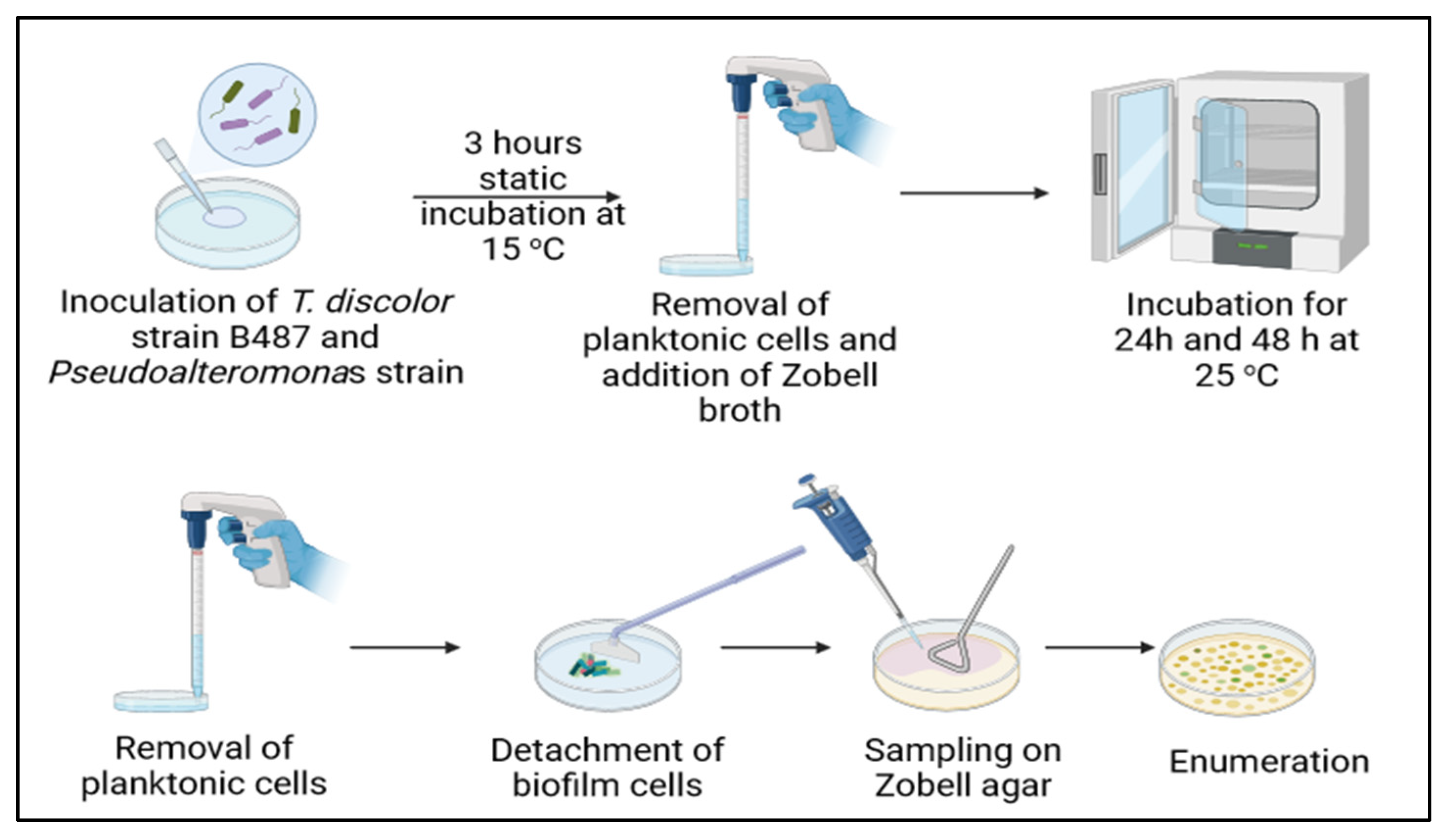
The antibiofilm activity of the three Pseudoalteromonas strains against T. discolor strain FMCC B487 was further investigated in dual-species biofilms. The procedure is depicted in Figure 1. Briefly, 100 µL portions of each appropriate strain cultured in Zobell broth medium for 24 h were added to Petri dishes (90 mm diameter) containing 10 mL of Maximum Recovery Diluent (MRD-NaCl 8.5 g/L and Bacteriological Peptone 1 g/L). Mono-species and dual-species biofilms (one of the Pseudoalteromonas strains and T. discolor FMCC B487) were studied. After the adhesion step at 15 °C without agitation for 3 h, planktonic cells were removed by carefully pipetting, and 10 mL of Zobell medium was added to cover the whole Petri surface.
The adhered cells were left to form a biofilm upon static incubation for 3, 24, and 48 h at 25 °C, on different sets of plates. At an appropriate time, planktonic cells were aspirated, and loosely attached cells were removed by a double wash with MRD. After adding 2 mL of MRD, sessile cells were sampled with a cell scraper and enumerated on Zobell agar plates immediately. Single-species biofilms serving as controls were tested simultaneously for all strains. Assays were carried out thrice with 3 technical replicates for each treatment (i.e., 18 Petri dishes for each treatment). The enumeration of biofilm cells was performed on Zobell agar plates for both the single and dual-species treatments (Figure 1). In order to assess any significant differences in biofilm cell population of all the strains due to antagonistic effects in dual-species culture, Student’s t-test was deployed at a 95% confidence level.

3. Results

3.1. Effect of Supernatants of Pseudoalteromonas on T. discolor Strain FMCC B487

The supernatants (SNs) of P. spongiae MB2, Pseudoalteromonas. sp. GY795-2, and P. tetraodonis SAE20 were evaluated for effects on the growth and biofilm formation of T. discolor strain FMCC B487 using a microtiter-plate assay. The mean values and standard deviations of OD600 (for growth) and CV (for biofilm) are described in Table 1; two independent sets of controls are included, as experiments were conducted in two separate establishments.
The presence of the Pseudoalteromonas SNs affected both growth and biofilm development of T. discolor strain FMCC B487. Specifically, the supernatant from P. spongiae MB2 caused a significant reduction in OD600 of 10%, indicating the inhibition of the growth of the target strain. In contrast, the supernatant from the strain GY795-2 led to a statistically significant increase by 17% in OD600, suggesting enhanced growth, while adding the supernatant of the P. tetraodonis strain SAE 20 had no significant impact compared to the control (corresponding to the biofilm produced by the addition of T. discolor SN on the preformed biofilm).
Biofilm development was quantified as the percentage change between the initial biofilm (measured before treatment) and the biofilm after the 24 h exposure, allowing direct comparison of growth or loss in each condition. The CV assays for both experiments showed that none of the three Pseudoalteromonas SNs disrupted the pre-existing biofilm of T. discolor strain FMCC B487. In fact, adding the supernatant of strain GY795-2 to the 24 h-preformed biofilm of T. discolor FMCC B487 resulted in a 21% increase in CV values; similarly, applying supernatants from P. spongiae MB2 and P. tetraodonis strain SAE 20 led to increases of 50% and 71%, respectively. Regarding the anti-biofilm activity (Δbiofilm), adding the supernatant of strain GY795-2 led to statistically significantly higher CV % values (21%) compared to the control. However, adding the SNs of the other two strains reduced the CV values significantly (by 22% and 32%) compared to the corresponding control.

3.2. Biofilm Antagonism in Pseudoalteromonas Strains and T. discolor Strain FMCC B487 Co-Cultures

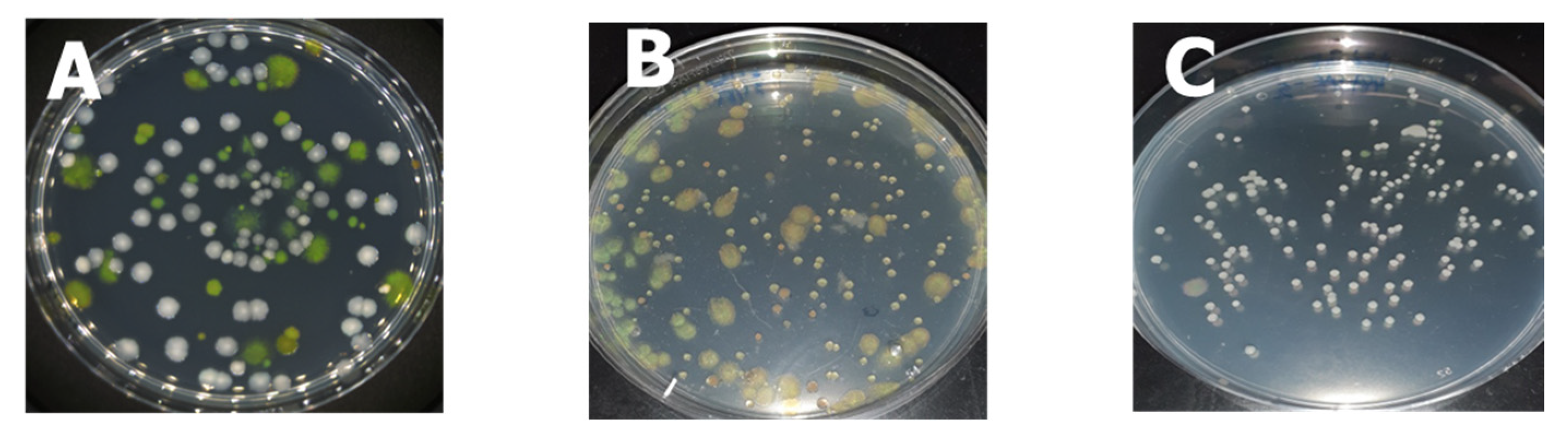
To evaluate how the biofilm of T. discolor strain FMCC B487 would develop in the presence of the Pseudoalteromonas strains, first, we assessed the development of the biofilm of each single strain biofilm individually, according to the protocol described in Figure 1. Discrimination of T. discolor strain FMCC B487 colonies was easy, as it forms distinct green/orange iridescent colonies, as seen in Figure 2.
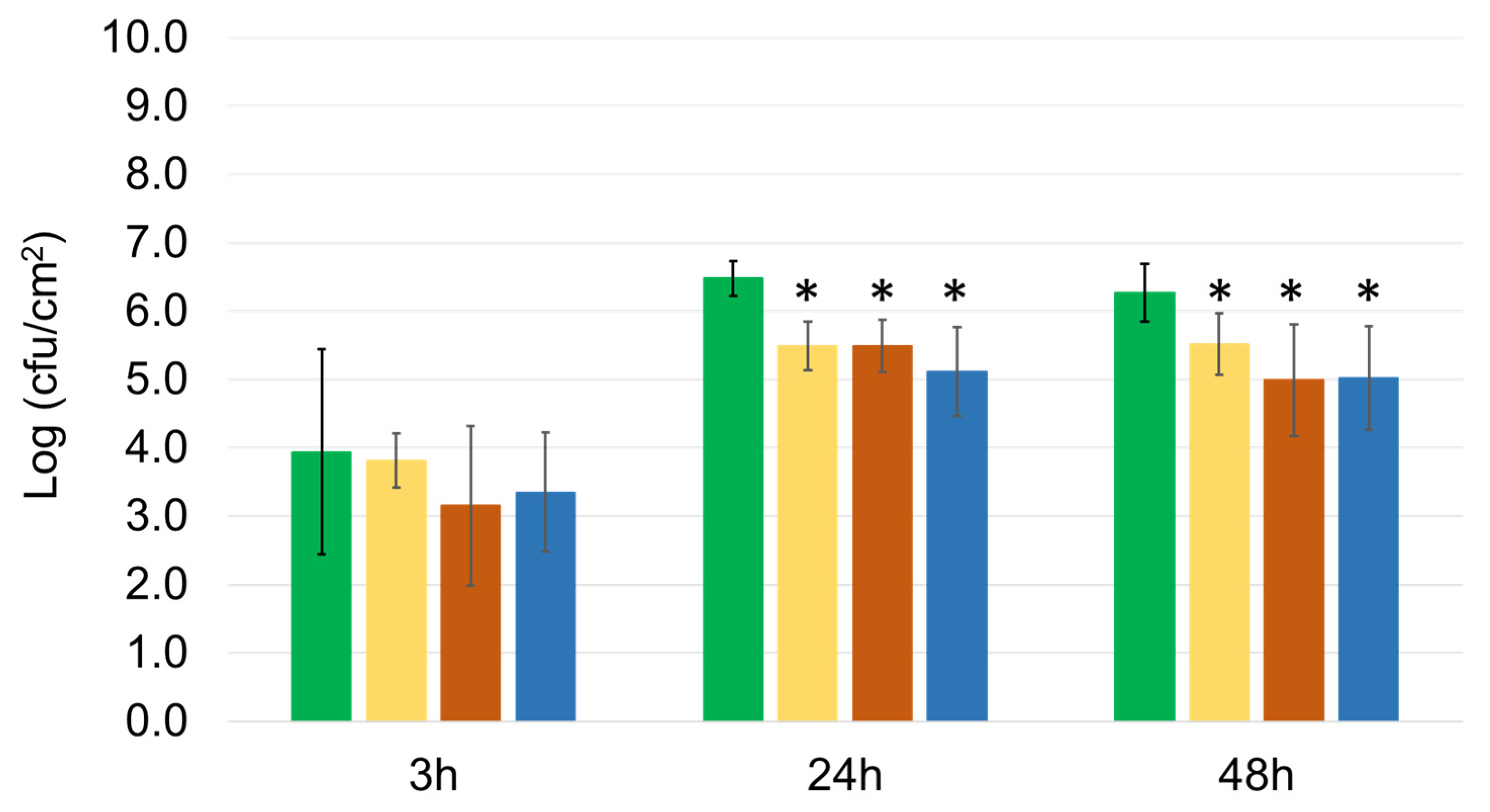
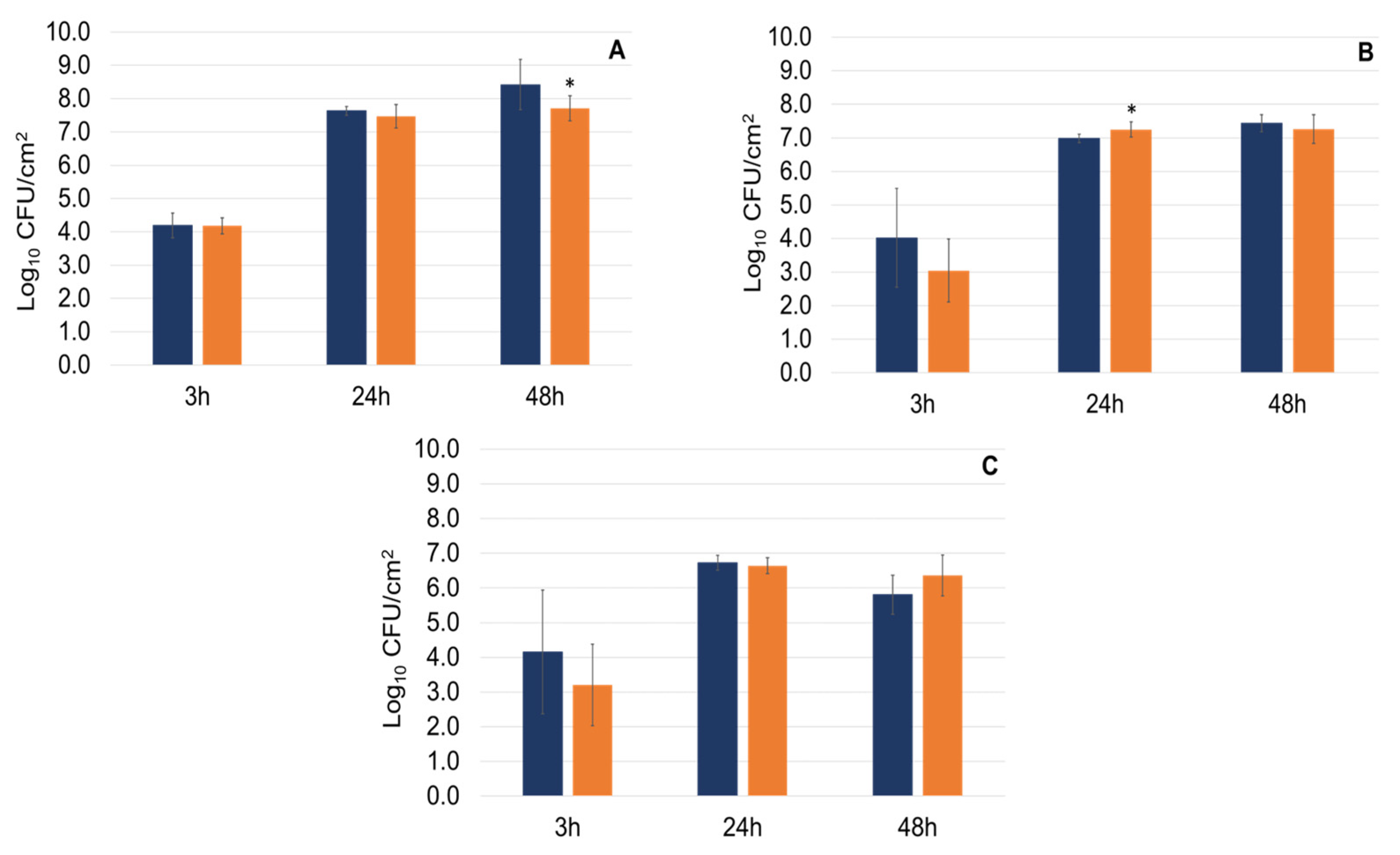
After 3 h of incubation, cells from all strains were able to attach on the Petri surface, with their population reaching 3.9 ± 1.5 log cfu/cm2 for T. discolor strain FMCC B487, 4.2 ± 0.4 log cfu/cm2 for Pseudoalteromanas sp. strain GY795-2, 4.0 ± 1.5 log cfu/cm2 for P. spongiae MB2 4.0 ± 1.5 log cfu/cm2, and 4.2 ± 1.8 log cfu/cm2 for P. tetraodonis strain SAE 20 4.2 ± 1.8 log cfu/cm2 (Figure 3). Their numbers increased to about 6–8 log/cm2 after 24 h incubation and remained at a similar level after 48 h of incubation. Specifically, within 24 h, T. discolor strain FMCC B487 was able to form a highly populated biofilm with a concentration of 6.5 ± 0.3 log cfu/cm2, while the population of the Pseudoalteromonas biofilms was also high, with Pseudoalteromonas sp. strain GY795-2 reaching a concentration of 7.6 ± 0.1 log cfu/cm2.
In the dual species cultures, all strains were able to attach in comparable numbers to the single species treatment, and all antagonist strains initially adhered at equal levels. Sessile cells of T. discolor strain FMCC B487 were decreased after 24 h by 2 log cfu/cm2 in the presence of Pseudoalteromonas strains, while the populations of all Pseudoalteromonas strains were similar to the single species biofilms at all times, indicating an inhibitory effect on T. discolor strain FMCC B487 cells in the biofilm matrix. Figure 3 describes the changes in T. discolor strain FMCC B487 biofilm cells in single- and dual-species cultures, while Figure 4 shows the changes in Pseudoalteromonas strains’ biofilm cell counts.

3.3. Phylogenetic Study of Strain GY795-2

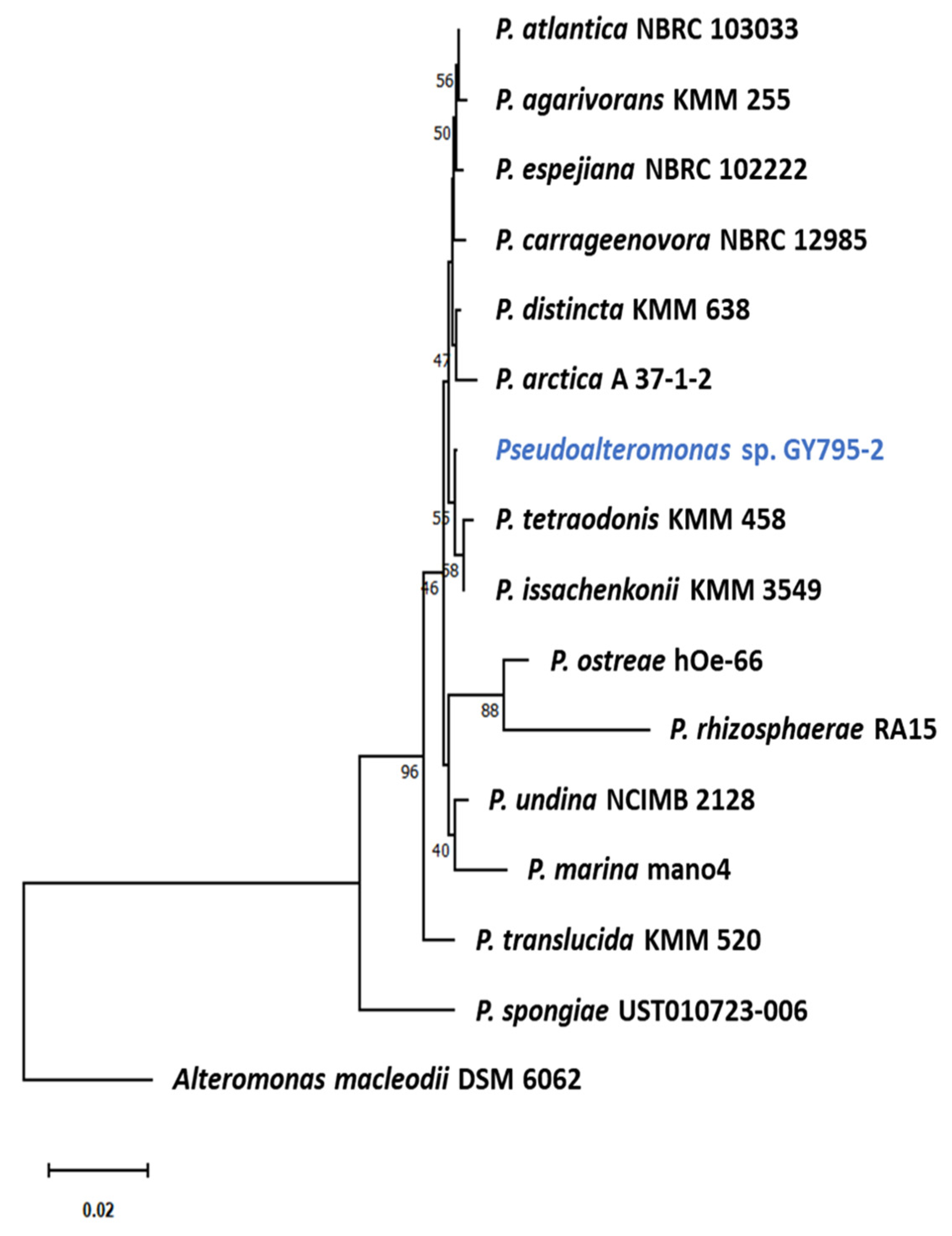
To better identify Pseudoalteromonas sp. GY795-2, the phylogeny of the strain GY795-2 was further investigated (Figure 5). Both this phylogenetic tree and blast alignment show that the strain GY795-2 is close to both P. tetraodonis and P. issachenkonii.

4. Discussion

In recent years, the use of probiotics has been rising in aquaculture practices as an alternative strategy to antibiotic abuse [27,28]. Several bacterial groups have been used as probiotics in aquaculture, such as lactic acid bacteria, Bacillus, as well as others like Pseudoalteromonas [27,29,30]. In the context of marine aquaculture, Pseudoalteromonas species may be considered better probiotic candidates compared with lactic acid bacteria due to their ecological compatibility and association with marine organisms [31]. The members of the Pseudoalteromonas genus are indigenous to the marine environment, being adapted to high salinity, low temperatures, and oligotrophic conditions. This trait allows them to colonize the water column and aquaculture-related surfaces [9,12].
The majority of the studies on the probiotic effect of Pseudoalteromonas strains have targeted mostly Vibrio pathogens [32,33,34,35]. However, only recently have alternative strategies against Tenacibaculum pathogens drawn attention [8]. To date, there is a limited number of studies on T. discolor, and to the best of our knowledge, this is the first study that examines the implementation of Pseudoalteromonas as probiotics against T. discolor. Here, we evaluated the potential use of three Pseudoalteromonas strains for inhibiting T. discolor strain FMCC B487. These strains were isolated from different niches, and in preliminary spot-on-lawn assays, all three exhibited inhibitory effects against the target bacterium. To determine whether this effect was caused by excreted molecules, we examined the activities of their cell-free supernatants. The supernatants of all three Pseudoalteromonas strains were shown to affect the growth and biofilm development of T. discolor strain FMCC B487. In particular, the SN of P. spongiae MB2 impacted the growth and biofilm of the pathogen negatively, whereas the two other strains gave contradictory results, with strain GY795-2 promoting both aspects, while strain SAE 20 displayed a rather inhibitory effect.
Apart from evaluating the SNs of the Pseudoalteromonas strains, we investigated whether, in the presence of both species on a sterile surface, there would be antagonistic relations in the settlement of the cells and further cell growth in the biofilm matrix. A simple experimental setup was established, which gave us information on the ability of the strains to adhere to the surface uninterrupted in single-species cultures or in challenging conditions in dual-species cultures, and information on the dynamics of cell populations further as the biofilm matrix was developed. All the Pseudoalteromonas strains tested here developed strong biofilms on the plastic surfaces with high populations in the single-species cultures. When one of the three Pseudoalteromonas strains was present, the population of T. discolor strain FMCC B487 biofilm cells was decreased by about 2 logs after 48 h of incubation. It is interesting that in the presence of living cells of the strain GY795-2, the population of T. discolor strain FMCC B487 was decreased, whereas adding the SN produced opposite results. This suggests the presence of different active metabolites in the supernatants and cells. Overall, the three Pseudoalteromonas strains of this study had an inhibitory effect on the growth of sessile cells of the T. discolor strain FMCC B487 in mixed biofilms. As the experimental setup was limited to 48 h, it would be interesting to repeat these experiments with a prolonged duration, so as to investigate if the Pseudoalteromonas bacteria can inhibit and remove the sessile cells of T. discolor strain FMCC B487 from the biofilm matrix.
Of the three strains, the supernatant of P. spongiae MB2 exhibited the most negative impact on the growth and biofilm development of the target bacterium. Notably, only this strain is pigmented, forming vivid orange-colored colonies. Special attention is given to the pigmented Pseudoalteromonas species [12]; genomic analyses have revealed that up to 15% of the genome of pigmented species is responsible for secondary metabolism, whereas in non-pigmented species, the percentage is limited to 3% [13]. Pigmentation in this genus has been suggested as an indicator of bioactive compound production, raising the possibility that these biosynthetic pathways may contribute, in part, to the observed pigmentation [36]. For instance, Pseudoalteromonas flavipulchra (pigmented) has displayed a broad spectrum of antimicrobial properties against diverse bacterial species [2]. Although there are only a few studies on the P. spongiae species since its first identification in 2005 [37], its biofilm has been associated with the larval settlement of the polychaete Hydroides elegans [38], while it has been described as the causative agent of tail rot in Hippocampus kuda [39].
Regarding the other two non-pigmented strains, they are both closely related to P. tetraodonis. P. tetraodonis has been previously detected in Pacific oysters and Sydney rock oysters [40], while the strains used here were isolated either from kelps cultivated in the Firth of Lorn sea area of western Scotland [21] or from marine thermal sources [20]. Degradation of quorum-sensing molecules has previously been identified in a strain of P. tetraodonis [41]. This can affect regulating the growth and biofilm development of other bacteria.
Bioinformatic studies on the whole-genome sequences of several Pseudoalteromonas species have revealed the presence of biosynthetic gene clusters, responsible for the biosynthesis of alterochromides, pseudoalterobactins, alteramids, and other compounds with antimicrobial activity [36]. Antimicrobial effects of Pseudoalteromonas strains against Gram-negative bacteria have been reported previously, with the antimicrobial effect being attributed to the presence of alterins [42]. All three Pseudoalteromonas strains used in this study are related to species that have been identified to possess only a few biosynthetic gene clusters [43]. Nevertheless, they exhibited inhibitory effects on T. discolor strain FMCC B487.
The decrease in the T. discolor strain FMCC B487 biofilm cells in the mixed cultures raises questions on the mechanism involved; Pseudoalteromonas strains can produce exoproducts such as degrading enzymes or quorum-sensing-associated molecules [44,45]. The application of new tools in genome mining of Pseudoalteromonas can provide us with information for novel antimicrobial compounds [43]. Recently, a study on the probiotic effect of Pseudoalteromonas strains used in the farming of European sea bass juveniles showed improved survival rates when fish were exposed to Vibrio harveyi and potential biofilm control [35]. Collectively, these data, along with the findings of this study, encourage further investigation of excreted molecules produced by these Pseudoalteromonas strains. In addition, testing a broader range of isolated strains would improve understanding of the observed antibiofilm activity and may facilitate the application of Pseudoalteromonas strains or their metabolites for the prevention of tenacibaculosis in marine farmed fish.

Supplementary Materials

The following supporting information can be downloaded at: https://www.mdpi.com/article/10.3390/aquacj6010005/s1, 16SrRNA gene sequence of Pseudoalteromonas sp. GY795-2.

Author Contributions

Conceptualization, E.S., C.D.-L., D.P., and G.-J.N.; methodology, E.S. and L.K.; software, E.S.; validation, E.S., D.P., and C.D.-L.; formal analysis, E.S. and D.P.; investigation, E.S.; resources, F.L., C.D.-L., and G.-J.N.; data curation, D.P. and C.D.-L.; writing—original draft preparation, E.S.; writing—review and editing, D.P., F.L., C.D.-L., and G.-J.N.; visualization, E.S. and D.P.; supervision, D.P., F.L., C.D.-L., G.-J.N.; project administration, G.-J.N.; funding acquisition, G.-J.N. All authors have read and agreed to the published version of the manuscript.

Funding

This research was funded by the European Union’s Horizon 2020 research and innovation programme under grant agreement No 774109 (project “Intelligent Management System for Integrated Multi-trophic Aquaculture—IMPAQT’’).

Institutional Review Board Statement

The experiments conducted exclusively on bacteria. No fish or other animals were involved in the study. For this reason, the ethics statement is not applicable.

Data Availability Statement

The data presented in this study are available on request from the corresponding author.

Conflicts of Interest

The authors declare no conflicts of interest. The funders had no role in the design of the study; in the collection, analyses, or interpretation of data; in the writing of the manuscript; or in the decision to publish the results.

References

  1. Sannino, F.; Parrilli, E.; Apuzzo, G.A.; de Pascale, D.; Tedesco, P.; Maida, I.; Perrin, E.; Fondi, M.; Fani, R.; Marino, G.; et al. Pseudoalteromonas haloplanktis produces methylamine, a volatile compound active against Burkholderia cepacia complex strains. New Biotechnol. 2017, 35, 13–18. [Google Scholar] [CrossRef] [PubMed]
  2. Wang, H.; Sun, B.; Xie, G.; Wan, X.; Huang, J.; Song, X. Spotlight on a novel bactericidal mechanism and a novel SXT/R391-like integrative and conjugative element, carrying multiple antibiotic resistance genes, in Pseudoalteromonas flavipulchra strain CDM8. Microbiol. Res. 2021, 242, 126598. [Google Scholar] [CrossRef] [PubMed]
  3. Devkar, H.U.; Thakur, N.L.; Kaur, P. Marine-derived antimicrobial molecules from the sponges and their associated bacteria. Can. J. Microbiol. 2023, 69, 1–16. [Google Scholar] [CrossRef]
  4. Romano, G.; Costantini, M.; Sansone, C.; Lauritano, C.; Ruocco, N.; Ianora, A. Marine microorganisms as a promising and sustainable source of bioactive molecules. Mar. Environ. Res. 2017, 128, 58–69. [Google Scholar] [CrossRef] [PubMed]
  5. Toranzo, A.E.; Magariños, B.; Romalde, J.L. A review of the main bacterial fish diseases in mariculture systems. Aquaculture 2005, 246, 37–61. [Google Scholar] [CrossRef]
  6. Avendaño-Herrera, R.; Collarte, C.; Saldarriaga-Córdoba, M.; Irgang, R. New salmonid hosts for Tenacibaculum Species: Expansion of tenacibaculosis in chilean aquaculture. J. Fish. Dis. 2020, 43, 1077–1085. [Google Scholar] [CrossRef]
  7. Avendaño-Herrera, R.; Núñez, S.; Barja, J.L.; Toranzo, A.E. Evolution of drug resistance and minimum inhibitory concentration to enrofloxacin in Tenacibaculum maritimum strains isolated in fish farms. Aquac. Int. 2008, 16, 1–11. [Google Scholar] [CrossRef]
  8. Tesdorpf, J.E.; Geers, A.U.; Strube, M.L.; Gram, L.; Bentzon-Tilia, M. Roseobacter group probiotics exhibit differential killing of fish pathogenic Tenacibaculum Species. Appl. Environ. Microbiol. 2022, 88, e02418-21. [Google Scholar] [CrossRef]
  9. Holmström, C.; Kjelleberg, S. Marine Pseudoalteromonas species are associated with higher organisms and produce biologically active extracellular agents. FEMS Microbiol. Ecol. 1999, 30, 285–293. [Google Scholar] [CrossRef]
  10. Offret, C.; Desriac, F.; Le Chevalier, P.; Mounier, J.; Jégou, C.; Fleury, Y. Spotlight on antimicrobial metabolites from the marine bacteria Pseudoalteromonas: Chemodiversity and Ecological Significance. Mar. Drugs 2016, 14, 129. [Google Scholar] [CrossRef]
  11. Alviz-Gazitua, P.; González, A.; Lee, M.R.; Aranda, C.P. Molecular relationships in biofilm formation and the biosynthesis of exoproducts in Pseudoalteromonas spp. Mar. Biotechnol. 2022, 24, 431–447. [Google Scholar] [CrossRef]
  12. Bowman, J. Bioactive compound synthetic capacity and ecological significance of marine bacterial genus Pseudoalteromonas. Mar. Drugs 2007, 5, 220–241. [Google Scholar] [CrossRef]
  13. Paulsen, S.S.; Strube, M.L.; Bech, P.K.; Gram, L.; Sonnenschein, E.C. Marine chitinolytic Pseudoalteromonas represents an untapped reservoir of bioactive potential. mSystems 2019, 4, 1–12. [Google Scholar] [CrossRef]
  14. Wang, X.; Isbrandt, T.; Strube, M.L.; Paulsen, S.S.; Nielsen, M.W.; Buijs, Y.; Schoof, E.M.; Larsen, T.O.; Gram, L.; Zhang, S. Chitin degradation machinery and secondary metabolite profiles in the marine bacterium Pseudoalteromonas rubra S4059. Mar. Drugs 2021, 19, 108. [Google Scholar] [CrossRef]
  15. Shnit-Orland, M.; Sivan, A.; Kushmaro, A. Antibacterial activity of Pseudoalteromonas in the coral holobiont. Microb. Ecol. 2012, 64, 851–859. [Google Scholar] [CrossRef] [PubMed]
  16. Jouault, A.; Gobet, A.; Simon, M.; Portier, E.; Perennou, M.; Corre, E.; Gaillard, F.; Vallenet, D.; Michel, G.; Fleury, Y.; et al. Alterocin, an antibiofilm protein secreted by Pseudoalteromonas sp. Strain 3J6. Appl. Environ. Microbiol. 2020, 86, 1–18. [Google Scholar] [CrossRef]
  17. Zeng, Z.; Guo, X.P.; Cai, X.; Wang, P.; Li, B.; Yang, J.L.; Wang, X. Pyomelanin from Pseudoalteromonas lipolytica reduces biofouling. Microb. Biotechnol. 2017, 10, 1718–1731. [Google Scholar] [CrossRef] [PubMed]
  18. Richards, G.P.; Watson, M.A.; Needleman, D.S.; Uknalis, J.; Boyd, E.F.; Fay, J.P. Mechanisms for Pseudoalteromonas piscicida-induced killing of vibrios and other bacterial pathogens. Appl. Environ. Microbiol. 2017, 83, 1–17. [Google Scholar] [CrossRef]
  19. Schoina, E.; Doulgeraki, A.I.; Miliou, H.; Nychas, G.-J.E. Dynamics of water and biofilm bacterial community composition in a Mediterranean Recirculation Aquaculture System. Aquac. J. 2022, 2, 164–179. [Google Scholar] [CrossRef]
  20. Alayse, A.-M. Guaynaud. Cruise, RV Le Nadir, 1991. Available online: https://campagnes.flotteoceanographique.fr/campagnes/91006111/ (accessed on 26 December 2025).
  21. Lytou, A.E.; Schoina, E.; Liu, Y.; Michalek, K.; Stanley, M.S.; Panagou, E.Z.; Nychas, G.E. Quality and safety assessment of edible seaweeds Alaria esculenta and Saccharina latissima cultivated in Scotland. Foods 2021, 10, 2210. [Google Scholar] [CrossRef]
  22. Tamura, K.; Stecher, G.; Kumar, S. MEGA11: Molecular evolutionary genetics analysis Version 11. Mol. Biol. Evol. 2021, 38, 3022–3027. [Google Scholar] [CrossRef]
  23. Lianou, A.; Koutsoumanis, K.P. Strain variability of the biofilm-forming ability of Salmonella enterica under Various Environmental Conditions. Int. J. Food Microbiol. 2012, 160, 171–178. [Google Scholar] [CrossRef]
  24. Saitou, N.; Nei, M. The neighbor-joining method: A new method for reconstructing phylogenetic trees. Mol. Biol. Evol. 1987, 4, 406–425. [Google Scholar] [CrossRef]
  25. Felsenstein, J. Confidence limits on phylogenies: An approach using the bootstrap. Evolution 1985, 39, 783–791. [Google Scholar] [CrossRef] [PubMed]
  26. Jukes, T.H.; Cantor, C.R. Evolution of protein molecules. In Mammalian Protein Metabolism; Munro, H.N., Ed.; Academic Press: New York, NY, USA, 1969; pp. 21–132. [Google Scholar] [CrossRef]
  27. Ringø, E.; Van Doan, H.; Lee, S.H.; Soltani, M.; Hoseinifar, S.H.; Harikrishnan, R.; Song, S.K. Probiotics, Lactic Acid Bacteria and Bacilli: Interesting Supplementation for Aquaculture. J. Appl. Microbiol. 2020, 129, 116–136. [Google Scholar] [CrossRef]
  28. Torres-Maravilla, E.; Parra, M.; Maisey, K.; Vargas, R.A.; Cabezas-Cruz, A.; Gonzalez, A.; Tello, M.; Bermúdez-Humarán, L.G. Importance of probiotics in fish aquaculture: Towards the identification and design of novel probiotics. Microorganisms 2024, 12, 626. [Google Scholar] [CrossRef]
  29. Newaj-Fyzul, A.; Al-Harbi, A.H.; Austin, B. Review: Developments in the use of probiotics for disease control in aquaculture. Aquaculture 2014, 431, 1–11. [Google Scholar] [CrossRef]
  30. Leroy, G.; Parizadeh, L.; Cuny, H.; Offret, C.; Protat, M.; Bazire, A.; Rodrigues, S.; Le Chevalier, P.; Brillet, B.; Gonzalez-araya, R.; et al. Pseudoalteromonas strains as biofilm control agents in Ostrea edulis aquaculture: Reducing biofilm biovolume while preserving microbial diversity. Microorganisms 2025, 13, 363. [Google Scholar] [CrossRef] [PubMed]
  31. Egan, S.; Thomas, T.; Kjelleberg, S. Unlocking the diversity and biotechnological potential of marine surface associated microbial communities. Curr. Opin. Microbiol. 2008, 11, 219–225. [Google Scholar] [CrossRef]
  32. Kesarcodi-Watson, A.; Kaspar, H.; Lategan, M.J.; Gibson, L. Probiotics in Aquaculture: The need, principles and mechanisms of action and screening processes. Aquaculture 2008, 274, 1–14. [Google Scholar] [CrossRef]
  33. Sorée, M.; Kolypczuk, L.; Hadjiev, E.; Lozach, S.; Verrez-Bagnis, V.; Delbarre-Ladrat, C.; Heath, D.H.; Passerini, D. Screening of Marine Lactic Acid Bacteria for Vibrio parahaemolyticus inhibition and application to depuration in Pacific Oysters (Crassostrea gigas). J. Appl. Microbiol. 2023, 134, lxac081. [Google Scholar] [CrossRef]
  34. Rodrigues, S.; Paillard, C.; Dufour, A.; Bazire, A. Antibiofilm activity of the marine bacterium Pseudoalteromonas sp. 3J6 against Vibrio tapetis, the causative agent of brown ring disease. Probiot. Antimicrob. Proteins 2015, 7, 45–51. [Google Scholar] [CrossRef] [PubMed]
  35. Rahmani, A.; Parizadeh, L.; Baud, M.; Francois, Y.; Bazire, A.; Rodrigues, S.; Fleury, Y.; Cuny, H.; Debosse, E.; Cabon, J.; et al. Potential of marine strains of Pseudoalteromonas to improve resistance of juvenile sea bass to pathogens and limit biofilm development. Probiot. Antimicrob. Proteins 2025, 17, 640–654. [Google Scholar] [CrossRef]
  36. Chau, R.; Pearson, L.A.; Cain, J.; Kalaitzis, J.A.; Neilan, B.A. A Pseudoalteromonas clade with remarkable biosynthetic potential. Appl. Environ. Microbiol. 2021, 87, 1–16. [Google Scholar] [CrossRef] [PubMed]
  37. Lau, S.C.K.; Tsoi, M.M.Y.; Li, X.; Dobretsov, S.; Plakhotnikova, Y.; Wong, P.K.; Qian, P.Y. Pseudoalteromonas spongiae sp. nov., a novel member of the γ-Proteobacteria isolated from the sponge Mycale adhaerens in Hong Kong waters. Int. J. Syst. Evol. Microbiol. 2005, 55, 1593–1596. [Google Scholar] [CrossRef] [PubMed]
  38. Huang, Y.L.; Dobretsov, S.; Xiong, H.; Qian, P.Y. Effect of biofilm formation by Pseudoalteromonas spongiae on induction of larval settlement of the polychaete Hydroides elegans. Appl. Environ. Microbiol. 2007, 73, 6284–6288. [Google Scholar] [CrossRef]
  39. Jiang, L.; Chen, L.; Zhu, L. Fouling process of membrane distillation for seawater desalination: An especial focus on the thermal-effect and concentrating-effect during biofouling. Desalination 2020, 485, 114457. [Google Scholar] [CrossRef]
  40. Madigan, T.L.; Bott, N.J.; Torok, V.A.; Percy, N.J.; Carragher, J.F.; de Barros Lopes, M.A.; Kiermeier, A. A microbial spoilage profile of Half Shell Pacific Oysters (Crassostrea gigas) and Sydney Rock Oysters (Saccostrea glomerata). Food Microbiol. 2014, 38, 219–227. [Google Scholar] [CrossRef]
  41. Pan, Y.; Wang, Y.; Yan, X.; Mazumder, A.; Liang, Y. Draft Genome Sequence of Pseudoalteromonas tetraodonis strain MQS005, a bacterium with potential quorum sensing regulation. Genome Announc. 2016, 4. [Google Scholar] [CrossRef]
  42. Offret, C.; Cuny, H.; Bodet, P.E.; Desriac, F.; Jegou, C.; Bazire, A.; Chevrot, R.; Thiery, V.; Brillet, B.; Fleury, Y. Alterins, a new family of marine antibacterial cyclolipopeptides. Int. J. Antimicrob. Agents 2022, 59, 106514. [Google Scholar] [CrossRef]
  43. Wang, Z.; Zhou, H.; Zhang, Y.; Yan, F.; Huo, L.; Wang, X. RECC: A Red/ET–CRISPR/Cas9-Based System Enabling Genome Mining of marine Pseudoalteromonas for novel natural products. Synth. Syst. Biotechnol. 2026, 12, 342–351. [Google Scholar] [CrossRef] [PubMed]
  44. Li, S.; Wu, S.; Ren, Y.; Meng, Q.; Yin, J.; Yu, Z. Characterization of differentiated autoregulation of LuxI/LuxR-Type Quorum Sensing System in Pseudoalteromonas. Biochem. Biophys. Res. Commun. 2022, 590, 177–183. [Google Scholar] [CrossRef] [PubMed]
  45. Yu, Z.; Yu, D.; Mao, Y.; Zhang, M.; Ding, M.; Zhang, J.; Wu, S.; Qiu, J.; Yin, J. Identification and characterization of a LuxI/R-Type Quorum Sensing System in Pseudoalteromonas. Res. Microbiol. 2019, 170, 243–255. [Google Scholar] [CrossRef] [PubMed]
Figure 1. Graphic procedure for mono- and dual-species biofilm experiments. Biofilm cells were enumerated on Zobell agar plates (Lower part). Image created in Created in BioRender. SCHOINA, E. (2026) https://BioRender.com/mj23ujj, accessed on 28 December 2025.
Aquacj 06 00005 g001
Figure 2. Representative images of dual species on Zobell agar of T. discolor strain FMCC B487 (flat, green/orange iridescent colonies) after 3 h with (A) Pseudoalteromonas sp. strain GY795-2 (beige colonies), (B) P. spongiae (orange colonies), and (C) P. tetraodonis strain SAE 20 (beige colonies).
Aquacj 06 00005 g002
Figure 3. Biofilm cell concentration (Log10 CFU/cm2) of T. discolor strain FMCC B487 after the adhesion step and a 3 h, 24 h, and 48 h of incubation. T. discolor as a single species biofilm (green), and in dual species cultures with Pseudoalteromonas sp. strain GY795-2 (yellow), P. spongiae MB2 (orange), and P. tetraodonis SAE 20 (blue). Results are expressed as mean value ± SD. Asterisks denote a statistically significant difference between the means of the biofilm cell concentration of T. discolor strain FMCC B487 in the single- versus dual-species cultures at the 95.0% confidence level.
Aquacj 06 00005 g003
Figure 4. Biofilm cell concentration (Log10 CFU/cm2) of Pseudoalteromonas strains after adhesion step 3 h, 24 h, and 48 h of incubation as single-species biofilm (blue bar) and in dual-species cultures with T. discolor strain FMCC 487 (orange bar). (A) Pseudoalteromonas sp. strain GY795-2, (B) P. spongiae MB2, and (C) P. tetraodonis strain SAE 20. Results are expressed as mean value ± SD. Asterisks denote a statistically significant difference between the means of the biofilm cell concentration of each strain in the single- versus dual-species cultures at the 95.0% confidence level.
Aquacj 06 00005 g004
Figure 5. Phylogenetic study of the strain GY795-2 (written in blue). The evolutionary history was inferred using the neighbor-joining method [24]. The optimal tree is shown. The percentages of replicate trees in which the associated taxa clustered together in the bootstrap test (1000 replicates) are shown next to the branches [25]. The tree is drawn to scale, with branch lengths in the same units as those of the evolutionary distances used to infer the phylogenetic tree. The evolutionary distances were computed using the Jukes–Cantor method [26] and are in units of the number of base substitutions per site. This analysis involved 16 nucleotide sequences. All ambiguous positions were removed for each sequence pair (pairwise deletion option). There were 1542 positions in the final dataset. Evolutionary analyses were conducted in MEGA11 [22].
Aquacj 06 00005 g005
Table 1. Antimicrobial and antibiofilm activities of supernatants derived from Pseudoalteromonas strains against T. discolor strain FMCC B487 were performed in two separate experiments. Mean values ± standard deviations are shown. The impact on growth (%) is compared to the control values. The antibiofilm activity (%) is compared to the control values.
SN AddedGrowth (OD600)Impact on Growth ΔOD600Biofilm (CV 590)Antibiofilm Activity ( Δ b i o f i l m )
Experiment A
T. discolor strain FMCC B487 (Control A)0.580 ± 0.157-0.770 ± 0.267-
Pseudoalteromonas sp. GY795-20.677 ± 0.035 *+17%0.931 ± 0.286 *+21%
Experiment B
T. discolor strain FMCC B487 (Control B)0.530 ± 0.048-1.235 ± 0.222-
P. spongiae MB20.479 ± 0.036 *−10%0.840 ± 0.263 *−32%
P. tetraodonis strain SAE 200.530 ± 0.0300% 0.960 ± 0.328 *−22%
SN AddedControl APseudoalteromonas sp. GY795-2Control BP. spongiae MB2P. tetraodonis strain SAE 20
Growth (OD600)0.580 ± 0.1570.677 ± 0.035 *0.530 ± 0.0480.479 ± 0.0360.530 ± 0.030
Impact on growth Δ OD600NA+17%NA−10%ND
Biofilm (CV 590)0.770 ± 0.2670.931 ± 0.286 *1.235 ± 0.2220.840 ± 0.263 *0.960 ± 0.328 *
Antibiofilm activity (Δbiofilm)NA+21%NA−32%−22%
* Denotes significant (p < 0.05) difference from the control value (t-test) at 95% confidence level. NA: not applicable. ND: no difference.
Disclaimer/Publisher’s Note: The statements, opinions and data contained in all publications are solely those of the individual author(s) and contributor(s) and not of MDPI and/or the editor(s). MDPI and/or the editor(s) disclaim responsibility for any injury to people or property resulting from any ideas, methods, instructions or products referred to in the content.