
Sleep Disturbances in Menopause: Neuroendocrine Mechanisms and Clinical Implications

Abstract
1. Introduction
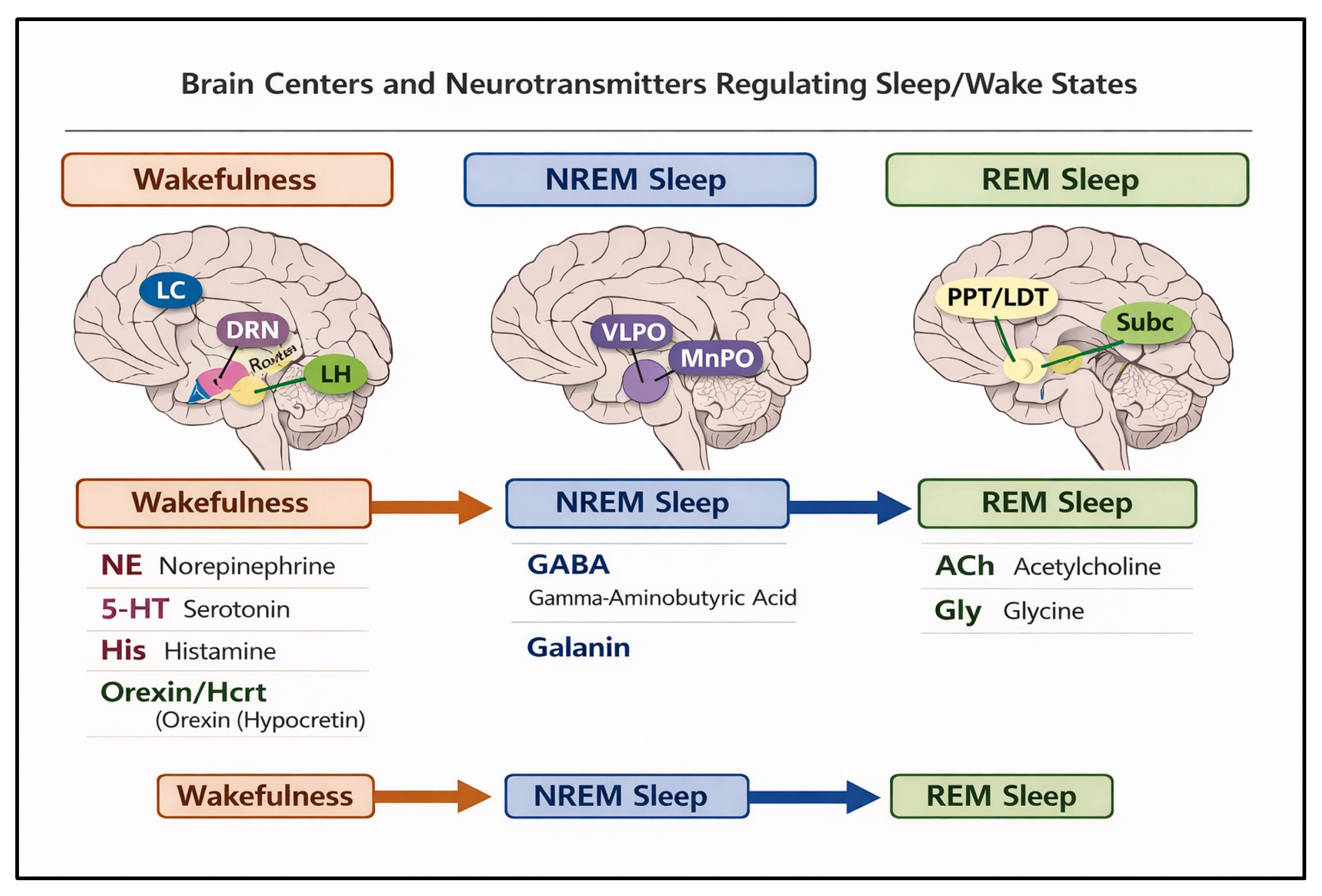
2. Normal Sleep Physiology
- Pathophysiology of Sleep Disturbances in Menopause
2.1. Effects of Fluctuating Gonadal Hormones on Sleep Quality
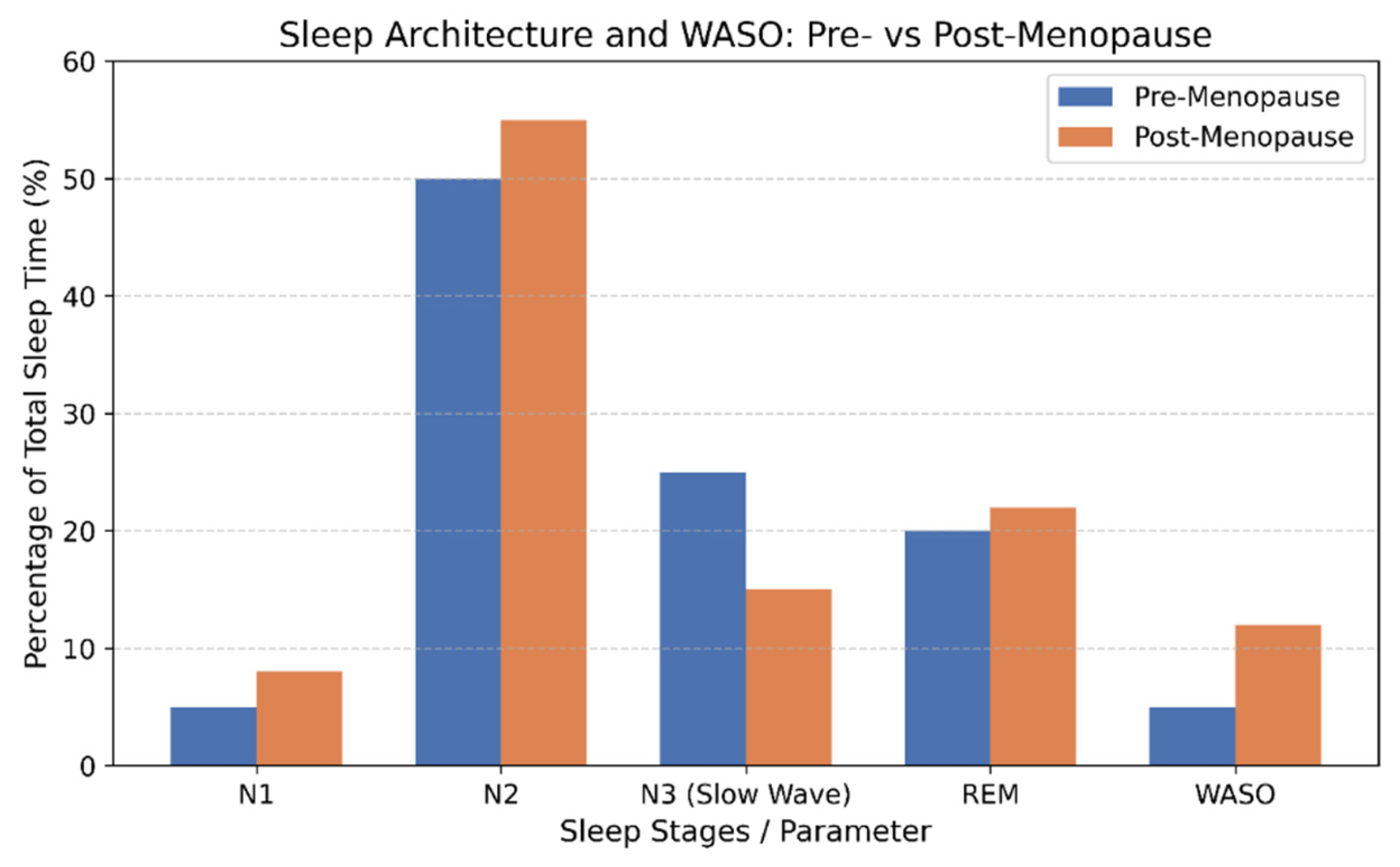
2.2. Changes in Sleep Architecture
2.3. Alterations in Circadian Rhythms
2.4. Changes in Body Weight and Energy Regulation
2.5. Interaction Between Obesity and Sleep Disorders
3. Types of Sleep Disorders Associated with Menopause
3.1. Insomnia
3.2. Obstructive Sleep Apnea
3.3. Restless Legs Syndrome and Periodic Limb Movements
3.4. Circadian Rhythm Sleep Disturbance
4. Role of Pharmacotherapy to Improve Sleep in Menopause
5. Conclusions
Author Contributions
Funding
Institutional Review Board Statement
Informed Consent Statement
Data Availability Statement
Conflicts of Interest
References
- Harlow, S.D.; Gass, M.; Hall, J.E.; Lobo, R.; Maki, P.; Rebar, R.W.; Sherman, S.; Sluss, P.M.; de Villiers, T.J.; Straw +10 Collaborative Group. Executive summary of the Stages of Reproductive Aging Workshop +10: Addressing the unfinished agenda of staging reproductive aging. Climacteric 2012, 15, 105–114. [Google Scholar] [CrossRef]
- Bertisch, S.; Joffe, H. Sleep and menopause. Menopause 2025, 32, 727. [Google Scholar] [CrossRef] [PubMed]
- Maki, P.M.; Panay, N.; Simon, J.A. Sleep disturbance associated with the menopause. Menopause 2024, 31, 724. [Google Scholar] [CrossRef]
- Jia, Y.; Zhou, Z.; Cao, X. Prevalence of poor sleep quality during menopause: A meta-analysis. Sleep Breath. Schlaf Atm. 2024, 28, 2663–2674. [Google Scholar] [CrossRef] [PubMed]
- Zolfaghari, S.; Yao, C.; Thompson, C.; Gosselin, N.; Desautels, A.; Dang-Vu, T.T.; Postuma, R.B.; Carrier, J. Effects of menopause on sleep quality and sleep disorders: Canadian Longitudinal Study on Aging. Menopause 2020, 27, 295. [Google Scholar] [CrossRef] [PubMed]
- Harlow, S.D.; Karvonen-Gutierrez, C.; Elliott, M.R.; Bondarenko, I.; Avis, N.E.; Bromberger, J.T.; Brooks, M.M.; Miller, J.M.; Reed, B.D. It is not just menopause: Symptom clustering in the Study of Women’s Health Across the Nation. Womens Midlife Health 2017, 3, 2. [Google Scholar] [CrossRef]
- Toffol, E.; Kalleinen, N.; Haukka, J.; Vakkuri, O.; Partonen, T.; Polo-Kantola, P. Melatonin in perimenopausal and postmenopausal women: Associations with mood, sleep, climacteric symptoms, and quality of life. Menopause 2014, 21, 493. [Google Scholar] [CrossRef]
- Baker, F.C.; de Zambotti, M.; Colrain, I.M.; Bei, B. Sleep problems during the menopausal transition: Prevalence, impact, and management challenges. Nat. Sci. Sleep 2018, 10, 73–95. [Google Scholar] [CrossRef]
- Wakabayashi, Y.; Oka, R.; Nakaya, M.; Karashima, S.; Kometani, M.; Sakurai, M.; Yoshimura, K.; Yoneda, T. Associations between Sleep-Disordered Breathing and Metabolic Risk Factors beyond Obesity. J. Diabetes Res. 2018, 2018, 1567683. [Google Scholar] [CrossRef]
- Cintron, D.; Lipford, M.; Larrea-Mantilla, L.; Spencer-Bonilla, G.; Lloyd, R.; Gionfriddo, M.R.; Gunjal, S.; Farrell, A.M.; Miller, V.M.; Murad, M.H. Efficacy of menopausal hormone therapy on sleep quality: Systematic review and meta-analysis. Endocrine 2017, 55, 702–711. [Google Scholar] [CrossRef]
- Saper, C.B.; Fuller, P.M.; Pedersen, N.P.; Lu, J.; Scammell, T.E. Sleep state switching. Neuron 2010, 68, 1023–1042. [Google Scholar] [CrossRef]
- Jones, B.E. From waking to sleeping: Neuronal and chemical substrates. Trends Pharmacol. Sci. 2005, 26, 578–586. [Google Scholar] [CrossRef]
- Landis, C.A.; Moe, K.E. Sleep and menopause. Nurs. Clin. N. Am. 2004, 39, 97–115. [Google Scholar] [CrossRef]
- Mong, J.A.; Baker, F.C.; Mahoney, M.M.; Paul, K.N.; Schwartz, M.D.; Semba, K.; Silver, R. Sleep, rhythms, and the endocrine brain: Influence of sex and gonadal hormones. J. Neurosci. Off. J. Soc. Neurosci. 2011, 31, 16107–16116. [Google Scholar] [CrossRef]
- Kravitz, H.M.; Ganz, P.A.; Bromberger, J.; Powell, L.H.; Sutton-Tyrrell, K.; Meyer, P.M. Sleep difficulty in women at midlife: A community survey of sleep and the menopausal transition. Menopause 2003, 10, 19–28. [Google Scholar] [CrossRef] [PubMed]
- Freedman, R.R. Menopausal hot flashes: Mechanisms, endocrinology, treatment. J. Steroid Biochem. Mol. Biol. 2014, 142, 115–120. [Google Scholar] [CrossRef] [PubMed]
- Freeman, E.W.; Sammel, M.D.; Lin, H.; Gracia, C.R. Obesity and reproductive hormone levels in the transition to menopause. Menopause 2010, 17, 718. [Google Scholar] [CrossRef] [PubMed]
- Walters, J.F.; Hampton, S.M.; Ferns, G.A.A.; Skene, D.J. Effect of menopause on melatonin and alertness rhythms investigated in constant routine conditions. Chronobiol. Int. 2005, 22, 859–872. [Google Scholar] [CrossRef]
- Dugral, E.; Ordu, G. Differences in Polysomnography Parameters of Women in the Post and Transitional Phases of Menopause. Cureus 2021, 13, e20570. [Google Scholar] [CrossRef]
- Matthews, K.A.; Lee, L.; Kravitz, H.M.; Joffe, H.; Neal-Perry, G.; Swanson, L.M.; Evans, M.A.; Hall, M.H. Influence of the menopausal transition on polysomnographic sleep characteristics: A longitudinal analysis. Sleep 2021, 44, zsab139. [Google Scholar] [CrossRef]
- Gómez-Santos, C.; Saura, C.B.; Lucas, J.A.R.; Castell, P.; Madrid, J.A.; Garaulet, M. Menopause status is associated with circadian- and sleep-related alterations. Menopause 2016, 23, 682. [Google Scholar] [CrossRef]
- Buffenstein, R.; Poppitt, S.D.; McDevitt, R.M.; Prentice, A.M. Food intake and the menstrual cycle: A retrospective analysis, with implications for appetite research. Physiol. Behav. 1995, 58, 1067–1077. [Google Scholar] [CrossRef]
- Butera, P.C. Estradiol and the control of food intake. Physiol. Behav. 2010, 99, 175–180. [Google Scholar] [CrossRef]
- Abdulnour, J.M.; Doucet, É.; Brochu, M.; Lavoie, J.-M.; Strychar, I.E.; Rabasa-Lhoret, R.; Prud’homme, D.M. The effect of the menopausal transition on body composition and cardiometabolic risk factors: A Montreal-Ottawa New Emerging Team group study. Menopause 2012, 19, 760. [Google Scholar] [CrossRef]
- Toth, M.J.; Tchernof, A.; Sites, C.K.; Poehlman, E.T. Menopause-related changes in body fat distribution. Ann. N. Y. Acad. Sci. 2000, 904, 502–506. [Google Scholar] [CrossRef]
- Rogers, N.H.; Perfield, J.W.I.I.; Strissel, K.J.; Obin, M.S.; Greenberg, A.S. Reduced Energy Expenditure and Increased Inflammation Are Early Events in the Development of Ovariectomy-Induced Obesity. Endocrinology 2009, 150, 2161–2168. [Google Scholar] [CrossRef] [PubMed]
- Sowers, M.R.; Wildman, R.P.; Mancuso, P.; Eyvazzadeh, A.D.; Karvonen-Gutierrez, C.A.; Rillamas-Sun, E.; Jannausch, M.L. Change in adipocytokines and ghrelin with menopause. Maturitas 2008, 59, 149–157. [Google Scholar] [CrossRef]
- Proserpio, P.; Marra, S.; Campana, C.; Agostoni, E.C.; Palagini, L.; Nobili, L.; Nappi, R.E. Insomnia and menopause: A narrative review on mechanisms and treatments. Climacteric J. Int. Menopause Soc. 2020, 23, 539–549. [Google Scholar] [CrossRef] [PubMed]
- Kravitz, D.H.M.; Zhao, X.; Bromberger, J.T.; Gold, E.B.; Hall, M.H.; Matthews, K.A.; Sowers, M.R. Sleep Disturbance During the Menopausal Transition in a Multi-Ethnic Community Sample of Women. Sleep 2008, 31, 979–990. [Google Scholar] [CrossRef] [PubMed][Green Version]
- Lancel, M.; Steiger, A. Sleep and Its Modulation by Drugs That Affect GABAA Receptor Function. Angew. Chem. Int. Ed. 1999, 38, 2852–2864. [Google Scholar] [CrossRef]
- Moon, H.-J.; Yu, S.-N.; Hur, M.-H. Effects of cognitive behavioral therapy on sleep quality and insomnia severity index in women with menopausal insomnia: A systematic review and meta-analysis. Women’s Health Nurs. 2025, 31, 304–319. [Google Scholar] [CrossRef]
- Jehan, S.; Masters-Isarilov, A.; Salifu, I.; Zizi, F.; Jean-Louis, G.; Pandi-Perumal, S.R.; Gupta, R.; Brzezinski, A.; McFarlane, S.I. Sleep Disorders in Postmenopausal Women. J. Sleep Disord. Ther. 2015, 4, 212. [Google Scholar] [PubMed]
- Perger, E.; Mattaliano, P.; Lombardi, C. Menopause and Sleep Apnea. Maturitas 2019, 124, 35–38. [Google Scholar] [CrossRef]
- Blackman, A.; Foster, G.D.; Zammit, G.; Rosenberg, R.; Aronne, L.; Wadden, T.; Claudius, B.; Jensen, C.B.; Mignot, E. Effect of liraglutide 3.0 mg in individuals with obesity and moderate or severe obstructive sleep apnea: The SCALE Sleep Apnea randomized clinical trial. Int. J. Obes. 2016, 40, 1310–1319. [Google Scholar] [CrossRef]
- Malhotra, A.; Grunstein, R.R.; Fietze, I.; Weaver, T.E.; Redline, S.; Azarbarzin, A.; Sands, S.A.; Schwab, R.J.; Dunn, J.P.; Chakladar, S.; et al. Tirzepatide for the Treatment of Obstructive Sleep Apnea and Obesity. N. Engl. J. Med. 2024, 391, 1193–1205. [Google Scholar] [CrossRef] [PubMed]
- Strollo, P.J., Jr.; Soose, R.J.; Maurer, J.T.; De Vries, N.; Cornelius, J.; Froymovich, O.; Hanson, R.D.; Padhya, T.A.; Steward, D.L.; Gillespie, M.B.; et al. Upper-Airway Stimulation for Obstructive Sleep Apnea. N. Engl. J. Med. 2014, 370, 139–149. [Google Scholar] [CrossRef] [PubMed]
- Wesström, J.; Nilsson, S.; Sundström-Poromaa, I.; Ulfberg, J. Restless legs syndrome among women: Prevalence, co-morbidity and possible relationship to menopause. Climacteric 2008, 11, 422–428. [Google Scholar] [CrossRef]
- Allen, R.P.; Picchietti, D.L.; Garcia-Borreguero, D.; Ondo, W.G.; Walters, A.S.; Winkelman, J.W.; Zucconi, M.; Ferri, R.; Trenkwalder, C.; Lee, H.B. Restless legs syndrome/Willis–Ekbom disease diagnostic criteria: Updated International Restless Legs Syndrome Study Group (IRLSSG) consensus criteria—History, rationale, description, and significance. Sleep Med. 2014, 15, 860–873. [Google Scholar] [CrossRef]
- Dijk, D.-J.; Archer, S.N. Light, Sleep, and Circadian Rhythms: Together Again. PLoS Biol. 2009, 7, e1000145. [Google Scholar] [CrossRef]
- Greendale, G.A.; Witt-Enderby, P.; Karlamangla, A.S.; Munmun, F.; Crawford, S.; Huang, M.; Santoro, N. Melatonin Patterns and Levels During the Human Menstrual Cycle and After Menopause. J. Enocr. Soc. 2020, 4, bvaa115. [Google Scholar] [CrossRef]
- AASM. International Classification of Sleep Disorders (ICSD-3-TR); American Academy of Sleep Medicine: Darien, IL, USA, 2023. [Google Scholar]
- Duffy, J.F.; Czeisler, C.A. Age-related change in the relationship between circadian period, circadian phase, and diurnal preference in humans. Neurosci. Lett. 2002, 318, 117–120. [Google Scholar] [CrossRef] [PubMed]
- Ullah, M.I.; Tamanna, S. Sleep disturbances in aging: Clinical evaluation and treatment of common disorders. Ann. Gerontol. Geriatr. 2025, 1, 1018. [Google Scholar] [CrossRef] [PubMed]
- Wirz-Justice, A.; Terman, M. Chronotherapeutics (light and wake therapy) as a class of interventions for affective disorders. In Handbook of Clinical Neurology; Elsevier: Amsterdam, The Netherlands, 2012; Volume 106, pp. 697–713. [Google Scholar] [CrossRef]
- Zisapel, N. New perspectives on the role of melatonin in human sleep, circadian rhythms and their regulation. Br. J. Pharmacol. 2018, 175, 3190–3199. [Google Scholar] [CrossRef]
- Ensrud, K.E.; Guthrie, K.A.; Hohensee, C.; Caan, B.; Carpenter, J.S.; Freeman, E.W.; LaCroix, A.Z.; Landis, C.A.; Manson, J.; Newton, K.M.; et al. Effects of estradiol and venlafaxine on insomnia symptoms and sleep quality in women with hot flashes. Sleep 2015, 38, 97–108. [Google Scholar] [CrossRef]
- Shan, D.; Zou, L.; Liu, X.; Shen, Y.; Cai, Y.; Zhang, J. Efficacy and safety of gabapentin and pregabalin in patients with vasomotor symptoms: A systematic review and meta-analysis. Am. J. Obstet. Gynecol. 2020, 222, 564–579.e12. [Google Scholar] [CrossRef]
- Stubbs, C.; Mattingly, L.; Crawford, S.A.; Wickersham, E.A.; Brockhaus, J.L.; McCarthy, L.H. Do SSRIs and SNRIs reduce the frequency and/or severity of hot flashes in menopausal women. J. Okla. State Med. Assoc. 2017, 110, 272–274. [Google Scholar] [PubMed]



| Parameter | Perimenopause (Menopausal Transition) | Postmenopause | Clinical Implications |
|---|---|---|---|
| Ovarian Hormones | Fluctuating and declining estrogen/progesterone | Persistently low estrogen/progesterone | Hormonal instability contributes to circadian disruption |
| Circadian Phase | Variable phase; early signs of phase advancement | Predominant phase advancement | Early sleep onset and early-morning awakening |
| Circadian Amplitude | Reduced amplitude with increasing fragmentation | Markedly reduced amplitude | Frequent nocturnal awakenings, daytime fatigue |
| Melatonin Secretion | Reduced peak amplitude and shortened duration | Persistently decreased secretion | Impaired sleep initiation and maintenance |
| Core Body Temperature Rhythm | Attenuated nocturnal decline | Blunted temperature rhythm | Sleep fragmentation, vasomotor-related awakenings |
| Light Sensitivity | Altered light sensitivity | Reduced entrainment capacity | Increased vulnerability to circadian misalignment |
| Sleep Architecture | Increased arousals and awakenings | Fragmented sleep, reduced efficiency | Non-restorative sleep, insomnia symptoms |
| Vasomotor Influence | Frequent nocturnal hot flashes | Variable persistence | Disruption of circadian and sleep continuity |
| Chronotype | Shift toward morningness | Predominant morning chronotype | Social jet lag, functional impairment |
| Rest–Activity Rhythm | Increased variability | Irregular and fragmented pattern | Daytime sleepiness, reduced alertness |
| Prevalence of CRSWDs | Moderate and increasing | High | Greater need for chronotherapeutic interventions |
| Treatment Responsiveness | Variable | Often reduced | Requires multimodal management |
Disclaimer/Publisher’s Note: The statements, opinions and data contained in all publications are solely those of the individual author(s) and contributor(s) and not of MDPI and/or the editor(s). MDPI and/or the editor(s) disclaim responsibility for any injury to people or property resulting from any ideas, methods, instructions or products referred to in the content. |
© 2026 by the authors. Licensee MDPI, Basel, Switzerland. This article is an open access article distributed under the terms and conditions of the Creative Commons Attribution (CC BY) license.
Share and Cite
Tamanna, S.; Ullah, M.I.; Iftekhar, R.; Shamsuddin, L. Sleep Disturbances in Menopause: Neuroendocrine Mechanisms and Clinical Implications. Physiologia 2026, 6, 22. https://doi.org/10.3390/physiologia6020022
Tamanna S, Ullah MI, Iftekhar R, Shamsuddin L. Sleep Disturbances in Menopause: Neuroendocrine Mechanisms and Clinical Implications. Physiologia. 2026; 6(2):22. https://doi.org/10.3390/physiologia6020022
Chicago/Turabian StyleTamanna, Sadeka, Mohammad Iftekhar Ullah, Ridwan Iftekhar, and Latifa Shamsuddin. 2026. "Sleep Disturbances in Menopause: Neuroendocrine Mechanisms and Clinical Implications" Physiologia 6, no. 2: 22. https://doi.org/10.3390/physiologia6020022
APA StyleTamanna, S., Ullah, M. I., Iftekhar, R., & Shamsuddin, L. (2026). Sleep Disturbances in Menopause: Neuroendocrine Mechanisms and Clinical Implications. Physiologia, 6(2), 22. https://doi.org/10.3390/physiologia6020022