1. Introduction
Driven by the global commitment to achieving net-zero emissions by 2050, solar energy has experienced unprecedented growth worldwide as a crucial renewable energy source [
1,
2,
3]. Currently, crystalline silicon (c-Si) photovoltaic (PV) modules dominate the global market due to their mature technology, robust supply chains, and stable energy conversion efficiency [
4,
5]. However, since the average operational lifespan of these solar panels is approximately 20 to 30 years, the rapid and continuous expansion of PV installations will inevitably lead to a massive influx of end-of-life (EOL) PV modules in the near future [
6]. According to projections by the International Renewable Energy Agency (IRENA), the global cumulative PV waste is expected to reach 8 million tons by 2030 and surge to an estimated 78 million tons by the year 2050 [
6]. This impending wave of EOL solar panels presents a significant environmental and waste management challenge; however, it simultaneously serves as a critical driver for the emerging resource circularity and recycling industry [
7,
8,
9]. Consequently, the development of safe, sustainable, and highly efficient EOL PV module recycling management strategies has become a global priority to accomplish the transition toward a zero-waste circular economy [
5,
7].
In practice, the recycling of c-Si PV modules primarily relies on physical and mechanical separation methods, such as primary crushing and milling, to dismantle the aluminum frames and separate encapsulate materials [
10,
11]. Following the initial volume reduction, the recovered secondary materials, predominantly comprising crushed glass and silicon fragments, are frequently directed toward downstream reuse industries [
12,
13]. For instance, these recycled glass sands are increasingly repurposed in the manufacturing of glass abrasives or as fine aggregates in controlled low-strength materials (CLSM) for civil infrastructure [
14,
15]. However, these physical crushing, grinding, and powder-mixing processes inevitably generate substantial quantities of airborne dust [
16,
17]. Consequently, workers operating within these facilities are exposed to potential inhalation hazards [
18,
19], making the comprehensive characterization of occupational dust emissions throughout the PV module recycling value chain a critical industrial hygiene concern [
20].
Despite the acknowledged environmental and health risks associated with EOL PV module processing, empirical occupational hygiene data from actual operating facilities remains highly limited. Previous studies have predominantly focused on the technological efficiency of material recovery [
21,
22], life cycle assessments (LCA) of recycling pathways [
23], or laboratory-scale emission evaluations [
24]. While the potential for dust generation during mechanical fragmentation is widely recognized [
25], there is a critical lack of on-site, quantitative exposure assessments that explicitly differentiate between total dust and the more hazardous respirable dust fractions. Furthermore, existing occupational health research has disproportionately concentrated on the primary recycling phase (e.g., panel dismantling and coarse crushing). The potential shift of exposure risks—specifically, the generation of highly respirable particulate matter when recovered glass sands undergo secondary fine grinding or are mixed with fine powders as aggregates in downstream reuse plants—has been largely overlooked [
26,
27]. Because these downstream mixing and milling processes inherently involve fine particulates, they are suspected to pose more severe respiratory hazards to workers [
28]. This critical knowledge gap hinders the development of targeted, risk-based engineering controls and personal protective strategies for the entire resource circulation chain.
To address these critical knowledge gaps, this study aims to conduct a comprehensive, on-site occupational hygiene assessment to characterize airborne dust exposure across the entire crystalline silicon PV module recycling value chain. Specifically, this research quantitatively compares the exposure profiles of total dust and respirable dust between three primary recycling facilities (involving dismantling and physical coarse crushing) and three downstream reuse plants (comprising fine glass milling and controlled low-strength material [CLSM] mixing). By conducting both area and personal sampling during actual operations, this study seeks to elucidate the heterogeneity of dust hazards and verify the potential shift of respiratory risks toward downstream processes. Furthermore, the trace heavy metal content within the airborne particulates is analyzed to establish a comprehensive occupational health baseline. Ultimately, the empirical data generated from this study will provide crucial scientific evidence for formulating targeted regulatory standards, optimizing engineering controls, and implementing adequate personal protective equipment (PPE) strategies in this emerging resource circularity industry [
29,
30].
2. Materials and Methods
2.1. Study Design and Facility Selection
To comprehensively evaluate the occupational hygiene risks across the crystalline silicon (c-Si) PV module recycling value chain, a cross-sectional field study was conducted at six distinct operating facilities in Taiwan. The facilities were strategically categorized into two main groups based on their processing phases and distinct operational characteristics: primary recycling and downstream reuse. The operational characteristics and dust generation profiles of these selected facilities are summarized in
Table 1.
2.1.1. Primary Recycling Facilities
The primary recycling group comprised three facilities that utilized physical and mechanical separation methods to process EOL solar panels.
Recycling Plants 1 and 2 (Coarse Crushing): These facilities focused on primary volume reduction. Operations involved the manual or mechanical removal of aluminum frames and junction boxes, followed by conveying the entire modules directly into heavy-duty crushers. No delicate separation of the glass, ethylene-vinyl acetate (EVA), or silicon cell layers was performed during this stage, resulting in coarse mixed fragments (approximately 5–10 cm in size).
Recycling Plant 3 (Surface Grinding): This facility employed a more advanced secondary crushing technique. After frame and junction box removal, a specialized automated grinding machine was utilized to selectively mill the surface glass layer off the PV modules. This process inherently generated finer glass particulates compared to primary crushing.
2.1.2. Downstream Reuse Facilities
The secondary materials recovered from the primary recycling stage (predominantly crushed glass) are directed to downstream facilities for further processing, which involves intensive mechanical milling or mixing.
Glass Milling Plant (n = 1): This facility received coarse glass fragments from primary recyclers and utilized intensive milling equipment to further reduce the particle size from secondary crushed fragments down to fine glass sands (sub-centimeter to powder grade).
Controlled Low-Strength Material (CLSM) Batching Plants (n = 2): These open or semi-open facilities utilized the recycled glass sands as fine aggregates for civil infrastructure applications. Operations at these plants involved the stockpiling, turning, and blending of glass sands with other fine-particulate binders (e.g., cement, fly ash, and bottom ash). Heavy machinery, including excavators and wheel loaders, was continuously operated by workers to feed and mix the materials, significantly contributing to the resuspension of settled dust in the work environment.
2.2. Sampling Strategy
The air sampling strategy was designed to concurrently assess the spatial distribution of ambient contaminants and the actual personal exposure of the workers [
30,
31]. Area sampling was deployed at designated high-risk operational zones, including primary crushing, glass milling, and CLSM mixing areas. To accurately represent the human breathing zone, area samplers were positioned at a vertical height of 120–150 cm above the floor and maintained at a minimum distance of 50 cm from any walls or structural barriers. Simultaneously, personal sampling was conducted by attaching the sampling devices directly to the workers’ collars to monitor their actual exposure during routine tasks (e.g., equipment operation, material handling, and heavy machinery driving) [
31]. All sampling sessions were conducted continuously for 6 h during standard operational shifts to estimate the time-weighted average (TWA) concentrations of the airborne particulates.
2.3. Gravimetric Analysis of Airborne Dust
To evaluate the distinct respiratory hazards associated with different processing stages, airborne particulates were fractionated into total dust and respirable dust fractions [
27,
28]. The sampling and analytical procedures were conducted in compliance with established occupational hygiene protocols, adopting guidelines from the NIOSH Manual of Analytical Methods [
31].
Total Dust Collection: Total dust samples were collected utilizing 37 mm polyvinyl chloride (PVC) filters with a 5 μm pore size, housed in enclosed cassettes. The personal sampling pumps were calibrated to a constant flow rate of 2.0 L/min.
Respirable Dust Collection: For the collection of the respirable dust fraction, New-IOSH cyclone size-selective samplers were connected to identical PVC filter cassettes. The pump flow rate for respirable dust was strictly maintained at 2.1 L/min to ensure the appropriate aerodynamic cut-point for particles capable of penetrating the alveolar region.
Quality Assurance and Quality Control (QA/QC): Prior to and following the sampling campaigns, all PVC filters were acclimatized overnight in a controlled environmental chamber maintained at a temperature of 22.5 ± 5 °C and a relative humidity of 40 ± 5%. Gravimetric determinations were performed using a precision ultra-microbalance (Mettler Toledo, Greifensee, Switzerland, readability: 0.1 μg), with a method limit of detection (LOD) established at 0.03 mg based on standard filter stability criteria. Stringent QA/QC protocols were adhered to, including the utilization of field blanks corresponding to 10% of the total sample volume to assess potential handling and transport contamination. All field blank values were subtracted from the corresponding sample mass prior to concentration calculations.
2.4. Heavy Metal Analysis
Although c-Si PV modules primarily consist of glass and aluminum, trace heavy metals (e.g., Pb in solder ribbons and Ag in front contacts) can be aerosolized during physical fragmentation [
5,
20]. Therefore, the collected dust filters were subjected to heavy metal analysis using Inductively Coupled Plasma-Optical Emission Spectrometry (ICP-MS, iCAP Q, Thermo Fisher Scientific, Waltham, MA, USA) in accordance with standardized analytical methods. The sample digestion process involved a hot-block technique utilizing a mixture of nitric and perchloric acids (HNO
3/HClO
4, 80/20
v/
v), which was progressively heated to 120–150 °C until the solution was clarified. The analysis quantified 12 trace elements: Al, Cr, Mn, Fe, Co, Ni, Cu, Zn, Ag, Cd, Ba, and Pb. The rigorous QA/QC protocol mandated a linear calibration curve with a correlation coefficient (r) > 0.995, an analytical detection limit of 0.1 ng/mL, and the use of reagent blanks to prevent overestimation.
2.5. Data Processing and Statistical Analysis
Descriptive statistics, including the mean and standard deviation, were calculated to summarize the concentrations of airborne dust and trace heavy metals across the monitored facilities. To explicitly characterize the shift in aerodynamic particle size distribution—a critical indicator of alveolar penetration capability—the mass ratio of respirable dust to total dust (%) was calculated for each sampling point. The normality of the environmental monitoring data was initially evaluated using the Shapiro–Wilk test. Given that occupational air sampling data frequently violate the assumptions of normal distribution, non-parametric inferential statistics were employed for hypothesis testing. Specifically, the Mann–Whitney U test was utilized to assess whether there were statistically significant differences in total dust concentrations, respirable dust concentrations, and respirable dust ratios between the primary recycling group and the downstream reuse group. A p-value of less than 0.05 (two-tailed) was considered statistically significant. All statistical analyses were executed using IBM SPSS Statistics 22.0 software (Armonk, NY, USA).
3. Results
3.1. Airborne Dust Concentrations Across the Solar Panel Recycling Value Chain
To comprehensively characterize the occupational dust exposure profiles, both area and personal sampling were conducted across the six evaluated facilities.
Table 2 details the specific sampling locations, associated job tasks, and the corresponding measured concentrations of total and respirable dust.
The ambient concentrations varied considerably, reflecting the distinct nature of the physical processes involved at each stage of the photovoltaic (PV) module recycling value chain.
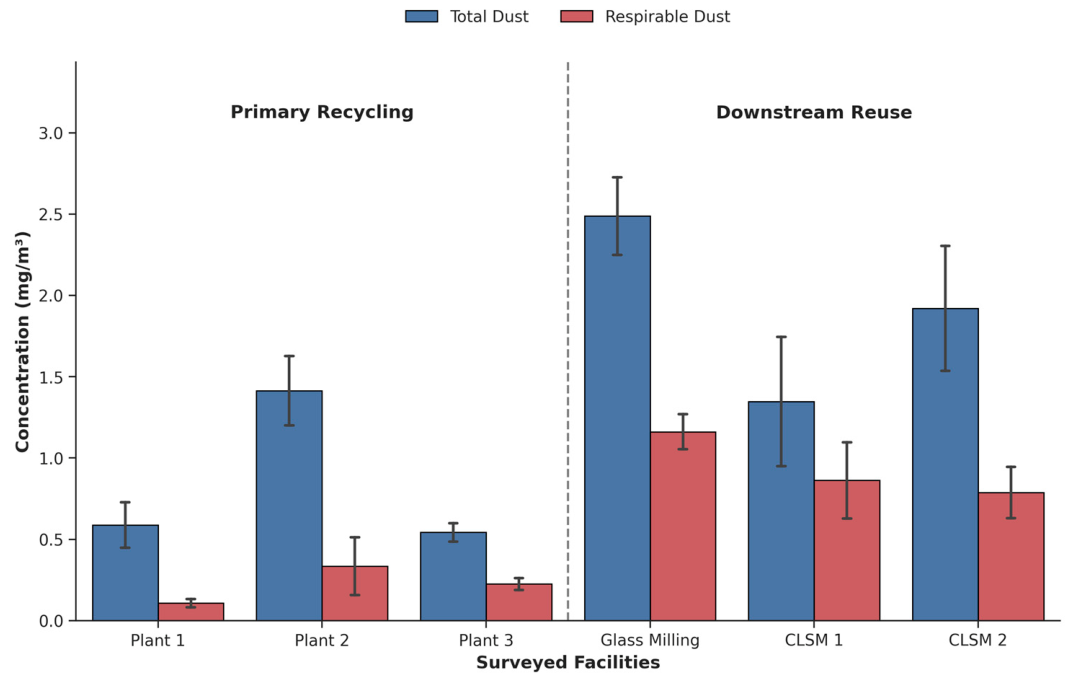
Figure 1 illustrates the distribution of absolute dust concentrations for each facility. In the primary recycling group, the total dust concentrations remained relatively low, ranging from 0.43 to 1.59 mg/m
3, while the respirable dust concentrations fluctuated between 0.07 and 0.59 mg/m
3. These lower concentrations can be attributed to the physical characteristics of the primary coarse crushing processes, which predominantly yielded larger fragments (e.g., 5–10 cm) rather than fine airborne particulates.
Conversely, facilities in the downstream reuse group exhibited markedly elevated dust emissions. The glass milling plant, which employed intensive secondary crushing to produce fine glass sands, recorded the highest total dust concentrations (ranging from 2.15 to 2.78 mg/m3) and respirable dust levels (1.01 to 1.29 mg/m3) among all surveyed sites. Similarly, the controlled low-strength material (CLSM) batching plants, where recycled glass sands were heavily mixed with fine binders such as cement and fly ash, demonstrated substantial dust resuspension, with peak total dust concentrations reaching 2.55 mg/m3.
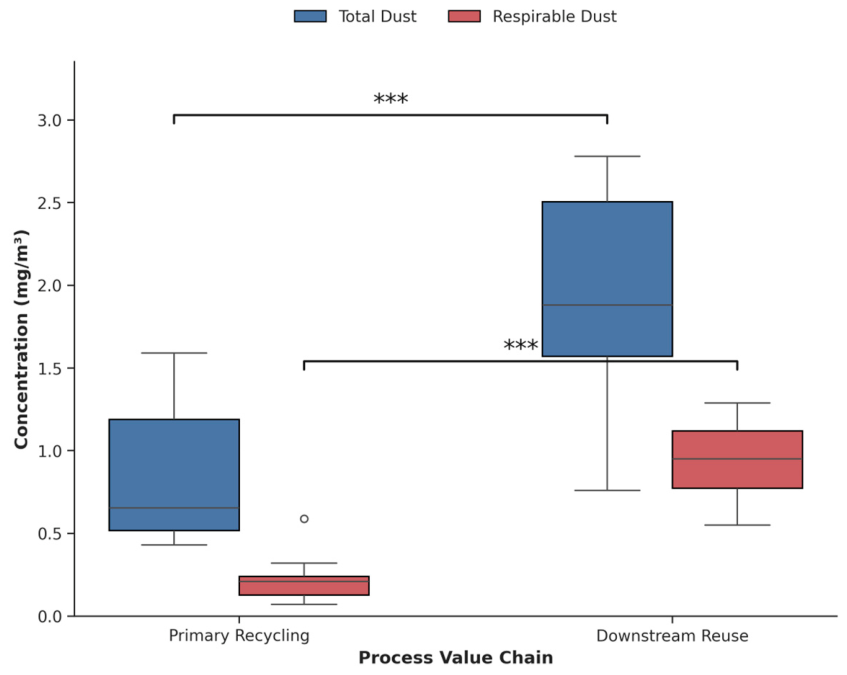
To rigorously assess these observational trends, the facilities were aggregated into two overarching categories: Primary Recycling (n = 12 samples) and Downstream Reuse (n = 14 samples). As depicted in the grouped boxplots (
Figure 2), non-parametric statistical analysis via the Mann–Whitney U test revealed highly significant disparities in dust loading between the two groups. The downstream reuse facilities demonstrated significantly higher concentrations of both total dust (1.95 ± 0.58 mg/m
3 vs. 0.85 ± 0.48 mg/m
3, U = 13.0,
p < 0.001) and respirable dust (0.94 ± 0.23 mg/m
3 vs. 0.22 ± 0.14 mg/m
3, U = 2.0,
p < 0.001) compared to the primary recycling facilities. This quantitative comparison corroborates the hypothesis that downstream processes involving fine milling and the open-air blending of fine secondary materials inherently generate a higher absolute mass of inhalable particulates.
3.2. Shift in Aerodynamic Particle Size Distribution and Respiratory Hazard Transfer
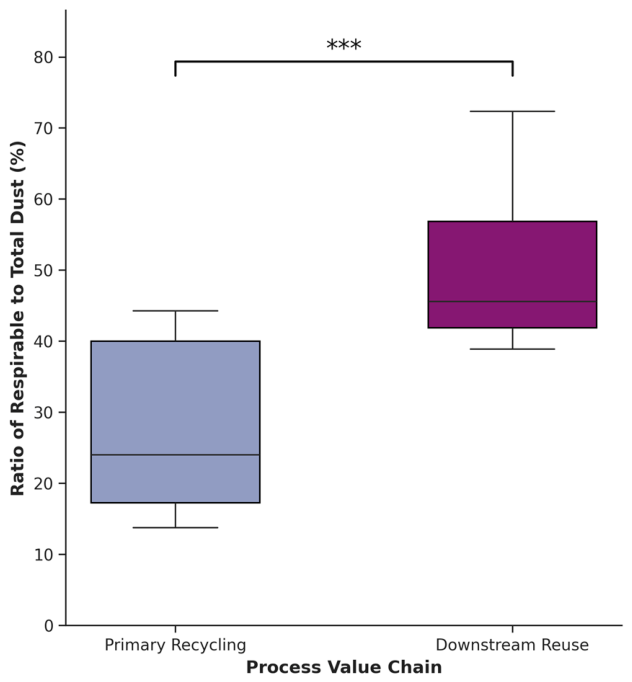
While absolute dust concentrations provide a baseline for environmental loading, the relative proportion of the respirable fraction is a more critical determinant of alveolar penetration and long-term pulmonary risk. To explicitly characterize the shift in aerodynamic particle size distribution across the value chain, the mass ratio of respirable dust to total dust (%) was evaluated for each operational group.
As illustrated in
Figure 3, the primary recycling facilities exhibited a relatively low respirable dust ratio, with a group average of 28.0 ± 12.1%. Despite localized spikes in total dust during certain mechanical dismantling tasks, the particulates generated from the primary coarse crushing of glass, aluminum frames, and encapsulant materials (EVA) were predominantly non-respirable, aerodynamic large particles that are less likely to penetrate the deep lung regions.
In stark contrast, a pronounced shift towards finer particle generation was observed in the downstream reuse facilities. The average respirable dust ratio in this group surged to 49.9 ± 11.8%, representing a highly significant increase compared to the primary recycling group (Mann–Whitney U test, U = 15.5, p < 0.001). This hazardous transfer was particularly evident during the material batching and mixing processes in the CLSM plants, where the intensive blending of fine recycled glass sands with pulverized binders (e.g., cement and fly ash) systematically shifted the particle size distribution towards the respirable range (often exceeding 50%). These findings empirically validate the hypothesis that the respiratory hazard profile intensifies progressively as the recycled PV materials move downstream and undergo intensive secondary processing and open-air material handling.
3.3. Trace Heavy Metal Profiles in the Workplace Atmosphere
The concentrations of the 12 trace heavy metals analyzed (Al, Cr, Mn, Fe, Co, Ni, Cu, Zn, Ag, Cd, Ba, and Pb) were consistently low across all surveyed facilities, remaining orders of magnitude below their respective national and international permissible exposure limits (PELs).
Table 3 summarizes the exposure concentrations of key heavy metals of structural and toxicological interest. Iron (Fe) and Aluminum (Al) were the most abundant elements detected in both the total and respirable dust fractions. This elemental profile fundamentally aligns with the structural composition of crystalline silicon (c-Si) PV modules, where aluminum is extensively used for the peripheral framing. Furthermore, iron is a common trace impurity in the solar cover glass and a product of continuous mechanical wear and abrasion from the heavy crushing and milling equipment.
Crucially, the highly toxic metals of significant occupational health concern, specifically Cadmium (Cd) and Lead (Pb), were found at negligible or non-detectable (ND) levels in the workers’ breathing zones. The absence of significant Cd exposure is attributed to the fact that the domestic end-of-life recycling stream is currently heavily dominated by c-Si modules, rather than thin-film Cadmium Telluride (CdTe) technologies.
Furthermore, while Pb is inherently present in the tin–lead (Sn/Pb) solder ribbons used for solar cell interconnections, the physical nature of the current primary crushing and milling processes mitigates its aerosolization. Unlike glass and silicon, which are brittle and readily fracture into micro-particles, the metallic solder ribbons exhibit high ductility. During mechanical processing, these ductile components tend to deform, elongate, and tear into larger fragments rather than being pulverized into inhalable dust. Consequently, the empirical data suggest that the immediate occupational risk during the current mechanical recycling processes is overwhelmingly driven by the physical hazards of high-mass fine glass and silicon particulates, whereas the chemical toxicity risk from heavy metal inhalation remains low.
4. Discussion
4.1. Cross-Industry Comparison of Total Dust Exposure: Differences from Traditional WEEE and the Construction Industry
The environmental monitoring data from this study revealed that total dust concentrations during the primary recycling of PV modules were relatively low, ranging strictly between 0.43 and 1.59 mg/m
3. This finding presents a stark contrast to the occupational exposure profiles typically associated with the mechanical recycling of traditional waste electrical and electronic equipment (WEEE). Extensive studies on WEEE dismantling facilities have documented that the mechanical shredding of conventional e-waste (e.g., printed circuit boards, plastic casings, and CRTs) frequently generates severe dust emissions, often exceeding 5 to 10 mg/m
3 due to the violent pulverization of brittle resins, fiberglass, and micro-components [
32]. The discrepancy observed in PV primary recycling can be fundamentally attributed to the unique macroscopic structure of crystalline silicon (c-Si) modules. A standard c-Si module is predominantly composed of a robust aluminum frame and a large sheet of tempered glass, which are tightly laminated together by highly ductile ethylene-vinyl acetate (EVA) copolymer resins. The primary crushing process evaluated in this study acts primarily as a volume-reduction step, yielding large structural fragments (typically 5–10 cm). The high ductility of the EVA layer effectively acts as a shock absorber, preventing the catastrophic shattering of the glass into micro-scale aerosols under mechanical stress, thereby maintaining a relatively low and controllable ambient dust baseline in the primary recycling plants.
Conversely, the exposure paradigm shifts drastically in the downstream reuse phase. Facilities engaged in glass milling and controlled low-strength material (CLSM) batching exhibited significantly elevated total dust concentrations, peaking at 2.78 mg/m
3. This elevated exposure profile no longer mirrors the e-waste recycling industry; rather, it closely aligns with the occupational hazards endemic to the traditional construction materials and cement manufacturing sectors. Literature evaluating concrete batching plants and construction aggregate processing has consistently highlighted massive particulate resuspension driven by the handling of fine silica sands and powdered binders [
27]. In the evaluated downstream facilities, the intensive secondary grinding required to convert coarse glass fragments into fine recycled glass sands fundamentally alters the emission dynamics. Furthermore, the open-air blending of these fine glass aggregates with other pulverized materials (e.g., fly ash, bottom ash, and cement), exacerbated by the continuous operation of heavy machinery such as excavators and wheel loaders, inevitably leads to significant secondary dust resuspension. Consequently, our findings suggest that as PV materials move downstream for reuse, their occupational hazard profile transitions from a manageable “e-waste dismantling” context into a highly dispersive “heavy construction material” context. Specifically, the measured dust concentrations across the evaluated facilities were strongly modulated by on-site ventilation and spatial characteristics. Primary Recycling Plants 1 and 2 operate in semi-open buildings relying largely on natural dilution ventilation, which sufficed to maintain a low dust baseline due to the macroscopic fragmentation (5–10 cm) of the PV waste. However, the absence of Local Exhaust Ventilation (LEV) at Plant 2, coupled with its proximity to heavy machinery traffic, resulted in higher ambient concentrations than at Plant 1, which utilized a localized dust collection system. The impact of meteorological and operational factors was most pronounced in the downstream Controlled Low-Strength Material (CLSM) facilities. These open-air batching yards are highly vulnerable to weather conditions, particularly low relative humidity and wind speed, which accelerate the drying and subsequent aerosolization of fine aggregates. Crucially, the continuous operation of heavy machinery—such as excavators and wheel loaders performing stockpile turning and material feeding—exerted a high degree of operational intensity. This mechanical disturbance heavily re-suspended settled dust (pulverized cement, fly ash, and recycled glass sand), creating elevated localized exposure zones independent of industrial background levels.
4.2. Shift in Particle Size Distribution and the “Hazard Transfer” Phenomenon
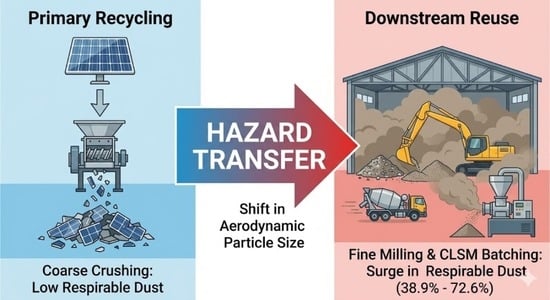
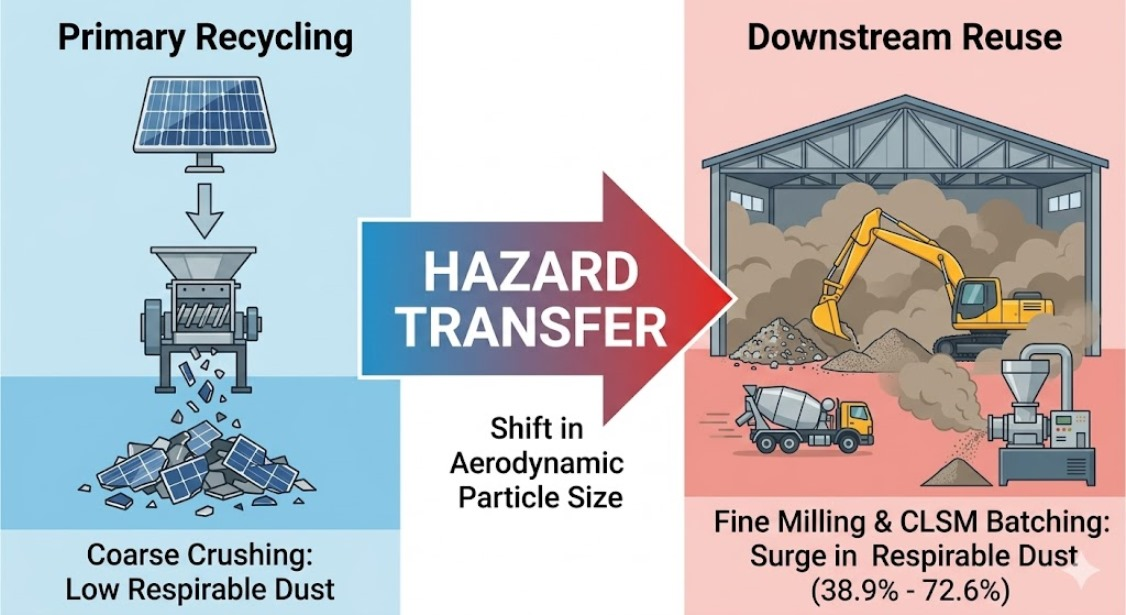
A pivotal finding of this study is the pronounced shift in the aerodynamic particle size distribution across the PV recycling value chain. While the primary recycling facilities generally maintained a lower respirable-to-total dust ratio (typically below 30% for Plants 1 and 2), the downstream reuse facilities exhibited a dramatic escalation, with respirable fractions frequently exceeding 40% and peaking at 72.6% in the CLSM batching operations. This aerodynamic shift toward finer particulates is a direct physical consequence of the downstream valorization processes. To achieve the required material specifications for recycled aggregates, the coarse glass fragments generated during primary dismantling must undergo intensive secondary grinding. Furthermore, in CLSM production, these processed glass sands are vigorously blended with ultra-fine powdered binders such as cement and fly ash. These sequential processes inherently pulverize the materials, systematically increasing the proportion of deeply penetrable alveolar dust.
This dynamic empirically illustrates a critical, yet often overlooked, “hazard transfer” phenomenon within the circular economy framework. Contemporary Life Cycle Assessments (LCAs) and zero-waste initiatives predominantly emphasize the overarching environmental benefits of diverting end-of-life PV modules from landfills and recovering valuable secondary raw materials [
32]. However, these macro-environmental assessments rarely account for the localized occupational exposure burdens generated during the transition. The transformation of a relatively stable, large-format waste (a decommissioned solar panel) into a highly dispersible, respirable powder (recycled fine glass sand) intrinsically amplifies the inhalation risk for the workers handling these secondary materials [
33].
Our empirical data suggest that the pursuit of material circularity inadvertently triggers a downstream hazard transfer. The toxicity risk profile transitions from manageable macro-structural handling and physical hazards at the front-end dismantlers to severe, fine-particulate respiratory hazards at the back-end processors. This necessitates a paradigm shift in how regulatory bodies govern the PV recycling industry. It underscores the urgent need for occupational safety and health (OSH) interventions that extend beyond the primary recycling facilities, demanding stringent, targeted exposure controls for the downstream secondary processing and reuse sectors where the respiratory risks are, paradoxically, the most intense.
4.3. Discrepancy Between Theoretical Heavy Metal Risks and Empirical Occupational Exposure (Pb and Cd)
In the broader context of electronic waste management, end-of-life PV modules are frequently categorized as hazardous waste, primarily due to the potential ecological and health impacts of highly toxic trace metals, notably Cadmium (Cd) and Lead (Pb) [
7]. However, the empirical environmental monitoring across the evaluated facilities revealed a stark divergence from these theoretical toxicity concerns. Both Pb and Cd concentrations in the respirable dust fractions were consistently near or below the detection limits (ND) across all surveyed mechanical processing plants.
The absence of significant Cd exposure is fundamentally a market-driven artifact. While thin-film Cadmium Telluride (CdTe) modules present well-documented Cd exposure risks during thermal or chemical recovery processes, the current domestic recycling stream is overwhelmingly dominated by first-generation crystalline silicon (c-Si) modules, which inherently lack Cd in their cell architecture.
The consistently negligible levels of Pb, however, necessitate a mechanistic explanation based on material physics. In standard c-Si modules, Pb is primarily localized within the tin–lead (Sn/Pb) solder ribbons used for solar cell interconnection. The discrepancy between the presence of Pb in the bulk material and its absence in the respirable air can be attributed to the aerosolization potential of the materials under mechanical stress. According to aerosol generation principles in comminution processes, highly brittle materials, such as tempered glass and silicon wafers, readily fracture and shatter into micro-scale, inhalable dust upon impact [
34]. In stark contrast, the metallic solder ribbons exhibit high macroscopic ductility. During the evaluated primary crushing and secondary milling processes, these ductile metallic components tend to undergo plastic deformation—elongating, bending, and tearing into larger, heavier macroscopic fragments—rather than being pulverized into respirable aerosols (<5 μm).
Consequently, while the Pb content in solar panels poses a substantial environmental leaching risk if improperly landfilled [
35], our empirical data strongly suggest that the immediate occupational inhalation risk during ambient mechanical processing is intrinsically mitigated by the metal’s ductility. This insight is critical for OSH practitioners, indicating that in current mechanical recycling operations, the chemical toxicity risks associated with heavy metal aerosols are largely subordinate to the physical respiratory hazards posed by massive silicate and glass dust exposure.
4.4. Field Observations: Limitations of Engineering Controls and PPE Mismatch
While quantitative exposure assessments provide a snapshot of ambient hazards, field observations regarding the implemented occupational safety and health (OSH) measures reveal systemic vulnerabilities within the current PV recycling sector. Evaluated against the fundamental “Hierarchy of Controls” in occupational hygiene, the current preventive strategies across multiple facilities demonstrate significant limitations [
35].
Regarding engineering controls, the primary recycling facilities frequently operate in semi-open spaces, heavily relying on natural ventilation and general dilution via floor or wall-mounted fans. While this may suffice for coarse crushing where dust generation is minimal, it is fundamentally inadequate for secondary processing. The absence of high-efficiency Local Exhaust Ventilation (LEV) equipped with filtration systems at the emission sources allows finer particulates to inevitably escape into the broader breathing zone. This deficiency is most acutely observed in the downstream CLSM facilities, where the open-air handling, batching, and continuous disturbance of fine recycled glass sands and powdered binders by heavy machinery (e.g., excavators and wheel loaders) circumvent any localized containment efforts. The resulting uncontained secondary resuspension represents a critical failure in engineering containment.
Furthermore, a concerning “PPE mismatch” was universally documented across the evaluated sites. Field inspections revealed that workers predominantly relied on standard surgical or medical masks for respiratory protection and basic cotton gloves for dermal protection. From an aerosol science perspective, surgical masks are designed strictly to intercept large-droplet biological emissions; they lack the structural integrity, electrostatic filtration media, and facial seal required to impede the penetration of fine aerodynamic industrial particulates (<5 μm) [
36]. Consequently, while the ambient dust concentrations may statistically comply with overall regulatory limits, the actual pulmonary deposition for these workers remains poorly mitigated due to the inadequate filtration efficiency and poor fit-factor of surgical masks. To address this gap, employers must mandate the use of NIOSH-certified N95 or P100 filtering facepiece respirators (or international equivalents such as FFP2/FFP3) as the minimum acceptable standard for downstream milling, blending, and material-handling tasks. For operations involving continuous exposure or high-intensity dust generation, elastomeric half-mask respirators equipped with P100 particulate filters are preferred to ensure a higher assigned protection factor (APF).
These field observations underscore an urgent need for industry-wide OSH standardization. To adequately protect workers from the highly penetrable silicate and glass dust generated during downstream processing, it is imperative to mandate the installation of high-efficiency LEV systems and wet-suppression techniques. Concurrently, respiratory protection protocols must be strictly upgraded, transitioning from ineffective medical masks to certified elastomeric half-mask respirators or filtering facepieces rated at N95, FFP2, or higher.
4.5. Limitations and Future Research Directions
While this study provides critical preliminary insights into the occupational exposure profiles of the emerging PV module recycling industry, several limitations must be acknowledged. Primarily, the domestic PV recycling sector is currently in a nascent, developmental phase, preceding the massive wave of decommissioned modules anticipated in the 2030s [
6]. Consequently, the facilities evaluated in this study were frequently operating at partial capacity or undertaking intermittent processing. This current domestic production volume represents a key operational constraint, as the reported exposures reflect low-load processing periods rather than a full-capacity, worst-case scenario under continuous mass commercial production. Chronically, this operational reality also resulted in a very low personal sampling size (e.g., n = 1) for certain specific tasks, notably the downstream milling operator and several CLSM batching operations. The monitored environmental dust and heavy metal concentrations should therefore be interpreted as an early-stage “occupational exposure baseline” rather than worst-case maximum exposure scenarios under continuous, full-scale commercial production. Future longitudinal studies with larger sample sizes and higher operational intensities will be necessary to establish a comprehensive exposure profile as the industry scales up.
Secondly, the technological landscape of the surveyed facilities is currently dominated by primary physical dismantling and coarse crushing. As demonstrated by our findings, the high ductility of metallic components and the macro-scale fragmentation of glass intrinsically mitigate the aerosolization of highly toxic particulates at this specific stage. However, as the industry scales up and strives for higher secondary material purity (e.g., extracting intact silicon wafers or recovering trace silver and copper), operators will inevitably transition towards more aggressive and advanced valorization technologies. The widespread adoption of high-speed fine milling, high-temperature thermal delamination, or chemical leaching will fundamentally alter the emission dynamics, potentially introducing severe occupational risks associated with ultra-fine metallic aerosols, volatile organic compounds (VOCs) from EVA pyrolysis, and acidic vapors [
20].
Furthermore, the pronounced heterogeneity observed across the downstream reuse facilities—particularly the CLSM batching plants, which utilize varying mixtures of secondary aggregates (e.g., fly ash and bottom ash)—complicates the development of a universal exposure model. The synergistic or additive respiratory hazards posed by these complex, multi-source particulate mixtures remain poorly understood.
Given these limitations, future research must adopt a longitudinal approach. It is imperative to conduct continuous occupational exposure surveillance as the PV recycling volume scales up to full capacity. Subsequent studies should proactively characterize the aerosol dynamics and toxicological profiles of emerging advanced separation technologies before their widespread commercial deployment. Ultimately, integrating comprehensive epidemiological surveillance, including routine pulmonary function testing and biological monitoring, will be essential to safeguard the long-term health of this specialized workforce transitioning into the circular economy sector.
5. Conclusions
This study provides a comprehensive occupational exposure assessment of the emerging solar photovoltaic (PV) module recycling and downstream reuse industry in Taiwan. While overall airborne dust concentrations and toxic heavy metal (Pb, Cd) aerosols generally complied with current permissible exposure limits (PELs), the exposure characteristics varied significantly across the value chain. Primary mechanical crushing yields relatively low ambient dust, largely due to the macroscopic ductility of metallic solder ribbons and the shock-absorbing properties of EVA encapsulation, which inherently resist aerosolization into fine inhalable particles.
A critical finding of this research is the empirical identification of a “hazard transfer” phenomenon within the circular economy framework. As recovered materials transition to downstream reuse processes—specifically fine glass milling and Controlled Low-Strength Material (CLSM) batching—the occupational respiratory hazard is significantly amplified. The intensive secondary grinding and open-air blending of fine recycled aggregates systematically shift the aerodynamic particle size distribution, resulting in a dramatic surge in the proportion of deeply penetrable respirable dust (reaching 38.9–72.6% of total dust).
Paradoxically, the pursuit of zero-waste material circularity inadvertently creates a highly dispersive dust environment in the downstream sectors. As the global PV industry approaches a massive decommissioning wave, environmental sustainability must not compromise worker health. Policymakers and industry stakeholders must recognize this downstream hazard shift to ensure a truly safe and sustainable transition to a circular economy.