
Resacralizing the Secular: The Spatial Production and Everyday Appropriation of a Popular Religion Space in Urban China


Abstract
1. Introduction
2. Methodology
2.1. Research Design and Case Background
2.2. Rationale for Case Selection
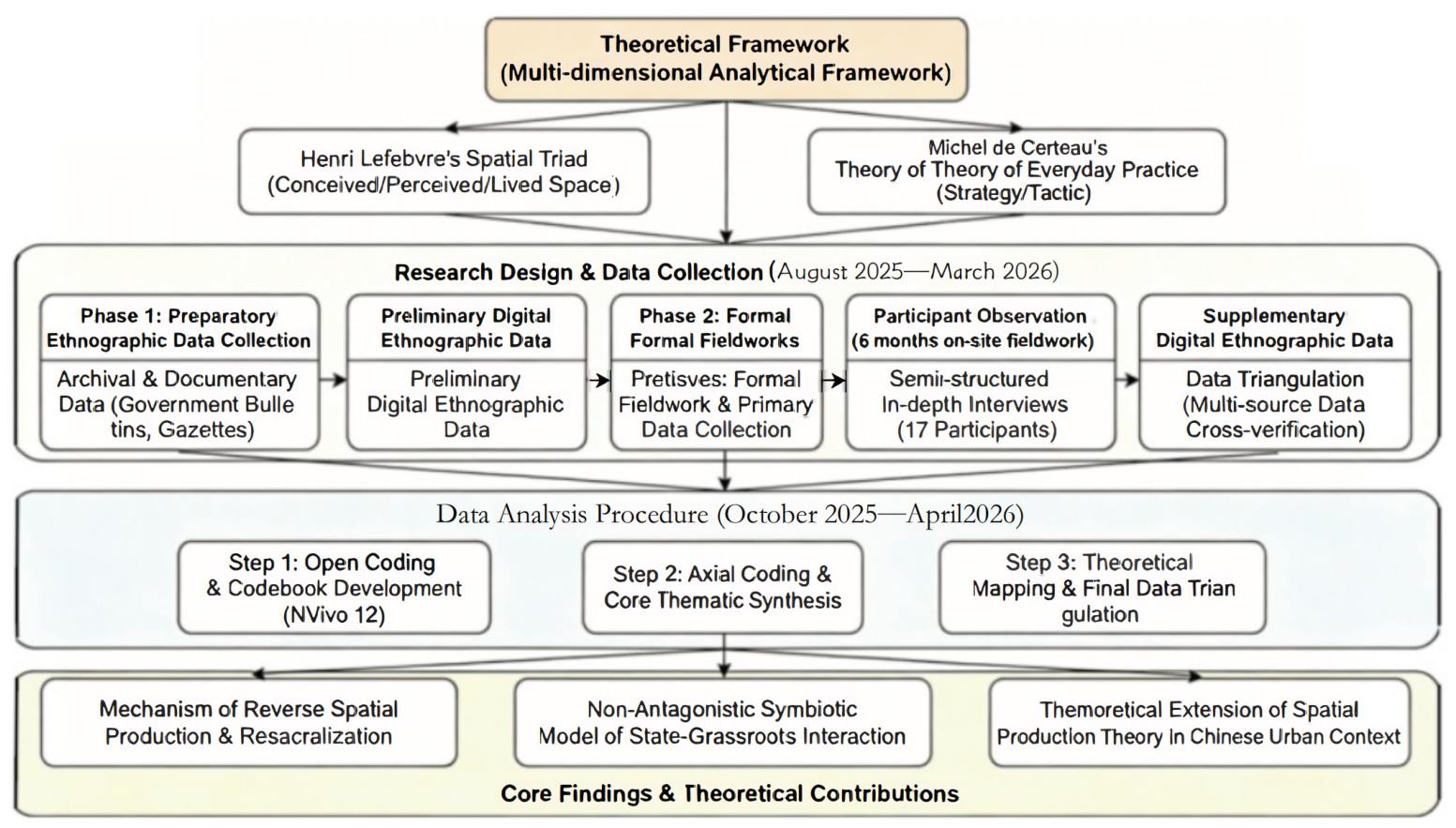
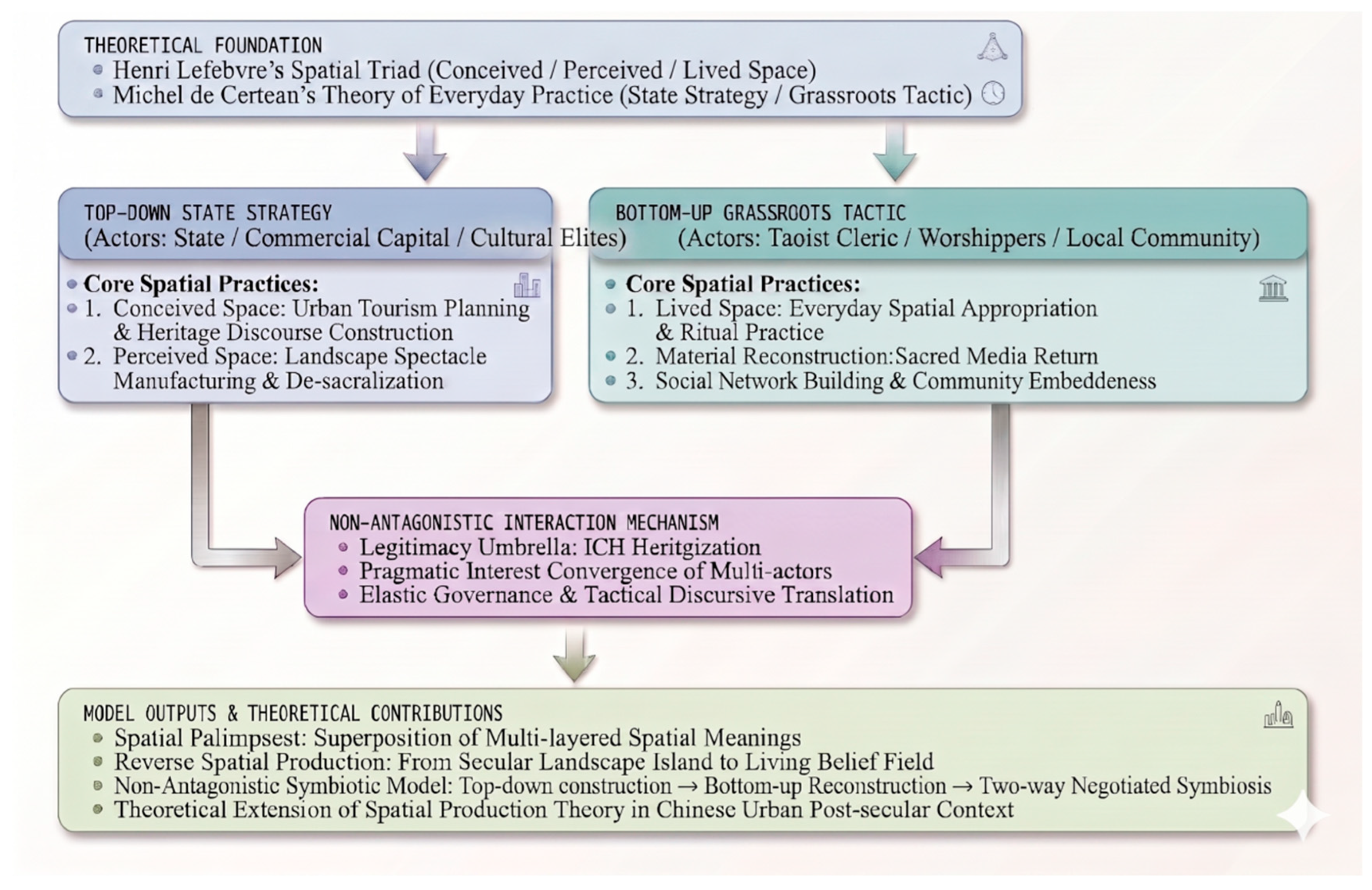
2.3. Theoretical Framework and Operationalization
2.4. Data Collection Methods
2.5. Timeline of Data Collection and Analysis
2.6. Data Analysis Procedures
2.7. Research Ethics and Researcher Positionality
3. The Hegemonic Construction of Space: The Cultural Landscape from the Official Perspective
3.1. Representations of Power in Space: The Logic of State-Led Cultural and Tourism Development
3.2. Deconstruction and Recomposition of Symbols: From Religious Deities to Urban Cultural Icons
Taoist cleric: “Back then, to compete for the ‘UN-Habitat Scroll of Honour Award,’ the government was just ‘striking a pose’ along the canal. They took the original site of the Dawang Temple and built a few rooms… Look at the neighboring Chanzhi Temple; they just built a gate tower, a pier, and a section of wall along the river, but there was absolutely nothing behind it. Not a single room, not even a toilet was built. It was a mere facade. When you travel by boat on the river and see ‘Chanzhi Temple,’ it reminds you of Tang poetry—’How fine the mountain scenery of Chanzhi…’ But there wasn’t a single room inside.”Interviewer: “Isn’t that the poem about Yangzhou’s Chanzhi Temple? ‘Who knew the Zhuxi Road, with singing and playing, was Yangzhou?’”Taoist cleric: “Exactly! It was just for show! It was so when tourists passed by on boats, the tour guides could start their stories. Behind the wall, there wasn’t even a room—just a few pillars. Wasn’t that all just for Yangzhou to strike a pose?”.(Interview, September 2025)
3.3. Engineering the Main Hall Space: Elitist Cultural Conceptions
Interviewer: When the new Dawang Temple was being constructed, were there any references to photos of the original temple?Mr. Li: No, none.Interviewer: I noticed that the main hall of the Baolun Temple was dismantled, and its wooden framework was used for the reconstruction.Mr. Li: At that time, it was conceptualized by experts in Yangzhou’s ancient architecture. Are you familiar with Gu?Interviewer: Yes, we are all very familiar with him.Mr. Li: Led by Gu, a group of ancient architecture experts sat down to deliberate on the architectural styles. This included deciding on the two main statues—who would craft them—as well as the poetic couplets and horizontal plaques. For instance, the inscription “En bei Gan Wu” inside the hall was written by Gu Feng himself in the Great Seal Script.During this period, the interior of the Hangou Dawang Temple exclusively featured statues of the two Kings of Wu, positioned at the center of the hall. The eastern and western walls were adorned with expansive murals: the former depicted Fuchai’s historical feats, such as excavating the Hangou Canal, contending for hegemony in the north, and constructing the Han City; the latter illustrated Liu Bi’s contributions to the regional economy, including boiling seawater for salt and mining mountains for coinage. A single offering table with spirit tablets was placed before the statues.
3.4. Summary: The De-Sacralized Monument Under Official Construction
Aunt Wang: “When Dawang Temple was first completed, there was nothing inside except the two statues of the Kings of Wu. It didn’t really count as a proper temple, so none of us went there to worship. We’d just wander in for a casual look when we had nothing else to do.”(Interview, January 2025)
Taoist cleric: “They used to play cards right at the entrance of the main hall. At night, they would store the card tables inside. Why the entrance? Because the sunlight was good there… These elderly people, once they started playing, they couldn’t even hold their bladders. Before I arrived, people were urinating everywhere around the site. It only started to get better after I began to manage the place.”.(Interview, September 2025)
4. From “Landscape Island” to “Field of Belief”: The Reverse Spatial Production Since 2017
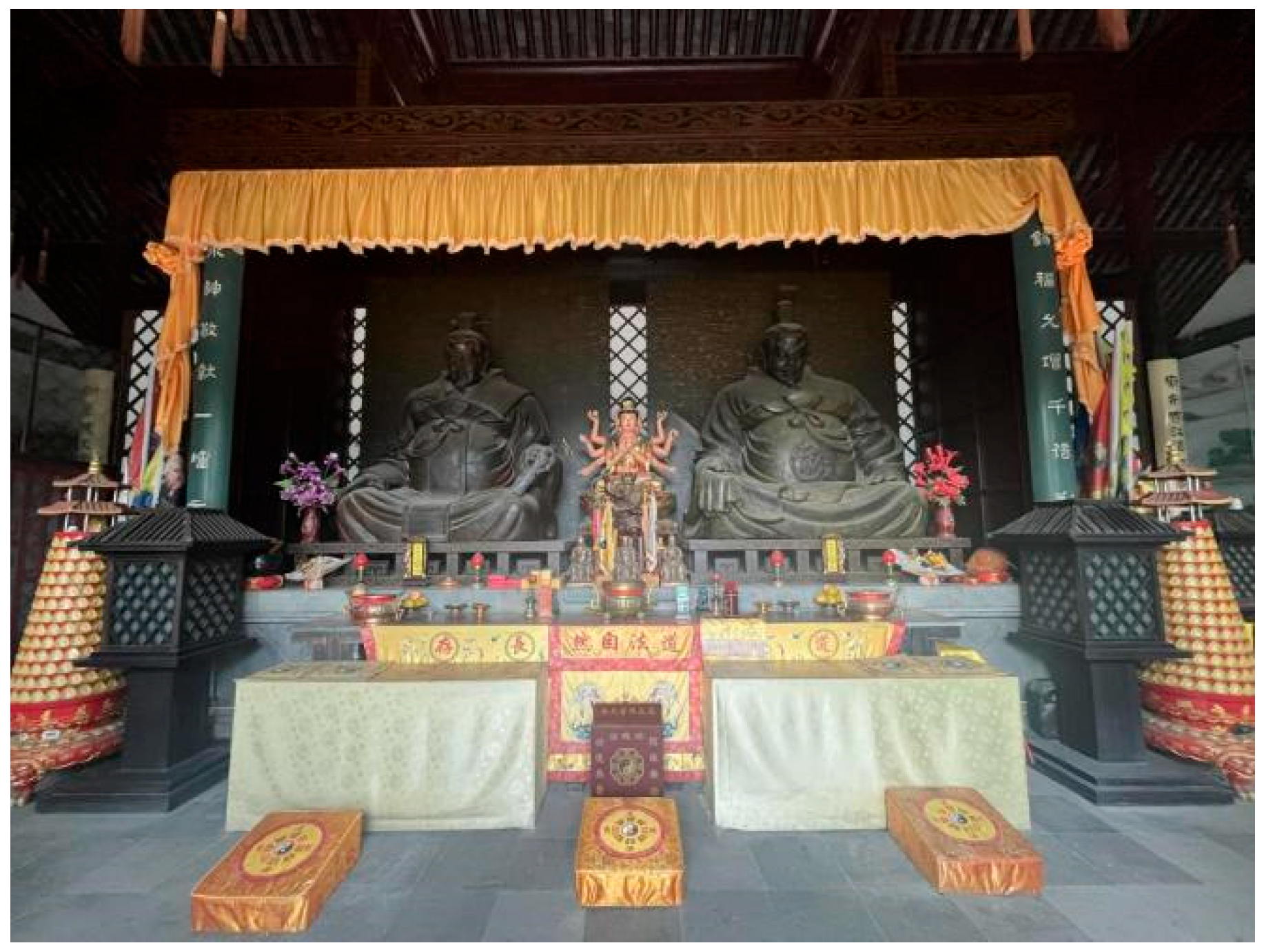
4.1. Agent Intervention and the Return of Material Media: Physical Anchors of Sacredness
Youth: So I think the Master’s charisma is really, really strong. You know, if someone else took over—if someone else were the abbot of Dawang Temple—though actually, there’s technically no official abbot role at the temple at all, right? Because Master Ma is the only cleric there. If it were run by anyone else, any other person, I really don’t believe this belief tradition could be properly sustained.If that were to happen, sooner or later this place would lose its original character. It’d end up just like Daming Temple, right? Or become something no different from a museum.
4.2. Non-Antagonistic Symbiosis: The Confluence of Official Heritage and Popular Belief
5. Conclusions
Funding
Institutional Review Board Statement
Informed Consent Statement
Data Availability Statement
Conflicts of Interest
References
- Ai, S., Zhang, N., Li, H., Wang, B., & Li, L. (2018). Local context, collective negotiation, and the production of religious space: A case study of the reconstruction of mosques for scattered Hui residents. Nationalities Research in Qinghai, 29(3), 188–195. (In Chinese) [Google Scholar] [CrossRef]
- American Anthropological Association [AAA]. (2012). Statement on ethics. Available online: https://ethics.americananthro.org/ethics-statement-0-preamble/ (accessed on 1 July 2026).
- Ammerman, N. T. (2015). Lived religion. In R. A. Scott, & S. M. Kosslyn (Eds.), Emerging trends in the social and behavioral sciences. Wiley. [Google Scholar] [CrossRef] [Scilit]
- Braun, V., & Clarke, V. (2006). Using thematic analysis in psychology. Qualitative Research in Psychology, 3(2), 77–101. [Google Scholar] [CrossRef] [Scilit]
- Brenner, N., & Elden, S. (2009). Henri Lefebvre on state, space, territory. International Political Sociology, 3(4), 353–377. [Google Scholar] [CrossRef] [Scilit]
- Chau, A. Y. (2008). Miraculous response: Doing popular religion in contemporary China. Stanford University Press. [Google Scholar]
- Chaves, M. (1993). Denominations as dual structures: An organizational analysis. Sociology of Religion, 54(2), 147–169. [Google Scholar] [CrossRef] [Scilit]
- Chen, W., Liu, B., & Liu, J. (2003). Returning to nature, developing the city, promoting culture, and creating life: Planning and design of the eastern bank scenic belt of the Yangzhou ancient canal. Archicreation, (7), 98–103. (In Chinese) [Google Scholar]
- Compiling Committee of Chengbei Township Gazetteer (Ed.). (2025). Chengbei township gazetteer. Guangling Shushe. (In Chinese) [Google Scholar]
- Corbin, J., & Strauss, A. (2015). Basics of qualitative research: Techniques and procedures for developing grounded theory (4th ed.). SAGE Publications. [Google Scholar]
- de Certeau, M. (1984). The practice of everyday life (S. Rendall, Trans.). University of California Press. [Google Scholar]
- Denzin, N. K. (1978). The research act: A theoretical introduction to sociological methods (2nd ed.). McGraw-Hill. [Google Scholar]
- Fang, L. (2002, May 22). Doing a good job on the ancient canal: Reflections on achieving great development and breakthroughs in Yangzhou’s tourism industry. People’s Daily Overseas Edition. p. 6. (In Chinese)
- Feng, L. (2011). Public identity and choice of reconstructed cultural spaces: Changes in cultural traditions after the renovation of Dawang Temple in Nianbadu Town. Shandong Social Sciences, (11), 69–71+89. (In Chinese) [Google Scholar] [CrossRef]
- Guo, T., Xiao, D., & Duan, L. (2008, April 10). Ancient canal: The spiritual bloodline of new Yangzhou’s development. Modern Water Conservancy Weekly. Available online: https://www.chinawater.com.cn/ztgz/hy/rshxkyz/200804/t20080411_122271.htm (accessed on 22 April 2026). (In Chinese)
- Guo, W. (2019). Localized production of sacred space, differentiation of resident identity, and everyday resistance: A case study of Qingkou Hani village in southwest China. Tourism Tribune, 34(6), 96–108. (In Chinese) [Google Scholar] [CrossRef]
- Han, L., & Ming, Q. (2020). A study on the modernity dilemma of the spatial production of traditional religious ritual space of the Jingpo nationality. Human Geography, 35(5), 44–51+110. (In Chinese) [Google Scholar] [CrossRef]
- He, X., Zhao, Y., Jiang, X., Pei, J., & Yin, W. (2002). Ecological landscape construction planning for the Yangzhou ancient canal scenic belt. Journal of Yangzhou University, (3), 74–78. (In Chinese) [Google Scholar] [CrossRef]
- He, Z., & Meng, X. (2024). Ritual, Daoist temple, and geography: Spatial interpretation of Wang Lingguan’s belief. Religions, 15(3), 305. [Google Scholar] [CrossRef] [Scilit]
- Hellawell, D. (2006). Inside-out: Analysis of the insider-outsider concept as a heuristic device to develop reflexivity in students doing qualitative research. Teaching in Higher Education, 11(4), 483–494. [Google Scholar] [CrossRef] [Scilit]
- Hervieu-Léger, D. (2002). Space and religion: New approaches to religious spatiality in modernity. International Journal of Urban and Regional Research, 26(1), 99–105. [Google Scholar] [CrossRef] [Scilit]
- Hine, C. (2015). Ethnography for the internet: Embedded, embodied and everyday. Bloomsbury Academic. [Google Scholar]
- Hu, M. (2006, October 5). Yangzhou received the ‘UN-Habitat Scroll of Honour Award’ plaque yesterday. Yangzhou Daily. p. 1. (In Chinese)
- Huang, M. (2005, November 5). The large-scale remediation of the Yangzhou section of the ancient canal. CPPCC Daily. p. 3. (In Chinese)
- Kilde, J. H. (2013). Approaching religious space: An overview of theories, methods, and challenges in religious studies. Religion and Theology, 20(3–4), 183–201. [Google Scholar] [CrossRef] [Scilit]
- Knott, K. (2008). Spatial theory and the study of religion. Religion Compass, 2(6), 1102–1116. [Google Scholar] [CrossRef] [Scilit]
- Knott, K. (2010). Religion, space, and place: The spatial turn in research on religion. Religion and Society, 1(1), 29–43. [Google Scholar] [CrossRef] [Scilit]
- Knott, K. (2015). The location of religion: A spatial analysis. Routledge. [Google Scholar] [CrossRef] [Scilit]
- Lefebvre, H. (1991). The production of space (D. Nicholson-Smith, Trans.). Blackwell. [Google Scholar]
- Li, Z. (2020). Cong Fang Junyi “Chongjian Hangou Wangmiao beiji” kaoxi Hangou Dawangmiao de xingfei [Analyzing the rise and fall of the Hangou Dawang Temple from Fang Junyi’s “Record of the reconstruction of the Hangou Wang Temple”]. Dang’an yu jianshe, (7), 71–74. [Google Scholar]
- Lu, W. (2012). Regional social development of Yangzhou in a global perspective. Social Sciences Academic Press. (In Chinese) [Google Scholar]
- Meyer, B. (2006). Religious sensations: Media, aesthetics, and the anthropological study of religion. London School of Economics and Political Science. [Google Scholar]
- Mu, L. (2022). A study on place-making and tourists’ authenticity experience of ‘ancient’ town tourism from the perspective of spatial production [Doctoral dissertation, Sichuan University]. (In Chinese) [Google Scholar] [CrossRef]
- Paper, J. (2020). Chinese religion and familism: The basis of Chinese culture, society, and government. Bloomsbury Academic. [Google Scholar] [CrossRef] [Scilit]
- Patton, M. Q. (1999). Enhancing the quality and credibility of qualitative analysis. Health Services Research, 34(5), 1189–1208. [Google Scholar] [PubMed]
- Patton, M. Q. (2015). Qualitative research & evaluation methods: Integrating theory and practice (4th ed.). SAGE Publications. [Google Scholar]
- People’s Government of Yangzhou Suburbs (Ed.). (1997). Gazetteer of Yangzhou suburbs. Fangzhi Press. (In Chinese) [Google Scholar]
- Pink, S., Horst, H., Postill, J., Hjorth, L., Lewis, T., & Tacchi, J. (2016). Digital ethnography: Principles and practice. SAGE Publications. [Google Scholar]
- Rose, G. (1997). Situating knowledges: Positionality, reflexivities and other tactics. Progress in Human Geography, 21(3), 305–320. [Google Scholar] [CrossRef] [Scilit]
- Scott, W. R. (2017). Institutional theory: Onward and upward. In The SAGE handbook of organizational institutionalism (pp. 853–871). SAGE. [Google Scholar]
- Urry, J., & Larsen, J. (2011). The tourist gaze 3.0. Sage Publications. [Google Scholar]
- Van Maanen, J. (2011). Tales of the field: On writing ethnography (2nd ed.). University of Chicago Press. [Google Scholar]
- Wang, K. (2007). Promoting Yangzhou’s canal culture and building Yangzhou’s ‘canal tour’. Tourism Research, (2), 187–190. (In Chinese) [Google Scholar]
- Wang, X. (2023). Making religion, making the city: Religion and urban formation in modern China. Archiv für Religionsgeschichte, 25(1), 179–193. [Google Scholar] [CrossRef] [Scilit]
- Weiyang District Bureau of Culture and Education. (2009). Jiangsu sheng feiwuzhi wenhua yichan pucha Weiyang qu ziliao huibian (shang) [Compilation of materials from the Weiyang District intangible cultural heritage census of Jiangsu province (Vol. 1)]. self-published; Weiyang District Bureau of Culture and Education.
- Xu, Y., & Zhou, S. (2026). From “Canal God” to “God of Wealth”: Evolution and cultural adaptation of the Hangou Dawang belief in the Ming and Qing dynasties. Jiangsu Local Chronicles, (2), 73–76. [Google Scholar]
- Yangzhou Intangible Cultural Heritage Protection Association. (n.d.). Legends of the Hangou Dawang Temple. Available online: http://www.yzfyzx.com/nd.jsp?id=31 (accessed on 22 April 2026). (In Chinese)
- Yangzhou Municipal People’s Government. (2006). 2006 Yangzhou municipal people’s government work report. Available online: https://www.doc88.com/p-4731617783563.html (accessed on 22 April 2026). (In Chinese)
- Yangzhou Taoist Association. (2017, September 28). The Dawang Temple was officially placed under the trusteeship of the municipal Taoist association. Available online: http://www.yzdjxh.com/article/show_article.php?id=257 (accessed on 22 April 2026).
- Yin, R. K. (2018). Case study research and applications: Design and methods (6th ed.). SAGE Publications. [Google Scholar]
- Zhang, N., Ai, S., Li, H., & Cao, J. (2019). Religious elites, power reconstruction, and the local construction of religious space production in Hui communities: A case study of the reconstruction of Jiaoping village mosque. In C. Miao (Ed.), Yellow River civilization and sustainable development (Vol. 15, pp. 115–128). Henan University Press. (In Chinese) [Google Scholar]
- Zhang, X., & Li, X. (2016). Spatial politics in the revival of popular religion: A study of Longmu belief in City A, Guangdong province. Guangxi Social Sciences, (8), 130–135. (In Chinese) [Google Scholar]
- Zhu, Y. (2024). Contested sacred space: State power, spatial politics, and heritage tourism. Tourism Geographies, 1–25. [Google Scholar] [CrossRef] [Scilit]


Disclaimer/Publisher’s Note: The statements, opinions and data contained in all publications are solely those of the individual author(s) and contributor(s) and not of MDPI and/or the editor(s). MDPI and/or the editor(s) disclaim responsibility for any injury to people or property resulting from any ideas, methods, instructions or products referred to in the content. |
© 2026 by the author. Licensee MDPI, Basel, Switzerland. This article is an open access article distributed under the terms and conditions of the Creative Commons Attribution (CC BY) license.
Share and Cite
Xu, Y. Resacralizing the Secular: The Spatial Production and Everyday Appropriation of a Popular Religion Space in Urban China. Humans 2026, 6, 23. https://doi.org/10.3390/humans6030023
Xu Y. Resacralizing the Secular: The Spatial Production and Everyday Appropriation of a Popular Religion Space in Urban China. Humans. 2026; 6(3):23. https://doi.org/10.3390/humans6030023
Chicago/Turabian StyleXu, Yongpeng. 2026. "Resacralizing the Secular: The Spatial Production and Everyday Appropriation of a Popular Religion Space in Urban China" Humans 6, no. 3: 23. https://doi.org/10.3390/humans6030023
APA StyleXu, Y. (2026). Resacralizing the Secular: The Spatial Production and Everyday Appropriation of a Popular Religion Space in Urban China. Humans, 6(3), 23. https://doi.org/10.3390/humans6030023