1. Introduction
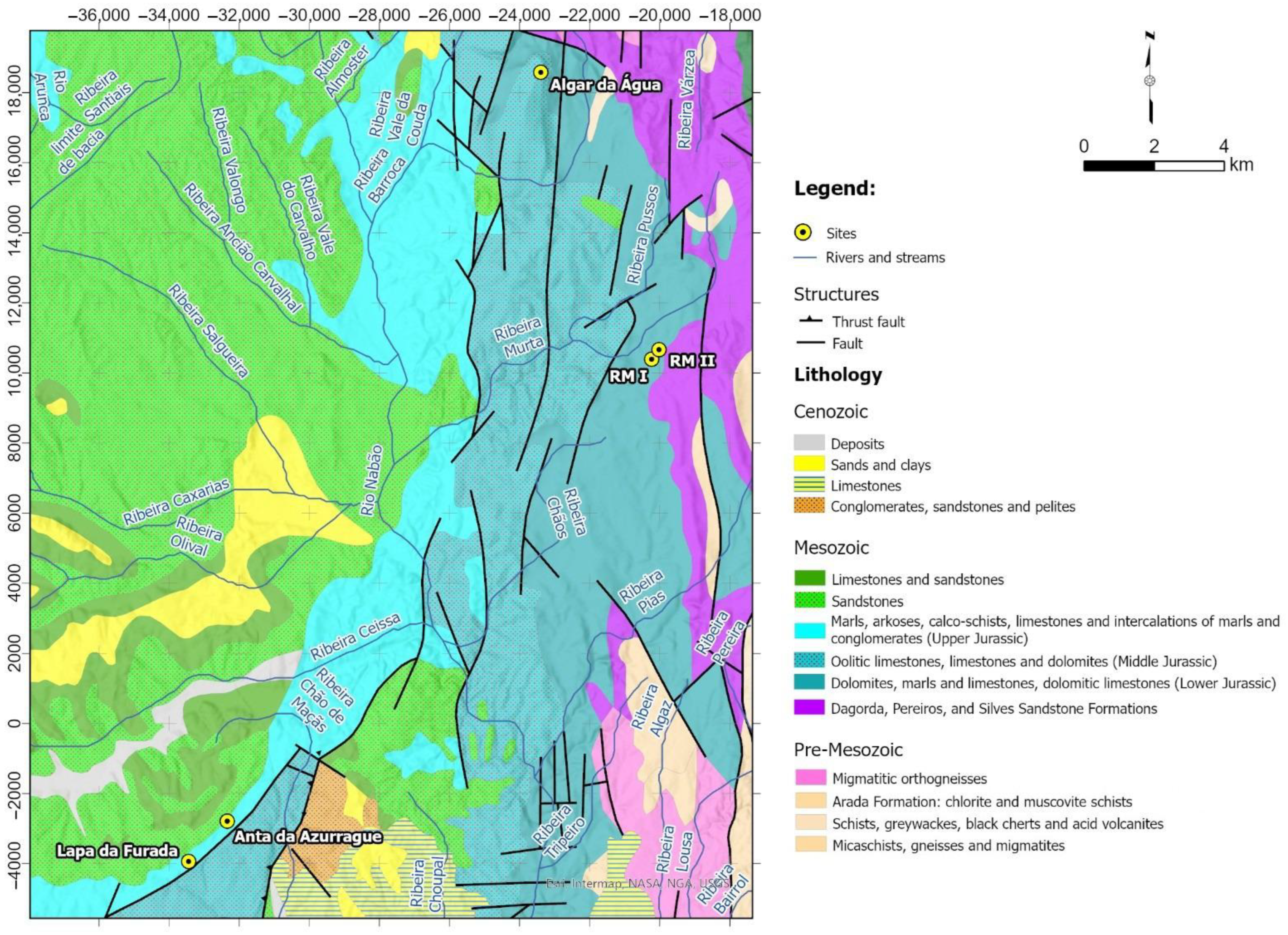
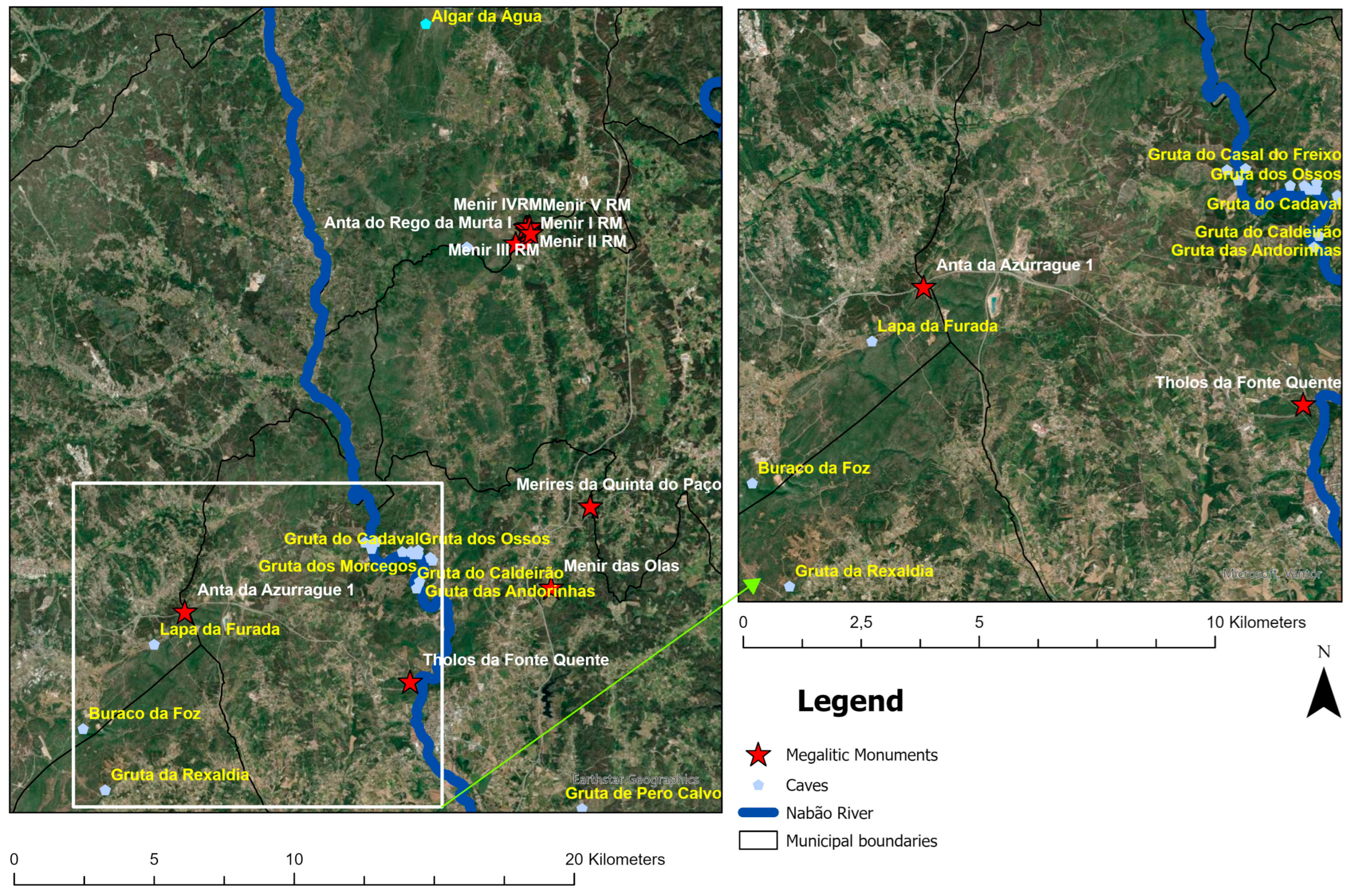
The relationship between megalithic monuments, the landscape, and cave cults is central to the study of the Azurrague 1 dolmen, located in the parish of Alburitel, Ourém. This work is developed within the framework of the MEDICE II project (Memories, Dynamics, and Scenarios from Prehistory to the Classical Era), approved by the Public Institute of Cultural Heritage, with a four-year duration running until 2027. The project involves a multidisciplinary team composed of more than 20 PhD researchers and is coordinated by the Polytechnic Institute of Tomar, the Autonomous University of Lisbon, and the NGO CAAPortugal, in collaboration with several national and international institutions in order to achieve its research objectives. This site is one of several funerary constructions in central Portugal and highlights the strong connection between ritual spaces in dolmens and in caves, particularly in relation to the Nabão River and the karstic geo-logy that characterizes the region (
Figure 1). The importance of the site lies in the presence of a dolmen within a landscape where the most frequent cultic contexts identified archaeologically are caves, still poorly documented in this municipality but extensively studied in neighboring areas (
Zilhão, 1992,
1993,
2000;
Oosterbeek, 1993a,
1993b,
1994,
1999,
2021;
Cruz, 2000,
2010;
Mateus & Queiroz, 2012;
Figueiredo, 2017,
2019a,
2019c;
Andrade & Van Calker, 2024).
The Portuguese Estremadura, set within a karstic limestone massif, presents a diversity of ritual practices and considerable structural heterogeneity, as noted by several researchers (
Figueiredo, 2007;
Cruz, 2010;
Carvalho et al., 2012;
Andrade & Van Calker, 2024;
Figueiredo & Monteiro, 2025b;
Van Calker, 2025). In addition to natural cavities, the Neolithic and Chalcolithic archaeological record includes hypogea (artificial caves) and, to a lesser extent, megalithic dolmens of different typologies. Among these, two main architectural types stand out in the northeastern Estremadura: monuments with simple circular-plan chambers, more common in the southern areas (
Andrade & Van Calker, 2024), and passage grave, which present an internal organization with differentiated spaces, such as higher chambers and lower passages, well defined in the areas associated with the Nabão River and its tributaries (
Figueiredo, 2021). The coexistence of these monuments with cave contexts, whether through very close spatial proximity or through chronologies that can be considered contemporary, suggests different architectural and ritual solutions within the symbolic framework associated with funerary deposition. The presence of materials with similar characteristics, such as macrolithic objects (quartzite artefacts knapped or shaped on large cores or flakes) in both contexts, reinforces this interpretation and supports the hypothesis that these practices were carried out by the same groups.
Research conducted in 2024 and 2025 at Azurrague 1 aimed to characterize the ritual practices associated with the monument and, subsequently, to understand how prehistoric communities interacted with the dynamics observed in the caves. Neighboring regions further north were studied with the same objective, allowing analogies to be drawn, particularly with the Rego da Murta Megalithic Complex (
Figueiredo, 2007,
2019b,
2021;
Figueiredo & Monteiro, 2025a,
2025b).
East of the study area, the lithology is different, dominated by schist, which does not allow the formation of natural caves. This characteristic helps situate the Nabão region, within the karstic zone of Portuguese Estremadura, as a transitional area that is essential for understanding the adoption of these practices in a territory where cavities dominate the archaeological record.
This article presents preliminary data of Azurrague 1 dolmen which, although recent, already provide relevant insights that justify discussion within the scientific community.
2. Megalithic Context in a Karstic Area near Nabão River
The Azurrague 1 Dolmen is located in the municipality of Ourém, in a territory marked by the presence of rock shelters and sinkholes. In the surrounding area, another megalithic monument is described, mentioned in 1884 in the newspaper “O Elvense” (
Batata, 1997, pp. 158–159), known as the Mesa dos Ladrões, which is said to have been destroyed by a quarry. There is also a reference, in heritage authority records, to a dolmen called Seara da Serra, situated relatively close to what is considered the area of the Mesa dos Ladrões. Neither of these monuments was identified during the surveys conducted but based on the description of the Mesa dos Ladrões, we assume it corresponds to the Azurrague 1 Dolmen, as the account mentions a large hole in one of the slabs, an uncommon feature that is present in one of the orthostats of the monument under study.
A little farther north, connected to a tributary of the Nabão, lies the Rego da Murta Megalithic Complex (
Figueiredo, 2007,
2019a,
2019b,
2021;
Figueiredo & Monteiro, 2025a), composed of several monuments investigated over the past decades, as well as the menhirs of Quinta do Paço (
Caron & Freitas, 2005), the latter located further east. A small cromlech can also be observed near the town of Alvaiázere, though it has not yet been studied. In the same municipality, three additional dolmens are mentioned, whose current locations are unknown, or which have already been destroyed, two at Penedos Altos and one at Cabreira (
Figueiredo, 2007, p. 342).
Southeast of the Azurrague 1 Dolmen, close to the Zêzere River, lies the site of Vale da Laje, where essentially one monument remains, excavated in the late twentieth century (
Oosterbeek, 1997). Associated with this dolmen are handmade ceramics, including red-slipped vessels and carinated containers, blades, bladelets, geometric microliths and flint arrowheads, as well as polished and macrolithic quartzite artefacts (
Oosterbeek, 1997). To the south, in the municipality of Alcanena, there is a reference to a dolmen known as Fonte da Moreira (
Oosterbeek, 1994, p. 421;
Andrade & Van Calker, 2024), whose exact location is also unknown. Excavations at this latter monument took place in 1909, and the finds were placed in custody of the Ethnological Museum. Among the materials recently reexamined (
Andrade & Van Calker, 2024), key elements recorded in the original excavation inventories were found to be missing, including human bones, a leaf-shaped copper point, and ceramic fragments (
Andrade & Van Calker, 2024, pp. 10–18). It is likely that many other items have also been lost. The remaining assemblage includes several polished tools (axes and adzes), some flint blades and flakes, and a quartzite blade that may be classified as macrolithic.
There are therefore few documented sites in the Nabão area that can serve as an effective comparative basis for Azurrague 1. By focusing the analysis of this article on the local karstic megalithic context, the Rego da Murta Megalithic Complex, located in Alvaiázere along the Nabão tributary known as the Ribeira de Rego da Murta, constitutes the most suitable nucleus for developing comparative studies with the Azurrague 1 Dolmen. This complex is one of the most significant in the region, positioned between the Nabão and the Zêzere, and includes a total of fourteen monuments (
Figueiredo, 2021), comprising dolmens, menhirs (
Figueiredo, 2013), rock art panels, and atypical structures that do not appear to have a specific funerary function. It has been suggested that the organization of this nucleus is not random but is instead articulated with other existing elements, both in relation to landscape features such as the stream or local topography, and through associations with other monuments or even specific constellations (
Figueiredo et al., 2018), thus integrating the perception of the sky and landscape within the cosmological framework of these groups. Among the dolmens, two monuments stand out: Dolmen I and Dolmen II of Rego da Murta, which were extensively excavated in the first decade of the twenty-first century. They are particularly relevant due to the preservation of their contexts, which revealed a succession of actions, depositions, and reutilizations (
Figueiredo, 2021, p. 55).
In architectural terms, the morphological configuration of the Azurrague 1 Dolmen is like Dolmen I of Rego da Murta, presenting a raised chamber and a short, relatively low passage. Archaeological objects recovered from this site include several ceramic forms, totaling 243 fragments, with a minimum of 40 distinct vessels; 382 flakes or small cores in flint and quartzite; 138 blades and bladelets in flint, one of them in hyaline quartz; three polished objects, including an axe, a polisher and a chisel; thirty-three arrowheads of different typologies; adornment items such as pendants and beads in variscite and schist, amounting to 52 elements; an anthropomorphic-type plaque in undecorated schist and another in limestone; and nine bone artefacts, including a V-perforated button (
Figueiredo, 2007,
2021).
Dolmen II is a passage grave, though exhibiting some distinct particularities. The orthostats are not markedly elevated and lean against one another through slight overlapping, without creating a significant spatial distinction between the corridor and the chamber, as is the case with Azurrague. A total of 635 ceramic fragments were recovered, mostly undecorated. Those that bear decoration fall into the impressed or comb-incised categories, with examples of Boquique and Bell Beaker motifs. Some fragments of red-slipped vessels were also found. Fifty-four vessels were identified in total, mostly spherical, as well as simple or carinated truncated-conical containers. A significant assemblage of arrowheads, 174 in total, was recovered, concentrated mainly in the chamber. The polished tools were more evident in the passage, close to the walls, including several axes and adzes and a variety of polishers and grinding stones. Other objects include forty-five blades and bladelets in flint and quartzite, about 150 small flakes and cores in flint and quartzite, flint microliths, a decorated schist plaque, thirty-four macrolithic quartzite artefacts (cores and large flakes), more than ten halberds, and four copper objects, including a small blade, a pendant, a bead and a small awl. More than 250 beads made of variscite, chrysoprase and schist were identified, along with a pendant in an undetermined green stone and two bone buttons of the loop type (
Figueiredo, 2007). During the Early Chalcolithic, cleaning and maintenance of the space were observed at this site, including the construction of a slab pavement in the chamber (
Figueiredo, 2021). Burials were deposited in pits sealed by small stone structures. The depositional pattern, involving disarticulated sets of human bones from several individuals covered by a stone structure, is similar to what is observed in the final phase of Gruta dos Ossos (
Oosterbeek, 1993a;
Cruz, 2010), which is chronologically the closest to the megalithic monuments mentioned.
In addition to megalithic monuments, funerary cults are also associated with deposition in caves. Near the Rego da Murta Megalithic Complex is the Algar da Água, a cavity located about eight kilometers away and presenting an occupation extending from the Early Neolithic to the Early Middle Ages (
Figueiredo, 2019c), with traces of funerary deposition from the Neolithic to the Middle Bronze Age. The contexts were heavily disturbed, making it impossible to observe a depositional pattern, whether similar or not to that recorded at Dolmen II of Rego da Murta or at Gruta dos Ossos (
Oosterbeek, 1993a). The artefacts include more than one hundred ceramic fragments from plain, mostly spherical vessels, around twenty bladelets and blades in flint, flakes and cores in flint and quartzite. A large limestone axe with traces of use and a small granite grinding stone were also recovered (
Figueiredo, 2019a). Some macrolithic objects were recorded in the earliest layers. However, the disturbance of the prehistoric contexts did not allow for a clear identification of the actions that produced them. Although a monograph has been published (
Figueiredo, 2019a), a detailed study of the artefacts is still lacking, which would allow for a clearer understanding of the depositional contexts and their chronological associations.
Within the municipality of Alvaiázere, no other caves with burials attributed to the period under study are known. However, several cavities are being investigated around Azurrague 1 Dolmen. The closest are Lapa da Furada and Buraco da Foz, currently under study and not yet published. At Lapa da Furada, plain ceramics and macrolithic artefacts have been identified, while at Buraco da Foz a variety of artefacts have been observed, including flakes, blades and bladelets in flint, microliths, plain ceramics and concave-based arrowheads, associated with human and faunal bones.
3. Azurrague 1 Dolmen
The excavation campaigns at the Azurrague 1 Dolmen revealed a significant set of material and bioanthropological evidence that allows for a preliminary interpretation of the ritual practices, occupation, and chronology of this megalithic monument located in the northeast of Estremadura.
Structurally, the monument corresponds to a small limestone dolmenic construction, whose architectural configuration reflects the typical solutions adopted by local communities in regions where this lithology predominates (
Oosterbeek, 1997;
Figueiredo, 2007;
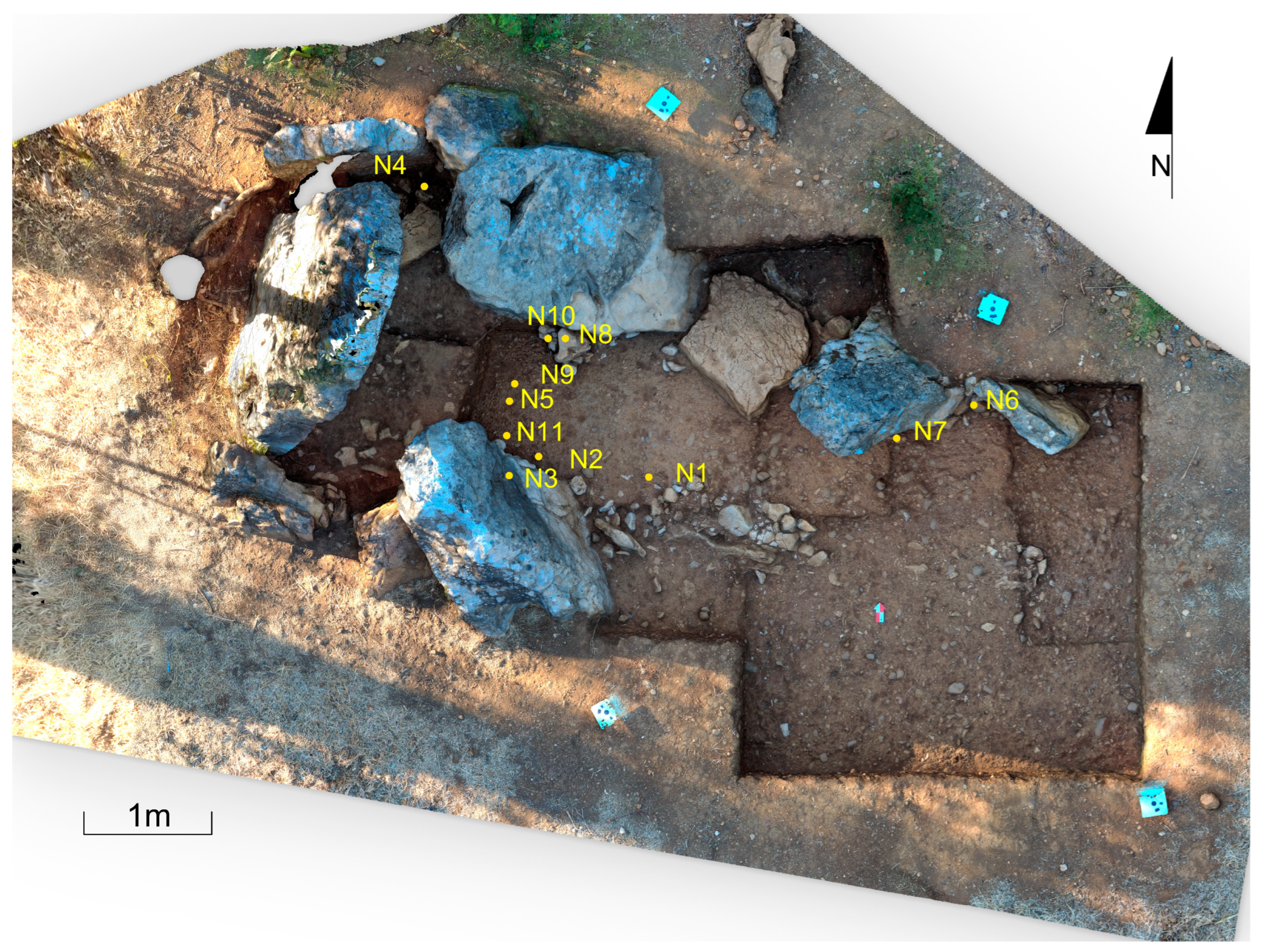
Andrade & Van Calker, 2024). The chamber is formed by seven orthostats arranged in a subcircular plan and set directly into the substrate, with slight back-support, presenting low elevation and a tendency for partial overlapping at their contact points. This construction technique, based on the juxtaposition of irregular blocks rather than the erection of large, deeply embedded slabs, is also consistent with documented structural patterns. The orthostats display natural irregularities and fractured surfaces, characteristic of the mechanical behavior of local limestones. Their spatial organization clearly demonstrates the intention to delimit the chamber from the corridor. The corridor extends for approximately three meters, closely matching the dimensions observed at Dolmen Rego da Murta I and II. Its structural elements are fractured and fragmented, preventing a precise reconstruction; however, several slabs of the monument lie displaced, indicating episodes of structural collapse and later disturbances. In the face of this, the alignment is preserved, either through the visible orthostats or through those still buried, which reveal the negative impressions of missing stones, allowing the reconstruction of much of the original configuration of the monument. No evidence of a mound is present (
Figure 2).
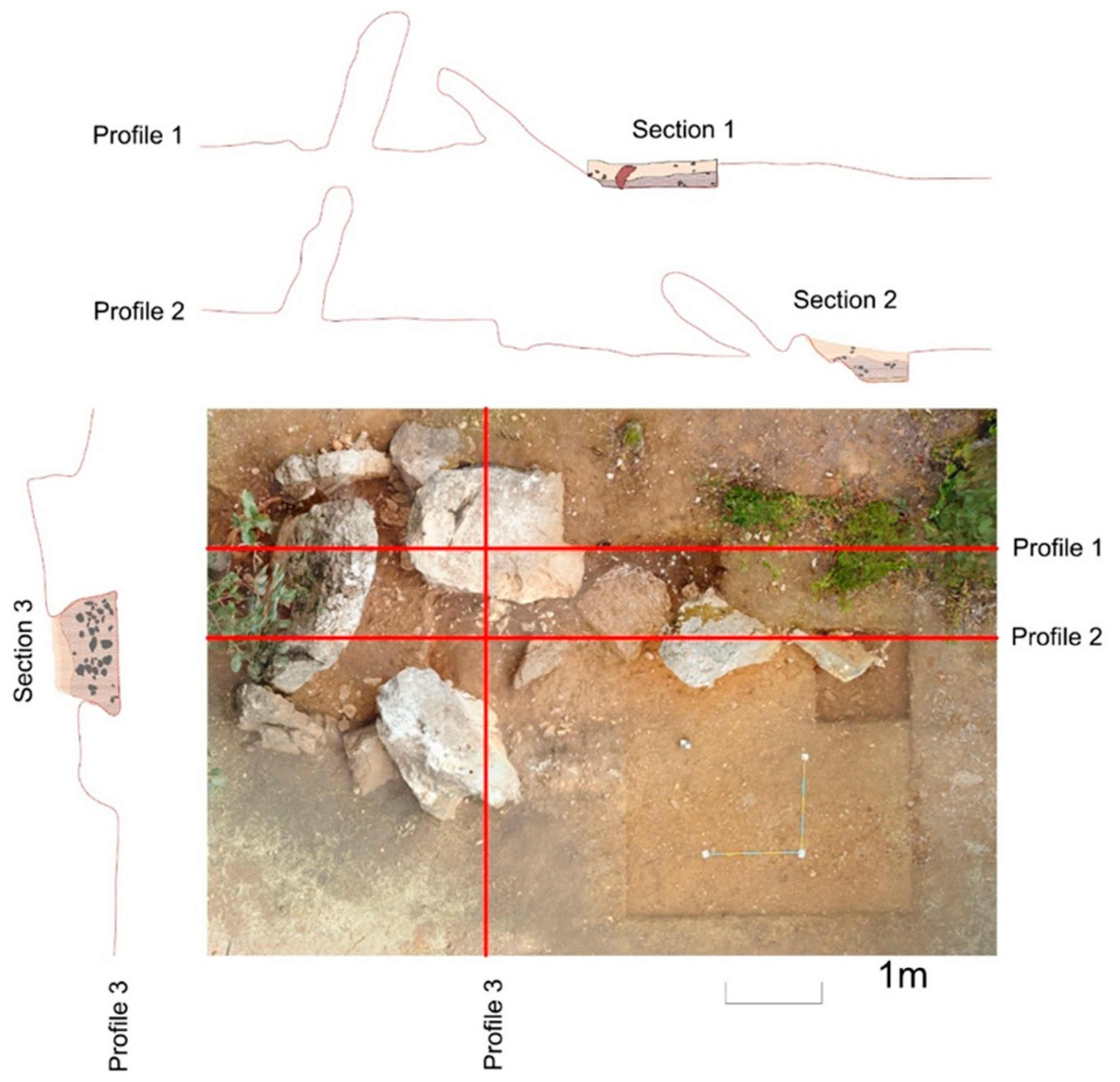
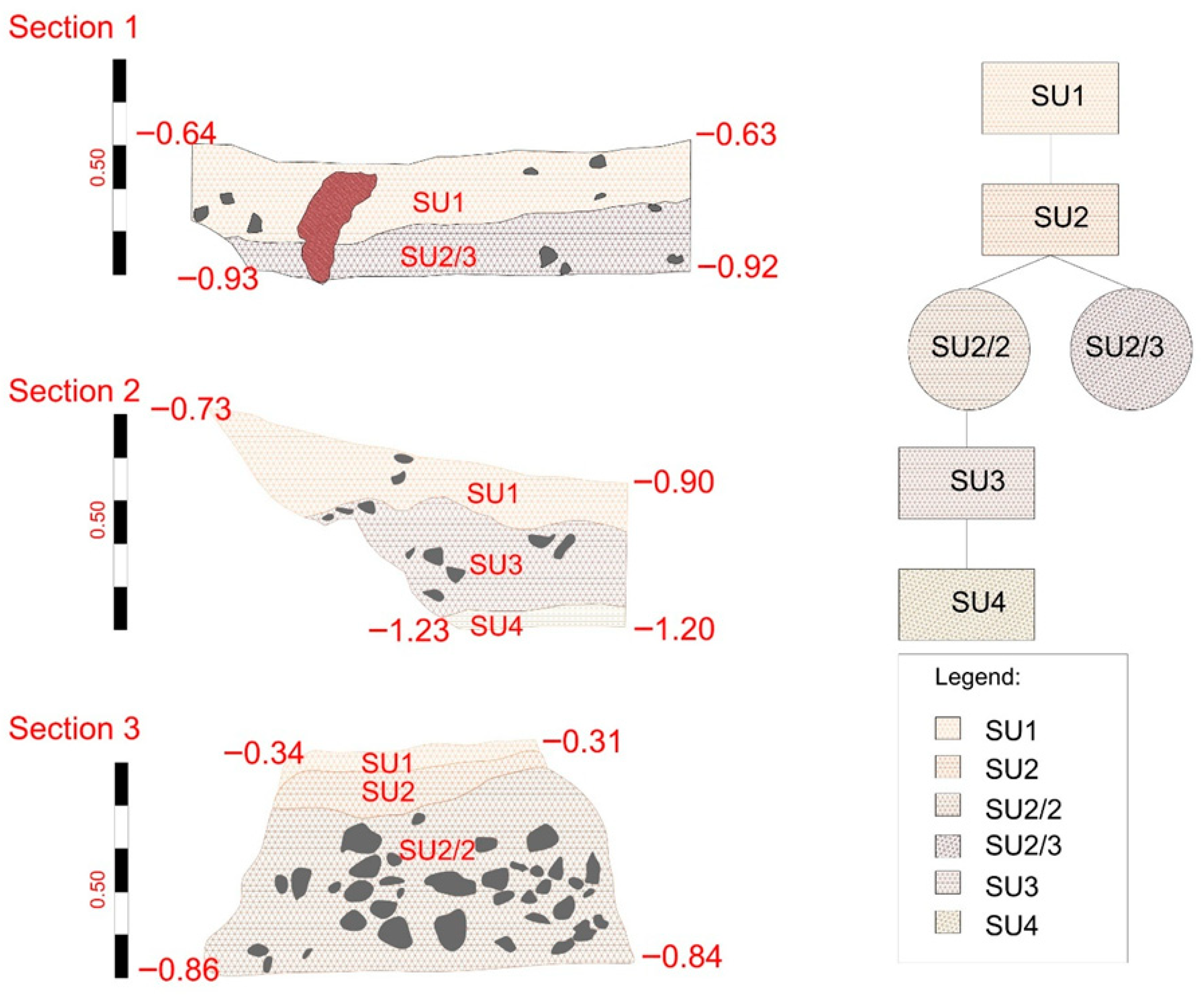
Despite structural damage caused by recent agricultural practices, namely the intense burning carried out by the landowners inside the chamber, well-preserved layers were identified. The stratigraphic sequence of the archaeological site comprises four main stratigraphic units (SU1 to SU4) and two transitional interfaces (
Figure 2 and
Figure 3).
Stratigraphic Unit 1 (SU1) corresponds to the most recent surface layer, resulting from current natural deposition. This unit is characterized by biologically active soils, within which contemporary processes of bioturbation, root activity and organic decomposition are taking place. Root activity extends down to SU4.
Stratigraphic Unit 2 (SU2) corresponds to anthropogenic deposits resulting from the accumulation and burning of olive and vine branches, confined within the chamber by the structural role of the orthostats. This unit is restricted to the interior of the dolmen, unlike SU1, which covers the entire surface, as seen in
Section 3, Profile 3 (
Figure 3).
At the interface between SU2 and SU3, an interfacial unit designated SU2/3 has formed, composed of mixed sediments that show evidence of post-depositional disturbance. This layer exhibits characteristics that raise questions regarding its chronology, and it remains to be determined whether the observed alterations stem from activities in prehistory or from later historical periods. SU2/3 is visually distinct due to its dark coloration, attributed to the migration of carbon particles from SU2. Despite this contamination, the ceramic fragments recovered from this layer suggest contextual coherence: the sherds, which belong to the same vessel groups, appear close together and without the presence of modern materials. The human and animal bones identified in this context are highly disarticulated, with no preserved anatomical connections, indicating significant disturbance of the original deposits.
Stratigraphic Unit 3 (SU3) is interpreted as the prehistoric occupation layer of the monument. It is particularly evident in the trench sections opened in the passage (
Section 1 and
Section 2), documented in Profiles 1 and 2 (
Figure 3). This unit consists of a relatively compact and thin layer but shows good preservation of archaeological contexts.
Outside the dolmen structure, a transitional interface can be identified between SU2 and a possible Stratigraphic Unit 4 (SU4), which has not yet been fully confirmed and may correspond either to the natural substrate or to a phase predating the construction of the monument. This interface, referred to as Interface 2/3, marks the boundary between the more recent deposits and the underlying layers and should be subject to further analysis. At the end of the passage, SU4 becomes visible due to the greater depth reached during excavation. This unit appears to correspond to undisturbed geological substrate, lacking any direct anthropogenic alteration, and is presumed to predate the construction of the megalithic monument.
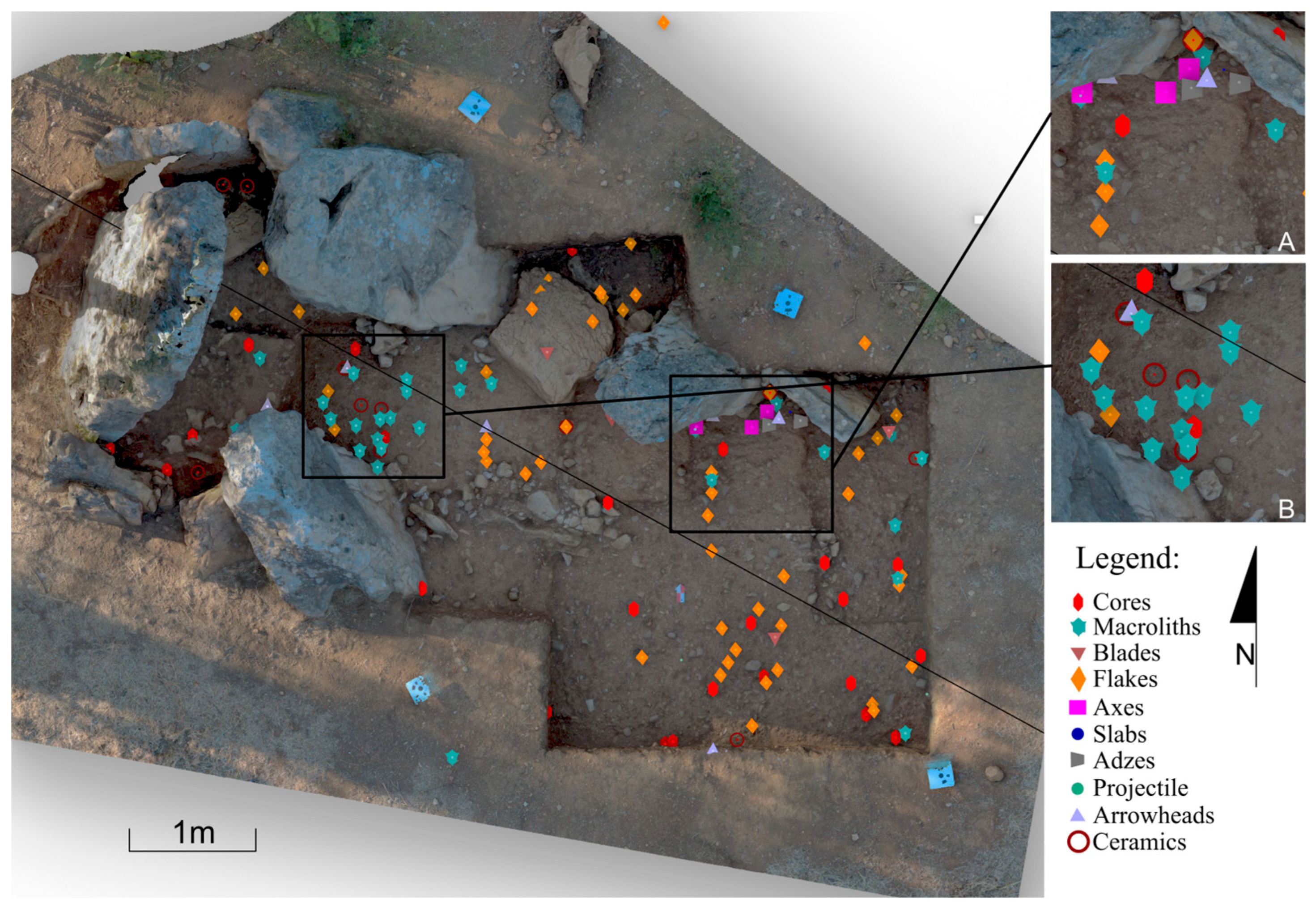
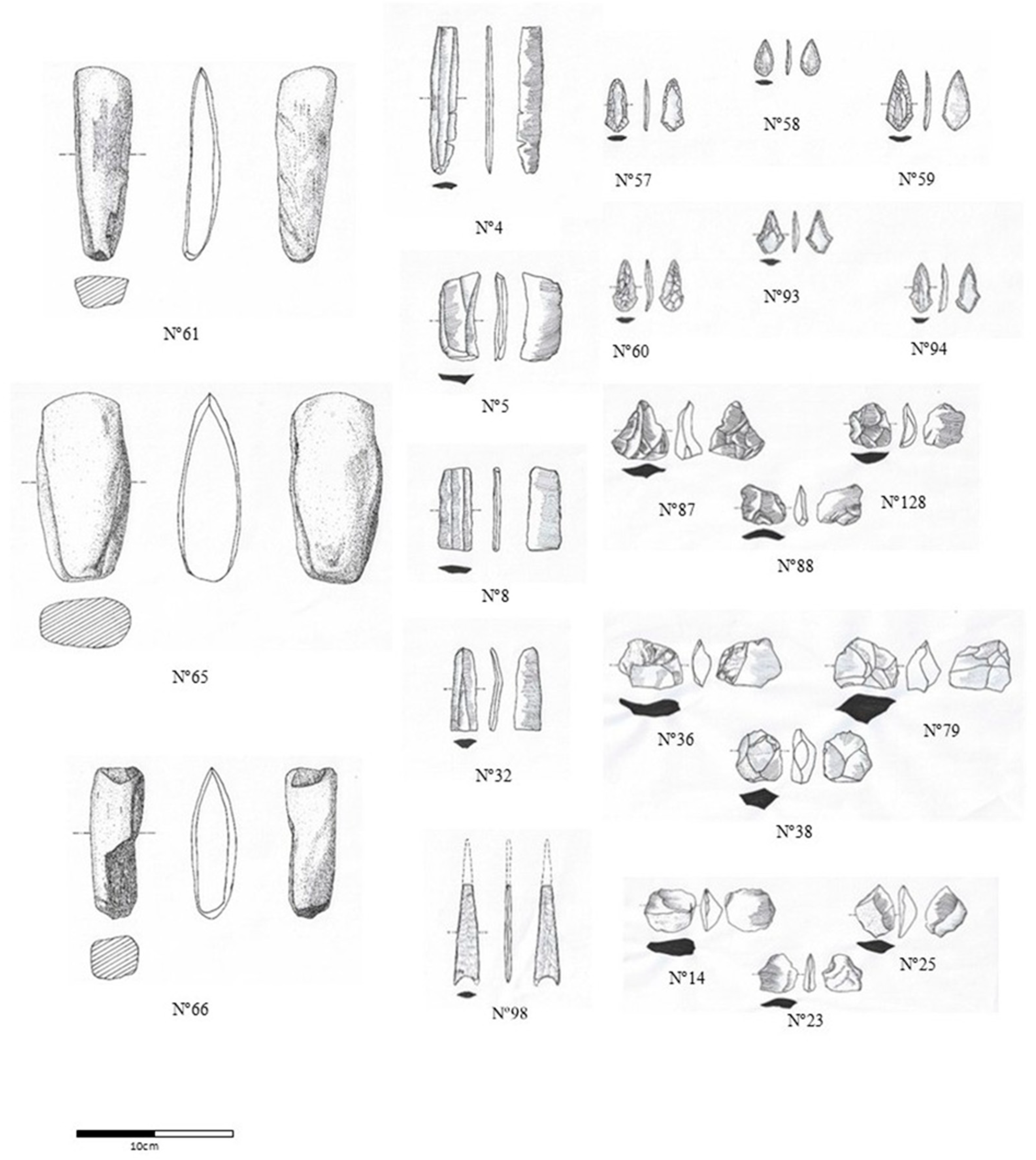
During the excavation, several lithic artefacts were recovered, including 73 flakes (mainly in quartzite), 7 blades, 2 microliths in flint and chert, 9 cores, 7 flint arrowheads, 34 macrolithic tools, 3 axes, 14 necklace beads in schist, one in jet, and 2 adzes made of amphibolite. Two rectangular mica-schist plates were also identified, possibly used as sharpeners for polished tools (
Figure 4 and
Figure 5).
A particularly significant assemblage in SU3 was found next to a preserved slab in the passage, in an in situ context, where 2 axes, 2 adzes and 2 polishers were recovered, all possible deposited at the same time (
Figure 4B). This suggests a ritual act with strong symbolic intent associated with agriculture and woodworking. A radiocarbon date obtained from a human bone recovered from the sediments composing SU3 in this context (
Table 1—AZ24.D04/2024N4) yielded a chronology of 3023–2886 BC, with 95.4% probability, calibrated at 2σ BCE using version 4.4.4 of the OxCal program (
Bronk Ramsey, 2021), employing the INTCAL20 calibration curve (
Reimer et al., 2020).
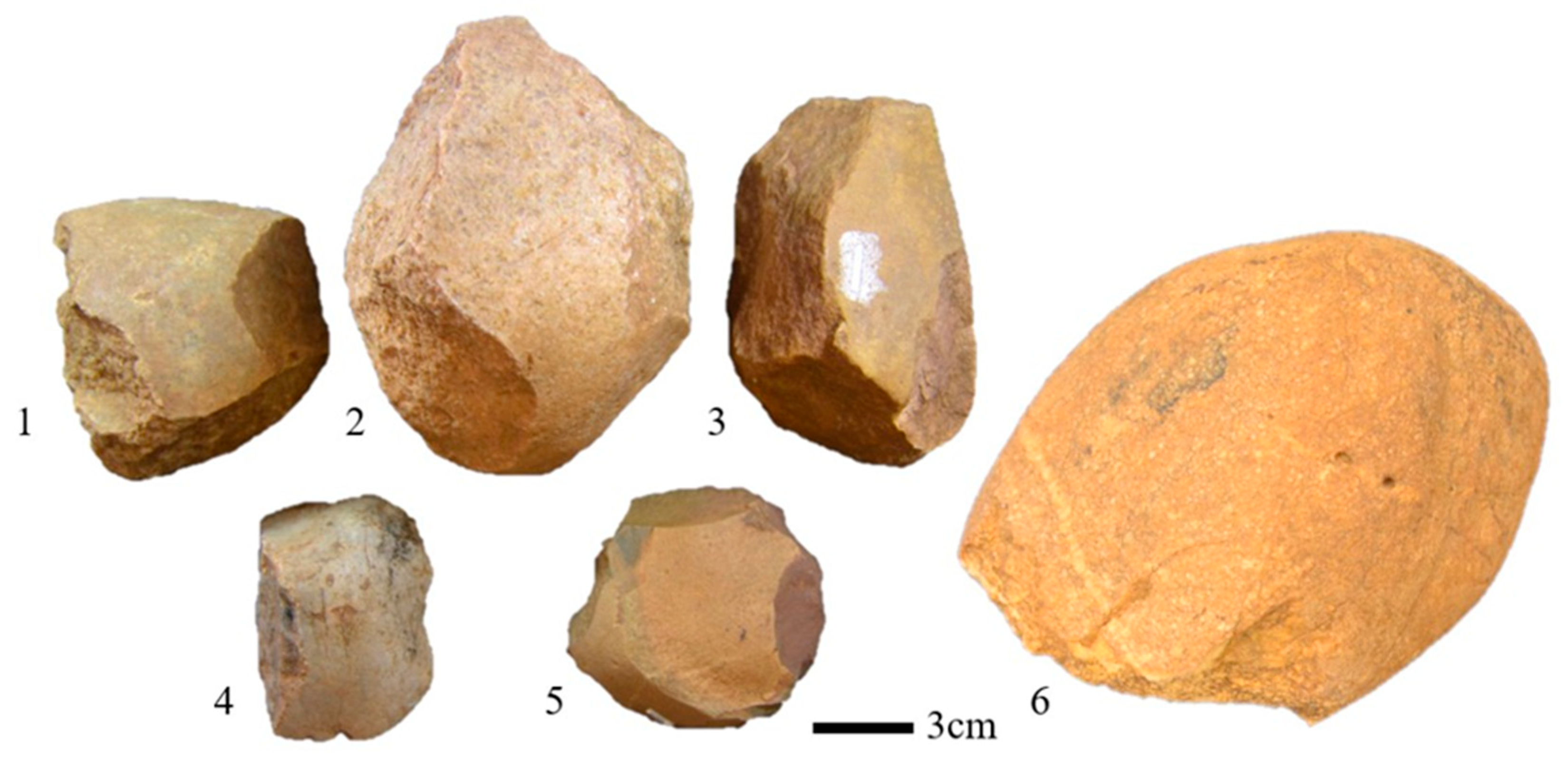
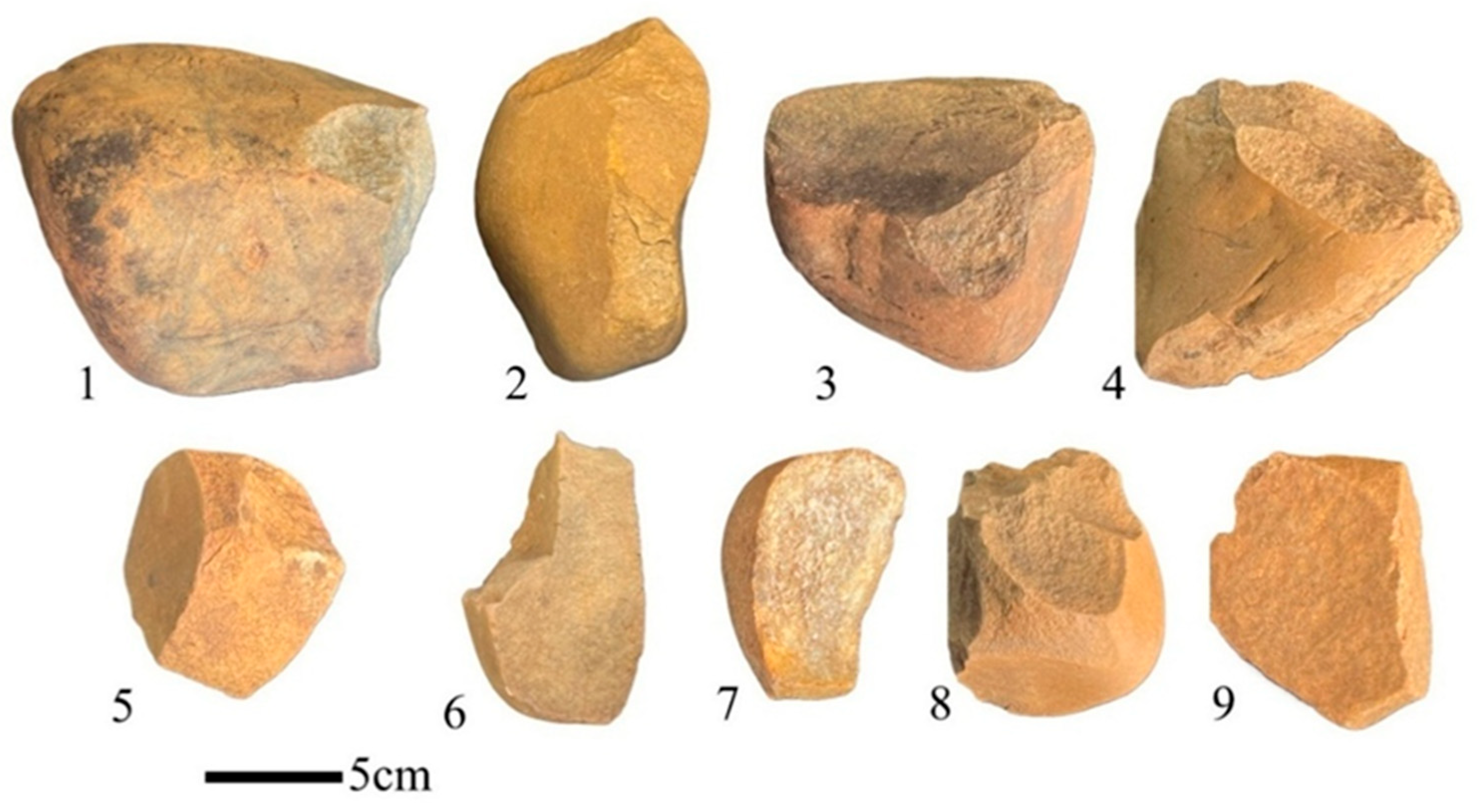
Throughout the monument, though more concentrated within the chamber, macrolithic artefacts were recorded (
Figure 4A and
Figure 6).
These materials consist of large quartzite flakes and cores produced by direct percussion for the manufacture of cutting edges. Most pieces display limited retouch and simple morphologies. The distribution of these artefacts across the monument suggests that their presence is associated with the various depositional events that occurred during its period of use. Such dispersion does not appear to result from specific functional needs related to individual depositions but rather reflects the continuous circulation of tools belonging to a long-standing regional tradition. From a symbolic perspective, these materials may indicate that the communities attributed ritual or votive value to such artefacts, deliberately incorporating them as offerings or ceremonial accompaniments.
In total, more than thirty artefacts were documented.
As for the ceramics, fragments from the modern and contemporary periods were found in the upper layers, in stratigraphic units SU1 and SU2, indicating recent contamination.
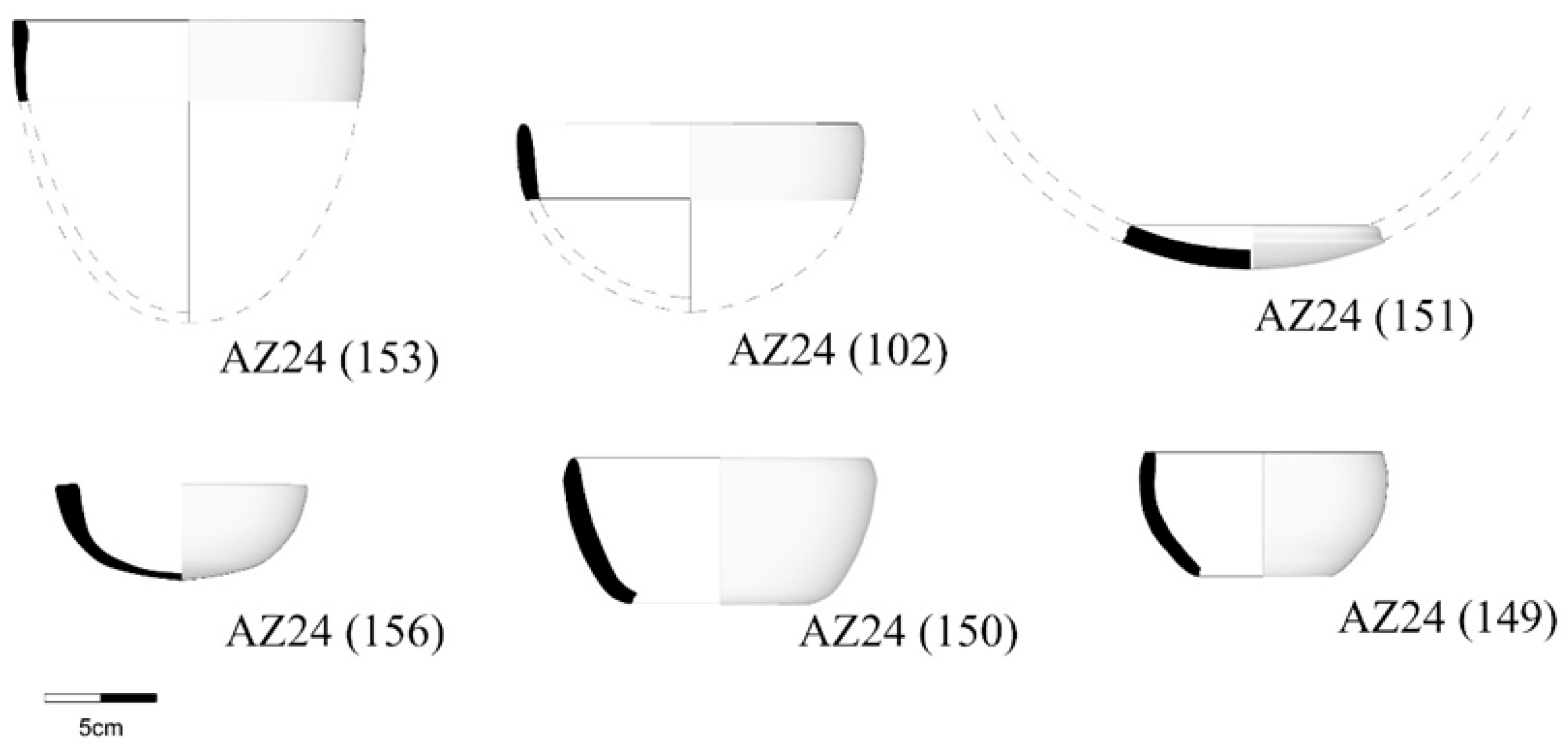
However, in the older archaeological units, SU3 and the interfaces SU2/2 and SU2/3, the contexts appear to be preserved, although they were disturbed during prehistory. The macroscopic study of the ceramic assemblage allowed the identification of at least six distinct vessels. The identified forms are spherical or slightly truncated-conical, undecorated, with heterogeneous texture, and all in poor condition (
Figure 7).
The excavation also recovered disarticulated and poorly preserved human osteological remains, including long bones, vertebrae, mandibles, maxillae and loose teeth.
According to Silva’s method (
Silva, 1993), these remains represent a minimum number of six individuals, both adults and non-adults of both sexes.
Some bones display slight traces of burning, interpreted as the result of recent agricultural fires that affected primarily UE 1 and, to a lesser extent, UE 2. This evidence is not observed in the lower levels nor in the units located outside the chamber interior.
The faunal remains identified include rabbits (MNI = 3) and sheep/goat (MNI = 1).
Isotopic analysis of the human remains revealed a diet based on C3 plants, with the inclusion of carnivorous protein sources. The δ
13C values ranged between –19.76 and –20.36, the δ
15N values between 7.68 and 9.23, and the C/N ratio between 3.11 and 3.49. These values suggest stable and similar dietary patterns among all the dated individuals (
Table 1).
4. Chronological Framework of the Regional Funerary Context
Eleven radiocarbon dates were obtained from the Azurrague 1 Dolmen (
Table 2,
Figure 8) allowing, for the time being, the integration of age-at-death estimates for individuals deposited between the beginning of the Late Neolithic and the Middle Copper Age (
Table 2).
The earliest date, AZ25 FTMC-BG46-5, comes from SU3 and is associated with a fragment of long bone found near the left side of the chamber entrance, in a context where fourteen schist beads were recorded. It dates to the beginning of the Late Neolithic and represents, within the existing sequence of funerary radiocarbon dates, the sample closest to the possible foundational depositions or an initial phase of the monument’s use.
The subsequent dates for Azurrague 1 are AZ25 FTMC-BG46-2, AZ25 FTMC-BG46-3, and AZ24.D02/2024N2. The first two are chronologically very close and correspond to human remains observed in the chamber near the orthostats, and although chronologically close, they were recovered beneath opposite orthostats. Sample AZ24.D02/2024N2 was obtained from a molar collected near the north slab of the chamber, also in SU3. The remaining dates fall after 3000 BC. Although AZ24.D03/2024N3 and AZ24.D04/2024N4 slightly exceed this threshold, they were included in this group due to their clear extension into the Copper Age.
The most recent date is AZ24.D06/2024N6, which shows ranges of 2848 to 2810 BC or 2744 to 2728 BC, with the highest probability between 2696 and 2475 BC. This sample comes from the transition area between the corridor and the chamber, within SU2/2. Closely associated with this date is AZ25 FTMC-BG46-1, from the chamber, derived from a canine tooth of a mandible observed at the intersection with SU3. Similarly, AZ24.D01/2024N1 has a comparable chronological range and comes from layer SU2/3, spatially close to the previous sample.
The dates AZ24.D03/2024N3 and AZ24.D04/2024N4 are very similar, with temporal intervals integrated within one to two years, and both originate from SU3. They correspond to two distinct samples, one from a tooth of the right maxilla found in the chamber and the other from a fragment of long bone collected in the passage, adjacent to a deposit of six polished objects, including two axes, two adzes, and two polishers. The nearly identical chronological ranges raise the possibility that both samples belong to the same individual. This hypothesis is supported by the absence of direct anatomical incompatibilities between the dated elements.
In the context of secondary burials, suggested by disarticulated remains and possible taphonomic disturbances, it is common to find human remains redistributed within the funerary space due to practices of reopening, manipulation, and reorganization of the bones over time. However, it is also plausible that the two remains belong to different individuals whose deaths occurred within a very short chronological interval. This possibility cannot be excluded without ancient DNA analyses, which would allow confirmation or rejection of the hypothesis that they belong to the same individual.
The date AZ24.D05/2024N5 was associated with a small polished adze, distinct from the set coded AZ24.D04/2024N4, displaying polished surfaces and evidence of percussion on the edge, both deriving from SU3.
All radiocarbon dates from the Azurrague 1 Dolmen were obtained at the Vilnius Radiocarbon Laboratory using a Single Stage Accelerator Mass Spectrometer, based on the Automated Graphitization Equipment AGE-3. Samples were pretreated using an acid–base–acid protocol and collagen extraction, with NIST-OXII and phthalic anhydride used as reference materials.
For the Rego da Murta Megalithic Complex, eleven dates are also noteworthy, six from Dolmen II and five from Dolmen I (
Table 3). The Rego da Murta dates were obtained at the Beta Analytic Institute.
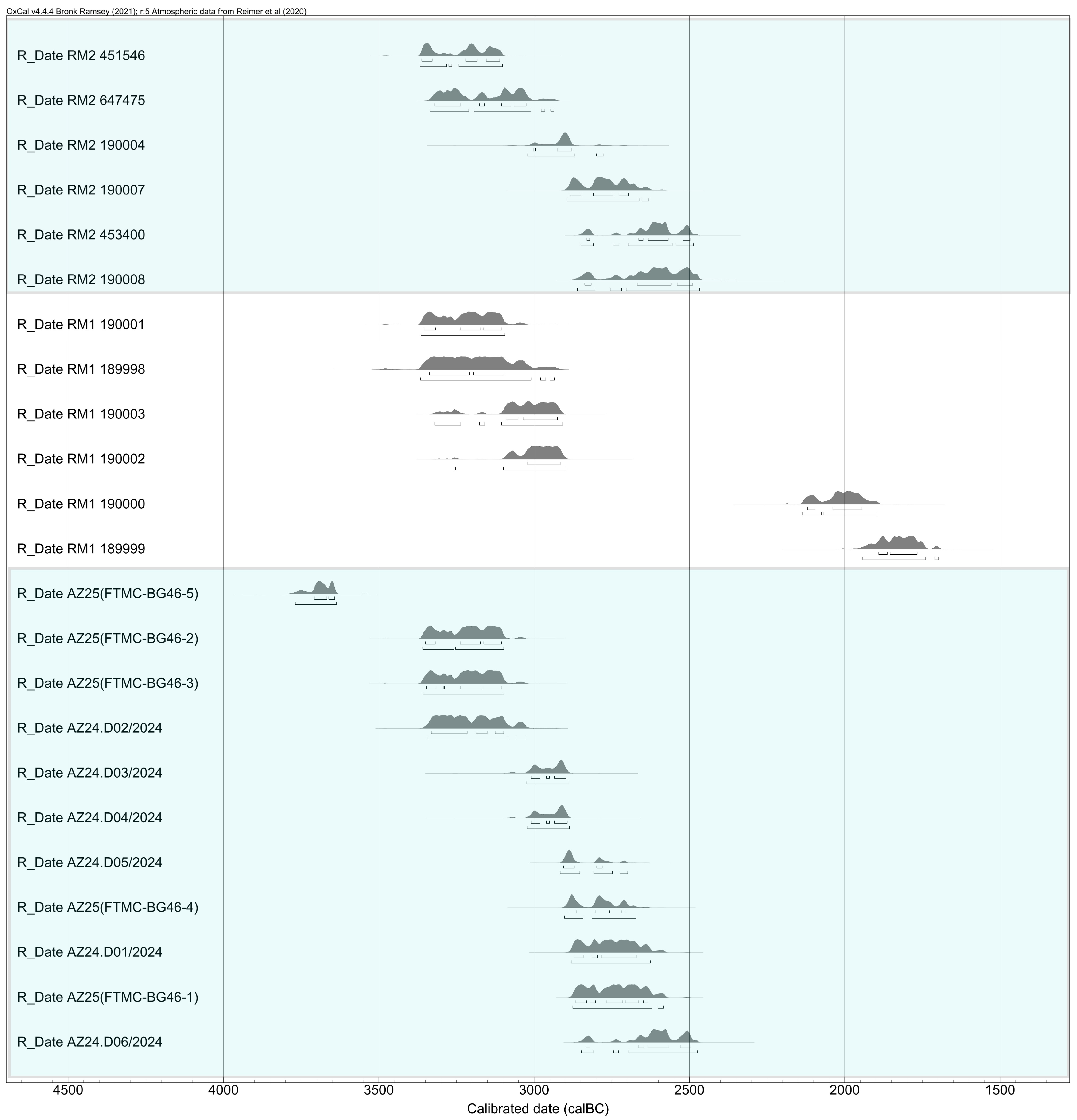
Except for the AZ25 FTMC-BG46-5 date, which places the Azurrague Dolmen as the earliest megalithic monument in the Nabão region and its tributaries with no temporal parallel, the chronological data from Azurrague 1 are largely consistent with those from the Rego da Murta dolmens (
Figure 9).
The Azurrague 1 samples AZ24.D02/2024N2, AZ25 FTMC-BG46-2, and AZ25 FTMC-BG46-3 are roughly contemporary with Rego da Murta I dates Beta-190001, Beta-189998, and Beta-19003, as well as Rego da Murta II dates Beta-451546 and Beta-647475. All are centered in the Late Neolithic, indicating a strong chronological core of deposition across the three monuments between 3360 and 3090 BC, representing the closest correlation observed.
Additional depositions are evident, particularly those extending into the mid-third millennium BC. In this phase, only one date from Rego da Murta I (Beta-19003) is recorded. During the period of Copper Age, both Azurrague and Rego da Murta II show a parallel trajectory of continuous use, with significant chronological overlaps between 3020 and 2470 BC. Two dates, AZ24.D03/2024N3 from Azurrague 1 (3024–2888 BC, 95.4%) and Beta-190004 from Rego da Murta II (3022–2870 BC, 92.6%), are nearly identical, raising the possibility that both monuments were active simultaneously under regional ritual practices. The interval 2900–2700 BC also appears in both contexts, with polished objects deposited in comparable internal zones of the dolmens.
A notable difference is observed in the later dates from Rego da Murta I, which extend into the Early Bronze Age, a phase not yet documented in Azurrague 1 or Rego da Murta II.
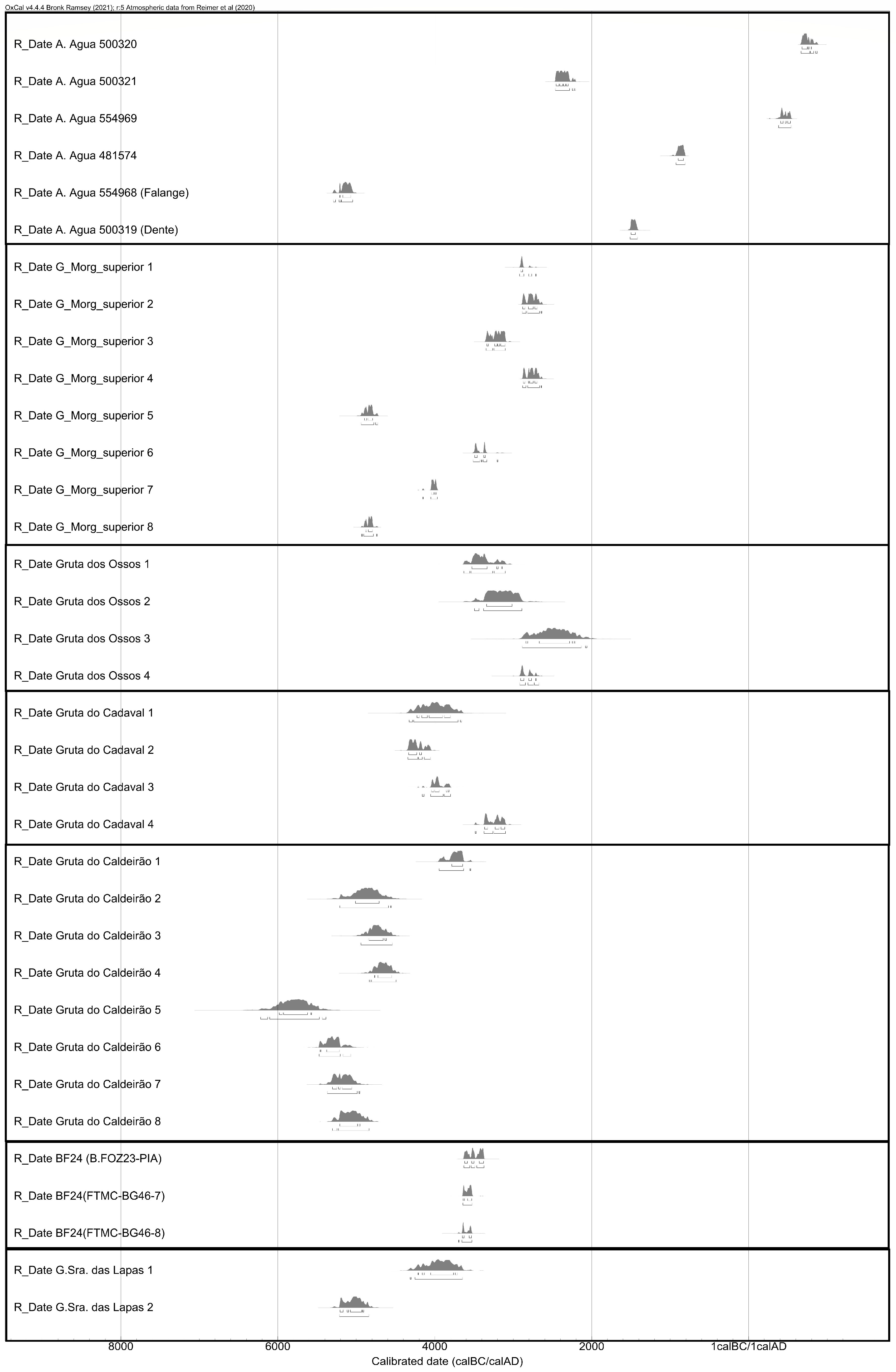
Considering other funerary practices in the region, particularly those within caves, further observations can be made regarding the broader ritual landscape (
Figure 10).
Early chronologies in caves are notable, covering the phases that precede the construction of megalithic monuments, with dates around 5000 BC. Prominent sites include Gruta do Caldeirão, Gruta do Morgado Superior, and Nossa Senhora das Lapas near Azurrague 1, as well as Algar da Água, located to the north near the Rego da Murta complex. However, parallel depositions are also observed in almost all cave sites.
For a closer comparison with the Azurrague 1 Dolmen, it is important to mention Lapa da Furada and Buraco da Foz, which are the nearest sites (
Figure 11).
The Lapa da Furada cave has a single radiocarbon date, placing it in the 3rd millennium BC (4149 ± 33 BP, with 95.4% probability of falling between 2879 and 2623 BC), and is located less than 2 km from Azurrague 1. It shows correlations with four Azurrague 1 samples (AZ24.D01/2024N1; AZ24.D06/2024N6; AZ25 FTMC-BG46-1; AZ25 FTMC-BG46-2) (
Figure 9). This strong connection suggests a temporal interrelation between these sites, as it is highly unlikely that the presence and use of the nearby monument would have been unknown. Although still at the beginning of its study, Lapa da Furada already reveals notable similarities with Azurrague 1, particularly in the presence of macrolithic tools, which are relatively similar to those found in the dolmen (
Figure 12).
Buraco da Foz has also not yet been published. The first intervention campaign, conducted in 2025 by the MEDICE II project, shows that its dates are contemporaneous with the earliest date from Azurrague 1 (
Table 4). In turn, this date correlates chronologically with other caves, such as Gruta do Morgado Superior, Gruta do Cadaval, and Gruta dos Ossos (
Figure 10).
The materials recorded, except for the presence of polished or ornamental objects, including buttons within this category, are very similar, encompassing flint blades and lamellae, macrolithic tools, microliths, and arrowheads.
5. Analogies and Preliminary Interpretations
One of the central issues in this region relates to the karstic nature of the landscape, where numerous natural cavities preserve evidence of human funerary remains and were used as sacred places for ritual depositions. These cavities, such as Gruta do Caldeirão, Lapa da Furada, Gruta do Cadaval, Gruta do Almonda, Gruta dos Ossos, Nossa Senhora das Lapas, Algar da Água, among others, bear witness to funerary practices that in some cases date back to the Upper Paleolithic, while in others continue into the Bronze Age (
Zilhão, 1992,
1993,
2000;
Oosterbeek, 1985,
1993a,
1993b,
1994,
1997,
1999,
2004;
Cruz & Oosterbeek, 1999;
Cruz, 1997,
2000,
2010;
Figueiredo, 2007,
2019c,
2021).
The introduction and adoption of megalithic monuments in areas where such cavities and long-standing ritual practices are documented raises important questions. These include whether the same communities were involved in both practices, what the precise functions of these ritual activities were, and to what extent one may have replaced or been intended to replace the other. Based on the observed data, we are led to believe that the introduction of megalithic monuments may have arisen from symbolic, religious, or practical motivations, namely the need to fulfill functions that natural cavities could not accommodate or for which they were never suitable. The presence of megalithic monuments very close to caves, with analogous chronologies and depositions, is not exclusive to this area; it appears throughout the Estremadura region Limestone Massif. Examples include Fonte Moreira dolmen and Lapa da Galinha cave in Alcanena, approximately 500 m apart (
Andrade & Van Calker, 2024); the Barbata 1 and 2 dolmens, near the caves of Redondas, at roughly the same distance as the Azurrague 1 dolmen from Lapa da Furada (2–3 km); or the Fontes Velas 1 and 2 dolmens with Carvalhal de Turquel cave (Turquel) or Alcobertas dolmen with Alcobertas cave (Rio Maior), the latter also at about 2 km distance (
Andrade & Van Calker, 2024).
Also the archaeological materials excavated from the Azurrague 1 dolmen indicate a direct connection with the occupations recorded in Dolmens I and II of Rego da Murta (
Figueiredo, 2021), Vale da Laje (
Oosterbeek, 1997), and Fonte Moreira dolmen (
Andrade & Van Calker, 2024), establishing both structural and cultural correlations between the monuments. Structurally, the Azurrague 1 dolmen shares several construction similarities with Dolmen I of Rego da Murta, such as the differentiated positioning of the passage grave relative to the chamber, the low entrance requiring the body to be inclined for access, and the arrangement of slabs (
Figueiredo, 2007,
2021). These same analogies are observed at Vale da Laje (
Oosterbeek, 1997). The passage also follows a similar alignment pattern, that is characteristic also from Dolmen II of Rego da Murta. All these monuments are oriented southeast, with minimal variation in angle (
Figueiredo et al., 2018). Regarding Fonte da Moreira, there is no detailed information about the structure, but it has been considered a probable monument with a simple circular chamber (
Andrade & Van Calker, 2024), although this cannot be confirmed. It is very likely that, as in the dolmens of Rego da Murta or Azurrague 1, the passage supports are smaller than the chamber and may have become imperceptible over time.
Among the excavated remains, the significant presence of macrolithic artifacts in the deposition layers at the Azurrague 1 dolmen stands out. These quartzite tools have been documented not only at this monument but also at other megalithic sites in the region, such as the Rego da Murta Megalithic Complex (
Figueiredo, 2021) and the monuments of the Zêzere, including Vale da Laje (
Oosterbeek, 1994), Pedra da Encavalada (
Cruz, 2004,
2010,
2020), Colos Monument (
Gaspar & Batista, 2000,
2001), and the caves of the Nabão valley (
Oosterbeek, 1994,
1999;
Cruz, 1997). The same materials also stand out in Lapa da Furada and Buraco da Foz.
There is significant discussion regarding macrolithic tools, cores, and flakes of quartzite, shaped flexibly for various uses (
Raposo & Silva, 1984;
Jorge, 1990;
Oosterbeek, 1994;
Cura et al., 2004). Analyzing these materials is crucial for understanding the communities that possibly built the monuments. Considering that these artifacts are part of a long-standing regional tradition (
Pereira, 2011, pp. 114–115), commonly found in habitation sites and caves since the Paleolithic, such as Abrigo do Alecrim, Lapa do Picareiro, Gruta do Caldeirão, Abrigo da Pena d’Água, Abrigo Grande das Bocas, and Terra do Manuel, it is important to understand their association with more recent deliberate deposits, such as those in megalithic monuments.
The continuity in the use of materials and flaking techniques may indicate not only utilitarian purposes, which some suggest were tools for robust activities (
Zilhão, 1995;
Bicho, 1997), but also symbolic significance, connecting ancient traditions with new cultural and religious expressions. Indeed, these remains are primarily evident in the chamber area and are not associated with deposits near menhirs in this region (
Figueiredo, 2021, pp. 40–50).
6. Final Considerations
The Azurrague 1 dolmen, located in the municipality of Ourém, represents a significant example of megalithic architecture, although it has suffered some damage, evident in structural alterations and contamination of recent sedimentary layers. Nevertheless, it preserves contexts that allow the collection of valuable data about the communities that built and used it. Dolmen structures in the karstic region near the Nabão River are relatively scarce, especially compared with other areas such as the Zêzere valley. Comparisons between Azurrague 1 and the Megalithic Complex of Rego da Murta (
Figueiredo, 2007,
2010,
2019a,
2021), the closest and best-studied site in the karstic region, reveal structural, artifact, chronological, and cultural similarities, suggesting connections between the two sites.
The structure of Rego da Murta II, located approximately 400 m from Rego da Murta I, shows no differentiation between the passage and the chamber, unlike Azurrague 1 or Rego da Murta I, demonstrating a certain polymorphism that aligns with the rituals practiced in the Estremadura limestone massif, even though all of these structures belong to the passage grave type. In this region, funerary cults were also performed in natural cavities and hypogea, accounting for approximately 70% of the cases, compared with about 30% for megalithic dolmen monuments (
Andrade & Van Calker, 2024). This polymorphism is also visible in the neighboring schist region of Canteirões do Nabão (
Figueiredo & Monteiro, 2025b), to the east, where atypical structures, both orthostatic and non-orthostatic, are observed, such as in Colos (
Gaspar & Batista, 2000,
2001) or Pedra da Encavalada (
Cruz, 2004,
2010), alongside dolmen monuments, with notable examples in Vale da Laje (
Oosterbeek, 1994) and Chãos and Jogada (
Cruz, 2010,
2020) along the Zêzere River.
Issues of reuse, cleaning, and secondary deposition are recurrent both in cavities (
Oosterbeek, 1994) and in megalithic monuments. In the latter, near the Canteirões do Nabão area, this appears to have occurred after the end of the Neolithic. Clear evidence is recorded in the Megalithic Complex of Rego da Murta, such as the construction of a stone pavement in the chamber following site cleaning in Rego da Murta II, or the reconstruction of the passage in Rego da Murta I (
Figueiredo, 2007). In the context of caves along the Nabão River, there appears to have been a shift in burial practices from primary burials, which occurred until the Middle Neolithic, to pit structures based on secondary deposits with evidence of spatial rearrangements, as seen in the Gruta dos Ossos (
Oosterbeek, 1993a,
1994).
The same structural deposition process observed in the cavities was clearly recorded in Rego da Murta II (
Figueiredo, 2019b,
2021), where pit deposition cores were documented, containing deposits of different parts of individuals, covered by a stone structure that defined and sealed the pit, and associated with inverted ceramic vessels and lithic items such as necklace beads, pendants, arrowheads, and some blades. The macrolithic remains recorded in caves, such as Lapa da Furada (unpublished), Algar da Água (
Figueiredo, 2019c), or Gruta do Caldeirão (
Zilhão, 1992), as well as in habitation sites such as Castelo da Loureira, Sobral Chão, Outeiro de São Pedro (both in Alvaiázere) (
Figueiredo, 2007), Agroal (Ourém) (
Lilios, 1991), Maxial near Zêzere (
Cruz & Oosterbeek, 1998a,
1998b), Amoreira (Abrantes) (
Cura et al., 2004), and Santa Margarida da Coutada (Constância) (
Cura et al., 2004), dated from recent prehistory, confirm the use of these sites across different typologies and chronologies, including megalithic monuments of the Zêzere region (
Oosterbeek, 1994;
Cruz, 1997,
2004;
Gaspar & Batista, 2001). However, these materials are more characteristic of the karstic zone. Beyond the Nabão River sites, similar artifacts have been documented across Portugal, particularly in the coastal central region along the Tagus, in the Quaternary beaches of Minho, on the Alentejo coast (between Sines and Vila Nova de Milfontes), and along the Guadiana River (
Raposo & Silva, 1984;
Jorge, 1990;
Grimaldi et al., 1998,
1999,
Cura et al., 2004;
Oosterbeek, 2004).
In the studied region, the presence of these materials demonstrates a continuity of stone-working traditions and the integration of these practices into a new cultic narrative introduced during the beginning of the Late Neolithic in the karstic zone. Imported materials are also found alongside them, illustrating the relationship between new and local traditions.
It is still notorious that burial practices in caves not only run parallel to the use of megalithic monuments but also extend beyond their chronological range. For example, Algar da Água, located north of the Megalithic Complex of Rego da Murta, shows evidence of continuous occupation. This supports the view that the presence of megalithic monuments in these landscapes should be seen as an adaptation of architectural ideals that do not exclude ancestral cave behaviors. This proposition was first defended by
Figueiredo (
2007) in her doctoral thesis, which interpreted the Megalithic Complex as a monumentalized and sacralized space. She argued that “the ensemble… does not convey a message, but a dialogue between the various generations or communities that used” (
Figueiredo, 2021, p. 157) a broader territory imbued with symbolic connotations, functions, and communication mechanisms, whether through structures, natural landscape elements, or the sky. Different sites complement one another, integrating new structures with pre-existing sacred locations or symbolic intentions that enabled the achievement of communal objectives within neighboring groups or families. Figueiredo further observes that “by constructing these structures [dolmens], they were building the institutions in which they were integrated, expressing a commitment to a ritual connection with the world of the ancestors” (
Figueiredo, 2021, p. 165).
The relative scarcity of megalithic monuments in the Estremadura Limestone Massif, compared to regions to the east or south, combined with their proximity to caves (up to approximately 2 km) with contemporary occupations, indicates a conscious integration within these territories, reflecting similarities and continued associations of cults and funerary rituals that extend beyond the duration of activities performed at the megalithic monuments. The significant factor may lie in the act itself and the sacralized space rather than the structure housing it, explaining the observed polymorphism.
Recent interpretations of the materials from Fonte Moreira and Lapa da Galinha (
Andrade & Van Calker, 2024) also highlight symbolic continuity, functional complementarity, and the construction of ritual landscapes. While there is a high degree of transregional influence and exchange of exotic materials, evident in personal grave goods including chrysoprase and variscite (particularly in Rego da Murta) (
Figueiredo, 2007), deposits of traditional materials also persist.
In conclusion, the results of the MEDICE II project, which includes the study of the Azurrague 1 dolmen, suggest that megalithic monuments in this region were integrated into a broader landscape of sacred spaces, encompassing both constructed monuments and natural cavities. These practices, shaped by the interaction of local traditions and external influences, demonstrate the continuity and adaptation of ritual behaviors over time. The recognition of sacred places by the communities, who adapted and integrated new ideas while maintaining connections with ancestral traditions, highlights the flexibility of these practices.
The first dimension is the synchronic coexistence of different architectural structures. Available data show that simple dolmens, passage graves, atypical structures, hypogea, and cave necropolises coexisted not as successive or substitutive phases, but as integrated ritual strategies adapted to lithological conditions and regional symbolic memories.
The second dimension concerns the choice between constructing dolmens, using natural cavities, or erecting atypical structures. This choice does not appear to be determined solely by environmental or technical constraints, as different architectural solutions coexist within the same territory and under similar geological conditions. Rather, the diversity of funerary and ritual forms suggests differentiated strategies for the use and marking of space, through which specific locations were selected, transformed, and repeatedly employed. The preference for natural or constructed spaces reflects distinct modes of engagement with the landscape and the materialization of ritual, drawing upon local traditions and place-based memories. The repeated enactment of these practices over time contributed to the attribution of symbolic meaning to the territory, integrating these structures into a gradual process of landscape sacralization. This interpretation aligns with theoretical perspectives that view landscape as the product of the interaction between social practices, materiality, and lived experience (
Tilley, 1997;
Bradley, 1998;
Criado Boado & Villoch Vázquez, 1998).
In line with these dimensions, characteristics of the Azurrague 1 dolmen reflect a shared understanding of the role of space in ritual performance. The distinct yet interconnected relationship between natural and constructed spaces suggests a multifaceted approach to the sacred, where the act of building and using these monuments was as significant as the monuments themselves. Furthermore, the presence of votive offerings and diverse artifacts indicates dynamic cultural exchange and ongoing dialogue between past and those of the megalithic construction period.