


Abstract
Higher education inculcates in students an enduring curiosity about the world. Accomplishing this goal requires helping undergraduates recognize that learning is a social process occurring within multiple communities of practice. Each of these collectives provides different lenses through which aspects of reality are illuminated, none encompassing all there is to know about a subject. Students thus appreciate that learning is an open-ended processes driven by a curiosity that is never satisfied. Knowledge resulting from that process is forever being refined, a project to which undergraduates can contribute. Appreciating the many ways of knowing the world requires engaging meaningfully with these distinct communities. This is best achieved by participating directly in the work and lives of multiple such collectives. Field schools provide excellent opportunities in which students come to perceive, think about, and act in worlds constituted by the community of archeologists and that comprise people hosting and participating in the investigations. We use our experiences directing an archeological field school in northwest Honduras from 1983-2008 to illustrate how we used this learning environment to help undergraduates make original contributions to knowledge of the area’s past while rethinking who they are and what they are capable of achieving.
1. Introduction
We contend that education at every level serves the student and society best when it encourages enduring curiosity about, and habits of critical reflection on, everyday experiences (Kadlec, 2006). Among the elements that constitute this critical, or social, intelligence are the abilities to participate in shared inquiry and communicate effectively with people who bring different perspectives to bear on common issues. It is through such collaborative investigations that we solve problems together (Kadlec, 2006; Roth & Jornet, 2014; Stoller, 2018). It is also how we expand our sense of who we are and what we can accomplish with others. These contentions follow from the premise, ultimately based on the work of John Dewey (1931, 1935), that learning is not primarily geared to internalizing unquestioned truths through which all experiences can be described and explained. Such certainty is the enemy of curiosity-driven collaborative inquiry (Bok, 2006, pp. 68–69). Rather, learning is a process of forever refining our capacity to observe, analyze, and act effectively with others to understand a world that refuses to stand still (Kadlec, 2006, pp. 539–540; Saltmarsh, 2008). Learning understood in this way promotes personal growth, enhances respect for the wisdom of others with whom we collaborate, and refines our grasp of reality (Dewey, 1931; Stoller, 2018, p. 61). It also never ends. Every inquiry is open-ended, each query answered posing new, previously unimagined questions that lead us to deeper understandings of the issues at hand (Bartle, 2015, pp. 5–6).
Structuring education to achieve these ends is not easy. This is especially so when the value of schooling at all levels is judged by its capacity to convey facts and skills students will need to secure and keep a job (A. Kolb & Kolb, 2009, p. 305; Shore & Wright, 1999; Strathern, 2000). Teaching facts and skills without questioning the former and demonstrating the latter’s use in focused inquiries reproduces a status quo whose premises and consequences remain unchallenged (Braa & Callero, 2006; Duncan-Andrade & Morrell, 2008, pp. 24, 32; Giroux, 2016). Rote reproduction of current arrangements stymies individual growth and leaves us unprepared to deal with looming crises (Braa & Callero, 2006, pp. 357–358; Giroux, 2016; Lambert & Colaninno, 2023).
We draw on our experiences directing an archeological field school in Honduras to suggest how inquiry-based education can empower students to: reimagine how they learn; rethink what constitutes knowledge; and appreciate what those from different backgrounds have to teach them about the world and their relations to it (Stoller, 2018).
2. Learning as a Social Process
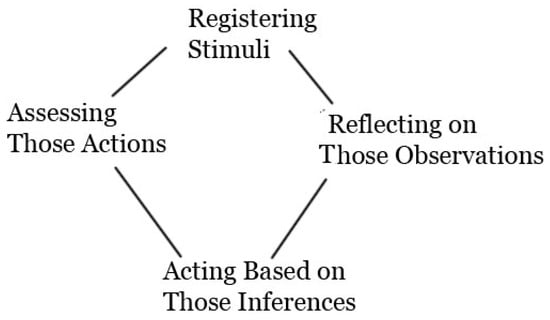
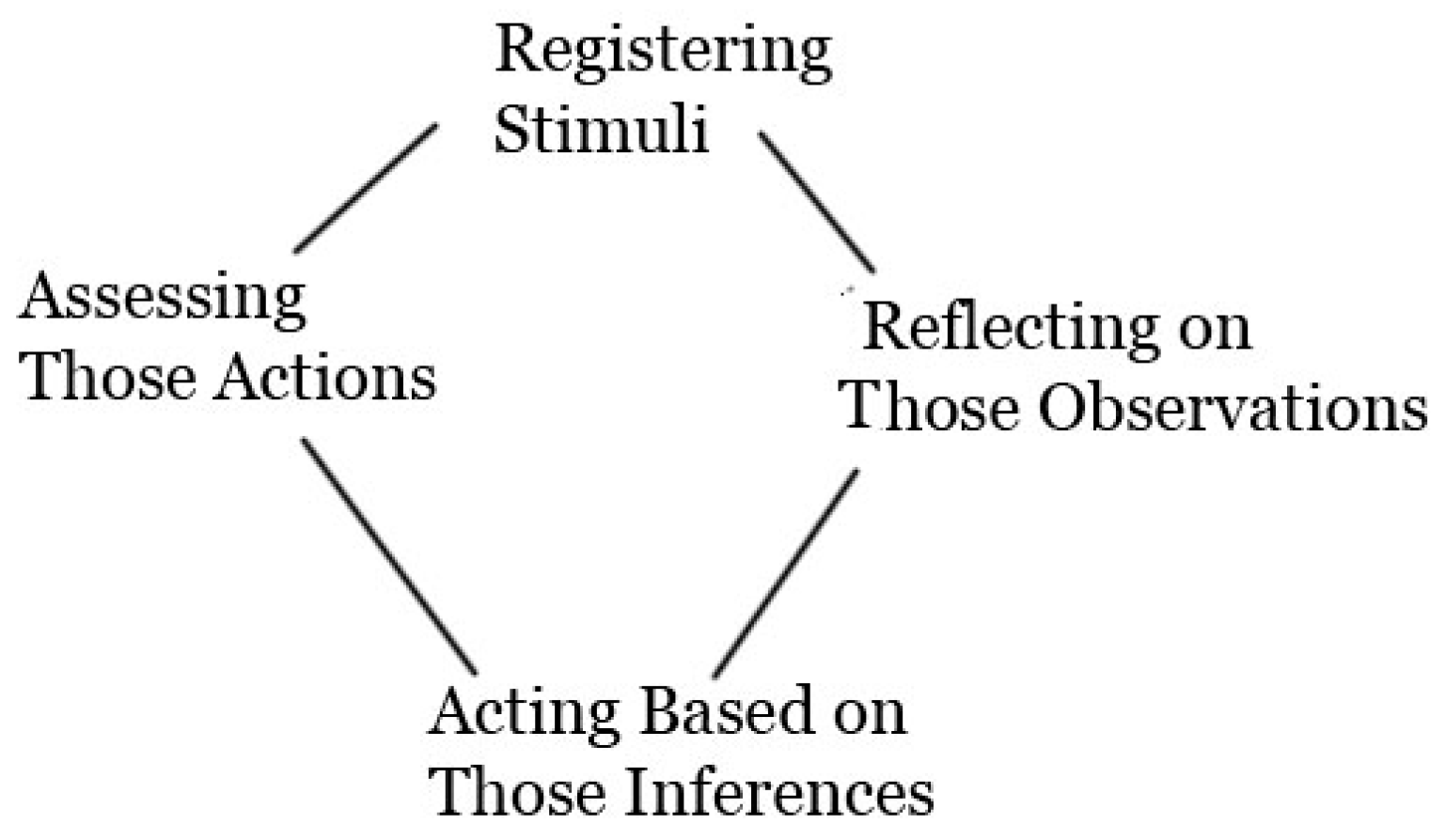
Drawing inspiration from the literature on experiential and critical pedagogy, we suggest that learning consists of: registering stimuli; interpreting what those inputs signify; and, acting based on those inferences. Our actions become further stimuli that we observe and assess, the cycle beginning again (Figure 1; Barth, 2002, p. 1; Clarke, 2005, p. 84; Hamilakis, 2001, pp. 8, 10; Hamilakis & Rainbird, 2004, p. 50; A. Kolb & Kolb, 2009, p. 320; Lave & Wenger, 1991; Spencer, 1985; Wenger, 1998, pp. 101, 184, 273). Those judgments are essential to learning. If our actions yield expected results, we have reason to believe that the principles we use to understand the world are valid. If not, then we are justified in questioning the reliability of our observations and the ways we interpret them. We are thus motivated to find better ways of performing both (Lemert & Branaman, 1997). Learning, therefore, begins as we engage in experiences with the world, uncertain as to what those experiences mean. Knowledge emerges as we make sense, and test our understandings, of those encounters (Dewey, 1935, p. 45; A. Kolb & Kolb, 2005, p. 194; 2009, pp. 307, 309; D. Kolb, 1984, p. 41).
Figure 1.
Schematic representing the learning cycle.
We are learning every waking moment of our lives. Higher education provides the opportunity to learn mindfully and so to become better at it. Crucial to being better learners is to realize that this process is distributed among multiple people (Jordan & Henderson, 1995, p. 42). We never learn alone (Hutchins, 2006; A. Kolb & Kolb, 2009, p. 320; Salomon, 1993; Wolcott, 1982). The stimuli we attend to are those others have called to our attention. Similarly, the principles we use to interpret those inputs and evaluate our actions are ones we acquire from people with whom we share understandings about what constitutes reality. Consequently, learning, like all we do, is social, embedded within recurring interpersonal interactions (Kadlec, 2006). The contexts in which learning in all its forms occurs are communities of practice (CoP; Lambert & Colaninno, 2023; Lave & Wenger, 1991; Wenger, 1998, pp. 4, 45). These social formations are instantiated by their members’ collective participation in projects whose aims they determine together (Ortner, 1995). These collective inquiries can yield results that range from cultivating fields to mapping the galaxy. Neophytes master ways of observing, reflecting, and acting appropriate to their CoP through formal and informal interactions with established members of the community. Such learning depends on cultivating shared means of communication through which crucial information is passed and group activities coordinated. Communities of practice range in size, spatial extent, and duration. Each constitutes a specific way of being in the world, a culture born of interactions among people who have learned to observe, reflect, and act from each other.
3. The Many Forms of Knowledge
What emerges from these coordinated inquiries is knowledge about aspects of reality that interest a community’s members. Each CoP makes truth claims about different features of the world, informed by their participants’ shared experiences, values, and assumptions (Bok, 2006, pp. 68–69, 109–114; Bradley & Kahn, 2024; Kadlec, 2006; Wenger, 1998). Knowledge generated by different communities cannot be ranked based on universal criteria. All reliable claims are evidence-based and context-specific. Each CoP has something to teach the rest of us within their area of expertise.
Knowledge is, therefore, not a thing complete. Rather, it is information about our shared reality that emerges from open-ended learning processes pursued by many in different ways. Each generation working within their CoP contributes novel insights to a body of thought they will never see completed. This does not mean that there are no knowable truths. Instead, we need students to understand that there are many truths that can be advanced about our world (Inayatullah, 2019). Each is valid in the moment, pertaining to a distinct knowledge domain, and is the foundation for more refined understandings that will emerge as observing, analyzing, and assessing continue.
Acknowledging that there are many ways of understanding our shared reality encourages curiosity by alerting us to the limits of our entrenched perspectives while opening us up to alternative ways of observing, thinking, and behaving. Learning to communicate across community boundaries, drawing on the well-honed perspectives of many, are essential abilities needed to solve problems that affect those collectives. This is because no one community’s knowledge encompasses all there is to understand about a topic. Climate scientists, for example, have much to teach us about the effects of fossil fuels on global climate change. They, however, have little to say about what a shift to renewable energy sources would mean for those working in refineries and on drilling platforms. A humane environmental policy needs to be based on perspectives offered by members of these and other relevant CoPs, thus ensuring a habitable environment in which displaced workers are made whole. It is crucial, therefore, to encourage students to realize that: the ways of learning and knowing with which they are familiar are limited; we must seek out those with other perspectives to address our collective crises; and so must find ways to make common cause with diverse people.
4. Anthropology as a Community of Practice
Anthropologists are well positioned to play a crucial role in this process. On the one hand, the field spans humanistic through social and natural science approaches to observing, analyzing, and acting. It is a microcosm of the liberal arts. On the other, it is the only academic discipline that explicitly challenges western common sense notions about what guides, and gives meaning to, human interactions. Mounting those challenges depends on the ability of anthropologists to engage meaningfully with CoPs whose ways of knowing differ significantly from those with which the anthropologist is familiar. We should by training and practice, be adept at learning other ways of being from our many teachers.
What we come to understand often makes students uncomfortable. Uncomfortable as they realize just how much of what they “know” about the world and its people is based on untried, historically contingent, culturally constructed assumptions. Uncomfortable as they grapple with the many ways people fashion meaningful lives and the different perspectives anthropologists use to decipher those cultural constructs. Anthropology, performed well, encourages just the sorts of critical musings that are central to frustrating complacency and spurring the uncertainty that drives curiosity and lifelong learning (Pluciennik, 2001, p. 26).
5. Putting Thought into Action on Field Schools
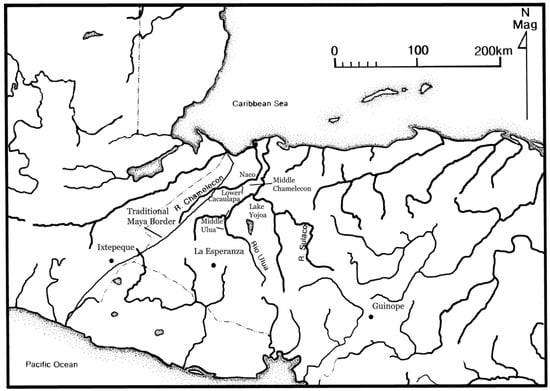
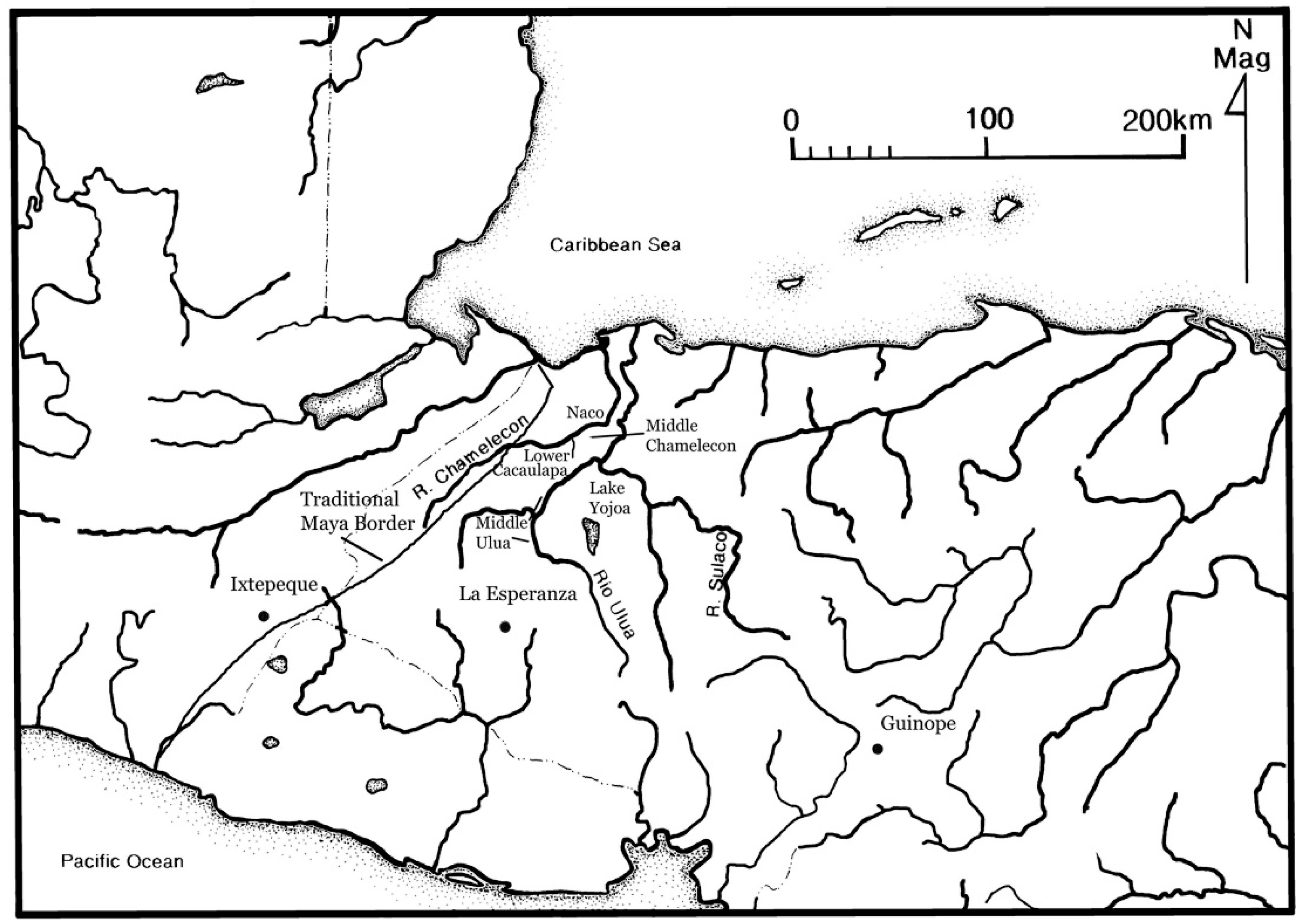
It is difficult for undergraduates to experience what it means to observe, think, and act as an anthropologist within a classroom. Doing so requires that student practices in the field constitute significant investigations yielding results they can meaningfully contemplate (Duncan-Andrade & Morrell, 2008, pp. 24–25; A. Kolb & Kolb, 2005, 2009). Undergraduates should then be encouraged to share those findings with others who can comment on their interpretations, thus leading to new insights. Archeologists have an established means for accomplishing these objectives in field schools. We argue that this learning environment, often narrowly rationalized as teaching practical skills, can serve as a powerful basis for accomplishing additional pedagogical objectives. Doing so requires re-thinking a field school’s aims, still teaching techniques but clarifying how those practices contribute to the distinct ways of inquiring that characterize anthropology’s CoP. In pursuing this topic, we will not dwell on how field programs teach archeological method and theory to undergraduates. Instead, we focus on the field school as a means of fomenting critical reasoning on several levels. That is what we tried to accomplish while directing an archeological field program from 1983–2008 in the Naco, lower Cacaulapa, middle Chamelecon, and middle Ulua valleys of northwest Honduras (Figure 2; Urban & Schortman, 2019).
Figure 2.
Map of Southeast Mesoamerica showing the valleys where members of the field school conducted research (redrawn from Urban & Schortman, 2024, Figure 1.1).
6. Learning How to Know
Field investigations pose numerous opportunities for students to destabilize their understanding of how learning proceeds and what knowledge is. They do so by encouraging undergraduates to grapple with open-ended problems and ambiguous results. This is especially the case where participants follow the research process through from: formulating a question to ask about the past; developing a strategy to address that query; conducting the necessary work; analyzing their results; and, reporting on those findings in a systematic manner to project members and professional audiences (Duncan-Andrade & Morrell, 2008, pp. 24–26; Hamilakis, 2001, p. 9; Hawkins, 2014; Kong, 2021; Weldrake, 2004, p. 192). Students given this freedom and responsibility come to appreciate:
How observations are conditioned by the interpretive frameworks guiding an investigation;
The ways in which those conceptual schemes can be challenged by new findings leading to critical evaluations of all you thought you knew;
How to make reasoned judgments about the past based on incomplete data, acknowledging that these interpretations are more inferences to the best explanation than definitive truths (Bevan et al., 2004, p. 209; Copeland, 2004; Hawkins, 2014; Urban & Schortman, 2019).
Such tacking between theory and data highlights how we make sense of life in general as we apply interpretive frameworks to observations and critically assess the former in reference to the latter (D. Kolb, 1984). Such awareness makes students better problem-solvers if only because they are keenly aware of how easily their preconceived notions can lead them astray (Hamann, 2003). Learning mindfully also maintains the link between knowledge and self-development that classroom-based instruction can obscure (Bunderson et al., 1996, p. 41; Dewey, 1931; Hamilakis, 2004, p. 289; Hawkins, 2014; Lock, 2004, p. 59; Wilcock, 2004, p. 218). All too often knowledge is treated as a commodity transferred ready-made from professor to student (Duncan-Andrade & Morrell, 2008, p. 24; Giroux, 2016, p. 351; A. Kolb & Kolb, 2009, p. 305). Direct participation in the focused inquiries through which knowledge is generated makes clear that what we know results from an open-ended “life-transforming experiential process” (Hamilakis, 2004, p. 289) to which undergraduates can contribute and from which they and others can benefit (Kadlec, 2006). Students who engage in this process should find it harder to take received wisdom for granted. They should be especially aware of the temptation to accept anything as true simply because it reinforces premises with which they are comfortable (Clarke, 2005, p. 84; Hamilakis, 2001, p. 9; 2004, p. 296). Conducting meaningful research also inculcates a sense of confidence in undergraduates who pursue their investigations through to successful conclusions.
Accomplishing these goals takes time, a diverse array of teachers, and contexts in which students can successfully conduct meaningful research (Bartle, 2015, p. 6). We began by running 10-week field programs (1983–1984, 1986) but found that the participants just reached the point when they could conduct research confidently and effectively at the field season’s end. This led us, with the support of Kenyon College and the Instituto Hondureňo de Antropologia e Historia (IHAH, the national body overseeing archeological investigations), to shift to 11, five-month seasons (1985, 1988–2008). These more extensive field experiences gave undergraduates the opportunity to hone their skills as investigators while deepening their appreciation for the questions they might use those skills to answer.
The program benefitted from the diverse company of teachers of different ages and backgrounds with whom students worked. Staff members, many who were working on their MA and PhD theses, modeled how archeology was practiced by those just beginning their careers. Working with these young professionals, the undergraduates gained a sense of archeology as something they could do as they saw people near their own ages pursuing research (Farah et al., 2024). As directors, our decades of experience and greater ages represented different ways of being members of the archeological community. The undergraduates also learned a good deal from the Hondurans with whom they collaborated on a daily basis. These highly skilled excavators subtly and effectively conveyed their knowledge about how best to expose different contexts to the students as they worked together. These experiences impressed on the undergraduates that the archeological CoP that crystalized each field season was composed of many people with different experiences and kinds of knowledge. Everyone knew something of value, sharing that expertise was key to the project’s success (Table 1).
Table 1.
Structure of Archeological Instruction and Research (January–May).
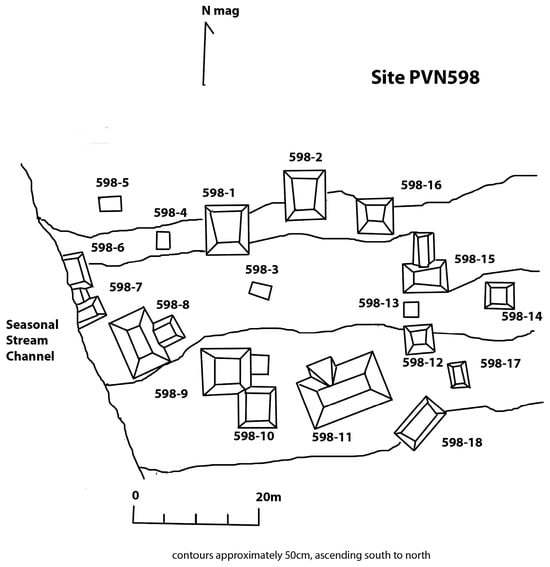
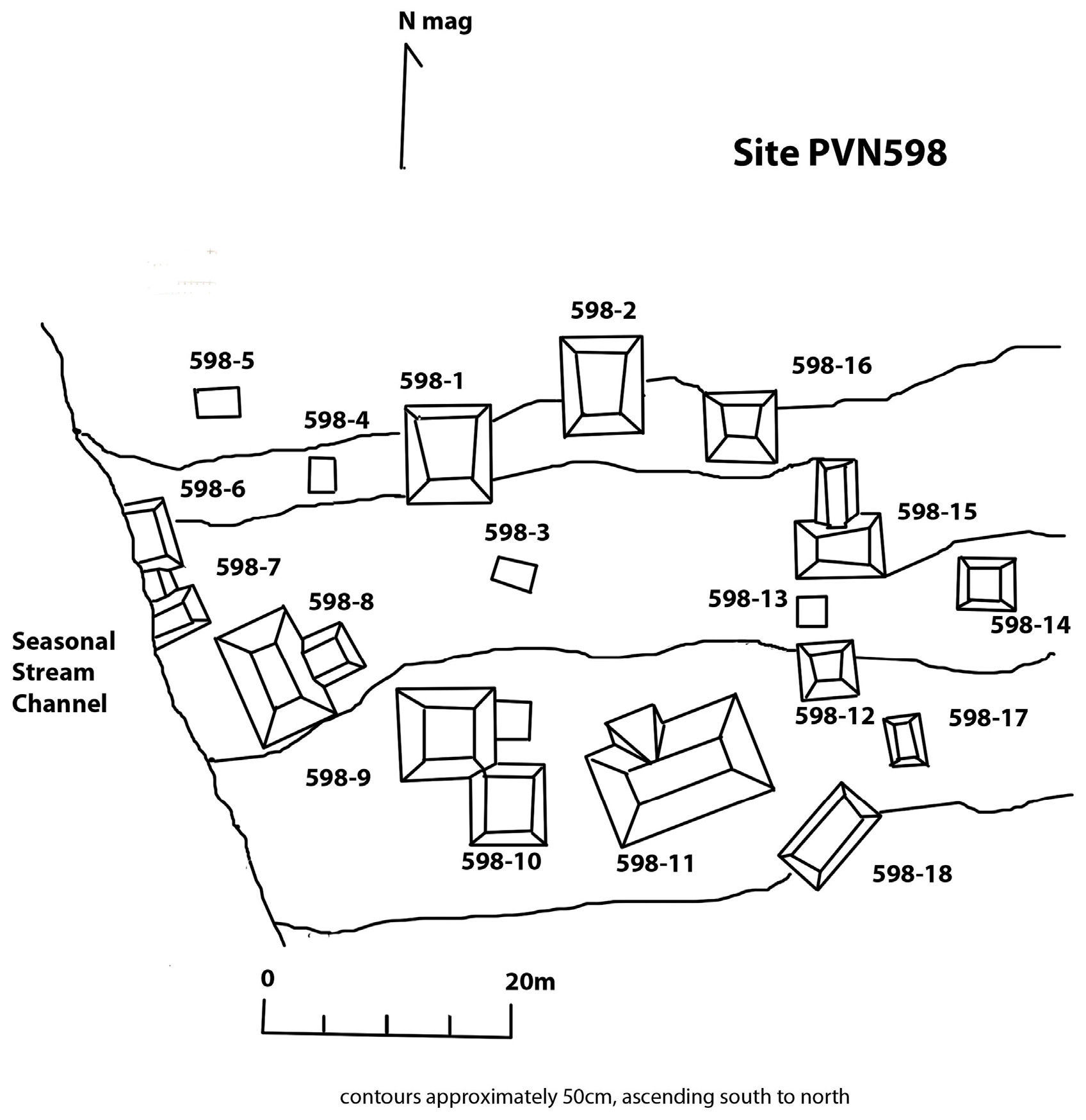
Student independent research generally involved their working with 8–10 local men for seven weeks excavating a household (Figure 3). These ubiquitous domestic compounds, dating from 600–1000 CE, consist of stone-faced platforms, usually under 1 m high, arranged around a plaza. The platforms supported residences, work-stations, and storerooms made of perishable materials. Households were venues where ancient CoPs took shape as their residents produced and consumed food, practiced crafts, raised children, and conducted religious rituals together. Their investigation provided valuable information on the varying ways people organized their lives as they satisfied their needs.
Figure 3.
Map of a household dating to CE600–900 in the middle Chamelecon valley showing the distribution of platforms surrounding an earthen patio.
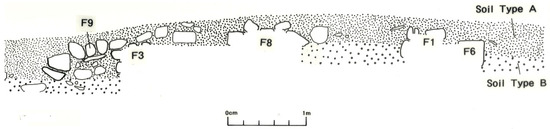
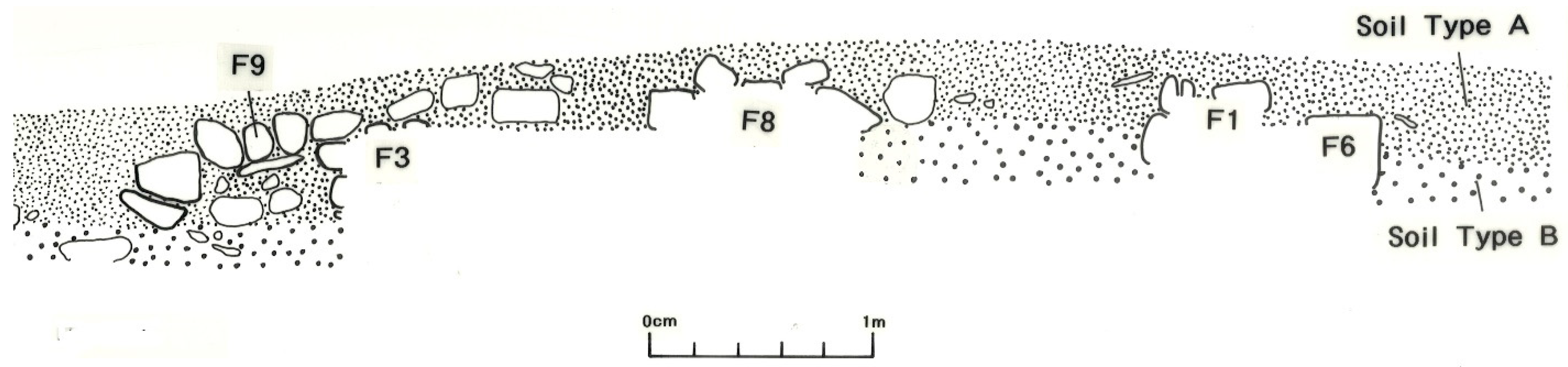
The work generally began as students, collaborating with trained local excavators, dug a trench over and within two to three platforms. These probes revealed something of a building’s architecture where it was generally best preserved along its centerline (Figure 4). Excavating through the final version of a structure uncovered different phases of construction, most buildings growing as new versions were erected atop their predecessors. Using information from the axial trench as a guide, digging then proceeded by laterally clearing architectural features to determine an edifice’s size and form. This information, coupled with data on the types of artifacts associated with different parts of the structure, allowed students to infer what activities the building’s inhabitants conducted at different points in the household’s history.
Figure 4.
Student drawing revealing constructions (labeled as F) exposed in an excavation through the center of an earth-filled, stone-faced platform. F9 consists of stones fallen from their original position atop wall F3.
Each step in the process involved students phrasing hypotheses about what they were seeing, testing those notions through targeted excavations, reassessing their original inferences, and, based on those evaluations, deciding where next to dig. Pursuing these inquiries required learning to perceive patterns in the distribution of rocks, soil, and artifacts that signified purposeful human actions in the past. At least one of us was on site every workday to consult with students as they made their decisions. Members of staff and the local people directly engaged in the excavations also helped students think through what they were observing and determining what it might signify about past behaviors. Throughout this process of collective meaning-making, mentors walked a delicate balance, asking students what they thought they were observing, how they came to that conclusion, what alternative interpretations might be possible, and what they needed to do to decide among those options. By the semester’s end, the undergraduates had internalized the basic questions that archeologists ask themselves when going about excavations. They were largely directing research on their own, seeking advice on increasingly specific points of interpretation. Seeing, reflecting, and acting as members of the archeological CoP, they generated an unprecedented corpus of knowledge about how the people who resided in the areas we studied lived.
We came to realize that undergraduates did not have sufficient time in the field to analyze, compare, and reflect on the full significance of their household studies. We thus offered a course in the United States during the semester after the field season that gave program participants the chance to write up formal reports on their research. In those summaries they considered in detail how what they found answered, or failed to answer, the queries they originally raised. The outcomes of these efforts were 34 papers they delivered at the Society for American Archaeology meetings and 39 honors theses. Presenting their research to professionals and outside examiners ensured that the students appreciated how knowledge is created through, and comes to constitute, CoPs. They also realized that they were contributors to that collective enterprise along with the members of staff and local people with whom they worked (Bourdieu, 1977, 1990; Hawkins, 2014; Wenger, 1998). Pursuing such investigations literally transformed undergraduates’ senses of themselves and their capacities.
Results of student research, together with their theses, are posted at https://digital.kenyon.edu/honduras/ (accessed on 24 November 2025). The archive contains all field records generated by undergraduates and staff who took part in the field school. By providing free access to the notes, drawings, photographs, and other records made by project members, the work of undergraduates and others is available to those who want to learn about the people we were fortunate enough to study for over two decades (see Schortman et al., 2020, for a description of the archive and examples of its use in teaching and research).
7. Evaluation of Student Work
We assessed student research efforts primarily through direct, daily interactions with them in the field. Participating in all aspects of their studies gave us a privileged position from which to assess how well they were mastering concepts and practices that constitute the archeological CoP. Engaging so fully with students in shared inquiries was made possible by limiting enrollments to 10–12 undergraduates each semester.
While on site, we talked with them about how the investigations were proceeding, assessed their confidence (and if that confidence was well founded) as they made decisions, and helped them learn essential recording procedures. What we were looking for was evidence of improvement in their capacity to pursue the interpretive spiral of observing closely, inferring reasonably, and evaluating effectively those inferences through which knowledge is repeatedly refined and deepened (Figure 1; Bartle, 2015; Garrett, 1997, p. 130; A. Kolb & Kolb, 2005, p. 2007; 2009, p. 314). To the extent that students mastered this process, and demonstrated they were aware of these learning steps, they were succeeding. We also reviewed the preliminary reports the undergraduates prepared on their work at the field season’s end. Here we were assessing the extent to which the students could describe their findings using a vocabulary members of the archeological CoP could understand.
The ultimate evaluation came when the undergraduates collaborated on presentations they gave before professional audiences. Here we were alert for signs that they had further refined their analyses begun in the field. We also gauged the reactions of those professionals who attended the session as well as soliciting the students’ opinions of their performances. We were no longer assigning grades but trying to determine the extent to which these neophyte archeologists had become, if only temporarily, members of the discipline’s CoP. The frequency with which their work is accessed from the program’s digital archive suggests that they are making contributions to the work of that community.
8. Learning How to Know Others
Field schools are wonderful environments for enlarging a student’s field of social interactions to include people who they would otherwise never know (Hamilakis, 2004, p. 295). Certainly, this is the case for a field school’s participants who often form close bonds with each other because of their shared experiences and mutual dependencies. We are thinking more specifically, however, of ties forged with the communities whose members contribute significantly to, and have a stake in, a field school’s activities and outcomes. The life experiences of these interested parties may well diverge considerably from those of the undergraduates. This is especially the case when field schools are conducted outside the student’s home country. We know ourselves through our interactions with others. Consequently, the more diverse the backgrounds of those with whom we deal, the richer our understanding of who we are and the greater our respect for those who comprehend the world differently from us (Lambert & Colaninno, 2023). Promoting this broadening of student visions requires that field programs be structured in ways that destabilize student perceptions of themselves and those around them. This is achieved by helping undergraduates re-think their relations to people living in other CoPs (Table 2).
Table 2.
Formal Structure Promoting Student Engagement with Local Communities of Practice (January–May).
One way we sought to achieve these aims was by offering semester-long courses on the local history and cultures of the area where we lived. These classes shook student complacency to the extent that they challenged the participants’ sense that they knew where they were residing and who their neighbors were. The two weeks of intensive language instruction offered by trained teachers helped students with varying levels of fluency in Spanish to begin conversing in that language. Holding the classes and home stays on Honduras’ north coast gave the undergraduates a chance to experience something of the distinctive cultures practiced along the Caribbean littoral.
Throughout the semester, we encouraged program participants to use what they were learning in seminars to engage with our hosts in informal settings. This involvement was facilitated by the small sizes of the towns where we lived, none having more than 5000 residents, and the fact that students worked regularly with local people in the field and lab. It was in the course of interactions while excavating in particular that undergraduates and residents had a chance to talk with, and get to know, one another. From there, students were invited to take part in events, such as soccer and volleyball games. These group interactions led to invitations to birthday parties and christenings just as our neighbors were welcomed at parties hosted by the program.
Structuring student involvement in what were to them deeply unfamiliar ways of knowing and being depended on significant support from field school staff and the directors (A. Kolb & Kolb, 2005, p. 206). Most importantly, these engagements relied on the willingness of our hosts to teach the students what they needed to know to behave properly in their new setting. It was critical to monitor, but not control, student interactions in town to make sure they were learning in new ways without disrupting the lives of their local mentors. We relied heavily on contacts we had developed over the years to establish and track student interactions with our neighbors just as we worked with staff to assess how the undergraduates were feeling about those dealings. Eating dinner together seven days a week and living arrangements that included students and staff facilitated evaluating student morale and identifying problems before they became crises. Having five months allowed student relations with our hosts to take shape more fully than was the case within the earlier, shorter field seasons.
All of the students went through periods when they despaired of ever being able to avoid making mistakes in conducting archeological research or in their dealings with local people. These were followed by intervals of euphoria when all seemed to be going well. Such satisfying moments were inevitably succeeded by an awareness of how much more they still had to learn. Through time, these emotional and intellectual oscillations moderated until by the semester’s end students had the sense that they were beginning to understand something of their local co-workers’ and friends’ aspirations, perceptions, and models for living. They were not fully part of the community where we resided. They did appreciate something of its rich complexity. Encouraging undergraduates to participate in a host’s CoP:
Reveals the diversity and complexity of our hosts’ lives;
Helps students to understand what their interlocutors are “saying” in the broadest sense;
Provides the opportunity for students to reflect critically on their own lives as they come to appreciate another way of being;
Encourages students to see the humanity that unites us all while not losing appreciation for cultural and socio-economic differences.
Near the end of the 2002 field season, a student remarked to Schortman at dinner, “I always knew that poor people were people but here I am working with these local men and they’re very poor but we laugh, joke, talk about our families. They really are people!” There are subtler ways of conveying this basic idea but they got at the heart of what we were attempting to do for the 25 years we worked with undergraduates in Honduras. That is, to get students to the point where they could empathize with people whose lives were different in many ways from their own. In so doing, students’ senses of self and their relations to others were unsettled and expanded (Stoller, 2018, p. 59).
Accomplishing this goal was never easy; some undergraduates remarked that the experience could at times be “too strong.” Nonetheless, every student we worked with said that they had never felt more alive, more challenged, and more satisfied with themselves for meeting those challenges, than when they were working in Honduras. They all acknowledged that they had grown in unexpected ways and took those experiences and insights into their careers in business, medicine, teaching, social work, government service, law, and even anthropology.
Mindful disruptions of student cultural complacency follows the same steps through which they were introduced to being archeologists. Courses and conversations with a diverse a range of people provided students with concepts needed to observe and reflect in new ways. These understandings were then put into practice, giving the undergraduates the chance to evaluate their newly acquired modes of seeing and thinking as they gauged the reactions of others to their behaviors. This leaning spiral, as in the excavations, required constant support from the directors, staff, and local colleagues to ensure that students were not overwhelmed by, or oblivious to, the significance of these encounters (Hamilakis, 2001, p. 9; Hawkins, 2014).
9. Limits and Missed Opportunities
We are quite aware of how lucky we were to develop the field program described here. It is also clear that there are limitations to the form of inquiry-driven learning we directed. One is cost. Though financial aid officers at Kenyon and other institutions worked creatively and diligently to cover the students’ financial needs, expenses were still high. Grants from the National Science Foundation’s Research Experiences for Undergraduates Program helped defray some of those charges in most years. Still, there is no doubt that there were many undergraduates who might have benefited from the program but who could not afford to join us.
The other cost was in the time we invested in the field school. Being away from Kenyon for protracted periods was a burden for the College and our colleagues. We compensated by teaching overloads when we were on campus but there is no doubt that our absences posed curricular and administrative challenges. Administrators, staff, and faculty bore those costs with remarkable grace, for which we are deeply grateful. Nonetheless, we realize how fortunate we were to have this support and that it is not available at many other institutions.
We also failed to gauge how fully the Hondurans with whom we worked were integrated within the CoP we repeatedly formed each field season. We had good working relationships based on some level of mutual understanding. With the support of the IHAH, we also shared the results of each season with our hosts in schools and town halls Students and program alumni took leading roles in these outreach efforts. Such “participatory modes” of interaction (Colwell, 2016, p. 117) gave back something to the people on whose labor and kindness we depended.
We did not, however, systematically determine what our local colleagues made of the research. Most likely, the CoP we created together included people who cooperated effectively while imbuing our actions with different meanings. We only tried once, in 1995, to test this notion but terminated that effort before obtaining meaningful results. This was a mistake we hope others will not repeat.
In order to avoid our error, archeologists might follow the lead of those who involve all stakeholders in an area’s history in negotiations that determine an investigation’s conduct and assessment (Angelbeck, 2023; Brown, 2024; Colwell, 2016; Franklin et al., 2020; Gilmore et al., 2024; Piccini & Schaepe, 2014; https://in-herit.org/ (accessed 23 October 2025); cf. Campbell & Lassiter, 2010). These community archeology projects are not necessarily parts of field schools. Nonetheless, to the extent they require that everyone involved plans and acts together, such initiatives provide rich opportunities to create learning collectives that encompass all participants as equal partners in knowledge creation (Colwell, 2016).
10. Conclusions
When we initiated our field school, we replicated an educational model with which we were familiar. Students would participate in research tasks and learn to do them effectively. We soon realized that field experiences offered opportunities for a more holistic form of learning that went beyond skills training to engage the entire person emotionally, intellectually, socially, and physically (Bartle, 2015, p. 2; Garrett, 1997, p. 130). Watching undergraduates grow as individuals through their meaningful interactions with established archeologists and local colleagues and friends, we began to appreciate that inquiry-based education could both contribute to knowledge and personal empowerment (Bartle, 2015, p. 2; Stoller, 2018, pp. 53–54). Field schools could be more than extensions of classroom instruction. They were opportunities for self-discovery and prods to continue that process throughout life. These programs also offer students the chance to engage with different identities, one of which is as a life-long learner who is always open to new ways of being (A. Kolb & Kolb, 2009, pp. 305–306).
We also belatedly came to understand what many had realized before us; this form of empowerment is essential to sustaining democratic societies (Dewey, 1931; Saltmarsh, 2008, pp. 66–67). Whether called experiential, critical, or inquiry-driven learning, these curricula inculcate in students the ability and confidence to reflect critically on the familiar and envisage better alternatives (Bartle, 2015, p. 8). The capacity to think in different categories, to imagine novel outcomes, and have the confidence to act with others on both is the wellspring of democracy and a motor for positive social change (Duncan-Andrade & Morrell, 2008, pp. 32–33; Giroux, 2016, p. 356; Jenlink & Jenlink, 2008; Lambert & Colaninno, 2023).
Most participants on our field school never became archeologists. It was not our intention to send them down this path, though we did want those who chose the profession to be well prepared to succeed in it. What we desired for all students was the chance to shake up their understanding of themselves. We achieved this by giving them the opportunity to accomplish goals they never imagined possible by working with people they never would have known. In doing so, we hoped the students would be transformed, not by us, but with the support we orchestrated with diverse colleagues (Stoller, 2018, p. 54). Judging by our conversations with program alumni, by the careers they have successfully pursued in different fields, we feel their time in Honduras was well spent.
Author Contributions
Conceptualization, P.A.U. and E.M.S.; methodology, P.A.U. and E.M.S.; validation, E.M.S. and P.A.U.; formal analysis, E.M.S. and P.A.U.; investigation, P.A.U. and E.M.S.; resources, E.M.S. and P.A.U.; data curation, E.M.S.; writing—original draft preparation, E.M.S. and P.A.U.; writing—review and editing, E.M.S.; visualization, E.M.S.; supervision, E.M.S. and P.A.U.; project administration, P.A.U. and E.M.S.; funding acquisition, E.M.S. and P.A.U. All authors have read and agreed to the published version of the manuscript.
Funding
This research was funded by The National Science Foundation [BNS-8919272, BNS-9022247, BNS-9121386, SBR-9407751, SBR 9904025, BCS-0109952, DIR-9100569, SBR-9322330, SES-9912296, SES 0101071, SES-0243644], National Endowment for the Humanities [RO-21897-89], National Geographic Society [4208-89], and the Wenner-Gren Foundation for Anthropological research [1991].
Institutional Review Board Statement
Not applicable.
Informed Consent Statement
Not applicable.
Data Availability Statement
All data relating to this project are available at https://digital.kenyon.edu/honduras/ (accessed on 24 November 2025).
Acknowledgments
Our experiences working with undergraduates in Honduras were made possible by the generous support of the National Science Foundation (especially its Research Experiences for Undergraduates program), National Endowment for the Humanities, National Geographic Society, Wenner-Gren Foundation, and Kenyon College. Posting field records to the online archive was supported by a grant from the Council on Library and Information Resources. Meg Galipault was instrumental in securing that funding. Jenna Nolt and Sharon Fair, aided by numerous undergraduates and staff, played central roles in creating the collection. Colleagues at Kenyon greatly facilitated our collaboration with students in the field while staff and directors of the IHAH were our esteemed collaborators throughout our many years teaching and conducting research in Honduras. Marne Ausec played especially important roles as program lab director and supervisor of student interactions within the communities where we lived. Ellen Bell directed the field school with Marcello Canuto in 2006 and was an invaluable colleague through many field seasons. Lauren Schwartz and Marcella Esqueda did excellent jobs sharing teaching duties with us during the 2008 field season. Residents of the communities where we worked were invariably welcoming hosts and valued collaborators in all we did together. Jorge Bueso Cruz and don Luis Nolasco were our essential liaisons and good friends throughout the work. We are very grateful to all these people and institutions for their generous support of student learning in Honduras. Perhaps our deepest thanks go to the undergraduates. By sharing with them a country and field we love, our interest in, and appreciation for, that place and discipline were enriched far more than if we had conducted the work without them. We appreciate the comments of the four anonymous readers who evaluated this manuscript and the support of Maria Mendonca who urged us to write this article. All errors and omissions that stubbornly remain in the essay are solely the authors’ responsibilities.
Conflicts of Interest
The authors declare no conflict of interest.
References
- Angelbeck, B. (2023). Franz boas refracted through his local collaborators: A legacy with implications for collaborative archaeologies. Ethnographisch-Archaeologische Zeitschrift, 57, 1–17. [Google Scholar] [CrossRef] [Scilit]
- Barth, F. (2002). An anthropology of knowledge. Current Anthropology, 43, 1–18. [Google Scholar] [CrossRef] [Scilit]
- Bartle, E. (2015). Experiential learning: An overview. University of Queensland. Available online: https://itali.uq.edu.au/files/1264/Discussion-paper-Experiential_learning_an_overview.pdf (accessed on 4 November 2025).
- Bevan, B., Barnatt, J., Dymond, M., Edmonds, M., & McElearney, G. (2004). Public prehistories: Engaging archaeology on Gardom’s edge, Derbyshire. In D. Henson, P. Stone, & M. Corbishley (Eds.), Education and the historic environment (pp. 195–211). Routledge. [Google Scholar]
- Bok, D. (2006). Our underachieving colleges: A candid look at how much students learn and why they should be learning more. Princeton University Press. [Google Scholar]
- Bourdieu, P. (1977). Outline of a theory of practice (R. Nice, Trans.). Cambridge University Press. [Google Scholar]
- Bourdieu, P. (1990). The logic of practice. Stanford University Press. [Google Scholar]
- Braa, D., & Callero, P. (2006). Critical pedagogy and classroom praxis. Teaching Sociology, 34, 357–369. [Google Scholar] [CrossRef] [Scilit]
- Bradley, E., & Kahn, J. (2024, August 28). In pursuit: The power of epistemic humility. Inside Higher Ed. Available online: https://www.insidehighered.com/opinion/views/2024/08/28/power-epistemic-humility-opinion (accessed on 4 November 2025).
- Brown, K. (2024). Praxis, persistence, and public archaeology: Disrupting the mission Myth at La Purísima Concepción. American Antiquity, 89, 399–416. [Google Scholar] [CrossRef] [Scilit]
- Bunderson, E., van Mondfrans, A., & Henderson, M. (1996). The baker village teachers’ archaeology field school: A case study of public involvement in archaeology. Journal of California and Great Basin Archaeology, 18, 38–47. [Google Scholar]
- Campbell, E., & Lassiter, L. (2010). From collaborative ethnography to collaborative pedagogy: Reflections on the other side of Middletown project and community-university research partnerships. Anthropology & Education Quarterly, 41, 370–385. [Google Scholar]
- Clarke, C. (2005). Archaeology: Another story. Australian Archaeology, 61, 80–87. [Google Scholar] [CrossRef] [Scilit]
- Colwell, C. (2016). Archaeologies and descendant communities. Annual Review of Anthropology, 45, 113–127. [Google Scholar] [CrossRef] [Scilit]
- Copeland, T. (2004). Interpretations of history: Constructing pasts. In D. Henson, P. Stone, & M. Corbishley (Eds.), Education and the historic environment (pp. 33–40). Routledge. [Google Scholar]
- Dewey, J. (1931). Individualism old and new. George Allen and Unwin, Ltd. [Google Scholar]
- Dewey, J. (1935). Liberalism and social action. Prometheus Books. [Google Scholar]
- Duncan-Andrade, J., & Morrell, E. (2008). Contemporary developers of critical pedagogy. In J. Duncan-Andrade, & E. Morrell (Eds.), The art of critical pedagogy: Possibilities for moving from theory to practice in urban schools (Vol. 285, pp. 23–48). Peter Lang. [Google Scholar]
- Farah, K., Kemmerlin, A., & Luley, B. (2024). Experiencing archaeology beyond the classroom. The SAA Archaeological Record, 24, 34–39. [Google Scholar]
- Franklin, M., Dunnavant, J. P., Flewellen, A. O., & Odewale, A. (2020). The future is now: Archaeology and the eradication of anti-blackness. International Journal of Historical Archaeology, 24, 753–766. [Google Scholar] [CrossRef] [Scilit]
- Garrett, L. A. (1997). Dewey, dale, and bruner: Educational philosophy, experiential learning, and library school cataloging instruction. Journal of Education for Library and Information Science, 38, 129–136. [Google Scholar] [CrossRef] [Scilit]
- Gilmore, J., Ofunniyin, A., Oubre, L., Fleskes, R., & Schurr, T. (2024). “The dead have been awakened in the service of the living”: Activist community-engaged archaeology in Charleston, south Carolina. American Antiquity, 89, 165–184. [Google Scholar] [CrossRef] [Scilit]
- Giroux, H. (2016). When schools become dead zones of the imagination: A critical pedagogy manifesto. The High School Journal, 99, 351–359. [Google Scholar] [CrossRef] [Scilit]
- Hamann, E. (2003). Imagining the future of the anthropology of education if we take Laura Nader seriously. Anthropology & Education Quarterly, 34, 438–449. [Google Scholar] [CrossRef] [Scilit]
- Hamilakis, Y. (2001). Interrogating archaeological pedagogies. In P. Rainbird, & Y. Hamilakis (Eds.), Interrogating pedagogies: Archaeology in higher education (Vol. 948, pp. 5–12). British Archaeological Reports International Series. Archaeopress. [Google Scholar]
- Hamilakis, Y. (2004). Archaeology and the politics of pedagogy. World Archaeology, 36, 287–309. [Google Scholar] [CrossRef] [Scilit]
- Hamilakis, Y., & Rainbird, P. (2004). Interrogating pedagogies: Archaeology in higher education. In D. Henson, P. Stone, & M. Corbishley (Eds.), Education and the historic environment (pp. 47–54). Routledge. [Google Scholar]
- Hawkins, J. (2014). The undergraduate ethnographic field school as a research method. Current Anthropology, 55, 551–590. [Google Scholar] [CrossRef] [Scilit]
- Hutchins, E. (2006). The distributed cognition perspective on human interaction. In S. Levinson, & N. Enfield (Eds.), Roots of human sociality: Culture, cognition, and interaction (pp. 375–398). Routledge. [Google Scholar]
- Inayatullah, N. (2019). Why do some people think they know what is good for others? In J. Edkins, & M. Zehfuss (Eds.), Global politics: A new introduction (pp. 344–369). Routledge. [Google Scholar] [CrossRef] [Scilit]
- Jenlink, P., & Jenlink, E. (2008). Creating democratic learning communities: Transformative work as spatial practice. Theory Into Practice, 47, 311–317. [Google Scholar] [CrossRef] [Scilit]
- Jordan, B., & Henderson, A. (1995). Interaction analysis: Foundations and practice. The Journal of the Learning Sciences, 4, 39–103. [Google Scholar] [CrossRef] [Scilit]
- Kadlec, A. (2006). Reconstructing dewey: The philosophy of critical pragmatism. Polity, 38, 519–542. [Google Scholar] [CrossRef] [Scilit]
- Kolb, A., & Kolb, D. (2005). Learning styles and learning spaces: Enhancing experiential learning in higher education. Academy of Management Learning & Education, 4, 193–212. [Google Scholar] [CrossRef] [Scilit]
- Kolb, A., & Kolb, D. (2009). The learning way: Meta-cognitive aspects of experiential learning. Simulation and Gaming, 40, 297–327. [Google Scholar] [CrossRef] [Scilit]
- Kolb, D. (1984). Experiential learning: Experience as the source of learning and development. Prentice Hall. [Google Scholar]
- Kong, Y. (2021). The role of experiential learning on students’ motivation and classroom engagement. Frontiers in Psychology, 12, 771272. [Google Scholar] [CrossRef] [Scilit]
- Lambert, S., & Colaninno, C. (2023). Bending the trajectory of field school teaching and learning through active and advocacy archaeology. Humans, 3, 10–23. [Google Scholar] [CrossRef] [Scilit]
- Lave, J., & Wenger, E. (1991). Situated learning: Legitimate peripheral participation. Cambridge University Press. [Google Scholar]
- Lemert, C., & Branaman, A. (Eds.). (1997). The Goffman reader. Blackwell Publishers. [Google Scholar]
- Lock, G. (2004). Rolling back the years: Lifelong learning and archaeology in the united kingdom. In D. Henson, P. Stone, & M. Corbishley (Eds.), Education and the historic environment (pp. 55–64). Routledge. [Google Scholar]
- Ortner, S. (1995). Resistance and the problem of ethnographic refusal. Comparative Studies in Society and History, 37, 173–193. [Google Scholar] [CrossRef] [Scilit]
- Piccini, A., & Schaepe, D. (2014). The messy business of archaeology as participatory local knowledge: A conversation between the Stó:lō nation and Knowle West. Canadian Journal of Archaeology, 38, 466–495. [Google Scholar]
- Pluciennik, M. (2001). Theory as practice. In P. Rainbird, & Y. Hamilakis (Eds.), Interrogating pedagogies: Archaeology in higher education (Vol. 948, pp. 21–28). British Archaeological Reports International Series. Archaeopress. [Google Scholar]
- Roth, W.-M., & Jornet, A. (2014). Towards a theory of experience. Science Education, 98, 106–126. [Google Scholar] [CrossRef] [Scilit]
- Salomon, G. (Ed.). (1993). Distributed cognitions: Psychological and educational considerations. Cambridge University Press. [Google Scholar]
- Saltmarsh, J. (2008). Why dewey matters. The Good Society, 17, 63–68. [Google Scholar] [CrossRef] [Scilit]
- Schortman, E., Bell, E., Nolt, J., & Urban, P. (2020). The past is prologue: Preserving and disseminating archaeological data online. In J. Crowder, L. Poirier, M. Fortun, & R. Besara (Eds.), Anthropological data in the digital age (pp. 185–207). Springer. [Google Scholar]
- Shore, C., & Wright, S. (1999). Audit culture and anthropology: Neo-liberalism in british higher education. The Journal of the Royal Anthropological Institute, 5, 557–575. [Google Scholar] [CrossRef] [Scilit]
- Spencer, R. (1985). What do we mean by experiential learning? Teacher Education Quarterly, 12, 12–15. [Google Scholar]
- Stoller, A. (2018). Dewey’s creative ontology. Journal of Thought, 52, 47–64. [Google Scholar]
- Strathern, M. (Ed.). (2000). Audit cultures: Anthropological studies in accountability, ethics, and the academy. Routledge. [Google Scholar]
- Urban, P., & Schortman, E. (2019). Archaeological theory in practice (2nd ed.). Routledge. [Google Scholar]
- Urban, P., & Schortman, E. (2024). Ancient southeast mesoamerica: Political economies without the state. Cambridge University Press. [Google Scholar]
- Weldrake, D. (2004). Archaeology at Wilsden, West Yorkshire: A local focus for national curriculum work. In D. Henson, P. Stone, & M. Corbishley (Eds.), Education and the historic environment (pp. 185–193). Routledge. [Google Scholar]
- Wenger, E. (1998). Communities of practice: Learning, meaning, and identity. Cambridge University Press. [Google Scholar]
- Wilcock, D. (2004). Kilmartin house trust. In D. Henson, P. Stone, & M. Corbishley (Eds.), Education and the historic environment (pp. 213–219). Routledge. [Google Scholar]
- Wolcott, H. (1982). The anthropology of learning. Anthropology & Education Quarterly, 13, 83–108. [Google Scholar] [PubMed]

Disclaimer/Publisher’s Note: The statements, opinions and data contained in all publications are solely those of the individual author(s) and contributor(s) and not of MDPI and/or the editor(s). MDPI and/or the editor(s) disclaim responsibility for any injury to people or property resulting from any ideas, methods, instructions or products referred to in the content. |
© 2025 by the authors. Licensee MDPI, Basel, Switzerland. This article is an open access article distributed under the terms and conditions of the Creative Commons Attribution (CC BY) license (https://creativecommons.org/licenses/by/4.0/).