Article

Assessment of the Use of Coconut Water as a Cultivation Medium for Limnospira (Arthrospira) platensis (Gomont): Effects on Productivity and Phycocyanin Concentration


by
Maria Rafaele Oliveira Bezerra da Silva
1,2,
Bruna Emanuelle Gomes do Nascimento
1,2,
Maria Eduarda Moura Mendes
1,
Rayane Oliveira Bezerra da Silva
1,2,
Silvana de Fátima Ferreira da Silva
2,
Romero Marcos Pedrosa Brandão Costa
1,* and
Daniela de Araújo Viana Marques
1,2
1
Integrated Multiuser Laboratory for Applied Biotechnology (LIBAS), Institute of Biological Sciences, University of Pernambuco—UPE, Santo Amaro, Recife 50100-130, PE, Brazil
2
Biotechnology and Parasitology Laboratory, University of Pernambuco—UPE, Santo Amaro, Recife 50100-130, PE, Brazil
*
Author to whom correspondence should be addressed.
Phycology 2025, 5(4), 82; https://doi.org/10.3390/phycology5040082 (registering DOI)
Submission received: 28 October 2025 / Revised: 29 November 2025 / Accepted: 30 November 2025 / Published: 1 December 2025
(This article belongs to the Special Issue Development of Algal Biotechnology)

Abstract

Due to the scarcity of sustainable inputs for photosynthetic microorganisms’ biotechnology, the search for natural substrates such as coconut water has gained prominence. This by-product is a substrate rich in macro- and micronutrients, as well as endogenous phytohormones that support microbial growth. In this context, this study aimed to use it as an alternative cultivation medium for Limnospira platensis (Gomont), formerly known as Arthrospira platensis, a high-value cyanobacterium. We evaluated growth parameters, phycocyanin concentration, purity, and biomass yield cultivated in coconut water and in SAG1x medium, a modified Zarrouk medium. Over 35 days of cultivation, both media efficiently supported cyanobacterial growth. In coconut water, the specific growth rate was 0.305 d−1, the maximum growth rate was 0.629 d−1, and the productivity was 0.256 g L−1 d−1. In SAG1x medium, the values obtained were 0.240 d−1, 0.676 d−1, and 0.218 g L−1 d−1, respectively. Phycocyanin obtained from cultivation in SAG1x medium presented food-grade purity (OD620/OD280 ratio > 0.7), while in coconut water, it was 0.6. The pigment concentration and yield in SAG1x (19.1 mg/L and 34.3%, respectively) also slightly exceeded those obtained with coconut water (14.3 mg/L and 25.5%, respectively). Despite this, the data reinforce the potential of coconut water as a viable and economically competitive alternative to conventional media for L. platensis production.

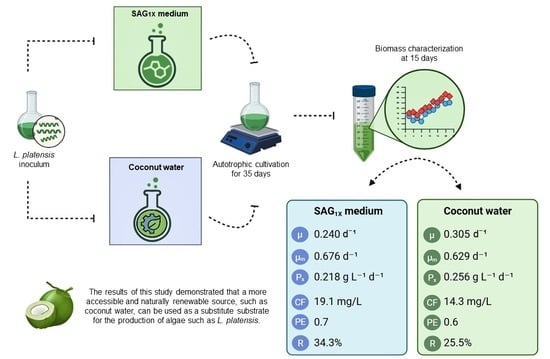
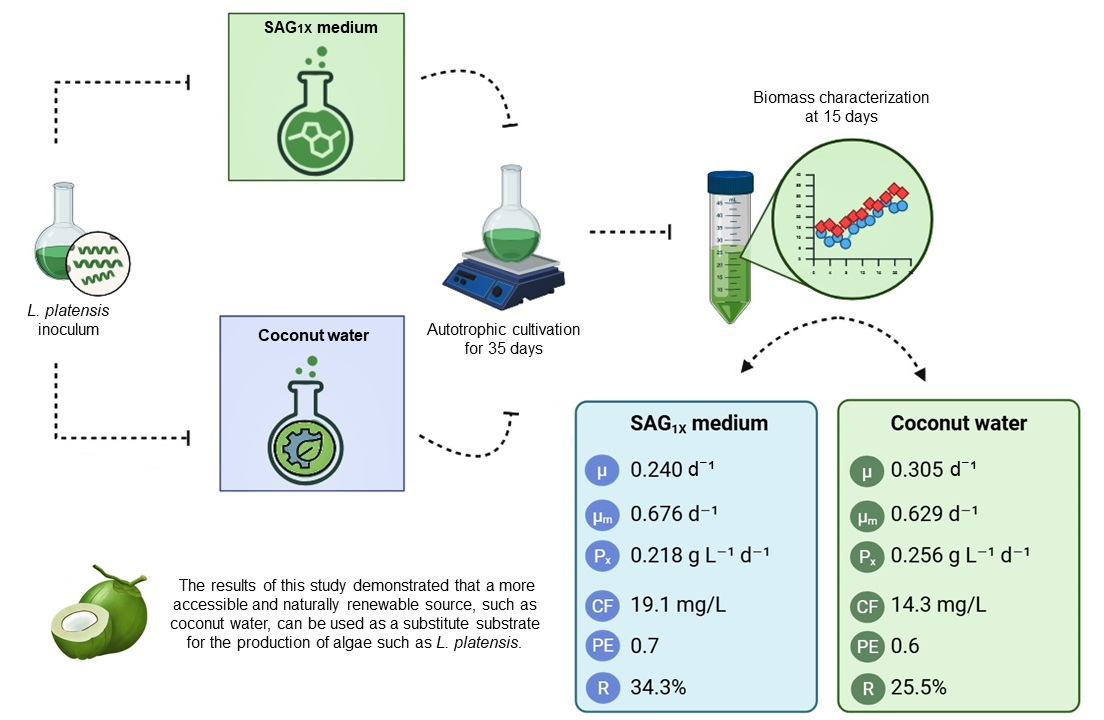
Graphical Abstract

1. Introduction

Cyanobacteria, also known as blue–green algae, are a group of prokaryotic, photosynthetic, and unicellular microorganisms that, due to their easy adaptation to environments with adverse conditions, can be found in almost all habitats on Earth, including those with low nutrient availability [1,2]. In recent years, these microorganisms have gained prominence as a rich source of bioactive compounds, with them being considered one of the most promising groups for the production of such molecules [3,4].
Among the species of greatest economic relevance, Limnospira platensis (Gomont), formerly known as Arthrospira platensis [5], stands out, a filamentous cyanobacterium widely recognized for its use as a nutritional supplement and food additive, due to its high protein content (70% on dry weight basis) [6], polysaccharides, carbohydrates, lipids, and enzymes. Furthermore, it is an excellent source of phycobiliproteins, a protein-pigment complex that captures light in cyanobacteria [7]. There are three main classes of phycobiliproteins that differ in protein structure, consisting of C-phycocyanin (C-PC), allophycocyanin, and phycoerythrin. C-phycocyanin represents the main group of phycobiliproteins [8] and has wide applicability in the pharmaceutical industry as an antioxidant, anti-inflammatory, immunomodulatory, and antitumor agent [9,10,11,12]. Additionally, it has also been used as a color additive in the food and cosmetics industries [13,14]. This is an important topic, as the U.S. Department of Health and Human Services (HHS) and the Food and Drug Administration (FDA) have recently indicated a significant shift toward the restriction and gradual phase-out of synthetic dyes, especially those derived from petroleum, due to growing evidence of health risks [15,16].
In view of this, the phycocyanin market size is expected to increase by 33.8% by 2030 [17], which implies that production will likely rise in the coming years. This results in greater interest in research on new processing methods. However, for these applications to become viable at an industrial scale, it is essential to optimize the cultivation conditions of biomass rich in C-PC [18]. Biomass growth and pigment synthesis are influenced by light, temperature, pH, and agitation. Nevertheless, nutrient availability is one of the main promising strategies to alter and control cyanobacterial growth and pigment production [19,20]. During cultivation, essential nutrients consist of nitrogen sources and carbon sources, either organic or inorganic, which represent one of the most economically impactful factors in production and other micronutrients necessary for cell development [21,22], as well as other micronutrients necessary for cell development, such as iron, magnesium, zinc, and others [23,24].
Consequently, the replacement of basic carbon sources in the medium by other organic components as an alternative strategy for cultivation medium formulation has shown promise, aiming at cost reduction, which represents approximately 35% of the total cost of algal biomass production, and greater availability of nutrient sources [25,26]. Previously, the use of chicken or goat manure [27,28] and sugarcane molasses [29] has been reported. The use of these alternative cultivation media increased nutrient use efficiency and Limnospira productivity, indicating that other natural products may also have potential for this purpose.
In this context, coconut water, a liquid present in the endosperm of Cocos nucifera L. seeds, stands out as a promising option, as it is a free by-product and a nutrient-rich substrate for microbial cultivation [30], consisting mainly of water (95.5%), as well as 4% sugars, 0.1% fat, 0.02% calcium, 0.01% phosphorus, 0.5% iron, and considerable amounts of carbohydrates, proteins, amino acids, minerals, vitamins, and endogenous phytohormones essential for the growth and maintenance of cyanobacteria such as L. platensis [31]. The use of coconut water as an alternative cultivation method for the growth of L. platensis is an approach that offers several benefits, potentially improving quality and productivity compared to traditional cultivation methods [30,32]. For example, coconut water has been successfully employed as a growth medium for Meyer lemon, as well as for various microbes and fungi, and has provided a straightforward and cost-effective strategy for large-scale growth, making it suitable for commercial-scale operations [31,33,34].
Furthermore, the global coconut water market has been consistently growing, particularly in Asia and the Pacific, especially in Indonesia, the Philippines, India, Sri Lanka, and Brazil, which together account for the majority of global coconut production. In these countries, there is a well-established infrastructure for collection, transportation, and processing, ensuring sufficient supply to meet the needs of both the food industry and potential biotechnological applications [35,36,37]. The operational costs associated with this production, which are already considerably low, can be further reduced by utilizing residual or industrial by-product coconut water. This subproduct, typically considered a low-value waste, can be obtained at virtually no cost, thereby significantly decreasing expenditures on inputs [38,39]. The cost of the standard Zarrouk medium for the production of L. platensis is approximately USD 0.08 per liter, representing up to 35% of the total biomass cost, whereas alternative media or residual substrates have been shown to reduce this cost by about fivefold (USD 0.016 per liter) [40]. This context contributes to strengthening the local economy and promotes production sustainability, offering new perspectives for the implementation of more sustainable and adaptable production.
Thus, in view of its abundance, low cost and suitable chemical composition, coconut water was tested in this study as an alternative growth medium for L. platensis, a nutritionally demanding and high-value cyanobacterial species, with the aim of evaluating its impact on growth rates and on the production and purity of C-PC in comparison with a standard cultivation medium, thereby contributing to its feasibility as a potential microbial growth medium.

2. Materials and Methods

2.1. Inoculum Preparation, Culture Media and Experimental Design

The cultivation of L. platensis (UTEX 1926) was carried out using two distinct growth media: Spirulina 1x modified medium (SAG1x) [41], considered a modified variation of the SAG medium (Sammlung von Algenkulturen Göttingen), developed by University of Texas Algae Culture Collection (UTEX) and closely resembling Zarrouk’s medium, and coconut water (Cocos nucifera L.), corresponding to the liquid endosperm extracted from fresh fruits approximately two months old. For the formulation of the coconut water-based medium, the liquid was previously filtered through a 0.22 µm sterilizing membrane and then supplemented with the same metal (P-IV) and micronutrient (Chu) solution used in the SAG1x medium. The pH was adjusted to 9.0 by adding sodium carbonate (Na2CO3) [42]. The composition of the growth media, including the reagents used for their preparation, is described in Table 1.
The inoculum was prepared by cultivating the cyanobacterium in SAG1x medium until reaching the exponential growth phase. At this stage, the wet biomass was harvested and washed by centrifugation three times with distilled water, a procedure that served as a transition step to completely remove the previous medium before the transfer to coconut water and to SAG1X medium. The cell concentration was adjusted to 50 mg L−1 based on spectrophotometric measurements at 560 nm using a previously established growth curve. This inoculum was then used to initiate the cultivation in 16 independent 250 mL Erlenmeyer flasks, each filled with 150 mL of culture (eight containing SAG1x medium and eight containing coconut water, of two fresh fruits), maintained under continuous agitation on an orbital shaker at 120 rpm and continuous illumination, at a temperature of 28 ± 2 °C and a light intensity of 45 ± 5 μmol photons m−2 s−1.
During the cultivation days (35 d), until the death phase, 1 mL aliquots were withdrawn daily from all eight flasks containing SAG1x and coconut water. The cell concentration was determined by measuring OD 560 nm in a spectrophotometer. Each aliquot was measured in triplicate (analytical replicates), and the mean of the three readings was considered as the value for that flask on each day. Before withdrawing the aliquots, the cultures were homogenized by gentle agitation, and both the positions of the flasks and the sampling order were randomized to minimize possible biases. To determine the other growth parameters and phycocyanin production, the wet biomass was collected at the stationary phase of the cultures (15 days for both media) and concentrated by centrifugation (5 min at 2000 rpm). The concentrated wet biomass was then used to determine the growth parameters and phycocyanin content by standardized analytical methods, without prior drying or additional extraction steps.

2.2. Growth Parameters

The growth of the culture was determined daily based on the OD at 560 nm, and the specific growth rate was calculated using the equation:
μ = ln O D x l n ( O D 0 ) t x t 0
where μ is the specific growth rate, ODx is the maximum optical density, OD0 is the initial optical density at t0 (time zero), and tx is the cultivation time at the maximum ODx.
The maximum growth rate (μmax) was calculated as:
μ max = 1 Δ t l n X j X j 1
where Xj e Xj−1 are the cell concentrations at the end and the beginning of each time interval (Δt = 1 day).
Finally, the average cell productivity (Px) was calculated by dividing the variation in cell concentration (XmaxXi) by the cultivation time (Tc), according to the equation:
P x = X m a x X i T c
where Xmax is the maximum cell concentration and Xi is the initial cell concentration at the cultivation time (Tc).

2.3. Pigment Analysis

To determine the phycocyanin concentration, the absorbance of the collected wet biomass was measured using a spectrophotometer at 280, 615, and 652 nm. The quantification was calculated according to the equations of Bennett and Bogorad [46]:
C F = O D 615 0.474 × O D 652 5.34
where CF is the phycocyanin concentration, and OD615 and OD652 refer to the optical density readings at 615 and 652 nm, respectively.
The phycocyanin purity ratio was determined according to Antelo et al. [47], using the equation:
P E = O D 615 O D 280
where PE corresponds to the purity of the extract, and OD615 and OD280 refer to the optical density readings at 615 and 280 nm, respectively.
The cultivation yield was determined following the methodology described by Silveira et al. [48], according to the equation:
R % = P C × V P C × V D B
where PC is the phycocyanin concentration, V is the solvent volume (mL), and DB is the biomass (dry weight in g).

2.4. Statistical Analysis

The data were checked for normality using the Shapiro-Wilk test. Based on these results, Pearson or Spearman correlation tests were performed to determine the relationship between cultivation time and biomass growth in both media. In addition, to verify the significance between the two media regarding pigment production, a one-way analysis of variance (ANOVA) with Tukey’s post-hoc test was applied. Finally, to determine differences in growth parameters between SAG1x medium and coconut water, the non-parametric Mann-Whitney test was used. The data related to pigment production and growth parameters were obtained from measurements performed on three independent flasks, randomly selected at the stationary phase of growth. All analyses were carried out using GraphPad Prism 8.0.1, and the results were expressed as mean ± standard deviation. A p-value ≤ 0.05 was considered statistically significant.

3. Results and Discussion

Due to the high cost of chemical culture media, which can account for up to 35% of the total cost of L. platensis biomass production, there is a growing interest in the search for more economical alternatives [49,50,51]. Coconut water stands out as a promising alternative to conventional culture media, as it is a natural matrix rich in sugars, amino acids, vitamins, and minerals essential for microbial growth. Its availability in many tropical regions where coconut cultivation is common makes it a potentially attractive resource for cyanobacterial biomass production under specific geographic and economic conditions. In addition, coconut water has a relatively low cost when compared to other media. A conceptual cost analysis indicates that the use of coconut water reduces the number of chemical reagents required in other media, laboratory steps, preparation time, and energy demand [43,52]. For example, the price of NaHCO3, the reagent most commonly used in standard media, can reach approximately USD 49.15 per kg, whereas the average price of coconut water ranges from USD 0.17–0.34 [53].
In this study, coconut water appears to provide a slightly more favorable environment for the growth of L. platensis, as it showed a trend toward higher biomass production compared to the SAG1x medium, although the difference was not statistically significant (p = 0.8549) (Figure 1). Growth curve analysis showed that both media supported exponential growth until the tenth day of cultivation. However, coconut water sustained higher cell concentrations during the stationary phase. After this phase, a declining trend was observed in both media. Nevertheless, a weak but significant positive correlation (r = 0.3790; p = 0.0271) was observed in the culture with SAG1x, suggesting a moderately consistent increase in biomass over time. In contrast, in the culture with coconut water, the positive correlation was not significant (r = 0.2590; p = 0.1391), indicating greater variability in the growth response in this medium, with faster growth and a shorter stability phase.
The replacement of a standard culture medium with cheaper and more accessible organic sources for the production of Limnospira has previously been implemented as a strategy to reduce cultivation costs. In the study by Thathsatani et al. [54], the carbon source (NaHCO3) of Zarrouk’s medium was replaced with mungbean flour in different proportions (25%, 50%, 75%, and 100%). On the first day of inoculation, no significant differences in growth were observed among the treatments. However, by the end of the seventh day of incubation, cultures with 75% and 100% replacement showed a significant reduction in growth, resulting in cyanobacteria death by the 13th day. Similarly, the replacement of the micronutrient solution of Kosaric medium with banana leaf ash extract, as well as the use of papaya peel extract diluted in water and enriched with different concentrations of urea, NaCl, and NaHCO3, also compromised the cell growth of L. platensis [55,56].
The addition of coconut water to the culture medium has also been analyzed in other studies; however, only low concentrations (3, 5, and 10%) were well tolerated by L. platensis cells [57,58]. In the study by Khasena et al. [57], the cultures entered the decline phase on the 8th day, shortly after reaching peak cell density on the 7th day. In contrast, in the present study, the decline phase was observed only from the 20th day onward, demonstrating greater stability of cell growth over time. This difference in the observed growth of the strain used and the initial concentration of the inoculum and nutrients employed in both media [59,60,61,62]. There is also reason to believe that experimental differences may have contributed to the different responses observed among the studies: factors such as the pH of the coconut water, which was adjusted by supplementation with sodium carbonate (Na2CO3), increasing carbon availability, as well as temperature and light intensity, which vary considerably among culture protocols, may have influenced the results obtained, since these are conditions to which the strain used in our experiment was already highly adapted [63,64].
Additionally, quantitative growth parameters were compared between SAG1x medium and coconut water. The comparative analysis of these parameters also revealed significant differences in the performance of the cultures (p < 0.05) (Table 2). The specific growth rate (μ), calculated between days 2 and 10, corresponding to the exponential phase, indicated faster growth in the coconut water medium (0.305 d−1) compared to SAG1x medium (0.240 d−1). This difference was statistically significant (p = 0.0043), suggesting that coconut water provides a more favorable environment for the initial development of L. platensis biomass. In addition, the μmax obtained over intervals of consecutive days, was significantly higher in SAG1x medium (0.676 d−1) than in coconut water (0.629 d−1) (p = 0.0022), which may indicate rapid growth peaks in both media, although at different stages of cultivation. The average cell productivity in both cultures also showed similar results. In coconut water, L. platensis exhibited a Px of 0.256 g L−1·d−1, while in SAG1x medium, the Px was 0.218 g L−1·d−1 (p = 0.0022).
The results obtained in this study demonstrate higher productivity compared to media described in the literature using chemical products and other alternative media. For example, in unmodified Zarrouk medium, the cell productivity was 0.235 g L−1 d−1 [65]. When the medium was supplemented with sugarcane molasses, a by-product of the sugar-alcohol industry with a high sugar content (>50%), the daily cell productivity was lower (0.130 g L−1 d−1), with a μmax of 0.147 d−1 [66]. In turn, the replacement of Zarrouk medium components with commercial fertilizers (such as ammonium nitrate (NH4NO3), urea (CO·(NH2)2), and single super phosphate fertilizer SSP (Ca·(H2PO4)2·H2O)) resulted in a productivity of 0.028 mg L−1 d−1 and a μmax of 0.233 div d−1 [67]. Similarly, the use of anaerobically digested dairy manure wastewater, a culture medium highly rich in organic compounds, achieved a Px of 0.080 g L−1 d−1 [68].
These results indicate that the presence of organic compounds in the medium promotes mixotrophic growth of the cultures, which could confer advantages for the growth of L. platensis [69,70]. However, this may also favor an imbalance in autotrophic or heterotrophic metabolism, and when this occurs, the limiting factor for the unfavorable metabolic process (light in the case of photosynthesis or organic carbon for heterotrophic growth) can inhibit growth [71]. The findings of Michael et al. [65] clearly illustrate this metabolic balance, since the macronutrients (N, P, K) in Zarrouk medium were replaced by the commercial fertilizer NPK 10-20-20 (10% ammonia (NH3), 20% phosphorus pentoxide (P2O5), and 20% potassium oxide (K2O)), combined with the addition of sodium bicarbonate (NaHCO3), sodium chloride (NaCl), and a trace element solution to meet the nutritional requirements of L. platensis. Under these conditions, the cell productivity was 0.254 g L−1 day−1, a result similar to that obtained with coconut water used in the present study (0.256 g L−1 day−1).
These data demonstrate that, although some alternative sources show economic viability, there is considerable variability in cellular growth efficiency, making it necessary to evaluate the nutritional composition and physicochemical conditions of the culture medium [72]. In this context, the enhanced growth observed in the formulation with SAG1x medium and coconut water can be attributed to the more balanced nutritional composition of these substrates. SAG1x medium contains organic and inorganic sources that enhance nutrient availability and facilitate uptake by the biomass [41]. Coconut water, besides containing essential macro- and micronutrients also present in SAG1x medium, stands out due to the presence of growth-regulating substances such as cytokinins (5.8 mg L−1), auxins (0.07 mg L−1), and small amounts of gibberellins, which together promote a biochemically favorable environment for cellular multiplication and the development of L. platensis [30,73]. This reinforces the potential of the proposed formulation as a viable and economically competitive alternative compared to conventional media or those composed of agro-industrial residues, which could result in imbalances in growth conditions.
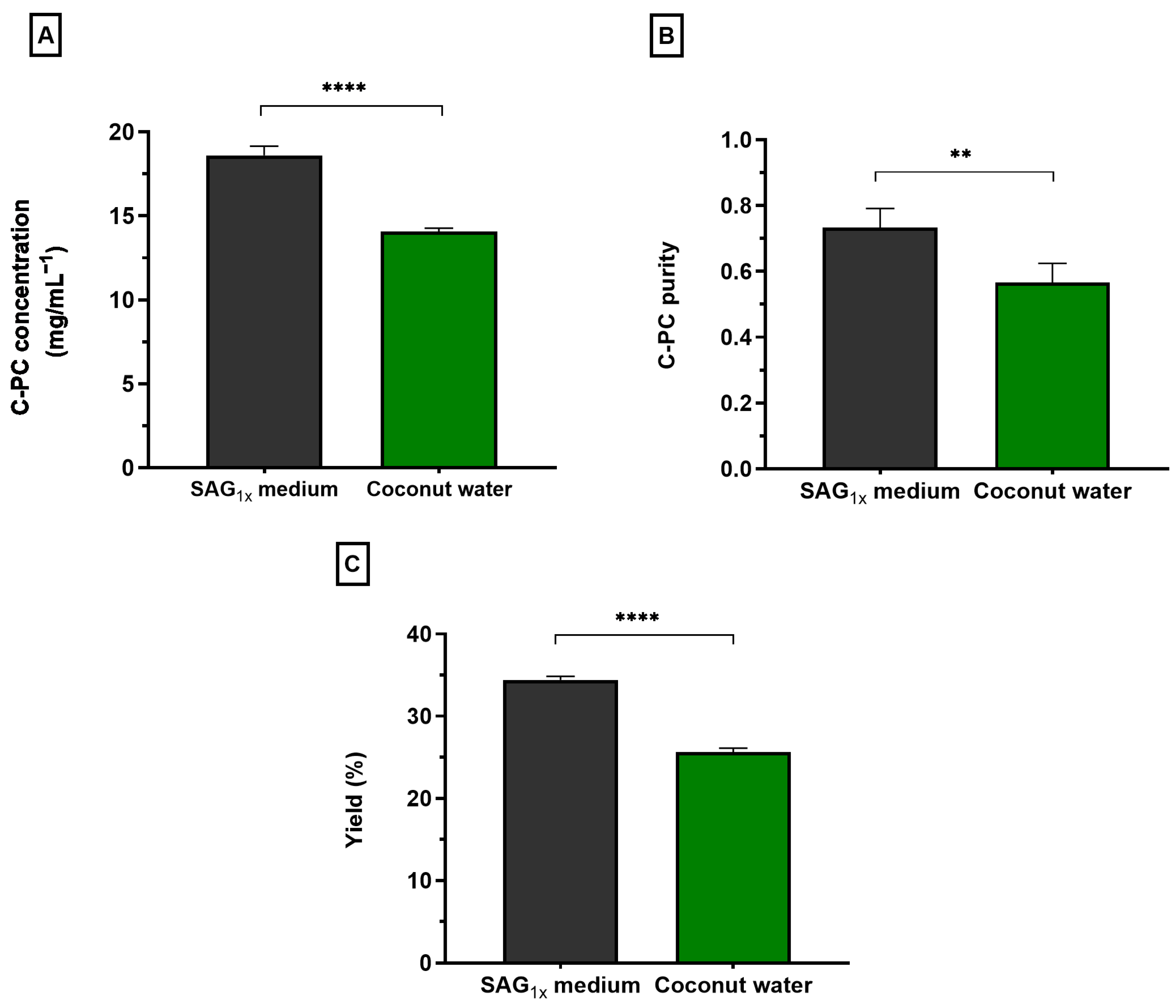
Finally, the concentration of pigments present in the media was evaluated (Figure 2). When L. platensis grew in SAG1x medium, it exhibited a higher cellular concentration of phycocyanin (19.1 mg/mL) (p < 0.0001), a higher purity index (0.7) (p = 0.0088), and an extraction yield of 34.3% (p < 0.0001). In contrast, cultivation in coconut water resulted in a phycocyanin concentration of 14.3 mg/mL, with a purity of 0.6 and a yield of 25.8%. These results indicate that, although coconut water sustained biomass growth, SAG1x medium was slightly more efficient in promoting phycocyanin synthesis and recovery.
To date, no published study has quantified the phycocyanin content in microalgae or cyanobacteria specifically cultivated in coconut water. However, previous research has explored other alternative culture media, such as Zarrouk medium supplemented with leachate. After extraction by ultrasonication with sodium dihydrogen phosphate buffer (NaH2PO4) and sodium chloride (NaCl), followed by three freeze-thaw cycles, the extract of Limnospira maxima (formerly Spirulina maxima) presented a phycocyanin concentration of 6.19 mg L−1 [74]. Higher concentrations were obtained from Spirulina sp. cultivated in Zarrouk medium supplemented with liquid molasses, where phycocyanin was extracted by two-step precipitation with ammonium sulfate ((NH4)2SO4) (32.1 mg/g). However, the purity levels of phycocyanin were 0.5 for the extract obtained under photoautotrophic cultivation (unmodified Zarrouk medium) and 0.6 for mixotrophic cultivation (supplemented Zarrouk medium) [75].
The purity of phycocyanin obtained from biomass cultivated in SAG1x medium is considered food-grade (OD620/OD280 ratio ≥ 0.7), meeting the minimum criteria for application in products intended for human consumption [76]. Although coconut water exhibited slightly lower purity (0.6), the data indicate its potential as an alternative medium, especially considering its accessibility and natural origin [31]. In addition, extraction and purification techniques should be employed, since the yield of this pigment is directly related to these additional steps [7,77]. Therefore, the results indicate that both SAG1x medium and coconut water are promising for the production of L. platensis and coproduction of phycocyanin, highlighting coconut water as a viable, naturally derived, and cost-effective alternative.

4. Conclusions

The results of this study demonstrate that a more accessible and naturally renewable source, such as coconut water, can be used as a substitute substrate for the production of L. platensis. In this work, coconut water efficiently supported the growth of L. platensis, maintaining higher cell concentrations when compared to SAG1x medium, a standard medium with synthetic sources used for cyanobacteria cultivation. Furthermore, similar values were observed for specific growth rate, maximum growth rate, and cellular productivity, indicating that both media have the potential to sustain cyanobacteria growth.
Finally, phycocyanin production was analyzed, and the biomasses cultivated in both media were able to produce significant concentrations of the pigment, with purity indexes higher than those reported in other alternative media described in the literature. Therefore, this study indicates that coconut water is a competitive alternative medium to synthetic media, such as SAG1x (a modified zarrouk medium), which is frequently used as a reference and contains many of the nutrients present in other Limnospira cultivation media, as it produces comparable results in terms of productivity and pigment production, while also offering the advantage of significantly reduced production costs.
Moreover, future studies should explore the integration of bioreactors to optimize cultivation conditions in real time, ensuring efficient and scalable production. Additionally, it is also important to apply Coconut water characterization and biomass extraction techniques to improve pigment recovery and overall process efficiency, as well as performing a complete economic analysis that includes logistics, storage, and labor, with the goal of enabling the use of coconut water as a sustainable and functional cultivation medium for the growth of L. platensis and other high-value photosynthetic microorganisms.

Author Contributions

Conceptualization, M.R.O.B.d.S., S.d.F.F.d.S., R.M.P.B.C. and D.d.A.V.M.; methodology, M.R.O.B.d.S., B.E.G.d.N., M.E.M.M., R.O.B.d.S., S.d.F.F.d.S., R.M.P.B.C. and D.d.A.V.M.; validation, M.R.O.B.d.S., S.d.F.F.d.S., R.M.P.B.C. and D.d.A.V.M.; formal analysis, M.R.O.B.d.S., B.E.G.d.N., M.E.M.M. and R.O.B.d.S.; investigation, M.R.O.B.d.S., B.E.G.d.N., M.E.M.M. and R.O.B.d.S.; resources, M.R.O.B.d.S., B.E.G.d.N., M.E.M.M. and R.O.B.d.S.; data curation, M.R.O.B.d.S., B.E.G.d.N., M.E.M.M. and R.O.B.d.S.; writing—original draft preparation, M.R.O.B.d.S., B.E.G.d.N., M.E.M.M. and R.O.B.d.S.; writing—review and editing, M.R.O.B.d.S., S.d.F.F.d.S., R.M.P.B.C. and D.d.A.V.M.; visualization, M.R.O.B.d.S., B.E.G.d.N., M.E.M.M. and R.O.B.d.S.; supervision, M.R.O.B.d.S., S.d.F.F.d.S., R.M.P.B.C. and D.d.A.V.M.; project administration, S.d.F.F.d.S., R.M.P.B.C. and D.d.A.V.M. All authors have read and agreed to the published version of the manuscript.

Funding

This project was financed by the Fundação Coordenação de Aperfeiçoamento de Pessoal de Nível Superior/Brazil (CAPES)—Finance code 001 and Fundação de Amparo à Ciência e Tecnologia de Pernambuco (FACEPE) Project (Process No. APQ-0136-5.01/24), under Call 21/2023—Support for Innovation Networks in Pernambuco, project title: “UPGRADE TECNOLÓGICO e NETworking”.

Data Availability Statement

Dataset available on request from the authors.

Conflicts of Interest

The authors declare no conflicts of interest.

Abbreviations

The following abbreviations are used in this manuscript:
CFPhycocyanin concentration
C-PCC-phycocyanin
ODOptical Density
PEPhycocyanin purity
PxCell productivity
RYield
SAGSammlung von Algenkulturen Göttingen
SAG1xSpirulina 1x modified medium
UTEXThe Culture Collection of Algae at the University of Texas at Austin
μSpecific growth rate
μmaxMaximum growth rate

References

  1. Militão, F.P.; Fernandes, V.d.O.; Bastos, K.V.; Martins, A.P.; Colepicolo, P.; Machado, L.P. Nutritional value changes in response to temperature, microalgae mono and mixed cultures. Acta Limnol. Bras. 2019, 31, e17. [Google Scholar] [CrossRef]
  2. Salomón, S.; Rivera-Rondón, C.A.; Zapata, Á.M.; Salomón, S.; Rivera-Rondón, C.A.; Zapata, Á.M. Floraciones de cianobacterias en Colombia: Estado del conocimiento y necesidades de investigación ante el cambio global. Rev. Acad. Colomb. Cienc. Exactas Físicas Nat. 2020, 44, 376–391. [Google Scholar] [CrossRef]
  3. Demay, J.; Bernard, C.; Reinhardt, A.; Marie, B. Natural products from cyanobacteria: Focus on beneficial activities. Mar. Drugs 2019, 17, 320. [Google Scholar] [CrossRef] [PubMed]
  4. He, Y.; Chen, Y.; Tao, H.; Zhou, X.; Liu, J.; Liu, Y.; Yang, B. Secondary metabolites from cyanobacteria: Source, chemistry, bioactivities, biosynthesis and total synthesis. Phytochem. Rev. 2025, 24, 483–525. [Google Scholar] [CrossRef]
  5. AlgaeBase. Limnospira Platensis (Gomont) KRSSantos & Hentschke: AlgaeBase. Available online: https://www.algaebase.org/search/species/detail/?species_id=194031 (accessed on 24 October 2025).
  6. Maag, P.; Dirr, S.; Karslioglu, Ö.Ö. Investigation of bioavailability and food-processing properties of Arthrospira platensis by enzymatic treatment and micro-encapsulation by spray drying. Foods 2022, 11, 1922. [Google Scholar] [CrossRef]
  7. Khazi, M.I.; Demirel, Z.; Dalay, M.C. Evaluation of growth and phycobiliprotein composition of cyanobacteria isolates cultivated in different nitrogen sources. J. Appl. Phycol. 2018, 30, 1513–1523. [Google Scholar] [CrossRef]
  8. Eriksen, N.T. Production of phycocyanin-A pigment with applications in biology, biotechnology, foods and medicine. Appl. Microbiol. Biotechnol. 2008, 80, 1–14. [Google Scholar] [CrossRef]
  9. Da Silva, M.R.O.B.; da Silva, G.M.; Silva, A.L.F.D.; Lima, L.R.A.D.; Bezerra, R.P.; Marques, D.D.A.V. Bioactive compounds of Arthrospira Spp. (Spirulina) with potential anticancer activities: A systematic review. ACS Chem. Biol. 2021, 16, 2057–2067. [Google Scholar] [CrossRef]
  10. Braune, S.; Krüger-Genge, A.; Kammerer, S.; Jung, F.; Küpper, J.H. Phycocyanin from Arthrospira platensis as potential anti-cancer drug: Review of in vitro and in vivo studies. Life 2021, 11, 91. [Google Scholar] [CrossRef]
  11. Chwil, M.; Mihelič, R.; Matraszek-Gawron, R.; Terlecka, P.; Skoczylas, M.M.; Terlecki, K. Comprehensive review of the latest investigations of the health-enhancing effects of selected properties of Arthrospira and Spirulina microalgae on skin. Pharmaceuticals 2024, 17, 1321. [Google Scholar] [CrossRef]
  12. Sahin, S.C. The potential of Arthrospira platensis extract as a tyrosinase inhibitor for pharmaceutical or cosmetic applications. S. Afr. J. Bot. 2018, 119, 236–243. [Google Scholar] [CrossRef]
  13. Setthamongkol, P.; Kulert, W.; Wanmanee, S.; Swami, R.; Kutako, M.; Chanthathamrongsiri, N.; Semangoen, T.; Hiransuchalert, R. In vitro characterization and assessment of a potential cosmetic cream containing phycocyanin extracted from Arthrospira platensis BUUC1503 blue-green algae. J. Appl. Phycol. 2023, 35, 1685–1697. [Google Scholar] [CrossRef]
  14. Kumar, D.; Dhar, D.W.; Pabbi, S.; Kumar, N.; Walia, S. Extraction and purification of C-phycocyanin from Spirulina platensis (CCC540). Indian J. Plant Physiol. 2014, 19, 184–188. [Google Scholar] [CrossRef] [PubMed]
  15. U.S. Food and Drug Administration (FDA). HHS, FDA to Phase out Petroleum-Based Synthetic Dyes in Nation’s Food Supply. Brown Univ. Child Adolesc. Psychopharmacol. Update 2025, 27, 8. [Google Scholar] [CrossRef]
  16. Boni, D.; Alcides Brandini, L. The revolution in American Public Health Policy: Petroleum-based dyes and the chronic disease epidemic. Forum Artic. South. J. Sci. 1993, 33, 12–17. [Google Scholar]
  17. Athiyappan, K.D.; Routray, W.; Paramasivan, B. Phycocyanin from Spirulina: A comprehensive review on cultivation, extraction, purification, and its application in food and allied industries. Food Humanit. 2024, 2, 100235. [Google Scholar] [CrossRef]
  18. Chaiklahan, R.; Chirasuwan, N.; Srinorasing, T.; Attasat, S.; Nopharatana, A.; Bunnag, B. Enhanced biomass and phycocyanin production of Arthrospira (Spirulina) platensis by a cultivation management strategy: Light intensity and cell concentration. Bioresour. Technol. 2022, 343, 126077. [Google Scholar] [CrossRef]
  19. Dejsungkranont, M.; Chisti, Y.; Sirisansaneeyakul, S. Optimization of production of C-phycocyanin and extracellular polymeric substances by Arthrospira Sp. Bioprocess Biosyst. Eng. 2017, 40, 1173–1188. [Google Scholar] [CrossRef]
  20. Johnson, E.M.; Kumar, K.; Das, D. Physicochemical parameters optimization, and purification of phycobiliproteins from the isolated Nostoc Sp. Bioresour. Technol. 2014, 166, 541–547. [Google Scholar] [CrossRef]
  21. Yahya, M.S.H.; Halim, M.; Wong, F.W.F.; Wasoh, H.; TAN, J.S.; Mohamed, M.S. Enhancing the production of phycocyanin biopigment from microalga Arthrospira maxima through medium manipulation utilizing box-behnken design. Nusant. Biosci. 2024, 16, 263–276. [Google Scholar] [CrossRef]
  22. Mogany, T.; Swalaha, F.M.; Kumari, S.; Bux, F. Elucidating the role of nutrients in C-phycocyanin production by the halophilic cyanobacterium Euhalothece Sp. J. Appl. Phycol. 2018, 30, 2259–2271. [Google Scholar] [CrossRef]
  23. Setyoningrum, T.M.; Nur, M.M.A. Optimization of C-phycocyanin production from S. platensis cultivated on mixotrophic condition by using response surface methodology. Biocatal. Agric. Biotechnol. 2015, 4, 603–607. [Google Scholar] [CrossRef]
  24. Chen, F.; Zhang, Y. High cell density mixotrophic culture of Spirulina platensis on glucose for phycocyanin production using a fed-batch system. Enzyme Microb. Technol. 1997, 20, 221–224. [Google Scholar] [CrossRef]
  25. Yu, J.; Hu, H.; Wu, X.; Wang, C.; Zhou, T.; Liu, Y.; Ruan, R.; Zheng, H. Continuous cultivation of Arthrospira platensis for phycocyanin production in large-scale outdoor raceway ponds using microfiltered culture medium. Bioresour. Technol. 2019, 287, 121420. [Google Scholar] [CrossRef]
  26. Machado, A.; Pereira, H.; Costa, M.; Santos, T.; Carvalho, B.; Soares, M.; Quelhas, P.; Silva, J.T.; Trovão, M.; Barros, A.; et al. Development of an organic culture medium for autotrophic production of Chlorella vulgaris biomass. Appl. Sci. 2020, 10, 2156. [Google Scholar] [CrossRef]
  27. Ryu, Y.K.; Lee, W.K.; Choi, W.Y.; Kim, T.; Lee, Y.J.; Park, A.; Park, H.S.; Oh, C.; Kang, D.H. Potential of a chicken manure concentrate additive for Arthrospira maxima (Cyanophyceae): Biochemical characterization and phycocyanin production. Phycologia 2024, 63, 158–169. [Google Scholar] [CrossRef]
  28. Rusydi, R.; Ayuzar, E.; Muliani, M.; Saifuddin, S. A comprehensive study of potential Arthrospira platensis cultivated in various manure-based media for biodiesel feedstock. Indones. J. Biotechnol. 2024, 29, 8–17. [Google Scholar] [CrossRef]
  29. Dineshkumar, R.; Umamageswari, P.; Jayasingam, P.; Sampathkumar, P. Enhance the growth of Spirulina platensis using molasses as organic additives. World J. Pharm. Res. 2015, 4, 1057–1066. [Google Scholar]
  30. Shayanthavi, S.; Kapilan, R.; Wickramasinghe, I. A Comprehensive review of coconut liquid endosperm (Cocos nucifera L.): Composition, physicochemical characteristics, antimicrobial and antioxidant properties, and applications in microbial and tissue culture media. J. Sci. Univ. Kelaniya 2025, 18, 1–18. [Google Scholar] [CrossRef]
  31. Sekar, N.; Veetil, S.K.; Neerathilingam, M. Tender Coconut water an economical growth medium for the production of recombinant proteins in Escherichia coli. BMC Biotechnol. 2013, 13, 70. [Google Scholar] [CrossRef]
  32. Soares, J.S.; Rosa, Y.B.C.J.; Suzuki, R.M.; Scalon, S.P.Q.; Rosa Junior, E.J. Cultivo in vitro de Dendrobium nobile com uso de água de coco no meio de cultura. Hortic. Bras. 2013, 31, 63–67. [Google Scholar] [CrossRef]
  33. Iadcharoen, A.; Cheirsilp, B.; Ruangwicha, J.; Srinuanpan, S.; O Thong, S. Utilization of agro-industrial byproducts as low-cost nutrient sources for production of kefiran and lactic acid by Lactobacillus kefiranofaciens. Carbon Resour. Convers. 2025, 8, 100268. [Google Scholar] [CrossRef]
  34. Wong, S.Q.E.; Haradzi, N.A.; Sriskanda, D.; Subramaniam, S.; Chew, B.L. Effects of Coconut water and banana homogenate on shoot regeneration of meyer lemon (Citrus × Meyeri). Pertanika J. Trop. Agric. Sci. 2024, 47, 147–158. [Google Scholar] [CrossRef]
  35. Simões, M.A.; Diniz, S.; Danielli, S.; De, M.; Dantas, M.; Olivera Gálvez, A. Algas Cultiváveis e Sua Aplicação Biotecnológica; 1a Edição Instituto Federal; Instituto Federal de Sergipe: Aracaju, SE, Brazil, 2016; pp. 1–98. ISBN 978-85-68801-37-6. [Google Scholar]
  36. de Queiroz Andrade, H.M.M.; Rosa, L.P.; de Souza, F.E.S.; da Silva, N.F.; Cabral, M.C.; Alves Teixeira, D.I. Seaweed Production potential in the Brazilian Northeast: A Study on the Eastern coast of the state of Rio Grande do Norte, RN, Brazil. Sustainability 2020, 12, 780. [Google Scholar] [CrossRef]
  37. D’Almeida, A.P.; de Albuquerque, T.L. Coconut Husk Valorization: Innovations in bioproducts and environmental sustainability. Biomass Convers. Biorefin. 2025, 15, 13015–13035. [Google Scholar] [CrossRef]
  38. Azimatun Nur, M.M.; Irawan, M.A. Hadiyanto Utilization of coconut milk skim effluent (CMSE) as medium growth for Spirulina platensis. Procedia Environ. Sci. 2015, 23, 72–77. [Google Scholar] [CrossRef]
  39. Sukanya, A.; Meena, R.; Ravindran, A.D. Cultivation of Spirulina using low-cost organic medium and preparation of phycocyanin based ice creams. Int. J. Curr. Microbiol. Appl. Sci. 2020, 9, 392–399. [Google Scholar] [CrossRef]
  40. Musa, M.N.; Jirgi, G.M.; Zango, Z.U.; Isah, M.N.; Abdurrazak, M.; Adamu, A.A.; Wadi, I.A.; Adeleke, A.A.; Garba, Z.N.; Bello, U.; et al. A Review on techno-economic assessment of Spirulina for sustainable nutraceutical, medicinal, environmental, and bioenergy applications. Bioresour. Bioprocess. 2025, 12, 51. [Google Scholar] [CrossRef]
  41. UTEX Spirulina Medium|UTEX Culture Collection of Algae. Available online: https://utex.org/products/spirulina-medium?utm_source=chatgpt.com&variant=30991737454682 (accessed on 26 July 2025).
  42. Duan, Y.; Guo, X.; Yang, J.; Zhang, M.; Li, Y. Nutrients recycle and the growth of Scenedesmus obliquus in synthetic wastewater under different sodium carbonate concentrations. R. Soc. Open Sci. 2020, 7, 191214. [Google Scholar] [CrossRef]
  43. Yong, J.W.H.; Ge, L.; Ng, Y.F.; Tan, S.N. The chemical composition and biological properties of coconut (Cocos Nucifera L.) water. Molecules 2009, 14, 5144–5164. [Google Scholar] [CrossRef]
  44. Alchoubassi, G.; Kińska, K.; Bierla, K.; Lobinski, R.; Szpunar, J. Speciation of essential nutrient trace elements in coconut water. Food Chem. 2021, 339, 127680. [Google Scholar] [CrossRef]
  45. Prades, A.; Dornier, M.; Diop, N.; Pain, J.P. Coconut water uses, composition and properties: A review. Fruits 2012, 67, 87–107. [Google Scholar] [CrossRef]
  46. Bennett, A.; Bogobad, L. Complementary chromatic adaptation in a filamentous blue-green alga. J. Cell Biol. 1973, 58, 419–435. [Google Scholar] [CrossRef] [PubMed]
  47. Antelo, F.S.; Anschau, A.; Costa, J.A.V.; Kalil, S.J. Extraction and purification of C-phycocyanin from Spirulina platensis in conventional and integrated aqueous two-phase systems. J. Braz. Chem. Soc. 2010, 21, 921–926. [Google Scholar] [CrossRef]
  48. Silveira, S.T.; Burkert, J.F.M.; Costa, J.A.V.; Burkert, C.A.V.; Kalil, S.J. Optimization of phycocyanin extraction from Spirulina platensis using factorial design. Bioresour. Technol. 2007, 98, 1629–1634. [Google Scholar] [CrossRef] [PubMed]
  49. Costa, J.A.V.; Freitas, B.C.B.; Rosa, G.M.; Moraes, L.; Morais, M.G.; Mitchell, B.G. Operational and economic aspects of Spirulina-based biorefinery. Bioresour. Technol. 2019, 292, 121946. [Google Scholar] [CrossRef]
  50. Ragaza, J.A.; Hossain, M.S.; Meiler, K.A.; Velasquez, S.F.; Kumar, V. A review on Spirulina: Alternative media for cultivation and nutritive value as an aquafeed. Rev. Aquac. 2020, 12, 2371–2395. [Google Scholar] [CrossRef]
  51. Valdez, Y.; Rodrigues, S.; Dos, E.; Almeida, S.; Vieira, E.D. Characterization of Arthrospira sp. (Spirulina) biomass growth in hydroponic waste solution: A Review. J. Bioeng. Technol. Health 2020, 3, 354–358. [Google Scholar] [CrossRef]
  52. Shi, S.; Wang, W.; Wang, F.; Yang, P.; Yang, H.; He, X.; Liao, X. Research progress in coconut water: A review of nutritional composition, biological activities, and novel processing technologies. Foods 2025, 14, 1503. [Google Scholar] [CrossRef]
  53. Hidalgo, H.A. Market potential of pasteurized coconut water in the Philippine beverage industry. Int. J. Adv. Sci. Eng. Inf. Technol. 2017, 7, 898. [Google Scholar] [CrossRef]
  54. Thathsatani, A.O.T.; Arunakumara, K.K.I.U.; Marikar, F.M.M.T. Development of low-cost growing media with mungbean as a source of carbon for Spirulina. Peruv. J. Agron. 2023, 7, 239–251. [Google Scholar] [CrossRef]
  55. Khatun, S.; Hossain, M.; Akter, T.; Banu, M.; Kawser, A. Replacement of sodium bicarbonate and micronutrients in Kosaric medium with Banana Leaf ash extract for culture of Spirulina platensis. Ann. Bangladesh Agric. 2020, 23, 37–47. [Google Scholar] [CrossRef]
  56. Akhtar, N.; Ahmed, M.; Sarker, N.; Mahbub, R.; Abdul, M.; Sarker, M. Growth response of Spirulina platensis in Papaya skin extract and antimicrobial activities of Spirulina extracts in different culture media. Bangladesh J. Sci. Ind. Res. 2012, 47, 147–152. [Google Scholar] [CrossRef]
  57. Khasena, A.; Nurrachmi, I.; Zulkifli, Z. Effect of addition of coconut water as enrichment of Spirulina platensis growth media in laboratory scale. Asian J. Aquat. Sci. 2023, 6, 180–186. [Google Scholar] [CrossRef]
  58. Rubiyah, R.; Muliani, M.; Mahdaliana, M.; Rusydi, R.; Mainisa, M. Application of liquid organic fertilizer from wild banana stem waste (Musa Acuminate) and coconut husk as a culture medium for Spirulina platensis. Acta Aquat. Aquat. Sci. J. 2023, 10, 235–242. [Google Scholar] [CrossRef]
  59. Bari, E.; Cascino, F.C.; Foglio, L.; Proietti, L.; Perteghella, S.; Torre, M.L.; Parati, K. Alternative culture media and cold-drying for obtaining high biological value Arthrospira platensis (Cyanobacteria). Phycologia 2021, 60, 237–246. [Google Scholar] [CrossRef]
  60. Tarko, T.; Duda-Chodak, A.; Kobus, M. Influence of growth medium composition on synthesis of bioactive compounds and antioxidant properties of selected strains of Arthrospira Cyanobacteria. Czech J. Food Sci. 2012, 30, 258. [Google Scholar] [CrossRef]
  61. Balseca, F.; Reyes, C.; Rodríguez, M.; Veselova, V.; Maksimov, I.; Alberto Freire Balseca, D.; Susana Castro Reyes, K.; Elena Maldonado Rodríguez, M. Optimization of an alternative culture medium for phycocyanin production from Arthrospira platensis under laboratory conditions. Microorganisms 2024, 12, 363. [Google Scholar] [CrossRef]
  62. Markou, G.; Diamantis, A.; Arapoglou, D.; Mitrogiannis, D.; González-Fernández, C.; Unc, A. Growing Spirulina (Arthrospira platensis) in seawater supplemented with digestate: Trade-Offs between increased salinity, nutrient and light availability. Biochem. Eng. J. 2021, 165, 107815. [Google Scholar] [CrossRef]
  63. Aditya, L.; Vu, H.P.; Abu Hasan Johir, M.; Mahlia, T.M.I.; Silitonga, A.S.; Zhang, X.; Liu, Q.; Tra, V.T.; Ngo, H.H.; Nghiem, L.D. Role of culture solution PH in balancing CO2 input and light intensity for maximising microalgae growth rate. Chemosphere 2023, 343, 140255. [Google Scholar] [CrossRef]
  64. Kumar, M.; Kulshreshtha, J.; Singh, G.P. Growth and biopigment accumulation of cyanobacterium Spirulina platensis at different light intensities and temperature. Braz. J. Microbiol. 2011, 42, 1128. [Google Scholar] [CrossRef]
  65. Michael, A.; Kyewalyanga, M.S.; Lugomela, C.V. Biomass and nutritive value of Spirulina (Arthrospira fusiformis) cultivated in a cost-effective medium. Ann. Microbiol. 2019, 69, 1387–1395. [Google Scholar] [CrossRef]
  66. Andrade, M.R.; Costa, J.A.V. Mixotrophic cultivation of microalga Spirulina platensis using molasses as organic substrate. Aquaculture 2007, 264, 130–134. [Google Scholar] [CrossRef]
  67. Madkour, F.F.; Kamil, A.E.W.; Nasr, H.S. Production and nutritive value of Spirulina platensis in reduced cost media. Egypt. J. Aquat. Res. 2012, 38, 51–57. [Google Scholar] [CrossRef]
  68. Taufikurahman, T.; Ilhamsyah, D.P.A.; Rosanti, S.; Ardiansyah, M.A. Preliminary design of phycocyanin production from Spirulina platensis using anaerobically digested dairy manure wastewater. IOP Conf. Ser. Earth Environ. Sci. 2020, 520, 012007. [Google Scholar] [CrossRef]
  69. Pereira, M.I.B.; Chagas, B.M.E.; Sassi, R.; Medeiros, G.F.; Aguiar, E.M.; Borba, L.H.F.; Silva, E.P.E.; Neto, J.C.A.; Rangel, A.H.N. Mixotrophic cultivation of Spirulina platensis in dairy wastewater: Effects on the production of biomass, biochemical composition and antioxidant capacity. PLoS ONE 2019, 14, e0224294. [Google Scholar] [CrossRef] [PubMed]
  70. Vonshak, A.; Cheung, S.M.; Chen, F. Mixotrophic growth modifies the response of Spirulina (Arthrospira) platensis (Cyanobacteria) cells to light. J. Phycol. 2000, 36, 675–679. [Google Scholar] [CrossRef] [PubMed]
  71. Zhang, X.W.; Zhang, Y.M.; Chen, F. Application of mathematical models to the determination optimal glucose concentration and light intensity for mixotrophic culture of Spirulina platensis. Process Biochem. 1999, 34, 477–481. [Google Scholar] [CrossRef]
  72. Braun, J.C.A.; Balbinot, L.; Beuter, M.A.; Rempel, A.; Colla, L.M. Mixotrophic cultivation of microalgae using agro-industrial waste: Tolerance level, scale up, perspectives and future use of biomass. Algal Res. 2024, 80, 103554. [Google Scholar] [CrossRef]
  73. Ohoiulun, D.; Endang, Y.H.; Mahmudi, M. The effect of with coconut water content on different concentration of essential Chlorella pyronoidosa chick international journal of biosciences. Int. J. Biosci. 2014, 5, 213–218. [Google Scholar]
  74. dos Santos, W.R.; da Silva, M.L.; Tagliaferro, G.V.; Ferreira, A.L.G.; Guimarães, D.H.P. The cultivation of Spirulina maxima in a medium supplemented with leachate for the production of biocompounds: Phycocyanin, carbohydrates, and biochar. AgriEngineering 2024, 6, 1289–1299. [Google Scholar] [CrossRef]
  75. Cordeiro, A.P.; Nogueira, A.O.d.M.; Salgado, H.Z.; Kokuszi, L.T.F.; Costa, J.A.V.; de Lima, V.R.; Santos, L.O. Simultaneous application of mixotrophic culture and magnetic fields as a strategy to improve Spirulina Sp. LEB 18 Phycocyanin synthesis. Curr. Microbiol. 2021, 78, 4014–4022. [Google Scholar] [CrossRef]
  76. Rito-Palomares, M.; Nuez, L.; Amador, D. Practical application of aqueous two-phase systems for the development of a prototype process for C-phycocyanin recovery from Spirulina maxima. J. Chem. Technol. Biotechnol. 2001, 76, 1273–1280. [Google Scholar] [CrossRef]
  77. Patil, G.; Chethana, S.; Sridevi, A.S.; Raghavarao, K.S.M.S. Method to obtain C-phycocyanin of high purity. J. Chromatogr. A 2006, 1127, 76–81. [Google Scholar] [CrossRef]
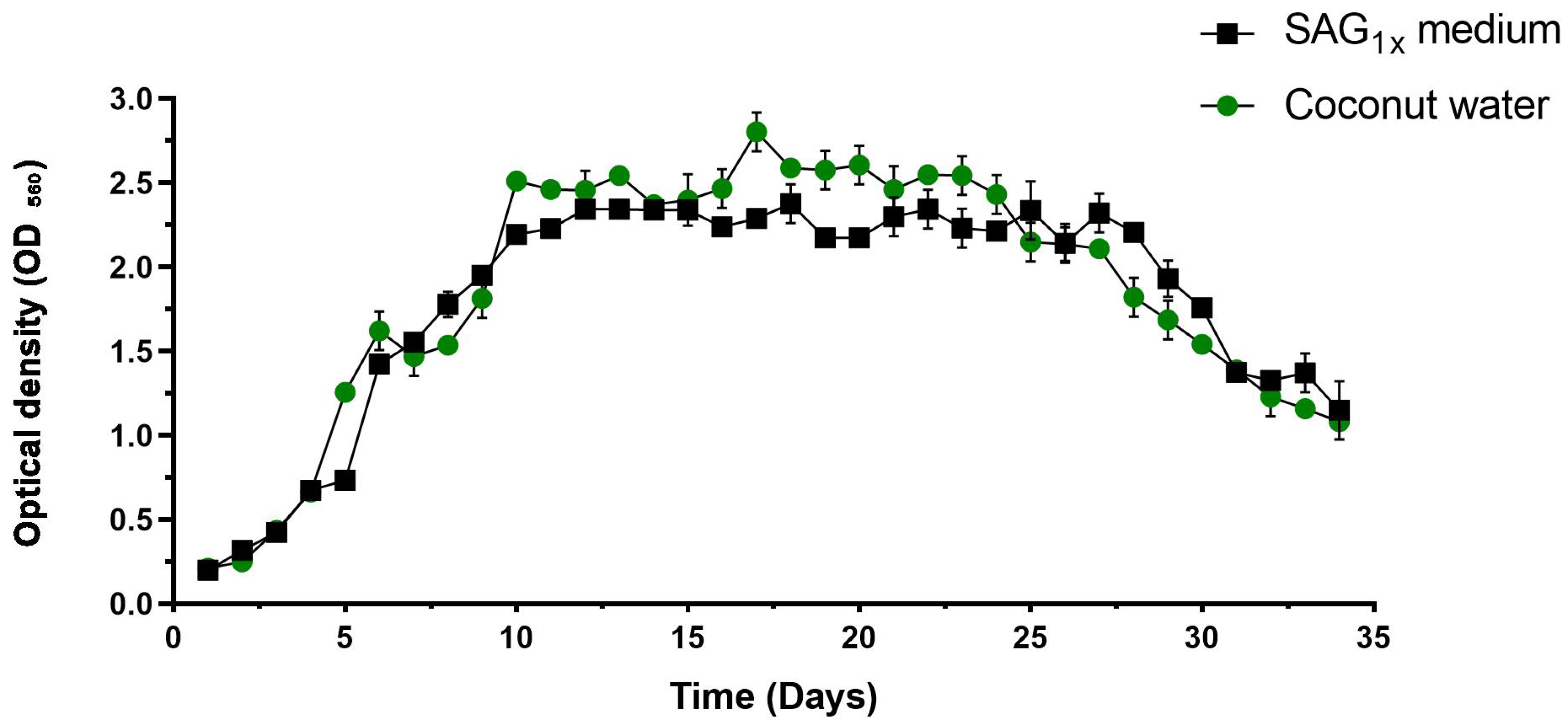
Figure 1. Effect of SAG1x medium (black squares) and coconut water (green circles) on the cell growth of L. platensis under autotrophic cultivation for 35 days.
Phycology 05 00082 g001
Figure 2. Phycocyanin concentration (A), pigment purity (B), and yield (C) obtained from the cultivation of L. platensis in SAG1X medium (black bars) and coconut water (green bars). Asterisks indicate significant differences compared to the negative control (ANOVA, p ≤ 0.05): ** p < 0.01; **** p < 0.0001.
Phycology 05 00082 g002
Table 1. Composition of SAG1x medium and presence of corresponding components in coconut water. Concentrations are expressed in g L−1. The presence of components in coconut water is indicated qualitatively and quantitatively, based on values reported in the literature [43,44,45].
Chemicals/CompoundsConcentration in SAG1x Medium
(g L−1)
Concentration Naturally Present in Coconut Water (g L−1)Supplemented in Coconut Water? (g L−1)
NaHCO327.22n.d.No
Na2CO38.06n.d.Yes (for pH adjustment)
K2HPO410.027–0.033No
NaNO350.0002–0.0010 (traces)No
K2SO420.02–0.062No
NaCl20.40–1.20No
MgSO4·7H2O0.40.10–0.12No
CaCl2·2H2O0.080.074–0.185No
Vitamin B122 mLn.d.No
P-IV Metal Solution12 mL--
Composition of Metal Solution
Na2EDTA·2H2O0.75n.d.Yes—0.75
FeCl3·6H2O0.0970.0001–0.0005 (traces)Yes—0.097
MnCl2·4H2O0.0410.00002–0.0001 (traces)Yes—0.041
ZnCl20.0050.00001–0.00006 (traces)Yes—0.005
CoCl2·6H2O0.002<0.000001 (traces)Yes—0.002
Na2MoO4·2H2O0.004<0.000001 (traces)Yes—0.004
Chu Micronutrient Solution2 mL- -
Composition of
Micronutrient Solution
CuSO4·5H2O0.020.00002–0.00005 (traces)Yes—0.02
ZnSO4·7H2O0.0440.00001–0.00006 (traces)Yes—0.044
CoCl2·6H2O0.02<0.000001 (traces)Yes—0.02
MnCl2·4H2O0.0120.00002–0.0001 (traces)Yes—0.012
Na2MoO4·2H2O0.012n.d.Yes—0.012
H3BO30.620.005–0.009Yes—0.062
Na2EDTA·2H2O0.05n.d.Yes—0.05
The values in the column “Concentration naturally present in coconut water (g L−1)” are aggregated ranges obtained from the indicated references. “n.d.” = not detected. “traces” = present in trace amounts.
Table 2. Comparative growth parameters of L. platensis cultured in SAG1x medium and coconut water supplemented with trace metals and micronutrients.
Growth ParameterSAG1x MediumCoconut Waterp-Value
Specific growth rate (μ)0.240 ± 0.024 d−10.305 ± 0.023 d−10.0043 *
Maximum growth rate (μmax) 0.676 ± 0.0034 d−10.629 ± 0.0019 d−10.0022 *
Productivity (Px)0.218 ± 0.0019 g L−1·d−10.256 ± 0.0019 g L−1·d−10.0022 *
Values are expressed as the mean ± standard deviation (SD). Asterisks indicate significant differences compared to the negative control (ANOVA, p ≤ 0.05).
Disclaimer/Publisher’s Note: The statements, opinions and data contained in all publications are solely those of the individual author(s) and contributor(s) and not of MDPI and/or the editor(s). MDPI and/or the editor(s) disclaim responsibility for any injury to people or property resulting from any ideas, methods, instructions or products referred to in the content.