Skip to Content
JALJournal of Ageing and Longevity
  • Review
  • Open Access

16 January 2026

The Impacts of Age-Related Peripheral Hearing Loss, Central Auditory Processing, and Cognition on Quality of Life in Older Adults: A Scoping Review

,
and
Department of Speech Pathology and Audiology, Calvin University, Grand Rapids, MI 49546, USA
*
Author to whom correspondence should be addressed.

Abstract

This scoping review aims to synthesize peer-reviewed literature exploring quality of life (QoL) for individuals with age-related hearing loss (ARHL), age-related central auditory processing (ARCAP) deficits, and age-related cognitive decline. A growing body of research has identified ARHL as a risk factor for the development of dementia, highlighting the connection between the sensory and cognitive systems. As the aging population continues to grow, examining comorbid age-related hearing and cognitive decline is especially relevant. These conditions may have potential negative consequences on the daily functioning, social participation, mental health, and overall wellbeing of older adults. A systematic search of peer-reviewed literature was conducted across multiple databases, adhering to the PRISMA guidelines for scoping reviews. Studies that focused on the impact of ARHL, ARCAP deficits, and/or related cognitive deficits on QoL were included in the present review. Key data extracted included QoL measures categorized into the ICF framework, the effects of hearing loss intervention on QoL, and the impact of ARHL on QoL for aging individuals. This review summarizes the reported effects that ARHL, ARCAP, and/or cognitive decline have on older adults, and discusses the clinical and practical implications for managing clients with these conditions. In addition to preventative measures and deficit management, maintenance of life participation, social engagement, and overall wellbeing should be considered when caring for aging adults with hearing and/or cognitive impairment.

1. Introduction

With a rapidly aging global population, the prevalence of age-related sensory and cognitive changes is increasing [1]. Hearing loss is one of the most common chronic conditions in older adults, with nearly two-thirds of individuals over 70 years old affected by presbycusis, or age-related hearing loss (ARHL), a progressive, symmetrical sensorineural hearing loss that occurs with aging. As high as 95% of individuals over 80 years old are reported to have age-related central auditory processing (ARCAP) deficits, with many individuals having concomitant peripheral ARHL and ARCAP deficits [2,3]. It is difficult to determine the independent effects of peripheral and central auditory issues due to their close relationship. The peripheral and central auditory system are interconnected, and the presence of central deficits can contribute to the further degradation of the auditory signal received from the peripheral system. Central auditory processing (CAP) is characterized by a received auditory signal traveling through the central auditory nervous system after it leaves the cochlea; phonemic processing, which involves the discrimination of phonemes; the blending and segmentation of sounds; and finally, linguistic processing, wherein meaning is attached to the auditory signal. Deficits in CAP are secondary to the disruption of the auditory signal in the brain, which impacts how an individual understands what they are hearing. Individuals may have difficulties discriminating between phonemes, organizing auditory signal, and hearing-in-noise [2,4,5]. For individuals affected by CAP deficits, even if their peripheral hearing level is within normal limits, their speech perception deteriorates in the presence of background noise [6].
Pathological cognitive decline is similarly prevalent and poses significant challenges to independence and quality of life (QoL) in older individuals. In the United States, dementia, a major neurocognitive disorder (NCD), affects 4.0% of adults over 64 years old, increasing to greater than 13% for those over 85 years old [7]. Mild cognitive impairment (MCI), a minor NCD, has a higher prevalence, with an estimate of 14 to 18% of individuals aged 70 years and older diagnosed [8]. As the aging population continues to grow, examining comorbid age-related hearing and cognitive decline is especially relevant [1]. A growing body of research has shown that ARHL may precede the onset of NCD by several years, and untreated hearing loss is a significant risk factor for the development of dementia, highlighting the connection between the sensory and cognitive systems [9,10,11,12,13]. Various hypotheses have proposed a causal association between ARHL and cognitive decline including increased loneliness, increased social isolation, increased cognitive load, and changes in brain structure [14]. Gates et al. [15,16] investigated the relationship between CAP deficits and dementia and found that CAP deficits were observed in subjects with mild Alzheimer’s disease (AD), whereas peripheral auditory functioning was not different from that in control participants. In a 3-year follow-up study, Gates et al. [16] showed that severe CAP deficits were predictive for the subsequent diagnosis of AD.
Speech-in-noise problems related to ARHL and ARCAP deficits negatively impact social situations, social isolation, mental health, and disability. Many affected individuals withdraw from their social lives, which is a significant risk factor for the development of dementia [17,18,19]. Increasingly recognized as a critical outcome in aging research, QoL is a multidimensional construct encompassing physical, social, and emotional well-being [20]. Particularly relevant to aging populations with irreversible sensory and cognitive decline, QoL does not always improve in parallel with impairment reduction. Furthermore, QoL can improve in the absence of impairment reduction [21,22,23]. Examining outcomes beyond symptom severity and impairment reduction is crucial to fully exploring healthy aging and QoL.
The World Health Organization’s International Classification of Functioning, Disability, and Health (ICF) is a biopsychosocial framework that can be used to describe the experience of an individual by examining an individual’s body functions (BF) and structures, and activities and participation (AP). The ICF framework also considers the influence of environmental and personal factors to describe the far-reaching effects of a range of health conditions on an individual’s life [24]. Use of the ICF framework allows for the greater consideration of all domains of an individual’s life, beyond their diagnosis, and facilitates person-centered care for meaningful, collaborative goal setting and treatment that is aligned with the real-life impacts of their disability.
Meyer et al. [24] described the application of the ICF framework for audiologists. When considering the disability of hearing loss, the corresponding impacts can be categorized as functioning and disability, as well as contextual factors. Functioning and disability incorporates a description of BF and structures, and AP. Contextual factors consider the impact of environmental factors (e.g., societal attitudes, health professionals, family, and friends) and personal factors (e.g., personality, age, gender, and comorbidities) [24].
The impact of hearing loss as a broad category of disability has been well studied, with the conclusion that hearing loss is associated with poorer QoL among elderly people. The QoL- and health-related impacts of hearing loss include poorer general health, mood disorders (e.g., anxiety and depression), and increased risk of mortality [25,26,27,28]. Despite the recognition that central auditory deficits play a role in presbycusis, the impact of ARCAP deficits on QoL has not been established to the same extent as peripheral deficits of the auditory system. In literature, hearing loss has often been grouped as a singular condition without specifying or narrowing the population included to account for etiology or onset, and sometimes without adequately measuring the potential cognitive and central influences on results. There are many available measures for documenting QoL outcomes that range from condition-specific to general QoL measures. As a result, research methods have often employed a variety of QoL measures, leading to mixed findings. Examining whether generic QoL instruments are sensitive to the effects of hearing loss is important for understanding how to appropriately care for aging populations. Conversely, condition-specific measures are often too narrow to assess the broader psychosocial, emotional, and social consequences resulting from the condition (i.e., hearing loss). While these measures are sensitive to self-perceived functional hearing impairment, they may not be sufficient to adequately understand the role hearing loss plays in the other domains of the ICF. The same challenge is relevant to intervention research. Although interventions such as hearing aids are often reported to improve function, it is less known whether this translates to meaningful, real-life change and QoL outcomes across all ICF domains.

Overall Aim and Research Questions

A scoping review was conducted to identify knowledge gaps and understand the current state of literature on QoL outcomes for ARHL, ARCAP deficits, and age-related cognitive decline. By synthesizing QoL outcomes through the lens of the ICF, this review provides a structured understanding of how different domains of functioning are assessed across studies. This framework allowed for the identification of both well-represented and underrepresented domains in the current evidence base, highlighting priorities for future research and clinical practice. While prior studies have identified ARHL as a risk factor for developing dementia, and both conditions have significant implications for the overall QoL of aging individuals, the interplay of effects of ARCAP deficits in older adults on QoL and cognition has historically been less widely investigated [10,11,12,13]. The overall aim of this review was to provide a comprehensive overview of the interaction between the effects of cognition, ARHL, and/or ARCAP deficits on the QoL of aging individuals within the ICF framework. Another purpose of this review was to identify outcome measures, as well as how frequently they are used and in what combinations, to account for potential comorbid cognitive decline and ARHL and/or ARCAP deficits in aging individuals. We also explored the specific aspects of QoL that were reported in research for those with the aforementioned conditions. We aimed to synthesize the evidence on the management of these conditions that reportedly improved QoL in these populations for application in clinical practice. Lastly, we wanted to identify and describe key demographic information that should be considered when determining how and when to screen or manage these conditions. The specific research questions (RQ) were as follows:
  • What key demographic information has been considered when screening for or assessing ARHL, cognition, and/or ARCAP deficits?
  • What was the frequency of these conditions being screened or assessed together in research to account for comorbidity as a variable in older populations?
  • What measures were used to screen or assess QoL in age-related cognitive decline, ARHL, and ARCAP deficits in research?
  • What aspects of the ICF model were addressed in the assessment and treatment of cognitive decline, ARHL, and/or ARCAP deficits to improve QoL?
  • What management techniques were utilized, and which of those techniques led to improvements in QoL for those with cognitive decline, ARHL, and/or ARCAP deficits?

2. Materials and Methods

2.1. Design

A scoping review was chosen because the research on ARHL, ARCAP, and cognition varies widely in terms of how, and whether, these constructs are measured together. Given the exploratory nature of our research questions, a scoping review provided the appropriate methodological flexibility that a systematic review would not. The scoping review was conducted per the methodological framework in Arskey and O’Malley [29], adhering to the Preferred Reporting Items for Systematic Review and Meta-Analyses Extension for Scoping Reviews (PRISMA-ScR) guidelines (see Supplementary Materials) [30].

2.2. Search Strategy

Phase 1 of the PRISMA-ScR guidelines includes identifying potentially relevant articles in existing research literature. The electronic databases searched included EBSCO, Medline, and PubMed (see Appendix A, Table A1). Three separate searches were conducted utilizing key words and synonyms developed per domain relevant to the clinical questions and were combined with the Boolean “OR” to increase the number of articles that could be located on the topics to yield increased sensitivity. The Boolean term “AND” was used between terms when necessary to increase specificity to identify relevant studies. The searches were conducted in the title, abstract, and author keyword fields.

2.3. Study Selection

Two blinded, independent reviewers (SV and AB) screened the titles and abstracts of the articles prior to full-text review, utilizing a decision tree for eligibility criteria. The inclusion criteria were as follows: (i) the participant pool included humans 60 years of age or older, but studies with younger participants were also considered; (ii) studies that focused on ARHL, ARCAP, and/or cognitive decline; (iii) studies that assessed QoL as an outcome related to these conditions. Qualitative, quantitative, and mixed-methods studies were eligible to be included. Exclusion criteria were as follows: (i) articles that were not available in English; (ii) studies that focused on congenital hearing loss or non-age-related hearing loss; (iii) studies that did not include at least some participants greater than 60 years; (iv) studies of cognitive disorders unrelated to age; (v) studies that did not assess QoL; (vi) studies published prior to January 2002, and (vii) non-peer-reviewed publications. Any disagreements between the two reviewers were discussed and resolved. All references were entered into Zotero, then into Rayyan for deduplication and screening [31,32].
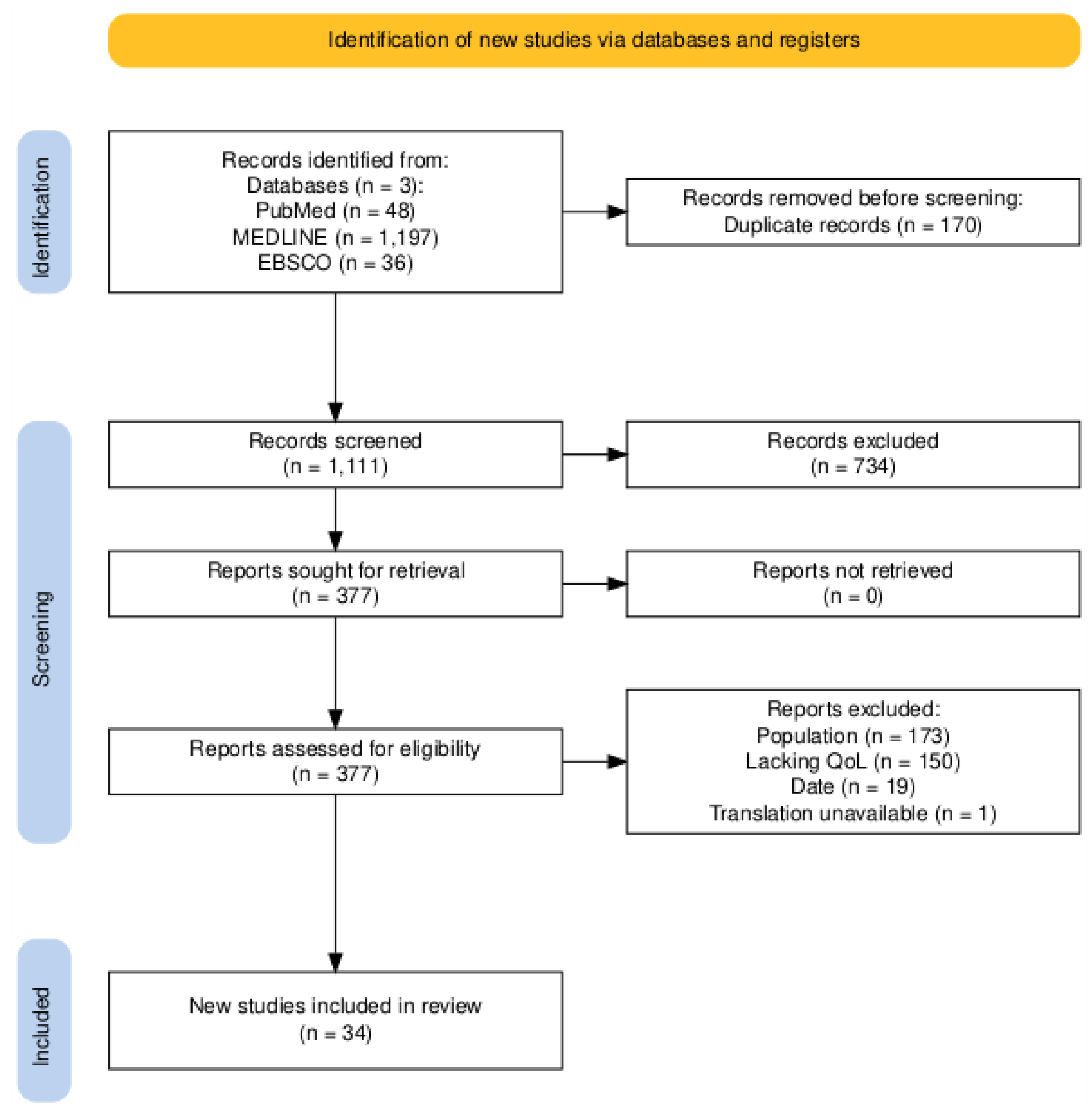
A total of 1281 citations were retrieved from database searches. After duplicates were removed, 1111 article titles and abstracts were screened, resulting in the exclusion of 734 records. The reviewers took a deliberately conservative approach when abstracts lacked sufficient detail regarding the type of hearing loss represented in the sample. Because many abstracts did not specify whether participants had ARHL, these records were moved forward to full-text screening to verify whether the population and hearing loss characteristics were relevant to the review. Therefore, 377 records were sought for retrieval and assessed at the full-text level for eligibility. Most were ultimately excluded after confirming that the hearing loss etiology or population characteristics did not align with the scope of this review. Reasons for full text exclusion were categorized as follows: wrong population (e.g., non-ARHL etiology, comorbidities outside of the review’s scope, age; n = 173), absence of QoL measures (n = 150), publication date outside of the inclusion window (n = 19), and unavailable translation for a non-English article (n = 1). Some papers met more than one exclusion criterion; in these cases, they were categorized under the first identified reason for exclusion. This process resulted in the exclusion of 343 articles, thus leaving 34 studies eligible for this review (Figure 1).
Figure 1. PRISMA 2020 flow diagram of the study selection process. Adapted from the PRISMA 2020 statement and generated using the PRISMA 2020 flow diagram template from prisma-statement.org [33].

2.4. Data Extraction and Summarization

Data charting was completed using a customized data-extraction Microsoft Excel spreadsheet designed by SV and BK. Extraction focused on relevant study characteristics including citation details, country of study, participant demographic information, sample sizes, measures utilized, measures categorized into ICF domains, relevant inclusion/exclusion criteria pertaining to cognition, intervention type if applicable, duration of intervention and follow up, and key findings pertaining to QoL. The included studies were categorized into one of four tables, namely, ARHL (peripheral only), ARHL and ARCAP, ARHL (peripheral) and/or ARCAP and Cognition, and Intervention studies. Studies that measured outcomes on speech-in-noise performance were categorized as measuring ARCAP. Key findings were coded and interpreted within the context of the broader literature within their subcategory.

3. Results

3.1. Characteristics and Demographic Information from Included Studies

Eleven studies assessed ARHL (peripheral only), and nine countries were represented, as follows: United Kingdom, United States, Singapore, South Korea, Sweden, France, Austria, Nepal, and Israel. One study was a hospital-based study, while the rest included community-dwelling elderly adults. Across 10 studies, the mean ages represented were 68.4 to 80.7 years. One study [34] included participants older than 40 years of age but did not include specific age distribution information. Six studies examined ARHL and ARCAP. Three countries were represented, as follows: United States, Netherlands, and Italy. The ages represented in these papers were 55 to 93 years old. Four studies were categorized as ARHL and/or ARCAP and Cognition. Three of these papers examined cognitive decline in addition to peripheral and central deficits related to ARHL, and one examined cognitive decline and peripheral ARHL. Thefour countries represented were United Kingdom, Taiwan, Canada, and Korea. Ages ranged from 55 to 80 years old. Thirteen studies were included in the intervention category. Twelve countries were represented, namely, Germany, Italy, Finland, Turkey, Brazil, Colombia, India and France, and a study included researchers from Cyprus, France, Greece, Ireland, and the United Kingdom. The ages represented in the studies on intervention were approximately 60 to 85 years old.

3.2. Peripheral ARHL and QoL

3.2.1. Measures for Assessment and Screening Peripheral ARHL QoL

There were 11 included studies that examined peripheral ARHL, determined by pure-tone average (PTA) and its impact on QoL. Eight used validated questionnaires, two used interviews, and one used a survey. The Hearing Handicap Inventory for Elderly-Screening (HHIE-S), a questionnaire used to determine the severity of perceived handicap associated with hearing loss, was used twice. The HHIE-S is a self-assessment questionnaire that focuses on how an individual’s hearing experience impacts their daily social and emotional wellbeing, in addition to activity or participation restrictions [35]. General QoL measures were used in six studies (Table 1). The eight domains of the 36-Item Short Form Health Survey (SF-36) correspond to different aspects of the ICF framework [36]. Physical functioning (PF), role limitations (RL), and social functioning (SF) were determined to correspond to the AP domain of the ICF framework, while bodily pain (BP), vitality, and mental health primarily address the BF domain. Semi-structured interviews and surveys, such as those completed in Bennion and Forshaw [37], Espmark and Scherman [38], and Espmark et al. [39] targeted all domains of the ICF framework and gathered more robust data on the impact of hearing loss as it related to contextual factors (CF), including environmental factors and personal factors. The EuroQoL-5 (EQ-5D), as administered in Choi et al. [34], evaluates five key dimensions of QoL including mobility, self-care, usual activities, pain/discomfort, and anxiety/depression [40]. This corresponds to the BF and AP domains of the ICF framework. The World Health Organization Quality of Life Instrument-BREF (WHOQOL-BREF) and World Health Organization Quality of Life Assessment Instrument (WHOQOL), used in Moser et al. [41] and Lazzarotto et al. [42], assesses physical health, psychological health, social relationships, and environmental health, which addresses the BF, AP, and CF domains of the ICF framework [43,44]. Of these 11 studies, 7 did not assess for comorbid cognitive decline, while 4 excluded participants with NCD.
Table 1. ARHL (peripheral) impact on QoL.

3.2.2. Peripheral ARHL QoL and ICF Domains Represented

All studies determined that peripheral ARHL was associated with reduced QoL in elderly individuals. Consistent findings across studies that examined peripheral ARHL and QoL impacts included AP limitations characterized by reduced social participation, avoidance of other people, and overall lower social dimension scores on QoL measures [37,39,42,46]. Mental health and coping was also examined. Significant themes of embarassment, suicidal ideation, worry, and self-stigma were observed for those with ARHL [34,37,39,42,47]. Severity of hearing loss and untreated hearing loss were associated with worse QoL outcomes in Dalton et al. [46], Espmark et al. [39], Shrestha et al. [49], and Chew and Yeak [45].

3.3. Peripheral and Central ARHL on QoL

3.3.1. Measures for Assessment and Screening Peripheral and Central ARHL QoL

Six studies reported on QoL impacts associated with peripheral and central deficits related to ARHL (Table 2). Measures of central functioning included speech-in-noise tests. One study, Lozupone et al. [50], utilized Synthetic Sentence Identification-Ipsilateral Competing Message (SSI-ICM) to assess participants’ central auditory processsing. Hearing-related QoL was measured by two studies using the Speech, Spatial, and Qualities of Hearing Scale (SSQ-12) and HHIE-2. The SSQ-12 assesses the AP domain of the ICF framework by evaluating an individual’s listening abilities and limitations in real-world, everyday situations [50]. Late life depression and loneliness were measured with interviews and the Social Dysfunction Rating Scale (SDRS) in one study [51,52]. The De Jong Giervald Scale and Center for Epidemiologic Studies Depression Scale (CES-D) were used in three papers utilizing the same participant data from a longitudinal study [53,54,55]. The De Jong Gierveld Scale measures emotional and social loneliness, which were mapped to the AP and EF domains of the ICF framework, while the CES-D primarily measures the mental functions within the BF domain of the ICF framework.
Table 2. Effects of peripheral and central auditory age-related deficits on QoL.

3.3.2. Peripheral ARHL and ARCAP QoL ICF Domains Represented

Speech-in-noise performance assoicated with central and peripheral deficits was measured with instruments that assessed the BF and AP domains of the ICF framework. For studies examining speech-in-noise, the relationship to social network and loneliness was the predominant topic of research. Within the ICF domain of AP, speech-in-noise deficits were correlated with worse QoL when utilizing measures such as the CES-D and the De Jong-Gierveld scale, but only for specific subgroups, as reported by Pronk et al. [53,54,55]. These subgroups included men and non-users of hearing aids. However, Huang et al. [57] utilized a hearing-specific QoL questionnaire, the HHIE-S, and found worse PTA and worse hearing-related QoL were associated with greater loneliness. Better speech-in-noise recognition was associated with larger and more diverse social network characteristics. Worse hearing-related QoL was strongly associated with increased loneliness and smaller social network size. Adachi and Paul [56] used the SSQ-12, a hearing specific questionnaire, and the Hospital Anxiety and Depression Scale (HADS). They found that self-rated hearing correlated to perceived social support with no correlation to loneliness. However, listening performance did not correlate with loneliness or social isolation.

3.4. Cogniton and ARHL on QoL

3.4.1. Measures for Assessment and Screening Cognition and ARHL QoL

Four studies in total examined cognitive impairment with ARHL (Table 3). Of these studies, three examined peripheral and central ARHL, while one examined peripheral auditory deficits only. To measure central auditory functioning, speech-in-noise tests were used. This included the Bamford-Kowal-Bench Speech-in-Noise Test (BKB-SIN) in Slade et al. [58], sentence recognition tests with speech-spectrum noise (SSN) and multi-talker babble background noise (MBN) at a signal-to-noise ratio of -5 dB in Lee et al. [59], and the Hearing in Noise Test (HINT) in Jose et al. [60]. Cognitive impairment, including Parkinson’s disease (PD) and mild cognitive impairment (MCI), were examined across the four studies (Table 3). To assess QoL, two studies utilized a hearing-specific QoL questionnaire in addition to a generic QoL questionnaire. One study used a generic QoL questionnaire only, and one study used a hearing-specific QoL questionnaire only. The QoL measures used in these papers included the SF-36 and HHIE-S used by Jose et al. [60] and Slade et al. [58], the K-HHIE used by Lee et al. [59], and the Life Satisfaction Index-A (LSIA) used by Meng et al. [61].
Table 3. QoL for populations with ARHL with cognitive considerations.

3.4.2. Cognition and ARHL QoL ICF Domains Represented

All included studies primarily examined the BF and structures domains by examinating mental health and emotional state, and the AP domain of the ICF framework. Specifically, Jose et al. [60] studied the role of functional hearing impairment (FHI) in PD and found that more than half of the participants had poorer-than-expected hearing in noise abilities, despite two-thirds of the participants having normal pure-tone audiometry. These functional hearing deficits were present even in early PD disease stages. There was a disconnect between hearing assessment results and subjective hearing burden, which the authors reported may have been attributed to the lack of recognition of these symptoms, as sometimes observed with other motor and sensory deficits in this population. Lee et al. [59] and Meng et al. [61] examined populations with less severe cognitive decline (e.g., MCI) and found that those with cognitive deficits are more likely to experience hearing handicap and diminished QoL than their cognitively normal peers. Slade et al. [58] examined the impacts of age and psychosocial factors on cognitive and auditory outcomes and found increased depression was associated with poorer subjective hearing ability (SSQ-12 scores). Older adults in their study had poorer speech-in-noise scores and poorer global cognition compared to younger adults.

3.5. ARHL and Intervention on QoL

Thirteen of the included studies examined intervention to address ARHL (Table 4). Three of these studies included participants with cognitive decline; the remainder excluded or did not control for individuals with cognitive impairments. Two studies measured speech-in-noise performance, while the remainder utilized peripheral measures of auditory funcitoning. All included studies examined hearing aids and their impact on QoL for older individuals with ARHL. The timeline of these studies ranged from follow-ups with participants after one month through two years.
Table 4. QoL after receiving intervention for ARHL.
Studies that had a shorter duration of follow-up tended to yield improved QoL findings. However, Atef et al. [62] examined QoL outcomes beyond 1 year and did not find statistically significant QoL improvements. Studies that included participants with significant cognitive impairment, such as Leroi et al. [66] and Atef et al. [62], did not observe significant QoL improvements with hearing aids. However, Kumar et al. [64] found that those with MCI who utilized hearing aids had improved QoL and the use of hearing aids had a substantial positive impact on cognitive function and overall hearing ability. Hearing aids to treat ARHL in populations without cognitive impairment resulted in QoL improvements in the ICF domains of BF, AP, and CF.

4. Discussion

To contextualize how demographic characteristics shaped the findings of this review, we considered age, study context, and the geographic representation (RQ1). The mean ages from the studies included in this review mostly fell between 68 to 80 years. As such, exploring the effects of ARHL at the relative age of onset and in the oldest old populations should be explored further. Including participants younger than 60 years who may be experiencing the beginning stages of presbycusis could reveal findings that contrast with those in their seventh to ninth decade of life. Overwhelmingly, community-dwelling elderly adults were represented throughout the included studies. This suggests that research tends to focus on participants who are relatively healthier and more independent than those in hospital or institutional settings. The data may underrepresent older adults with more severe health conditions experienced in older age. Geographically, the included studies were heavily concentrated in high-income, Western countries, with limited representation from low- and middle-income countries. The representation of Asia was limited to Singapore, South Korea, and Taiwan. The findings of this review may primarily reflect populations in high-resource settings, which may differ from low- to middle-income countries in terms of healthcare access, audiology practices, and cultural factors related to QoL and perceptions of aging.
A central aim of this review was to assess how frequently ARHL, cognition, and/or ARCAP deficits were measured together (RQ2). Eleven studies in this review examined the effects of peripheral hearing deficits related to aging on QoL, six reported on QoL impacts associated with peripheral and central deficits related to ARHL, and only four studies examined cognitive impairment with ARCAP and/or ARHL. Among the 11 studies examining the effects of ARHL on QoL, 7 did not report screening for comorbid cognitive impairment. Despite the recognition of the role of central deficits associated with ARHL, not all studies measured or accounted for the potential impact of central impairment. Of the 34 included studies, only 11 measured speech-in-noise performance, and only 1 study performed measures beyond basic speech-in-noise testing to measure ARCAP performance. As central deficits are common in elderly populations, there remains a paucity of data that help us to understand the effects of ARCAP deficits on the QoL of older populations. This has significant implications for treatment and maintenance of life participation. Speech-in-noise challenges are routinely the most reported hearing-related burden experienced by elderly adults, but these challenges may not be adequately addressed by hearing aids alone [75]. For those who experience cognitive deficits, including MCI, self-perceived hearing handicap is mainly associated with speech-in-noise perception and increased vulnerability to cognitive interference [59]. Hearing aids may amplify the sound the individual is receiving, but the clarity of sound may still be insufficient. In the presence of external noise, the cognitive burden and listening effort required to participate may restrict these individuals from fully participating in their lives.
To address RQ3, the measures utilized to assess QoL for those with age-related cognitive decline and/or ARHL were broad, and included hearing-specific questionnaires (e.g., HHIE-S), generic QoL questionnaires (e.g., SF-36), and disease specific QoL questionnaires (e.g., DEMQoL). Measures employed to understand the mental health impact (e.g., HADS) were also utilized by researchers. Questionnaires that are utilized to capture the hearing experience may be employed in future research to help determine sensitivity in accurately capturing perceived central deficits with measured deficits. At present, there are no specific self-report or QoL measures that target the central domain separately from the peripheral, but such measures may be of use in cases where individuals have greater perceived hearing difficulties than hearing test results indicate. This may also be of use to disciplines beyond audiology in screening for central deficits to make appropriate referrals, as well as during assessments to rule out the effects of ARCAP deficits on cognitive assessments.
When considering the cognitive evaluation and screening of older adults who may be impacted by ARHL, professionals must be cautious in selecting the appropriate measures. A new version of the Montreal Cognitive Assessment (MoCA), the MoCA-H, has been validated specifically for individuals with hearing loss, which may allow for the more sensitive screening of cognitive deficits as the impacts of hearing deficits are minimized [76].
Another purpose of this review was to categorize and determine which aspects of the ICF model were represented in current research when considering the assessment and treatment of cognitive decline, ARHL, and/or ARCAP (RQ4). Overwhelmingly, QoL research has focused on the BF and AP domains of the ICF. Research focused on QoL for other communication disorders (e.g., aphasia) demonstrated that impairment reduction did not always translate to QoL improvements. Further, QoL improvements are possible in the absence of impairment reduction when assessment and treatment practices consider life participation, self-identity and personal factors, and the individual’s communication environment [21,22,23]. Going beyond BF and AP into the domains of the environment and other personal factors is essential, particularly in cases where central deficits and cognitive changes are observed due to aging, as these cannot be remediated with devices such as hearing aids. Therefore, clinicians should also consider the patient’s needs beyond the treatment of peripheral auditory system impairments.
Future research should consider examining the effects of alternative interventions. Such interventions may focus on environmental modifications and compensatory strategies to target the whole person. Holistic care is associated with all domains of functioning and wellbeing, which goes beyond BF and AP. These interventions may support participation and yield better long-term QoL improvement, particularly in cases where continuous decline related to age may be likely.
Maintaining a robust support system and social life can help elderly individuals continue to age healthily. The QoL in older adults with ARHL is predicted by the extent of perceived social support [41]. Therefore, the maintenance of activities that support these relationships needs to be addressed. Given that loneliness and untreated hearing loss have been linked to dementia, and that robust social lives are associated with increased quality of life, the focus of professionals who treat these individuals cannot be solely on the impairment, but must be holistic in nature to include all aspects of the ICF [77].
In exploring management and QoL improvement for these conditions (RQ5), the studies that examined individuals with age-related cognitive decline and ARHL (peripheral or central in nature) showed that QoL improvements are not always significant, even when hearing aids are prescribed. This contrasts from general populations (i.e., those with normal cognition) who tend to benefit significantly. There are a few potential reasons for these differences in outcomes. First, those with significant cognitive deficits, as observed in PD, may also have decreased deficit awareness, which is supported by the findings of Jose et al. [60]. Second, the measures utilized to measure QoL impacts may not be sensitive enough to capture the hearing-related benefits of hearing aids. Third, hearing aids may not address deficits related to hearing-in-noise, particularly related to central deficits experienced by those with dementia. Additionally, cognitive deficits may play a larger role in reducing QoL than hearing. More research is warranted to understand the interplay and impact of ARHL and ARCAP deficits on individuals with major NCD. The role of hearing aids should continue to be explored, particularly due to evidence that individuals with cognitive impairment experienced improvements in cognitive screening scores with just three months of hearing aid use [71]. Improvements in cognitive screening scores suggest that amplification may help individuals perform cognitive tasks more easily, and hearing aids may have a positive effect on delaying cognitive changes related to auditory perception and attention.
Despite the benefit of hearing aids, many older individuals decide against using them. David et al. [47] examined self-stigma and ARHL, finding that self-stigma is prevalent among those with ARHL and occurs in multiple stages. Individuals with ARHL may have internalized perceptions of being perceived as old, stupid, or crippled. Shame and pity are dominant emotional reactions related to ARHL and the use of hearing aids. The visibility of hearing aids had a large role in influencing embarrassment. These are perceptions that cannot always be clearly obtained through generic or hearing-specific questionnaires. When considering reasons why individuals do not use hearing aids, the issue may be deeper than non-compliance; it may be due to internalized feelings and personal or environmental factors that become barriers to care.
The current state of research has only begun to explore ARCAP, with a single speech-in-noise measure being the most commonly used to determine the level of deficit. It is notable that the oldest study found in this search on the QoL of individuals with ARHL and cognitive deficits was published in 2019, with three being published in 2024, suggesting this may be a newer area of research. At this time, no significant conclusions can be made concerning the consistency of findings across studies, as each of these studies examined different populations, with different aims and methodologies.
The limitations for this study include the omission of gray literature and studies without an English translation available. Various terms have been utilized to characterize CAP deficits or have been used synonymously with CAP deficits. Although synonyms for CAP were considered and included in our search strategy, it is possible that relevant works were missed and thus excluded from this review. Our review also did not appraise the quality of the studies. Lastly, when categorizing the included papers, labels were assigned based on our interpretation of what was measured. However, we believed this to be an important step in yielding a differentiated understanding of peripheral and central deficits and their relationship to QoL.

5. Conclusions

This review revealed gaps and emerging trends in research on ARHL, ARCAP, and their interplay with cognitive decline and QoL. Current evidence is skewed toward community-dwelling older adults in high-income countries, limiting generalizability to more diverse and vulnerable populations. While peripheral hearing loss has been widely studied, central deficits and their impact on cognition and life participation remain underexplored. Hearing-related challenges are multifactorial and are shaped by a person’s auditory experience, cognitive status, environmental factors, and psychosocial dimensions such as stigma and social support.
Interventions focused solely on impairment reduction, such as hearing aids, may not adequately address speech-in-noise difficulties or the broader participation restrictions experienced by individuals with cognitive decline. Holistic approaches that incorporate environmental modifications, compensatory strategies, and social engagement may be essential to improve long-term QoL outcomes for these populations. Future research should prioritize the inclusion of robust measures of central auditory functioning when selecting participants from the aging populations with hearing loss and/or cognitive decline. For clinical application, research should also explore interventions that extend beyond the biomedical model to embrace all domains of the ICF framework. By doing so, clinicians and researchers can better support aging individuals in maintaining communication, independence, and overall well-being.

Supplementary Materials

The following supporting information can be downloaded at: https://www.mdpi.com/article/10.3390/jal6010012/s1, PRISMA-ScR Checklist.

Author Contributions

Conceptualization, S.E.V. and B.M.K.; methodology, S.E.V. and B.M.K. software, S.E.V.; validation, S.E.V., A.J.B. and B.M.K.; formal analysis, S.E.V. and B.M.K.; investigation, S.E.V., A.J.B. and B.M.K.; data curation, S.E.V. and A.J.B.; writing—original draft preparation, S.E.V.; writing—review and editing, S.E.V., B.M.K. and A.J.B.; visualization, S.E.V.; supervision, B.M.K. project administration, B.M.K. All authors have read and agreed to the published version of the manuscript.

Funding

This research received no external funding.

Institutional Review Board Statement

Not applicable.

Data Availability Statement

All data analyzed during this study are included in this published article.

Conflicts of Interest

The authors declare no conflicts of interest.

Abbreviations

The following abbreviations are used in this manuscript:
ARHLAge-related hearing loss
ARCAPAge-related central auditory processing
ADAlzheimer’s disease
APActivities and participation
BFBody functions
BPBodily pain
CAPCentral auditory processing
CES-DCenter for Epidemiologic Studies Depression Scale
CFContextual factors
EQ-5DEuroQoL-5
HHIE-SHearing Handicap Inventory for Elderly-Screening
HINTHearing in Noise Test
MCIMild cognitive impairment
NCDNeurocognitive disorder
PDParkinson’s disease
PFPhysical functioning
PTAPure tone average
QoLQuality of life
RLRole limitations
SFSocial functioning
SF-3636-Item Short Form Health Survey
SSQ-12Speech, Spatial, and Qualities of Hearing Scale
ICFWorld Health Organization’s International Classification of Functioning, Disability, and Health

Appendix A

Table A1. Search Strategy.
Database Search Query
MEDLINESearch 1: ARHL and QOLTS = (“hearing loss” or “hearing impairment” or hypoacusis or “untreated hearing loss” or “presbycusis”) AND TS = (QOL OR “Quality of life” OR wellbeing OR “mental health” OR life participation OR “life assessment” OR “life quality”) AND TS = (adult or “older adult” or geriatric or elderly or aging) NOT TS = cochlear implant NOT TS = tinnitus NOT TS = deaf NOT TS = (child or children or adolescent or kid or teen)
Search 2: (C)APD and QOLTS = (“central auditory processing disorder” or “auditory processing disorder” or CAPD or “central auditory dysfunction” or “central presbycusis” or speech-in-noise or “central hearing loss”) AND TS = (QOL OR “Quality of life” OR wellbeing OR “mental health” OR life participation OR “life assessment” OR enjoyment OR “life quality” OR depression OR anxiety OR PROM OR “patient reported outcome”) AND TS = (adult or “older adult” or geriatric or elderly or aging) NOT TS= “cochlear implant”
Search 3: Cognition + Presbycusis + QOLTS= (“cognitive decline” OR “neurocognitive decline” OR MCI OR “Alzheimer’s Disease” OR dementia OR “cognitive impairment”) AND TS = (“hearing loss” OR “hearing impairment” OR hypoacusis OR “age-related hearing loss” OR ARHL OR presbycusis OR “untreated hearing loss”) AND TS = (QOL OR “Quality of life” OR wellbeing OR “mental health” OR “life participation” OR “life assessment” OR “life quality”) AND TS = (adult or older adult or geriatric or elderly or aging)
PubMedSearch 1: ARHL and QOL(presbycusis [MeSH Terms]) AND (quality of life [MeSH Terms])) AND (adult [MeSH Terms])
Search 2: (C)APD and QOL(((central auditory processing disorder [MeSH Terms]) OR (central auditory dysfunction [MeSH Terms])) AND (quality of life [MeSH Terms])) AND (adult [MeSH Terms])
Search 3: Cognition + Presbycusis + QOL((cognitive decline [MeSH Terms])) AND (hearing [MeSH Terms]) AND (quality of life [MeSH Terms])) AND (adult [MeSH Terms])
EBSCOSearch 1: ARHL and QOLSU (hearing loss OR hearing impairment OR hypoacusis OR age-related hearing loss OR presbycusis OR untreated hearing loss) AND SU (QOL OR Quality of life OR wellbeing OR mental health OR life participation OR life assessment OR enjoyment OR life quality OR depression OR anxiety OR PROM OR patient reported outcome) AND AB (adult or older adult or geriatric or elderly or aging) NOT cochlear implant NOT tinnitus NOT deaf
Search 2: (C)APD and QOLSU (central auditory processing disorder or auditory processing disorder or capd or central auditory dysfunction or central presbycusis or speech-in-noise or central hearing loss) AND SU (QOL OR Quality of life OR wellbeing OR mental health OR life participation OR life assessment OR enjoyment OR life quality OR depression OR anxiety OR PROM OR patient reported outcome) AND AB (adult or older adult or geriatric or elderly or aging)
Search 3: Cognition + Presbycusis + QOLSU (cognitive decline OR neurocognitive decline OR MCI OR Alzheimer’s Disease OR dementia) AND SU (hearing loss OR hearing impairment OR hypoacusis OR age-related hearing loss OR presbycusis OR untreated hearing loss) AND SU (QOL OR Quality of life OR wellbeing OR mental health OR life participation OR life assessment OR enjoyment OR life quality OR depression OR anxiety OR PROM OR patient reported outcome) AND AB (adult or older adult or geriatric or elderly or aging)

References

  1. Centers for Disease Control Prevention Trends in aging—United States worldwide. MMWR. Morb. Mortal. Wkly. Rep. 2003, 52, 101–106.
  2. Aristidou, I.L.; Hohman, M.H. Central Auditory Processing Disorder; StatPearls Publishing: Tampa, FL, USA, 2023. [Google Scholar]
  3. Cheslock, M.; De Jesus, O. Presbycusis; StatPearls Publishing: Tampa, FL, USA, 2023. [Google Scholar]
  4. American Academy of Audiology. Diagnosis, Treatment and Management of Children and Adults with Central Auditory Processing Disorder [Clinical Practice Guidelines]; American Academy of Audiology: Reston, VA, USA, 2010. [Google Scholar]
  5. American Speech-Language-Hearing Association. (Central) Auditory Processing Disorders [Technical Report]; American Speech-Language-Hearing Association: Washington, DC, USA, 2005. [Google Scholar]
  6. Golding, M.; Taylor, A.; Cupples, L.; Mitchell, P. Odds of demonstrating auditory processing abnormality in the average older adult: The Blue Mountains Hearing Study. Ear Hear. 2006, 27, 129–138. [Google Scholar] [CrossRef]
  7. Kramarow, E.A. Diagnosed dementia in adults age 65 and older. In National Health Statistics Reports, 203; National Center for Health Statistics: Hyattsville, MD, USA, 2024. [Google Scholar] [CrossRef]
  8. McDonald, W.M. Overview of Neurocognitive Disorders. Focus J. Lifelong Learn. Psychiatry 2017, 15, 4–12. [Google Scholar] [CrossRef]
  9. Albers, M.W.; Gilmore, G.C.; Kaye, J.; Murphy, C.; Wingfield, A.; Bennett, D.A.; Boxer, A.L.; Buchman, A.S.; Cruickshanks, K.J.; Devanand, D.P.; et al. At the interface of sensory and motor dysfunctions and Alzheimer’s disease. Alzheimer’s Dement. J. Alzheimer’s Assoc. 2015, 11, 70–98. [Google Scholar] [CrossRef]
  10. Deal, J.A.; Betz, J.; Yaffe, K.; Harris, T.; Purchase-Helzner, E.; Satterfield, S.; Pratt, S.; Govil, N.; Simonsick, E.M.; Lin, F.R.; et al. Hearing Impairment and incident dementia and cognitive decline in older adults: The Health ABC study. J. Gerontology. Ser. A Biol. Sci. Med. Sci. 2017, 72, 703–709. [Google Scholar] [CrossRef] [PubMed]
  11. Golub, J.S.; Luchsinger, J.A.; Manly, J.J.; Stern, Y.; Mayeux, R.; Schupf, N. Observed hearing loss and incident dementia in a multiethnic cohort. J. Am. Geriatr. Soc. 2017, 65, 1691–1697. [Google Scholar] [CrossRef] [PubMed]
  12. Gurgel, R.K.; Ward, P.D.; Schwartz, S.; Norton, M.C.; Foster, N.L.; Tschanz, J.T. Relationship of hearing loss and dementia: A prospective, population-based study. Otol. Neurotol. 2014, 35, 775–781. [Google Scholar] [CrossRef] [PubMed]
  13. Lin, F.R.; Metter, E.J.; O’Brien, R.J.; Resnick, S.M.; Zonderman, A.B.; Ferruci, L. Hearing loss and incident dementia. Arch. Neurol. 2011, 68, 214–220. [Google Scholar] [CrossRef]
  14. Pichora-Fuller, M.K. Cognitive aging and auditory information processing. Int. J. Audiol. 2003, 42, S26–S32. [Google Scholar] [CrossRef]
  15. Gates, B. Contemporary issues in intellectual disability practice policy and research. J. Intellect. Disabil. 2011, 15, 226–228. [Google Scholar] [CrossRef]
  16. Gates, G.A.; Anderson, M.L.; McCurry, S.M.; Feeney, M.P.; Larson, E.B. Central auditory dysfunction as a harbinger of Alzheimer dementia. Arch. Otolaryngol. Head Neck Surg. 2011, 137, 390–395. [Google Scholar] [CrossRef]
  17. Amieva, H.; Ouvrard, C.; Meillon, C.; Rullier, L.; Dartigues, J.F. Death, depression, disability, and dementia associated with self-reported hearing problems: A 25-year study. J. Gerontol. Ser. A Biol. Sci. Med. Sci. 2018, 73, 1383–1389. [Google Scholar] [CrossRef]
  18. Stevenson, J.S.; Clifton, L.; Kuźma, E.; Littlejohns, T.J. Speech-in-noise hearing impairment is associated with an increased risk of incident dementia in 82,039 UK Biobank participants. Alzheimer’s Dement. J. Alzheimer’s Assoc. 2022, 18, 445–456. [Google Scholar] [CrossRef]
  19. Tomida, K.; Shimoda, T.; Nakajima, C.; Kawakami, A.; Shimada, H. Risk of dementia with hearing impairment and social isolation. Alzheimers Dement. Diagn. Assess. Dis. Monit. 2024, 16, e12586. [Google Scholar] [CrossRef]
  20. WHOQOL. The World Health Organization Quality of Life assessment (WHOQOL): Position paper from the World Health Organization. Soc. Sci. Med. 1995, 41, 1403–1409. [Google Scholar] [CrossRef] [PubMed]
  21. Armour, M.; Brady, S.; Sayyad, A.; Krieger, R. Self-reported quality of life outcomes in aphasia using life participation approach values: 1-year outcomes. Arch. Rehabil. Res. Clin. Transl. 2019, 1, 100025. [Google Scholar] [CrossRef] [PubMed]
  22. Brown, K.; Worrall, L.E.; Davidson, B.; Howe, T. Living successfully with aphasia: A qualitative meta-analysis of the perspectives of individuals with aphasia, family members, and speech-language pathologists. Int. J. Speech Lang. Pathol. 2012, 14, 141–155. [Google Scholar] [CrossRef] [PubMed]
  23. Porter, L.L.; Wijntjes, K.; Simons, K.S.; van den Boogaard, M.; Custers, J.A.E.; Zegers, M. Beyond functional outcomes: Exploring quality of life after critical illness-a qualitative study. Crit. Care Med. 2025, 53, e1190–e1201. [Google Scholar] [CrossRef]
  24. Meyer, C.; Grenness, C.; Scarinci, N.; Hickson, L. What is the international classification of functioning, disability and health and why is it relevant to audiology? Semin. Hear. 2016, 37, 163–186. [Google Scholar] [CrossRef]
  25. Chia, E.M.; Wang, J.J.; Rochtchina, E.; Cumming, R.R.; Newall, P.; Mitchell, P. Hearing impairment and health-related quality of life: The Blue Mountains Hearing Study. Ear Hear. 2007, 28, 187–195. [Google Scholar] [CrossRef]
  26. Heine, C.; Browning, C. The communication and psychosocial perceptions of older adults with sensory loss: A qualitative study. Ageing Soc. 2004, 24, 113–130. [Google Scholar] [CrossRef]
  27. Gopinath, B.; Wang, J.J.; Schneider, J.; Burlutsky, G.; Snowdon, J.; McMahon, C.M.; Leeder, S.R.; Mitchell, P. Depressive symptoms in older adults with hearing impairments: The Blue Mountains Study. J. Am. Geriatr. Soc. 2009, 57, 1306–1308. [Google Scholar] [CrossRef]
  28. Karpa, M.J.; Gopinath, B.; Beath, K.; Rochtchina, E.; Cumming, R.G.; Liew, G.; Mitchell, P. Associations between hearing impairment and mortality risk in older persons: The Blue Mountains Hearing Study. Ann. Epidemiol. 2010, 20, 452–459. [Google Scholar] [CrossRef] [PubMed]
  29. Arksey, H.; O’Malley, L. Scoping studies: Towards a methodological framework. Int. J. Soc. Res. Methodol. 2005, 8, 19–32. [Google Scholar] [CrossRef]
  30. Tricco, A.C.; Lillie, E.; Zarin, W.; O’Brien, K.K.; Colquhoun, H.; Levac, D.; Moher, D.; Peters, M.D.J.; Horsley, T.; Weeks, L.; et al. PRISMA extension for scoping reviews (PRISMA-ScR): Checklist and explanation. Ann. Intern. Med. 2018, 169, 467–473. [Google Scholar] [CrossRef] [PubMed]
  31. Zotero, 6.0.37; Original Work Published 2006; Corporation for Digital Scholarship: Vienna, VA, USA, 2023. Available online: https://www.zotero.org/ (accessed on 24 June 2025).
  32. Ouzzani, M.; Hammady, H.; Fedorowicz, Z.; Elmagarmid, A. Rayyan—A web and mobile app for systematic reviews. Syst. Rev. 2016, 5, 210. [Google Scholar] [CrossRef]
  33. Page, M.J.; McKenzie, J.E.; Bossuyt, P.M.; Boutron, I.; Hoffmann, T.C.; Mulrow, C.D.; Shamseer, L.; Tetzlaff, J.M.; Aki, E.A.; Brennan, S.E.; et al. The PRISMA 2020 statement: An updated guideline for reporting systematic reviews. PLoS Med. 2021, 18, e1003583. [Google Scholar] [CrossRef]
  34. Choi, Y.; Go, J.; Chung, J.W. Association between hearing level and mental health and quality of life in adults aged >40 years. J. Audiol. Otol. 2024, 28, 52–58. [Google Scholar] [CrossRef]
  35. Jupiter, T.; DiStasio, D. An evaluation of the HHIE-S as a screening tool for the elderly homebound population. J. Acad. Rehabil. Audiol. 1998, 31, 11–21. [Google Scholar]
  36. Ware, J.E., Jr. SF-36 Health Survey. In The Use of Psychological Testing for Treatment Planning and Outcomes Assessment, 2nd ed.; Maruish, M.E., Ed.; Lawrence Erlbaum Associates Publishers: Mahwah, NJ, USA, 1999; pp. 1227–1246. [Google Scholar]
  37. Bennion, A.; Forshaw, M.J. Insights from the experiences of older people with hearing impairment in the United Kingdom: Recommendations for nurse-led rehabilitation. Int. J. Older People Nurs. 2013, 8, 270–278. [Google Scholar] [CrossRef]
  38. Espmark, A.K.; Scherman, M.H. Hearing confirms existence and identity—Experiences from persons with presbycusis. Int. J. Audiol. 2003, 42, 106–115. [Google Scholar] [CrossRef]
  39. Espmark, A.K.; Rosenhall, U.; Erlandsson, S.; Steen, B. The two faces of presbyacusis: Hearing impairment and psychosocial consequences. Int. J. Audiol. 2002, 41, 125–135. [Google Scholar] [CrossRef]
  40. EuroQol Group. EuroQol—A new facility for the measurement of health-related quality of life. Health Policy 1990, 16, 199–208. [Google Scholar] [CrossRef] [PubMed]
  41. Moser, S.; Luxenberger, W.; Freidl, W. The influence of social support and coping on quality of life among elderly with age-related hearing loss. Am. J. Audiol. 2017, 26, 170–179. [Google Scholar] [CrossRef] [PubMed]
  42. Lazzarotto, S.; Baumstarck, K.; Loundou, A.; Hamidou, Z.; Aghababian, V.; Leroy, T.; Auquier, P. Age-related hearing loss in individuals and their caregivers: Effects of coping on the quality of life among the dyads. Patient Prefer. Adherence 2016, 10, 2279–2287. [Google Scholar] [CrossRef] [PubMed]
  43. Skevington, S.M.; Lotfy, M.; O’Connell, K.A. The World Health Organization’s WHOQOL-BREF quality of life assessment: Psychometric properties and results of the international field trial. A report from the WHOQOL Group. Qual. Life Res. Int. J. Qual. Life Asp. Treat. Care Rehabil. 2004, 13, 299–310. [Google Scholar] [CrossRef]
  44. WHOQOL Group. The World Health Organization Quality of Life assessment (WHOQOL): Development and general psychometric properties. Soc. Sci. Med. 1998, 46, 1569–1585. [Google Scholar] [CrossRef]
  45. Chew, H.S.; Yeak, S. Quality of life with untreated age-related hearing loss. J. Laryngol. Otol. 2010, 124, 835–841. [Google Scholar] [CrossRef]
  46. Dalton, D.S.; Cruickshanks, K.J.; Klein, B.E.K.; Klein, R.; Wiley, T.L.; Nondahl, D.M. The impact of hearing loss on quality of life in older adults. Gerontologist 2003, 43, 661–668. [Google Scholar] [CrossRef]
  47. David, D.; Zoizner, G.; Werner, P. Self-stigma and age-related hearing loss: A qualitative study of stigma formation and dimensions. Am. J. Audiol. 2018, 27, 126–136. [Google Scholar] [CrossRef]
  48. Pugh, K.C. Hearing loss, hearing handicap, and functional health status between African American and Caucasian American seniors. J. Natl. Med. Assoc. 2004, 96, 772–779. [Google Scholar] [CrossRef] [PubMed]
  49. Shrestha, K.K.; Shah, S.; Malla, N.S.; Jha, A.K.; Joshi, R.R.; Rijal, A.S.; Dhungana, A. The impact of hearing loss in older adults: A tertiary care hospital based study. Nepal Med. Coll. J. NMCJ 2014, 16, 131–134. [Google Scholar] [PubMed]
  50. Noble, W.; Jensen, N.S.; Naylor, G.; Bhullar, N.; Akeroyd, M.A. A short form of the Speech, Spatial and Qualities of Hearing scale suitable for clinical use: The SSQ12. Int. J. Audiol. 2013, 52, 409–412. [Google Scholar] [CrossRef] [PubMed]
  51. Lozupone, M.; Sardone, R.; Donghia, R.; D’Urso, F.; Piccininni, C.; Battista, P.; Di Gioia, I.; Resta, E.; Castellana, F.; Lampignano, L.; et al. Late-onset depression is associated to age-related central auditory processing disorder in an older population in Southern Italy. GeroScience 2021, 43, 1003–1014. [Google Scholar] [CrossRef]
  52. Linn, M.W.; Sculthorpe, W.B.; Evje, M.; Slater, P.H.; Goodman, S.P. A social dysfunction rating scale. J. Psychiatr. Res. 1969, 6, 299–306. [Google Scholar] [CrossRef]
  53. Pronk, M.; Deeg, D.J.; Kramer, S.E. Hearing status in older persons: A significant determinant of depression and loneliness? Results from the longitudinal aging study Amsterdam. Am. J. Audiol. 2013, 22, 316–320. [Google Scholar] [CrossRef]
  54. Pronk, M.; Deeg, D.J.H.; Smits, C.; van Tilburg, T.G.; Kuik, D.J.; Festen, J.M.; Kramer, S.E. Prospective effects of hearing status on loneliness and depression in older persons: Identification of subgroups. Int. J. Audiol. 2011, 50, 887–896. [Google Scholar] [CrossRef]
  55. Pronk, M.; Deeg, D.J.H.; Smits, C.; van Tilburg, T.G.; Kuik, D.J.; Festen, J.M.; Kramer, S.E. Hearing loss in older persons: Does the rate of decline affect psychosocial health? J. Aging Health 2014, 26, 711–723. [Google Scholar] [CrossRef]
  56. Adachi, R.; Paul, B.T. Comparison of subjective self-reported hearing and objective speech-in-noise perception as predictors of social isolation and loneliness in adults 60 years and older. Int. J. Audiol. 2024, 63, 1–9. [Google Scholar] [CrossRef]
  57. Huang, A.R.; Reed, N.S.; Deal, J.A.; Arnold, M.; Burgard, S.; Chisolm, T.; Couper, D.; Glynn, N.W.; Gmelin, T.; Goman, A.M.; et al. Loneliness and social network characteristics among older adults with hearing loss in the ACHIEVE study. J. Gerontol. Ser. A Biol. Sci. Med. Sci. 2024, 79, glad196. [Google Scholar] [CrossRef]
  58. Slade, K.; Davies, R.; Pennington, C.R.; Plack, C.J.; Nuttall, H.E. The impact of age and psychosocial factors on cognitive and auditory outcomes during the COVID-19 pandemic. J. Speech Lang. Hear. Res. 2023, 66, 3689–3700. [Google Scholar] [CrossRef]
  59. Lee, S.J.; Kim, H.; Kim, L.-S.; Kim, J.-H.; Park, K.W. Effects of frontal-executive dysfunction on self-perceived hearing handicap in the elderly with mild cognitive impairment. PLoS ONE 2019, 14, e0210014. [Google Scholar] [CrossRef]
  60. Jose, M.; Nene, D.; Choi, M.W.Y.; Yu, A.C.; Small, J.; Mirian, M.; Jenstad, L.; Appel-Cresswell, S. Functional hearing impairment common in Parkinson’s disease: Insights from a pilot study. Clin. Neurol. Neurosurg. 2024, 246, 108524. [Google Scholar] [CrossRef]
  61. Meng, L.C.; Chuang, H.M.; Lu, W.H.; Lee, W.J.; Liang, C.K.; Loh, C.H.; Hsiao, F.Y.; Chen, L.K. Multi-trajectories of intrinsic capacity decline and their impact on age-related outcomes: A 20-year national longitudinal cohort study. Aging Dis. 2024, 15, 2697–2709. [Google Scholar] [CrossRef]
  62. Atef, R.Z.; Michalowsky, B.; Raedke, A.; Platen, M.; Mohr, W.; Mühlichen, F.; Thyrian, J.R.; Hoffmann, W. Impact of hearing aids on progression of cognitive decline, depression, and quality of life among people with cognitive impairment and dementia. J. Alzheimer’s Dis. 2023, 92, 629–638. [Google Scholar] [CrossRef] [PubMed]
  63. Boi, R.; Racca, L.; Cavallero, A.; Carpaneto, V.; Racca, M.; Dall’ Acqua, F.; Ricchetti, M.; Santelli, A.; Odetti, P. Hearing loss and depressive symptoms in elderly patients. Geriatr. Gerontol. Int. 2012, 12, 440–445. [Google Scholar] [CrossRef] [PubMed]
  64. Kumar, S.; Dutta, A.; Natraj, R.; Singh, R.; Dwivedi, S. Cognitive benefits of hearing aids in elderly Indian population: A longitudinal study. Indian J. Otolaryngol. Head Neck Surg. 2024, 76, 4602–4608. [Google Scholar] [CrossRef]
  65. Lacerda, C.F.; Silva, L.O.; de Tavares Canto, R.S.; Cheik, N.C. Effects of hearing aids in the balance, quality of life and fear to fall in elderly people with sensorineural hearing loss. Int. Arch. Otorhinolaryngol. 2012, 16, 156–162. [Google Scholar] [CrossRef]
  66. Leroi, I.; Armitage, C.J.; Camacho, E.M.; Charalambous, A.P.; Connelly, J.P.; Constantinidou, F.; David, R.; Dawes, P.; Elliott, R.A.; Hann, M.; et al. SENSE-Cog Study Team Hearing and vision rehabilitation for people with dementia in five European countries (SENSE-Cog): A randomised controlled trial. Lancet. Healthy Longev. 2024, 5, 100625. [Google Scholar] [CrossRef]
  67. Magalhães, R.; Iório, M.C.M. Quality of life and participation restrictions, a study in elderly. Braz. J. Otorhinolaryngol. 2011, 77, 628–638. [Google Scholar] [CrossRef]
  68. Mondelli, M.F.; Souza, P.J. Quality of life in elderly adults before and after hearing aid fitting. Braz. J. Otorhinolaryngol. 2012, 78, 49–56. [Google Scholar] [CrossRef]
  69. Parlak Kocabay, A.; Aksoy, S. The effect of consistent hearing aid use on quality of life and depression in older persons: From objective data log evidence. Hacet. Univ. Fac. Health Sci. J. 2024, 11, 265–274. [Google Scholar] [CrossRef]
  70. Peñaranda, D.; Pérez-Herrera, L.C.; Moreno-López, S.; Noguera, L.; Hernández, D.; Martínez, D.; Peñaranda, A. Audiological benefit, quality of life, and factors associated with functional gain in elderly hearing aid users in a developing country between 2017 and 2020: A pre-post-study. BMC Geriatr. 2023, 23, 376. [Google Scholar] [CrossRef] [PubMed]
  71. Rocha, L.V.; Martinelli, M.C.M.I. Cognition and benefit obtained with hearing aids: A study in elderly people. CoDAS 2020, 32, e20180259. [Google Scholar] [CrossRef] [PubMed]
  72. Sacco, G.; Gonfrier, S.; Teboul, B.; Gahide, I.; Prate, F.; Demory-Zory, M.; Turpin, J.M.; Vuagnoux, C.; Genovese, P.; Schneider, S.; et al. Clinical evaluation of an over-the-counter hearing aid (TEO First®) in elderly patients suffering of mild to moderate hearing loss. BMC Geriatr. 2016, 16, 136. [Google Scholar] [CrossRef]
  73. Şenkal, O.A.; Köse, A.; Aksoy, S. Assessment of geriatric patients’ satisfaction on hearing aids and their influence on quality of life. Turk. J. Geriatr. 2014, 17, 389–396. Available online: https://geriatri.dergisi.org/abstract.php?id=851 (accessed on 31 October 2025).
  74. Vuorialho, A.; Karinen, P.; Sorri, M. Effect of hearing aids on hearing disability and quality of life in the elderly. Int. J. Audiol. 2006, 45, 400–405. [Google Scholar] [CrossRef]
  75. Kramer, S.E.; Kapteyn, T.S.; Festen, J.M. The self-reported handicapping effect of hearing disabilities. Audiology 1998, 37, 302–312. [Google Scholar] [CrossRef]
  76. Völter, C.; Fricke, H.; Faour, S.; Lueg, G.; Nasreddine, Z.S.; Götze, L.; Dawes, P. Validation of the German Montreal-Cognitive-Assessment-H for hearing-impaired. Front. Aging Neurosci. 2023, 15, 1209385. [Google Scholar] [CrossRef]
  77. Luchetti, M.; Aschwanden, D.; Sesker, A.A.; Zhu, X.; O’Súilleabháin, P.S.; Stephan, Y.; Terracciano, A.; Sutin, A.R. A meta-analysis of loneliness and risk of dementia using longitudinal data from >600,000 individuals. Nature. Ment. Health 2024, 2, 1350–1361. [Google Scholar] [CrossRef]
Disclaimer/Publisher’s Note: The statements, opinions and data contained in all publications are solely those of the individual author(s) and contributor(s) and not of MDPI and/or the editor(s). MDPI and/or the editor(s) disclaim responsibility for any injury to people or property resulting from any ideas, methods, instructions or products referred to in the content.

Article Metrics

Citations

Article Access Statistics

Multiple requests from the same IP address are counted as one view.