


A Review of Net-Zero Greenhouse Gas (GHG) Emission Non-Regulatory Environmental Building Standards and Frameworks

Abstract
1. Introduction
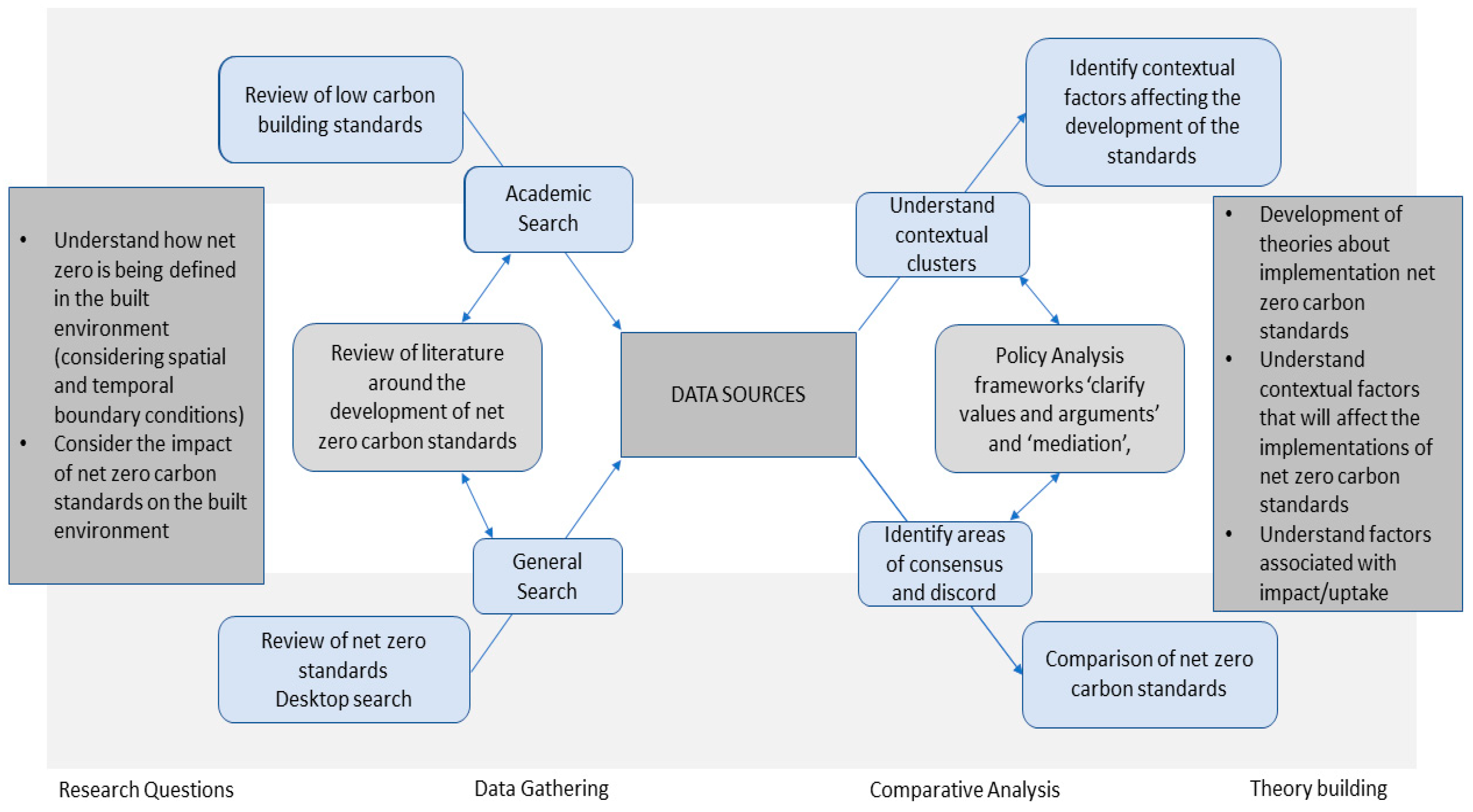
2. Methodology
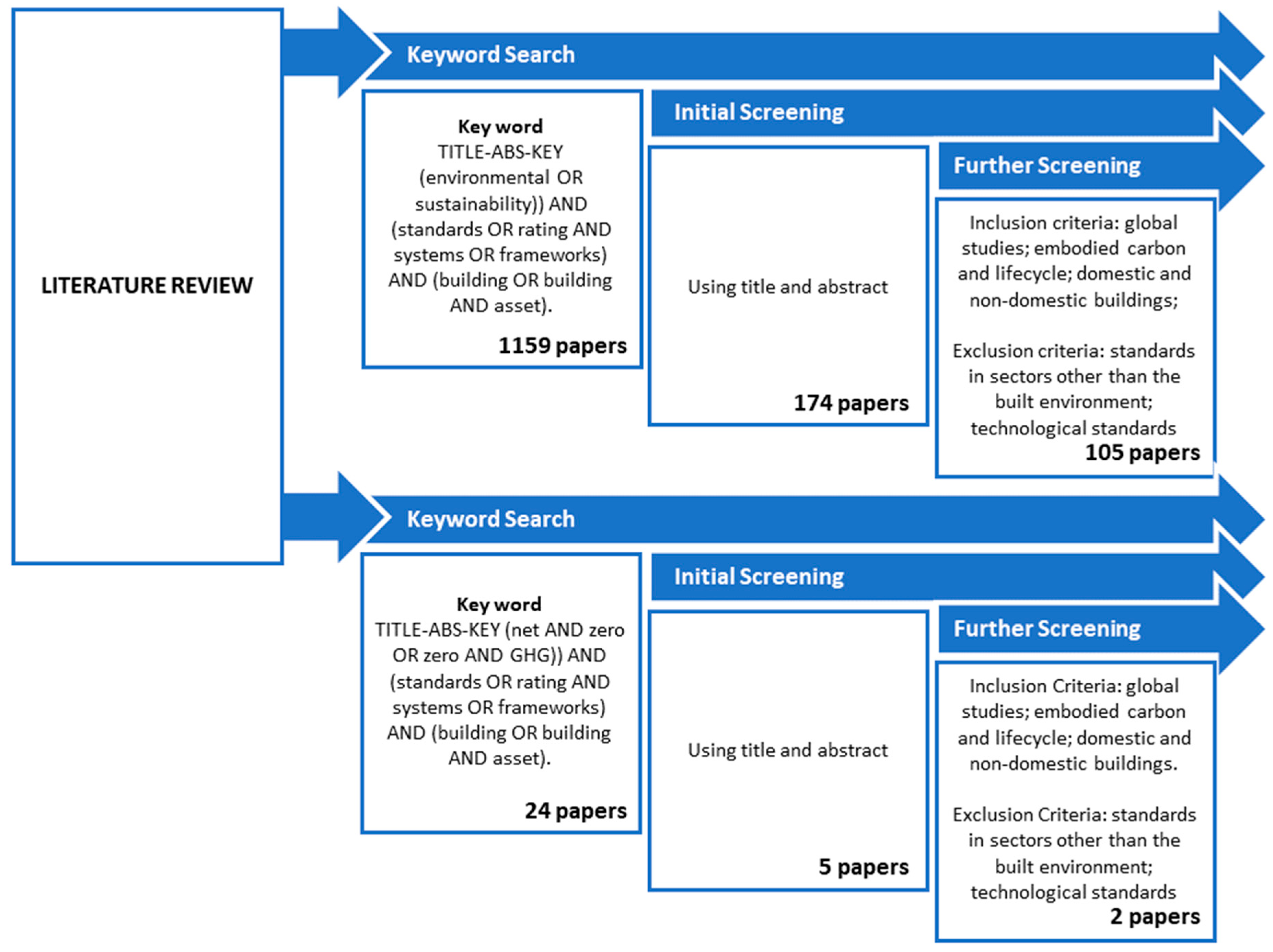
- TITLE-ABS-KEY (net AND zero OR zero AND GHG) AND (standards OR rating AND systems OR frameworks) AND (building OR building AND asset). With a year range limited from 2015 to 2022.
- TITLE-ABS-KEY (environmental OR sustainability) AND (standards OR rating AND systems OR frameworks) AND (building OR building AND asset). With a year range of 1999 to 2022.
3. Review of Non-Regulatory Building Standards and Policy Context
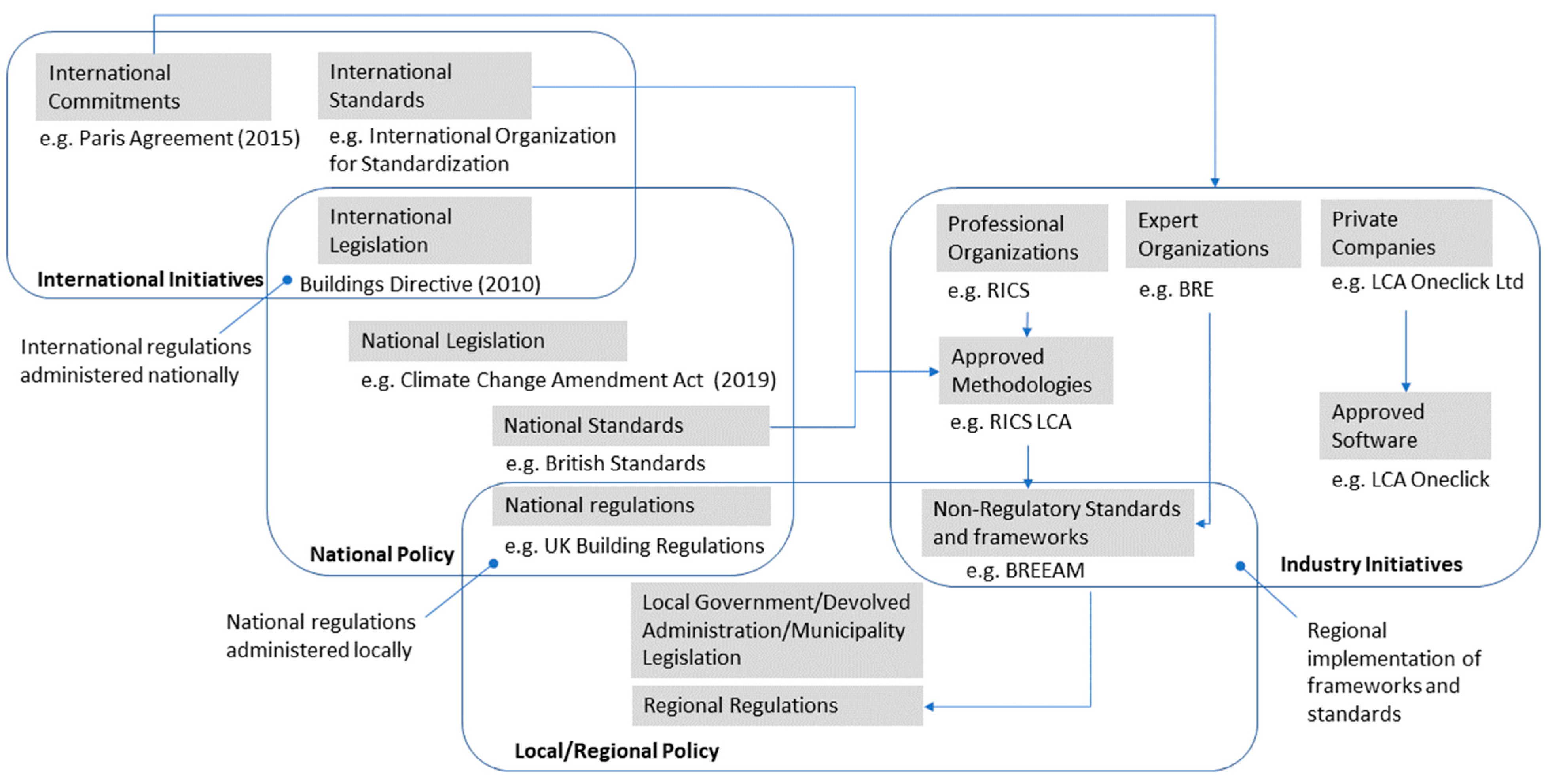
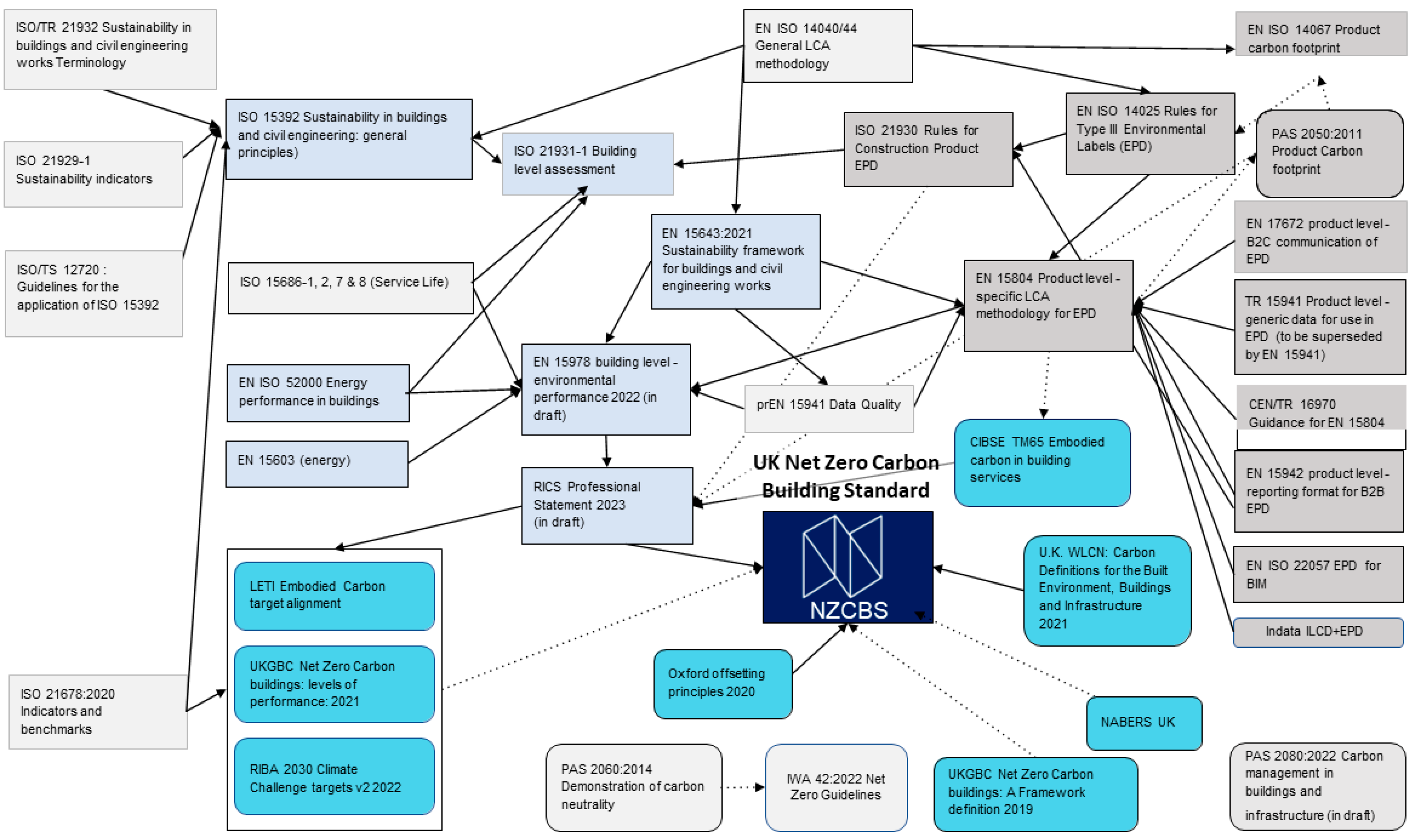
- Non-regulatory standards are developed by organisations fully or partially independent of government (see Figure 4). Examples of organisations developing EBSs include the Building Research Establishment (BRE) in the UK, the Passivhaus Institut in Germany, and the United States Green Building Council (USGBC) in the USA, all of whom are private institutions distinct from government bodies. In the case of the BRE, this organisation was founded as a government-funded research facility but has been independent of government since 1997 after being privatised [27]. Another example is DGNB, which was founded in 2007 by companies within the German construction and real-estate sectors with an aim to promote sustainable buildings [28].
- Organisations developing EBSs typically have a recognised level of expertise in their field. The bodies mentioned above (the BRE, DGNB, and USGBC) undertake independent research, provide training for professionals, produce white papers, and provide consultation for the government and industry in their respective countries [29,30,31]. Many of these organisations, such as the BRE, ILFI, USGBC, and DGNB, have developed several EBSs or produced several variations in EBSs (see Table A1). This definition can include organisations consisting of a coalition of experts and professionals assembled to drive changes in environmental development. One example of such a coalition is the Low Energy Transformation Initiative (LETI), which is a network of built environment professionals who assembled to define net-zero GHG emissions in the built environment in the UK [32] (see Table A2).
- Because non-regulatory standards are developed by private institutions, their implementation is discretionary rather mandatory. This is significant because mandatory national regulations (see Figure 4 below) typically establish minimum standards for a country. An example of legislative standards is the building regulations in the UK [33], which has specific requirements for operational energy reduction in buildings defined in the Approved Document Part L (conservation of fuel and power) [33].
- Many EBSs use a credit-based scoring matrix, whereby a broad range of criteria are identified, weighted, and scored (see Table A1, below). Criteria and credits are frequently grouped into themes based on key sustainability principles. For example, LEED has nine main categories based on the economic impact; demographic needs and priorities; flood risk assessment; noise pollution; energy strategy; existing buildings and infrastructure; water strategy; ecological strategy; land use and transport. BREEAM has nine categories, which include energy; land use and ecology; water; health and wellbeing; pollution; transport; materials; waste; and management (see Table A1).
- Performance tiers are another feature of EBSs. For example, LEED has Certified, Silver, Gold, and Platinum levels of compliance and BREEAM has Pass, Good, Very Good, Excellent, and Outstanding (see Table A1). These ratings are achieved based on the number of credits achieved.
- These standards typically have an accredited assessor, who will act as an intermediary between the certifying organisation, which is tasked with acquiring and auditing the data required for certification, and the design team.
- Typically, compliance with these standards is based on the building as designed rather than the building in use. Therefore, data will be submitted in advance of building completion to achieve certification. In-use performance standards have been introduced such as BREEAM In-use [45] and LEED Zero [16], which will be discussed in more detail later in this paper. However, even in these cases, the core assessments are based on a design rather than an occupied building (see Table A1).
- Non-regulatory EBSs are used by private and public organisations to set environmental targets for buildings beyond the mandatory minimum requirements of national regulations. One reason for the widespread use of EBSs is that accreditation provides a means for private organisations, state agencies, and regional authorities to identify and validate the environmental credentials of their buildings. For example, the BRE literature explains that, since 1998, over 16,000 projects have been BREEAM certified, equating to over 250,000 buildings [53].
- Whilst EBSs are not mandated by national governments, these standards can be adopted by municipal authorities and city administrations keen to enact more challenging environmental targets than national governments [54]. These standards can be enacted directly through local legislation or indirectly by making their use compulsory funding requirements for municipal authorities and national agencies [40] (see Figure 2). For example, in the UK, regional municipal authorities such as the Welsh and Scottish governments have made achieving BREEAM Very Good or Excellent a compulsory requirement for all new buildings fully or partially funded by them [55,56]. In addition, again in the UK, government agencies such as the Defence Estates and the Department of Health, with extensive property portfolios, have similarly made BREEAM and DREAM compulsory requirements for new buildings [57,58]. Similarly, LEED is a requirement for buildings for state-funded buildings in the USA [59], and Passivhaus is a requirement for public buildings in several municipal authorities in Europe, such as Voralburg in Austria [60].
- Finally, non-regulatory building standards can influence national building regulations. For example, in the UK, NABERS is cited as an EBS that informs the development of a performance-based policy framework for large commercial and industrial buildings in England and Wales [61].
4. The Development Context for Net-Zero GHG Emission Building Standards
4.1. Zero GHG Emission Building Standards Before the Paris Agreement
4.2. Drivers for the Development of Net-Zero GHG Emission Standards
- Recognition that more significant action was required to address the issue of global warming;
- Identification of issues around building performance and the performance gap;
- Increased awareness of embodied energy and carbon as a contributor of GHG emissions from the construction sector;
- Perceived flaws with current EBS frameworks.
4.2.1. Global Warming and the Paris Agreement
4.2.2. The Performance Gap
4.2.3. Embodied Carbon and Lifecycle Assessment
4.2.4. Criticisms of Existing EBS
5. Critical Review of Net-Zero GHG Emissions Building Standards
6. Net-Zero GHG Emissions Building Standard Distinguishing Features
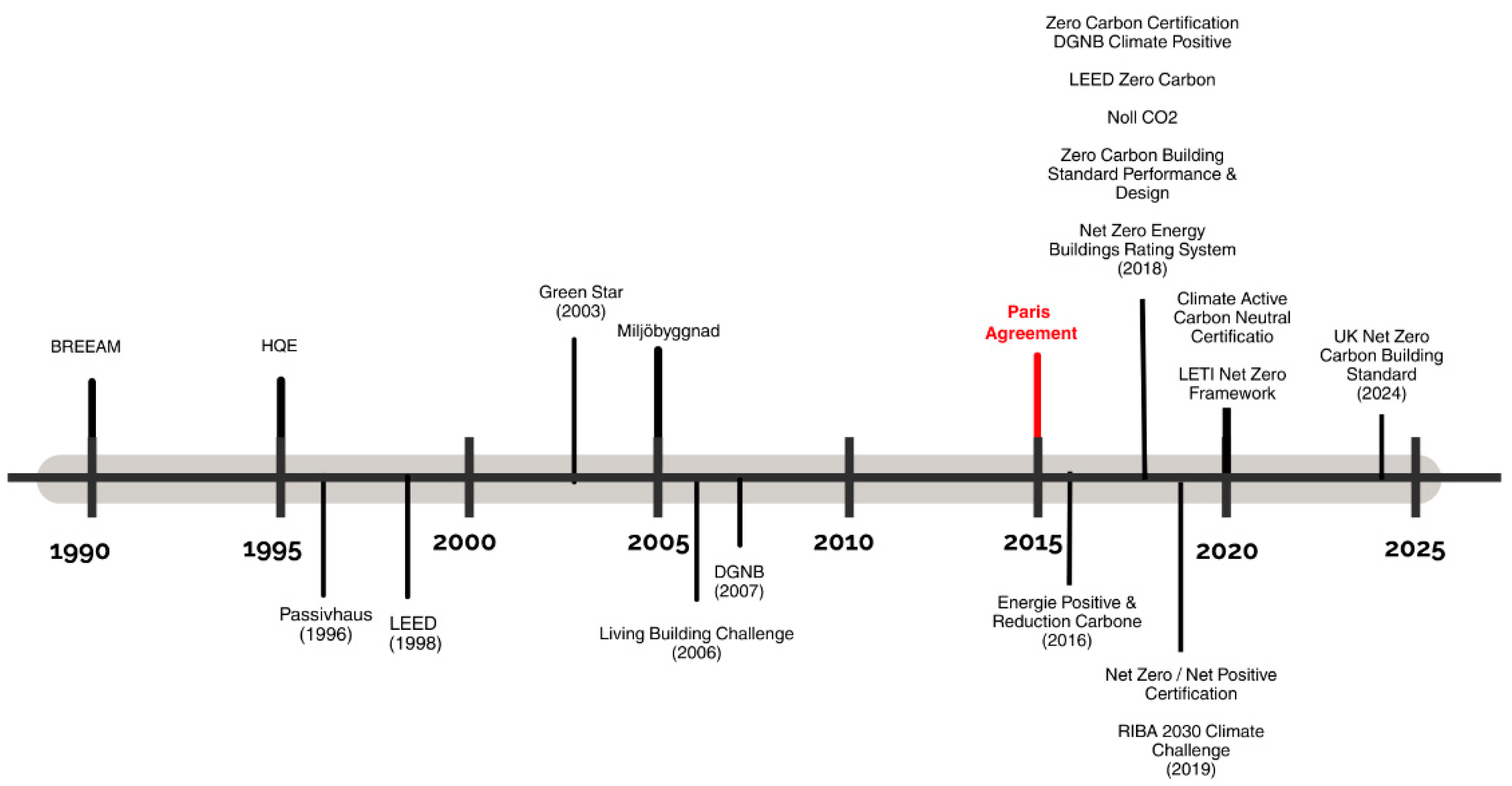
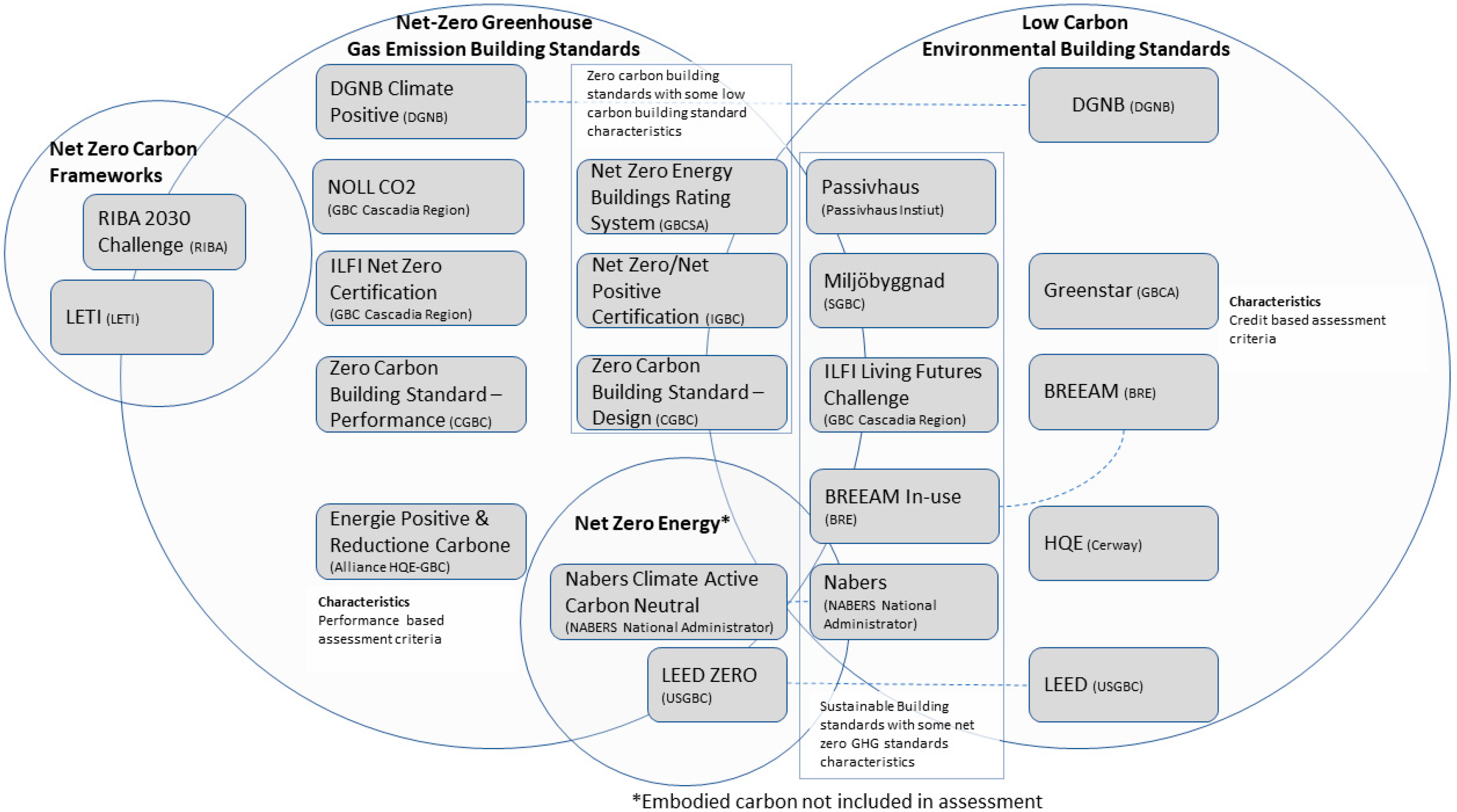
- A key feature of NZGHGEBSs is that compliance should be based on post-occupancy or as-built performance, rather than on design or predicted performance. This is a significant departure from most EBSs, and it can be postulated, based on critiques in the literature, that this is a response to the problem of the performance gap. While most NZGHGEBSs require post occupancy evaluation of performance to ensure compliance, the assessment period varies considerably. The point at which an asset can be considered a net-zero GHG emission building can be one year after practical completion, as is the case with ILFI Zero Carbon Certification, to five years for Noll CO2, to ongoing on an annual basis until the end of a building’s life, as is the case with LEED ZERO. This variance highlights some discord around the temporal boundaries of net-zero GHG emission definitions but is also a reflection of the practicalities of applying a standard.
- Another feature is the use of a limited set of assessment criteria. In some cases, such as ILFI Zero Carbon Certification and LEED ZERO, only two principal metrics are evaluated. The use of a limited set of evaluation criteria has more in common with the Passivhaus standard than with EBSs that have numerous criteria across a range of themes. However, it is notable that the Passivhaus standard has criteria relating to user comfort, something which is a notable absence in many NZGHGEBSs. Whilst comfort criteria are absent in most standards, it is notable that the Indian Green Building Council Net-Zero Energy Buildings Rating System [120] is one of the exceptions. The Indian Green Building Council Net-Zero Energy Buildings Rating System provides scope for comfort conditions to be compromised to meet carbon reduction requirements, and there is some evidence to indicate that this is already happening where in-use performance standards have been applied, such as in some cases where NABERS has been implemented on projects [121].
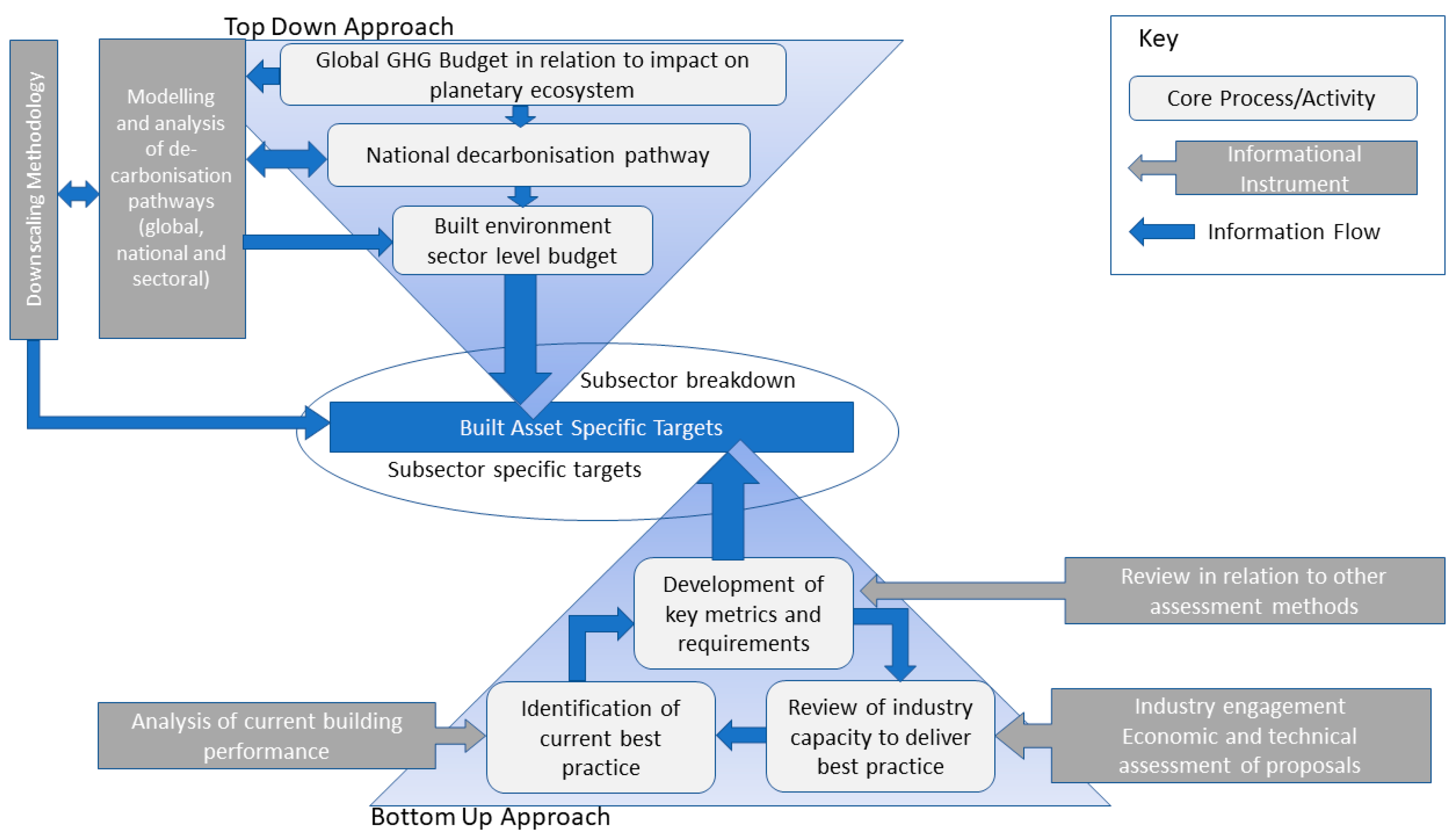
- The use of benchmarking based on assessment of building performance and the widespread identification of best practice as the basis of performance targets (i.e., a bottom-up methodology) is another feature of these standards. Again, this is not universal, and there were gaps in the data, with few developing organisations providing details of the data sets that had informed the benchmarks. However, it appeared that a common response of the challenge of defining a net-zero GHG building was to examine best practice in the current building stock and use this data as the basis for performance targets.
- The use of a binary pass/fail or threshold-based approach based on in-use metrics as opposed to levels of compliance is another common feature of the net-zero EBSs. Whilst not stated explicitly, this could be a response to some of the criticisms levelled at some EBSs, where levels of compliance fail to represent building performance.
- Regarding one of the more controversial aspects of the net-zero GHG compliance, carbon offsetting, there is agreement among the NZGHGEBSs that operational carbon emitted should be compensated (or surpassed) on an annual basis, with almost all standards providing this capacity in the assessment method. However, there is disagreement about what is included in the calculation methods. All the standards allow the use of off-site renewables; however, there is no consensus on the use of carbon offsetting for embodied carbon. Carbon offsetting can be interpreted as a response to the use of a bottom-up methodology, which identifies best practice but leaves residual GHG emissions that needed to be addressed. However, there are several potential issues that could compromise the role of carbon offsets in reducing emissions and achieving net-zero greenhouse gas emissions. For example, verifying the additionality of a carbon offsetting project, which means that any reduction in emissions is only caused by the offset project taking place, is challenging. There are also risks associated with carbon leakages and reversals [122]. Therefore, priority should always be given to reducing or eliminating emissions at source. For example, on-site renewables and sequestration of carbon on-site (using measures as structural timber) should be prioritised over carbon offsets and biogenic sequestration off-site. Offsetting is generally regarded as a final step to be applied when benchmarks are met and should follow rigorous verification methods such as the guidelines provided in the latest edition of the Oxford Offsetting Principles [123].
7. Discussion
8. Conclusions
- Improved transparency in how the benchmarks and targets are derived, reconciling the bottom-up (best-practice building performance) approach with the top-down (GHG-based budget) approach (see Figure 6);
- Contractual arrangements to facilitate building fine tuning after completion and post-occupancy evaluations (including post-construction LCA audits to cover both operational and embodied carbon);
- Robust measurement and verification protocols to demonstrate the effectiveness of these standards in practice, using third party independent verification;
- Address interoperability or equivalence agreements between regional standards to prevent market fragmentation, especially for international real estate portfolios.
Author Contributions
Funding
Data Availability Statement
Acknowledgments
Conflicts of Interest
Appendix A

| Background Information | Accreditation Information | |||||||
|---|---|---|---|---|---|---|---|---|
| Standard Name | Developing Organisation and Country of Origin (in Brackets) | Launch Year | Certification Process (Verification Mechanism) | Certificate Renewal Period | Assessment Criteria (Scope) | Compliance Levels | Targets/Benchmarks and Minimum Requirements | Notes |
| BREEAM [4] | BRE (UK) | 1990 | An accredited assessor guides the certification process, ensures requirements are fulfilled, and undertakes a pre-assessment. Certification includes collating project information and submitting to the certification body. | One-off certificate achieved on completion of the project; BREEAM in-use provides for continual assessment. | Energy; Health and Well-being; Innovation; Land Use; Materials; Management; Pollution; Transport; Waste; Water. | Outstanding Excellent Very good Good Pass Acceptable | BREEAM uses six levels to describe points a project achieves: outstanding (above 85%), excellent (70–85%), very good (55–70%), good (45–55%), pass (30–45%), and acceptable (Under 30%). | BREEAM was the first certification system to assess, rate, and certify the sustainability of buildings. It is one of the most used systems in the world. |
| LEED [15] | U.S. Green Building Council | 1998 | Certification process has two phases—design and construction. For both phases, design documents are submitted and reviewed by the certification body. First review either approves or rejects the sustainable solutions proposed for the project. | One-off certificate achieved on completion of the project. | Location and Transportation; Sustainable Sites; Water Efficiency; Energy and Atmosphere; Materials and Resources; Indoor Environmental Quality; Innovation; Regional Priority. | Platinum Gold Silver Certified | The point system consists of 110 attainable total points. Projects with 40+ points achieve the Certified level, projects with 50+ achieve the Silver level, projects with 60+ achieve the Gold, and projects with 80+ achieve the Platinum level of certification. | LEED is one of the largest existing certification systems. It focuses both on the environmental and social aspects of building sustainability. |
| Greenstar [129] | Green Building Council of Australia | 2003 | After registration, the project’s sustainable attributes are documented with design and construction information. Documents are reviewed by the Council. Projects can choose to rate design-related credits before construction is completed. | One-off certificate achieved on completion of the project | Management Indoor Environmental Quality Energy Transport; Water; Materials; Land use and Ecology; Emissions; Innovation. | 6 Star: International excellence 5 Star: Australian excellence 4 Star: Best practice | The Green Star rating system is based on a 1 to 6 Star framework with 1 Star as the lowest score and 6 Star as the highest. To achieve certification, a project must have 4 Stars or more. To achieve a 4 Star rating the project must score at least 45% of the available points, for a 5 Star rating 60% or more, and 75% or more for the highest 6 Star rating. | This standard allows certification of buildings and district scale development, and caters for design, delivery, and ongoing performance. |
| HQE [130,131] | CERTIVEA (non-domestic), CERQUAL (for housing) (France) | 1995 | Certification varies based on building type: new buildings, residential buildings, existing buildings in use, etc. Non-residential buildings have a three-step assessment process. When certifying residential buildings, the property developer or the building contractor which is certified. | One-off certificate—option for contractors and developers to have a licence that validates their experience (renewed every 3 years). | Energy; Environment; Health; Comfort. | Exceptional Excellent Very Good Good Pass | The five HQE certification levels are Exceptional, Excellent, Very Good, Good and Pass. These are determined by the level of achievement in 14 targets classified into four categories (eco-construction, eco-management, comfort, health) | This standard includes some continual assessment of the developer or contractor though a licencing scheme. |
| Living Buildings Challenge [10] | ILFI (USA) | 2006 | The certification process has three parts: (1) registration; (2) project documentation evaluated followed by a 12-month performance period, where data is recorded in relation to requirements; (3) audit of documentation and site inspection. | One-off certificate achieved on completion of the assessment period. | Place; Water; Energy; Health and Happiness; Materials; Equity; Beauty. | Living certified Petal certified | LBC has two certification degrees: Living and Petal. To obtain the full Living certification, all demands of the (principles) must be met. If the project can reach the standards of at least three out of the seven petals (with at least one being either Water, Energy or Health), it can receive a Petal Certification. | This standard is one that evaluates the design and the final building incorporating assessment a year after practical completion. |
| DGNB [11] | DGNB (Germany) | 2007 | Two types of DGNB certifications: a precertification and a final certification. Accredited assessor guides the certification process, ensures requirements are fulfilled—collates and submits project information. | One-off certificate achieved on completion of the project. | Environmental quality; Economic quality; Sociocultural and functional quality; Process quality; Technical quality. | Platinum Gold Silver Bronze | For platinum certification, the project must obtain at least 80% of the total points available. For gold, a minimum of 65% is required and for silver 50%. For the bronze (existing buildings only) a minimum of 35% of points must be achieved. A DGNB diamond certification, is available for high quality projects. | |
| Passvihaus [47] | Passivhaus Institut (Germany) | 1996 | The certification covers the following phases: initial check; preliminary review—design phase; design stage review—before the start of the construction work; final review—after completion of the construction work. | One-off certificate achieved on completion of the project. | Energy; Thermal Comfort. | Passivhaus (Classic) Passivhaus Plus Passivhaus Premium | The heating demand of a Passive House should not exceed 15 kWh/(m2a). For Passivhaus Classic primary energy not more than 60 kWh/(m2a). A Passivhaus Plus should not consume more than 45 kWh/(m2a) of renewable primary energy and must generate 60 kWh/(m2a) of energy. For Passivhaus Premium, energy demand is 30 kWh/(m2a), with 120 kWh/(m2a) of energy generated by the building | |
| Miljöbyggnad [132] | Sweden Green Building Council | 2005 | Application content is verified by professional verifiers. For new buildings, a pre-certification is awarded. After two years, the building is then verified, and if all requirements are fulfilled, the final certification is awarded. | The final certification must be checked every five years to maintain its validity. | Energy; Indoor climate; Materials. | Gold Silver Bronze | Miljöbyggnad levels relate to Swedish building regulations. Bronze certification complies with statutory requirements, Silver, well over the set values, and significantly better statutory requirements; Gold, is the highest certification requirements. In addition, to reach Gold, requires a survey of building users’ experience of the indoor environment. | This standard incorporates assessment of building performance in relation to indoor environment after practical completion. |
| Background Information | Accreditation Information | ||||||||
|---|---|---|---|---|---|---|---|---|---|
| Standard Name | Developing Institution and Country of Origin (in Brackets) | Launch Year | Certification Data Sources (Verification Mechanism) | Certificate Awarding Period | Assessment Criteria (Scope) | Compliance Levels | Targets/Benchmarks and Minimum Requirements | Offsetting Approach | Notes |
| LEED Zero Carbon [15] (adjunct to LEED EBS) | USGBC (USA) | 2018 | Annually submitted performance data, metered energy, transport assessments and on-site and off-site renewable energy and offsets (proposed that in future it will incorporate carbon from water consumption, waste, and the embodied carbon). | LEED Zero certification is valid for three years. | Operational and Transport Energy | Pass or fail | Baseline performance requirements provided by mandatory LEED BD+C or O+M certification | Accredited offsets and off-site renewables permitted (Energy Attribute Certificates) by Green-e or equivalent | Assessment Based on Carbon Balance = Carbon Emitted (operational and transport energy) -Carbon Avoided LEED Zero Carbon |
| Zero Carbon Certification [17] | ILFI (USA) | 2018 | Based on metered energy and utility bills 1 year after PC Metre data and on-site renewable energy production data. As-built material types and quantities | One-off certificate awarded at end of assessment period (1 year after PC). | Operational Energy and Upfront Embodied Carbon | Pass or fail | Benchmarks based on climatic region and asset type: New Buildings 25% reduction; Existing Buildings 30% reduction in EUI from a typical existing building of an equivalent type, size, and location. Embodied carbon not to exceed 500 kg CO2e/m2 (RICS A1-A5) | Off-site renewables for residual operational energy and Accredited Offsets permitted for residual embodied carbon | |
| Climate Active Carbon Neutral Certification [133] | NABERS National Administrator & Green Building Council of Australia (Australia) | 2020 | Annual metered operational energy subject to independent verification every three years. (Embodied energy of materials and processes may be considered in the future versions). | Certification is valid for three years. | Operational Energy, refrigerant-gas, and water | Pass or fail | 4 Star or greater NABERS Energy rating; Or 4 Star or greater Green Star—Performance rating, (8 of 20 points base building or 9 out of 23 points (whole building) scored in the GHG credit | Accredited Offsets permitted either in arrears or Upfront (in advance) | Two pathways to standard one based on NABERS the other based on Greenstar Can be applied to the base build or the whole building |
| DGNB Climate Positive [18] | DGNB (Germany) | 2018 | CO2 accounting according to the DGNB Framework and documentation of data in the DGNB-CO2 accounting tool. Evidence of key performance indicators self-generated fraction of consumed final energy | The award is granted when the DGNB system buildings in use is achieved. The building must have been in operation for one year. | CO2 reporting of the building in used based on metered energy their real consumption data. | Pass or fail | Evidence for a negative annual CO2 balance form measured data of one calendar year. Minimum requirements for the building envelope from DGNB System New Buildings. | Remote energy sources in the CO2 balance but must be disclosed. Off-site purchased energy must be compliant with minimum requirements. | Objectives for future energy saving (i.e., a climate Action plan) are required. The recording of CO2 emissions should verify the effectiveness of measures |
| Noll CO2 [134,135] | [135] Sweden Green Building Council (Sweden) | 2018 | Metered energy 5 years after PC Verification of construction and of Report the amount of replaced and added materials/products/systems during renovations and conversions following PC. | Certification is valid for five years. Complete periodic reporting every five years to maintain the certification. | The whole-life carbon building service system is factored based on the component’s climate data (kg CO2e/kg) and respective quantity (kg). | Pass or fail | Benchmarks are based on minimum complementary certification levels: Miljöbyggnad level Silver; BREEAM-SE Very Good; LEED Gold. Operational energy 25–50% lower than code mandated energy performance. Embodied carbon benchmarks are based on a SGBC calculated baseline and a calculated value for stage A1-A3. The climate impact of A4-A5 not exceeding 55 kg CO2e/m2. | Compensation can be performed through one of three programmes: Verra, Gold Standard or Plan Vivo | Net-zero balance between the climate impact of the building’s whole-life carbon and the project’s climate actions (offsets). |
| Energie Positive and Reduction Carbone [136] | Alliance HQE-GBC (France) | 2016 | Checks on documents and standardised thermal and environmental assessments including, models and results of performance calculations. Construction phase review of changes and updates and the calculation of their impact on the energy performance. Compliance review at the end of the construction phase. | One-off certificate awarded at the end of design and construction assessment period. | Operational Energy, Embodied Carbon, Thermal Comfort, and other environmental indicators. | 4 Energy Levels: (1) (2) improvement on current requirements; (3) significant increase in energy efficiency; (4) zero (or negative) energy balance. 2 Carbon Levels: (1) construction methods and operations improvement; (2) best practice. | For operational energy there are four levels of performance with benchmarks for small scale domestic, large scale residential, offices and other building types. The reductions range from 5% and 10% for residential at Level 1 to 20% at Level 2 to 20% for Residential at Level 3 for Residential and 40% for Offices to achieving an energy. To carry out the analysis of the lifecycle of the building, taken as equal to 50 years for all buildings. | Carbon compensation is not part of the process. | Experimental voluntary standard. The energy balance of a building is defined by the difference, primary energy, and quantity of non-renewable or recovered energy consumed by the building. |
| Zero Carbon Building Standard Performance and Design [137,138] | Canada Green Building Council (Canada) | 2018 | 2 compliance routes: Design, measured or modelled carbon balance; and Performance, where certification is awarded based on one year of operating data evidencing a carbon balance. | Annual certification for existing buildings Design: One-time certification for new buildings and major renovations. | Operational Carbon and Embodied Carbon (including lifecycle carbon). | Pass or fail | Design standard operational energy 4 approaches: Flexible—Thermal Energy Demand I(TEDI) of 30–40 kWh/m2/yr and site energy use intensity 25% better than minimum requirements; passive design—(TEDI) of 20–30 kWh/m2/year; renewable energy (TEDI) of 30–40 kWh/m2/year; and zero carbon balance for operational carbon without offsets. LCA analysis demonstrating embodied carbon reduction for lifecycle stages A, B, and C. relative to baseline building Performance Standard: no benchmarks. | Embodied carbon offset by a single purchase or annually (up to five years). Offsets certified by Green-e or equivalent, or by high-quality international programmes. Green power products from renewable sources to offset grid electricity usage. | Lifecycle carbon (lifecycle stage D) does not require offsets. |
| Net-Zero/Net Positive Certification Scheme [139] | Green Building Council South Africa (South Africa) | 2019 | Measured and modelled data | Certificate valid for 3 years | Carbon (Embodied and Operational) 0 kgCO2/m2/year Water Waste Ecology | Two certification levels: Net-Zero and Net Positive | For Net-Zero building Emissions services and occupants using a rating tool energy calculator value is 0 kgCO2/m2/year or equal or less than the on-site renewable energy carbon emissions reductions. For Net Positive Carbon: Tool value is 5% above zero. Requirements for water, waste, and ecology for Net-Zero: Water—consumption is 0 L/day/m2; waste—achieved when construction waste measured to be 0 kg/year to landfill; operational waste achieved when measured waste is 0 kg/year to landfill over 12 consecutive months. | Off-Site renewables permitted in country project is certified. Carbon offsets can be purchased from verified and permitted trading schemes. | Assessment is based on modelling, but GBCSA have reserved the right to remove modelled options for all or some certification types, or shorten the validity period. |
| Net-Zero Energy Buildings Rating System [120] | Indian Green Building Council (India) | 2018 | Credit points with verification based on modelled and submission of documents. The measurement of Total Metered Energy Consumption (kWh) and Renewable Energy Generation based on a minimum of 80% occupancy. | One-off certificate awarded at end of assessment period; however, 80% occupancy is a requirement for assessment. | Mandatory credits for: (1) Energy Performance(2) Thermal Comfort. Energy Performance credits for Simulation; Energy Efficient Building Envelope, Services, and appliances; and Renewable Energy. | Net-Zero Energy (when all mandatory credits achieved) and Net-Zero Energy Platinum (mandatory credits and more than 80 credit points) or building to meet all energy requirements through renewable energy. | The project can demonstrate energy performance of the facility through (1) meeting the respective IGBC rating—minimum energy performance requirement; (2) the Energy Performance Index Ratio based on in-use less than or equal to the design energy performance index on annual basis; (3) demonstrating that the energy performance of major equipment is meeting Energy Conservation Building Code requirements. | Off-site renewable energy; Resources permitted and points are awarded based on the proportion of on-site to off-site generation. | Building rating: the project must satisfy all the mandatory requirements and can demonstrate that the net annual energy consumption as zero. |
| UK Net-Zero Carbon Building Standard [85] | Coalition of organisations including BBP, BRE, Carbon Trust, CIBSE, IStructE, LETI, RICS, RIBA, and UKGBC, (UK) | 2024 | The total electricity generated on-site should be measured using metre readings, and the quantity used on-site should be separated from exported electricity. For embodied carbon, quantity information according to the sources listed for ‘post-completion phase—actual quantities’ should be used. | The minimum occupancy rate requirements for buildings intended to be occupied and at the post-completion stage. | Embodied Carbon; Operational Energy; Space Heating Demand GHG Refrigerant Gas. | Pass or fail | Embodied carbon limits for specific typologies based on kgCO2e/m2 GIA reducing on an annual basis derived from a top-down methodology. Operational energy limits for specific typologies based on kWh/m2 GIA/yr reducing on an annual basis derived from a top-down methodology. Limit on annual space heating delivered to the building, new buildings based on typology; GWP limit for refrigerant systems = 677 kg CO2e/kg. | For all building and works types, carbon emissions may be offset and reported. Carbon credits from programmes assessed as meeting the requirements, e.g.,:
| Development of limits based on the use of top-down and bottom-up methodologies. |
References
- 3XN/GXN. A Guide to Sustainable Building Certifications; GXN Innovation: Copenhagen, Denmark, 2012; p. 156. [Google Scholar]
- Parkin, A.; Mitchell, A.; Coley, D. A new way of thinking about environmental building standards: Developing and demonstrating a client-led zero-energy standard. Build. Serv. Eng. Res. Technol. 2016, 37, 413–430. [Google Scholar] [CrossRef] [Scilit]
- Williams, J.; Mitchell, R.; Raicic, V.; Vellei, M.; Mustard, G.; Wismayer, A.; Yin, X.; Davey, S.; Shakil, M.; Yang, Y.; et al. Less is more: A review of low energy standards and the urgent need for an international universal zero energy standard. J. Build. Eng. 2016, 6, 65–74. [Google Scholar] [CrossRef] [Scilit]
- BRE Group. BREEAM v7: Where Are We Now? Available online: https://www.the-ies.org/resources/essential-environment-breeam-v7 (accessed on 13 December 2025).
- Richards, J. Green Building: A Retrospective on the History of LEED Certification. Sustain. Ind. Sect. Retrosp. 2012, 1–6. Available online: https://enviroinstitute.org/wp-content/uploads/2012/09/GREEN-BUILDING-A-Retrospective-History-of-LEED-Certification-November-2012.pdf (accessed on 13 December 2025).
- Reed, R.; Bilos, A.; Wilkinson, S.; Schulte, K.W. International Comparison of Sustainability Rating Tools. J. Sustain. Real Estate 2009, 1, 1–22. [Google Scholar] [CrossRef] [Scilit]
- MINERGIE International—Minergie, the Quality Standard for Your Sustainable Building. Available online: https://www.minergie.com/ (accessed on 4 April 2022).
- Green Building Council of Australia Exploring Green Star | Green Building Council of Australia. Available online: https://new.gbca.org.au/green-star/exploring-green-star/ (accessed on 4 April 2022).
- Ministry of Defence Section 6: Defence Related Environmental Assessment Methodology (DREAM), MOD Sustainability and Environmental Appraisal Tools Handbook. Available online: https://www.gov.uk/government/publications/mod-sustainability-and-environmental-appraisal-tool-handbook (accessed on 13 December 2025).
- Cascadia Region Green Building Council. The Living Building Challenge: In Pursuit of True Sustainability in the Built Environment Version 1.3; International Living Building Institute: Seattle, WA, USA, 2008. [Google Scholar]
- DGNB The DGNB System | DGNB System. Available online: https://www.dgnb-system.de/en/system/index.php (accessed on 4 March 2022).
- HM Government. Paris Agreement; HM Government: London, UK, 2019; Volume 7, pp. 1–16.
- Hoxha, E.; Passer, A.; Saade, M.R.M.; Trigaux, D.; Shuttleworth, A.; Pittau, F.; Allacker, K.; Habert, G. Biogenic carbon in buildings: A critical overview of LCA methods. Build. Cities 2020, 1, 504–524. [Google Scholar] [CrossRef] [Scilit]
- Röck, M.; Baldereschi, E.; Verellen, E.; Passer, A.; Sala, S.; Allacker, K. Environmental modelling of building stocks—An integrated review of life cycle-based assessment models to support EU policy making. Renew. Sustain. Energy Rev. 2021, 151, 111550. [Google Scholar] [CrossRef] [Scilit]
- USGBC. LEED Zero Program Guide; USGBC: Washington, DC, USA, 2020; Volume 12. [Google Scholar]
- USGBC. USGBC Launches LEED Zero, to Address Net Zero Carbon Operations and Resources in LEED Green Building Projects | U.S. Green Building Council. Available online: https://www.usgbc.org/articles/usgbc-launches-leed-zero-address-net-zero-carbon-operations-and-resources-leed-green-buildi (accessed on 4 March 2022).
- Introducing ILFI’s New Zero Carbon Certification. Available online: https://trimtab.living-future.org/blog/introducing-the-ilfis-new-zero-carbon-certification/ (accessed on 4 March 2022).
- DGNB. New DGNB ‘Climate Positive’ Award for Buildings That Make an Active Contribution to Climate Protection. Available online: https://www.dgnb.de/en/making-the-most-of-dgnb/newsroom/press/article/new-dgnb-climate-positive-award-for-buildings-that-make-an-active-contribution-to-climate-protection (accessed on 23 December 2022).
- CaGBC. Zero Carbon Building Design Standard Version 2; CaGBC: Ottawa, ON, Canada, 2020. [Google Scholar]
- Schmitt, S. Comparative approaches to the study of public policy-making. In Routledge Handbook of Public Policy; Routledge: Oxfordshire, UK, 2012; pp. 29–43. [Google Scholar]
- Gupta, J. The multi-level governance challenge of climate change. Environ. Sci. 2007, 4, 131–137. [Google Scholar] [CrossRef] [Scilit]
- Vogel, B.; Henstra, D. Studying local climate adaptation: A heuristic research framework for comparative policy analysis. Glob. Environ. Change 2015, 31, 110–120. [Google Scholar] [CrossRef] [Scilit]
- Rose, R. Learning from Comparative Public Policy: A Practical Guide; Routledge: Oxfordshire, UK, 2005. [Google Scholar]
- Mayer, I.S.; van Daalen, C.E.; Bots, P.W.G. Perspectives on policy analysis: A framework for understanding and design. In Routledge Handbook of Policy Design; Routledge: Oxfordshire, UK, 2018; pp. 161–179. [Google Scholar]
- Hasan, L.N.; Lizarralde, G.; Lachapelle, E. The legitimation of private net zero emission building standards in the context of global decarbonization goals. Constr. Manag. Econ. 2024, 43, 360–380. [Google Scholar] [CrossRef] [Scilit]
- World GBC. Advancing Net Zero: Status Report May 2019; World GBC: London, UK, 2019; p. 24. [Google Scholar]
- BRE. Our History—BRE Group. Available online: https://www.bregroup.com/about-us/our-history/ (accessed on 13 April 2022).
- DGNB. Our Network | DGNB. Available online: https://www.dgnb.de/en/network/index.php (accessed on 13 May 2022).
- USGBC. Greening the Codes: Building; USGBC: Washington, DC, USA, 2011. [Google Scholar]
- EIT. Climate-KIC White Paper: How Blended Finance Can Catalyse Building; EIT: Budapest, Hungary, 2021. [Google Scholar]
- BRE. 2017 White Paper: Action Programme for Responsible Ethical Sourcing: Eight Pathways to Best Practice; BRE: Hertfordshire, UK, 2017; pp. 1–16. [Google Scholar]
- LETI. London Climate Emergency Design Guide. How New Buildings Can Meet UK Climate Change Targets; LETI: London, UK, 2020; p. 158. [Google Scholar]
- HM Government. Approved Document L: Conservation of Fuel and Power—Volume 1; HM Government: London, UK, 2022.
- Doan, D.T.; Ghaffarianhoseini, A.; Naismith, N.; Zhang, T.; Ghaffarianhoseini, A.; Tookey, J. A critical comparison of green building rating systems. Build. Environ. 2017, 123, 243–260. [Google Scholar] [CrossRef] [Scilit]
- Li, Y.; Chen, X.; Wang, X.; Xu, Y.; Chen, P.H. A review of studies on green building assessment methods by comparative analysis. Energy Build. 2017, 146, 152–159. [Google Scholar] [CrossRef] [Scilit]
- Lee, W.L. A comprehensive review of metrics of building environmental assessment schemes. Energy Build. 2013, 62, 403–413. [Google Scholar] [CrossRef] [Scilit]
- Zuo, J.; Zhao, Z.Y. Green building research-current status and future agenda: A review. Renew. Sustain. Energy Rev. 2014, 30, 271–281. [Google Scholar] [CrossRef] [Scilit]
- Haapio, A.; Viitaniemi, P. A critical review of building environmental assessment tools. Environ. Impact Assess Rev. 2008, 28, 469–482. [Google Scholar] [CrossRef] [Scilit]
- Muller, M.F.; Esmanioto, F.; Huber, N.; Loures, E.R.; Canciglieri, O. A systematic literature review of interoperability in the green Building Information Modeling lifecycle. J. Clean. Prod. 2019, 223, 397–412. [Google Scholar] [CrossRef] [Scilit]
- Zhang, Y.; Wang, H.; Gao, W.; Wang, F.; Zhou, N.; Kammen, D.M.; Ying, X. A survey of the status and challenges of green building development in various countries. Sustainability 2019, 11, 5385. [Google Scholar] [CrossRef] [Scilit]
- Roostaie, S.; Nawari, N.; Kibert, C.J. Sustainability and resilience: A review of definitions, relationships, and their integration into a combined building assessment framework. Build. Environ. 2019, 154, 132–144. [Google Scholar] [CrossRef] [Scilit]
- Trigaux, D.; Allacker, K.; Debacker, W. Environmental benchmarks for buildings: A critical literature review. Int. J. Life Cycle Assess. 2021, 26, 1–21. [Google Scholar] [CrossRef] [Scilit]
- Shan, M.; Hwang, B. gang Green building rating systems: Global reviews of practices and research efforts. Sustain. Cities Soc. 2018, 39, 172–180. [Google Scholar] [CrossRef] [Scilit]
- Khoshbakht, M.; Gou, Z.; Lu, Y.; Xie, X.; Zhang, J. Are green buildings more satisfactory? A review of global evidence. Habitat Int. 2018, 74, 57–65. [Google Scholar] [CrossRef] [Scilit]
- BRE. BREEAM In-Use. 2013. Available online: https://files.bregroup.com/bre-co-uk-file-library-copy/filelibrary/pdf/Brochures/BREEAM_In-Use.pdf (accessed on 13 December 2025).
- Institute, P.H. Criteria for the Passive House, EnerPHit and PHI Low Energy Building Standard; Passive House Institute: Darmstadt, Germany, 2016. [Google Scholar]
- Passivhaus Trust. Claiming the Passivhaus Standard: Technical Briefing Document; Passivhaus Trust: West Sussex, UK, 2015. [Google Scholar]
- BRE. NABERS UK: Guide to Design for Performance; BRE: Hertfordshire, UK, 2021. [Google Scholar]
- BS ISO 16309; BSI Standards Publication Sustainability of Construction Works—Assessment of Social Performance of Buildings—Calculation Methodology. British Standards Institution: London, UK, 2012.
- Roberts, M.; Allen, S.; Coley, D. Life cycle assessment in the building design process—A systematic literature review. Build Environ. 2020, 185, 107274. [Google Scholar] [CrossRef] [Scilit]
- Lynch, H. Passivhaus in the UK: The Challenges of an Emerging Market a Case Study of Innovation Using Mixed Methods Research. Ph.D. Thesis, University College London, London, UK, 2014. [Google Scholar]
- UK Net Zero Carbon Buildings Standard, The Pilot Version. Available online: https://www.nzcbuildings.co.uk/pilotversion (accessed on 13 December 2025).
- BRE. Best of BREEAM: Today’s Most Sustainable Buildings; BRE Group: Watford, UK, 2013. [Google Scholar]
- Becqué, R.; Weyl, D.; Stewart, E.; Mackres, E.; Jin, L.; Shen, X. Accelerating Building Decarbonization: Eight Attainable Policy Pathways to Net Zero Carbon Buildings For All; World Resources Institute: Washington, DC, USA, 2019; pp. 1–84. [Google Scholar]
- Welsh Government. Sustainable Buildings, Compliance with BREEAM Requirements and the Exception Process. Available online: https://www.gov.wales/docs/wefo/publications/170412-cct-breeam-document.pdf (accessed on 13 December 2025).
- The Scottish Government. Review of Scottish Public Sector Procurement in Construction; The Scottish Government: Edinburgh, UK, 2013.
- BRE Global. BREEAM Healthcare FAQs; BRE Global: Hertfordshire, UK, 2013. [Google Scholar]
- Evans, D.; Dickinson, R.; Udell, J. Defence Related Environmental Assessment Methodology (DREAM) Version 7; UK Ministry of Defence (MoD): London, UK, 2020.
- USGBC. Engaging with State and Local Governments on LEED | U.S. Green Building Council. Available online: https://www.usgbc.org/articles/engaging-state-and-local-governments-leed (accessed on 14 April 2022).
- Passivhaus Institut International Passive House Association | Legislation & Funding. Available online: https://passivehouse-international.org/index.php?page_id=501 (accessed on 16 December 2022).
- Department for Business Energy and Industrial Strategy. Introducing a Performance-Based Policy Framework in Large Commercial and Industrial Buildings in England and Wales; Government UK: London, UK, 2021.
- Moghaddasi, H.; Culp, C.; Vanegas, J.; Ehsani, M. Net zero energy buildings: Variations, clarifications, and requirements in response to the Paris Agreement. Energies 2021, 14, 3760. [Google Scholar] [CrossRef] [Scilit]
- Satola, D.; Wiberg, A.H.; Singh, M.; Babu, S.; James, B.; Dixit, M.; Sharston, R.; Grynberg, Y.; Gustavsen, A. Comparative review of international approaches to net-zero buildings: Knowledge-sharing initiative to develop design strategies for greenhouse gas emissions reduction. Energy Sustain. Dev. 2022, 71, 291–306. [Google Scholar] [CrossRef] [Scilit]
- European Union Directive 2010/31/EU of the European Parliament and of the Council of 19 May 2010 on the energy performance of buildings (recast). Off. J. Eur. Union 2010, 63, 619.
- Ministry of Housing Communities & Local Government. Energy Performance of Buildings Regulations 2012. 2012; pp. 1–21. Available online: https://assets.publishing.service.gov.uk/media/5ebd4b97d3bf7f5d3ff86a7e/Implementation_Report_-_EPB_Regs_2012.pdf (accessed on 13 December 2025).
- Zero Carbon Hub. Available online: https://zerocarbonhubs.co.uk/ (accessed on 13 December 2025).
- HM Communities and Local Government. Definition of Zero Carbon Homes and Non-Domestic Buildings; HM Communities and Local Government: London, UK, 2008.
- Zero Carbon Hub. Closing the Gap Between Design and As-Built Performance: Interim Progress Report. 2014. Available online: https://kb.goodhomes.org.uk/wp-content/uploads/2020/05/ZCH-DVAB-EndofTermReport-AppendixG_0.pdf (accessed on 13 December 2025).
- IEA SHC || Task 40 || IEA SH C || Task 40. Available online: https://task40.iea-shc.org/ (accessed on 12 April 2022).
- Belleri, A.; Napolitano, A. Net ZEB Evaluation Tool—User Guide. 2012. Available online: https://task40.iea-shc.org/Data/Sites/11/documents/net-zeb/Net-ZEB-Evaluation-Tool-User-Guide.pdf (accessed on 13 December 2025).
- Rosenberg, M.; Jonlin, D.; Nadel, S. A perspective of energy codes and regulations for the buildings of the future. J. Sol. Energy Eng. Trans. ASME 2017, 139, 010801. [Google Scholar] [CrossRef] [Scilit]
- Hale, T.; Smith, S.M.; Black, R.; Cullen, K.; Fay, B.; Lang, J.; Mahmood, S. Assessing the rapidly-emerging landscape of net zero targets. Clim. Policy 2022, 22, 18–29. [Google Scholar] [CrossRef] [Scilit]
- Instruments, S. 2003 No. 604 Climate Change Levy: The Climate Change Levy (General) (Amendment) Regulations 2003. Compend. Sustain. Energy Laws 2010, 50, 495–503. [Google Scholar]
- Pye, S.; Li, F.G.N.; Price, J.; Fais, B. Achieving net-zero emissions through the reframing of UK national targets in the post-Paris Agreement era. Nat. Energy 2017, 2, 17024. [Google Scholar] [CrossRef] [Scilit]
- World Economic Forum. Net Zero Carbon Cities: An Integrated Approach; World Economic Forum: Geneva, Switzerland, 2021. [Google Scholar]
- Royal Academy of Engineering. Net Zero: A Systems Perspective on the Climate Challenge; Royal Academy of Engineering: London, UK, 2020; pp. 1–12. [Google Scholar]
- Satola, D.; Balouktsi, M.; Lützkendorf, T.; Wiberg, A.H.; Gustavsen, A. How to define (net) zero greenhouse gas emissions buildings: The results of an international survey as part of IEA EBC annex 72. Build. Environ. 2021, 192, 107619. [Google Scholar] [CrossRef] [Scilit]
- RIBA. RIBA 2030 Climate Challenge; RIBA: London, UK, 2019. [Google Scholar]
- UK Green Building Council. Net Zero Carbon Buildings: A Framework Definition. Advancing Net Zero; UK Green Building Council: London, UK, 2019. [Google Scholar]
- Ministry of Housing Communities & Local Government. The Future Homes Standard 2019 Consultation on Changes to Part L (Conservation of Fuel and Power) and Part F (Ventilation) of the Building Regulations for New Dwellings; Government UK: London, UK, 2019.
- Ministry of Housing Communities & Local Government. The Future Buildings Standard Consultation on Changes to Part L (Conservation of Fuel and Power) and Part F (Ventilation) of the Building Regulations for Non-Domestic Buildings and Dwellings; and Overheating in New Residential Buildings; Government UK: London, UK, 2021; p. 183.
- UKBGC. Net Zero Carbon: Energy Performance Targets for Offices; UKBGC: London, UK, 2020. [Google Scholar]
- Balouktsi, M.; Lützkendorf, T. Net zero emission buildings: Next generation of benchmarks and calculation rules. IOP Conf. Ser. Earth Environ. Sci. 2022, 1078, 012052. [Google Scholar] [CrossRef] [Scilit]
- IIÖ Institute for Real Estate Economics. From Global Emission Budgets to Decarbonisation Pathways at Property Level: CRREM Downscaling and Carbon; IIÖ Institute for Real Estate Economics: Wörgl, Austria, 2020; Available online: https://www.crrem.eu/wp-content/uploads/2023/01/CRREM-downscaling-documentation-and-assessment-methodology_Update-V2_V1.0-11-01-23.pdf (accessed on 13 December 2025).
- UK Net Zero Carbon Buildings Standard. Balancing the UK Stock Against a Net Zero Trajectory to Derive the Pilot Version Limits May 2025. 2025. Available online: https://www.nzcbuildings.co.uk/_files/ugd/6ea7ba_8eaff0e25fcc494c8b7fb92c3fac4821.pdf (accessed on 13 December 2025).
- Bullen, L.; McLaren, S.J.; Dowdell, D.; Chandrakumar, C. Absolute sustainability of New Zealand office buildings in the context of climate targets. Build. Environ. 2021, 205, 108186. [Google Scholar] [CrossRef] [Scilit]
- Habert, G.; Röck, M.; Steininger, K.; Lupísek, A.; Birgisdottir, H.; Desing, H.; Chandrakumar, C.; Pittau, F.; Passer, A.; Rovers, R.; et al. Carbon budgets for buildings: Harmonising temporal, spatial and sectoral dimensions. Build. Cities 2020, 1, 429–452. [Google Scholar] [CrossRef] [Scilit]
- Hoxha, E.; Röck, M.; Truger, B.; Steininger, K.; Passer, A. Austrian GHG emission targets for new buildings and major renovations: An exploratory study. IOP Conf. Ser. Earth Environ. Sci. 2020, 588, 032052. [Google Scholar] [CrossRef] [Scilit]
- Robertson, C.; Mumovic, D. Building performance in the context of industry pressures. Int. J. Energy Sect. Manag. 2014, 8, 527–543. [Google Scholar] [CrossRef] [Scilit]
- van Dronkelaar, C.; Dowson, M.; Burman, E.; Spataru, C.; Mumovic, D. A Review of the Energy Performance Gap and Its Underlying Causes in Non-domestic Buildings. Front. Mech. Eng. 2016, 1, 17. [Google Scholar] [CrossRef] [Scilit]
- International Performance Measurement & Verification Committee. International Performance Measurement & Verification Protocol Concepts and Options for Determining Energy and Water Savings Volume 1; US Department of Energy: Oak Ridge, TN, USA, 2002.
- Newsham, G.R.; Mancini, S.; Birt, B.J. Do LEED-certified buildings save energy? Yes, but…. Energy Build. 2009, 41, 897–905. [Google Scholar] [CrossRef] [Scilit]
- De Wilde, P. The gap between predicted and measured energy performance of buildings: A framework for investigation. Autom. Constr. 2014, 41, 40–49. [Google Scholar] [CrossRef] [Scilit]
- CIBSE. Technical Memorandum 61 (TM61): Operational Performance of Buildings; The Chartered Institution of Building Services Engineers: Balham, UK.
- WorldGBC. Bringing Embodied Carbon Upfront: Coordinated Action for the Building and Construction Sector to Tackle Embodied Carbon; World Green Building Council: London, UK, 2019. [Google Scholar]
- United Nations Environment Programme. 2021 Global Status Report for Buildings and Construction; United Nations Environment Programme: Nairobi, Kenya, 2021. [Google Scholar]
- Global Climate Action. Race to Zero Dialogues, Outcome Document Built Environment, UNCC Marrakech Partnership. 2020, pp. 1–5. Available online: https://unfccc.int/sites/default/files/resource/R2Z%20Dialogues%20outcomes%20-%20Built%20Environment.pdf (accessed on 13 December 2025).
- Skelton, A.; Guan, D.; Peters, G.P.; Crawford-Brown, D. Mapping flows of embodied emissions in the global production system. Environ. Sci. Technol. 2011, 45, 10516–10523. [Google Scholar] [CrossRef] [Scilit]
- Crawford, R.H.; Stephan, A.; Prideaux, F. The EPiC database: Hybrid embodied environmental flow coefficients for construction materials. Resour. Conserv. Recycl. 2022, 180, 106058. [Google Scholar] [CrossRef] [Scilit]
- LETI. Embodied Carbon Primer: Supplementary Guidance to the Climate Emergency Design Guide; LETI: London, UK, 2020. [Google Scholar]
- Lausselet, C.; Urrego, J.P.F.; Resch, E.; Brattebø, H. Temporal analysis of the material flows and embodied greenhouse gas emissions of a neighborhood building stock. J. Ind. Ecol. 2021, 25, 419–434. [Google Scholar] [CrossRef] [Scilit]
- Röck, M.; Saade, M.R.M.; Balouktsi, M.; Rasmussen, F.N.; Birgisdottir, H.; Frischknecht, R.; Habert, G.; Lützkendorf, T.; Passer, A. Embodied GHG emissions of buildings—The hidden challenge for effective climate change mitigation. Appl. Energy 2020, 258, 114107. [Google Scholar] [CrossRef] [Scilit]
- Pomponi, F.; Moncaster, A. Embodied carbon mitigation and reduction in the built environment—What does the evidence say? J. Environ. Manag. 2016, 181, 687–700. [Google Scholar] [CrossRef] [Scilit]
- Carbon Emissions (Buildings) Bill—Parliamentary Bills—UK Parliament. Available online: https://bills.parliament.uk/bills/3107 (accessed on 7 April 2022).
- Part Z. Available online: https://part-z.uk/ (accessed on 7 April 2022).
- Sturgis, S.; Papakosta, A. Whole Life Carbon Assessment for the Built Environment: RICS Professional Standards and Guidance; RICS: London, UK, 2017. [Google Scholar]
- UKGBC. Net Zero Whole Life Carbon Roadmap. A Pathway to Net Zero for the UK Built Environment; UKGBC: London, UK, 2021. [Google Scholar]
- Carbon Leadership Forum 2017 Embodied Carbon Benchmark Study—Carbon Leadership Forum. Available online: https://carbonleadershipforum.org/lca-benchmark-database/ (accessed on 14 April 2022).
- Amiri, A.; Emami, N.; Ottelin, J.; Sorvari, J.; Marteinsson, B.; Heinonen, J.; Junnila, S. Embodied emissions of buildings—A forgotten factor in green building certificates. Energy Build. 2021, 241, 110962. [Google Scholar] [CrossRef] [Scilit]
- Sartori, T.; Drogemuller, R.; Omrani, S.; Lamari, F. A schematic framework for Life Cycle Assessment (LCA) and Green Building Rating System (GBRS). J. Build. Eng. 2021, 38, 102180. [Google Scholar] [CrossRef] [Scilit]
- Schendler, A.; Udall, R. LEED Is Broken…Let’s Fix It. 2005. Available online: https://dailyreporter.com/files/2010/08/leedisbroken.pdf (accessed on 13 December 2025).
- O’Malley, C.; Piroozfar, P.A.E.; Farr, E.R.P.; Gates, J. Evaluating the efficacy of BREEAM code for sustainable homes (CSH): A cross-sectional study. Energy Procedia 2014, 62, 210–219. [Google Scholar] [CrossRef] [Scilit]
- Schweber, L. The effect of BREEAM on clients and construction professionals. Build. Res. Inf. 2013, 41, 129–145. [Google Scholar] [CrossRef] [Scilit]
- Pritchard, R.; Kelly, S. Realising operational energy performance in non-domestic buildings: Lessons learnt from initiatives applied in Cambridge. Sustainability 2017, 9, 1345. [Google Scholar] [CrossRef] [Scilit]
- CaGBC. Zero Carbon Building Standard—Canada Green Building Council (CAGBC). Available online: https://portal.cagbc.org/cagbcdocs/zerocarbon/CaGBC_Zero_Carbon_Building_Standard_EN.pdf (accessed on 13 December 2025).
- International Living Future Institute. ILFI Zero Carbon Certification. Available online: https://living-future.org/zero-carbon/basics/ (accessed on 13 December 2025).
- BRE. BREEAM and Net Zero Carbon Update. Available online: https://bregroup.com/insights/breeam-net-zero-carbon-update (accessed on 13 December 2025).
- NABERS. Climate Active Carbon Neutral Building Demonstrate Your Building’s Sustainability Excellence with a Carbon Neutral Certification. Available online: https://www.nabers.gov.au/sites/default/files/2022-11/Fact%20Sheet%20-%20Climate%20Active%20Carbon%20Neutral%20Certification.pdf (accessed on 13 December 2025).
- DGNB. Framework for Carbon Neutral Buildings and Sites; DGNB: Stuttgart, Germany, 2020. [Google Scholar]
- IGBC. IGBC Net Zero Energy Buildings Rating System; Confederation of Indian Industry CII: New Delhi, India, 2018. [Google Scholar]
- Roumi, S.; Stewart, R.A.; Zhang, F.; Santamouris, M. Unravelling the relationship between energy and indoor environmental quality in Australian office buildings. Sol. Energy 2021, 227, 190–202. [Google Scholar] [CrossRef] [Scilit]
- D’Amico, B.; Pomponi, F. Net zero in buildings and construction, Use and misuse of carbon offsets. In The Routledge Handbook of Embodied Carbon in the Built Environment; Azari, R., Moncaster, A., Eds.; Routledge: Oxfordshire, UK, 2023; ISBN 9781003277927. [Google Scholar]
- Axelsson, K.; Wagner, A.; Johnstone, I.; Allen, M.; Caldecott, B.; Eyre, N.; Fankhauser, S.; Hale, T.; Hepburn, C.; Hickey, C.; et al. Oxford Principles for Net Zero Aligned Carbon Offsetting (Revised 2024); Smith School of Enterprise and the Environment, University of Oxford: Oxford, UK, 2024. [Google Scholar]
- Hui, S.C. Zero energy and zero carbon buildings: Myths and facts. In Proceedings of the International Conference on Intelligent Systems, Structures and Facilities: Intelligent Infrastructure and Buildings, Hong Kong, China, 12 January 2010; pp. 15–25. [Google Scholar]
- Epton, T.; Currie, S.; Armitage, C.J. Supplemental Material for Unique Effects of Setting Goals on Behavior Change: Systematic Review and Meta-Analysis. J. Consult. Clin. Psychol. 2017, 85, 1182–1198. [Google Scholar] [CrossRef] [Scilit] [PubMed]
- WBCSD. Net-Zero Operational Carbon Buildings State of the Art, World Business Council for Sustainable Development. 2023. Available online: https://www.arup.com/globalassets/downloads/insights/net-zero-opertationa-buildings-state-of-the-art.pdf (accessed on 4 December 2025).
- CIBSE. Leading the Way: First UK Building Achieves NABERS UK 5-Star Energy Rating Following Design for Performance Journey, The Chartered Institution of Building Services Engineers. 2025. Available online: https://www.cibse.org/policy-advocacy/news/leading-the-way-first-uk-building-achieves-nabers-uk-5-star-energy-rating-following-design-for-performance-journey/ (accessed on 4 December 2025).
- Oreskovic, L.; Gupta, R.; Strong, D. In-use energy and carbon performance of a true zero carbon housing development in England. Sci. Technol. Built Environ. 2021, 27, 1425–1439. [Google Scholar] [CrossRef] [Scilit]
- Green Star Rating System | Green Building Council of Australia. Available online: https://new.gbca.org.au/green-star/rating-system/ (accessed on 12 September 2022).
- CERTIVEA. European Taxonomy Applied to Commercial Real Estate; CERTIVEA: Paris, France, 2023; Available online: https://certivea.fr/wp-content/uploads/2023/03/taxonomy-report-certivea-BD.pdf (accessed on 13 December 2025).
- QUALITEL. HQE Residential Certification Scheme, February 2023. Available online: https://www.qualitel.org/professionnels/uploads/Technical-requirements-guide-For-built-and-renovated-residential-buildings-performance-ENG-022023.pdf (accessed on 13 December 2025).
- SGBC. Miljöbyggnad—Sweden Green Building Council. Available online: https://www.sgbc.se/certifiering/miljobyggnad/ (accessed on 12 September 2022).
- NSW Government. Climate Active Carbon Neutral Certification | NABERS. Available online: https://www.nabers.gov.au/ratings/climate-active-certification (accessed on 12 April 2022).
- SGBC. NollC02 a Net Zero Carbon Future: Summary Manual 1.0; SGBC: Stockholm, Sweden, 2018. [Google Scholar]
- SGBC. NollC02 Nettonoll Klimatpaverkan Ramverk; SGBC: Stockholm, Sweden, 2020. [Google Scholar]
- MTES Référentiel « Energie-Carbone » pour les Bâtiments Neufs—Méthode d’Évaluation de la Performance Énergétique et Environnementale des Bâtiments Neufs. 2017, pp. 1–74. Available online: https://rt-re-batiment.developpement-durable.gouv.fr/IMG/pdf/referentiel-energie-carbone-methode-evaluation-2017-07-01.pdf (accessed on 13 December 2025).
- CAGBC. Zero Carbon Building Performance Standard Version 2; Canada Green Building Council (CAGBC): Ottawa, ON, Canada, 2020. [Google Scholar]
- Canada Green Building Council (CaGBC). Zero Carbon Building Design Standard Version 2; Canada Green Building Council (CAGBC): Ottawa, ON, Canada, 2020; p. 46. [Google Scholar]
- GBCSA. Getting to Zero. The Green Building Council of South Africa. 2020. Available online: https://gbcsa.org.za/wp-content/uploads/2020/08/Getting-to-Zero_2020.pdf (accessed on 13 December 2025).


Disclaimer/Publisher’s Note: The statements, opinions and data contained in all publications are solely those of the individual author(s) and contributor(s) and not of MDPI and/or the editor(s). MDPI and/or the editor(s) disclaim responsibility for any injury to people or property resulting from any ideas, methods, instructions or products referred to in the content. |
© 2026 by the authors. Licensee MDPI, Basel, Switzerland. This article is an open access article distributed under the terms and conditions of the Creative Commons Attribution (CC BY) license.
Share and Cite
Hatherley, S.; Robertson, C.; Burman, E.; Mumovic, D. A Review of Net-Zero Greenhouse Gas (GHG) Emission Non-Regulatory Environmental Building Standards and Frameworks. Architecture 2026, 6, 19. https://doi.org/10.3390/architecture6010019
Hatherley S, Robertson C, Burman E, Mumovic D. A Review of Net-Zero Greenhouse Gas (GHG) Emission Non-Regulatory Environmental Building Standards and Frameworks. Architecture. 2026; 6(1):19. https://doi.org/10.3390/architecture6010019
Chicago/Turabian StyleHatherley, Simon, Craig Robertson, Esfand Burman, and Dejan Mumovic. 2026. "A Review of Net-Zero Greenhouse Gas (GHG) Emission Non-Regulatory Environmental Building Standards and Frameworks" Architecture 6, no. 1: 19. https://doi.org/10.3390/architecture6010019
APA StyleHatherley, S., Robertson, C., Burman, E., & Mumovic, D. (2026). A Review of Net-Zero Greenhouse Gas (GHG) Emission Non-Regulatory Environmental Building Standards and Frameworks. Architecture, 6(1), 19. https://doi.org/10.3390/architecture6010019