1. Introduction
Aortic coarctation (CoA) is a congenital cardiovascular malformation characterized by narrowing of the aortic isthmus, most commonly near the ductus arteriosus.
It accounts for approximately 5–8% of congenital heart defects, with an incidence of 1 in 2500 live births. Despite advances in fetal echocardiography and neonatal cardiovascular care, CoA remains one of the most challenging congenital heart defects to diagnose before clinical deterioration occurs [
1].
Delayed diagnosis may result in severe cardiovascular compromise after ductal closure, including left ventricular dysfunction, systemic hypoperfusion, metabolic acidosis, and cardiogenic shock. Early identification therefore remains a major unmet need in neonatal cardiovascular medicine.
Current neonatal screening approaches remain suboptimal for early CoA detection. Pulse oximetry demonstrates limited sensitivity because oxygen saturation may remain normal until significant ductal closure occurs. Similarly, upper-to-lower limb pressure gradients may initially be absent or inconsistent during the transitional neonatal circulation phase [
2]. Consequently, a substantial proportion of affected neonates are diagnosed only after the onset of hemodynamic instability.
These limitations highlight the need for complementary physiological markers capable of detecting functional vascular alterations before overt circulatory collapse occurs.
Pulse wave velocity (PWV) is a recognized surrogate marker of arterial wall mechanics and vascular compliance. Because pulse wave propagation depends on vessel elasticity, intraluminal pressure, and arterial geometry, pathological narrowing of the aortic isthmus may substantially alter wave transmission characteristics between proximal and distal vascular segments. In neonatal CoA, reduced distal perfusion pressure and altered arterial compliance may contribute to delayed pulse transit and attenuation of systolic–diastolic pressure excursions. These physiological alterations suggest that PWV-derived parameters may provide functional information complementary to conventional anatomical assessment.
CoA most commonly involves the aortic isthmus at the junction between the aortic arch and descending thoracic aorta. The anatomical severity may range from discrete narrowing to tubular hypoplasia or complete atresia, with ductal forms being particularly relevant during neonatal transition [
3].
Prenatal diagnosis remains limited because fetal echocardiography cannot predict the hemodynamic consequences of ductal closure. After birth, the patency of the ductus arteriosus temporarily preserves systemic perfusion. Once closure occurs (within the first 72 h of life), neonates with severe CoA may develop critical illness requiring urgent prostaglandin E1 infusion and surgical or catheter-based intervention [
4].
The transitional physiology of the ductus arteriosus further complicates early functional assessment during the first postnatal hours.
Previous observational findings in preliminary physiological studies have suggested prolonged pulse transit times and reduced distal pulse amplitude in neonates with CoA compared with healthy infants. These alterations have been attributed, at least in part, to reduced distal blood pressure and increased vascular distensibility distal to the coarctation [
5,
6,
7,
8].
However, despite these physiological observations, no simplified theoretical framework has specifically explored the quantitative relationship between PWV alterations and systolic–diastolic pressure modulation in neonatal CoA.
The physiologic basis for this observation is that pulse wave velocity (PWV), which is generally measured at end-diastole just as the systolic upstroke is starting, increases with higher diastolic blood pressures [
8]. The low blood pressure distal to the CoA results in an increase in the blood pressure-pulse transit time to the lower extremity, a finding that is most likely due to the decreased PWV associated with increased arterial distensibility [
6,
7].
These observations support the hypothesis that combined PWV and pressure-gradient assessment may provide physiologically relevant information complementary to conventional neonatal screening approaches.
The aim of the present study was to develop a simplified hemodynamic mathematical model describing the relationship between pulse wave velocity propagation, arterial compliance, and systolic–diastolic pressure variation in neonatal aortic coarctation. The proposed framework is intended as a conceptual and physiologically grounded basis for future translational and clinical investigations.
The present work is intended as a conceptual theoretical approximation rather than a clinically validated diagnostic model.
2. Materials and Methods
2.1. Model Assumptions
The proposed framework was developed as a simplified conceptual hemodynamic model describing pulse wave propagation across aortic coarctation in the neonatal circulation.
The model was based on the following assumptions:
- -
negligible viscous and turbulent energy losses;
- -
negligible reflected wave contribution;
- -
quasi-linear elastic behavior of the arterial wall;
- -
negligible compliance at the coarctation ring;
- -
greater effective compliance distal to the coarctation;
- -
simplified one-dimensional propagation of the pulse wave.
These assumptions were introduced to obtain an analytically tractable approximation of the hemodynamic alterations associated with neonatal CoA.
The proposed model is based on the principle of energy conservation across the aortic segment affected by aortic coarctation (CoA).
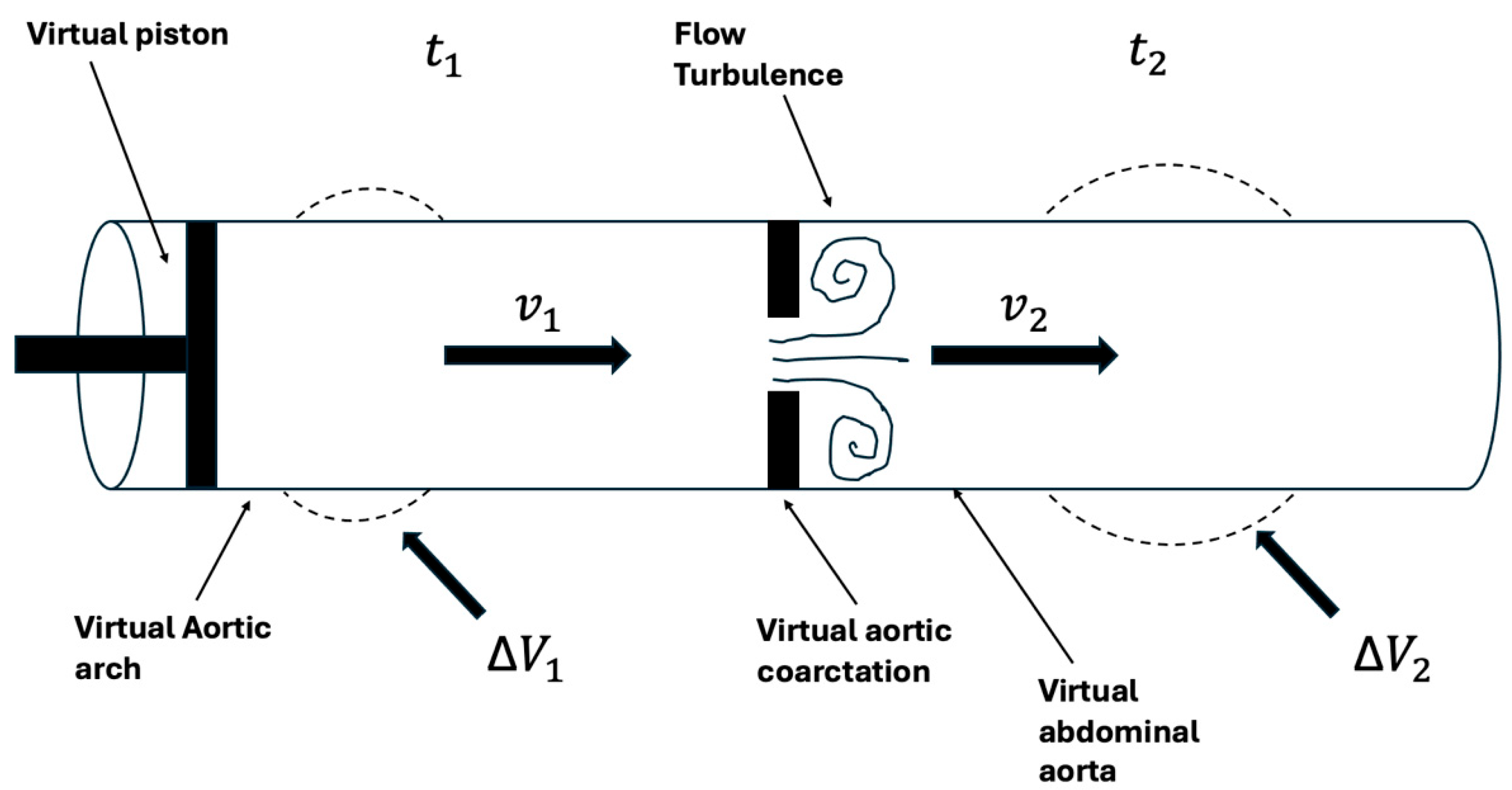
The pre- and post-coarctation aortic segments are represented as compliant elastic compartments. Left ventricular ejection is schematically represented by a piston generating a propagating pressure wave (ΔV1).
Assuming conservation of total mechanical energy between the initial (t
i) and final (t
f) propagation states:
where Ei and E
f represent the initial and final total mechanical energy states, respectively.
According to the schematic representation shown in
Figure 1, the initial phase of pulse wave propagation may be approximated as an elastic reservoir accumulating mechanical work L
1, which corresponds to the initial energy state E
i:
The energy that is accumulated as work in the initial phase L1 is expressed as (for conceptual simplification, the pressure–volume work was approximated using the mean distending pressure over the considered volume excursion):
The energy accumulated as work in the initial phase L1 represents the area under the pressure–volume curve. Applying the Mean Value Theorem, we express this integration as the product of the mean distending pressure (Δp1) and the volume change (ΔV1):
L1 = p1V1 (where p1 represents the mean proximal distending pressure and V1 the corresponding volume displacement) in integral form L1 = .
L
1 is transformed, thanks to the elastic properties of the pre-coarctation aortic wall, into kinetic energy, and therefore K
1:
Within the simplified model, the stored elastic work is assumed to be converted into kinetic propagation energy across the coarctation segment:
By developing the equation, we obtain
Given that the density is defined as
Substituting into the equation
Dividing all terms by ΔV
1 e ΔV
2 and eliminating the terms that can be simplified, it follows that
So, comparing the velocities pre and post aortic coarctation,
The ratio of speeds can be expressed as
Given that the work L is defined as
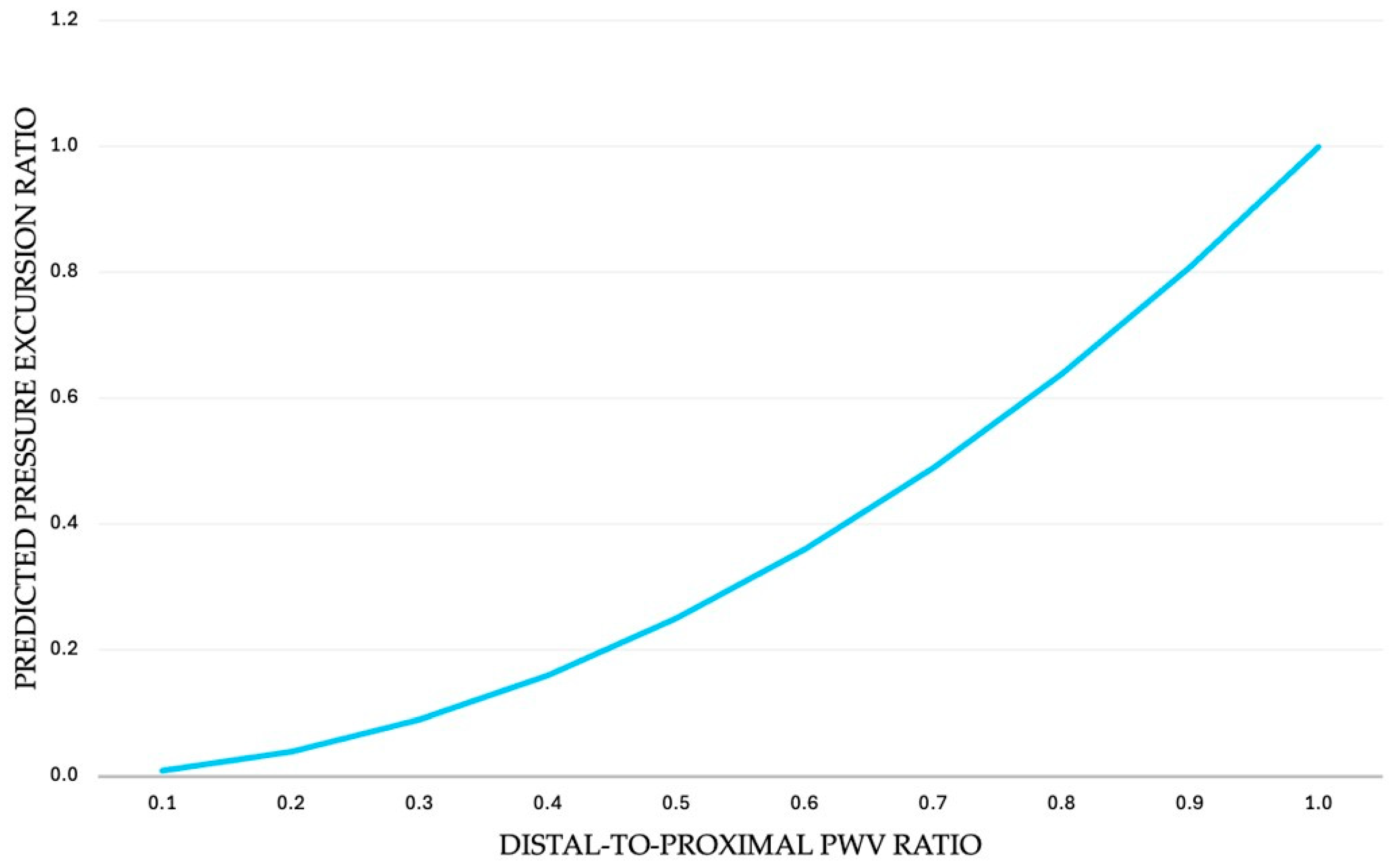
Thus the ratio of velocities as a function of pressure variations is
2.2. Relationship with Classical Arterial Wave Propagation Theory
To assess the physiological consistency of the proposed framework, the derived PWV–pressure relationships were qualitatively compared with the classical Moens–Korteweg formulation for arterial pulse wave propagation.
where h is the thickness of the vessel wall, E the Young’s modulus, ρ the fluid density, and r the vessel radius.
To compare the ratio of the squares of the velocities, we can rewrite the equation:
Solving the equation, we have
The Laplace law for the cylinder can be written as follows:
where τ is the elastic tension and r is the radius of the vessel.
Bringing the equation into τ
Assuming proportional scaling between vessel wall thickness and effective wall tension within the elastic regime, the ratio between wall thickness terms may be approximated by the corresponding tension ratio for conceptual interpretation purposes.
Assuming a linear relationship within the elastic range, wall thickness h is proportional to the wall tension τ (a thicker wall supports proportionally higher tension). Therefore, in the ratio calculation, the ratio of thicknesses h
2/h
1 can be substituted with the ratio of tensions τ
2/τ
1; we see how the previous Moens–Korteweg equation simplifies:
Thus, obtaining the same final equation, supporting the conceptual consistency of the proposed simplified framework,
2.3. Scope of the Model
The present framework was developed as a simplified theoretical approximation intended to explore physiologically plausible relationships between PWV alterations and systolic–diastolic pressure modulation in neonatal CoA. The model was not intended to provide patient-specific quantitative predictions.
4. Discussion
The present simplified framework suggests that alterations in pulse wave velocity may be mechanistically associated with systolic–diastolic pressure modulation in neonatal aortic coarctation. Within the proposed model, reduced distal PWV reflects the combined effects of lower distending pressure and increased effective arterial compliance distal to the coarctation segment. These hemodynamic alterations may contribute to delayed pulse transmission and attenuation of distal pulse amplitude, consistent with previously described physiological observations in CoA [
6,
7,
8,
9].
Pulse wave propagation is strongly influenced by arterial wall elasticity, vascular geometry, and intraluminal pressure conditions. The physiological rationale underlying the present framework is consistent with established principles of arterial wave propagation described by the Moens–Korteweg formulation and related pressure–distensibility relationships [
10].
Previous studies have demonstrated that PWV varies according to arterial stiffness and blood pressure conditions, particularly diastolic pressure levels [
8]. In the setting of neonatal CoA, reduced distal perfusion pressure and altered vascular compliance may therefore plausibly contribute to measurable changes in pulse transit dynamics.
If future clinical validation confirms these theoretical relationships, combined brachio-femoral PWV and pressure-gradient assessment could potentially provide adjunctive physiological information during neonatal cardiovascular screening. Future neonatal screening approaches may benefit from integration of automated PWV-derived parameters with conventional pulse oximetry and pressure-gradient assessment. From a translational perspective, the proposed framework may support future development of non-invasive neonatal monitoring technologies capable of integrating pulse transit analysis with peripheral pressure measurements. Such approaches could theoretically facilitate earlier recognition of hemodynamic abnormalities before overt circulatory compromise develops.
4.1. Limitations
Several limitations should be acknowledged. First, the present framework was intentionally developed as a simplified conceptual approximation and does not incorporate patient-specific vascular geometry or compliance variability. Second, viscous losses, reflected waves, branch vessel effects, and turbulence distal to the stenotic segment were neglected to maintain analytical tractability. Third, the model was not validated against clinical datasets or computational fluid dynamics simulations.
Turbulent flow caused by arterial stenosis can invalidate the ideal conversion of K to L, thereby reducing PWV distal to the aortic coarctation and decreasing the pressure excursion. To simplify the model, the mathematical factor expressing the energy loss converted into heat has been omitted; this loss should be very small but is certainly present. Consequently, the proposed relationships should be interpreted as physiologically plausible theoretical approximations rather than quantitative predictive equations. In addition, the assumptions underlying the Moens–Korteweg equation are known to represent idealized conditions and may not fully capture the complex nonlinear biomechanical behavior of neonatal arteries [
9].
4.2. Future Perspectives
Despite these simplifications, the derived relationships appeared qualitatively consistent with established principles of arterial wave propagation and with previous physiological observations describing delayed distal pulse transmission and altered pulse amplitude in CoA [
6,
7].
The conceptual consistency between the proposed framework and classical arterial wave propagation theory supports the physiological plausibility of the model.
Future investigations should evaluate the proposed framework using neonatal clinical datasets, non-invasive PWV monitoring technologies, and computational hemodynamic simulations. A possible noninvasive method to estimate PWV is to acquire oxygen saturation signals simultaneously from the right upper arm and the foot and calculate the time delay; this provides an indirect measure of PWV. Another approach is to use the pressure signals from the right brachial cuff and the leg cuff and calculate the time delay between the two pressure peaks (for example, by using the first derivative). In this case, calculating the pulse pressure excursion is also easier because the signals are sampled at the same time. Additional studies will also be necessary to determine whether PWV-derived parameters may improve the sensitivity of existing neonatal CoA screening strategies.




 ,
,