Review

Current Trends in Synthesis and Characterization of Biomass-Based Materials for CO2 Capture

by
Sabina Alexandra Nicolae
National Institute of Materials Physics, Atomistilor Str. 405 A, 077125 Magurele, Romania
Biomass 2025, 5(4), 70; https://doi.org/10.3390/biomass5040070
Submission received: 4 September 2025 / Revised: 13 October 2025 / Accepted: 22 October 2025 / Published: 4 November 2025

Abstract

Driven by global economic growth and the rapid advancement of emerging technologies, the escalating demand for fossil fuels and hazardous chemicals has intensified, contributing to severe environmental degradation and widespread pollution. Hence, the demand for sustainable, eco-friendly solutions has become more urgent than ever. Since the industrial revolution, the atmospheric concentration of CO2 has been on the rise, with reports suggesting a significant increase by 2080. To overcome this, more and more sustainable materials have been proposed as efficient adsorbents for CO2. Biomass represents a green and sustainable platform for the production of materials with applications in various areas. Considering its non-toxic character, abundance, and low cost, biomass is frequently used as carbon feedstock. This paper focuses on the usage of biomass for the synthesis of efficient CO2 adsorbents. This study addresses the influence of biomass composition on final uptake performance, offering a better insight into the role of each feedstock component in shaping the properties of the final material. In addition, the advantages and disadvantages of the carbon synthesis routes are presented, accompanied by various examples of materials and their performances. Overall, the current work focuses on multiple cases of biomass-derived carbons for CO2 adsorption, covering aspects from synthesis to performance evaluation, while highlighting the current findings and existing challenges.

1. Introduction

Innovative sustainable technologies and renewable energy sources are required to address the current climate crisis, an ongoing problem caused by population growth and economic development. The ever-increasing energy demand relies on fossil fuel combustion, which has a serious impact on our earth [1]. According to the Berkeley Earth Report [2] on global temperatures, the year of 2024 had been the warmest year on Earth since 1850. The data showed that the global mean temperature in 2024 registered an increase, and was 1.62 °C above the average temperature reported in pre-industrial times. High amounts of greenhouse gases are released as a result of anthropogenic activities, including energy production and manufacture industries, transportation, and electricity generation. In 2015, during the Paris Agreement Conference, countries around the world agreed on implementing actions that will keep global warming below 2 °C, slightly higher than the values reported in the pre-industrial era. In this way, many countries announced changes including the elimination of fossil fuels by switching to renewable energy resources [3]. In this regard, biomass has been identified as a promising renewable energy resource worldwide, and biogas production from biomass represents a sustainable solution to the energy crisis. Making use of biogas at industrial scale might help in reducing the amount of wasted biomass as well as greenhouse gases emissions. The use of biogas includes some other advantages, like renewable and economical sources of energy for rural areas or promising resources for soil remediation using biogas plants’ products, such as digestate. The main use of biogas relies on electricity generation, with 17,400 functional biogas plants in the EU. In addition, European countries use biogas as a transportation fuel in the form of purified biogas, equivalent to compressed natural gas [4].
In general, biomass refers to organic materials derived from living or recently living organisms, primarily plants and animals. The main sources of biomass can be wood or wood processing waste (firewood, wood pellets, and chips, and lumber and furniture mill sawdust and waste), agricultural crops and waste materials (corn, soybeans, sugarcane, and food processing residues), biogenic materials in municipal solid waste (paper, cotton, and wool products), and animal manure and human sewage [5]. Owing to its natural origin, carbon stability, low cost, non-toxicity, and abundance, biomass serves as a renewable energy source with applications across various sectors, including heat and electricity generation, transportation fuels, and as a feedstock for chemical production [6]. According to the 2023 Union Bioenergy Sustainability Report, biomass constitutes the predominant source of renewable energy within the European Union, comprising 59% of renewable energy consumption in 2021 [7].
Biomass can be converted into high-value carbonaceous, charcoal-like materials via different techniques, such as pyrolysis, hydrothermal carbonization, gasification, combustion, torrefaction, and calcination [8]. These processes may be preceded by activation strategies, either chemical activation, using potassium hydroxide (KOH), sodium hydroxide (NaOH), or acidic activators such as phosphoric acid (H3PO4), or physical activation, in order to develop the carbon structure and create porosity [9]. Additionally, materials obtained via hydrothermal carbonization can be tuned directly during the HTC step by means of templating materials, which act as porosity-directing agents. In the case of materials obtained in the absence of templates, the structure of the pristine carbon sample can be further improved by subsequent thermal treatment (post-HTC carbonization), to ensure pore development and removal of impurities, or by subsequent activation [10].
Biomass-derived materials (biochar or hydrochar) have gained a lot of attention due to their sustainable character, as well as their versatile structure, which can be modified accordingly in order to fit a large range of applications, including energy storage and conversion (fuel cells, solar cells, and supercapacitors) [5], catalysis (electrocatalytic water-splitting devices and oxygen reduction reaction) [11], and gas capture (greenhouse gas adsorption) [12].
Carbon dioxide (CO2) is a greenhouse gas and one of the main contributors to global warming. More precisely, it was reported that the atmospheric concentration of CO2 increased by 45%, from 280 ppm in 1750 to 415 ppm in 2019 [13]. The global emissions of greenhouse gases were grouped by their emission sector in a report published by Our World in Data [3]. According to this report, the main greenhouse gas source is represented by the energy sector, including electricity, heat, and transportation, making up a total of 73.2%, followed by agriculture, forestry and land use at 18.4%, direct industrial processes at 5.2%, and waste at only 3.2%. CO2 emissions are on the rise and projections suggest that the atmospheric concentration of CO2 could reach 500 ppm by 2050, increasing up to 800 ppm by 2100 [14]. The emissions are a cumulative result from anthropogenic and natural sources. Generally, the CO2 generated by natural sources, such as respiration, volcanic eruptions, ocean release, or biomass burning, are part of the Earth’s carbon cycle and are naturally balanced. In contrast, for the human-made emissions, fossil fuel combustion, deforestation, agriculture, and waste management are the main suppliers of this gas in the atmosphere (Figure 1).
Over the years, numerous international efforts tackled the CO2 atmospheric emissions by proposing strategies based on reducing/eliminating the greenhouse effect, air and water depollution, and clean and sustainable energy production. First attempts date from 1992 with Agenda 21, followed by the Kyoto Protocol (1997), Bali Road Map (2007), Copenhagen Accord (2009), Paris Agreement (2015), European Green Deal and UK, Japan, Korea and US 2050 Net Zero (2019), and China 2060 Net Zero (2020) [15].
The conventional removal of CO2 using amine-based solutions suffers from some challenges, like high energy requirement (regeneration energy), solvent degradation, corrosion issues, emission of volatile compounds, and high operating costs [14].
Carbon-rich materials derived from natural biomass sources have emerged as a sustainable and low-cost alternative to the traditional carbon capture materials. CO2 is captured via physisorption, where the gas adheres to the surface and pores via van der Waals forces. If the surface is functionalized, the sorption capacity can be improved, opening up the possibility of forming chemical bonds and trapping the gas via chemisorption. Other advantages of these materials include their low cost, carbon-negative potential, tunable properties, and reusability. Numerous studies have focused their interest on the development of biomass sorbents for CO2 capture [16,17,18].
This mini review intends to provide a short overview of the recent studies published on the synthesis and characterization of carbon materials sourced from biomass feedstock and discuss their performance regarding CO2 adsorption, underlining the challenges and benefits in using biomass as a carbon precursor. It targets the critical analysis and exposure of the recent findings on the aforementioned topic, highlighting the best biomass sources for the synthesis of carbon-rich materials with exceptional performance in CO2 removal.

2. Biomass

In the context of energy and environmental science, biomass refers to organic materials derived from plants, animals, or even humans, that can be processed as a renewable resource for energy via combustion or biochemical conversion processes. It can be classified as raw biomass, including lignocelluloses, harvests, and plants, and waste biomass, referring mainly to industrial solid waste, wastewater, and agricultural waste [19,20].
Biomass consists of cellulose, hemicellulose, lignin, starch, minor organic components, and ash, with a chemical composition based on carbon, oxygen, hydrogen, and nitrogen, with trace amounts of sulfur, magnesium, and calcium [21]. The biomass composition represents an important feature for targeted applications, influencing parameters such as conversion efficiency, carbon yield, and material structure and properties. In general, the precursors with the smallest ash contribution, including wood and nut shells, are the most promising for obtaining carbon-rich materials with fine structures. In particular, it has been observed that the presence of cellulose and lignin has a beneficial impact on CO2 adsorption. Cellulosic biomass can form highly fibrous and porous structures, with high surface area and abundant microporosity, due to its structure and chemical composition which consists of linear chains of glucose. Lignin possesses a high carbon content together with a complex aromatic structure, which results in thermally stable carbon materials, excellent for long-term CO2 adsorption. Moreover, lignin contains oxygenated functional groups (methoxy, hydroxyl, and carbonyl) which enhances the CO2 capture via polar interactions, especially if they are preserved or tailored during activation. Along with cellulose and lignin, hemicellulose and starch are also present in the biomass. These two components can have both a negative and a positive impact. Too much starch and/or hemicellulose can lead to weak, non-stable carbons, not efficient in long-term adsorption experiments. An additional improvement is brought by the presence of proteins, which decompose at around 240–400 °C and release gases, NH3, HCN, and other nitrogen-containing compounds, which can lead to the formation of nitrogen-doped carbon materials decorated with pyridinic-N and/or pyrrolic-N functionalities, enhancing the CO2 adsorption via acid–base interactions. Even though the carbon yield and the porosity obtained from protein-based biomasses are not great, the surface chemistry of these materials is perfect for CO2 capture. On the downside, the presence of lipids and ash is challenging for the synthesis of efficient adsorbents for CO2; lipids decompose into tars, heavy oils, and volatile gases, and as a result less solid carbon is obtained. Additionally, the byproducts can block the pores and reduce the available surface area. On the same note, the inorganic residue after burning biomass (ash) can clog the pores and/or block the access to internal adsorption active sites. Moreover, the silica (SiO2), and traces of Ca, Mg, and K, in the ash can catalyze some carbon reactions during pyrolysis, which will result in the degradation of the carbon structure by destroying its microporosity. The materials derived from high ash-containing biomasses are characterized by less uniform pore formation and mechanical weakness, given that the ash has high melting points and remains solid during thermal treatment, interfering with the carbon formation and structure development [22,23].
Consequently, the selection of the precursor is a critical factor in the future performance of the synthesized materials, particularly in the context of carbon capture.

2.1. Types of Biomasses for CO2 Adsorption

Source materials, such as coal, petroleum pitch, synthetic polymers (polyacrylonitrile, phenolic resins, polyethylene, and polypropylene), and inorganic carbon sources (CO2 or CH4) traditionally used in the production of carbon are less sustainable, come with environmental drawbacks like high carbon emissions and pollution, involve energy-intensive processes, present high costs, toxicity, hazardous working conditions, and lower versatility [24]. Considering all of these, biomass-based feedstock represents a reasonable choice for the synthesis of adsorbents aimed at CO2 removal. The main types of biomasses used for the preparation of CO2 adsorbents are agricultural, forestry, and food waste, due to their high carbon content—high in cellulose, hemicellulose, and lignin—providing a good framework for carbonization and activation. Other sources include aquatic biomass (algae and seaweed) due to their high nitrogen proportions, animal-based biomass (eggshells, bones, and fish scales) when carbon composites are targeted, or industrial byproducts (paper mill sludge and palm oil waste) [25]. Negro et al. [26] used Sirora pistachio shells to prepare activated carbon adsorbents. The resulting materials showed a maximum adsorption capacity of 2.17 mmol/g and high stability after four adsorption cycles. The authors tested various CO2 concentrations, and it was observed that the adsorption capacity increases by increasing the gas concentration. Corn cob, as a starting material, was also recently mentioned [27,28]. The resulting materials showed high textural properties, 1017.963 m2/g, with a maximum adsorption capacity of 1.52 mmol/g in standard conditions of temperature and pressure (STP) [27]. Yang et al. [29] reported CO2 adsorption of 7.62 mmol/g in STP on carbon materials derived from chitosan. The materials were characterized by high porosity, 1555 m2/g, and large pore volume (0.67 cm3/g). Other biomass-based sources include lotus petiole [30], coconut shell [31], ginger [32], real plastic waste and agricultural sewage sludge [33], tobacco stem powder [34], sugarcane bagasse [35,36], palm date seeds [37,38,39], and winged beans [40]. More examples of possible biomass sources and their performance in CO2 removal are listed in Table 1.

2.2. Synthesis of Porous Adsorbents from Biomass

The synthesis of porous carbon materials derived from biomass has been intensively studied and reported in numerous studies [6,40,55,56]. The most common procedure is biomass pyrolysis, a chemical process in which the starting material is heated in the absence of oxygen so that it can be thermally decomposed into small molecules. Generally, the biomass is heated to between 300 and 900 °C, and as the temperature rises the chemical bonds in the material break down, producing biochar (solid carbon-rich material), bio-oil (liquid fuel) and syngas (CH4, CO, and H2). The biomass pre-treatment involves washing and drying to ensure the complete removal of impurities and moisture. Usually, biochar has a nonporous structure and underdeveloped properties, needed for future applications; therefore, subsequent treatments are often applied to enhance its material properties. Activation strategies have emerged as efficient and rapid solutions for porosity development. Biochar activation can be achieved with KOH, NaOH, and H3PO4 (chemical activation) or via physical activation using acidic gases.
The reaction between KOH and C starts by solid–solid interaction, followed by the solid–liquid reaction, which may reduce the potassium compounds to metallic potassium and oxidize carbon to carbon oxides and carbonates, accompanied by the formation of various active intermediates. KOH is entirely consumed when the mixture is heated to around 600 °C. When the activation takes place at higher temperatures (>700 °C), the K2CO3, formed previously, starts to decompose into CO2 and K2O. Furthermore, the K2O is reduced to metallic potassium, which can remain embedded in the C matrix, resulting in the expansion of the carbon framework. Post-activation, the solid is washed, ensuring the removal of all potassium forms, leaving behind high microporosity. Plus, the carbon content is increased, due to aromatization and formation of carbon basal planes, with increasing temperature [57,58,59]. Some studies [60,61] reported that the utilization of eutectic mixtures at high carbonization temperatures can help form hierarchically meso and microporous structures due to the incorporation of the metallic species into the carbon lattice. The chemical activation of carbon with H3PO4 usually takes place via the chemical reactions that take place during carbonization, after impregnating the carbon structure with the acid. The acid has multiple effects on the carbon structure: it acts as a dehydrating agent, promoting the removal of water and volatile compounds; helps break down hemicellulose, cellulose, and lignin, acting as a catalyst; and helps maintain the porous structure, creating phosphate and polyphosphate linkages. All these effects contribute to a well-developed porous structure with high surface area [62].
Physical activation, also called thermal activation, is achieved with CO2 and involves two steps: carbonization and activation. Firstly, the carbon source is heated in an inert atmosphere, up to 800 °C, to form the carbon-rich biochar, and in the second step the biochar is heated at elevated temperatures (800–1000 °C) in CO2 atmosphere. In the second step, the gas reacts with the char via gasification reaction and releases carbon monoxide. This reaction is endothermic and helps enlarge the pores and increase surface area by selectively removing disordered carbon. From a mechanistic point of view, the CO2 etches the carbon structure at defect sites, developing micropores (<2 nm) and acting as a milder activating agent compared to steam, offering more control over pore size distribution and structure [63,64].
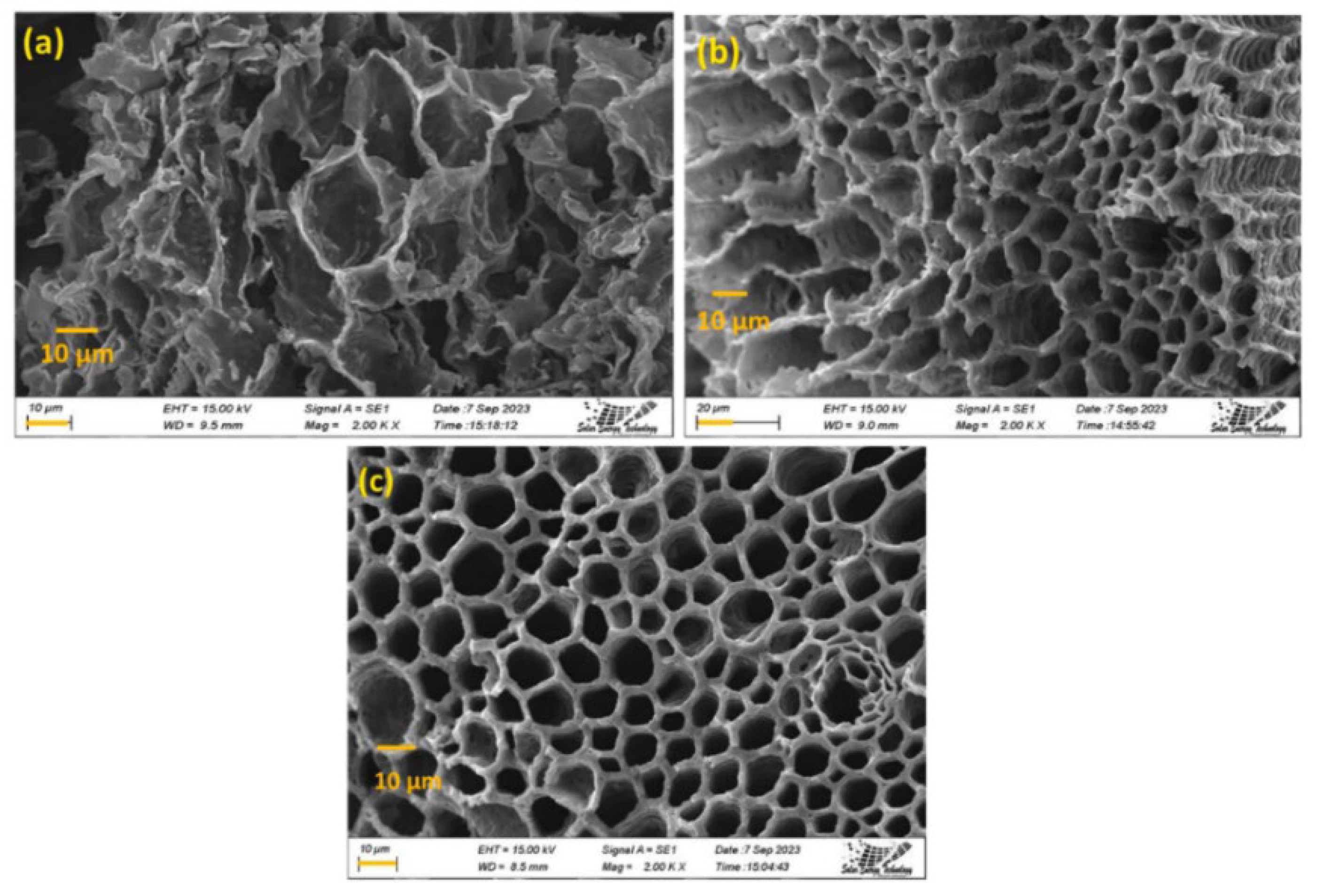
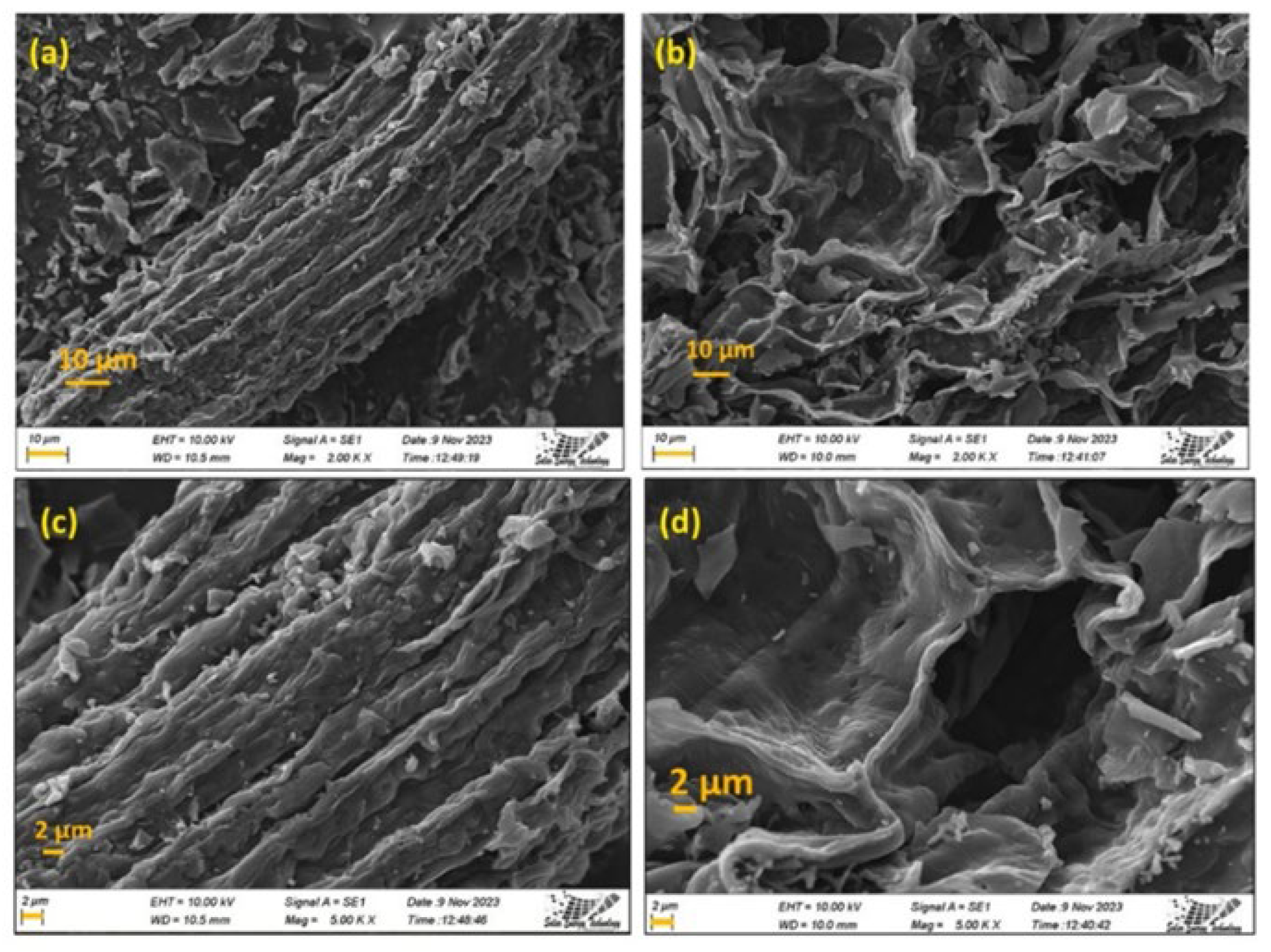
Negro et al. [26] reported the synthesis of activated carbon materials both by chemical activation with KOH and physical activation with CO2. The results showed a higher porosity for the KOH-activated material at 531 m2/g, compared with only 340 m2/g for the CO2-activated sample. As a result, the CO2 uptake is higher when porosity is better. Tahsin et al. [27] reported that mixing salt and carbon in the solid phase leads to better-developed textural properties compared to mixing them in the liquid phase. Microscopic analysis showed the presence of porous cavities with greater order and organization in MAC-2 (the solid-phase sample, Figure 2c) than in MAC-1 (Figure 2b). MAC-2 exhibited a surface area of 1017.963 m2/g and a total pore volume of 0.34 cm3/g [27]. Interestingly, the authors studied the morphology change during CO2 adsorption, and Figure 3 shows the material after 20 min of adsorption and desorption. The morphology is clearly affected by the interaction with CO2. Liu et al. [65] proposed the efficient synthesis of CO2 adsorbents, starting from distilled spent grains, by pyrolysis and chemical activation with K2CO3. It was observed that the material’s performance regarding CO2 removal was significantly influenced by the amount of activator and the activation temperature. The authors obtained as much as 5.2 mmol/g CO2 adsorption, in normal conditions of temperature and pressure, for a moderate K2CO3 mixing ratio and 700 °C carbonization temperature. This value slightly improved, reaching 5.76 mmol/g, due to nitrogen doping, underlining the importance of nitrogen functionalities within the carbon structure. The choice of K2CO3 rather than KOH was based on the less corrosive and more eco-friendly character of the first one compared to the second one. More examples of materials synthesized via pyrolysis and subsequent activation methods are gathered in Table 2.
Besides pyrolysis, biomass can be transformed into carbon-rich materials using hydrothermal carbonization (HTC). During HTC, biomass is converted to hydrochar, together with a liquid phase (organic compounds, nutrients, and acids) and a gaseous phase (CO2, minor amounts of CO, and CH4) as byproducts. This strategy operates in water, at temperatures between 180 and 250 °C and pressure range 2–10 MPa, and is suitable for high-moisture biomass. The advantages over pyrolysis include usage of wet biomass (no need for prior drying step), the need for lower energy input, the production of useful hydrochar, and the recovery of nutrients from process water. The scale-up and economic viability of this process remain under evaluation and represent the primary challenges to its practical implementation. The hydrochar is nonporous, similar to the solid result after pyrolysis. In this regard, subsequent activations steps (chemical or physical) need to be employed. For example, Xue et al. [34] reported the synthesis of highly porous carbon materials derived from tobacco steam powder synthesized via HTC (200 °C, 6 h) followed by subsequent chemical activation with KOH. The materials showed an important affinity towards CO2 uptake, retaining 5.59 mmol/g of gas in normal conditions of temperature and pressure. The activation step takes place after HTC, similarly to the activation after pyrolysis.
Besides activation strategies, porosity can be achieved by the usage of some template materials, for example, block copolymers as in soft template or silica for the hard template methodology. In the case of soft templating strategy, the pores are formed and organized around the micelles generated by the template surfactant. After thermal treatment, the template is removed by decomposition, leaving behind the porous carbon structure. In the hard templating strategy a porous rigid material, such as silica, zeolites, or metal oxide, is used as a mold and the carbon infiltrates into the template. Once the hard template is chemically removed, the negative replica of the template’s structure is obtained. Both strategies present advantages, for example, high precision in controlling pore size, shape, and the order of the pores, with a resulting high surface area and tailored functionalities in the case of hard template. Soft template strategy is simpler and more scalable, resulting in mesoporous materials. It is suitable for low-temperature processes, but on the negative side, it can be less precise in controlling the pore’s architecture compared with the hard template strategy. On the other hand, hard template strategy is less environmentally friendly, because of hazardous chemicals employed in the template etching step, and is also pricier. Zhu et al. [67] used calcium carbonate as a template in the synthesis of mesoporous carbon, starting from lignin. The materials were synthesized in a paste-based aqueous solution, followed by drying, carbonization, and acid etching for template removal. The data showed the formation of highly porous materials, reaching as much as 837 m2/g in surface area. The textural properties were enhanced by a synergistic effect between the hard template and physical activation, with CO2 gas resulteding from the pyrolysis of the CaCO3 template as a byproduct. Liu et al. [68] proposed the synthesis of hierarchically porous carbon frameworks using polyvinylpyrrolidone and silicium dioxide as templates. The resulting powders were treated at high temperature in Ar atmosphere, followed by HCl etching. The final samples were highly porous, with a surface area of 832 m2/g. Zheng et al. [69] reported on the preparation of porous carbons from batatas biomass and the use of soft templates with Pluronic F127 via HTC. After the HTC, the dark solid was collected by filtration and further processed towards carbonization and template removal. The final material was characterized by moderate porosity, reaching a maximum of 286 m2/g. Soft template carbons with considerable porosity have been synthesized from glucose and Pluronic P123 [70]. The specific surface area reached a maximum of 1258 m2/g at the highest carbonization temperature used in the study (900 °C). Hou et al. [71] reported surface areas between 145 and 445 m2/g for hard-templated carbons derived from rice husk and silica—hard template. A combined process of crosslinking sodium alginate by CaCO3—hard template was proposed by Qin et al. [72]. The specific surface areas obtained in the study were above 1000 m2/g, reaching a maximum of 1297 m2/g.
Generally, the synthesis of carbon materials faces some challenges regarding the chemical composition, structure, and morphology, and the overall process might be considered tedious. However, based on the above, it can be observed that by employing the correct strategy, the challenges can be overcome and the structure and morphology of the final material may be easily tailored. Moreover, the impressive abundance and variety of the carbon sources, together with the flexibility of the synthesis strategies, promote carbon materials for a wide range of applications.

2.3. Characterization of Biomass-Based Adsorbents

The chemical, physical, and textural properties of biomass-derived carbon adsorbents are investigated using various characterization techniques to gain comprehensive insights into their structural and functional attributes. For example, Brunauer–Emmett–Teller (BET) analysis is used for the determination of specific surface area and porosity. For the pore size distribution of mesopores, the BJH method (Barrett–Joyner–Halenda) is effective, while for micropores, t-plot or Dubinin–Radushkevich (DR) models are used. In practice, the porosity determination and calculations rely on using nitrogen adsorption–desorption isotherms. Further analyses on texture and surface morphology are performed via SEM (scanning electron microscopy) and TEM (transmission electron microscopy) analyses. While on SEM micrographs one can visualize surface morphology and details on the texture, TEM reveals internal microstructures and fine details at the nanoscale. The crystallinity and the presence of graphitic domains can be determined via XRD (X-ray diffraction), while the surface chemistry can be resolved via FTIR (Fourier transform infrared spectroscopy). XPS (X-ray photoelectron spectroscopy) measurements are used for studying the surface elemental composition and chemical states determination. Using Boehm titration and a pH-point of zero charge (pH-PZC), the acidic and basic sites can be quantified, and the pH at which the surface charge is neutral can be determined. Additionally, thermal stability and composition can be evaluated via TGA (thermogravimetric analysis), CHNS elemental analysis is used to evaluate the carbon, hydrogen, nitrogen, and sulfur content, and, finally, the moisture, volatile matter, ash, and fixed carbon content are obtained via proximate analysis. The adsorption behavior is assessed by gas adsorption isotherms, iodine number, and methylene blue adsorption.
In particular, for CO2 adsorption, the carbon materials need to be characterized by a series of specific features, such as high surface area (>500 m2/g, to provide more active sites for adsorption); optimized pore structure—the presence of micropores (<2 nm, crucial for CO2 due to similar size scale—0.33 nm—kinetic diameter of CO2); narrow ultra-micropores (<0.7 nm), especially effective at ambient and sub-ambient pressures; surface functional groups—to enhance the CO2 uptake via acid–base interactions; CO2 affinity and selectivity; thermal and chemical stability—for cyclic adsorption–desorption processes; recyclability—should retain its capacity over multiple adsorption–desorption cycles with minimal degradation, low production cost, and sustainability.
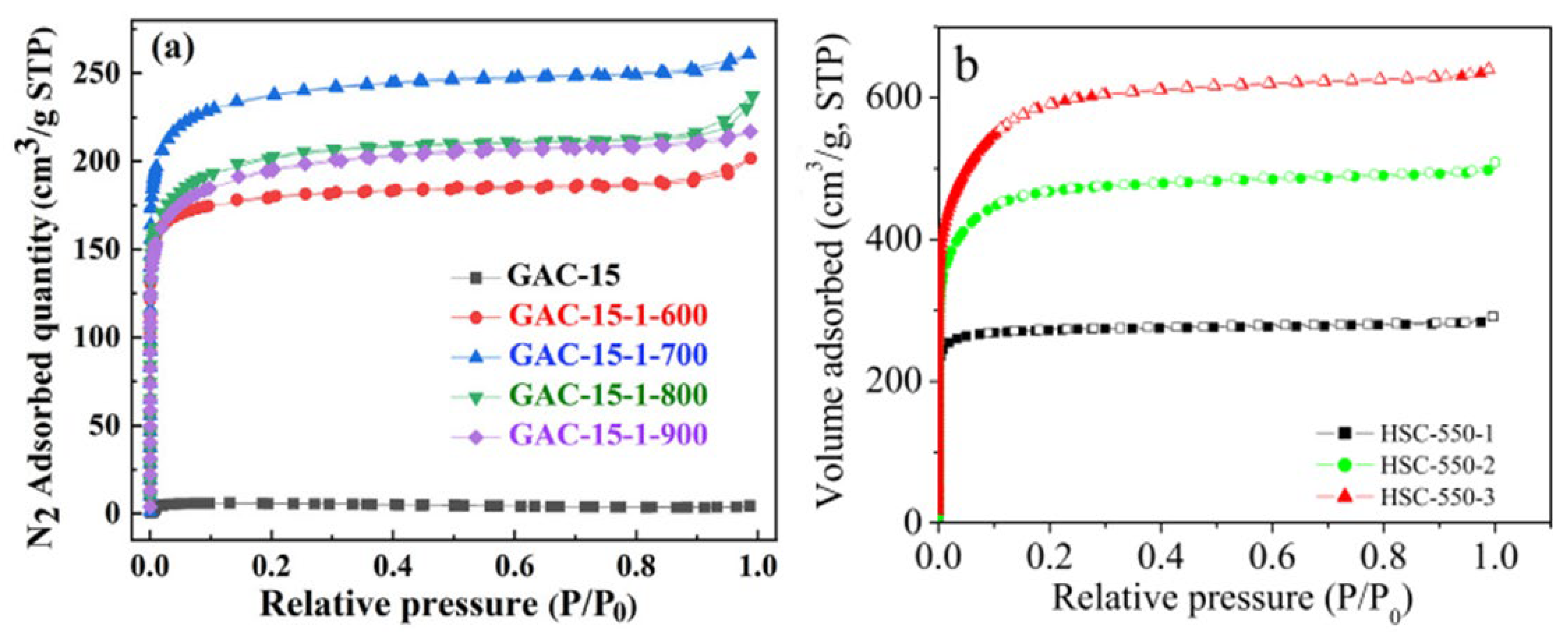
Generally, the specific surface area is calculated using a mathematical model (BET equation) from the measured isotherms and it is reported in square meters over grams (m2/g). According to IUPAC classifications, the shape of the isotherm can provide information about the size and form of the existing pores. As mentioned before, for the gas capture applications, microporous materials are ideal and this type of porosity is described by the type I or Langmuir isotherm, in which desorption often overlaps adsorption due to the lack of capillary condensation which typically happens in mesopores. In this case, most of the adsorption occurs in the low-pressure range as a monolayer, followed by a plateau. At higher pressures, no significant increase in adsorption occurs because the adsorption sites are already saturated.
Zhang et al. [41] studied the synthesis of activated carbon from pistachio shells via chemical activation, obtaining a micropore surface area between 286 and 412 m2/g. The isotherms followed the shape of the Langmuir model, characterized by a microporous structure (Figure 4a). Liu et al. [73] reported the synthesis of carbon-based adsorbents from hazelnut shell biomass and chemical activation. The authors reported the formation of microporous materials, described by the Langmuir isotherm, as shown in Figure 4b. Many reports linked CO2 adsorption performance with porosity, especially with the presence of micropores. In the case of GAC-15-2-700, the CO2 uptake reached 3.56 mmol/g, compared to GAC-15-1-700, which only retained 1.43 mmol/g in the same conditions. This difference is due to the larger number of activators used in the case of GAC-15-2-700. The amount of KOH was doubled in this case, and it expanded the porosity, leading to the formation of a higher number of micropores, also observed from porosity measurements. The reported micropore volume of GAC-15-2-700 was double that of GAC-15-1-700 [41]. Hanif et al. [74] reported the same findings on carbon adsorbents derived from Albizia procera leaves chemically activated with NaHCO3. The maximum CO2 uptake for this study was 2.53 mol/kg, and the authors observed a positive correlation of the adsorption behavior with the surface area and pore volume. It has been largely agreed that the main parameter controlling the adsorption capacity and selectivity towards CO2 is the presence of micropores, especially at low partial pressures and ambient temperatures. In these conditions, the gas adsorption depends on short-term, non-specific interactions between the gas and the adsorbent. In contrast, at higher pressures, surface coverage becomes the main factor, so the presence of wider pores is required [75]. For example, the CO2 adsorption capacity of CKC-900-4 (3.63 mmol/g) is larger than that of CKC-900-3 (2.95 mmol/g), and this is due to the key factors present in CKC-900-4, such as the abundancy of ultra-micropores (<0.7 nm) with narrow distribution of pore size, as well as high oxygen functionalities. A further increase in the number of activators in CKC-900-5 (2.59 mmol/g) results in a decrease in CO2 uptake as a result of a broader pore size distribution and a decrease in oxygen functionalities. Overall, the CO2 uptake was enhanced by a synergistic relationship between high surface area, the presence of ultra-micropores, pore size distribution, and oxygen functionalities [76]. Although most studies report a strong correlation between CO2 capture and porosity characteristics, some authors have noted cases where no clear relationship exists between high surface area or a large number of micropores and adsorption performance. For example, HSC-550-1 (4.32 mmol/g) exhibits superior CO2 uptake compared to HSC-500-2 (3.50 mmol/g) and HSC-500-3 (3.48 mmol/g), even if among the three samples it has the lowest micropore volume. These values indicate that additional, often overlooked variables play a significant role in influencing adsorption performance. For example, it has been observed that smaller pore size and narrower distribution of the pores could lead to a superior adsorption capacity [73]. Similar findings were reported by Li et al. [77], who observed that the best-performing sample was characterized by the second-best volume of narrow micropores. Additionally, it was reported that the carbon sample had a wider distribution of pores and larger pore size, enhancing the adsorptive properties regarding the selected gas. Other reports [78] emphasized the idea that not only a large volume of narrow micropores, but also the contribution of heteroatoms such as N and S, can have a positive impact on the material’s performance in CO2 removal. For a better view of how porosity can impact CO2 uptake, more examples of materials are listed in Table 2.
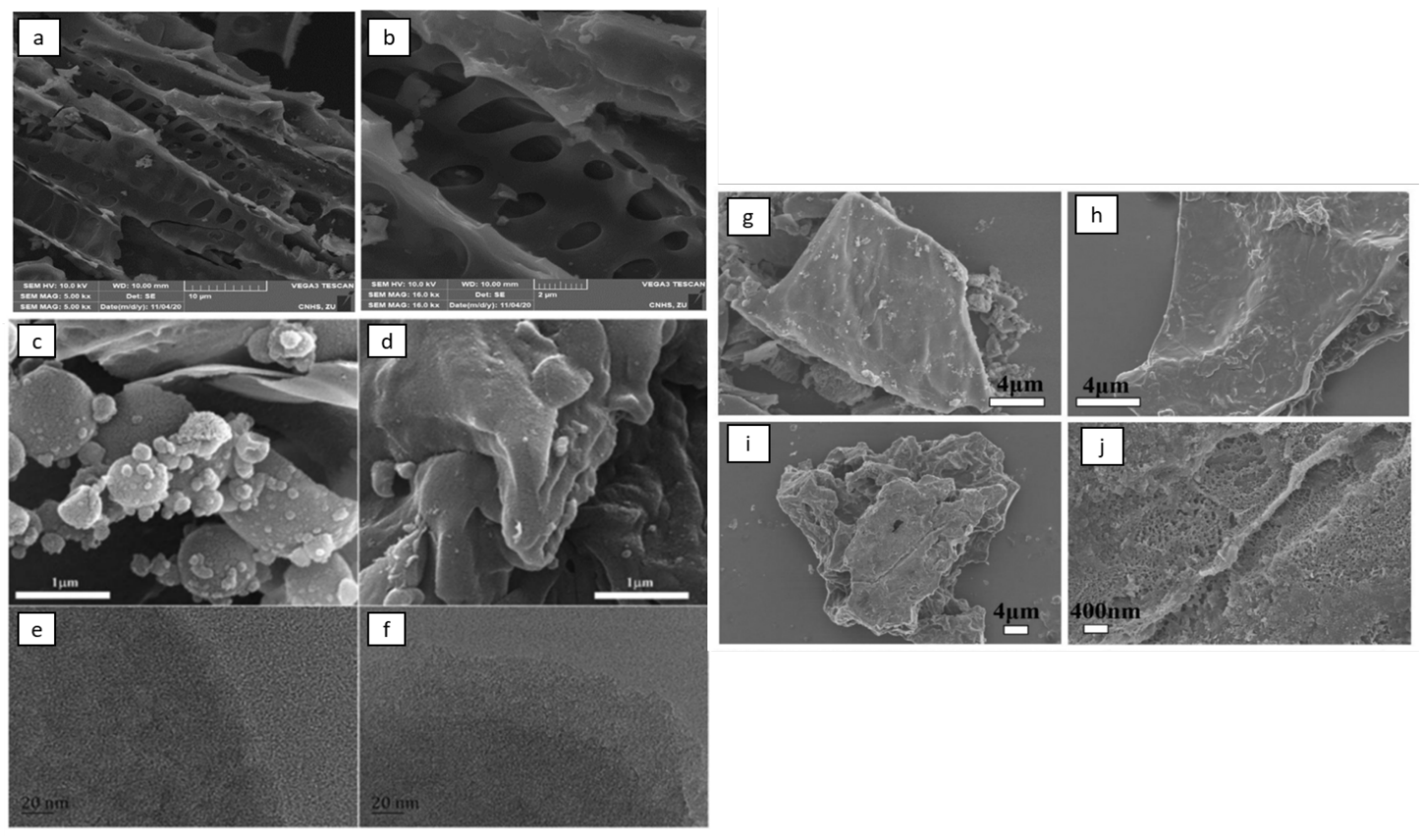
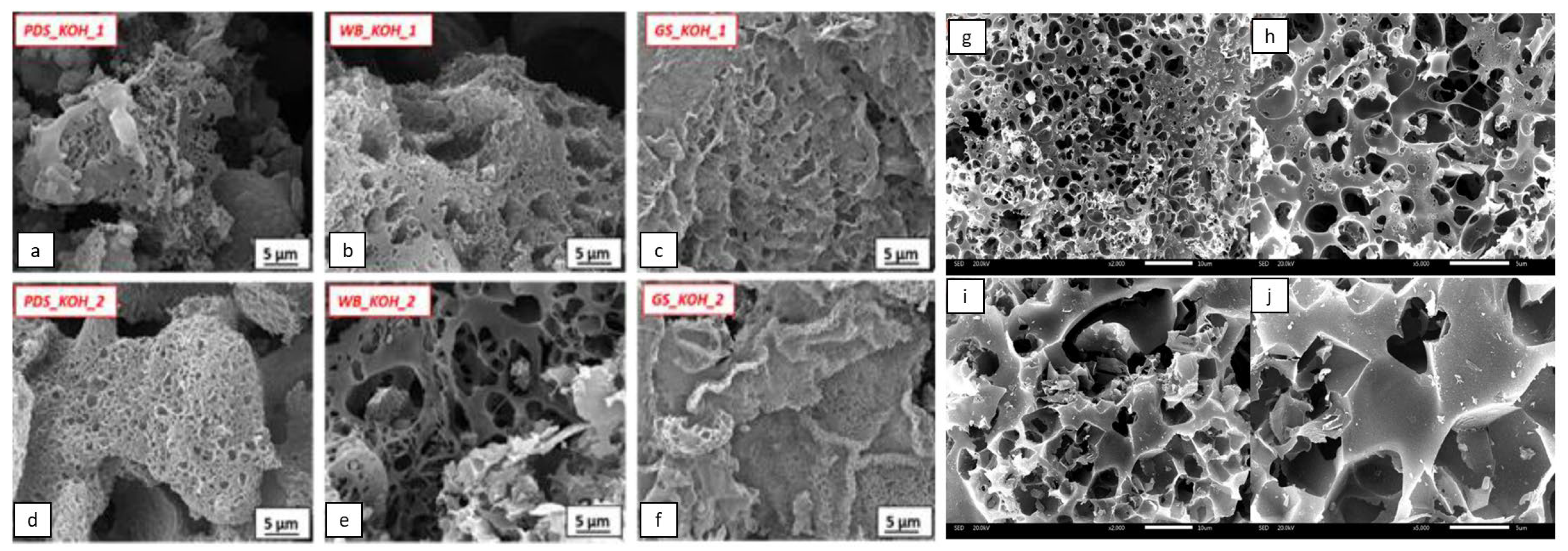
In terms of morphology, carbon-based adsorbents are highly influenced by the feedstock. Biomass is highly heterogeneous, and it can direct the carbon structure via a template effect or through decomposition behavior. For example, materials with tubular or channel-like structures can be obtained from wood vessels or plant stems, sheet-like ribbon morphologies can be generated from leaves, and 3D porous sponges or foams can be obtained from cork or coconut shell. Additionally, the volatilization behavior of biomass has an impact on the material’s morphology. Gases, such as CO, CO2, CH4, and H2O, can determine pore formation and/or cracking and fragmentation, leading to the formation of disordered or foam-like morphologies with large surface areas. Moreover, the ash and inorganic content can have both a negative impact by disrupting the carbon surface and creating a rugged morphology and a positive impact by acting as a catalyst or activator for pore formation. Rice husk can lead to the formation of a porous or cracked morphology. Some examples of SEM and TEM micrographs and of carbons reported in the literature are presented in Figure 5 and Figure 6. In general, it is observed that biomass generates irregular structures with porous cavities. In the case of walnut shells [79], seen in Figure 5c–f, the formation of a convex morphology, densely stacked, was observed. The materials have been synthesized via chemical activation and, as a result, TEM images reveal the presence of worm-like, amorphous micropores with sizes smaller than 1 nm.
In addition to the biomass composition, the morphology of the carbon material can be influenced by the activation process. Both physical and chemical activation steps enhance porosity by creating micro and mesopores. Finally, the materials are characterized by flaky, foam-like, or nanostructured morphologies. Figure 6 illustrates the morphologies of carbon materials synthesized via chemical activation, from different biomass sources.
The high-temperature treatment can promote smoother carbon morphologies but can also affect the materials by reducing the porosity if some structures collapse. In general, it has been observed that wood [82,83] or bamboo [84,85] feedstocks create aligned channels or carbon tubes; leaves [74,86] and cellulose [46,87,88] can form thin sheets or a layered morphology; corn cob [28,89] or rice husk [90,91] provide honeycomb structures or cracked porous networks; and carbon nanofibers can be obtained from cotton [92] or silk.
Biomass source has an important influence on the surface chemistry and functional groups of the final adsorbent material. It determines the initial elemental composition and the types of functional groups formed during subsequent thermal treatment [21]. For example, lignocellulosic biomass (wood and straw) forms oxygen-containing groups, like hydroxyl, carboxyl, or carbonyl. These functionalities enhance surface polarity and improve CO2 adsorption via hydrogen bonding and acid–base interactions. Other feedstocks, including algae, manure, and coffee or tea waste, with high contents of proteins, can be very effective in the synthesis of CO2 adsorbents due to their ability to generate nitrogen-containing groups such as amines and pyridinic or quaternary nitrogen, which trap the gas via Lewis acid–base interactions. Moreover, the carbon’s surface chemistry can contain other heteroatoms, not only nitrogen. For example, sulfur and phosphorus-containing groups may introduce polar sites or alter the electronic properties of the surface [93,94]. These heteroatoms are commonly found in sludge [95] or algae [96,97]. The distribution of the functional groups, as well as the ash content and mineral components, determines the surface pH [98]. The pH value plays a crucial role in determining the type of CO2 adsorption. When the surface is acidic (pH < 7), CO2 primarily interacts through physisorption, which is governed by weak, nonspecific interactions. In contrast, under basic conditions (pH > 7), CO2 can be captured via chemisorption, enhancing the gas’s affinity under dry conditions [99].
The characterization of carbon materials derived from diverse biomass sources reveals clear correlations between feedstock composition and surface chemistry. Spectroscopic and analytical techniques such as FTIR, XPS, and elemental analysis consistently show that the type and abundance of functional groups—particularly oxygen-, nitrogen-, sulfur-, and phosphorus-containing moieties—are directly inherited or evolved from the original biomass. These surface functionalities govern critical properties, like surface pH, polarity, and the presence of active sites, which in turn influence CO2 adsorption mechanisms. For instance, materials derived from lignocellulosic biomass typically exhibit oxygenated groups conducive to physisorption, whereas those from protein- and mineral-rich feedstocks show enhanced basicity and heteroatom doping, favoring chemisorption. Thus, comprehensive material characterization not only confirms the chemical transformation during activation but also highlights the role of biomass selection in tuning CO2 capture performance.

3. Mechanisms of CO2 Capture

Current technologies for capturing and separating carbon dioxide include oxy-fuel combustion, pre-combustion, post-combustion, absorption, membrane separation, and adsorption methods.
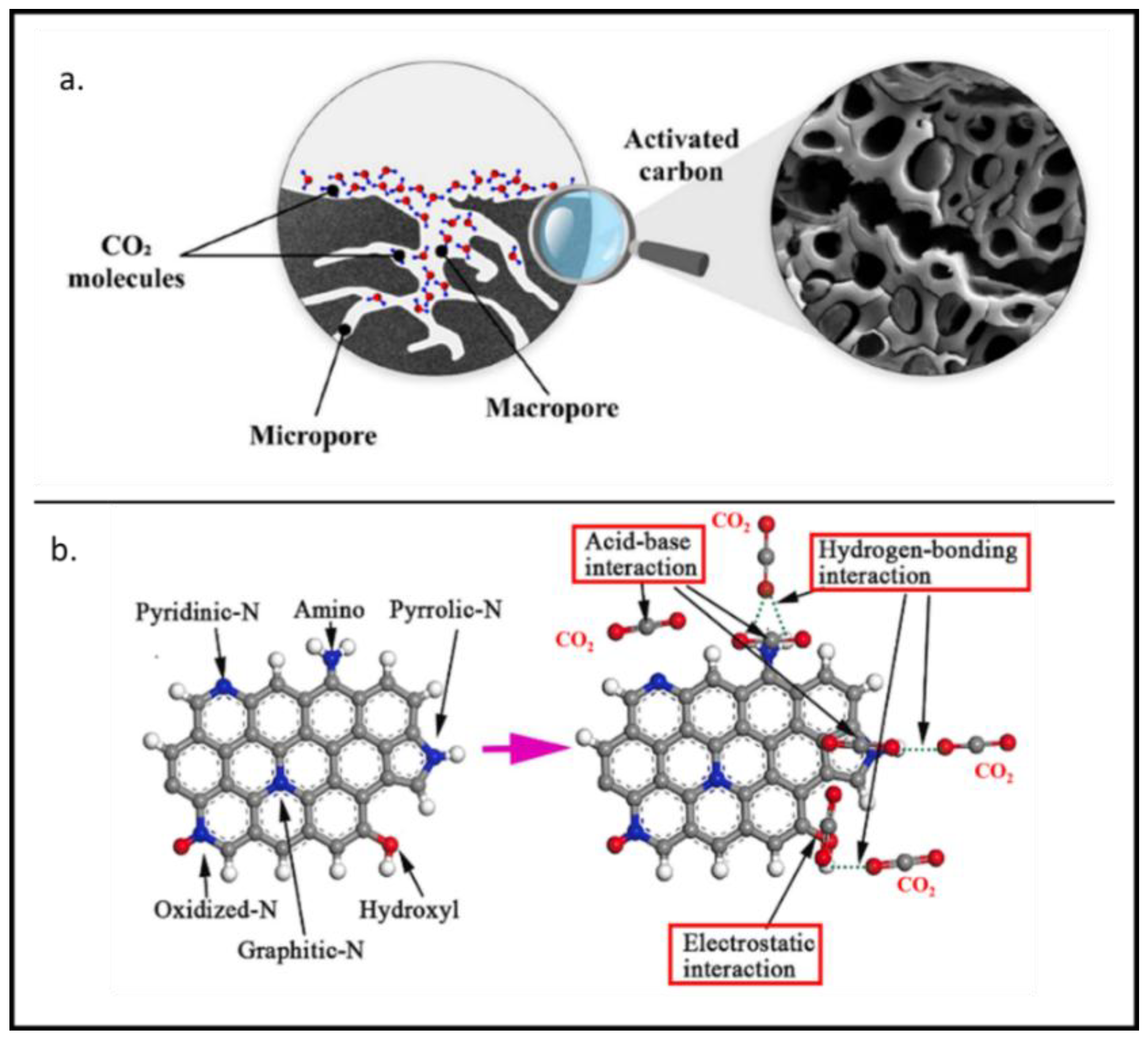
During oxy-fuel combustion, the fuels are burned in an oxygen-rich atmosphere, resulting in the production of flue gas containing CO2 and water vapor. Consequently, the CO2 is removed through the condensation of the water vapor and subsequent separation from other gases. The challenge lies in the separation of oxygen from air to ensure an air-free atmosphere. This step may reduce the overall efficiency of the industrial process [100]. In pre-combustion, the fossil fuels are converted into syngas before combustion via gasification. H2 and CO2 are produced via a gas-shift reaction, with H2 being used as a clean source of fuel and CO2 being separated via pressure swing adsorption or membrane technology. During this process, the gasification requires extra attention and expensive infrastructure [101]. Post-combustion stands as the most commonly used strategy and focuses on removing CO2 from flue gases after combustion. Being intensively used, its infrastructure has been improved, requiring minimal changes before being implemented in different regions of the plant. However, the CO2 concentration in flue gas is low, affecting, in this way, the efficiency of the process. Additional gases or impurities represent a challenge as well [102,103,104]. Removal of CO2 via absorption takes place via CO2 dissolution into a solvent. The absorption can be achieved via physical or chemical interactions. In the case of physical absorption, CO2 dissolves in a liquid based on solubility, without any chemical interactions tacking place. The process generally occurs at high temperature and high pressure, and examples of solvents include water, selexol, and rectisol. During chemical absorption, CO2 reacts with the absorbent, forming new compounds. The gas removal is more efficient in contrast to physical absorption. Chemical absorption is very common in post-combustion carbon capture, and examples of solvents used are aqueous amines and potassium carbonate [102]. The CO2 capture via absorption involves the contacting phase, where the gas comes into contact with the absorbent in an absorption column, followed by the gas–liquid transfer and solubilization or reaction if the removal takes place in a chemical system. Finally, the CO2-rich liquid is heated or depressurized to release the CO2 and regenerate the adsorbent. The CO2 absorption depends on several factors, including temperature and pressure, absorbent type and concertation, contact time, the flow rate of gas and liquid, and the presence of other gases in the mix, or even impurities [104,105]. In contrast, adsorption involves the removal of CO2 via the gas molecule’s adherence to the surface of a solid substrate (adsorbent) [106]. The advantages of the adsorbents include less toxicity, less waste, better yield, and the ability to use them at higher temperatures. In order to enhance the contact with the gas molecules and increase the process performance, the adsorbents used are generally porous materials, with a defined pore size distribution and sometimes with a certain degree of functionalization [17,107]. Same as in the case of absorption, CO2 adsorption can take place via physisorption or chemisorption (Figure 7). During physisorption, weak interactions take place between the gas molecules and the solid surface. These interactions are mainly van der Waals forces (dispersion, dipole–dipole, or dipole-induced–dipole). In some cases, very weak hydrogen bonding may also contribute. The energy demand is minimal, and the process can be reversible. Based on this, removal of CO2 via physical adsorption is preferred over the conventional strategies [108]. Since the process performance is governed by the textural properties of the material, it is very important to design adsorbents with superior porosity features and also take care of the eventual impurities that can compete at the active sites and inhibit CO2 capture. As a different option, the porous adsorbents can be decorated with amine functionalities, which may result in improved efficiency by capturing the CO2 via chemisorption [109,110]. This can improve the uptake in low-pressure ranges and moisture tolerance during the adsorption. During chemical adsorption, specific chemical bonds are formed between CO2 and the solid sorbent, the interaction being specific to each adsorbent. Chemisorption occurs at elevated temperatures and requires activating energy. It is not reversible, and the adsorbent recovery can be challenging. The adsorption mechanism of CO2 on solid porous adsorbents can be described as follows: in the first step, diffusion of CO2 molecules from the gas phase into the porous adsorbent material takes place. The diffusion rate is influenced by the pore size distribution, surface area, and temperature of the system. Surface interaction is the second step; once the CO2 reaches the porous surface, it begins to interact via van der Waals forces and electrostatic interactions, in the case of physisorption, or via chemical bonding formation, if chemisorption is taking place. The adsorbent surface and polarity have important influences during physisorption; as CO2 is a polar molecule with a quadrupole moment, the adsorbent surface can interact with this quadrupole moment via π-π interactions (CO2 can interact with the π electrons of the aromatic carbons or graphene sheets) or dipole-induced–dipole interactions (the CO2 dipole can induce dipole in nearby surface atoms). During chemisorption, the presence of amine groups and/or basic sites (pyridinic, pyrrolic, or graphitic nitrogen) is crucial for process performance. Following surface interactions, the formation of adsorption layers takes place. During physisorption, CO2 molecules tend to form a monolayer or a multilayer, as a function of the adsorbent’s structure and temperature. For chemisorption, the adsorbed molecules often form a monolayer as a result of the stronger nature of the bonds [102,111].
All in all, CO2 capture on carbon-based materials primarily involves physisorption within microporous structures and chemisorption at functionalized sites, with absorption occurring in liquid solvents or hybrid systems. In post-combustion scenarios, adsorption targets dilute CO2 in flue gas via selective binding, while in pre-combustion and oxy-fuel combustion, higher CO2 concentrations and pressures enhance uptake through engineered pore structures and surface functionalities.

4. Performance Evaluation

It has been commonly agreed that porous carbon materials represent an excellent choice for CO2 adsorption applications. To evaluate the carbon-based adsorbents in terms of performance, several parameters are mandatory. In this way, researchers always pay attention to the following aspects: adsorption capacity, selectivity, adsorption kinetics, regeneration efficiency, and energy consumption.
The adsorption capacity is evaluated by the maximum amount of CO2 that can be retained by the carbon adsorbent, and it is highly influenced by the material’s textural properties (surface area and pore volume), temperature and pressure, CO2 concentration, and the interaction between the gas and carbon surface. Equally important is the material’s selectivity towards the selected gas, as generally CO2 is part of a mixture, with N2 in post-combustion, H2 in pre-combustion, O2 in the case of air-purification, and CH4 in biogas upgrading. It has been reported [112] that the selective adsorption of CO2 can take place via different mechanisms, as follows: (i) molecular sieve impact (the uptake is governed by the shape and size of the gas molecule—it is common in the case of zeolites and carbon MOFs adsorbents); (ii) dynamic impact (takes place in materials with mesopores and is strongly influenced by polarizability, magnetic susceptibility, the permanent dipole moment, and the quadrupole moment); (iii) kinetic impact (in this case, the adsorbent’s pore size should be controlled in order to better accommodate the molecule of interest from the mixture; the mechanism is generally used for CO2 and CH4 capture); and (iv) quantum sieve impact (the adsorption is facilitated by the differences in the diffusion speeds of the guest molecules and the compatibility between the pore diameter and the de Broglie wavelength of these materials). In general, studies agree that the selective capture of CO2 can happen via molecular sieve impact, the interaction between CO2 molecules and adsorbent surface, and the combination of these two phenomena. Additionally, when the adsorbent’s kinetic diameter matches the kinetic diameter of CO2, the gas will stay trapped [113]. The material’s performance regarding gas removal is evaluated by adsorption kinetics studies. In the case of CO2 removal, adsorption kinetics define the mechanism of adsorption and also the speed of the process. Generally, the adsorption can take place via physisorption or chemisorption, and the kinetic models can be (i) pseudo-first order (assumes physisorption and is determined by the availability of adsorption sites); (ii) pseudo-second order (fits chemisorption better); (iii) Elovich equation (in the case of heterogeneous structures); and (iv) intraparticle diffusion (considers the diffusion into the pores as a limiting step) [114,115]. Regeneration efficiency or the material’s recyclability describes the ability of a sample to be restored to its initial adsorption capacity after being used, by desorbing the CO2. High-quality adsorbents retain more than 90% efficiency after regeneration, but there are cases when this drops, especially with chemisorption, after 10 or more cycles [116]. Finally, the adsorption process energy consumption needs to be quantified as well. It refers to the amount of energy required to capture, regenerate, and recycle the carbon material in each cycle, and it represents a critical factor for economic and environmental evaluation. The energy consumption is influenced by several factors, including (i) heat capacity of the adsorbent (lower is ideal, as it needs less energy to heat or cool); (ii) working capacity (more gas adsorbed in once cycle results in less energy being required for one cycle); (iii) thermal conductivity (good conductivity can help by decreasing the regeneration time and decreasing energy consumption); (iv) cycle time (longer cycles result in more energy being consumed); and (v) moisture content (if water is adsorbed, degassing and prior cleaning takes longer, and more energy is consumed) [116]. Xiao et al. [113] studied the performance of nitrogen-doped carbon materials regarding CO2 uptake. The materials showed surface areas between 482 and 1209 m2/g, and the maximum adsorption reported was around 4.16 mmol/g, obtained for an intermediate surface area rather than for the largest one. This is due to the fact that the largest surface area was obtained at large carbonization temperatures, and by increasing the heat treatment more gases were released, causing the micropores’ deformation and expansion to larger pores. In order to assess the material’s performance and the adsorption mechanism, the data was fitted using several models, and the results showed the best match with the Redlich–Peterson equation, indicating the micropore filling mechanism by multilayer adsorption involving both physical and chemical interactions. The physical adsorption character was confirmed, as well, by checking the adsorption capacity as a function of temperature. A good linear dependence was observed, with adsorption capacity decreasing with increasing temperatures, due to the fact that part of the CO2 molecules obtained enough energy and could easily desorb from the material’s surface. Further studies of adsorption enthalpy and the isosteric heat of adsorption revealed the combination of chemical and physical interactions. In terms of selectivity, the authors observed a very good affinity of these materials towards CO2 compared to N2, despite the fact that the two gases present similar kinetic diameters. The increased selectivity towards CO2 was promoted by the presence of nitrogen active sites, introduced during synthesis. The recyclability was also studied, and data showed a very good CO2 retention after nine consecutive cycles (4.155 mmol/g~99.9% from initial performance). Similar formalism was reported by Wu et al. [88], who studied carbon materials derived from cow dung for CO2 uptake. The authors obtained a maximum adsorption of 91.8 mg/g, with high selectivity over N2 and good recyclability after ten adsorption–desorption cycles. Chen et al. [117] proposed carbon materials derived from dopamine. The materials showed a maximum adsorption of 3.01 mmol/g, and during the long-term stability and recyclability period it was observed that there was no obvious decrease in the adsorption capacity after six consecutive cycles. Additionally, selectivity studies on N2 showed a higher affinity of the materials for CO2. The isosteric heat of adsorption was evaluated in the range of 21.4–28.4 kJ/mol, much lower as compared to other adsorbents, which implies easier desorption and material regeneration. Nitrogen-doped carbon-based adsorbents, derived from soya chunks, have been studied by Rana et al. [118], with a maximum adsorption of 3.2 mmol/g and high selectivity due to their basic active adsorption sites. Fonseca-Ramirez and co-workers [48] reported on CO2 and CH4 adsorption on cashew nut shell carbons, with 4 mmol/g uptake towards CO2 and only 1.7 mmol/g for CH4, and a selectivity range of 9.1–1.8 for the CO2/CH4 mixture. Additionally, the performance of the carbon-based adsorbents is evaluated in comparison with other adsorbents reported in the literature, including zeolites, metal–organic frameworks (MOFs), polymer-based adsorbents, and amines [119]. For example, Jin et al. [120] reported the rapid synthesis of Ca-modified MOFs for CO2 capture. The authors reported the formation of a micro-mesoporous structure at elevated temperatures (800 °C), beneficial for gas capture. The materials removed CO2 with a capacity of 2.30 mmol/g in standard conditions of temperature and pressure. Studies [121] reported CO2 uptake up to 8 mmol/g in the case of MOF-74, up to 6 mmol/g for MOF-199, 7.5 mmol/g in the case of MOF-177, and between 2.5 and 4 mmol/g in the case of UiO-66. These values are directly corelated with MOFs’ ultra-high surface area, with some achieving 6000 m2/g (MOF-210). In addition, MOFs demonstrated high selectivity for CO2, due to the possibility of incorporating functional groups such as amines, azoles, and hydroxyls. The main challenge for MOFs lies in their sensitivity to moisture and the cost and scale-up challenges [122,123]. Among the solid adsorbents, zeolites have been often mentioned [121,124]. The values for the adsorption capacities for zeolites are between 2.5 and 5 mmol/g with, for example, Zeolite 13X being characterized by the maximum adsorption due to its high surface area (~700 m2/g) and large micropore volume (~0.74 nm) [125]. Other examples of zeolite-based adsorbents include Zeolite 5A, ZSM-5, and SAPO-34. In general, zeolites are popular due to their good thermal and chemical stability, allowing easy regeneration and repeated cycle adsorption. However, on the negative side, they have high hydrophilicity, resulting in competitive water adsorption in humid environments [121]. Al Atrach et al. [119] reported on CO2 uptake on LEV-type zeolite, obtaining 3.30 mmol/g CO2 adsorption at room temperature and a selectivity of 38 over CH4 and 84 over N2. The authors observed that a lower Si/Al ratio and a higher Na+ content is the optimal combination for improved adsorption. Besides MOFs and zeolites, a significant number of publications studied and discussed amine-functionalized cellulose adsorbents [126,127,128]. Wang et al. [129] studied the CO2 adsorption on PEI-impregnated cellulose gels, obtaining a maximum adsorption of 2.31 mmol/g at 25 °C. The authors observed excellent CO2 adsorption–desorption recyclability, which was tested over 10 cycles. Sepahvand et al. [130] obtained 5.2 mmol/g CO2 uptake for phthalimide-modified cellulose nanofibers. In general, the CO2 uptake for amine-modified cellulose varies between 1 and 4 mmol/g with tunable selectivity, but the amines tend to undergo degradation associated with oxidative stability issues. [126]. Covalent organic frameworks (COFs) have been studied for CO2 uptake, with adsorption capacities between 2 and 4 mmol/g, and are characterized by a large surface area (1263 m2/g for COF-18 or 1760 m2/g for COF-10) [131]. On the downside, COFs present relatively low stability [132]. For high-temperature CO2 capture, metal oxides (CaO, MgO, and LDHs) can be used, reaching as much as 8–12 mmol/g. In this way, the regeneration energy required is quite high and slow kinetics are observed [133].
Summing up, the performance assessment of biomass-derived carbon materials towards CO2 adsorption is directly influenced by the material’s properties and features. As discussed, in comparison with other adsorbents, porous carbon performs well, outgrowing other adsorbents, such as COFs, and they also have the advantage of low cost both for the precursors and the synthetic route, sustainability, eco-friendly, feedstock abundancy and flexibility. Moreover, carbon adsorbents show high surface areas and tunable porosity, easy surface functionalization, thermal and chemical stability, and require moderate energy for regeneration. For a better overview, Table 3 sums up the key features of porous carbon and other materials reported in the literature for CO2 adsorption.

5. Summary and Future Perspectives

This work focused on comprehensively analyzing and presenting the recent publications on the synthesis of carbon materials derived from biomass sources for CO2 adsorption. Given the sustainable and low-cost character of biomass, it been extensively studied and used in the production of carbon materials for a wide range of applications. Here, the composition of the biomass was examined, with a focus on its influence on the resulting carbon structures and its performance in CO2 removal. The importance of biomass selection and synthesis strategies was discussed, followed by examples of adsorbents and their CO2 uptake. The synthetic routes and subsequent strategies for tailoring the final carbon structure were presented and comprehensively explained. Chemical activation with KOH stands out as the most efficient way to synthesize biomass-derived materials suitable for gas storage. Studies agreed that the material’s performance is very much influenced by the surface area, pore size distribution, and the micropores volume, as well as the presence of narrow micropores. Although porosity directly affects CO2 adsorption capacity, there remains a gap in identifying and evaluating the specific features that enhance carbon–gas interactions. Some studies have reported that a large micropore volume leads to maximum gas removal, whereas others found that the best-performing material was not necessarily the one with the largest micropore volume. Instead, materials with slightly lower micropore volumes but a broader pore size distribution performed better, as the wider pores facilitated gas diffusion and provided greater accessibility to the internal structure. Further optimization is therefore needed to clarify the relationship between material performance, structural properties, and the chosen synthetic routes (e.g., pyrolysis and HTC), as well as subsequent treatments (chemical or physical activation). In addition, the synthesis of carbon materials often involves considerable costs and the use of corrosive chemicals for pre- or post-treatment to enhance the final structure, which contrasts with the otherwise sustainable and low-cost nature of biomass. More research should be devoted to eliminating these corrosive and harmful chemicals and implementing eco-friendly strategies for the development of the carbon structure. Polymeric templates emerged as an alternative, although the synthetic route is not yet optimized, and sometimes the compatibility between the biomass and template is not favorable. Alternatives include, firstly, thorough study of the carbon structure, focusing on the ultra-micropores and correlating pore size with adsorption capacity and energetics via in situ gas adsorption and modeling. Secondly, the combination of synthetic routes with the purpose of creating a hierarchical pore structure will improve diffusion kinetics. Another alternative is, employing new templating strategies, like ice-templating or additive manufacturing, in order to create more complex structures with enhanced gas diffusion sites and easy regeneration. Moreover, most of the research in this field has been limited to laboratory-scale applications rather than real-life conditions. Evidently, there is a strong need to scale up and expand towards practical CO2 adsorption by synthesizing large amounts of adsorbents with high efficiency, stability, and recyclability, while ensuring that the overall process remains sustainable, environmentally friendly, and cost-effective. For example, a solution could rely on circular activation using CO2 itself for pore generation or regeneration and reuse cycles, using the captured CO2 for reactivation or conversion into carbon-valued fuels. More in-depth research on the formation mechanisms of the biomass-derived carbons and surface chemistry optimization (heteroatom doping, molecular grafting, or dynamic surface functionalization by introduction of versatile functional groups that could modulate CO2 affinity under mild electrochemical bias), plus their stability and recyclability, will help in designing advanced materials for a wider range of applications.
Addressing these research gaps will enable the full potential of biomass to be realized across a wider range of applications, including energy storage, water treatment, and gas capture, thereby advancing carbon capture technologies and promoting environmental sustainability.

Funding

The Core Program of the National Institute of Materials Physics, granted by the Romanian Authority for Research (RAR) through the Project PC3-PN23080303.

Institutional Review Board Statement

Not applicable.

Informed Consent Statement

Not applicable.

Data Availability Statement

Not applicable.

Conflicts of Interest

The author Sabina Alexandra Nicolae was an employee of MDPI from May 2021 to March 2025, however they do not work for the journal Materials at the time of submission and publication.

References

  1. Anwar, M.N.; Fayyaz, N.; Sohail, F.; Khokhar, M.F.; Baqar, M.; Khan, W.D.; Rasool, K.; Rehan, M.; Nizami, A.S. CO2 capture and storage: A way forward for sustainable environment. J. Environ. Manag. 2018, 226, 131–144. [Google Scholar] [CrossRef]
  2. Robert, R. Global Temperature Report for 2024. Available online: https://berkeleyearth.org/global-temperature-report-for-2024/ (accessed on 24 October 2025).
  3. Hannah Ritchie, P.R.M.R. CO2 and Greenhouse Gas Emissions. 2023. Available online: https://ourworldindata.org/co2-and-greenhouse-gas-emissions (accessed on 23 July 2025).
  4. Charisiou, N.D.; Douvartzides, S.L.; Goula, M.A. Biogas Sweetening Technologies. In Engineering Solutions for CO2; Wiley: Hoboken, NJ, USA, 2021; pp. 145–173. [Google Scholar] [CrossRef]
  5. Ramalingam, G.; Priya, A.K.; Gnanasekaran, L.; Rajendran, S.; Hoang, T.K.A. Biomass and waste derived silica, activated carbon and ammonia-based materials for energy-related applications—A review. Fuel 2024, 355, 129490. [Google Scholar] [CrossRef]
  6. Sun, L.; Gong, Y.; Li, D.; Pan, C. Biomass-derived porous carbon materials: Synthesis, designing, and applications for super-capacitors. Green. Chem. 2022, 24, 3864–3894. [Google Scholar] [CrossRef]
  7. Biomass. Available online: https://energy.ec.europa.eu/topics/renewable-energy/bioenergy/biomass_en (accessed on 23 July 2025).
  8. Khandaker, T.; Islam, T.; Nandi, A.; Anik, M.A.A.M.; Hossain, M.S.; Hasan, M.K.; Hossain, M.S. Biomass-derived carbon materials for sustainable energy applications: A comprehensive review. Sustain. Energy Fuels 2024, 9, 693–723. [Google Scholar] [CrossRef]
  9. Tang, Z.; Gao, J.; Zhang, Y.; Du, Q.; Feng, D.; Dong, H.; Peng, Y.; Zhang, T.; Xie, M. Ultra-microporous biochar-based carbon adsorbents by a facile chemical activation strategy for high-performance CO2 adsorptio. Fuel Process. Technol. 2023, 241, 107613. [Google Scholar] [CrossRef]
  10. Gorbounov, M.; Petrovic, B.; Ozmen, S.; Clough, P.; Masoudi Soltani, S. Activated carbon derived from Biomass combustion bottom ash as solid sorbent for CO2 adsorption. Chem. Eng. Res. Des. 2023, 194, 325–343. [Google Scholar] [CrossRef]
  11. Zhang, S.; Zhang, X.; Zhang, S.; Zhang, J.; Li, G.; He, Y.; Shao, J.; Zhang, S.; Yang, H.; Chen, H. Biomass-derived functional carbon material for CO2 adsorption and electrochemical CO2 reduction reaction. Carbon Capture Sci. Technol. 2023, 9, 100135. [Google Scholar] [CrossRef]
  12. Goskula, S.; Siliveri, S.; Gujjula, S.R.; Adepu, A.K.; Chirra, S.; Narayanan, V. Development of activated sustainable porous carbon adsorbents from Karanja shell biomass and their CO2 adsorption. Biomass Convers. Biorefin 2023, 14, 32413–32425. [Google Scholar] [CrossRef]
  13. Hernández, S.P.; Scarpa, F.; Fino, D.; Conti, R. Biogas purification for MCFC application. Int. J. Hydrogen Energy 2011, 36, 8112–8118. [Google Scholar] [CrossRef]
  14. Wennersten, R.; Sun, Q.; Li, H. The future potential for Carbon Capture and Storage in climate change mitigation—An overview from perspectives of technology, economy and risk. J. Clean. Prod. 2015, 103, 724–736. [Google Scholar] [CrossRef]
  15. Maslin, M.A.; Lang, J.; Harvey, F. A short history of the successes and failures of the international climate change negotiations. UCL Open Environ. 2023, 5, e059. [Google Scholar] [CrossRef]
  16. Sharma, A.; Jindal, J.; Mittal, A.; Kumari, K.; Maken, S.; Kumar, N. Carbon materials as CO2 adsorbents: A review. Environ. Chem. Lett. 2021, 19, 875–910. [Google Scholar] [CrossRef]
  17. Ahmed, A.S.; Alsultan, M.; Sabah, A.A.; Swiegers, G.F. Carbon Dioxide Adsorption by a High-Surface-Area Activated Charcoal. J. Compos. Sci. 2023, 7, 179. [Google Scholar] [CrossRef]
  18. Serafin, J.; Dziejarski, B. Activated carbons—Preparation, characterization and their application in CO2 capture: A review. Environ. Sci. Pollut. Res. 2024, 31, 40008–40062. [Google Scholar] [CrossRef] [PubMed]
  19. Saxena, R.C.; Adhikari, D.K.; Goyal, H.B. Biomass-based energy fuel through biochemical routes: A review. Renew. Sustain. Energy Rev. 2009, 13, 167–178. [Google Scholar] [CrossRef]
  20. Funke, A.; Ziegler, F. Hydrothermal carbonization of biomass: A summary and discussion of chemical mechanisms for process engineering. Biofuels Bioprod. Biorefining 2010, 4, 160–177. [Google Scholar] [CrossRef]
  21. Uroić Štefanko, A.; Leszczynska, D. Impact of Biomass Source and Pyrolysis Parameters on Physicochemical Properties of Biochar Manufactured for Innovative Applications. Front. Energy Res. 2020, 8, 138. [Google Scholar] [CrossRef]
  22. Begum, Y.A.; Kumari, S.; Jain, S.K.; Garg, M.C. A review on waste biomass-to-energy: Integrated thermochemical and bio-chemical conversion for resource recovery. Environ. Sci. Adv. 2024, 3, 1197–1216. [Google Scholar] [CrossRef]
  23. Yang, X.; Zhang, Y.; Sun, P.; Peng, C. A review on renewable energy: Conversion and utilization of biomass. Smart Mol. 2024, 2, e20240019. [Google Scholar] [CrossRef]
  24. Supee, A.H.; Zaini, M.A.A. Hydrothermal carbonization of biomass: A commentary. Fuller. Nanotub. Carbon Nanostructures 2024, 32, 119–127. [Google Scholar] [CrossRef]
  25. Serafin, J.; Dziejarski, B.; Fonseca-Bermúdez, Ó.J.; Giraldo, L.; Sierra-Ramírez, R.; Bonillo, M.G.; Farid, G.; Moreno-Piraján, J.C. Bioorganic activated carbon from cashew nut shells for H2 adsorption and H2/CO2, H2/CH4, CO2/CH4, H2/CO2/CH4 selectivity in industrial applications. Int. J. Hydrogen Energy 2024, 86, 662–676. [Google Scholar] [CrossRef]
  26. Márquez Negro, A.; Martí, V.; Sánchez-Hervás, J.M.; Ortiz, I. Development of Pistachio Shell-Based Bioadsorbents Through Pyrolysis for CO2 Capture and H2S Removal. Molecules 2025, 30, 1501. [Google Scholar] [CrossRef] [PubMed]
  27. Tahsin, M.; Shahinuzzaman, M.; Akter, T.; Abdur, R.; Bashar, M.S.; Kadir, M.R.; Hoque, S.; Jamal, M.S.; Hossain, M. Improved CO2 adsorption and desorption using chemically derived activated carbon from corn cob hard shell. Carbon Trends 2025, 19, 100495. [Google Scholar] [CrossRef]
  28. Chen, W.; Tang, Y.; Tang, J.; Liu, H.; Deng, J.; Sun, Z.; Ma, X. Preparation of corncob-templated carbide slag sorbent pellets by agar method for CO2 capture: One-step synthesis and cyclic performance. Sep. Purif. Technol. 2025, 353, 128550. [Google Scholar] [CrossRef]
  29. Yang, C.; Luo, L.; Zhao, T.; Cao, J.; Lin, Q. Chitosan-Based Porous Carbon Materials with Built-In Lewis Acid Boron Sites for Enhanced CO2 Capture and Conversion via an Electron-Inducing Effect. ACS Appl. Mater. Interfaces 2025, 17, 8644–8656. [Google Scholar] [CrossRef]
  30. Zhi, Y.; Shao, J.; Liu, C.; Xiao, Q.; Demir, M.; Al Mesfer, M.K.; Danish, M.; Wang, L.; Hu, X. High-performance CO2 adsorption with P-doped porous carbons from lotus petiole biomass. Sep. Purif. Technol. 2025, 361, 131253. [Google Scholar] [CrossRef]
  31. Zhang, J.; Li, Q.; Zhang, J.; Liu, H.; Wang, H.; Zhang, J. Enhanced CO2 absorption in amine-based carbon capture aided by coconut shell-derived nitrogen-doped biochar. Sep. Purif. Technol. 2025, 353, 128451. [Google Scholar] [CrossRef]
  32. Davidraj, J.M. Multifunctional nanoporous biocarbon derived from ginger: A promising material for CO2 capture and supercapacitor. Energy Mater. 2025, 5, 500016. [Google Scholar] [CrossRef]
  33. Miskolczi, N.; Gao, N.; Quan, C.; Laszlo, A.T. CO2 reduction by chars obtained by pyrolysis of real wastes: Low temperature adsorption and high temperature CO2 capture. Carbon Capture Sci. Technol. 2025, 14, 100332. [Google Scholar] [CrossRef]
  34. Xue, R.; Xu, W.; Ma, X.; Guo, Y.; Zeng, Z.; Li, L.; Si, J. Targeted enhancement of ultra-micropore in highly oxygen-doped carbon derived from biomass for efficient CO2 capture: Insights from experimental and molecular simulation studies. Sep. Purif. Technol. 2025, 353, 128472. [Google Scholar] [CrossRef]
  35. He, G.; Yuan, X.; Wang, Y.; Yilmaz, M.; Li, J.; Yuan, S. N, S-codoped porous biochar derived from bagasse-based polycondensate for high-performance CO2 capture and supercapacitor. Sep. Purif. Technol. 2025, 354, 128826. [Google Scholar] [CrossRef]
  36. Guo, Y.; Tan, C.; Sun, J.; Li, W.; Zhang, J.; Zhao, C. Porous activated carbons derived from waste sugarcane bagasse for CO2 adsorption. Chem. Eng. J. 2020, 381, 122736. [Google Scholar] [CrossRef]
  37. Al Malki, M.; Yaser, A.Z.; Hamzah, M.A.A.M.; Zaini, M.A.A.; Latif, N.A.; Hasmoni, S.H.; Zakaria, Z.A. Date Palm Biochar and Date Palm Activated Carbon as Green Adsorbent—Synthesis and Application. Curr. Pollut. Rep. 2023, 9, 374–390. [Google Scholar] [CrossRef]
  38. Alazmi, A.; Nicolae, S.A.; Modugno, P.; Hasanov, B.E.; Titirici, M.M.; Costa, P.M.F.J. Activated carbon from palm date seeds for CO2 capture. Int. J. Environ. Res. Public Health 2021, 18, 12142. [Google Scholar] [CrossRef] [PubMed]
  39. Salem, I.B.; Saleh, M.B.; Iqbal, J.; El Gamal, M.; Hameed, S. Date palm waste pyrolysis into biochar for carbon dioxide adsorption. Energy Rep. 2021, 7, 152–159. [Google Scholar] [CrossRef]
  40. Nicolae, S.A.; Louis-Therese, J.; Gaspard, S.; Szilágyi, P.Á.; Titirici, M.M. Biomass derived carbon materials: Synthesis and application towards CO2 and H2S adsorption. Nano Sel. 2022, 3, 165–177. [Google Scholar] [CrossRef]
  41. Zhang, Y.; Jin, Y.; Li, S.; Wu, H.; Luo, H. Preparation of pistachio shell-based porous carbon and its adsorption performance for low concentration CO2. Particuology 2024, 95, 103–114. [Google Scholar] [CrossRef]
  42. Yıldız, Z.; Kaya, N.; Topcu, Y.; Uzun, H. Pyrolysis and optimization of chicken manure wastes in fluidized bed reactor: CO2 capture in activated bio-chars. Process Saf. Environ. Prot. 2019, 130, 297–305. [Google Scholar] [CrossRef]
  43. Liu, S.H.; Huang, Y.Y. Valorization of coffee grounds to biochar-derived adsorbents for CO2 adsorption. J. Clean. Prod. 2018, 175, 354–360. [Google Scholar] [CrossRef]
  44. Geng, Z.; Xiao, Q.; Lv, H.; Li, B.; Wu, H.; Lu, Y.; Zhang, C. One-Step Synthesis of Microporous Carbon Monoliths Derived from Biomass with High Nitrogen Doping Content for Highly Selective CO2 Capture. Sci. Rep. 2016, 6, 30049. [Google Scholar] [CrossRef]
  45. Ma, X.; Xu, W.; Xue, R.; Su, C.; Su, R.; Li, X.; Zeng, Z.; Li, L. Effect of mechanical compaction and nitrogen doping treatment on ultramicropore structure of biomass-based porous carbon and the mechanism of CO2 capture. Chem. Eng. Sci. 2025, 303, 120995. [Google Scholar] [CrossRef]
  46. Yu, J.; Xiao, J.; Wang, Y.; Zhang, T.C.; Li, J.; He, G.; Yuan, S. N, P co-doped cellulose-based carbon aerogel: A dual-functional porous material for CO2 capture and supercapacitor. Sep. Purif. Technol. 2025, 359, 130569. [Google Scholar] [CrossRef]
  47. Xu, Y.; Liu, Y.; Zhan, W.; Zhang, D.; Liu, Y.; Xu, Y.; Wu, Z. Enhancing CO2 capture with K2CO3-activated carbon derived from peanut shell. Biomass Bioenergy 2024, 183, 107148. [Google Scholar] [CrossRef]
  48. Fonseca-Bermúdez, Ó.J.; Giraldo, L.; Sierra-Ramírez, R.; Serafin, J.; Dziejarski, B.; Bonillo, M.G.; Farid, G.; Moreno-Piraján, J.C. Cashew nut shell biomass: A source for high-performance CO2/CH4 adsorption in activated carbon. J. CO2 Util. 2024, 83, 102799. [Google Scholar] [CrossRef]
  49. Zhu, M.; Cai, W.; Verpoort, F.; Zhou, J. Preparation of pineapple waste-derived porous carbons with enhanced CO2 capture performance by hydrothermal carbonation-alkali metal oxalates assisted thermal activation process. Chem. Eng. Res. Des. 2019, 146, 130–140. [Google Scholar] [CrossRef]
  50. Boyjoo, Y.; Cheng, Y.; Zhong, H.; Tian, H.; Pan, J.; Pareek, V.K.; Jiang, S.P.; Lamonier, J.F.; Jaroniec, M.; Liu, J. From waste Coca Cola® to activated carbons with impressive capabilities for CO2 adsorption and supercapacitors. Carbon 2017, 116, 490–499. [Google Scholar] [CrossRef]
  51. Ello, A.S.; De Souza, L.K.C.; Trokourey, A.; Jaroniec, M. Coconut shell-based microporous carbons for CO2 capture. Microporous Mesoporous Mater. 2013, 180, 280–283. [Google Scholar] [CrossRef]
  52. Jedli, H.; Almonnef, M.; Rabhi, R.; Mbarek, M.; Abdessalem, J.; Slimi, K. Activated Carbon as an Adsorbent for CO2 Capture: Adsorption, Kinetics, and RSM Modeling. ACS Omega 2024, 9, 2080–2087. [Google Scholar] [CrossRef]
  53. Zhang, C.; Sun, S.; He, S.; Wu, C. Direct air capture of CO2 by KOH-activated bamboo biochar. J. Energy Inst. 2022, 105, 399–405. [Google Scholar] [CrossRef]
  54. Zhang, X.; Xu, Y.; Zhang, G.; Wu, C.; Liu, J.; Lv, Y. Nitrogen-doped porous carbons derived from sustainable biomass via a facile post-treatment nitrogen doping strategy: Efficient CO2 capture and DRM. Int. J. Hydrogen Energy 2022, 47, 24388–24397. [Google Scholar] [CrossRef]
  55. Zhang, B.; Jiang, Y.; Balasubramanian, R. Synthesis, formation mechanisms and applications of biomass-derived carbonaceous materials: A critical review. J. Mater. Chem. A 2021, 9, 24759–24802. [Google Scholar] [CrossRef]
  56. Ogungbenro, A.E.; Quang, D.V.; Al-Ali, K.A.; Vega, L.F.; Abu-Zahra, M.R. Synthesis and characterization of activated carbon from biomass date seeds for carbon dioxide adsorption. J. Environ. Chem. Eng. 2020, 8, 104257. [Google Scholar] [CrossRef]
  57. Liu, P.; Sun, S.; Huang, S.; Wu, Y.; Li, X.; Wei, X.; Wu, S. KOH Activation Mechanism in the Preparation of Brewer’s Spent Grain-Based Activated Carbons. Catalysts 2024, 14, 814. [Google Scholar] [CrossRef]
  58. Jedynak, K.; Charmas, B. Adsorption properties of biochars obtained by KOH activation. Adsorption 2024, 30, 167–183. [Google Scholar] [CrossRef]
  59. Lv, Y.; Zhang, F.; Dou, Y.; Zhai, Y.; Wang, J.; Liu, H.; Xia, Y.; Tu, B.; Zhao, D. A comprehensive study on KOH activation of ordered mesoporous carbons and their supercapacitor application. J. Mater. Chem. 2012, 22, 93–99. [Google Scholar] [CrossRef]
  60. De Smedt, J.; Arauzo, P.J.; Maziarka, P.; Ronsse, F. Adsorptive carbons from pinewood activated with a eutectic mixture of molten chloride salts: Influence of temperature and salt to biomass ratio. J. Clean. Prod. 2022, 376, 134216. [Google Scholar] [CrossRef]
  61. De Smedt, J.; Soroush, S.; Heynderickx, P.M.; Arauzo, P.J.; Ronsse, F. The feasibility of activated carbon derived from waste seaweed via molten salt activation in a eutectic mixture of ZnCl2-NaCl-KCl for adsorption of anionic dyes. Biomass Convers. Biorefin 2024, 15, 2891–12903. [Google Scholar] [CrossRef]
  62. Li, Y.; Zhang, X.; Yang, R.; Li, G.; Hu, C. The role of H3PO4 in the preparation of activated carbon from NaOH-treated rice husk residue. RSC Adv. 2015, 5, 32626–32636. [Google Scholar] [CrossRef]
  63. Taurbekov, A.; Abdisattar, A.; Atamanov, M.; Yeleuov, M.; Daulbayev, C.; Askaruly, K.; Kaidar, B.; Mansurov, Z.; Castro-Gutierrez, J.; Celzard, A.; et al. Biomass Derived High Porous Carbon via CO2 Activation for Supercapacitor Electrodes. J. Compos. Sci. 2023, 7, 444. [Google Scholar] [CrossRef]
  64. Kundu, S.; Khandaker, T.; Anik, M.A.A.M.; Hasan, M.K.; Dhar, P.K.; Dutta, S.K.; Latif, M.A.; Hossain, M.S. A comprehensive review of enhanced CO2 capture using activated carbon derived from biomass feedstock. RSC Adv. 2024, 14, 29693–29736. [Google Scholar] [CrossRef]
  65. Liu, Z.; Fan, W.; Xu, Y. Synthesis and characterisation of K2CO3-activated carbon produced from distilled spent grains for the adsorption of CO2. Environ. Sci. Pollut. Res. 2024, 31, 34726–34737. [Google Scholar] [CrossRef]
  66. Yang, Z.; Zhang, G.; Guo, X.; Xu, Y. Designing a novel N-doped adsorbent with ultrahigh selectivity for CO2: Waste biomass pyrolysis and two-step activation. Biomass Convers. Biorefin. 2021, 11, 2843–2854. [Google Scholar] [CrossRef]
  67. Zhu, J.; Huang, T.; Lu, M.; Qiu, X.; Zhang, W. Sustainable lignin-derived hierarchical mesoporous carbon synthesized by a renewable nano-calcium carbonate hard template method and its utilization in zinc ion hybrid supercapacitors. Green. Chem. 2024, 26, 5441–5451. [Google Scholar] [CrossRef]
  68. Liu, W.; Man, J.; Guo, Y.; Liu, K.; Zhang, H.; Sun, J. Hard template synthesis of Zn, Co co-doping hierarchical porous carbon framework for stable Li metal anodes. Appl. Surf. Sci. 2023, 637, 157902. [Google Scholar] [CrossRef]
  69. Zheng, Z.; Zhao, B.; Guo, Y.; Guo, Y.; Pak, T.; Li, G. Preparation of mesoporous batatas biochar via soft-template method for high efficiency removal of tetracycline. Sci. Total Environ. 2021, 787, 147397. [Google Scholar] [CrossRef]
  70. Nicolae, S.A.; Szilágyi, P.Á.; Titirici, M.M. Soft templating production of porous carbon adsorbents for CO2 and H2S capture. Carbon 2020, 169, 193–204. [Google Scholar] [CrossRef]
  71. Hou, J.; Mao, X.; Wang, J.; Liang, C.; Liang, J. Preparation of rice husk-derived porous hard carbon: A self-template method for biomass anode material used for high-performance lithium-ion battery. Chem. Phys. 2021, 551, 111352. [Google Scholar] [CrossRef]
  72. Qin, L.; Xiao, Z.; Zhai, S.; Wang, S.; Lv, H.; Niu, W.; Zhao, Z.; An, Q. Defect-rich N-doped porous carbon derived from alginate by HNO3 etching combined with a hard template method for high-performance supercapacitors. Mater. Chem. Phys. 2021, 260, 124121. [Google Scholar] [CrossRef]
  73. Liu, S.; Ma, R.; Hu, X.; Wang, L.; Wang, X.; Radosz, M.; Fan, M. CO2 Adsorption on Hazelnut-Shell-Derived Nitrogen-Doped Porous Carbons Synthesized by Single-Step Sodium Amide Activation. Ind. Eng. Chem. Res. 2020, 59, 7046–7053. [Google Scholar] [CrossRef]
  74. Hanif, A.; Aziz, M.A.; Helal, A.; Abdelnaby, M.M.; Khan, A.; Theravalappil, R.; Khan, M.Y. CO2 Adsorption on Biomass-Derived Carbons from Albizia procera Leaves: Effects of Synthesis Strategies. ACS Omega 2023, 8, 36228–36236. [Google Scholar] [CrossRef]
  75. Tian, H.; Zhou, T.; Wang, J.; Rego, F.; Yang, Y.; Xiang, H.; Yin, Y.; Liu, W.; Bridgwater, A.V. CO2 adsorption on Miscanthus × giganteus (MG) chars prepared in different atmospheres. J. CO2 Util. 2021, 52, 101670. [Google Scholar] [CrossRef]
  76. Wu, R.; Ye, Q.; Wu, K.; Wang, L.; Dai, H. Highly efficient CO2 adsorption of corn kernel-derived porous carbon with abundant oxygen functional groups. J. CO2 Util. 2021, 51, 101620. [Google Scholar] [CrossRef]
  77. Li, Q.; Liu, S.; Peng, W.; Zhu, W.; Wang, L.; Chen, F.; Shao, J.; Hu, X. Preparation of biomass-derived porous carbons by a facile method and application to CO2 adsorption. J. Taiwan. Inst. Chem. Eng. 2020, 116, 128–136. [Google Scholar] [CrossRef]
  78. Ma, C.; Lu, T.; Shao, J.; Huang, J.; Hu, X.; Wang, L. Biomass derived nitrogen and sulfur co-doped porous carbons for efficient CO2 adsorption. Sep. Purif. Technol. 2022, 281, 119899. [Google Scholar] [CrossRef]
  79. Shao, X.; Zhang, Y.; Miao, X.; Wang, W.; Liu, Z.; Liu, Q.; Zhang, T.; Ji, J.; Ji, X. Renewable N-doped microporous carbons from walnut shells for CO2 capture and conversion. Sustain. Energy Fuels 2021, 5, 4701–4709. [Google Scholar] [CrossRef]
  80. Li, Q.; Liu, S.; Wang, L.; Chen, F.; Shao, J.; Hu, X. Efficient nitrogen doped porous carbonaceous CO2 adsorbents based on lotus leaf. J. Environ. Sci. 2021, 103, 268–278. [Google Scholar] [CrossRef] [PubMed]
  81. He, S.; Chen, G.; Xiao, H.; Shi, G.; Ruan, C.; Ma, Y.; Dai, H.; Yuan, B.; Chen, X.; Yang, X. Facile preparation of N-doped activated carbon produced from rice husk for CO2 capture. J. Colloid. Interface Sci. 2021, 582, 90–101. [Google Scholar] [CrossRef]
  82. Xu, C.; Strømme, M. Sustainable Porous Carbon Materials Derived from Wood-Based Biopolymers for CO2 Capture. Nanomaterials 2019, 9, 103. [Google Scholar] [CrossRef]
  83. Francis, J.C.; Nighojkar, A.; Kandasubramanian, B. Relevance of wood biochar on CO2 adsorption: A review. Hybrid Adv. 2023, 3, 100056. [Google Scholar] [CrossRef]
  84. Wu, W.; Wu, C.; Liu, J.; Yan, H.; Zhang, G.; Li, G.; Zhao, Y.; Wang, Y. Nitrogen-doped porous carbon through K2CO3-activated bamboo shoot shell for an efficient CO2 adsorption. Fuel 2024, 363, 130937. [Google Scholar] [CrossRef]
  85. Wu, W.; Wu, C.; Zhang, G.; Liu, J.; Li, Y.; Li, G. Synthesis and characterization of magnetic K2CO3-activated carbon produced from bamboo shoot for the adsorption of Rhodamine b and CO2 capture. Fuel 2023, 332, 126107. [Google Scholar] [CrossRef]
  86. Serafin, J.; Dziejarski, B.; Vendrell, X.; Kiełbasa, K.; Michalkiewicz, B. Biomass waste fern leaves as a material for a sustainable method of activated carbon production for CO2 capture. Biomass Bioenergy 2023, 175, 106880. [Google Scholar] [CrossRef]
  87. Tan, Y.; Wang, X.; Song, S.; Sun, M.; Xue, Y.; Yang, G. Preparation of Nitrogen-Doped Cellulose-Based Porous Carbon and Its Carbon Dioxide Adsorption Properties. ACS Omega 2021, 6, 24814–24825. [Google Scholar] [CrossRef]
  88. Wu, R.; Bao, A. Preparation of cellulose carbon material from cow dung and its CO2 adsorption performance. J. CO2 Util. 2022, 68, 102377. [Google Scholar] [CrossRef]
  89. Phromphithak, S.; Onsree, T.; Shariati, K.; Drummond, S.; Katongtung, T.; Tippayawong, N.; Naglic, J.; Lauterbach, J. Low-transition temperature mixtures pretreatment and hydrothermal carbonization of corncob residues for CO2 capture materials. Biomass Bioenergy 2025, 193, 107541. [Google Scholar] [CrossRef]
  90. Wang, S.; Lee, Y.-R.; Won, Y.; Kim, H.; Jeong, S.-E.; Hwang, B.W.; Cho, A.R.; Kim, J.-Y.; Park, Y.C.; Nam, H.; et al. Development of high-performance adsorbent using KOH-impregnated rice husk-based activated carbon for indoor CO2 adsorption. Chem. Eng. J. 2022, 437, 135378. [Google Scholar] [CrossRef]
  91. Nandi, R.; Jha, M.K.; Guchhait, S.K.; Sutradhar, D.; Yadav, S. Impact of KOH Activation on Rice Husk Derived Porous Activated Carbon for Carbon Capture at Flue Gas alike Temperatures with High CO2/N2 Selectivity. ACS Omega 2023, 8, 4802–4812. [Google Scholar] [CrossRef]
  92. Xing, L.-A.; Yang, F.; Zhong, X.; Liu, Y.; Lu, H.; Guo, Z.; Lv, G.; Yang, J.; Yuan, A.; Pan, J. Ultra-microporous cotton fiber-derived activated carbon by a facile one-step chemical activation strategy for efficient CO2 adsorption. Sep. Purif. Technol. 2023, 324, 124470. [Google Scholar] [CrossRef]
  93. Sun, Y.; Jia, J.; Liu, Z.; Liu, Z.; Huo, L.; Zhao, L.; Zhao, Y.; Yao, Z. Heteroatom-doped biochar devised from cellulose for CO2 adsorption: A new vision on competitive behavior and interactions of N and S. Biochar 2023, 5, 76. [Google Scholar] [CrossRef]
  94. Liu, C.; Zhi, Y.; Yu, Q.; Tian, L.; Demir, M.; Colak, S.G.; Farghaly, A.A.; Wang, L.; Hu, X. Sulfur-Enriched Nanoporous Carbon: A Novel Approach to CO2 Adsorption. ACS Appl. Nano Mater. 2024, 7, 5434–5441. [Google Scholar] [CrossRef]
  95. Guo, S.; Xu, D.D.; Guo, X.; Li, X.; Zhao, C. Multi-response optimization of sewage sludge-derived hydrochar production and its CO2-assisted gasification performance. J. Environ. Chem. Eng. 2022, 10, 107036. [Google Scholar] [CrossRef]
  96. Yang, Y.; Tang, S.; Chen, J.P. Carbon capture and utilization by algae with high concentration CO2 or bicarbonate as carbon source. Sci. Total Environ. 2024, 918, 170325. [Google Scholar] [CrossRef]
  97. Wang, H.; Wang, H.; Liu, G.; Yan, Q. In-situ pyrolysis of Taihu blue algae biomass as appealing porous carbon adsorbent for CO2 capture: Role of the intrinsic N. Sci. Total Environ. 2021, 771, 145424. [Google Scholar] [CrossRef]
  98. Quan, C.; Zhou, Y.; Wang, J.; Wu, C.; Gao, N. Biomass-based carbon materials for CO2 capture: A review. J. CO2 Util. 2022, 68, 102373. [Google Scholar] [CrossRef]
  99. Tomczyk, A.; Sokołowska, Z.; Boguta, P. Biochar physicochemical properties: Pyrolysis temperature and feedstock kind effects. Rev. Environ. Sci. Bio/Technol. 2020, 19, 191–215. [Google Scholar] [CrossRef]
  100. Yang, M.; Ma, C.; Xu, M.; Wang, S.; Xu, L. Recent Advances in CO2 Adsorption from Air: A Review. Curr. Pollut. Rep. 2019, 5, 272–293. [Google Scholar] [CrossRef]
  101. Deng, H.; Li, T.; Li, H.; Dang, A.; Han, Y. Carbon-based adsorbents for CO2 capture: A systematic review. J. Ind. Eng. Chem. 2024, 147, 39–55. [Google Scholar] [CrossRef]
  102. Soo, X.Y.D.; Lee, J.J.C.; Wu, W.Y.; Tao, L.; Wang, C.; Zhu, Q.; Bu, J. Advancements in CO2 capture by absorption and adsorption: A comprehensive review. J. CO2 Util. 2024, 81, 102727. [Google Scholar] [CrossRef]
  103. Zeng, H.; Qu, X.; Xu, D.; Luo, Y. Porous Adsorption Materials for Carbon Dioxide Capture in Industrial Flue Gas. Front. Chem. 2022, 10, 939701. [Google Scholar] [CrossRef] [PubMed]
  104. Raganati, F.; Miccio, F.; Ammendola, P. Adsorption of Carbon Dioxide for Post-combustion Capture: A Review. Energy Fuels 2021, 35, 12845–12868. [Google Scholar] [CrossRef]
  105. Khosrowshahi, M.S.; Mashhadimoslem, H.; Shayesteh, H.; Singh, G.; Khakpour, E.; Guan, X.; Rahimi, M.; Maleki, F.; Kumar, P.; Vinu, A. Natural Products Derived Porous Carbons for CO2 Capture. Adv. Sci. 2023, 10, e2304289. [Google Scholar] [CrossRef]
  106. Yu, H.; Li, T.; Yang, X.; Li, C.; Mi, J.; Meng, H.; Jin, J. Hydrophobic carbon-based coating on metal tube with efficient and stable adsorption–desorption of CO2 from wet flue gas. Sep. Purif. Technol. 2023, 307, 122798. [Google Scholar] [CrossRef]
  107. Bai, J.; Huang, J.; Yu, Q.; Demir, M.; Akgul, E.; Altay, B.N.; Hu, X.; Wang, L. Fabrication of coconut shell-derived porous carbons for CO2 adsorption application. Front. Chem. Sci. Eng. 2023, 17, 1122–1130. [Google Scholar] [CrossRef]
  108. Goel, C.; Mohan, S.; Dinesha, P. CO2 capture by adsorption on biomass-derived activated char: A review. Sci. Total Environ. 2021, 798, 149296. [Google Scholar] [CrossRef]
  109. Igalavithana, A.D.; Choi, S.W.; Dissanayake, P.D.; Shang, J.; Wang, C.H.; Yang, X.; Kim, S.; Tsang, D.C.W.; Lee, K.B.; Ok, Y.S. Gasification biochar from biowaste (food waste and wood waste) for effective CO2 adsorption. J. Hazard. Mater. 2020, 391, 121147. [Google Scholar] [CrossRef]
  110. Valdebenito, F.; García, R.; Cruces, K.; Ciudad, G.; Chinga-Carrasco, G.; Habibi, Y. CO2 Adsorption of Surface-Modified Cellulose Nanofibril Films Derived from Agricultural Wastes. ACS Sustain. Chem. Eng. 2018, 6, 12603–12612. [Google Scholar] [CrossRef]
  111. Chakraborty, S.; Saha, R.; Saha, S. A critical review on graphene and graphene-based derivatives from natural sources emphasizing on CO2 adsorption potential. Environ. Sci. Pollut. Res. 2024, 31, 67633–67663. [Google Scholar] [CrossRef]
  112. Ali Abd, A.; Roslee Othman, M.; Kim, J. A review on application of activated carbons for carbon dioxide capture: Present performance, preparation, and surface modification for further improvement. Environ. Sci. Pollut. Res. 2021, 28, 43329–43364. [Google Scholar] [CrossRef] [PubMed]
  113. Xiao, J.; Yuan, X.; Zhang, T.C.; Ouyang, L.; Yuan, S. Nitrogen-doped porous carbon for excellent CO2 capture: A novel method for preparation and performance evaluation. Sep. Purif. Technol. 2022, 298, 121602. [Google Scholar] [CrossRef]
  114. Huang, Y.F.; Chiueh, P.-T.; Lo, S.-L. Carbon capture of biochar produced by microwave co-pyrolysis: Adsorption capacity, kinetics, and benefits. Environ. Sci. Pollut. Res. 2023, 30, 22211–22221. [Google Scholar] [CrossRef]
  115. Adilla Rashidi, N.; Bokhari, A.; Yusup, S. Evaluation of kinetics and mechanism properties of CO2 adsorption onto the palm kernel shell activated carbon. Environ. Sci. Pollut. Res. 2020, 28, 33967–33979. [Google Scholar] [CrossRef] [PubMed]
  116. Álvarez-Gutiérrez, N.; Gil, M.V.; Rubiera, F.; Pevida, C. Adsorption performance indicators for the CO2/CH4 separation: Application to biomass-based activated carbons. Fuel Process. Technol. 2016, 142, 361–369. [Google Scholar] [CrossRef]
  117. Chen, C.; Yu, Y.; He, C.; Wang, L.; Huang, H.; Albilali, R.; Cheng, J.; Hao, Z. Efficient capture of CO2 over ordered micro-mesoporous hybrid carbon nanosphere. Appl. Surf. Sci. 2018, 439, 113–121. [Google Scholar] [CrossRef]
  118. Rana, M.; Subramani, K.; Sathish, M.; Gautam, U.K. Soya derived heteroatom doped carbon as a promising platform for oxygen reduction, supercapacitor and CO2 capture. Carbon 2017, 114, 679–689. [Google Scholar] [CrossRef]
  119. Al Atrach, J.; Aitblal, A.; Amedlous, A.; Clatworthy, E.B.; Honorato Piva, D.; Xiong, Y.; Guillet-Nicolas, R.; Valtchev, V. Exploring a Novel Adsorbent for CO2 Capture and Gas Separation. ACS Appl. Mater. Interfaces 2025, 17, 7119–7130. [Google Scholar] [CrossRef]
  120. Jin, X.; Li, Z.; Ge, J.; Zhu, L.; Liu, C.; Li, Q.; Liu, J.; Yin, C.; Su, G. Rapid synthesis of MOF CaBTC using an ultrasonic irradiation method and its derivative materials for CO2 capture. New J. Chem. 2025, 49, 9395–9407. [Google Scholar] [CrossRef]
  121. Mouctar, M.H.; Hassan, M.G.; Bimbo, N.; Abbas, S.Z.; Shigidi, I. Comparative Assessment and Deployment of Zeolites, MOFs, and Activated Carbons for CO2 Capture and Geological Sequestration Applications. Inventions 2025, 10, 78. [Google Scholar] [CrossRef]
  122. Wang, X.; Liu, Y.; Dai, H.; Wei, Z.; Xie, S.; Deng, J. MOFs-based porous liquids for CO2 capture and utilization. Green. Energy Environ. 2025, 10, 1674–1691. [Google Scholar] [CrossRef]
  123. Kazemi, A.; Pordsari, M.A.; Tamtaji, M.; Zainali, F.; Keshavarz, S.; Baesmat, H.; Manteghi, F.; Ghaemi, A.; Rohani, S.; Iii, W.A.G. Eco-Friendly Synthesis and Morphology Control of MOF-74 for Exceptional CO2 Capture Performance with DFT Validation. Sep. Purif. Technol. 2025, 361, 131328. [Google Scholar] [CrossRef]
  124. Abreu, N.J.; Jaramillo, A.F.; Becker-Garcés, D.F.A.; Antileo, C.; Martínez-Retureta, R.; Martínez-Ruano, J.A.; Ñanculeo, J.; Pérez, M.M.; Cea, M. Modification of Natural and Synthetic Zeolites for CO2 Capture: Unrevealing the Role of the Compensation Cations. Materials 2025, 18, 2403. [Google Scholar] [CrossRef] [PubMed]
  125. Amornsin, P.O.; Nokpho, P.; Wang, X.; Piumsomboon, P.; Chalermsinsuwan, B. Investigation of microwave-assisted regeneration of zeolite 13X for efficient direct air CO2 capture: A comparison with conventional heating method. Sci. Rep. 2025, 15, 18376. [Google Scholar] [CrossRef]
  126. Akaya, H.; Lamnini, S.; Sehaqui, H.; Jacquemin, J. Amine-Functionalized Cellulose as Promising Materials for Direct CO2 Capture: A Review. ACS Appl. Mater. Interfaces 2025, 17, 16380–16395. [Google Scholar] [CrossRef]
  127. Li, X.; Li, R.; Peng, K.; Zhao, K.; Bai, M.; Li, H.; Gao, W.; Gong, Z. Amine-impregnated porous carbon–silica sheets derived from vermiculite with superior adsorption capability and cyclic stability for CO2 capture. Chem. Eng. J. 2023, 464, 142662. [Google Scholar] [CrossRef]
  128. Singh, B.; Gorji, Z.E.; Singh, R.; Sharma, V.; Repo, T. Silica Gel Supported Solid Amine Sorbents for CO2 Capture. Energy Environ. Mater. 2024, 8, e12832. [Google Scholar] [CrossRef]
  129. Wang, C.; Okubayashi, S. Polyethyleneimine-crosslinked cellulose aerogel for combustion CO2 capture. Carbohydr. Polym. 2019, 225, 115248. [Google Scholar] [CrossRef] [PubMed]
  130. Sepahvand, S.; Jonoobi, M.; Ashori, A.; Gauvin, F.; Brouwers, H.J.H.; Oksman, K.; Yu, Q. A promising process to modify cellulose nanofibers for carbon dioxide (CO2) adsorption. Carbohydr. Polym. 2020, 230, 115571. [Google Scholar] [CrossRef]
  131. Aslam, A.A.; Amjad, S.; Irshad, A.; Kokab, O.; Ullah, M.S.; Farid, A.; Mehmood, R.A.; Hassan, S.U.; Nazir, M.S.; Ahmed, M. From Fundamentals to Synthesis: Covalent Organic Frameworks as Promising Materials for CO2 Adsorption. Top. Curr. Chem. 2025, 383, 1–55. [Google Scholar] [CrossRef] [PubMed]
  132. Qu, Q.; Jiang, Y.; Cheng, L.; Xue, Q.; Li, R.; Fang, C.; Li, H.; Ding, J.; Wan, H.; Guan, G. Screening and preparation of functionalized TpBD-COFs for CO2 capture. Chem. Eng. Sci. 2025, 301, 120702. [Google Scholar] [CrossRef]
  133. Khdary, N.H.; Alayyar, A.S.; Alsarhan, L.M.; Alshihri, S.; Mokhtar, M. Metal Oxides as Catalyst/Supporter for CO2 Capture and Conversion, Review. Catalysts 2022, 12, 300. [Google Scholar] [CrossRef]
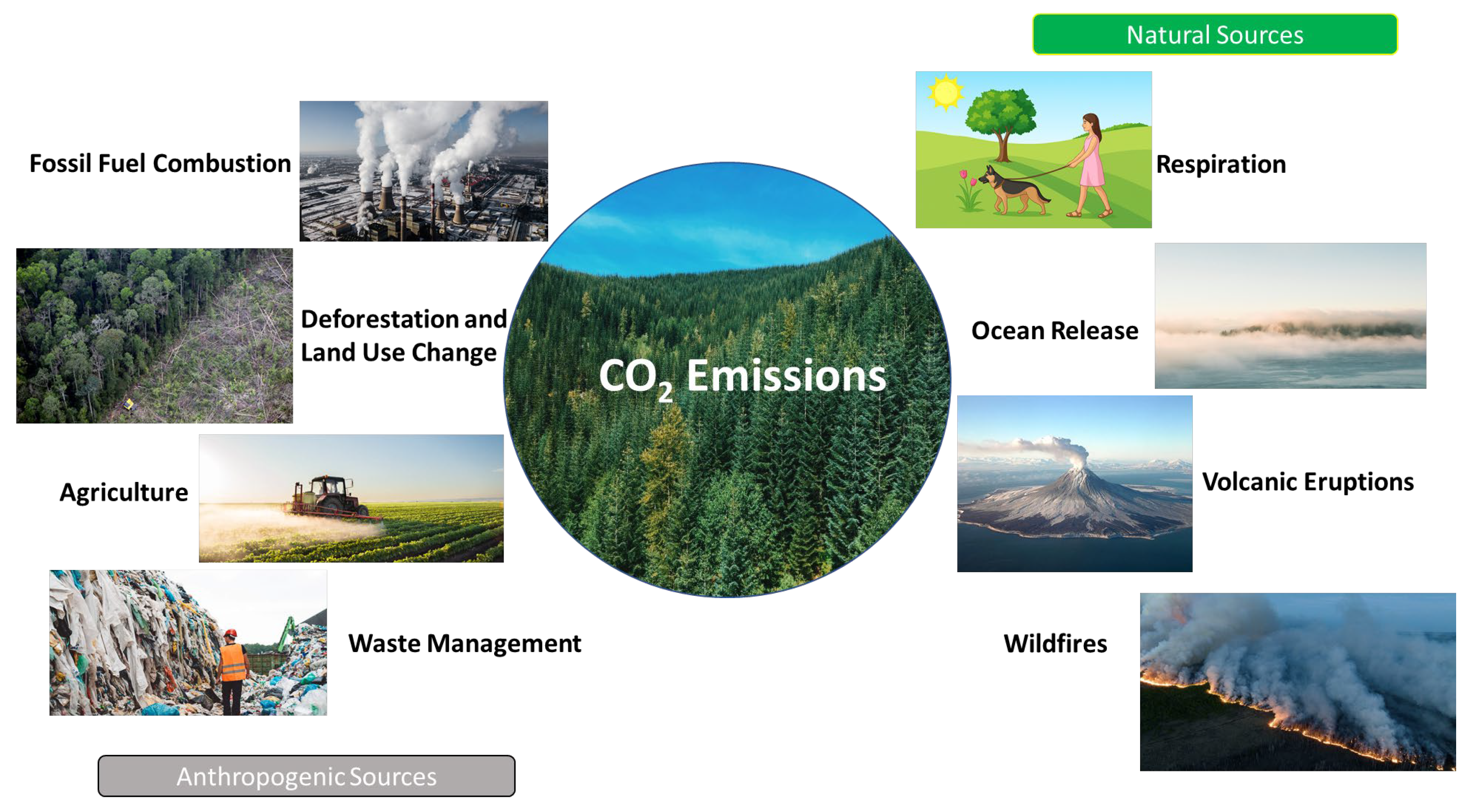
Figure 1. Schematic representation of CO2 emissions (humankind + natural sources).
Biomass 05 00070 g001
Figure 2. SEM image of (a) biochar, (b) activated carbon of MAC-1, and (c) activated carbon of MAC-2. Reproduced with permission from [27].
Biomass 05 00070 g002
Figure 3. SEM images (a,c) are of MAC-2 at 20 min of adsorption, and (b,d) are at 20 min of desorption. Reproduced with permission from [27].
Biomass 05 00070 g003
Figure 4. N2 sorption isotherms depicting microporous carbon materials, reported in the literature. Reproduced with permission from (a) [41] and (b) [73].
Biomass 05 00070 g004
Figure 5. SEM images of (a,b)—palm date seeds biochar, reproduced with permission from [39]; (c,d)—walnut shells carbon, reproduced with permission from [79]; and (gj)—lotus leaves, reproduced with permission from [80], and (e,f) TEM micrographs of walnut shells carbon, reproduced with permission from [79].
Biomass 05 00070 g005
Figure 6. SEM micrographs of (a,d)—palm date seeds carbon; (b,e)—winged beans carbon; (c,f)—guava seeds carbon, chemically activated with KOH, reproduced with permission from [40]; and (gj)—rice husk carbon chemically activated with KOH, reproduced with permission from [81].
Biomass 05 00070 g006
Figure 7. (a) Schematic representation of the mechanism of CO2 adsorption on activated carbons (ACs), reproduced with permission from [18] and (b) schematic representation of the molecular interactions between CO2 and a modified surface, reproduced with permission from [101].
Biomass 05 00070 g007
Table 1. Examples of biomass sources used in the literature for CO2 adsorption.
Biomass SourceCO2 Uptake (mmol/g)ConditionsReference
Pistachio Shells2.1730 °C and 1 bar[26]
3.5625 °C and 1 bar[41]
Chicken Manure1.9525 °C and 1 bar[42]
Coffee Grounds2.6735 °C and 1 bar[43]
Corn Cobs1.5225 °C and 1 bar[27]
2.81[44]
Chitosan4.8225 °C and 1 bar[29]
Lotus Petiole4.0025 °C and 1 bar[30]
Ginger4.8725 °C and 1 bar[32]
Tobacco Stem5.5925 °C and 1 bar[34]
5.60[45]
Sugarcane Bagasse3.7625 °C and 1 bar[35]
Cellulose2.8925 °C and 1 bar[46]
Peanut Shell3.7625 °C and 1 bar[47]
Cashew Nut Shell1125 °C and 10 bars[48]
Palm Date Seeds4.3625 °C and 1 bar[40]
5.44[38]
Winged Beans2.6725 °C and 1 bar[40]
Guava Seeds3.0225 °C and 1 bar[40]
Pineapple Waste4.2525 °C and 1 bar[49]
Coca Cola Waste5.2025 °C and 1 bar[50]
Coconut Shell3.9025 °C and 1 bar[51]
Olive Waste1.8525 °C and 1 bar[52]
Bamboo3.4925 °C and 1 bar[53]
Soy Beans3.0125 °C and 1 bar[54]
Table 2. Examples of carbon materials derived from biomass via pyrolysis and subsequent activation.
SamplePrecursorActivatorT
(°C)
SBET
(m2/g)
Vn (cm3/g)N
%
P
%
CO2 Uptake
(mmol/g)
Ref
LPCP-600-2Lotus petioleKOH (1:2)6008610.390.713.392.57[30]
LPCP-600-3KOH (1:3)13900.690.522.074.00
LPCP-700-2KOH (1:2)70012280.541.020.823.76
LPCP-700-3KOH (1:3)14560.711.150.303.91
NPCChitosanNaNH2 (1:1)60015550.54--2.89[29]
NBPC-1015530.55--3.14
PSB-PAPistachio shellN2 + CO2 (50 mL/min)7003400.070.42-1.3[26]
PSB-CAKOH (2:1)6005310.210.28-2.17
KTCTobacco stemsKOH (1:2)70012590.640.90-4.78[45]
KTC516640.830.71-5.59
KUTCTobacco stems + urea19360.803.05 3.50
KUTC520670.784.41-3.85
TS500-5TTobacco stemsKOH (1:2)5006380.281.89-3.56[34]
TS600-5T6007280.351.17-4.81
TS700-5T70016650.830.71-5.59
TS800-5T80015250.320.81-5.16
K2CO3:DG-1:1-700Distilled spent grainsK2CO3 (1:1)70013170.49--4.33[65]
K2CO3:DG-1:2-700K2CO3 (1:2)11940.44--5.20
K2CO3:DG-1:3-700K2CO3 (1:3)10460.38--4.61
K2CO3:DG-1:2-800K2CO3 (1:2)80015910.66--4.21
HAC-650-1.5Walnut shell powders
+ urea
KOH (1:1.5)6507590.334.45-2.32[66]
HAC-750-1.575016360.682.69-2.86
HAC-850-1.585023540.970.86-3.04
HAC-650-2.5KOH (1:2.5)65016060.784.02-1.92
HAC-750-2.575022511.030.94-2.54
HAC-850-2.585025560.960.76-2.27
“-”: It means that N or P is not detectable in that case.
Table 3. Materials for CO2 adsorption.
MaterialCO2 Adsorption CapacityAdvantagesChallenges
Biomass-Derived Carbon~2–6 mmol/g
  • Sustainable;
  • Low cost
  • Easy to recycle
  • Stable
  • High porosity
  • Possibility for chemical functionalization
  • Low uptake at low partial pressures
  • Low selectivity
MOFs~6–9 mmol/g
  • High porosity
  • Possibility for chemical functionalization
  • High CO2 uptake
  • Low stability in humid conditions
  • Scaling up
  • High cost
COFs~2–4 mmol/g
  • High porosity
  • Possibility for chemical functionalization
  • Low stability
  • High cost
Zeolites~3–5 mmol/g
  • High selectivity
  • Fast kinetics
  • Used in industry
  • Moderate regeneration cost
  • Affected by humidity
Amine-Based Cellulose~2–5 mmol/g
  • High selectivity
  • Works well in humid conditions
  • Low recyclability
  • Amine degradation
  • High cost for regeneration
  • High energy consumption
Metal Oxides~8–12 mmol/g
  • Low cost
  • Efficient in high-temperature conditions
  • Sintering
  • High regeneration energy
Disclaimer/Publisher’s Note: The statements, opinions and data contained in all publications are solely those of the individual author(s) and contributor(s) and not of MDPI and/or the editor(s). MDPI and/or the editor(s) disclaim responsibility for any injury to people or property resulting from any ideas, methods, instructions or products referred to in the content.