
Toward Efficient Virtual Cell-Based Topology Management and Adaptive Routing for Underwater Wireless Sensor Networks


Abstract
1. Introduction
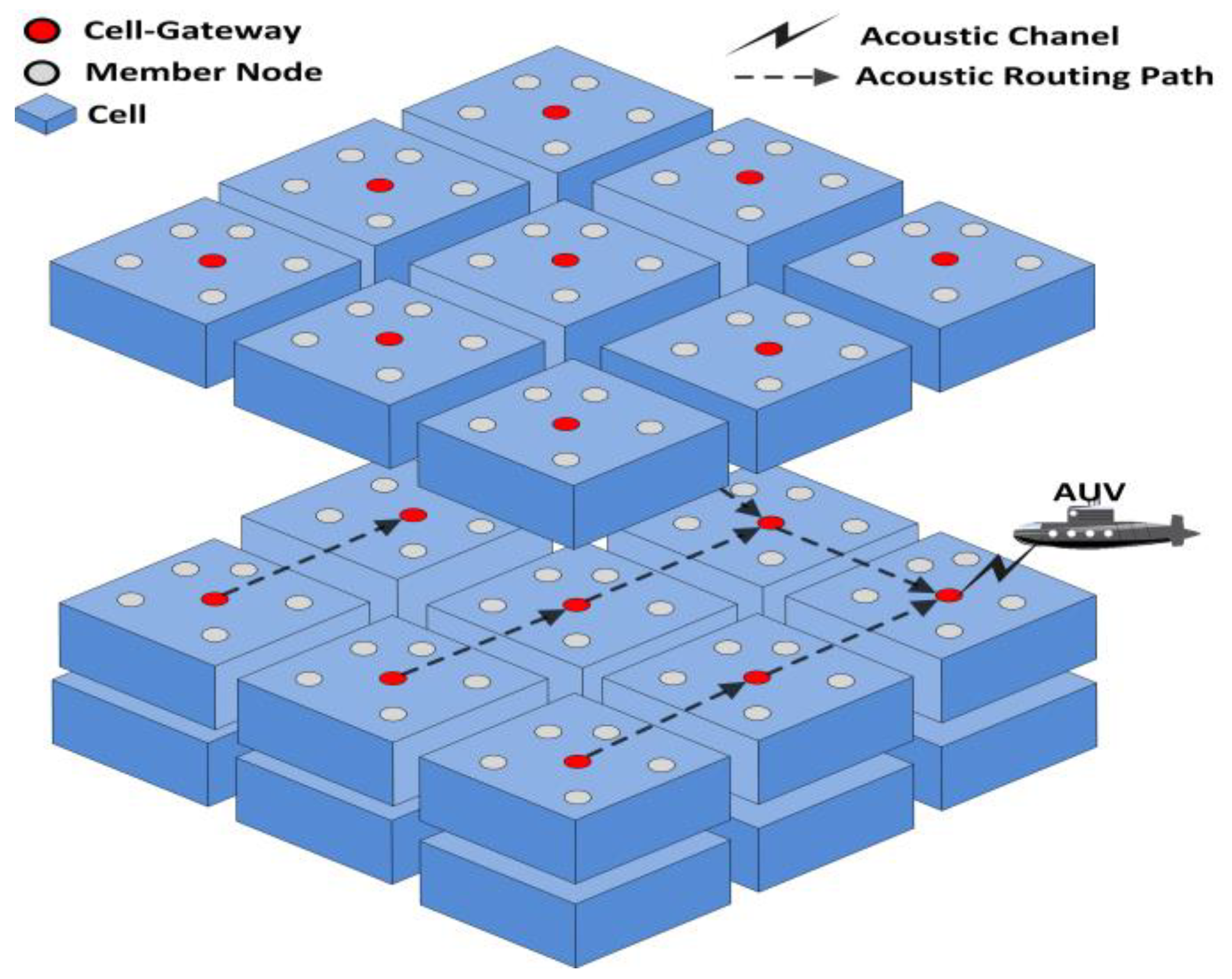
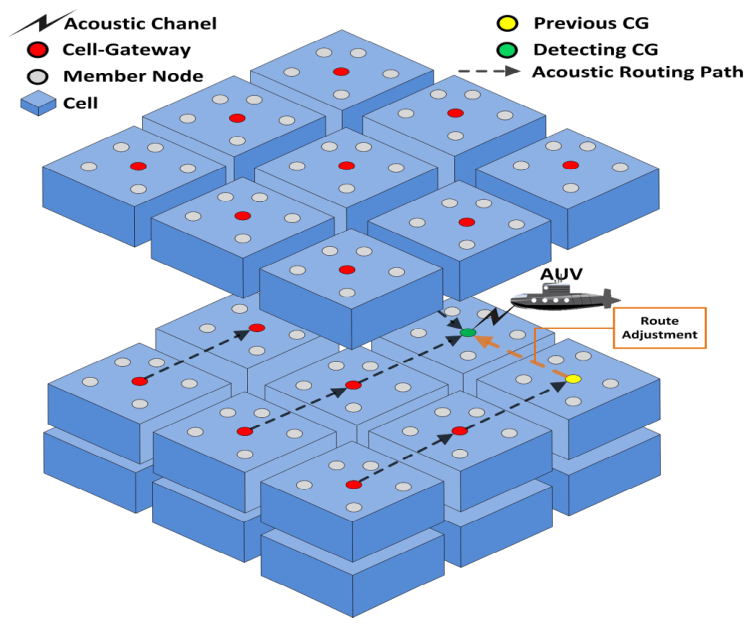
- Introduces a virtual cell–based routing adjustment mechanism that utilizes face-adjacent cell correlations to adaptively update routing paths in response to sink mobility, which significantly reduces control overhead and convergence delay.
- Introduces a detecting cell-gateway-based sink discovery and validation mechanism that reduces routing adjustment updates and conserves energy.
- Develops a loop-free backtrack and forward-path optimization strategy that maintains stable data delivery and routing consistency as the mobility of the sink across the sensing field.
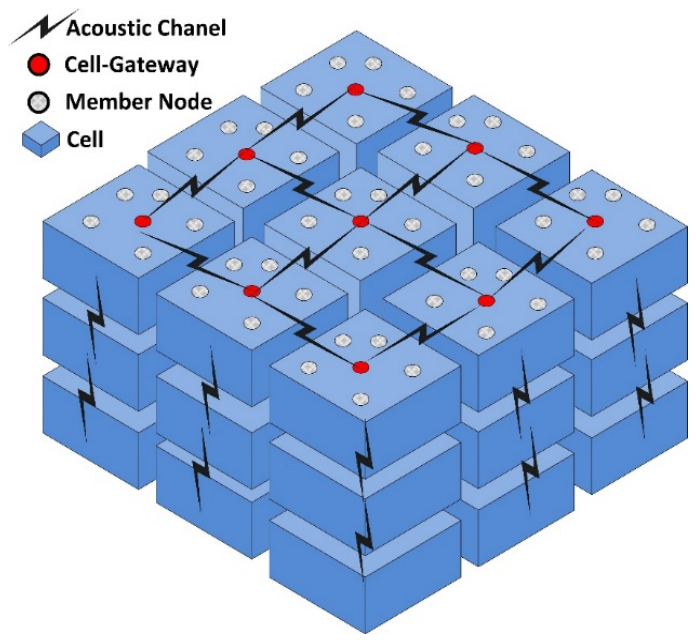
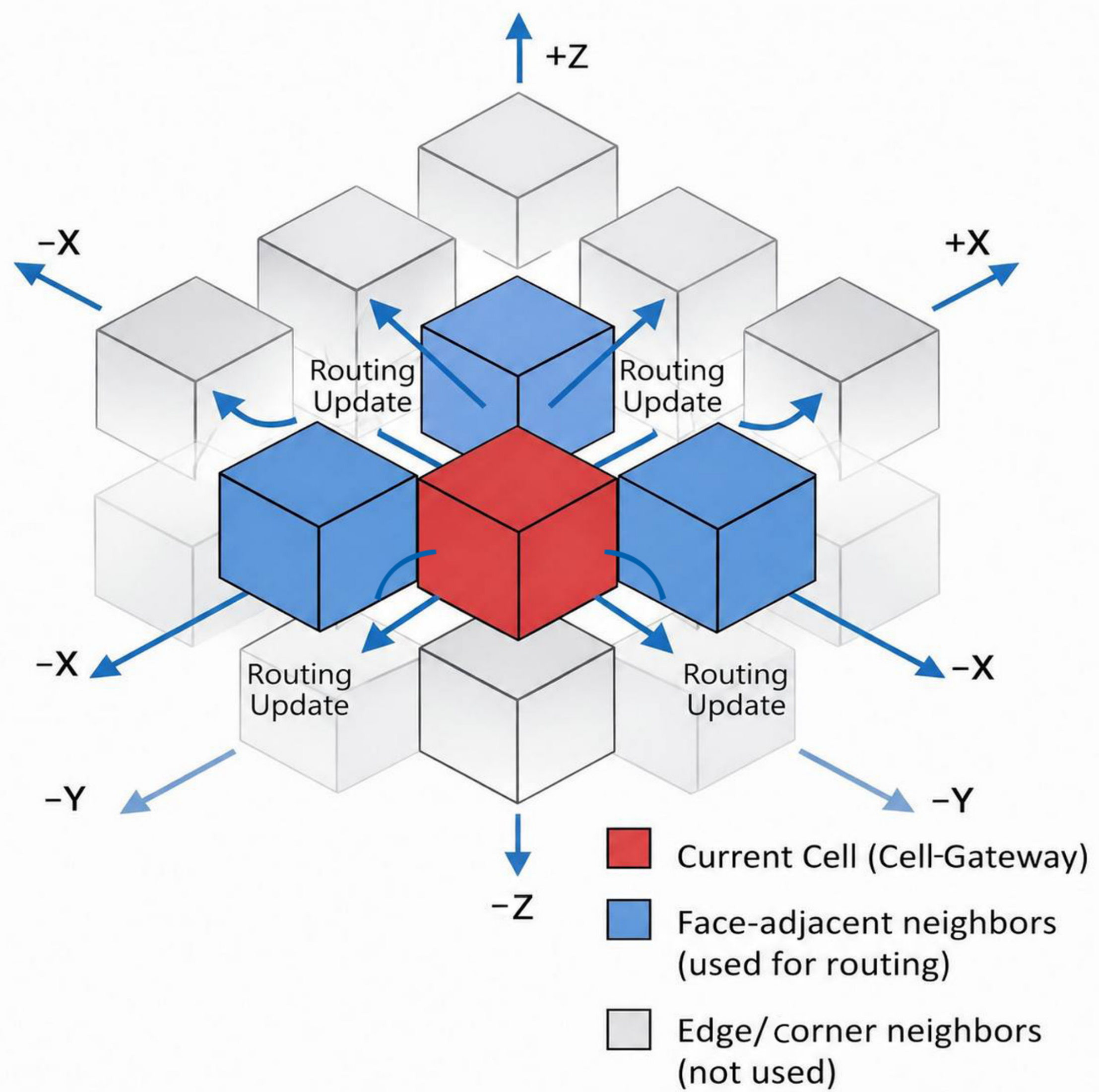
- Simplify routing decisions and improve network scalability by restricting routing interactions to face-adjacent neighboring cells within a 3D virtual grid.
2. Related Works
3. System Model and Assumptions
3.1. Network Architecture and System Assumptions
3.2. Communication and Energy Model
4. Detailed Description of Proposed VC-MAR Protocol
4.1. The Virtual 3D Structure Construction
4.2. Cell-Gateway Selection
4.3. Dynamic Routes Adjustment in VC-MAR
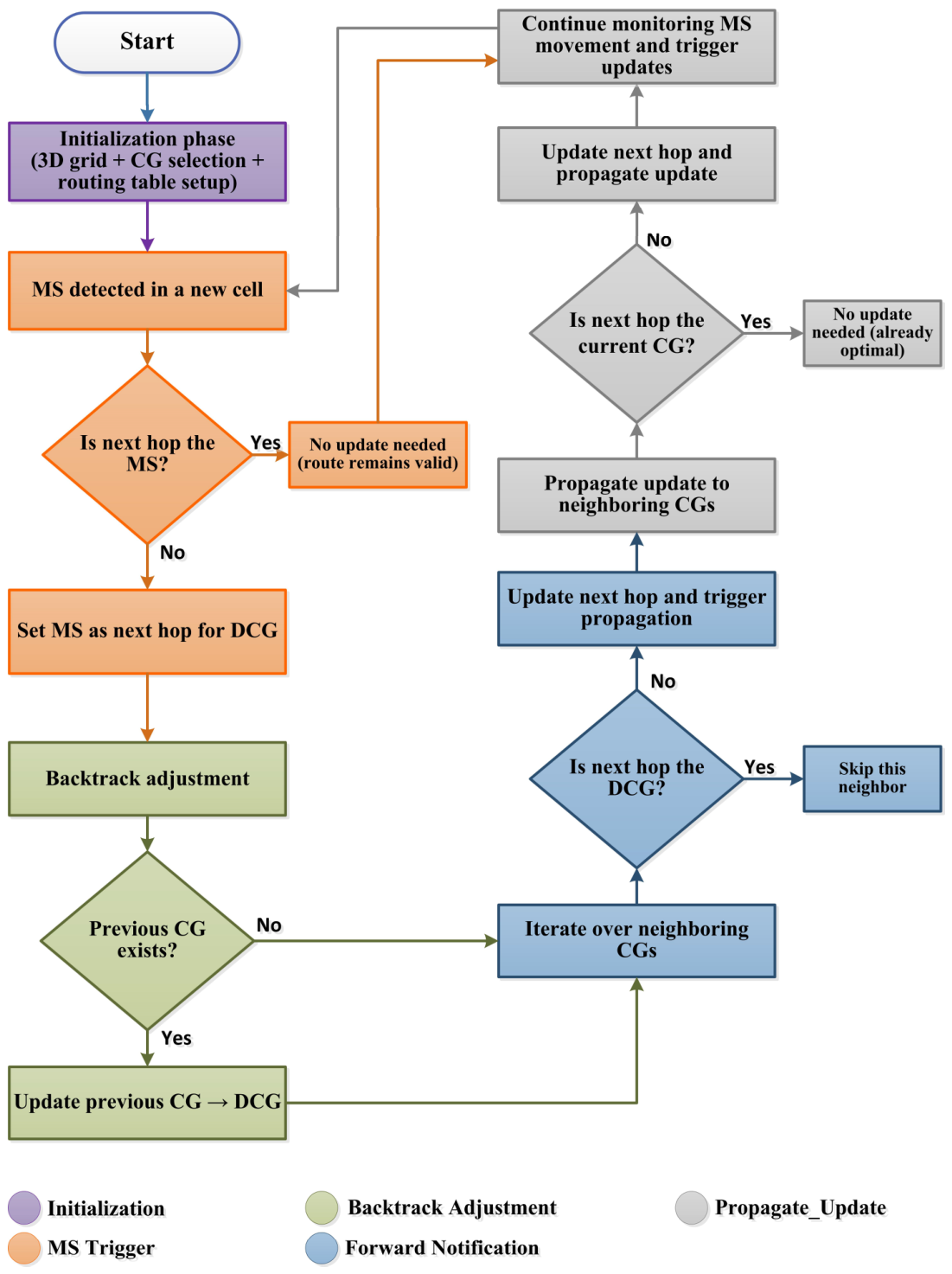
| Algorithm 1: Dynamic Route Adjustment in VC-MAR |
| Input: Deployed sensor nodes, mobile sink (MS) Output: Efficient routing paths toward MS |
| Initialization: |
| Partition the 3D sensing field into uniform cubic cells and assign one cell-gateway per cell. |
| 1. Establish face-adjacent neighborhood relationships among all cell-gateways. |
| 2. Assume an initial static position of the mobile sink (MS) within the sensing field. |
| 3. Each CG initializes its routing table by selecting a face-adjacent CG as its Next_Hop toward the MS. |
| 4. The set of cell-gateways collectively forms a connected 3D virtual backbone. |
| MS Trigger: (MS is detected in a new cubic region) |
| 5. A cell-gateway detects the presence of the MS. |
| 6. The detecting cell-gateway is designated as the detecting cell-gateway (DCG). |
| 7. If DCG.Next_Hop ≠ MS then |
| 8. Set DCG.Next_Hop ← MS. |
| Backtrack Adjustment: |
| 9. If a previous detecting cell-gateway (Prev_DCG) exists then |
| 10. Set Prev_DCG.Next_Hop ← DCG. |
| Forward Notification: |
| 11. For each face-adjacent neighboring cell-gateway (NCG) of DCG do |
| 12. If NCG.Next_Hop ≠ DCG then |
| 13. Set NCG.Next_Hop ← DCG. |
| 14. Invoke Propagate_Update (DCG). |
| 15. Else |
| 16. Terminate the update process (current route remains valid). |
| Propagate_Update (Current_CG): |
| 17. For each face-adjacent downstream cell-gateway FCG ϵ neighbor (Current_CG) do |
| 18. If FCG.Next_Hop ≠ Current_CG then |
| 19. Set FCG.Next_Hop ← Current_CG. |
| 20. Invoke Propagate_Update (FCG). |
| 21. Else |
| 22. Drop the update message (route already optimal). |
| 23. End. |
5. Simulations and Results
5.1. Simulation Setup
5.2. Performance Evaluation
6. Conclusions
Author Contributions
Funding
Data Availability Statement
Conflicts of Interest
References
- Jouhari, M.; Ibrahimi, K.; Tembine, H.; Ben-Othman, J. Underwater wireless sensor networks: A survey on enabling technologies, localization protocols, and internet of underwater things. IEEE Access 2019, 7, 96879–96899. [Google Scholar] [CrossRef]
- Chaudhary, M.; Goyal, N.; Benslimane, A.; Awasthi, L.K.; Alwadain, A.; Singh, A. Underwater wireless sensor networks: Enabling technologies for node deployment and data collection challenges. IEEE Internet Things J. 2022, 10, 3500–3524. [Google Scholar] [CrossRef]
- Mohsan, S.A.H.; Mazinani, A.; Othman, N.Q.H.; Amjad, H. Towards the internet of underwater things: A comprehensive survey. Earth Sci. Inform. 2022, 15, 735–764. [Google Scholar] [CrossRef]
- Domingos, F.P.F.; Lotfi, A.; Ihianle, I.K.; Kaiwartya, O.; Machado, P. Underwater communication systems and their impact on aquatic life—A survey. Electronics 2024, 14, 7. [Google Scholar] [CrossRef]
- Xu, G.; Shen, W.; Wang, X. Applications of wireless sensor networks in marine environment monitoring: A survey. Sensors 2014, 14, 16932–16954. [Google Scholar] [CrossRef]
- Theocharidis, T.; Kavallieratou, E. Underwater communication technologies: A review. Telecommun. Syst. 2025, 88, 54. [Google Scholar] [CrossRef]
- Khan, H.; Hassan, S.A.; Jung, H. On underwater wireless sensor networks routing protocols: A review. IEEE Sens. J. 2020, 20, 10371–10386. [Google Scholar] [CrossRef]
- Yan, J.; Guan, X.; Yang, X.; Chen, C.; Luo, X. A Survey on Integration Design of Localization, Communication and Control for Underwater Acoustic Sensor Networks. IEEE Internet Things J. 2025, 12, 6300–6324. [Google Scholar] [CrossRef]
- Fattah, S.; Gani, A.; Ahmedy, I.; Idris, M.Y.I.; Targio Hashem, I.A. A survey on underwater wireless sensor networks: Requirements, taxonomy, recent advances, and open research challenges. Sensors 2020, 20, 5393. [Google Scholar] [CrossRef]
- Mahdi, O.A.; Al-Mayouf, Y.B.; Ghazi, A.B.; Wahab, A.A.; Idris, M. An energy-aware and load-balancing routing scheme for wireless sensor networks. Indones. J. Electr. Eng. Comput. Sci. 2018, 12, 1312–1319. [Google Scholar]
- Zhang, J.; Wang, X.; Wang, B.; Sun, W.; Du, H.; Zhao, Y. Energy-efficient data transmission for underwater wireless sensor networks: A novel hierarchical underwater wireless sensor transmission framework. Sensors 2023, 23, 5759. [Google Scholar] [CrossRef] [PubMed]
- Luo, J.; Yang, Y.; Wang, Z.; Chen, Y.; Wu, M. A mobility-assisted localization algorithm for three-dimensional large-scale UWSNs. Sensors 2020, 20, 4293. [Google Scholar] [CrossRef]
- Belesaca, J.D.; Vazquez-Rodas, A.; Criollo, C.R.; de la Cruz Llopis, L.J. Centrality-Based Topology Control in Routing Protocols for Wireless Sensor Networks with Community Structure. Electronics 2025, 14, 3812. [Google Scholar] [CrossRef]
- Song, Y.; Kong, P.-Y. Optimizing design and performance of underwater acoustic sensor networks with 3D topology. IEEE Trans. Mob. Comput. 2019, 19, 1689–1701. [Google Scholar] [CrossRef]
- Chu, H.; Wang, B.; Fang, T.; Liu, B. Adaptive Power-Controlled Energy-Efficient Depth-Based routing protocol for underwater wireless sensor networks. J. Mar. Sci. Eng. 2025, 13, 1418. [Google Scholar] [CrossRef]
- Wei, X.; Guo, H.; Wang, X.; Wang, X.; Qiu, M. Reliable data collection techniques in underwater wireless sensor networks: A survey. IEEE Commun. Surv. Tutor. 2021, 24, 404–431. [Google Scholar] [CrossRef]
- Sandeep, D.; Kumar, V. Review on clustering, coverage and connectivity in underwater wireless sensor networks: A communication techniques perspective. IEEE Access 2017, 5, 11176–11199. [Google Scholar] [CrossRef]
- Lilhore, U.K.; Khalaf, O.I.; Simaiya, S.; Tavera Romero, C.A.; Abdulsahib, G.M.; M, P.; Kumar, D. A depth-controlled and energy-efficient routing protocol for underwater wireless sensor networks. Int. J. Distrib. Sens. Netw. 2022, 18, 15501329221117118. [Google Scholar] [CrossRef]
- Yan, H.; Shi, Z.J.; Cui, J.-H. DBR: Depth-based routing for underwater sensor networks. In Proceedings of the International Conference on Research in Networking, Singapore, 5–9 May 2008; pp. 72–86. [Google Scholar]
- Xie, P.; Cui, J.-H.; Lao, L. VBF: Vector-based forwarding protocol for underwater sensor networks. In Proceedings of the International Conference on Research in Networking, Coimbra, Portugal, 15–19 May 2006; pp. 1216–1221. [Google Scholar]
- Hwang, D.; Kim, D. DFR: Directional flooding-based routing protocol for underwater sensor networks. In Proceedings of the OCEANS 2008, Quebec City, QC, Canada, 15–18 September 2008; pp. 1–7. [Google Scholar]
- Al Bahanta, F.; Alzeidi, N.; Day, K.; Touzene, A.; Al-Maqbali, H. Performance Evaluation of a Tree-Based Routing Protocol over a 3D Grid for UWSNs. In Proceedings of the 2019 Eleventh International Conference on Ubiquitous and Future Networks (ICUFN), Zagreb, Croatia, 2–5 July 2019; pp. 426–431. [Google Scholar]
- Liu, Y.; Wang, H.; Cai, L.; Shen, X.; Zhao, R. Fundamentals and advancements of topology discovery in underwater acoustic sensor networks: A review. IEEE Sens. J. 2021, 21, 21159–21174. [Google Scholar] [CrossRef]
- Mahdi, O.A.; Ghazi, A.B.; Al-Mayouf, Y.R.B. Void-hole aware and reliable data forwarding strategy for underwater wireless sensor networks. J. Intell. Syst. 2021, 30, 564–577. [Google Scholar] [CrossRef]
- Gola, K.K.; Gupta, B. Underwater sensor networks:‘Comparative analysis on applications, deployment and routing techniques’. IET Commun. 2020, 14, 2859–2870. [Google Scholar] [CrossRef]
- Yahya, A.; Islam, S.U.; Akhunzada, A.; Ahmed, G.; Shamshirband, S.; Lloret, J. Towards efficient sink mobility in underwater wireless sensor networks. Energies 2018, 11, 1471. [Google Scholar] [CrossRef]
- Banaeizadeh, F.; Toroghi Haghighat, A. An energy-efficient data gathering scheme in underwater wireless sensor networks using a mobile sink. Int. J. Inf. Technol. 2020, 12, 513–522. [Google Scholar] [CrossRef]
- Shaikh, S.N.; Shaikh, N.N.; Jokhio, S.H.; Jokhio, I.A. Lightweight and robust data collection in a UWSN using a mobile sink. In Proceedings of the 2018 IEEE International Conference on Innovative Research and Development (ICIRD), Piscataway, Bangkok, 11–12 May 2018; IEEE: Piscataway, NJ, USA, 2018; pp. 1–6. [Google Scholar]
- Hu, Y.; Hu, K.; Liu, H.; Wan, X. An energy-balanced head nodes selection scheme for underwater mobile sensor networks. EURASIP J. Wirel. Commun. Netw. 2022, 2022, 63. [Google Scholar] [CrossRef]
- Ahmed, F.; Wadud, Z.; Javaid, N.; Alrajeh, N.; Alabed, M.S.; Qasim, U. Mobile sinks assisted geographic and opportunistic routing based interference avoidance for underwater wireless sensor network. Sensors 2018, 18, 1062. [Google Scholar] [CrossRef]
- Khan, A.; Ali, I.; Ghani, A.; Khan, N.; Alsaqer, M.; Rahman, A.U.; Mahmood, H. Routing protocols for underwater wireless sensor networks: Taxonomy, research challenges, routing strategies and future directions. Sensors 2018, 18, 1619. [Google Scholar] [CrossRef]
- Ayaz, M.; Baig, I.; Abdullah, A.; Faye, I. A survey on routing techniques in underwater wireless sensor networks. J. Netw. Comput. Appl. 2011, 34, 1908–1927. [Google Scholar] [CrossRef]
- Ismail, A.; Wang, X.; Hawbani, A.; Alsamhi, S.; Abdel Aziz, S. Routing protocols classification for underwater wireless sensor networks based on localization and mobility. Wirel. Netw. 2022, 28, 797–826. [Google Scholar] [CrossRef]
- Khisa, S.; Moh, S. Survey on recent advancements in energy-efficient routing protocols for underwater wireless sensor networks. IEEE Access 2021, 9, 55045–55062. [Google Scholar] [CrossRef]
- Bouabdallah, F.; Zidi, C.; Boutaba, R.; Mehaoua, A. Collision avoidance energy efficient multi-channel MAC protocol for underwater acoustic sensor networks. IEEE Trans. Mob. Comput. 2019, 18, 2298–2314. [Google Scholar] [CrossRef]
- Day, K.; Touzene, A.; Arafeh, B.; Alzeidi, N. GARP: A Highly reliable grid-based adaptive routing protocol for underwater wireless sensor networks. Int. J. Comput. Commun. Netw. 2017, 9, 71–82. [Google Scholar] [CrossRef]
- Alkindi, Z.; Alzeidi, N.; Arafehand, B.; Touzene, A. Performance evaluation of grid based routing protocol for underwater wireless sensor networks under different mobility models. Int. J. Wirel. Mob. Netw. 2018, 10, 13. [Google Scholar]
- Al Salti, F.; Alzeidi, N.; Arafeh, B.R. EMGGR: An energy-efficient multipath grid-based geographic routing protocol for underwater wireless sensor networks. Wirel. Netw. 2017, 23, 1301–1314. [Google Scholar] [CrossRef]
- Noorbakhsh, H.; Soltanaghaei, M. EEGBRP: An energy-efficient grid-based routing protocol for underwater wireless sensor networks. Wirel. Netw. 2022, 28, 3477–3491. [Google Scholar] [CrossRef]
- Al-Salti, F.; Alzeidi, N.; Day, K.; Arafeh, B.; Touzene, A. Grid-based priority routing protocol for uwsns. Int. J. Comput. Netw. Commun. 2017, 9, 1–20. [Google Scholar] [CrossRef]
- Al-Salti, F.; Alzeidi, N.; Day, K.; Touzene, A. An efficient and reliable grid-based routing protocol for UWSNs by exploiting minimum hop count. Comput. Netw. 2019, 162, 106869. [Google Scholar] [CrossRef]
- Shahraki, M.A.B.; Emadi, S.; Ayatollahitafti, V.; Mirjalily, G. RQAR: Location-free reliable and QoS-aware routing protocol for mobile sink underwater wireless sensor networks. Int. J. Commun. Syst. 2023, 36, e5435. [Google Scholar] [CrossRef]
- Gul, H.; Ullah, G.; Khan, M.; Khan, Y. EERBCR: Energy-efficient regional based cooperative routing protocol for underwater sensor networks with sink mobility. J. Ambient Intell. Humaniz. Comput. 2023, 14, 6063–6075. [Google Scholar] [CrossRef]
- Latif, K.; Javaid, N.; Ullah, I.; Kaleem, Z.; Abbas Malik, Z.; Nguyen, L.D. DIEER: Delay-intolerant energy-efficient routing with sink mobility in underwater wireless sensor networks. Sensors 2020, 20, 3467. [Google Scholar] [CrossRef] [PubMed]
- Chenthil, T.; Jesu Jayarin, P. An energy-efficient distributed node clustering routing protocol with mobility pattern support for underwater wireless sensor networks. Wirel. Netw. 2022, 28, 3367–3390. [Google Scholar] [CrossRef]
- Pradeep, S.; Bapu, T.B.B.R.; Rajendran, R.; Anitha, R. Energy efficient region based source distributed routing algorithm for sink mobility in underwater sensor network. Expert Syst. Appl. 2023, 233, 120941. [Google Scholar] [CrossRef]
- Li, H.; Dai, Y.; Chen, Q.; Liao, D.; Jin, H. Energy efficient mobile sink driven data collection in wireless sensor network with nonuniform data. Sci. Rep. 2024, 14, 28190. [Google Scholar] [CrossRef] [PubMed]
- Yu, H.; Yao, N.; Wang, T.; Li, G.; Gao, Z.; Tan, G. WDFAD-DBR: Weighting depth and forwarding area division DBR routing protocol for UASNs. Ad Hoc Netw. 2016, 37, 256–282. [Google Scholar] [CrossRef]
- Khan, A.W.; Abdullah, A.H.; Razzaque, M.A.; Bangash, J.I. VGDRA: A virtual grid-based dynamic routes adjustment scheme for mobile sink-based wireless sensor networks. IEEE Sens. J. 2014, 15, 526–534. [Google Scholar] [CrossRef]
- Heinzelman, W.B.; Chandrakasan, A.P.; Balakrishnan, H. An application-specific protocol architecture for wireless microsensor networks. IEEE Trans. Wirel. Commun. 2002, 1, 660–670. [Google Scholar] [CrossRef]
- Stojanovic, M. On the relationship between capacity and distance in an underwater acoustic communication channel. ACM SIGMOBILE Mob. Comput. Commun. Rev. 2007, 11, 34–43. [Google Scholar] [CrossRef]



| Protocol | Routing Structure | 3D Grid | Route Adaptation | Energy/Load Aware | Mobile Sink |
|---|---|---|---|---|---|
| GARP | Grid-based geographic | ✓ | Predefined paths | ✗ | ✗ |
| MGGR | Grid-based multipath | ✓ | Path switching | ✓ | ✗ |
| EMGGR | Grid-based multipath | ✓ | Gateway-based | ✓ | ✗ |
| EEGBRP | Grid-based, TOPSIS | ✓ | Semi-static | ✓ | ✗ |
| GBPR | Grid-based priority | ✓ | Priority-based | ✓ | ✗ |
| ERGR-EMHC | Grid-based, hop-based | ✓ | Limited | ✓ | ✗ |
| RQAR | Location-free QoS-aware | ✗ | Dynamic | ✓ | ✓ |
| EERBCR | Region-based cooperative | ✗ | Limited (predefined zones) | ✓ | ✓ |
| DIEER | Depth-based + adaptive routing | ✗ | Moderate (threshold-based) | ✓ | ✓ |
| DNC-MPRP | Clustering-based routing | ✗ | Limited (mobility pattern-based) | ✓ | ✓ |
| EERSDRA-GCOP | Region-based opportunistic | ✗ | Moderate (metric-based) | ✓ | ✓ |
| OCNTMS | Clustering + trajectory planning | ✗ | Limited (pre-planned paths) | ✓ | ✓ |
| Proposed VC-MAR | Grid-based adaptive routing | ✓ | Dynamic local adjustment | ✓ | ✓ |
| Simulation Parameter | Value | Description |
|---|---|---|
| Deployment area | 900 × 900 × 900 m3 | Represents a realistic underwater sensing environment |
| Number of sensor nodes | 500–1000 | Evaluates scalability under varying node density |
| Number of sinks | 1 mobile | Considers a single mobile sink with unlimited energy |
| Deployment model | Random 3D | Reflects realistic underwater node distribution |
| Channel model | Underwater acoustic channel [51] | Standard underwater transmission medium |
| Bandwidth | 10 kbps | Typical limitation of underwater channels |
| Data packet size | 128 bytes | Balanced between overhead and payload |
| Control packet size | 32 bytes | Reduces routing overhead |
| Initial energy (sensor nodes) | 25 J | Ensures sufficient energy for sustained network operation |
| Transmission power | 1 J | Represents energy cost of acoustic transmission |
| Reception power | 0.35 J | Represents the energy cost of packet reception |
| Idle power | 5 mJ | Accounts for idle energy consumption |
| Packet generation rate | 15–60 packets/s | Tests performance under varying traffic loads |
| Communication range | 200 m | Reflects practical underwater communication range |
| Sensing range | 40 m | Represents typical sensing capability |
| Sink mobility model | Random constrained 3D mobility | Simulates realistic sink movement |
| Number of simulation runs | 10 | Ensures statistical reliability |
Disclaimer/Publisher’s Note: The statements, opinions and data contained in all publications are solely those of the individual author(s) and contributor(s) and not of MDPI and/or the editor(s). MDPI and/or the editor(s) disclaim responsibility for any injury to people or property resulting from any ideas, methods, instructions or products referred to in the content. |
© 2026 by the authors. Licensee MDPI, Basel, Switzerland. This article is an open access article distributed under the terms and conditions of the Creative Commons Attribution (CC BY) license.
Share and Cite
Al-Mayouf, Y.R.B.; Adil Mahdi, O.; Hassan, S.S.; Taha, N.A. Toward Efficient Virtual Cell-Based Topology Management and Adaptive Routing for Underwater Wireless Sensor Networks. Network 2026, 6, 30. https://doi.org/10.3390/network6020030
Al-Mayouf YRB, Adil Mahdi O, Hassan SS, Taha NA. Toward Efficient Virtual Cell-Based Topology Management and Adaptive Routing for Underwater Wireless Sensor Networks. Network. 2026; 6(2):30. https://doi.org/10.3390/network6020030
Chicago/Turabian StyleAl-Mayouf, Yusor Rafid Bahar, Omar Adil Mahdi, Sameer Sami Hassan, and Namar A. Taha. 2026. "Toward Efficient Virtual Cell-Based Topology Management and Adaptive Routing for Underwater Wireless Sensor Networks" Network 6, no. 2: 30. https://doi.org/10.3390/network6020030
APA StyleAl-Mayouf, Y. R. B., Adil Mahdi, O., Hassan, S. S., & Taha, N. A. (2026). Toward Efficient Virtual Cell-Based Topology Management and Adaptive Routing for Underwater Wireless Sensor Networks. Network, 6(2), 30. https://doi.org/10.3390/network6020030