1. Introduction
In recent years, electrification has significantly transformed transportation systems, including ground vehicles and aircraft, driven by advances in battery technology and high-power electric propulsion. Electric vertical takeoff and landing (eVTOL) aircraft, which combine the vertical takeoff capability of rotary-wing platforms with the efficiency of fixed-wing flight, have emerged as a promising solution for urban air mobility (UAM) applications [
1,
2]. These vehicles enable point-to-point transportation for both passenger mobility and cargo delivery.
A critical challenge in eVTOL operation is the transition between hovering and forward flight. During this phase, the aerodynamic forces generated by the fixed wing and the thrust produced by the vertical propulsion units must be properly balanced to ensure stability, avoid stalling, and maintain efficient energy use [
3,
4,
5]. This challenge is particularly relevant in lift-plus-cruise configurations, where separate propulsion systems are responsible for vertical and horizontal flight.
In this architecture, vertical lifters provide thrust during hover and low-speed flight, whereas forward propulsion and aerodynamic lift dominate in cruise. The transition between these regimes is therefore characterized by the coexistence of propulsion-borne and wing-borne lift, leading to a highly nonlinear flight condition in which aerodynamic forces, moments, stability derivatives, and control effectiveness may vary significantly [
5,
6]. As the fixed wing is progressively required to support a larger fraction of the vehicle weight while the aircraft is still operating at low forward speed, the required lift coefficient can increase substantially, leading to high angles of attack and possible operation near the nonlinear pre-stall region. Consequently, the transition dynamics become particularly sensitive to variations in the lift-curve slope and to the resulting changes in the local stability derivatives along the transition flight path.
Wake interactions and slipstream effects associated with the fore lift propellers located ahead of the wings and the rear lift propellers positioned upstream of the tail can further modify the local flow field, affecting lift, drag, and control effectiveness [
2,
7,
8]. Together, these effects highlight the strong coupling among propulsion, aerodynamics, and rigid-body dynamics that characterizes eVTOL transition flight.
Nonlinear aerodynamic effects play a central role in this scenario, as propulsion-induced forces interact with the airflow, generating additional drag and moments that influence flight dynamics [
9,
10]. From a control perspective, lift-plus-cruise eVTOL systems are inherently over-actuated and operate across multiple flight regimes, requiring control architectures capable of handling actuator redundancy and varying control effectiveness throughout the transition envelope [
11,
12].
To address these challenges, nonlinear approaches such as Nonlinear Dynamic Inversion (NDI) have been investigated for full-envelope control, while adaptive and nonlinear control strategies have demonstrated promising results in experimental platforms [
13,
14]. Classical VTOL control design also provides a foundation for multi-regime operation and actuator coordination [
15,
16]. However, these approaches typically rely on simplified aerodynamic assumptions or region-dependent models, which may not accurately capture the stability implications of aerodynamic variations during transition.
The coupling between aerodynamic forces and propulsion can significantly affect the stability characteristics of the vehicle. In the near-stall region, the reduction in lift-curve slope modifies the local force and moment derivatives entering the linearized dynamics, particularly those associated with angle-of-attack perturbations, inducing short-period or phugoid-like motions [
11]. This can alter the short-period response and reduce stability margins during transition, especially when control authority is being redistributed between vertical propulsion and aerodynamic surfaces.
From a modeling point of view, aerial vehicles exhibit strongly nonlinear and coupled dynamics, making simplified linear models insufficient to capture transition behavior. Nonlinear six-degree-of-freedom models combined with realistic aerodynamic representations are therefore essential for accurate analysis and control design [
10,
17].
Despite these advances, existing studies typically address transition control and aerodynamic modeling separately. Control-oriented approaches often assume nominal aerodynamic behavior or rely on switching strategies between flight regimes, whereas aerodynamic studies generally do not explicitly analyze the implications for closed-loop stability.
As a result, the relationship between lift-curve slope degradation and flight modal stability under varying control allocation strategies remains insufficiently understood. This limitation hinders the systematic design of control architectures capable of ensuring robust stability throughout the transition envelope.
This work addresses this gap by establishing a direct relationship between the reduction in lift-curve slope in the pre-stall region and short-period stability, explicitly linking aerodynamic nonlinearities to changes in modal damping characteristics. Although the present work neglects unsteady aerodynamic effects and explicit rotor–wing interactions, the resulting lift-curve behavior and slope degradation trends still effectively alter the aerodynamic damping and stiffness of longitudinal dynamics, particularly short-period and phugoid-like motions. A nonlinear six-degree-of-freedom model is developed that incorporates aerodynamic forces, tractor propulsion, and vertical lifter dynamics. The model is linearized about representative flight conditions to enable longitudinal and lateral-directional modal analysis.
In addition, a control allocation strategy based on airspeed-dependent blending between propulsion-based and aerodynamic control is investigated. Two blending approaches, linear and sigmoid, are evaluated to quantify their effects on stability margins and transition performance.
The main contributions of this work are: (i) the identification of a critical near-stall region in which lift-curve slope reduction and the associated variation of local stability derivatives lead to a significant reduction in short-period damping; (ii) a quantitative analysis of control authority blending strategies and their effectiveness in recovering stability margins; and (iii) the demonstration of an inherent asymmetry in transition dynamics between aerodynamic lift buildup and propulsion response. These results provide insight into the mechanisms governing eVTOL transition flight and offer practical guidelines for the design of control allocation strategies in multi-regime aerial systems.
The remainder of this paper is organized as follows.
Section 2 presents the nonlinear six-degree-of-freedom model of the eVTOL platform, incorporating aerodynamic nonlinearities, propulsion dynamics, and control allocation strategies.
Section 3 investigates the resulting stability characteristics and discusses the simulation results, with particular emphasis on the interplay between the decrease in lift-curve slope in the pre-stall region and the redistribution of control authority during the transition flight. Finally,
Section 4 summarizes the main findings and provides direction for future work.
2. Methodology
This section establishes a modeling and control framework to assess the transition-flight stability of a lift-plus-cruise eVTOL. First, the platform is characterized by its geometric, aerodynamic, inertial, and propulsive properties. Following that, aerodynamic, propulsion, and vehicle-dynamics models, which are integrated into a control-oriented state-space representation, are described. Finally, the proposed control authority blending strategies and control design procedures are introduced, forming the basis for the subsequent stability margin analysis.
2.1. eVTOL Platform Description
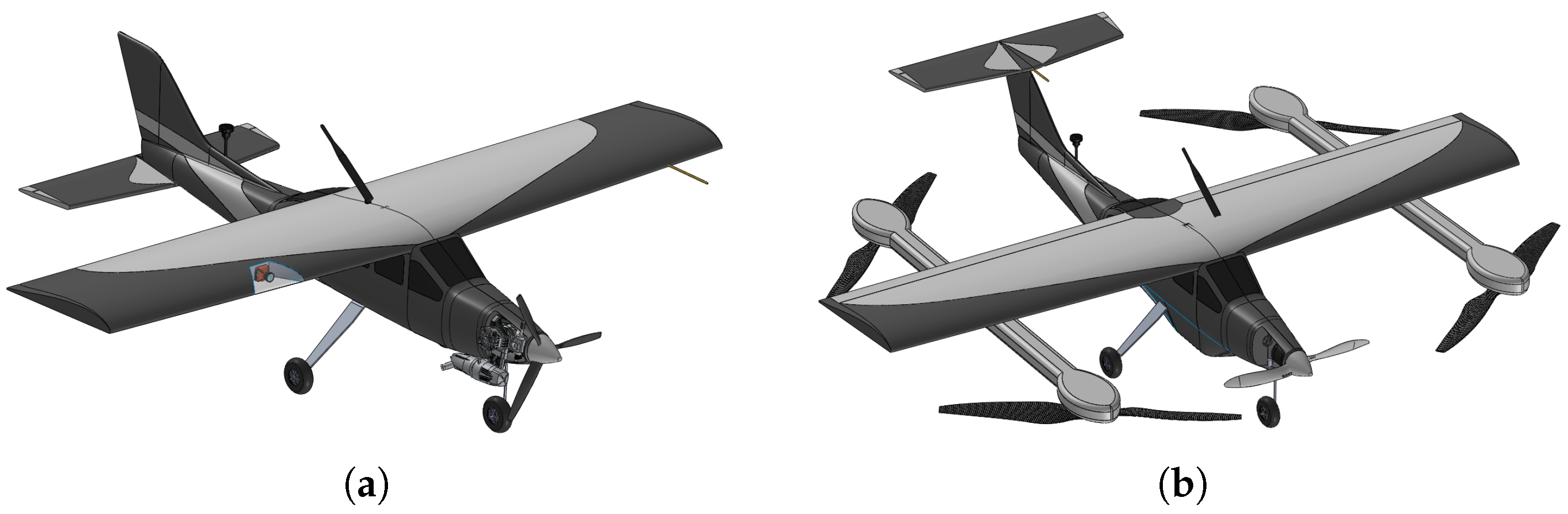
The platform considered in this study is derived from a conventional fixed-wing radio-controlled aircraft originally designed for classic forward flight, take-off, and landing. The baseline configuration was modified to a lift-plus-cruise eVTOL architecture to enable vertical takeoff and landing and controlled transitions between propulsion-dominated and aerodynamically sustained flight regimes.
The original propulsion system, based on a combustion engine, was replaced by an electric propulsion unit, allowing precise thrust modulation and compatibility with the distributed propulsion architecture. The airframe was reconfigured to accommodate the increased mass and altered load distribution resulting from the integration of vertical propulsion units. The addition of lifters and changes to the propulsion system also introduces a shift in the center of gravity, which affects the longitudinal stability characteristics of the aircraft.
The main modifications are summarized as follows: (i) replacement of the combustion propulsion system by an electric unit; (ii) geometric and structural adaptations of the wing and fuselage to accommodate additional mass and changes in the center-of-gravity location; (iii) integration of four vertical propulsion units (lifters) to provide thrust in hover and low-speed regimes; (iv) structural reinforcement to support distributed propulsion loads.
The lifters are symmetrically distributed along the airframe around the new center-of-gravity location to generate vertical thrust during hover and low-speed flight, where aerodynamic lift is insufficient. As airspeed increases, their contribution is reduced, and aerodynamic lift becomes dominant. This results in a transfer of control authority from propulsion to aerodynamic surfaces.
During transition, the thrust of the rotor and the aerodynamic lift act simultaneously, defining a hybrid flight regime. This interaction introduces nonlinear behavior, particularly near stall conditions where the lift-curve slope begins to decrease and the aerodynamic response departs from linear behavior. As a result, the local longitudinal dynamics obtained from the linearized model during transition may exhibit short-period- and phugoid-like modes in terms of time scales and oscillatory behavior. However, their physical origin and control authority distribution differ from those of conventional fixed-wing aircraft due to the simultaneous contribution of rotor-borne and wing-borne lift during transition flight. In particular, at low forward speed and high angle of attack, the response depends strongly on the balance between propulsive and aerodynamic contributions. This motivates the control authority blending strategy adopted in this work.
The main physical parameters used in the dynamic model are summarized in
Table 1. These parameters define the aerodynamic and inertial properties of the platform and are used in nonlinear simulations.
Figure 1 presents the original fixed-wing configuration and the modified eVTOL platform.
2.2. Aerodynamic Modeling
In the present dynamic model, the aerodynamic loads are simplified by retaining the dominant contributions from the wing and empennages, while propulsive forces and moments generated by the tractor propeller and vertical lifters are modeled separately. Aerodynamic contributions from secondary components, including the fuselage, landing gear, propeller support structures, and other external bodies, are neglected. Intrinsic airfoil section pitching-moment contributions are also neglected; however, the resulting aerodynamic moments about the center of gravity are retained through the force–moment formulation described below.
The aerodynamic coefficients used in this study were derived from a geometrically consistent aircraft model developed in a CAD environment and analyzed using vortex-lattice-based tools, including AVL [
18,
19,
20] and XFLR5 [
21,
22,
23]. The aerodynamic analyses provided the coefficients associated with the wing and empennages as nonlinear functions of angle of attack
, sideslip angle
, and control-surface deflections. These data were subsequently represented by interpolated coefficient surfaces, from which local stability and control derivatives were obtained by numerical linearization about representative trim conditions following classical small-disturbance flight-dynamics formulations [
24].
The aerodynamic analyses were performed under standard sea-level atmospheric conditions, with air density and dynamic viscosity . Considering the mean aerodynamic chord and the operating airspeed range investigated in this work, the corresponding Reynolds number based on the chord was of the order of to , which is representative of small-scale unmanned aircraft.
The aerodynamic database was generated for the fixed airframe configuration. The tractor propeller and the vertical lifters were not modeled as rotating actuators during the AVL/XFLR5 analyses. Consequently, rotor-induced slipstream effects, as well as rotor–wing and rotor–tail aerodynamic interactions, are not embedded in the aerodynamic coefficient database. Instead, the propulsion system is modeled separately through thrust and torque models, and the coupling between propulsion and aerodynamics is represented only through the nonlinear equations of motion.
A discretization sensitivity assessment was conducted by refining the chordwise and spanwise panel distributions in the XFLR5 aerodynamic model. Only negligible variations were observed in the main aerodynamic coefficients, particularly , , and , indicating that the aerodynamic results are effectively independent of the adopted panel discretization for the purposes of the present study.
The aerodynamic behavior of the aircraft is characterized by the lift coefficient
as a function of the angle of attack
, together with the corresponding degradation of the lift-curve slope, as shown in
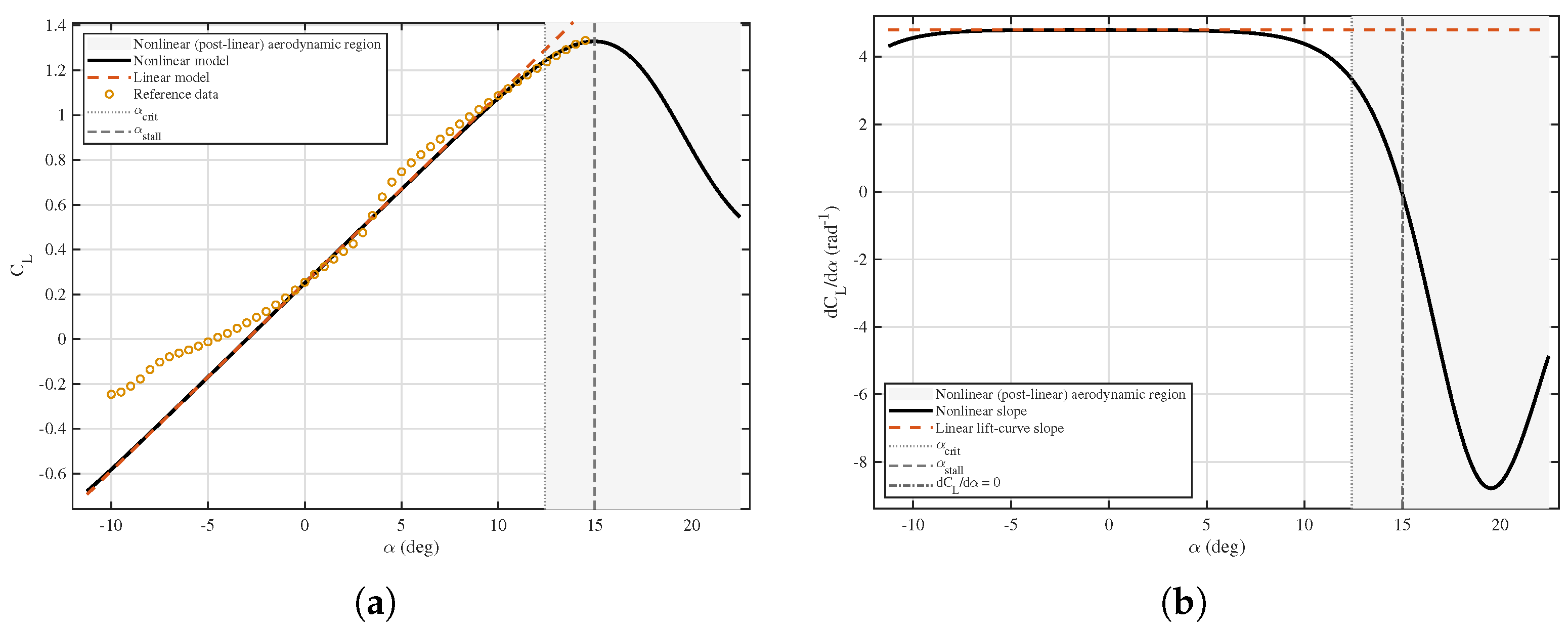
Figure 2.
Figure 2a compares the lift coefficient obtained from AVL/XFLR5 analyses with the nonlinear interpolation adopted in the dynamic model. Classical experimental data reported by Abbott and von Doenhoff [
25] are also included for qualitative comparison of the lift trend and stall behavior. The interpolation accuracy with respect to the aerodynamic data used for model construction resulted in a root mean square error of 0.1295 and a mean absolute error of 0.0844 for the lift coefficient.
The near-stall aerodynamic behavior was modeled through nonlinear interpolation of the aerodynamic coefficients obtained from the AVL/XFLR5 database over an extended angle-of-attack range. Consequently, the progressive reduction in lift-curve slope near the stall was directly incorporated into the dynamic model, allowing the local aerodynamic stability derivatives to vary along the transition envelope, although unsteady aerodynamic effects and explicit rotor–wing interactions were neglected.
The reduction of the lift-curve slope near stall is particularly relevant for transition flight in lift-plus-cruise eVTOL configurations, where aerodynamic and propulsive effects coexist. In this work, the local slope
is used as an indicator of departure from the linear aerodynamic regime. The onset of the nonlinear region is defined as the angle of attack at which the local slope decreases to 70% of its nominal linear value. Based on this criterion, as shown in
Figure 2b, the critical angle is
, and the maximum lift condition occurs at
, with
.
Therefore, the interval between and , spanning approximately , is interpreted as the nonlinear transition region preceding stall. In this region, the reduction in modifies the local stability derivatives and can significantly alter the short-period and phugoid-like dynamics during transition. This motivates the explicit consideration of the nonlinear pre-stall behavior when evaluating the effectiveness of the proposed control authority blending strategy.
Finally, it is important to note that the aerodynamic model adopted in this work is quasi-steady. Unsteady aerodynamic effects associated with rapid variations in angle of attack, wake development, circulatory lag, and dynamic stall are not modeled. These phenomena may become relevant during vertical-to-horizontal transition, particularly at low forward speeds and high angles of attack, where the aerodynamic response may exhibit hysteresis and phase lag. However, their inclusion would require higher-fidelity aerodynamic models or additional aerodynamic states, substantially increasing the computational cost and reducing the suitability of the model for repeated control-oriented simulations and future real-time implementation.
The quasi-steady formulation was adopted because the primary objective of this work is to evaluate the relative effectiveness of control authority blending strategies within a reduced-order framework suitable for repeated simulation and stability margin assessment. Strongly unsteady separated-flow phenomena, including dynamic stall and high-fidelity rotor–wake interactions, remain outside the scope of the present model and should be addressed in future work using higher-fidelity aerodynamic or aeroelastic formulations.
2.3. Vehicle Dynamic Model
2.3.1. Kinematics and Rigid-Body Dynamics
The aircraft kinematics are described using a quaternion-based formulation to avoid singularities associated with Tait–Bryan angle representations. The position dynamics in the inertial frame is given by
where
is the vector of inertial position,
is the velocity vector in the body frame, and
is the rotation matrix associated with the quaternion vector
.
The quaternion dynamics are
where
is the angular velocity vector and
is the quaternion kinematic matrix. Quaternion normalization is enforced during simulation.
The translational and rotational dynamics follow the Newton–Euler equations:
where
m is the mass of the aircraft,
is the inertia matrix of the body frame, and
and
are the total force and moment vectors.
2.3.2. Aerodynamic Forces and Moments
Aerodynamic forces and moments are modeled as nonlinear functions of the angle of attack
, sideslip angle
, and control surface deflections
, where
is the angle of attack,
is the sideslip angle, and
represents the control surface deflections (elevator, aileron, and rudder):
where
is the air density,
is the airspeed,
S is the wing reference area,
is the aerodynamic force coefficient vector, and
is the resulting aerodynamic moment coefficient vector over the center of gravity, corresponding to the terms
,
, and
, which are the roll, pitch, and yaw moment coefficients, respectively.
To capture pre-stall and near-stall behavior, the lift coefficient is modeled using a nonlinear blending between linear aerodynamics and a post-linear flat-plate approximation:
where
is a smooth sigmoid function that blends the linear and nonlinear aerodynamic regimes,
is the lift offset,
is the linear lift-curve slope, and
is the lift coefficient obtained from a flat-plate approximation in the post-stall regime. The full set of aerodynamic coefficients is provided in
Appendix A.
2.3.3. Propulsion Modeling
The propulsion system comprises a forward thrust unit (tractor) and four vertical propulsion units (lifters). The tractor thrust is modeled as a function of throttle input
and airspeed:
where
is the throttle command and
represents the propulsion model relating throttle input and airspeed to thrust.
Each lifter produces thrust proportional to the square of its rotor speed:
where
is the rotational speed of the
i-th rotor and
is the thrust constant. The corresponding reaction torque is
where
is the torque constant. The combined force and moment contributions of the lifters are obtained through a standard allocation mapping from rotor speeds to body forces and torques.
2.3.4. Forces and Moments
The total forces and moments are composed of gravitational, aerodynamic, and propulsive contributions:
where
is the gravitational force vector.
The aerodynamic forces in the body frame are denoted by the coefficients , , and , while the aerodynamic moments are denoted by , , and . These terms correspond to the baseline aerodynamic force and moment coefficients. The subscript coefficients, such as , , and , represent stability and control derivatives with respect to the associated variables.
The force and moment expressions presented below correspond to local small-perturbation models obtained from the nonlinear aerodynamic coefficient surfaces described previously. For a given operating condition along the transition trajectory (
,
,
,
,
,
), the aerodynamic coefficients are expanded about the corresponding reference operating point. Thus, the baseline coefficients
,
,
,
,
and
denote the values of the nonlinear aerodynamic model at the reference condition, while the subscript coefficients denote the local stability and control derivatives evaluated at that point, following the classical theory of small-perturbation flight-dynamics. For compactness, the perturbation notation is omitted in Equations (
11) and (
12), but the variables multiplying the derivatives should be interpreted as small deviations from the selected equilibrium condition.
Expanding the body-frame force components:
The corresponding moments are
where
and
are the roll and pitch angles,
is the total thrust generated by the vertical propulsion units, and
,
, and
are the corresponding moments.
2.3.5. Nonlinear State-Space Form and Linearization for Control Design
The complete nonlinear model is written as
where the state vector
includes position, attitude, linear velocities and angular rates, and the input vector
includes control surface deflections, tractor throttle, and lifter commands.
For control design and stability analysis, the nonlinear model is linearized about a trim condition corresponding to steady flight:
where
and
denote perturbations around the trim condition.
The longitudinal subsystem includes the states
, while the lateral-directional subsystem includes
. The resulting stability and control derivatives are summarized in
Appendix A.
2.4. Transition Strategy
The transition between vertical and forward flight regimes is achieved through a control allocation strategy that distributes authority between the fixed-wing control surfaces and the vertical propulsion units (lifters). This allocation is governed by a blending factor that depends on the airspeed. Let Va denote the airspeed and Vstall the stall speed. A normalized transition factor K is defined as follows:
where
represents the proximity to the stall region, and
(·) denotes saturation to the interval
. For
,
K approaches unity, indicating dominance of the lifter-based control. As
increases toward 1.2
,
K decreases toward zero, transferring control authority to the aerodynamic surfaces. Based on the definition of
K, two transition strategies are evaluated: linear blending and sigmoid blending. For both strategies control commands are distributed as follows:
where
represents the fixed-wing control inputs (elevator, aileron, rudder, and throttle),
denotes the lifter command vector and
is the control blending factor, which is defined in each strategy as follows:
The linear approach results in a proportional redistribution of control authority with respect to airspeed. The sigmoid approach provides a smooth nonlinear scheduling of the blending factor, where controls the steepness of the authority transfer and defines the location of the transition along the normalized airspeed range. The fixed-wing and lifter controllers generate feedback commands and , which are subsequently weighted by the blending factor to produce the allocated actuator commands and . By properly selecting and , the authority transfer can be concentrated around a prescribed airspeed interval while preserving a continuous transition in the commands sent to the aerodynamic surfaces and vertical propulsion units. This property is particularly important near stall conditions, where smooth redistribution between propulsion-based and aerodynamic control helps preserve stability and mitigate abrupt dynamic responses.
2.5. Control Design
The control architecture is structured as a cascaded system composed of decoupled lateral-directional and longitudinal subsystems. The design follows a classical inner–outer loop configuration, in which inner loops regulate fast dynamics, while outer loops generate reference signals.
A separation of bandwidth is enforced between loops, such that each outer loop operates at a lower bandwidth than its corresponding inner loop. This hierarchical structure ensures closed-loop stability and consistent tracking performance across the flight envelope.
2.5.1. Gain Scheduling and Controller Tuning
The aircraft dynamics vary significantly with airspeed, especially during transition. To maintain consistent control performance, gain scheduling is implemented as a function of airspeed.
For the fixed-wing regime, controller gains are obtained from linearized models around trimmed flight conditions. In the hover regime, the nonlinear coupling introduced by motor mixing prevents direct analytical tuning. Therefore, gains are adjusted empirically.
The controller gains adopted in this work were selected through iterative simulation-based tuning to ensure stable tracking performance, smooth transition behavior, and adequate damping margins throughout the investigated flight envelope. Particular emphasis was placed on maintaining stability in the critical near-stall transition region while avoiding excessive actuator activity and abrupt control authority transfer between the propulsion and aerodynamic control systems.
Controller gains are obtained at multiple trimmed flight conditions and interpolated across the flight envelope. The resulting gain schedules are summarized in
Appendix B.
2.5.2. Fixed-Wing Control
During forward flight, the aircraft is controlled using aerodynamic control surfaces. The control strategy is based on single-input single-output (SISO) loops, allowing independent regulation of the main flight variables.
The lateral-directional control is organized in a cascaded structure. The outer loop regulates the heading angle , generating a roll reference , while the inner loop tracks the roll angle through the aileron deflection .
The roll control law is
where
p is the roll rate.
To ensure coordinated flight, a sideslip controller is implemented using a proportional–integral structure:
where
is the sideslip angle.
The longitudinal subsystem is also implemented using a cascaded structure. The outer loop regulates altitude h, generating a pitch reference , while the inner loop controls the pitch angle via elevator deflection .
The pitch control law is
where
q is the pitch rate.
The airspeed is regulated through throttle modulation using a proportional–integral controller:
Throttle-based speed regulation is adopted to avoid pitch-based acceleration strategies, particularly at low altitude.
2.5.3. Lifter-Based Control (Hover Regime)
In hover and low-speed flight, control is achieved through differential thrust generated by the lifters. The control inputs are mapped to rotor speeds through a motor mixing algorithm.
The thrust generated by each rotor can be calculated using the rotational speed of the i-th lifter (Equation (
24)), of which the inverse allocation from total force and moments to individual rotor commands is
where
is the allocation matrix defined by the vehicle geometry. For a symmetric quad lift layout,
maps squared rotor speeds to total vertical force and body moments according to lifter arm length, thrust coefficient, torque coefficient and rotor rotation directions.
The corresponding motor commands are
where
is the maximum rotor speed.
Attitude regulation in hover is achieved through control of roll and yaw moments:
where
and
denote the commanded roll and yaw angles prescribed by the optimal reference trajectory, and
p and
r denote the roll and yaw rates, respectively. During transition, these references maintain wing-level flight and constant heading.
Altitude is controlled through modulation of the total vertical thrust:
where
is the commanded lifting force, defined as positive upward, and
acts as a feedforward term that compensates for gravity. The altitude
h is defined using the same positive-upward convention, and
denotes the change in altitude. Thus, the proportional term increases lift when the vehicle is below the commanded altitude, whereas the derivative term opposes vertical motion and provides damping. Since the aircraft body-fixed
Z axis is positive downward in the adopted flight-dynamics convention, this upward lifting force corresponds to a negative body-axis
Z-force near level flight.
The forward motion in hover and transition is achieved by generating a pitch angle, which produces a horizontal thrust component. A cascade structure is used, where the outer loop regulates the ground speed and generates a pitch reference , while the inner loop tracks and produces the corresponding torque command.
Ground speed is used instead of airspeed in this regime due to improved measurement reliability at low velocities.
3. Results and Discussion
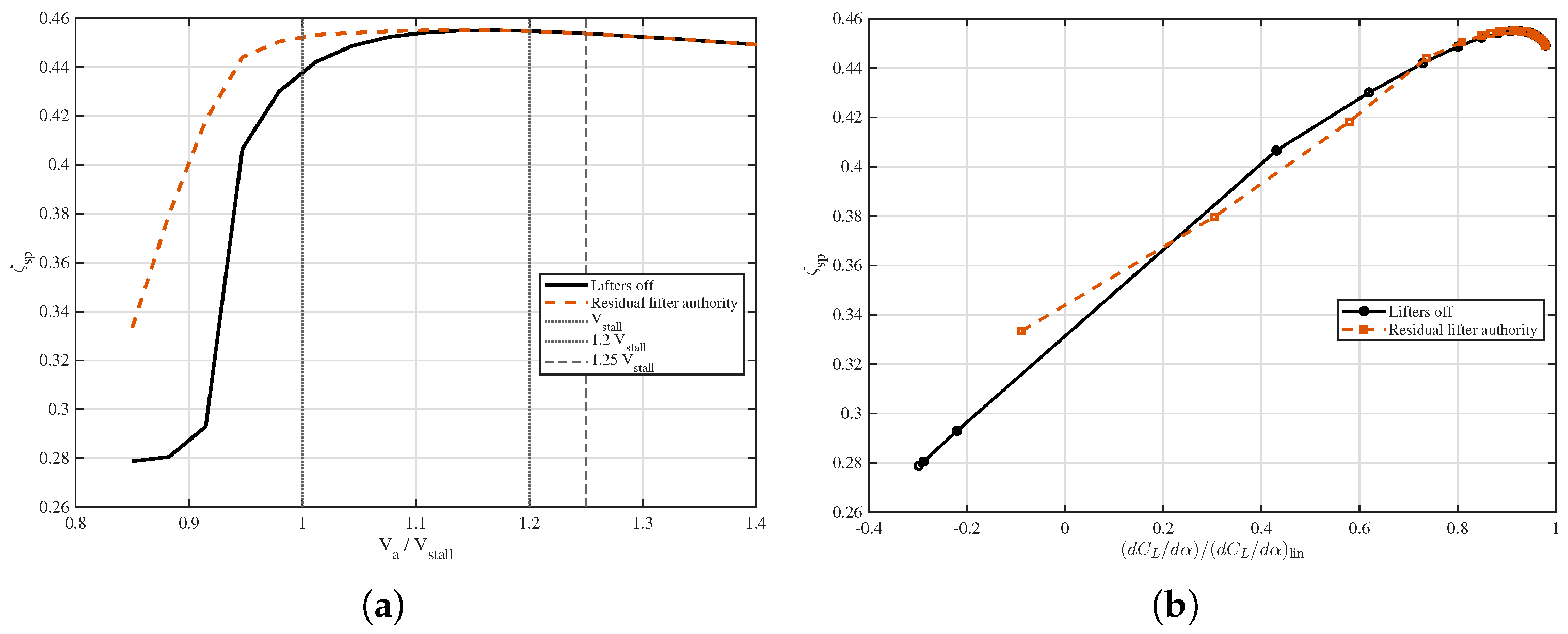
Figure 3 presents the variation of the short-period damping ratio as a function of normalized airspeed and normalized lift-curve slope, providing insight into the fundamental mechanisms governing dynamic stability during transition flight.
As shown in
Figure 3a, the short-period damping ratio decreases as the airspeed is reduced toward the near-stall regime
. This behavior cannot be attributed solely to the reduction in dynamic pressure and highlights a limitation of transition analyses that rely primarily on dynamic pressure variation or assume nominal aerodynamic derivatives [
4,
5]. The longitudinal dynamics also depend on the local stability derivatives, which vary as the lift-curve departs from its pre-stall linear behavior.
In particular, the reduction in , together with the changing projection of lift and drag onto the body-fixed axes at high angles of attack, modifies the local force derivatives, especially . This variation propagates to the pitching dynamics through the moment balance about the center of gravity, affecting the effective longitudinal aerodynamic stiffness associated with angle-of-attack perturbations. Therefore, the observed reduction in short-period damping reflects the combined influence of reduced dynamic pressure, near-stall aerodynamic nonlinearities, and the resulting changes in the local linearized stability derivatives.
This effect is further evidenced in
Figure 3b, where the damping ratio is expressed as a function of the normalized lift-curve slope. As
decreases, the local force and moment derivatives associated with angle-of-attack perturbations are modified, reducing the effective restoring contribution in the longitudinal dynamics. Consequently, the short-period mode becomes increasingly underdamped in the analyzed operating range, making the system more sensitive to disturbances and more prone to oscillatory behavior.
This degradation defines a critical assisted-transition region, typically within , where the aircraft may operate near or below the equivalent wing-borne stall speed due to residual support from the vertical propulsion system.
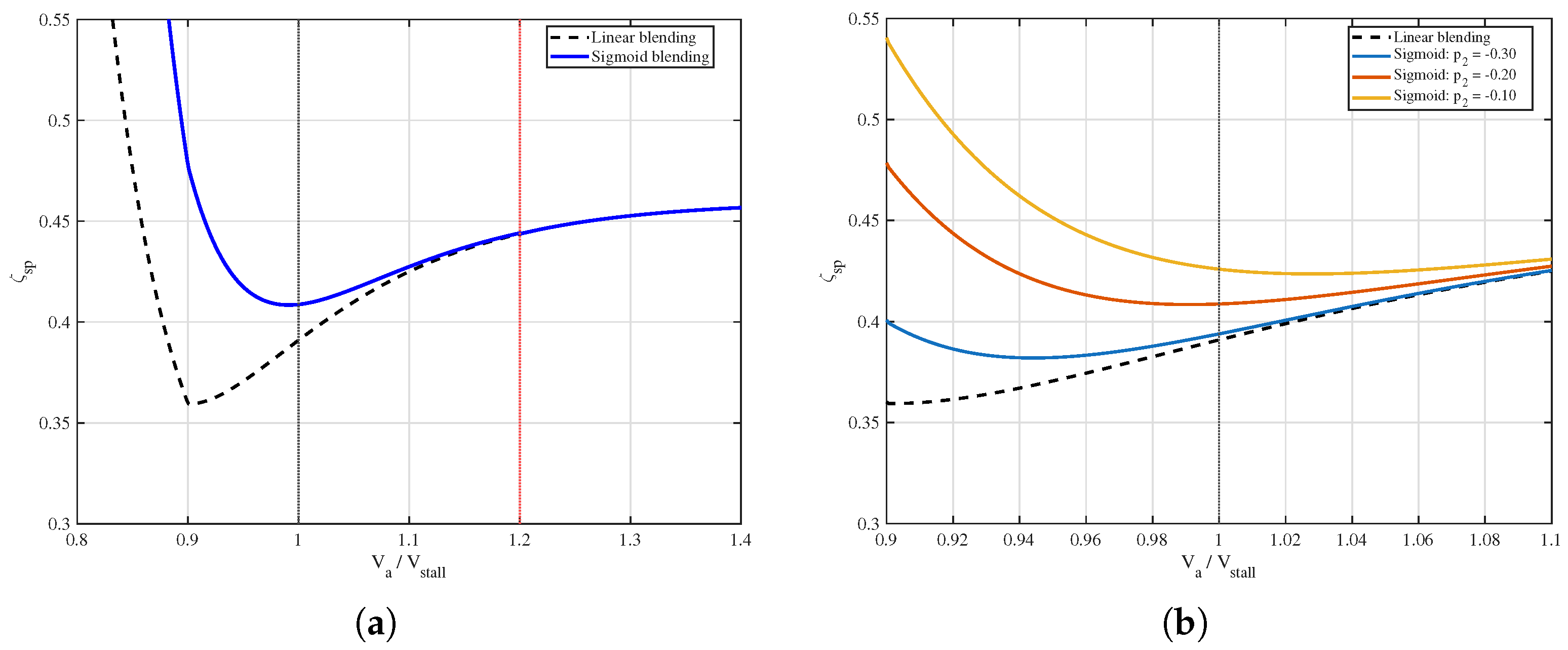
Figure 4 compares the linear and sigmoid blending strategies used to distribute control authority between lifter-based and fixed-wing controllers.
A sensitivity analysis was performed by varying the midpoint parameter
of the sigmoid blending function while keeping the steepness parameter
fixed. In the present analysis,
was kept constant in order to isolate the effect of
on the location of the damping recovery. As shown in
Figure 4b, increasing
shifts the control authority transfer toward higher normalized airspeeds, resulting in an earlier contribution of the vertical lifters within the critical near-stall region. This shift increases the minimum short-period damping ratio and improves the associated stability margins over the investigated range. These results confirm that
is the primary parameter governing the location of the damping recovery and should therefore be selected to balance stability enhancement and smooth authority redistribution.
For the nominal sigmoid configuration (), a quantitative comparison in the critical region () reveals that the sigmoid blending increases the minimum damping ratio from 0.3594 to 0.4084, corresponding to an improvement of approximately 13.65%. This result demonstrates that control authority blending actively compensates for the loss of aerodynamic stiffness near stall, directly increasing short-period damping in the most critical operating condition.
While previous works demonstrate successful transition control using blending or control allocation strategies [
4,
11], they typically assume constant or smoothly varying aerodynamic effectiveness. The present results show that neglecting lift-curve slope degradation leads to an overestimation of stability margins, particularly in the near-stall region where aerodynamic stiffness is significantly reduced.
However, this improvement is achieved at the cost of sharper variations in system dynamics, as evidenced by the increase in the local gradient of the damping curve from 0.4171 (linear) to 2.0722 (sigmoid). This behavior reveals a fundamental trade-off between stability recovery and smoothness of control authority redistribution.
The damping variation remains comparable between both approaches (0.0654 for linear and 0.0676 for sigmoid), indicating similar global dispersion of the damping ratio. Nevertheless, the sigmoid strategy consistently provides higher damping across the transition region, with a maximum improvement of 0.1167 and an average increase of 0.0307.
Additionally, the minimum damping point shifts closer to the stall condition when using sigmoid blending, moving from to . This indicates that the region of lowest stability is shifted closer to stall, effectively expanding the portion of the flight envelope where adequate damping is maintained.
Without control authority blending, the degradation of aerodynamic effectiveness would lead to further reduction in damping and potentially to loss of stability in the near-stall region, highlighting the necessity of coordinated control between propulsion and aerodynamic surfaces during transition [
11].
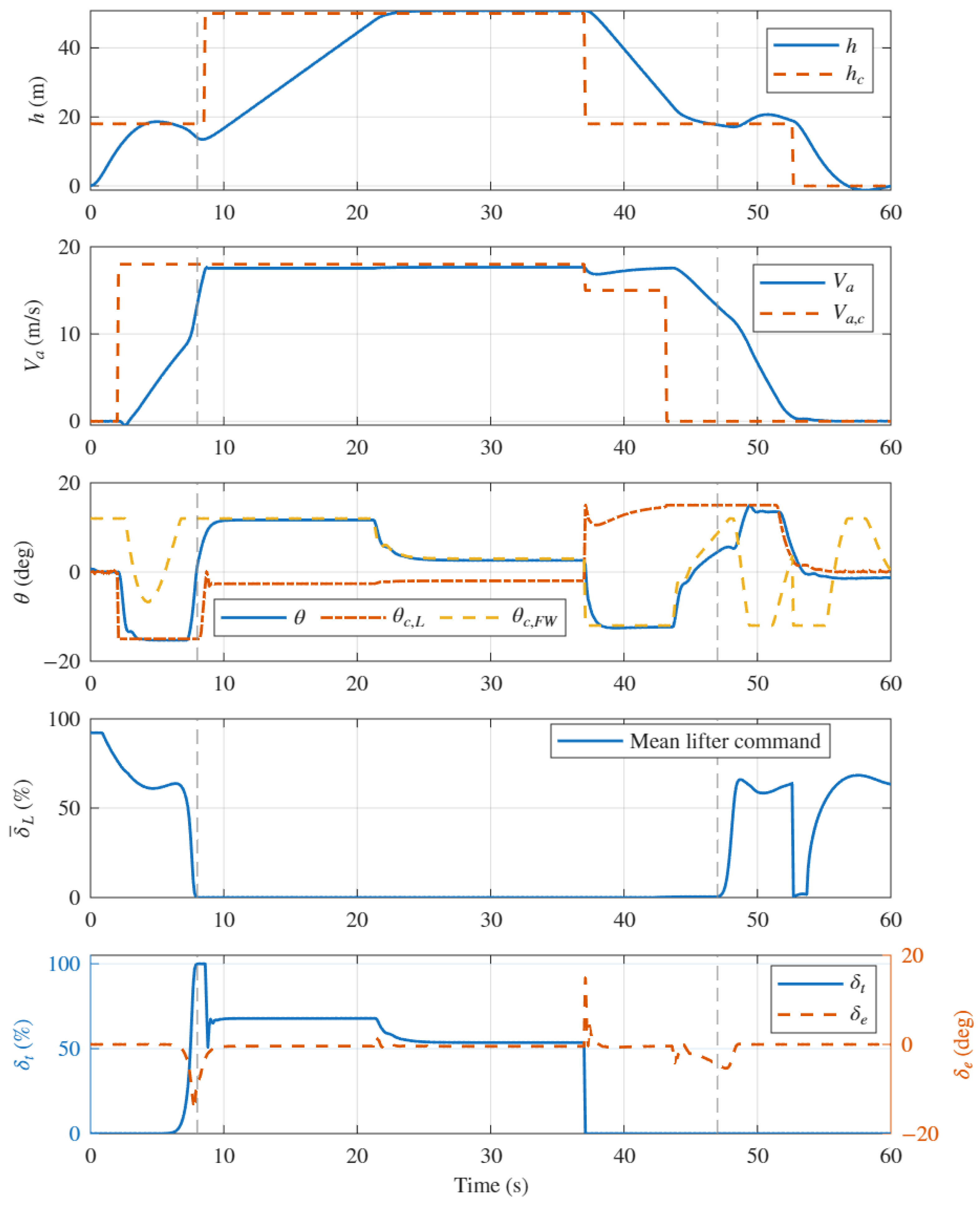
To evaluate the practical implications of these results, the closed-loop response of the system is shown in
Figure 5.
The simulated flight trajectory was designed to reproduce a complete lift-plus-cruise mission profile, including vertical takeoff, transition to forward flight, cruise, descent, and landing.
Initially, the aircraft is commanded to take off from ground level and reach an altitude of approximately 18 m using the lifters. At around s, the hover-to-forward-flight transition phase begins and is completed at approximately s, when the lifter thrust is reduced to zero and the vehicle becomes fully controlled by the tractor propulsion system and aerodynamic surfaces.
During the forward-flight phase, the aircraft climbs to an altitude of 50 m while accelerating to the desired cruise speed, representing steady fixed-wing operation.
At approximately s, a descent maneuver is initiated, commanding the altitude to decrease from 50 m to 18 m. During this phase, the cruise throttle is progressively reduced and eventually reaches zero, contributing to the reduction in aerodynamic lift and initiating the descent, while the longitudinal motion remains regulated by the aerodynamic control surfaces, mainly through elevator deflection. Shortly after, the ground speed is commanded to decrease, reaching near-zero values at around s.
At approximately s, the forward-to-hover transition phase begins, with the reactivation of the vertical propulsion system and a progressive reduction of aerodynamic control authority. The aircraft then performs a controlled vertical descent, completing the landing maneuver at approximately s.
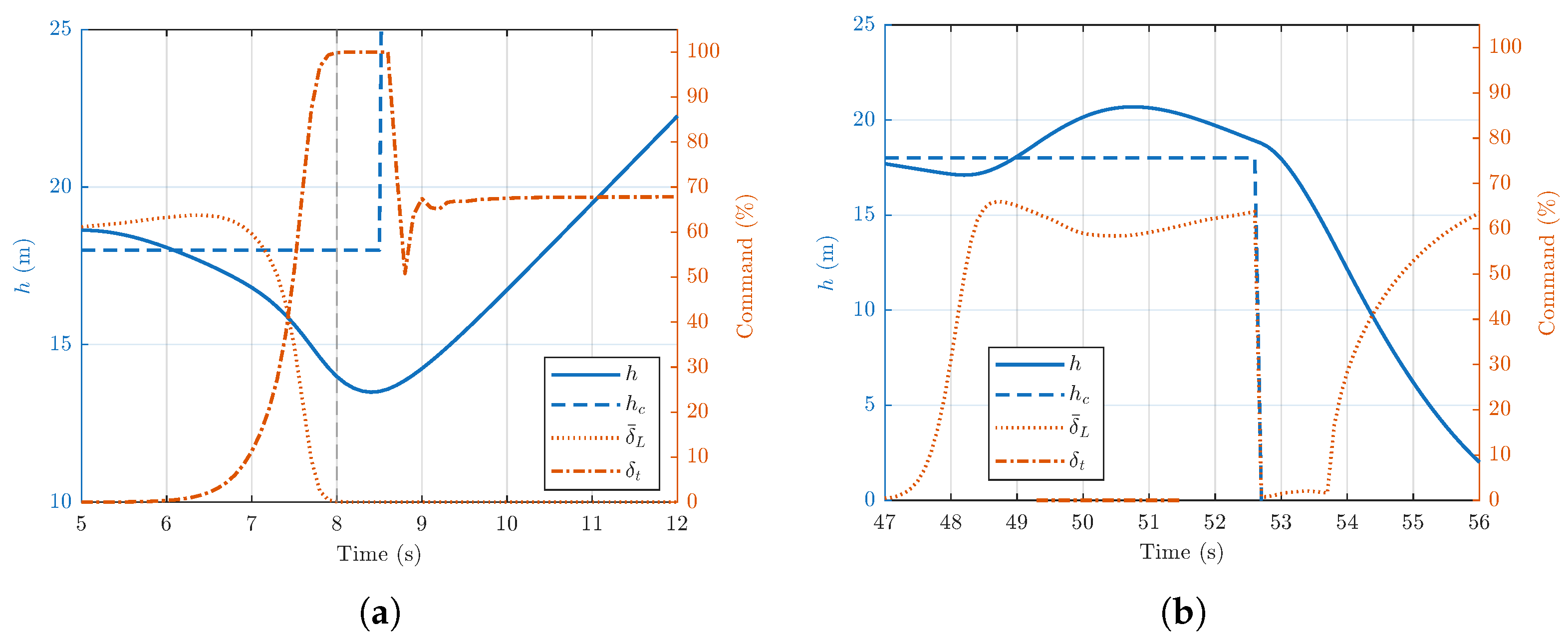
The altitude response demonstrates accurate tracking performance, with only small transient deviations during the regime transitions. During the hover-to-forward-flight transition, a temporary altitude loss is observed due to the reduction in vertical thrust before sufficient aerodynamic lift is established.
A quantitative analysis shows a minimum altitude of 13.49 m at s, corresponding to an undershoot of 4.51 m (25.05%). During landing, a maximum altitude of 20.69 m is observed at s, corresponding to an overshoot of 2.69 m (14.96%).
These results reveal an inherent asymmetry in transition dynamics, where the forward transition is limited by the gradual buildup of aerodynamic lift, while the landing phase is dominated by the faster response of propulsion-based control.
The airspeed response shows smooth acceleration and deceleration, while the pitch dynamics confirm the transition between thrust-vectoring and aerodynamic control.
The control inputs illustrate the redistribution of authority. The lifter command decreases with increasing airspeed, while during descent the throttle is reduced to zero and the longitudinal dynamics are primarily governed by elevator deflection. This behavior confirms the shift from propulsion-based actuation to aerodynamic control.
Figure 6 provides detailed views of the transition phases.
Overall, the results demonstrate that the transition dynamics of lift-plus-cruise eVTOL aircraft cannot be fully understood without explicitly accounting for the aerodynamic separation that reduces the lift-curve slope near the stall region. The analysis reveals that this lift-curve slope reduction is the primary mechanism driving the loss of short-period damping near the stall, whereas control authority redistribution acts as a compensatory mechanism to restore stability. This interplay between pre-stall lift-curve slope degradation and control allocation is not captured in conventional formulations, underscoring the need for physically grounded aerodynamic models in the stability and control analysis of eVTOL systems.
4. Conclusions
This paper investigated the dynamic behavior and control of a lift-plus-cruise eVTOL aircraft during transition flight, with emphasis on the interaction between lift-curve slope degradation in the pre-stall and near-stall regions and control authority redistribution between rotor-borne and wing-borne lift. The results show that this interaction is a primary driver of stability loss in both short-period and phugoid-like motions during transition.
Within the assumptions of the present reduced-order model, the results demonstrate that the reduction in lift-curve slope plays a dominant role in the degradation of short-period stability near the stall. As the aircraft approaches the low-speed transition boundary, the resulting changes in the local longitudinal stability derivatives lead to a significant decrease in damping ratio, defining a critical region in which aerodynamic control alone may be insufficient to maintain the desired stability margins.
To address this limitation, a control allocation strategy based on airspeed-dependent blending between propulsion-based and aerodynamic control was evaluated. The comparison between linear and sigmoid blending strategies showed that the sigmoid approach improves stability margins in the critical near-stall region, increasing the minimum damping ratio by approximately 13.65%, while maintaining similar global variation throughout the flight envelope.
However, this improvement is accompanied by increased local sensitivity of the system dynamics, reflecting a trade-off between stability enhancement and smoothness of control authority redistribution. This result highlights the importance of carefully designing blending functions to balance robustness and transient response.
Closed-loop simulations of a complete mission profile, including takeoff, transition, cruise, descent, and landing, confirmed the effectiveness of the proposed control architecture. The system exhibited stable behavior and accurate trajectory tracking in all flight regimes.
Although these closed-loop evaluations focus on nominal mission profiles, atmospheric disturbances such as wind shear and continuous turbulence significantly affect eVTOL stability during hover and transition flight. While explicit wind modeling and dynamic disturbance rejection analysis remain outside the scope of this work, the enhanced modal damping achieved through the proposed sigmoid blending strategy—which increases the minimum short-period damping ratio by —fundamentally strengthens the system’s inherent resilience against external perturbations. This increased stability margin helps mitigate low-frequency attitude oscillations that are typically amplified by wind gusts in multi-regime flight, establishing a robust baseline for future explicit disturbance-rejection control designs.
The transition dynamics were further quantified. During the hover-to-forward-flight transition, an altitude undershoot of 4.51 m (25.05%) was observed, resulting from the reduction in vertical thrust before sufficient aerodynamic lift is established. During the landing phase, an altitude overshoot of 2.69 m (14.96%) occurred due to the rapid reactivation of vertical propulsion. These results highlight an inherent asymmetry in the transition dynamics, associated with the delayed buildup of aerodynamic lift and the faster response of propulsion-based control.
The analysis confirms that the combined use of propulsion and aerodynamic control is essential to ensure stability and performance in lift-plus-cruise configurations, particularly in the vicinity of stall where aerodynamic effectiveness is reduced.
Despite these contributions, some limitations should be noted. The aerodynamic model relies on analytical nonlinear representations and does not explicitly account for high-fidelity effects such as unsteady aerodynamics, turbulence, wake interactions, or detailed rotor–wing interaction dynamics. In addition, the propulsion model assumes idealized thrust generation without considering actuator dynamics, delays, or saturation effects beyond the implemented control structure. Furthermore, validation is limited to numerical simulations, and experimental verification is required to confirm the stability characteristics observed under real operating conditions. Although experimental validation is beyond the scope of this work, the observed trends are consistent with the established aerodynamic behavior in the near-stall regime.
In general, the proposed framework provides a consistent methodology for modeling, control design, and transition management in eVTOL aircraft, explicitly accounting for the reduction in lift-curve slope near stall and the corresponding redistribution of control authority. The results demonstrate a direct relationship between lift-curve slope degradation and the loss of short-period damping, showing that aerodynamic stiffness degradation is a primary mechanism driving stability loss during transition. By quantifying this relationship, the proposed approach provides a physically grounded explanation of transition dynamics and supports the design of more robust control strategies for multi-regime aerial vehicles.
Regarding the scalability of these findings, the core physical mechanisms identified in this work, particularly the coupling between pre-stall lift-curve slope degradation and longitudinal short-period damping reduction, are expected to remain relevant for larger urban air mobility (UAM) aircraft. In larger lift-plus-cruise configurations, the transition to wing-borne flight still forces the fixed wing to operate at high lift coefficients near the low speed boundary of the transition envelope. While larger platforms exhibit higher structural mass, greater inertia, and distinct Reynolds numbers that modify their specific longitudinal flight modal frequencies, the degradation of aerodynamic stiffness near stall remains fundamentally bound to these local lift-curve slope reductions. Consequently, the severe damping degradation observed here represents a critical transition-flight challenge that must be considered in full-scale configurations. Furthermore, while the proposed airspeed-dependent blending strategy provides a fundamentally scalable control framework, the exact quantitative boundaries, such as critical airspeed ranges, damping ratios, and allocation schedules, are inherently vehicle-specific. Applying this methodology to larger configurations therefore requires recomputing the underlying aerodynamic database, trim conditions, and local linearizations to tailor the control allocation to the unique wing loading, inertia, and rotor–wing interference of the target aircraft.
Future work will focus on experimental validation, the modeling of unsteady aerodynamic effects, robustness analysis under external disturbances and model uncertainties, and the extension of the control framework to more complex aircraft configurations and flight conditions. Future investigations will also consider disturbance-rejection and robustness-oriented control strategies, including wind disturbances, atmospheric turbulence, actuator uncertainties, and more advanced nonlinear control architectures for transition-flight operations.




 ,
,