


Abstract
Mesenchymal stem cells are multipotent stromal cells with immunomodulatory, anti-inflammatory, and trophic properties that support tissue repair and regeneration. Increasing evidence suggests that their therapeutic effects are primarily mediated by paracrine signaling, especially through extracellular vesicles, which can cross the blood–brain barrier and act as cell-free therapeutic agents. Preclinical and clinical studies in stroke, multiple sclerosis, spinal cord injury, and neurodegenerative diseases report encouraging outcomes but also reveal major challenges, including limited engraftment, donor-related heterogeneity, incomplete understanding of mechanisms, and potential oncogenic risks. Recent advances in biotechnology—such as mesenchymal stem cell-derived extracellular vesicles, genetic engineering using CRISPR/Cas9 or viral vectors, 3D culture systems, and bioengineered delivery platforms—offer new opportunities to overcome these limitations. Early clinical trials demonstrate promising safety and functional improvements, yet results remain inconsistent, highlighting the need for standardized protocols and large-scale controlled studies. This review outlines current knowledge, key challenges, and emerging strategies aimed at optimizing mesenchymal stem cell-based approaches for regenerative neurology.
1. Introduction
Mesenchymal stem cells (MSCs) are multipotent stromal cells capable of differentiating into various mesodermal cell types, including osteocytes, chondrocytes, and adipocytes. In addition to their differentiation potential, MSCs exhibit significant immunomodulatory and anti-inflammatory properties, support angiogenesis, and promote tissue repair and regeneration through a broad range of paracrine mechanisms. These properties make them promising tools for the treatment of various degenerative and inflammatory diseases, particularly in the context of neurological disorders, where immune regulation and support for neuronal survival are critical.
MSCs can be isolated from a wide range of tissues, including bone marrow, adipose tissue, umbilical cord blood, Wharton’s jelly, dental pulp, and others. Compared to many other cell types, MSCs offer several practical advantages: they are relatively easy to obtain and expand in vitro, demonstrate low immunogenicity, and can be propagated at a large scale under standardized conditions. These features have accelerated their use in both preclinical and clinical settings.
A growing body of evidence suggests that the therapeutic effects of MSCs are mediated primarily through the release of extracellular vesicles (EVs), rather than through direct cell replacement. EVs are nanoscale membrane-bound particles secreted by cells under both physiological and pathological conditions. They are traditionally divided into three major categories based on their biogenesis and size: exosomes (40–100 nm), which originate from endosomal compartments; microvesicles (50–1000 nm), which bud directly from the plasma membrane; and apoptotic bodies (50–5000 nm), which are released during programmed cell death [1,2].
Both exosomes and microvesicles serve as carriers of biologically active molecules such as proteins, lipids, mRNAs, and non-coding RNAs (including miRNAs), thus enabling horizontal transfer of signaling cargo between cells. Unlike them, apoptotic bodies mainly reflect disassembly of dying cells and are typically less involved in regulated intercellular communication.
Given the critical role of EVs in intercellular signaling, their potential as therapeutic agents has received increasing attention. EVs derived from MSCs (MSC-EVs) have been shown to contain a wide range of bioactive molecules involved in neuroprotection, neurogenesis, immunoregulation, and modulation of inflammation [3]. These vesicles can cross biological barriers, including the blood–brain barrier, and act on target cells without the risks associated with live cell transplantation, such as immune rejection or tumor formation [4].
Recent studies have demonstrated the beneficial effects of MSC-EVs in experimental models of various neurological disorders, including stroke, spinal cord injury, Parkinson’s disease, and multiple sclerosis [5,6]. These findings underscore the therapeutic promise of MSC-derived EVs as a cell-free and biologically safe alternative to stem cell transplantation.
However, despite the growing interest and encouraging results, several unresolved issues remain. These include limited survival and engraftment of transplanted MSCs, variability in EV composition, and challenges in large-scale manufacturing, including differences in EV isolation methods (e.g., ultracentrifugation versus size-exclusion chromatography), which can affect purity and functional activity. Standardization of isolation protocols and functional assays is therefore urgently needed. Furthermore, while two-dimensional cultures have provided valuable insights, they fail to fully recapitulate the complexity of the injured neural microenvironment. In response, advanced strategies such as 3D culture systems, biomaterial-based encapsulation, and biofabrication techniques are being explored to enhance the therapeutic efficacy and reproducibility of MSC-based approaches.
In this review, we summarize the current knowledge on the application of MSCs and their extracellular derivatives in regenerative medicine, focusing on neurological diseases. We highlight both the persistent limitations and the emerging technological solutions aimed at improving their clinical utility. Publications indexed in PubMed and Scopus between 2015 and 2025 were analyzed, with emphasis on original research and clinical trials on ClinicalTrials.gov addressing mesenchymal stem cells and their derivatives in neurological diseases.
2. Clinical Studies on the Application of MSCs
Early-phase clinical trials of MSCs in stroke, multiple sclerosis, and spinal cord injury (SCI) have demonstrated preliminary signs of safety and potential therapeutic benefit, including reduced inflammation and improved functional recovery [7,8,9,10]. However, these findings remain exploratory, and most evidence is still at the Phase I–II level. However, the results of most studies remain contradictory, and further randomized trials are needed. To facilitate comparison between studies and highlight the heterogeneity of clinical trial designs, a summary table of MSCs-based interventions in major neurological disorders is presented below (Table 1).
Table 1.
Summary of clinical trials on MSCs in neurological diseases.
2.1. Stroke
Ischemic stroke is characterized by acute interruption of cerebral blood flow, leading to neuronal death, neuroinflammation, and loss of neural connectivity. Current therapeutic options are limited to narrow time windows, and there are no effective neurorestorative treatments for chronic stroke. These factors make stroke a major target for cell-based therapies aimed at promoting neuroregeneration and functional recovery.
In recent years, convincing data have been accumulated on the safety and potential of MSCs in patients with stroke. In the study by Bang et al., 2005, involving 30 patients with acute middle cerebral artery ischemic stroke, intravenous administration of autologous bone marrow-derived MSCs (1 × 10⁸ cells) was found to be safe and contributed to variable improvement in the Barthel Index, with a trend toward lower scores on the modified Rankin Scale; serological and neuroimaging assessments showed no adverse effects [11]. In a more recent article, Levy et al., 2019, described the results of a phase I/II clinical trial including 36 patients with chronic stroke (on average 4.2 years after the event) who received a single infusion of allogeneic bone marrow-derived MSCs from healthy donors (up to 1.5 million cells/kg). No serious adverse events related to therapy were recorded, and functional outcomes (NIHSS, Barthel, MMSE, depression scale) showed statistically significant improvement over 12 months of follow-up [12]. Both studies confirm that intravenous administration of MSCs in stroke is effective and well tolerated, supporting the need for further randomized trials with larger cohorts and strict evaluation criteria.
However, in the randomized clinical trial by Chung et al., 2021, results were obtained that contradicted the above. The use of autologous MSCs for the treatment of ischemic stroke (IV injection) in 39 patients in the experimental group and a control group of 15 patients also demonstrated the safety of this treatment. However, this study provided evidence that autologous MSCs do not improve 90-day outcomes in patients with chronic stroke [8]. The discrepancy between the results of Bang et al. (2005) [11] and Chung et al. (2021) [8] may be attributed to several factors. First, the study by Bang et al. [11] involved patients in the subacute stage of stroke, whereas Chung et al. [8] investigated subjects with chronic ischemic stroke, in whom neuroregenerative potential is significantly lower. Second, differences in the dose and timing of MSC administration, as well as variability in cell isolation and culture protocols, may have influenced therapeutic efficacy. Finally, the limited sample size and heterogeneity of clinical and functional assessment criteria across studies complicate direct comparison of outcomes. These factors underscore the importance of standardized trial design and patient stratification in future investigations.
2.2. Multiple Sclerosis
Multiple sclerosis is a chronic inflammatory demyelinating disease of the central nervous system, driven by autoimmune mechanisms and neurodegeneration. Despite the availability of immunomodulatory drugs, progressive multiple sclerosis remains largely untreatable. The immunoregulatory and neuroprotective properties of MSCs make them promising candidates for modifying disease progression and repairing neuronal damage.
Randomized, double-blind, placebo-controlled phase II clinical trial for the treatment of patients with progressive multiple sclerosis demonstrated the effectiveness of treatment using bone marrow MSC-derived neural progenitors (NPs) [10]. In year one of the study, subjects assigned to the MSC-NP group received six separate IT injections of up to 1 × 10⁷ autologous MSC-NPs spaced two months apart (treatments one through six). Intrathecal injection of MSC-NP led to improvement in bladder function and a reduction in the rate of gray matter atrophy on brain MRI. Biomarker analysis showed increased MMP9 and decreased CCL2 levels in cerebrospinal fluid after treatment. Although encouraging, these findings remain preliminary, and further studies are needed to confirm the reproducibility and long-term clinical relevance of these effects.
2.3. Spinal Cord Injury
Spinal cord injury (SCI) leads to irreversible loss of sensory and motor function due to extensive neuronal death, glial scar formation, and chronic inflammation. Current treatments focus primarily on stabilization and rehabilitation, with limited regenerative outcomes. MSC-based therapies offer potential for neuroprotection, axonal regeneration, and modulation of the post-injury microenvironment.
In the study by Macêdo et al. (2024), autologous bone marrow-derived MSC transplantation was performed in patients with chronic cervical SCI. Patients received two doses of MSCs: an intraspinal injection following hemilaminectomy and, three months later, an intrathecal injection. The therapy was shown to be safe, with MRI findings revealing no new gliotic foci or signs of tumor growth. Functional assessments did not demonstrate significant improvement in patient outcomes following MSC administration. However, the lack of randomization and the small sample size of six patients limit the ability to draw definitive conclusions [13].
In another recent phase I clinical trial, intrathecal administration of autologous adipose-derived MSCs was carried out in 10 patients with SCI [14]. The results confirmed the safety of this therapeutic approach, with 7 out of 10 patients demonstrating improvements on the Abbreviated Injury Scale (AIS). Nevertheless, AIS outcomes should be interpreted with caution, as they do not account for factors such as level and severity of injury, etiology, timing of intervention, comorbidities, disease-modifying factors, and patient-specific characteristics including genetic polymorphisms [16]. Consequently, patients classified within the same AIS category may present with distinct functional outcomes. Yet, the absence of randomization, small cohort size, and variability in injury characteristics limit interpretation. These data collectively indicate safety and feasibility, but do not yet demonstrate clinical efficacy.
2.4. Alzheimer’s Disease
Alzheimer’s disease is a progressive neurodegenerative disorder characterized by amyloid-β accumulation, tau pathology, synaptic dysfunction, and neuronal loss. Current pharmacological therapies provide only symptomatic relief without altering disease progression. MSCs and their derivatives represent a novel approach targeting neuroinflammation and promoting neurotrophic support in Alzheimer’s disease.
Kim et al. (2021) successfully conducted a phase I clinical trial of intracerebroventricular administration of human umbilical cord blood-derived MSCs (hUCB-MSCs) in patients with mild-to-moderate Alzheimer’s disease. Nine patients were implanted with Ommaya reservoirs, through which hUCB-MSCs were administered three times at 4-week intervals: three patients received a low dose (1.0 × 10⁷ cells/2 mL), while six patients received a high dose (3.0 × 10⁷ cells/2 mL). Transient fever occurred immediately after administration and resolved spontaneously within 1–2 days. This response likely reflects immune reactions either to hUCB-MSCs themselves or to serum and culture medium components. Alzheimer’s disease biomarkers (total tau, phosphorylated tau, and Aβ42) decreased one day after each injection but returned to baseline within four weeks. Amyloid-PET imaging revealed modest improvements in some patients; however, the absence of a control group makes it difficult to draw firm conclusions regarding efficacy [15].
Overall, despite the substantial number of clinical trials on MSCs registered at ClinicalTrials.gov, their current status remains uncertain. The majority of studies are either incomplete or lack publicly available results, preventing a definitive evaluation of the clinical efficacy and safety of MSC-based therapies at this stage. Large, randomized Phase III trials are still required to establish the therapeutic efficacy and reproducibility of MSC-based interventions. Therefore, the current evidence should be regarded as early clinical-stage data, not as proof of clinical readiness.
3. Old Problems and Challenges
Despite the active development of MSC application technologies and the promising results of preclinical studies in neurological diseases, a number of key problems remain that limit their clinical use.
- (1)
- Low efficiency of migration and engraftment. One of the main obstacles remains the low survival and limited migration of MSCs. In nonhuman primates, after intravenous administration, the efficiency of MSC engraftment into various tissues is extremely low, ranging from 0.1 to 2.7% [17]. The homing of culture-expanded MSCs is ineffective compared to leukocytes and hematopoietic stem cells, which is apparently due to the absence of the corresponding adhesion receptors and chemokines; however, there are engineering strategies that can enhance homing [18]. Such strategies include genetic modification, cell surface engineering, MSC priming in vitro, and, in particular, ultrasound-based methods [19].
- (2)
- Heterogeneity of sources and cell quality. A key problem remains the variability of MSC characteristics, which depends on donor age, method of isolation, culture conditions, and the selected tissue source (bone marrow, adipose tissue, umbilical cord blood) [20]. It is known that with donor age, the proliferative potential and differentiation capacity of MSCs decrease [21,22], which is critical for neuroregeneration.
- (3)
- Insufficient clarity of mechanisms of action. Systemically administered MSCs are often detected in significant concentrations in the bone marrow compartment, as well as in the area of injury or inflammation, and these cells have the potential to reduce inflammation and stimulate tissue regeneration [18]. Although MSCs demonstrate positive effects in neuroregeneration, the question remains unresolved: do they act as a source for replacing missing cells, or is their key role immunomodulation and support of the regenerative niche through the secretion of growth factors and exosomes? Current data suggest that the main effect is associated with paracrine action rather than direct integration of MSCs into damaged tissues [23].
- (4)
- Oncogenic risks. Finally, there is a risk of adverse side effects associated with MSC transplantation. In the study by Jeong et al., 2016, in a mouse model of experimental myocardial infarction and diabetic neuropathy, transplantation of BM-MSCs led to sarcoma development in 30–50% of animals; histology indicated malignant tumors of muscle origin. Chromosomal analysis revealed multiple chromosomal aberrations in the injected MSCs [24]. In another study, the possibility of MSC malignancy under the influence of the tumor microenvironment was experimentally demonstrated. EGFP-labeled BM-MSCs were transplanted into immunodeficient mice via tail vein, while glioma stem-like cells (GSCs) were injected into the skull region of the same animals. After tumor formation, MSCs were isolated from tumor tissue and analyzed. Transplanted MSCs exhibited signs of transformation: overexpression of Telomerase Reverse Transcriptase (TERT), high proliferation rate, colony-forming ability in vitro, and pronounced malignant behavior in vivo—upon re-transplantation, tumors developed in 100% of recipients [25]. The authors concluded that MSC malignancy was induced by the tumor microenvironment associated with GSCs and accompanied by TERT activation, which may represent a potential oncogenic risk in the clinical use of MSCs, especially in the context of tumor diseases. This approach necessitates strict clinical selection of patients with clearly established exclusion criteria, including mandatory verification of the absence of oncological conditions.
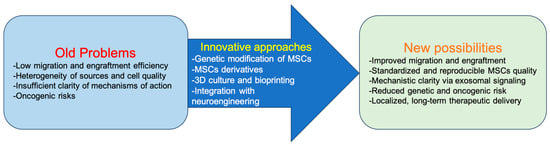
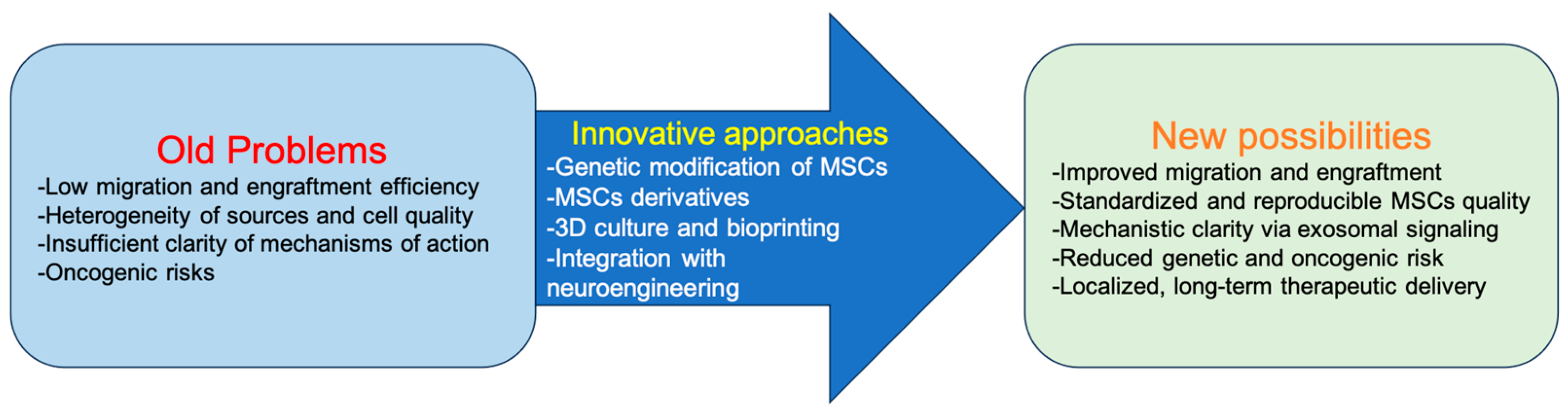
Thus, for successful transition from experimental models to routine clinical practice, it is necessary to address the above-mentioned fundamental problems, including improving delivery specificity, standardizing cell quality, and gaining a deeper understanding of mechanisms of action and safety of MSC application (Figure 1).
Figure 1.
Schematic representation of the transition from “Old Problems” to “New Possibilities” in MSC-based neuroregenerative therapy. The figure illustrates how major historical limitations of MSC application (left) are being addressed by current biotechnological strategies (center), leading to safer, more standardized, and clinically translatable MSC-based therapies (right).
4. New Possibilities and Approaches
Despite the existing questions and limitations in the application of MSCs, the development of biotechnology has opened new perspectives:
- MSCs derivatives. Over the past decade, research focus has shifted from MSCs themselves to their derivatives—exosomes, microvesicles, and secretomes. These components facilitate intercellular communication, stimulate tissue regeneration, and reduce inflammation. MSC-derived exosomes have attracted the greatest attention due to their ability to cross the blood–brain barrier, low immunogenicity, and feasibility of standardized large-scale production [5,26,27,28]. Experimental studies in models of stroke, spinal cord and brain injury, and Parkinson’s disease have demonstrated that MSC exosomes reduce neuroinflammation, improve tissue repair, and promote functional recovery [7,29,30,31].
- Genetic modification of MSCs. Genetic engineering provides opportunities to enhance the therapeutic potential of MSCs. Introduction of constructs via CRISPR/Cas9, lentiviruses, or AAV vectors enables targeted upregulation of neurotrophic factors (Brain-Derived Neurotrophic Factor (BDNF), Glial cell line-Derived Neurotrophic Factor (GDNF), Nerve Growth Factor (NGF)), anti-inflammatory molecules (IL-10), or chemotaxis receptors (CXCR4)), thereby improving homing and engraftment [4,16,32,33]. Such modified MSCs show improved survival in the hostile microenvironment of the CNS and more efficient migration to injury sites [34,35]. Furthermore, the creation of regulatory MSC lines that induce therapeutic gene expression in response to microenvironmental signals (e.g., hypoxia or inflammation) represents a promising direction in genetic engineering. Selich et al. (2023) successfully developed the ECA7 promoter, which is activated by IFN-γ and induces IL-10 secretion in a mouse model of acute allergic syndrome. This approach could potentially be applied to a wide spectrum of pathological conditions [36].
- 3D culture and bioprinting. The transition from 2D cultures to three-dimensional systems, including spheroids, organoids, and bioprinted constructs, has enabled more accurate modeling of the microenvironment of damaged neural tissue in vitro [37]. These 3D systems enhance MSC secretion, interaction with the extracellular matrix, and resistance to stress conditions [38]. Moreover, bioprinting allows for the creation of patient-specific matrices incorporating MSCs, paving the way toward personalized regenerative medicine [39,40].
- Integration with neuroengineering. The use of biocompatible materials—including hydrogels, nanofibers, and magnetic or conductive nanostructures—as carriers for MSCs and their derivatives enables localized delivery, prolonged therapeutic action, and protection from cell death. For example, encapsulation of MSCs in alginate- or collagen-based matrices enhances their survival and preserves functional activity after transplantation [41,42]. The use of magnetically guided systems and nanotechnologies is also being actively explored for targeted delivery of MSCs to lesion sites [43,44].
Thus, emerging MSC-based strategies offer enhanced therapeutic potential for neurological disorders. MSC derivatives, such as exosomes and microvesicles, demonstrate neuroprotective and immunomodulatory effects, though variability in cargo and limited clinical validation remain challenges [5,26,27,28,29,30,31]. Genetically modified MSCs and 3D culture/bioprinting approaches improve survival, homing, and functional outcomes, yet safety, scalability, and regulatory approval require careful consideration [4,16,32,33,34,35,36,37,38,39,40]. Neuroengineering strategies, including biomaterial encapsulation and targeted delivery, further support localized and sustained effects, highlighting a spectrum of translational readiness across these technologies [41,42,43,44].
The following sections will discuss new opportunities and approaches in more detail, including MSC derivatives and strategies for genetic modification. Figure 1 summarizes the key challenges that have historically limited the therapeutic efficacy of MSCs and contrasts them with emerging biotechnological solutions.
5. Clinical Studies on the Application of MSC-Derived Exosomes
One of the first clinical studies aimed at evaluating the safety and efficacy of intranasal administration of MSC-derived exosomes was the open-label phase I/II trial by Xie et al. (2023). The authors tested exosomes isolated from allogeneic adipose tissue-derived MSCs (ahaMSC-Exos) in patients with mild-to-moderate Alzheimer’s disease. Nine participants received different doses (2 × 10⁸, 4 × 10⁸, and 8 × 10⁸ particles) twice weekly for 12 weeks, with follow-up extending to 48 weeks. The therapy was found to be safe and well tolerated across all dosing groups. The most pronounced cognitive benefits were observed in the medium-dose group (4 × 10⁸ particles), where statistically significant improvements were reported on the Alzheimer’s Disease Assessment Scale-Cognitive Subscale (ADAS-Cog) and Montreal Cognitive Assessment-Basic (MoCA-B) scale, along with a trend toward reduced hippocampal atrophy. These findings support the potential of MSC-derived exosomes as a novel therapeutic approach for neurodegenerative diseases; however, confirmation in larger randomized controlled trials is required [45].
MSC-derived exosomes have also demonstrated potential in the treatment of SCI. In a single-arm, open-label, first-in-human phase I clinical trial involving nine patients with complete subacute SCI, intrathecal injection of allogeneic exosomes derived from human umbilical cord MSCs (HUC-MSCs-Exos) was shown to be safe over a 12-month observation period [46]. Patients exhibited modest functional improvements, including in the Spinal Cord Independence Measure and subscales for self-care, respiratory function, and sphincter management. Although improvement in neurogenic bowel dysfunction reached statistical significance, patients also reported slight improvements in bladder filling sensation, voiding ability, urinary incontinence, and lower limb spasticity.
Despite these positive and encouraging findings, many questions remain regarding the clinical efficacy of this therapeutic approach, which must be addressed in future studies.
6. Gene Modification of MSCs
Recent advances in genetic engineering are creating new opportunities to enhance the therapeutic potential of MSCs [47,48]. The promise of this approach lies in the possibility of targeted modification of MSCs aimed at strengthening their neuroprotective properties through activation of neurotrophic factor expression, increasing resistance to apoptosis under conditions of oxidative stress and hypoxia, and optimizing migratory capacity by regulating chemokine receptors [49]. Of particular interest is the application of genetically modified MSCs in the treatment of neurodegenerative diseases, as well as ischemic and traumatic injuries of the nervous system.
6.1. CRISPR/Cas9
This system has revolutionized genetic engineering, offering unprecedented opportunities for precise genome editing. In the context of cell therapy, CRISPR/Cas9 can serve as a tool to overcome previously mentioned limitations by targeted modification of the MSC genome [50]. CRISPR/Cas9 enables specific alterations of genes involved in key processes such as migration, proliferation, survival, senescence, and immune response. Studies have shown that inactivation of the Bak gene using CRISPR/Cas9 promotes translocation of Bax to mitochondria in response to TNFα/CHX-induced apoptosis in MSC cultures, thereby enhancing resistance of MSCs to apoptosis under oxidative stress and hypoxia [51]. Knockout of the PTEN gene with CRISPR/Cas9 in MSCs significantly increased their proliferative activity and survival, while reducing osteogenic and adipogenic differentiation capacity [52]. Deletion of JAK1 using CRISPR/Cas9 suppressed TLR3-induced senescence, whereas removal of the TZAP gene prevented telomere shortening and maintained MSC proliferative activity [53].
A recent study developed a method for genetic modification of MSCs using CRISPR/Cas9 in the form of ribonucleoprotein (RNP) complexes [54]. This approach achieved editing efficiency of the B2M gene up to 85.1% while maintaining high MSC viability (>90%), significantly surpassing conventional plasmid DNA-based methods. B2M-knockout MSCs exhibited reduced MHC class I expression (<1% of the population) and, in co-culture with T cells, demonstrated a 2.4-fold increase in survival while retaining key characteristics and differentiation potential. Importantly, B2M-knockout MSCs also showed enhanced expression of immunosuppressive factors (Indoleamine 2,3-dioxygenase 1 (IDO-1) and Prostaglandin E2 (PGE2)) upon IFN-γ stimulation, opening new perspectives for the development of allogeneic cell therapies.
CRISPR/Cas9 may also be applied in therapeutic strategies involving EVs: either by modifying MSCs to enhance the therapeutic properties of their EVs or by loading CRISPR/Cas9 components into EVs for targeted delivery to recipient cells. Hybrid exosome–liposome nanoparticles were previously developed, retaining the biological properties of exosomes (e.g., surface proteins Alix, TSG101, CD63, CD81, CD9) while exhibiting higher efficiency in loading large plasmids, similar to liposomes [55]. This strategy was successfully applied for efficient CRISPR/Cas9 delivery into MSCs, which are otherwise difficult to transfect using standard methods such as lipofection. Experiments confirmed that hybrid nanoparticles provide targeted gene delivery and expression in MSCs, including Runx2 suppression via CRISPR/dCas9 and CTNNB1 editing using CRISPR/Cas9 [50].
The EV-based EXO-C@P system, equipped with the CAQK peptide, was designed for precise delivery of MSC-derived EVs and CRISPR/Cas9 to sites of injury to modulate inflammation. In mouse models, EXO-C@P effectively accumulated in spinal cord lesion areas, reduced inflammation (by decreasing pro-inflammatory M1 macrophages and increasing anti-inflammatory M2), and improved motor function [56].
The emergence of CRISPR/Cas9 has also brought revolutionary advances in the treatment of neurodegenerative diseases. This technology not only enables correction of genetic defects but also imparts new functional properties to cells. In the study by Lee et al. (2019) [53], a therapeutic approach for Parkinson’s disease was developed using umbilical cord blood-derived MSCs (UCB-MSCs) genetically engineered with CRISPR/Cas9 to secrete soluble receptor for advanced glycation end-products (sRAGE) and albumin complex, used as a biomarker of neuroinflammation. Transplantation of sRAGE-secreting UCB-MSCs into the striatum reduced AGE-albumin levels, suppressed neuroinflammation and apoptosis, and improved motor function in a mouse model of Parkinson’s disease. The protective mechanism involved competitive binding of sRAGE to AGE-albumin, thereby blocking activation of RAGE and downstream signaling. This strategy appears promising for neuroprotection in Parkinson’s disease, although further optimization of editing efficiency and management of immune responses is required.
CRISPR/Cas9 allows precise genome editing and functional modulation of MSCs, with high efficiency in targeted gene knockout or activation. Advantages include specificity and the ability to confer new functional properties. Limitations include potential off-target effects, the need for optimized delivery systems (e.g., RNP complexes or EV-based systems), and regulatory concerns regarding genome-edited cells. Clinical translatability is promising but requires thorough safety evaluation. Further studies addressing safety, efficacy, off-target effects, delivery efficiency, immunogenicity, and compliance with regulatory guidelines will be essential for the clinical translation of CRISPR/Cas9-modified MSCs.
6.2. Virus-Mediated Modification
One of the key directions in MSC-based therapies is their modification using viral vectors. The most commonly applied vectors are lentiviruses (LVs) and adeno-associated viruses (AAVs). These vectors enable efficient delivery of genetic material into cells, opening new horizons for gene- and cell-based therapy.
LVs are widely used for MSC modification due to their ability to infect both dividing and non-dividing cells. This makes them particularly valuable in therapies requiring long-term gene expression. However, the use of LV-transduced MSCs today is more often directed toward therapeutic approaches for hereditary diseases [57,58] and less frequently as a direct means of stimulating neuroregeneration.
In an in vitro ischemia model, LV-transduced MSCs engineered for heat shock protein 70 (HSP70) overexpression demonstrated significantly higher survival compared with control cells. Moreover, the adipogenic differentiation capacity of HSP70-MSCs was preserved even under stress conditions, whereas it was markedly reduced in non-transduced cells [59]. In a rat model of spinal cord contusion injury (Th10), intrathecal transplantation of MSCs genetically modified with LV to express sonic hedgehog (Shh) enhanced cell survival, promoted axonal regeneration, and inhibited glial scar formation, resulting in improved functional recovery [60].
In an in vivo cerebral ischemia model, LV-transduced MSCs overexpressing CXCR4 migrated more efficiently to damaged tissue and contributed to improved functional recovery in rats [61]. In the study by Scheper et al. (2019), LVs were used to genetically modify MSCs for BDNF overexpression. Notably, BDNF secreted by transduced MSCs exhibited a stronger neuroprotective effect on spiral ganglion neuron cultures compared with recombinant BDNF, despite lower concentrations [62]. Earlier work had already demonstrated that LV-BDNF-MSCs could enhance functional recovery in a rat model of middle cerebral artery occlusion [63]. Attempts have also been made to transduce MSCs with bicistronic LV for co-expression of BDNF and VEGF [64]. Systemic transplantation of genetically modified MSCs in rats with global cerebral ischemia showed their successful migration into the brain and significantly greater neuroprotective effects compared with native MSCs, confirmed by reduced neurological deficit, decreased neuronal damage, enhanced angiogenesis and promising good clinical translatability.
LVs efficiently transduce both dividing and non-dividing MSCs, enabling long-term stable expression of therapeutic genes. Advantages include high transduction efficiency and stable gene expression. Disadvantages include insertional mutagenesis risk, immunogenicity, and regulatory hurdles.
6.3. Adeno-Associated Viruses (AAVs)
AAVs are promising candidates for clinical application in gene therapy owing to their high specificity, low immunogenicity, and ability to achieve sustained gene expression in target cells. A previous study evaluated the efficiency of human and rat MSC transduction using AAV serotype DJ. Results demonstrated superior efficiency of AAV-DJ compared with AAV2—98% vs. 70% in human MSCs and 80% vs. less than 4% in rat MSCs. Transduction was associated with a 25–30% reduction in MSC proliferation, likely due to activation of cellular stress mechanisms, while cell viability and differentiation capacity remained unaffected [65].
The therapeutic potential of genetically modified MSCs for ischemic stroke was demonstrated in the study by Nakajima et al. (2017). Using AAV to drive IL-10 overexpression, MSCs-IL-10 reduced infarct volume by 39%, significantly improved motor function, and suppressed inflammatory responses by attenuating microglial activation and levels of pro-inflammatory molecules [66].
In a rodent sciatic nerve injury model, AAV-mediated MSCs engineered to overexpress the transcription Kruppel-like factor 7 (KLF7) enhanced secretion of neurotrophic factors (NGF, BDNF, GDNF, and Ciliary Neurotrophic Factor (CNTF)), thereby accelerating remyelination and functional recovery of the sciatic nerve [67].
Therapeutic applications of genetically modified MSCs have also been explored in models of neurodegenerative diseases. Liu et al. (2015) used AAVs to deliver as-miR-937 into MSCs, thereby suppressing endogenous miR-937 and increasing expression of the transcription factor Brn-4. Transplantation of MSC-as-miR-937 into APP/PS1 Alzheimer’s disease model mice reduced β-amyloid deposition, increased BDNF levels, and improved cognitive function [68].
Thus, AAVs offer high specificity and low immunogenicity, with relatively safe, sustained gene expression. Advantages include minimal risk of insertional mutagenesis and established clinical use in gene therapy. Limitations include restricted cargo size and variable transduction efficiency depending on serotype and species. Clinical translation of AAV-modified MSCs is promising, particularly for short-term or tissue-specific gene expression.
Thus, genetic modification of MSCs opens new opportunities for the treatment of neurological disorders. Engineering MSCs with CRISPR/Cas9 and other advanced tools, such as viral vectors, can enhance their tropism toward injured tissues, secretion of neurotrophic factors, and resilience to hostile microenvironments. Further studies addressing safety and scalability issues are essential for the successful clinical translation of genetically modified MSCs. Overall, the choice of modification strategy should consider the therapeutic goal, target tissue, desired duration of gene expression, and safety profile to maximize translational potential.
7. Conclusions
Despite decades of intensive research, the clinical implementation of MSC-based therapies in neurology remains challenging. Current evidence indicates that the beneficial effects of MSCs are mediated predominantly through paracrine mechanisms, especially EVs, rather than direct cell replacement. However, limited engraftment, donor- and source-dependent variability, incomplete understanding of mechanisms, and safety concerns, including tumorigenic risks, significantly constrain their translational potential.
In addition to paracrine and extracellular vesicle-mediated effects, MSCs modulate immune responses by interacting with various immune cells. MSCs can promote polarization of macrophages toward an anti-inflammatory M2 phenotype, reduce pro-inflammatory microglial activation (adhere to the authors’ terminology), and induce regulatory T cell responses, thereby supporting tissue repair and attenuating neuroinflammation in neurological disorders [35,48,53]. These immunomodulatory interactions complement the effects of MSC-derived EVs, highlighting the multifaceted mechanisms through which MSCs contribute to neuroprotection, neurogenesis, and functional recovery in preclinical and early clinical studies [3,5,6,48]. Integrating these pathways (JAK/STAT, NF-κB, TGF-β/SMAD) emphasizes that the therapeutic potential of MSCs is not limited to cell replacement or paracrine signaling alone but also involves active regulation of the local immune microenvironment. This mechanistic understanding may help explain variability in outcomes observed across preclinical models and early-phase clinical trials and guide strategies to optimize MSC-based therapies for neurological disorders.
Recent advances—such as the use of MSC-derived exosomes, precise genetic modification with CRISPR/Cas9 and viral vectors, development of 3D culture and bioprinting systems, and integration with bioengineered delivery platforms—are opening new avenues to enhance therapeutic efficacy, specificity, and safety. Early-phase clinical trials demonstrate encouraging safety profiles and modest functional improvements in neurological disorders, but results remain inconsistent across studies.
The successful transition of MSC-based strategies into routine clinical practice requires addressing several critical tasks: minimizing off-target effects of genetic modifications, developing standardized GMP-compliant production and characterization protocols, and conducting large-scale randomized controlled clinical trials with clearly defined endpoints. Resolving these issues will allow MSCs and their derivatives to evolve from experimental approaches into reliable therapeutic tools, significantly expanding the possibilities of regenerative neurology.
Author Contributions
Writing—original draft preparation, E.A., I.S. and T.F.; Supervision, A.R.; Writing—review and editing, Y.M. All authors have read and agreed to the published version of the manuscript.
Funding
This paper was supported by the Kazan Federal University Strategic Academic Leadership Program (PRIORITY-2030).
Institutional Review Board Statement
Not applicable.
Informed Consent Statement
Not applicable.
Data Availability Statement
No new data were created or analyzed in this study. Data sharing is not applicable to this article.
Conflicts of Interest
The authors declare no conflicts of interest.
Abbreviations
| AAVs | Adeno-associated viruses |
| ADAS-Cog scale | Alzheimer’s Disease Assessment Scale-Cognitive Subscale |
| AIS | Abbreviated Injury Scale |
| BDNF | Brain-Derived Neurotrophic Factor |
| CNTF | Ciliary Neurotrophic Factor |
| GSGs | Glioma Stem-like Cells |
| GDNF | Glial Cell Line-Derived Neurotrophic Factor |
| IDO-1 | Indoleamine 2,3-dioxygenase 1 |
| KLF7 | Kruppel-like factor 7 |
| LV | Lentiviruses |
| MoCA-B scale | Montreal Cognitive Assessment-Basic |
| MSC-NP | Mesenchymal stem cell-derived neural progenitors |
| NGF | Nerve growth factor |
| PGE2 | Prostaglandin E2 |
| SCI | Spinal Cord Injury |
| sRAGE | Soluble Receptor for Advanced Glycation End-products |
| TERT | Telomerase Reverse Transcriptase |
References
- Galieva, L.R.; James, V.; Mukhamedshina, Y.O.; Rizvanov, A.A. Therapeutic potential of extracellular vesicles for the treatment of nerve disorders. Front. Neurosci. 2019, 13, 163. [Google Scholar] [CrossRef] [Scilit]
- Buzas, E.I. The roles of extracellular vesicles in the immune system. Nat. Rev. Immunol. 2023, 23, 236–250. [Google Scholar] [CrossRef] [Scilit]
- Jafarinia, M.; Farrokhi, M.R.; Ganjalikhani Hakemi, M.; Cho, W.C. The role of miRNAs from mesenchymal stem/stromal cells-derived extracellular vesicles in neurological disorders. Hum. Cell 2023, 36, 62–75. [Google Scholar] [CrossRef] [Scilit] [PubMed]
- Zhang, Z.; Yang, J.; Yan, W.; Li, Y.; Shen, Z.; Asahara, T. Pretreatment of cardiac stem cells with exosomes derived from mesenchymal stem cells enhances myocardial repair. J. Am. Heart Assoc. 2016, 5, e002856. [Google Scholar] [CrossRef] [Scilit]
- Qiu, L.; Cai, Y.; Geng, Y.; Yao, X.; Wang, L.; Cao, H.; Zhang, X.; Wu, Q.; Kong, D.; Ding, D.; et al. Mesenchymal stem cell-derived extracellular vesicles attenuate tPA-induced blood–brain barrier disruption in murine ischemic stroke models. Acta Biomater. 2022, 154, 424–442. [Google Scholar] [CrossRef] [Scilit]
- Peng, H.; Li, Y.; Ji, W.; Zhao, R.; Lu, Z.; Shen, J.; Wu, Y.; Wang, J.; Hao, Q.; Wang, J.; et al. Intranasal administration of self-oriented nanocarriers based on therapeutic exosomes for synergistic treatment of Parkinson’s disease. ACS Nano 2022, 16, 869–884. [Google Scholar] [CrossRef] [Scilit] [PubMed]
- Li, Z.; Dong, X.; Tian, M.; Liu, C.; Wang, K.; Li, L.; Liu, Z.; Liu, J. Stem cell-based therapies for ischemic stroke: A systematic review and meta-analysis of clinical trials. Stem Cell Res. Ther. 2020, 11, 1–13. [Google Scholar] [CrossRef] [Scilit] [PubMed]
- Chung, J.W.; Chang, W.H.; Bang, O.Y.; Moon, G.J.; Kim, S.J.; Kim, S.K.; Lee, J.S.; Sohn, S.I.; Kim, Y.H.; Starting-2 Collaborators. Efficacy and safety of intravenous mesenchymal stem cells for ischemic stroke. Neurology 2021, 96, e1012–e1023. [Google Scholar] [CrossRef] [Scilit]
- Islam, M.A.; Alam, S.S.; Kundu, S.; Ahmed, S.; Sultana, S.; Patar, A.; Hossan, T. Mesenchymal stem cell therapy in multiple sclerosis: A systematic review and meta-analysis. J. Clin. Med. 2023, 12, 6311. [Google Scholar] [CrossRef] [Scilit]
- Harris, V.K.; Stark, J.; Williams, A.; Roche, M.; Malin, M.; Kumar, A.; Carlson, A.L.; Kizilbash, C.; Wollowitz, J.; Andy, C.; et al. Efficacy of intrathecal mesenchymal stem cell-neural progenitor therapy in progressive MS: Results from a phase II, randomized, placebo-controlled clinical trial. Stem Cell Res. Ther. 2024, 15, 151. [Google Scholar] [CrossRef] [Scilit]
- Bang, O.Y.; Lee, J.S.; Lee, P.H.; Lee, G. Autologous mesenchymal stem cell transplantation in stroke patients. Ann. Neurol. 2005, 57, 874–882. [Google Scholar] [CrossRef] [Scilit]
- Levy, M.L.; Crawford, J.R.; Dib, N.; Verkh, L.; Tankovich, N.; Cramer, S.C. Phase I/II study of safety and preliminary efficacy of intravenous allogeneic mesenchymal stem cells in chronic stroke. Stroke 2019, 50, 10. [Google Scholar] [CrossRef] [Scilit]
- Macêdo, C.T.; de Freitas Souza, B.S.; Villarreal, C.F.; Silva, D.N.; da Silva, K.N.; de Souza, C.L.E.M.; da Silva Paixão, D.; da Rocha Bezerra, M.; da Silva Moura Costa, A.O.; Brazão, E.S.; et al. Transplantation of autologous mesenchymal stromal cells in complete cervical spinal cord injury: A pilot study. Front. Med. 2024, 11, 1451297. [Google Scholar] [CrossRef] [Scilit]
- Bydon, M.; Qu, W.; Moinuddin, F.M.; Hunt, C.L.; Garlanger, K.L.; Reeves, R.K.; Windebank, A.J.; Zhao, K.D.; Jarrah, R.; Trammell, B.C.; et al. Intrathecal delivery of adipose-derived mesenchymal stem cells in traumatic spinal cord injury: Phase I trial. Nat. Commun. 2024, 15, 2201. [Google Scholar] [CrossRef] [Scilit]
- Kim, H.J.; Cho, K.R.; Jang, H.; Lee, N.K.; Jung, Y.H.; Kim, J.P.; Lee, J.I.; Chang, J.W.; Park, S.; Kim, S.T.; et al. Intracerebroventricular injection of human umbilical cord blood mesenchymal stem cells in patients with Alzheimer’s disease dementia: A phase I clinical trial. Alzheimer’s Res. Ther. 2021, 13, 154. [Google Scholar] [CrossRef] [Scilit] [PubMed]
- Kirshblum, S.; Snider, B.; Eren, F.; Guest, J. Characterizing natural recovery after traumatic spinal cord injury. J. Neurotrauma 2021, 38, 1267–1284. [Google Scholar] [CrossRef] [Scilit]
- Devine, S.M.; Cobbs, C.; Jennings, M.; Bartholomew, A.; Hoffman, R. Mesenchymal stem cells distribute to a wide range of tissues following systemic infusion into nonhuman primates. Blood 2003, 101, 2999–3001. [Google Scholar] [CrossRef] [Scilit] [PubMed]
- Karp, J.M.; Teo, G.S.L. Mesenchymal stem cell homing: The devil is in the details. Cell Stem Cell 2009, 4, 206–216. [Google Scholar] [CrossRef] [Scilit]
- Ullah, M.; Liu, D.D.; Thakor, A.S. Mesenchymal stromal cell homing: Mechanisms and strategies for improvement. iScience 2019, 15, 421–438. [Google Scholar] [CrossRef] [Scilit]
- Chen, S.; Liang, B.; Xu, J. Unveiling heterogeneity in MSCs: Exploring marker-based strategies for defining MSC subpopulations. J. Transl. Med. 2024, 22, 459. [Google Scholar] [CrossRef] [Scilit] [PubMed]
- Zaim, M.; Karaman, S.; Cetin, G.; Isik, S. Donor age and long-term culture affect differentiation and proliferation of human bone marrow mesenchymal stem cells. Ann. Hematol. 2012, 91, 1175–1186. [Google Scholar] [CrossRef] [Scilit]
- Choudhery, M.S.; Badowski, M.; Muise, A.; Pierce, J.; Harris, D.T. Donor age negatively impacts adipose tissue-derived mesenchymal stem cell expansion and differentiation. J. Transl. Med. 2014, 12, 8. [Google Scholar] [CrossRef] [Scilit]
- Spees, J.L.; Lee, R.H.; Gregory, C.A. Mechanisms of mesenchymal stem/stromal cell function. Stem Cell Res. Ther. 2016, 7, 125. [Google Scholar] [CrossRef] [Scilit]
- Jeong, J.O.; Han, J.W.; Kim, J.M.; Cho, H.J.; Park, C.; Lee, N.; Kim, D.W.; Yoon, Y.S. Malignant tumor formation after transplantation of short-term cultured bone marrow mesenchymal stem cells in experimental myocardial infarction and diabetic neuropathy. Circ. Res. 2011, 108, 1340–1347. [Google Scholar] [CrossRef] [Scilit]
- Zhao, Y.; Chen, J.; Dai, X.; Cai, H.; Ji, X.; Sheng, Y.; Liu, H.; Yang, L.; Chen, Y.; Xi, D.; et al. Human glioma stem-like cells induce malignant transformation of bone marrow mesenchymal stem cells by activating TERT expression. Oncotarget 2017, 8, 104418. [Google Scholar] [CrossRef] [Scilit]
- Kink, J.A.; Bellio, M.A.; Forsberg, M.H.; Lobo, A.; Thickens, A.S.; Lewis, B.M.; Ong, I.M.; Khan, A.; Capitini, C.M.; Hematti, P. Large-scale bioreactor production of extracellular vesicles from mesenchymal stromal cells for treatment of acute radiation syndrome. Stem Cell Res. Ther. 2024, 15, 72. [Google Scholar] [CrossRef] [Scilit]
- Wang, C.C.; Hu, X.M.; Long, Y.F.; Huang, H.R.; He, Y.; Xu, Z.R.; Qi, Z.Q. Treatment of Parkinson’s disease model with human umbilical cord mesenchymal stem cell-derived exosomes loaded with BDNF. Life Sci. 2024, 356, 123014. [Google Scholar] [CrossRef] [Scilit]
- Wang, C.; Hu, X.; Liu, Y.; Xiao, Y.; Jiang, P.; Lin, Y.; Liu, X.; Zhang, Z.; Li, L.C.; Qi, Z. Immunological safety evaluation of exosomes derived from human umbilical cord mesenchymal stem cells in mice. Stem Cells Int. 2025, 2025, 9986368. [Google Scholar] [CrossRef] [Scilit] [PubMed]
- Han, Y.; Seyfried, D.; Meng, Y.; Yang, D.; Schultz, L.; Chopp, M.; Seyfried, D. Multipotent mesenchymal stromal cell–derived exosomes improve functional recovery after experimental intracerebral hemorrhage in the rat. J. Neurosurg. 2018, 131, 290–300. [Google Scholar] [CrossRef] [Scilit] [PubMed]
- Kostennikov, A.; Kabdesh, I.; Sabirov, D.; Timofeeva, A.; Rogozhin, A.; Shulman, I.; Rizvanov, A.; Mukhamedshina, Y. A comparative study of mesenchymal stem cell-derived extracellular vesicles’ local and systemic dose-dependent administration in rat spinal cord injury. Biology 2022, 11, 1853. [Google Scholar] [CrossRef] [Scilit] [PubMed]
- Wang, J.; Chen, Z.J.; Zhang, Z.Y.; Shen, M.P.; Zhao, B.; Zhang, W.; Zhang, Y.; Lei, J.G.; Ren, C.J.; Chang, J.; et al. Manufacturing, quality control, and GLP-grade preclinical study of nebulized allogenic adipose mesenchymal stromal cells-derived extracellular vesicles. Stem Cell Res. Ther. 2024, 15, 95. [Google Scholar] [CrossRef] [Scilit]
- Kim, M.; Kim, D.I.; Kim, E.K.; Kim, C.W. CXCR4 overexpression in human adipose tissue-derived stem cells improves homing and engraftment in an animal limb ischemia model. Cell Transplant. 2017, 26, 191–204. [Google Scholar] [CrossRef] [Scilit]
- Peruzzaro, S.T.; Andrews, M.M.M.; Al-Gharaibeh, A.; Pupiec, O.; Resk, M.; Story, D.; Maiti, P.; Rossignol, J.; Dunbar, G.L. Transplantation of mesenchymal stem cells genetically engineered to overexpress interleukin-10 promotes alternative inflammatory response in rat model of traumatic brain injury. J. Neuroinflammation 2019, 16, 2. [Google Scholar] [CrossRef] [Scilit] [PubMed]
- Zhou, H.; He, Y.; Xiong, W.; Jing, S.; Duan, X.; Huang, Z.; Nahal, G.S.; Peng, Y.; Li, M.; Zhu, Y.; et al. MSC based gene delivery methods and strategies improve the therapeutic efficacy of neurological diseases. Bioact. Mater. 2023, 23, 409–437. [Google Scholar] [CrossRef] [Scilit] [PubMed]
- Lu, D.; Xu, Y.; Liu, Q.; Zhang, Q. Mesenchymal stem cell-macrophage crosstalk and maintenance of inflammatory microenvironment homeostasis. Front. Cell Dev. Biol. 2021, 9, 681171. [Google Scholar] [CrossRef] [Scilit]
- Selich, A.; Fleischauer, J.; Roepke, T.; Weisskoeppel, L.; Galla, M.; von Kaisenberg, C.; Maus, U.A.; Schambach, A.; Rothe, M. Inflammation-inducible promoters to overexpress immune inhibitory factors by MSCs. Stem Cell Res. Ther. 2023, 14, 270. [Google Scholar] [CrossRef] [Scilit]
- Orr, A.; Kalantarnia, F.; Nazir, S.; Bolandi, B.; Alderson, D.; O’Grady, K.; Hoorfar, M.; Julian, L.M.; Willerth, S.M. Recent advances in 3D bioprinted neural models: A systematic review on the applications to drug discovery. Adv. Drug Deliv. Rev. 2025, 218, 115524. [Google Scholar] [CrossRef] [Scilit]
- Bartosh, T.J.; Ylostalo, J.H. Efficacy of 3D culture priming is maintained in human mesenchymal stem cells after extensive expansion of the cells. Cells 2019, 8, 1031. [Google Scholar] [CrossRef] [Scilit] [PubMed]
- Murphy, S.V.; Atala, A. 3D bioprinting of tissues and organs. Nat. Biotechnol. 2014, 32, 773–785. [Google Scholar] [CrossRef] [Scilit]
- Zhu, H.; Yao, C.; Xu, Z.; Shang, G.; Peng, J.; Xie, H.; Qian, T.; Qiu, Z.; Maeso, L.; Mao, M.; et al. Recent advances in 3D models of the nervous system for neural regeneration research and drug development. Acta Biomater. 2025, 202, 1–26. [Google Scholar] [CrossRef] [Scilit]
- Leijs, M.; Villafuertes, E.; Haeck, J.; Koevoet, W.; Fernandez-Gutierrez, B.; Hoogduijn, M.; Verhaar, J.A.N.; Bernsen, M.; Buul, G.; van Osch, G. Encapsulation of allogeneic mesenchymal stem cells in alginate extends local presence and therapeutic function. Eur. Cells Mater. 2017, 33, 43–58. [Google Scholar] [CrossRef] [Scilit]
- San JoseLorena, H. Microfluidic encapsulation supports stem cell viability, proliferation, and neuronal differentiation. Tissue Eng. Part C Methods 2018, 24, 158–170. [Google Scholar]
- Vaněček, V.; Zablotskii, V.; Forostyak, S.; Růřička, J.; Herynek, V.; Babič, M.; Jendelová, P.; Kubinová, Š.; Dejneka, A.; Syková, E. Highly efficient magnetic targeting of mesenchymal stem cells in spinal cord injury. Int. J. Nanomed. 2012, 7, 3719–3730. [Google Scholar] [CrossRef] [Scilit]
- Moayeri, A.; Darvishi, M.; Amraei, M. Homing of super paramagnetic iron oxide nanoparticles (SPIONs) labeled adipose-derived stem cells by magnetic attraction in a rat model of Parkinson’s disease. Int. J. Nanomed. 2020, 15, 1297–1308. [Google Scholar] [CrossRef] [Scilit]
- Xie, X.; Song, Q.; Dai, C.; Cui, S.; Tang, R.; Li, S.; Chang, J.; Li, P.; Wang, J.; Li, J.; et al. Clinical safety and efficacy of allogenic human adipose mesenchymal stromal cells-derived exosomes in patients with mild to moderate Alzheimer’s disease: A phase I/II clinical trial. Gen. Psychiatry 2023, 36, e101143. [Google Scholar] [CrossRef] [Scilit]
- Akhlaghpasand, M.; Tavanaei, R.; Hosseinpoor, M.; Yazdani, K.O.; Soleimani, A.; Zoshk, M.Y.; Soleimani, M.; Chamanara, M.; Ghorbani, M.; Deylami, M.; et al. Safety and potential effects of intrathecal injection of allogeneic human umbilical cord mesenchymal stem cell-derived exosomes in complete subacute spinal cord injury: A first-in-human, single-arm, open-label, phase I clinical trial. Stem Cell Res. Ther. 2024, 15, 264. [Google Scholar] [CrossRef] [Scilit] [PubMed]
- Ebrahim, N.; James, V.; Rizvanov, A.A.; Mukhamedshina, Y. Genetic modification of mesenchymal stem cells for neurological disease therapy: What effects does it have on phenotype/cell behavior, determining their effectiveness? Mol. Diagn. Ther. 2020, 24, 683–702. [Google Scholar] [CrossRef] [Scilit] [PubMed]
- Andrzejewska, A.; Dabrowska, S.; Lukomska, B.; Janowski, M. Mesenchymal stem cells in neurological disorders. Adv. Sci. 2021, 8, 2002944. [Google Scholar] [CrossRef] [Scilit] [PubMed]
- Nasiri, H.; Manoochehrabadi, T.; Eskandari, F.; Majidi, J.; Gholipourmalekabadi, M. Genetic modification of mesenchymal stem cells (MSCs): Novel strategy to expand their naïve applications in critical illness. Mol. Biol. Rep. 2025, 52, 501. [Google Scholar] [CrossRef] [Scilit]
- Hazrati, A.; Malekpour, K.; Soudi, S.; Hashemi, S.M. CRISPR/Cas9-engineered mesenchymal stromal/stem cells and their extracellular vesicles: A new approach to overcoming cell therapy limitations. Biomed. Pharmacother. 2022, 156, 113943. [Google Scholar] [CrossRef] [Scilit]
- Zhang, J.; Niu, H.; Zhao, Z.J.; Fu, X.; Wang, Y.; Zhang, X.; Zhang, F.; Zeng, L. CRISPR/Cas9 knockout of Bak mediates Bax translocation to mitochondria in response to TNFα/CHX-induced apoptosis. Biomed. Res. Int. 2019, 2019, 9071297. [Google Scholar] [CrossRef] [Scilit]
- Shen, Y.; Zhang, J.; Yu, T.; Qi, C. Generation of PTEN knockout bone marrow mesenchymal stem cell lines by CRISPR/Cas9-mediated genome editing. Cytotechnology 2018, 70, 783–791. [Google Scholar] [CrossRef] [Scilit] [PubMed]
- Lee, H.J.; Choi, B.; Kim, Y.; Lee, S.E.; Jin, H.J.; Lee, H.S.; Chang, E.J.; Kim, S.W. The upregulation of toll-like receptor 3 via autocrine IFN-β signaling drives the senescence of human umbilical cord blood-derived mesenchymal stem cells through JAK1. Front. Immunol. 2019, 10, 1659. [Google Scholar] [CrossRef] [Scilit]
- Han, A.R.; Shin, H.R.; Kwon, J.; Lee, S.B.; Lee, S.E.; Kim, E.Y.; Kweon, J.; Chang, E.J.; Kim, Y.; Kim, S.W. Highly efficient genome editing via CRISPR-Cas9 ribonucleoprotein (RNP) delivery in mesenchymal stem cells. BMB Rep. 2024, 57, 60–65. [Google Scholar] [CrossRef] [Scilit]
- Lin, Y.; Wu, J.; Gu, W.; Huang, Y.; Tong, Z.; Huang, L.; Tan, J. Exosome–liposome hybrid nanoparticles deliver CRISPR/Cas9 system in MSCs. Adv. Sci. 2018, 5, 1700611. [Google Scholar] [CrossRef] [Scilit] [PubMed]
- Wang, B.; Chang, M.; Zhang, R.; Wo, J.; Wu, B.; Zhang, H.; Sun, G. Spinal cord injury target-immunotherapy with TNF-α autoregulated and feedback-controlled human umbilical cord mesenchymal stem cell derived exosomes remodelled by CRISPR/Cas9 plasmid. Biomater. Adv. 2022, 133, 112624. [Google Scholar] [CrossRef] [Scilit] [PubMed]
- Collon, K.; Gallo, M.C.; Bell, J.A.; Chang, S.W.; Rodman, J.C.S.; Sugiyama, O.; Kohn, D.B.; Lieberman, J.R. Improving lentiviral transduction of human adipose-derived mesenchymal stem cells. Hum. Gene Ther. 2022, 33, 1260–1268. [Google Scholar] [CrossRef] [Scilit]
- Martín, F.; Tristán-Manzano, M.; Maldonado-Pérez, N.; Sánchez-Hernández, S.; Benabdellah, K.; Cobo, M. Stable genetic modification of mesenchymal stromal cells using lentiviral vectors. Methods Mol. Biol. 2019, 1937, 267–280. [Google Scholar]
- McGinley, L.; McMahon, J.; Strappe, P.; Barry, F.; Murphy, M.; O’Toole, D.; O’Brien, T. Lentiviral vector mediated modification of mesenchymal stem cells & enhanced survival in an in vitro model of ischaemia. Stem Cell Res. Ther. 2011, 2, 12. [Google Scholar] [CrossRef] [Scilit]
- Jia, Y.; Wu, D.; Zhang, R.; Shuang, W.; Sun, J.; Hao, H.; An, Q. Bone marrow-derived mesenchymal stem cells expressing the Shh transgene promotes functional recovery after spinal cord injury in rats. Neurosci. Lett. 2014, 573, 46–51. [Google Scholar] [CrossRef] [Scilit]
- Yu, X.; Chen, D.; Zhang, Y.; Wu, X.; Huang, Z.; Zhou, H.; Zhang, Y.; Zhang, Z. Overexpression of CXCR4 in mesenchymal stem cells promotes migration, neuroprotection and angiogenesis in a rat model of stroke. J. Neurol. Sci. 2012, 316, 141–149. [Google Scholar] [CrossRef] [Scilit]
- Scheper, V.; Schwieger, J.; Hamm, A.; Lenarz, T.; Hoffmann, A. BDNF-overexpressing human mesenchymal stem cells mediate increased neuronal protection in vitro. J. Neurosci. Res. 2019, 97, 1414–1429. [Google Scholar] [CrossRef] [Scilit]
- Huang, D.; Zhang, Z.; Chen, B.; Wu, X.; Wang, N.; Zhang, Y. Therapeutic efficacy of lentiviral vector mediated BDNF gene-modified MSCs in cerebral infarction. Sheng Wu Gong Cheng Xue Bao 2008, 24, 1174–1179. [Google Scholar]
- Zhou, L.; Lin, Q.; Wang, P.; Yao, L.; Leong, K.; Tan, Z.; Huang, Z. Enhanced neuroprotective efficacy of bone marrow mesenchymal stem cells co-overexpressing BDNF and VEGF in a rat model of cardiac arrest-induced global cerebral ischemia. Cell Death Dis. 2017, 8, e2774. [Google Scholar] [CrossRef] [Scilit] [PubMed]
- Zubkova, E.S.; Beloglazova, I.B.; Ratner, E.I.; Dyikanov, D.T.; Dergilev, K.V.; Menshikov, M.Y.; Parfyonova, Y.V. Transduction of rat and human adipose-tissue derived mesenchymal stromal cells by adeno-associated viral vector serotype DJ. Biol. Open 2021, 10, bio058461. [Google Scholar] [CrossRef] [Scilit] [PubMed]
- Nakajima, M.; Nito, C.; Sowa, K.; Suda, S.; Nishiyama, Y.; Nakamura-Takahashi, A.; Nitahara-Kasahara, Y.; Imagawa, K.; Hirato, T.; Ueda, M.; et al. Mesenchymal stem cells overexpressing interleukin-10 promote neuroprotection in experimental acute ischemic stroke. Mol. Ther. Methods Clin. Dev. 2017, 6, 102–111. [Google Scholar] [CrossRef] [Scilit]
- Li, W.Y.; Zhu, G.Y.; Yue, W.J.; Sun, G.D.; Zhu, X.F.; Wang, Y. KLF7 overexpression in bone marrow stromal stem cells graft transplantation promotes sciatic nerve regeneration. J. Neural Eng. 2019, 16, 056011. [Google Scholar] [CrossRef] [Scilit]
- Liu, Z.; Wang, C.; Wang, X.; Xu, S. Therapeutic effects of transplantation of As-miR-937-expressing mesenchymal stem cells in murine model of Alzheimer’s disease. Cell. Physiol. Biochem. 2015, 37, 321–330. [Google Scholar] [CrossRef] [Scilit] [PubMed]

Disclaimer/Publisher’s Note: The statements, opinions and data contained in all publications are solely those of the individual author(s) and contributor(s) and not of MDPI and/or the editor(s). MDPI and/or the editor(s) disclaim responsibility for any injury to people or property resulting from any ideas, methods, instructions or products referred to in the content. |
© 2025 by the authors. Licensee MDPI, Basel, Switzerland. This article is an open access article distributed under the terms and conditions of the Creative Commons Attribution (CC BY) license (https://creativecommons.org/licenses/by/4.0/).