Systematic Review

Injectable Lipid-Lowering Therapies in Chronic Kidney Disease: Efficacy, Outcomes, Safety and Implementation—A Systematic Review


by
Joshua Louis Davies
1,*,
Yimeng Zhang
2,
Inuri Patabendi
2,
Sudarshan Ramachandran
3,4,5 and
Jyoti Baharani
2
1
Department of Renal Medicine, Royal Stoke Hospital, University Hospitals of North Midlands NHS Foundation Trust, Newcastle Road, Stoke-on-Trent ST4 6QG, UK
2
Department of Renal Medicine, University Hospitals Birmingham NHS Foundation Trust, Birmingham B15 2GW, UK
3
Department of Mechanical and Aerospace Engineering, Brunel University London, London UB8 3PH, UK
4
Department of Clinical Biochemistry, University Hospitals Birmingham NHS Foundation Trust, Birmingham B15 2GW, UK
5
Institute for Science and Technology in Medicine, Keele University, Newcastle-Under-Lyme ST4 2DF, UK
*
Author to whom correspondence should be addressed.
BioMed 2026, 6(2), 11; https://doi.org/10.3390/biomed6020011
Submission received: 3 February 2026 / Revised: 1 April 2026 / Accepted: 8 April 2026 / Published: 12 April 2026

Abstract

Background/Objectives: Cardiovasc{Citation}ular disease accounts for 50% of chronic kidney disease (CKD) mortality, yet fewer than 40% of patients achieve guideline LDL-cholesterol (LDL-C) targets on statins. Injectable lipid-lowering therapies (ILLTs)—PCSK9 inhibitors and inclisiran—offer 50–70% LDL-C reductions but lack comprehensive CKD-specific evidence synthesis. This systematic review evaluated ILLT efficacy, safety, and implementation across kidney function stages including dialysis. Methods: Following PROSPERO registration (CRD42024612594), we searched MEDLINE, Embase, Cochrane Library, CINAHL, and Google Scholar (1995–August 2025). Two reviewers independently screened studies using PICOS criteria: adults with CKD stages G3-G5, dialysis, or transplant recipients receiving injectable lipid therapies. Primary outcomes were LDL-C percentage change and major adverse cardiovascular events. Quality was assessed using NIH tools. Given heterogeneity, we performed narrative synthesis following SWiM guidance. Results: Eight studies (n = 28,013) met the criteria. The FOURIER trial demonstrated that evolocumab achieved 58–59% LDL-C reductions across kidney function strata (interaction p = 0.77) with preserved cardiovascular benefit (HR 0.82–0.89). Absolute risk reduction was greater in advanced CKD (2.5% vs. 1.7%), reflecting higher baseline rates. Pharmacokinetic studies showed no eGFR-exposure correlation requiring dose adjustment; evolocumab was not removed by haemodialysis. Inclisiran achieved a 67–80% PCSK9 reduction and a 35–58% LDL-C reduction across renal groups, with twice-yearly maintenance dosing. Both classes reduced non-HDL-C (45–50%), apoB (40–45%), and lipoprotein(a) (20–25%). Safety was favourable, with mild injection-site reactions (< 5%); no renal decline signals emerged. Conclusions: Evidence for injectable lipid-lowering therapies in CKD are driven largely by a single large post hoc subgroup analysis (FOURIER) and small phase 1–2 PK/PD studies, with minimal dialysis representation and no transplant data. These agents appear to provide substantial LDL-C reductions across CKD stages G3–G5 without dose adjustment, but cardiovascular and renal outcome data in advanced CKD and dialysis remain limited and should be interpreted cautiously.

1. Introduction

Chronic kidney disease (CKD) is associated with increased cardiovascular (CV) morbidity and mortality, with CV events accounting for a substantial proportion of deaths and contributing to reduced life expectancy compared with age-matched individuals without CKD [1]. Risk rises as kidney function declines, becoming evident from CKD stage G3a (eGFR 45–59 mL/min/1.73 m2) and increasing further across stages G3–G5 [1,2]. Observational data suggest a 2–4-fold higher CV mortality in CKD stages G3–G5 compared with individuals without CKD, and substantially higher event rates in those receiving dialysis [1,2]. This reflects traditional risk factors alongside CKD-related mechanisms (e.g., uraemic toxins, inflammation/oxidative stress, mineral bone disorder) and treatment complexity, including polypharmacy, altered pharmacokinetics, and comorbidity burden [2].
Cardiovascular risk in CKD is therefore multifactorial and extends beyond LDL-C alone. Systemic inflammation, often captured by high-sensitivity C-reactive protein (hsCRP), has emerged as a major determinant of residual cardiovascular risk even when LDL-C is aggressively lowered with statins and PCSK9 inhibitors, and higher on-treatment hsCRP levels remain associated with recurrent events despite very low LDL-C [3,4]. Uraemic toxins and CKD-related vascular inflammation further contribute to atherothrombosis and plaque vulnerability, underscoring the need to situate LDL-C lowering within a broader risk-reduction framework in CKD [3,4].
Dyslipidaemia is common in CKD and contributes to atherosclerotic risk [2,5]. CKD-associated lipid abnormalities reflect impaired clearance of triglyceride-rich lipoproteins, qualitative low-density lipoprotein (LDL) changes, inflammation, and the metabolic effects of proteinuria and malnutrition–inflammation states [4,5]. The phenotype often includes hypertriglyceridemia, lower high-density lipoprotein-cholesterol (HDL-C), variable low-density lipoprotein-cholesterol (LDL-C), small dense LDL, and elevated lipoprotein(a) [6,7]. Triglyceride-rich remnant lipoproteins, captured by non–HDL-C, may contribute to residual risk and indicate that LDL-C alone may underestimate the atherogenic burden in CKD [4,5]. Despite this, lipid management is frequently suboptimal. The 2019 European Society of Cardiology/European Atherosclerosis (ESC/EAS) guidelines classify CKD stage G3 with additional CV risk factors as high risk and stages G4–G5, or any CKD with established ASCVD, as very high risk; recommended targets for very high risk are LDL-C < 1.4 mmol/L (<55 mg/dL) with ≥50% reduction from baseline [8].
Real-world studies show many CKD patients on statins do not achieve these targets, particularly in advanced disease [9,10]. LDL-C remains the primary treatment target, supported by mechanistic, genetic, and trial evidence; the Cholesterol Treatment Trialists (CTT) meta-analysis data show ~22% relative reduction in major vascular events per 1 mmol/L LDL-C reduction with statins, with a proportional benefit reported in CKD [8,10,11,12,13]. Non–HDL-C is recommended as a secondary target, while HDL-C is a risk marker rather than a treatment target; triglycerides are generally treated only when severely elevated (>10 mmol/L) to reduce pancreatitis risk [8,11].
Oral statins and ezetimibe are the mainstay of treatment. SHARP showed simvastatin plus ezetimibe reduced major atherosclerotic events by 17% in non-dialysis CKD [13], and observational data suggest benefit in transplant recipients, although trial evidence is limited [9]. In most CKD care pathways, statins with or without ezetimibe remain first-line oral therapy, and parenteral agents are considered as adjuncts or second-line options when LDL-C targets are not achieved or oral therapies are not tolerated. In contrast, 4D and AURORA did not show significant reductions in primary CV endpoints in dialysis populations despite LDL-C lowering, with proposed explanations including competing non-CV mortality, non-atherosclerotic mechanisms, and limited power for subgroup effects [14,15]. Many high-risk patients remain above LDL-C thresholds despite maximally tolerated therapy; barriers include limited dose escalation, pill burden and adherence, drug–drug interactions (notably with calcineurin inhibitors), and intolerance, which may be harder to manage in CKD because of altered pharmacokinetics and comorbidity [8,9,16].
Injectable lipid-lowering therapies (ILLTs) offer additional LDL-C lowering. Inhibition of proprotein convertase subtilisin/kexin type-9 (PCSK9) by monoclonal antibodies (PCSK9-inhibitors: evolocumab, alirocumab) lower LDL-C by ~50–70% on top of statins, and inclisiran, a small interfering ribonucleic acid (siRNA), offers twice-yearly maintenance dosing after the second administration (3 months between the initial and second administration), which may be useful where adherence and clinic capacity are challenges [17,18,19,20,21,22,23,24]. These agents are not typically dose-adjusted for kidney function and have relatively few clinically important pharmacokinetic interactions [16,25,26]. PCSK9 inhibition also lowers lipoprotein(a) by ~20–30%, relevant as Lp(a) is commonly elevated in CKD and not meaningfully lowered by statins or ezetimibe [9,17,18,27,28]. However, advanced CKD and dialysis populations have been underrepresented in pivotal trials, limiting precision of subgroup estimates for efficacy and safety; CKD-relevant concerns include infection risk, immunogenicity, and injection-site tolerability in frail patients [9,25]. Guidelines recommend PCSK9-directed therapy for very high-risk patients not reaching LDL-C targets on maximally tolerated statins (with or without ezetimibe), including those with CKD [8,29], while implementation depends on service pathways, training, monitoring, prior authorisation, and cost [27,30,31,32,33,34]. Earlier injectable approaches evaluated in CKD have limited evidence and no clear contemporary role [35,36,37,38].
Many patients with CKD remain above LDL-C targets despite maximally tolerated oral therapy, and uncertainty persists about the effectiveness, safety, and practical delivery of ILLTs in CKD, particularly in advanced CKD, dialysis, and transplantation [8,9,10,16,25]. This review evaluates CKD-specific evidence for ILLTs, focusing on lipid efficacy, cardiovascular and kidney outcomes, safety and tolerability across CKD stages (including dialysis and transplantation), and implementation considerations, and identifies evidence gaps to guide future research and service delivery.

2. Materials and Methods

The protocol was registered on PROSPERO (CRD42024612594) before screening commenced. Reporting follows PRISMA 2020 [39]; narrative synthesis is structured using SWiM guidance, as clinical, methodological, and statistical heterogeneity precluded pooling. Eligibility criteria were defined a priori using the PICOS framework. We included studies enrolling adults (≥18 years) with chronic kidney disease stages G3–G5 (non-dialysis and dialysis) or kidney transplant recipients; mixed-population studies were eligible when CKD-specific data could be extracted. Interventions of interest were injectable lipid-modifying therapies (ILLTs), including PCSK9 monoclonal antibodies (evolocumab, alirocumab), PCSK9-targeting small interfering RNA (inclisiran), and other parenteral agents administered with lipid-modifying intent (for example, L-carnitine-based regimens and historical injectable therapies) to preserve contemporary clinical relevance and contextualise current practice. Eligible comparators were placebo, usual care, or active comparators; single-arm pharmacokinetic/pharmacodynamic (PK/PD) studies without a control group were also included for safety and PK synthesis.
Primary outcomes were percentage change in LDL-cholesterol and major adverse cardiovascular events (MACE), defined as reported in each study. Secondary outcomes included other lipid parameters (non–HDL-C, triglycerides, HDL-C, lipoprotein(a)), renal endpoints (eGFR slope, onset of end-stage kidney disease), safety and tolerability (including adverse events, serious adverse events, injection-site reactions, and treatment discontinuations), and implementation-related signals (dose adjustment, adherence proxies, clinic utilisation or pathway descriptions). We included randomised controlled trials, non-randomised comparative studies, and PK/PD studies; conference abstracts were eligible when sufficient information on design, population, and outcomes was available and no full-text report could be identified.
We searched MEDLINE and Embase (Ovid), the Cochrane Library, CINAHL, and Google Scholar from 1 January 1995 to 31 August 2025. The electronic search strategy combined CKD-related terms (for example, chronic kidney disease, renal insufficiency, haemodialysis, peritoneal dialysis, kidney transplant), lipid-lowering terms (for example, dyslipidaemia, hypercholesterolaemia, LDL cholesterol, lipid-lowering therapy), and injectable agent terms (for example, evolocumab, alirocumab, inclisiran, PCSK9 inhibitor, siRNA, injectable, subcutaneous, parenteral), linked with Boolean operators (AND/OR). Full database-specific search strategies are provided in Supplementary Table S1. To identify additional studies, we hand-searched reference lists of relevant reviews and included articles and screened abstracts from major nephrology meetings (UKKA, ERA, ASN). An English-language restriction was applied for feasibility; no restrictions were placed on publication status.
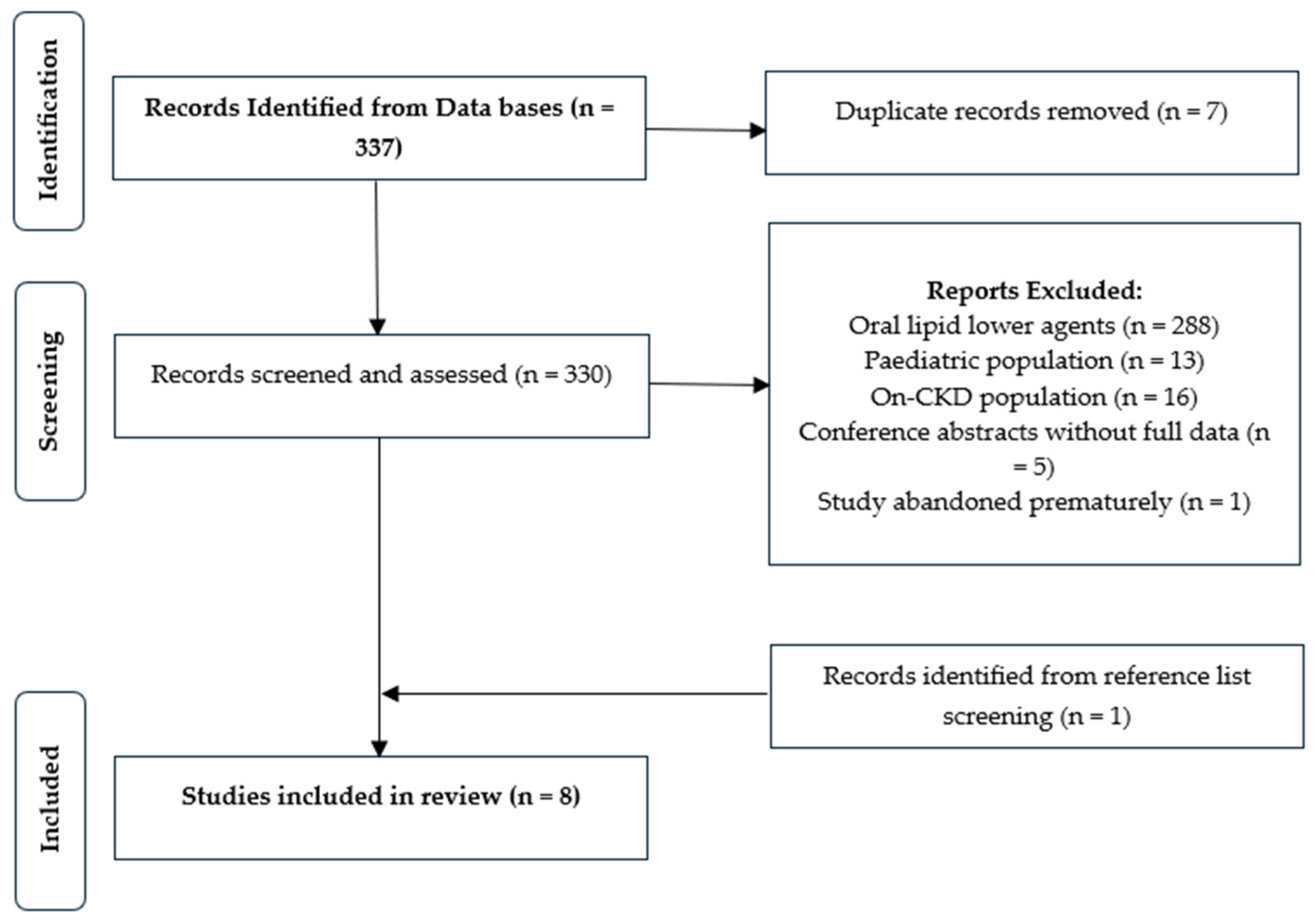
Search results were imported into Rayyan for de-duplication and screening. Two reviewers independently screened titles and abstracts against the PICOS criteria, followed by full-text assessment of potentially eligible articles. Discrepancies at either stage were resolved through discussion, with recourse to a third reviewer as arbiter when required. Reasons for full-text exclusion were recorded and are summarised in the PRISMA flow diagram (Figure 1). Data were extracted independently by two reviewers using a piloted, standardised extraction form. Extracted variables included study design, setting, country, sample size, CKD stage distribution, dialysis or transplant status, details of the intervention (agent, dose, dosing schedule, timing in relation to dialysis where applicable), comparator, duration of follow-up, and definitions of primary and secondary outcomes. We also recorded baseline lipid profiles and kidney function, measures of lipid efficacy (absolute and percentage changes where reported), cardiovascular and renal outcomes, adverse events (including injection-site reactions, immunogenicity, and serious adverse events), and any implementation-related information (for example, dose adjustment for kidney function, adherence proxies, clinic utilisation or pathway descriptions). Where multiple reports described the same study, data were collated to avoid double-counting; intention-to-treat analyses and adjusted estimates were prioritised when available.
Risk of bias was assessed at the study level by two reviewers, with disagreements resolved by consensus. For randomised controlled trials and non-randomised comparative studies, we used the relevant National Institutes of Health (NIH) quality assessment tools, evaluating domains such as selection, comparability of groups, outcome measurement, attrition, and selective reporting. For single-arm PK/PD studies, we focused on internal validity domains relevant to small mechanistic studies, including clarity of inclusion criteria, completeness of follow-up, and standardisation of outcome measurements. Each study was rated as “good”, “fair”, or “poor” quality according to NIH guidance, and detailed assessments are reported in Supplementary Table S4; risk-of-bias judgements informed the narrative synthesis but were not used to generate summary scores.
We had prespecified that a meta-analysis would be conducted if studies were sufficiently homogeneous with respect to populations, interventions, comparators, and outcome definitions. However, marked heterogeneity in CKD stage mix and dialysis status, injectable agents (class, dose, schedule), background lipid-lowering therapy, and timing and definition of outcomes precluded meaningful statistical pooling, and we therefore undertook a structured narrative synthesis. Studies were grouped primarily by intervention class (PCSK9-pathway therapies versus other injectable or historical agents), and within each group, we summarised lipid efficacy, cardiovascular and renal outcomes, safety, and implementation-related findings. Where feasible, we report both absolute and relative changes and comment on between-study consistency, highlighting where conclusions are based on a single large outcomes trial versus small PK/PD or historical studies. Sensitivity considerations—such as the potential influence of high-risk-of-bias studies and dialysis-only cohorts—are discussed qualitatively in the Discussion, consistent with SWiM guidance.
The PRISMA checklist is available as Supplementary Material Table S2.

3. Results

The search yielded 330 records. Following title and abstract screening, 323 records were excluded, most commonly because they evaluated oral rather than injectable lipid-lowering therapies (n = 288). One additional study was identified through reference list screening, leaving eight studies for inclusion (Figure 1). Across these studies, 28,013 participants were represented, spanning a range of CKD severity (Table 1; further detailed study characteristics are included in the Supplementary Material, in Table S3). The evidence base was weighted towards patients with preserved or mildly to moderately impaired kidney function in the FOURIER subgroup and inclisiran trials, while most historical parenteral interventions were conducted in haemodialysis cohorts. Only one small evolocumab PK/PD study included haemodialysis patients (n = 6), and no PCSK9-pathway trials specifically targeted dialysis or transplant populations. Study quality assessments and detailed lipid outcomes are provided as Supplementary Materials, Tables S4 and S5, respectively. Three studies evaluated PCSK9-pathway therapies (evolocumab and inclisiran), while five examined other parenteral interventions. Given their contemporary relevance and stronger methodological design, the results below focus on the PCSK9-pathway studies, with the remaining interventions summarised briefly for completeness.

3.1. Large Outcomes Data (FOURIER Post Hoc Analysis)

A post hoc analysis of FOURIER assessed the efficacy and safety of evolocumab in 27,554 participants with established atherosclerotic cardiovascular disease receiving background high-intensity statin therapy. Participants were stratified by baseline kidney function into: eGFR ≥ 90 mL/min/1.73 m2 (n = 5718), eGFR 60–89 mL/min/1.73 m2 (n = 13,940), and eGFR < 60 mL/min/1.73 m2 (n = 7896), with mean eGFR 97 ± 7, 74 ± 8, and 46 ± 11 mL/min/1.73 m2, respectively. The cohort was predominantly male (75%), with a mean age of 63 years, and 37% had diabetes. Mean baseline LDL-C was 2.4 mmol/L (92 mg/dL). Evolocumab (140 mg subcutaneously every 2 weeks or 420 mg monthly) produced consistent LDL-C reductions of 58–59% at 48 weeks across kidney function strata (interaction p = 0.77), with reductions in non–HDL-C (~50%), apolipoprotein B (~40%), and lipoprotein(a) (25–27%). Over a median follow-up of 26 months, the primary composite endpoint (CV death, myocardial infarction, stroke, hospitalisation for unstable angina, or coronary revascularisation) was reduced with hazard ratios of 0.82 (95% CI 0.71–0.94) for eGFR ≥ 90, 0.85 (0.77–0.94) for eGFR 60–89, and 0.89 (0.76–1.05) for eGFR < 60 (interaction p = 0.77).
Absolute risk reduction for the key secondary composite (CV death, myocardial infarction, or stroke) was 2.5% in eGFR < 60 compared with 1.7% in eGFR ≥ 90. Safety outcomes were comparable across kidney function strata; adverse events were similar between evolocumab and placebo, most were mild injection-site reactions, and eGFR trajectories were broadly similar between arms.
Overall, among the included studies, FOURIER provides the highest-level evidence for cardiovascular outcomes, whereas the remaining PCSK9-pathway and historical injectable studies contribute primarily PK/PD and surrogate lipid data.

3.2. Pharmacokinetic/Pharmacodynamic Studies of PCSK9 Pathway Therapies

These PK/PD studies did not evaluate hard cardiovascular or renal endpoints but provided mechanistic and dosing information across the CKD spectrum studied. Lee and colleagues evaluated evolocumab PK/PD and safety in an open-label, single-dose, parallel-group study of 18 participants (normal kidney function: eGFR ≥ 90 mL/min/1.73 m2, n = 6; severe renal impairment: eGFR 15–29 mL/min/1.73 m2 with a mean ~22, n = 6; and end-stage kidney disease receiving maintenance haemodialysis, n = 6). Mean age was 57.2 ± 9.6 years, 39% were women, and all were on stable statin therapy for at least three months with baseline LDL-C 70–190 mg/dL. Following a single 140 mg subcutaneous dose, evolocumab exposure (C_max and AUC_last) showed no clinically meaningful relationship with baseline creatinine clearance. Although plasma concentrations were modestly higher in severe renal impairment, these differences remained within expected inter-individual variability and were not associated with adverse safety signals. LDL-C reached its nadir between days 11 and 15, with maximum mean percentage reductions of −60% (normal), −58% (severe impairment), and −49% (haemodialysis). PCSK9 suppression was rapid (>73% at 4 h post-dose) and sustained (>94% from days 2–11). Adverse events were infrequent and no anti-evolocumab antibodies were detected.
Inclisiran evidence was reported by Wright and colleagues, combining ORION-7 (a phase 1 renal impairment PK/PD study, n = 31) and the renal subgroup of ORION-1 (a phase 2 randomised, placebo-controlled dose-finding trial, n = 247). In ORION-7, inclisiran 300 mg produced PCSK9 reductions at day 60 of approximately 68–80% across renal categories (normal, mild, moderate, severe impairment), with corresponding LDL-C reductions versus placebo that were clinically meaningful across strata. In ORION-1, the two-dose regimen demonstrated greater and more durable LDL-C reductions than single-dose regimens, with reductions maintained at day 180 (around 51–58% with two doses). Inclisiran exposure increased with worsening renal impairment, but plasma concentrations fell rapidly and were undetectable by 48 h in all groups; these PK differences did not translate into clear differences in PD response or safety. Adverse events were mainly mild injection-site reactions, and no dose adjustment was considered necessary across CKD stages represented in these studies.
Across the PCSK9-pathway studies, PCSK9 monoclonal antibodies produced LDL-C reductions of approximately 50–60% when added to background statin therapy, while inclisiran achieved 35–58% reductions. Effects were broadly consistent across baseline LDL-C, statin intensity, diabetes status, and degrees of renal impairment. Both approaches reduced non–HDL-C (~45–50%), apolipoprotein B (~40–45%), triglycerides (~10–15%), and Lp(a) (~20–25%), with monoclonal antibodies achieving slightly larger Lp(a) reductions than siRNA therapy.

3.3. Other Injectable or Historical Interventions

Five included studies assessed other injectable approaches, largely in dialysis cohorts, including L-carnitine-based regimens, magnesium pyridoxal 5-phosphate glutamate, coenzyme Q10 combinations, and the endothelin receptor antagonist sitaxentan. These studies were generally small, older, and methodologically limited, with heterogeneous populations and inconsistent lipid effects, and none were powered for cardiovascular or renal outcomes. One small randomised crossover study of sitaxentan in non-dialysis CKD reported short-term reductions in total cholesterol, LDL-C, and PCSK9 over eight weeks, but sitaxentan has since been withdrawn because of hepatotoxicity, so these findings have little relevance to current practice.

4. Discussion

In this review, the available CKD-specific evidence for PCSK9-pathway therapies is largely dominated by a single post hoc analysis of the FOURIER outcomes trial, supplemented by small early-phase renal pharmacokinetic/pharmacodynamic (PK/PD) studies. In FOURIER, evolocumab delivered similar relative reductions in major cardiovascular events across kidney function strata (interaction p = 0.77), and higher baseline event rates at lower eGFR translated into larger absolute risk reductions in participants with reduced kidney function. However, because this was not a trial specifically designed for CKD, and patients with very advanced kidney disease or dialysis dependence were underrepresented, the precision of effect estimates in these populations is limited and the findings should be viewed as hypothesis-generating rather than definitive for advanced CKD [17].
The PK/PD studies provide supportive evidence for dosing across the CKD spectrum studied. For evolocumab, drug exposure was not meaningfully related to renal function, and lipid/PCSK9 responses were broadly comparable across normal function, severe impairment, and haemodialysis groups in the dedicated study. This supports fixed dosing without renal adjustment and suggests that administration does not need to be timed to coincide with haemodialysis sessions. For inclisiran, renal-function analyses from ORION-7 and ORION-1 showed substantial and durable PCSK9 and LDL-C reductions across renal strata, with higher exposure in severe impairment but rapid plasma clearance (undetectable by 48 h) and no clear differences in pharmacodynamic response or safety. Although these findings support fixed dosing across the CKD stages represented, evidence in dialysis-dependent populations is sparse, and there remain gaps for kidney transplant recipients.
Across the CKD strata examined, tolerability appeared favourable, with adverse events predominantly mild injection-site reactions, generally reported in fewer than 5% of participants, and no consistent CKD-specific excess of serious adverse events. Importantly, the included trial data did not identify a signal for accelerated decline in kidney function, acute kidney injury, or worsening proteinuria attributable to PCSK9 inhibition. Nonetheless, the evidence base remains constrained by underrepresentation of dialysis populations and the absence of transplant-specific data; therefore, safety in these groups should be interpreted cautiously, and ongoing pharmacovigilance is appropriate as use expands.
Kidney outcomes represent a major evidence gap. Although the FOURIER subgroup and early-phase studies provide some reassurance that PCSK9-pathway therapies do not accelerate eGFR decline over the time horizons studied, none of the included trials were designed with renal endpoints as primary outcomes (such as eGFR slope or progression to ESKD), and events such as progression to ESKD were infrequent. Furthermore, there were only six haemodialysis patients and no kidney transplant recipients across the PCSK9-pathway studies included, thus precluding any firm conclusions about renal safety or potential renoprotective effects in advanced CKD, dialysis, or transplant populations.
These patterns of recruitment have important implications for generalisability. Most PCSK9-pathway data in this review derive from patients with predominantly non-dialysis CKD (stages G3–G4), often enrolled in broader ASCVD trials, whereas dialysis-dependent and transplant populations are largely absent. Clinicians should therefore be cautious when extrapolating efficacy and safety estimates to patients with ESKD on maintenance dialysis or to kidney transplant recipients, in whom competing risks, non-atherosclerotic mechanisms, and complex immunosuppression may modify both baseline risk and treatment response.
While LDL-C remains the central modifiable lipid target in current CKD guidelines, PCSK9-pathway therapies will primarily address cholesterol-mediated risk and do not obviate the need to manage non-lipid drivers of residual cardiovascular risk such as systemic inflammation, uraemic toxins, and vascular calcification, which remain important even when LDL-C is aggressively lowered [2,3,4,6,7,8,10]. Implications for practice follow from the combination of guideline targets and the persistent gap between targets and achieved LDL-C levels in CKD [8,9,10,16,25]. For very high-risk CKD patients who remain above ESC/EAS LDL-C targets on maximally tolerated statin therapy (with or without ezetimibe), PCSK9-directed therapies are reasonable escalation options, consistent with guideline recommendations. In practical terms, our findings support a stepped approach in CKD whereby LDL-C is first optimised with high-intensity statins (where tolerated) and ezetimibe, followed by consideration of PCSK9-pathway therapies in very high-risk patients who remain above guideline LDL-C thresholds or have recurrent events despite standard therapy [8,9,10]. In parallel, there is a need to improve systematic identification of high-risk CKD patients, embed lipid assessment into routine nephrology care, and coordinate lipid-lowering strategies across nephrology, cardiology, and primary care services.
Within contemporary CKD lipid-management algorithms, injectable PCSK9-pathway therapies should generally be viewed as add-on or second-line agents to maximally tolerated statins with or without ezetimibe, rather than substitutes for first-line oral therapy. Compared with oral agents, PCSK9 monoclonal antibodies and inclisiran offer larger incremental LDL-C and Lp(a) reductions, minimal drug–drug interactions, and fixed dosing without renal adjustment, but at substantially higher cost, with parenteral administration requirements and variable reimbursement depending on jurisdiction [8,22,24,25,30]. They may therefore be most appropriate for very high-risk CKD patients who remain above LDL-C targets or have documented statin intolerance, while ensuring that evidence-based oral therapies and broader risk-factor modification (e.g., blood pressure, glycaemia, smoking cessation, and inflammation-targeted strategies where appropriate) are optimised.
In practice, treatment selection should be individualised, taking account of CKD stage, comorbidity burden, and the patient’s capacity to engage with different delivery models. Where frequent administration is feasible and supported, monoclonal antibodies given every 2–4 weeks may be suitable; where visit frequency and adherence are limiting, inclisiran’s six-monthly maintenance dosing after initial loading may align better with service capacity and patient preference. For patients receiving haemodialysis, evolocumab dosing does not require coordination with dialysis timing based on the included PK data; for inclisiran, the limited data on dialysis clearance mean scheduling should be pragmatic and embedded within existing dialysis or clinic workflows while further evidence accrues.
Service delivery considerations are central to implementation. Both classes require cold-chain storage (2–8 °C), prescribing governance and consent, and structured patient education. Integration into established CKD pathways—such as anaemia management, vaccination clinics, or routine multidisciplinary reviews—may reduce additional travel and appointment burden and facilitate reliable recall systems, particularly for twice-yearly inclisiran maintenance dosing. Given the practical barriers described, local protocols should also specify monitoring arrangements and responsibilities across nephrology, primary care, and lipid/cardiology services to avoid fragmented follow-up.
Finally, the evidence base for the alternative injectable interventions identified in this review was limited by small sample sizes, older study designs, inconsistent lipid effects, and the fact that one agent (sitaxentan) is no longer clinically applicable due to hepatotoxicity [34,35,36,37]. These approaches are unlikely to inform contemporary practice. Overall, current data support PCSK9-pathway therapies as effective lipid-lowering options in CKD stages represented in major trials and early-phase studies but highlight the need for more definitive evidence in dialysis-dependent patients and kidney transplant recipients, as well as implementation studies that address delivery models and follow-up in routine CKD care [17,22,23,24,25,30].
This review followed a pre-registered protocol, used a comprehensive multi-database search strategy, and applied structured narrative synthesis methods (SWiM), which strengthens transparency and reproducibility. However, the evidence base was heterogeneous with respect to CKD stage mix, dialysis status, concomitant therapies, and outcome definitions, precluding meta-analysis and limiting direct comparisons between studies. Advanced CKD, dialysis, and transplant populations were markedly underrepresented, with only six haemodialysis participants in dedicated PK/PD work and no transplant-specific data, so generalisability to these groups is limited. In addition, reliance on a single large subgroup analysis and several small, short-term PK/PD studies increases the risk of imprecision and selective reporting, and earlier historical injectable interventions do not reflect contemporary practice [17,23,35,36,37,38].
PCSK9 inhibitors and inclisiran provide substantial additional LDL-C and apoB-containing lipoprotein reductions across CKD stages G3–G5 without the need for renal dose adjustment, with reassuring short- to medium-term safety data and preserved cardiovascular benefit in patients with mild-to-moderate CKD [17,22,23,24,25,26]. However, the CKD-specific evidence base remains narrow, relying on one large subgroup analysis and a handful of small, short-term mechanistic studies, with limited representation of dialysis and no transplant-specific data, and virtually no dedicated kidney outcome trials. Current findings support selective use of injectable lipid-lowering therapies as adjuncts to maximally tolerated oral therapy in very high-risk CKD populations while prioritising broader cardiovascular risk reduction and careful shared decision-making [8,9,25,29,30,31]. Future research should include adequately powered trials in advanced CKD, dialysis, and transplant cohorts with prespecified cardiovascular and renal endpoints, as well as implementation studies addressing cost-effectiveness, service delivery models, and strategies to integrate lipid-lowering with inflammation-targeted and multimorbidity-focused care.

Supplementary Materials

The following supporting information can be downloaded at: https://www.mdpi.com/article/10.3390/biomed6020011/s1, Table S1: Full search strategy; Table S2: detailed study characteristics; Table S3: PRISMA Checklist; Table S4: Study quality assessment; Table S5: Detailed lipid outcomes.

Author Contributions

Conceptualisation, J.B.; methodology, J.L.D., J.B., Y.Z. and S.R.; data curation, J.L.D., Y.Z. and I.P.; writing—original draft preparation, J.L.D.; writing—review and editing, J.L.D., J.B. and S.R.; visualisation, J.L.D. All authors have read and agreed to the published version of the manuscript.

Funding

This research received no external funding.

Institutional Review Board Statement

Not applicable.

Informed Consent Statement

Not applicable.

Data Availability Statement

No new data have been generated from this study. Data used for analysis/synthesis are available from the original research articles.

Acknowledgments

During the preparation of this manuscript/study, the authors used Claude AI, Sonnet 4.5 for the purposes of refining grammar and sentence structure. The authors have reviewed and edited the output and take full responsibility for the content of this publication.

Conflicts of Interest

The authors declare that the research was conducted in the absence of any commercial or financial relationships that could be construed as a potential conflict of interest.

Abbreviations

The following abbreviations are used in this manuscript:
4DDie Deutsche Diabetes Dialyse Study
ASCVDAtherosclerotic Cardiovascular Disease
ASNAmerican Society of Nephrology
AURORAA Study to Evaluate the Use of Rosuvastatin in Subjects on Regular Haemodialysis: An Assessment of Survival and Cardiovascular Events
CKDChronic Kidney Disease
CTTCholesterol Treatment Trialists
CVCardiovascular
DBDouble Blind
EASEuropean Association of Atherosclerosis and Lipid Management
eGFREstimated Glomerular Filtration Rate
ERAEuropean Renal Association
ESCEuropean Society of Cardiology
HDL-CHigh-Density Lipoprotein Cholesterol
ILLTInjectable Lipid Lower Therapy
IVIntravenous
LDLLow-Density Lipoprotein
MACEMajor Adverse Cardiovascular Events
MMPGMagnesium Pyridoxal 5-Phosphate Glutamate
OLOpen Label
PCSK9Proprotein Convertase Subtilisin/Kexin Type 9
PDPharmacodynamic
PKPharmacokinetic
PRISMAPreferred Reporting Items for Systematic Reviews and Meta-Analyses
PROSPEROProspective Register of Systematic Reviews
Q2WTwo Weekly
RCTRandomised Control Trial
SCSubcutaneously
SHARPStudy of Heart and Renal Protection
UKKAUnited Kingdom Kidney Association

References

  1. Go, A.S.; Chertow, G.M.; Fan, D.; McCulloch, C.E.; Hsu, C. Chronic kidney disease and the risks of death, cardiovascular events, and hospitalization. N. Engl. J. Med. 2004, 351, 1296–1305. [Google Scholar] [CrossRef]
  2. Tonelli, M.; Muntner, P.; Lloyd, A.; Manns, B.; Klarenbach, S.; Pannu, N.; James, M.; Hemmelgarn, B. Association between LDL-C and risk of myocardial infarction in CKD. J. Am. Soc. Nephrol. 2013, 24, 979–986. [Google Scholar] [CrossRef]
  3. Pradhan, A.D.; Aday, A.W.; Rose, L.M.; Ridker, P.M. Residual Inflammatory Risk on Treatment with PCSK9 Inhibition and Statin Therapy. Circulation 2018, 138, 141–149. [Google Scholar] [CrossRef]
  4. Lv, L.; Rajpura, J.; Liu, M.; Strum, M.; Chastek, B.; Johnson, J.; Gluckman, T.J. Prevalence and clinical characteristics of patients with hsCRP testing and test-confirmed systemic inflammation among individuals with atherosclerotic cardiovascular disease with or without chronic kidney disease in the United States (PLUTUS). Am. J. Prev. Cardiol. 2025, 21, 100950. [Google Scholar] [CrossRef] [PubMed]
  5. Mohamed-Yassin, M.-S.; Baharudin, N.; Abdul-Razak, S.; Ramli, A.S.; Lai, N.M. Global prevalence of dyslipidaemia in adult populations: A systematic review protocol. BMJ Open 2021, 11, e049662. [Google Scholar] [CrossRef]
  6. Kon, V.; Yang, H.; Fazio, S. Residual Cardiovascular Risk in Chronic Kidney Disease: Role of High-density Lipoprotein. Arch. Med. Res. 2015, 46, 379–391. [Google Scholar] [CrossRef] [PubMed]
  7. Baek, J.; He, C.; Afshinnia, F.; Michailidis, G.; Pennathur, S. Lipidomic approaches to dissect dysregulated lipid metabolism in kidney disease. Nat. Rev. Nephrol. 2022, 18, 38–55. [Google Scholar] [CrossRef]
  8. Mach, F.; Baigent, C.; Catapano, A.L.; Koskinas, K.C.; Casula, M.; Badimon, L.; Chapman, M.J.; De Backer, G.G.; Delgado, V.; Ference, B.A.; et al. 2019 ESC/EAS Guidelines for the management of dyslipidaemias: Lipid modification to reduce cardiovascular risk. Eur. Heart J. 2020, 41, 111–188. [Google Scholar] [CrossRef]
  9. Ferro, C.J.; Mark, P.B.; Kanbay, M.; Sarafidis, P.; Heine, G.H.; Rossignol, P.; Massy, Z.A.; Mallamaci, F.; Valdivielso, J.M.; Malyszko, J.; et al. Lipid Management in Patients with Chronic Kidney Disease. Nat. Rev. Nephrol. 2018, 14, 727–749. [Google Scholar] [CrossRef]
  10. Taskinen, M.-R.; Del Prato, S.; Bujas-Bobanovic, M.; Louie, M.J.; Letierce, A.; Thompson, D.; Colhoun, H.M. Efficacy and Safety of Alirocumab in Individuals with Type 2 Diabetes Mellitus with or without Mixed Dyslipidaemia: Analysis of the ODYSSEY LONG TERM Trial. Atherosclerosis 2018, 276, 124–130. [Google Scholar] [CrossRef]
  11. Gaudet, D.; Drouin-Chartier, J.-P.; Couture, P. Lipid Metabolism and Emerging Targets for Lipid-Lowering Therapy. Can. J. Cardiol. 2017, 33, 872–882. [Google Scholar] [CrossRef]
  12. Ference, B.A.; Ginsberg, H.N.; Graham, I.; Ray, K.K.; Packard, C.J.; Bruckert, E.; Hegele, R.A.; Krauss, R.M.; Raal, F.J.; Schunkert, H.; et al. Low-Density Lipoproteins Cause Atherosclerotic Cardiovascular Disease. 1. Evidence from Genetic, Epidemiologic, and Clinical Studies. A Consensus Statement from the European Atherosclerosis Society Consensus Panel. Eur. Heart J. 2017, 38, 2459–2472. [Google Scholar] [CrossRef]
  13. Baigent, C.; Landray, M.J.; Reith, C.; Emberson, J.; Wheeler, D.C.; Tomson, C.; Wanner, C.; Krane, V.; Cass, A.; Craig, J.; et al. SHARP Investigators. The Effects of Lowering LDL Cholesterol with Simvastatin plus Ezetimibe in Patients with Chronic Kidney Disease (Study of Heart and Renal Protection): A Randomised Placebo-Controlled Trial. Lancet 2011, 377, 2181–2192. [Google Scholar] [CrossRef]
  14. Wanner, C.; Krane, V.; März, W.; Olschewski, M.; Mann, J.F.E.; Ruf, G.; Ritz, E. German Diabetes and Dialysis Study Investigators. Atorvastatin in Patients with Type 2 Diabetes Mellitus Undergoing Hemodialysis. N. Engl. J. Med. 2005, 353, 238–248. [Google Scholar] [CrossRef] [PubMed]
  15. Fellström, B.C.; Jardine, A.G.; Schmieder, R.E.; Holdaas, H.; Bannister, K.; Beutler, J.; Chae, D.-W.; Chevaile, A.; Cobbe, S.M.; Grönhagen-Riska, C.; et al. Rosuvastatin and Cardiovascular Events in Patients Undergoing Hemodialysis. N. Engl. J. Med. 2009, 360, 1395–1407. [Google Scholar] [CrossRef] [PubMed]
  16. Velenosi, T.J.; Urquhart, B.L. Pharmacokinetic Considerations in Chronic Kidney Disease and Patients Requiring Dialysis. Expert. Opin. Drug Metab. Toxicol. 2014, 10, 1131–1143. [Google Scholar] [CrossRef] [PubMed]
  17. Charytan, D.M.; Sabatine, M.S.; Pedersen, T.R.; Im, K.; Park, J.-G.; Pineda, A.L.; Wasserman, S.M.; Deedwania, P.; Olsson, A.G.; Sever, P.S.; et al. FOURIER Steering Committee and Investigators. Efficacy and Safety of Evolocumab in Chronic Kidney Disease in the FOURIER Trial. J. Am. Coll. Cardiol. 2019, 73, 2961–2970. [Google Scholar] [CrossRef] [PubMed]
  18. Sabatine, M.S.; Giugliano, R.P.; Keech, A.C.; Honarpour, N.; Wiviott, S.D.; Murphy, S.A.; Kuder, J.F.; Wang, H.; Liu, T.; Wasserman, S.M.; et al. FOURIER Steering Committee and Investigators. Evolocumab and Clinical Outcomes in Patients with Cardiovascular Disease. N. Engl. J. Med. 2017, 376, 1713–1722. [Google Scholar] [CrossRef]
  19. Schwartz, G.G.; Steg, P.G.; Szarek, M.; Bhatt, D.L.; Bittner, V.A.; Diaz, R.; Edelberg, J.M.; Goodman, S.G.; Hanotin, C.; Harrington, R.A.; et al. ODYSSEY OUTCOMES Committees and Investigators. Alirocumab and Cardiovascular Outcomes after Acute Coronary Syndrome. N. Engl. J. Med. 2018, 379, 2097–2107. [Google Scholar] [CrossRef]
  20. Toth, P.P.; Worthy, G.; Gandra, S.R.; Sattar, N.; Bray, S.; Cheng, L.-I.; Bridges, I.; Worth, G.M.; Dent, R.; Forbes, C.A.; et al. Systematic Review and Network Meta-Analysis on the Efficacy of Evolocumab and Other Therapies for the Management of Lipid Levels in Hyperlipidemia. J. Am. Heart Assoc. 2017, 6, e005367. [Google Scholar] [CrossRef]
  21. Zijlstra, L.E.; Trompet, S.; Mooijaart, S.P.; van Buren, M.; Jukema, J.W. Renal Impairment, Cardiovascular Disease, and the Short-Term Efficacy and Safety of PCSK9 Targeted by Inclisiran. Mayo Clin. Proc. 2020, 95, 12–14. [Google Scholar] [CrossRef]
  22. Ray, K.K.; Wright, R.S.; Kallend, D.; Koenig, W.; Leiter, L.A.; Raal, F.J.; Bisch, J.A.; Richardson, T.; Jaros, M.; Wijngaard, P.L.J.; et al. ORION-10 and ORION-11 Investigators. Two Phase 3 Trials of Inclisiran in Patients with Elevated LDL Cholesterol. N. Engl. J. Med. 2020, 382, 1507–1519. [Google Scholar] [CrossRef] [PubMed]
  23. Wright, R.S.; Ray, K.K.; Raal, F.J.; Kallend, D.G.; Jaros, M.; Koenig, W.; Leiter, L.A.; Landmesser, U.; Schwartz, G.G.; Friedman, A.; et al. ORION Phase III Investigators. Pooled Patient-Level Analysis of Inclisiran Trials in Patients With Familial Hypercholesterolemia or Atherosclerosis. J. Am. Coll. Cardiol. 2021, 77, 1182–1193. [Google Scholar] [CrossRef] [PubMed]
  24. Raal, F.J.; Kallend, D.; Ray, K.K.; Turner, T.; Koenig, W.; Wright, R.S.; Wijngaard, P.L.J.; Curcio, D.; Jaros, M.J.; Leiter, L.A.; et al. ORION-9 Investigators. Inclisiran for the Treatment of Heterozygous Familial Hypercholesterolemia. N. Engl. J. Med. 2020, 382, 1520–1530. [Google Scholar] [CrossRef]
  25. Igweonu-Nwakile, E.O.; Ali, S.; Paul, S.; Yakkali, S.; Teresa Selvin, S.; Thomas, S.; Bikeyeva, V.; Abdullah, A.; Radivojevic, A.; Abu Jad, A.A.; et al. A Systematic Review on the Safety and Efficacy of PCSK9 Inhibitors in Lowering Cardiovascular Risks in Patients with Chronic Kidney Disease. Cureus 2022, 14, e29140. [Google Scholar] [CrossRef]
  26. Lee, E.; Gibbs, J.P.; Emery, M.G.; Block, G.; Wasserman, S.M.; Hamilton, L.; Kasichayanula, S.; Hanafin, P.; Somaratne, R.; Egbuna, O. Influence of Renal Function on Evolocumab Exposure, Pharmacodynamics, and Safety. Clin. Pharmacol. Drug Dev. 2019, 8, 281–289. [Google Scholar] [CrossRef]
  27. Robinson, J.G.; Rosenson, R.S.; Farnier, M.; Chaudhari, U.; Sasiela, W.J.; Merlet, L.; Miller, K.; Kastelein, J.J.P. Safety of Very Low Low-Density Lipoprotein Cholesterol Levels with Alirocumab: Pooled Data From Randomized Trials. J. Am. Coll. Cardiol. 2017, 69, 471–482. [Google Scholar] [CrossRef]
  28. Koren, M.J.; Kereiakes, D.; Pourfarzib, R.; Winegar, D.; Banerjee, P.; Hamon, S.; Hanotin, C.; McKenney, J.M. Effect of PCSK9 Inhibition by Alirocumab on Lipoprotein Particle Concentrations Determined by Nuclear Magnetic Resonance Spectroscopy. J. Am. Heart Assoc. 2015, 4, e002224. [Google Scholar] [CrossRef]
  29. Arnett, D.K.; Blumenthal, R.S.; Albert, M.A.; Buroker, A.B.; Goldberger, Z.D.; Hahn, E.J.; Himmelfarb, C.D.; Khera, A.; Lloyd-Jones, D.; McEvoy, J.W.; et al. 2019 ACC/AHA Guideline on the Primary Prevention of Cardiovascular Disease: Executive Summary: A Report of the American College of Cardiology/American Heart Association Task Force on Clinical Practice Guidelines. J. Am. Coll. Cardiol. 2019, 74, 1376–1414. [Google Scholar] [CrossRef]
  30. Mercep, I.; Strikic, D.; Hrabac, P.; Pecin, I.; Reiner, Ž. PCSK9 Inhibition: From Effectiveness to Cost-Effectiveness. Front. Cardiovasc. Med. 2024, 11, 1339487. [Google Scholar] [CrossRef] [PubMed]
  31. Nee, R.; Yuan, C.M.; Narva, A.S.; Yan, G.; Norris, K.C. Overcoming Barriers to Implementing New Guideline-Directed Therapies for Chronic Kidney Disease. Nephrol. Dial. Transplant. 2023, 38, 532–541. [Google Scholar] [CrossRef]
  32. Warden, B.A.; Fazio, S.; Shapiro, M.D. The PCSK9 Revolution: Current Status, Controversies, and Future Directions. Trends Cardiovasc. Med. 2020, 30, 179–185. [Google Scholar] [CrossRef]
  33. Chaudhary, R.; Garg, J.; Shah, N.; Sumner, A. PCSK9 Inhibitors: A New Era of Lipid Lowering Therapy. World J. Cardiol. 2017, 9, 76–91. [Google Scholar] [CrossRef]
  34. Colhoun, H.M.; Robinson, J.G.; Farnier, M.; Cariou, B.; Blom, D.; Kereiakes, D.J.; Lorenzato, C.; Pordy, R.; Chaudhari, U. Efficacy and Safety of Alirocumab, a Fully Human PCSK9 Monoclonal Antibody, in High Cardiovascular Risk Patients with Poorly Controlled Hypercholesterolemia on Maximally Tolerated Doses of Statins: Rationale and Design of the ODYSSEY COMBO I and II Trials. BMC Cardiovasc. Disord. 2014, 14, 121. [Google Scholar] [CrossRef]
  35. Guarnieri, G.F.; Ranieri, F.; Toigo, G.; Vasile, A.; Ciman, M.; Rizzoli, V.; Moracchiello, M.; Campanacci, L. Lipid-Lowering Effect of Carnitine in Chronically Uremic Patients Treated with Maintenance Hemodialysis. Am. J. Clin. Nutr. 1980, 33, 1489–1492. [Google Scholar] [CrossRef]
  36. Kirsten, R.; Heintz, B.; Nelson, K.; Sieberth, H.G.; Oremek, G.; Hasford, J.; Speck, U. Magnesium Pyridoxal 5-Phosphate Glutamate Reduces Hyperlipidaemia in Patients with Chronic Renal Insufficiency. Eur. J. Clin. Pharmacol. 1988, 34, 133–137. [Google Scholar] [CrossRef] [PubMed]
  37. Shojaei, M.; Djalali, M.; Khatami, M.; Siassi, F.; Eshraghian, M. Effects of Carnitine and Coenzyme Q10 on Lipid Profile and Serum Levels of Lipoprotein(a) in Maintenance Hemodialysis Patients on Statin Therapy. Iran J. Kidney Dis. 2011, 5, 114–118. [Google Scholar] [PubMed]
  38. Farrah, T.E.; Anand, A.; Gallacher, P.J.; Kimmitt, R.; Carter, E.; Dear, J.W.; Mills, N.L.; Webb, D.J.; Dhaun, N. Endothelin Receptor Antagonism Improves Lipid Profiles and Lowers PCSK9 (Proprotein Convertase Subtilisin/Kexin Type 9) in Patients With Chronic Kidney Disease. Hypertension 2019, 74, 323–330. [Google Scholar] [CrossRef] [PubMed]
  39. Page, M.J.; McKenzie, J.E.; Bossuyt, P.M.; Boutron, I.; Hoffmann, T.C.; Mulrow, C.D.; Shamseer, L.; Tetzlaff, J.M.; Akl, E.A.; Brennan, S.E.; et al. The PRISMA 2020 Statement: An Updated Guideline for Reporting Systematic Reviews. BMJ 2021, 372, n71. [Google Scholar] [CrossRef]
Figure 1. PRISMA flow chart.
Biomed 06 00011 g001
Table 1. Concise study characteristics. See Abbreviations section for further details.
Study (Year)
[Reference]
DesignNCKD StageseGFR Level/DialysisDurationInterventionPrimary
Outcomes
PCSK9 Pathway Therapies
FOURIER (2019) [17]RCT, DB27,554Preserved, G2, G397+/−7, 74+/−8, 46+/−1126 monthsEvolocumab 140 mg SC Q2WCV events, LDL-C
Lee (2019) [26]OL, PK/PD18Normal, G4, G5D>90, ~22, dialysis14 weeksEvolocumab 140 mg SCLDL-C, PK parameter
Wright (2019) [23]RCT, DB532G1–G4Spectrum 16–90+180 daysInclisiran 300 mg SCPCSK9, LDL-C
Alternative Injectable Agents
Guarnieri (1980) [35]Non-RCT16G5DDialysis15 weeksL-Carnitine IVTriglycerides
Kirsten (1988) [36]RCT, DB30G3–G4<40 (estimated)12 weeksMMPG oralLipid profile
Wanner (1990) [14]Non-RCT42G5DDialysis12 weeksBezafibrate + L-carnitineTriglycerides
Shojaei (2011) [37]RCT, DB64G5DDialysis3 monthsCoQ10 + carnitineLipoprotein(a)
Farah (2019) [38]RCT, crossover27G1–G454+/−268 weeksSitaxentanPCSK9
Disclaimer/Publisher’s Note: The statements, opinions and data contained in all publications are solely those of the individual author(s) and contributor(s) and not of MDPI and/or the editor(s). MDPI and/or the editor(s) disclaim responsibility for any injury to people or property resulting from any ideas, methods, instructions or products referred to in the content.