1. Introduction
The digitalization of contemporary societies has turned learning into a data-rich, ubiquitous activity, as learners leave digital traces through learning management systems, educational apps, social platforms, and smart-city infrastructures; these traces increasingly inform decisions about access to resources, support services, and opportunities across the life course [
1,
2,
3]. When designed with human well-being in mind, such ecosystems can enable personalized and equitable learning. When poorly governed, they risk amplifying existing inequalities and creating new forms of exclusion. In education, this makes governance, transparency, and proportional data use central conditions for inclusive innovation rather than optional add-ons.
Mathematics sits at the heart of this dynamic. It is foundational for scientific literacy and acts as a gatekeeper to many academic and professional pathways, particularly in science, technology, engineering, and mathematics (STEM). For a substantial minority of students, however, mathematics is associated with persistent difficulty and intense emotional distress. A subgroup of these learners meet criteria for “specific learning disorder with impairment in mathematics” in the International Classification of Diseases, 11th Revision (ICD-11), which provides a standardized framework for diagnosing developmental learning disorders and related conditions [
1]. Many other students experience low and unstable achievement, irregular attendance, or repeated failure without a formal diagnosis [
1,
4]. In both cases, they can be considered students with learning difficulties in mathematics who are at risk of negative educational and life outcomes if appropriate support is not provided. To avoid deficit labeling, this entry treats “risk” as a dynamic indicator used to mobilize support rather than a fixed trait.
These cognitive and academic challenges are frequently accompanied by mathematics anxiety, a negative emotional response characterized by worry, tension, and fear that interferes with performance and undermines self-beliefs [
5,
6]. A broad body of research has shown robust links between mathematics anxiety, working memory, and achievement: anxiety consumes cognitive resources required for problem solving and can trigger avoidance of mathematical tasks, which in turn limits practice and reinforces low performance [
7,
8,
9]. Students who already face learning difficulties, socio-economic disadvantages, or limited support at home are particularly vulnerable [
4,
6,
10]. Critically, anxiety is also shaped by classroom experience (e.g., evaluative pressure and error-related shame), making emotionally safe instructional design a core inclusion requirement.
In parallel, rapid developments in AI and digital technologies have reshaped mathematics learning environments. Intelligent tutoring systems (ITSs), adaptive practice platforms, digital games, virtual manipulatives, and immersive technologies can provide continuous assessment, immediate feedback, and multiple representations of mathematical concepts. Meta-analytic evidence suggests that well-designed digital interventions can significantly improve mathematical performance for students with persistent difficulties and can, in some cases, also reduce mathematics anxiety [
11,
12,
13]. In the broader Artificial Intelligence in Education (AIED) and intelligent tutoring systems (ITS) tradition, evidence syntheses have also reported learning gains from ITS use, supporting the view that adaptive tutoring can meaningfully complement teacher-led instruction when integrated into classroom practice.
These educational developments intersect with broader shifts towards digital society, smart cities, and Industry 5.0. Smart-city initiatives embed AI, the Internet of Things (IoT), and learning analytics into classrooms, campuses, libraries, and public spaces, aiming to create “smart learning environments” that are context-aware and personalized [
14,
15,
16]. Within an Industry 5.0 perspective, this transformation is explicitly framed as human-centric, sustainable, and resilient: technology should augment human capabilities and well-being rather than replace human agency [
2,
17]. However, smart learning infrastructures can also increase monitoring pressure and perceived surveillance if progress and affective states are continuously tracked, underscoring the need for privacy-aware, proportionate, and transparent deployment.
For students with learning difficulties in mathematics and elevated mathematics anxiety, this raises a central question: can AI-mediated mathematics education within smart-city learning ecosystems act as a lever for inclusion and emotional safety, or will it intensify surveillance, stress, and exclusion? This entry addresses that question from a conceptual and integrative perspective. From the educator’s standpoint, the answer depends on whether AI is implemented as human-in-the-loop decision support—enhancing differentiation and emotional safety—rather than as automated ranking, tracking, or cost-cutting infrastructure.
This entry adopts a conceptual and narrative review approach rather than reporting original empirical data. Its aim is to integrate existing knowledge from four intersecting domains:
- (a)
Mathematics learning difficulties and at-risk profiles in mathematics;
- (b)
Mathematics anxiety and its cognitive and affective mechanisms;
- (c)
AI-based and technology-mediated interventions in mathematics education; and
- (d)
Digital society, smart cities, and smart learning environments within an Industry 5.0 framework.
Literature was identified through searches in databases such as Scopus, Web of Science, ERIC, and Google Scholar, using combinations of keywords including “artificial intelligence”, “mathematics education”, “learning difficulties”, “students at risk”, “math anxiety”, “digital society”, “smart city”, and “Industry 5.0”. Priority was given to peer-reviewed articles, books, and policy documents published between 2010 and 2025, while earlier seminal works were included to clarify concepts or theoretical foundations. In addition, foundational syntheses on intelligent tutoring systems (ITS) and research from the Artificial Intelligence in Education (AIED) field were consulted to strengthen the evidence base on established AI-supported approaches in mathematics learning.
The entry does not claim to provide an exhaustive systematic review. Instead, it offers a thematically organized synthesis that clarifies key concepts, summarizes typical benefits and risks of AI-mediated mathematics learning for students with learning difficulties, and derives design principles for inclusive, anxiety-aware educational practice in digital and smart-city learning ecosystems. Particular attention is given to classroom implementation conditions, including teacher agency, usability of analytics and dashboards, professional learning needs, and feasibility considerations related to resources and sustainability.
As illustrated in
Figure 1, the overall perspective rests on the intersection of three core domains: AI in mathematics education, learning difficulties and mathematics anxiety, and digital society/smart-city ecosystems.
Figure 1 provides the conceptual framing of the entry.
To avoid conceptual ambiguity,
Figure 1 is used as a conceptual framework (a domain-level map of intersections).
3. Inclusive AI-Mediated Mathematics Education for Students with Learning Difficulties
This section focuses on AI-mediated mathematics environments designed to support students with learning difficulties and mitigate mathematics anxiety. Four areas are discussed: AI-based assessment and screening, intelligent tutoring and adaptive practice, affective computing, and accessibility-by-design through UDL.
Educators’ Perspective: Teacher Agency and Classroom Orchestration. From an educator’s standpoint, inclusive AI-mediated mathematics education succeeds only when AI is treated as instructional decision support rather than an autonomous authority. Teachers remain responsible for (i) selecting tasks aligned with curriculum goals; (ii) interpreting analytics and affect-related indicators as probabilistic signals rather than labels; (iii) deciding when to slow pacing, change representations, or shift to teacher-led explanation; and (iv) protecting learners’ emotional safety by preventing public comparison, speed-based pressure, and deficit framing. In practice, teachers orchestrate AI use through short routines (e.g., 15–20 min of adaptive practice followed by targeted small-group reteaching), explicit norms (errors as information, not failure), and reflective prompts that connect feedback to strategy use. Teacher professional judgment is also essential for equity: educators contextualize patterns that may reflect language barriers, attendance disruptions, or limited home access, ensuring that AI outputs mobilize support rather than justify lowered expectations.
3.1. AI-Based Assessment and Screening
Traditional methods of identifying students with learning difficulties in mathematics often rely on periodic standardized tests, teacher referrals, or psycho-educational assessments. These processes can be slow, resource-intensive, and unequally accessible. AI-enhanced screening tools analyze fine-grained performance data—such as error patterns, response times, and sequences of actions—to flag learners at risk earlier and more sensitively than coarse-grained scores [
29].
Survey research highlights the potential of neural networks, ensemble models, and hybrid approaches that integrate cognitive tasks with behavioral indicators to improve classification accuracy and offer continuous, formative insight into learners’ difficulties [
29]. International organizations such as the OECD note that AI-driven dashboards can support teachers in planning differentiated instruction, provided that they remain interpretable, transparent, and aligned with professional judgment [
18]. In practice, screening outputs are most appropriate as prompts for teacher inquiry and targeted support (e.g., short diagnostic tasks, flexible grouping, or scaffolded practice), rather than as standalone labels.
However, early and continuous algorithmic screening raises ethical concerns: misclassification, stigma, and the risk that risk scores may be treated as stable traits rather than dynamic indicators. Inclusive practice requires robust safeguards, human oversight, and a shift from deficit-oriented labelling to supportive response.
3.2. Intelligent Tutoring Systems, Adaptive Practice, and Virtual Manipulatives
ITSs and adaptive practice systems adjust tasks, hints, and feedback based on learners’ performance histories. In mathematics, they have been developed for topics ranging from basic numeracy and fractions to algebra and geometry [
19,
20]. For students with learning difficulties, ITSs that combine multiple representations, error-sensitive feedback, and pacing control can provide a more supportive environment than time-pressured worksheets or rigid homework sets [
11,
21,
25]. Evidence syntheses in the ITS/AIED literature report consistent learning gains across tutoring systems and contexts, supporting the role of ITS as a complementary scaffold within classroom instruction [
23,
24]. Applied work on mathematics-focused ITS, including Cognitive Tutor research, further illustrates how model-based feedback and stepwise scaffolding can support mathematical learning [
22].
Classroom vignette (micro level). During a Grade 6 fractions unit, a student with persistent mathematics difficulties shows an “error streak” and prolonged response times in the AI tutor. A brief in-app self-check also indicates rising worry. Rather than lowering expectations, the teacher consults the dashboard and identifies a misconception (confusing the meaning of numerator and denominator). The teacher then switches the student to a visual representation (area model) and assigns two worked examples with guided prompts. Next, the teacher provides a six-minute small-group reteaching segment using manipulatives. The student returns to a low-stakes practice mode (no timer, no leaderboard, private retry) to rebuild confidence. Progress is reviewed the next day using a growth-oriented prompt (“Which strategy helped?”), so that anxiety does not turn into avoidance.
Some systems explicitly target learners with special educational needs and persistent mathematics difficulties. They use fine-grained models of misconceptions, integrate visual supports and audio cues, and provide step-wise scaffolding. Rather than treating these tools as replacements for instruction, a common effective practice is to use short, frequent ITS sessions (e.g., 15–20 min) integrated with teacher-led follow-up, where analytics guide re-teaching, strategy instruction, and error analysis in small groups. Some systems also detect negative affect from interaction patterns and trigger supportive responses such as encouragement, hints, or short breaks [
26]. Game-based environments and virtual manipulatives designed for students with mathematics learning difficulties often embed tasks within narratives or missions, reducing anxiety by shifting focus from evaluation to exploration [
11,
25].
For mathematics-anxious students, design features that appear beneficial include gradual increases in challenge, opportunities for private practice before public display, feedback emphasizing process and strategy rather than speed or ranking, and flexible pacing [
9,
13]. These features are particularly important when systems are deployed in high-stakes school contexts, where time pressure and comparative performance cues can inadvertently intensify anxiety.
3.3. Affective Computing and Regulation of Mathematics Anxiety
Affective computing extends AI-mediated learning by modelling not only cognitive but also emotional states. In mathematics education, systems infer states such as boredom, confusion, frustration, or anxiety from behavioral and physiological signals (e.g., response time patterns, error streaks, gaze dispersion, facial expressions) [
18,
26]. These moment-to-moment states are pedagogically consequential: confusion may shift to frustration, embarrassment, or threat appraisals, which can trigger avoidance and reinforce negative self-beliefs; conversely, timely support can promote relief, pride, and renewed persistence.
Affect-aware tutoring systems can detect early signs of disengagement or distress and respond by offering hints, reducing task difficulty, suggesting short breaks, or encouraging metacognitive reflection (“What is difficult here? Which strategy could you try?”). Available evidence suggests that affect-sensitive prompts can help stabilize engagement and reduce negative affect when they are transparent, respectful, and combined with teacher support and appropriate instructional follow-up [
26]. To avoid overreach, affect-related inferences should be treated as probabilistic indicators rather than diagnoses, and learners should be able to understand when and why supportive prompts are triggered.
Beyond tutoring, VR-based and AI-supported relaxation or exposure environments have been explored as tools for reducing general and math-specific anxiety. Immersive scenarios that integrate breathing exercises, calming visuals, and gradually more demanding tasks can help learners reframe mathematical challenges as manageable rather than threatening [
13,
27]. Emerging AI-driven interventions that combine adaptive practice with resilience training show promise for students with persistently low mathematics performance and high anxiety [
28]. In school settings, these approaches are most defensible when implemented as low-stakes supports (e.g., short regulation breaks or optional preparatory activities) rather than as continuous emotional monitoring.
3.4. Universal Design for Learning and Accessibility-by-Design
UDL offers a framework for designing educational environments that accommodate learner variability from the outset, rather than retrofitting accommodations after difficulties arise [
30]. Its three core principles—multiple means of representation, multiple means of action and expression, and multiple means of engagement—align naturally with the affordances of AI-mediated mathematics technologies.
In digital and AI-rich environments, UDL can guide the implementation of flexible layouts, adjustable font sizes and contrast, text-to-speech and speech-to-text options, multimodal representations of concepts, and diverse forms of learning activities (e.g., worked examples, simulations, games, collaborative tasks). AI can further support UDL by learning from learners’ preferences and patterns of use, proactively suggesting accessibility features, and adapting tasks while minimizing stigma (e.g., offering supports as standard options available to all learners rather than as “special” settings) [
18,
30]. Prioritizing universally beneficial, low-friction adaptations (e.g., pacing control, multiple representations, optional audio/visual supports) can also improve feasibility and sustainability across diverse school contexts.
When combined with teacher dashboards, UDL-informed AI systems can help educators design inclusive tasks and groupings and interpret learning analytics in ways that highlight strengths and potential strategies rather than deficits.
4. Smart-City and Smart-Learning Ecosystems: A Multi-Level Perspective
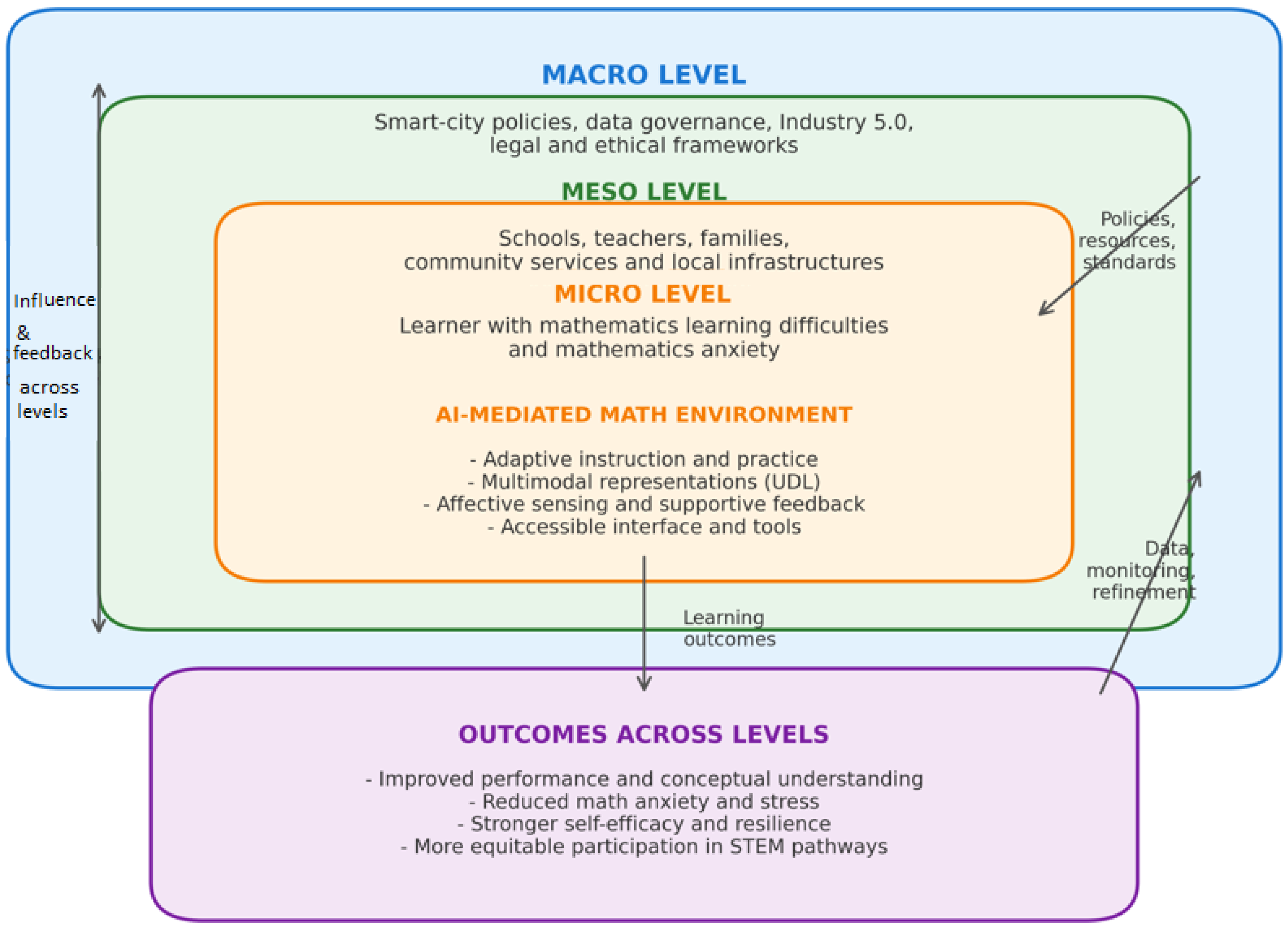
Smart-city learning ecosystems operate at multiple levels. At the micro level, individual learners interact with AI-mediated tools within specific emotional and cognitive profiles. At the meso level, schools, families, community services, and local infrastructures shape how technologies are selected, implemented, and supported. At the macro level, policies, funding mechanisms, regulatory frameworks, and broader smart-city strategies define the conditions under which AI is developed, procured, and governed [
14,
15,
16,
17]. In this entry, the smart-city lens is used primarily to emphasize cross-setting continuity (school–home–community), governance, and equity, rather than technology novelty per se.
For students with learning difficulties in mathematics, inclusive AI-mediated education depends on the alignment of these levels: technologies that are accessible and anxiety-aware at the micro level, supported by competent and caring adults at the meso level, within macro-level governance that prioritizes equity, transparency, and human rights [
2,
3,
18].
Figure 2 conceptualizes these relationships. Sustainable implementation also depends on practical capacity—device access, connectivity, staff time, and ongoing support—so that inclusive benefits do not rely on exceptional resources available only in advantaged contexts.
4.1. Datafication, Learning Analytics, and Ethics
Smart learning environments rely heavily on learning analytics: systematic collection, analysis, and reporting of data about learners and their contexts. In mathematics, these data can include detailed logs of problem-solving steps, error patterns, solution times, and inferred affective states [
15,
18]. Such information can be powerful for tailoring instruction and identifying students in need of support, but it also raises ethical concerns.
Key issues include privacy and informed consent, especially for children and young people who are already at risk; algorithmic bias when models are trained on unrepresentative or historically biased data; and the risk that persistent “risk profiles” shape how students view themselves and how others treat them [
18,
29]. Human-centric smart-city and Industry 5.0 frameworks stress the need for transparent data policies, stakeholder participation, and mechanisms for contesting algorithmic decisions [
2,
17]. Operationally, this implies data minimization (collect only what is necessary), purpose limitation (use data only for clearly stated educational aims), understandable communication to students and families, and human oversight for any high-impact decisions influenced by analytics. Where affect-related indicators are used, proportionality and opt-out options (where feasible) help prevent supportive technologies from being experienced as intrusive monitoring.
4.2. Illustrative Examples from Smart-City Learning Ecosystems
The multi-level perspective becomes more concrete when examined through specific, albeit hypothetical, smart-city initiatives. These examples are not empirical case studies; they are plausible implementation sketches intended to clarify how design choices, governance, and local capacity can shape outcomes.
Example 1. AI-supported mathematics intervention in a smart primary school cluster. In a medium-sized European city with a human-centric smart-city strategy, the municipal education department creates a “smart primary school cluster” of several schools serving socially diverse neighborhoods. Classrooms are equipped with interactive displays, shared tablets, and a cloud-based AI-mediated mathematics platform aligned with the national curriculum. To support sustainability, procurement includes provisions for maintenance, teacher training time, and minimum connectivity standards.
At the micro level, a group of Grade 4–6 students identified with mathematics learning difficulties and elevated mathematics anxiety participate in a targeted program. They use the AI platform three times per week in short sessions. The system adapts task difficulty, offers multiple representations (e.g., visual models for fractions), and provides non-punitive feedback focused on strategies rather than speed. Brief in-app check-ins capture self-reported anxiety and confidence. A low-stakes mode (no leaderboards, no time pressure, private error correction) is enabled by default to reduce threat appraisals.
At the meso level, special educators and classroom teachers access a shared dashboard to plan small-group instruction and coordinate with school psychologists. Parents receive simple progress summaries that explain both performance and anxiety indicators. At the macro level, the city defines clear data-governance rules and uses aggregated, anonymized data to monitor equity across schools. After two years, schools report moderate gains in mathematics achievement and reduced anxiety for participating students, alongside challenges such as unequal device access at home and the need to simplify dashboard visualizations for busy teachers. If implemented well, such an arrangement could plausibly support improved engagement, more timely scaffolding, and reductions in anxiety-related avoidance; however, outcomes would depend on implementation fidelity and local capacity.
Risks and failure modes (and mitigations). Potential risks include unequal device access at home (mitigation: loan schemes, library access, offline-capable tasks), teacher overload from complex dashboards (mitigation: simplified views, actionable alerts, protected time), privacy concerns about emotion-related data (mitigation: data minimization, transparency, opt-out where feasible), and misclassification from screening outputs (mitigation: human review and short diagnostic follow-ups). There is also a risk of “tracking by analytics” if dashboards are used for grouping that becomes rigid; mitigation includes periodic review, mixed-ability opportunities, and emphasis on growth-oriented indicators.
Example 2. Community-based smart learning hubs in a public library network. In a larger metropolitan area with pronounced socio-economic disparities, the municipality invests in “smart learning hubs” located in public libraries across low-income districts. Each hub offers after-school support in core subjects, with a focus on mathematics, and is equipped with laptops, high-speed internet, and a small number of VR headsets. Because resources are constrained, hubs prioritize shared access, scheduled sessions, and low-cost, high-impact supports (connectivity, quiet space, and staffed tutoring) over high-end equipment.
Students aged 11–15 who experience persistent mathematics difficulties and anxiety attend weekly sessions that combine an AI-based mathematics tutor with short virtual reality (VR)-supported relaxation or exposure activities. The tutor adapts exercises, identifies recurring misconceptions, and offers multimodal explanations; the VR segments introduce calming environments and brief breathing exercises before problem solving. Participation is voluntary and positioned as supportive preparation rather than remediation, reducing stigma and performance pressure.
At the meso level, librarians, part-time mathematics teachers, and a coordinating special educator work together to ensure that data from the AI system are used formatively rather than for high-stakes labelling. Family meetings and teacher contacts help transfer insights from the hubs back into classroom practice (for example, by agreeing on flexible timing for tests). At the macro level, the library network is integrated into the city’s inclusive smart-city strategy, with data-sharing agreements that restrict access to individual-level data and use aggregated information to plan targeted training and infrastructure investments. Early evaluation suggests improved homework completion, modest gains in performance, and self-reported reductions in mathematics anxiety, as well as a stronger sense of belonging among participating students. If implemented effectively, such hubs could plausibly improve homework completion, support conceptual understanding through guided practice, and reduce anxiety via regulation routines; nevertheless, rigorous evaluation would be required to confirm effects.
Risks and failure modes (and mitigations). Potential risks include inconsistent staffing and program continuity (mitigation: standard operating procedures, stable coordinator role), low attendance due to transport/time barriers (mitigation: flexible schedules, outreach through schools), inequitable access if hubs are oversubscribed (mitigation: transparent prioritization, rotation models), and novelty effects for VR without learning transfer (mitigation: brief, structured regulation routines linked to subsequent practice). As with school-based systems, careful boundary-setting is required so that supportive analytics do not become surveillance; governance should limit secondary uses of data and ensure community oversight.
5. A Process Model of Inclusive AI-Mediated Mathematics Education
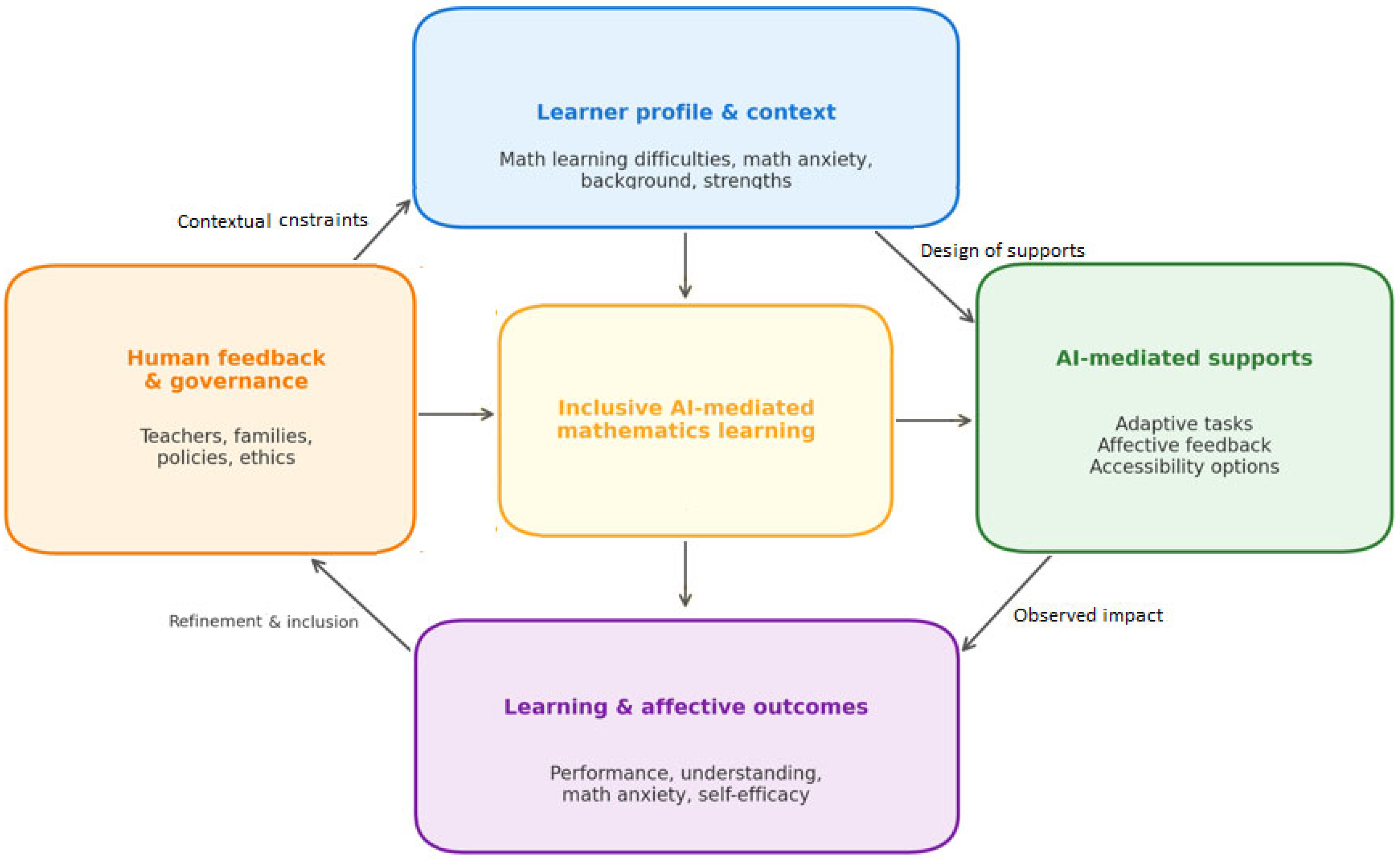
Inclusive AI-mediated mathematics education for students with learning difficulties can be conceptualized as a cyclical process connecting four key components:
Learner profiles and contexts (persistent mathematics difficulties, low achievement, mathematics anxiety, strengths, language and cultural background).
AI-mediated supports (adaptive tasks, affect-aware feedback, accessibility options).
Learning and affective outcomes (achievement, conceptual understanding, anxiety, self-efficacy).
Human feedback and governance (teachers, families, specialists, and policy frameworks).
Learner profiles and contextual factors inform the design and configuration of AI-mediated supports; these supports, in turn, shape learning and affective outcomes. Outcomes then feed back into human feedback and governance structures, which refine both the technological environment and broader practices [
18,
28]. Over time, this cycle can either reinforce exclusion (e.g., when data are used primarily for tracking and segregation) or foster inclusion (e.g., when data are used to adapt supports, mobilize resources, and challenge deficit narratives). Whereas
Figure 1 maps the intersection of key domains at a conceptual level,
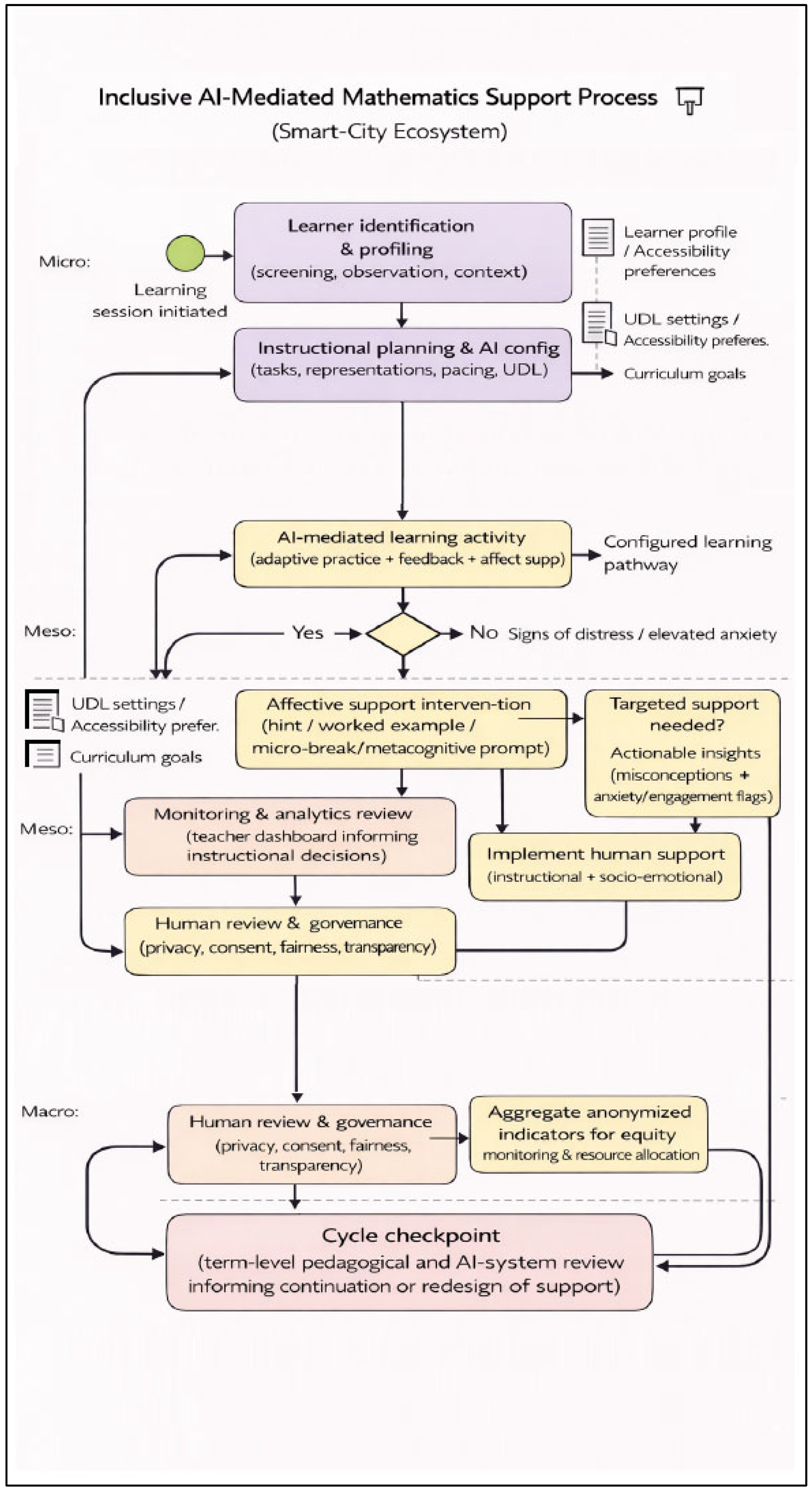
Figure 3 translates inclusive AI-mediated mathematics education into a staged workflow. Specifically, it highlights human-in-the-loop decision points where teachers and support staff interpret learning analytics and affect-related indicators, adjust instruction, and set governance boundaries (e.g., purpose limitation and data minimization) to ensure that analytics are used formatively rather than for static tracking or ranking. To avoid conceptual ambiguity,
Figure 1 is used as a conceptual framework (a domain-level map of intersections), whereas
Figure 3 is used as a process model (an implementation workflow with iterative feedback loops and explicit decision points).
Figure 3 summarizes this process model; more specifically, the process can be described as a staged workflow: (i) profile and interpret learner needs and strengths (e.g., patterns of misconceptions, pacing needs, anxiety triggers, language supports); (ii) configure and deliver AI-mediated supports (adaptive sequences, scaffolds, affect-sensitive prompts, accessibility features) in coordination with teacher-led instruction; (iii) Monitor learning and affective indicators formatively (performance trends, persistence, self-reports of confidence/anxiety) to identify whether supports are helping or inadvertently increasing pressure; and (iv) use human review and governance to adjust practice and policies (instructional regrouping, task redesign, communication with families, data-use boundaries, equity checks). The workflow then iterates, with each cycle refining both the instructional configuration and the socio-technical conditions of implementation.
7. Design Principles and Practical Guidelines
Synthesizing the foregoing discussion, several design principles emerge for inclusive, anxiety-aware AI-mediated mathematics education in digital and smart-city contexts:
Design low-stakes practice modes, private workspaces, and gradual exposure to public performance. Emphasize growth and strategies rather than speed or ranking [
5,
9]. Include “recovery-friendly” design (e.g., undo/try-again options, non-punitive error messages, and short regulation breaks) to reduce threat appraisals during difficulty.
- 2.
Implement UDL-informed, multimodal representations.
Provide flexible combinations of symbolic, textual, visual, and kinesthetic representations and allow learners to choose and switch between them without stigma [
30]. Where possible, offer these supports as default options for all learners (not “special settings”), reducing stigma and increasing uptake.
- 3.
Use AI primarily for formative, not punitive, assessment.
Focus on diagnosing misconceptions, suggesting scaffolds, and informing instruction rather than labeling and tracking. Present learning analytics in ways that are understandable and empowering for students and families [
18]. Frame outputs as “actionable next steps” (e.g., misconception → representation/scaffold) and require human review before any high-impact decisions.
- 4.
Integrate affective support transparently and respectfully.
If affective states are inferred, communicate this clearly and provide options for opting out where feasible. Use affect detection to offer supportive strategies (e.g., brief relaxation, metacognitive prompts) rather than to restrict access to challenging content [
13,
26]. Prefer proportional, low-intrusion signals (e.g., interaction patterns, brief self-reports) over continuous biometric monitoring in routine school use.
- 5.
Align AI tools with human relationships.
Teacher dashboards should offer concise, actionable insights and help educators respond empathetically rather than overwhelm them. Systems should facilitate communication between school and home while respecting privacy and reducing blame [
15,
18]. Support teacher agency by allowing educators to override recommendations, annotate interpretations, and connect analytics to specific instructional actions.
- 6.
Ensure interoperability and continuity across learning spaces.
Learners should be able to access essential supports—such as mathematics-friendly visual representations or anxiety-reducing features—across school, home, and community settings. Interoperable data formats and ethical data-sharing agreements are crucial [
14,
16]. Continuity should prioritize function (access to supports) over data centralization (sharing only what is necessary).
- 7.
Target structural inequities explicitly.
Prioritize deployment in under-resourced schools and communities. Provide sustained professional development for teachers on AI literacy, inclusive pedagogy, and mathematics anxiety [
2,
3,
18]. Adopt cost-aware deployment models (e.g., shared-device routines, community hubs, offline-capable tools) so that inclusion does not depend on high-end infrastructure.
- 8.
Build in iterative evaluation and co-design.
Combine quantitative indicators (e.g., achievement, engagement, anxiety scales) with qualitative feedback from students, families, and educators. Use design-based research and co-design methods to iteratively improve tools and address unintended harms [
14,
30]. Include explicit “harm checks” (e.g., increased anxiety, disengagement, stigma, inequitable access) and revise workflows accordingly.
9. Conclusions
AI-mediated mathematics education within digital and smart-city ecosystems offers substantial promise for supporting students with learning difficulties and reducing mathematics anxiety. When grounded in human-centric Industry 5.0 principles, UDL, and robust ethical frameworks, AI systems can provide early identification, tailored scaffolding, affect-aware support, and rich opportunities for practice that together foster competence, confidence, and resilience [
2,
17,
30]. This promise is strongest when AI is used to complement—not replace—high-quality teaching, and when analytics are translated into actionable instructional supports that protect learners’ dignity and emotional safety.
However, this potential is not automatic. The same technologies can intensify surveillance, freeze learners into risk categories, or concentrate benefits among already advantaged groups if they are implemented without attention to equity, ethics, and human relationships [
18,
29]. Inclusive AI-mediated mathematics education for students with learning difficulties is therefore best understood as a socio-technical project that requires ongoing collaboration among learners, educators, families, technologists, urban planners, and policy-makers. In addition, sustainable implementation requires feasibility-aware planning, including realistic resourcing for devices and connectivity, teacher professional learning, maintenance, and privacy compliance, so that inclusion is not contingent on exceptional funding.
If approached thoughtfully, AI and smart-city infrastructures can help transform mathematics from a persistent source of anxiety and exclusion into a domain of accessible exploration and empowerment for all learners. A balanced pathway forward combines evidence-based AI supports, strong governance, and careful attention to cost, equity, and classroom realities—ensuring that technological innovation serves inclusive and emotionally safe mathematics learning.