Entry

Stock Valuation and Investor Expectations

by
Morris G. Danielson
Department of Finance, Saint Joseph’s University, Philadelphia, PA 19131, USA
Encyclopedia 2025, 5(4), 203; https://doi.org/10.3390/encyclopedia5040203
Submission received: 10 September 2025 / Revised: 7 November 2025 / Accepted: 1 December 2025 / Published: 3 December 2025
(This article belongs to the Section Social Sciences)

Definition

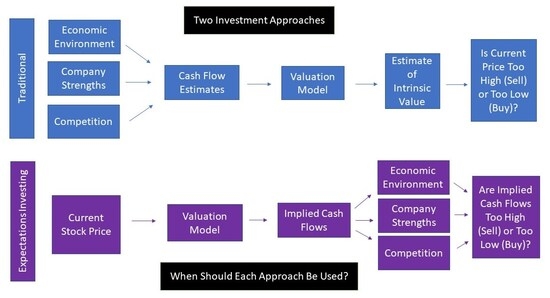
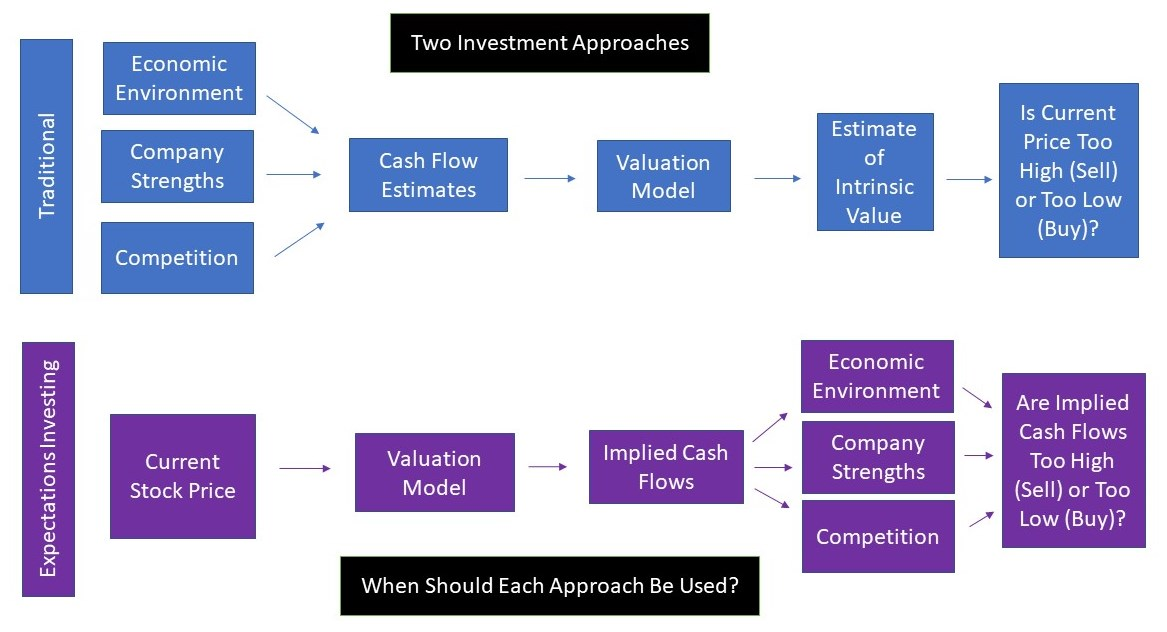
Stock valuation models can be used to guide the investment decisions of institutions or individuals. In the traditional approach, the investor will use a valuation model to calculate a stock’s intrinsic value as a function of the estimated future cash flows the firm will distribute to its shareholders. The investment decision will hinge on how the estimated intrinsic value compares to the current stock price. This approach is appropriate when the investor has access to the detailed company-specific information required to forecast future cash flows. In an alternative approach, the process is reversed, and stock valuation models can be used to identify the cash flow expectations supporting a firm’s current stock price. Depending on whether or not these expectations are reasonable—in light of current and expected firm-specific, industry, and macroeconomic conditions—the investor can decide whether to buy, sell, or hold the stock. This approach is appropriate for external investors who do not have access to detailed company-specific information. This entry discusses the uses and limitations of the most prominent stock valuation models when used in the traditional framework, and explains how to identify and evaluate the expectations embedded within a current stock price.

Graphical Abstract

1. Introduction

In theory, a stock price is the present value of the future cash flows the company is expected to pay shareholders. In practice, however, the process of first identifying the future cash flows and then calculating the present value of a lengthy (or infinite) cash flow stream can be unwieldy. To sidestep these challenges, stock valuation models make simplifying assumptions about the growth pattern future cash flows will follow, streamlining the process of estimating a firm’s stock price. These models can then be used by institutional and individual investors in one of two different, but related, ways.
In the standard textbook approach, students are taught how to use stock valuation models in a linear fashion. The investor must first estimate the model’s inputs (e.g., cash flow growth rates and the required return), before using the model to calculate the stock’s intrinsic value [1,2]. If this value is greater than the current stock price, the investor should buy the stock. If the intrinsic value is less than the current stock price, the investor should either sell the stock or, at a minimum, refrain from buying it. This approach can be appropriate when the investor has access to the detailed company-specific information required to forecast future cash flows (e.g., an institutional investor when pricing an IPO or valuing a company prior to a merger or divestiture).
An alternative approach reverses the process. Starting with the current stock price, a stock valuation model can be used to characterize the cash flow expectations supporting that price. In particular, is the firm expected to invest in positive net present value projects in the future? If so, for how many years must the firm make those investments? And, how profitable must these new projects be? Depending on whether or not these expectations are reasonable—in light of current and expected firm-specific, industry, and macroeconomic conditions—the investor can decide whether to buy, sell, or hold the stock [3,4,5]. This approach is appropriate for external investors (either institutional or individual) who do not have access to detailed company-specific information, and can help those investors quickly identify stocks that are potentially over- or underpriced.
This entry identifies the most prominent valuation models and summarizes their uses and limitations as methods to estimate a stock’s intrinsic value. The entry then shows how to quantify the expectations supporting a current stock price and explains how an investor can evaluate the reasonableness of those expectations.

2. Stock Valuation Models: Overview

The idea that a stock price is the present value of all future dividends can be traced back to the work of John Burr Williams in 1938 [6]. When the per-share dividend to be paid in year t is D t , and the discount rate is k , the firm’s current stock price, P 0 , is calculated using Equation (1):
P 0 = t = 1 t = D t 1 + k t
Subsequent authors have shown how to simplify Equation (1) by specifying the growth pattern the future dividends will follow. Section 2.1 discusses the uses and limitations of the well-known constant growth model. Section 2.2 examines models that allow a firm to experience two or more growth phases in the future.

2.1. Constant Growth

The constant growth model was also initially developed by Williams in 1938 [6]. The model was subsequently restated and simplified by Gordon and Shapiro in 1956 and Gordon in 1959 [7,8]. The model, as written here, uses the following definitions.
The firm’s assets in place at the beginning of year t = 1 will generate the perpetual, end-of-year, equity cash flow E 1 . To calculate E 1 , the firm’s expected accounting earnings are first increased by the expected depreciation expense (a non-cash charge), and then reduced by the capital expenditure necessary to maintain the productivity of the assets in place. In addition, the expected accounting earnings should be adjusted if those earnings are artificially high or low due to transitory business conditions.
At the end of each year, t = 1 to , the firm will invest the percentage ρ of its economic earnings, E t , in new projects and will pay the remainder of its earnings as dividends: D t = E t 1 ρ . The new investments will generate a perpetual equity return equal to R N , which will cause the firm’s annual earnings and dividends to grow at the rate g = ρ R N . The return on new investments, R N , is also an economic, rather than accounting, measure. In particular, it is the equity portion of the internal rate of return expected to be earned on new investments. Although a firm’s accounting return on investment is unlikely to equal its unobservable economic return, some authors argue that return measures using accounting information can provide useful (albeit imperfect) information about a firm’s economic performance [9,10].
Using the discount rate k and assuming that E 1 , k , and R N are stated in real terms (i.e., are not increased by the expected inflation rate), the constant growth model is Equation (2):
P 0 = E 1 1 ρ k ρ R N = D 1 k g

2.1.1. Real vs. Nominal Variables

To restate Equation (2) in nominal terms, the variables R N , k , and E 1 must be adjusted. If the expected annual inflation rate is h, and if all cash flows will increase at this annual rate, the nominal values R N , k , and E 1 are defined as follows [11,12]:
R N = 1 + R N 1 + h 1 ,
k = 1 + k 1 + h 1 ,
E 1 = E 1 1 + h .
When defined in nominal terms, a firm’s earnings and dividend growth will come from two sources. The portion of the firm’s earnings that is reinvested will cause earnings to grow at the rate ρ R N . The remainder of the firm’s earnings will grow at the rate 1 ρ h . Thus, the firm’s combined growth rate will be g = 1 ρ h + ρ R N [13].
Using these definitions, the constant growth model in nominal terms is Equation (3):
P 0 = E 1 1 ρ k 1 ρ h ρ R N = D 1 k g
If the future inflation rate, h , is expected to be neutral, in that it will affect E 1 , k , and R N equally, Equations (2) and (3) will produce the same stock price estimate, P 0 [12]. For notational simplicity, the remainder of this article will define all model inputs in real terms.

2.1.2. Dividends vs. Repurchases

Stock valuation models traditionally define the cash payments to shareholders as “dividends.” However, firms can also distribute funds to shareholders by repurchasing stock. Although share repurchases were rare before 1980, their use has increased significantly since then. Indeed, the aggregate amount of repurchases by U.S. industrial firms has exceeded the aggregate amount paid as dividends in most years since 1998 [1].
In theory, non-selling shareholders will benefit from buyback programs if these activities reduce the number of shares outstanding, increasing the portion of future cash flows that will accrue to the non-selling shareholders. Equation (2), as well as multi-stage stock valuation models, will calculate identical prices—regardless of whether the payout takes the form of cash dividends or share repurchases—if two conditions are met. First, the repurchase price must be equal to the stock’s intrinsic value. Second, the repurchased shares must not be replaced by newly issued shares (e.g., shares issued as employee stock options are exercised) [14].
To illustrate these requirements, assume that a firm is expected to realize earnings of 10 at the end of Year 1 and that the firm initially has 10 shares of stock outstanding. In addition, assume that ρ = 40 % ; R N = 20 % ; k = 10 % ; and ρ R N = 8 % . Using these inputs, the firm will pay 6 = 10 × (1 − 40%) to shareholders at the end of Year 1. Table 1 summarizes the calculation of the current value of the firm, V 0 , and the current stock price in two scenarios: (1) 100% of the disbursement takes the form of a cash dividend and (2) 100% of the disbursement is used to repurchase stock.
Because the firm repurchases the stock at its intrinsic value of 33 at the end of Year 1, and because the number of shares outstanding decreases accordingly (i.e., the repurchase is not offset by the issuance of new stock), the firm’s stock price at the beginning of the year, P 0 , is equal to 30 regardless of whether the firm pays a cash dividend or repurchases stock at the end of the year.
If a firm repurchases stock when it is overpriced (i.e., if the firm in this example paid more than 33 to repurchase each share), the reduction in the number of shares outstanding will not be sufficient to compensate shareholders for the foregone dividend, and shareholder wealth will be reduced [15,16].
In this example, the firm did not issue any new stock during the year. However, some firms repurchase stock to offset the issuance of new shares (e.g., shares issued as employee stock options are exercised). Thus, an analyst should include only the expected, net, per share, repurchase amount in the numerator of Equation (2). This amount should be estimated as a function of the net reduction in shares outstanding, not the net amount spent on repurchases. To illustrate this distinction, consider Microsoft’s repurchase activity during its fiscal year ending 30 June 2025. During that year, Microsoft repurchased 31 million shares for USD 18,420 million, while issuing 31 million shares for USD 2056 million. Because the number of outstanding shares at the beginning and end of the year was 7434 million, the repurchases simply facilitated the issuance of new shares following the exercise of employee stock options; they did not take the place of cash dividends [17]. Because repurchase and option exercise activity can both vary dramatically from year to year, estimating the correct, estimated, per-share repurchase amount to include in the numerator of Equation (2) can be challenging.

2.1.3. Other Limitations of the Constant Growth Model

The constant growth model “…is taught in all top-tier business schools and used widely throughout the financial community” [13] (p. 66). Yet, some of its limitations have been known since its introduction in 1938. In particular, Williams [6] (p. 87) wrote that “… it is obvious that no stock exists whose dividends will increase without limit, for no company can continue to grow in dividend-paying power forever….”
Williams also noted that the model requires g to be less than k . When g is slightly less than k , analysts should use price estimates from Equation (2) with caution, as a large portion of the estimated stock price can be attributed to cash flows expected to be generated in the distant future [12,18]. For example, when k = 4 % and g = 3 % , 62% of the value estimate is created by cash flows expected to be received more than 50 years into the future [18]. As g approaches k from below, stock price estimates from Equation (2) can be sensitive to small changes in either g or k . For example, if D 1 = 0.5 , k = 6 % , and g = 5 % , P 0 = 50 . If g increases to 5.5 % , P 0 doubles to 100 !
Finally, the model implicitly assumes that a firm’s asset efficiency ratios and profit margins will remain constant over time—assumptions that are unlikely to be met. Because of the simplifying assumptions embedded in Equation (2), price estimates from this equation should be viewed as first-cut estimates of a stock’s intrinsic value.

2.1.4. Pedagogical Value

Despite these limitations, the constant growth model retains value as a simple framework within which to illustrate the links between capital budgeting and stock valuation. If the firm does not have a competitive advantage, and if the potential return on new investments, R N , is equal to the required return, k , the firm’s stock price and its P/E ratio, calculated from Equation (2), will be equal to E 1 k and 1 k , respectively. A firm’s P/E ratio can exceed 1 k if it can develop a sustainable competitive advantage, empowering it to invest in positive net present value projects in new markets (e.g., R N > k ). Leibowitz and Kogelman [19] use the constant growth model to illustrate this concept, calling the premium assigned to the firm’s stock price and its P/E ratio the “franchise factor.”
Conversely, if the firm is expected to invest a portion of its earnings in zero (or negative) net present value projects (e.g., R N k ), the firm’s growth rate could be positive, while its P/E ratio will be equal to (or less) than 1 k . To illustrate this, assume that E 1 = 1 , k = 8 % , R N = 6 % , and ρ = 50 % . The firm’s growth rate will be 3% and its stock price and P/E ratio will both be equal to 10. In this case, the firm can increase its value by reducing its reinvestment rate and increasing its dividend. If ρ is reduced to 0, the firm’s stock price and its P/E ratio will both increase to 12.5 (which is equal to 1 k ). Thus, the constant growth model can be used to illustrate the fact that not all growth creates value [20,21].

2.2. Multi-Stage Growth Models

Because a firm’s growth phase is unlikely to last forever [6,22,23,24], multi-stage models provide a more realistic framework within which to estimate a firm’s stock price. In these models, it is typically assumed that the firm will be able to maintain a competitive advantage for the next T years. This competitive advantage will allow it to earn investment returns R N > k in new markets. In all subsequent years, new investments will earn a return equal to k [24].
In the most general form of the multi-stage model, a firm’s stock price is calculated as the present value of the dividends to be received during a forecast period plus the present value of the firm’s stock price at the end of the that period [2]. If the forecast period spans the years t = 1 to t = T , this model is Equation (4):
P 0 = t = 1 t = T D t 1 + k t + P T 1 + k T
The price P T is the stock’s terminal value. This value is frequently estimated using the constant growth formula [2], as shown in Equation (5):
P T = E T + 1 1 ρ k ρ R N = D T + 1 k g
If positive net present value growth is unlikely during a firm’s terminal phase [24], R N = k (during this period) and Equation (5) simplifies to Equation (6):
P T = E T + 1 k
Assuming that the firm’s dividends during each of the next T years will grow at the constant rate ρ R N and that P T is calculated using Equation (6), the firm’s stock price can be written as Equation (7) [25,26]:
P 0 = t = 1 T E 1 1 ρ 1 + ρ R N t 1 1 + k t + E 1 1 + ρ R N T k 1 + k T
When it is assumed that the dividends D 1 to D T are not paid to shareholders, but instead are reinvested in projects earning a return equal to k [3,27], Equation (7) can be simplified to Equation (8) [3]:
P 0 = E 1 k θ T
where
  θ T = 1 + k + ρ R N k 1 + k T
Equations (7) and (8) predict similar stock prices when the period of competitive advantage is less than 20, and the difference between R N and k is less than 10 percentage points [3]. If the firm reinvests 100% of its earnings during each of the next T years, Equation (8) simplifies to Equation (9) [3]:
P 0 = E 1 k 1 + R N 1 + k T
For firms that are not expected to pay dividends during their competitive advantage period, Equations (7) and (9) will produce identical stock price estimates.
One of the drawbacks of Equations (7)–(9) is that R N drops abruptly to k at the end of the firm’s competitive advantage period. To address this weakness, numerous models assume that a firm’s return on new investments and its growth rate will gradually decrease across future years [28,29,30,31,32]. However, R N can also be viewed as the average return on new investments during a firm’s competitive advantage period. Thus, price estimates using Equations (7)–(9) can be interpreted as approximations of price estimates that would be obtained using more complicated growth patterns.
When a firm’s value is being calculated prior to a merger, IPO, or divestiture, analysts might have access to the detailed company information necessary to construct pro forma income statements and to develop plausible estimates of D 1 to D T . It is within these applications that multi-stage models provide the most value as tools to estimate a stock’s intrinsic value. Unfortunately, most external investors will not have access to such detailed company-specific information, limiting their ability to estimate a firm’s intrinsic value using any multi-stage model.

3. Investment Expectations

Instead of attempting to identify the intrinsic value of a share of a firm’s stock, an investor can reverse the process, and attempt to identify the set of expectations supporting the current stock price. The investor can then evaluate these expectations for reasonableness. Are the expectations too pessimistic, too optimistic, or broadly reasonable in light of current and expected firm-specific, industry, and macroeconomic conditions? After answering this question, the investor can buy, sell, or hold the stock accordingly. Mauboussin and Rappaport call this approach “expectations investing” [4].

3.1. Overview

In a sense, expectations investing is similar to the thought process a bettor will use when deciding whether or not to place a wager “against the spread” on an athletic contest. Assume that Team A will be playing a contest against Team B. Because Team A has more talented players and has won more games, Team A is favored to win and the spread is set at 13.5 points. Under these terms, if an individual places a bet on Team A to “win,” Team A must not only win the game, it must win by 14 or more points. If it does not do so, the bettor will lose the wager. Thus, the individual must make a subjective determination as to just how much better Team A is relative to Team B before placing the bet.
Similarly, before purchasing a share of stock, an investor must identify the relevant betting line. In particular, what operating performance and growth must the firm achieve in the future to justify a firm’s current stock price? These expectations can be viewed within the following framework [2]:
P 0 = E 1 k + P V G O
Equation (10) divides the stock price into two parts: E 1 / k is the value of the firm’s assets in place, P V G O is the expected present value of the firm’s future growth opportunities. Conceptually, these values define a benchmark level of future performance for the firm. In order to earn an annual return equal to or in excess of k , the firm must maintain the productivity of its assets in place, and its future investments must produce positive net present values with a current value equal to or in excess of the amount P V G O .

3.2. Quantifying Expectations: Two Approaches

Mauboussin and Rappaport [4] and Danielson [3] provide two alternative ways to quantify the expectations supporting a firm’s current stock price.
Mauboussin and Rappaport [4] propose a step-by-step, sequential approach to quantifying expectations. The first step is to develop detailed forecasts of a firm’s future sales growth rate, profit margin, capital investments, and cost of capital. These estimates are then used to forecast the future amounts available for dividends or stock repurchases. Finally, the expected period of competitive advantage ( = T ) is calculated using these inputs and Equation (4).
Yet, there are an infinite number of future cash flow patterns consistent with any given stock price, not just one. Danielson [3] shows how to identify many of these patterns, starting from Equation (8). The first step is to divide each side of the equation by E 1 , to obtain an equation calculating the firm’s P 0 / E 1 ratio. (Alternatively, Danielson and Lipton [33] show how to calculate growth expectations from a firm’s price-to-sales ratio. That approach is appropriate for firms that do not currently produce positive earnings.) Then, multiply each side of that equation by k . Finally, take the logarithm of each side of the equation and rearrange terms. Equation (11) calculates the implied period of competitive advantage, T :
T = l n P 0 E 1 k l n θ
where
θ = 1 + k + ρ R N k 1 + k
Bierman [34] develops a similar model, combining the term k + ρ R N k in the numerator of θ into a single growth rate.
Equation (11) estimates a firm’s required competitive advantage period, T , as a function of the firm’s P 0 / E 1 ratio, the discount rate k , the reinvestment rate ρ , and the return on new investments R N . Equation (11) empowers analysts to quickly calculate implied T values for different combinations of P 0 / E 1 , k , ρ , and R N . The analyst must then determine whether any of these T values are reasonable before making a purchase or sale decision.
In a competitive economy, the range of plausible T values will be limited as rival firms will have the incentive to enter profitable markets, or copy the latest technological innovations. Some empirical studies claim that competitive advantage periods across firms typically average less than 10 years, while ranging between 5 and 15 years [24,35,36,37]. More recent studies reveal that competitive advantage periods between 18 and 30 years can be possible [4,38] for firms with “…access to resources that competitors cannot effectively obtain, such as brands, patents, captive customers, or specialized plants” [38] (p. 181).

3.3. Quantifying Expectations: Numerical Examples

Table 2 reports T values, calculated using Equation (11), for P 0 / E 1 ratios of 20, 40, and 60 and k values ranging from 5% to 19.95% assuming that ρ = 100 % and R N = 20 % . Within this application, k is not necessarily the firm’s cost of equity capital. Instead, k is the annual stock return an investor would realize if the firm can invest 100% of its earnings in new projects earning the return R N = 20 % for T years.
Table 2 reveals that if P 0 / E 1 = 20, the firm does not have to grow in the future to support an annual investment return of 5% (i.e., T = 0 ). However, if P 0 / E 1 = 40, or P 0 / E 1 = 60, the firm must continue to invest in new projects earning a return of 20% for 5.19 or 8.23 years, respectively, in order to produce an annual return, k , of just 5%. If the firm cannot maintain its competitive advantage for more than 10 years, Table 2 reveals that its annual stock return will be 5.85% or less if P 0 / E 1 = 60, 7.51% or less if P 0 / E 1 = 40, and 10.95% or less if P 0 / E 1 = 20. To earn higher annual returns, the firm must continue to invest in positive net present value projects in new markets for more than 10 years. As the desired annual stock return increases beyond 10%, the required values of T increase rapidly. For example, if P 0 / E 1 = 40 and k = 10 % , T = 15.93 ; if P 0 / E 1 = 40 and k = 15 % , T = 42.10 . As the desired annual return approaches 20%, T increases toward infinity.
Table 3 lists T values, calculated using Equation (11), for P 0 / E 1 ratios of 20, 40, and 60 and R N values ranging from 9% to 30% assuming that ρ = 100 % and k = 8.4 % , which is an estimate of the average, historical real return on stocks [2].
If competition will limit the size of R N relative to k , the required values of T are extremely large. For example, if P 0 / E 1 = 20 and R N = 9 % , T = 93.99 ; if P 0 / E 1 = 60 and R N = 9 % , T = 293.02 . If competition will limit the length of T to 10 years or less, and if P 0 / E 1 = 20, R N must be 14.17% or greater to produce the annual return k = 8.4 % . If P 0 / E 1 = 60 and T is 10 years or less, R N must be 27.43% or greater.
Finally, Table 4 reports T values, calculated using Equation (11), for P 0 / E 1 = 20, 40, and 60 and ρ values ranging from 15% to 100% assuming that R N = 20 % and k = 8.4 % . This table reveals that a firm must maintain its competitive advantage in new markets for a longer period of time as it reduces its reinvestment rate.

3.4. Evaluating Expectations

After quantifying the expectations supporting a stock price, the analyst must determine if those expectations are reasonable in light of the firm’s historical operating performance and the macroeconomic, industry, and firm-specific conditions the firm will likely face in the future. In particular, the investor should attempt to answer the following questions:
  • What return on investment is the firm currently earning on its assets in place? To answer this question, the investor should use historical accounting information as a starting point, recognizing that accounting returns are imperfect (but also useful) measures of a firm’s economic performance [9,10].
  • To the extent that the firm’s assets in place are generating returns in excess of the firm’s cost of capital, does the firm benefit from a durable competitive advantage, and sufficiently strong entry barriers, empowering it to maintain these excess returns into the future? Porter [39,40] identifies factors the investor should consider when answering this question.
  • Are there identifiable markets into which the firm can successfully introduce new or existing products? Information in the firm’s annual report can help the investor answer this question, but this question also requires the investor to use a considerable amount of subjective judgment.
  • How large are the new markets the firm could potentially enter, and how quickly will these markets be available to the firm? The answer to this question can help define the plausible range of T values.
  • How much competition will the firm face in new markets, and are investment returns likely to be higher or lower than the returns the firm is currently earning in existing markets? The answer to this question can help define the plausible range of R N values. Again, Porter [39,40] identifies factors the investor should consider when answering this question.
Based upon the answers to these questions, the investor can determine if any of the growth patterns implied by the firm’s current stock price are reasonable.

3.5. Limitations and Contemporary Relevance

The expectations investing approach is designed to help investors identify stocks that are potentially over- or underpriced. However, because the approach requires the investor to make many subjective judgements, expectations investing will not necessarily produce risk-adjusted investment returns that “beat the market.”
The first challenge investors face is estimating the correct P 0 / E 1 ratio to use in Equation (11). In theory, the denominator in this ratio is an estimate of the economic earnings the firm will generate next year. To calculate this unobservable earnings measure, the analyst must adjust forecasts of future accounting earnings for the potential distortions created by accounting conventions such as depreciation, other accruals, and the immediate expensing of research and development costs. Complicating matters further for international investors, U.S. firms calculate earnings using Generally Accepted Accounting Principles (GAAP), whereas most non-U.S. firms use International Financial Reporting Standards (IFRS) [41,42]. Thus, the economic relevance of unadjusted accounting numbers can differ between U.S. and non-U.S. firms.
Even if investors can calculate a plausible P 0 / E 1 ratio to plug into Equation (11), the expectations investing approach would not consistently produce above-average returns if the stock market were perfectly efficient [43]. In this case, growth expectations would be reasonable, by definition. However, the degree to which the market is efficient remains a matter of debate. Proponents of the efficient market hypothesis argue that pricing anomalies tend to be short-lived, providing support for the hypothesis [44,45]. In contrast, critics point to bubbles in individual stocks or market sectors as evidence against the hypothesis [46,47]. Regardless, there must be a sufficient number of informed investors attempting to identify temporarily mispriced securities—and buying or selling those securities accordingly—for the market to be efficient. Expectations investing can help informed investors play this important role.
Finally, the expectations investing approach is time consuming. Thus, it is not the most efficient tool to use when constructing a large portfolio. In contrast, machine learning [48] and artificial intelligence [49] approaches have been developed in recent years to empower portfolio managers to efficiently sift through large data sets and construct optimal portfolios.
Nevertheless, the value of a share of stock is still a direct function of the future cash flows the firm is expected to pay to the shareholder. If a firm’s future earnings and dividends exceed (are less than) the expected amounts, the stock price will rise (fall). This simple idea, which can be traced back to John Burr Williams in 1938 [6], remains relevant today as evidenced by the results in several recent studies [50,51,52]. Thus, expectations investing can complement more complex methods of stock selection. Once a portfolio is formed, expectations investing can be used to determine if certain stocks—such as those with high P 0 / E 1 ratios—should remain in the portfolio.
The information in Table 2, Table 3 and Table 4 suggests that investors and portfolio managers should be wary of stocks with P 0 / E 1 ratios of 40, 60, or higher, as these stock prices will ultimately be justified only if that firm can invest in new projects offering returns of 25%, 30% or more each year for a prolonged period of time. However, that does not mean that investors should shun all stocks with high P 0 / E 1 ratios. Historical evidence reveals that some exceptional firms do indeed produce the future growth necessary to meet or exceed the expectations embedded in extremely high valuation ratios [33,53].

4. Conclusions

Stock valuation models can be useful in two different, but related, investment applications. If the investor/analyst has access to detailed company financial information (e.g., when pricing an IPO or valuing a company prior to a merger or divestiture), plausible estimates of future cash flows can be developed, and stock valuation models can be used to estimate the intrinsic value of the company. However, if the investor/analyst does not have access to detailed company financial information, the investor is a price-taker and the investment decision hinges on the analyst’s subjective opinion about the current stock price. Is it too high, too low, or reasonable? In this application, the expectations investing approach can be useful. The investor first uses a multi-stage valuation model to identify the growth expectations supporting a firm’s current stock price. The investor then evaluates these expectations within the context of the competitive environment facing the firm. Only if the investor believes that the firm’s future performance can meet or exceed these expectations should the investor purchase the stock.

Funding

This research received no external funding.

Institutional Review Board Statement

Not applicable.

Informed Consent Statement

Not applicable.

Data Availability Statement

No new data were created or analyzed in this study. Data sharing is not applicable to this article.

Conflicts of Interest

The author declares no conflicts of interest.

References

  1. Ross, S.A.; Westerfield, R.W.; Jordan, B.D. Fundamentals of Corporate Finance; McGraw-Hill: New York, NY, USA, 2025. [Google Scholar]
  2. Brealey, R.A.; Myers, S.C.; Allen, F.; Edmans, A. Principles of Corporate Finance; McGraw-Hill: New York, NY, USA, 2025. [Google Scholar]
  3. Danielson, M.G. A Simple Valuation Model and Growth Expectations. Financ. Anal. J. 1997, 54, 50–57. [Google Scholar] [CrossRef]
  4. Mauboussin, M.J.; Rappaport, A. Expectations Investing; Columbia University Press: New York, NY, USA, 2021. [Google Scholar]
  5. Danielson, M.G. Investor Expectations and the AIRR Model. Eng. Econ. 2023, 68, 211–229. [Google Scholar] [CrossRef]
  6. Williams, J.B. The Theory of Investment Value; North Holland Publishing Company: Amsterdam, The Netherlands, 1938. [Google Scholar]
  7. Gordon, M.J.; Shapiro, E. Capital Equipment Analysis: The Required Rate of Profit. Manag. Sci. 1956, 3, 102–110. [Google Scholar] [CrossRef]
  8. Gordon, M.J. Dividends, Earnings, and Stock Prices. Rev. Econ. Stat. 1959, 41, 99–105. [Google Scholar] [CrossRef]
  9. Rajan, M.V.; Reichelstein, S.; Soliman, M.T. Conservatism, Growth, and Return on Investment. Rev. Account. Stud. 2007, 12, 325–370. [Google Scholar] [CrossRef]
  10. Danielson, M.G. A Robust Model to Estimate a Firm’s Average Economic Return. J. Contemp. Account. Econ. 2024, 20, 100400. [Google Scholar] [CrossRef]
  11. Weston, J.F.; Chang, S.C.; Siu, J. Takeovers, Restructuring, and Corporate Governance; Prentice Hall: Upper Saddle River, NJ, USA, 1998. [Google Scholar]
  12. Danielson, M.G.; Heck, J.L. The Perpetual Growth Model and the Cost of Computational Simplicity: Rounding Errors or Wild Distortions. Fin. Serv. Rev. 2014, 23, 189–206. [Google Scholar] [CrossRef]
  13. Bradley, M.; Jarrell, G.A. Expected Inflation and the Constant-Growth Valuation Model. J. Appl. Corp. Financ. 2008, 20, 66–78. [Google Scholar] [CrossRef]
  14. Stowe, J.D.; McLeavey, D.W.; Pinto, J.E. Share Repurchases and Stock Valuation Models. J. Portf. Manag. 2009, 35, 170–179. [Google Scholar] [CrossRef]
  15. Bonaime, A.; Hankins, K.W.; Jordan, B.D. The Cost of Financial Flexibility: Evidence from Share Repurchases. J. Corp. Financ. 2016, 38, 345–362. [Google Scholar] [CrossRef]
  16. Edmans, A.; Fang, V.W.; Huang, A.H. The Long-Term Consequences of Short-Term Incentives. J. Account. Res. 2022, 60, 1007–1046. [Google Scholar] [CrossRef]
  17. Microsoft Corporation. 10-K 2025; Microsoft Corp.: Redmond, WA, USA, 2025. Available online: https://www.microsoft.com/en-us/investor/sec-filings (accessed on 13 October 2025).
  18. Shaffer, S. Corporate Failure and Equity Valuation. Financ. Anal. J. 2006, 62, 71–80. [Google Scholar] [CrossRef]
  19. Leibowitz, M.; Kogelman, S. Inside the P/E Ratio: The Franchise Factor. Financ. Anal. J. 1990, 46, 17–35. [Google Scholar] [CrossRef]
  20. Leibowitz, M.; Kogelman, S. Franchise Value and the Growth Process. Financ. Anal. J. 1992, 48, 53–62. [Google Scholar] [CrossRef]
  21. Leibowitz, M.; Kogelman, S. The Growth Illusion: The P/E Cost of Earnings Growth. Financ. Anal. J. 1994, 50, 36–48. [Google Scholar] [CrossRef]
  22. Clendenin, J.C.; Cleave, M.V. Growth and Common Stock Values. J. Financ. 1954, 9, 365–376. [Google Scholar] [CrossRef]
  23. Burrell, O.K. A Mathematical Approach to Stock Valuation. Financ. Anal. J. 1960, 16, 69–76. [Google Scholar] [CrossRef]
  24. Mauboussin, M.; Johnson, P. Competitive Advantage Period: The Neglected Value Driver. Financ. Manag. 1997, 26, 67–74. [Google Scholar] [CrossRef]
  25. Miller, M.H.; Modigliani, F. Dividend Policy, Growth, and the Valuation of Shares. J. Bus. 1961, 34, 411–433. [Google Scholar] [CrossRef]
  26. Gordon, J.R.; Gordon, M.J. The Finite Horizon Expected Return Model. Financ. Anal. J. 1997, 53, 52–61. [Google Scholar] [CrossRef]
  27. Holt, C.C. The Influence of Growth Duration on Share Prices. J. Financ. 1962, 17, 465–475. [Google Scholar] [CrossRef]
  28. Brigham, E.F.; Pappas, J.L. Duration of Growth, Changes in Growth Rates, and Corporate Share Prices. Financ. Anal. J. 1966, 22, 157–162. [Google Scholar] [CrossRef]
  29. Mao, J. The Valuation of Growth Stocks: The Investment Opportunities Approach. J. Financ. 1966, 21, 95–102. [Google Scholar] [CrossRef]
  30. Fuller, R.J.; Hsia, C.C. A Simplified Common Stock Valuation Model. Financ. Anal. J. 1984, 40, 49–56. [Google Scholar] [CrossRef]
  31. Leibowitz, M.L. Franchise Valuation Under Q-type Competition. Financ. Anal. J. 1998, 54, 62–74. [Google Scholar] [CrossRef]
  32. O’Brien, T. A Simple and Flexible DCF Valuation Model. J. Appl. Fin. 2003, 13, 54–62. [Google Scholar]
  33. Danielson, M.G.; Lipton, A.F. Are Some Stock Prices Destined to Fall? J. Appl. Fin. 2012, 22, 144–160. [Google Scholar]
  34. Bierman, H. Valuation of Stocks with Extraordinary Growth Prospects. J. Investig. 2001, 10, 23–26. [Google Scholar] [CrossRef]
  35. Fuller, R.J.; Huberts, L.C.; Levinson, M.J. Returns to E/P Strategies, Higgledy-Piggledy Growth, Analyst Forecast Errors, and Omitted Risk Factors. J. Portf. Manag. 1993, 19, 13–24. [Google Scholar] [CrossRef]
  36. Lakonishok, J.; Shleifer, A.; Vishny, R.W. Contrarian Investment, Extrapolation, and Risk. J. Financ. 1994, 49, 1541–1578. [Google Scholar] [CrossRef]
  37. Olsen, B.C. Firms and the Competitive Advantage Period. J. Investig. 2013, 22, 41–50. [Google Scholar] [CrossRef]
  38. Wibbens, P.D. Performance Persistence in the Presence of Higher-Order Resources. Strateg. Manag. J. 2018, 40, 181–202. [Google Scholar] [CrossRef]
  39. Porter, M.E. Competitive Advantage: Creating and Sustaining Superior Performance; The Free Press: New York, NY, USA, 1985. [Google Scholar]
  40. Porter, M.E. The Five Competitive Forces that Shape Strategy. Harv. Bus. Rev. 2008, 86, 78–93. [Google Scholar]
  41. Harris, P.; Jermakowicz, E.K.; Epstein, B.J. Seeking Truly Global Financial Reporting Standards. CPA J. 2022, 92, 36–41. [Google Scholar]
  42. Brackney, K.S.; Tang, W. The Lingering Differences between IFRS and GAAP. CPA J. 2022, 94, 42–49. [Google Scholar]
  43. Fama, E.F. Efficient Capital Markets: A Review of Theory and Empirical Work. J. Financ. 1970, 25, 383–417. [Google Scholar] [CrossRef]
  44. Malkiel, B.G. The Efficient Market Hypothesis and Its Critics. J. Econ. Perspect. 2003, 17, 59–82. [Google Scholar] [CrossRef]
  45. Hon, K.; Xue, C.; Zhang, L. Replicating Anomalies. Rev. Financ. Stud. 2020, 33, 2019–2133. [Google Scholar] [CrossRef]
  46. Shiller, R.J. From Efficient Markets Theory to Behavioral Finance. J. Econ. Perspect. 2003, 17, 83–104. [Google Scholar] [CrossRef]
  47. Potrykus, M.; Ramzan, I.; Mazhar, M.; Bouri, E. Price Bubbles and Co-Bubbles in the Green Economy Market. J. Environ. Manag. 2024, 370, 122678. [Google Scholar] [CrossRef] [PubMed]
  48. Kelly, B.; Xiu, D. Financial Machine Learning. Found Trends Financ. 2023, 13, 205–363. [Google Scholar] [CrossRef]
  49. Schwender, S.K.; Sipos, P.; Lorenzo, L.; Lameski, P.; Kabasinskas, A.; Tidjani, C.; Ozturkkal, B.; Cerneviciene, J. Enhancing Portfolio Management Using Artificial Intelligence: Literature Review. Front. Artif. Intell. 2024, 7, 1371502. [Google Scholar] [CrossRef]
  50. Bouchaud, J.P.; Kruger, P.; Landier, A.; Thesmar, D. Sticky Expectations and the Profitability Anomaly. J. Financ. 2019, 74, 639–674. [Google Scholar] [CrossRef]
  51. Bordalo, P.; Gennaioli, N.; LaPorta, R.; Shleifer, A. Diagnostic Expectations and Stock Returns. J. Financ. 2019, 74, 2839–2874. [Google Scholar] [CrossRef]
  52. Bordalo, P.; Gennaioli, N.; LaPorta, R.; Shleifer, A. Finance Without Exotic Risk. J. Financ. Econ. 2025, 173, 104145. [Google Scholar] [CrossRef]
  53. Siegel, J.J. The Nifty-Fifty Revisited: Do Growth Stocks Ultimately Justify their Price? J. Portf. Manag. 1995, 21, 8–20. [Google Scholar] [CrossRef]

Table 1. Dividends vs. repurchases when ρ = 40 % , R N = 20 % , and k = 10 % .
Calculation of V0 Calculation of P0
t = 1t = 2 DividendRepurchase
Et1010.8 1Shares (t = 1)109.8182 6
Payout66.48D10.60
Vt−1300 2324 3P132.4 433 7
Total Value3333
P030 530 5
1 10.8 = 10 × (1.08). 2  300 = 1 40 % 10 10 % 8 % or 6 + 324 1.1     . 3  324 = 1 40 % 10.8 10 % 8 %   . 4 32.4 = 324/10. 5 30 = 33/1.1. 6 9.8182 = 10 × (1 – (6/(6 + 324)). 7 33 = 324/9.8182.
Table 2. T estimates if ρ = 100 % and R N = 20 % .
P 0 / E 1 =
k 204060
5.00%0.005.198.23
5.85%1.256.7710.00
7.51%3.7010.0013.69
10.0%7.9715.9320.59
10.95%10.0018.8424.01
15%25.8142.1051.63
17.5%59.5092.43111.69
19.95%3320.414983.615956.53
Table 3. T estimates if ρ = 100 % and k = 8.4 % .
P 0 / E 1 =
R N 204060
9%93.99219.56293.02
12%15.8837.1049.51
14.17%10.0023.3631.18
22%4.2810.0013.35
27.43%3.217.4910.00
30%2.866.678.90
Table 4. T estimates if R N = 20 % and k = 8.4 % .
P 0 / E 1 =
ρ 204060
15%32.5876.11101.57
30%16.4238.3551.19
45%11.0325.7734.39
60%8.3419.4825.99
75%6.7215.7020.95
90%5.6413.1817.59
100%5.1011.9215.91
Disclaimer/Publisher’s Note: The statements, opinions and data contained in all publications are solely those of the individual author(s) and contributor(s) and not of MDPI and/or the editor(s). MDPI and/or the editor(s) disclaim responsibility for any injury to people or property resulting from any ideas, methods, instructions or products referred to in the content.