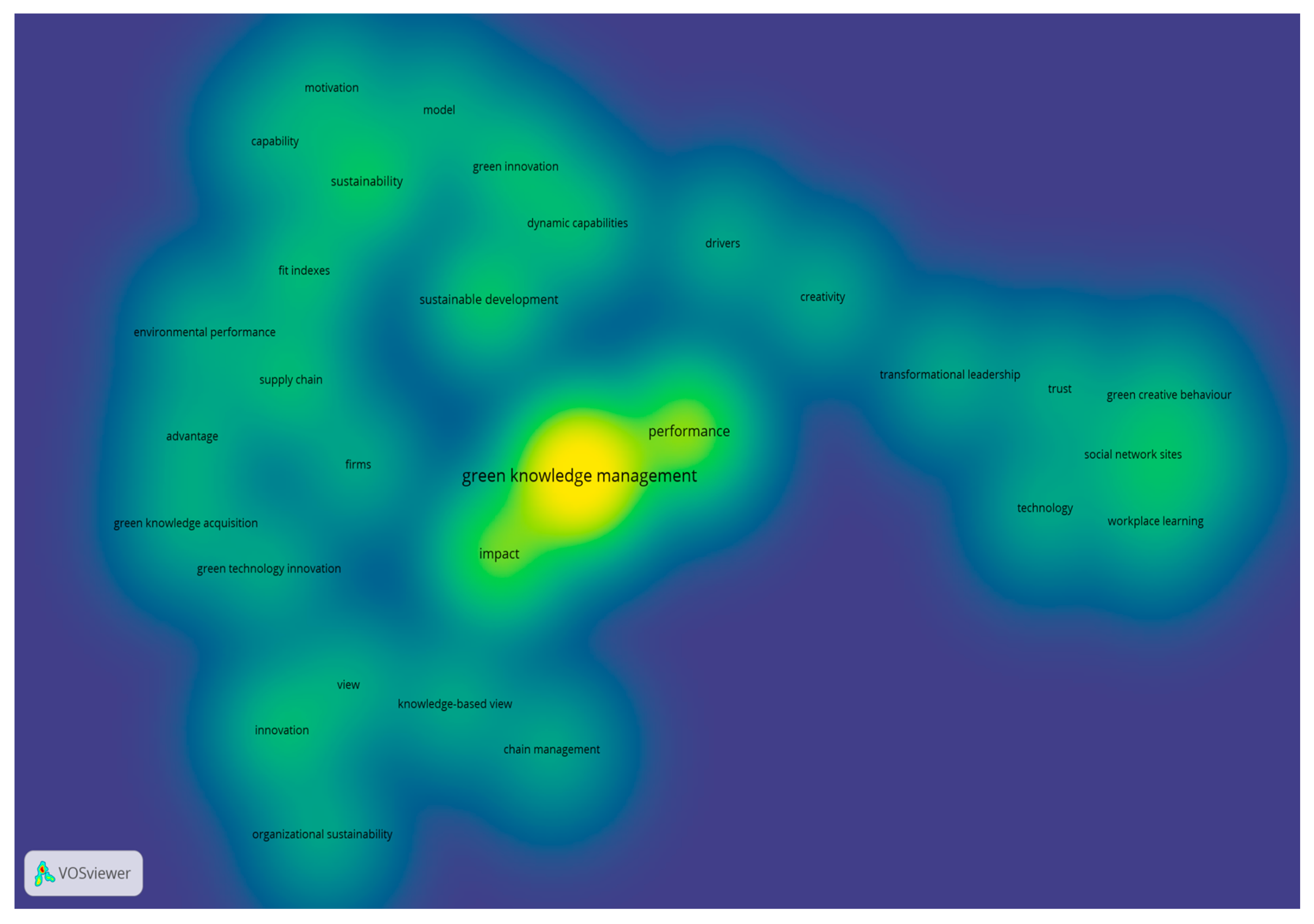


Green Knowledge Management—Bibliometric Analysis

Abstract
1. Introduction
2. Methodology
3. Results
4. Findings
5. Conclusions
Funding
Institutional Review Board Statement
Informed Consent Statement
Data Availability Statement
Conflicts of Interest
References
- Kumari, K.; Ali, S.B.; Khan, N.N.K.; Abbas, J. Examining the role of motivation and reward in employees’ job performance through mediating effect of job satisfaction: An empirical evidence. Int. J. Organ. Leadersh. 2021, 10, 401–420. [Google Scholar] [CrossRef]
- Davenport, T.H.; Prusak, L. Working Knowledge: How Organizations Manage What They Know; Harvard Business School Press: Boston, MA, USA, 2000. [Google Scholar]
- Hadad, S. Knowledge economy: Characteristics and dimensions. Manag. Dyn. Knowl. Econ. 2017, 5, 203–225. [Google Scholar] [CrossRef]
- Nonaka, I.; Takeuchi, H. The Wise Company: How Companies Create Continuous Innovation; Oxford University Press: Oxford, UK, 2019. [Google Scholar]
- Zbuchea, A.; Pînzaru, F.; Busu, M.; Stan, S.-O.; Bârgăoanu, A. Sustainable knowledge management and its impact on the performances of biotechnology organizations. Sustainability 2019, 11, 359. [Google Scholar] [CrossRef]
- Salvioni, D.M.; Gennari, F.; Bosetti, L. Sustainability and convergence: The future of corporate governance systems? Sustainability 2016, 8, 1203. [Google Scholar] [CrossRef]
- Śmigielska, G. A business case for sustainable development. CES Work. Pap. 2018, 10, 49–66. [Google Scholar]
- Drexhage, J.; Murphy, D. Sustainable development: From Brundtland to Rio 2012. Adv. Appl. Sociol. 2015, 5, 12. [Google Scholar]
- Jamison, A. The Making of Green Knowledge: Environmental Politics and Cultural Transformation; Cambridge University Press: Cambridge, UK, 2001. [Google Scholar]
- Scoones, I. The politics of sustainability and development. Annu. Rev. Environ. Resour. 2016, 41, 293–319. [Google Scholar] [CrossRef]
- UNDP. Sustainable Development Goals; United Nations Development Programme: New York, NY, USA, 2021; Available online: https://www.undp.org/sustainable-development-goals (accessed on 10 January 2024).
- Zbuchea, A. Are customers rewarding responsible businesses? An overview of the theory and research in the field of CSR. Manag. Dyn. Knowl. Econ. 2014, 1, 367–386. [Google Scholar]
- Van Eck, N.J.; Waltman, L. Software survey: VOSviewer, a computer program for bibliometric mapping. Scientometrics 2010, 84, 523–538. [Google Scholar] [CrossRef] [PubMed]
- Van Eck, N.J.; Waltman, L. Text mining and visualization using VOSviewer. ISSI Newsl. 2011, 7, 50–54. [Google Scholar]
- Van Eck, N.J.; Waltman, L. VOSviewer Manual 1.6.16; Universiteit Leiden: Laiden, The Netherlands, 2020. [Google Scholar]
- Van Eck, N.J.; Waltman, L. VOSviewer Manual 1.6.17; Universiteit Leiden: Laiden, The Netherlands, 2021. [Google Scholar]
- Janik, A.; Ryszko, A.; Szafraniec, M. Scientific Landscape of Smart and Sustainable Cities Literature: A Bibliometric Analysis. Sustainability 2020, 12, 779. [Google Scholar] [CrossRef]
- Janik, A.; Ryszko, A.; Szafraniec, M. Exploring the Social Innovation Research Field Based on a Comprehensive Bibliometric Analysis. J. Open Innov. Technol. Mark. Complex. 2021, 7, 226. [Google Scholar] [CrossRef]
- Theodorson, G.A.; Theodorson, A.G. A Modern Dictionary of Sociology; Methuen: London, UK, 1970. [Google Scholar]
- Gauthier, J.; Zhang, Z. Green knowledge management and strategic renewal: A discursive perspective on corporate sustainability. Int. J. Product. Perform. Manag. 2020, 69, 1797–1811. [Google Scholar] [CrossRef]
- Al-Faouri, A.H. Green knowledge management and technology for organizational sustainability: The mediating role of knowledge-based leadership. Cogent Bus. Manag. 2023, 10, 2262694. [Google Scholar] [CrossRef]
- Yu, S.; Abbas, J.; Álvarez-Otero, S.; Cherian, J. Green knowledge management: Scale development and validation. J. Innov. Knowl. 2022, 7, 100244. [Google Scholar] [CrossRef]
- Cheng, J.; Singh, H.S.M.; Zhang, Y.C.; Wang, S.Y. The impact of business intelligence, big data analytics capability, and green knowledge management on sustainability performance. J. Clean. Prod. 2023, 429, 139410. [Google Scholar] [CrossRef]
- Sahoo, S.; Kumar, A.; Upadhyay, A. How do green knowledge management and green technology innovation impact corporate environmental performance? Understanding the role of green knowledge acquisition. Bus. Strategy Environ. 2023, 32, 551–569. [Google Scholar] [CrossRef]
- Shehzad, M.U.; Zhang, J.; Latif, K.F.; Jamil, K.; Waseel, A.H. Do green entrepreneurial orientation and green knowledge management matter in the pursuit of ambidextrous green innovation: A moderated mediation model. J. Clean. Prod. 2023, 388, 135971. [Google Scholar] [CrossRef]
- Dornhöfer, M.; Weber, C.; Zenkert, J.; Fathi, M. A data-driven smart city transformation model utilizing the green knowledge management cube. In Proceedings of the 2019 IEEE International Smart Cities Conference (ISC2), Casablanca, Morocco, 14–17 October 2019; pp. 691–696. [Google Scholar]
- Abbas, J.; Khan, S.M. Green knowledge management and organizational green culture: An interaction for organizational green innovation and green performance. J. Knowl. Manag. 2023, 27, 1852–1870. [Google Scholar] [CrossRef]
- Wang, S.; Abbas, J.; Sial, M.S.; Álvarez-Otero, S.; Cioca, L.I. Achieving green innovation and sustainable development goals through green knowledge management: Moderating role of organizational green culture. J. Innov. Knowl. 2022, 7, 100272. [Google Scholar] [CrossRef]
- Khan, A.N.; Mehmood, K.; Kwan, H.K. Green knowledge management: A key driver of green technology innovation and sustainable performance in the construction organizations. J. Innov. Knowl. 2024, 9, 100455. [Google Scholar] [CrossRef]
- Hou, Y.; Song, J.; Li, H. Green’knowledge management in higher education-mediating effect of trust. J. Environ. Prot. Ecol. 2020, 21, 2381–2388. [Google Scholar]
- Cai, X.; Khan, N.A.; Egorova, O. Transactional leadership matters in green creative behavior through workplace learning and green knowledge management: Moderating role of social network sites use. Pers. Rev. 2023, 53, 317–335. [Google Scholar] [CrossRef]
- Sahoo, S. Assessing the impact of stakeholder pressure and green data analytics on firm’s environmental performance–understanding the role of green knowledge management and green technological innovativeness. RD Manag. 2024, 54, 3–20. [Google Scholar] [CrossRef]
- Javeed, S.A.; Akram, U. The factors behind block-chain technology that boost the circular economy: An organizational perspective. Technol. Forecast. Soc. Chang. 2024, 200, 123194. [Google Scholar] [CrossRef]
- Rehman, N.; Majeed, N.; Javaid, M.U.; Arooj, A. Assessing the sustainable development of firms: The moderating role of transformational leadership and firm size. Bus. Strategy Dev. 2023, 6, 957–971. [Google Scholar] [CrossRef]
- Di Chiacchio, L.; Martínez-Caro, E.; Cegarra-Navarro, J.G.; Garcia-Perez, A. Eco-innovation in the textile industry: The strategic importance of data privacy and environmental knowledge management. Kybernetes, 2023; in press. [Google Scholar] [CrossRef]
- Baresel-Bofinger, A.C.; Ketikidis, P.H.; Koh, S.L.; Cullen, J. Role of ‘green knowledge’ in the environmental transformation of the supply chain: The case of Greek manufacturing. Int. J. Knowl.-Based Dev. 2019, 2, 107–128. [Google Scholar] [CrossRef]
- Cheng, C.C.; Hsu, S.H.; Sheu, C. How can green innovation from manufacturers benefit from supplier networks? Supply Chain Manag. Int. J. 2022, 28, 559–575. [Google Scholar] [CrossRef]
- Widyanti, R.; Rajiani, I.; Basuki, B. Green knowledge management to achieve corporate sustainable development. J. Infrastruct. Policy Dev. 2024, 8, 2844. [Google Scholar] [CrossRef]
- Wan, A.W.; Mohd, M.S.; Yusr, M. Green supply chain and market orientation: Catalysts for sustainable green knowledge management. Multidiscip. Sci. J. 2024, 6, 2024120. [Google Scholar]
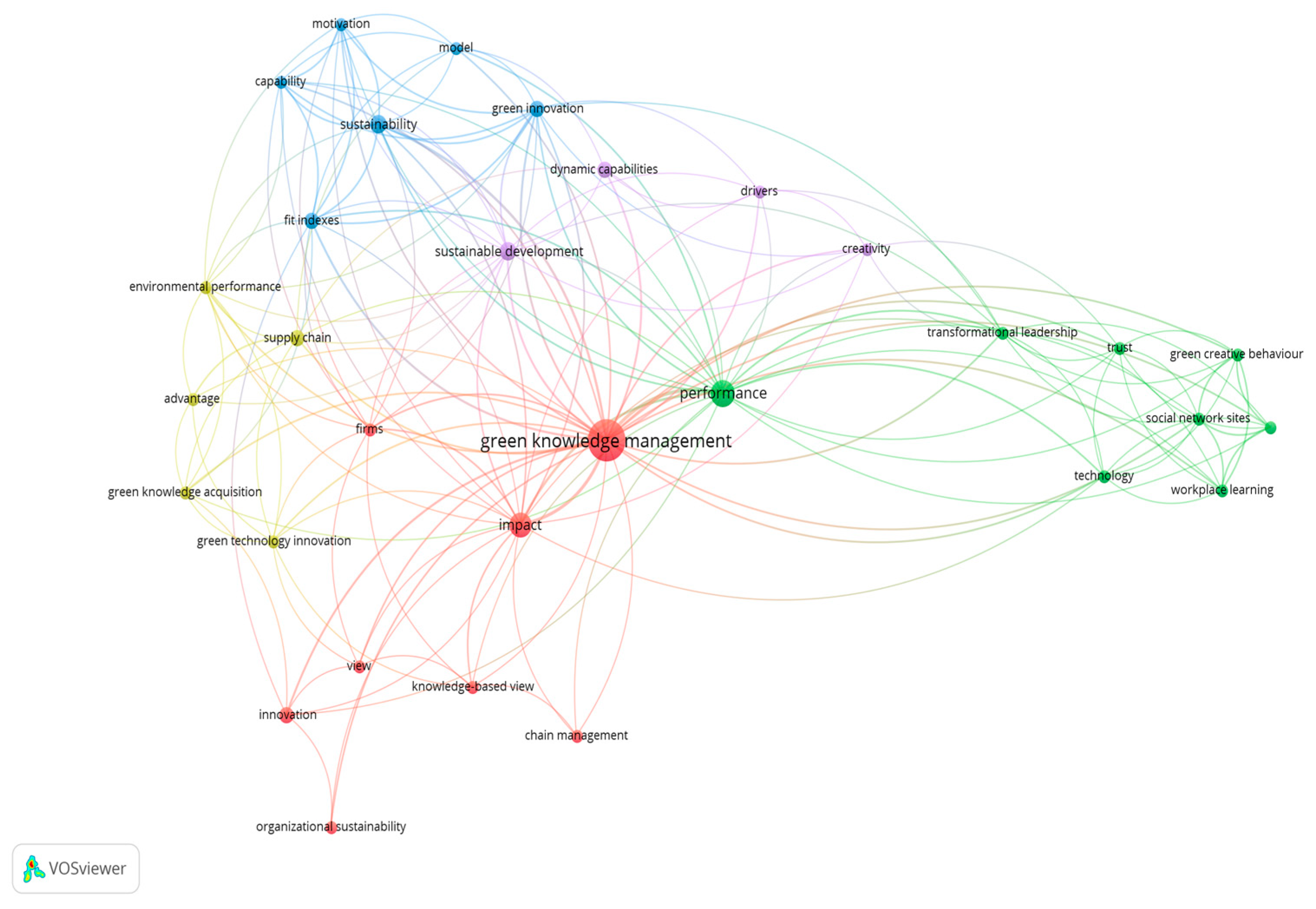
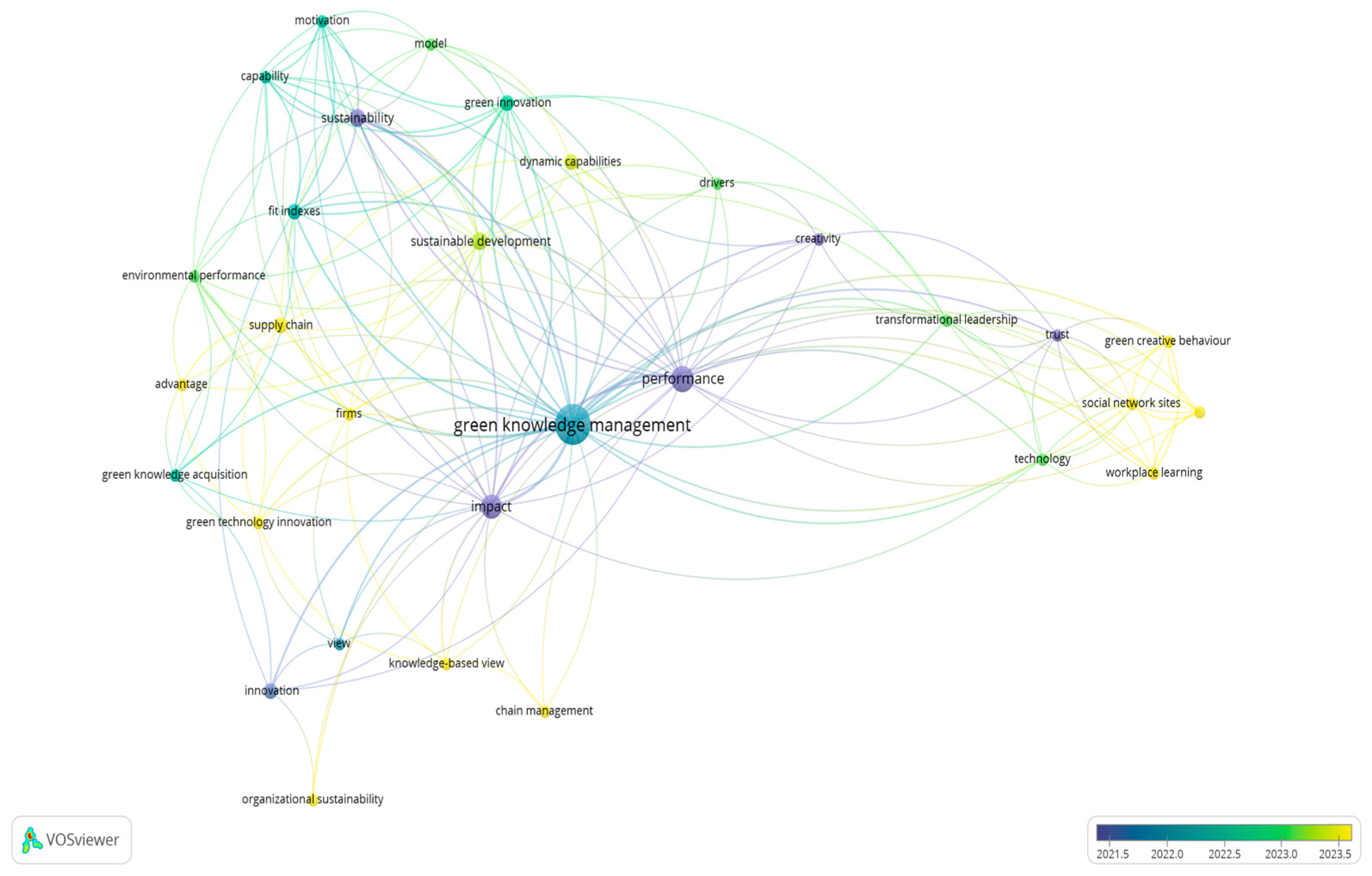


| Keyword | Occurrence | Link Strength |
|---|---|---|
| chain management | 2 | 4 |
| Firms | 2 | 14 |
| green knowledge management | 19 | 73 |
| Impact | 7 | 33 |
| Innovation | 3 | 9 |
| knowledge-based view | 2 | 8 |
| organizational sustainability | 2 | 4 |
| View | 2 | 7 |
| Keyword | Occurrence | Link Strength |
|---|---|---|
| green creative behavior | 2 | 12 |
| Performance | 8 | 39 |
| social network sites | 2 | 12 |
| Technology | 2 | 11 |
| transactional leadership | 2 | 12 |
| transformational leadership | 2 | 15 |
| Trust | 2 | 10 |
| workplace learning | 2 | 12 |
| Keyword | Occurrence | Link Strength |
|---|---|---|
| Creativity | 2 | 9 |
| fit indexes | 3 | 20 |
| green innovation | 3 | 23 |
| Model | 2 | 11 |
| Motivation | 2 | 16 |
| Sustainability | 4 | 20 |
| Keyword | Occurrence | Link Strength |
|---|---|---|
| Advantage | 2 | 7 |
| environmental performance | 2 | 14 |
| green knowledge acquisition | 2 | 9 |
| green technology innovation | 2 | 10 |
| supply chain | 3 | 11 |
| Keyword | Occurrence | Link Strength |
|---|---|---|
| Capability | 2 | 16 |
| Drivers | 2 | 9 |
| dynamic capabilities | 3 | 8 |
| sustainable development | 4 | 20 |
| Authors (Year) | Topic | Research Method | Findings |
|---|---|---|---|
| Gauthier J.; Zhang Z. (2020) [20] | Discourse in strategic renewal and GKM. | Qualitative | The authors developed a model based on discourse for GKM, integrating strategy renewal elements. |
| Al-Faouri A. (2023) [21] | GKM impact on organizational sustainability (OS). | Quantitative | GKM improved OS by over 25% and knowledge-based leadership is a mediator for GKM, technology, and OS |
| Yu S.; Abbas J.; Alvarez-Otero S.; Cherian J. (2022) [22] | Development and validation of a new GKM scale. | Qualitative and quantitative | A new GKM scale of 27 items and 5 variables has been developed and validated |
| Cheng J.; Singh H.; Zhang Y.; Wang S. (2023) [23] | The impact of big data analytics (BDA) on sustainability performance (SP), as moderated by GKM in manufacturing firms. | Quantitative | While BDA has a significant impact on SP, the relationship between business intelligence and SP is affected by the changes in GKM. |
| Sahoo S.; Kumar A.; Upadhyay A. (2023) [24] | The role of GK acquisition (GKA) and GK innovation (GKI) in GKM development and, respectively, corporate environmental performance (CEP). | Quantitative | The relationship between GKA, GKM, and GKI is moderated by resource commitment, which enables managers to plan, allocate, and budget resources to meet green targets for improving CEP. |
| Shehzad M.; Zhang J.; Latif K.; Jamil K.; Waseel A. (2023) [25] | The relationship between green entrepreneurial orientation (GEO), ambidextrous green innovation (AGI), GKM, and resource orchestration capability (ROC). | Quantitative | GEO impacts both exploratory and exploitative GIs while ROC enhances the effect of GOE on GKM as well as the effect of GKM on exploratory GI. |
| Dornhöfer M.; Weber C.; Zenkert J.; Fathi M. (2019) [26] | Necessary knowledge for transformation of cities into smart cities. | Conceptual | A model for transforming a city into a smart city is introduced, and the Green KM Cube, which is a part of GKM, is used as a method to outline the stages of knowledge management dimensions to assist in planning and decision-making. |
| Abbas J.; Khan S. (2023) [27] | What is the impact of GKM on the development of organizational green innovation capabilities (GIC), which in turn leads to improved green performance (GP)? | Quantitative | GKM predicts and improves OGI and GP while green innovation partially mediates GKM and corporate green performance (CGP). Furthermore, green culture (GC) emphasizes the relationship between GKM and OGI. |
| Wang S.; Abbas J.; Sial M; Alvarez-Otero S.; Cioca L. (2022) [28] | Organizational capabilities (OC) required to meet sustainable development goals (SDG), involving the analysis of green knowledge management (GKM) and green innovation (GI). | Quantitative | GKM has a positive impact on OC to acquire GI and SDG. GKM positively predicts corporate sustainability development (CSD). GKM is relevant for all sizes of firms analyzed (manufacturing and services). |
| Khan A.; Mehmood K.; Kwan H. (2024) [29] | Relationship between GKM and green technological innovation (GTI), and sustainable performance (SP), while focusing on construction firms. What is the role of artificial intelligence (AI) in moderating the link between GKM and green human capital (GHC)? | Quantitative | A positive correlation between the development of GKM and GIC has been identified with effects on GTI and SP. |
| Hou Y.; Song J.; Li H. (2020) [30] | The importance of formal education in shaping green knowledge (GK) for sustainable transformation. | Quantitative | The authors define a set of best practices for higher education to meet organizational trust objectives in present times. |
| Cai X.; Khan N.; Egorova O. (2023) [31] | Exploring the predictive link between transactional leadership (TL) and employee green creative behavior (EGCB). Exploring the role of workplace learning (WL) and GKM in the system above, powered by the leader-member exchange theory (LMX). | Quantitative | The study’s findings showed that TL has a relevant effect on WL and GKM. Furthermore, WL and GKM act as mediators in the impact of TL and EGCB. |
| Sahoo S. (2024) [32] | Investigating the relevant correlations between stakeholder pressure (SP), green data analytics (GDA), green knowledge management (GKM), green technological innovativeness (GTI), and environmental performance (EP). | Quantitative | The study’s findings show a positive impact of SP on GDA, GKM, and GTI. Furthermore, it shows an indirect influence on organizational EP. Finally, GDA proved essential for GKM and green innovation. |
| Javeed S.; Akram U. (2024) [33] | The connection between digital block-chain technology (BCT) and circular economy (CE) by considering several moderators, including GKM. | Quantitative | GKM, organizational agility, and strategic and institutional factors prove responsible for enhancing CE practices. |
| Rehman N.; Majeed N.; Javaid M.; Arooj A. (2023) [34] | Integration of direct and indirect sustainable development (SD) antecedents including the interaction between GKM and green dynamic capacity (GDC) through green innovation (GI) and green competitive advantage (GCA). | Quantitative | The results proved positive and strong both direct and indirect effects with significant prof for GI and GCA as mediators of GKM and SD. Additionally, the results show that transformational leadership and large firm size are important moderators of the established relationships. |
| Di Chiacchio L.; Martínez-Caro E.; Cegarra-Navarro J.; Garcia-Perez A. (2023) [35] | The impact of ethical management of data privacy (EMDP) on the organizational reputation. | Quantitative | EMDP has a positive impact on organizational reputation and eco-innovation. Additionally, eco-innovation has a beneficial effect on the development of GKM. Finally, GKM determines growth in the perception of organizational ethical commitment, as perceived by stakeholders. |
| Baresel-Bofinger A.; Ketikidis P.; Koh S.; Cullen J. (2011) [36] | The role of GKM and environmental intellectual capital (EIC) in the setup process of the green supply chain management (GSCM) | Qualitative | A positive association between qualitative GKM and added value to GSCM, but not without defining and implementing well-suited measure items and targets. |
| Cheng C.; Hsu S.; Shen C. (2023) [37] | Develop an understanding of supply chain management (SCM) and green innovation development (GID) through green knowledge diversity (GND) | Quantitative | The GKM process is a mediator of the GKD impact on GID. Supplier network heterogeneity becomes a strengthening agent of GKD, which is hindered by the supplier network density. |
| Widyanti R.; Rajiani I.; Basuki B. (2024) [38] | Integrating sustainability elements into the operational practices of the mining industry is strongly related to the economy, environment, and society. | Quantitative | Findings reveal that 4 out of 5 components of GKM acquisition, storage, application, and creation directly impact mining activities. Additionally, the study’s results indicate certain measures encourage GKM for sustainable development, such as rewarding systems, organizational culture focused on sustainability, and adequate setup for social interactions in this respect. |
| Wan A. W.; Mohd M. S.; Yusr M. (2024) [39] | Testing the relationship between green market orientation (GMO) and green supply chain management (GSCM) in setting up GKM within manufacturing companies | Quantitative | GKM is positively and directly impacted by GMOs and by GSCM |
Disclaimer/Publisher’s Note: The statements, opinions and data contained in all publications are solely those of the individual author(s) and contributor(s) and not of MDPI and/or the editor(s). MDPI and/or the editor(s) disclaim responsibility for any injury to people or property resulting from any ideas, methods, instructions or products referred to in the content. |
© 2024 by the author. Licensee MDPI, Basel, Switzerland. This article is an open access article distributed under the terms and conditions of the Creative Commons Attribution (CC BY) license (https://creativecommons.org/licenses/by/4.0/).
Share and Cite
Iliescu, A.-N. Green Knowledge Management—Bibliometric Analysis. Encyclopedia 2024, 4, 923-935. https://doi.org/10.3390/encyclopedia4020060
Iliescu A-N. Green Knowledge Management—Bibliometric Analysis. Encyclopedia. 2024; 4(2):923-935. https://doi.org/10.3390/encyclopedia4020060
Chicago/Turabian StyleIliescu, Andra-Nicoleta. 2024. "Green Knowledge Management—Bibliometric Analysis" Encyclopedia 4, no. 2: 923-935. https://doi.org/10.3390/encyclopedia4020060
APA StyleIliescu, A.-N. (2024). Green Knowledge Management—Bibliometric Analysis. Encyclopedia, 4(2), 923-935. https://doi.org/10.3390/encyclopedia4020060