
Prevalence, Factors, and Impact of CKD-aP on Quality of Life and Sleep in Indian Hemodialysis Patients: Cross-Sectional Study

 , , ,
, , ,
Abstract
1. Introduction
2. Materials and Methods
2.1. Study Sample
2.2. Outcome Measures
2.3. Statistical Analysis
3. Results
3.1. Primary Outcomes
- Prevalence: In our study, 216 patients undergoing MHD were analyzed, of whom 60.6% (n = 131) experienced CKD-aP. The mean age of the pruritic population was 53.71 ± 13.6 years, and the majority were men (n = 102; 77.8%). Diabetic kidney disease (DKD) was the most common cause of ESKD (n = 48; 36.6%), and 11 patients (8.4%) were active smokers (Table 2).
- Influence of clinical parameters: The CKD-aP and non-CKD-aP groups had similar highest percentages for each category in the baseline data analysis. In both groups, 64.89% and 64.7% of patients were 50–65 years old, respectively. The majority of the population were males (77.8% and 85.8%). A total of 36.6% and 35.2% of the respective groups had DKD, the most common cause of ESKD. Non-smokers dominated both groups (91.6% and 96.4%). None of these differences were statistically significant, suggesting no association between CKD-aP and clinical factors. Both groups had low rates of hepatitis C and B seropositivity, at 0.4% and 1.2%, respectively (Table 2).
- Influence of dialysis-related factors: Dialysis-related factors did not differ between patients with and without CKD-aP. In both groups respectively, with 91.6% and 96.5% patients were on weekly-twice dialysis frequency. This suggests that both groups had similar dialysis frequencies and that CKD-aP was not associated with dialysis frequency (p = 0.09). Of the patients with CKD-aP, 67.9% had been on dialysis for less than five years, compared with 57.6% of the patients without CKD-aP. The proportion of patients with different dialysis durations was not statistically significant (p = 0.12) (Table 2).
- Influence of lab parameters: There were no significant differences in the clinical parameters between the groups. The two groups had similar hemoglobin levels of 10.4 ± 2.1 g/dL and 10.6 ± 2.2 g/dL. Similar serum albumin levels were observed, with a mean of 4.3 ± 0.5 g/dL. The CKD-aP group had slightly higher serum phosphorus levels (5.81 ± 1.6 mg/dL) than the non-CKD-aP group (5.3 ± 1.7 mg/dL), but the difference was not statistically significant. Both groups had similar serum calcium levels of 8.1 ± 0.6 mg/dL. There were no significant differences in serum parathyroid hormone (PTH) levels, with a median of 990 [IQR 470–1480] pg/mL and 1008 [IQR 472.5–1488.1] (Table 2).
- A multivariate analysis was conducted, but no variables were found to be independently associated with the outcome. The other variables did not reach significance after accounting for confounders.
3.2. Secondary Outcomes
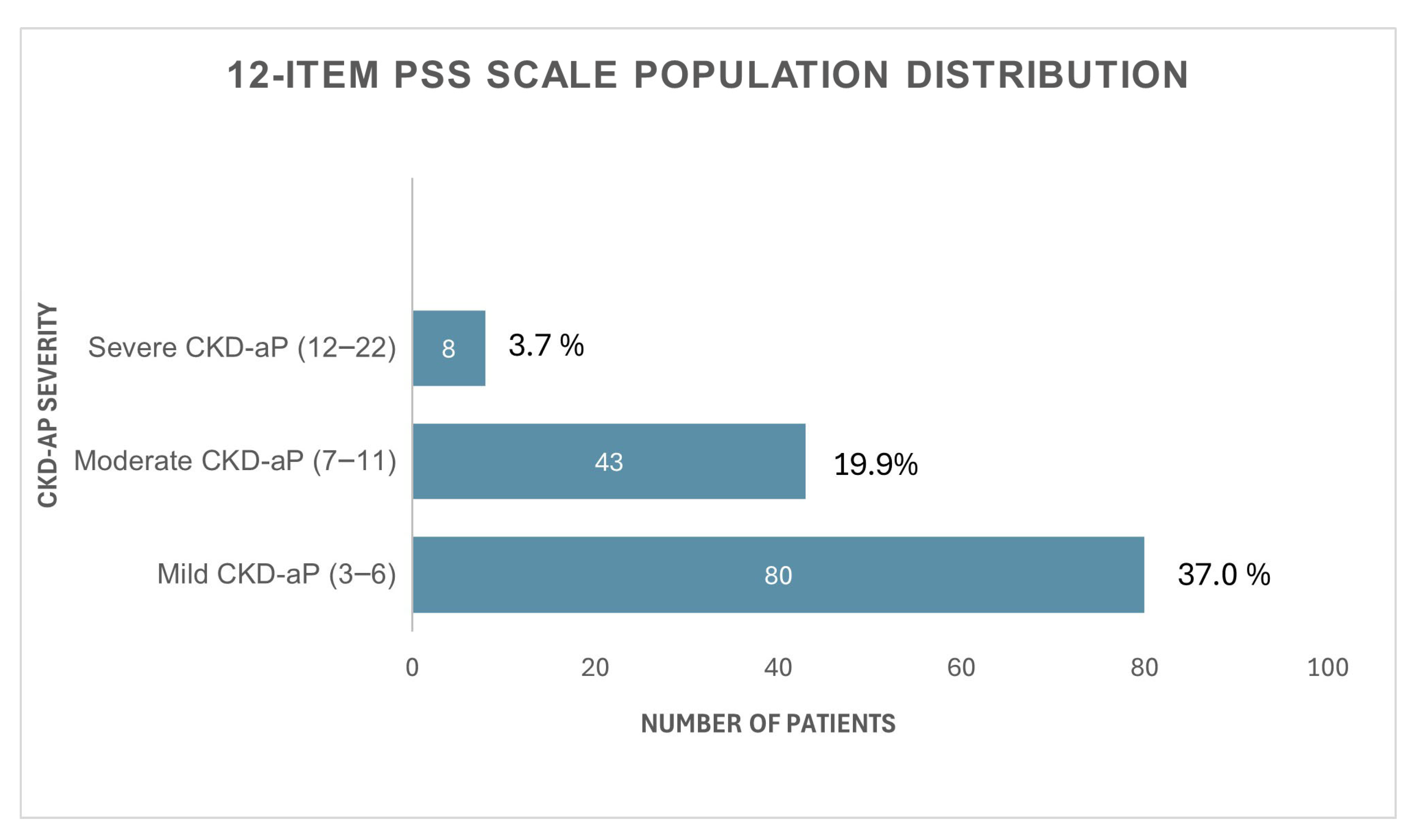
- Severity of pruritus by ‘12-Item Pruritus Severity Scale (12-PSS)’ (Figure 1): The CKD-aP severity assessed by the 12-PSS revealed that the largest proportion (37%) reported it to be mild, indicating that most patients experienced relatively low levels of discomfort. A smaller group (19.9%) reported moderate CKD-aP, while 3.7% of patients experienced severe CKD-aP, suggesting that a notable minority suffered from more intense symptoms. These findings underscore that, while a substantial number of patients were free from CKD-aP, the majority who reported CKD-aP had symptoms of mild to moderate severity, with a smaller subset experiencing more severe CKD-aP.
- Characteristics of CKD-aP by 5-D Itch Scale: Patients with moderate-to-severe CKD-aP reported longer daily durations of itching. A higher percentage of patients in the moderate-to-severe group experienced CKD-aP for 12–18 h per day (52.9%) compared to 26.3% in the mild group. Conversely, a greater proportion of patients with mild CKD-aP reported having pruritus for less than 6 h a day (37.5%) compared to only 17.6% in the moderate-to-severe group (p = <0.001).
- The direction variable, which reflects the concept of change over time, showed no significant difference between the mild and moderate-to-severe groups (p = 0.18). While a larger proportion of patients in both groups reported feeling ‘much better but still present’ (48.8% in the mild group vs. 35.3% in the moderate-to-severe group), there were no statistically significant differences in symptom resolution patterns between the two groups. Additionally, a small proportion of patients in both groups reported that their symptoms were ‘completely resolved’ or ‘unchanged.’
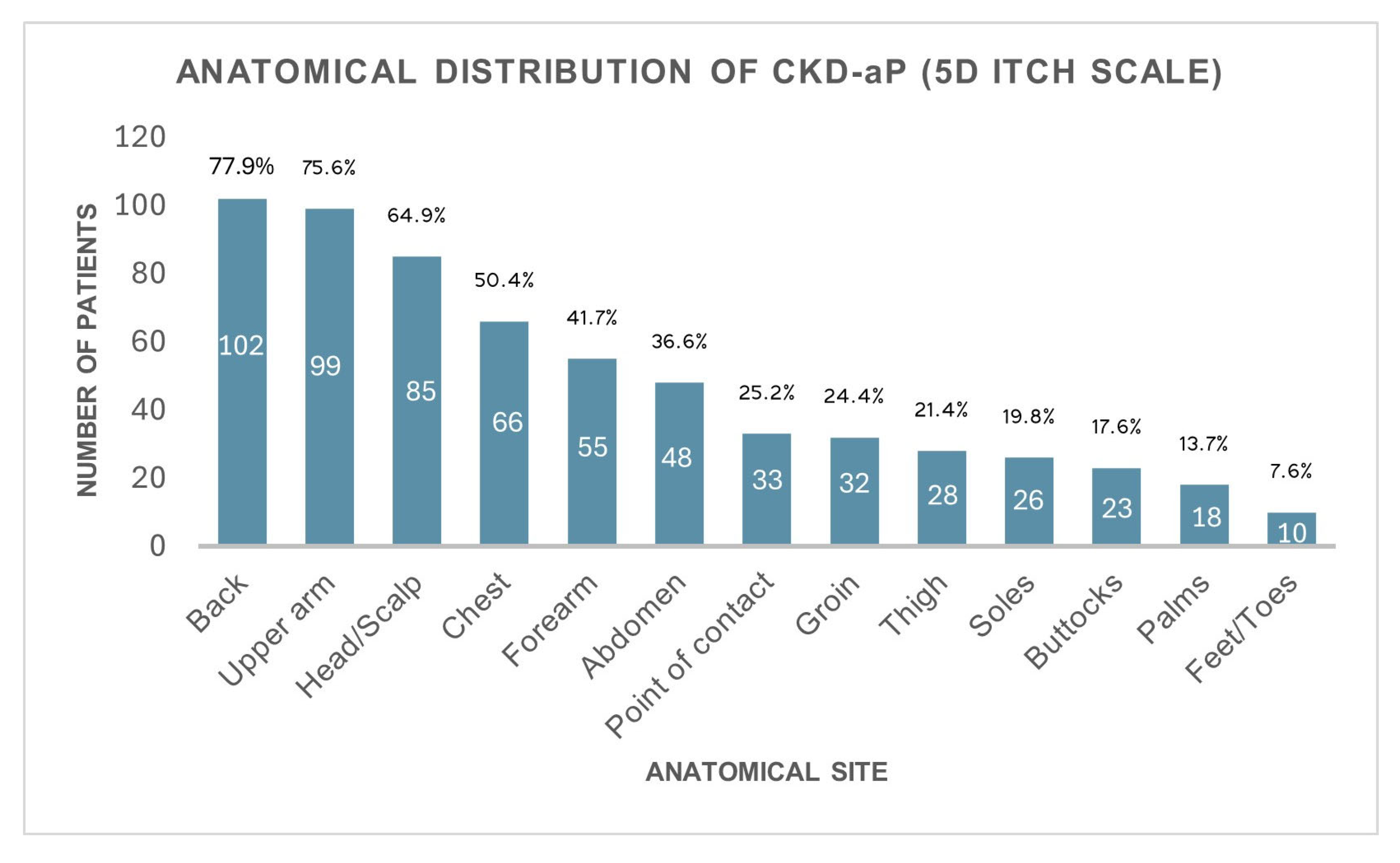
- The analysis revealed a varied distribution of CKD-aP across multiple anatomical sites (Figure 2). The back emerged as the most affected area, with 77.9% of the participants reporting itching in this region. The head and scalp also showed a high prevalence of itching, with 64.9% of patients reporting discomfort in these areas. The chest and forearm areas followed closely, with 50.4% and 41.7% of patients experiencing CKD-aP, respectively. Other regions, such as the abdomen (36.6%), thighs (21.4%), and buttocks (17.6%), showed moderate prevalence rates of CKD-aP. The lower body, including the feet/toes (7.6%) and soles (19.8%), showed comparatively lower prevalence rates. Interestingly, the palms (13.7%) and groin (24.4%) areas also showed notable prevalence, with a significant proportion of participants reporting itching in these regions. The point of contact (25.2%) may reflect localized itching due to friction, pressure, or other external factors that are common in patients undergoing dialysis. Although the upper arms (75.6%) also showed a high rate of CKD-aP, the soles and palms showed moderate levels of itching.
3.3. Impact on ‘Health-Related Quality of Life (HRQoL)’
- ‘Dermatology Life Quality Index (DLQI)’: Only 24.4% said their skin condition had ‘no effect’ on daily life. A total of 36.6% reported a ‘small effect’. A total of 38.9% reported a ‘moderate effect’ on quality of life. These findings showed that 75.5% of the participants had QoL impairment. The DLQI subscales revealed significant differences in quality of life between mild and moderate-to-severe CKD-aP. The Leisure subscale revealed that moderate-to-severe CKD-aP severity (mean = 3.07) had a more negative impact on leisure activities than mild severity (mean = 1.51). Moderate-to-severe CKD-aP (mean = 1.96) affected work and school more than mild CKD-aP (0.51). Moderate to severe CKD-aP disrupted relationships more than mild CKD-aP (mean = 1.41). Treatment for moderate to severe CKD-aP (mean = 2) requires more than mild treatment (0.46). In the Symptoms and Feelings subscale, moderate to severe CKD-aP (mean = 2.74) affected emotional well-being more than mild (1.63). The Daily Activities subscale revealed that moderate-to-severe CKD-aP (mean = 3.03) interfered more with daily life than mild CKD-aP (mean = 1.6).
- Skindex 16: In the Symptoms subscale, mild CKD-aP had a median score of 14 (IQR = 9–23), whereas moderate-to-severe CKD-aP had a significantly higher median score of 46 (IQR = 38–52), (p < 0.001). Participants with mild CKD-aP had a median emotion subscale score of 18 (IQR = 9–24.7), whereas those with moderate-to-severe CKD-aP had a median score of 42 (IQR = 34–52), representing a significant difference (p < 0.001). Individuals with mild CKD-aP scored 17 on the function subscale (IQR = 7.2–25.7), while those with moderate to severe pruritus scored 51 (IQR = 43–55), a significant difference (p < 0.001).
- Sleep disturbance assessment by ‘Pittsburgh Sleep Quality Index (PSQI)’: The participants were classified into two groups according to their PSQI score: poor sleep group (PSQI > 5) and good sleep group (PSQI ≤ 5). Most respondents with moderate-to-severe CKD-aP had a higher global PSQI score, with a median and interquartile range [IQR] of 8.00 (7–10); thus, higher scores were indicative of poor and impaired sleep quality.
4. Discussion
5. Conclusions
Author Contributions
Funding
Institutional Review Board Statement
Informed Consent Statement
Data Availability Statement
Acknowledgments
Conflicts of Interest
Abbreviations
| 12-PSS | 12 Item Pruritus Severity Scale |
| ADPKD | Autosomal Dominant Polycystic Kidney Disease |
| CGN | Chronic/Crescentic Glomerulonephritis |
| CKDaP | Chronic Kidney Disease-associated Pruritus |
| CTIN | Chronic Tubulo-interstitial Nephritis |
| DKD | Diabetic Kidney Disease |
| DLQI | Dermatology Life Quality Index |
| DOPPS | Dialysis Outcomes And Practice Patterns Study |
| ESKD | End-stage Kidney Disease |
| HRQoL | Health-related Quality Of Life |
| IQR | Inter-quartile Range |
| MHD | Maintenance Hemodialysis |
| NRS | Numerical Rating Scale |
| PREM | Patient-reported Experience Measure |
| PRO | Patient-reported Outcome |
| PROM | Patient Reported Outcome Measure |
| PSQI | Pittsburgh Sleep Quality Index |
| PTH | Parathyroid Hormone |
| SD | Standard Deviation |
| SPSS | Statistical Package For Social Sciences |
| VAS | Visual Analogue Scale |
| VNRS | Verbal Numerical Rating Scale |
References
- Agarwal, P.; Garg, V.; Karagaiah, P.; Szepietowski, J.C.; Grabbe, S.; Goldust, M. Chronic kidney disease-associated pruritus. Toxins 2021, 13, 527. [Google Scholar] [CrossRef]
- Weisshaar, E.; Szepietowski, J.C.; Dalgard, F.J.; Garcovich, S.; Gieler, U.; Giménez-Arnau, A.M.; Lambert, J.; Leslie, T.; Mettang, T.; Misery, L.; et al. European S2k guideline on chronic pruritus. Acta Derm.-Venereol. 2019, 99, 469–506. [Google Scholar] [CrossRef] [PubMed]
- Lipman, Z.M.; Paramasivam, V.; Yosipovitch, G.; Germain, M.J. Clinical management of chronic kidney disease-associated pruritus: Current treatment options and future approaches. Clin. Kidney J. 2021, 14, i16–i22. [Google Scholar] [CrossRef]
- Makar, M.; Smyth, B.; Brennan, F. Chronic kidney disease-associated pruritus: A review. Kidney Blood Press. Res. 2021, 46, 659–669. [Google Scholar] [CrossRef] [PubMed]
- Aresi, G.; Rayner, H.C.; Hassan, L.; Burton, J.O.; Mitra, S.; Sanders, C.; van der Veer, S.N. Reasons for underreporting of uremic pruritus in people with chronic kidney disease: A qualitative study. J. Pain Symptom Manag. 2019, 58, 578–586. [Google Scholar] [CrossRef]
- Kim, D.; Pollock, C. Epidemiology and burden of chronic kidney disease-associated pruritus. Clin. Kidney J. 2021, 14, i1–i7. [Google Scholar] [CrossRef] [PubMed]
- Rayner, H.C.; Larkina, M.; Wang, M.; Graham-Brown, M.; van der Veer, S.N.; Ecder, T.; Hasegawa, T.; Kleophas, W.; Bieber, B.A.; Tentori, F.; et al. International comparisons of prevalence, awareness, and treatment of pruritus in people on hemodialysis. Clin. J. Am. Soc. Nephrol. 2017, 12, 2000–2007. [Google Scholar] [CrossRef]
- Verduzco, H.A.; Shirazian, S. CKD-associated pruritus: New insights into diagnosis, pathogenesis, and management. Kidney Int. Rep. 2020, 5, 1387–1402. [Google Scholar] [CrossRef]
- Shirazian, S.; Aina, O.; Park, Y.; Chowdhury, N.; Leger, K.; Hou, L.; Miyawaki, N.; Mathur, V.S. Chronic kidney disease-associated pruritus: Impact on quality of life and current management challenges. Int. J. Nephrol. Renov. Dis. 2017, 10, 11–26. [Google Scholar] [CrossRef]
- Wolff, A.C.; Dresselhuis, A.; Hejazi, S.; Dixon, D.; Gibson, D.; Howard, A.F.; Liva, S.; Astle, B.; Reimer-Kirkham, S.; Noonan, V.K.; et al. Healthcare provider characteristics that influence the implementation of individual-level patient-centered outcome measure (PROM) and patient-reported experience measure (PREM) data across practice settings: A protocol for a mixed methods systematic review with a narrative synthesis. Syst. Rev. 2021, 10, 169. [Google Scholar]
- Breckenridge, K.; Bekker, H.L.; Gibbons, E.; van der Veer, S.N.; Abbott, D.; Briançon, S.; Cullen, R.; Garneata, L.; Jager, K.J.; Lønning, K.; et al. How to routinely collect data on patient-reported outcome and experience measures in renal registries in Europe: An expert consensus meeting. Nephrol. Dial. Transpl. 2015, 30, 1605–1614. [Google Scholar] [CrossRef]
- Reich, A.; Heisig, M.; Phan, N.; Taneda, K.; Takamori, K.; Takeuchi, S.; Furue, M.; Blome, C.; Augustin, M.; Ständer, S.; et al. Visual analogue scale: Evaluation of the instrument for the assessment of pruritus. Acta Derm. Venereol. 2012, 92, 497–501. [Google Scholar] [CrossRef]
- Vernon, M.K.; Swett, L.L.; Speck, R.M.; Munera, C.; Spencer, R.H.; Wen, W.; Menzaghi, F. Psychometric validation and meaningful change thresholds of the Worst Itching Intensity Numerical Rating Scale for assessing itch in patients with chronic kidney disease-associated pruritus. J. Patient-Rep. Outcomes 2021, 5, 134. [Google Scholar] [CrossRef]
- Yosipovitch, G.; Reaney, M.; Mastey, V.; Eckert, L.; Abbé, A.; Nelson, L.; Clark, M.; Williams, N.; Chen, Z.; Ardeleanu, M.; et al. Peak Pruritus Numerical Rating Scale: Psychometric validation and responder definition for assessing itch in moderate-to-severe atopic dermatitis. Br. J. Dermatol. 2019, 181, 761–769. [Google Scholar] [CrossRef]
- Cheung, H.N.; Chan, Y.S.; Hsiung, N.H. Validation of the 5-D Itch Scale in Three Ethnic Groups and Exploring Optimal Cutoff Values Using the Itch Numerical Rating Scale. BioMed Res. Int. 2021, 2021, 7640314. [Google Scholar] [CrossRef] [PubMed]
- Majeski, C.J.; Johnson, J.A.; Davison, S.N.; Lauzon, G.J. Itch Severity Scale: A self-report instrument for the measurement of pruritus severity. Br. J. Dermatol. 2007, 156, 667–673. [Google Scholar] [CrossRef] [PubMed]
- Swerlick, R.A.; Zhang, C.; Patel, A.; Chren, M.M.; Chen, S. The Skindex-Mini: A streamlined quality of life measurement tool suitable for routine use in clinic. J. Am. Acad. Dermatol. 2021, 85, 510–512. [Google Scholar] [CrossRef] [PubMed]
- Finlay, A.Y.; Khan, G.K. Dermatology Life Quality Index (DLQI)—A simple practical measure for routine clinical use. Clin. Exp. Dermatol. 1994, 19, 210–216. [Google Scholar] [CrossRef]
- Buysse, D.J.; Reynolds, C.F., III; Monk, T.H.; Berman, S.R.; Kupfer, D.J. The Pittsburgh Sleep Quality Index: A new instrument for psychiatric practice and research. Psychiatry Res. 1989, 28, 193–213. [Google Scholar] [CrossRef]
- Sukul, N.; Karaboyas, A.; Csomor, P.A.; Schaufler, T.; Wen, W.; Menzaghi, F.; Rayner, H.C.; Hasegawa, T.; Al Salmi, I.; Al-Ghamdi, S.M.; et al. Self-reported pruritus and clinical, dialysis-related, and patient-reported outcomes in hemodialysis patients. Kidney Med. 2021, 3, 42–53. [Google Scholar] [CrossRef]
- Rehman, I.U.; Chohan, T.A.; Bukhsh, A.; Khan, T.M. Impact of pruritus on sleep quality of hemodialysis patients: A systematic review and meta-analysis. Medicina 2019, 55, 699. [Google Scholar] [CrossRef] [PubMed]
- Thompson, J.; Kammerer, J.; Boshears, T.; Oliveira, J.; Johansen, K.L.; Kovar, A.; Lee, L.; Yosipovitch, G. Chronic Kidney Disease-Associated Pruritus Burden: A Patient Survey Study. Kidney Med. 2024, 6, 100900. [Google Scholar] [CrossRef]
- Farage, M.A.; Miller, K.W.; Berardesca, E.; Maibach, H.I. Clinical implications of aging skin: Cutaneous disorders in the elderly. Am. J. Clin. Dermatol. 2009, 10, 73–86. [Google Scholar] [CrossRef]
- Hu, X.; Sang, Y.; Yang, M.; Chen, X.; Tang, W. Prevalence of chronic kidney disease-associated pruritus among adult dialysis patients: A meta-analysis of cross-sectional studies. Medicine 2018, 97, e10633. [Google Scholar] [CrossRef]
- Pisoni, R.L.; Wikström, B.; Elder, S.J.; Akizawa, T.; Asano, Y.; Keen, M.L.; Saran, R.; Mendelssohn, D.C.; Young, E.W.; Port, F.K. Pruritus in haemodialysis patients: International results from the Dialysis Outcomes and Practice Patterns Study (DOPPS). Nephrol. Dial. Transpl. 2006, 21, 3495–3505. [Google Scholar] [CrossRef] [PubMed]
- Martin, C.E.; Clotet-Freixas, S.; Farragher, J.F.; Hundemer, G.L. Have we just scratched the surface? A narrative review of uremic pruritus in 2020. Can. J. Kidney Health Dis. 2020, 7, 2054358120954024. [Google Scholar] [CrossRef] [PubMed]
- Afsar, B.; Afsar, R.E. HbA1c is related with uremic pruritus in diabetic and nondiabetic hemodialysis patients. Ren. Fail 2012, 34, 1264–1269. [Google Scholar] [CrossRef]
- Akhyani, M.; Ganji, M.R.; Samadi, N.; Khamesan, B.; Daneshpazhooh, M. Pruritus in hemodialysis patients. BMC Dermatol. 2005, 5, 7. [Google Scholar] [CrossRef]
- Yacoub, R.; Habib, H.; Lahdo, A.; Al Ali, R.; Varjabedian, L.; Atalla, G.; Akl, N.K.; Aldakheel, S.; Alahdab, S.; Albitar, S. Association between smoking and chronic kidney disease: A case control study. BMC Public Health 2010, 10, 731. [Google Scholar] [CrossRef]
- Huang, W.H.; Lin, J.H.; Weng, C.H.; Hsu, C.W.; Yen, T.H. Environmental NO2 and CO exposure: Ignored factors associated with uremic pruritus in patients undergoing hemodialysis. Sci. Rep. 2016, 6, 31168. [Google Scholar] [CrossRef]
- Mathur, V.S.; Lindberg, J.; Germain, M.; Block, G.; Tumlin, J.; Smith, M.; Grewal, M.; McGuire, D.; ITCH National Registry Investigators. A longitudinal study of uremic pruritus in hemodialysis patients. Clin. J. Am. Soc. Nephrol. 2010, 5, 1410–1419. [Google Scholar] [CrossRef] [PubMed]
- Weiss, M.; Mettang, T.; Tschulena, U.; Passlick-Deetjen, J.; Weisshaar, E. Prevalence of chronic itch and associated factors in haemodialysis patients: A representative cross-sectional study. Acta Derm. Venereol. 2015, 95, 816–882. [Google Scholar] [CrossRef] [PubMed]
- Kimata, N.; Fuller, D.S.; Saito, A.; Akizawa, T.; Fukuhara, S.; Pisoni, R.L.; Robinson, B.M.; Akiba, T. Pruritus in haemodialysis patients: Results from the Japanese Dialysis Outcomes and Practice Patterns Study (JDOPPS). Hemodial. Int. 2014, 18, 657–666. [Google Scholar] [CrossRef]
- Jeele, M.O.; Adam, A.M.; Addow, R.O. Unveiling the Burden of Pruritus: Its Prevalence and Impact on Sleep Quality in Hemodialysis Patients in Somalia. Int. J. Gen. Med. 2025, 18, 473–482. [Google Scholar] [CrossRef]
- Ravindran, A.; Kunnath, R.P.; Sunny, A.; Vimal, B. Comparison of safety and efficacy of pregabalin versus gabapentin for the treatment of uremic pruritus in patients with chronic kidney disease on maintenance haemodialysis. Indian. J. Palliat. Care 2020, 26, 281. [Google Scholar]
- Fishbane, S.; Jamal, A.; Munera, C.; Wen, W.; Menzaghi, F. A phase 3 trial of difelikefalin in hemodialysis patients with pruritus. N. Engl. J. Med. 2020, 382, 222–232. [Google Scholar] [CrossRef]


| S. No. | Assessment Criteria | Tool(s) Used | Range | Justification |
|---|---|---|---|---|
| 1. | Severity Scale for CKD-aP | 12-Item Pruritus Severity Scale (12-PSS) | Total points: 22 No pruritus: 0–2; Mild: 3–6; Moderate: 7–11; Severe: 12–22 | CKD-aP severity was quantified using patient-reported scores, enabling standardized severity classification (mild, moderate, severe) and tracking its consequences and extent. Essential for symptom evaluation in clinical practice and research settings. |
| 2. | Characteristics of CKD-aP | 5-D Itch Scale | Total Points: 25 No itching: ≤8; Mild: 9–11; Moderate: 12–17; Severe: 18–21; Very severe: ≥22 | It evaluates CKD-aP across five dimensions (duration, degree, direction, disability, and distribution), capturing the multidimensional aspects of itching and facilitating targeted symptom management strategies. |
| 3. | Sleep Quality | Pittsburgh Sleep Quality Index (PSQI) | Total Points: 21 ≤5: Good Sleep; >5: Degrading Sleep Quality | Sleep quality and disturbance influenced by CKD-aP severity were assessed, with scores directly reflecting sleep disruption. Key for linking pruritus with sleep outcomes in patients with CKD. |
| 4. | Quality of Life | Dermatology Life Quality Index (DLQI) | Total Points: 30 0–1: No effect; 2–5: Small effect; 6–10: Moderate effect; 11–20: Very large effect; 21–30: Extremely large effect | It measures dermatological QoL impairment across diverse daily life domains, highlighting the significant impact of CKD-aP on daily living, leisure, work, relationships, and emotional well-being. |
| 5. | Skindex 16 | Symptoms: Mild (median score ~14 [IQR 9–23]), Moderate to Severe (median score ~46 [IQR 38–52]); Emotions: Mild (median score ~18 [IQR 9–24.7]), Moderate to Severe (median score ~42 [IQR 34–52]); Function: Mild (median score ~17 [IQR 7.2–25.7]), Moderate to Severe (median score ~51 [IQR 43–55]) | It provides a validated, sensitive measure of skin-related QoL, capturing the physical, emotional, and functional impairment caused by CKD-aP. |
| Demographic Variables | Total (n = 216) | CKD-aP (n = 131) | No CKD-aP (n = 85) | p-Value | |
|---|---|---|---|---|---|
| Age (years) (Mean ± SD) | 53.4 ± 13.2 | 53.7 ± 13.6 | 53.0 ± 12.8 | 0.70 | |
| Males (n, %) * | 175 (81.0) | 102 (77.8) | 73 (85.8) | 0.14 | |
| Etiology of CKD (n, %) * | |||||
| ADPKD | 8 (3.7) | 6 (4.5) | 2 (2.3) | 0.66 | |
| CGN | 53 (24.5) | 29 (22.1) | 24 (28.2) | ||
| CTIN | 77 (35.6) | 48 (36.6) | 29 (34.1) | ||
| DKD | 78 (36.1) | 48 (36.6) | 30 (35.2) | ||
| Lifestyle | |||||
| Current smokers (n, %) * | 13 (6.0) | 11 (8.4) | 3 (3.5) | 0.15 | |
| Dialysis Characteristics (n, %) | |||||
| Hemodialysis Frequency (per week) * | Once | 1 (0.4) | 0 | 1 (1.2) | 0.09 |
| Twice | 202 (93.5) | 120 (91.6) | 82 (96.5) | ||
| Thrice | 13 (6.0) | 11 (8.3) | 2 (2.4) | ||
| Dialysis Vintage * | <5 years | 138 (63.8) | 89 (67.9) | 49 (57.6) | 0.12 |
| >5 years | 78 (36.1) | 42 (32.0) | 36 (42.4) | ||
| Laboratory Parameters | |||||
| Hemoglobin (g/dL) (Mean ± SD) | 10.6 ± 2.2 | 10.4 ± 2.1 | 9.7 ± 2.0 | 0.80 | |
| S. Albumin (g/dL) (Mean ± SD) | 4.3 ± 0.56 | 4.3 ± 0.57 | 4.3 ± 0.55 | 0.38 | |
| S. Phosphorous (mg/dL) (Mean ± SD) units | 5.3 ± 1.6 | 5.5 ± 1.6 | 5.1 ± 1.6 | 0.07 | |
| S. Calcium (mg/dL) (Mean ± SD) | 8.1 ± 0.6 | 8.1 ± 0.6 | 8.1 ± 0.6 | 0.72 | |
| S. Parathormone (pg/mL) (Median, IQR) | 1008 (472.5, 1488.1) | 1020 (500, 1490) | 990 (470, 1480) | 0.72 | |
| Hepatitis C (n, %) * | 1 (0.4) | 1 (1.2) | 0 | 0.43 | |
| Hepatitis B (n, %) * | 1 (0.4) | 1 (1.2) | 0 | ||
Disclaimer/Publisher’s Note: The statements, opinions and data contained in all publications are solely those of the individual author(s) and contributor(s) and not of MDPI and/or the editor(s). MDPI and/or the editor(s) disclaim responsibility for any injury to people or property resulting from any ideas, methods, instructions or products referred to in the content. |
© 2026 by the authors. Licensee MDPI, Basel, Switzerland. This article is an open access article distributed under the terms and conditions of the Creative Commons Attribution (CC BY) license.
Share and Cite
Jain, S.; Nagaraju, S.P.; Rani, P.; Bhojaraja, M.V.; Shirodkar, S.N.S.; Prabhu, A.R.; Rangaswamy, D.; Rao, I.R.; Shenoy, S.V. Prevalence, Factors, and Impact of CKD-aP on Quality of Life and Sleep in Indian Hemodialysis Patients: Cross-Sectional Study. Kidney Dial. 2026, 6, 32. https://doi.org/10.3390/kidneydial6020032
Jain S, Nagaraju SP, Rani P, Bhojaraja MV, Shirodkar SNS, Prabhu AR, Rangaswamy D, Rao IR, Shenoy SV. Prevalence, Factors, and Impact of CKD-aP on Quality of Life and Sleep in Indian Hemodialysis Patients: Cross-Sectional Study. Kidney and Dialysis. 2026; 6(2):32. https://doi.org/10.3390/kidneydial6020032
Chicago/Turabian StyleJain, Shreya, Shankar Prasad Nagaraju, Priya Rani, Mohan Varadanayakanahalli Bhojaraja, Shriya Narendra Shet Shirodkar, Attur Ravindra Prabhu, Dharshan Rangaswamy, Indu Ramachandra Rao, and Srinivas Vinayak Shenoy. 2026. "Prevalence, Factors, and Impact of CKD-aP on Quality of Life and Sleep in Indian Hemodialysis Patients: Cross-Sectional Study" Kidney and Dialysis 6, no. 2: 32. https://doi.org/10.3390/kidneydial6020032
APA StyleJain, S., Nagaraju, S. P., Rani, P., Bhojaraja, M. V., Shirodkar, S. N. S., Prabhu, A. R., Rangaswamy, D., Rao, I. R., & Shenoy, S. V. (2026). Prevalence, Factors, and Impact of CKD-aP on Quality of Life and Sleep in Indian Hemodialysis Patients: Cross-Sectional Study. Kidney and Dialysis, 6(2), 32. https://doi.org/10.3390/kidneydial6020032