Review

Challenges in Diagnosing Acute Kidney Injury in Children with Severe Malaria in Sub-Saharan Africa: Limits of Current Diagnostic Approaches


by
Flore Makaya Talu
1,
Therance Tobo Matoka
1,
Agathe Bikupe Nkoy
1,*,
Bienvenu Matondo Odio
1,
Orielle Mafuta Minimbu
1,
Floreen Maluwenze Mumaka
1,
Yoli Ngamukuba Ndiyo
1,
Dieumerci Kabasele Betukumesu
1,
Orly Kazadi wa Kazadi
1,
Célestin Ndosimau Nsibu
2 and
Pépé Mfutu Ekulu
1
1
Division of Nephrology, Department of Pediatrics, University Hospital of Kinshasa, University of Kinshasa, Kinshasa P.O. Box 123, Democratic Republic of the Congo
2
Division of Intensive Care, Department of Pediatrics, University Hospital of Kinshasa, University of Kinshasa, Kinshasa P.O. Box 123, Democratic Republic of the Congo
*
Author to whom correspondence should be addressed.
Kidney Dial. 2026, 6(2), 33; https://doi.org/10.3390/kidneydial6020033
Submission received: 20 March 2026 / Revised: 9 May 2026 / Accepted: 9 May 2026 / Published: 14 May 2026

Abstract

Malaria remains a leading cause of morbidity and mortality among children in sub-Saharan Africa. Acute kidney injury (AKI) is increasingly recognized as a frequent and severe complication of pediatric severe malaria, yet it remains largely underdiagnosed. This under-recognition is driven by important limitations in current diagnostic approaches. The World Health Organization (WHO) criteria rely on fixed serum creatinine (SCr) thresholds that are poorly adapted to children, whereas Kidney Disease Improving Global Outcomes (KDIGO) criteria require baseline SCr (bSCr) values that are rarely available in low-resource settings. The estimation of bSCr using back-calculation methods is further complicated by population-specific factors, particularly malnutrition, which reduces creatinine generation and may mask kidney injury. In addition, urine output (UO) monitoring is often underutilized despite its diagnostic value, and access to laboratory testing remains limited. Emerging biomarkers such as neutrophil gelatinase-associated lipocalin (NGAL), cystatin C, and kidney injury molecule-1 (KIM-1) show promise for early detection and risk stratification but remain insufficiently validated in African pediatric populations. In this narrative review, we highlight key challenges in diagnosing malaria-associated AKI (MAKI) in children and discuss potential strategies to improve early detection in resource-limited settings, with the aim of reducing morbidity and mortality.

1. Introduction

Malaria remains a global health problem. Despite considerable efforts made to reduce its burden, malaria continues to disproportionately affect people living in sub-Saharan Africa (SSA) [1,2]. Indeed, malaria is associated with high morbidity and mortality in SSA, especially in younger children [1,3]. According to the latest World Malaria Report, 282 million malaria cases were reported globally in 2024, an increase of about 3% from 2023, with the African region bearing most of the burden [1]. Malaria caused an estimated 610,000 deaths in 2024, with four countries [Nigeria, Democratic Republic of Congo (DRC), Niger, and Tanzania] responsible for over half of these deaths. Notably, Nigeria accounted for the highest proportion, especially among children under five years old [1].
Severe malaria is a serious condition associated with multiple organ damage, the kidney being one of the primary targets [4,5,6,7]. AKI, defined as an abrupt decline in kidney function, is one of the most severe complications and contributes to high malaria-associated mortality in children [4,8]. AKI was once considered a complication observed during acute Plasmodium falciparum malaria in adults and thought to be rare in pediatric populations with severe malaria [9,10]. However, studies in the past decade show a high prevalence of AKI in children with severe malaria, even among younger groups, proving that AKI is a common complication of severe malaria and is independently associated with mortality [9,11,12,13].
Based on various studies from SSA, the incidence of malaria-associated acute kidney injury (MAKI) in children ranges between 0 and 59%, with reported rates of approximately 24–59% when using KDIGO criteria and 0–33% when applying alternative AKI definitions based on various creatinine thresholds and/or urine output [9]. This substantial variability in the prevalence of MAKI among children is largely due to differences in the AKI diagnostic criteria across studies [4,9]. In addition, the mortality associated with AKI in severe malaria remains high across the SSA region due to delays in early detection and appropriate management [14]. Growing evidence indicates that even small alterations in kidney function are linked to higher morbidity, increased mortality, and a greater risk of progression to chronic kidney disease (CKD) [15].
In the present review, we discuss current evidence on AKI in children with severe malaria, focusing on the diagnostic criteria of MAKI, the role of emerging AKI biomarkers, and the association with the outcomes of children living in SSA. We also propose pragmatic approaches tailored to resource-limited settings to improve the early detection of MAKI.

2. Definition Criteria of AKI and Its Impact on the Prevalence of MAKI in Children

2.1. WHO Versus KDIGO Criteria for the Diagnosis of AKI in Children with Severe Malaria

The WHO defines severe malaria as an infection caused by Plasmodium falciparum, associated with clinical or laboratory evidence of vital organ dysfunction, or a high parasite density, and requiring urgent medical intervention [16]. AKI is included among these severity criteria established by the WHO and is defined as a serum creatinine (SCr) level >3 mg/dL (>265 µmol/L) in both adults and children [17]. However, several pediatric studies on MAKI have shown that the SCr threshold used by the WHO is not appropriate for the pediatric population and tends to underestimate the incidence or prevalence of AKI among children with severe malaria [9,10,18].
Importantly, this WHO criterion for AKI in severe malaria leads to a misclassification of patients. This impacts early diagnosis and interventions that can prevent or attenuate the progression to severe and late stages of AKI, associated with higher mortality and increased risk of developing CKD. At this latter stage, survival often requires kidney replacement therapy (KRT), such as dialysis, which is generally unavailable or financially inaccessible in most SSA countries [10].
Several studies have adopted internationally standardized consensus definitions to diagnose AKI in children with severe malaria. Indeed, in recent years, increasing efforts have been made by nephrology societies to establish more sensitive guidelines and criteria for the detection of AKI, which are applicable to adults while also accounting for the specific characteristics of the pediatric population and incorporating prognostic considerations. In this context, the criteria of the definition of AKI have evolved over time. The earliest international guidelines for AKI were established in 2004 with the introduction of the RIFLE (Risk, Injury, Failure, Loss, and End-stage renal disease) classification by the Acute Dialysis Quality Initiative (ADQI) [19]. This framework provided the first standardized approach to defining and grading AKI severity. Recognizing the limitations of RIFLE in pediatric populations, subsequent adaptations were developed to better reflect age-related physiological differences in kidney function. The pediatric RIFLE criteria (pRIFLE), published in 2007, represented a pediatric-specific modification of the original RIFLE criteria [20]. Additionally, in the same year, the Acute Kidney Injury Network (AKIN) proposed a revised definition of AKI that shifted emphasis away from the glomerular filtration rate (GFR), acknowledging that GFR cannot be reliably estimated during acute kidney dysfunction. Notably, AKIN introduced an absolute SCr threshold, defining AKI as an increase in SCr of ≥0.3 mg/dL within 48 h, thereby improving sensitivity for diagnosing early kidney injury [21]. Later, in 2012, the Kidney Disease Improving Global Outcomes (KDIGO) guidelines integrated the RIFLE and AKIN definitions into a unified framework and are now regarded as the reference standard for AKI diagnosis. The KDIGO criteria provide both a general definition and a severity staging system for AKI, based on two parameters: changes in SCr relative to the baseline value and a decrease in urine output (UO) [9,22].
The discrepancy observed between these international guidelines and the WHO in AKI diagnosis criteria explains the heterogeneity and wide variability in the reported prevalence (or incidence) of MAKI in children [23], as depicted in Table 1. For instance, in a Nigerian study, 7.6% of children with severe malaria met the WHO criteria for AKI, while 32.4% met KDIGO criteria [24]. A similar observation was reported in a Ugandan study, where only 1.1% of children had a peak SCr > 3 mg/dL, while 45.5% met KDIGO criteria [15]. More recently, a meta-analysis that pooled 18 studies on MAKI over a 33-year period reported an AKI prevalence of 47% using KDIGO criteria versus 3.4% when the WHO criteria were applied [14]. These findings demonstrate significant limitations in the current WHO severe malaria guidelines regarding AKI diagnosis. This limitation is more pronounced in children, whose normal SCr concentrations are physiologically lower, and even more so in children from low- and middle-income countries (LMICs), where undernutrition, associated with reduced baseline creatinine levels, is common [9]. This observation clearly shows that the WHO criteria for AKI may be inadequate in the assessment of kidney injury, particularly in children. This highlights the need for revised age- and potentially region-specific criteria for AKI assessment in the context of malaria infection [25]. This will support the early detection and management of AKI in children with severe malaria, thereby improving their outcomes [10,14].

2.2. Baseline Estimation of SCr in Children with Severe Malaria

2.2.1. Approach to Estimating Baseline SCr (bSCr)

Accurate application of the KDIGO AKI criteria requires knowledge of the baseline SCr (bSCr) to ensure reliable identification and staging of AKI. The bSCr is defined as the lowest recent SCr values ideally obtained within 3–6 months prior to hospital admission [9,22,26,27]. However, bSCr values are frequently unavailable in most hospitalized children, especially those living in resource-limited settings. In this condition, bSCr should be estimated [26,28,29,30].
Different studies have evaluated and proposed several approaches to estimating bSCr in children [26,27,28,31,32,33,34,35]. The most commonly used approach is to back-calculate bSCr using pediatric estimated GFR (eGFR) equations and assuming a normal eGFR of 120 mL/min/1.73 m2 [15,28,31,32,36,37]. It should be noted that there is no consensus on which eGFR equation should be used to back-calculate bSCr in children [26]. In the literature, the Schwartz equations, especially the Bedside Schwartz, are the most widely used SCr-based equations in children [26]. However, the Schwartz equations require a height measurement [38], which is generally not available in the medical record and may be difficult to obtain in critically ill children [28]. Another concern regarding the height measurement is the dependence of creatinine on muscle mass, especially in resource-limited settings. Indeed, in the settings where undernutrition is more frequent, bSCr can be underestimated using the height approach due to lower muscle per body surface area [28]. In addition, the Bedside Schwartz equation, derived from US children with CKD and growth retardation, does not perform well in healthy children, as acknowledged by the authors [39].
To overcome these limitations, Pottel et al. developed a height-independent eGFR equation in children based on the concept of normalized SCr (SCr/Q), in which the Q-value is the median SCr of the corresponding age-/sex-matched healthy population [40]. It is worth mentioning that the validation of these eGFR equations is understudied in the pediatric African population [41]. However, more recently, in a study assessing the applicability of different SCr-based equations in healthy Congolese children aged 6 to 16 years, Nkoy et al. found that the Full Age Spectrum (FAS)-Age equation (a Pottel height-independent equation) performed best and was most suitable in this population [41]. Similar results have been reported in healthy Ugandan community children aged 6 months to 12 years [28]. These findings imply that the Pottel equation could be used to back-calculate bSCr in African children. Additional studies are needed to evaluate and validate this equation across different cohorts of African children, enabling standardized bSCr estimation and comparisons across pediatric populations [28].
In the African pediatric population with severe malaria, a few researchers attempted to evaluate the best method to estimate bSCr and validated the Pottel height-independent approach as the most appropriate one in these patients [10,14]. Indeed, aiming to evaluate methods of estimation of bSCr in Ugandan children with severe malaria, it was recently reported that bSCr estimated using the Pottel age-based eGFR equation was comparable to bSCr levels measured in healthy community children. In addition, the Pottel age-based equation, assuming a normal GFR of 120 mL/min/1.73 m2, was more accurate than the Schwartz height-based equation. AKI diagnosed using the Pottel age-based equation to estimate bSCr showed the strongest association with mortality in this population [28]. Similarly, in Nigerian children with severe malaria, Ibrahim et al. found that bSCr based on the Pottel age equation showed a minimal bias, narrow limits of agreement, and high accuracy compared to bSCr estimates derived from the Bedside Schwartz equation. Moreover, the Pottel approach identified a greater proportion of AKI cases and deaths compared with the Schwartz approach [31].
In a more recent meta-analysis, Bond et al. proposed an operationalized AKI definition, easy to use in routine clinical practice, based on simplified age-based creatinine thresholds. These thresholds were derived from rounded and batched estimates of bSCr multiplied by the fold-change in creatinine for each stage. This approach demonstrated performance comparable to KDIGO-defined AKI and could enable healthcare providers, especially those working in primary and secondary care levels, to rapidly diagnose AKI at the bedside. However, this approach has yet to be validated [14].
Table 1. Heterogeneity in AKI definition criteria and its impact on the prevalence of MAKI in African children.
Authors, Year of PublicationCountryStudy DesignSample Size and Age GroupsAKI Definition CriteriaBaseline SCr Estimation MethodsMAKI Prevalence (%)
Ibrahim et al., 2023 [31] NigeriaRetrospective cohort study541 children aged 3 months to 14 yearsKDIGObSCrPottel120,
bSCr Schwartz 120
43.3
38.4
Afolayan et al., 2022 [4]NigeriaProspective cohort study170 children aged 6 months to 14 yearspRIFLE
WHO
61.2
7.7
Namazzi et al., 2022 [42]UgandaProspective cohort study598 children aged 6 months to 4 yearsKDIGO bSCrPottel12045.3
Batte et al., 2020 [28]UgandaProspective cohort study1078 children aged 6 months to 12 yearsKDIGO bSCrSchwartz137
bSCrSchwartz120
bSCrPottel120
bSCrupperlimit
bSCrheightCC
bSCrageCC
43.4
31.4
40.4
15.6
39.2
39.2
Afolayan et al., 2020 [24]NigeriaCross-sectional study170 children aged 6 months to 14 yearsKDIGO
WHO
Absolute SCr > 1.5 mg/dL
Cystatin C-based eGFR
bSCrSchwartz 12032.4
7.6
16.5
51.8
Oshomah-Bello et al., 2020 [43]NigeriaCross-sectional study244 children aged 6 months to 12 yearsKDIGObSCrSchwartz 12059
Conroy et al., 2019 [44]UgandaProspective cohort study479 children aged 18 months to 12 yearsKDIGObSCrSchwartz 12035.1
Hashim et al.,2017 [45]SudanCross-sectional study112 children aged >2 months to 15 yearsWHO 7.4
Conroy et al., 2016 [15]UgandaRandomized controlled trial178 children aged 1 to 10 yearsKDIGObSCrSchwartz 12045.5
Jallow et al., 2012 [46]GambiaObservational study2901 children aged 4 months to 14 yearsWHO 0.6
Abbreviations: AKI, acute kidney injury; bSCr, baseline serum creatinine; bSCrSchwartz137, bSCr back-calculated using the Bedside Schwartz equation (eGFR = 0.413 × height/SCr), assuming a normal eGFR of 137 mL/min/1.73 m2; bSCrSchwartz120, bSCr back-calculated using the Bedside Schwartz equation (eGFR = 0.413 × height/SCr), assuming a normal eGFR of 120 mL/min/1.73 m2; bSCrPottel120, bSCr back-calculated using the Pottel age-based equation (eGFR = 107.3/(SCr/Q)), assuming a normal eGFR of 120 mL/min/1.73 m2; bSCrheightCC, bSCr estimated using linear regression models based on height-for-creatinine data derived from community Ugandan children; bSCrageCC, bSCr estimated using linear regression models based on age-for-creatinine data derived from community Ugandan children; bSCrupperlimit: bSCr estimated using published upper limits of normal creatinine by age category; KDIGO, kidney disease improving global outcomes; MAKI, malaria-associated acute kidney injury; WHO, world health organization.

2.2.2. Baseline eGFR Threshold to Estimate bSCr

The estimation of bSCr using the back-calculation approach requires fixing a value for the normal baseline eGFR. Although a value of 120 mL/min/1.73 m2 is commonly assumed in the pediatric literature, the choice of this value remains a concern in children, especially those younger than 2 years, given the physiological increase in GFR that occurs from birth to 2 years [26,32]. Another concern is also related to population-specific characteristics in SCr values [28]. Applying a fixed assumed normal eGFR of 120 mL/min/1.73 m2 in children less than 2 years may underestimate bSCr. Indeed, the optimal eGFR value to back-calculate bSCr should reflect the mean GFR of the corresponding population and account for nutritional status as well as physiological characteristics [28]. Thus, many pediatric studies proposed to use age-based normative eGFR values in children, especially those younger than 2 years [28,32].
Interestingly, in a study evaluating bSCr estimation methods among community Ugandan children aged 6 months to 12 years, most of whom were undernourished, the authors observed an increase in eGFR across age groups. The eGFR was greater than 120 mL/min/1.73 m2 (mean eGFR of 137 mL/min/1.73 m2) across all age groups, including children younger than 2 years. The authors concluded that the use of age-based normative eGFR values may not be applicable to Ugandan children [28,32]. This finding highlights the need to establish normal reference eGFR values for the African pediatric populations.

2.2.3. Nutritional Status and bSCr Estimation

The nutritional status and body habitus should be considered when estimating bSCr in African children [28,32]. As discussed previously, bSCr is estimated by back-calculation using a fixed GFR. Ideally, this GFR value should match the population’s characteristics, including nutritional status.
Importantly, in SSA, severe malaria frequently occurs in children who are already vulnerable due to underlying or concurrent malnutrition. The interaction between malaria and malnutrition is complex and bidirectional, with each condition potentially exacerbating the other [47,48]. In this context, reduced muscle mass and altered metabolic state associated with malnutrition may lead to lower baseline SCr levels, thereby masking early kidney injury during acute malaria episodes. Indeed, the creatinine pool has two main sources: endogenous production in muscle as the end product of creatine metabolism via recycling, and dietary intake of creatine or its precursor from meat or supplements [49,50]. Therefore, low dietary protein intake and the resulting low muscle mass can limit creatinine generation. Thus, protein malnutrition may lead to low SCr levels [51], as depicted in Figure 1.
In LMICs, due to low socio-economic conditions, children’s dietary intake is not always adequate, and many children suffer from malnutrition. Indeed, according to the 2025 UNICEF report, Africa was the only region where the number of children with stunting had significantly increased [52]. Creatinine levels in severely malnourished children are lower than those in the normal population [9]. Hari et al. found that SCr levels in malnourished boys were significantly lower than those in well-nourished boys. SCr levels were significantly correlated with weight (r = 0.29, p < 0.01) and height (r = 0.33, p < 0.01). They concluded that malnourished children generally have lower SCr levels [53].
This low SCr level may lead to an overestimation of GFR derived from prediction equations [53]. Indeed, it has been reported that GFR estimated by the Schwartz equation from SCr and height was significantly higher in malnourished children [141.80 (123.34–160.27) mL/min per 1.73 m2] than in normally nourished children [119.46 (109.39–129.53) mL/min per 1.73 m2] (p = 0.04) [53]. Similarly, Batte et al., using SCr and the Bedside Schwartz equation, found that the mean eGFR in Ugandan community children (predominantly malnourished) was 137 mL/min per 1.73 m2, which is higher than the assumed normal GFR of 120 mL/min per 1.73 m2. This highlights the importance of nutritional status when selecting methods to estimate bSCr [28].
Indeed, this apparent “normal” kidney function must be interpreted with caution. Specifically, this finding may reflect reduced creatinine generation due to low muscle mass, rather than true hyperfiltration. Consequently, relying on creatinine-based estimates may overestimate kidney function and mask early injury. As a result, small increases in SCr may remain within a low range, not reaching diagnostic thresholds and thus delaying recognition or underestimating AKI.
A recent prospective study in Ugandan children hospitalized with acute malnutrition further illustrated malnutrition’s impact on AKI diagnosis [54]. In this study, AKI was defined by KDIGO criteria, based on changes in SCr relative to a baseline estimated or defined as the lowest value measured during hospitalization. The clinical relevance of different AKI definitions was assessed by examining their association with in-hospital mortality. Importantly, using only relative changes in creatinine was not associated with in-hospital mortality, so this approach did not reliably identify clinically relevant AKI. To address this limitation, the authors added minimum absolute creatinine thresholds, requiring the peak value to exceed 0.4 mg/dL or 0.5 mg/dL, in addition to KDIGO criteria. Notably, a threshold of ≥0.4 mg/dL identified AKI in 23.2% of children and was associated with mortality (adjusted OR 4.06; 95% CI: 1.39–11.84); while a threshold of ≥0.5 mg/dL reduced prevalence to 14.1% but identified cases more strongly associated with death (adjusted OR 12.64; 95% CI: 3.79–42.18) [54].
From a practical perspective, these changes have important diagnostic implications. In malnourished children, relying only on SCr may delay or miss the diagnosis of AKI. Baseline values can be falsely low, and changes may not reach diagnostic thresholds. This can lead to the under-recognition of early AKI stages and delayed management. Therefore, clinicians should interpret SCr levels with caution in malnourished populations. When possible, they should integrate other parameters such as UO, clinical context, and alternative biomarkers to improve diagnosis.

2.3. Urine Output Assessment for the Diagnosis of AKI in Children with Severe Malaria

UO is a simple, readily available bedside test for kidney function. A decrease in urine production represents the oldest known biomarker for AKI [55]. The current definition of AKI, according to the 2012 KDIGO criteria, is based on two parameters: SCr and UO [6,22,56]. However, the majority of studies rely exclusively on SCr to assess kidney function.
In low-resource settings where SCr testing is not always available, UO measurement could be an indispensable tool for assessing kidney function. In addition, UO measurement offers some advantages over SCr, namely, the speed of the response and the fact that low UO is defined by a predefined cutoff value, so there is no need to look for a baseline UO. Importantly, when AKI diagnosis is based on the UO criterion alone, it is essential to rule out urinary tract obstructions that reduce UO [55] or other causes that may affect UO, including the drug’s effects [e.g., angiotensin-converting enzyme inhibitors (ACE-I)], the influence of fluid balance [22], and the effect of humid environments (particularly in the neonatal population).
Some studies have evaluated the benefit of UO in the detection of AKI. A recent systematic literature review conducted by Manu et al., including studies that diagnosed AKI based on either UO alone, SCr alone, UO or SCr, or both UO and SCr, found that the incidence of AKI was highest among studies that used UO or SCr criteria (median, IQR: 63%, 40–70%), followed by those that used UO only (median, IQR: 36%, 21–60%). In addition, UO monitoring appeared to identify AKI earlier than SCr monitoring alone, offering an opportunity for earlier intervention [57]. Kaddourah et al. reported that relying solely on plasma creatinine levels to diagnose AKI would fail to identify a substantial proportion of affected patients. Indeed, in their study, they found that when AKI was assessed using only plasma creatinine criteria, 67.2% of patients with reduced UO were not recognized as having AKI [58]. In the study conducted by Ralib et al., the authors found that 34% of patients with AKI based on UO were not diagnosed as having AKI based on plasma creatinine changes [59]. These data highlight the importance of considering UO in the diagnosis of AKI in addition to SCr, which is already routinely used.
In routine clinical practice, in LMICs, UO is often not monitored in hospitalized children, and it is sometimes difficult to measure accurately in patients without an indwelling urinary catheter. Nevertheless, considering its important role in the diagnosis of AKI, greater efforts are needed to systematically measure UO in hospitalized children. Importantly, UO measurement does not depend on laboratory testing and can be readily evaluated at the bedside [9].

3. Emerging Biomarkers for Early Detection of MAKI in Children

An elevation in SCr levels, which is commonly used to establish the diagnosis of AKI, is known to be a late marker of AKI. Indeed, it takes about 48 h to occur when up to 50% of kidney function would have been lost [12,60,61]. Furthermore, SCr levels can vary widely depending on age, gender, muscle mass, diet, medications, and hydration status. It is imprecise and can delay the diagnosis of AKI [12,62]. Advanced stages of MAKI in children are associated with an increased risk of mortality. Therefore, early diagnosis is crucial to detect AKI at early stages, which are often asymptomatic and potentially reversible. This could help prevent further deterioration in kidney function through appropriate fluid management, the avoidance of nephrotoxic drugs, and close monitoring to assess the need for KRT [63]. Another challenge related to SCr, particularly in low-resource settings, is the need for laboratory infrastructure for its measurement. In some healthcare facilities, such infrastructure is not always available, and when it is, the cost remains high for the population that is often poor. This situation significantly impacts the ability to assess AKI in clinical settings.
Therefore, it is crucial to evaluate the utility and diagnostic performance of the existing and novel biomarkers in the early diagnosis of MAKI [9]. The ideal biomarker for AKI should rapidly and reliably reflect changes in kidney function, offering high sensitivity and specificity in diagnosis. It should be stable, easily measurable, non-affected by external factors, and applicable across different demographics [64].
In recent years, multiple studies have assessed early AKI biomarkers in children and young adults across various clinical settings, including cardiac surgery, abdominal surgery, infections, and critical illness [56,60,65,66,67,68]. Numerous biomarkers have been identified as potential early indicators of AKI and promising in MAKI: neutrophil gelatinase-associated lipocalin (NGAL), kidney injury molecule-1 (KIM-1), cystatin C, tissue inhibitor of metalloproteinases-2 (TIMP-2), insulin-like growth factor-binding protein 7 (IGFBP7), urinary uromodulin (uUMOD), and liver fatty acid-binding protein (L-FABP). These biomarkers reflect distinct pathophysiological processes in AKI, including tubular damage, cell cycle arrest, and glomerular injury [64].

3.1. Neutrophil Gelatinase-Associated Lipocalin

NGAL is one of the most widely studied [64] new biomarkers for the early detection of kidney damage (specifically tubular damage) and can predict AKI in the early phase [12,69,70]. It is a 25 kDa glycoprotein, initially discovered in activated neutrophils and later found to be produced by many tissues, including kidney tubular epithelial cells. Under physiologic conditions, NGAL is present at very low concentrations in the urine and plasma [9,60,63], and it is one of the most upregulated genes in the kidney, very early after AKI (both urine and plasma NGAL concentrations). It has been reported that both urinary NGAL (uNGAL) and serum NGAL (sNGAL) levels are good predictors of AKI with comparable predictive performance [12,71]. Wolfswinkel et al. found that uNGAL had excellent performance with a positive predictive value (PPV) of 1.00 (95% CI 0.54–1.00), a negative predictive value (NPV) of 1.00 (95% CI 0.89–1.00), and an AUROC of 1.00 (95% CI 1.00–1.00) for diagnosing AKI in children with malaria. Both sNGAL and uNGAL had excellent predictive performance for MAKI [63]. Furthermore, in a study evaluating SCr and NGAL for the early detection of MAKI, Okafor et al. found that the prevalence of AKI at day 0 was 74.4% with NGAL compared to 7.7% with SCr. At day 2, the AKI prevalence was 35.9% with NGAL versus 5.1% with SCr, demonstrating that sNGAL predicts AKI earlier than creatinine [12].
Regarding the cutoff value, an NGAL threshold of 125 ng/mL demonstrated excellent specificity and NPV for the presence of stage 2/3 AKI at 48–72 h in critically ill children, as reported by Goldstein et al. [60]. Olcott et al. found that plasma NGAL > 300 ng/mL was significantly associated with severe AKI (stage 3) in patients with severe malaria [25]. It is important to note that, despite several studies evaluating this biomarker, no consensus has yet been established on the NGAL cutoff value to be considered clinically significant. Furthermore, the optimal cutoff in malaria requires larger validation studies with longitudinal follow-up to establish its predictive power for AKI [25].
It is worth mentioning that, as an acute-phase protein, NGAL is upregulated in neutrophils in response to inflammatory cytokines, a process that is amplified in severe malaria. This systemic inflammatory activation limits the specificity of plasma NGAL as a marker of structural kidney injury [25]. However, Park et al. noted a significant positive relationship between NGAL and SCr levels in patients with normal leukocyte counts, but not in those with elevated leukocyte counts. They concluded that the clinical usefulness of sNGAL should be interpreted carefully [12,72].
Importantly, the need for laboratory materials to measure NGAL limits its use in resource-limited settings [63]. Recently, a novel point-of-care dipstick for uNGAL was developed by Bioporto to facilitate the rapid quantitation of uNGAL in such settings [9,62]. In a Malawian trauma cohort, Bjornstad et al. found that the uNGAL dipsticks performed similarly to the laboratory-based NGAL test in predicting AKI. The authors concluded that these dipsticks may be a useful tool for ruling out AKI in resource-limited settings [62].

3.2. Kidney Injury Molecule-1

KIM-1 is a transmembrane protein in tubular kidney cells that is undetectable in the plasma of patients with undamaged kidneys. Urinary KIM-1 (uKIM-1) concentrations were found to increase much earlier than blood urea nitrogen (BUN) and plasma creatinine in studies in which proximal tubule injury was induced by cadmium or ischemia [63,73]. However, its utility may be enhanced when combined with other biomarkers, such as NGAL [64]. Indeed, it has been shown that uKIM-1, combined with sNGAL and uNGAL, has good diagnostic performance for predicting AKI [63]. In a meta-analysis evaluating the diagnostic accuracy of uKIM-1 for predicting AKI in children, uKIM-1 levels were higher in children with stage 1 AKI compared with non-AKI patients only when measured within the first 12 h after admission (SMD = 0.95; 95% CI: 0.07–1.84; p = 0.034). However, uKIM-1 levels were significantly elevated in children with stage 2–3 AKI compared with non-AKI patients at all time points (p < 0.01). The overall diagnostic performance of uKIM-1 was moderate, with an AUROC of 0.69 (95% CI: 0.62–0.77) [74]. Data from another meta-analysis showed that uKIM-1 has a sensitivity of 74.0% (95% CI: 61.0–84.0) and a specificity of 86.0% (95% CI: 74.0–93.0) for the diagnosis of AKI. Summary receiver operating characteristic (SROC) analysis demonstrated an AUROC of 0.86 (95% CI: 0.83–0.89), indicating good overall diagnostic performance. Subgroup analyses further suggested that population characteristics and the timing of biomarker measurement were key factors influencing the diagnostic accuracy of KIM-1 [75].

3.3. Cystatin C

Cystatin C is an endogenous protease inhibitor produced by all nucleated cells. Its levels remain unaffected by factors such as age, gender, or muscle mass in children [64,76,77]. Indeed, while SCr concentrations in children increase progressively with age until adulthood, cystatin C levels remain relatively stable after the first year of life. This age-independent stability makes cystatin C a more reliable biomarker than creatinine for detecting impaired kidney function in pediatric populations [78]. Afolayan et al. found that kidney function assessment using cystatin C-derived eGFR resulted in significantly higher AKI detection among children with severe malaria than traditional SCr-based criteria [24]. In a meta-analysis assessing the accuracy of cystatin C for predicting AKI in children, Nakhjavan et al. found that the AUROC for serum cystatin C in AKI prediction was 0.83 (95% CI: 0.80–0.86). They also reported that the diagnostic value of serum cystatin C was higher than that of urinary cystatin C, and concluded that cystatin C had an acceptable prognostic value for predicting AKI in children [66]. In a study by Korede et al., cystatin C demonstrated a sensitivity of 80.0%, a specificity of 73.9%, and an NPV of 92.2% for the diagnosis of AKI in children with severe malaria. In this study, a cystatin C level > 0.95 mg/L was used as the diagnostic threshold, as recommended by the manufacturer of the assay [79].
The incorporation of cystatin C into routine kidney function assessment may improve the detection of impaired kidney function and support clinical decision-making. However, its widespread adoption requires improved availability and accessibility in clinical laboratories. It is also important to note that the routine implementation of cystatin C testing is limited by three major barriers: cost, limited accessibility, and insufficient clinical familiarity with result interpretation. Notably, cystatin C testing is substantially more expensive than SCr, with an estimated cost of approximately USD 3.00 per test compared to USD 0.30 for creatinine [80].

3.4. Intestinal Injury Biomarkers

Some studies have explored the use of intestinal injury biomarkers, including trefoil factor 3 (TFF3) and intestinal fatty acid binding protein (I-FABP). Sarangam et al. reported that these biomarkers were significantly associated with both AKI and mortality in children with severe malaria [81].

3.5. Liver-Type Fatty Acid Binding Protein

L-FABP is expressed in human proximal tubules and has an endogenous antioxidative function. According to a systematic review and meta-analysis by Meena et al., evaluating the diagnostic accuracy of biomarkers for predicting AKI in pediatric patients, ten studies reported on the predictive performance of urinary L-FABP, with a pooled AUROC of 0.80 (0.73–0.88). Higher diagnostic performance was observed in cardiac surgery populations (AUROC 0.86; 0.83–0.90). Similarly, studies using creatinine-normalized L-FABP reported an AUROC of 0.80 (0.70–0.90), supporting its potential as a useful biomarker for AKI prediction [82].

3.6. Insulin-like Growth Factor

IGFBP-7 plays an important role in kidney function and is primarily used as an early diagnostic and prognostic biomarker of acute kidney injury (AKI). A study by Bihorac et al. prospectively validated the ability of the combined urinary tissue inhibitor of metalloproteinases-2 [TIMP-2]•[IGFBP-7] test, using a cutoff value of 0.3, to identify critically ill patients at high risk of developing moderate to severe AKI within 12 h, with a high sensitivity of 92% (95% CI: 85–98%) [83].

3.7. Uromodulin

UMOD is produced by cells in the thick ascending limb (TAL) and distal convoluted tubule (DCT) of the nephron [64,84]. In a meta-analysis conducted by You et al., decreased UMOD (uUMOD) was observed as a potential novel biomarker for AKI prediction, especially in children [84].
Moreover, Meena et al. observed good diagnostic performance for predicting severe AKI using urine L-FABP, NGAL, and serum cystatin C. Indeed, the overall pooled AUROC for predicting AKI was 0.82 (95% CI 0.77–0.88) for urinary NGAL, 0.74 (0.64–0.84) for sNGAL, 0.70 (0.63–0.75) for uKIM-1, 0.80 (0.73–0.88) for L FABP, 0.80 (0.76–0.85) for serum cystatin C, and 0.69 (0.62–0.76) for urine interleukin 18 (IL-18) [82].
It should be noted that the diagnostic accuracy of all these biomarkers varies with the sample collection time, sample source (blood or urine), and cutoff used. Also, none has proven to be truly specific for AKI. Given the etiological diversity underlying these biomarkers [85], ADQI suggests combining damage and functional biomarkers with clinical information to improve the diagnostic accuracy of AKI [86]. This combined approach would enhance the sensitivity and specificity of AKI detection, improve its early detection, and provide clinicians with a more comprehensive understanding of kidney injury in pediatric patients [24,82]. To date, there remains a lack of consensus on the most appropriate biomarkers, sample source, and cutoff in children with MAKI, limiting their use in clinical practice [82]. Although these biomarkers are very promising, they require further validation in a large cohort of children with MAKI.
In SSA, data on the performance of these biomarkers in detecting MAKI remain limited. Given the higher burden of malaria in SSA, more studies are urgently needed to evaluate the utility of these biomarkers in the context of MAKI.
Overall, these emerging biomarkers have demonstrated strong diagnostic performance for the early detection of AKI, often identifying kidney injury before significant rises in SCr. These biomarkers may improve sensitivity for early-stage AKI and provide additional prognostic information. However, their applicability in SSA remains limited. The high costs, limited availability of laboratory platforms, lack of point-of-care formats for most of these biomarkers, and insufficient validation in African pediatric populations significantly constrain their routine use. In many settings, the infrastructure required for biomarker assays is unavailable, particularly in primary and rural healthcare facilities. From a practical perspective, NGAL may represent a more immediately applicable option, as it is available in rapid formats such as dipstick-based assays that can be used at the point of care without requiring complex laboratory infrastructure. This characteristic could facilitate its use in primary and resource-limited settings. However, further validation and cost considerations remain essential before widespread implementation.
In summary, despite their promising diagnostic performance, the current feasibility of these biomarkers in low-resource settings is low. Their integration into clinical practice will require further context-specific validation studies, cost-reduction strategies, and the development of affordable, point-of-care technologies adapted to these environments.

4. Biomarkers Associated with Prognosis in MAKI

AKI is widely recognized as a major predictor of mortality in children with severe malaria [15,44,87]. Importantly, its presence substantially increases the risk of death, and mortality tends to rise with increasing severity of kidney injury [15]. Several studies have confirmed this association, reporting higher mortality among children with AKI compared to those without AKI. In a Ugandan cohort, in-hospital mortality was 11.9% in children with AKI compared to 4.2% in those without AKI [44]. Similar findings have been reported in another cohort (4.1% vs 0.8%) [42], and a recent meta-analysis confirmed higher mortality in patients with AKI (9.1% vs. 3.5%) [14].
Beyond clinical factors, several biomarkers have also been identified as being associated with mortality in children with MAKI. Chitinase-3-like1 protein (CHI3L1), a 39 kDa secreted glycoprotein produced by a variety of cell types in response to inflammation, including activated macrophages, neutrophils, and fibroblasts, has been associated with mortality in children with MAKI [88]. Conroy et al. found that CHI3L1 levels in the highest quartile were significantly associated with death, and median CHI3L1 levels were higher among children who died in hospital than those who survived. Just a one-unit increase in log10 (CHI3L1) was associated with a 4.10-fold increased risk of in-hospital death [64]. Another biomarker of mortality in MAKI is the soluble triggering receptor expressed on myeloid cells 1 (sTREM-1), which has been shown to be a robust predictor of mortality, with the highest AUROC (0.78 [95% confidence interval, 0.70–0.86]), outperforming several other biomarkers [89].
In Ugandan children, the findings of Conroy et al. suggested that the severe stage of AKI (stage 3 KDIGO) was associated with mortality, while BUN > 21 mg/dL had a sensitivity and specificity of 78.6% and 67.2%, respectively, to predict short-term mortality. Additionally, elevated cystatin C was also a predictor of death [15]. Bond et al. reported that hyperuricemia was associated with both lactic acidosis and AKI. Furthermore, hyperuricemia was associated with several additional biomarkers of kidney injury, including BUN, SCr, cystatin C, NGAL, CHI3L1, and UMOD, as well as hyperkalemia. Their data showed that, for each complication of severe malaria, mortality was higher among children presenting with both hyperuricemia and the complication compared with those with the complication alone, hyperuricemia alone, or neither condition [90]. Olcott et al. reported that patients with severe malaria and plasma NGAL > 300 ng/mL were 5.5 times more likely to have cytotoxic edema than those with lower NGAL values (Prevalence Risk Ratio, 5.5; 95% CI, 2.3–13.2; p < 0.001) [25]. Similarly, Wolfswinkel et al. reported that all patients who subsequently required KRT had elevated levels of sNGAL and uNGAL at admission [63]. Finally, Sarangam et al. evaluated the relationship between markers of intestinal injury and mortality in severe malaria. They reported a significant increase in both TFF3 and I-FABP in children who died during the initial hospital admission compared with survivors (p < 0.001 for both). Children presenting with only one of the three complications (intestinal injury without AKI or acidosis) had relatively low mortality; the coexistence of AKI and acidosis in the context of intestinal injury was associated with a mortality rate of 30%. Moreover, among children with elevation in both TFF3 and I-FABP levels, mortality reached 60% [81].
Therefore, knowledge of factors associated with and predictive of mortality in children with MAKI remains essential for improving outcomes. Identifying these factors at admission may facilitate early, targeted treatment and the establishment of appropriate surveillance strategies.

5. Practical Recommendations to Improve the Diagnosis of MAKI in Low-Resource Settings

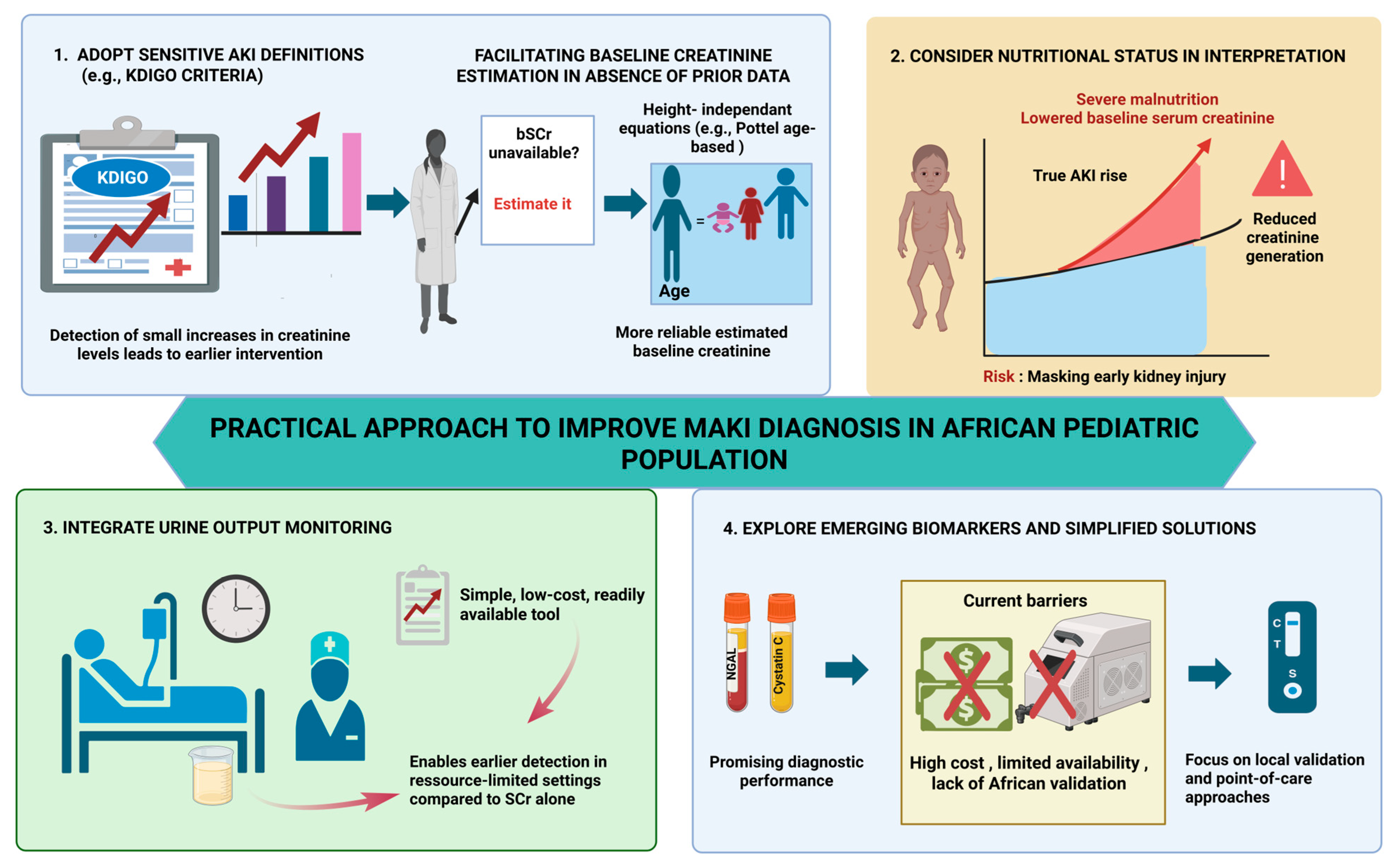
Improving the diagnosis of MAKI in children in SSA requires pragmatic and context-adapted approaches. Based on the challenges discussed above, several practical strategies can be implemented using currently available tools (Figure 2).
First, given the limitations of the WHO criteria, the use of more sensitive definitions such as the KDIGO criteria should be encouraged whenever feasible. However, their application requires the estimation of bSCr, which remains a major challenge in settings where previous measurements are unavailable. In this context, height-independent equations, such as the Pottel age-based (e.g., FAS-age) equation, appear to be more suitable for African children and may facilitate more reliable bSCr estimation [28,41].
Second, nutritional status should be systematically considered when interpreting SCr values. In many children with severe malaria, coexisting malnutrition may lead to reduced creatinine generation and consequently lower baseline values, potentially masking early kidney injury [28,47,48].
Third, UO monitoring represents a simple, low-cost, and readily available tool that should be more consistently integrated into routine clinical practice. In hospitalized children with severe malaria, systematic monitoring of UO should be routinely implemented, as it provides a key bedside indicator of kidney function. Its use is particularly valuable in settings where access to laboratory testing is limited, and it may allow earlier detection of kidney dysfunction compared with SCr alone [55,57].
In addition, clinicians should ensure early recognition and appropriate management of conditions that predispose to AKI in children with severe malaria, such as dehydration and hemoglobinuria. Failure to adequately address these factors may significantly increase the risk of kidney injury and worsen clinical outcomes.
Furthermore, point-of-care creatinine testing (POCT) represents a simple, rapid, low-cost, and user-friendly tool that can facilitate the detection of both acute and chronic kidney diseases at the bedside. Although this approach is not without limitations and may be affected by some degree of imprecision, it could constitute a valuable alternative to laboratory-based testing, particularly in resource-limited settings where laboratory diagnostics are often unavailable or financially inaccessible to patients. The cost per test ranges approximately from 4 to 20 USD [9]. Importantly, most creatinine POCT devices are calibrated to enzymatic methods, which are less susceptible to analytical interferences compared to the Jaffe method commonly used in many laboratories across low-resource settings. Despite the need for further validation in specific populations, POCT provides actionable, real-time information that can support the early identification of kidney injury and enable timely clinical interventions [91].
Finally, although emerging biomarkers such as NGAL and cystatin C show promising diagnostic and prognostic performance, their routine use remains limited by cost, availability, and lack of validation in African pediatric populations. Efforts should therefore focus on validating these tools in local contexts and exploring simplified point-of-care approaches [9,62].
Taken together, these strategies highlight the importance of combining standardized definitions with context-specific adaptations to improve the early recognition of MAKI and guide timely clinical management.

6. Conclusions and Perspectives

MAKI is increasingly recognized as a frequent and severe complication of pediatric severe malaria in SSA, yet it remains underdiagnosed. This under-recognition is largely driven by limitations in current diagnostic approaches, including the use of fixed SCr thresholds and the difficulty of estimating bSCr where prior measurements are unavailable. These challenges are further compounded by context-specific factors such as malnutrition, which may mask early kidney injury.
The use of standardized definitions such as the KDIGO criteria, combined with pragmatic approaches for bSCr estimation, may improve the detection and staging of AKI in this population. Greater attention should also be given to simple and accessible tools, particularly UO monitoring and POCT, which may facilitate earlier recognition of kidney injury in resource-limited settings. Although emerging biomarkers offer promising opportunities for earlier diagnosis and risk stratification, their clinical utility in African pediatric populations remains to be established.
Future research should focus on validating appropriate methods for bSCr estimation, defining population-specific reference values, and evaluating novel biomarkers and point-of-care diagnostic tools in African children. Beyond diagnostic innovation, addressing MAKI in SSA requires a broader health system approach integrating malaria prevention strategies, strengthening healthcare workforce capacity and access to kidney care, and supporting the implementation of context-adapted diagnostic tools through locally driven research and sustainable investments. Improving the early diagnosis of MAKI remains essential to guide timely management and ultimately improve outcomes in children with severe malaria.

Author Contributions

Conceptualization: F.M.T., A.B.N. and P.M.E.; literature search: F.M.T. and A.B.N.; original draft writing: F.M.T.; figure preparation: F.M.T.; supervision and critical review: A.B.N. and P.M.E.; review and editing: all authors. All authors have read and agreed to the published version of the manuscript.

Funding

This research received no external funding.

Institutional Review Board Statement

Not applicable.

Informed Consent Statement

Not applicable.

Data Availability Statement

No new data were created or analyzed in this study.

Acknowledgments

Figure 1 and Figure 2 were created using Biorender.com.

Conflicts of Interest

The authors declare no conflicts of interest.

Abbreviations

The following abbreviations are used in this manuscript:
ACE-IAngiotensin-Converting Enzyme Inhibitors
ADQIAcute Dialysis Quality Initiative
AKIAcute Kidney Injury
AKINAcute Kidney Injury Network
AUCArea Under the Curve
AUROCArea Under the Receiver Operating Characteristic Curve
bSCrBaseline Serum Creatinine
BUNBlood Urea Nitrogen
CHI3L1Chitinase-3-like protein 1
CIConfidence Interval
CKDChronic Kidney Disease
DCTDistal Convoluted Tubule
DRCDemocratic Republic of Congo
eGFREstimated Glomerular Filtration Rate
FASFull-Age Spectrum
GFRGlomerular Filtration Rate
I-FABPIntestinal Fatty Acid Binding Protein
IGFBP7Insulin-like Growth Factor Binding Protein 7
IL-18Interleukin 18
KDIGOKidney Disease Improving Global Outcomes
KIM-1Kidney Injury Molecule-1
KRTKidney Replacement Therapy
L-FABPLiver Fatty Acid-Binding Protein
LMICsLow-and Middle-Income Countries
MAKIMalaria-Associated Acute Kidney Injury
NGALNeutrophil Gelatinase-Associated Lipocalin
NPVNegative Predictive Value
POCTPoint-of-care creatinine testing
PPVPositive Predictive Value
PRRPrevalence Risk Ratio
RIFLERisk, Injury, Failure, Loss, End-stage renal disease
SCrSerum Creatinine
sNGALSerum Neutrophil Gelatinase-Associated Lipocalin
SMDStandardized Mean Difference
SROCSummary Receiver Operating Characteristic
SSASub-Saharan African
sTREM-1Soluble Triggering Receptor Expressed on Myeloid Cells-1
TALThick Ascending Limb
TFF3Trefoil Factor 3
TIMP-2Tissue Inhibitor of Metalloproteinases-2
UMODUromodulin
uNGALUrinary Neutrophil Gelatinase-Associated Lipocalin
UNICEFUnited Nations International Children’s Emergency Fund
UOUrine Output
WHOWorld Health Organization

References

  1. World Malaria Report 2025. Available online: https://www.who.int/publications/i/item/9789240117822 (accessed on 21 December 2025).
  2. Li, Q.; Liu, T.; Lv, K.; Liao, F.; Wang, J.; Tu, Y.; Chen, Q. Malaria: Past, present, and future. Signal Transduct. Target. Ther. 2025, 10, 188. [Google Scholar] [CrossRef] [PubMed]
  3. Sarfo, J.O.; Amoadu, M.; Kordorwu, P.Y.; Adams, A.K.; Gyan, T.B.; Osman, A.-G.; Asiedu, I.; Ansah, E.W. Malaria amongst children under five in Sub-Saharan Africa: A Scoping review of prevalence, risk factors and preventive interventions. Eur. J. Med. Res. 2023, 28, 80. [Google Scholar] [CrossRef] [PubMed]
  4. Afolayan, F.M.; Adedoyin, O.T.; Abdulkadir, M.B.; Ibrahim, O.R.; Biliaminu, S.A.; Mokuolu, O.A.; Ojuawo, A. Incidence and predictors of acute kidney injury in children with severe malaria. Paediatr. Indones. 2022, 62, 44–50. [Google Scholar] [CrossRef]
  5. Ajetomobi, A.; Mark, F.; Lawal, R.; Olanrewaju, P.O.; Owa, J.A.; Toye, I.I.; Oyeleke, F.; Oladipe, T.T.; Adedigba, E.O.; Adedoyin, O.T.; et al. Kidney function in children with severe malaria seen at the University of Ilorin Teaching Hospital, Ilorin. Open Access Libr. J. 2025, 12, 1–21. [Google Scholar] [CrossRef]
  6. Umuhire, L.; Dushimiyimana, V.; Nkuranyabahizi, M.; Ngendahayo, F.; Shyaka, J.C.; Ngerageze, I.; Rajeswaran, L.; Chironda, G. Factors associated with acute kidney injury and outcomes in patients with malaria in a district Hospital in Rwanda. Afr. Health Sci. 2024, 24, 81–89. [Google Scholar] [CrossRef]
  7. Garrido-Cardenas, J.A.; González-Cerón, L.; García-Maroto, F.; Cebrián-Carmona, J.; Manzano-Agugliaro, F.; Mesa-Valle, C.M. Analysis of fifty years of severe malaria worldwide research. Pathogens 2023, 12, 373. [Google Scholar] [CrossRef]
  8. Katsoulis, O.; Georgiadou, A.; Cunnington, A.J. Immunopathology of acute kidney injury in severe malaria. Front. Immunol. 2021, 12, 651739. [Google Scholar] [CrossRef] [PubMed]
  9. Batte, A.; Berrens, Z.; Murphy, K.; Mufumba, I.; Sarangam, M.L.; Hawkes, M.T.; Conroy, A.L. Malaria-associated acute kidney injury in African children: Prevalence, pathophysiology, impact, and management challenges. Int. J. Nephrol. Renov. Dis. 2021, 14, 235–253. [Google Scholar] [CrossRef]
  10. Batte, A.; Luyckx, V.A.; Taylor, T.E.; Conroy, A.L. Current severe malaria guidelines fall short in diagnosing acute kidney injury. Lancet Glob. Health 2024, 12, 194–196. [Google Scholar] [CrossRef]
  11. Batte, A.; Namazzi, R.; Conroy, A.L. Acute kidney injury in severe malaria: A new dawn. Semin. Nephrol. 2025, 45, 151613. [Google Scholar] [CrossRef] [PubMed]
  12. Okafor, U.; Mbanefo, N.; Nnakenyi, I.; Ayuk, A.; Nnajekwu, U.; Ossai, E.; Chinawa, J. Prevalence of acute kidney injury (AKI) in children with severe malaria using a novel biomarker: Serum neutrophil gelatinase-associated lipocalin (NGAL) in Enugu. West Afr. J. Med. 2024, 41, 853–859. [Google Scholar]
  13. Olwit, G.; Gutanamuka, T.B.; Chris-Uchendu, H.C.; Mugisha, A.I. Malaria-associated acute kidney injury: A key driver of mortality in endemic regions. Int. J. Nephrol. Renov. Dis. 2026, 19, 600266. [Google Scholar] [CrossRef]
  14. Bond, C.; Batte, A.; Afolayan, F.; Anstey, N.; Bassat, Q.; Bejon, P.; Berkley, J.A.; Evans, R.D.R.; Goldstein, S.L.; Hawkes, M.T.; et al. Identification of acute kidney injury in african children with severe malaria: A multinational individual participant data meta-analysis. Research Square 2025. preprint. [Google Scholar] [CrossRef]
  15. Conroy, A.L.; Hawkes, M.; Elphinstone, R.E.; Morgan, C.; Hermann, L.; Barker, K.R.; Namasopo, S.; Opoka, R.O.; John, C.C.; Liles, W.C.; et al. Acute kidney injury is common in pediatric severe malaria and is associated with increased mortality. Open Forum Infect. Dis. 2016, 3, ofw046. [Google Scholar] [CrossRef]
  16. Guidelines for the Treatment of Malaria, 3rd ed.; World Health Organization: Geneva, Switzerland, 2015. Available online: https://www.afro.who.int/publications/guidelines-treatment-malaria-third-edition (accessed on 21 December 2025).
  17. World Health Organization. Severe malaria. Trop. Med. Int. Health 2014, 19, 7–131. [Google Scholar] [CrossRef]
  18. Watson, J.A.; Conroy, A.L.; Batte, A.; Namazzi, R.; Hawkes, M.T.; Kain, K.C.; Plewes, K.; Leopold, S.; Kingston, H.; Hien, T.T.; et al. Acute kidney injury and death in severe falciparum malaria. medRxiv 2025. preprint. [Google Scholar] [CrossRef]
  19. Bellomo, R.; Ronco, C.; Kellum, J.; Mehta, R.; Palevsky, P.; The ADQI Work Group. Acute renal failure—Definition, outcome measures, animal models, fluid therapy and information technology needs: The Second International Consensus Conference of the Acute Dialysis Quality Initiative (ADQI) Group. Crit. Care 2004, 8, R204. [Google Scholar] [CrossRef] [PubMed]
  20. Akcan-Arikan, A.; Zappitelli, M.; Loftis, L.L.; Washburn, K.K.; Jefferson, L.S.; Goldstein, S.L. Modified RIFLE criteria in critically ill children with acute kidney injury. Kidney Int. 2007, 71, 1028–1035. [Google Scholar] [CrossRef] [PubMed]
  21. Birkelo, B.C.; Pannu, N.; Siew, E.D. Overview of diagnostic criteria and epidemiology of acute kidney injury and acute kidney disease in the critically ill patient. Clin. J. Am. Soc. Nephrol. 2022, 17, 717–735. [Google Scholar] [CrossRef]
  22. Kellum, J.A.; Lameire, N.; Aspelin, P.; Barsoum, R.S.; Burdmann, E.A.; Goldstein, S.L.; Herzog, C.A.; Joannidis, M.; Kribben, A.; Levey, A.S.; et al. Kidney Disease: Improving Global Outcomes (KDIGO) Acute Kidney Injury Work Group. KDIGO Clinical practice guideline for acute kidney injury. Kidney Int. 2012, 2, 1–138. [Google Scholar] [CrossRef]
  23. Mbengue, M. Prevalence, Associated factors, and prognosis of acute kidney injury in severe malaria among Sub-Saharan Africans. G. Ital. Nefrol. 2025, 42. [Google Scholar] [CrossRef]
  24. Afolayan, F.M.; Adedoyin, O.T.; Abdulkadir, M.B.; Ibrahim, O.R.; Biliaminu, S.A.; Mokuolu, O.A.; Ojuawo, A. Acute kidney injuries in children with severe malaria. Sultan Qaboos Univ. Med. J. 2020, 20, 312–317. [Google Scholar] [CrossRef]
  25. Olcott, F.; Bertran-Cobo, C.; Sahu, P.K.; Maharana, S.; Bage, J.; Mohanty, A.K.; Hoffmann, A.; Mohanty, S.; Wassmer, S.C. Plasma neutrophil gelatinase-associated lipocalin as a biomarker of kidney injury and potential predictor of hypoxic brain injury in severe Plasmodium falciparum malaria: Insights from India. Semin. Nephrol. 2025, 45, 151619. [Google Scholar] [CrossRef] [PubMed]
  26. Bjornstad, E.C.; Acharjee, M.K.; Rahman, A.K.M.F.; Zappitelli, M.; Basu, R.K.; Schwartz, G.J.; Goldstein, S.L.; Braun, C.; Askenazi, D. Acute kidney injury diagnostic accuracy and implications of different baseline creatinine equations. Kidney Int. Rep. 2025, 10, 3444–3455. [Google Scholar] [CrossRef]
  27. Lee, Y.J.; Park, Y.S.; Park, S.J.; Jhang, W.K. Estimating baseline creatinine values to define acute kidney injury in critically ill pediatric patients. Kidney Res. Clin. Pract. 2022, 41, 322–331. [Google Scholar] [CrossRef]
  28. Batte, A.; Starr, M.C.; Schwaderer, A.L.; Opoka, R.O.; Namazzi, R.; Phelps Nishiguchi, E.S.; Ssenkusu, J.M.; John, C.C.; Conroy, A.L. Methods to estimate baseline creatinine and define acute kidney injury in lean Ugandan children with severe malaria: A prospective cohort study. BMC Nephrol. 2020, 21, 417. [Google Scholar] [CrossRef]
  29. Braun, C.; Rahman, A.K.M.F.; Macomb, E.; Askenazi, D.; Bjornstad, E.C. Derivation and evaluation of baseline creatinine equations for hospitalized children and adolescents: The AKI baseline creatinine equation. Pediatr. Nephrol. 2022, 37, 3223–3233. [Google Scholar] [CrossRef]
  30. Bouchard, J. Estimating baseline serum creatinine for assessing acute kidney injury: Not a one size fits all approach. Kidney Int. Rep. 2021, 6, 562–564. [Google Scholar] [CrossRef] [PubMed]
  31. Ibrahim, O.R.; Afolayan, F.M.; Alao, M.A.; Mohammed, B.; Suleiman, B.M.; Adedoyin, O.T. Impact of methods of estimating baseline serum creatinine (bSCr) on the incidence and outcomes of acute kidney injury in childhood severe malaria. Egypt. Pediatr. Assoc. Gaz. 2023, 71, 36. [Google Scholar] [CrossRef]
  32. Hessey, E.; Ali, R.; Dorais, M.; Morissette, G.; Pizzi, M.; Rink, N.; Jouvet, P.; Lacroix, J.; Phan, V.; Zappitelli, M. Evaluation of height-dependent and height-independent methods of estimating baseline serum creatinine in critically ill children. Pediatr. Nephrol. 2017, 32, 1953–1962. [Google Scholar] [CrossRef]
  33. Kuai, Y.; Li, M.; Chen, J.; Jiang, Z.; Bai, Z.; Huang, H.; Wei, L.; Liu, N.; Li, X.; Lu, G.; et al. Comparison of diagnostic criteria for acute kidney injury in critically ill children: A multicenter cohort study. Crit. Care 2022, 26, 207. [Google Scholar] [CrossRef] [PubMed]
  34. Marpaung, F.R.; Notobroto, H.B.; Prasetyo, R.V.; Santoso, D.; Cavalier, E.; Aryati, A. Determining reference intervals and median blood creatinine levels in children from three different regional populations. J. Clin. Med. 2025, 14, 5373. [Google Scholar] [CrossRef]
  35. Ghosh, E.; Eshelman, L.; Lanius, S.; Schwager, E.; Pasupathy, K.S.; Barreto, E.F.; Kashani, K. Estimation of baseline serum creatinine with machine learning. Am. J. Nephrol. 2021, 52, 753–762. [Google Scholar] [CrossRef] [PubMed]
  36. Conroy, A.L.; Hawkes, M.T.; Leligdowicz, A.; Mufumba, I.; Starr, M.C.; Zhong, K.; Namasopo, S.; John, C.C.; Opoka, R.O.; Kain, K.C. Blackwater fever and acute kidney injury in children hospitalized with an acute febrile illness: Pathophysiology and prognostic significance. BMC Med. 2022, 20, 221. [Google Scholar] [CrossRef]
  37. Adan, D., Jr.; Batte, A.; Namazzi, R.; Mufumba, I.; Kazinga, C.; Mellencamp, K.A.; Bond, C.; Opoka, R.O.; John, C.C.; Conroy, A.L. Renin as a biomarker of acute kidney injury and mortality in children with severe malaria or sickle cell disease. Cureus 2023, 15, e45124. [Google Scholar] [CrossRef]
  38. Khader, N.A.; Kamath, V.G.; Kamath, S.U.; Rao, I.R.; Prabhu, A.R. Kidney function estimation equations: A narrative review. Ir. J. Med. Sci. 2025, 194, 725–743. [Google Scholar] [CrossRef]
  39. Pottel, H. Measuring and estimating glomerular filtration rate in children. Pediatr. Nephrol. 2017, 32, 249–263. [Google Scholar] [CrossRef]
  40. Pottel, H.; Hoste, L.; Martens, F. A simple height-independent equation for estimating glomerular filtration rate in children. Pediatr. Nephrol. 2012, 27, 973–979. [Google Scholar] [CrossRef]
  41. Nkoy, A.B.; Matoka, T.T.; Bukabau, J.B.; Sumaili, E.K.; Labarque, V.; van den Heuvel, L.P.; Levtchenko, E.; Cavalier, E.; Delanaye, P.; Ekulu, P.M.; et al. Estimated glomerular filtration rate: Applicability of creatinine-based equations in African children. Pediatr. Nephrol. 2024, 39, 3013–3022. [Google Scholar] [CrossRef] [PubMed]
  42. Namazzi, R.; Batte, A.; Opoka, R.O.; Bangirana, P.; Schwaderer, A.L.; Berrens, Z.; Datta, D.; Goings, M.; Ssenkusu, J.M.; Goldstein, S.L.; et al. Acute kidney injury, persistent kidney disease, and post-discharge morbidity and mortality in severe malaria in children: A prospective cohort study. eClinicalMedicine 2022, 44, 101292. [Google Scholar] [CrossRef]
  43. Oshomah-Bello, E.O.; Esezobor, C.I.; Solarin, A.U.; Njokanma, F.O. Acute kidney injury in children with severe malaria is common and associated with adverse hospital outcomes. J. Trop. Pediatr. 2020, 66, 218–225. [Google Scholar] [CrossRef]
  44. Conroy, A.L.; Opoka, R.O.; Bangirana, P.; Idro, R.; Ssenkusu, J.M.; Datta, D.; Hodges, J.S.; Morgan, C.; John, C.C. Acute Kidney injury is associated with impaired cognition and chronic kidney disease in a prospective cohort of children with severe malaria. BMC Med. 2019, 17, 98. [Google Scholar] [CrossRef]
  45. Hashim, H.A.; Ali, E.M.A. Pattern of malaria in hospitalized children in Khartoum State. Sudan. J. Paediatr. 2017, 17, 35–41. [Google Scholar] [CrossRef]
  46. Jallow, M.; Casals-Pascual, C.; Ackerman, H.; Walther, B.; Walther, M.; Pinder, M.; Sisay-Joof, F.; Usen, S.; Jallow, M.; Abubakar, I.; et al. Clinical features of severe malaria associated with death: A 13-year observational study in the Gambia. PLoS ONE 2012, 7, 45645. [Google Scholar] [CrossRef] [PubMed]
  47. Das, D.; Grais, R.F.; Okiro, E.A.; Stepniewska, K.; Mansoor, R.; van der Kam, S.; Terlouw, D.J.; Tarning, J.; Barnes, K.I.; Guerin, P.J. Complex interactions between malaria and malnutrition: A systematic literature review. BMC Med. 2018, 16, 186. [Google Scholar] [CrossRef]
  48. Caulfield, L.E.; De Onis, M.; Blössner, M.; Black, R.E. Undernutrition as an Underlying cause of child deaths associated with diarrhea, pneumonia, malaria, and measles. Am. J. Clin. Nutr. 2004, 80, 193–198. [Google Scholar] [CrossRef] [PubMed]
  49. Creatine and Creatinine Metabolism. Available online: https://journals.physiology.org/doi/epdf/10.1152/physrev.2000.80.3.1107 (accessed on 11 March 2026).
  50. Jančič, S.G.; Močnik, M.; Marčun Varda, N. Glomerular filtration rate assessment in children. Children 2022, 9, 1995. [Google Scholar] [CrossRef] [PubMed]
  51. De Rosa, S.; Greco, M.; Rauseo, M.; Annetta, M.G. The good, the bad, and the serum creatinine: Exploring the effect of muscle mass and nutrition. Blood Purif. 2023, 52, 775–785. [Google Scholar] [CrossRef]
  52. UNICEF-WHO-The World Bank: Joint Child Malnutrition Estimates (JME). 2025. Available online: https://data.unicef.org/resources/jme (accessed on 10 March 2026).
  53. Hari, P.; Bagga, A.; Mahajan, P.; Lakshmy, R. Effect of malnutrition on serum creatinine and cystatin c levels. Pediatr. Nephrol. 2007, 22, 1757–1761. [Google Scholar] [CrossRef]
  54. Batte, A.; Namugumya, A.; Hasson, D.C.; Desmarais, A.; Goings, M.J.; Mpimbaza, A.; Babikako, H.M.; Bassat, Q.; Conroy, A.L. Acute kidney injury and mortality in children hospitalized with malnutrition. Kidney Int. Rep. 2026; in press. [CrossRef]
  55. Makris, K.; Spanou, L. Acute kidney injury: Diagnostic approaches and controversies. Clin. Biochem. Rev. 2016, 37, 153–175. [Google Scholar] [PubMed]
  56. Wu, Q.; Qiu, X.; Chen, H. Advancements in early biomarkers of acute kidney injury: From traditional indicators to a paradigm shift in lactate metabolism. Ann. Med. 2026, 58, 2612383. [Google Scholar] [CrossRef]
  57. Malbrain, M.; Tantakoun, K.; Zara, A.; Ferko, N.; Kelly, T.; Dabrowski, W. Urine output is an early and strong predictor of acute kidney injury and associated mortality: A systematic literature review of 50 clinical studies. Ann. Intensive Care 2024, 14, 110. [Google Scholar] [CrossRef]
  58. Kaddourah, A.; Basu, R.K.; Bagshaw, S.M.; Goldstein, S.L. Epidemiology of acute kidney injury in critically ill children and young adults. N. Engl. J. Med. 2017, 376, 11–20. [Google Scholar] [CrossRef]
  59. Md Ralib, A.; Pickering, J.W.; Shaw, G.M.; Endre, Z.H. The urine output definition of acute kidney injury is too liberal. Crit. Care 2013, 17, 112. [Google Scholar] [CrossRef] [PubMed]
  60. Goldstein, S.L.; Akcan-Arikan, A.; Afonso, N.; Askenazi, D.J.; Basalely, A.M.; Basu, R.K.; Beng, H.; Fitzgerald, J.C.; Gist, K.; Kizilbash, S.; et al. Derivation and validation of an optimal neutrophil gelatinase-associated lipocalin cutoff to predict stage 2/3 acute kidney injury (AKI) in critically ill children. Kidney Int. Rep. 2024, 9, 2443–2452. [Google Scholar] [CrossRef] [PubMed]
  61. Mishra, O.P. Predictive Ability of Renal angina index alone or in combination with biomarkers for detection of acute kidney injury in children. Pediatr. Nephrol. 2022, 37, 1171–1174. [Google Scholar] [CrossRef]
  62. Bjornstad, E.C.; Muronya, W.; Kamija, M.; Smith, Z.; Munthali, C.K.; Gibson, K.; Mottl, A.K.; Charles, A.; Marshall, S.W.; Golightly, Y.M.; et al. Validity of urine NGALds dipstick for acute kidney injury in a Malawian Trauma Cohort. Kidney Int. Rep. 2020, 5, 1791–1798. [Google Scholar] [CrossRef]
  63. van Wolfswinkel, M.E.; Koopmans, L.C.; Hesselink, D.A.; Hoorn, E.J.; Koelewijn, R.; van Hellemond, J.J.; van Genderen, P.J.J. Neutrophil gelatinase-associated lipocalin (NGAL) predicts the occurrence of malaria-induced acute kidney injury. Malar. J. 2016, 15, 464. [Google Scholar] [CrossRef]
  64. Bargielska, A.; Wasilewska, A.; Rybi-Szumińska, A. Novel acute kidney injury biomarkers and their utility in children and adolescents-Overview. Ital. J. Pediatr. 2025, 51, 158. [Google Scholar] [CrossRef]
  65. Conroy, A.L.; Hawkes, M.T.; Elphinstone, R.; Opoka, R.O.; Namasopo, S.; Miller, C.; John, C.C.; Kain, K.C. Chitinase-3-like 1 is a biomarker of acute kidney injury and mortality in paediatric severe malaria. Malar. J. 2018, 17, 82. [Google Scholar] [CrossRef] [PubMed]
  66. Nakhjavan-Shahraki, B.; Yousefifard, M.; Ataei, N.; Baikpour, M.; Ataei, F.; Bazargani, B.; Abbasi, A.; Ghelichkhani, P.; Javidilarijani, F.; Hosseini, M. Accuracy of cystatin C in prediction of acute kidney injury in children; serum or urine levels: Which one works better? A systematic review and meta-analysis. BMC Nephrol. 2017, 18, 120. [Google Scholar] [CrossRef]
  67. Rivetti, G.; Gizzone, P.; Petrone, D.; Di Sessa, A.; Miraglia del Giudice, E.; Guarino, S.; Marzuillo, P. Acute kidney injury in children: A focus for the general pediatrician. Children 2024, 11, 1004. [Google Scholar] [CrossRef] [PubMed]
  68. Canney, M.; Clark, E.G.; Hiremath, S. Biomarkers in acute kidney injury: On the cusp of a new era? J. Clin. Investig. 2023, 133, e171431. [Google Scholar] [CrossRef]
  69. Phiri, D.T.; Ngwira, S.; Wynkoop, H.; Seydel, K.; O’Brien, N.F. Chasing the mystery of the etiology of acute kidney injury in pediatric severe malaria. Semin. Nephrol. 2025, 45, 151618. [Google Scholar] [CrossRef]
  70. Xu, C.; Lin, S.; Mao, L.; Li, Z. Neutrophil gelatinase-associated lipocalin as predictor of acute kidney injury requiring renal replacement therapy: A systematic review and meta-analysis. Front. Med. 2022, 9, 859318. [Google Scholar] [CrossRef]
  71. Merrikhi, A.; Gheissari, A.; Mousazadeh, H. Urine and serum neutrophil gelatinase-associated lipocalin cut-off point for the prediction of acute kidney injury. Adv. Biomed. Res. 2014, 3, 66. [Google Scholar] [CrossRef]
  72. Park, H.-D.; Seo, J.-Y.; Lee, S.-Y. The relationship between serum neutrophil gelatinase-associated lipocalin and renal function in patients with vancomycin treatment. Ann. Clin. Lab. Sci. 2012, 42, 7–13. [Google Scholar]
  73. Prozialeck, W.C.; Edwards, J.R.; Lamar, P.C.; Liu, J.; Vaidya, V.S.; Bonventre, J.V. Expression of kidney injury molecule-1 (Kim-1) in relation to necrosis and apoptosis during the early stages of Cd-induced proximal tubule injury. Toxicol. Appl. Pharmacol. 2009, 238, 306–314. [Google Scholar] [CrossRef] [PubMed]
  74. Fazel, M.; Sarveazad, A.; Mohamed Ali, K.; Yousefifard, M.; Hosseini, M. Accuracy of urine kidney injury molecule-1 in predicting acute kidney injury in children; a systematic review and meta-analysis. Arch. Acad. Emerg. Med. 2020, 8, e44. [Google Scholar]
  75. Shao, X.; Tian, L.; Xu, W.; Zhang, Z.; Wang, C.; Qi, C.; Ni, Z.; Mou, S. Diagnostic value of urinary kidney injury molecule 1 for acute kidney injury: A meta-analysis. PLoS ONE 2014, 9, e84131. [Google Scholar] [CrossRef]
  76. Gupta, G.; Sharma, S.; Kapoor, K.; Rani, A.; Gera, R. Acute kidney injury in non-critically ill children and correlation with Cystatin C in the diagnosis of acute kidney injury: A Single Centre Prospective Cohort Study. J. Ped. Nephrol. 2022, 10, 180–189. [Google Scholar] [CrossRef]
  77. Skidmore, M.; Spencer, S.; Desborough, R.; Kent, D.; Bhandari, S. Cystatin C as a marker of kidney function in children. Biomolecules 2024, 14, 938. [Google Scholar] [CrossRef]
  78. Cigula Kurajica, V.; Vogrinc, Ž.; Turčić, A.; Galić, S. Determination of cystatin C reference interval for children in croatia. Biochem. Med. 2024, 34, 80–87. [Google Scholar] [CrossRef]
  79. Oluwatuyi, K.O.; Alonge, A.O.; Fasoranti, I.O.; Jegede, T.O.; Salau, Q.O.; Kareem, A.J.; Aiyeku, O.M.; Ekogiawe, F.T.; Akinmadelo, O.O.; Adetona, G.; et al. Serum cystatin C as an index of early detection of acute kidney injury in children with severe malaria. World J. Nephrol. Urol. 2024, 13, 19–25. [Google Scholar] [CrossRef]
  80. Spencer, S.; Desborough, R.; Bhandari, S. Should Cystatin C eGFR become routine clinical practice? Biomolecules 2023, 13, 1075. [Google Scholar] [CrossRef]
  81. Sarangam, M.L.; Namazzi, R.; Datta, D.; Bond, C.; Vanderpool, C.P.B.; Opoka, R.O.; John, C.C.; Conroy, A.L. Intestinal injury biomarkers predict mortality in pediatric severe malaria. mBio 2022, 13, 0132522. [Google Scholar] [CrossRef] [PubMed]
  82. Meena, J.; Thomas, C.C.; Kumar, J.; Mathew, G.; Bagga, A. Biomarkers for prediction of acute kidney injury in pediatric patients: A systematic review and meta-analysis of diagnostic test accuracy studies. Pediatr. Nephrol. 2023, 38, 3241–3251. [Google Scholar] [CrossRef]
  83. Bihorac, A.; Chawla, L.S.; Shaw, A.D.; Al-Khafaji, A.; Davison, D.L.; DeMuth, G.E.; Fitzgerald, R.; Gong, M.N.; Graham, D.D.; Gunnerson, K.; et al. Validation of cell-cycle arrest biomarkers for acute kidney injury using clinical adjudication. Am. J. Respir. Crit. Care Med. 2014, 189, 932–939. [Google Scholar] [CrossRef] [PubMed]
  84. You, R.; Zheng, H.; Xu, L.; Ma, T.; Chen, G.; Xia, P.; Fan, X.; Ji, P.; Wang, L.; Chen, L. Decreased urinary uromodulin is potentially associated with acute kidney injury: A systematic review and meta-analysis. J. Intensive Care 2021, 9, 70. [Google Scholar] [CrossRef] [PubMed]
  85. Bazargani, B.; Moghtaderi, M. New biomarkers in early diagnosis of acute kidney injury in children. Avicenna J. Med. Biotechnol. 2022, 14, 264–269. [Google Scholar] [CrossRef]
  86. Ostermann, M.; Zarbock, A.; Goldstein, S.; Kashani, K.; Macedo, E.; Murugan, R.; Bell, M.; Forni, L.; Guzzi, L.; Joannidis, M.; et al. Recommendations on acute kidney injury biomarkers from the Acute Disease Quality Initiative Consensus Conference: A consensus statement. JAMA Netw. Open 2020, 3, e2019209. [Google Scholar] [CrossRef]
  87. Namazzi, R.; Opoka, R.; Datta, D.; Bangirana, P.; Batte, A.; Berrens, Z.; Goings, M.J.; Schwaderer, A.L.; Conroy, A.L.; John, C.C. Acute kidney injury interacts with coma, acidosis, and impaired perfusion to significantly increase risk of death in children with severe malaria. Clin. Infect. Dis. 2022, 75, 1511–1519. [Google Scholar] [CrossRef]
  88. Hawkes, M.T.; Leligdowicz, A.; Batte, A.; Situma, G.; Zhong, K.; Namasopo, S.; Opoka, R.O.; Kain, K.C.; Conroy, A.L. Pathophysiology of acute kidney injury in malaria and non-malarial febrile illness: A prospective cohort study. Pathogens 2022, 11, 436. [Google Scholar] [CrossRef]
  89. Mufumba, I.; Kazinga, C.; Namazzi, R.; Opoka, R.O.; Batte, A.; Bond, C.; John, C.C.; Conroy, A.L. sTREM-1: A biomarker of mortality in severe malaria impacted by acute kidney injury. J. Infect. Dis. 2023, 229, 936–946. [Google Scholar] [CrossRef] [PubMed]
  90. Bond, C.; Bednarski, O.J.; Datta, D.; Namazzi, R.; Opoka, R.O.; Lima-Cooper, G.; Batte, A.; Udumula, K.; Balasubramani, D.; Vasquez, M.; et al. Elevated uric acid levels, mortality and cognitive impairment in children with severe malaria. Nat. Med. 2025, 31, 777–787. [Google Scholar] [CrossRef] [PubMed]
  91. Fabian, J.; Vetter, B.; Bramham, K.; Luyckx, V.A.; Omosule, C.L. Point-of-Care serum creatinine testing—Why, When, Where? Nephrol. Dial. Transplant. 2025, 40, 839–841. [Google Scholar] [CrossRef] [PubMed]
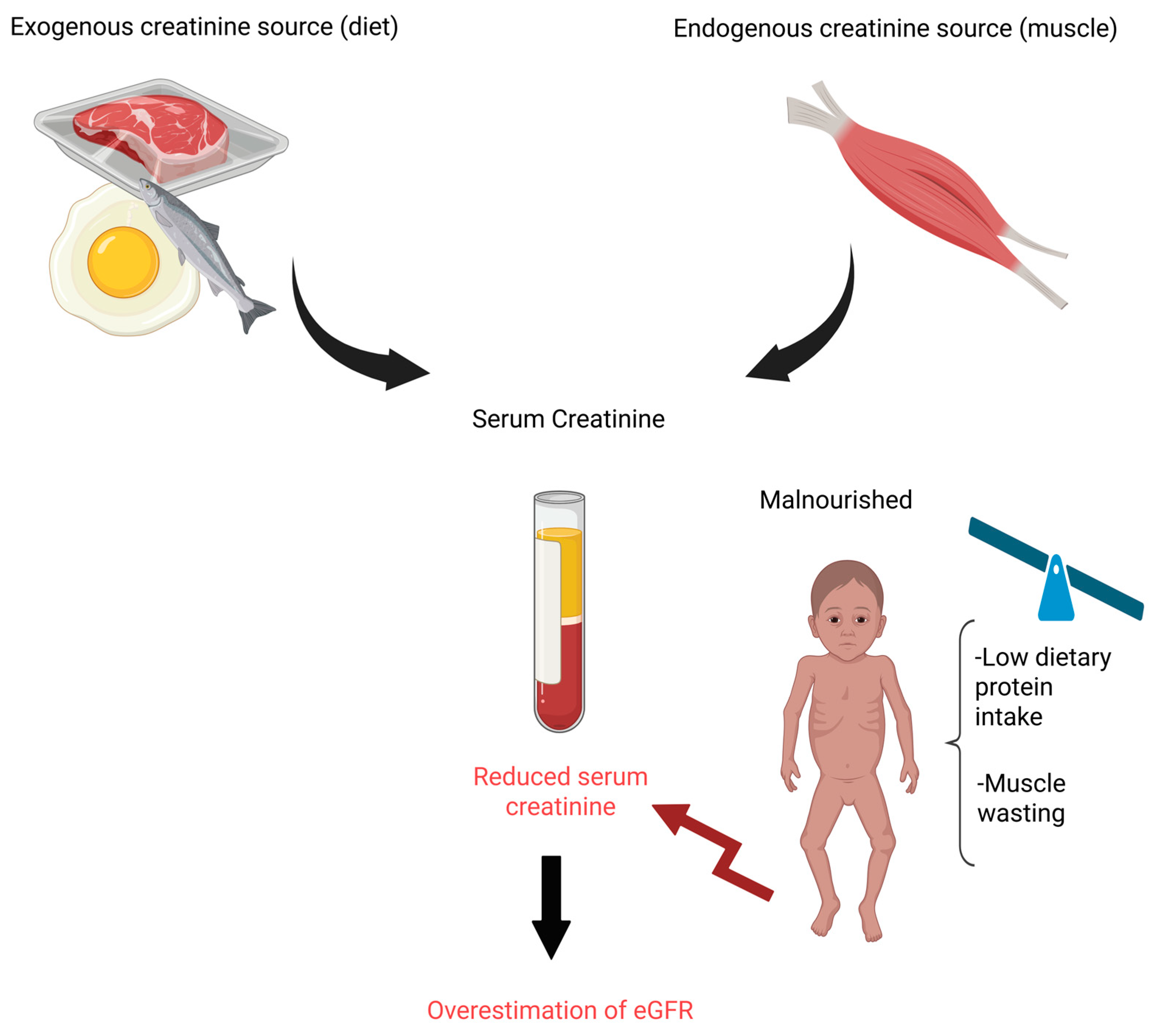
Figure 1. Impact of malnutrition on serum creatinine (SCr) levels. SCr originates from endogenous muscle metabolism and exogenous dietary intake. In malnourished children, low protein intake and reduced mass may lead to decreased creatinine production, resulting in lower SCr levels and overestimation of GFR.
Kidneydial 06 00033 g001
Figure 2. Practical approach to improve malaria-associated acute kidney injury (MAKI) diagnosis in the African pediatric population. This figure summarizes a pragmatic, stepwise approach enhancing the early detection and diagnosis of MAKI in the African pediatric population. (1) The use of sensitive AKI definitions, such as KDIGO criteria, allows the earlier identification of small increases in serum creatinine (SCr). In the absence of baseline SCr (bSCr), height-independent equations (e.g., Pottel equation) could be used. (2) Nutritional status should be considered when interpreting creatinine levels, as severe malnutrition may reduce creatinine production and mask early kidney injury. (3) Systematic urine output (UO) monitoring represents a simple, low-cost, and widely available tool that can improve early AKI detection compared to reliance on SCr alone. (4) Emerging biomarkers show promising diagnostic performance, but their use remains limited by cost, availability, and lack of validation in African settings. Therefore, emphasis should be placed on locally validated and point-of-care approaches.
Kidneydial 06 00033 g002
Disclaimer/Publisher’s Note: The statements, opinions and data contained in all publications are solely those of the individual author(s) and contributor(s) and not of MDPI and/or the editor(s). MDPI and/or the editor(s) disclaim responsibility for any injury to people or property resulting from any ideas, methods, instructions or products referred to in the content.