


Abstract
Background: Patients undergoing maintenance hemodialysis (HD) have a high risk of developing cardiovascular diseases due to calcification of the heart valves and coronary arteries, which results in a high mortality rate. In particular, aortic stenosis (AS) is an independent risk factor for heart failure-related mortality in patients undergoing HD. Recently, the analysis of digitized heart sounds using artificial intelligence (AI) has promoted the automation of cardiac disease detection and technological advances in diagnostic algorithms. Methods: We retrospectively investigated the 203 consecutive patients receiving HD who had undergone visualized phonocardiography using a regulatory-approved medical device (Japan) between January and May 2025 to detect AS. The usefulness of this phonocardiogram device, which utilizes acoustic analysis and an AI-based automatic diagnostic algorithm named the “Super Stethoscope”, was evaluated for the screening of AS in patients undergoing HD based on comparisons with findings obtained from echocardiography. Results: The results showed a significant correlation between the severity of systolic murmurs determined by the AI-based approach and the peak aortic jet velocity measured in 19 patients diagnosed with AS using transthoracic echocardiography (r = 0.578, p < 0.05). Additionally, for the AI-based diagnosis of AS based on systolic murmurs, the sensitivity and specificity in detecting moderate or severe AS were 0.90 and 0.70, respectively, among the patients undergoing HD. Conclusions: The AI-based diagnostic approach using the ECG-gated phonocardiogram “Super Stethoscope” could be a promising tool for AS screening. Transthoracic echocardiography is recommended in cases classified as grade B or higher by AI-based assessment.
1. Background
Heart failure and valvular heart disease affect millions of people worldwide. In Japan, more than 300,000 patients with end-stage renal disease undergo hemodialysis. Patients undergoing maintenance hemodialysis (HD) have a high risk of developing cardiovascular disease (CVD) due to calcification of the heart valves and coronary arteries [1,2], and cardiovascular mortality, including heart failure, myocardial infarction, and cerebrovascular disorders, accounts for approximately 30% of deaths in the Japanese population on HD [3]. In particular, aortic stenosis (AS) is common in patients undergoing MHD, progressing more rapidly than in non-dialysis patients, and is an independent risk factor for heart failure-related mortality in patients receiving HD [4,5,6,7].
Heart sounds are widely accepted to reflect characteristics of heart disease. Cardiac auscultation (CA) has been the primary option for screening patients with valvular heart disease and is a common examination method used in clinical practice; however, it presents several problems, including variability in auscultation skills, objectivity of the clinical method, and the presence of sounds inaudible to the human ear. The sensitivity and specificity of the diagnosis of valvular heart disease using physical examination with a stethoscope vary among studies [8,9]. However, cardiac ultrasound examination, which is very helpful for the diagnosis of valvular heart disease, requires advanced technical skills and knowledge as well as expensive equipment, and these issues contribute to delays in the diagnosis of valvular heart disease.
In recent years, studies analyzing digitized heart sounds using artificial intelligence (AI) have promoted the automation of heart disease detection and technological advancements in diagnostic algorithms [10,11]. In studies aimed at the early diagnosis of AS, the analysis of heart sounds using wavelet transform (WT) and short-time Fourier transform (STFT) successfully achieved a high-sensitivity diagnosis of AS [12,13], suggesting that the analysis of heart sounds using WT or STFT may enhance diagnostic sensitivity. Using this acoustic analysis approach, a regulatory-approved new medical device in Japan for visualizing heart sounds (phonocardiogram) named the “Super Stethoscope” and an AI-based automatic diagnostic algorithm have become clinically applicable [14,15,16]. Therefore, we determined the presence of AS using the estimation of “Super Stethoscope” and echocardiography among patients undergoing HD and analyzed their association to evaluate the usefulness of the super stethoscope and AI-based automatic diagnosis algorithm (AMI-SSS01 Series; AMI Inc., Kagoshima, Japan) [17].
2. Methods
2.1. Study Population
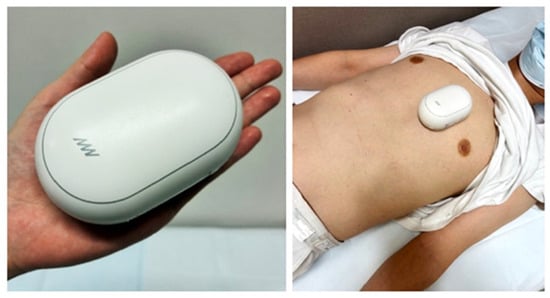
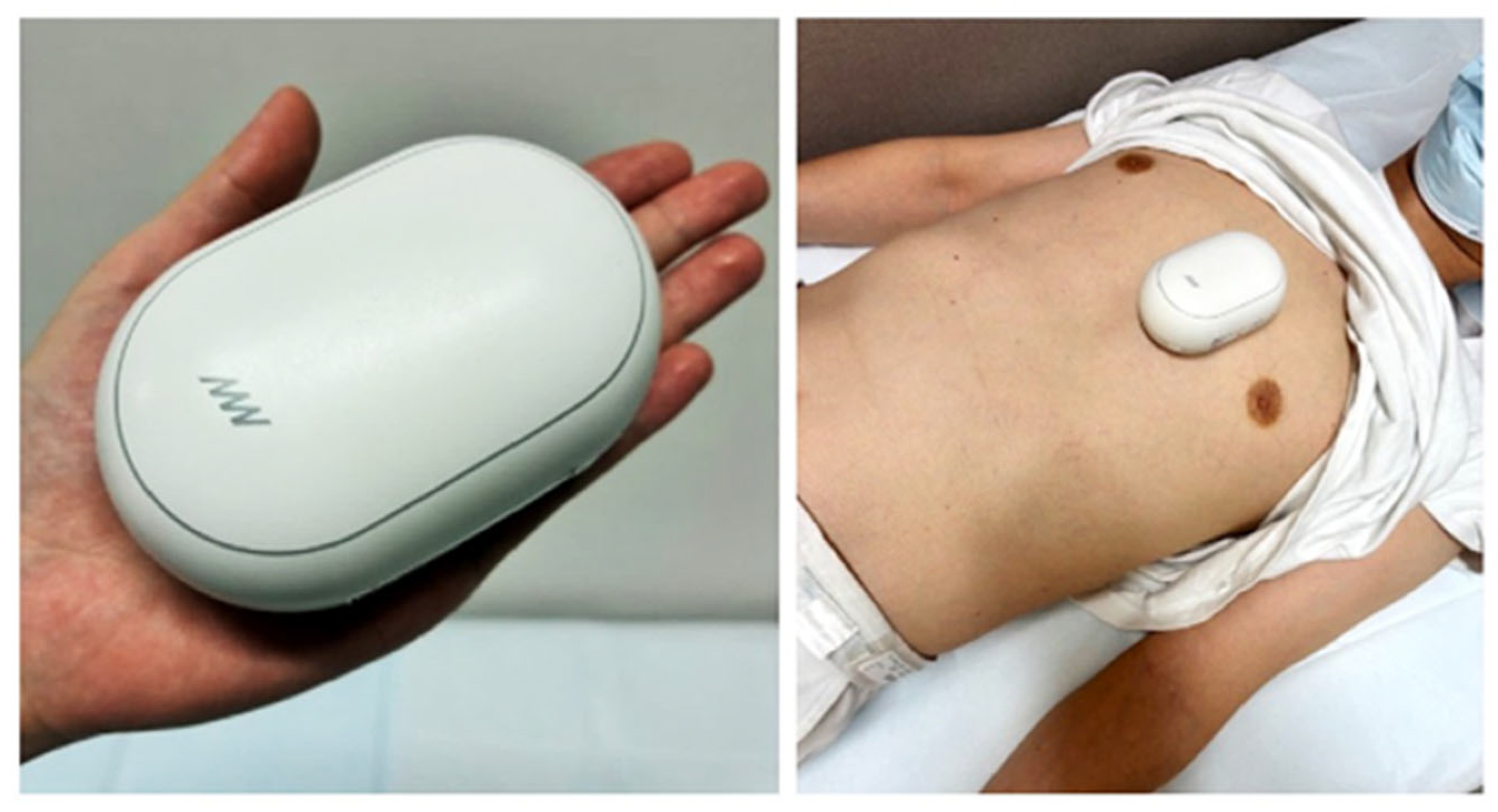
Since January 2025, visualized phonocardiograms have been obtained from patients undergoing HD to confirm the cardiac findings using a regulatory-approved medical device. Consecutive patients receiving HD who underwent Super Stethoscope visualization were enrolled in this study. Cardiac function was evaluated using ECG and echocardiography. We detected AS using the Super Stethoscope and echocardiography and analyzed the similarity among the findings. Among the 203 consecutive patients receiving HD who underwent visualized phonocardiography between January and May 2025, 194 were enrolled in the present analysis, and those who had undergone surgical aortic valve replacement or transcatheter aortic valve implantation were excluded. We examined the presence of AS using the Super Stethoscope and transthoracic echocardiography. Measurements were obtained by placing the Super Stethoscope at the fourth left sternal border (4 LSB) (Figure 1). A visualized phonocardiogram was usually conducted either before dialysis or on an off-dialysis day to minimize the hemodynamic effects of dialysis. Simultaneous acquisition of ECG data enabled a more precise assessment of heart failure and valvular function [17,18].
Figure 1.
A close-up view of the Super Stethoscope and a volunteer being tested with this device.
2.2. Methodology of the AI Algorithm
The entire raw waveform of 8 s heart sound recordings was utilized for the estimation of AS using phonocardiograms, and the results were ultimately classified into four categories of AS severity: A, B, C, or D [16]. This AI framework was developed using a convolutional neural network (CNN), with the input consisting of phonocardiographic signals and the supervisory labels derived from AS severity determined by transthoracic echocardiography. The model was trained on approximately 2000 paired datasets. During training, data augmentation techniques such as the superimposition of Gaussian noise were applied to enhance the model’s robustness to signal variations. The 1D-CNN was constructed with a ResNet backbone incorporating a self-attention pooling mechanism. Importantly, this AI framework is considered to learn not only the typical features of ejection systolic murmurs that we usually observe, but also additional information such as the width of the first heart sound and the presence of extra heart sounds, including the fourth sound. In this study, the AS estimation was performed in a stepwise manner. First, cases were classified as moderate AS or not; for those not classified as moderate, a second step classified them as mild AS or not. Finally, patients were categorized into four classes: A = none; B = mild; C = moderate; D = severe.
2.3. Comparison Between AI-Based Estimation and Echocardiography
The results of the AI-based estimation of AS were compared with the findings obtained using transthoracic echocardiography conducted within the past 18 months. According to the JCS/JSCS/JATS/JSVS 2020 Guidelines on the Management of Valvular Heart Disease, AS was defined as a peak aortic jet velocity of 2.6 m/s or higher (Mild—2.6–2.9; Moderate—3.0–3.9; Severe—4.0–4.9) as determined by transthoracic echocardiography [19]. Patients with a peak aortic jet velocity of 2.0–2.5 m/s were considered to have aortic valve calcification without stenosis, based on previous definitions in the literature.
2.4. Statistical Analysis
Data were analyzed using descriptive statistics. The results of the stratified analysis were compared between the two groups using Fisher’s exact test or the Mann–Whitney U test. Correlation analysis was performed using Spearman’s rank test with logistic regression analysis. All p-values were two-sided, and p-values of < 0.05 were considered statistically significant. All statistical analyses were performed using EZR (Saitama Medical Center, Jichi Medical University, Saitama, Japan), which is a graphical user interface for R (R Foundation for Statistical Computing, Vienna, Austria). Specifically, it is a modified version of the R commander, designed to add statistical functions frequently used in biostatistics [20]. This study was approved by the Ethics Committee of Shinseikai Dai-ichi Hospital (S2024-#001; 25 July 2024). We also thank Honyaku Center Inc. for English language editing.
3. Results
3.1. Patient Characteristics
The demographic features of the 194 patients undergoing HD enrolled in the present study from January to May 2025 are shown in Table 1. The AI diagnosis of systolic murmurs resulted in 129 patients being classified as normal (A), 29 as mild (B), 22 as moderate (C), and 14 as severe (D). Among the 19 patients diagnosed with AS using echocardiography, AI-based analysis of systolic murmurs yielded the following results: A 3, B 1, C 6, and D 9 (Table 2).
Table 1.
Characteristics of patients on maintenance hemodialysis enrolled in the present study.
Table 2.
Associations between the findings of echocardiography and AI-based analysis of systolic murmurs.
3.2. Correlation Between the Grade of AI Diagnosis and Echocardiography
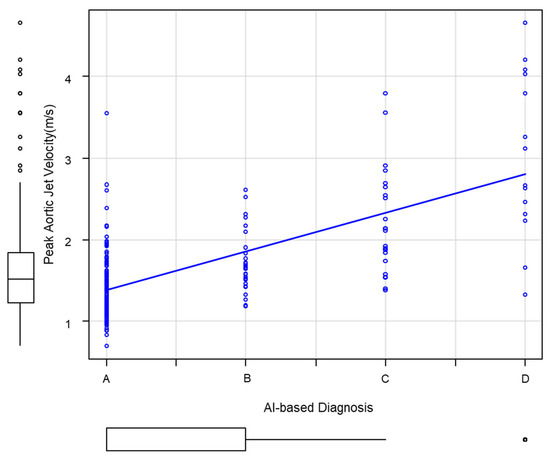
There was a significant correlation between the degree of systolic murmur determined by the AI-based method and the peak aortic jet velocity determined using echocardiography (r = 0.578, p < 0.05) (Figure 2). When grade B was applied to judgment criteria of the presence of AS diagnosed using echocardiography, the sensitivity and specificity of the AI-based diagnosis method were 0.84 and 0.72. In detecting moderate or severe AS, the sensitivity and specificity of the visualized phonocardiogram were 0.90 and 0.70, respectively (Table 3). Because the specificity of the Super Stethoscope in detecting moderate and severe AS was not high enough, auscultation was then performed by two physicians (one cardiologist and one nephrologist) using archived audio data to compare the specificity between AI diagnosis and human auscultation. Of the total 194 cases, 17 could not be evaluated due to environmental noise interference or lack of saved audio data. In contrast, AI diagnosis was able to make a determination even in cases where auscultation was impossible due to environmental factors. As a result, 177 cases could be evaluated where direct comparison between the Super Stethoscope and standard human auscultation was possible. The specificity of actual auscultation to detect moderate and severe AS was 0.37 for both a cardiologist and a nephrologist, which was much lower than the specificity of AI diagnosis (0.70).
Figure 2.
Association between the degree of systolic murmur determined by the AI-based method and the peak aortic jet velocity determined using echocardiography.
Table 3.
The sensitivity and specificity of the AI-based diagnosis method.
3.3. A Case Showing Discrepancy
During the application of these diagnostic criteria, a remarkable discrepancy was observed in one patient who was classified as grade A using the Super Stethoscope but was diagnosed with moderate AS using echocardiography. According to the AI-based analysis, the waveforms gradually increased and decreased, which showed that the systolic murmur was evident in the late systolic phase in both the phonocardiogram and wavelet analyses. The possible causes of a waveform that becomes more pronounced in the late systolic phase include severe mitral regurgitation (MR), mitral valve prolapse without click sounds, and MR with a late systolic accent due to papillary muscle dysfunction. In this case, a moderate degree of MR was observed on the echocardiogram.
4. Discussion
We propose that the Super Stethoscope could be a useful screening tool for grade B AS cases, because of its high sensitivity. Recent advances in heart sound and ECG analytical technologies may facilitate more accurate cardiac screening. We observed a significant correlation between the AI-based murmur grade and peak aortic jet velocity, but a Pearson coefficient of 0.578 indicated only a moderate, not a strong, relationship. This association might be improved if echocardiography were examined on the same day as the Super Stethoscope instead of within the past 18 months; however, echocardiography involves high screening costs and requires physicians or trained technicians, and it is sometimes difficult to promptly make a reservation for echocardiography in a dialysis unit. The characteristic of high sensitivity and low specificity to detect AS provided by this modality might be beneficial in a clinical setting, such as in the outpatient hemodialysis clinics, where specialists in echocardiography do not hold a full-time position. On the other hand, screening to detect AS using the Super Stethoscope, a low-cost medical device that aims to be easy for general practitioners to use thanks to its advanced auscultation technology and AI diagnosis, can also cover other valvular heart diseases, which sometimes require prompt treatment. Further improvements of deep learning-based methods can be made by accumulating more cases to increase the sample size, especially to reduce environmental noise. Among the patients undergoing MHD, the sensitivity and specificity of the visualized phonocardiogram in detecting moderate or severe AS were 0.90 and 0.70, respectively; however, the sensitivity and specificity in detecting moderate or severe AS were much higher for the individuals without hemodialysis [13,21]. The reasons why the rate of false positives is increased in patients receiving HD are as follows. Firstly, aortic valve calcification is more commonly observed in this population, which might cause a functional systolic murmur. Secondly, hemodialysis itself affects the hemodynamics. Thirdly, there are less data accumulated in the patients undergoing HD compared to non-dialysis patients. Fourthly, patients on HD sometimes have other valvular heart disease comorbidities than AS [mitral valve regurgitation (MR), mild 67, moderate 16, severe 0; aortic valve regurgitation (AR), mild 40, moderate 18, severe 1; tricuspid regurgitation (TR), mild 57, moderate 14, severe 1; mitral valve stenosis (MS), mild 0, moderate 1, severe 0].
Recently, Provenzano M et al. proposed that having a risk profile of chronic kidney disease (CKD) patients with abnormal renal resistance index (RI) may be relevant for clinicians [22]. Decreased eGFR, cardiovascular disease, diabetes, smoking, and high serum phosphorus were identified as independent predictors of elevated RI in non-dialysis CKD. These findings emphasize a common pathophysiological mechanism linking renal microvascular injury and valvular heart disease—such as vascular calcification and remodeling. Therefore, the AI-equipped “Super Stethoscope” is expected to contribute as a non-invasive screening tool for cardiovascular disease in patients with CKD, as well as those on HD.
In addition to the high sensitivity in detecting AS, the Super Stethoscope is highly portable and easy to use, and the output of the results can be available within 1 min; therefore, this device could be beneficial for screening for valvular heart disease in clinical settings, such as a dialysis center. AS can cause sudden death or heart failure and has an incidence of 100,000 in Japan and 1.5 million in the United States. Patients with severe AS undergoing HD had a significantly higher 5-year cumulative mortality rate than non-dialysis patients (71% vs. 40%) [7]. The use of a visualized phonocardiogram can reduce sudden death due to AS in patients undergoing HD. Moreover, this modality may be useful for remote auscultation by visualizing auscultation data to further prevent AS.
This study had several limitations. Firstly, the present findings were obtained from a single institute, and the sample size was very small, which limited the generalizability of our findings. Secondly, this was a retrospective observational study and not a randomized controlled trial. Thirdly, confounding factors such as medications, ages, blood pressure, and serum cholesterol levels cannot be neglected when interpreting the obtained data [19,23,24,25]. Fourthly, the findings of echocardiography within the past 18 months were utilized to compare with those obtained using the Super Stethoscope in the present analysis. The progression of valvular heart disease or deterioration of cardiac functions might occur during the 18 months among the patients on HD who frequently suffer from various complications. Finally, we had no data on the outcomes or prognosis of patients undergoing HD on whom the Super Stethoscope was used; therefore, we were unable to confirm the clinical usefulness of screening with this modality.
5. Conclusions
The Super Stethoscope is highly portable and easy to use, even in dialysis centers; therefore, this device can be useful for detecting moderate or severe AS in patients undergoing HD. Transthoracic echocardiography is recommended to confirm the diagnosis of AS in cases of grade B or higher detected using the AI-based method.
Author Contributions
A.I. and K.I. had full access to all data in the study and took responsibility for the integrity of the data and the accuracy of the data analysis. A.I., A.M. and K.I. contributed to the study design and conceptualization. A.I., Y.M., M.O. and K.S. collected the data. A.I., Y.M., A.K., K.G. and K.I. analyzed and interpreted the data. A.I. and Y.T. performed the statistical analyses. A.I., Y.M., A.M., M.O. and K.I. drafted and revised the manuscript. All authors have read and agreed to the published version of the manuscript.
Funding
This research received no external funding.
Institutional Review Board Statement
Ethics approval and consent to participate; The study was approved by the Ethics Committee of Shinseikai Dai-ichi Hospital (S2024-#001; 25 July 2024) and conducted in compliance with the “Ethical Guidelines for Medical and Health Research Involving Human Subjects”.
Informed Consent Statement
Information about study inclusion was posted on the hospital’s homepage, and consent was obtained from each patient using an opt-out method.
Data Availability Statement
The original contributions presented in this study are included in the article. Further inquiries can be directed to the corresponding author.
Acknowledgments
We express our gratitude to Shimpei Ogawa for providing kind advice and suggestions. We appreciate Yoshihiro Ohta, Takayuki Nanbu, Daisuke Fuwa, Munetaka Fujiwara, and Kengo Nanya for supervising the study design.
Conflicts of Interest
Author Atushi Morizane was employed by the company HOSPY. The remaining authors declare that the research was conducted in the absence of any commercial or financial relationships that could be construed as a potential conflict of interest.
Abbreviations
The following abbreviations are used in this manuscript:
HD: hemodialysis; CVD: cardiovascular disease; AS: aortic stenosis; CA: cardiac auscultation; AI: artificial intelligence; WT: wavelet transform; STFT: short-time Fourier transform; ECG: electrocardiogram; MR: mitral regurgitation.
References
- Hoshina, M.; Wada, H.; Sakakura, K.; Kubo, N.; Ikeda, K.; Sugawara, Y.; Yasu, T.; Ako, J.; Momomura, S.-I. Determinants of progression of aortic valve stenosis and outcome of adverse events in hemodialysis patients. J. Cardiol. 2012, 59, 78–83. [Google Scholar] [CrossRef] [Scilit]
- Sasakawa, Y.; Okamoto, N.; Fujii, M.; Kato, J.; Yuzawa, Y.; Inaguma, D. Factors associated with aortic valve stenosis in Japanese patients with end-stage kidney disease. BMC Nephrol. 2022, 23, 129. [Google Scholar] [CrossRef] [Scilit]
- Masaki, T.; Hanabusa, N.; Abe, M.; Joki, N.; Hoshino, J.; Taniguchi, M.; Kikuchi, K. 2023 Annual dialysis data report, JSDT renal data registry. J. Jpn. Soc. Dial. Ther. 2024, 57, 543–620. (In Japanese) [Google Scholar]
- Ohara, T.; Hashimoto, Y.; Matsumura, A.; Suzuki, M.; Isobe, M. Accelerated progression and morbidity in patients with aortic stenosis on chronic dialysis. Circ. J. 2005, 69, 1535–1539. [Google Scholar] [CrossRef] [Scilit] [PubMed]
- Straumann, E.; Meyer, B.; Misteli, M.; Blumberg, A.; Jenzer, H.R. Aortic and mitral valve disease in patients with end stage renal failure on long-term haemodialysis. Br. Heart J. 1992, 67, 236–239. [Google Scholar] [CrossRef] [Scilit]
- Inaguma, D.; Sasakawa, Y.; Suzuki, N.; Ito, E.; Takahashi, K.; Hayashi, H.; Koide, S.; Hasegawa, M.; Yuzawa, Y. Aortic stenosis is a risk factor for all-cause mortality in patients on dialysis: A multicenter prospective cohort analysis. BMC Nephrol. 2018, 19, 80. [Google Scholar] [CrossRef] [Scilit] [PubMed]
- Kawase, Y.; Taniguchi, T.; Morimoto, T.; Kadota, K.; Iwasaki, K.; Kuwayama, A.; Ohya, M.; Shimada, T.; Amano, H.; Maruo, T.; et al. Severe aortic stenosis in dialysis patients. J. Am. Heart Assoc. 2017, 6, e004961. [Google Scholar] [CrossRef] [Scilit]
- Stanger, D.; Wan, D.; Moghaddam, N.; Elahi, N.; Argulian, E.; Narula, J.; Ahmadi, A. Insonation versus auscultation in valvular disorders: Is aortic stenosis the exception? A systematic review. Ann. Glob. Health 2019, 85, 104. [Google Scholar] [CrossRef] [Scilit] [PubMed]
- Anne, H.D.; Stian, A.; Peder, A.H.; Henrik, S.; Eirik, R.; Hasse, M. Diagnostic accuracy of heart auscultation for detecting valve disease: A systematic review. BMJ Open 2023, 13, e068121. [Google Scholar] [CrossRef] [Scilit]
- Hossain, A.; Uddin, S.; Rahman, P.; Anee, M.J.; Rifat, M.M.H.; Uddin, M.M. Wavelet and spectral analysis of normal and abnormal heart sound for diagnosing cardiac disorders. Biomed. Res. Int. 2022, 2022, 9092346. [Google Scholar] [CrossRef] [Scilit]
- Mehrez, B.; Reem, A.; Amal, A.; Ahmed, B. Cardiovascular disease recognition based on heartbeat segmentation and selection process. Int. J. Environ. Res. Public Health 2021, 18, 10952. [Google Scholar] [CrossRef] [Scilit]
- Andreas, V.; Andrea, M.; Thomas, H. Diagnosing aortic valve stenosis by parameter extraction of heart sound signals. Ann. Biomed. Eng. 2005, 33, 1167–1174. [Google Scholar] [CrossRef] [Scilit]
- Saraf, K.; Baek, C.I.; Wasko, M.H.; Zhang, X.; Zheng, Y.; Borgstrom, P.H.; Mahajan, A.; Kaiser, W.J. Fully-Automated Diagnosis of Aortic Stenosis Using Phonocardiogram-Based Features. In Proceedings of the 2019 41st Annual International Conference of the IEEE Engineering in Medicine and Biology Society (EMBC 2019), Berlin, Germany, 23–27 July 2019; pp. 6673–6676. [Google Scholar] [CrossRef] [Scilit]
- Ogawa, S.; Namino, F.; Mori, T.; Sato, G.; Yamakawa, T.; Saito, S. AI diagnosis of heart sounds differentiated with super StethoScope. J. Cardiol. 2024, 83, 265–271. [Google Scholar] [CrossRef] [Scilit]
- Yagi, K.; Ogawa, S.; Saito, S.; Iwakawa, M.; Tsuchiya, T.; Mizuta, S.; Yamasaki, N.; Muro, T. A case of intensified fourth and second heart sounds analyzed using a visualized phonocardiogram during the 2024 Noto Peninsula earthquake recovery efforts. Intern. Med. 2024, 64, 1998–2001. [Google Scholar] [CrossRef] [Scilit] [PubMed]
- Nomura, A.; Takeji, Y.; Shimojima, M.; Takamura, M. Digitalomics: Towards artificial intelligence/machine learning-based precision cardiovascular medicine. Circ. J. 2024, CJ-24-0865. [Google Scholar] [CrossRef] [Scilit] [PubMed]
- Ogawa, S.; Ishii, M.; Saito, S.; Seki, H.; Ikeda, K.; Yasui, Y.; Komatsu, T.; Sato, G.; Tabata, N.; Ohishi, M.; et al. Deep learning for cardiac overload estimation―Predicting B-type natriuretic peptide (BNP) levels from heart sounds and electrocardiogram. Circ. J. 2025, 89, 1684–1692. [Google Scholar] [CrossRef] [Scilit] [PubMed]
- Luo, H.; Weerts, J.; Bekkers, A.; Achten, A.; Lievens, S.; Smeets, K.; van Empel, V.; Delhaas, T.; Prinzen, F.W. Association between phonocardiography and echocardiography in heart failure patients with preserved ejection fravtion. Eur. Heart J. Digit. Health 2023, 4, 4–11. [Google Scholar] [CrossRef] [Scilit]
- Izumi, C.; Eishi, K.; Ashihara, K.; Arita, T.; Otsuji, Y.; Kunihara, T.; Komiya, T.; Shibata, T.; Seo, Y.; Daimon, M.; et al. JCS/JSCS/JATS/JSVS 2020 guidelines on the management of valvular heart disease. Circ. J. 2020, 84, 2037–2119. [Google Scholar] [CrossRef] [Scilit]
- Kanda, Y. Investigation of the freely available easy-to-use software ‘EZR’ for medical statistics. Bone Marrow Transpl. 2013, 48, 452–458. [Google Scholar] [CrossRef] [Scilit]
- Ichihara, H.; Koga, H.; Muratsu, I.; Takeguchi, Y.; Nakanishi, N.; Uemura, T.; Kusunoki, S.; Hirose, T. Severity analysis of aortic valve stenosis using the cardiac sound graph examination device AMI-SSS01. Jpn. J. Med. Tech. 2025, 74, 37–44. (In Japanese) [Google Scholar] [CrossRef]
- Provenzano, M.; Rivoli, L.; Garofalo, C.; Faga, T.; Pelagi, E.; Perticone, M.; Serra, R.; Michael, A.; Comi, N.; Andreucci, M. Renal resistive index in chronic kidney disease patients: Possible determinants and risk profile. PLoS ONE 2020, 15, e0230020. [Google Scholar] [CrossRef] [Scilit] [PubMed]
- Reetu, S.; Joel, A.S.; Leo, O.; Babu, J.; Michael, D.V. Age-related changes in the aortic valve affect leaflet stress distributions: Implications for aortic valve degeneration. J. Heart Valve Dis. 2008, 17, 290–298. [Google Scholar]
- Grimard, B.H.; Safford, R.E.; Burns, E.L. Aortic stenosis: Diagnosis and treatment. Am. Fam. Physician 2008, 78, 717–724. [Google Scholar] [PubMed]
- Kjeldsen, E.W.; Thomassen, J.Q.; Rasmussen, K.L.; Nordestgaard, B.G.; Tybjag-Hansen, A.; Frikke-Schmidt, R. Cardiovascular risk factors and aortic valve stenosis: Towards 10-year absolute risk charts for primary prevention. Eur. J. Prev. Cardiol. 2024, 32, zwae177. [Google Scholar] [CrossRef] [Scilit] [PubMed]

Disclaimer/Publisher’s Note: The statements, opinions and data contained in all publications are solely those of the individual author(s) and contributor(s) and not of MDPI and/or the editor(s). MDPI and/or the editor(s) disclaim responsibility for any injury to people or property resulting from any ideas, methods, instructions or products referred to in the content. |
© 2026 by the authors. Licensee MDPI, Basel, Switzerland. This article is an open access article distributed under the terms and conditions of the Creative Commons Attribution (CC BY) license.