

Renal Ultrasound Findings and Estimated Glomerular Filtration Rate (eGFR): A Cross-Sectional Observational Study

 , , ,
, , ,
Abstract
1. Introduction
2. Materials and Methods
2.1. Study Design and Population
2.2. Ultrasound Evaluation
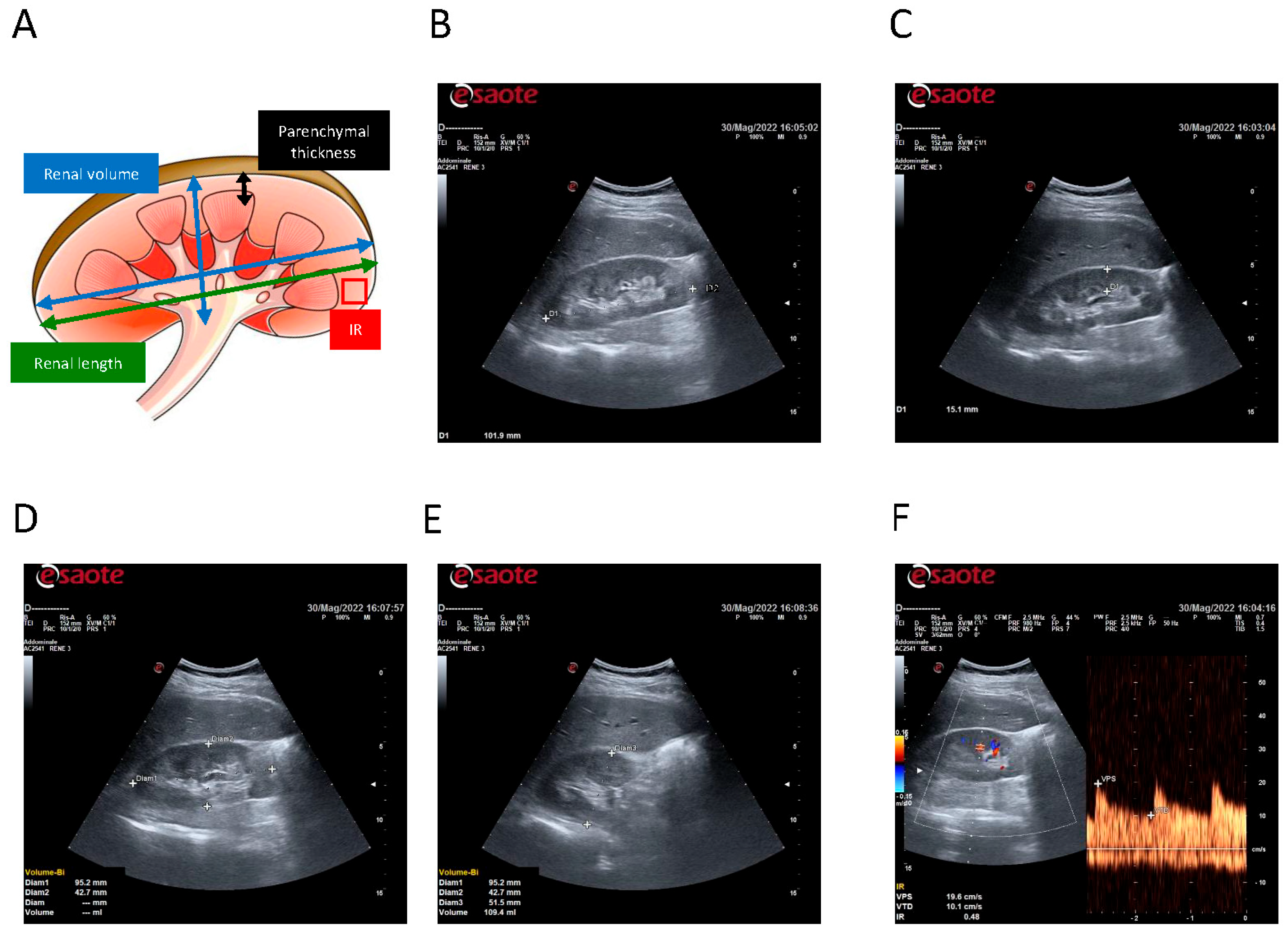
- Renal length: Defined as the maximal pole to pole distance and measured in a longitudinal view from upper to lower pole in both kidneys (mm).
- Parenchymal thickness: Measured as distance between the sinus fat and the renal capsule, assessed at the mesorenal level, avoiding cysts or structural anomalies (mm).
- Renal volume: Estimated using the ellipsoid formula (length × width × depth × 0.523) when feasible.
- Cortical–medullary differentiation: Echogenicity generally refers to how bright or dark the kidney parenchyma appears in comparison to the liver. In a normal kidney, the cortex is typically hypoechoic (darker) relative to the echogenic (brighter) central renal sinus. Thus we classified the cortical–medullary differentiation as preserved when renal cortex was less echogenic than liver and spleen or as reduced or absent when renal cortex echogenicity was equal to liver and spleen. To reduce operator/observer bias, patients were classified by combining subjects with reduced or moderately non-preserved corticomedullary differentiation with those showing absent or non-preserved corticomedullary differentiation.
- Intrarenal resistive index (IR): Measured at interlobar arteries using pulsed-wave Doppler ultrasound. Three measurements per kidney were averaged.
2.3. Laboratory and Clinical Data
2.4. Statistical Analysis
3. Results
3.1. Patients’ Characteristics
3.2. Ultrasound Findings
3.3. Correlation Analysis
3.4. Linear Regression Model
4. Discussion
5. Conclusions
Author Contributions
Funding
Institutional Review Board Statement
Informed Consent Statement
Data Availability Statement
Conflicts of Interest
Abbreviations
| US | Ultrasound |
| MRI | Magnetic resonance imaging |
| eGFR | Estimated glomerular filtration rate |
| CKD | Chronic kidney disease |
| RI | Intrarenal resistive index |
References
- Ahmed, S.; Bughio, S.; Hassan, M.; Lal, S.; Ali, M. Role of ultrasound in the diagnosis of chronic kidney disease and its correlation with serum creatinine level. Cureus 2019, 11, e4241. [Google Scholar] [CrossRef] [PubMed]
- Getaneh, F.H.; Kassa, B.F.; Amha, L.G.; Getaneh, F.B. Ultrasound characteristics and correlation with estimated glomerular filtration rate in patients with chronic kidney disease: A facility-based cross-sectional study. J. Int. Med. Res. 2025, 53, 03000605251327484. [Google Scholar] [CrossRef] [PubMed]
- Page, J.E.; Morgan, S.H.; Eastwood, J.B.; Smith, S.A.; Webb, D.J.; Dilly, S.A.; Chow, J.; Pottier, A.; Joseph, A.E.A. Ultrasound findings in renal parenchymal disease: Comparison with histological appearances. Clin. Radiol. 1994, 49, 867–870. [Google Scholar] [CrossRef] [PubMed]
- Han, B.K.; Babcock, D.S. Sonographic measurements and appearance of normal kidneys in children. Am. J. Roentgenol. 1985, 145, 611–616. [Google Scholar] [CrossRef] [PubMed]
- Park, C.W.; Yu, N.; Yun, S.W.; Chae, S.A.; Lee, N.M.; Yi, D.Y.; Choi, Y.B.; Lim, I.S. Measurement and Estimation of Renal Size by Computed Tomography in Korean Children. J. Korean Med. Sci. 2017, 32, 448–456. [Google Scholar] [CrossRef] [PubMed]
- Lucisano, G.; Comi, N.; Pelagi, E.; Cianfrone, P.; Fuiano, L.; Fuiano, G. Can renal sonography be a reliable diagnostic tool in the assessment of chronic kidney disease? J. Ultrasound Med. 2015, 34, 299–306. [Google Scholar] [CrossRef] [PubMed]
- Sanusi, A.A.; Arogundade, F.A.; Famurewa, O.C.; Akintomide, A.O.; Soyinka, F.O.; Ojo, O.E.; Akinsola, A. Relationship between sonographic renal volume and measured GFR in chronic kidney disease. Saudi J. Kidney Dis. Transpl. 2009, 20, 439–443. [Google Scholar]
- Radermacher, J.; Mengel, M.; Ellis, S.; Stuht, S.; Hiss, M.; Schwarz, A.; Eisemberger, U.; Burg, M.; Luft, F.C.; Gwinner, W.; et al. The renal arterial resistance index and renal allograft survival. N. Engl. J. Med. 2003, 349, 115–124. [Google Scholar] [CrossRef] [PubMed]
- Avramovski, P.; Ilkovska, B.; Nikleski, Z.; Avramovska, M.; Sikole, A. Which Better Determines the Renal Function and Glomerular Filtration Rate: Renal Parenchymal Thickness or Renal Resistive Index? Saudi J. Kidney Dis. Transplant. 2021, 32, 754–762. [Google Scholar] [CrossRef] [PubMed]
- Ikee, R.; Kobayashi, S.; Hemmi, N.; Imakiire, T.; Kikuchi, Y.; Moriya, H.; Suzuki, S.; Miura, S. Correlation between the resistive index and kidney function and histology. Am. J. Kidney Dis. 2005, 46, 603–609. [Google Scholar] [CrossRef] [PubMed]
- Moghazi, S.; Jones, E.; Schroepple, J.; Arya, K.; Mcclellan, W.; Hennigar, R.A.; O’Neill, W.C. Correlation of renal histopathology with sonographic findings. Kidney Int. 2005, 67, 1515–1520. [Google Scholar] [CrossRef] [PubMed]
- Korkmaz, M.; Aras, B.; Guneyli, S.; Yilmaz, M. Clinical significance of renal cortical thickness in patients with chronic kidney disease. Ultrasonography 2018, 37, 50–54. [Google Scholar] [CrossRef] [PubMed]
- Garg, A.; Jhobta, A.; Kapila, S.; Rathour, D. Correlation of sonographic parameters with renal function in patients with newly diagnosed chronic kidney disease. J. Ultrason. 2022, 22, e216–e221. [Google Scholar] [CrossRef] [PubMed]
- Mayeden, R.N.; Dzefi-Tettey, K.; Mensah, Y.B.; Ohene-Botwe, B.; Acheampong, F.; Nketiah, L.; Dadson, E.E.; Obeng, S.K. Renal cortical thickness and bipolar renal length and their correlation with estimated glomerular filtration rate of chronic kidney disease patients: A study at a teaching hospital in Ghana. Chin. J. Acad. Radiol. 2024, 7, 253–263. [Google Scholar] [CrossRef]
- Wei, S.; Zhao, S.; Zhou, Z.; Lian, R.; Lian, X.; Zhong, Z.; Yang, S.; Huang, N.; Wang, Y.; Chen, W.; et al. Associetion of renal cortical thickness and renal function in patients with malignant hypertensionwith thrombotic microangiopathy: A biopsy-based cohort study in China. BMJ Open 2025, 15, e096581. [Google Scholar] [CrossRef] [PubMed]
- Wang, H.; Bowe, B.; Cui, Z.; Yang, H. A Deep Learning Approach for the Estimation of Glomerular Filtration Rate. IEEE Trans. Nanobioscience 2022, 21, 560–569. [Google Scholar] [CrossRef] [PubMed]
- Lanot, A.; Akesson, A.; Nakano, F.K.; Vens, C.; Björk, J.; Nyman, U.; Grubb, A.; Sundin, P.-O.; Eriksen, B.O.; Melsom, T.; et al. Enhancing individual glomerular filtration rate assessment: Can we trust the equation? Development and validation of machine learning models to assess the trustworthiness of estimated GFR compared to measured GFR. BMC Nephrol. 2025, 26, 4. [Google Scholar] [CrossRef] [PubMed]


| Females | 64 (49.2%) |
| Age | |
| Mean (SD) | 65.9 (13.6) |
| Median [Q1; Q3] | 67.5 [59; 74.8] |
| Min; Max | 24.0; 89.0 |
| Hypertension | 77 (59.2%) |
| Diabetes | 22 (16.9%) |
| eGFR (Renal stage) | |
| Stage 1 | 25 (19.2%) |
| Stage 2 | 43 (33.1%) |
| Stage 3° | 28 (21.5%) |
| Stage 3b | 17 (13.1%) |
| Stage 4 | 16 (12.3%) |
| Stage 5 | 1 (0.8%) |
| Solitary/shrunken kidney | 13 (10.0%) |
| Mean (SD) | Median [Q1; Q3] | Min; Max | Missing | |
|---|---|---|---|---|
| Renal volume (cm3) | 206.7 (72.4) | 200.5 [152.8; 230.7] | 115.0; 371.0 | 118 (90.8%) |
| Right kidney length (cm) | 9.8 (1.1) | 10.0 [9.1; 10.4] | 5.6; 13.0 | 4 (3.1%) |
| Left kidney length (cm) | 10.2 (1.0) | 10.3 [9.5; 10.9] | 7.5; 12.8 | 7 (5.4%) |
| Mean kidney length (cm) | 10.1 (1.0) | 10.1 [9.5; 10.5] | 7.0; 13.0 | |
| Right kidney parenchymal thickness (cm) | 1.7 (0.4) | 1.8 [1.5; 2.0] | 0.3; 3.0 | 4 (3.1%) |
| Left kidney parenchymal thickness (cm) | 1.8 (0.4) | 1.8 [1.4; 2.1] | 0.7; 2.7 | 7 (5.4%) |
| Mean kidney parenchymal thickness (cm) | 1.8 (0.4) | 1.8 [1.6; 2.0] | 0.7; 3.0 | |
| Mean kidney cortical thickness (cm) | 1.2 (1.8) | 0.7 [0.6; 0.9] | 0.5; 8.8 | 104 (80.0%) |
| Right kidney arteriolar resistance | 0.68 (0.07) | 0.70 [0.64; 0.73] | 0.51; 0.85 | 5 (3.8%) |
| Left kidney arteriolar resistance | 0.68 (0.06) | 0.71 [0.64; 0.74] | 0.55; 0.80 | 7 (5.4%) |
| Mean kidney arteriolar resistance | 0.68 (0.06) | 0.71 [0.64; 0.73] | 0.55; 0.83 |
| Predictors | Intercept | |||||||
|---|---|---|---|---|---|---|---|---|
| Estimates | Std. Error | 95%CI | p | Estimates | Std. Error | 95%CI | p | |
| Age (years) | −0.94 | 0.16 | −1.25; −0.63 | <0.001 | 125.48 | 10.46 | 104.78; 146.18 | <0.001 |
| Biological sex (female) | −0.11 | 4.78 | −9.57; 9.36 | 0.982 | 63.53 | 3.36 | 56.89; 70.17 | <0.001 |
| Hypertension (yes) | −3.30 | 4.86 | −12.92; 6.31 | 0.498 | 65.43 | 3.74 | 58.04; 72.83 | <0.001 |
| Diabetes (yes) | −9.49 | 6.32 | −22.00; 3.02 | 0.136 | 65.08 | 2.60 | 59.94; 70.23 | <0.001 |
| Solitary/shrunken kidney (yes) | −19.16 | 7.79 | −34.58; −3.75 | 0.015 | 65.39 | 2.46 | 60.52; 70.27 | <0.001 |
| Echogenicity (preserved) | 23.85 | 6.15 | 11.69; 36.02 | <0.001 | 59.62 | 2.47 | 54.74; 64.51 | <0.001 |
| Mean kidney length (cm) | 10.20 | 2.19 | 5.87; 14.54 | <0.001 | −39.22 | 22.16 | −83.08; 4.63 | 0.079 |
| Mean kidney parenchymal thickness (cm) | 24.77 | 5.60 | 13.69; 35.85 | <0.001 | 19.86 | 10.11 | −0.14; 39.86 | 0.052 |
| Mean kidney arteriolar resistance | −233.48 | 31.46 | −295.72; −171.23 | <0.001 | 224.20 | 21.75 | 181.17; 267.23 | <0.001 |
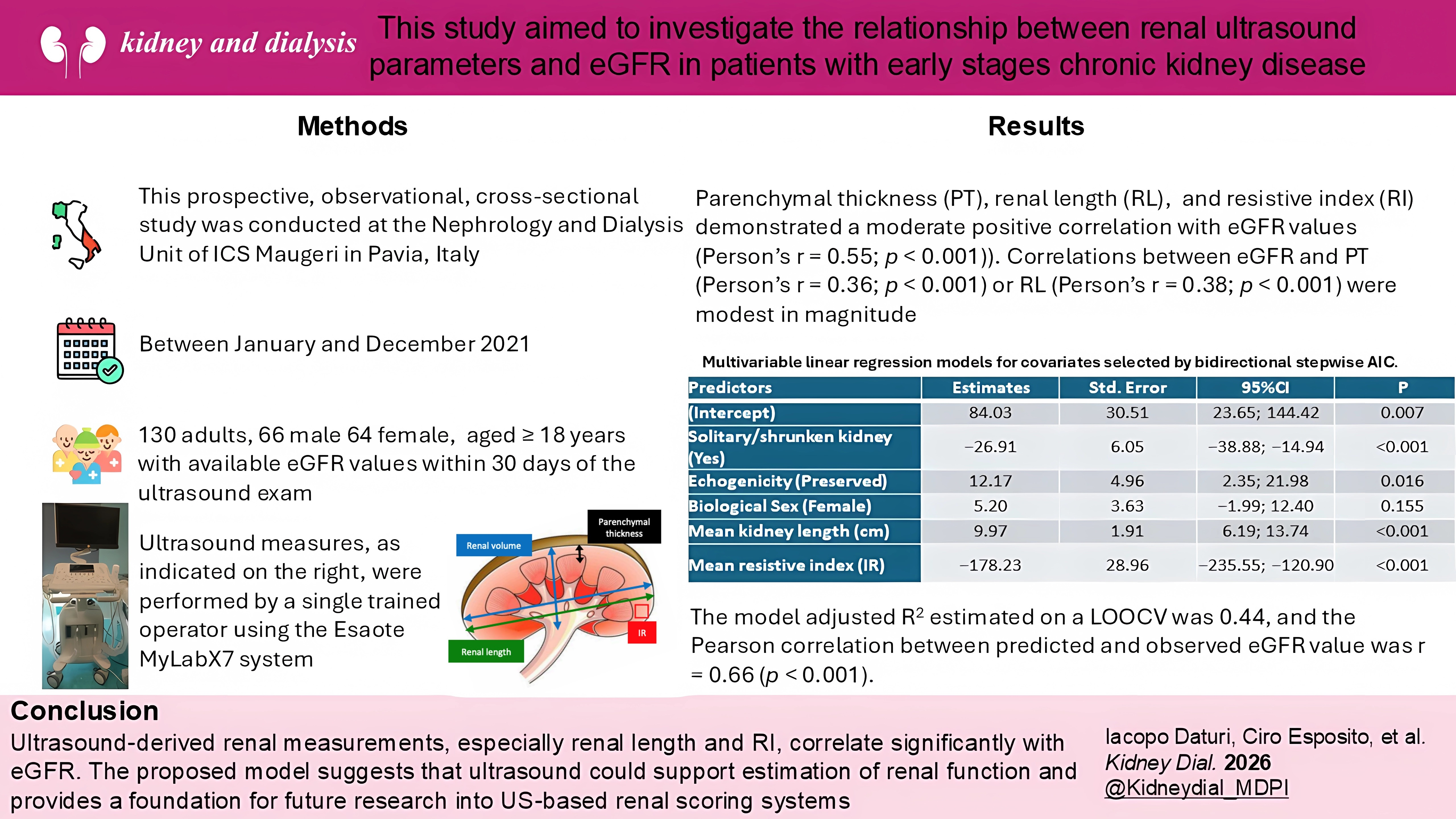
| Predictors | Estimates | Std. Error | 95%CI | p |
|---|---|---|---|---|
| (Intercept) | 84.03 | 30.51 | 23.65; 144.42 | 0.007 |
| Solitary/shrunken kidney (Yes) | −26.91 | 6.05 | −38.88; −14.94 | <0.001 |
| Echogenicity (Preserved) | 12.17 | 4.96 | 2.35; 21.98 | 0.016 |
| Biological Sex (Female) | 5.20 | 3.63 | −1.99; 12.40 | 0.155 |
| Mean kidney length (cm) | 9.97 | 1.91 | 6.19; 13.74 | <0.001 |
| Mean resistive index (IR) | −178.23 | 28.96 | −235.55; −120.90 | <0.001 |
Disclaimer/Publisher’s Note: The statements, opinions and data contained in all publications are solely those of the individual author(s) and contributor(s) and not of MDPI and/or the editor(s). MDPI and/or the editor(s) disclaim responsibility for any injury to people or property resulting from any ideas, methods, instructions or products referred to in the content. |
© 2026 by the authors. Licensee MDPI, Basel, Switzerland. This article is an open access article distributed under the terms and conditions of the Creative Commons Attribution (CC BY) license.
Share and Cite
Daturi, I.; Esposito, C.; Efficace, E.; Sileno, G.; Arazzi, M.; Colucci, M.; Adamo, G.; Semeraro, L.; Baiardi, P.; Fassio, F.; et al. Renal Ultrasound Findings and Estimated Glomerular Filtration Rate (eGFR): A Cross-Sectional Observational Study. Kidney Dial. 2026, 6, 15. https://doi.org/10.3390/kidneydial6010015
Daturi I, Esposito C, Efficace E, Sileno G, Arazzi M, Colucci M, Adamo G, Semeraro L, Baiardi P, Fassio F, et al. Renal Ultrasound Findings and Estimated Glomerular Filtration Rate (eGFR): A Cross-Sectional Observational Study. Kidney and Dialysis. 2026; 6(1):15. https://doi.org/10.3390/kidneydial6010015
Chicago/Turabian StyleDaturi, Iacopo, Ciro Esposito, Emanuela Efficace, Giuseppe Sileno, Marta Arazzi, Marco Colucci, Gabriella Adamo, Luca Semeraro, Paola Baiardi, Federico Fassio, and et al. 2026. "Renal Ultrasound Findings and Estimated Glomerular Filtration Rate (eGFR): A Cross-Sectional Observational Study" Kidney and Dialysis 6, no. 1: 15. https://doi.org/10.3390/kidneydial6010015
APA StyleDaturi, I., Esposito, C., Efficace, E., Sileno, G., Arazzi, M., Colucci, M., Adamo, G., Semeraro, L., Baiardi, P., Fassio, F., Grosjean, F., & Esposito, V. (2026). Renal Ultrasound Findings and Estimated Glomerular Filtration Rate (eGFR): A Cross-Sectional Observational Study. Kidney and Dialysis, 6(1), 15. https://doi.org/10.3390/kidneydial6010015