Article

COVID-19 Grant Policy and Unemployment in South Africa

by
Lateef Olalekan Bello
* and
Dorah Dubihlela
Department of Business Management and Economics, Faculty of Economic and Financial Sciences, Walter Sisulu University, Mthatha 5099, South Africa
*
Author to whom correspondence should be addressed.
COVID 2026, 6(7), 114; https://doi.org/10.3390/covid6070114
Submission received: 11 May 2026 / Revised: 18 June 2026 / Accepted: 28 June 2026 / Published: 30 June 2026
(This article belongs to the Section COVID Public Health and Epidemiology)

Abstract

The COVID-19 pandemic prompted the introduction of South Africa’s Social Relief of Distress (SRD) grant to mitigate income shocks among individuals excluded from existing social programs. This study utilizes a three-year national representative dataset from the General Household Survey and applies a fixed effects regression framework to estimate the association between COVID-19 SRD grants and unemployment. The findings indicate a positive and statistically significant association between grant receipt and unemployment. Specifically, the results suggest that grant recipients are approximately 27–32% more likely to be unemployed than non-recipients. The findings suggest that while the grant provided necessary initial financial relief, in the absence of complementary labour market interventions, income support alone may be insufficient to address unemployment. The study concludes by recommending the coordination of temporary income relief integrated with active labour market policies to promote sustainable employment outcomes.

1. Introduction

1.1. Background

South Africa has one of the largest and most comprehensive social grant programs in Africa, providing protection against diverse socioeconomic vulnerabilities [1]. Although these grants are primarily used for food consumption, evidence suggests that recipients also invest part of their benefits in livelihood activities, such as small-scale businesses and other productive ventures [2].
The COVID-19 pandemic, however, exposed structural gaps in the country’s social security system, prompting the introduction of the Social Relief of Distress (SRD) grant in May 2020. The SRD grant was established to support working-age adults who lost income due to lockdown restrictions and were not receiving other forms of social assistance or Unemployment Insurance Fund (UIF) benefits. The grant primarily targeted low-income and unemployed individuals, including citizens, permanent residents, and refugees aged 18 and above [3]. Initially introduced as a short-term measure to mitigate financial hardships caused by the pandemic, the grant has been extended multiple times [4].
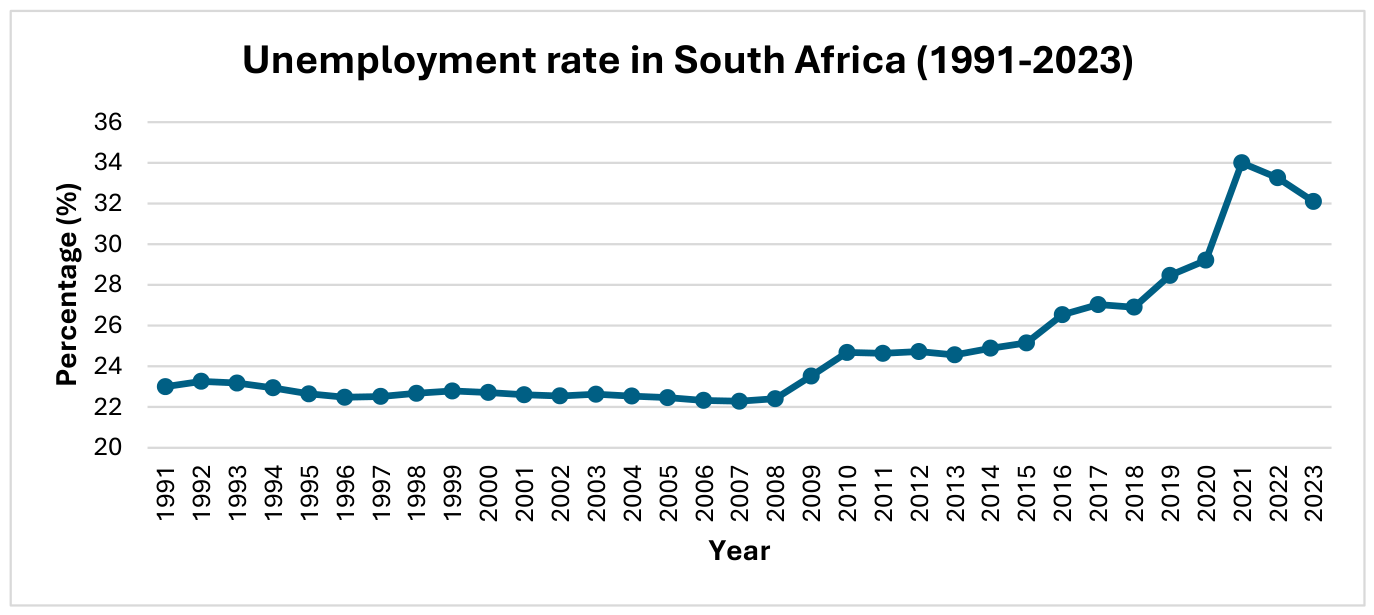
Unemployment remains a critical socioeconomic challenge in South Africa, characterized by fluctuations over time. Prior to the COVID-19 pandemic, the national unemployment rate exhibited significant variability, a situation that was exacerbated during the pandemic due to economic disruptions and lockdown measures. This surge in unemployment had profound implications for the livelihoods of millions, given the prevailing high levels of poverty and inequality [5]. However, post-pandemic trends indicate a subsequent decline in unemployment (see Figure 1), which may be attributed to the relaxation of lockdown restrictions and the implementation of national social protection programs. This presents an interesting opportunity for conducting this study.
This study focuses on the COVID-19 Social Relief of Distress (SRD) grant, which differs from traditional social grants (such as age, disability and caregiving grants) in both its target group and implementation process. The COVID-19 SRD grant specifically targets unemployed and economically vulnerable individuals outside the formal welfare system, with applications processed primarily online, differing from the administrative procedures associated with other grants [3].
Therefore, our study differs from the existing literature [7,8,9,10] on social grants in South Africa due to the direct relationship between the COVID-19 SRD grant and unemployment. In addition, unlike prior studies on social grants, this research uniquely incorporates three rounds of survey data, allowing for an assessment of the long-term impact of the grant on unemployment in the post-pandemic period. Thus, this study aims to contribute to the literature by addressing the following research question: Does the COVID-19 SRD grant reduce unemployment in South Africa? We employ the fixed effect econometric approach to analyse three rounds of national survey data collected between 2021 and 2023. Our findings reveal that the COVID-19 SRD grant is associated with an increase in unemployment, underscoring the necessity for concrete policy reforms to guide the design and implementation of more effective and sustainable social protection programs. This is crucial for achieving one of the key objectives of South Africa’s National Development Plan 2030, which seeks to eradicate poverty and reduce inequality through increased employment generation.

1.2. Review of the Literature on Social Grants and Labour Market Outcomes

Social protection programs function as a vital policy instrument for mitigating the adverse consequences of economic crises, particularly in developing countries with high poverty and unemployment rates. The nexus between social grants and labour market outcomes is complex and remains a subject of considerable debate. Theoretical and empirical studies suggest that cash transfers may affect employment through multiple channels. For example, behavioural poverty theories [11,12] suggest that cash transfers can alleviate cognitive and financial constraints associated with poverty, enabling recipients to make better labour market and consumption decisions. Similarly, the job search literature [13,14] argues that temporary income support may affect reservation wages, search intensity, and job-matching quality, particularly during periods of economic disruption. Overall, these narratives imply that social grants (such as the COVID-19 SRD grant) may either facilitate labour market participation by relaxing financial constraints or discourage employment by reducing the immediate necessity to seek work.
Empirical evidence on the labour market effects of social protection programs remains mixed. Banerjee et al. [15] re-analysed random control trials of government cash transfers from six developing countries. The authors found no statistically significant evidence of systemic differences in work behaviour between cash transfer beneficiaries and non-beneficiaries across pooled, male, and female estimates. In a rigorous and detailed systematic review of the effect of social protection programs on adult labour market outcomes, Baird et al. [16] found that cash transfers (conditional, unconditional, remittances, and transfers) not explicitly designed to influence employment have little or no effect on labour market participation. However, the review also highlighted substantial heterogeneity across programs. Transfers directed at elderly populations and refugees were associated with reduced labour force participation, whereas employment-oriented interventions, including job search assistance and business start-up support, generated positive effects on employment and earnings. In a review of social protection programs in 223 countries during and after the COVID-19 pandemic period, Gentilini et al. [17] found that governments implemented a wide range of labour market policies, including wage subsidies, adjustments to labour regulation, shorter working hours arrangements, and activation measures such as training and job placement assistance. While high-income countries relied more heavily on wage subsidies, countries with larger informal sectors tended to favour cash transfers and labour regulations, given their broader coverage and lower administrative requirements. The authors argue that income support measures were most effective when complemented by active labour market interventions designed to facilitate labour market re-entry, skills development, and employment retention, highlighting the importance of integrating social protection with employment policies during and after economic crises.
Empirical studies on social grants have also been well-documented in South Africa. Mackett, in Ref. [8], employed a longitudinal analysis to examine the effect of social grants on labour market and poverty outcomes in South Africa. The results showed that social grants have a negative effect on labour market outcomes (increasing unemployment). Comparing households with different types of grant beneficiaries, the author found that individuals residing with an old-age grant beneficiary are less likely to be unemployed and poorer than those residing with a child support grant beneficiary. Van Heerden et al. [18] conducted a recent study on the economic implications of the Social Relief of Distress grant and wage subsidies in South Africa. The authors utilized the University of Pretoria General Equilibrium Model (UPGEM), a dynamic Computable General Equilibrium (CGE) model of the South African economy, to test the performance of the Social Relief of Distress grant in comparison with wage subsidies on labour market outcomes. Forecasting a period of approximately two decades (2022–2045), the authors documented that if the same amount of government resources is allocated to wage subsidies and SRD grants, the wage subsidies scenario yields higher economic benefits (in terms of GDP, employment, and industry production) than SRD grants. On the other hand, Omotayo and Ogunniyi, in Ref. [10], evaluated the impact of social grants on poverty and health outcomes using pre- and post-COVID-19 pandemic survey data. The results from the difference-in-difference fixed effect estimation demonstrated that social grants relaxed the adverse effect of the COVID-19 pandemic in the context of poverty and health-related outcomes. Using the National Income Dynamics Study (NIDS) and Coronavirus Rapid Mobile Survey (CRAM) data, Gelo and Dikgang [5] examined the effect of COVID-19 labour shock and social grant uptake on child and household food insecurity in South Africa. The authors demonstrated that job loss resulting from the COVID-19 pandemic leads to increased child and household hunger. However, the likelihood of reporting food insecurity among unemployed individuals in households receiving social grants (child support and old-age pension) was lower compared to employed individuals in households not receiving child support grants.
Despite the growing literature on social grants and household welfare, limited attention has been paid to the long-term labour market implications of the COVID-19 SRD grant. Existing studies have primarily focused on poverty reduction, food security, health outcomes, and household welfare, while evidence regarding the relationship between COVID-19 SRD grant receipt and unemployment remains scarce. Moreover, policy debates continue regarding whether prolonged receipt of the COVID-19 SRD grant promotes economic resilience by supporting job search and consumption smoothing or whether it creates labour market disincentives through income support mechanisms. This gap is particularly important given the continued extension of the COVID-19 SRD grant and ongoing discussions regarding its future role within South Africa’s social protection system. The primary objective of the study is to estimate the relationship between COVID-19 SRD grant receipt and unemployment using three-year nationally representative survey data. We hypothesize that receipt of the COVID-19 SRD grant is associated with a higher likelihood of unemployment.

2. Methods

2.1. Data and Sampling Procedure

This study utilized the South African General Household Survey (GHS) data. The GHS data originated from a yearly survey conducted by the Department of Statistics South Africa (Stats SA) in all nine provinces of South Africa. The GHS is designed to provide comprehensive information on the living conditions, socioeconomic characteristics, and service access of South African households. The survey employs a stratified, two-stage sampling design based on the national population census sampling frame. In the first stage, primary sampling units (PSUs), commonly referred to as enumeration areas (EAs), are selected using probability proportional to size. In the second stage, households are systematically sampled within each selected EA [19]. This sampling framework ensures national and provincial representativeness of the survey population. The GHS data is divided into two parts: house and person data. The house data contains detailed household information, such as household composition and conditions. The person data is collected based on individual characteristics, such as medical condition, marital status, and employment, among others. The GHS was obtained from residential homes, including workers’ apartments/hostels. The survey covers only non-institutionalized and non-military individuals/households, as it excludes students’ hostels, care homes, hospitals, military barracks and prisons.
We combined three rounds (2021–2023) of both the house and person GHS data for our analysis. The COVID-19 social relief distress (SRD) grant and employment status variables were captured in the person data, while other household characteristics were in the household data. We merged both datasets across the three-year period. The COVID-19 SRD grant was rolled out in 2020 and was captured in the GHS 2020 data. However, the employment status variable was not captured in the GHS 2020 dataset. Thus, we utilized the dataset that includes the main variables (COVID-19 SRD grant and employment status) of interest in this study to capture the post-COVID-19 impact of the SRD grant.
We excluded non-applicable responses for the COVID-19 SRD grant from the sample to ensure that the respondents selected were those who answered yes/no. The non-applicable sample might consist of those who are not in need of the grant or those with other types of social protection grants. Finally, we excluded non-economically active individuals, and thus, our samples were restricted between ages 18 and 64 across the three rounds of data. Economically active individuals in South Africa are people aged 15–64 [20]. However, the age limit for receiving the COVID-19 SRD grant was 18 years and older. Thus, to fulfil both the grant and employment access criteria, we restricted the age range of the sample to 18–64 years. After data cleaning, we retained 2934 observations for analysis over the three-year period. Stata 18 statistical software was used to manage and analyze the data.

2.2. Variable Measurement

The primary outcome variable is unemployment status. An individual is classified as unemployed if he or she was not employed during the reference period. The variable is coded as a binary indicator equal to 1 if unemployed and 0 otherwise. The key explanatory variable is receipt of the COVID-19 Social Relief of Distress (SRD) grant. This variable is a binary indicator equal to 1 if an individual reported receiving the SRD grant during the survey year and 0 otherwise. Several control variables are included to account for observable factors associated with both grant receipt and labour market outcomes. These controls include age, gender, race, marital status, educational attainment, household size, province of residence, access to basic services, and other socioeconomic characteristics available in the GHS dataset. Year dummy variables are also included to capture macroeconomic shocks and common time trends. The summary statistics of the variables are presented and discussed in Section 3.

2.3. Conceptual Framework and Empirical Strategy

This study is grounded in labour supply theory and the dependency hypothesis, which together structure the expected relationship between receipt of the COVID-19 Social Relief of Distress (SRD) grant and unemployment outcomes in South Africa. From the perspective of labour supply theory, income transfers, such as the COVID-19 SRD grant, affect labour market behaviour through two channels: the income effect and the substitution effect [21,22]. The income effect predicts that unconditional income transfers reduce the incentive to supply labour by increasing non-labour income and making leisure relatively more attractive. In contrast, the substitution effect suggests that transfers can enhance employability by relaxing liquidity constraints, enabling recipients to finance job searches, cover transportation costs, or invest in small-scale enterprises [22]. The dependency hypothesis complements this framework by emphasizing the implication of sustained access to unconditional income on individuals’ behaviour, diminishing their motivation to seek employment or develop productive skills [23,24]. Thus, the net effect of social assistance on unemployment depends on which mechanism dominates. Accordingly, this study hypothesizes that while the COVID-19 SRD grant provides critical short-term income stability, its longer-term effect on unemployment may vary depending on labour market conditions and recipients’ behavioural responses.
To empirically assess this relationship, the study utilizes data from the General Household Survey (GHS) for 2021–2023. Although the GHS is a repeated cross-sectional dataset rather than a true panel, following Deaton [25] and Verbeek [26], a pseudo-panel is constructed by aggregating consistent individual characteristics across three waves within cohorts. Pseudo-panel methods create synthetic cohorts from repeated cross-sectional surveys by grouping individuals according to characteristics that remain fixed over time [26]. In this study, cohorts were constructed based on time-invariant characteristics, such as age, gender, and race. These characteristics are stable across survey periods and therefore provide a consistent basis for identifying comparable population groups over time. The temporal dimension of the data enabled us to apply a fixed-effects (FE) estimation strategy, which helps mitigate potential endogeneity and measurement errors commonly found in observational data [27,28]. For example, endogeneity arising from unobserved confounders (such as cultural norms, job aspirations, and social capital) may correlate with grant receipt and unemployment at the individual, household, and geographic levels. Another serious issue is reverse causality, as unemployment status may affect grant eligibility or reporting behaviour. For instance, while the grant targets unemployed and vulnerable individuals, recipients may later gain employment or alter their reporting behaviour after receiving the grant. This dynamic complicates the assumption that receipt of the COVID-19 SRD grant is strictly exogenous to employment outcomes. Moreover, the GHS data rely solely on self-reported responses to grant receipt and employment status, which may be subject to misreporting or measurement error. While the fixed effects estimator cannot completely eliminate all sources of endogeneity, it reduces bias arising from unobserved time-invariant factors that may confound the relationship between grant receipt and employment outcomes. Unlike random effects or propensity score matching (PSM), FE estimation does not rely on the assumption that unobserved factors are uncorrelated with explanatory variables and can account for unobservable time-invariant heterogeneity [28]. Although instrumental variable (IV) methods can address endogeneity, identifying valid instruments for SRD grant receipt is empirically challenging, and potential instruments may be correlated with local labour market conditions [29]. Therefore, in our study, the FE estimation provides the most credible and methodologically appropriate approach given the pseudo-panel structure and available data. The fixed effect empirical specification is expressed as follows;
E i t = β 0 + β 1 S R D i t + β 2 X i t + T t + ϑ i + η p t + ξ i t
where E i t is a dummy for the employment status of individual i at year t . SRD is a dummy variable that equals 1 if the individual receives the COVID-19 SRD grant at time t and 0 otherwise. The coefficient β 1 is the main interest of the study. X i t is the vector of household characteristics, while T t represents survey-year dummies, which account for temporal shocks, such as price shocks, that may have affected household-level outcomes over time. ϑ i captures the household fixed effects, which account for all unobserved time-invariant household characteristics. η p t and ξ i t denotes the province–time trend dummies and the idiosyncratic error term.
In addition to the fixed effects approach, we employ Ordinary Least Squares (OLS) regression as a baseline estimator to estimate the average treatment effect of COVID-19 SRD grant receipt on unemployment status. We acknowledged that the OLS may be susceptible to omitted variable bias if unobserved heterogeneity correlates with the COVID-19 SRD grant variable. As such, the OLS results serve as an exploratory foundation, while the fixed effects model offers more rigorous inference. The use of both estimation approaches tends to provide robustness in the credibility and interpretability of the study’s findings on the effect of the SRD grant on employment outcomes. We also conduct a placebo test to ascertain the robustness of our result. While we employ several specifications for the analysis, the empirical strategy is designed to estimate associations rather than establish causal effects. Given that eligibility for the SRD grant is closely linked to unemployment and economic vulnerability, the possibility of reverse causality and selection bias cannot be completely eliminated. Consequently, the results should be interpreted as evidence of an association rather than a causal relationship between SRD grant receipt and unemployment. The Ordinary Least Squares (OLS) regression empirical specification is expressed as follows:
E i t =   β 0 +   β 1 S R D i t +   β 2 X i t +   T t +   η p t + ξ i t

3. Results and Discussion

3.1. Descriptive Statistics

Table 1 and Table 2 reveal the summary statistics of the sampled households.
While Table 1 presents the overall means and standard deviations for the selected outcome and independent variables, Table 2 shows the mean difference test results for COVID-19 SRD grant recipients and non-recipients. The results in Table 1 show that 78.1% of the respondents received the COVID-19 SRD grant. The unemployment rate among the sampled respondents is 42%, indicating that almost half of the individuals were unemployed. This finding underscores the challenging and unfavourable labour market conditions faced by individuals in South Africa [5,8]. The average age of the respondents is about 45 years, and more than half (58%) of them are male. In terms of the sampled individuals’ educational status, the result indicated that the majority have secondary education. Specifically, about 5.4% do not have formal education, while 13.6%, 77.7%, 1.2%, and 2% possess primary, secondary, vocational and tertiary education, respectively. Furthermore, our findings revealed that 18.2%, 12.1%, 2.6%, 8.9%, and 55.7% of the respondents are married, cohabiting, separated, widowed, and single, respectively. About 19.5% of the individuals have chronic health issues such as diabetes, hypertension and asthma. However, the proportion of respondents who subscribed to medical aid/insurance is very low (1.3%). This suggests that the individuals are in dire economic conditions, or they probably prefer to attend government-subsidized hospitals. The majority (93.5%) of the sample respondents are Black, while about 5.7%, 3% and 5.8% constitute the Coloured, Indian and White racial population groups. The respondents are domiciled across the nine provinces of South Africa, with Gauteng and the Western Cape having the largest (19.2%) and smallest (3.5%) sample sizes, respectively.
The results in Table 2 indicate a statistically significant difference between COVID-19 SRD grant recipients and non-recipients for the selected outcome and explanatory variables. The unemployment rate among the grant recipients (66.8%) is statistically and significantly higher than that of non-recipients (26.8%). This is not surprising as the COVID-19 SRD grant is targeted at vulnerable and unemployed individuals. The grant recipients are significantly younger than the non-recipients (41 vs. 57 years). This indicates that younger individuals encounter more financial difficulties than older individuals. Respondents who possess secondary education are significantly more prevalent among grant recipients (82.9%) than among non-recipients (58.9%). However, the tertiary education status of the grant non-recipients (3.6%) is significantly higher compared to that of the grant recipients (1.6%). In terms of social amenities such as medical aid (3.7% vs. 0.6%) and access to potable water (74.3% vs. 43.7%), the non-recipients of the grant have a more favourable status than the grant recipients. Regarding geographical distribution, the majority of grant recipients (19.6%) and non-recipients (21.5%) are concentrated in the provinces of Gauteng and KwaZulu-Natal. In contrast, the lowest proportions of grant recipients (2.3%) and non-recipients (4.8%) are found in the Northern Cape and Northwest provinces. These figures highlight significant regional disparities in economic conditions across South Africa.

3.2. The Association Between COVID-19 Social Relief of Distress (SRD) Grant and Unemployment

In Table 3, we present the relationship between the COVID-19 SRD grant and unemployment using ordinary least squares (OLS) and fixed effects (FEs) regression models.
The results presented in Table 3 indicate that the COVID-19 Social Relief of Distress (SRD) grant has a positive and statistically significant effect on unemployment status across all model specifications. This suggests that the grant is associated with an increase in unemployment during the study period. To account for regional heterogeneity, estimations were conducted using both fixed effects (FEs) and ordinary least squares (OLS) approaches, with and without province fixed effects. The magnitude of the estimated coefficients varies depending on whether province–time trends are included. Specifically, after controlling for these trends, the OLS coefficient estimate increased from 0.309 to 0.322, suggesting that grant recipients are 32.2% more likely to be unemployed compared to non-recipients. This suggests that the COVID-19 SRD grant, rather than facilitating labour market reintegration or employment-seeking behaviour, may have inadvertently influenced disproportionate individuals who are less motivated to actively seek employment while receiving grant support. The results reflect the income effect labour supply theory [15,16].
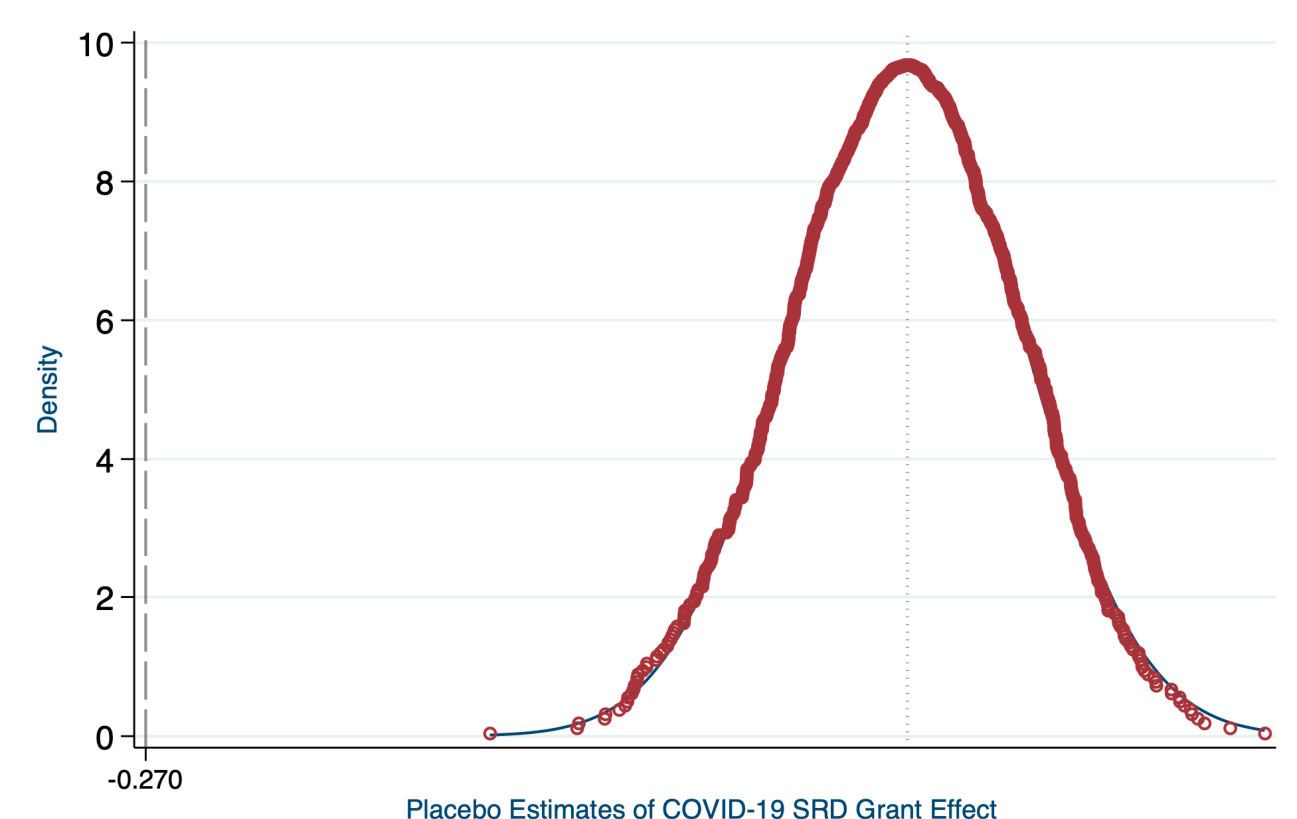
After controlling for unobserved heterogeneity and province–time dynamics, the FE estimates indicate that grant recipients are about 27% more likely to be unemployed than non-recipients. This reinforces the robustness of the findings and reduces concerns about omitted variable bias. Moreover, our placebo test (see Appendix A) further confirmed the consistency of the results. The difference in the magnitude of the coefficient estimates of the OLS and FE regressions could be due to the fact that OLS do not capture unobserved heterogeneity, which makes the coefficient estimates larger than those of FE. However, the consistency of the positive relationship across both OLS and FE estimations supports the conclusion that the grant may have had unintended labour market consequences. Moreover, the design of the COVID-19 SRD grant targeted at unemployed and vulnerable adults may reinforce this effect through eligibility constraints. That is, beneficiaries may delay job-seeking to maintain access to the grant, especially if the perceived benefits of employment are marginal or uncertain. This finding aligns with the existing literature [7,8] in the South African context on the nexus between social grants and unemployment. In contrast to this study, Banerjee et al. [15] documented no statistically significant evidence between unemployment and cash transfer among beneficiaries and non-beneficiaries in six developing economies.

3.3. Discussion

This study examined the relationship between receipt of the COVID-19 SRD grant and unemployment among economically active adults in South Africa. Across all model specifications, the results reveal a positive and statistically significant association between grant receipt and unemployment status. The findings are broadly consistent with previous South African studies that report a positive relationship between social grant receipt and unemployment. For example, Mackett [8] found that social assistance was associated with unemployment among beneficiaries. Similarly, Miyajima [9] documented evidence suggesting a negative relationship between social grant types and labour market participation in South Africa. The present study extends this literature by focusing specifically on the COVID-19 SRD grant and by examining labour market outcomes during the post-pandemic period.
Several plausible explanations may account for the observed association. First, because unemployment is a central eligibility criterion for the SRD grant, unemployed individuals are naturally overrepresented among beneficiaries. Consequently, the positive relationship identified in the analysis may partly reflect program targeting rather than behavioural responses to grant receipt. Second, persistent structural unemployment, weak economic growth, limited labour demand, and skill mismatches continue to constrain employment opportunities in South Africa [30]. Under such conditions, unemployment among grant recipients may reflect broader labour market challenges rather than the direct effects of social assistance. These findings resonate with those of Gentilini et al. [17], who reveal that COVID-19 income support programs were primarily designed to provide temporary income protection rather than improve employment outcomes. Their global review suggests that cash transfers are most effective when complemented by active labour market interventions, particularly in contexts characterized by weak labour demand and structural unemployment. This is especially relevant to South Africa, where persistent labour market constraints may limit the employment effects of social assistance programs. The findings should therefore not be interpreted as evidence that the COVID-19 SRD grant causes unemployment. Rather, they indicate that grant recipients are disproportionately represented among unemployed individuals during the study period. This distinction is important because reverse causality remains a plausible explanation. Individuals may receive the grant because they are unemployed, rather than becoming unemployed because they receive it. The results also differ from the broader international literature on cash transfer programs, which generally finds limited or no adverse effects on labour supply. For example, Banerjee et al. [15] and Baird et al. [16] reported limited evidence of systematic reductions in employment among cash transfer beneficiaries across multiple developing countries. These differences may reflect contextual factors, including South Africa’s exceptionally high unemployment rates, the COVID-19 SRD program’s design and targeting criteria, and broader labour market constraints.
To assess the robustness of the results, a falsification test was conducted in which the COVID-19 SRD grant was randomly assigned to non-beneficiaries, generating a placebo treatment group. The placebo analysis shows no statistically significant association between the placebo COVID-19 SRD grant and unemployment (Figure A1). This provides further confidence that the observed relationship is not driven by random variation or unobserved time-varying confounders but rather reflects the underlying association between COVID-19 SRD grant receipt and unemployment.

3.4. Limitations

Despite the study’s contribution, several limitations should be considered when interpreting its findings. First, despite the use of fixed effects specifications, the possibility of reverse causality cannot be completely eliminated. Since unemployment is one of the eligibility requirements for receiving the COVID-19 SRD grant, unemployed individuals are more likely to become beneficiaries. As a result, the observed association may partly reflect program targeting rather than the effect of grant receipt on unemployment. Second, the analysis relies on self-reported measures of both COVID-19 SRD grant receipt and employment status. As a result, reporting errors, recall bias, or misclassification may introduce measurement error into the estimates. Although fixed effects estimation may reduce the influence of some forms of measurement error, it cannot completely eliminate these concerns. Finally, the study focuses on the post-pandemic period between 2021 and 2023. As a result, the findings may not fully capture longer-term labour market dynamics associated with the COVID-19 SRD program or subsequent policy changes. Future research could employ longitudinal datasets, quasi-experimental methods, randomized policy evaluations or other credible identification strategies to provide a more robust assessment of the long-term causal effects of temporary cash transfer programs on employment dynamics.

4. Conclusions and Policy Implications

This study investigates the labour market implications of the COVID-19 Social Relief of Distress (SRD) grant in South Africa, with a specific focus on its association with unemployment. Using ordinary least squares (OLS) and fixed effects (FE) estimations, the results consistently indicate a positive and statistically significant association between SRD grant receipt and unemployment status. The findings suggest that grant beneficiaries remain concentrated among individuals facing labour market vulnerability, reflecting both the program’s targeting design and the broader structural challenges in South Africa’s labour market. The results highlight the importance of distinguishing between behavioural responses to social transfers and selection effects arising from program eligibility criteria. In contexts characterized by persistently high unemployment and limited labour demand, positive associations between grant receipt and unemployment may primarily reflect the concentration of social assistance among disadvantaged groups rather than disincentive effects.
The findings also have broader implications for the future design of social policy and labour market strategy in South Africa and similar developing contexts. While temporary cash transfers play a critical role in protecting vulnerable households from income shocks and poverty, income support alone is unlikely to improve labour market outcomes where structural barriers to employment remain binding. In line with the objectives of South Africa’s National Development Plan (NDP) 2030 [31], which identifies employment creation as one of the primary mechanisms for reducing poverty and inequality, policymakers should strengthen the integration of social assistance programs with active labour market interventions. These interventions may include vocational training, job search assistance, entrepreneurship support, and employment placement services. Such an integrated approach would enable social protection systems to fulfil both protective and developmental objectives while supporting the NDP 2030 targets of expanding employment opportunities, enhancing labour market participation, and promoting inclusive economic growth.
Furthermore, while the COVID-19 SRD grant was designed as a temporary relief mechanism, its prolonged implementation without clear exit strategies may have entrenched dependency in some cases. Thus, future social protection policies should incorporate clear pathways that facilitate beneficiaries’ transition into employment where opportunities exist. Rather than focusing solely on benefit withdrawal, policy design should emphasize mechanisms that support labour market attachment while maintaining adequate income security for vulnerable individuals. Aligning social assistance with the NDP 2030 agenda would help ensure that social protection functions not only as a safety net during periods of economic vulnerability but also as a catalyst for human capital development, economic inclusion, and sustainable livelihoods.

Author Contributions

Conceptualization, L.O.B.; methodology, L.O.B.; software, L.O.B.; validation, L.O.B. and D.D.; formal analysis, L.O.B.; investigation, L.O.B. and D.D.; resources, L.O.B. and D.D.; data curation, L.O.B.; writing—original draft preparation, L.O.B.; writing—review and editing, L.O.B. and D.D.; visualization, L.O.B. and D.D. All authors have read and agreed to the published version of the manuscript.

Funding

This research received no external funding.

Institutional Review Board Statement

Not applicable.

Informed Consent Statement

Not applicable.

Data Availability Statement

The data used in this study are available upon reasonable request from the corresponding author.

Acknowledgments

The authors acknowledge Walter Sisulu University for supporting the APC.

Conflicts of Interest

The authors declare no conflicts of interest.

Abbreviations

The following abbreviations are used in this manuscript:
COVID-19Coronavirus Disease 2019
CGEComputable General Equilibrium
FEsFixed Effects
GHSGeneral Household Survey
NDPNational Development Plan
OLSOrdinary Least Squares
Stats SAStatistics South Africa
SRDSocial Relief of Distress
UIFUnemployment Insurance Fund
UPGEMUniversity of Pretoria General Equilibrium Model

Appendix A

Figure A1. Placebo test for COVID-19 SRD grant effect on unemployment.
Covid 06 00114 g0a1

References

  1. Patel, L.; Dikoko, V.; Archer, J. Social Grants, Livelihoods and Poverty Responses of Social Grant Beneficiaries in South Africa. In Research Brief; Center for Social Development in Africa: Johannesburg, South Africa, 2023; Available online: https://www.uj.ac.za/wp-content/uploads/2023/02/csda-_-social-grants-livelihood-_-research-brief-_-a4-_-jan-2023_5-1.pdf (accessed on 16 April 2025).
  2. Granlund, S.; Hochfeld, T. ‘That Child Support Grant Gives Me Powers’–Exploring Social and Relational Aspects of Cash Transfers in South Africa in Times of Livelihood Change. J. Dev. Stud. 2019, 56, 1230–1244. [Google Scholar] [CrossRef]
  3. Government of South Africa. Social Grants-Coronavirus COVID-19. 2025. Available online: https://www.gov.za/covid-19/individuals-and-households/social-grants-coronavirus-covid-19 (accessed on 27 February 2025).
  4. GCIS (2025) COVID-19 Social Grant Extended Until 2025. South African Government News Agency Report. Government Communication and Information System. Available online: https://www.sanews.gov.za/south-africa/covid-19-social-grant-extended-until-2025 (accessed on 27 January 2025).
  5. Gelo, D.; Dikgang, J. Implications of COVID-19 labour market shock for child and household hungers in South Africa: Do social protection programs protect?’. PLoS ONE 2022, 17, e0269848. [Google Scholar] [CrossRef] [PubMed]
  6. World Bank. Unemployment, Total (% of Total Labor Force) (Modeled ILO Estimate)-South Africa. 2026. Available online: https://data.worldbank.org/indicator/SL.UEM.TOTL.ZS?end=2025&locations=ZA&most_recent_year_desc=true&start=1991&view=chart (accessed on 15 May 2026).
  7. Abel, M. Unintended Labor Supply Effects of Cash Transfer Programs: New Evidence from South Africa’s Pension†. J. Afr. Econ. 2019, 28, 558–581. [Google Scholar] [CrossRef]
  8. Mackett, O. Social Grants as a Tool for Poverty Reduction in South Africa? A Longitudinal Analysis Using the NIDS Survey. Afr. Stud. Q. 2020, 19, 41–64. [Google Scholar]
  9. Miyajima, K. The link between social grants and employment in South Africa. Int. Rev. Appl. Econ. 2024, 38, 706–717. [Google Scholar] [CrossRef]
  10. Omotayo, A.O.; Ogunniyi, A.I. COVID-19 Pandemic, Poverty and Health Outcomes in South Africa: Do Social Protection Programmes Protect? J. Afr. Econ. 2024, 33, i9–i29. [Google Scholar] [CrossRef]
  11. Barrett, C.B.; Carter, M.; Chavas, J.-P.; Carter, M.R. The Economics of Poverty Traps; University of Chicago Press: Chicago, IL, USA, 2019. [Google Scholar]
  12. Mani, A.; Mullainathan, S.; Shafir, E.; Zhao, J. Poverty Impedes Cognitive Function. Science 2013, 341, 976–980. [Google Scholar] [CrossRef] [PubMed]
  13. Chetty, R. Moral Hazard versus Liquidity and Optimal Unemployment Insurance. J. Political Econ. 2008, 116, 173–234. [Google Scholar] [CrossRef]
  14. Landais, C.; Michaillat, P.; Saez, E. A Macroeconomic Approach to Optimal Unemployment Insurance: Applications. Am. Econ. J. Econ. Policy 2018, 10, 182–216. [Google Scholar] [CrossRef]
  15. Banerjee, A.V.; Hanna, R.; Kreindler, G.E.; Olken, B.A. Debunking the Stereotype of the Lazy Welfare Recipient: Evidence from Cash Transfer Programs. World Bank Res. Obs. 2017, 32, 155–184. [Google Scholar] [CrossRef]
  16. Baird, S.; McKenzie, D.; Özler, B. The effects of cash transfers on adult labor market outcomes. IZA J. Dev. Migr. 2018, 8, 22. [Google Scholar] [CrossRef]
  17. Gentilini, U.; Almenfi, M.; Iyengar, H.T.; Okamura, Y.; Downes, J.A.; Dale, P.; Weber, M.; Newhouse, D.; Alas, C.R.; Kamran, M.; et al. Social Protection and Jobs Responses to COVID-19: A Real-Time Review of Country Measures; World Bank: Washington, DC, USA, 2020. [Google Scholar] [CrossRef]
  18. Van Heerden, J.H.; Horridge, J.M.; Suarez-Cuesta, D. A supply-side alternative for SRD grants in South Africa. S. Afr. J. Econ. 2024, 92, 69–79. [Google Scholar] [CrossRef]
  19. Statistics South Africa. General Household Survey 2023: Metadata/Statistics South Africa; Statistical Release P0318; Statistics South Africa: Pretoria, South Africa, 2024. [Google Scholar]
  20. Maluleke, R. Quarterly Labour Force Survey (QLFS) Q2:2024; Department of Statistics of South Africa: Pretoria, South Africa, 2024. Available online: https://www.statssa.gov.za/publications/P0211/Presentation%20QLFS%20Q2%202024.pdf (accessed on 16 April 2025).
  21. Becker, G.S. A Theory of the Allocation of Time. Econ. J. 1965, 75, 493–517. [Google Scholar] [CrossRef]
  22. Moffitt, R.A. Chapter 34 Welfare programs and labor supply. In Handbook of Public Economics; Elsevier: Amsterdam, The Netherlands, 2002; pp. 2393–2430. [Google Scholar]
  23. Schubert, B.; Slater, R. Social Cash Transfers in Low-Income African Countries: Conditional or Unconditional? Dev. Policy Rev. 2006, 24, 571–578. [Google Scholar] [CrossRef]
  24. Sen, A. On Economic Inequality; Oxford University Press: New York, NY, USA, 1997. [Google Scholar]
  25. Deaton, A. Panel data from time series of cross-sections. J. Econ. 1985, 30, 109–126. [Google Scholar] [CrossRef]
  26. Verbeek, M. Pseudo-Panels and Repeated Cross-Sections. In The Econometrics of Panel Data; Mátyás, L., Sevestre, P., Eds.; Advanced Studies in Theoretical and Applied Econometrics; Springer: Berlin/Heidelberg, Germany, 2008; Volume 46, pp. 369–383. [Google Scholar]
  27. Angrist, J.D.; Krueger, A.B. Empirical strategies in labor economics. In Handbook of Labor Economics; Elsevier: Amsterdam, The Netherlands, 1999; pp. 1277–1366. [Google Scholar]
  28. Wooldridge, J.M. Econometric Analysis of Cross Section and Panel Data; MIT Press: Cambridge, MA, USA; London, UK, 2010. [Google Scholar]
  29. Angrist, J.D.; Pischke, J.-S. Mastering’ Metrics: The Path from Cause to Effect; Princeton University Press: Princeton, NJ, USA, 2014. [Google Scholar]
  30. Bello, L.O.; Dubihlela, D. Evaluating the Socioeconomic Effects of South Africa’s COVID-19 Social Relief of Distress Grant. Discov. Soc. Sci. Health 2026, 6, 27. [Google Scholar] [CrossRef]
  31. NPC 2012 National Development Plan 2030: Our Future—Make It Work. National Planning Commission (NPC), the Presidency Department, Republic of South Africa. Sherino Printers, Boksburg. Available online: https://www.gov.za/sites/default/files/gcis_document/201409/ndp-2030-our-future-make-it-workr.pdf (accessed on 11 April 2025).
Figure 1. Unemployment rate in South Africa for the period 1991–2023. Source: Authors’ computation based on World Bank data [6].
Covid 06 00114 g001
Table 1. Summary statistics of pooled sampled respondents.
VariableDescriptionMeanStd. Dev.
COVID-19 SRD grant1 if respondent received the COVID-19 SRD grant, 0 otherwise0.7810.414
Unemploy1 if the respondent is unemployed, 0 otherwise0.420.494
HHoldszHousehold size (count)3.2962.399
AgeAge of the respondent (year)44.88511.537
Gender1 if respondent is male, 0 if female0.580.494
no_edu 1 if no access to formal education, 0 otherwise0.0540.226
pry_edu1 if attended primary school, 0 otherwise0.1360.343
sec_edu1 if attended secondary school, 0 otherwise0.7770.416
voc_edu1 if attended vocational school, 0 otherwise0.0120.11
tet_edu1 if attended tertiary school, 0 otherwise0.020.142
married1 if legally married, 0 otherwise0.1820.386
cohabitate1 if living together as a couple but not married, 0 otherwise0.1210.327
separated1 if separated, 0 otherwise0.0260.158
widow1 if widow, 0 otherwise0.0890.285
single1 if single, 0 otherwise0.5570.497
hlt issue1 if the respondent has a chronic health issue, 0 otherwise0.1950.396
Black1 if the population group of the household is Black, 0 otherwise0.9350.113
Coloured1 if the population group of the household is Coloured, 0 otherwise0.0570.232
Indian1 if the population group of the household is Indian, 0 otherwise0.0030.052
White1 if the population group of the household is White, 0 otherwise0.0580.076
access water1 if the household has access to quality water, 0 otherwise0.6640.473
med aid1 if the respondent subscribes to a medical aid scheme, 0 otherwise0.1300.113
PV WC1 if the respondent resides in Western Cape province, 0 otherwise0.0350.184
PV EC1 if the respondent resides in Eastern Cape province, 0 otherwise0.1330.339
PV NC1 if the respondent resides in Northern Cape province, 0 otherwise0.0370.188
PV FS1 if the respondent resides in Free State province, 0 otherwise0.080.271
PV KZN1 if the respondent resides in KwaZulu-Natal province, 0 otherwise0.1850.388
PV NW1 if the respondent resides in Northwest province, 0 otherwise0.0760.265
PV GT1 if the respondent resides in Gauteng province, 0 otherwise0.1920.394
PV MP1 if the respondent resides in Mpumalanga province, 0 otherwise0.1380.345
PV LP1 if the respondent resides in Limpopo province, 0 otherwise0.1250.331
Observations2934
NB: Std. Dev. denotes standard deviation. The data shown is for a three-year period (2021–2023).
Table 2. Mean difference test of COVID-19 Social Relief of Distress grant reception.
COVID-19 SRD Grant
Non-Recipient
COVID-19 SRD Grant
Recipient
Difference
VariableMeanSEMean SEMeanSE
Unemploy0.2680.4430.6680.471−0.400 ***0.021
HHoldsz3.8122.7843.1522.260−0.660 ***0.106
Age57.028.39941.4869.891−15.534 ***0.428
Gender0.530.5000.5940.4910.064 ***0.022
no_edu0.1420.3490.030.170−0.112 ***0.010
pry_edu0.2290.4200.110.313−0.119 ***0.015
sec_edu0.5890.4920.8290.3760.241 ***0.018
voc_edu0.0050.0680.0140.1190.010 **0.005
tet_edu0.0360.1860.0160.126−0.020 ***0.006
married0.2620.4400.160.366−0.102 ***0.017
cohabitate0.0830.2750.1320.3390.050 ***0.015
separated0.0390.1940.0220.146−0.017 **0.007
widow0.2120.4090.0550.228−0.157 ***0.012
single0.3570.4790.6130.4870.256 ***0.022
hlt_issue0.4110.4920.1350.342−0.276 ***0.017
Black0.8430.3640.960.1950.118 ***0.011
Coloured0.1290.3360.0370.188−0.093 ***0.010
Indian0.0090.0960.0010.030−0.008 ***0.002
White0.0190.1360.0020.047−0.017 ***0.003
access_water0.7430.4370.6410.480−0.102 ***0.021
med_aid0.0370.1900.0060.078−0.031 ***0.005
PV_WC0.0760.2660.0240.152−0.053 ***0.008
PV_EC0.1390.3460.1310.337−0.0080.015
PV_NC0.0870.2820.0230.149−0.065 ***0.008
PV_FS0.0790.2710.080.2720.0010.012
PV_KZN0.2150.4110.1760.381−0.039 **0.017
PV_NW0.0480.2150.0830.2760.035 ***0.012
PV_GT0.1740.3800.1960.3970.0220.018
PV_MP0.1070.3100.1470.3540.040 **0.015
PV_LP0.0730.2610.140.3470.066 ***0.015
Observations          64222922934
NB: SE denotes standard error. *** p < 0.01; ** p < 0.05.
Table 3. Association between COVID-19 SRD grant and unemployment.
(1)(2)(3)(4)
VariablesOLSOLSFEFE
COVID-19 SRD grant 0.309 ***0.322 ***0.281 ***0.270 **
(0.0256)(0.0258)(0.106)(0.107)
Constant0.550 ***0.500 ***0.831 **0.861 *
(0.139)(0.174)(0.407)(0.510)
R-squared0.1400.1610.0520.111
Household controlsYesYesYesYes
Year dummyYesYesYesYes
Year–province dummyNoYesNoYes
Observations2934293429342934
NB: Standard errors in parentheses. *** p < 0.01, ** p < 0.05, and * p < 0.1. OLS and FE denote ordinary least squares and fixed effects regressions, respectively.
Disclaimer/Publisher’s Note: The statements, opinions and data contained in all publications are solely those of the individual author(s) and contributor(s) and not of MDPI and/or the editor(s). MDPI and/or the editor(s) disclaim responsibility for any injury to people or property resulting from any ideas, methods, instructions or products referred to in the content.