Article

The Empowerment Spiral: From Constraint to Transformation in Rural Indonesian Women’s Entrepreneurship


Department of Administrative Science, Boston University Metropolitan College, 1010 Commonwealth Ave, Boston, MA 02215, USA
*
Author to whom correspondence should be addressed.
Submission received: 19 December 2025 / Revised: 26 January 2026 / Accepted: 6 February 2026 / Published: 14 February 2026
(This article belongs to the Special Issue Sustainable Entrepreneurship in the Digital Age)

Abstract

This study examines how rural Indonesian women entrepreneurs navigate the gendered structures and institutional barriers that shape their entrepreneurial experiences. Grounded in the Gender and Development (GAD) framework, the research employs a qualitative, interpretive design and draws on 22 semi-structured interviews with women entrepreneurs from diverse regions and sectors. Data were analyzed using reflexive thematic analysis to identify recurring patterns of constraint, agency, and transformation within women’s narratives. Findings reveal that patriarchal norms and time poverty continue to restrict women’s visibility and resource access. Nevertheless, they exercise negotiated agency through adaptive strategies such as front-stage/back-stage role division, emotional resilience, and collective peer support. Over time, these adaptive behaviors evolve into transformative practices, such as digital market-making, gender-conscious leadership, and intergenerational empowerment, that challenge structural inequalities from within. The study refines GAD theory by conceptualizing empowerment as cyclical and context-embedded, rather than linear or absolute. Policy implications emphasize reforms linking inclusion to transformation through childcare-linked training, collateral access, digital literacy, and institutional support for women’s networks. Overall, entrepreneurship emerges as both a livelihood strategy and a transformative social practice redefining gender relations in Indonesia.

1. Introduction

In recent decades, entrepreneurship has been widely recognized as a driver of economic development and local resilience, particularly in rural contexts with limited formal employment opportunities [1]. Within this landscape, women’s entrepreneurship has attracted attention for its potential to contribute to inclusive growth. However, research consistently shows that rural women’s entrepreneurial trajectories remain shaped by entrenched cultural norms, gendered inequalities, and limited institutional support, particularly in developing economies such as Indonesia. These constraints not only affect business performance but also condition the forms of agency available to women entrepreneurs. While their entrepreneurial contributions are vital to local economies, they remain insufficiently under-recognized and under-supported, making the path to long-term business sustainability and economic independence especially challenging.
Globally, the number of women entrepreneurs has been steadily increasing. According to the Global Entrepreneurship Monitor (GEM), more than 250 million women worldwide are engaged in entrepreneurial activity [2]. Initiatives promoting financial inclusion, digital literacy, and women’s economic empowerment have gained traction in multilateral development agendas. In Southeast Asia, and particularly in Indonesia, rural women have become increasingly visible as economic actors in sectors such as tourism, agriculture, and micro-retail [3]. While some studies interpret this expansion as evidence of growing empowerment, others emphasize that persistent gender disparities in access to land, credit, and technology continue to limit women’s influence over economic decision-making and long-term transformation [4]. This divergence underscores the need to distinguish between increased participation and meaningful shifts in power relations—a distinction central to the present study. Even so, local efforts such as community cooperatives and women’s savings groups underscore a growing trend of community-rooted entrepreneurship that balances income generation with cultural preservation and social cohesion.
In Indonesia, rural women are increasingly turning to small-scale entrepreneurship, often out of necessity rather than opportunity. While these ventures hold promise, they are frequently constrained by gendered expectations, limited mobility, and systemic barriers, including limited access to finance and business networks [5,6]. Emotional resilience, community solidarity, and cultural values emerge as vital influences shaping their entrepreneurial journeys. This reality underscores the importance of viewing entrepreneurship through a gender lens, not merely as women’s participation, but as a complex interplay of roles, expectations, and power dynamics that affects every stage of the entrepreneurial process [7,8].
Gendered entrepreneurship highlights the structural inequities that disproportionately affect women, underscoring the need for development strategies that address both practical needs, such as access to training and finance, and strategic needs, including rights, representation, and autonomy [9]. Supporting rural women’s entrepreneurial initiatives is not only an economic necessity; it also serves as a vital pathway for fostering community empowerment, intergenerational resilience, and inclusive, sustainable development [10,11]. In alignment with these aims, both liberal and postmodern feminist frameworks offer valuable analytical tools for identifying and addressing the structural and cultural constraints that limit women’s entrepreneurial participation. Policymakers have increasingly utilized these perspectives to create interventions that not only dismantle systemic barriers but also cultivate enabling environments that support women’s entrepreneurial success.
This paper examines the role of policymaking in shaping inclusive ecosystems by investigating the gendered experiences of rural women entrepreneurs in Indonesia and advancing the discourse on opportunity-driven entrepreneurship within specific local social and cultural contexts, which is rarely examined as relational and cyclical rather than linear. While recognizing that entrepreneurship may not be the chosen path for all women [12], this study argues that equitable access should be ensured for anyone who elects to pursue it, regardless of gender. However, despite some progress, rural women entrepreneurs in Indonesia continue to face persistent barriers. Socio-cultural norms often confine women to domestic roles, limiting their mobility and decision-making power. Rural women’s educational attainment and financial literacy remain lower than those of their urban counterparts. Access to capital, markets, training, and technology is also unevenly distributed. Additionally, emotional and psychological pressures, including societal judgment, family obligations, and internalized gender expectations, compound women’s difficulties in launching and sustaining businesses [13].
Despite a growing body of literature on women’s entrepreneurship [14,15,16,17,18,19], limited attention has been given to how rural women perceive and navigate the intersecting issues of gender, sustainability, and resilience, particularly within their local communities. Much of the existing research focuses on urban or formalized contexts, leaving a gap in understanding the lived experiences of rural women entrepreneurs.
The Gender and Development (GAD) framework offers a lens for analyzing these experiences as both isolated cases of struggle and reflections of broader structural inequalities. Few studies have used the GAD framework to examine how these women draw on emotional strength, community networks, and local values to sustain their ventures. Rather than claiming novelty in identifying these dynamics, this study contributes by integrating them into a processual framework that clarifies how adaptive agency may, under specific conditions, accumulate into transformative outcomes. This study addresses that gap by asking:
RQ: How do rural women entrepreneurs navigate socio-cultural, emotional, and structural challenges in sustaining their businesses, and what role do local values and community involvement play in shaping their economic and gendered identities in Indonesia?
To address the central research question of how rural Indonesian women entrepreneurs navigate gendered constraints and exercise agency within patriarchal contexts, this study articulates specific research objectives. These objectives operationalize the research question by translating its core analytical components into empirically examinable aims, while remaining grounded in the Gender and Development (GAD) framework. To operationalize this research question within a GAD framework, the study advances the following interrelated objectives:
  • Objective 1: Identify the socio-cultural and structural constraints shaping rural Indonesian women’s entrepreneurial activity.
  • Objective 2: Examine how women exercise negotiated agency (e.g., role negotiation, resilience, networks) within culturally sanctioned boundaries.
  • Objective 3: Distinguish adaptive practices from outcomes indicative of broader change (access, legitimacy, opportunity structures), consistent with a GAD lens.
  • Objective 4: Derive practice implications aligned with practical and strategic gender needs.
Given the persistent structural, cultural, and institutional barriers faced by rural women entrepreneurs in Indonesia, there is a pressing need for research that captures their lived experiences and critically analyzes them through an intersectional, gender-sensitive lens. While existing studies have begun to document rural women’s economic activities, few have holistically examined how gendered dynamics, community engagement, and cultural values intersect to shape their entrepreneurial trajectories. The insights gained will inform policy and practice, fostering more inclusive, equitable, and resilient entrepreneurial ecosystems. This research fills a critical gap in the literature and responds to a broader development imperative: ensuring that rural women are not merely included in economic growth narratives, but are empowered as agents of sustainable and gender-just transformation. By amplifying the voices of these women, the research contributes to the broader discourse on inclusive development. It highlights their often-overlooked role in driving gender equity and sustainable rural transformation [20].

2. Literature Review and Theoretical Framework

2.1. Women’s Entrepreneurship in Rural Contexts: Constraints and Debates

Research on women’s entrepreneurship in rural contexts consistently documents the persistence of gendered constraints that shape women’s access to resources, markets, and decision-making authority. These constraints are commonly embedded in patriarchal norms, unequal asset ownership, restricted mobility, and the disproportionate burden of unpaid care work. In rural settings, such barriers are often intensified by geographic isolation, weak institutional support, and limited access to education, finance, and formal business networks. Global evidence demonstrates that when appropriate infrastructure, policy support, and market access are available, rural women’s entrepreneurship can contribute meaningfully to poverty reduction and local economic development, including through microenterprise activity, craft production, agriculture, and tourism. However, these enabling conditions remain unevenly distributed across contexts [21,22].
Despite broad agreement on the existence of structural barriers, scholars differ in how they interpret women’s entrepreneurial responses. Some studies conceptualize rural women’s entrepreneurship primarily as a coping or survival strategy, emphasizing income supplementation, household resilience, and adaptation within existing gender hierarchies. From this perspective, entrepreneurial activity mitigates vulnerability without fundamentally altering power relations. Other scholars argue that entrepreneurship can function as a pathway to empowerment, enabling women to renegotiate social roles, expand decision-making influence, and gain legitimacy within households, markets, and communities. Comparative research across Asia, Africa, and Europe illustrates that women often creatively recombine limited resources, leverage digital platforms, and mobilize local identities to sustain enterprises, suggesting that entrepreneurship may open spaces for agency even under constraint [23,24,25]. Extending this pattern across the Global South, evidence from Iran highlights how women’s entrepreneurial agency is negotiated differently in public versus private spheres, as women employ context-specific leadership strategies embedded in family and community relations to navigate patriarchal constraints, strengthening the view that agency is shaped by localized socio-cultural dynamics rather than purely economic motives [26].
This divergence has generated sustained debate regarding whether women’s entrepreneurial participation constitutes meaningful transformation or remains largely adaptive. Critics caution against equating participation or income generation with empowerment, noting that women may continue to operate under male authority, customary norms, or social sanctions despite their economic contributions. Conversely, proponents of a more processual interpretation highlight incremental and relational changes—such as enhanced bargaining power, social recognition, collective organizing, and community leadership—as indicators of evolving agency, even in the absence of formal institutional reform [25,27].
In the context of rural Indonesia, these debates are particularly salient. Empirical studies highlight how deeply embedded cultural norms, customary institutions, and religious expectations shape women’s entrepreneurial experiences in ways that differ markedly from urban or Western contexts. As a result, empowerment cannot be assumed to follow a linear trajectory from participation to liberation. Instead, women’s entrepreneurial practices often involve ongoing negotiation, selective conformity, and culturally mediated strategies that blur the boundary between adaptation and transformation [25,27].
These debates are particularly salient in rural Indonesia, where deeply embedded cultural norms, customary institutions, and religious expectations shape women’s entrepreneurial experiences in ways that differ markedly from urban or Western contexts. Empowerment cannot be assumed to follow a linear trajectory from participation to liberation. Instead, women’s entrepreneurial practices often involve ongoing negotiation, selective conformity, and culturally mediated strategies that blur the boundary between adaptation and transformation. Taken together, these unresolved debates underscore the need for analytical approaches that move beyond binary distinctions between constraint and empowerment and examine how agency is exercised within culturally sanctioned boundaries [2,5].

2.2. From Women in Development (WID) to Gender and Development (GAD): An Analytical Lens

Early gender-focused development approaches were shaped by the Women in Development (WID) paradigm, which emerged in the 1970s in response to feminist critiques highlighting women’s exclusion from mainstream development processes. WID sought to increase women’s participation in development initiatives under the assumption that inclusion would improve outcomes. While this approach played an important role in making women visible, it largely treated gender inequality as a problem of exclusion rather than one rooted in structural power relations. As a result, WID-oriented interventions often emphasized efficiency and productivity without challenging the patriarchal norms, institutional arrangements, and socio-cultural hierarchies that systematically disadvantage women [28,29].
Critiques of WID highlighted its alignment with modernization theory and its tendency to promote technocratic, Western-centric models of progress that inadequately account for non-Western and rural contexts. By framing women as untapped economic resources rather than as actors embedded in gendered power relations, WID failed to interrogate how inequality is produced and reproduced. These limitations prompted the emergence of the GAD framework in the 1980s as a more relational and critical approach [28,29].
GAD shifts the analytical focus from women’s participation to the examination and transformation of gender relations. It conceptualizes gender as a social and relational construct embedded in institutions, ideologies, and everyday practices, and understands inequality as a product of power relations shaping access, authority, and legitimacy. From a GAD perspective, empowerment is not a linear outcome of inclusion but a dynamic and negotiated process unfolding across private and public spheres. GAD also emphasizes the involvement of men and institutions in restructuring gender relations, recognizing that sustainable change cannot be achieved through women-only interventions [30,31,32].
Contemporary scholarship has nevertheless critiqued GAD for the uneven application of intersectionality and, in some institutional settings, a partial reversion to instrumentalized approaches, sometimes described as retroliberal WID, in which women are framed primarily as drivers of economic efficiency rather than rights-bearing actors. Despite these critiques, GAD remains particularly relevant for examining women’s entrepreneurship in rural Indonesia, where patriarchal traditions, customary governance, and social hierarchies continue to constrain women’s authority despite their economic contributions. Accordingly, this study adopts GAD not as a prescriptive development model but as an analytical lens to examine how gendered power relations shape women’s entrepreneurial constraints, negotiated agency, and prospects for structural change [28,33].
Nevertheless, GAD remains particularly relevant for examining women’s entrepreneurship in rural Indonesia, where deeply embedded patriarchal norms, customary institutions, and social hierarchies continue to constrain women’s participation and authority despite their substantial economic contributions. In such contexts, development interventions that focus solely on participation or income generation risk obscuring the relational and cultural dimensions of empowerment. By emphasizing power relations, intersectionality, and the distinction between practical and strategic gender needs, the GAD framework offers a more nuanced and context-sensitive lens for understanding how women navigate constraints, exercise agency, and pursue change within culturally sanctioned boundaries [33].
Accordingly, this study adopts GAD not as a prescriptive development model but as an analytical lens through which to examine how gendered power relations shape rural Indonesian women’s entrepreneurial experiences. This perspective guides the interpretation of empirical findings by distinguishing adaptive practices that enable entrepreneurship under constraint from outcomes that signal broader shifts in access, legitimacy, and opportunity structures [34].

2.3. Intersectionality

Intersectionality provides a critical lens for understanding how gendered experiences of entrepreneurship are shaped by the interaction of multiple social identities and structural positions, rather than by gender alone. Originally articulated to highlight the compounded nature of inequality, an intersectional perspective emphasizes that class, age, marital status, ethnicity, religion, and geographic location intersect to produce differentiated constraints and opportunities for women. As a result, women’s entrepreneurial experiences cannot be understood as homogeneous, even within the same cultural or institutional context.
In rural settings, intersectionality is particularly salient because social hierarchies are often tightly embedded in customary norms, kinship systems, and local governance structures. Research shows that women’s access to resources, legitimacy in public spaces, and participation in economic activities is mediated not only by gender but also by their social positioning within families and communities. For example, unmarried women, widows, or single mothers may face heightened scrutiny and reduced legitimacy, while women from marginalized ethnic or religious groups may encounter additional barriers to market access or collective participation. These intersecting identities shape both the form and the limits of women’s entrepreneurial agency.
From a GAD perspective, intersectionality strengthens the analysis of power relations by revealing how structural constraints operate unevenly across women’s lives. It cautions against universalizing narratives of empowerment and highlights the importance of context-sensitive interpretation. In this study, an intersectional lens informs the analysis by sensitizing attention to variation in women’s constraints, strategies, and outcomes, thereby enabling a more nuanced understanding of how negotiated agency unfolds across different social locations.

2.4. Practical vs. Strategic Gender Needs

The distinction between practical and strategic gender needs provides a useful analytical framework for evaluating the depth of empowerment within entrepreneurship and development initiatives. Practical gender needs refer to immediate conditions required for women’s participation, such as access to income, credit, training, childcare, digital infrastructure, and time-saving resources. Addressing these needs can alleviate short-term hardship and facilitate engagement in entrepreneurial activity, particularly in resource-constrained rural settings [35].
However, meeting practical needs alone does not necessarily alter the structural conditions that produce gender inequality. Strategic gender needs concern transforming unequal power relations and include changes in legal rights, asset ownership, decision-making authority, social norms, and institutional recognition. From a GAD perspective, sustainable empowerment requires movement beyond accommodation within existing systems toward shifts in the structures and norms that govern access, legitimacy, and control over resources.
In the context of women’s entrepreneurship, this distinction is critical. Interventions that focus exclusively on microcredit, skills training, or income generation may enhance women’s economic participation while leaving underlying gender hierarchies intact. Conversely, initiatives that support women’s leadership, collective organization, market legitimacy, and bargaining power can contribute to strategic change by expanding women’s influence within households, communities, and institutions. Importantly, strategic outcomes often emerge incrementally and relationally, rather than through abrupt or formalized reforms.
In this study, the practical–strategic distinction informs the analytical differentiation between adaptive entrepreneurial practices that enable women to operate under constraint and outcomes that indicate broader shifts in access, authority, or opportunity structures. This lens allows the analysis to avoid equating participation with empowerment and provides a principled basis for interpreting when and how entrepreneurial activity may contribute to longer-term gender transformation.

2.5. Research Gap and Positioning

Despite extensive scholarship on rural women’s entrepreneurship, existing studies rarely integrate structural, socio-cultural, and emotional dimensions within a single analytical framework. Much of the literature emphasizes practical constraints—such as access to finance, skills, and markets—while giving limited attention to the emotional and relational labor through which women sustain entrepreneurship under patriarchal conditions. Emotional resilience, community engagement, faith, and social learning are often acknowledged descriptively but remain under-theorized within GAD analyses, particularly in rural Indonesian contexts.
Moreover, prior studies often emphasize outcomes (such as income generation or participation) without adequately examining the processes of negotiated agency through which women navigate constraints in culturally specific ways. As a result, empowerment is frequently treated as a linear or end-state achievement, rather than as a relational and iterative process shaped by social norms, institutional contexts, and intersecting identities. This gap is particularly evident in rural Indonesian settings, where culturally sanctioned forms of conformity and resistance coexist, complicating simple categorizations of empowerment or subordination.
Positioned within the GAD framework, this study addresses these gaps by conceptualizing empowerment as a processual, negotiated, and context-dependent phenomenon. Rather than equating participation with transformation, the analysis differentiates adaptive entrepreneurial practices from outcomes that indicate incremental but meaningful changes in access, authority, or legitimacy. By grounding this distinction in women’s lived experiences and situating it within local cultural contexts, the study contributes a nuanced understanding of how agency is exercised and constrained in rural entrepreneurship. In doing so, it advances GAD scholarship by clarifying the conditions under which women’s entrepreneurship may function not only as a livelihood strategy but also as a site of gradual gendered social change.

3. Theoretical Framework

3.1. Gender and Development (GAD) as an Analytical Lens

The Gender and Development (GAD) framework serves as the core theoretical foundation for this study. Emerging in the 1980s as a critique of the Women in Development (WID) approach, GAD shifted attention away from simply adding women into existing development structures and toward interrogating the gendered power relations that shape those structures [31,36]. Unlike WID, which often treats women as a homogeneous group whose participation enhances efficiency, GAD positions gender as a relational, socially constructed system embedded within cultural norms, institutions, and everyday practices [37].
Recent scholarship underscores the contemporary relevance of GAD. Bazbauers & Madkour [38] posit a retroliberal WID, through a revival of instrumental, market-oriented gender programming that risks sidelining structural transformation. In contrast, GAD retains a sharper focus on power, inequality, and systemic change, making it particularly suited for examining rural Indonesian contexts marked by strong patriarchal traditions and persistent gendered exclusions.

3.2. GAD in Rural Indonesian Entrepreneurship

In rural Indonesia, women’s entrepreneurial activities unfold within deeply rooted socio-cultural systems that define gendered expectations, limit mobility, and allocate economic resources unevenly [3,8]. Traditional norms assign women primary responsibility for domestic and caregiving labor, constraining their time, decision-making authority, and opportunities for business expansion [3,6]. Limited asset ownership further restricts their access to credit, markets, and institutional support [5].
Despite these constraints, rural women continue to pursue entrepreneurship—often informally—contributing significantly to household income, food security, and community well-being. However, empowerment programs frequently prioritize practical gender needs (e.g., income generation, basic skills training) while neglecting the strategic gender interests required for long-term structural change, such as leadership, resource control, and institutional voice [38,39] GAD provides the conceptual tools to interpret these realities not as isolated challenges but as expressions of gendered power relations that shape the entrepreneurial landscape.
Applying the GAD perspective allows this research to conceptualize entrepreneurship as a gendered process, rather than a purely economic activity. It highlights how women’s decisions, constraints, and agency are shaped by interactions between structural forces—patriarchal norms, religious expectations, and cultural obligations—and individual strategies, such as negotiation, resilience, and community-based support [31,40].
Within this framework, women are not viewed as passive beneficiaries of development but as active agents who navigate and reshape gender norms through everyday entrepreneurial practice. GAD thus illuminates how rural women negotiate authority, seek legitimacy, leverage informal networks, and exercise agency even within restrictive environments. The approach also foregrounds policy gaps, identifying where institutional arrangements fail to address the structural conditions that limit women’s empowerment.

3.3. Positioning GAD in This Study

Grounding the qualitative analysis in the GAD framework enables a multidimensional interpretation of women’s entrepreneurial experiences in rural Indonesia. It allows the study to examine the following:
  • How women experience constraint;
  • How they exercise agency through negotiation, adaptation, and resilience;
  • How these actions contribute, incrementally or collectively, to social transformation.
When combined with intersectionality and the distinction between practical and strategic gender needs, GAD provides a holistic theoretical scaffold for understanding how structural conditions and individual actions intertwine to shape women’s entrepreneurial empowerment.

3.4. Gender and Development Analysis: Intersectionality

The concept of intersectionality holds that social identities such as class, ethnicity, age, marital status, and geographic location intersect to produce varied gendered experiences. First introduced by Kimberlé Crenshaw [41], intersectionality has become an important way to analyze gender and development, highlighting that women’s realities cannot be understood through a single lens of identity or oppression. Instead, multiple systems such as inequality, patriarchy, religion, class, and location work together to shape how women experience empowerment or exclusion.
In the rural Indonesian context, intersectionality plays a decisive role in determining how women access resources, gain legitimacy in public spaces, and secure entrepreneurial opportunities [42,43]). For instance, on Papua Island, patriarchal norms and adat-based social structures shape public perceptions of unmarried women, who are often viewed as lacking authority or moral legitimacy to lead a business. The situation is even more restrictive for single mothers or widows, who face a dual burden, providing income for their families while fulfilling caregiving responsibilities. Similarly, ethnicity and religion influence women’s participation in markets and community initiatives, as exclusionary practices and social stigma often limit mobility and access to collective resources [31,43]. These dynamics reveal how multiple identity markers compound marginalization, reinforcing unequal power relations within local contexts.
By applying the concept of intersectionality, this study reveals the varied configurations of barriers and enablers shaping rural women’s entrepreneurial experiences, moving beyond homogenized portrayals of “women entrepreneurs”. It highlights that empowerment must be contextually grounded, acknowledging how overlapping dimensions of gender, class, ethnicity, and marital status produce differentiated access to opportunity and power. Such a perspective underscores the importance of targeted, context-responsive policies that are attuned to women’s multiple and intersecting identities [44]. Within the Gender and Development framework, this lens further strengthens the argument that effective empowerment strategies must consider how structural inequalities operate simultaneously across social, cultural, and institutional domains.

3.5. Power Relations

The primary concept within the GAD framework for critiquing gender inequality is power relations. In the rural Indonesian context, women face limitations in their ability to make decisions, own land, or manage finances as power relations are often consolidated in male-dominated institutions, including religious organizations, village councils, and household hierarchies [33,38].
Social control mechanisms, such as gossip, public shaming, and moral expectations, are further enforced to create an imbalance that penalizes women who deviate from traditional roles [31,45]. As a result, some women have to rely on men to avoid community backlash, for instance, by using their husband’s name to hide their business ownership. However, many women show their strong resilience by negotiating power relations despite these challenges. They leverage their roles in religious groups, collective saving, or family networks to gain legitimacy and support [36,46].
This study employs a power-sensitive lens to explore how rural women navigate and adapt to entrenched hierarchies, examining how these processes shape their entrepreneurial identities and decision-making. Ultimately, this study examines how relational dynamics are essential for designing empowerment programs that intentionally reinforce equality [41,47].

3.6. Strategic and Practical Gender Needs

A central tenet of the GAD approach is the distinction between practical and strategic gender needs [20,48]. Practical gender needs refer to the immediate necessities women identify in their socially defined roles, such as access to income, credit, childcare, or food security, that help them manage daily life within existing power structures. These needs do not inherently challenge gender hierarchies; rather, they seek to improve living conditions under current social norms.
While practical needs refer to immediate concerns of women, including income generation, training, and equipment, strategic needs involve things beyond those practical concerns, such as how women can be involved in structural transformation, more likely gain access to leadership, control over resources, and gender equity in decision-making [9,32].
By contrast, strategic gender needs encompass the broader structural transformations required to achieve gender equality. These involve shifts in power relations, decision-making authority, and cultural norms that define gendered divisions of labor and legitimacy. Strategic needs include the right to own property, participate in political or economic decision-making, and control reproductive choices, aspirations that question and potentially disrupt the patriarchal order.
In the rural Indonesian context, these two dimensions of gender need to frequently overlap. Women entrepreneurs’ pursuit of income generation or flexible work arrangements often begins as a response to practical needs, ensuring family welfare or supplementing household income. However, over time, these activities can evolve into strategic expressions of empowerment. For instance, when women acquire digital literacy, gain market visibility, or mentor other women, their entrepreneurship transcends household survival and becomes a platform for transformative agency. Such transitions suggest the potential for movement from practical need fulfillment toward strategic gender interests. However, whether these practices result in broader transformation depends on the extent to which they alter decision-making authority, access to resources, or social legitimacy beyond the household level [13].
Applying this distinction to the present study allows for a deeper understanding of how constraint, agency, and transformation interact across multiple levels of women’s experience. Addressing women’s practical needs, such as access to finance, flexible time, and family support, can catalyze the fulfillment of their strategic interests, particularly as institutional systems and cultural expectations begin to accommodate women’s evolving roles. Within the GAD framework, this intersection underscores the importance of designing empowerment programs that do not merely alleviate women’s burdens but also enable structural change in the gendered distribution of power, resources, and recognition [14,41].
These three concepts will guide the thematic analysis of the qualitative data in this study, offering insights into how women navigate systemic barriers. By integrating intersectionality, power relations, and gendered needs, this study uncovers the nuances and multi-layered nature of rural women’s entrepreneurial journeys in Indonesia. Ultimately, integrating these concepts helps this study contribute to gender-just, community-rooted development.
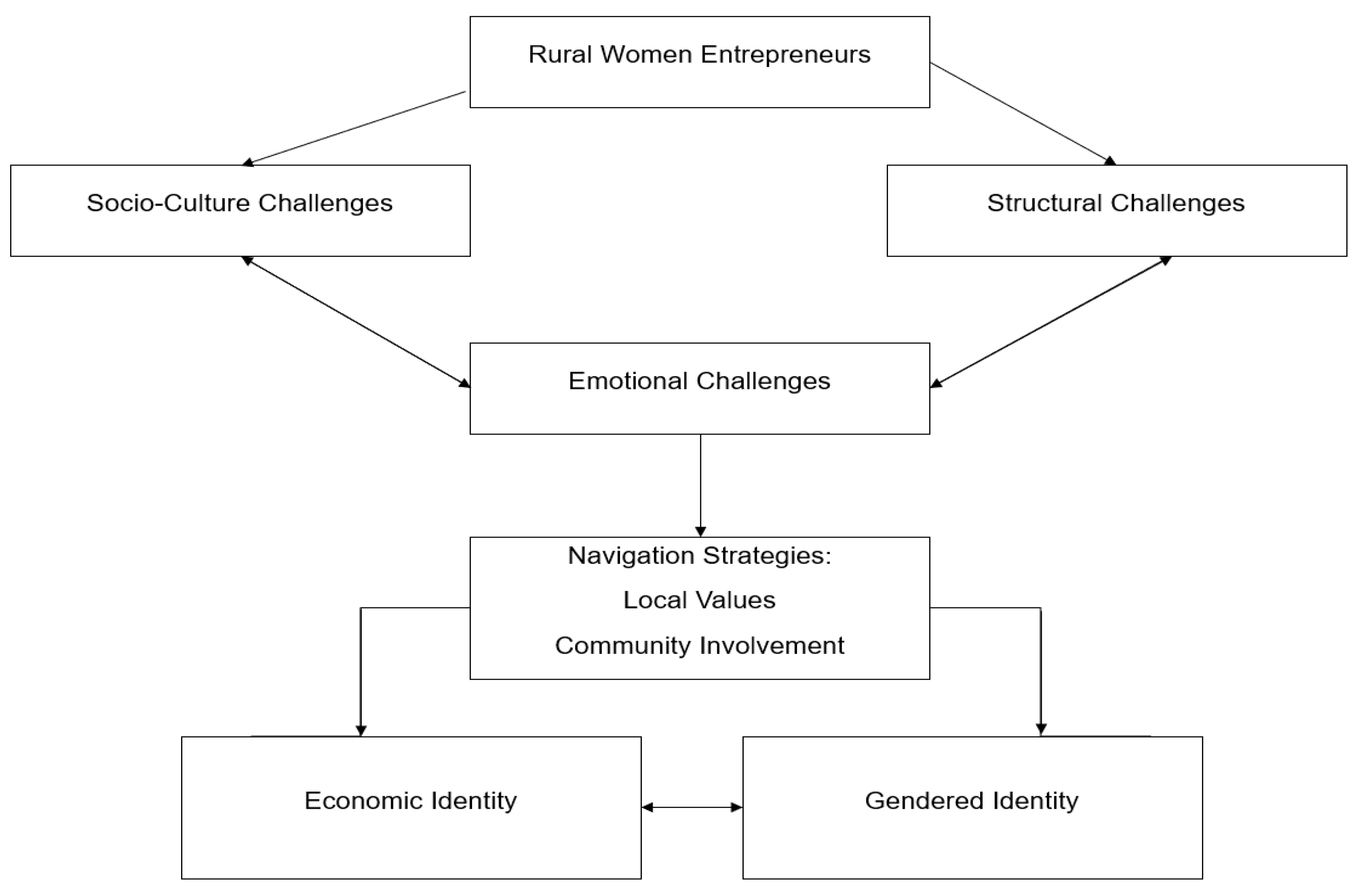
Figure 1 presents the conceptual framework underpinning this study, grounded in the Gender and Development (GAD) perspective. The model illustrates how the entrepreneurial experiences of rural women are shaped by the interplay of socio-cultural and structural challenges, reflecting the broader gendered power relations embedded in rural Indonesian communities. These constraints—including patriarchal norms, mobility restrictions, asset inequalities, and limited institutional support—produce a set of emotional challenges that women must continually negotiate as part of their entrepreneurial journeys.
Drawing on GAD principles, the framework shows that women respond to these layered constraints through navigation strategies rooted in local cultural values and community involvement. Such strategies represent forms of negotiated agency, whereby women adapt to gendered expectations while simultaneously creating spaces for economic participation and decision-making. Through this ongoing negotiation, women construct and balance two interconnected identities: an economic identity, linked to income generation and entrepreneurial roles, and a gendered identity, shaped by social norms, caregiving responsibilities, and community expectations.
The bidirectional relationship between these identities reflects GAD’s emphasis on empowerment as a dynamic, relational process rather than a linear shift from constraint to autonomy. The figure thus conceptualizes rural women’s entrepreneurship as both shaped by and shaping local gender systems, illustrating how everyday practices can gradually contribute to the transformation of gendered structures.
Rural women entrepreneurs form the core of the framework, facing a combination of socio-cultural, emotional, and structural challenges every day that shape their entrepreneurship experiences. These challenges are often inseparable in practice. Socio-cultural constraints, including traditional gender norms, community expectations, and religious values, intersect with emotional challenges such as psychological stress, low confidence, and social stigma. Structural limitations, such as restricted access to capital, limited mobility, inadequate policy support, and exclusion from formal decision-making arenas, further compound these challenges, reflecting the intersectionality, a key concept of the GAD framework. This pattern reflects intersectional forms of marginalization, in which gendered disadvantage is compounded by factors such as ethnicity, age, marital status, and geographic location, shaping women’s access to resources and legitimacy in rural entrepreneurial contexts [50,51].
Women adopt diverse navigation strategies in response to the multi-layered constraints. Those include negotiation, adaptation, silent resistance, and community-rooted resilience. These strategies reflect the relational nature of power, another foundational concept of the GAD framework. Rural women entrepreneurs often negotiate space for autonomy within the boundaries of cultural acceptability to gain legitimacy in entrepreneurship by leveraging social roles, religious status, or networks [38,51]. There are two contextual dimensions to navigating these constraints: local values and community involvement. These elements function both as sources of support and mechanisms of control. For example, local value codes may constrain women’s mobility, but at the same time, community networks such as savings groups can foster solidarity and provide informal mentorship. These dynamics underscore the importance of addressing both practical and strategic gender needs, a key concept within the GAD framework of any development intervention. This encompasses access to skills, childcare, and income, as well as leadership, voice, and agency [32,52].
Economic and gendered identity constitute the final layer of the framework, highlighting the complex interplay that leads to the study’s construction outcomes. Through entrepreneurship, women may begin to redefine themselves as economic actors, leaders, or innovators who challenge the historical expectations imposed upon them. These identities can develop influence through the ongoing negotiation between agency and structure. Overall, the diagram illustrates that the central premise of the GAD framework is that gender is not merely an individual constraint but also a product of social systems, power relations, and institutionalized inequality. Consequently, women’s empowerment requires more than mere inclusion; it also demands transformation.
A central premise of this study is that rural women’s entrepreneurship in Indonesia does not operate in isolation, but is continually shaped by socio-cultural and structural power relations. These domains intersect and frequently generate emotional pressures that are often interpreted as individual shortcomings rather than manifestations of gendered constraints. Consistent with Moser [23] view of empowerment as an ongoing negotiation within unequal power structures, this framework positions “emotional challenges” as consequences of socio-cultural and structural challenges. The inclusion of “navigation strategies” as a mediating process reflects women’s active engagement in negotiating autonomy, mobilizing local values, religious networks, and community involvement to make entrepreneurship socially legitimate and personally sustainable. Through these everyday negotiations, women gradually construct intertwined economic and gendered identities, illustrating how agency emerges relationally within the constraints of patriarchal social systems.

4. Methodology

This study adopts a qualitative case study grounded in a social constructionist perspective and interpretive epistemology, following the approach by Burns et al. [53]. A qualitative case study design was selected because it enables an in-depth examination of how women in leadership roles interpret, negotiate, and respond to gendered constraints that cannot be captured through standardized or outcome-based measures. Applying the GAD framework, this research examines how women entrepreneurs in rural Indonesia sustain their business by navigating socio-cultural, emotional, and structural challenges in their environment. This study examines the role that local values and community involvement play in shaping the economic and identity of rural women entrepreneurs in Indonesia. Focusing on power relations, the intersectionality of identity, and practical and strategic gender needs, the GAD framework provides a lens for analyzing the root causes of women’s constraints. The GAD framework’s key concepts examine how women navigate their entrepreneurial journeys while confronting gendered expectations, limited mobility, and systemic barriers. This approach helps reveal entrepreneurship as an economic activity and a socially constructed, gendered process deeply embedded in local contexts.
Using a snowball sampling strategy, this study recruited 22 rural women entrepreneurs operating micro, meso, and small-scale enterprises across Indonesia. The sample reflects contexts characterized by strong patriarchal norms, limited access to capital and business networks, and constrained support systems. The purpose was to explore how these women navigate intersecting socio-cultural and structural barriers throughout their entrepreneurial trajectories. Data were collected through semi-structured interviews conducted by an Indonesian researcher fluent in the local language and familiar with local cultural practices, ensuring contextual sensitivity and rapport. Participant inclusion criteria required active engagement in entrepreneurial activities, involvement in leadership or decision-making roles, and direct experience with gendered constraints that restrict access to resources and opportunities. Additionally, participants were required to have operated their business for at least 3 years and to have held managerial responsibility for at least 1 year. An outline of the sample composition and relevant demographic characteristics is shown in Table 1.
Semi-structured interviews served as the primary method of data collection for this study. All interviews were conducted by an Indonesian member of the research team who was deeply familiar with the local language, cultural norms, and community dynamics, thereby facilitating rich, contextually grounded accounts of participants’ lived experiences. Interviews were carried out via Zoom between May and August 2025, each lasting approximately 60–75 min. With participants’ consent, all sessions were audio-recorded, transcribed verbatim, and subsequently translated from Indonesian into English. The translated transcripts were imported into NVivo for thematic coding and analysis. The analytic process involved iterative cycles of transcription review, data cleaning, coding, and refinement to identify patterned meanings and recurring themes across the dataset. This systematic approach ensured that raw narrative data were transformed into analytically robust findings that could be meaningfully interpreted within the study’s theoretical framework.
Written, signed informed consent was obtained from all participants prior to the start of each interview, in accordance with the ethical principles outlined in the Declaration of Helsinki. Consent forms were provided in both Indonesian and English and clearly described the non-invasive nature of the study, the voluntary basis of participation, and the absence of foreseeable physical, psychological, or social risks. Participants were assured of full confidentiality and anonymity and informed of their right to decline to answer any question or to withdraw from the study at any time without penalty. As the study focused exclusively on entrepreneurship, business practices, and decision-making processes—and did not involve clinical procedures, biomedical interventions, or sensitive personal data—formal institutional review board (IRB) approval was not required. Nonetheless, all procedures adhered to established international standards for ethical conduct in social science research.
The data collected from the semi-structured interview process will be analyzed using thematic analysis, a qualitative method that identifies, analyzes, and reports patterns within the data. Thematic analysis will be applied to categorize recurring responses and participant narratives that align with the key categories relevant to this study. The analysis will be conducted in stages, following data collection, editing, preparation, cleaning, and coding, using NVivo version 15 software.
The data analysis process will include several stages, beginning with familiarization through repeated reading of the interview transcripts. This will be followed by initial coding to generate open codes from meaningful units in participants’ narratives. The next step involves axial coding, which connects emerging categories and explores the relationships between gendered experiences and entrepreneurial decision-making. Finally, the themes will be interpreted using the GAD framework to examine how gender norms, access to resources, and social expectations influence women’s entrepreneurial behavior.

4.1. Reflexive Thematic Analysis Aligned with the GAD Framework

The analysis of the 22 interview transcripts was conducted using reflexive thematic analysis (RTA) as proposed by Braun et al. [54]. This method was chosen for its flexibility in uncovering the social, emotional, and structural dimensions of gendered experience, which align closely with the GAD framework’s focus on relational power and systemic inequality. The analytical process followed six stages:
  • Familiarization through repeated reading of transcripts.
  • Open coding of meaning units reflecting constraints, agency, and transformation.
  • Axial grouping to connect related codes and identify subthemes.
  • Interpretive review of each theme against the GAD distinction between practical and strategic gender needs [55].
  • Refinement and naming of themes based on resonance with the GAD constructs of structure, agency, and transformation.
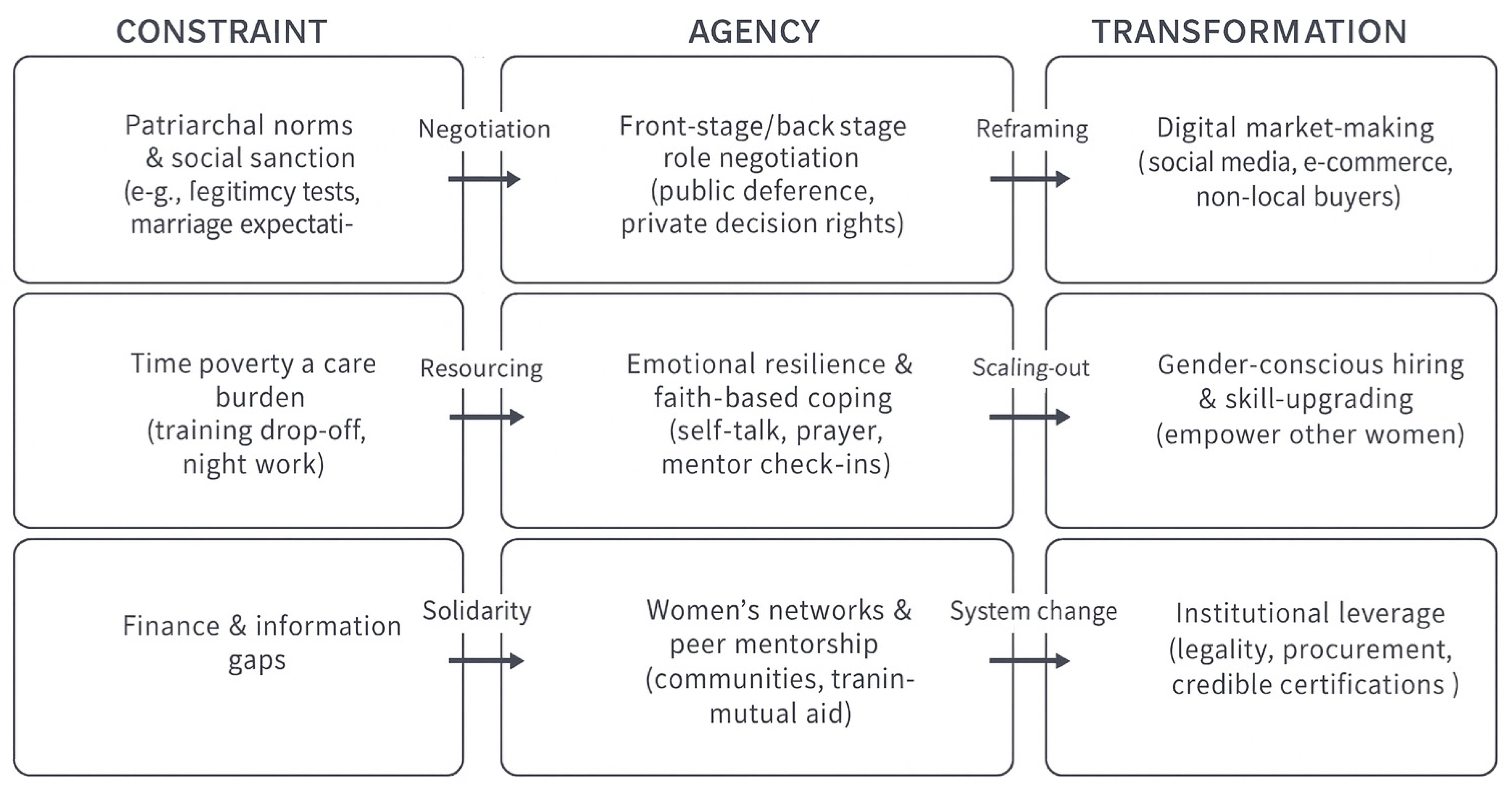
  • Synthesis into a thematic map illustrating the transition from constraint to empowerment among rural Indonesian women entrepreneurs.
Each transcript segment was treated as a unit of analysis representing women’s lived experiences of constraint, adaptation, and negotiation, whether through household roles, institutional interactions, or market strategies. Reflexive engagement was maintained throughout the process, allowing for theoretical sensitivity while acknowledging the lead researcher’s positionality as both an insider (in terms of cultural familiarity) and an outsider (in terms of analytic interpretation).
To ensure validity and reliability, the study employed multiple verification strategies. These included iterative peer debriefings, double-coding a 15–20% sample to assess interpretive convergence, maintaining a detailed codebook to ensure analytical consistency, and including deviant cases to preserve the data’s richness and complexity. Reflexive journaling and continuous comparison between codes, subthemes, and theoretical constructs further strengthened analytic rigor. Together, these measures enhanced the study’s methodological transparency and confirmed the credibility of the interpretive findings. This approach integrates inductive insights with the GAD framework to illuminate how women entrepreneurs navigate patriarchal constraints, build adaptive agency, and foster transformative empowerment, aligning empirical findings with the broader gender and development discourse [56,57]. A summary of the coding structure and the corresponding GAD dimensions is presented in Table 2.

4.2. Thematic Map

The relational pattern of themes that emerged from the reflexive thematic analysis is illustrated in Figure 2, which visualizes the dynamic progression from structural constraint to adaptive agency and to transformative empowerment within the GAD framework. Women lived experiences in entrepreneurial contexts reveal how gendered structures initially manifest as patriarchal constraints and social policing, then evolve into adaptive strategies of role negotiation and emotional resilience, and culminate in transformative outcomes such as digital empowerment, gender-conscious leadership, and intergenerational spillovers. The mapping illustrates that this trajectory is neither linear nor uniform; rather, it represents an iterative, context-dependent process in which structural barriers are continuously negotiated and reframed through agency. Arrows between columns symbolize these transitions: negotiation, resourcing, and solidarity, to reframing, scaling out, and system change, demonstrating how women entrepreneurs progressively expand their spheres of influence from private adaptation to public transformation. This integrative framework provides the analytical foundation for the following section, which details each theme with supporting evidence from participants’ narratives.

4.3. Analytical Sufficiency, Saturation, and Researcher Positionality

The sample size of 22 interviews was determined by analytical sufficiency rather than numerical representativeness. Consistent with reflexive thematic analysis, sampling aimed to achieve depth, diversity of experience, and theoretical relevance, rather than statistical generalization [54]. Participants were selected to reflect variation in age, marital status, caregiving responsibilities, enterprise type, and community context, enabling the analysis to capture a range of gendered constraints and entrepreneurial strategies across rural Indonesian settings.
Thematic saturation was assessed iteratively during analysis rather than treated as a fixed threshold. By the later stages of data collection, no substantively new themes were identified; subsequent interviews primarily reinforced, nuanced, or deepened existing patterns related to constraint, negotiated agency, and adaptive practices. This repetition at the level of meaning, rather than surface description, indicated that the dataset was sufficient to support the study’s analytical aims.
The researcher’s positionality also played a critical role in shaping both data collection and interpretation. Interviews were conducted by an Indonesian researcher with cultural and linguistic proximity to the participants, facilitating trust, contextual sensitivity, and access to nuanced accounts of gendered experience that might otherwise have remained inaccessible to an external interviewer. At the same time, reflexive practices—including memo writing, iterative code refinement, and regular analytic review—were employed to critically examine how the researcher’s positional position informed interpretation. Rather than being treated as a source of bias to be eliminated, researcher positionality was engaged as an analytic resource, enabling deeper insight into culturally embedded forms of agency, legitimacy, and negotiation.
These considerations support the analytical adequacy of the sample and the methodological rigor of the study, aligning with established qualitative standards for reflexive thematic analysis. The following section elaborates on these themes in detail, illustrating how individual strategies of adaptation and resilience intersect with broader structural forces shaping gendered entrepreneurship in Indonesia.

5. Findings

The findings of this study are organized around three interrelated themes that emerged from the thematic analysis: constraint, agency, and transformation. These themes capture recurrent patterns in rural Indonesian women’s entrepreneurial experiences and are presented sequentially to provide analytical clarity. At the same time, the findings demonstrate that these dimensions frequently overlap and interact in practice, reflecting the dynamic and relational nature of women’s lived experiences rather than discrete or linear stages.

5.1. Constraint: Patriarchal Norms and Structural Limitations

Addressing Objective 1: Identify the socio-cultural and structural constraints shaping rural Indonesian women’s entrepreneurial activity.
Across nearly all interviews, participants described living and working within locally dominant social norms that shape how women’s roles are evaluated through domestic and marital roles. Expectations of modesty, deference to men, and adherence to religious or adat norms (the unwritten, traditional code that shapes a community’s identity and provides a framework for issues like marriage, inheritance, and land use, often coexisting with formal and religious laws) constrained their public visibility as entrepreneurs.
“People usually ask, ‘How old are you now? Where do you work?’ From there, the next questions often come: ‘When will you get married? When will you have children?’ These questions and society’s expectations narrow my space to grow as a woman because I feel chased by the timeline to become a housewife, to marry, or to live with someone, before I can choose to grow in the path I want.”
(Interviewee 1)
“Because the mindset of people outside is different… comments like, ‘you’re a girl, if you’re not married, you must get married.’ That’s pressure.”
(Interviewee 4)
Participants also described structural constraints that reinforced these social expectations. Limited access to capital, training, and property ownership was commonly reported, particularly where credit systems required collateral registered under a male relative’s name. These institutional arrangements restricted women’s independent access to formal financial resources. Time poverty further intensified these constraints. Women frequently described managing entrepreneurial activities alongside childcare, household labor, and caregiving responsibilities, resulting in fragmented work schedules and interrupted participation in training or market activities.
“Sometimes when there’s training, I have to leave halfway because my child is sick… It’s hard to balance, but we have to keep going.”
(Interviewee 2)
“At first, it was difficult because I live with my family and have to help with household chores. Fortunately, my sewing workspace is also at home, so after finishing house chores early in the morning, I can immediately start sewing or organizing orders. But because my sewing place is at home, my time often overlaps—sometimes my mother suddenly asks me to help cook or take care of other things.”
(Interviewee 4)
These constraints were primarily experienced as everyday survival challenges related to time availability, access to tools, and childcare responsibilities.

5.2. Agency: Negotiation, Resilience, Collective Support, and Local Values as Navigation Strategies

Addressing Objective 2: Examine how women exercise negotiated agency within culturally sanctioned boundaries.
Despite these constraints, participants described a range of negotiated practices that allowed them to pursue entrepreneurial activities while maintaining social legitimacy. One common strategy involved allowing male partners to serve as public representatives while women retained control over daily operations, finances, and strategic decisions.
“In public, my husband is the one talking, but behind the scenes, I handle everything, the bookkeeping, suppliers, even prices.”
(Interviewee 5)
“Coincidentally, I used to be active in organizations, so I have experience in the activist world. And I also married a husband who has a good understanding of gender. Meaning he is not patriarchal and is very supportive. … when there is a clash with cultural expectations, usually my husband becomes the shield. He is the one who gives the reasons, takes my place, or does the work that I should have done.”
(Interviewee 3)
Several participants emphasized the need to limit their public visibility in order to preserve social harmony, while continuing to exercise influence within the household or enterprise.
“As I said earlier, I should not highlight my role or appear too much. Even though in reality it’s not like that, when dealing with people like that, or those whose views cannot be changed, whether I want to or not, I have to follow that path. The purpose is so that in people’s eyes, my husband is still respected. Even though in reality, I always respect my husband, both on and off stage, but not everyone knows that. … I give it to my husband. We cannot stand against such a strong current. … In decision-making, we still discuss, and I still have a big role in operational decisions and others.”
(Interviewee 18)
Emotional resilience and faith-based coping were also prominent across participants’ narratives. Women frequently described gratitude, prayer, and positive self-talk as daily practices that helped them manage uncertainty, social pressure, and business risk. Faith was framed as a stabilizing resource that supported persistence and emotional balance during periods of difficulty.
“When my business faced difficulties, I kept reminding myself that God has brought me this far, so He will not leave me halfway. Every time I pray, I feel calmer and more focused on solving the problem.”
(Interview 9)
“I’ve already come this far. God has brought me this far. There must be something good for this business.”
(Interview 12)
Others explained how religious conviction provided motivation and endurance:
“I always start the day with prayer and gratitude. When orders are few or when people doubt my work, I say to myself that Allah will open the door in His time. That belief gives me energy to keep going.”
(Interview 16)
“I deal with the pressure by praying and talking with my mom or close friends. Usually, after that, I feel calmer.”
(Interview 3)
“I’ve already come this far. God has brought me this far. There must be something good for this business. So as long as it’s halal, I keep fighting.”
(Interview 4)
Peer networks and women’s communities further supported participants by providing emotional reassurance and practical guidance. Informal solidarity reduced isolation and created spaces for sharing experiences:
“The women entrepreneurs all supported and encouraged each other… if one friend was struggling, others gave support.”
(Interview 12)
“Even if they don’t help directly with concrete solutions, I believe they bring prayers. That’s important for me. I have friends, all of them women, with different job backgrounds. If I have a problem, usually I invite them to meet. That’s where we share stories with each other… it helps a lot.”
(Interview 20)
In addition, participants drew on local cultural values as an important source of agency. Intergenerational knowledge transmitted through mothers, elders, and senior women shaped standards of quality, ethics, and meaning in their work. These values enabled innovation while remaining aligned with community expectations:
“When we talk about local traditions that support this business, it’s very evident in the way the mama-mama (women artisans) work… The senior artisans still hold on to the belief that a noken must be made the right way, using natural materials like tree bark and fibers that have been used by our ancestors for generations… When I came up with new ideas, like making pouches or slings, at first they were hesitant… but after I explained the purpose, they started to open up. We’re not just selling bags; we’re sharing stories and a way of life that has existed for a long time in the land of Papua.”
(Interview 15)
Everyday practices of communal reciprocity further supported entrepreneurial activity, particularly where formal resources were limited.
“I think people in Dobo have this natural habit from our local traditions of helping one another without saying much… when a ship arrives late at night and I can’t go to the port, my neighbors or relatives will say, ‘Don’t worry, we’ll help unload.’ There’s no discussion about payment… I’ve also learned from my parents’ values, that when you work, you must be honest and not greedy.”
(Interview 18)
“What I’m grateful for is that in Sumba, woven fabrics hold very high cultural value. Almost every traditional ceremony requires woven fabric… This helps me always have material supplies… And when tourists come to the village, they help promote my products as souvenirs. This kind of support means a lot because it’s not only about business, but also about mutual trust.”
(Interviewee 16)
These accounts show that women exercised agency through role negotiation, emotional resilience, peer support, and culturally embedded practices, enabling them to sustain their enterprises while navigating restrictive social environments.

5.3. Transformation: Digital Empowerment and Gender-Conscious Leadership

Addressing Objective 3: Distinguish adaptive practices from outcomes indicative of broader change in access, legitimacy, or opportunity structures.
Not all forms of entrepreneurial growth observed in this study reflected broader change beyond individual or collective adaptation. In this subsection, transformation refers only to practices that altered women’s access to markets, redistributed opportunities, or expanded decision-making authority beyond the immediate enterprise. A smaller but distinct group of participants described such outcomes. One area where these shifts were evident was digital adoption. The use of social media platforms and e-commerce enabled women to reach customers beyond their local communities, reducing their dependence on face-to-face transactions and on local gatekeepers.
“I learned about digital marketing and how to use social media to sell products… now I have customers from outside Flores.”
(Interview 1)
“At first, I only sold to neighbors and people around the village, but after joining online training, I started using Instagram and WhatsApp Business. Now my customers come from other islands, even Java and Bali.”
(Interview 10)
Participants also described how business expansion enabled them to create opportunities for other women through employment and skills development. Several entrepreneurs intentionally prioritized recruiting women and supporting their learning within the enterprise.
“Now I employ mostly women. They are like my younger sisters. I want them to grow, too.”
(Interview 6)
“When I recruit staff, I deliberately look for women who don’t yet have confidence. I tell them, ‘You can do this; we’ll learn together.’ Some of them were housewives before, and now they can earn and help their families. That makes me proud.”
(Interview 16)
These accounts indicate that, in some cases, entrepreneurial activity extended beyond sustaining individual livelihoods to generate wider access to income, skills, and participation for other women. Such practices marked observable changes in opportunity structures within local economic settings, distinguishing them from adaptive strategies oriented solely toward coping or survival.

5.4. Integrative Interpretation

Synthesizing across analytic levels, the findings reveal a continuum in which constraint, agency, and transformation coexist and dynamically interact rather than follow a linear trajectory. Women’s empowerment is not presented as an outcome, but rather as an ongoing process of negotiation, oscillating between adaptation and resistance. Within this process, participants continually recalibrate their roles, striking a balance between conforming to gendered expectations and engaging in strategic acts of defiance and innovation.
The thematic map, as shown in Figure 2, visualizes this cyclical movement: individual resilience [59] emerges in the shadow of constraint, is nurtured through emotional, social, and spiritual coping, and is culturally grounded in coping shaped by local values, and gradually extends outward into collective and institutional transformation. Acts of perseverance, such as maintaining a business while managing domestic responsibilities or using faith to reinterpret hardship, accumulate over time into collective empowerment through mentoring, digital visibility, and gender-conscious leadership.
From a GAD perspective, these transitions demonstrate how addressing women’s practical gender needs—such as time flexibility, access to credit, and mobility—can evolve into the pursuit of strategic gender interests, including leadership, voice, and normative change, once institutional environments begin to value women’s adaptive strategies. The continuum thus reflects not a unidirectional shift from oppression to liberation, but a spiraling process of empowerment in which personal adaptation gradually transforms structural boundaries.
Consequently, Indonesian women entrepreneurs emerge not as passive participants in the economy but as agents of social transformation. Their enterprises serve as both livelihood mechanisms and subtle forms of activism, reshaping gendered norms of work, authority, and legitimacy. The iterative interplay among constraint, agency, and transformation underscores the potential of women’s entrepreneurship to catalyze systemic gender equity, achieved through everyday acts of negotiation, resilience, and solidarity.
The synthesis of these findings underscores that empowerment is not a discrete outcome but a fluid, iterative process situated within specific cultural and institutional contexts. The interplay among constraint, agency, and transformation reveals that women’s entrepreneurship both reproduces and reconfigures gender norms through continuous negotiation. These lived realities underscore the relevance of the GAD framework as a lens for understanding how micro-level adaptations can lead to macro-level change. The following section deepens this interpretation, situating the findings within existing gender-and-development scholarship and outlining their broader theoretical, practical, and policy implications for advancing inclusive and transformative models of women’s entrepreneurship in Indonesia.
While participants reported meaningful gains in confidence, income stability, and social recognition, these outcomes primarily reflect adaptive agency within existing gendered structures. Evidence of broader institutional or structural transformation remained limited and uneven across cases.

6. Discussion and Implications

Building on the findings presented in Section 5.1, Section 5.2, Section 5.3 and Section 5.4, this discussion interprets patterns of constraint, negotiated agency, and bounded transformation through the GAD framework. The findings show that women’s entrepreneurship in rural Indonesia operates not only as an economic activity but also as a site of social negotiation in which gendered expectations are managed, reinterpreted, and occasionally reconfigured. Most entrepreneurial practices documented in this study reflect adaptive forms of agency that enable women to sustain their ventures while maintaining social legitimacy within patriarchal contexts. In fewer cases, however, these negotiated practices extend beyond individual coping to produce observable changes in access, visibility, and opportunity structures within families, markets, and community settings. Taken together, the findings support an understanding of empowerment as a relational and processual phenomenon, emerging through ongoing negotiation rather than as a linear or uniformly transformative outcome. The sections that follow situate these insights within GAD scholarship and derive implications for theory and practice.
While prior studies on rural women’s entrepreneurship often frame entrepreneurial participation as either a pathway to empowerment or a survival strategy that reproduces existing gender hierarchies, this study’s findings complicate this binary. Much of the existing literature implicitly equates increased participation, income generation, or market access with empowerment, particularly within policy-oriented accounts. In contrast, the present findings show that most entrepreneurial practices among rural Indonesian women function as negotiated and adaptive forms of agency that sustain livelihoods without necessarily altering underlying power relations. Transformation, when it occurs, is neither uniform nor inevitable, but emerges selectively through practices, such as digital market-making and gender-conscious leadership, that expand access and legitimacy beyond the household level. This distinction refines GAD-informed interpretations by empirically distinguishing between adaptation and transformation rather than treating empowerment as an assumed outcome of participation.

6.1. Implications to Theory

This study contributes to GAD scholarship and to the broader literature on women’s entrepreneurship in patriarchal contexts in several ways. First, it refines the conceptualization of empowerment by framing it as a dynamic and context-dependent process rather than a linear, outcome-driven trajectory. The findings indicate that empowerment unfolds through ongoing negotiation between constraint and agency, with women navigating shifting boundaries of legitimacy and decision-making rather than moving unidirectionally from subordination to liberation. This perspective highlights empowerment as an adaptive continuum, characterized by incremental and relational adjustments in practice, perception, and social positioning.
In addition, the study advances the concept of negotiated agency as an analytical bridge between adaptation and transformation. The findings demonstrate that conformity and resistance are not mutually exclusive but frequently operate in tandem, allowing women to pursue entrepreneurial activity while maintaining social legitimacy. Within a GAD framework, this insight underscores how agency is often exercised within culturally sanctioned boundaries, where practices such as delegating public authority to male figures coexist with women’s control over private decision-making. Importantly, these practices primarily reflect adaptive agency, though in some instances they create conditions that may enable broader shifts in influence or access.
Equally important, the analysis integrates micro-level psychosocial mechanisms—including faith-based resilience, emotional regulation, and peer solidarity—into GAD-based interpretations of empowerment. Rather than treating these mechanisms as merely supportive or contextual, the findings show how they function as culturally grounded resources through which women sustain entrepreneurial engagement and justify their agency. This extends GAD analysis beyond institutional and economic dimensions by recognizing affective and moral resources as integral to how empowerment is experienced and enacted, particularly in contexts where formal authority remains constrained.
Finally, the study contributes methodologically by demonstrating the value of reflexive thematic analysis (RTA) for examining the subtle and iterative negotiations that characterize women’s entrepreneurial lives. RTA enables an interpretive engagement with participants’ narratives that captures the interaction between individual subjectivities and gendered social structures, strengthening GAD’s analytical capacity to account for process, ambiguity, and relational power in entrepreneurship research.

6.2. Implications to Practice

This study offers practical insights for policymakers, development agencies, and practitioners seeking to support gender-equitable entrepreneurship ecosystems in Indonesia and comparable developing contexts. The findings indicate that effective interventions must address both practical and strategic gender needs, while recognizing that structural inequalities cannot be resolved through participation-oriented programs alone.
Financial inclusion initiatives should move beyond microcredit provision to address systemic barriers related to asset ownership and collateral requirements. Measures such as joint property titling, simplified lending procedures, and gender-responsive banking policies may reduce institutional constraints that disproportionately limit women’s access to capital.
Entrepreneurial training programs should also adopt family-responsive and flexible delivery models, including childcare-linked training and modular learning schedules. Such approaches acknowledge time poverty as a structural gender constraint rather than an individual limitation, enabling more sustained participation by women with caregiving responsibilities.
The findings further highlight the role of digital capacity-building in expanding market access and strengthening entrepreneurial confidence. Programs that support digital literacy, e-commerce adoption, and online brand development can enhance women’s visibility and economic reach. Partnerships among local cooperatives, non-governmental organizations, and technology providers are particularly important for extending these opportunities at scale. In addition, policy recognition of informal women’s networks as legitimate entrepreneurial ecosystems is essential. The peer communities observed in this study function as sites of mentorship, emotional support, and resource exchange. Formal engagement with these networks—through capacity-building grants, mentorship linkages, and leadership development initiatives—can strengthen women’s collective capacity without undermining their locally embedded practices.
Finally, practitioners should approach empowerment as an ongoing and negotiated process rather than a fixed outcome. Interventions that incorporate iterative reflection and adaptive learning mechanisms allow women to define success according to their own priorities, whether economic stability, community participation, or intergenerational support. Importantly, such programs should remain culturally responsive, building on local values and social norms rather than imposing externally defined models of empowerment.
These implications suggest that women’s entrepreneurship in rural Indonesia operates primarily as a space of adaptive agency, with potential—under supportive institutional conditions—to contribute to broader changes in access, legitimacy, and opportunity. By aligning development practice with women’s lived realities, these recommendations support a GAD-informed approach that emphasizes structural responsiveness while avoiding assumptions of automatic transformation.

7. Conclusions and Recommendations

This study examined how rural Indonesian women entrepreneurs navigate gendered social structures and institutional constraints shaping their entrepreneurial trajectories. Grounded in the GAD framework and based on a reflexive thematic analysis of 22 in-depth interviews, the findings illuminate a dynamic interplay between constraint and agency through which empowerment emerges as a negotiated and processual phenomenon rather than a linear outcome. Women’s entrepreneurial practices were shown to be simultaneously constrained by patriarchal norms and enabled by adaptive strategies, including resilience, faith-based coping, negotiation, and collective support rooted in local cultural values.
The findings challenge linear models of empowerment that equate participation with liberation. Instead, empowerment is shown to evolve through iterative adaptation and relational negotiation, as women work within culturally sanctioned boundaries to expand their scope of action and legitimacy. While some practices demonstrated potential for broader change, most forms of agency observed in this study functioned as adaptive responses that sustained entrepreneurial activity under constraint rather than as direct indicators of structural transformation. This distinction refines GAD scholarship by clarifying the analytical boundary between adaptation and transformation and by advancing the concept of negotiated agency as a key mechanism through which women navigate power, in line with the literature [60].
From a practical perspective, the study underscores the importance of interventions that address the intersectionality of gender [50] and both practical and strategic gender awareness needs [61,62,63]. Policies that combine access to finance reform, family-responsive training models, digital capacity-building, and recognition of informal women’s networks are more likely to support sustained entrepreneurial engagement and incremental gains in agency. Such approaches align development practice more closely with women’s lived realities and sociocultural contexts.
Women’s entrepreneurship in rural Indonesia can be understood less as an inherently transformative force and more as a contextually embedded practice of negotiated agency, with the potential, under supportive institutional conditions, to contribute to gradual shifts in access, legitimacy, and opportunity. By conceptualizing empowerment as an ongoing process shaped by cultural norms, relational power, and everyday practice, this study positions women entrepreneurs not as passive beneficiaries of development but as active participants in shaping pathways toward more inclusive and responsive forms of development.
These conclusions are analytically grounded in the experiences of the women interviewed and are intended to offer context-sensitive insights rather than generalized claims applicable to all women entrepreneurs or settings.

Limitations and Recommendations for Further Research

While this study provides contextually grounded insights into the intersection of gender, entrepreneurship, and development, several limitations should be acknowledged. First, the research employs a qualitative design, involving 22 in-depth interviews with rural Indonesian women entrepreneurs. Although this approach enabled rich and nuanced analysis, the findings are not intended to be statistically generalizable beyond the specific sociocultural contexts examined. Future research could employ mixed-method or longitudinal designs to examine how processes of negotiated agency and empowerment unfold over time and across regions with differing socio-religious and institutional configurations.
Also, the study focuses primarily on women-led micro, meso, and small enterprises. As a result, the findings may not fully capture the experiences of women operating larger firms, formal corporate ventures, or digitally native startup ecosystems. Comparative research across firm sizes, sectors, and ownership structures would help clarify how institutional environments mediate women’s access to resources, authority, and opportunity within different entrepreneurial settings.
While reflexive thematic analysis facilitated deep interpretive engagement with participants’ narratives, it necessarily relies on researchers’ reflexive judgment as a core analytic resource. Although transparency, iterative coding, and triangulation were used to enhance analytical rigor, future studies incorporating team-based coding, intercoder dialogue, or cross-national comparative designs could further strengthen interpretive robustness and theoretical transferability.
Lastly, the study’s focus on Indonesia provides culturally specific insights but limits direct engagement with transnational and regional dynamics shaping women’s entrepreneurship in Southeast Asia. Comparative research across contexts such as Malaysia, the Philippines, and Vietnam could illuminate both shared mechanisms of negotiated agency and context-specific expressions of empowerment under varying institutional regimes.
Building on these directions, future research may also benefit from integrating neurocognitive, behavioral, and policy-oriented approaches to explore how gendered decision-making, emotional regulation, and digital adaptation interact in entrepreneurial contexts. Such a multidimensional inquiry would enhance the empirical depth and theoretical sophistication of Gender and Development research on entrepreneurship while remaining attentive to context, culture, and power.

Author Contributions

Conceptualization, Y.T. and M.G.; methodology, Y.T.; software, Y.T. and M.G.; validation, Y.T., M.G. and E.R.; formal analysis, Y.T. and M.G.; investigation, Y.T.; resources, Y.T.; data curation, Y.T.; writing—original draft preparation, Y.T. and M.G.; writing—review and editing, Y.T., M.G. and E.R.; visualization, Y.T.; supervision, Y.T.; project administration, Y.T. All authors have read and agreed to the published version of the manuscript.

Funding

This research received no external funding.

Institutional Review Board Statement

Ethical review and approval were waived for this study due to the following reasons: in the methodology section, there is a paragraph that states the ethical approach adopted, indicating we used informed consent in English and Farsi, and IRB approval was not necessary as the questions asked to participants were exogenous to their personal lives and well being, only related to their business.

Informed Consent Statement

Informed consent was obtained from all subjects involved in the study.

Data Availability Statement

Under the MDPI/Merits “Share upon reasonable request” policy, the anonymized transcripts supporting this article’s conclusions will be made available by the authors, without undue reservation, to any qualified researcher. Requests for access to these data should be addressed to the corresponding authors. Please note that digital recordings of the interviews were not available to protect privacy and maintain the anonymity of the participants.

Conflicts of Interest

The authors declare no conflict of interest.

References

  1. Goncalves, M.; Vasquez, K.G. Exploring women’s entrepreneurial leadership in Mexico: A role-based analysis of motivation and decision-making. Int. J. Export. Mark. 2024, 6, 4–43. [Google Scholar]
  2. GEM. Global Entrepreneurship Monitor 2023/2024 Global Report: 25 Years and Growing; GEM: London, UK, 2024; Available online: https://www.gemconsortium.org/report/global-entrepreneurship-monitor-gem-20232024-global-report-25-years-and-growing (accessed on 9 December 2025).
  3. Hendratmi, A.; Agustina, T.S.; Sukmaningrum, P.S.; Widayanti, M.A. Livelihood strategies of women entrepreneurs in Indonesia. Heliyon 2022, 8, e10520. [Google Scholar] [CrossRef] [PubMed]
  4. Purba, H.J.; Rachmawati, R.R.; Irawan, A.R.; Rola-Rubzen, M.F.; Sudaryanto, T.; Erwidodo, E.; Dermoredjo, S.K.; Yaumidin, U.K. Linkages between gender and rural transformation in Indonesia. Asia Pac. Policy Stud. 2025, 12, e70027. [Google Scholar] [CrossRef]
  5. Imanuella, R.; Santosa, H.; Riantini, D. Women in local governance: Constraints and strategies in Indonesia. J. Southeast Asian Stud. 2025, 56, 201–220. [Google Scholar]
  6. Stacey, N.; Gibson, E.; Loneragan, N.R.; Warren, C.; Wiryawan, B.; Adhuri, D.S.; Steenbergen, D.J.; Fitriana, R. Developing sustainable small-scale fisheries livelihoods in Indonesia: Trends, enabling and constraining factors, and future opportunities. Mar. Policy 2021, 132, 104654. [Google Scholar] [CrossRef]
  7. Aravik, H.; Hamzani, A.I.; Khasanah, N. Women Entrepreneurship in Indonesia: Opportunities and Challenges. Islam. Bank. J. Pemikir. Pengemb. Perbank. Syariah 2025, 10, 327–348. [Google Scholar] [CrossRef]
  8. Setyaningrum, R.P.; Norisanti, N.; Fahlevi, M.; Aljuaid, M.; Grabowska, S. Women and entrepreneurship for economic growth in Indonesia. Front. Psychol. 2023, 13, 975709. [Google Scholar] [CrossRef]
  9. Inkumsah, S.G. Female Entrepreneur’s Perspective on Gender Equality and Strategies for Sustainable Entrepreneurship—A Qualitative Study of Female Entrepreneurs’ Motivation, Challenges, and Contribution to Gender Equality and Sustainability in Entrepreneurship. Master’s Thesis, Gothenburg University Publications Electronic Archive (GUPEA), Gothenburg, Sweden, 2024. Available online: https://gupea.ub.gu.se/items/6a831258-3f51-4853-bc1d-350701dc5ae6 (accessed on 12 September 2025).
  10. Chikwe, C.F.; Kuteesa, K.N.; Ediae, A.A. Gender equality advocacy and socioeconomic inclusion: A comparative study of community-based approaches in promoting women’s empowerment and economic resilience (2022). Int. J. Sci. Res. Updates 2024, 8, 110–121. [Google Scholar] [CrossRef]
  11. Kitole, F.A.; Genda, E.L. Empowering her drive: Unveiling the resilience and triumphs of women entrepreneurs in rural landscapes. In Women’s Studies International Forum; Pergamon: Oxford, UK, 2024; Volume 104, p. 102912. [Google Scholar]
  12. Merluzzi, J.; Burt, R.S. One path does not fit all: A career path approach to the study of professional women entrepreneurs. Entrep. Theory Pract. 2021, 45, 1366–1393. [Google Scholar] [CrossRef]
  13. Yusuf, H.; Fahrudin, A.; Fahrudin, F.I. Inequality and Cultural Obstacles of Women Empowerment: The Case of Indonesia. In The Palgrave Handbook of Global Social Problems; Springer: Berlin/Heidelberg, Germany, 2024; pp. 1–13. [Google Scholar]
  14. Goncalves, M.; Ahumada, E.D.L.V. A Bibliometric Analysis of Women Entrepreneurship: Current Trends and Challenges. Merits 2025, 5, 9. [Google Scholar] [CrossRef]
  15. Goncalves, M.; Vasquez, K.G. Leadership and entrepreneurial choices: Understanding the motivational dynamics of women entrepreneurs in Mexico. Int. J. Export. Mark. 2024, 6, 161–205. [Google Scholar] [CrossRef]
  16. Goncalves, M.; Haidar, N.; Celik, E. Drivers and motivations of Lebanese women entrepreneurs: Insights from the demand-constraint-choice framework. Cogent Bus. Manag. 2024, 11, 2371068. [Google Scholar] [CrossRef]
  17. Goncalves, M.; Papagelis, S.; Nicolitsas, D. Drivers for Women Entrepreneurship in Greece: A Case Analysis of Early-Stage Companies. Businesses 2025, 5, 1. [Google Scholar] [CrossRef]
  18. Goncalves, M.; Trainor, M.; Ursini, A. Exploring Barriers and Enablers for Women Entrepreneurs in Urban Ireland: A Qualitative Study of the Greater Dublin Area. Soc. Sci. 2025, 14, 412. [Google Scholar] [CrossRef]
  19. Challa, R. Equity, not equality: Rethinking gender in development policy. Gend. Dev. Stud. 2025, 29, 25–42. [Google Scholar]
  20. MacArthur, J.; Carrard, N.; Davila, F.; Grant, M.; Megaw, T.; Willetts, J.; Winterford, K. Gender-transformative approaches in international development: A brief history and five uniting principles. In Women’s Studies International Forum; Pergamon: Oxford, UK, 2022; Volume 95, p. 102635. [Google Scholar]
  21. Tagaza, R.; Manalansan, D. Teaching gender and culture: A historical and pedagogical inquiry into gender and development in Philippine education. Int. J. Cult. Hist. Relig. 2025, 7, 482–496. [Google Scholar] [CrossRef]
  22. Haque, M.N.; Beckers, D.; Costales, E.; Aad, S.; Sharifi, A.; Mora, L. A systematic review of research on just, equitable, responsible, and inclusive smart cities. Technol. Soc. 2025, 83, 103050. [Google Scholar] [CrossRef]
  23. Moser, C.O. From gender planning to gender transformation: Positionality, theory and practice in cities of the global South. Int. Dev. Plan. Rev. 2021, 43, 205–229. [Google Scholar] [CrossRef]
  24. Unesco. Education for All 2000 Assessment: Global Synthesis. 2000. Available online: https://unesdoc.unesco.org/ark:/48223/pf0000120058 (accessed on 8 December 2025).
  25. Lima, R. Social innovation through regenerative perspectives: A theoretical approach on gender-based violence system. In Proceedings of the IASDR 2023: Life-Changing Design, Milan, Italy, 9–13 October 2023. [Google Scholar] [CrossRef]
  26. Goncalves, M.; Sartipi, S.; Asadi Damavandi, G. Leadership and Entrepreneurial Choices: Understanding the Motivational Dynamics of Women Entrepreneurs in Iran. Merits 2025, 5, 1. [Google Scholar] [CrossRef]
  27. Kiradoo, G. The role of women entrepreneurs in advancing gender equality and social change. Res. Asp. Arts Soc. Stud. 2023, 8, 122–131. [Google Scholar]
  28. Mwije, S. Network governance as an alternative policy response to managing infectious disease outbreaks: Lessons from Uganda’s response to the COVID-19 crisis. Risk Hazards Crisis Public Policy 2024, 15, 47–66. [Google Scholar] [CrossRef]
  29. Seliga, L.G. Unpacking the Gendered Discourse of Peace Policy: A Feminist Poststructural Analysis of the United Nations Peacebuilding Commission Gender Strategy. Ph.D. Thesis, Kent State University, Kent, OH, USA, 2023. Available online: https://rave.ohiolink.edu/etdc/view?acc_num=kent1699782620930722 (accessed on 8 December 2025).
  30. Rinaldi, P.N.; Machado, R.S. Women in development vs. Gender and Development in the United Nations Development agenda (1970–1999)|Mulheres no Desenvolvimento x Gênero e Desenvolvimento na agenda de desenvolvimento da ONU (1970–1999). Mural Int. 2025, 16, e82103. [Google Scholar] [CrossRef]
  31. Bazbauers, A.R.; Madkour, N. Gender and the Multilateral Development Banks: From WID to GAD to Retroliberal WID. Prog. Dev. Stud. 2024, 24, 165–184. [Google Scholar] [CrossRef]
  32. Cullen, B.; Lefore, N.; Debevec, L.; Snyder, K.A. The Tyranny of Tools: The Politics of Knowledge Production in Gender Research. In Gender, Power and Politics in Agriculture: Revisiting Theory and Practice; Springer International Publishing: Cham, Switzerland, 2024; pp. 137–166. [Google Scholar] [CrossRef]
  33. Silalahi, W.E.H.; Malau, H.; Sinaga, J.T. Pengaruh Struktur Modal Dan Pertumbuhan Penjualan Terhadap Profitabilitas Pada Perusahaan Sektor Transportasi Yang Terdaftar Di Bursa Efek Indonesia Tahun 2021–2023. PESHUM J. Pendidik. Sos. Dan Hum. 2025, 4, 4952–4960. [Google Scholar]
  34. Greig, A.; Kimmel, M.; Lang, J. Men, masculinities, and the GAD framework: Beyond women-only empowerment. Gend. Dev. 2023, 31, 44–58. [Google Scholar]
  35. Loh, X.M.; Lee, V.H.; Tan, G.W.H.; Ooi, K.B.; Dwivedi, Y.K. Switching from cash to mobile payment: What’s the hold-up? Internet Res. 2021, 31, 376–399. [Google Scholar] [CrossRef]
  36. Guthridge, M.; Kirkman, M.; Penovic, T.; Giummarra, M.J. Promoting gender equality: A systematic review of interventions. Soc. Justice Res. 2022, 35, 318–343. [Google Scholar] [CrossRef]
  37. Edwards, G.A.S.; Cornwall, A. New Democratic spaces? The politics and dynamics of institutionalised participation. IDS Bull. 2014, 35, 1–10. [Google Scholar]
  38. Farhane-Medina, N.Z.; Luque, B.; Tabernero, C.; Castillo-Mayén, R. Factors associated with gender and sex differences in anxiety prevalence and comorbidity: A systematic review. Sci. Prog. 2022, 105, 00368504221135469. [Google Scholar] [CrossRef]
  39. Rathgeber, E.M. WID, WAD, GAD: Trends in research and practice. J. Dev. Areas 1990, 24, 489–502. [Google Scholar]
  40. Freeman, C. Women entrepreneurs in rural Indonesia: Resistance, resilience, and reinvention. Asian J. Women’s Stud. 2015, 21, 289–308. [Google Scholar]
  41. Chen, C. The healing economy: Women entrepreneurs and emotional labor in rural China. Asian J. Women’s Stud. 2024, 30, 123–140. [Google Scholar]
  42. Mosedale, S. Assessing women’s empowerment: Towards a conceptual framework. J. Int. Dev. 2005, 17, 243–257. [Google Scholar] [CrossRef]
  43. Davis, K. Intersectionality as critical methodology. In Writing Academic Texts Differently; Routledge: London, UK, 2014; pp. 17–29. [Google Scholar]
  44. Lindberg, M.; Forsberg, L.; Karlberg, H. Gender dimensions in women’s networking for social innovation. Innov. Eur. J. Soc. Sci. Res. 2016, 29, 410–423. [Google Scholar] [CrossRef]
  45. Siam, I.M.; Khalifeh, A.; Wahsheh, F.R.M.; Alshihabat, K. Entrepreneurship Education For Pre-University Students In The Kingdom of Jordan. J. Namib. Stud. 2023, 34, 5247. [Google Scholar]
  46. Utami, L.D.; Amin, M.; Mustafiyanti, M.; Alon, F. Masjid Friendly: Mosque Based Economic Empowerment. Pengabdi. J. Abdimas 2023, 1, 97–106. [Google Scholar] [CrossRef]
  47. Nikghadam-Hojjati, S.; Marchetti, E.; Gustavsson, M.; Ferrada, F.; Oliveira, A.I.; Halvarsson Lundqvist, A.; Fogelberg Eriksson, A.; Matei, O.; Barata, J.; Andreica, L.; et al. Gender-Responsive Research and Innovation: Issues and Initiatives. Sustainability 2025, 17, 6215. [Google Scholar] [CrossRef]
  48. Khoo, Y.H.; Wijeratne, P.; Genda, J. Rethinking gender in community tourism: Case studies from Sri Lanka and Tunisia. Tour. Hosp. Res. 2023, 23, 14–29. [Google Scholar]
  49. Tovar-García, E.D. Factors Contributing to the Relatively Low Gender Gap in Entrepreneurship in Russia. Change Soc. Personal. 2025, 9, 218–241. [Google Scholar] [CrossRef]
  50. Ahmad, I.; Islam, M.R. Empowerment and participation: Key strategies for inclusive development. In Building Strong Communities: Ethical Approaches to Inclusive Development; Emerald Publishing Limited: Leeds, UK, 2024; pp. 47–68. [Google Scholar] [CrossRef]
  51. Lahiri-Dutt, K. Translating the feminist theory of intersectionality into gender analytical frameworks for gender and development. Fem. Theory 2025, 26, 446–467. [Google Scholar] [CrossRef]
  52. Nurlinah; Haryanto. Transmigration village development: The state and community organizations in rural Indonesia. Front. Political Sci. 2024, 6, 1441393. [Google Scholar] [CrossRef]
  53. Lestari, P.; Kurniawan, G.F. Intersectionality and Political Representation: Challenges and Policy Implications for Marginalized Women in Indonesia. J. Soc. Stud. Educ. Res. 2025, 16, 1–38. [Google Scholar]
  54. Moser, C. Gender Planning and Development: Theory, Practice and Training; Routledge: London, UK, 2012. [Google Scholar]
  55. Burns, M.; Bally, J.; Burles, M.; Holtslander, L.; Peacock, S. Constructivist grounded theory or interpretive phenomenology? Methodological choices within specific study contexts. Int. J. Qual. Methods 2022, 21, 16094069221077758. [Google Scholar] [CrossRef]
  56. Braun, V.; Clarke, V.; Hayfield, N.; Davey, L.; Jenkinson, E. Doing reflexive thematic analysis. In Supporting Research in Counselling and Psychotherapy: Qualitative, Quantitative, and Mixed Methods Research; Springer International Publishing: Cham, Switzerland, 2023; pp. 19–38. [Google Scholar]
  57. Chakrabarty, A. An Analysis of Power in gender, Energy, and Sustainable Development (GAD) Framework. In Women as Creators and Subjects Across Disciplines and Cultures; Cambridge Scholars Publishing: Newcastle upon Tyne, UK, 2024; p. 193. [Google Scholar]
  58. Chakrabarty, A. Gendering development: Rethinking agency and transformation. Dev. Pract. 2024, 34, 157–169. [Google Scholar]
  59. Thorne, S. Interpretive Description: Qualitative Research for Applied Practice; Taylor & Francis: Abingdon, UK, 2025; p. 354. [Google Scholar]
  60. Adomako, S.; Danso, A.; Boso, N. Resilience and entrepreneurial orientation: Empirical insights from female-owned small firms. J. Small Bus. Manag. 2023, 61, 34–58. [Google Scholar]
  61. Begum, A.; Amin, R.; Nath, H.; Nath, D.; Paul, M.; Khatun, M. Intersectionality of Gender with Race, Class and Ethnicity and its Impact on Economic Development: A Complex and Multi-Layered Framework. Libr. Prog.-Libr. Sci. Inf. Technol. Comput. 2024, 44, 16816. [Google Scholar]
  62. Brush, C.G.; de Bruin, A.; Welter, F. A gender-aware framework for women’s entrepreneurship. Int. J. Gend. Entrep. 2018, 10, 2–24. [Google Scholar]
  63. Imanuella, S.F.; Idris, A.; Kamaruddin, N. Social entrepreneurship and rural development in post-independence Indonesia. Soc. Enterp. J. 2025, 21, 46–66. [Google Scholar] [CrossRef]
Figure 1. Conceptual Framework of Rural Women Entrepreneurs. Source: Adapted from GAD Framework, drawing on [49].
Merits 06 00005 g001
Figure 2. Thematic Map of Constraint, Agency, and Transformation (GAD Framework). Source: The authors.
Merits 06 00005 g002
Table 1. Profile of Indonesian women interviewees.
IntervieweeAgeMarital StatusEducationRoleYears of Exp.Industry
Interviewee 137MarriedBachelor of NursingOwner8Food & Beverage
Interviewee 228SingleBachelor of Business ManagementCo-Owner8Food & Beverage
Interviewee 341MarriedVocational High SchoolOwner10Food & Beverage
Interviewee 438MarriedSenior High SchoolOwner5Food & Beverage
Interviewee 539SingleBachelor of AgribusinessOwner17Agribusiness
Interviewee 636MarriedBachelor of Public HealthOwner7Food & Beverage
Interviewee 741SingleBachelor of BiotechnologyOwner7Food & Beverage
Interviewee 836MarriedBachelor of EconomyOwner12Fashion/Traditional Woven
Interviewee 958MarriedJunior High SchoolOwner20 YearsFood & Beverage
Interviewee 1033SingleBachelor of AccountingOwner3 YearsHandicraft
Interviewee 1126SingleBachelor of EducationOwner4 YearsFood & Beverages
Interviewee 1224SingleBachelor of ManagementOwner3 YearsFood & Beverage
Interviewee 1339SingleSenior High SchoolOwner10 YearsFood & Beverage
Interviewee 1455MarriedBachelorOwner12 YearsFood & Beverage
Interviewee 1528SingleBachelor of TourismOwner4 YearsHandicraft
Interviewee 1626SingleBachelor of EconomyOwner6 YearsFashion, Traditional Woven
Interviewee 1739MarriedSenior High SchoolOwner4 YearsFood & Beverage
Interviewee 1834MarriedBachelor of Public AdministrationOwner6 YearsLogistic/Shipping
Interviewee 1935MarriedSenior High SchoolOwner4 YearsFashion/Accessories
Interviewee 2037SingleBachelor of English LiteratureOwner8 YearsFashion/Traditional Woven
Interviewee 2128MarriedBachelor of Arts in DanceOwner5 YearsCreative Industry- Performing Arts
Interviewee 2235MarriedBachelor of TourismOwner6 YearsTour Guide/Tourism
Source: Compiled by the authors.
Table 2. Summary of Codes, Subthemes, and Themes Aligned with the GAD Framework.
ThemeSubthemesIllustrative QuoteGAD Dimension
1. Patriarchal structures and social sanctionGendered legitimacy tests; expectations for deference to men; family and cultural surveillance“Because the mindset of people outside is different… comments like, ‘you’re a girl, if you’re not married, you must have a boyfriend, you must get married.’ That’s pressure.”Structural constraint/social norms
2. Frontstage/back-stage negotiation of rolesTactical compliance; public deference, private leadership“In public, my husband is the one talking, but behind the scenes, I handle everything—the bookkeeping, suppliers, even prices.”Agency within constraint
3. Care burden and time povertyDomestic work overload; childcare–business trade-offs“Sometimes when there’s training, I have to leave halfway because my child is sick… It’s hard to balance, but we have to keep going.”Practical gender needs
4. Limited access to capital and informationBarriers to credit, collateral, and visibility; information asymmetry“Funding? It’s been very difficult to get access to financial support… there’s rarely any socialization about it from the government.”Structural inequality/resource access
5. Community regulation and social policingGossip, envy, and legitimacy through moral conduct“Sometimes, when someone’s business progresses, others may feel threatened. But in our women’s community, we support instead of compete.”Social constraint and collective agency
6. Local Values as Cultural Navigation StrategiesIntergenerational skills and cultural knowledge; Communal reciprocity and mutual support; Traditional ceremonies as market opportunities“Here, whenever there is a traditional ceremony or a large family event, people usually buy local products to serve. That becomes a form of indirect support, because my products automatically get used.”Cultural legitimacy and collective agency
7. Emotional resilience and psycho-social copingFaith, optimism, and emotional self-regulation“I’ve already come this far. God has brought me this far. There must be something good for this business.”Agency/personal empowerment
8. Networks, mentorship, and peer empowermentWomen-led communities; emotional and practical mutual aid“The women entrepreneurs all supported and encouraged each other… if one friend was struggling, others gave support.”Empowerment and solidarity
9. Digital innovation and market diversificationSocial-media adoption; new markets beyond local norms“I learned about digital marketing and how to use social media to sell products… now I have customers from outside Flores.”Structural transformation/agency
10. Gender-conscious leadership and empowerment spilloversHiring and training other women; intergenerational empowerment“Now I employ mostly women. They are like my younger sisters. I want them to grow, too.”Strategic gender interest/transformative change
Note: Themes and subthemes were derived through reflexive thematic analysis [58] of 22 interview transcripts. Each theme corresponds to stages of gendered experience conceptualized within the GAD framework, progressing from structural constraints to adaptive agency and ultimately to transformative empowerment. Quotes are representative excerpts illustrating the lived experiences of Indonesian women entrepreneurs.
Disclaimer/Publisher’s Note: The statements, opinions and data contained in all publications are solely those of the individual author(s) and contributor(s) and not of MDPI and/or the editor(s). MDPI and/or the editor(s) disclaim responsibility for any injury to people or property resulting from any ideas, methods, instructions or products referred to in the content.