


Abstract
In this work, the volumetric properties of nine binary systems composed of ethyl propanoate and n-alkylcyclohexanes (from cyclohexane to decylcyclohexane) were investigated. Densities were measured at atmospheric pressure (101 kPa) over the entire composition range and at temperatures from 288.15 K to 328.15 K. A total of 525 density data points were obtained. Excess molar volumes were derived from the experimental densities and correlated using a Redlich–Kister equation, while mixture densities were modeled with the Jouyban–Acree model. All systems exhibit positive excess molar volumes over the studied temperature and composition ranges, indicating volume expansion upon mixing due to dominant repulsive interactions. The magnitude of the excess molar volume increases with increasing alkyl chain length of the branched naphthenic compound: for an equimolar mixture, VE is about 0.65 cm3·mol−1 for the methylcylohexane + ethyl propanoate mixture and reaches 0.83 cm3·mol−1 for the heptylcylohexane + ethyl propanoate binary system, although a plateau tendency is observed for longer alkyl chains. Excess molar volumes increase linearly with temperature, with a more pronounced temperature effect for shorter-chain alkylcyclohexanes. The Jouyban–Acree model provides an excellent correlation of the density data, yielding average relative deviations between 0.02% and 0.04%, and allows reliable predictions within the investigated temperature range.
1. Introduction
Mixtures of esters and hydrocarbons are very interesting since they are typical of systems constituted by a polar and a non-polar compound, presenting a highly non-ideal behavior. Consequently, the thermophysical properties of binary liquid mixtures esters + alkanes have been extensively studied [1,2,3,4,5,6,7,8,9,10]. Among these properties, density has received the most attention.
All these binary systems, characterized by significant repulsion forces, present pronounced and positive excess molar volumes (VE). Mixtures of esters + linear alkanes have been particularly studied. For these systems, it was found that the excess properties slightly depend on temperature, whereas, for a given ester mixed with different n-alkanes, the n-alkane chain length has a significant effect: the excess molar volume increases with increasing chain length. For example, at 298.15 K, the binary system ethyl acetate + n-pentane presents a maximum VE of roughly 0.8 cm3·mol−1 whereas for ethyl acetate + n-decane, VE exceeds 1.3 cm3·mol−1 [2].
On the contrary, binary systems consisting of ester + naphthenic compounds have received less attention [11,12,13,14,15,16,17]. Available studies regarding the density of such mixtures mainly involve cyclohexane or methylcyclohexane. To our knowledge, no systematic study has addressed the volumetric behavior of binary mixtures of ester + branched cyclohexane (n-alkylcyclohexanes).
The properties of such mixtures are of interest since these compounds are used in the formulation of solvents, lubricants and industrial oils. Furthermore, due to their high oxygen content and low toxicity, short-chain esters have been envisaged as potential additives for certain fuels in the context developing alternative fuels whereas alkylcycloalkanes serve as key components of bio-based fuels.
The aim of this work is therefore to determine the influence of the branched naphthenic compound alkyl chain length on the volumetric properties of the binary mixtures of ethyl propanoate + n-alkylcyclohexanes.
The density of nine binary systems was measured under atmospheric pressure (101 kPa ± 2 kPa) and at five temperatures ranging from 288.15 K to 328.15 K: ethyl propanoate + cyclohexane, methylcyclohexane, ethylcyclohexane, propylcyclohexane, butylcyclohexane, pentylcyclohexane, heptylcyclohexane, octylcyclohexane and decylcyclohexane. More than 500 experimental density data points were measured, covering the whole composition range of the studied mixtures. Excess molar volumes were derived from these density measurements to understand the impact of the alkyl chain length on the mixture’s behavior.
To our knowledge, among the investigated systems, ethyl propanoate + cyclohexane has been previously studied at 298.15 K [16,17] and 308.15 K [17] whereas the other systems are investigated for the first time in this work.
2. Materials and Methods
2.1. Materials
The compounds used in this study were purchased with the highest available purity and were used without further purification. A Karl-Fischer apparatus (Mettler Toledo V30 KF titrator) was used to determine the water content of the components. No water was detected in the naphthenic compounds whereas a water content not exceeding 0.0004 g·g−1 was found in the ethyl propanoate sample. Table 1 summarizes the purities and suppliers of the chemicals used in this work. They were degassed under vacuum before use.
Table 1.
Description of the pure components employed in this work.
2.2. Methods and Uncertainties
A vibrating tube densimeter DMA 4500M (Anton Paar) was used for pure components and mixtures density measurements under atmospheric pressure (P = 101 ± 2 kPa). This equipment, along with a similar procedure, has been fully described in our previous studies [5,10,13].
An analytical balance (Mettler Toledo ML204) with a weighing uncertainty of ±0.0002 g, was used to prepare binary solutions of known compositions. The mixtures were quickly prepared in 10 mL glass vials with great caution to prevent evaporation. The following expression was used to calculate the standard uncertainty in molar fraction:
where represents the mole fraction of the naphthenic compound, and and are the masses of the pure components used to prepare the binary mixture. The combined expanded uncertainty 0.0001 was obtained by multiplying the standard uncertainty by a factor 2 (≈95% level of confidence).
The densimeter was calibrated using ultrapure water, dry air and regularly checked during measurement campaign by measuring the density of high-purity reference chemicals (2,2,4-trimethylpentane, n-hexane and toluene). The temperature sensor of the device was calibrated annually against a calibration Pt-100 probe (model MKT 50—Anton Paar). The temperature expanded uncertainty is 0.02 K while the standard uncertainty in density measurements is 0.0003 g·cm−3.
In this work, the temperature program of the densimeter was used to measure the density of the same sample at different temperatures. Prior to this study, new density measurements were carried out for the binary system ethyl propanoate (1) + n-heptane (2), which has been studied previously, in order to validate our measurement procedure, including the apparatus’s temperature program. The experimental results obtained for the ethyl propanoate + heptane binary system are provided in the Supplementary Materials along with comparisons to the literature data (Figure S1). It is worth noting that the literature studies used for comparison did not employ a temperature program. In these previous works, different mixtures were prepared for each studied temperature. Figure S1 shows that, for each temperature, the excess molar volumes obtained by the two methods are almost identical across the entire composition range. Therefore, the use of the temperature scanning mode of the densimeter does not appear to alter the quality of the experimental results.
Impurities of the chemicals used shall be taken into account to properly evaluate the uncertainty of the measured densities [18]. The following expression was used to calculate the density uncertainty for a single component i having a mass fraction purity :
A 10% difference was assumed between the density of the component i and the impurity [18], that is 0.1.
For the pure compounds, the combined relative standard uncertainties thus ranged from 0.0003 (for high-purity chemicals with 0.999) to 0.0012 (for octylcyclohexane with a 0.988 mass fraction purity).
The combined density uncertainty for the binary mixtures (containing a naphthenic compound i + EP) was finally evaluated according to
The combined relative standard uncertainties obtained for the studied mixtures ranged from 0.0004 for a high-purity naphthenic compound + EP mixture to 0.0013 for the octylcyclohexane + EP binary system, due to the lower purity of the octylcyclohexane sample employed.
2.3. Pure Component Densities and Comparison with Literature Values
Pure components densities were measured from 288.15 K to 328.15 K to ascertain the accuracy of the densimeter, confirm the purity of the purchased chemicals and enable comparison with the available literature density data. Table 2 summarizes the pure compounds densities measured in this work along with high-quality experimental values previously reported in the literature for comparison.
Table 2.
Pure compounds density (ρ) measured in this work at temperatures T and pressure P = 101 kPa * with literature data for comparison.
Excellent agreement was observed between the present measurements and previously reported values (see Table 2), confirming both the reliability of the experimental procedure and the high purity of the chemicals used.
2.4. Modeling
The Jouyban–Acree model [38,39] was employed to correlate the densities of the studied binary liquid mixtures. This model is a powerful tool for representing various liquid mixtures properties, including their temperature dependance. When applied to binary mixture (1 + 2) density, the Jouyban–Acree model may be expressed as
where , , are the densities of the mixture, pure component 1, and component 2, respectively, at the studied temperatures T. and are the mole fractions in the mixture, whereas Ji are the model parameters regressed against experimental data. In this work, model parameters were obtained by nonlinear least-square regressions. Statistically non-significant parameters (p > 0.05) were excluded from the model.
A Redlich–Kister type expression was used to correlate excess molar volumes ()
, and are parameters regressed against the excess molar volumes calculated from the measured mixture densities. In addition, excess molar volumes were also predicted using the Jouyban–Acree model.
3. Experimental Results
3.1. Densities of the Studied Binary Liquid Mixtures
Table A1, Table A2, Table A3, Table A4, Table A5, Table A6, Table A7, Table A8 and Table A9 report the experimental density of the nine binary systems studied at five temperatures, from 288.15 K to 328.15 K. A total of 525 mixtures density measurements were performed. For each binary system, the corresponding combined density uncertainty is specified as it varies from one binary to another due to differences in pure components purities.
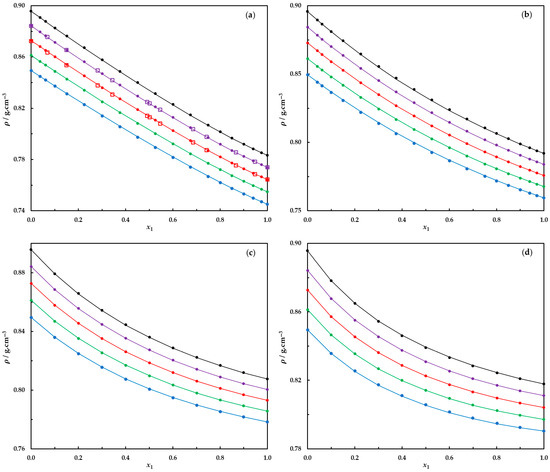
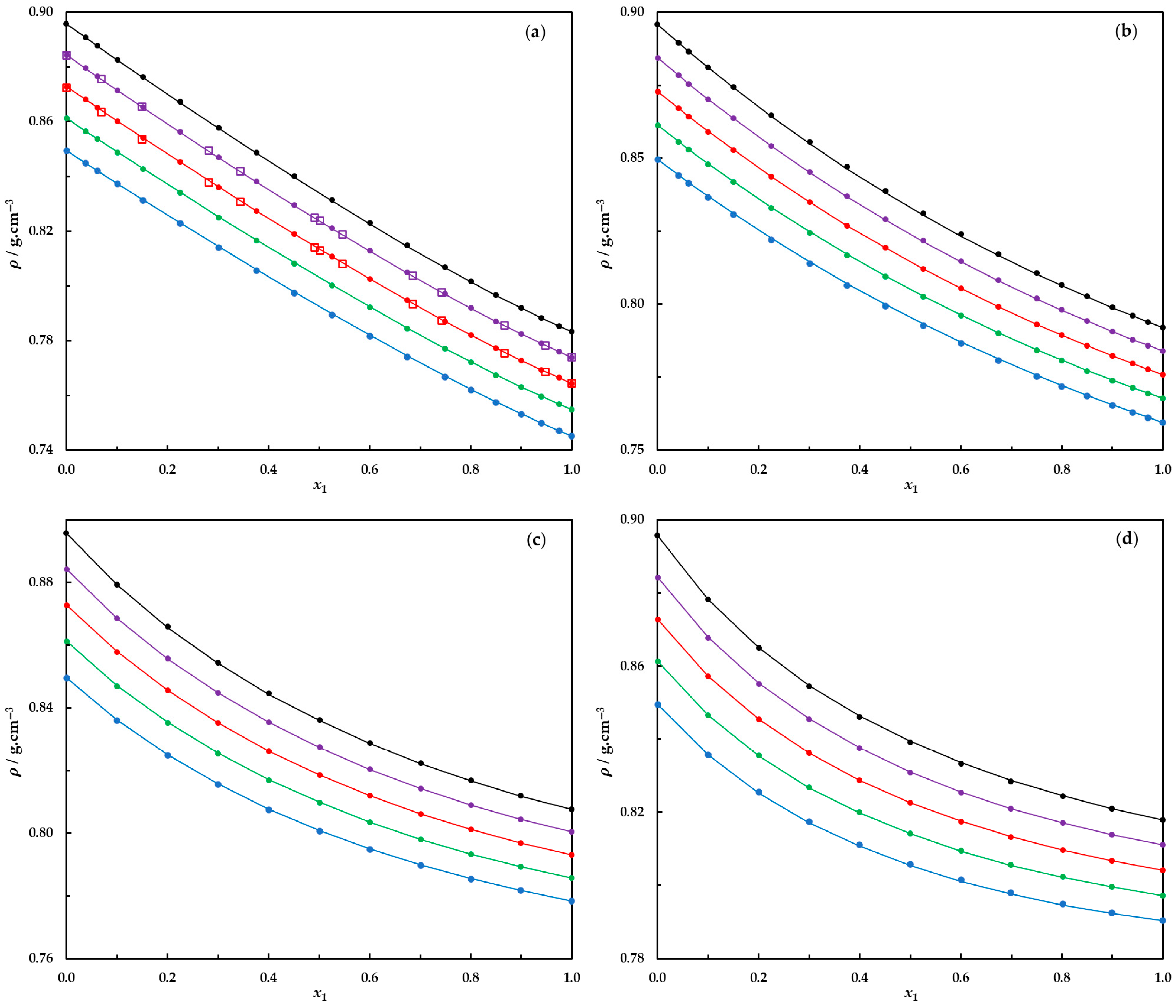
An overview of the experimental density data is given in Figure 1 for four binary systems studied in this work.
Figure 1.
Experimental and calculated densities for four binary systems: (a) C6 (1) + EP (2), (b) ethylC6 (1) + EP (2), (c) pentylC6 (1) + EP (2), (d) octylC6 (1) + EP (2). ●: experimental data from this work at 288.15 K, 298.15 K, 308.15 K, 318.15 K, 328.15 K. □: literature data from [17]. Solid curves: calculated densities using the Jouyban–Acree model with parameters reported in Table 3.
For the binary system C6 + EP, Figure 1 shows a good agreement between mixtures densities measured in this work and those reported in the literature [17].
The studied liquid mixtures present an important common behavior: curves (as plotted in Figure 1) are convex functions across all temperatures investigated. For such systems, the mixing process thus led to a volume expansion originating from the repulsive forces between EP and naphthenic molecules. As a consequence, all the binary systems present positive excess molar volumes, as discussed in the next section.
The volumetric behavior of the mixtures is well-described by the Jouyban–Acree model. The pertinent parameters are provided in Table 3 for each binary system. The low average relative deviations confirm the excellent agreement between experimental and calculated values. These parameters can confidently be used to predict the density of the studied binaries at any temperature between 288.15 and 328.15 K, over the entire composition range.
Table 3.
Jouyban–Acree model parameters for the density prediction, (in g·cm−3), of 9 binary systems from 288.15 K to 328.15 K *.
3.2. Excess Molar Volumes Derived from the Mixture’s Density Measurements
The mixture density data were used to calculate excess molar volumes, , using Equation (6)
in which , and , are the pure compounds molar masses and densities, respectively, while is the mixture density and and are the mole fractions of components 1 and 2.
To identify potential experimental errors and to ascertain the quality of the primary data, was systematically plotted against as this function is well-suited to detect outliers [40,41]. If outliers were detected, generally at the dilute ends, a new mixture of comparable composition was prepared and measured to eliminate doubtful data.
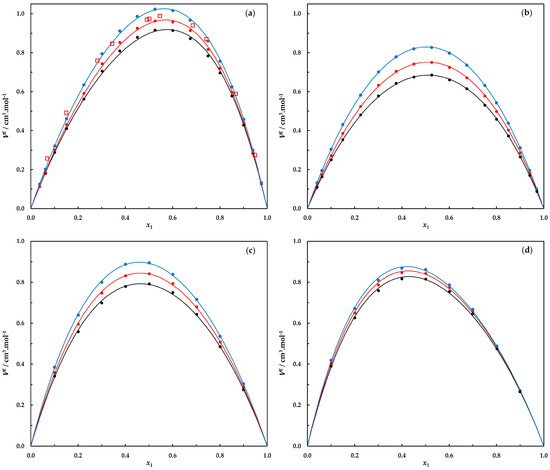
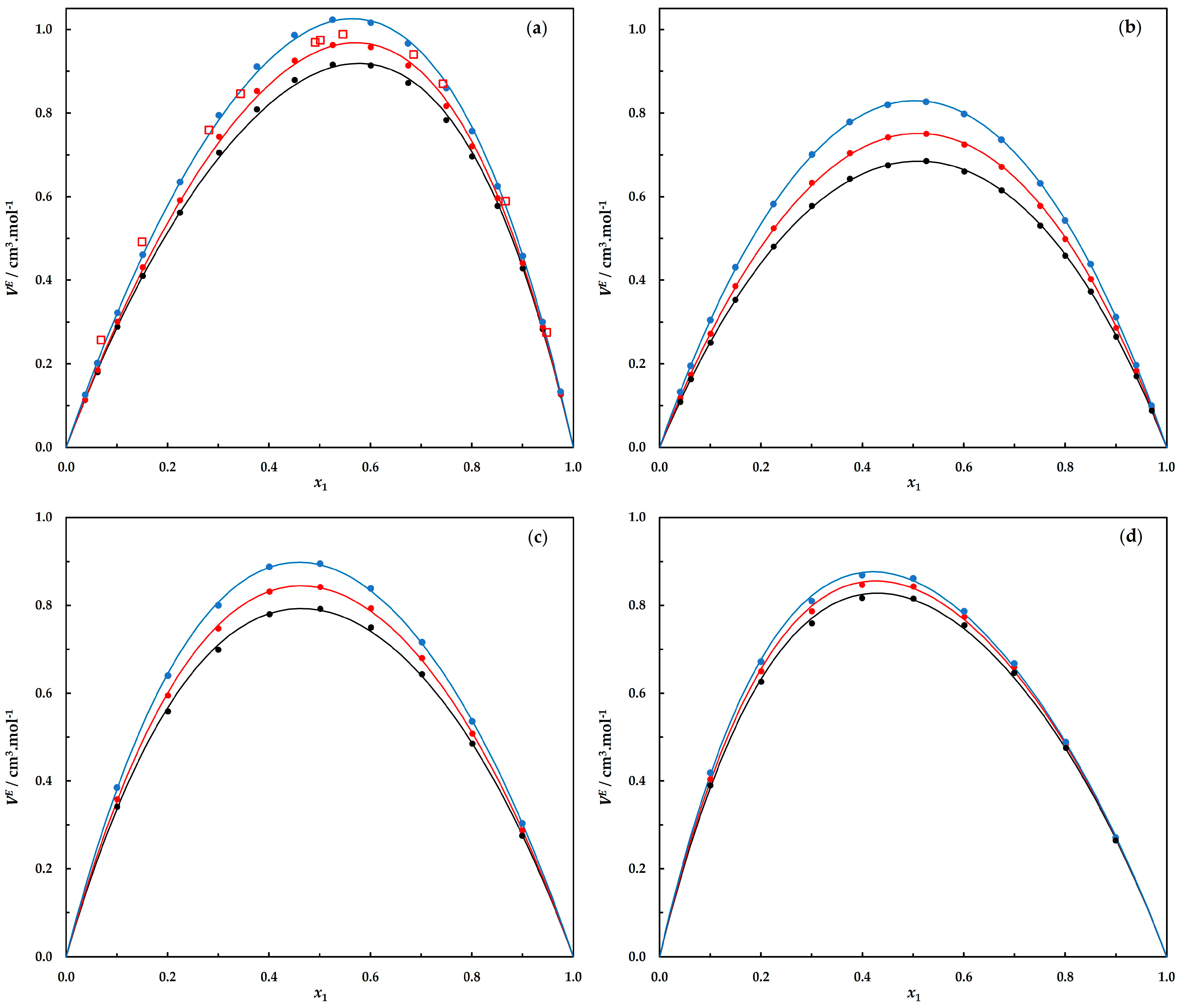
The excess molar volumes obtained from the density measurements are reported in Appendix A, Table A1, Table A2, Table A3, Table A4, Table A5, Table A6, Table A7, Table A8 and Table A9, for all the studied binary systems and are plotted for 4 binary systems in Figure 2. For clarity, only three isotherms (288.15 K, 308.15 K and 328.15 K) are represented for each binary system in this figure.
Figure 2.
Excess molar volumes for four binary systems: (a) C6 (1) + EP (2), (b) ethylC6 (1) + EP (2), (c) pentylC6 (1) + EP (2), (d) octylC6 (1) + EP (2). ●: this work at 288.15 K, 308.15 K, 328.15 K. □: literature data from [17]. Solid curves: Redlich–Kister correlation with parameters reported in Table A10.
As expected, all the investigated systems exhibit positive excess molar volumes, as a result of the repulsive forces prevailing within these mixtures. Among the nine binary systems investigated, the C6 + EP system shows the highest excess molar volumes. The presence of a branching on the naphthenic ring therefore appears to mitigate the expansive effects of the mixtures.
The effects of temperature and alkyl chain length on the behavior of the mixtures is discussed in the following section.
In all cases, the Redlich–Kister correlation led to precise correlations of the experimental excess molar volumes. The pertinent coefficients, regressed against experimental data, are listed in Table A10.
4. Discussion
4.1. Influence of Alkyl Chain Length on the Excess Molar Volumes
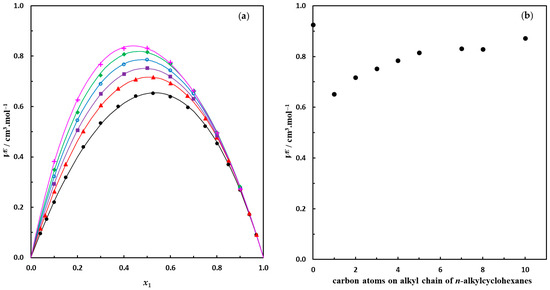
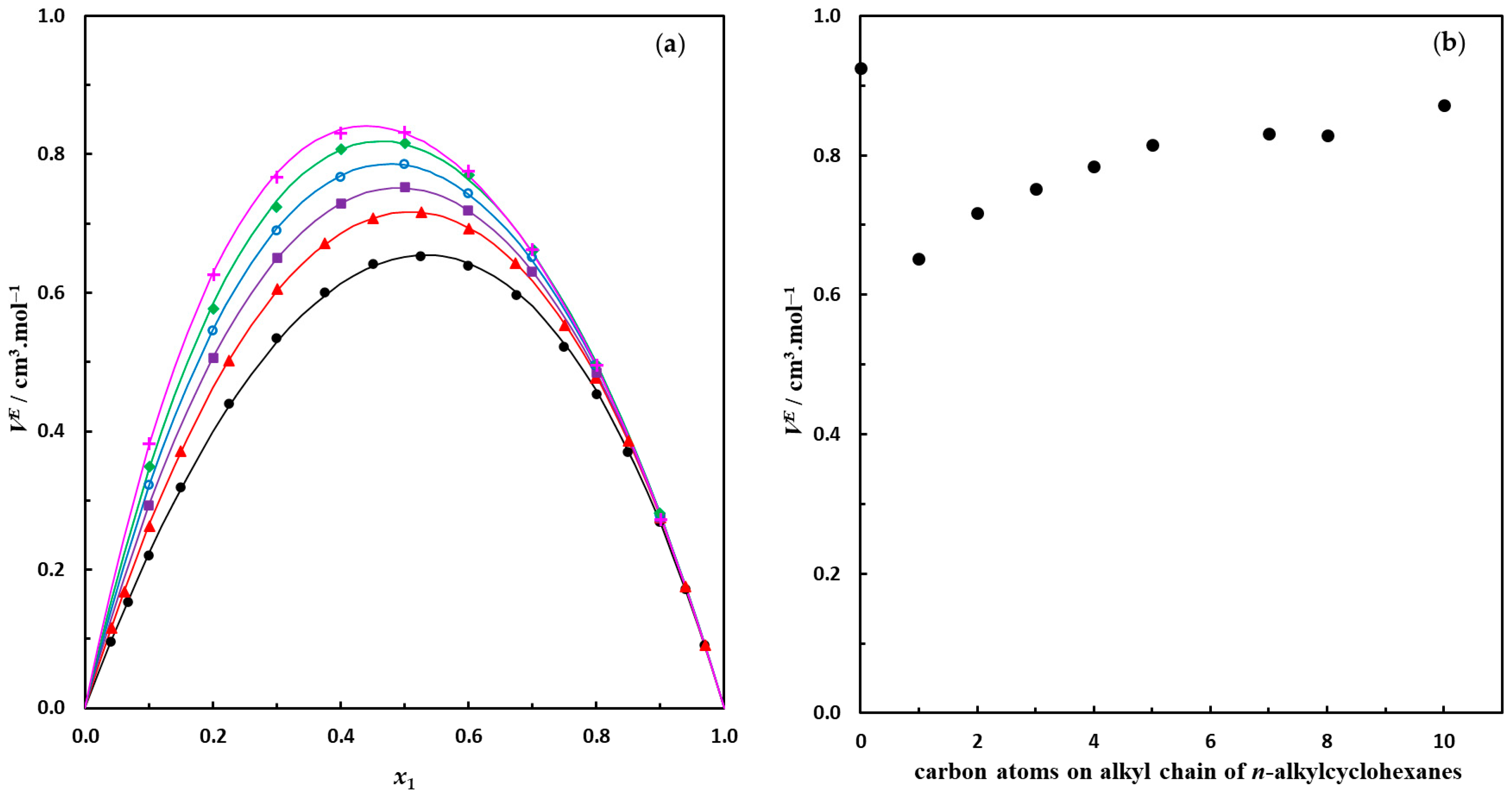
As illustrated in Figure 3, the volumetric behavior of the mixtures is notably impacted by the length of the alkyl chain on the cyclohexane ring.
Figure 3.
(a) Excess molar volumes at 298.15 K for 6 binary systems studied in this work. ●: methylC6 + EP, ▲: ethylC6 + EP, ■: propylC6 + EP, ○: butylC6 + EP, ♦: pentylC6 + EP, +: hepthylC6 + EP. (b) Comparison of excess molar volumes at 298.15 K of equimolar mixtures of alkylcyclohexane + ethyl propanoate.
Excess molar volumes increase as the alkyl chain increases. A similar trend has previously been observed for short-chain esters + linear alkanes binary mixtures [1,2,3,4]. In this study, is about 0.65 cm3·mol−1 for methylC6 + EP (for an equimolar mixture, at 298.15 K) but reaches roughly 0.83 cm3·mol−1 for heptylC6 + EP. Increasing the alkyl chain length appears to reduce the packing efficiency of the mixture. However, this phenomenon seems to reach a plateau for alkylcyclohexanes longer than pentylC6.
4.2. Influence of Temperature on the Excess Molar Volumes
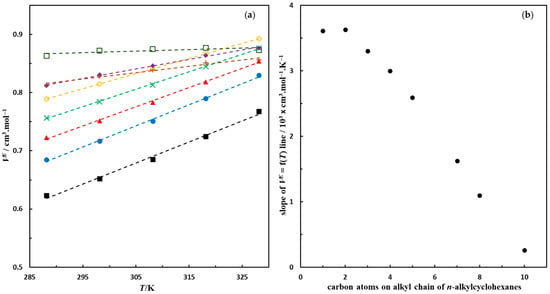
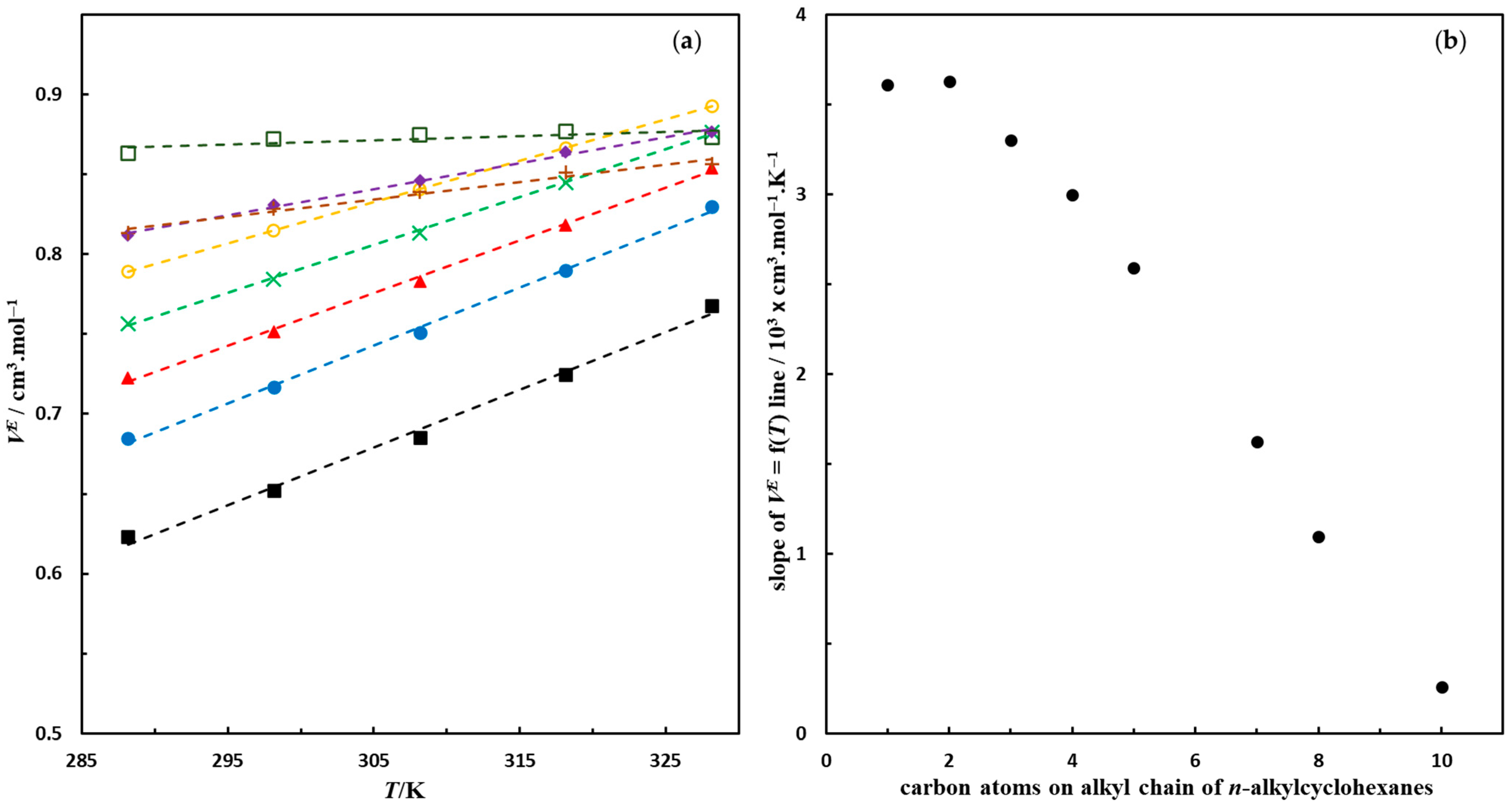
Figure 4 shows the temperature dependance of . A linear dependance was found and the excess molar volumes increase as the temperature increases but the influence of temperature becomes less and less pronounced as the alkyl chain length increases.
Figure 4.
(a) Excess molar volumes for equimolar mixtures alkylcyclohexane + EP as a function of temperature. ■: methylC6 + EP, ●: ethylC6 + EP, ▲: propylC6 + EP, ×: butylC6 + EP, ○: pentylC6 + EP, ♦: hepthylC6 + EP, +: octylC6 + EP, □: decylC6 + EP. Dashed lines: linear fits. (b) Variation in the slopes of the linear functions between equimolar excess molar volumes and temperatures.
For the methylC6 + EP mixture, the equimolar excess molar volume increases by more than 20% from 288 K to 328 K whereas it remains nearly constant in the investigated temperature range for the system decylC6 + EP. This behavior suggests that the increase in kinetic energy of the molecules significantly affects interstitial accommodation for mixtures with shorter-chain alkylcyclohexanes, while this effect is mitigated as the alkyl chain length increases.
There are several possible reasons for the experimental observations reported in this study. The volumetric behavior of a mixture arises from multiple interrelated phenomena, so these results should be interpreted carefully. The assumptions made in this study could be refined using advanced solution theories, but this was not the focus of the study.
4.3. Performance Analysis of Models
A Redlich–Kister approach and the Jouyban–Acree model were used to correlate the excess molar volumes determined in this work. The Redlich–Kister approach provides the best description of the excess molar volumes (see Table A10) with a standard deviation of 0.005 between experimental and calculated excess molar volumes (average value across all datasets). This is expected since the Redlich–Kister parameters were directly regressed against the experimental excess molar volumes.
The results obtained using the Jouyban–Acree model (average standard deviation of 0.016) are quite satisfactory given that this model uses a single set of parameters per binary system. Even if the temperature dependence of the excess molar volumes is not very well-described, the Jouyban–Acree model accurately reflects the order of magnitude of the excess molar volumes for all the studied mixtures.
Supplementary Materials
The following supporting information can be downloaded at: https://www.mdpi.com/article/10.3390/liquids6020015/s1, Figure S1: Comparison between excess molar volumes (VE) and VE/x1x2 plots obtained from this work and literature values [1,42] for the binary system ethyl propanoate (1) + n-heptane (2), from 288.15 K to 318.15 K. Black points: this work. Red triangles: data from [1]. Red squares: data from [42]. Curves simply join the points to guide eye.; Table S1: Description of the pure components employed in this work; Table S2: Experimental densities (ρ) and Excess molar volumes (VE) of ethyl propanoate (1) + n-heptane (2) system at mole fraction x1 in ethyl propanoate at temperature T and P = 101 kPa.
Author Contributions
Conceptualization, S.V.; methodology, V.C. and S.V.; software, K.A.A.; investigation, V.C. and K.A.A.; resources, S.V.; data curation, S.V.; writing—original draft preparation, S.V., V.C. and K.A.A.; writing—review and editing, S.V., V.C. and K.A.A.; supervision, S.V. All authors have read and agreed to the published version of the manuscript.
Funding
This research received no external funding.
Data Availability Statement
Data provided within the article.
Conflicts of Interest
The authors declare no conflicts of interest.
Appendix A
Table A1.
Experimental densities (ρ) and excess molar volumes () of cyclohexane (1) + ethyl propanoate (2) system at mole fraction in cyclohexane at temperature T and P = 101 kPa *.
Table A2.
Experimental densities (ρ) and excess molar volumes () of methylcyclohexane (1) + ethyl propanoate (2) system at mole fraction in methylcyclohexane at temperature T and P = 101 kPa *.
Table A3.
Experimental densities (ρ) and excess molar volumes () of ethylcyclohexane (1) + ethyl propanoate (2) system at mole fraction in ethylcyclohexane at temperature T and P = 101 kPa *.
Table A4.
Experimental densities (ρ) and excess molar volumes () of propylcyclohexane (1) + ethyl propanoate (2) system at mole fraction in propylcyclohexane at temperature T and P = 101 kPa *.
Table A5.
Experimental densities (ρ) and excess molar volumes () of butylcyclohexane (1) + ethyl propanoate (2) system at mole fraction in butylcyclohexane at temperature T and P = 101 kPa *.
Table A6.
Experimental densities (ρ) and excess molar volumes () of pentylcyclohexane (1) + ethyl propanoate (2) system at mole fraction in pentylcyclohexane at temperature T and P = 101 kPa *.
Table A7.
Experimental densities (ρ) and excess molar volumes () of heptylcyclohexane (1) + ethyl propanoate (2) system at mole fraction in heptylcyclohexane at temperature T and P = 101 kPa *.
Table A8.
Experimental densities (ρ) and excess molar volumes () of octylcyclohexane (1) + ethyl propanoate (2) system at mole fraction in octylcyclohexane at temperature T and P = 101 kPa *.
Table A9.
Experimental densities (ρ) and excess molar volumes () of decylcyclohexane (1) + ethyl propanoate (2) system at mole fraction in decylcyclohexane at temperature T and P = 101 kPa *.
Table A10.
Redlich–Kister coefficients * (Equation (5)) for the correlation of the excess molar volumes for nine binary systems studied in this work and Jouyban–Acree model’s performance in excess molar volumes prediction.
References
- Rios, R.; Ortega, J.; Fernandez, L.; de Nuez, I.; Wisniak, J. Improvements in the experimentation and the representation of thermodynamic properties (iso-p VLE and yE) of alkyl propanoate + alkane binaries. J. Chem. Eng. Data 2014, 59, 125–142. [Google Scholar] [CrossRef] [Scilit]
- Fernández, L.; Pérez, E.; Ortega, J.; Canosa, J.; Wisniak, J. Measurements of the Excess Properties and Vapor-Liquid Equilibria at 101.32 kPa for mixtures of Ethyl Ethanoate + Alkanes (from C5 et C10). J. Chem. Eng. Data 2010, 55, 5519–5533. [Google Scholar] [CrossRef] [Scilit]
- Fernández, L.; Ortega, J.; Pérez, E.; Toledo, F.; Canosa, J. Multiproperty Correlation of Experimental Data of the Binaries Propyl Ethanoate + Alkanes (Pentane to Decane). New Experimental Information for Vapor-Liquid Equilibrium and Mixing Properties. J. Chem. Eng. Data 2013, 58, 686–706. [Google Scholar] [CrossRef] [Scilit]
- Pérez, E.; Ortega, J.; Fernández, L.; Wisniak, J.; Canosa, J. Contributions to the modeling and behavior of solutions containing ethanoates and hydrocarbons. New experimental data for binaries of butyl ester with alkanes (C5-C10). Fluid Phase Equilib. 2016, 412, 79–93. [Google Scholar] [CrossRef] [Scilit]
- Vitu, S.; Berkalou, K.; Havet, J.L.; Caqueret, V. The 2,2,4-trimethylpentane + ethyl propanoate binary system: Density, Bancroft point and vapor-liquid equilibrium at 30, 60 and 101.3 kPa. J. Chem. Thermodyn. 2025, 207, 107486. [Google Scholar] [CrossRef] [Scilit]
- Ortega, J.; Fernández, L.; Sosa, A.; Lorenzo, B.; Ríos, R.; Wisniak, J. New Advances in the Modeling and Verification of Experimental Information for Ester-Alkane Solutions: Application to a Batch-Distillation Case. Ind. Eng. Chem. Res. 2020, 59, 8346–8360. [Google Scholar] [CrossRef] [Scilit]
- Rios, R.; Ortega, J.; Sosa, A.; Fernández, L. Strategy for the Management of Thermodynamic Data with Application to Practical Cases of Systems Formed by Esters and Alkanes through Experimental Information, Checking-Modeling, and Simulation. Ind. Eng. Chem. Res. 2018, 57, 3410–3429. [Google Scholar] [CrossRef] [Scilit]
- Susial Badajoz, P.; García-Vera, D.; Marrero-Pérez, A.; Padrón-Guerra, N.; Mujica-González, T. Measurement of VLE Data by Using an Experimental Installation with Automatic Control: Modeling of Binary Systems of Methyl Acetate or Ethyl Acetate with n-Heptane or 2,2,4-Trimethylpentane at Both 0.1 and 1.5 MPa. J. Chem. Eng. Data 2019, 64, 5591–5608. [Google Scholar] [CrossRef] [Scilit]
- Ortega, J.; Toledo-Marante, F.J. Thermodynamic properties of (an ethyl ester + a branched alkane). XV. HEm and VEm values for (an ester + an alkane). J. Chem. Thermodyn. 2002, 34, 1439–1459. [Google Scholar] [CrossRef] [Scilit]
- Caqueret, V.; Berkalou, K.; Havet, J.-L.; Debacq, M.; Vitu, S. Density, Excess Molar Volume and Vapor–Liquid Equilibrium Measurements at 101.3 kPa for Binary Mixtures Containing Ethyl Acetate and a Branched Alkane: Experimental Data and Modeling. Liquids 2023, 3, 187–202. [Google Scholar] [CrossRef] [Scilit]
- Linek, J. Excess Volumes of Binary Liquid Mixtures Containing Ethers, Alcohols, Esters, or Alkanes. ELDATA Int. Electron. J. Phys.-Chem. Data 1995, 1, 43–52. [Google Scholar]
- Rajasekhar, P.; Reddy, K.S. Excess Volumes of Methylcyclohexane with Ketones and Esters at 303.15 K. Phys. Chem. Liq. 1987, 17, 195–200. [Google Scholar] [CrossRef] [Scilit]
- Berkalou, K.; Caqueret, V.; Zanghelini, G.; Vitu, S. Thermodynamic Behavior of the (Methylcyclopentane + Ethyl Acetate) Binary Liquid Mixture: Density at Several Temperatures and Vapor–Liquid Equilibrium at 25, 50, and 101.3 kPa. J. Chem. Eng. Data 2024, 69, 1655–1667. [Google Scholar] [CrossRef] [Scilit]
- Krasniqi, R.; Aliaj, F.; Syla, N.; Musliu, A.; Zeqiraj, A. Thermophysical Properties of Binary and Ternary Mixtures Comprising Methyl Acetate, n-Hexane, and Cyclohexane: Experimental and Modeling Approach. Int. J. Thermophys. 2025, 46, 100. [Google Scholar] [CrossRef] [Scilit]
- Qin, A.; Hoffman, D.E.; Munk, P. Excess volumes of mixtures of alkanes with carbonyl compounds. J. Chem. Eng. Data 1992, 37, 55–61. [Google Scholar] [CrossRef] [Scilit]
- Jimenez, E.; Romani, L.; Andrade, M.I.P.; Roux-Desgranges, G.; Grolier, J.P. Molar excess heat capacities and volumes for mixtures of alkanoates with cyclohexane at 25 °C. J. Solut. Chem. 1986, 15, 879–890. [Google Scholar] [CrossRef] [Scilit]
- Sastry, N.V.; Patel, S.R.; Soni, S.S. Excess molar volumes, excess isentropic compressibilities, excess viscosities, relative permittivity and molar polarization deviations for methyl acetate+, ethyl acetate+, butyl acetate+, isoamyl acetate+, methyl propionate+, ethyl propionate+, ethyl butyrate+, methyl methacrylate+, ethyl methacrylate+, and butyl methacrylate + cyclohexane at T = 298.15 and 303.15 K. J. Mol. Liq. 2013, 183, 102–112. [Google Scholar] [CrossRef] [Scilit]
- Elliott, J.R.; Diky, V.; Knotts, T., IV; Wilding, W.V. The Properties of Gases and Liquids, 6th ed.; McGraw Hill: New York, NY, USA, 2023; pp. 11–33. [Google Scholar]
- Malhotra, R.; Woolf, L.A. PVT Property Measurements for the Liquids Ethyl Propionate and Ethyl Butyrate from (278 to 338) K and (0.1 to 380) MPa. J. Chem. Eng. Data 1996, 41, 1371–1374. [Google Scholar] [CrossRef] [Scilit]
- Liu, C.Y.; Ku, H.C.; Tu, C.H. Densities and Viscosities of Five Alkyl Esters with Nitroethane Systems at (293.15, 303.15, and 313.15) K. J. Chem. Eng. Data 1999, 44, 360–364. [Google Scholar] [CrossRef] [Scilit]
- Costa, H.F.; Gardas, R.L.; Johnson, I.; Fonseca, I.M.A.; Ferreira, A.G.M. PVT Property Measurements for Ethyl Propionate, Ethyl Butyrate, and Ethyl Pentanoate Esters from (298 to 393) K and up to 35 MPa. J. Chem. Eng. Data 2009, 54, 256–262. [Google Scholar] [CrossRef] [Scilit]
- Panduranga Rao, J.; Narendra, K.; Visalakshamma, V.; Krishna, T.S.; Srinivasa Rao, G. Acoustic and volumetric study of binary mixtures containing Ethyl propionate with amides at various temperatures. J. Chem. Thermodyn. 2024, 190, 107222. [Google Scholar] [CrossRef] [Scilit]
- Luning Prak, D.J. Binary Mixtures of Benzene and Cyclohexane with n-Alkyl Functional Groups up to 12 Carbons Long: Densities, Viscosities, and Speeds of Sound within the Temperature Range (288.15–333.15) K. J. Chem. Eng. Data 2022, 67, 1378–1396. [Google Scholar] [CrossRef] [Scilit]
- Kolska, Z.; Dvorakova, D.; Mika, J.; Boublik, T. Volumetric behavior of the binary systems benzene–cyclohexane and benzene–2,2,4-trimethyl-pentane at temperatures 293.15–323.15 K. Fluid Phase Equilib. 2011, 303, 157–161. [Google Scholar] [CrossRef] [Scilit]
- Malek, N.I.; Ijardar, S.P.; Oswal, S.B. Volumetric and acoustic properties of binary mixtures of cyclohexane + benzene and + benzaldehyde at (293.15–323.15) K. Thermochim. Acta 2012, 539, 71–83. [Google Scholar] [CrossRef] [Scilit]
- Hiroyuki, O. Excess volumes of (1-pentanol + cyclohexane or benzene) at temperatures between 283.15 K and 328.15 K. J. Chem. Thermodyn. 2002, 34, 849–859. [Google Scholar] [CrossRef] [Scilit]
- Luning Prak, D.J. Binary Mixtures of n-Tridecane with n-Alkylcyclohexanes: Density, Viscosity, and Speed of Sound within the Temperature Range (288.15 to 333.15) K. J. Chem. Eng. Data 2023, 68, 1053–1066. [Google Scholar] [CrossRef] [Scilit]
- Laesecke, A.; Outcalt, S.L.; Brumback, K.J. Binary Mixtures of n-Tridecane with n-Alkylcyclohexanes: Density and Speed of Sound Measurements of Methyl- and Propylcyclohexane. Energy Fuels 2008, 22, 2629–2636. [Google Scholar] [CrossRef] [Scilit]
- Zhao, J.; Wu, J.; Dai, Y.; Cheng, X.; Sun, H.; Guo, Y.; Fang, W. Density, Viscosity, and Freezing Point for Four Binary Systems of n-Dodecane or Methylcyclohexane Mixed with 1-Heptanol or Cyclohexylmethanol. J. Chem. Eng. Data 2017, 62, 643–652. [Google Scholar] [CrossRef] [Scilit]
- Zhang, C.; Li, G.; Yue, L.; Guo, Y.; Fang, W. Densities, Viscosities, Refractive Indices, and Surface Tensions of Binary Mixtures of 2,2,4-Trimethylpentane with Several Alkylated Cyclohexanes from (293.15 to 343.15) K. J. Chem. Eng. Data 2015, 60, 2541–2548. [Google Scholar] [CrossRef] [Scilit]
- Van Hecke, G.R.; Baldwin, O.W.M.; Wada, B.C. Density, Viscosity, Refractive Index, Isobaric Specific Heat Capacity, Ultrasonic Velocity, Molar Volume, Isentropic Compressibility, Isothermal Compressibility, and Heat Capacity Ratio for Binary Mixtures of the Organic Liquids Ethylbenzene, Ethylcyclohexane, Pentylbenzene, and Pentylcyclohexane at 298.15 K and 0.1 MPa. J. Chem. Eng. Data 2022, 67, 1037–1053. [Google Scholar] [CrossRef] [Scilit]
- Li, D.; Zheng, Y.; Wang, J.; Pang, Y.; Liu, M. Volumetric properties and viscosity for the ternary system of (1-pentanol+ethylcyclohexane+methylmyristate) and corresponding binary systems at T=293.15-323.15K. J. Chem. Thermodyn. 2022, 165, 106660. [Google Scholar] [CrossRef] [Scilit]
- Luning Prak, D.J.; Morrow, B.H.; Cowart, J.S.; Trulove, P.C.; Harrison, J.A. Thermophysical Properties of Binary Mixtures of n-Dodecane with n-Alkylcyclohexanes: Experimental Measurements and Molecular Dynamics Simulations. J. Chem. Eng. Data 2019, 64, 1550–1568. [Google Scholar] [CrossRef] [Scilit]
- Daridon, J.L.; Plantier, F.; Lagourette, B. Speed of Sound and Some Thermodynamic Properties of Liquid Methylcyclopentane and Butylcyclohexane in a Wide Range of Pressure. Int. J. Thermophys. 2003, 24, 639–649. [Google Scholar] [CrossRef] [Scilit]
- Baylaucq, A.; Zéberg-Mikkelsen, C.K.; Daugé, P.; Boned, C. Dynamic Viscosity and Density of Heptylbenzene and Heptylcyclohexane up to 100 MPa. J. Chem. Eng. Data 2002, 47, 997–1002. [Google Scholar] [CrossRef] [Scilit]
- Luning Prak, D.J. Binary Mixtures of Nonane and n-Alkylcyclohexanes: Densities and Speeds of Sound within the Temperature Range (288.15–333.15) K and Viscosities at 288.15, 293.15, and 298.15 K and 0.1 MPa. J. Chem. Eng. Data 2024, 69, 973–986. [Google Scholar] [CrossRef] [Scilit]
- Camin, D.L.; Forziati, A.F.; Rossini, F.D. Physical Properties of n-Hexadecane, n-Decylcyclopentane, n-Decylcyclohexane, 1-Hexadecene and n-Decylbenzene. J. Phys. Chem. 1954, 58, 440–442. [Google Scholar] [CrossRef] [Scilit]
- Jouyban, A.; Acree, W.E., Jr. A single model to represent physico-chemical properties of liquid mixtures at various temperatures. J. Mol. Liq. 2021, 323, 115054. [Google Scholar] [CrossRef] [Scilit]
- Muñoz, M.M.; Tinjacá, D.A.; Jouyban, A.; Martínez, F.; Acree, W.E., Jr. Volumetric properties of {PEG 200 (or 300) (1) + water (2)} mixtures at several temperatures and correlation with the Jouyban–Acree model. Phys. Chem. Liq. 2018, 56, 100–109. [Google Scholar] [CrossRef] [Scilit]
- Peralta, R.D.; Infante, R.; Cortez, G.; Ramirez, R.R.; Wisniak, J. Densities and excess volumes of binary mixtures of 1,4-dioxane with either ethyl acrylate, or butyl acrylate, or methyl methacrylate, or styrene at T = 298.15 K. J. Chem. Thermodyn. 2003, 35, 239–250. [Google Scholar] [CrossRef] [Scilit]
- Wisniak, J.; Peralta, R.D.; Infante, R.; Cortez, G. Volumetric Properties of the Ternary System 1,4-Dioxane + Butyl Acrylate + Ethyl Acrylate and Its Binary Butyl Acrylate + Ethyl Acrylate at 298.15 K. J. Solut. Chem. 2005, 34, 171–183. [Google Scholar] [CrossRef] [Scilit]
- Ortega, J.; Espiau, F.; Toledo, F.J.; Dieppa, R. Thermodynamic properties of (an ester + an alkane). XVII. Experimental Hem and Vem values for (an alkyl propanoate + an alkane) at 318.15 K. J. Chem. Thermodyn. 2005, 37, 967–983. [Google Scholar] [CrossRef] [Scilit]

Disclaimer/Publisher’s Note: The statements, opinions and data contained in all publications are solely those of the individual author(s) and contributor(s) and not of MDPI and/or the editor(s). MDPI and/or the editor(s) disclaim responsibility for any injury to people or property resulting from any ideas, methods, instructions or products referred to in the content. |
© 2026 by the authors. Licensee MDPI, Basel, Switzerland. This article is an open access article distributed under the terms and conditions of the Creative Commons Attribution (CC BY) license.